How Fiction Works, and how this review doesn’t

I keep citing James Wood’s How Fiction Works without writing about it directly because the book feels so whole that it lacks the typical cracks that offer handholds. It asks the right questions and, inevitably, can only offer partial answers, but those answers are far more illuminating than almost anyone else’s, and its contents are encapsulated by the epigraph: ‘There is only one recipe – to care a great deal for the cookery.’ Henry James said, and James Wood lives it.

For reasons opaque to me this book hasn’t come out in the United States yet and won’t in July, yet it seemed essential enough to buy it from the U.K., and now I perceive that decision as a wise one. How Fiction Works joins good company stretching back at least to E.M. Forster’s Aspects of the Novel, which is addressed, and it goes beyond that—the book is part how-to, part criticism, part literary theory, and part history, and all the whole is greater than their sum, offering much to almost every reader. If that weren’t enough, it also comes with potential reading list—for example, the affection Wood, along with Jane Smiley and others, shows toward Henry Green makes me realize I should read him. Some writers—like Dawn Powell and William Maxwell—seem destined to be remembered only by other writers, their secrets moving through the years with only thin strands connecting them from person to person, forgotten by teachers, academics, and other keepers of the past. I wish I had more than two short paragraphs to say, but this is the rare book that I can only recommend you read, and then perhaps you will understand why. The reviews I’ve seen so far—representative samples are here and here, though this is better—so miss their target, or at least so fail to really engage it, that I hesitate to add to clamor, rather than music. The critic whose writing is consistently music instead of bombast is too rare, and consequently, I encourage you to listen.

How Fiction Works, and how this review doesn't

I keep citing James Wood’s How Fiction Works without writing about it directly because the book feels so whole that it lacks the typical cracks that offer handholds. It asks the right questions and, inevitably, can only offer partial answers, but those answers are far more illuminating than almost anyone else’s, and its contents are encapsulated by the epigraph: ‘There is only one recipe – to care a great deal for the cookery.’ Henry James said, and James Wood lives it.

For reasons opaque to me this book hasn’t come out in the United States yet and won’t in July, yet it seemed essential enough to buy it from the U.K., and now I perceive that decision as a wise one. How Fiction Works joins good company stretching back at least to E.M. Forster’s Aspects of the Novel, which is addressed, and it goes beyond that—the book is part how-to, part criticism, part literary theory, and part history, and all the whole is greater than their sum, offering much to almost every reader. If that weren’t enough, it also comes with potential reading list—for example, the affection Wood, along with Jane Smiley and others, shows toward Henry Green makes me realize I should read him. Some writers—like Dawn Powell and William Maxwell—seem destined to be remembered only by other writers, their secrets moving through the years with only thin strands connecting them from person to person, forgotten by teachers, academics, and other keepers of the past. I wish I had more than two short paragraphs to say, but this is the rare book that I can only recommend you read, and then perhaps you will understand why. The reviews I’ve seen so far—representative samples are here and here, though this is better—so miss their target, or at least so fail to really engage it, that I hesitate to add to clamor, rather than music. The critic whose writing is consistently music instead of bombast is too rare, and consequently, I encourage you to listen.

J.K. Rowling, sexism, and literary merit

Colleen Lindsay’s The Swivet is worth reading, and from it comes an article about women in science fiction and fantasy that uses Harry Potter as a launching pad to argue that sexism animates some attacks on Harry Potter and female science fiction and fantasy authors more generally. I don’t think it motivates Bloom’s criticism of Harry Potter, and it certainly doesn’t motivate mine. The first two novels, which I read, weren’t all very good because they were cliché-laden and deprived of magic sentences. Why they’re so much more popular than the rest of the voluminous fantasy pile is unclear, and I attribute it to the vagaries and mysteries of books and place. Alas, some attackers of Rowling are fools, like at least one Harvard student:

Writing in the university paper, the Harvard Crimson, student Adam Goldenberg rips into Rowling as “a flash in the pan”, “a petty pop culture personality” who “tricked parents into letting their kids read books filled with sex, murder, and homosexual role models”. Furthermore, “writing bedtime stories is lame”.

One can, however, reach the right conclusion—that Harry Potter isn’t very good—using faulty reasoning, and just because someone uses faulty reasoning doesn’t mean their conclusion is incorrect in and of itself. If the article wanted to make a larger point not by citing Harry Potter, but one of the less-known female fantasy writers it deals with in the fourth paragraph—none of whom I know well enough to comment on.

I suppose that, being male, my argument could somehow be latent sexism emerging, though it seems unlikely given that one of the greatest fantasy, science, and speculative fiction writers of all time is Ursula K. Le Guin, who I used as an example of one of the few transcendent science fiction writers. Jane Smiley is one of my favorite modern writers—her work is uneven, but Moo and A Thousand Acres are excellent—and Flannery O’Connor’s short stories and novellas are masterpieces. Perhaps the “subtle mechanism” described only applies to fantasy and science fiction, but even there I’m not sure it’s truly at work, and separating where the many legitimate attacks on Rowling end and the possible sexism begins isn’t an easy task. Because there are so many legitimate attacks to be made, I’m not sure it can be done save through critics aren’t all that serious in the first place.

As long Rowling is in the air, I will give her credit for her commencement speech at Harvard, which has gotten a tremendous amount of deserved attention in blogs and the media: it’s funny and deep, while the temptation to keep throwing on positive adjectives is difficult to resist. I only wish Harry Potter had been up to the standards of that speech, in which case this post wouldn’t have been written.

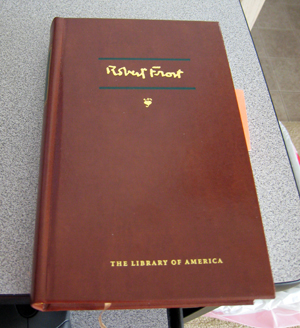
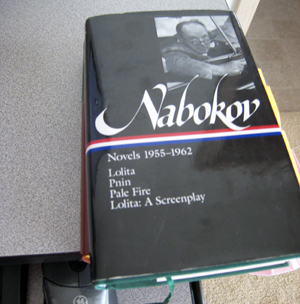
Mid-June links: The Library of America and the book as an object

* John Lanchester writes that he finds it hard to read those gorgeous Library of American volumes.

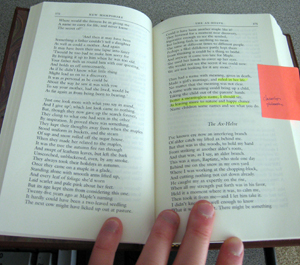
No such compulsion here! While I understand his feeling, I highlight when the need arises:

That’s one way of ensuring that the books exist to be read, not fetishized. Lanchester says, “A paperback is a paperback; the collected writings of a writer, any writer, have the air of belonging to Culture in the abstract. That’s off-putting.” I agree: responding to the author in the book itself is one way of ameliorating that problem.

Sometimes I write a fair amount, as in Lolita:

Screw resale value. Then again, Amazon knocks about a third off the price, and the Library of America had a fire sale (haha) of Frost, perhaps explaining part of my cavalier attitude.

EDIT 6/18/08: Gabriel Zaid’s So Many Books explains more about books as monuments than I do here.

* Kingsley Amis’ fairly extensive writing about alcohol has now been published in a single volume called Everyday Drinking, as the New York Times reports.

“Serving good drinks,” he wrote, “like producing anything worth while, from a poem to a motor-car, is troublesome and expensive.”

And, as with good food or good writing, good drinks are best prepared for those who will appreciate them.

Although I’m tempted to buy Everyday Drinking, I’m afraid I’ve already laden myself with enough contrarian books, ranging from The Joy of Drinking to The Book of Vice. In addition, despite my apparent dedication to such topics, I feel that drinking is better experienced in person than through the medium of literature, even if reflection deepens the experience once sufficient experience has been had.

Transpose those thoughts to other endeavors at your own peril.

* Nigel Beale writes about “How to re-establish evaluative criticism as central to the academic study of literature.” Since I’m about to start graduate school in English, it’s a topic near to my mind. What he doesn’t mention, however, is that evaluative criticism does exist to a greater extent than he gives it credit for, and it even has its own place in English departments—just under the heading “creative writing,” and “MFA,” rather than in the usual classes.

* Nigel Beale part deux—he says a good book needs:

1) to find and revel in funny, beautiful, thought-provoking phrases, 2) dwell on profound paragraphs that contain useful truths about life and human nature, 3) lose myself in the lives of exceptional characters.

They correspond roughly to professionalism and aesthetic delight, searching for meaning in life, and pleasure at being able to occupy someone else’s mind. Defining what those mean will quickly bloat any discussion of them to the size that Beale is trying to avoid with brevity.

* Jason Fisher on Rereading Madeleine L’Engle’s A Wrinkle in Time. It’s on my to be read list, along with 100 other books.

* Since science fiction has been in the air, Marc Andreessen’s top books of the 00s (“oughts?”) can land here.

* Read this concerning genre and that great bender Michael Chabon.

* Lester Hunt speculates on the decline of the Western:

[…] a major source of the charm of westerns is that they are set in a situation in which the presence of the state is minimal or non-existent. In the wild West, you often have to enforce your own rights. If you wait for civil society to do it, you’ll be dead. In a word, westerns are about anarchy. They are fiction’s only constitutionally anarchist genre. As such, they represent a wild sort of freedom. Maybe, like the romance of property, that’s not such a popular idea any more, either.

Notice that one of the most popular genres nowadays is the police procedural, in which the protagonist is a government employee. Yecch! Is there any way you could get further away from the ethos of the western? (Try to imagine Ethan Edwards even saying the word, “procedural.”)

This might explain why I don’t much care for police procedurals. Still, I’d note that many of them portray the police as corrupt and incompetent, while the heroes often act outside the traditional police structure.

* By way of Anecdotal Evidence, William Maxwell on reading and aging.

* That the TSA is denying the ability to fly to people without papers is infuriating. Have they not read the innumerable books about dystopias (1984, Brave New World, We…) and history/society (Foucault) on the subject of state surveillance? Evidently not. Slashdot commenters are unusually articulate about the issue. See my thoughts on its relation to reading here.

Reading: Wheaties, marijuana, or boring? You decide.

Eventually one must tire of reading the debates about reading and prefer to just read, or, if you’re the sort of person who doesn’t, watch T.V., or whatever—though if you don’t like reading, I’m rather puzzled that you’re at this site. Regardless, you should read this long, worthwhile, and non-polemical look at the decline of reading from Heather Harris (hat tip Books, Inq.):

One of the great pastimes of the literati, aside from complaining about the Bush administration and attending live tapings of A Prairie Home Companion, is collective hand-wringing about the sad fact that Americans no longer read. Apparently, most of us would sooner watch Rock of Love–Bret and Ambre are so not going to make it–than pick up a novel. Enter Mikita Brottman: Maryland Institute College of Art professor, Oxford scholar, author, and patron saint of the tome-averse masses in her new book The Solitary Vice: Against Reading. Brottman is the latest in a long line of philosophers and writers to question reading’s value, and in this day of reading campaigns and self-important book clubs, the question of whether reading per se is a virtuous activity is timely.

I’ve been collecting examples of quotes and articles concerning the decline of reading, as the debate about whether reading is good or bad for you seems to have been rolling around since the origins of the English novel. Other required reading on reading is Steven Johnson’s Dawn of the Digital Natives, whose perspective is closer to Brottman’s than the unnamed literati of the article.

I fall into more of the rah-rah reading crowd, both for personal and societal reasons. The argument about writing and reading changing our culture resonates with me, as even people who never read have been affected by the innumerable writers and reformers of various kinds whose work extends perpetually backwards in time. In addition, as Foucault argues, power and knowledge are inherently bound, and the most efficient way to transmit knowledge seems to be reading.

Why have we dismantled most forms of racial discrimination or many of the barriers to women in the workforce or other kinds of discrimination based on things other than ability? Why do we let atheists maintain their beliefs openly? It’s largely because some people were willing to challenge the larger culture, chiefly through writing, and enough people were interested in reading to have absorbed those principles or ideas, which now come at us through a thousand outlets. I just read in Alain Badiou’s ‘Ethics: An Essay on the Understanding of Evil (Wo Es War): “When Nietzsche proposes to ‘break the history of the world in two’ by exploding Christian nihilism and generalizing the great Dionysian ‘yes’ to Life […]” I thought, really? Although I don’t necessarily buy the “exploding Christian nihilism” bit (what nihilism?), count me as a late convert to the Dionysian principle. Without books, it’s doubtful that I would’ve made it there, and it’s in part my own trajectory that leads me to believe, perhaps irrationally, in the transformative value of thinking about the world through reading.

To delve into personal territory, books helped me leave the social carapace that hardened when I was 10 or 11, not create it, as Brottman says happened to her. Books were a recovery from an unhappy move and from video games and helped me articulate more of a worldview and change my behavior, and while I don’t think of books as therapy, they do have some therapeutic aspects to them. To bring the level of seriousness back to an appropriate level, consider what Richard Feynman said in Surely You’re Joking, Mr. Feynman!: “And Von Neumann gave me an interesting idea: that you don’t have to be responsible for the world that you’re in. So I have developed a very powerful sense of social irresponsibility as a result of Von Neumann’s advice. It’s made me a very happy man ever since. But it was Von Neumann who put the seed in that grew into my active irresponsibility!”

Without reading, I might lack this powerful sense of social irresponsibility and instead just have accepted accepted received wisdom instead of revising received wisdom. Let this be a lesson, by the way, to the natterers, including myself, on getting young people to read—instead of pushing reading ceaselessly like whole wheat bread, maybe it’s time to forbid it, and stock copies of Henry Miller and Bret Easton Ellis in the liquor store, thereby necessitating that teenagers get their older siblings or boyfriends or whatever to buy it for them. They might pass copies of Lost Girls around like furtive bongs at parties. I call this the “gateway drug” approach to reading, as opposed to the “whole wheat” approach.

Still, on a marginally more serious note, if no one reads, then who will write the challenges to cultural, legal, social, and technical problems? And who will read them? That, implicitly, is what many of hand-wringers worry about. Steven Johnson might argue, perhaps correctly, that those challenges will come from visual media, and that’s possible—but I doubt most visual media can match the depth of depth of text. I’m convinced that reading causes you to think—as Caleb Crain’s Twilight of the Books argues—differently and gives you the tools to argue against bad public policy, bureaucracies, and the like. To me, reading is linked to freedom itself, and I don’t think it’s mere correlation that the initial moves toward democracy coincided with the rise of what evidence we have for written languages, or that repressive governments fear and try to control books and knowledge. Thus, I see reading as important in the personal sphere for individual growth and in the societal sphere for correcting the excesses of organizations with power. And they’re fun—Feynman often criticized such organizations through his social irresponsibility, and has helped transmit that sense to others. Reading doesn’t have to be antisocial, and I usually find being social around people who read is more fun than being around people who don’t, simply because the readers get more and get it faster. Once again, the correlation/causation issue arises, but from my perspective, it doesn’t matter—I’ll take the reader over the non-reader, and many people not in positions of, say, government authority would probably do the same. Without falling prey to Godwin’s Law, I’ll note that many authoritarian regimes try to control knowledge and specific manifestations of knowledge, like books and professors. As a result, I see reading as both a public and private good, although one that, paradoxically, might be best inculcated in young people by trying to show it as dangerous, rather than good for you like Wheaties.

This argument might not matter, since surveys keep appearing that claim people read less and less, but like any believer, I’m still convinced of the faith’s importance. I’m not as much a proselytizer as someone who thinks others should come to it on their volition—I’m less of a Christian missionary and more of a Buddhist monk. Or maybe I’ve just got an economic interest in reading, since I spend an enormous amount of time writing. I think it’s deeper than that, although I won’t be so ridiculously grandiose as to say things like, “The future depends on it!” like a character from a bad superhero movie, I will say that reading still matters as a component of free thought and free life, and it doesn’t have to come at the expense of sociability. It can be good for you but shouldn’t necessarily be pitched that way. The culture, however, will move in whatever way it does, and I suspect those in the debate will be increasingly on the margins of the culture as a whole.


EDIT: Added last paragraph on 6/11/08.
June links: libraries edition

* Bowker says that “276,649 new titles and editions” appeared in the U.S. in 2007, up slightly from the year before. So Many Books: Reading and Publishing in an Age of Abundance, anyone? (Note: I haven’t actually read Gabriel Zaid’s book yet). And where’s the space for mine? Perhaps being taken up by Tolkien reprints, leading to the next item…

* Nick Owchar reports on still more efforts to wring cash out of J.R.R. Tolkien. The good news, however, is that the publication of Tales from the Perilous Realm will “gather […] several of the master’s shorter works–“Farmer Giles of Ham,” “Leaf by Niggle,” “Smith of Wootton Major” and “Roverandom”–as well as a book of poems, “The Adventures of Tom Bombadil.”” In other words, this will make it far easier for those of us who study Tolkien and avoid perhaps the foul smell of Children of Húrin.

* My dream, achieved by someone else. He has 30,000, and I only 260 – 270. It’s not the size, but how you use it, right?

(Hat tip ALN.)

* More personal library reflections from the Wall Street Journal:

I still possess a great many books. I’m not a book collector, though, not at all — and much less a bibliophile. The discreet charms of the first edition have always eluded me, although I can appreciate a nicely bound volume — as a consequence I own many second and third printings, which generally cost about 95% less. When I have a choice I go for interesting jackets, elegant typefaces, acid-free paper, but above all I prize compactness. Whenever possible I go for omnibus editions. The more books can fit in a single volume, the happier I am. And I mourn the passing of the pocket-sized paperback, which was once allowed to contain all sorts of material and is now strictly reserved for the kinds of books that inspire gold-embossed titles and peekaboo die-cuts. I like to carry books in my pockets, and trade paperbacks are an awkward fit, except in the dead of winter.

Anyway, I like the entire variety of books: thin little plaquettes, 16-volume histories, drugstore potboilers, privately printed crank pamphlets, ancient volumes in unknown languages, sleek new art editions with lots of white on the pages, forgotten doctoral dissertations from German universities in the 1880s, pornography bought by sailors in Tijuana, technical publications with wildly recondite diagrams… I remember a cartoon I saw as a child in which the books jumped off the shelves and had themselves a party in the bookstore in the middle of the night.

* XKCD strikes with this comic.

More on-line sanctioned ignorance: in defense of Tom Wolfe and others

James Wood wrote a typically fascinating piece to Nigel Beale defending “lifeness,” or sophisticated realism. As mentioned in my recent link post, it’s worth reading in full. I have to quote at length to set up my response:

It is perfectly possible to agree with Roland Barthes that realism is a set of codes and conventions (for all writing is a set of such codes, after all) and still try to defend that element in fiction — what I call “lifeness” — that eludes the nerveless grip of code. This is a defence both of that evanescence called ‘reality’ and of the artifice that makes it — and makes it up — and there is no contradiction in this doubleness: we read fiction with two eyes, as it were, one world-directed and one text-directed.

The review I just wrote about Joseph O’Neill’s superb novel,”Netherland,” in “The New Yorker,” praises the novel both for its deep and wise interest in life and lives, and for its high degree of artifice and style. That doubleness is entirely in keeping with my attacks on people like Tom Wolfe, John Irving, the more formulaic elements of John Updike, and so on, and in keeping with my praise, in essays and reviews, of writers like Cormac McCarthy (when he is not trying to write a genre thriller like “No Country for Old Men”), Saul Bellow, Roberto Bolano, Muriel Spark, Jose Saramago, W.G. Sebald, Philip Roth, Alan Hollinghurst, Milan Kundera, Norman Rush, V.S. Naipaul, Edward P. Jones, Michel Houellebecq, Anne Enright, David Means, Peter Carey, J.M. Coetzee, Bohumil Hrabal, Harold Brodkey (I was an early and pretty isolated English champion of Brodkey’s), not to mention earlier writers like Henry Green, Italo Svevo, Giovanni Verga, Knut Hamsun, J.F. Powers, and many others.

(Link added by me).

I see this in part as a facet of the long-running debate between whether one should understand the exterior world as reflective of the interior or whether the interior is perpetually hidden and most revealed through its own, psychological terms. This tension manifests itself in literary periods: the exterior world was more popular in the 18th Century with writers like Pope and Swift, and naturally lends itself to satire, while the Romantics brought acute focus back to the interior world through their poetry, while many of the modernists tried to reflect this shift to the inside through the shape of their prose itself. Some contemporary novelists think they’re doing one when they’re actually doing the other; although I hadn’t realized this at the time I wrote my review, it’s a malady Bridge of Sighs suffers from. And the greatest novels can go one way (Ulysses, I would argue, is radically interior) or find a middle path, as I think Bellow often does, but even he often veers interior, as in Henderson and Herzog, as opposed to the exterior-focused world of The Adventures of Augie March; I’m not sure where Ravelstein fits, but I take that subject up again later.

To be sure, some of these generalizations are overly broad, as they almost must be when describing grant literary trends. But some writers—like Tom Wolfe—can subvert the code they appear to be hewing to, and at his best in The Bonfire of the Vanities Wolfe accomplishes this and is a more sophisticated and better writer than many critics assume through his use of examining how the exterior reflects the interior. Being just slightly off makes him misfire completely: I Am Charlotte Simmons is a bad novel that parodies itself, and Wolfe’s symbolic and social purposes are utterly transparent, some of his details are wrong, and the whole effect falls apart. Wolfe has more lifeness than Wood credits him with, though perhaps not so much as some of the later writers on his list.

One way of avoiding the interior and exterior problem is to have a narrator observing someone else, thus allowing one to see the interiority of the narrator and the exteriority of the person being observed. I want to write a dissertation on what I call the nominal object or nominal subject, in which you have a first-person narrator observing another person who is the nominal object or subject of the story: think Ishmael and Ahab in Moby Dick, Carraway and Gatsby in The Great Gatsby, or Jack Burden and Willie Stark in All the King’s Men. All three novels exhibit what I think Wood means by “lifeness,” and although they don’t achieve exclusively that effect through this technique, it can, when used well, give a sense of interiority from the narrator and exteriority in the object. Ravelstein has the same technique, alone as far as I know in Bellow’s novels.

Which is right, the interior or exterior focus? I haven’t the slightest idea and suspect the answer is “neither,” but the debate’s terms are so often manifested in specific examples but not often stated in more general form. To me, novels that elude codes, ideologies, formulas, and other kinds of algorithmic writing—the ones that are truly novel—are the ones most worth reading, provided that they don’t try to evade codes merely to evade codes, but rather as a way of advancing the story, expanding our understanding of reality, and the like. This is the distinction I draw between someone like Bellow and someone like Alain Robbe-Grillet, who seemed interested in difference only for the sake of being different.

Memorial Day Links

* Mark Sarvas appeared in Seattle, as announced, and… no one showed up except yours truly. Way to go. The good news, however, is that the Seattle Times interviewed him. Alas, the interview leads with a reference to a hatchet job in the New York Times, which I won’t deign to link to here. A snippet of the interview:

Q: I worry that the kind of reading, that trancelike state you achieve when you get deep into a book, is going away in favor of a different kind of reading on the Internet. And what do you think is going to happen with book reviews? Will they eventually migrate to the Net, and how will that affect them?

A: There are different kinds of reading. The kind you do on a couch with a book is different from what you do with your blog.

I share your troubled view of the future — but I think it has absolutely nothing to do with the Internet. This is not just about book reviews; it’s about classical music, architecture, movie reviews.

It’s not a crisis in book reviewing; it’s the fact that we live in an age that I find distressingly incurious — interested in material pursuits, unreflective, narcissistic, shallow. An age when the thing that’s on everyone’s mind is … “Did you see ‘American Idol’ last night?”

It’s nothing to do with the Internet or the loss of newspapers. It’s a much wider critical moment, one that I leave to the cultural anthropologists to figure out.

* James Wood further illuminates what he values and what he doesn’t in fiction while simultaneously (and justifiably!) criticizing bloggers for their too-frequent rush to judgment. If you leave this blog to read it and don’t come back because you’ve spent too much time meditating on what he’s said, I won’t blame you. I’ve got a response rumbling in me, but it’s not ready for publication.

(Hat tip TEV.)

* From Anecdotal Evidence, more preaching to the choir. Granted, I agree with the post, but I’m guessing that the people who should most read it won’t, much like the protests at the NBCC and elsewhere regarding the cutbacks in book reviewing, or those endless damning reports about how we don’t, as a society, read much.

(Hat tip Books, Inq.)

* This video isn’t book-related, but watch it anyway.

Links for May 12

  • Simon Lipskar, a literary agent whose assistant sent perhaps the nicest and most encouraging rejection letter I’ve ever received, recently gave an excellent interview, in which he most notably said, “Writers should write the books they love. That way, no matter what the market says, their time wasn’t wasted.” I agree, but it would also be nice if the market were interested. The theme of love and market is one you’ll hear more about shortly.

“The New Confessions” is my favorite of Mr. Boyd’s many fine novels, but I recommend all of them. His most recent, “Restless,” a historical spy story published last year, is intelligent and thrilling; its heroine is an old woman. “Any Human Heart,” perhaps Mr. Boyd’s most critically acclaimed novel, is also a fictional autobiography of an English adventurer not so different from John James Todd.

I’ve often wondered why Mr. Boyd hasn’t become a British literary star in America, the way Nick Hornby, Martin Amis and John Mortimer have. He’s as good a writer as any of them. Maybe there’s no rational explanation for why some great writers don’t win the commercial sweepstakes. Maybe it’s just luck.

As if that weren’t enough, she also says:

In my last column I asked for recommendations of chewy modern novels. One reader mentioned “The Echo Maker” by Richard Powers, which I agree is one of those rare books with a plot that races and a thoughtfulness that slows you down. Two other modern novels I found equally provocative were “Cloud Atlas” by David Mitchell and “Seven Types of Ambiguity” by Elliot Perlman. I have a friend who recently reread “Cloud Atlas.” She said it was even better the second time.

Hmmm, among that, Hugh MacLennan’s The Watch That Ends the Night, and rereading some Saul Bellow, I’m not sure where I’m going to find time in the next few weeks.

  • The Watch That Ends the Night?” you ask. Terry Teachout says:

At any rate I finally got around to reading The Watch That Ends the Night last week, and I was knocked flat by it, so much so that I had to ration the number of pages I allowed myself each day so that I wouldn’t be distracted from my deadlines. I intend at some point in the next couple of weeks to discuss it in the weekly book column that I write for Commentary’s Web site, so I won’t jump the gun here. Suffice it for the moment to say that I feel inclined to rank it alongside Peter de Vries’ The Blood of the Lamb, an equally ill-remembered novel of similar vintage and subject matter (both books have at their center a woman who is suffering from a fatal illness and are narrated by a man who loves her).

  • Razim questions why modern literature doesn’t appeal to him so much as the past and comes up with a lot of answers that sound, to my ears, vaguely sexist. A more probable answer is this: modern literature—meaning anything published after World War II—is still being sorted out as to what’s worth reading and what’s not, and the cacophony of popular literature has probably drowned out some of the avant garde that will one day be acknowledged as great.

In addition, I think tastes have also shifted and become more dispersed, meaning that multiple kinds of canons are being created, rather than the more singular, dominant kind of past. Finally, I’m not sure the demand shift Razim argues is enough to explain the changes in literature; even if women read most fiction, an absolute number of men read it sufficiently to create their own market. This goes back to the dispersion argument.

(Hat tip Tyler Cowen).

Links for April 28

  • The Times Online has an essay about modern classics editions:
  • Today we have heaps of choice and plenty of publishers telling us what we should be reading. As the Oxford World’s Classics series is relaunched this month, its rivals include Penguin and Vintage, as well as enterprises from smaller presses such as Everyman, Wordsworth and Oneworld.

    The present “classics” industry dates back at least to 1906, when Joseph Dent hit on the idea of publishing 1,000 titles by the “best authors” at the (relatively) cheap price of one shilling. This was the Everyman Library. At the beginning of the 20th century there were many new “common readers” as a result of the Elementary Education Act passed in the 1870, and they wanted to own their books. Add to that the establishment of English Literature as a subject in the universities and you had the magic equation – readers wanting books, professors wanting to pontificate on what to read, and booksellers wanting to sell.

If that’s not enough classics for you, they have one more but less interesting piece.

I admit that I’m a fan of the classics genre, as I said in a post about the dubious winners of those tedious year-end prizes. As you’ve probably noticed, I’ve been reading To The Lighthouse (more on that shortly, as well as a post on James Wood’s How Fiction Works); Woolf’s novel is one of those that makes me sit up and go “Ah! This is the real thing.”

  • Not long ago the New York Times ran a great essay called It’s Not You, It’s Your Books, and that topic arose independently of the article at a party last night. This week, Rachel Donadio strikes again with You’re an Author? Me Too!:

    It’s well established that Americans are reading fewer books than they used to. A recent report by the National Endowment for the Arts found that 53 percent of Americans surveyed hadn’t read a book in the previous year — a state of affairs that has prompted much soul-searching by anyone with an affection for (or business interest in) turning pages. But even as more people choose the phantasmagoria of the screen over the contemplative pleasures of the page, there’s a parallel phenomenon sweeping the country: collective graphomania.

    In 2007, a whopping 400,000 books were published or distributed in the United States, up from 300,000 in 2006, according to the industry tracker Bowker, which attributed the sharp rise to the number of print-on-demand books and reprints of out-of-print titles. University writing programs are thriving, while writers’ conferences abound, offering aspiring authors a chance to network and “workshop” their work. The blog tracker Technorati estimates that 175,000 new blogs are created worldwide each day (with a lucky few bloggers getting book deals). And the same N.E.A. study found that 7 percent of adults polled, or 15 million people, did creative writing, mostly “for personal fulfillment.”

  • Riots, Terrorism etc (no complaints about the punctuation—it’s from the London Review of Books) isn’t except for the lede: “‘Important’ is a cant word in book reviewing: it usually means something like ‘slightly above average’, or ‘I was at university with her,’ or ‘I couldn’t be bothered to read it so I’m giving a quote instead.’ Very occasionally it might be stretched to mean ‘a book likely to be referred to in the future by other people who write about the same subject’.” Alas, the rest of it appears to be on the subject of how the British newspaper industry is doing as poorly as the American one. See here for more on the subject.
  • For pure amusement, check out What is the polite word for “pimp”? in Language Log. The title makes sense in the context of the article, and I won’t give away the joke here.