Product review: Pens, including the Pilot G2, Uniball Signo, Mont Blanc Extra Fine, and more

EDIT 2014: I’ll skip preliminaries and say that I now use Pigma Micron pens, usually very thin .25 or .2mm, for most purposes. They’re less fussy than the pens below and yield the best, thinnest, most consistent lines. Fountain pens have too many problems for someone like me, who writes on the go and isn’t trying to baby the pen or make it an art object. The discussion below is still valuable.

A good pen is a wonderful thing, and its connection to the right paper is one of those tiny victories that accumulate and sometimes affect us more than the major and obvious ones. I’ve sought such a victory recently: like many people, I become fond of the particular pens I use over time and bond with them, imagining that the pen is an extension of myself. That effect isn’t limited to pens, as my post on keyboards and other tools shows, and I become attached, perhaps irrationally, to the tools I use on a regular basis. Since my life is bound up with writing, such tools tend to mean pens, notebooks, computers, and computer programs.

The difficulty comes in finding the right one. So I decided to try a variety of pens, each of which seemed plausible based on its description and reputation. Part of my contest was inspired by the blog “Rands in Repose,” where a post about the “Joy Vectors” and The Gel Dilemma made me realize I had more choices. In other words, Rands underwent a similar pen crisis to mine. I’ve chiefly used fountain pens over the last few years: I like the way many of them write and didn’t mind the occasional hassles around cleaning, leakage, and upkeep. Somewhere in the last six months, however, the once-minor downsides regarding fountain pens became steadily more acute because I’ve been writing by hand much more often, and the Omas Paragon I began using with Baystate Blue ink has a habit of leaking in a most irritating way.

Moving back to a Mont Blanc Noblesse Oblige solved the problem temporarily, but the cap is loose—requiring a $45 repair to fix it. I don’t feel like paying when disposable pens are readily available and quite inexpensive. And the fountain pens I prefer have extra fine points, which require me to write slightly slower. This isn’t a big deal when you’re chiefly writing notes to yourself or marking your own work, but when I have 50 papers to grade and at least six hours of note taking per week, the difference adds up. If you’re running half a mile, the difference between a 7:10 and a 7:00 minute mile are marginal. Over a marathon, they add up.

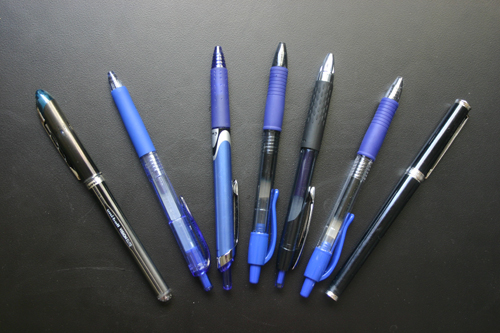
With that in mind, I found the following pens:
pens_2

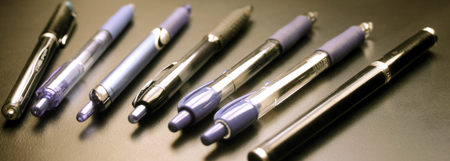
The contenders include:

* A Uniball Vision Elite Micro .5mm

* A Uniball Signo Gel RT Micro .38mm

* A Pilot Precise V5 RT Extra Fine .5mm

* A Pilot G2 Extra Fine .5mm

* A Uniball 207 Micro .5mm

* A Pilot G2 Ultra Fine .38mm

* The Mont Blanc Extra Fine fountain pen for comparison purposes.

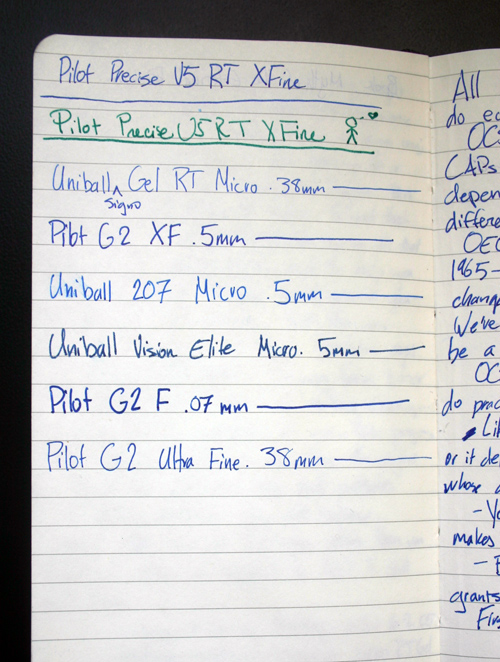
I sought a pen that wrote with a very fine line, had color that didn’t smear or bleed and looked good to me, wrote swiftly and smoothly, and fit my hand. The .38mm pens threw me at first: they seemed like they would be too fine. The following picture shows some of them writing:
notebook_gel_pens_final3

The picture doesn’t convey the thickness of the lines well, but it was obvious that the Pilot G2 Fine .7mm (not pictured among the contenders) was too thick for my purposes. The Pilot Precise wasn’t a gel pen of the sort that seems superior to the others, and the Uniball Vision Elite suffered the same problem: it spread over my moleskine notebook like blood. The Pilot G2 Extra Fine .5mm seemed a tad thick. At the end, I realized that the Signo Extra Micro .38mm, G2 Ultra Fine .38mm, and the 207 Micro .5mm were the best pens of the bunch. Japanese pens seem to be the winners: both Sanford Uniballs and all Pilot pens I tested were made in Japan and seemed to be the best regarded online.

The question: How to choose among them?

I couldn’t decide. All seemed like strong contenders. I didn’t like the 207 Micro housing as much, but it did produce a lovely sky blue color. The Pilot G2 .38mm ultimately seemed darker than I wanted. By process of elimination, I’m going with the Signo RT .38mm for now. For a while I tried swapping the 207 Micro housing with the Signo RT housing, which worked, but I’m not sure I wanted to stay with the .5mm. Thinness counts if I’m going to have any real chance at legibility, and although the .5mm and .38mm were indifferent for most note taking, writing in books with smeary pages made the .38mm shine. I could use one pen for notebooks and another for bound books, but that sounds like more hassle than it’s worth to me. I’ve now been using the Signo RT .38mm for about three weeks, and over the last month I’ve spent about a week with the Pilot G2 .38mm. The two are so close that I could be happy with either, so the .38mm wasn’t far from a coin toss. In the end, I could only pick one.

All the pens survived well. Most packages claimed that the pens would resist alteration. Although I’m not sure what a determined counterfeiter could do, but in these tests by Jet Pens simple water won’t make the ink run. I tried my own test with the finalists and found the same. In addition, Jet says that “The Uni-Ball line is known for its quick drying and waterproof characteristics, making it a favorite among artists.” I’m not an artist, at least in the visual sense, but I do appreciate quick drying and a narrow tip. The Signo RT meets those requirements, and it’s my go-to pen for the foreseeable future.
img_0053-bottom-of-post2

Announcement: The Tucson Festival of Books is this weekend

tucson_festival_books_tents21I’ve complained before about the dearth of literary activity in Tucson, but this weekend ought to shut me up for a while: the Tucson Festival of Books is coming to the University of Arizona campus this weekend. Preparations on the mall are underway, as shown on the right.

I’m particularly interested in Billy Collins and Elmore Leonard, who are both speaking on Saturday afternoon. Expect a report next week. If you’re in town, be sure to come!

New Kindle, same problems

As seemingly every media outlet has mentioned, Amazon released the Kindle 2.0, and the press fawning is more notable than the gadget itself. To be sure, its stats are impressive, and maybe this one will be better made than 1.0. Its big problem, however, still looms: DRM and software. You don’t own a “book” bought with the Kindle—you have a temporary license for it. If Amazon discontinues the Kindle, or declares bankruptcy, or has any of the myriad of other problems companies are susceptible to, your investment is as solid as the wireless transmission of the book itself.

To quote an earlier post:

Gizmodo tells us that we might or might not be able to resell “books” that have been “purchased” with the Kindle or Sony eBook reader. The scare quotes are intentional because whether the physical embodiment of words or the words themselves constitute a “book” hasn’t been decided, and whether one has actual control over a Kindle or eBook hasn’t been decided either. From my initial comments:

Furthermore, I know that I’ll be able to read my copy of A Farewell to Alms in ten years. Will Amazon still produce the Kindle or Kindle store in ten years? Maybe, maybe not. I have books printed a hundred years ago that have journeyed places I doubt their original owners could’ve fathomed. Most Kindles will end up in consumer electronic junk heaps in five years, just like most iPods.

To be sure, in a few circumstances the Kindle is superior, and Megan McArdle enumerates some here: “I don’t think it’s for everyone, but for a subset of people like me–people who buy a lot of new books every year, so that the half-price books make it cost effective, people who spend a lot of time in transit, and people who travel a lot for work–it’s a godsend.” If you’re moving every six months, or likely to be deployed on a Navy ship or sub, or tend to read any given book only once but read many books per year, the Kindle might be worthwhile. For the rest of us, its End User Licensing Agreement (EULA) makes it terribly unappealing.

The chronic fear of reading’s demise

As if you needed more on reading and its benefits (as I discuss here, here, here, and here), see People of the Screen from the New Atlantis. It’s a long article worth reading in full, but these paragraphs stand out:

Whether one agrees with the NEA or with Bloom, no one can deny that our new communications technologies have irrevocably altered the reading culture. In 2005, Northwestern University sociologists Wendy Griswold, Terry McDonnell, and Nathan Wright identified the emergence of a new “reading class,” one “restricted in size but disproportionate in influence.” Their research , conducted largely in the 1990s, found that the heaviest readers were also the heaviest users of the Internet, a result that many enthusiasts of digital literacy took as evidence that print literacy and screen literacy might be complementary capacities instead of just competitors for precious time.

[…]

Just as Griswold and her colleagues suggested the impending rise of a “reading class,” British neuroscientist Susan Greenfield argues that the time we spend in front of the computer and television is creating a two-class society: people of the screen and people of the book. The former, according to new neurological research, are exposing themselves to excessive amounts of dopamine, the natural chemical neurotransmitter produced by the brain. This in turn can lead to the suppression of activity in the prefrontal cortex, which controls functions such as measuring risk and considering the consequences of one’s actions.

Writing in The New Republic in 2005, Johns Hopkins University historian David A. Bell described the often arduous process of reading a scholarly book in digital rather than print format: “I scroll back and forth, search for keywords, and interrupt myself even more often than usual to refill my coffee cup, check my e-mail, check the news, rearrange files in my desk drawer. Eventually I get through the book, and am glad to have done so. But a week later I find it remarkably hard to remember what I have read.”

[…]

But the Northwestern sociologists also predicted, “as Internet use moves into less-advantaged segments of the population, the picture may change. For these groups, it may be that leisure time is more limited, the reading habit is less firmly established, and the competition between going online and reading is more intense.” This prediction is now coming to pass: A University of Michigan study published in the Harvard Educational Review in 2008 reported that the Web is now the primary source of reading material for low-income high school students in Detroit. And yet, the study notes, “only reading novels on a regular basis outside of school is shown to have a positive relationship to academic achievement.”

I realize the irony of sharing this on the Internet, where it’s probably being read on the same screens criticized by the study, and perhaps demonstrating the allegedly rising divide between screen readers and book readers.

Compare the section above to my post on Reading: Wheaties, marijuana, or boring? You decide, which discusses the innumerable articles on reading’s decline (or maybe not). Alan Jacobs has an excellent post on Frum and Literature in which he observes that reading, especially real books, has probably always been a minority taste and probably always will be. Orwell opens his 1936 essay “In Defence of the Novel” by saying “It hardly needs pointing out that at this moment the prestige of the novel is extremely low, so low that the words ‘I never read novels,’ which even a dozen years ago were generally uttered with a hint of apology are now always uttered in a tone of conscious pride.” The whole piece is available in the collection Essays.

Finally, consider From Books, New President Found Voice in the New York Times, which I’m sure every book/lit blogger has already linked to by now:

Much has been made of Mr. Obama’s eloquence — his ability to use words in his speeches to persuade and uplift and inspire. But his appreciation of the magic of language and his ardent love of reading have not only endowed him with a rare ability to communicate his ideas to millions of Americans while contextualizing complex ideas about race and religion, they have also shaped his sense of who he is and his apprehension of the world.

Mr. Obama’s first book, “Dreams From My Father” (which surely stands as the most evocative, lyrical and candid autobiography written by a future president), suggests that throughout his life he has turned to books as a way of acquiring insights and information from others — as a means of breaking out of the bubble of self-hood and, more recently, the bubble of power and fame. He recalls that he read James Baldwin, Ralph Ellison, Langston Hughes, Richard Wright and W. E. B. Du Bois when he was an adolescent in an effort to come to terms with his racial identity and that later, during an ascetic phase in college, he immersed himself in the works of thinkers like Nietzsche and St. Augustine in a spiritual-intellectual search to figure out what he truly believed.

Without his experience in books, Obama probably wouldn’t be where he is, and millions of others must silently share the same condition of achieving what they have thanks largely due to their learning. But they seldom get a voice in the pronouncements about reading’s decline, and those articles seldom acknowledge that, while society might lose a great deal from the allegedly decreasing literacy of its members, those members will lose vastly more on an individual level, and few will even realize what they’ve lost.

(Hat tip Andrew Sullivan.)

The chronic fear of reading’s demise set against its benefits

As if you needed more on reading and its benefits (as I discuss here, here, here, and here), see People of the Screen from the New Atlantis. It’s a long article worth reading in full, but these paragraphs stand out:

Whether one agrees with the NEA or with Bloom, no one can deny that our new communications technologies have irrevocably altered the reading culture. In 2005, Northwestern University sociologists Wendy Griswold, Terry McDonnell, and Nathan Wright identified the emergence of a new “reading class,” one “restricted in size but disproportionate in influence.” Their research , conducted largely in the 1990s, found that the heaviest readers were also the heaviest users of the Internet, a result that many enthusiasts of digital literacy took as evidence that print literacy and screen literacy might be complementary capacities instead of just competitors for precious time.

[…]

Just as Griswold and her colleagues suggested the impending rise of a “reading class,” British neuroscientist Susan Greenfield argues that the time we spend in front of the computer and television is creating a two-class society: people of the screen and people of the book. The former, according to new neurological research, are exposing themselves to excessive amounts of dopamine, the natural chemical neurotransmitter produced by the brain. This in turn can lead to the suppression of activity in the prefrontal cortex, which controls functions such as measuring risk and considering the consequences of one’s actions.

Writing in The New Republic in 2005, Johns Hopkins University historian David A. Bell described the often arduous process of reading a scholarly book in digital rather than print format: “I scroll back and forth, search for keywords, and interrupt myself even more often than usual to refill my coffee cup, check my e-mail, check the news, rearrange files in my desk drawer. Eventually I get through the book, and am glad to have done so. But a week later I find it remarkably hard to remember what I have read.”

[…]

But the Northwestern sociologists also predicted, “as Internet use moves into less-advantaged segments of the population, the picture may change. For these groups, it may be that leisure time is more limited, the reading habit is less firmly established, and the competition between going online and reading is more intense.” This prediction is now coming to pass: A University of Michigan study published in the Harvard Educational Review in 2008 reported that the Web is now the primary source of reading material for low-income high school students in Detroit. And yet, the study notes, “only reading novels on a regular basis outside of school is shown to have a positive relationship to academic achievement.”

I realize the irony of sharing this on the Internet, where it’s probably being read on the same screens criticized by the study, and perhaps demonstrating the allegedly rising divide between screen readers and book readers.

Compare the section above to my post on Reading: Wheaties, marijuana, or boring? You decide, which discusses the innumerable articles on reading’s decline (or maybe not). Alan Jacobs has an excellent post on Frum and Literature in which he observes that reading, especially real books, has probably always been a minority taste and probably always will be. Orwell opens his 1936 essay “In Defence of the Novel” by saying “It hardly needs pointing out that at this moment the prestige of the novel is extremely low, so low that the words ‘I never read novels,’ which even a dozen years ago were generally uttered with a hint of apology are now always uttered in a tone of conscious pride.” The whole piece is available in the collection Essays.

Finally, consider From Books, New President Found Voice in the New York Times, which I’m sure every book/lit blogger has already linked to by now:

Much has been made of Mr. Obama’s eloquence — his ability to use words in his speeches to persuade and uplift and inspire. But his appreciation of the magic of language and his ardent love of reading have not only endowed him with a rare ability to communicate his ideas to millions of Americans while contextualizing complex ideas about race and religion, they have also shaped his sense of who he is and his apprehension of the world.

Mr. Obama’s first book, “Dreams From My Father” (which surely stands as the most evocative, lyrical and candid autobiography written by a future president), suggests that throughout his life he has turned to books as a way of acquiring insights and information from others — as a means of breaking out of the bubble of self-hood and, more recently, the bubble of power and fame. He recalls that he read James Baldwin, Ralph Ellison, Langston Hughes, Richard Wright and W. E. B. Du Bois when he was an adolescent in an effort to come to terms with his racial identity and that later, during an ascetic phase in college, he immersed himself in the works of thinkers like Nietzsche and St. Augustine in a spiritual-intellectual search to figure out what he truly believed.

Without his experience in books, Obama probably wouldn’t be where he is, and millions of others must silently share the same condition of achieving what they have thanks largely due to their learning. But they seldom get a voice in the pronouncements about reading’s decline, and those articles seldom acknowledge that, while society might lose a great deal from the allegedly decreasing literacy of its members, those members will lose vastly more on an individual level, and few will even realize what they’ve lost.

(Hat tip Andrew Sullivan.)

IBM Model M / Unicomp Customizer Keyboard update: Mac edition

EDIT: Unicomp now offers a SpaceSaver M keyboard, in which the “M” stands for “Mac.” That’s probably what you want, rather than the Customizer, since the mechanical keys on the SpaceSaver M are the same as they are on the Customizer, while the keyboard itself is considerably smaller and includes Mac-specific keys out-of-the-box.

My Product Review of the Unicomp Customizer keyboard is the most enduringly popular post on this blog, and the last few days have seen an especially large amount of traffic thanks to an NPR story on how an Old-School Keyboard Makes [a] Comeback Of Sorts, which talks about Unicomp. The saddest part: the company is laying off workers because the Customizers and similar keyboards last too long and cost too much. The latter, of course, has a great deal to do with the former, but economic conditions mean that the initial investment apparently isn’t available to many people.

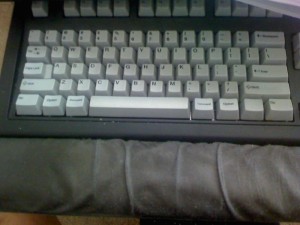
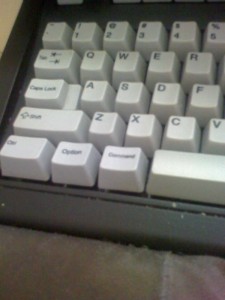
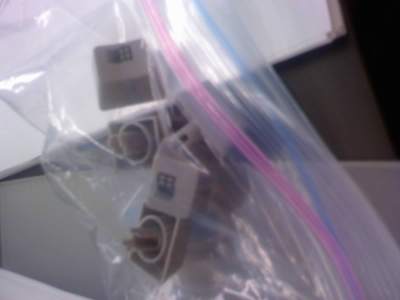
Aside from the durability of its products, Unicomp also has unusually good customer service. I use a Mac and the Customizer ships with Windows keys by default, which one can see in my original post. For $10, however, Unicomp sent me custom keys with “option” and “command” instead of Windows buttons (pardon the fuzzy pictures: I only have a lousy cell phone camera at the moment):

01-31-09_1223

Option and command close up

01-31-09_1225

Perfect: the Windows buttons aren’t staring at me and other people who use my computer aren’t confused (“Hit command-w to close the window.” “Where’s command?” “The one with the Windows logo to the left of the spacebar.” “Huh?”).

Mac users who care about typing, take note: buy a Unicomp SpaceSaver or SpaceSaver M rather than the lousy Matias Tactile Pro 2. You can find Unicomp’s website here.

The Gift — Lewis Hyde

Lewis Hyde’s The Gift is one of these frustrating books whose last chapter is vastly better than any other and whose main point is somehow true even as the support for that point is weak, nonexistent, or wrong. He argues, reasonably enough, that contemporary Western capitalist societies tend to undervalue creativity in the arts, particularly when said creativity doesn’t sell. But in trying to make his point, he too pretends that a firewall exists between the creative, “gift” economies and the exchange/contract economies. At the end he decides the two can be reconciled, but that occurs after a series of irritating pronouncements with unsubtle jabs the exchange/contract economy. Nonetheless, The Gift made me think differently about the world by the time I finished with it, which few books do. I’ll swing back to that at the end, because The Gift also deserves plenty of criticism.

Although The Gift is a book, it feels like a long magazine article might have been the more appropriate form for it. Do we really need more than 50 pages about American Indian gift exchange cultures? And the chapters on Ezra Pound seems particularly worthless, and the one on Whitman interesting but overlong—a microcosm for The Gift as a whole. Some of its metaphors strain credulity and seem almost deliberately narrow, as when Hyde writes:

Gifts of peace have the same synthetic character. Gifts have always constituted peace overtures among tribal groups and they still signify the close of war in the modern world, as when the United States helped Japan to rebuild after the Second World War. A gift is often the first step toward normalized relations. (To take a negative example, the United States did not offer aid to Vietnam after the war. […])

The United States didn’t rebuilt Japan in hopes of joining hands and singing about world harmony—the goal was to build Japan as a bulwark against Communism in Asia. The “gifts” were probably closer to bribes. At the same time, the United States didn’t win in Vietnam, which might explain why no foreign aid money went to the country; if the North had been overrun and destroyed, then it might have been rebuilt with American dollars. Likewise, the United States’ proxy war in Afghanistan resulted in little subsequent aid, as discussed at the end of George Crile’s Charlie Wilson’s War.

I’m not sure this shows anything other than Hyde failed in this example, but he does in many others too. In a footnote, he says:

There is no technology, no time-saving device that can alter the rhythms of creative labor. When the worth of labor is expressed in terms of exchange value, therefore, creativity is automatically devalued every time there is an advance in the technology of work.

Time-saving devices can free up more time for creative labor: there are more writers and artists today than there were in, say, 1800, in part because most people aren’t engaged in backbreaking farming or 15-hour days in factories. Education levels have risen enormously, in part thanks largely to time-saving devices that give us more time to study and more wealth to devote to schools, libraries, and the like. Furthermore, labor expressed in exchange value does not automatically devalue creativity—establishing things like copyright, which allowed writers and others to derive an independent income from their work, if anything increased the worth of creative labor for people like writers. And creativity is not limited to what we think of as traditional arts—for example, computer programming is often enormously creative, and those who tend to be maximally creative also tend to be better compensated than those who aren’t. If Hyde were going to say that “When the worth of labor is expressed in terms of exchange value, creativity can be devalued,” I would agree: the number of poets whose contribution can be measured monetarily is small. As Gabriel Zaid says in So Many Books: Reading and Publishing in an Age of Abundance, “[…] the conversation continues, unheeded by television, which will never report: ‘Yesterday, a student read Socrates’ Apology and felt free.’ ”

Such problems occur throughout the book, although they’re alleviated in the conclusion, where Hyde retreats on many of his more ridiculous assertions. He says:

[…] my own ideas underwent a bit of a re-formation. I began to understand that the permission to usure is also a permission to trade between two spheres [the commercial and gift economies]. The boundary can be permeable. Gift-increase (unreckoned, positive reciprocity) may be converted into market-increase (reckoned, negative reciprocity). And vice versa: the interest that a stranger pays on a loan may be brought into the center and converted into gifts. Put more generally, within certain limits what has been given us as a gift may be sold in the marketplace and what has been earned in the marketplace may be given as a gift.

Damn: if only that line of reasonable thinking had informed the entire book. It didn’t, which render sections of The Gift reminiscent of freshman-year manifestos written by tipsy students who just finished Marx. Despite those problems, some sections early fascinate, like the chapter on “The Gift Community,” where Hyde says:

Is is a rare society that can be sustained by bonds of affection alone; most, and particularly mass societies, must have as well those unions which are sanctioned and enforced by law that is detached from feeling. But just as the Roman saw the familia divided into res and personae, the modern world has seen the extension of law further and further into what was earlier the exclusive realm of the heart.

The more one tries to regulate the affairs of the heart, the less those affairs seem like they are of the heart. Dan Ariely and Tim Harford make similar observations, backed up by experiments, in Predictably Irrational and The Logic of Life, respectively. And institutions are fond of exploiting the gift economy by masquerading their exchange/commercial actions. For example, Division I American college sports piggyback on the gift economy: although to football, basketball and baseball players are essentially professionals, high-caliber universities pretend that tuition is a “gift” even as the same universities extract millions of dollars in television and merchandising revenue from such players. The idea that Division I players are amateurs has become increasingly absurd, much as the Olympics have been professionalized. In Beer and Circus: How Big-Time Sports Is Crippling Undergraduate Education, Murray Sperber even argues that the sports mentality harms students.

Yet I can’t help but imagine places where gift economies don’t apply at all, and they’re often not very pleasant. As I write this, I sit in a Tucson airpot bar. Airports have everything wrong with them: they are transitional, one-off spaces filled with strangers, the “restaurants” they offer consist of pre-made food with character slightly above a TV dinner, and for some reason we as a society have decided that Constitution rights and privacy don’t apply here. People I don’t know can stop me at will, and merely flying requires that I submit to security theater that is simultaneously ineffective and invasive. Everything is exorbitantly expensive but not of particularly high quality. Menus don’t have beer prices on them.

The airport, in short, is designed to extract money from a captive audience; this might be in part why I don’t care much for sports stadiums, Disneyland, and other areas where I feel vaguely captive. In Great American Cities (to use Jane Jacob’s phrase), something is always happening, there is always another place down the street, and you can decide to be as invested or anonymous in society as you like. In contrast, airpots feel like a trap: you can’t choose to avoid them, at least not without enormous costs in terms of time, money, and concentration. Maybe I wrote about college sports above because a few basketball games are playing around me, along with facile, noisy political news that’s more like a talk show than newspaper. If there were a bar in the Tucson airport without this ceaseless parade of visual noise, I would go to it. I’m trapped in an extreme form of the market economy, where no reciprocity exists and the gift is hidden and completely subservient to commerce. I might not have the gift, but regardless of whether I do, I’m frustrated here, where the food is more fuel more pleasure, as if choosing between burritos and pasta is like choosing between octane grades. Good chefs are artists, and maybe none could work in the security of an airport. I only wish that I had somewhere quiet and comfortable to sit. Neither kind of place exists in airports, unless you pay for it, and, again, I have no choice but to participate. At least with the most market, you have a choice.

In short, there are few better places to instill sympathy to the arguments of a book like The Gift, which, for all its problems in expression, nonetheless drives at a serious problem in market economies that seem unlikely to depart. They are not as serious as Hyde makes them out to be—I too would like it if more people read Saul Bellow and fewer watched Flavor of Love, a show I’ve never seen but have heard allusions to at least three times in the last week—and the market has a habit of self-correction, but that doesn’t mean they do not exist. And The Gift gives one a better way for analyzing the world and believing in creative acts that don’t necessary have immediate financial gain.

Despite my antipathy towards The Gift I occasionally find myself recommending it, albeit with caveats attached. It threads an argument that deserves to be more often heard in a non-sentimental or strident context: that not all worthy forms of creativity are financially remunerated adequately but that they are valuable nonetheless. The Gift is not brilliant, as the jacket copy claims, but art deserves all the defense it can muster, but over the long term, I suspect that art will be its own defense.

January links: Distraction, reading, routine, and more

* I wrote a lot about distraction in this post, and now Cory Doctorow—the same one who wears a red cape and blogs from high-altitude balloons—has written another of these articles. I’m going call them a genre. Reblock Yourself the Polly Frost Way! in The Atlantic might be part of it.

* The Daily Routines of Interesting People, courtesy of Mental Floss. Most of them are writers of some sort. You can find similar material in Writers on Writing: Collected Essays from The New York Times.

(I don’t remember where I picked up the link, but someone deserves a hat tip.)

* By way of the New York Times’ idea blog, a write up in New Scientist says Victorian literature might function in ways that demonstrate or reinforce positive social behavior:

WHY does storytelling endure across time and cultures? Perhaps the answer lies in our evolutionary roots. A study of the way that people respond to Victorian literature hints that novels act as a social glue, reinforcing the types of behaviour that benefit society.

Literature “could continually condition society so that we fight against base impulses and work in a cooperative way”, says Jonathan Gottschall of Washington and Jefferson College, Pennsylvania.

[…]

The team found that the characters fell into groups that mirrored the egalitarian dynamics of hunter-gather society, in which individual dominance is suppressed for the greater good (Evolutionary Psychology, vol 4, p 716). Protagonists, such as Elizabeth Bennett in Jane Austen’s Pride and Prejudice, for example, scored highly on conscientiousness and nurturing, while antagonists like Bram Stoker’s Count Dracula scored highly on status-seeking and social dominance.

I wonder how the writing of, say, Bret Easton Ellis, Martin Amis or Elmore Leonard would fit that theory. Maybe they’re showing us what not to do.

* Speculative Fiction and criticism is a nice complement to Science Fiction, literature, and the haters, my post on a topic that, I’m now starting to realize, is constantly discussed anew as though it hasn’t been analyzed before.

* The New Yorker has a simpering article about The Village Voice and its history. Although it’s not clear that the Voice did much to change journalism or is important beyond a New Yorker’s myopic vision, there are a few amusing pieces worth quoting:

Wolf considered his editorial policy as philosophy. “The Village Voice was originally conceived as a living, breathing attempt to demolish the notion that one needs to be a professional to accomplish something in a field as purportedly technical as journalism,” he wrote in the introduction to “The Village Voice Reader,” in 1962.

[…]

Since devaluing authority is one of the things journalism does, this [habit of internecine warfare among Voice writers] amounted to using the methods of journalism against the pretensions of mainstream journalism.

The same descriptions are frequently applied to bloggers.

* Another reason not to like the Kindle, this one from Philip Greenspun:

My Amazon Kindle is just slightly past its one year anniversary and showing signs of very ill health. Half of the pixels on the screen are stuck following a light knock. I called Amazon and they’re happy to fix it… for $180 plus $7 in shipping (free if you’re a Prime member). The Kindle is more fragile than a laptop computer but less likely to be pampered given that you use it in all the situations where you’d use a book.

I may have to rethink my enthusiasm for the electronic book. Realistically the way that people handle books, the Kindle is not going to last more than one year. That means you’re spending $360 for the initial purchase and $187 every year for hardware repairs. Some of the Kindle editions of books are edging their way up towards $20 […]

See my reasons here.

* Read Jason Fisher’s excellent post on The Imaginative and the Imaginary: Northrop Frye and Tolkien. Pay special attention to the second comment, which is from Glen Robert Gill.

* The Wall Street Journal asks, Blockbuster or Bust? about the incentives behind mega-advances in the publishing and other media industries (merely calling them industries feels dirty, but I guess everyone else does it, which makes it okay). Compare this to my recent post on how the Publishing Industry’s Gloom is Readers’ Gain and Why are so many awful movies so awful

* In the post on the publishing industry linked to above, I also linked to Ursula K. Le Guin’s Staying awake: Notes on the alleged decline of reading, which is so good that I will point to it again here. See too Ann Patchett’s The Triumph of the Readers: The markets may be down, but fiction is on the rise in the Wall Street Journal. I agree with this sentence: “I am a firm believer in the fact that it isn’t so much what you read, it’s that you read.” Later, she says “Even if you’re stepping into “Valley of the Dolls,” it’s better than nothing. I’m all for reading bad books because I consider them to be a gateway drug.”)

Compare that to Reading: Wheaties, marijuana, or boring? You decide, my post from June 2008:

Let this be a lesson, by the way, to the natterers, including myself, on getting young people to read—instead of pushing reading ceaselessly like whole wheat bread, maybe it’s time to forbid it, and stock copies of Henry Miller and Bret Easton Ellis in the liquor store, thereby necessitating that teenagers get their older siblings or boyfriends or whatever to buy it for them. They might pass copies of [Alan Moore’s] Lost Girls around like furtive bongs at parties. I call this the “gateway drug” approach to reading, as opposed to the “whole wheat” approach.

There are shades of Orwell too. Here’s Patchett:

It’s true, as a source of entertainment reading ranks somewhere between cheap and free, depending on where you get your books. A movie can give you two hours of entertainment, but a book can go on for days or even weeks.

And here’s Orwell in 1942:

Reading is one of the cheapest and least wasteful recreations in existence. An edition of tens of thousands of copies of a book does not use up as much paper or labour as a single day’s issue of one newspaper, and each copy the book may pass through hundreds of hands before it goes back to the pulping mill.

* Reason #1041 why I dislike Tucson: no authors come here because the city’s literary culture is insufficient to draw them. One might think a town with a major university would do better, but, alas, it does not. Steven Berlin Johnson’s book tour for The Invention of Air doesn’t include Tucson—but Johnson will be in Seattle, L.A. and Portland.

* As long as I’m beating up Tucson, notice this post from Nigel Beale regarding the United States’ most literate cities. Minneapolis/St. Paul dominate, Seattle is number two, and Tucson doesn’t make the top 10. But at 32, it does beat Los Angeles (56) and Phoenix (57), although I would take literary L.A. over Tucson for the better bookstores if nothing else.

* PCWorld writes “Inside the World’s Greatest Keyboard” concerning the IBM Model M. I wrote about the Unicomp Customizer here; it’s a version of the Model M that’s still manufactured.

* I’ve linked to Paul Graham’s essay on Philosophy several times, but now someone has written an excellent post disagreeing.

* From Kate’s Book Blog quoting “What is Style?”:

There is no such thing as a writer who has escaped being influenced. I have never heard a professional writer of any quality or standing talk about “pure” style, or say he would not read this or that for fear of corrupting or affecting his own; but I have heard it from would-be writers and amateurs.

* Although politics don’t interest me much, this seems so insightful regarding the Middle East as to deserve a link:

IV. As a consequence of the above three trends, major political issues of importance to the people of this region are increasingly inconsequential to most people and powers around the world. The electoral politics of the Metn region in Lebanon, the tribal politics of Gaza, the human rights conditions in Syria and Morocco, and the forty years of Moammar Gaddafi’s rule in Libya are issues that no longer occupy any serious time or thought among leaders in the world’s most powerful countries, regardless of whether we accept that or not.

The worst ramifications of the Middle East’s dysfunctions — terrorism, illegal migration, ethnic strife, corruption, police states, and assorted atrocities perpetuated by both state and private actors — are only occasional irritants for the rest of the world, not pressing strategic threats. We have marginalized ourselves as serious players on the global political stage, and now assume the role of nagging annoyances and miscreants.

Indeed: and the pity is that too few seem to realize this.

(Hat tip Jeffrey Goldberg. Incidentally, his piece Why Israel Feels Threatened is worth reading too.)

* The Wall Street Journal discusses Bernhard Schlink’s The Reader. See my analysis of the novel here.

Why are so many movies awful?

The short answer: they’re ruled by marketing, not by art, feeling, or emotion, to the extent that those characteristics can’t be captured by marketing.

The longer answer comes from Tad Friend’s article in the January 19 2009 issue of The New Yorker, “The Cobra: Inside a movie marketer’s playbook,” which describes how movies get made. Today, the answer is nearly identical to the question of how movies get marketed. My favorite quote is a little less than midway through:

” ‘Studios now are pimples on the ass of giant conglomerates,’ one studio’s president of production says. ‘So at green-light meetings it’s a bunch of marketing and sales guys giving you educated guesses about what a property might gross. No one is saying, “This director was born to make this movie.” ‘ “

“Pimples on the ass of giant conglomerates:” it’s a great metaphor that conveys precisely how much vast corporations care about art as well as the relative power of those existing within studios. Creativity isn’t dead, even in major studios’ presidents of production, but neither is cynicism, as the article shows in too many places to enumerate. “Cynical” might be too light a word—if Julie Salamon’s ‘The Devil’s Candy: The Bonfire of the Vanities Goes to Hollywood is somewhat cynical, then nothing except perhaps nihilism describes the Hollywood marketer’s mind as portrayed by Friend.

Read the whole article for more: it never comes out and baldly states what’s obvious, as I have. This blog only occasionally strays into territory dealing with movies; this analysis of Cloverfield is my only extended treatment of one, although this post discusses movie versions of Ian McEwan’s Atonement and George Crile’s Charlie Wilson’s War. Perhaps it isn’t a coincidence that the movies I tend to pay the most attention to are based off books; according to Friend’s article, such movies are “‘pre-awareness’ titles: movies like ‘Spider-Man’ whose stories the audience already knew from another medium […]” like virtually all that have made extraordinary amounts of money in the last decade. Movies also tend to raise a book’s profile enough to encourage me to read it when I otherwise wouldn’t; the movie version of Bernhard Schlink’s The Reader is an example of this.

I suppose the same question regarding why so many are so bad could be applied to books too, but books are often less obvious: critics seem to have (slightly) more power, and the sheer number of books makes the bad ones easier to ignore. Call it strength in diversity. Movies are noisier, and because there are fewer of them, each one collects more attention. But because they cost so much to make, they become a numbers game; I care vastly more about aesthetic worth than opening weekends. But, at least as shown in this article, Hollywood cares about those numbers.

It shows in their product.


EDIT: Wynton Marsalis, by way of Alex Ross:


At the root of our current national dilemmas is an accepted lack of integrity. We are assaulted on all sides by corruption of such magnitude that it’s hard to fathom. Almost everything and everyone seems to be for sale. Value is assessed solely in terms of dollars. Quality is sacrificed to commerce and truthful communication is supplanted by marketing.

In addition, see my comments on Julie Salamon’s The Devil’s Candy: The Bonfire of the Vanities Goes to Hollywood for more on how the way movies are made affects the movies that are made.

… I’m not the first or only one to have noticed Amazon.com’s utility

My recent post on how Publishing Industry Gloom is Readers’ Gain discussed the pervasive fear of used books. But now I’ve found an article from a decade ago concerning and predicting its rise, in Philip Greenspun’s hilarious (and depressing) piece about his experience writing a tech book. Towards the bottom, he included this:

Looking at the way my book was marketed made me realize that amazon.com is going to rule the world. A traditional bookstore is useful as an entertainment venue. You can arrange to meet someone there. You can kill 20 minutes browsing. But if you’re picky about what you want, the chance of them having the book is pretty small. They carry books that are being heavily hyped and books that were popular and relevant six months ago. Traditional bookstores can’t respond quickly to customer demand for new or newly popular titles. In dozens of cases, friends of mine would go into a store to ask after Database Backed Web Sites. Usually the book had not been ordered and the store had no intention of stocking the title. The front desk clerks had no mechanism to provide feedback to the buyers. If a person did not plunk down his credit card and special order the book, no record would exist of the inquiry.

Although I couldn’t find a date of original publication on his site, it appears to have been sometime around 1997. Talk about prescience. Not long ago I desperately wanted a copy of Chaim Potok’s The Gift of Asher Lev—which was a mistake—so I could start it immediately after finishing My Name is Asher Lev. None of the Bookman’s stores in Tucson had it. Antigone (of course) didn’t have it, but that didn’t stop me from calling. Eventually I found two stores, both inconveniently located, that did: a Barnes & Noble and a Borders. The Barnes & Noble didn’t actually have it, though their computer said they did. The Borders did have it for about $15. If I’d just started driving to bookstores, I would’ve been irate by the journey’s end. For the privilege, I paid a little more than $15.00. Amazon charges $10.20 as of this writing. A used copy costs $8.08 with shipping. Don’t get me started on the dearth New York Review of Books Press or Library of America titles, which are two of my favorite imprints.

This is why Amazon is growing in power.

In Seattle, I would go to Elliott Bay and the University Bookstore to hear authors. In Tucson, I lack even that reason.

Still, it appears that used books might not be substitutes for most Amazon buyers, according to Internet Exchanges for Used Books: An Empirical Analysis of Product Cannibalization and Welfare Impact, which says

Our analysis suggests that used books are poor substitutes for new books for most of Amazon’s customers. The cross-price elasticity of new book demand with respect to used book prices is only 0.088. As a result only 16% of used book sales at Amazon cannibalize new book purchases. The remaining 84% of used book sales apparently would not have occurred at Amazon’s new book prices. Further, our estimates suggest that this increase in book readership from Amazon’s used book marketplace increases consumer surplus by approximately $67.21 million annually.

Then again, it was also written in 2005, and I wouldn’t be surprised if reader behavior changes quickly.