Cheap Sex: The Transformation of Men, Marriage, and Monogamy — Mark Regnerus

Cheap Sex is more useful, interesting, and informative than many books on the same or adjacent topics, and it pairs nicely with Date-onomics. The books can be read as differing reactions to similar social phenomenon on the ground, with the latter having a more left-wing tilt that nonetheless describes how people should pragmatically react to current conditions, while the former has a more right-wing tilt that nonetheless describes how these conditions came to be. We live in an age in which everyone is outraged or offended by something; when you find something that outrages or offends you, leave a note in the comments. You may find that cathartic.

Although neither book makes this point, I think they’re part of the continuing social reaction to the Industrial Revolution. “What,” you might be thinking, “does the Industrial Revolution have to do with contemporary books on love, marriage, and dating?” Prior to the Industrial Revolution, most societies were (relatively) stable most of the time, at least for the duration of a human life; the technological and social conditions one’s parents faced were likely the same an individual would face and the same that individual’s children would face. Cultural and technological change was of course real for much of human history, but it was also relatively slow, allowing people to acclimate to it over generations instead of years or decades.

Since the Industrial Revolution, though, we’ve seen technologies that radically and repeatedly reshape the technological and social worlds. This leads to periodic moral panics, especially but not exclusively around sexuality and religion, in part because we never get a chance to get used to new technologies.

(It’s hard to think of a single book that summarizes the Industrial Revolution; Joel Mokyr has some, Deidre McCloskey has others).

Today, we’re still grappling with the reshaping of society due to pretty reliable contraception. In some ways we’ve had pretty reliable contraception for a very long time (since the ’60s), but in the view of human history, or even human history since the 1750s, we’ve had it a very short time. We’ve spent pretty much the entirety of human evolution without pretty reliable contraception, and that’s shaped our minds, our bodies, our societies, and our practices. And it’s still reshaping all of those things, without most of us stopping to think about what it all means to look at these things in the course of a very wide and long history.

That’s part of what Regnerus is doing. The present moment is the product of a whole lot of past, most of which most of us don’t think about most of the time. But a lot of our current conflicts come from past conflicts that we don’t fully understand. And he’s pointing to that history, when he writes in subheaders about “The transformation of intimacy.” Or when he writes about the “obsession of romance among many, and yet stability seems increasingly elusive.” At the same time, “the ramifications of cheaper sex are just beginning to unfold on a panoramic scale.”

No wonder people are confused. For most of human history, cultural notions around sexuality have been pretty stable. Now they’re incredibly unstable and we’re all making things up as we go along and responding to technologies that have unpredictable consequences.

Regnerus may not be right about many of his conclusions, but he is thinking differently and also not stupidly, which is valuable in and of itself.

I’m also not sure how much you can trust the book’s conclusions, as many are drawn from “nationally representative survey data” as well as “in-person interviews,” the problem being that people notoriously lie in surveys, especially about sensitive subjects, and the same biases occur in in-person interviews. Those weaknesses are part of the reason why books like A Billion Wicked Thoughts, Dataclysm, and Everybody Lies are so interesting: rather than relying on the surveys in which everybody lies, they look at revealed preferences in the form of data from the Internet (and online dating itself).

Cheap Sex itself is written competently but not beautifully. You will not stop to admire individual sentences, and that’s why I’ve not quoted much from it so far. Read it for the knowledge, not the prose. Like many academic books (this one is published by Oxford) it has its share of “You don’t say?” statements, like, “When it comes to relational happiness, then, sexual frequency is neither necessary nor sufficient, but it is certainly a net positive for most.” “A net positive:” really? I’m shocked! I would never have guessed.

But it also has its moments of humor, as when an interviewee discusses at length his own romantic dilemmas and then Regnerus writes, “After we turned off the microphone at the end of the interview, Brent asked if we though the and Betsy should break up. (We declined to respond).”

There are also moments I’m still mulling and don’t yet understand:

Meant to be a “haven in a heartless world,” as the late social critic Christopher Lasch described it, marriage is fast becoming a contest, another tenuous social arena in competition with the economic marketplace (for our limited time and energy) and the remarriage market (for second chances and variety).

A “haven in a heartless world:” Regnerus implies here and elsewhere in the book that maybe there isn’t such a place. I’m not arguing that he’s right. But I don’t see a compelling reason he isn’t.
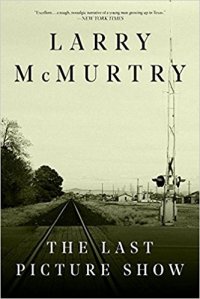
The Last Picture Show — Larry McMurtry

The Last Picture Show ought to be one of the most boring novels ever written: It’s about a handful of losers in a nowhere town who don’t do very much. Stated like that you wouldn’t want to read it. But the delivery makes it work and that delivery can’t be easily excerpted.

The Last Picture Show feels humane; I can’t exactly define that term in this context and I can’t point to a single sentence that encompasses it, but the feel permeates the novel. When people talk about politically correct art, they are talking about the opposite of The Last Picture Show, which is never doctrinaire yet often honest about its characters their foibles. Maybe the best is Lois, Jacy’s mom, who is scary and desiring and wants everyone around her to fuck off and wants to be gone but never quite can be.

Part of being humane entails familiarity with brutality, desperation, and annihilation—all of which appear, in various guises, as when Ruth Popper finds that a teenage boy has become everything to her: he “was what made the days worth confronting” (the word “confronting” being a better one here than “living”) and “the thought of going back to the existence she had had before he came was too much to face.” Yet on some level she must face it: he’s a high school senior and she’s married to his former football coach. Their relationship is by its nature has a terminus, but fighting the terminal nature is part of what makes the novel work—and part of the nature of its melancholy, melancholy being a feeling that is rarely if ever named yet one that pervades the whole thing. It isn’t melancholy the way someone like Houellebecq is, but all the characters yearn to be somewhere else.

The Last Picture Show world is very different from today; we learn that Sonny played football for four years at the local high school, but the football coach is “a man of most uncertain temper. He had already shot at Sonny once in his life, and with a new under-over he might not miss.” It’s hard to get the tone of this sentence in the context of the novel. Is it supposed to be farcically funny? Reported straight? A sign of the town and the boy’s resignation? Something else? I don’t know and not knowing is part of what makes it good.

Sometimes, but not too often, the sentences hit classic beautiful metaphors:

after an hour’s slopping necking with Charlene even the fantasy that he was kissing Jacy had a dangerous power. Charlene kissed convulsively, as if she had just swallowed a golf ball and was trying to force it back up.

If that is Charlene to Sonny, we know everything about their relationship.

Or, not in metaphor form:

“But I don’t care about money,” Jacy said solemnly. “I don’t care about it at all.”
Lois sighed. “You’re pretty stupid then,” she said. “If you’re that stupid you ought to go and marry him—it would be the cheapest way to educate you.”
Jacy was so shocked at being called stupid that she didn’t even cry. Her mother knew she made straight-A report cards!

And report cards are of course the surest, most steady sign of intellect devised by man.

The first sentence is, “Sometimes Sonny felt like he was the only human creature in the town.” “Human creature?” What and where is “the town?” “Lonely,” “lonesome” and similar words about the lack of human contact and camaraderie are the most-used in the novel. There is of course no social media, but even if there were it probably wouldn’t help much. The town is too far from the big city. For Sonny and Duane, the military may be a way out. For many others, there is no obvious out.

I love this book because I don’t get it, and it should be bad, but it isn’t.

The Hard Thing About Hard Things — Ben Horowitz

The Hard Thing About Hard Things is one of the best books I’ve read recently and one of those books whose subject matter is unlikely to interest most of you, but the execution is so good that you ought to read it anyway. The best books transcend their subject; this is probably the best passage in an already great book:

Most business relationships either become too tense to tolerate or not tense enough to be productive after a while. Either people challenge each other to the point where they don’t like each other or they become complacent about each other’s feedback and no longer benefit from the relationship.

Implicitly, you could strike the adjective “business” and replace it with a lot of others… or perhaps strike it altogether and still achieve a similar effect. I’ve often felt exactly what Horowitz is describing but never conceptualized it that way. Over and over again, I found myself marking passages and putting checkmarks next to them. In most books, that practice falls off a third of the way through; in this one, I kept going to the very end.
Many sections just demonstrate that Horowitz gets things. Like:

“What would you do if capital were free?” is a dangerous question to ask an entrepreneur. It’s kind of like asking a fat person, “What would you do if ice cream had the exact same nutritional value as broccoli?” The thinking this question leads to can be extremely dangerous.

Wishful thinking can block useful thinking. Which most of us don’t think, or don’t think consciously.

He’s thinking about antifragility before Nassim Taleb wrote the eponymous book:

The close call was a sign to me that the entire operation was far too fragile. I got another sign when our largest competitor, Exodus, filed for bankruptcy on September 26. It was a truly incredible bankruptcy in that the company had been valued at $50 billion a little more than a year earlier. It was also remarkable because Exodus had raised $800 million on a “fully funded plan” just nine months earlier. An Exodus executive later joked to me: “When we drove off a cliff, we left no skid marks.” It Exodus could lose $50 billion in market capitalization and $800 million in cash that fast, I needed a backup plan.

I’m surprised there aren’t more novels set among venture capitalists or startups. The drama is all there. Maybe most writers don’t realize it, but Horowitz is good at stakes and drama. His stories are too often to quote in full, but they’re full of narrative drama and tension in a way most books aren’t. And some character descriptions are as good as anything in fiction:

Wow. I had no idea who I was dealing with until that point. Understanding how differently Frank viewed the world than the people at Opsware helped clarify my thoughts. Frank expected to get screwed by us. It’s what always happened to him in his job and presumably in his personal life. We needed something dramatic to break his psychology. We needed to be associated with the airport bar, not with his job or his family.

Horowitz had an epiphany and he acted on it. Hard Things could be seen as a series of epiphanies, and we get to follow him through.

We’re often told to attend to data, likely because most people don’t, but once you attend to data, “Sometimes only the founder has the courage to ignore the data.” Like Peter Thiel, Horowitz argues that your life is not a lottery ticket and that markets are often wrong (or at least that insiders can see things that the outsiders who create market values cannot):

If I’d learned anything it was that conventional wisdom had nothing to do with the truth and the efficient markets hypothesis was deceptive. How else could one explain Opsware trading at half of the cash we had in the bank when we had a $20 million a year contract and fifty of the smartest engineers in the world? No, markets weren’t “efficient” at finding the truth; they were just very efficient at converging on a conclusion—often the wrong conclusion.

Almost anyone trying to do anything useful should be thinking about what good ideas are not being pursued: “Wall Street does not believe Opsware is a good idea, but I do.”

“The wrong conclusion:” if markets can converge on “the wrong conclusion,” so can individuals and societies. Some of Hard Things can be read as a critique of American society: “My single biggest personal improvement as CEO occurred on the day when I stopped being too positive.” American society is regularly considered to be positive, but in a way that isn’t necessarily founded on skill or improvement. The “self-esteem” movement is part of this trend, even though moving towards self-efficacy would be an improvement. In class, when I started teaching I was often too positive. Now I’m less positive and more likely to emphasize that growth often comes from pain and struggle. The deadlift doesn’t get higher without some pain, and the best lifters learn to love the pain. Same with intellectual, psychological, or emotional growth. Yet we have a society that shies away from those truths.

I’ve heard about Hard Things many times but this recommendation tipped me into reading it, and I hope my recommendation tips you. The best books can be read many ways and applied to many situations, and this is one of the best. I didn’t expect it to be, which makes it all the more delightful.

“F*cked,” the book by Corinne Fisher and Krystyna Hutchinson, is not good

F*cked: Being Sexually Explorative and Self-Confident in a World That’s Screwed seems promising and I’m sympathetic to its premise, but the execution is poor. The pull quote for an early chapter says, “Self-esteem isn’t everything. / It’s just that there’s nothing without it.” Is that true? I don’t know, but there is something without self-esteem. Like, say, the earth. “Everything” and “nothing” are too vague to be useful here. In the same chapter, Fisher writes, “Until I began recording the Guys We Fucked podcast, I really had no idea just how bad people felt about themselves.” Do people feel that bad about themselves? How do we know? We get no evidence and Fisher seems unfamiliar with selection bias; someone writing to an agony aunt is likely to feel worse than a random person in a population.

Another early chapter says, “Shame is nothing new—it’s been used for centuries.” But no longer than 999 years? Or more than that? If it’s more, why “centuries?” One minute searching the literature brings up, “Cross-Cultural Differences and Similarities in Proneness to Shame: An Adaptationist and Ecological Approach.” Almost everything they write about has people who’ve spent their careers studying it, but almost none of that knowledge percolates into the text. A pity.
Psychology Today, a pop psych site, appears at least three times, and there are lots of generalizations but no works cited page. In that respect it’s not worse than the books it criticizes (“We were tired of these books that pander to women like we’re all hot messes, unable to handle our emotions without the assistance of a man, a glass of rosé, and a Xanax”), but there is better out there. A book like The Guide to Getting It On is better.

F*cked presupposes so much anxiety in its readers; again, articles like “The Fragile Generation: Bad policy and paranoid parenting are making kids too safe to succeed” come to mind while reading it, as they did while reading La Belle Sauvage. The books opens, “Are you a degenerate cum dumpster who isn’t worthy of love or affection? Probably not, but odds are someone has made you feel that way at one point in time.” No, and probably no one has. Examples like this are way rhetorical questions should be used sparingly, if at all.

Don’t be like me and fall for the book, even if you are like me and sympathetic to its premise.

La Belle Sauvage — Philip Pullman

La Belle Sauvage is good but suffers from a problem: it occurs a little more than a decade before His Dark Materials and concerns Lyra as a baby. But anyone who’s read His Dark Materials knows that she survives. The supposed threats to her are drained of potency and that in turn drains the book of vibrancy. It feels more like a kids’ book than His Dark Materials, too.

There is even a strange moment on the third page, about Malcolm: “he took tips to be the generosity of providence, and came to think of himself as lucky, which did him no harm later in life.” So we know he survives, too.

Many sections are charming, though not in a flashy way:

There was probably nowhere, he thought, where anyone could learn so much about the world as this little bend of the river, with the inn on one side and the priory on the other.

There are probably many people who do think that you could learn more “about the world” somewhere else, but an 11-year-old could very easily believe otherwise, as Malcolm does.

Malcolm is also charmingly unmanaged; many passages like this:

“I lent the canoe to someone, and that man brought it back.”
“Oh. Well, get on and take these dinners through. Table by the fire.”

between Malcolm and his mother feel not of this world, or at least the chattering-class part of it. Valuable items like canoes would probably be the subject of much supervision today. Too much. Articles like “The Fragile Generation: Bad policy and paranoid parenting are making kids too safe to succeed” came to mind as I read Malcolm’s journey towards antifragility.

Scholars are important in the Pullman world, which is a refreshing change from much of our world.

Sprinkled throughout the book is a sense of malevolent bureaucracy, religious in form here but transferable to other kinds. The Consistorial Court of Discipline, the “Environmental Protection” people, the League of St. Alexander: they all have an undertone of official harassment, and even people not formally part of the organization can act like people in the organization. Yet suspicion of bureaucracy is not enough to impede its growth. The individuals matter, even the ones who are “terrifying” like Sister Benedicta. Even those adults who aren’t part of bureaucracies, per se, are making or speculating on bureaucratic pronouncements, like “I should think every boat that exists will have been requisitioned by the authorities.”

Despite moments of interest, La Belle Sauvage is not as narratively compelling as The Golden Compass, though I don’t entirely know why. Even apart from the issue of Lyra surviving, I often found my attention wandering, thinking about other books.

This piece is excellent and discusses the thematic elements, although it’s also spoiler-laden.

Jung’s Red Book, Liber Novus, is like listening to drunk friends ramble

Jung’s Red Book, Liber Novus, is like listening to your drunk friends ramble; there are endless non-narrative, disconnected passages, and this one is representative:

I find myself again on the desert path. It was a desert vision, a vision of the solitary who has wandered down long roads. There lurk invisible robbers and assassins and shooters of poison darts. Suppose the murderous arrow is sticking in my heart?

The whole thing reads like that. Another, much later passage:

Just as the disciples of Christ recognized that God had become flesh and lived among them as a man, we now recognize that the anointed of this time is a God who does not appear in the flesh; he is no man and yet is a son of man, but in spirit and not in flesh; hence he can be born only through the spirit of men as the conceiving womb of the God.

Word salad or profundity? You be the judge. Jung didn’t intend to publish this book and I’m guessing he knew what he was about when he made that choice. I started it due to the reference in “Jung and the Trumpian Shadow.” Don’t repeat my error.

Jung is an interesting writer and figure, especially for narrative artists, but the Red Book is a poor introduction to him and his work. I don’t know what the best introduction is, but it isn’t this. Suggestions welcome.

The Red Book has 100 pages of introductory material and translators notes as well, which is rarely a good sign.

It is very hard and maybe impossible to predict what the future will value

In one of Tolkien’s letters he writes, after The Lord of the Rings has been an unexpected success:

the appearance of the L.R. has landed me in the pincers. Most of my philological colleagues are shocked (cert. behind my back, sometimes to my face) at the fall of a philological into ‘Trivial literature’; and anyway the cry is: ‘now we know how you have been wasting your time for 20 years’. (238)

But of course those philological colleagues are long dead and forgotten; philology itself has been mostly pushed out of most academic language departments, which are now focused on literature and literary criticism. Still, the larger and more important point is that it’s very hard to and maybe impossible to predict what the future will value; all a person and especially an artist can do is try to follow their instincts and interests. Tolkien’s led him in a direction contrary to what his peers thought valuable, and in this case he turned out to be right. Our peers’ judge of value, especially in public settings, is a pernicious guide to action.

What people really want and really are interested often differs from what people say they want and what they want others to think they are interested in.


“Persuader” by Lee Child is actually a modern-day fairy tale

At first I was going to write a post about how ridiculous Persuader is: this is a novel in which not once but twice the protagonist somehow outwits opponents who have guns pointed at him. In both circumstances, the obvious, logical thing for the antagonists to do is shoot Jack Reacher, but instead they do the stupid talking villain thing, like no one would do in real life. One of those opponents is so stupid that he throws his gun away in order to engage in hand-to-hand combat with 6’5″ Reacher, like no one would ever do. But this level of inanity, or inanity interpreted in terms of realism, must point to something else, much as the implausibility of Gillian Flynn’s Sharp Objects made me realize that it isn’t trying to be realistic.*

Persuader is a fairy tale about a knight who is caught between the dark forces of chaos, evil, and greed on the one side and the grinding powers of bureaucracy—FBI and military—on the other. He’s a kind of small-c conservative who is interested in the intensely personal and where it intersects with larger forces of darkness, chaos, and excessive order. Chaos is bad because of the way it destabilizes relationships; excessive order is bad in the Reacher universe because it inhibits Reacher from inflicting his own moral code on the universe, and it’s a universe where the bad guys are conveniently universally bad and the good guys are conveniently universally good.

So what myth, or myths, are we getting from Persuader? That the military is sacrosanct and its training superhuman; that bureaucracy is stupid and the individual not; and perhaps most of all that we are less part of a network than we are a making, doing, acting, achieving supernode. This last is a particularly appealing idea, like life after death, and also in most ways a wildly inaccurate one, which is where the mythic elements of Persuader (and maybe the other Reacher books) come into play.

The novel feels paradoxically fascistic and libertarian at the same time, with different strains predominating at different moments, like someone who cannot quite decide between Judaism and atheism, but Reacher is a person of the immediate moment, not of the mind, so he never considers bigger pictures. His is not philosophy. He does think a little about his own past but not in any systematic way. He likes the specifics of gadgets but not of culture. What details he knows (about guns, say) tells as much as those that are superfluous.

The writing is not especially bad for its genre but not especially good either. Towards the beginning, the narrator (likely Reacher) says things like, “Connecting the pillars was a high double gate made from iron bars bent and folded and twisted into fancy shapes.” “Fancy shapes:” that’s a Reacher-like phrase, as he’s too busy kicking ass or whatever to know the term. “I” and “it” have to be the most common words in the novel, apart from the basics. College students sound like they’re described by someone’s hard-scrabble dad (“He had long messy hair and was dressed like a homeless person” or “He was majoring in some kind of contemporary art expression thing that sounded a lot like finger painting to me.”) We never really get out of this basic register.

Often the novel is just boring: “It showed me she and Eliot had at least five guys who would follow them to hell and back.” We can do better than the cliché but we don’t. Not here, not in many places.

How Jack Reacher was built” persuaded me to read Persuader, but one Child novel is enough, especially because Lanchester says it’s the best of them. Overall, the myth of military invincibility does more harm than good, and I prefer my supermen in different guises, perhaps with some weaknesses and humanity.

Still, the novel is not as offensively written as Camino Island, but I still have no desire to read another, ever, and love for Lee Child tells me something important about the person who loves his work (just as someone’s admiration for Elmore Leonard tells me something important, and positive, about theirs). As always I’m open for suggestions and if you have them leave them in the comments.

I did read to the end and remember very little, apart from the plot’s many absurdities. I’m surprised I haven’t seen more analyses of thrillers and similar works in terms of fairy tale and fantasy, which is what a lot of these works really are. Are they out there? I can’t imagine Child being a popular target for academics today, but perhaps there’s work I don’t know of.


*
When I teach Joyce Carol Oates’s short story “Where Are You Going, Where Have You Been?”, students sometimes ask how I (or someone) figure out that the story probably isn’t meant to be interpreted literally. Part of the answer involves implausibility combined with coherent writing: If something is well-done but seems ridiculous, it may be that symbolism or other non-realistic modes are involved, and if we as readers suspect that’s the case, we should start asking why and how.

The Ends of the World — Peter Brannen

The Ends of the World is titled well and is also fascinating—one of the best books I’ve read recently. It tells five (or arguably six) linked stories about mass extinctions; like most people I’m aware of the extinction of the dinosaurs, but I hadn’t realized that in many respects that extinction is actually less interesting than the other four. The dinosaurs steal the show, yet the other extinctions are at least as important—which is part of what makes The Ends of the World valuable. The 500-million-year history of complex life on earth is something most of us, including me, don’t know much about.

We should. For reasons that become apparent as the book moves forward, we may be repeating many histories of mass extinctions. Brannen traces how. Each chapter is set up like a detective story: People figure out that a mass extinction occurred, and paleontologists and geologists have to work backward from crime to culprit, examining various hypotheses along the way. The structure is effective but also difficult to excerpt.

But the preceding sentences also don’t give a flavor for the writing, which is excellent, and it matches the information. For example, the worst extinction of all time isn’t the End-Cretaceous mass extinction, when the dinosaurs died—it’s the End-Permian mass extinction, when nearly all plant and animal life on earth died. Spoiler alert: in the End-Permian event, massive volcanic activity in what we now call Siberia ejected huge amounts of carbon, methane, and other gasses into the atmosphere. But, in addition to that, lava ran into something else:

The Siberian Traps intruded through, and cooked, huge stores of coal, oil, and gas that had built up over hundreds of millions of years during the Paleozoic. The magma had no economic motive, but the effect was broadly familiar: it burned through huge reserves of fossil fuel in a few thousand years as surely as fossil fuels ignited in pistons and in power plants.

Uh oh:

Today humans emit a staggering 40 gigatons of carbon dioxide a year, perhaps the fastest rate of any period in the last 300 million years of earth history—a period that, you’ll note, includes the End-Permian mass extinction. Burning through every last oily drop and anthracite chunk of fossil fuel on earth would release roughly 5,000 gigatons of carbon into the atmosphere. If we do, the planet will become unrecognizable.

If there is slight good news, it’s that the End-Permian mass extinction event range from 10,000 gigatons of carbon to 48,000 gigatons. We’re unlikely to hit figures that catastrophic, but it’s dispiriting enough to think that, for the last several decades, we’ve had the technologies we need to dramatically reduce the amount of carbon released into the atmosphere and we’ve simply chosen not to use them. I’m young enough that I may be trying to explain the psychology and politics behind that decision to grand children in fifty years,

Still, we’re living through an extinction right now, but one that goes back ten of thousands of years. Brannen writes:

even Africa lost 21 percent of its megafauna, with larger animals getting hit the hardest.

British geologist Anthony Hallam (with a somewhat unseemly triumphalism) cites this record of precolonial ecological ruin to ‘dispel once and for all the romantic idea of the superior ecological wisdom of non-western and pre-colonial societies. The notion of the noble savage living in harmony with Nature should be dispatched to the realm of mythology were it belongs. Human beings have never lived in harmony with nature.’

Oddly, for a book about deep time and long time, the paper quality of the physical object is shitty. One would think that publisher (and author, although I don’t think most writers get much of a say on this) would want to produce a physical book that will last longer than the decade or two that most modern books are made to endure. The lousy paper stock implies, “We don’t really give a damn about the final product we produce.” Which is one of the points of the book: Most of us humans don’t.

And we don’t connect our own actions to global consequences. Towards the end of the book Brannen writes, “avoiding [seven to twelve degrees of average, planet-wide warming] will require the goodwill of energy companies to leave 80 percent of their profitable reserves in the ground, and the creation of staggeringly large new sources of carbon-free energy.” But he’s mixing up supply (from the energy companies) and demand (from consumers) here. Energy companies only dig up all those fossil fuels because people want to burn them. If people stop wanting to burn them through some combination of conservation and alternative technologies, energy companies will have no reason to dig.

I’m part of the problem. Back when I had a car, I could’ve bought a Prius, but for some reason I wasn’t thinking closely about energy efficiency at the time and got a Civic. The better car probably only would’ve saved a couple thousand gallons of gas, but multiplied across many people that matters. A friend just moved to L.A., did a similar calculation (or no calculation) and bought some kind of Subaru that probably cost more than, say, a Chevy Volt. Both of us are probably better informed about many planetary challenges than the average person and both of us are sending a signal to those dastardly energy companies to dig up more fossil fuels (and thus contribute to global warming).

Sort of like how people buying books printed on shitty paper are also encouraging publishers to keep printing books on shitty paper.

Who cares when it was released?

A reader asked how I find books like Rapture and why I write, seemingly at random, about older books. The “finding” answer is hard: books get found from all kinds of sources, including other writers, blogs, newspapers, friends, browsing (rarely, but sometimes), essays, and tweets (rarely). A great essay will get me to read a book more effectively than anything else apart from a friend or reader who knows me well; a great essay led me to Lonesome Dove, for example, and in my mind I imagine other people finding this blog and using it to find the right book at the right time.

The “why” answer is also pretty simple: I don’t really care when a book (or movie, or album, or whatever) was released; I care about whether it’s good and whether it should be read. If it’s good I want to read it, regardless of when it was published. Publishing companies may work on marketers’ schedules, but readers don’t have to and shouldn’t. If you know something I should read, send that email.