Reading James Joyce’s Ulysses for plunder

There’s a wonderful Paris Review interview with Robertson Davies, and the Interviewer says:

Bruce Chatwin once remarked that there were two ways of reading, reading for love and reading for plunder, in other words, reading to learn how writers accomplished certain effects, solved certain technical problems, or just in general went about doing their work. That’s a legitimate means of being influenced.

I’m precisely reading Ulysses (as previously discussed) for plunder. I find it hard to believe I will ever love Ulysses, but the number of technical effects (and the emotions they create) are astonishingly large and varied. More so perhaps than any other novel I’ve ever read. The amount of stuff worth plundering in Ulysses is tremendous, and its ability to convey a great deal in a small number of words through incomplete thoughts is showing me how to loosen up some in my own writing. At a few moments in the novel I’m working on now, I’ve come across sentences that make me say, “Yeah, that’s Ulysses‘ influence.”

Many of the novels I’ve read for grad school—The Crying of Lot 49, for instance—merely feel tedious. Ulysses, although I resisted it at first, feels like a trove of novelistic effects.

Note, however, that I’m not saying Ulysses is only good for those effects, as the kinds of emotional powers those effects create are equally impressive. But I’m reading much more for plunder.

Reading James Joyce's Ulysses for plunder

There’s a wonderful Paris Review interview with Robertson Davies, and the Interviewer says:

Bruce Chatwin once remarked that there were two ways of reading, reading for love and reading for plunder, in other words, reading to learn how writers accomplished certain effects, solved certain technical problems, or just in general went about doing their work. That’s a legitimate means of being influenced.

I’m precisely reading Ulysses (as previously discussed) for plunder. I find it hard to believe I will ever love Ulysses, but the number of technical effects (and the emotions they create) are astonishingly large and varied. More so perhaps than any other novel I’ve ever read. The amount of stuff worth plundering in Ulysses is tremendous, and its ability to convey a great deal in a small number of words through incomplete thoughts is showing me how to loosen up some in my own writing. At a few moments in the novel I’m working on now, I’ve come across sentences that make me say, “Yeah, that’s Ulysses‘ influence.”

Many of the novels I’ve read for grad school—The Crying of Lot 49, for instance—merely feel tedious. Ulysses, although I resisted it at first, feels like a trove of novelistic effects.

Note, however, that I’m not saying Ulysses is only good for those effects, as the kinds of emotional powers those effects create are equally impressive. But I’m reading much more for plunder.

Keith Richards’ Life and what the world used to look like

I skimmed Keith Richards’ memoir Life, which might be of interest to virulent Rolling Stones fans and people interested in how to live despite ingesting massive quantities of poisonous substances in search of altered states (answer: luck). Although most of the memoir is forgettable, this passage stands out because it describes a kind of insanity that feels completely foreign and bizarre to me:

It was 1975, a time of brutality and confrontation. Open season on the Stones had been declared since our last tour, the tour of ’72, known as the STP. The State Department had noted riots (true), civil disobedience (also true), illicit sex (whatever that is), and violence across the United States. All the fault of us, mere minstrels. We had been inciting youth to rebellion, we were corrupting America, and they had ruled never to let us travel in the United States again. It had become, in the time of Nixon, a serious political matter. He had personally deployed his dogs and dirty tricks against John Lennon, who he thought might cost him an election. We, in turn, they told our lawyer officially, were the most dangerous rock-and-roll band in the world.

Must be gratifying to be the most dangerous rock band in the world. It’s also astonishing to imagine that a rock-and-roll band could marshall this kind of attention; these days, the youth who were rebelling in the 1970s have grown up and assumed the reins of power, such that rock-and-roll has grown up with them, becoming rock-and-roll instead of rock ‘n’ roll.

Now it’s no longer subversive, so we have to turn our attention to other topics, like rap, but even that doesn’t inspire so much fear as Richards says the Stones did; rap is regularly reviewed in the New Yorker. Today, nothing is worse than being square. Almost anything goes. 1975 looks bizarre from the perspective of someone born after it: what was all the fuss about? The real question is what subjects generate all the fuss today that will be the same way in the future. I could generate a list of them but choose not to, per Paul Graham’s “What You Can’t Say,” but I bet regular readers could imagine a few things that might end up on the list.

There are other moments of bizarre provincialism too:

When I was growing up, the idea of leaving England was pretty much remote. My dad did it once, but that was in the army to go to Normandy and get his leg blown off. The idea was totally impossible. You just read about other countries and looked at them on TV, and in National Geographic, the black chicks with their tits hanging out and their long necks. But you never expected to see it. Scraping up the money to get out of England would have been way beyond my capabilities.

Although many people today no doubt feel the same, the rise of deregulated air service makes leaving virtually any industrialized country within the reach of a large proportion of the population. Not everyone, to be sure, but it’s much more normal now than it once was. Many fewer find the idea “totally impossible.” It’s easy, at least for me, to forget what the past was like. I think we all have a tendency to assume that the present is “normal,” along with whatever our situation is, and the past different. Then I read about someone who “never expected to see” a foreign country and remember that the time and place I live in is very different from those others have lived in. Such moments are the most revealing part of Life. The book made it on the New York Times bestseller list. Prediction: a large number of copies hit the used book market within six months. If you want to read the book, wait and snag a used copy cheap, or get it from the library.

The Crying of Lot 49 — Thomas Pynchon

How do you describe the absence of coherence? It’s not easy, because you can’t really quote something only to point out what it is not. I bring up the point because The Crying of Lot 49 lacks coherence; it lacks a plot; it’s random in a way that is not random like life, but like life diced by a food processor; it’s the kind of tedious book you read primarily in order to tell others that you’ve read and understood it. I’m not the first to notice: James Wood cites Pynchon’s Mason & Dixon in “Human, All Too Inhuman: The smallness of the “big” novel.” The essay is now behind a paywall, but if you want a copy, send me an e-mail. And B.R. Myers has noticed the issue too, in A Reader’s Manifesto.

Let me try to cite an example. Chapter two of The Crying of Lot 49 conflates life and movies in something akin to parody. But it feels set nowhere—like most of the novel—and perhaps that’s intentional, because L.A. feels like nowhere; and one of the novel’s best sentences describes southern California well: “San Narciso lay further south, near L.A. Like many named places in California it was less an identifiable city than a grouping of concepts—census tracts, special purpose bond-issue districts, shopping nuclei, all overlaid with access roads to its own freeway.”

The nowhere of L.A., however, is a very particular kind of nowhere. I would give real context to the quote if I could figure out what the context might be. But we know that Oedipa is an executrix for an estate; Mertzger is an investigator or lawyer or something. Here’s the block:

‘Maybe it’s a flashback,’ Metzger said. ‘Or maybe he gets it twice.’ Oedipa removed a bracelet. So it went: the succession of film fragments on the tube, the progressive removal of clothing that seemed to bring her no nearer nudity, the boozing, the tireless shivaree of voices and guitars from out by the pool. Now and then a commercial would come in, each time Metzger would say, ‘Inverarity’s,’ or ‘Big block of shares,’ and later settled for nodding and smiling. Oedipa would scowl back, growing more and more certain, while a headache began to flower behind her eyes, that they found among all possible combinations of new lovers had found a way to make time itself slow down. Things grew less and less clear. At some point she went into the bathroom, tried to find her image in the mirror and couldn’t. She had a moment of nearly pure terror. Then remembered that the mirror had broken and fallen in the sink. ‘Seven years’ bad luck,’ she said aloud. ‘I’ll be 35.’ She shut the door behind her and took the occasion to blunder, almost absently, into another slip and skirt, as well as a long-leg girdle and a couple pairs of knee socks. It struck her that if the sun ever came up Metzger would disappear. She wasn’t sure if she wanted him to. She came back in to find Metzger wearing only a pair of boxer shorts and fast asleep with a hardon and his head under the couch. She noticed also a fat stomach the suit had hidden. On the screen New Zealanders and Turks were impaling one another on bayonets. With a cry Oedipa rushed to him, fell on him, began kissing him to wake him up. His radiant eyes flew open, pierced her, as if she could feel the sharpness somewhere vague between her breasts. She sank with an enormous sigh that carried all rigidity like a mythical fluid from her, down next to him; so weak she couldn’t help him undress her; it took him 20 minutes, rolling, arranging her this way and that, as if she thought, he were some scaled-up, short-haired, poker-faced little girl with a Barbie doll. She may have fallen asleep once or twice. She awoke at last to find herself getting laid; she’d come in on a sexual crescendo in progress, like a cut to a scene where the camera’s already moving. Outside a fugue of guitars had begun, and she counted each electronic voice as it came in, till she reached six or so and recalled only three of the Paranoids played guitars; so others must be plugging in.

The paragraph is one giant block in the novel as well. Notice the moments where the narrative skips: we get in the bathroom, impressionistic moments there, and then a sex scene that comes from nowhere, goes nowhere, and appears to mean nothing. Is this: “It struck her that if the sun ever came up Metzger would disappear” figurative? “Maybe,” which is the answer to most questions raised by The Crying of Lot 49, except for the question of whether you should read it.

There are moments of nice writing here: “a headache bean to flower behind her eyes.” I’d never thought about a headache that way, but it makes perfect sense, with the roots reaching into the mind. But it’s isolated from a larger narrative, or at least a larger narrative. It doesn’t connect to anything. We don’t know why the headache is important, unless it’s to signal the confusion of what’s coming next. But if everything is confusion, what are we supposed to take?

I’ve heard that The Crying of Lot 49 is about the corruption of all meaning, of the impossibility of escaping the system, the difficulty of representation, or something along those lines. I think such interpretations say more about the novel than it does about anything outside the novel. Perhaps The Crying of Lot 49 is a joke, chiefly on those who read it—which is to say, people taking literature classes in universities.

The Authenticity Hoax: How We Get Lost Finding Ourselves — Andrew Potter

A lot of us are searching for something “real” and “authentic” in the same way that Jake Barnes is searching, fruitlessly, in The Sun Also Rises:

We ate dinner at Madame Lecomte’s restaurant on the far side of the island. It was crowded with Americans and we had to stand up and wait for a place. Some one had put it on the American Women’s Club list as a quaint restaurant on the Paris quais as yet untouched by Americans, so we had to wait forty-five minutes for a table.

As soon as Americans arrive, the place is spoiled, but, more importantly, a paradox emerges: when something is identified as “untouched,” it immediately becomes the focus of attention and is touched. The same phenomenon occurs with bullfighting: a nominally pure activity becomes contaminated by Americans seeking authenticity. Notice, however, that no one is directly responsible for putting Madame Lecomte’s on the list: it just happens. “Someone” does it, with no effort to identify that someone: the action is as natural as the dawn and perhaps as inevitable. There is no sense in fighting. It just is, which is part of the small joke, and a rare one in The Sun Also Rises. The meal ends: “After the coffee and a fine we got the bill, chalked up the same as ever on a slate, that was doubtless one of the ‘quaint’ features, paid it [. . .]” The supposed authenticity is inauthentic, and made so by people who are seeking the authentic. This leads us into a paradox that we can’t really get out of.

Unless we acknowledge that authenticity itself is a pernicious desire. That’s Andrew Potter’s main point in The Authenticity Hoax: How We Get Lost Finding Ourselves, which is as authentic a book I’ve read because it doesn’t strive to be authentic. He says:

In the end, authenticity is a positional good, which is valuable precisely because not everyone can have it. The upshot is that, like the earlier privilege given to the upper classes, or the later distinction gained from being cool, the search for the authentic is a form of status competition. Indeed, in recent years authenticity has established itself as the most rarified form of status competition in our society, attracting only the most discerning, well-heeled, and frankly competitive players to the game.
Any status hierarchy is socially pernicious when it is used to allocate scarce goods and resources on the basis of arbitrary or unearned qualities. It is good to be the kind, and almost as good to be a prince, or a duke, or a count, and on down the aristocratic chain. But not all forms of status are illegitimate: higher education is a status hierarchy that helps allocate wealth and privileges, yet for many people, the fact that the education system is for the most part a meritocracy makes it a fair, just, and even democratic form of status competition.

Once it becomes positional, it becomes fake. Still, I would argue that not everyone can have authenticity in the same way, but everyone can probably have it some way. Even the seemingly inauthentic can become authentic if pursued with sufficient vigor: think of the pop culture bubbles Paris Hilton or The Jersey Shore, in which crass commercialism becomes something like authentic. Las Vegas exists by being inauthentic and appropriating the styles of other places—and the pastiche has become a style of its own. Once aware, you can never become unaware:

Authenticity is like authority or charisma: if you have to tell people you have it, then you probably don’t. […] authenticity has an uneasy relationship with the market economy. This is because authenticity is supposed to be something that is spontaneous, nature, innocent, and ‘unspun,’ and for most people, the cash nexus is none of these. Markets are the very definition of that which is planned, fake, calculating, and marketed. That is, selling authenticity is another way of making it self-conscious, which is again, self-defeating.

The best you can do is fight back by not using the language of authenticity, because once one uses it, the thing itself becomes its opposite. Potter is pointing to something like The Gift, which deals with how people tend to have two modes: a commercial mode and a gift mode. Authenticity is supposed to correspond mostly to the gift mode, in opposition to the commercial one, except that this often doesn’t work out.

In The Sun Also Rises, there are long passages about “aficion” that can’t be stated exactly but can be seen. Once seen, it is not spoken of as such; it is only felt, as in this scene with Jake Barnes describing his friend Montoya introducing Jake to other aficionados:

Somehow it was taken for granted that an American could not have aficion. He might simulate it or confuse it with excitement, but he could not really have it. When they saw that I had aficion, and there was no password, no set questions that could bring it out, rather it was a sort of oral spiritual examination with the questions always a little on the defensive and never apparent, there was this same embarrassed putting the hand on the shoulder, or a ‘Beun hombre.’ But nearly always there was the actual touching. It seemed as though they wanted to touch you to make it certain.

In a world where the language of authenticity has been stolen by advertisers and whoever else happens along to appropriate it, we’re stuck striving for “conspicuous authenticity,” a play on Thorstein Veblen term, “conspicuous consumption.” Instead of merely consuming goods, we’re consuming status, which might come in the form of goods, but might also come in the form of experiences, behaviors, acts, postures, and the like. Potter gets this, and he hopes that once we get that the authenticity game—and it is a game—is a phony one, we’ll stop falling for it. And if we do, maybe we’ll also stop falling for some of the other major tropes of our time, in which everyone is striving to be unlike everyone else—and in the process is just like everyone else:

The idea that authority is repressive, that status-seeking is humiliating, that work is alienating, that conformity is a form of death. . . none of this is remotely original. We have heard every variation of the tune, from nineteenth-century bohemians to twentieth-century counterculturalists to twenty-first century antiglobalists, and we know every part by heart.

It is not the sheer persistence but rather the amazing popularity of the stance that ought to give us reason to pause and maybe reconsider our attitude toward modernity. Look around. Is there anyone out there who does not consider him or herself to be an ‘antihero of authenticity’? Anyone who embraces authority, delights in status-seeking, loves work, and strives for conformity?

My guess would be yes: people in the military or law enforcement embrace authority. A lot of celebrities or others of very high status seem to delight in status seeking. People who love work are common enough that we have a phrase for them: workaholics. And high school students either strive for conformity or for the anti-conformity of wearing all black as a group. But the overall point stands—like the point that

One reason I might find novels a more real or satisfying experience than cinema is because they feel further from the cash economy: although novels are obviously protected by copyright and charged for by their authors, many feel less crassly commercial. This is the problem with articles like “The Cobra: Inside a movie marketer’s playbook,” which detail exactly how calculating the movie industry is. Taken with Edward Jay Epstein’s The Hollywood Economist, and it’s hard not to feel bamboozled most of the time when you go to a big Hollywood movie.

Elif Batuman might agree with much of The Authenticity Hoax, especially after she spends a summer in Uzbekistan, which she describes this way in The Possessed: Adventures with Russian Books and the People Who Read Them:

I have never been so hungry in my life as I was that summer [in Uzbekistan]. I remember lying across the bed with Eric, fantasizing about buying anything we wanted from the twenty-four hour Safeway across from our apartment in Mountain View.
[…]
When we first moved to Mountain View, I used to think it was depressing to look out the window and see a gigantic Safeway parking lot, but that was before I spent any time in the ‘Fourth Paradise.’

If the authentic is starvation, give me McDonald’s. If the authentic is local vegetables, give me the avocados and bananas shipped halfway around the world so I can have salads and smoothies in December. In the case of Batuman, Safeway is banal and boring and symptomatic of soul-deadening consumer capitalism, right up to the point where you just want to buy some french fries and maybe one of those takeaway meals that aren’t very good, unless you’ve been subsisting on tea and rancid borscht in a third-world former Soviet republic. Modern life probably also looks sterile and boring up to the point when you’re kidnapped by pirates and die in the ensuring firefight. Some experiences are better left to the movies, unless you have to undergo them.

For example, one thing that makes The Lord of the Rings so effective is the reluctance of the hobbits to leave the Shire; they don’t really want to go on an adventure, or if they do they only half do, and would tarry a long time unless forced. Sam wants to go see Elves on an adventure chiefly because he doesn’t really conceive of what’s ahead. But if they must go, they will.

Their longing for home, rather than for power or for the misery that traveling entailed in a world before planes, trains, and automobiles, is what makes their experience so real. The Authenticity Hoax is partially about what happens if you try to take fantasy experiences and make them into messy realities without the many amenities that many people in developed countries now effectively assume will be there, invisibly woven into the fabric of our lives—like Safeway, and which so many generations have toiled so long in order to give us the standard of living we now enjoy (despite the anxiety still generated around status issues).

The book is worth reading, but skim sections. Some of the later chapters in The Authenticity Hoax are weak: there’s a gross misinterpretation of Harold Bloom’s The Anxiety of Influence at one point. The chapter “Vote for Me, I’m Authentic” is funny but overly focused on contemporary issues, like the 2008 election. At one point Potter says that “[…] it is dangerous for anyone, no matter what their partisan alliance, to have so much contempt for voters. Democracy is based on the premise that reasonable people can disagree over issues of fundamental importance, from abortion and gay rights to the proper balance between freedom and security.” The problem isn’t that voters disagree—the problem is how little voters know. If you read Bryan Caplan’s The Myth of the Rational Voter, it’s hard not to have contempt for voters: their ideology is incoherent, they don’t understand how economics or politics work, they know their individual votes are unlikely to affect the outcome and thus can vote irrationally or against their best interests without consequences, and they don’t know how the government they’re voting on is structured. As Caplan points out, the politicians who are elected are often substantially more knowledgeable than the people who elect them.

Later, Potter says that “[…] a great share of the blame [for politicians who massage the truth] lies with the media and its obsession with controversy and scandal at the expense of more difficult question of policy (sic) and other serious issues.” But the real issue is, once again, within us: a lot more people subscribe to People magazine than Foreign Affairs or The Atlantic, and a lot more voters (“consumers” might be a better word here) watch brain-dead network news shows than good-for-you special reports on the situation in Lebanon, or South Ossetia, or wherever. The problem isn’t the media or politicians—the problem is us. It always has been, and it probably always will be. You can gloss authenticity problems over political ones, but the political ones really point elsewhere.

Skip the last third of the book and pay great attention to the first half. If you read The Authenticity Hoax, maybe you’ll come out with a better conception of your self as an authentic person—which is to say, an inauthentic person. You’ll come out caring less. And when your friend comes back from an “exotic” location you’ll roll your eyes—as you should.

Six books I wish someone had handed to me:

1. Flow: The Psychology of Optimal Experience by Mihaly Csikszentmihalyi

2. The Guide to Getting It On by Paul Joannides

3. The Mating Mind: How Sexual Choice Shaped the Evolution of Human Nature by Geoffrey Miller

4. Hackers & Painters by Paul Graham; you can also get this material from his essays, which are posted online.

5. Man’s Search for Meaning by Viktor Frankl

6. Stumbling on Happiness by Daniel Gilbert

Each book profoundly shaped how not only I think, but how I live and view the world. All suddenly revealed new connections and ideas about the world I’d never experienced or expected to experience before. Their tendrils extend into a great deal of my thought and work.

Granted, no book can be removed from its context, and its possible that if I’d read some of these books as a younger person I wouldn’t have been ready to appreciate them. But Flow seems by far the most valuable of the choices listed above because it engulfs more of the content of the others than any other choice. Still, each one made me think so profoundly differently than I had before that I feel compelled to list them.

The Evolution of Childhood: Relationships, Emotion, Mind — Melvin Konner

I want to write a long post about how impressive and detailed Melvin Konner’s The Evolution of Childhood is, but to do so I would have to read it at least a couple times more and delve deeply into the bibliography. It ranks with The Evolutionary Biology of Human Female Sexuality by Randy Thornhill and Steven Gangestad in terms of its thoroughness and the density of its information. The Evolution of Childhood discusses, among other things:

  • how the environment shapes childhood
  • how group behaviors work
  • how group dynamics work
  • how life in evolutionary times differs from the present
  • problems with the Freudian interpretation of childhood
  • sexual play or expression among children is common (“Contrary to some claims of cultural historians, anthropologists find that liberal premarital sex mores are not new for a large proportion of the cultures of the ethnological record and that liberal sexual mores and even active sexual lives among adolescents do not necessarily produce pregnancies. In fact, a great many cultures permit or at least tolerate sex play in childhood (Frayser 1994)”).
  • why parent-child conflict is effectively inherent in the relationship

I lack the time to discuss what Konner says about each topic; here’s an example of the subtlety of his thinking:

Most explanations of behavior occur at one level only. But as pointed out by Tinbergen (1963), the question ‘Why did the animal do that?’ can be answered at different levels, four of which were immediately identified in his classic paper: phylogenic, ecological, developmental, and eliciting. These can be exemplified by categories of answers to a question about a short flight of a bird—say, a jay rising from a holly bush up to a longleaf pine. It flies because it is a bird; because flight gave it an advantage […] in its environment of evolutionary adaptedness; because its ontogeny gave it light bones, wings, feathers, and a motor neuron circuit oscillator for flight, through a genetically determined maturation pattern shaped by nutrition, exercise, and practice; and because a fox is chasing it.

This goes on to his own development of how the “causation” behind any given behavior might work. Arguments about the root causes of behavior often boil down to people arguing at different levels:

Levels 1 – 3: Remote or Evolutionary Causation

  • 1. Phylogenetic constraints: “Because an organism of a certain broad taxonomic type, it is constrained to some extent in the way it can solve the problems posed by its environment [. . .]”
  • 2. Ecological/demographic causes
  • 3. Genome

Levels 4 – 6: Intermediate or Developmental causation

  • 4. Embryonic/maturation process
  • 5. Formative early-environment effects
  • 6. Ongoing environments: “These are factors such as nutrition, stress, and reinforcement contingencies [. . .]”

Levels 7 – 9

  • 7. Longer-term physiology: “Though mainly hormonal, longer-term physiology also accounts for other metabolic effects [. . .]”
  • 8. Short-term physiology.
  • 9. Elicitors or releasers: “The immediate external causes of behavior, elicitors are the events in the stimulus envelope that precipitate the behavior; ethologists call this the releasing mechanism, and to the learning psychologist it is the conditions or unconditioned stimulus.”

I’d never consciously realized how levels like this work before. And I’d never consciously realized many of the subtle arguments Konner makes. The Evolution of Childhood is almost oppressively thorough; the woman I’m dating mentioned that I complain about books that are long magazine articles or that gloss their topics, and in doing so she implied that I should be thankful for The Evolution of Childhood’s move in the opposite direction. But I also came to the end, with the 100+ pages of citations, and felt that I’d come a long way since I began. Very few books feel like an intellectual journey in the most positive sense of the word. This one does.

Tucker Max Interview — Assholes Finish First and I Hope They Serve Beer in Hell

Tucker Max wrote I Hope They Serve Beer In Hell and, most recently, Assholes Finish First , both of which chronicle his experiences drinking, hooking up, and behaving like a self-proclaimed asshole. Think of the stories your friends tell the morning after, except edited (to maximize hilarity) and in book form.

Here’s an example from “Fucked-Up Pillow Talk, Part 2,” which is like the famous Abbott and Costello “Who’s On First?” routine, except for the subject matter:

—With some random girl who was really annoying:

Girl “Why don’t you last longer during sex? Ten minutes is not long enough for me.”
Tucker “I don’t understand. I lasted long enough for me to cum. Why would I go any longer?”
Girl “I want to cum too. What about me?”
Tucker “Who?”
Girl “Me.”
Tucker “Who are we talking about here?”
Girl “ME!”
Tucker “Who?”
Girl “I HATE YOU!”
Tucker “Who hates me?”

You can read other stories at TuckerMax.com. During the interview, Tucker’s friend, “Bunny” in Assholes Finish First, was present, along with Murph, his dog, and a bunch of law students from Arizona State University.

Jake Seliger: How’s your tour so far?

Tucker Max: Long and tiring but good.

JS: In another interview, you said that when you give speeches at colleges, you don’t tell stories and instead talk about what it is to live your dreams and take the path less traveled. So what is it to live your dreams, and what do you do, especially if you don’t know what your dreams are?

TM: Well you have to find out, don’t you? What I usually do in this speech—how old are you, dude?

JS: Twenty-six. I’m a grad student in English at the University of Arizona.

TM: All right, so—I need to get in interview mode.

JS: You don’t have to—it’s better to just do it like a conversation.

TM: I know, I’ve done this once or twice. So what I try to explain, when you’re an undergrad, generally you think you can do two things. You’re gonna have to get a job after you graduate or you gotta go do more school. Because everyone who’s giving you advice or telling you how to live your life are people who’ve done one of those two things. You don’t generally have anyone in your life who has gone out on their own and done something entrepreneurial or done something artistic or truly risky or truly taken the path less traveled, because those people—

JS: Aren’t in schools?

TM: —don’t work in academics. And don’t become cubicle monkeys. So what I try and explain in my speeches is that there’s a third way. Because a lot of people—I think most people—want to do something besides those two things. But they don’t really know how. They don’t know how to start, they don’t know how to get there, they don’t even know where to go. Unfortunately, there’s a map—if you want to stay in academia, it’s real fucking simple. There’s a map if you want to become a cubicle monkey. There’s no map for finding your dreams. There’s a process to it, and generally speaking, what you want to do, especially when you’re young, in college or right out of college when you have no debt, no responsibilities, no one relying on you, you’ve got all the freedom in the world. What you want to is experience as much as possible, see as much as possible, do as much as possible, hit as much as you can in the world. What you’re going to find are a whole list of things that you’re passionate about. And a whole list of things that you’re good at. And where those two circles overlap is where your life should fall. At least in terms of what you do for a living. And what you love and what creates value for other people. When you can find something that does both, that’s what you should focus on. That’s the sort of thing that people like me, people like Bunny, Tim Ferris, that’s what we did. We found a way to connect those two things. Taking that path is like a vision quest, so I can’t tell you, well, you need to be a surf coach in Brazil. What the fuck do I know, dude? I don’t know what your passion is, I don’t know what you’re good at, I don’t know what gets you up in the morning. I know generally how to approach that idea, and I know how hard it is, and I know the general things you’re going to have to overcome. But there is no map to that. And that’s what I try to explain in the speech.

JS: Your talk reminds me of Scott Adams, the creator of Dilbert, who observed that he’s not the funniest man in the world, and he’s not the best artist in the world, but he’s funnier than most people, and he’s a better artist than most people. And he combined those two things into Dilbert, and it worked really well for him.

TM: If I understand it correctly, it was a hard path. I don’t know his story real well, but if I remember correctly—I mean, here’s the problem. A lot of people who’ve succeeded either don’t remember or don’t understand how they got from where everyone else is to where they are.

JS: Or they make a narrative out of it, that takes out the ambiguity.

TM: They make the ex-post narrative, that simplifies it, and makes it look like it was inevitable. That’s not the way it works.

JS: Do you find that people who’re responding to your books create this kind of ex-post narrative?

TM: About me? Yeah, absolutely. Usually guys in their mid-twenties, 27 to 29, 30, whatever—

JS: That’s right where I am!

TM: Well, guys like that who read my stuff, there’s a certain type who—I’m not better looking, I’m not smarter, I’m not a better writer, but they’re stuck in a cubicle and I’m a star. And they get fuckin’ pissed off and can’t understand why—”Well, if I had a trust fund, I’d be able to do this.” I didn’t have a trust fund. I couldn’t eat for a couple years when I first started. I mean, you can ask [Bunny], who was my friend before anyone knew who I was in the world. There were times I was basically stealing food. And they’ll say—

JS: Hence the story about looking in the girl’s wallet?

[Laughter.]

TM: There were times, people are like, “Oh, well you already did it, if I had written my stories down—” dude, there is an unlimited market for funny stuff.

JS: It also helps to have a really strong sense of dialogue and pacing.

TM: My book agent, Byrd Leavell, estimates that he has seen 20,000 submissions since I Hope They Serve Beer in Hell came out in January of 2006. Twenty thousand submissions saying, “I’m the next Tucker Max, I’m the drunk Tucker Max, I’m the girl Tucker Max, I’m the monk Tucker Max, whatever.” Twenty thousand!

JS: Wait, I want to talk about the monk Tucker Max.

TM: But he hasn’t signed any of them, because they all suck as writers, or they’re not emotionally authentic, or it’s not funny, or whatever. People create all these narratives explaining away why they haven’t had the courage to take their personal path, or explaining away my success, or anyone else. Anyone who succeeds in anything, there’s always going to be people who don’t have the courage to do that. They get upset about it, either explain it away, or dismiss it away.

JS: It sounds like you almost found out by accident. In Assholes Finish First you say that when you and your friends graduated from law school, “We were slowly realizing that the ‘real life’ we’d chosen really fucking sucked. A lot.” Sounds like you’re trying to tell people how not to do that.

TM: As much as I’d like to sit here and be like, “Yeah, I had the courage to do all this stuff, and I had the vision to see where I was gonna go and I knew I would get there.” That’s fuckin’ bullshit. That’s not true. That’s the narrative I might tell when I’m 70, and I can’t remember all this stuff.

JS: Trying to inspire your grandkids?

TM: Right. The true, true story is it’s a combination of some determination and some talent on my part. Some talent, a lot of determination, a lot of luck, and a lot of serendipity. And a lot of failure. I was fired—

JS: There’s a section about failure in the book.

TM: I was fired from the legal profession, basically. I wasn’t just fired from Fenwick and West—you read the first book, the story’s in there. I got fired in such a public way that there was almost no way I was going to get back into law. I would have to go back and be a public defender or something if I wanted to be a lawyer. Seriously.

JS: Which these days, a lot of people would be happy with, because lawyers can’t find jobs—

TM: Yeah, yeah, exactly. But I was fired from the legal profession. I went to work for my father, he has a restaurant company in Florida. I went to work for him. A long, intricate story, it basically ends with me getting fired by my father.

JS: Didn’t you say the employees were more politically savvy than you were?

TM: My dad’s employees knew how to manipulate the situation better than I did. There was an internal battle, I wanted to take the company in one way, they wanted to maintain their job. They understood corporate politics, I didn’t. I thought because my name was on the door I was right, I would win. I was 25 years old, I was very naive, very naive. If either of those things had succeeded, I’m not sure I would have ever taken this path, because without that jolt of failure, you won’t ever stop and think. You know, if you’re on a train, you keep going on the train. You don’t stop to think, am I going to the right place. But failure forces you, failure crystalizes it. Failure forces you to think about it, about where you are, what your mistakes were, and where you’re going. And after those two failures, for me, it was like—I read A Heartbreaking Work of Staggering Genius by Dave Eggers, it’s this book—I don’t know if any of you read it—when it came out—

JS: Yeah.

TM: Well you’re an English major, I’m sure you’ve read it. When it came out, it was like—Eggers was like the hipster God. Everyone was like, “Oh, he’s the greatest writer of history, he’s funnier than Salinger, blah blah blah,” and I read this and I’m like, I can do better than this, I said it in a very arrogant, “I’m fuckin’ better than this” way. Now that I’ve done it, it sounds different. But at the time, it was totally posturing.

JS: Your friends were probably somewhat skeptical?

TM: Actually, my friends believed in me more than I did at the time. But that’s a different story. So instead of doing anything I just talked shit about them [the authors], whatever. And then I read Fight Club. I’d seen the movie, but I saw it when I was like 21, and I thought it was about fighting, I didn’t understand—like the way these 19-year-old idiots think my book is about drinking and fucking.

JS: Well, it is on one level. But it depends on how you wanna—

TM: Yeah, exactly. I read Fight Club, and it was like a slap in the face. The basic message of Fight Club is, “If you’re the man you think you are, then go out and be it. Go out and prove it.” And it was like, okay. All right. I’m going to go do this. At the same time—my buddy, who’s PWJ in the book. The first five stories or something like that of I Hope They Serve Beer in Hell started as e-mails to my buddies. “Sushi Pants,” I drove from that parking lot to my office at the time. I was living in Florida. I wrote that e-mail to my buddies. Almost verbatim. And PWJ was like, “Dude, this is what you should be doing. This is really good. This is the funniest shit I’ve ever read. You need to put this stuff up on a website, write a book, whatever.”

JS: Get it out there?

TM: He’s like, “Clearly, you don’t have the personality to work in law, to work in business, you are too much of an anti-authoritarian ass.”

JS: You seem like the sort of person who might start his own firm, though, and eventually roll with it. I don’t know if you’d insult clients too often.

TM: You know, if I was the type—I’m definitely the type, “I want my own kingdom.” But I was so reckless, so outa control, so obstinate, even at 23, 24, and 25—

JS: It seems to work really well with women.

TM: It does. Being the bad boy helps. I couldn’t exist in the normal business / legal system, because it’s so conformist and so anti-contrarian. And I’m such a contrarian. I was like literally pushed out of the system. And I ended up turning it around and making it work for me. But there’s no doubt that had that not happened, had I not failed so catastrophically and so completely, I’m not sure I would have ever had the half courage and half necessity. It’s like, if you break your leg in the middle of the forest and you crawl out, how much of that is courage and how much of that is survival? It’s kind of the same thing.

JS: And how much of that is luck being near the edge of the forest.

TM: Right, right. That was kind of the thing for me. It was half determination and half necessity. What the fuck else was I going to do? For me, it was either go follow your path and find your destiny, or accept the fact—change your behavior and become a monk. Become a cubicle monkey. And I went the other way.

JS: It’s interesting that you mention Fight Club and materialism, because there’s that line, I think it’s in Assholes Finish First, where you say you’re at a friend’s place with 19-year-old twins, and he’s worried about the wood floor or something like that.

TM: She was there, man!

JS: Can you say more about that party?

Bunny: Oh, they sucked. It was such a bizarre night, because those twins were just so weird. And so young.

TM: I mean, they were 19, but they acted like—

Bunny: The one in the car, when we were listening to, what was it—The Little Mermaid, “Under the Sea.” Oh my God.

TM: And you were makin’ fun of me.

Bunny: Yeah, and they showed up and they were just wasted. Totally wasted. They could barely walk.

TM: Cause they were so nervous.

Bunny: They were really cute girls, but it was so weird to have twins come to you in that manner.

JS: If it was normal, I guess it wouldn’t make a good story.

TM: Right, right, exactly.

JS: The Fight Club and materialism thing, there’s this line in [Assholes Finish First] where you say he had all this stuff, and yet he’s not having any fun, so what’s the point of having the stuff? [Direct quote: “All that money, all that stuff, and no freedom to just have fun.”]

TM: Yeah.

JS: I’m trying to academic-ize the question, but is that part of your philosophy? It sounds like Fight Club contributed to that.

TM: Look dude, what does it matter? I don’t want to regurgitate Chuck Palahniuk’s book, but what does it matter if you have a perfect apartment but you hate your life? He said it better than I ever could. He’s a much better writer, and that book is so brilliant. I mean, I wish I could write like that. I can’t. But I figured out somewhere in my mid-twenties that what mattered to me were experiences and relationships and ultimately what mattered was this: “Do I wake up every morning and love my life? And am I excited to do what I have to do?” Or: Am I waking up and hating what I have to do? And if I’m hating it, why the fuck am I doing it? Why don’t I change?

JS: I think the best lawyers and the best academics, even the ones working within the system, still love what they do. Otherwise they wouldn’t be at the top of it.

TM: You can love being a lawyer. I don’t have some scathing indictment of the entire legal system.

JS: That’s good, because we’ve got a bunch of lawyers sitting here.

TM: It’s not that you can’t like being a lawyer. But almost every job in law is predicated ultimately on exploitation or stealing. And even the way you do it, you do this awful, mind-numbing, grinding work. You’re cleaning up other people’s messes. And it fuckin’ sucks. That’s just not who I am. I’m a creator. I want to make something. I don’t want to clean up someone else’s shit. I would be a fuckin’ garbage man if that’s what I wanted, because at least I’d get exercise. It’s just like, yeah, what’s the point?

JS: If you start asking, “What’s the point?”, you can go very deep.

TM: When I moved to Austin, I got a bunch of royalty checks right in a row and I got a ton of money. I was trying to figure out what car—I’m not a huge material guy, but I wanted a nice car. I thought about getting a Maserati, a whatever. But I’ve got her [points to Murph]. And she’s a dog. And she doesn’t give a fuck if I buy a $200,000 car, she’s going to treat it the same as if I buy a $2,000 car. So if I buy a Maserati, I drop $150,000 on it, and it’s got some ridiculously expensive interior. If I’m yelling at her to keep her paws off, or I can’t bring her along, what the fuck good is that car? So I just bought a basic Range Rover and she fucks up the back, and it’s like, “I don’t care.” It’s a $60,000 car. It’s nice enough that I like driving it around, but it’s not so nice that I can’t use it. I can’t live in it. There’s no point in life if you can’t live it.

JS: Another interviewer said that you’re “one of those 21st-century media figures who has been interviewed so often it’s impossible to learn anything new.” To which I say—

TM: Depends on how good of an interviewer you are. I had a girl—I was hanging out with a girl a few nights ago, in San Francisco, and she asked me a question that I’d never been asked before. Stumped me. I was like, “Wow. I don’t ever get interviews like this.” No. I don’t give a fuck how many times someone’s been interviewed. You can always have a great interview if you—I tell interviewers this all the time. Don’t talk about what you want to talk about. If you want a great interview, talked about what the interviewee wants to talk about. And then you’ll get life out of them. You’ll get substance out of them. You’ll get unrehearsed answers out of them. And you might not get what your editor wants, but it’ll be a good interviewer.

JS: Nice. What do you want to talk about, besides, following your dreams?

TM: I mean, I don’t know. That’s part of your job, isn’t it, is to figure that out?

JS: That’s true, but sometimes the meta questions yield interesting answers too. The other part of my question was, is there anything new I should be asking about, or that others should be asking about?

TM: I’ll tell you, the question she asked me, was “What do you like best about yourself.” Seems like a simple question, right. But then when you think about it—it kinda threw me for a loop. I stuttered for a while, gave a bunch of start and stop answers. I eventually settled on—the thing I ultimately like about myself the most—about myself, not like, “I wrote this book.” I mean, that’s cool but—

JS: For writers, though, I think that often is the thing they like best about themselves—their work.

TM: Then they’re shallow, idiot pieces of shit. If you like the experiences that led to the book, or you like what the book creates, that’s one thing, but if you like just the object, that seems weird. The thing I ultimately rested on is, what I like best about myself is the fact that everything I’ve been through in my life, good, bad, almost every mistake you can make I’ve made—I’ve done so much stupid shit. All this stuff.

JS: Which become your books.

TM: Right. I turn it around. Or I turn it into something good. One of my defining characteristics, I guess, is my refusal to live someone else’s life. To let someone else put their boot on my neck. And everything I’ve ever done in my life, conscious or unconscious, has always been with this underlying desire to create my own path. And forge my own place in the world. And sometimes it’s been bad. Sometimes that’s led to me being arrogant, having too much hubris. I’ve had to climb a much harder path than I might’ve had to if I wasn’t such an arrogant know-it-all asshole when I was in my early twenties. But at the end of the day, because I refused to get off that path and refused to live someone else’s reality, I was able to create something out of nothing. Something good and valuable. Something I value, something other people value.

JS: Are you talking about life experience? Or are you talking about the writing.

TM: Both. I’ve taken the life experiences and made them into something. I’ve taken the failures and struggles and the successes, and I’ve made them into something tangible. Something valuable. I’ve created value for other people.

JS: Otherwise they wouldn’t buy the book, if it wasn’t valuable to them. So why do you think people are afraid of having fun, which seems like an underlying theme?

TM: I think some people are. I think the people who are, are so worried about what other people think of them, are so worried about—they have so much guilt over whatever sort of shit their parents have dumped on them, or other people, or friends, that they are afraid. They are afraid to be who they are, because they think that’s not okay. I’ve had a lot of issues in my life, that’s never been one of mine. I’ve always been willing to say, “Fuck you guys, I’m going to do what I want to do.” And I think that’s ultimately why people connect emotionally to my stuff. Because I’m honest and because I’m not afraid. And that other stuff, the funny, the drinking, whatever, that’s fun and cool and that’s there. But the people who emotionally connect—I mean, some people read it and laugh and that’s it—but the people who emotionally connect to it, that’s I think what they’re connected to.

JS: Maybe regarding the people who’ve emotionally connected to your work, what do you think is the most interesting thing a male fan has ever done in response to your work?

TM: Oh dude. It just happened in Denver. I gotta show you the picture, because this is not believable shit.

JS: It must have been something more than tattoos, then—

TM: Oh no. It’s a tattoo. This guy comes to the line in Denver. And he’s like totally tatted out, flaming homosexual. A dude you would never think would be a fan of my stuff. Huge fan. You know, super nice guy, he’s like, I want you to sign my chest. I’m like, “Signing a dude’s skin is a little weird.” He’s like, no, no, this is a little different. So he takes his shirt off, and he has a tattoo of a bra. A brassiere. A lacy fucking bra tattooed on him. It was fucking crazy. Not a henna tattoo—a fuckin’ tattoo. I was speechless. I was shocked. I didn’t know what the fuck to say, or how to think about this. I was so shocked.

JS: How often do you find yourself speechless? I’m guess not very frequently.

TM: Not very frequently, dude. It happens, but not often. I mean, I was able to render fuckin’ Dr. Drew speechless. So my bar is pretty fuckin’ high. But this dude bolted over it. He skipped over it. I’d never signed a dude’s skin. That’s just weird. But this guy, that was just so out there that I was like, “You got to, right.” So I signed TM. He loves it, gets a picture. He sends me a picture three days later—he went to a tattoo shop that night, got the tattoo guy to fill in where I signed. A permanent tattoo. He now has my signature tattooed—it’s on his back, thank God, it’s not on his dick or ass or something weird. That fuckin’ rendered me pretty, I was like, wow dude.

JS: What’s the most interesting or unusual thing a female fan has ever done?

TM: In Portland, there was a guy who dressed as Jesus. There’s this. A note that a girl passed me last night. I get phone numbers and shit from girls all the time, but she drew me a little cartoon. [Shows a pictured depicting fornicating stick figures.]

JS: Did it work?

TM: No. I hooked up with a different girl. It’s got me saying “Yay!” And we’re all cheering. And my penis is about 18 times larger than it is real life.

[Someone else suggests a woman who brought a condom bouquet of flowers. Or a bag with “whore trinkets” in it.]

JS: If you used to think you were legitimately a hyper-genius, as you said, what do you think now?

TM: Being a genius is overrated. However smart I am or am not, the amount of shit that I don’t know is vastly, infinitely larger than the amount of shit I do know.

JS: Which is true of everyone, because there’s more knowledge than there is time to learn.

TM: Exactly. So, even if I’m the smartest motherfucker on earth, I still don’t know shit.

JS: How old were you when you realized that, or came to that conclusion?

TM: That I wasn’t as smart as I thought I was? It was college. There was a lot that sucked about the University of Chicago, one of the good things was, there’s a lot of smart motherfuckers there. You go in there, and I thought I was the smartest person on earth when I walked in there. And then I was like, maybe I’m not. I can compete, but I’m not an all star there.

JS: I see the same kind of things in my students, since I’m teaching English Comp at the University of Arizona.

TM: Yeah, you get a kid like I was—the smartest kid in my high school. They’re like, great.

JS: The University of Chicago has a reputation for being very good at beating that out of you.

TM: It does. No doubt. I think, my first class or second class was David Bevington teaching The History of the Peloponnesian War. Bevington’s like the world’s premier Shakespeare scholar. And he was teaching a book that wasn’t even in his specialty, but he knows Thucydides really well. The first fuckin’ day, I walked out of that class and my brain fuckin’ hurt. This dude, he was so nuanced and so brilliantly subtle, it was like, “Fuck this guy is smart. Fuck!” I could keep up, but I had to run at a dead sprint to keep up with him going backwards. So I’m like, “All right, maybe I’m not as smart as I think.”

JS: How often do you think the stuff you’ve learned in school has been useful in, say, picking up girls at bars and what not?

TM: Being smart never hurts, at least for me. I’m not the type that being smart’s ever gotten in my way. A lot of people over-think stuff, whatever. That’s never been my issue. I’ve always been able to sort of cut the Gordian knot, to go in when it’s time to go in. Being smart, though, never hurts.

JS: You also said somewhere that you have a 100% discount rate, which I find somewhat hard to believe. If you do—

TM: You understand what that means?

JS: Yeah, yeah. I think anyone who would proclaim that doesn’t have one by default.

TM: Of course, of course.

JS: You ever read Philip Zimbardo and John Boyd’s The Time Paradox?

TM: No, I know the book, but I’ve never read it.

JS: It might be useful for you because it sounds like you’re a very present-oriented person—

TM: Definitely my point.

JS: —which might be an artifact of your writing.

TM: It’s also an artifact of my emotionally stressful childhood. Anytime you go through stress like that, you discount the future. Because it’s uncertain.

JS: Do you have any stories involving the University of Arizona or ASU that you haven’t told before, or that you’d like to share?

TM: SlingBlade used to live in Tucson—

JS: My apologies.

TM: Yeah, right. He works for the government. And his first posting was in Tucson, so I’ve been there a couple times, but not really. Who hangs out in Arizona?

JS: People who go to school in Arizona!

TM: Right, and I’m not at school in Arizona.

JS: You mentioned in Assholes Finish First, “I don’t have any legitimate excuse—”which is a funny phrase, because maybe you had an illegitimate excuse”—for what I did. I was stupid in my twenties, so what do you want from me?” Stories, evidently. But how about now? How do you think your 45-year-old self is going to look back on what you’re doing now?

TM: What I did at 25, or—

JS: What you’re doing now.

TM: Right now, dude, I think I’m kinda in a transitionary phase. When I was 25, five, six nights a week, I would’ve gone through a brick wall at the smell of pussy, I was an unguided missile of debauchery, dude. Now I’m much more measured. Also—it’s so easy for me now. It’s like, I’ve played this game, I’ve won it so well, it’s not even—it’s not fun anymore.

JS: Transcended the game?

TM: You played with GI Joes when you were 10, you play with yourself when you’re 20. GI Joes aren’t interesting anymore.

JS: Interesting comparing girls to GI Joes.

TM: I’m not comparing girls to GI Joes, I’m saying stages of life. This time, I’m on to other things. I’m still like one foot—I still like girls a lot, I still like hooking up, I still like drinking up, I like hanging out with my friends. I’m still coming out of one stage and coming into another, and I’m not fully out of one or fully into the other.

JS: I almost got to this earlier, but I’ll ask it to you explicitly because I ask it to every writer I interview: is there anything you wish interviewers would ask you that they don’t?

TM: The big thing with my interviewers, a lot of them, I think they take the wrong narrative from me. You get stupid questions, like “How long can you keep this up?” Do you ask that shit to Kid Rock? That motherfucker’s like 45, he’s drunk backstage at the CMTs last night, the afterparty started in eighth grade. Why doesn’t anyone ask him that?

JS: They probably do.

TM: They don’t.

JS: Really?

TM: They don’t. Because the narrative about rock stars is that they can do it. They can do all this stuff, it’s okay for them. But for some reason it’s not okay for me. I don’t know. It’s almost like—your interview is actually pretty good, if it sucked, I’d probably tell you, trust me.

JS: Thanks, I think.

TM: Most interviewers don’t get that there’s other stuff going on. And so they ask stupid questions like, “What do you think about inventing Fratire?” I don’t know, I didn’t even fuckin’ name it, go ask a literary critic. I get stupid questions like that, that don’t have anything to do with the substance. But this is actually not that type of interview, you covered most shit that I’d like to cover.

JS: Anything else you’d like to add or say?

TM: I think you got it man.


What Tucker said often resonated with what others said, but in very different contexts. For example, his comment about undergrad echoes Paul Graham’s third option mentioned in “A Student’s Guide to Startups:” “Till recently graduating seniors had two choices: get a job or go to grad school. I think there will increasingly be a third option: to start your own startup.” He’s also telling undergrads (and people in general) that there are more options than they imagine (“You Weren’t Meant to Have a Boss” is also on point).

Tucker is discussing work and one’s life, but one can see the same idea underlying his stories about sex: your own sex life doesn’t have to do what your parents, teachers, or friends think it should be. If you’re strong enough, you can go your own way. And his own way is funnier than most people’s.

Tucker also said regarding Fight Club, “I’d seen the movie, but I saw it when I was like 21, and I thought it was about fighting, I didn’t understand—like the way these 19-year-old idiots think my book is about drinking and fucking.” I teach English composition. Each semester is divided into three major units: the first is called “Questioning Authority and Assumptions,” the second is on novels, and the third is called “Rereading Romance.” The first is nominally about what the title implies, but it’s really about understanding how school and cultural systems are set up to create beliefs. We read a few Paul Graham essays, a few short stories, and some poems. The third is nominally about romance and love stories, but it’s really about how people respond to incentives, structures, and social situations. Most students don’t pick those things up until, on the last day of the third unit, I give a little speech about what they’re really about versus what they’re supposedly about. I don’t think very many of my students get the deeper point, which is okay because they’re 18 and 19. Maybe they eventually will.

In addition, the Fight Club section—along with the comments about the friend with the nice stuff—reminds me of this New York Times article on “minimalism,” or the practice of not caring about having a lot of shit.

This advice for interviewers is good: “Don’t talk about what you want to talk about. If you want a great interview, talked about what the interviewee wants to talk about,” but harder to implement in practice than it sounds. A lot of interviewees don’t know what they want to talk about, or they want to give the standard party line, and it’s a challenge to find what they want to talk about beyond that. Dating is often the same way: getting substance out of someone is hard immediately after you meet them. Hard, but doable. Ditto for interviews, which is what Tucker says: “That’s part of your job, isn’t it, is to figure that out?”

One other note from me: this was an unusual experience because I mostly interview writers who aren’t sufficiently famous that if you walked into a room and asked 20 people who they are, most wouldn’t know. But Tucker was the opposite, and I’ve never been in an environment that was more like interviewing a celebrity: dozens of people milling around; long lines; nervous expectation; and an obvious interview script that I probably didn’t really knock him off.

The Hollywood Economist: The Hidden Financial Reality Behind the Movies — Edward Jay Epstein

Edward Jay Epstein has perhaps the best, most consistent explanations of why a lot of movies are bad and how Hollywood actually works, which is quite different from how Hollywood is portrayed in the movies and media. The most recent excellent example of this isn’t in book form yet—it’s in an essential post called Role Reversal: Why TV Is Replacing Movies As Elite Entertainment, which explains why a lot of the better TV shows (The Sopranos, Rome, Entourage, True Blood—pretty much half of HBO’s output) are better than most movies: cable stations are now capable of targeting smaller, relatively discerning audiences, while movies, for the most part, aren’t. Until recently, the opposite was true. Read the post to learn why. See Alex Tarrabok’s post for an explanation that includes a nice demand curve graph.

Cable stations are, in essence, able to cater to adults. They’re not beholden to a censorship board that goes by the name MPAA. So they portray things like sex that many people are afraid of exposing teenagers to—better to let them see violence and explosions instead. As Epstein says in The Hollywood Economist: The Hidden Financial Reality Behind the Movies, “We may live in an anything-goes age, but if a studio wants to make money, it has to limit how much of ‘anything’—at least anything sexually explicit—it shows on the big screen.” Virtually everyone has seen porn by the time they graduate from high school, if not middle school today, but movies that want “to make money” can’t show people in real relationships, which tend to include sex.

This fact of studio life is a fact of life despite the dearth of real data on the supposed danger of sex; as Judith Levine points out in Harmful to Minors: The Perils of Protecting Children from Sex:

Evidence of the harm of exposure to sexually explicit images or words in childhood is inconclusive, even nonexistent. The 1970 U.S. Commission on Obscenity and Pornography, the ‘Lockhart commission,’ uncovered no link between adult exposure to pornography and bad behavior and called for dismantling legal restrictions on erotica. Not only did the panelists fail to find harm to children viewing erotic, moreover, they went so far as to suggest it could ‘facilitate much needed communication between parent and child over sexual matters.’

But is this a real change? Epstein says yes:

In the early days of Hollywood, nudity—or the illusion of it—was considered such an asset that director Cecil B. DeMille famously made bathing scenes an obligatory ingredient of his biblical epics. Nowadays, nudity may be a decided liability when it comes to the commercial success of a movie. The top twenty-five grossing films since 2000—including such franchises as Spider-Man, Lord of the Rings, Shrek, Harry Potter, Batman, and The Incredibles, contained no sexually oriented nudity. In fact, this absence of sex—at least graphic sex—is often key to the success of Hollywood’s moneymaking movies since it increases the potential audience of children in both the domestic and foreign markets. To be sure, directors may consider a sex scene artistically integral to their movie, but studios almost always have the right to exercise the final cut, and, if they want to maximize the potential revenue, they have to consider three factors.

Those factors include the rating system, the power Wal-Mart exerts on DVD sales (the company’s sales “accounted for nearly one-quarter of” DVD sales in 1997, and television censorship through the Federal Communications Commission, which regulates what can be shown on most non-cable TV stations. Taken together, these factors mean that Hollywood studios are most profitable when they don’t include nudity. But when they are most profitable, they are not necessarily producing the most artistically interesting material.

Note that merely showing nudity doesn’t make a movie artistic, and it’s obviously possible to make masterpieces without showing nudity. But the fact that Hollywood means that large-scale commercial movies are cut off from an important aspect of most people’s lives. And Hollywood executives wonder why their industry is being completely trashed by the Internet: not only can people pirates movies, but they can see as many naked people as they want with a single Google search. Sure, those naked people usually lack stories and decent lighting, but at least they’re available. To judge from what the average multiplex shows, you’d never know this, or you’d only know through implication. It’s like The Apartment happened and, while we’ve moved somewhat forward, we’ve not moved as much as we’d like to imagine.

Unless, of course, you’re watching HBO.

Epstein lists the “Midas Formula” that movie executives use:

1. They are based on children’s fare stories, comic books, serials, cartoons, or, in the case of Pirates of the Caribbean, a theme park ride.

2. They feature a child or adolescent protagonist (at least in the establishing episode of the franchise).

3. They have a fairy-tale-like plot in which a weak or ineffectual youth is transformed into a powerful and purposeful hero.

4. They contain only chaste, if not strictly platonic, relationships between the sexes, with no suggestive nudity, sexual foreplay, provocative language, or even hints of consummated passion. (This ensures the movie gets the PG-13 or better rating necessary for merchandising tie-ins and for placing ads on children’s TV programming.)

5. They include characters for toy and game licensing.

6. They depict only stylized conflict—though it may be dazzling, large-scale, and noisy, in ways that are sufficiently nonrealistic and bloodless (again allowing for a rating no more restrictive PG-13).

7. They end happily, with the hero prevailing over powerful villains and supernatural forces (and thus lend themselves to sequels).

8. They use conventional or digital animation to artificially create action sequences, supernatural forces, and elaborate settings.

9. They cast actors who are not ranking stars—at least in the sense that they do not command dollar-one gross-revenue shares.

Now, none of these are wrong in and of themselves—but they result in movies that deal with only a relatively small part of the human experience. Some movies, of course, get made that go beyond this, but the focus on such movies is probably detrimental to movies that aspire to be art. And a vicious cycle gets started: people who have real taste watch fewer movies because the movies are worse.

As movies get worse, studio executives realize they need to pander to teenagers, who can be lured out (“The studios zero in on teens not because they necessarily like them, or even because the teens buy buckets of popcorn, but because they are the only demographic group that can be easily motivated to leave their home”). Even this might no longer be as true, since video games are claiming a steadily larger proportion of teenage time, and every hour spent playing Halo is an hour not spent on a movie. As studios focus on comic book movies for teenagers, people with taste stop going to see them as often. They make sure they have subscriptions to HBO, if they care about that sort of thing. People like write unread blog posts like “Why are so many movies awful?” And the cycle continues. But at least The Hollywood Economist explains, clearly, lucidly, and quickly, why so many weekends in a row can pass with me wondering, “When will a movie I actually want to see come out?”

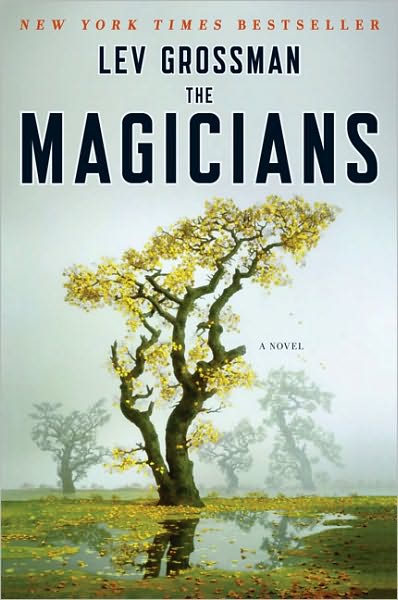
An interview with Lev Grossman, author of The Magicians and Codex, Part I

Lev Grossman’s book tour is just about finished, and I caught up with him at Changing Hands in Phoenix on June 10 to talk about The Magicians. In the novel, Quentin Coldwater is a bright and unhappy high school student searching for meaning, happiness, and a place in the world—which he thinks he’ll find when he receives an invitation to Brakebills, a college for magic. Unlike Hogwarts, however, classes are a grind, students are filled with angst, and sexual politics are everywhere.

As I wrote about the novel:

The Magicians is a surprise and delight: its language is not overly showy and yet often contains an unexpected surprise, especially at the ends of sentences, as this early description shows: “Quentin was thin and tall, though he habitually hunched his shoulders in a vain attempt to brace himself against whatever blow was coming from the heavens, and which would logically hit the tall people first.” Until the last clause, one could be reading any novel, fantasy or otherwise, but saying that a blow from heaven would hit the tall first gives us Quentin’s personality in a single line, and yet its ideas are spun coherently across the entire novel.

The following is an edited transcript, and any links were added by me after the interview:

Jake Seliger: I first read about The Magicians on John Scalzi’s blog, “Whatever.” I don’t know if you’ve met him or not, but he wrote about it and I thought “That’s exactly the book I want to read.”

Lev Grossman: He runs that features “The Big Idea.” I actually wrote that. I ran into him at the World Con—that is the convention—and we got to chatting. He’s a friendly fellow. He let me post something on the blog.

JS: I’m really glad you did. Not every book is one I’ve really loved. He posted about a book called Mistwood, which I thought was okay, but flat in a way. The premise is really interesting—instead of talking from the premise of a human who gains special powers and becomes more than she is, it discusses a summoned creature or magical being who’s becoming more human and doesn’t want to become human.

LG: That sounds like a great idea.

JS: Yeah. The execution is one I didn’t love. It was a first novel. It was a lot of fun. As far as The Magicians goes, I was struck that there’s this repeated expectation or hope of finding another world, that of course gets fulfilled. Even really early on, on page 8, Quentin says, when his interviewer’s “back was turned Quentin would stumble on a mysterious cabinet or an enchanted dumbwaiter or whatever, through which he would gaze with wild surmise on the clean breast of another world.” So he’s looking for these enchantments, and it seems like by the end of the novel that he finds or we find that we either make our enchantments or don’t make our enchantments. Do you agree? Or is my reading off?

LG: No, I think that’s fair enough. I think that for a very long time—an embarrassingly long time—instead of solving problems, I tended to buffer them. Something would come up and I would think, ‘Well, that sucks,’ but I’ll stick it in the buffer, and when I get to Narnia, I’ll basically clear out the whole buffer. And not literally Narnia, but I would decide that if a certain that was coming up—if I got into college, for example—it would solve everything and I would never have any problems again. So I would ever really solve problems: I would put them off and lay them away for a time when they would get solved by the course of events.

JS: That’s funny because it makes it sound like a very passive kind of action. “The course of events” would solve them rather than “I would solve them.”

LG: Oh, it is very passive. I was a very passive person for a very long time. I didn’t really understand how to engage with reality. I didn’t really grapple with it on a basic level. I just let it roll over me. As a result, I made a huge number of mistakes that I wish I hadn’t made. Events made them for me.

JS: I guess that got transposed to the novel.

LG: Yeah, well, writing The Magicians was in a way working through my acceptance of the fact that I never would get to Narnia. Quentin essentially does, and what happens to Quentin is that his problems come with him.

JS: Many of them.

LG: Yeah. And it turns out that action is required of him, in fact, to solve them. Or accept the fact that they’re insolvable.

JS: It seems that’s where a lot of the rhetoric about reality comes from. And not only the reality parts of it, but the two worlds or multiple worlds idea. One of the things I found really intriguing when I got to the end of the novel is when Emily Greenstreet [whose brother dies by becoming a Niffin and who has an affair with Professor Mayakovsky, leading him to be banished to Antarctica] reappears. There’s this wonderful line, and we learn that “In different ways they had both discovered the same truth: that to live out childhood fantasies as a grown-up was to court and wed and bed disaster.” It’s an intriguing sentence because the sexual language doesn’t seem like a mistake. Part of the issue is that incorporating sexuality in life is important and becomes a proximate cause because that’s what actually gets them to Fillory. Alice goes and sleeps with Penny [as revenge for Quentin sleeping with Janet].

LG: Obviously in this book I’m confronting a powerful literary forebear, namely C.S. Lewis. You only do that if you truly truly love the forebear in question. But, one of the things I find maddening about his books is this sense that magic and wonder and ultimately meaning are not compatible with sexual maturity. He’s so in love with childhood that he imagines that there is no such thing as magic once you get older, or if there is, then it’s a debased, ignorant, evil kind of magic, like the magician in The Magician’s Nephew. And I wanted to explore the idea—as Philip Pullman did before me—that coming of age, becoming a whole adult sexual being, entails not a loss of magic but a different kind of magic. A richer kind of magic.

JS: And one that doesn’t always go particularly well, either in the real world or in the novel itself. It seems to me that Quentin in Alice become almost victims of their own sexual politics, in a sort of game theory way. When Quentin sleeps with Janet, which he knows he shouldn’t’ve done but he does anyway, and then they get in this tit-for-tat—

LG: Right. No pun intended. Yeah, it’s true. Things turn out to be very much less than zero sum. It involves taking on a certain kind of risk that you do not have in childhood and accepting that risk.

JS: And the sense of risk is very real in the novel because people die and there are rules in it. The risk feels real that often times in fantasy novels it doesn’t because you know that good is somehow going to triumph in the end even if it’s not complete.

LG: The moment where I attempted in an almost self-conscious way to bring that into the book is when the beast appears in the classroom.

JS: Right. That’s exactly what I was referring to because it’s unexpected, and the teachers don’t know what’s going on. And then there’s speech—I’m pretty sure it’s Dean Fogg who gives it—where he basically says, “There are things out there we don’t know, we don’t understand.”

LG: I want it to feel less safe than Hogwarts. And that was one of the ways I tried to announce that. Here’s a being which is not even evil, necessarily, in a way that is comprehensible to us. It’s almost arbitrary.

JS: It’s chaotic or indifferent.

LG: Which is almost more terrifying, in a kind of mustachio-twiddling villain. And I very much wanted there not to be a Gandalf-like figure, who is able to explain what happened and assume the risk for the kids. Fogg is just about as lost as they are.

JS: To me what’s interesting is in Lord of the Rings, Gandalf almost never has complete explanations. When he leads [The Fellowship] into the Mines of Moria, he doesn’t know what’s down there. That’s part of what reminded me of the beast and the Mines of Moria. In Lord of the Rings, Gandalf doesn’t know everything. And he constantly says that—”I don’t necessarily know what’s going on,” and there’re conjectures and so forth, and that’s a lot of what the Council of Elrond is and some other places in the novel, where they’re always talking about what they don’t know and recognizing their own limitations.

LG: Yeah, that’s very true. I have a bad habit of underestimating Tolkien. He’s always better than I think he is—the Mines of Moria being a case in point.

JS: It’s somewhat dangerous talking to me about it because The Lord of the Rings is one of my favorite novels and I actually reread it about a month and a half ago, and this time around one thing that struck me is how funny it is, because they’re all these little jokes in there, and the relationship between Sam and Gollum is funny, and Pippin is ceaselessly getting in the way, and the relationship between Legolas and Gimli is very funny as well. Once they become friends, everyone is shocked at it: Galadriel goes, “This is a strange friendship!” People are constantly going, “An elf and a dwarf? This doesn’t make any sense!” and they just do their thing.

LG: It’s one of my major weaknesses as a fantasist. I never really came to—there’s almost no Tolkien in The Magicians

JS: There is that funny thing where Alice and Quentin are trying to get into the Physical Kids’ cottage—

LG: Right, right.

JS: —”speak, friend and enter.”

LG: It’s there. But I don’t really wrestle with Tolkien. I don’t understand him very well.

JS: How so?

LG: He’s just not easy pickings like Lewis is. Lewis wrote the Narnia novels—all of them—in the span of slightly over two years. And he’s an incredibly sloppy world builder, because Lewis’ threads are lying around all over the place.

JS: And you have Plover do some of the same things, especially when you describe the fifth novel. In The Magicians, Quentin describes the fifth Fillory novel as being unsatisfying because it just wanders off into nothing.

LG: Yeah. Plover wrote the second novel partly to plug the plot holes in the first one. Which was a vague allusion to The Magicians Nephew trying to explain what happens in The Lion, the Witch, and the Wardrobe, where the White Witch came from, which only ends up introducing a whole bunch of other plot holes. And just sort of, it’s turtles all the way down.

JS: “It’s turtles all the way down.” It’s funny you say that because it seems like Quentin is always look for some version of reality or happiness or whatever, but he doesn’t find it because—this is going to sound kind of trite—but he doesn’t find it because it’s either within you, or it’s not, and it’s not going to be imposed externally.

LG: Yeah, and he’s looking for some sort of safe, closed system, where risk is eliminated.

JS: If you don’t have religion, it seems like you don’t have that anywhere.

LG: Yeah. Well, I’m not very qualified to talk about religion. But certainly, I think what he ultimately has to do is become tolerant of risk and loss and imperfection. He has a tendency to say, “Oh shit, well that went wrong. This world sucks. I’m going to find another world, where it’s better.” But of course, he’ll just run forever—if that’s what he wants.

JS: Yeah, and it’s a little bit—the last world we see in The Magicians is when he’s at this firm he’s not particularly happy at, just making money. And he’s sitting there just before he’s rescued once again. He says, “With the coming of the bitter late fall weather the air-conditioning had gone silent and the heaters had sprung to life, and huge nebulae of steam curled off them in abstract whorls: hypnotic, silent, slowly turning shapes that never stopped and never repeated themselves. Smoke signals sent by no one, to no one, signifying nothing.” It seems like that becomes a metaphor for what Quentin is going through. Do you read a lot of Melville? Or a lot about Melville?

LG: I’ve read Moby-Dick.

JS: In PierrePierre‘s a terrible novel, don’t read it—but there’s a funny section where the narrator announces, “Silence is the only Voice of our God.” James Wood describes Parker’s biography and how “[…] it is not until very late in his story that [Parker] considers Melville’s difficult relationship to his inherited faith, a relationship which is the absent, sunless center of all his greatest fiction, poetry, and letters.” The idea of that “absent center” in Melville is about God, and it seems like Quentin’s case is more about himself. I had a question in there somewhere, I just lost it along the way.

LG: I don’t disagree with what you’re saying—

JS: I think it’s that line, “Smoke signals sent by no one, to no one, signifying nothing.” He doesn’t pick up on that thread of his observation.

LG: He’s attempting to grapple with a world charged with mean and found it intolerably painful. He sought out a world from which meaning has been almost completely expunged—and therefore risk of any kind.

JS: Can you say more about the meaning being expunged?

LG: Well, when you talk about meaning you automatically head into a thicket of solecisms.

JS: That’s true, and maybe that’s part of reason why it’s interesting to talk about it, if one can.

LG: Yeah, but what I mean to say is that there are no stakes in that world. Nothing means anything to him.

JS: In Brakebills, or the corporate world?

LG: In the corporate world. He’s shuffling fungible papers and there’s just nothing at stake.

JS: So how do we if we are modern office workers and we don’t happen to have magic within us, find some things to be at stake.

LG: Yeah.

JS: You’re looking at me with an expression that says, “I have no fucking idea, why are you asking me this?”

LG: There should be an answer. And of course, the office he’s working in is my office, in the Time-Life Building, and the heaters are across the street—that’s the view from my window. Actually, I think they might not be any more, because I moved offices.

JS: To me it sounds hopelessly glamorous, living in New York and working in a very large office building, because New York itself seems glamorous. Maybe that’s ridiculous, and it’s like me looking at New York is like Quentin looking at Fillory.

LG: I don’t know. Well, I guess that’s fair. It has glamorous bits. It has good restaurants.

JS: You distinctly not—

LG: Well, you know, I’ve been there for a while. It’s very expensive, living in New York.

JS: That’s why I didn’t apply to grad schools there.

LG: And it’s causing me—one has to make great sacrifices to maintain a lifestyle there. Recently I’ve become very aware of that.

JS: Have you ever heard of a woman named Penelope Trunk, who writes a blog called Brazen Careerist?

LG: No.

JS: She’s written pretty extensively about her time in New York and why she decided to move from there, which are essentially the reasons you’re describing: the tremendous, tremendous expense of living there makes it impractical.

LG: I have a daughter from my first marriage. If my daughter didn’t live in Brooklyn, I’d probably leave.

JS: But Quentin is busy trying to run away from Brooklyn, at the beginning, and thinks that Brooklyn is tremendously boring and there’s no meaning in Brooklyn. Which is funny, because New York has this romantic ideal in the American imagination of being the center of things and moving to the big city. Quentin is already there and he’s not happy and he wants to move somewhere magical. And then he moves to somewhere magical and he finds out that it’s not as glamorous as he thought either.

LG: Yeah, it’s kind of like moving from Brooklyn to Manhattan. If you live in Brooklyn, everything’s happening in Manhattan.

JS: And when you live in Manhattan, I wonder where everything’s happening. At a cooler party than where you’re at?

LG: Yeah, I don’t know. It’s happening in L.A. I don’t know. It’s always somewhere else though.

JS: Right. And the chase of it doesn’t seem to work out.

LG: It’s always happening at the secret after party you weren’t invited to. That’s where the action is.

JS: Yeah. I have to ask a question: have you ever read a book called Stumbling on Happiness, by Daniel Gilbert?

LG: I started it, but I didn’t finish it.

JS: Really? I’m surprised, because it feels like Quentin is always searching for happiness, and he has this happiness rhetoric going on. And he’s thinking a lot about his own happiness. I mean, there’s one bit pretty early when it says, “He was experimenting cautiously with the idea of being happy, dipping an uncertain toe into those intoxicatingly carbonated waters. It wasn’t something he’d had much practice at.” As though you get better at being happy like you get better at baseball. “It was just too fucking funny. He was going to learn magic! He was either the greatest genius of all time or the biggest idiot. But at least he was actually curious about what was going to happen to him next.” It seems like there are a couple of things going on in the book there: one, this idea of happiness, and two, what’s going to happen next to him, as opposed to what is he going to make happen.

LG: Yeah, that’s true. I guess there’s a passiveness built into that. Honestly, that comes out of—if you read my blog enough, you’ll find me crapping on about depression. While I was writing this book, I was going through therapy for the first time, and I was kind of understanding a little bit about how challenging it is to be happy. It requires an effort to organize your psyche in such a way that happiness is possible. Being depressed is very, very easy. It’s a zero-energy state.

JS: It seems like Quentin doesn’t learn how to organize his psyche in that way. Although going to Fillory or having Alice die might make it considerably harder.

LG: Yeah, well, I think he needs to learn how to mourn. I want to say in the Freudian sense, although now I don’t remember exactly what happens in Mourning and Melancholia, but he needs to learn how to process loss and process grief, rather than having it just stop him cold. I think that’s a lesson that he learns at the end.

JS: It’s funny, because if he does learn that lesson at the end, I didn’t necessarily read it that way because to me it seemed like he was still somewhat passive because he’s gone back to this office, and until Julia shows up and they break his window down and say, “Quentin, you need to come with us—”

LG: Well, he could’ve stayed. My mother thinks that he’s having a hallucination and he’s committing suicide.

JS: Really?

LG: She said it as if it was the most natural thing in the world—”That’s what you meant, right? He’s killing himself, and they’re not really real.” I said, “No.”

JS: I definitely didn’t read that into it, if that’s the question.

LG: I found that disturbing, coming from my mother.

JS: Right. Well, it must be strange hearing all the various interpretations of your books, some of which you’ve now heard from me and some of which you’ve heard from others too. And if we are talking books, you mentioned you reacting to C.S. Lewis in a kind of Harold Bloomian way. Have you read The Anxiety of Influence?

LG: I have, or rather I’ve read about the first 50 pages, which is all that I found comprehensible. Once—

JS: Once the jargon starts, you check out?

LG: Once the Greek starts, I lost it. But I got a lot out of those pages, and I found them to be very true, and very smart.

JS: How so?

LG: This idea of mapping the Oedipal struggle onto literary forebears, I simply find it to be true. And I’m aware that I probably work that way in a more self-conscious way than a lot of writers. And I’m also conscious that as Bloom points out, when one works that way, one is rarely grappling with the literary forebear him- or herself, but rather a caricature of that person one creates oneself for the purpose of then knocking it down.

JS: Like a literary straw man.

LG: Yeah, sure. Just so you have something to push against.

JS: It seems like people have always been pushing against Shakespeare. And you have a line from The Tempest as your epigraph, which I didn’t actually look up—

I’ll break my staff,
Bury it certain fathoms in the earth,
And deeper than did ever plummet sound
I’ll drown my book

What made you choose that? Or did it just sound cool?

LG: Number one, it sounded cool.

JS: That’s a good reason.

LG: It’s about renunciation. That’s the moment where Prospero decides, “I’ve passed the point of life where magic will be of use to me, and now I will return to terrestrial life,” you know, much as the children return from Narnia. And it’s a bit of a fake out, I guess, because it was never my intention to have Quentin give up magic for good. But I wanted him to confront that possibility very seriously.

JS: It’s interesting that you say that, because in giving up magic Quentin then feels as superior as he did when he originally took up magic. At the very end, he says, “To be honest, Quentin felt superior to anybody who still messed around with magic. They could delude themselves if they liked, those self-indulgent magical mandarins, but he’d outgrown that stuff.” Quentin is very touchy about status in the novel—

LG: Very, yeah.

JS: —just like people are in life. People are constantly jockeying for position: school, elsewhere, magically, sexually, and other hierarchies in the novel. Were you consciously shooting for this kind of status stuff and these kinds of status games, or were you just trying to represent the hyper-competitive? This is a somewhat dangerous question because I’m thinking forward ultimately towards a dissertation that might focus on signaling and status in novels—

LG: Really. That’s very interesting to me.

JS: How so?

LG: I’m very interested in that topic. Of course Quentin is a hyper-competitive individual. He’s not like a baseline human in that respect. He I think has a very tenuous grasp on his own self-esteem, and he’s always looking for ways in which he can rate himself above people around him.

JS: I wonder if having sex with Janet is part of that.

LG: Oh sure, yeah, God. I feel like, he must be very aware that—I think at that point, there’s a moment where Alice says, “You know Josh has slept with Janet.” I have a feeling that that fact went into his brain and kicked around for a while and he was like, “Are you kidding? Josh hit that? I have to be above Josh in some respect, and to do that, I want to sleep with Janet.”

JS: Of course, when they’re at Brakebills South, I believe Janet is involved in some of the orgies. But the sex at Brakebills South doesn’t seem to count, I guess.

LG: Yeah, but I think Quentin would’ve been upset if Alice were involved in that. But yeah, on some level—the idea that it doesn’t really count—I went back and forth as to whether that was realistic, or whether it was a bit—I don’t know.

JS: Which part was realistic?

LG: The idea that they would engage in these orgies. You know, I guess I went on in college, but I never got invited to those parties.

JS: Another one of those regrets?

LG: Yeah. The status thing. Status—this is getting way, way overly competitive—but realizing how obsessed I was with status was a big thing in therapy, where I had to deal with that.

JS: Well, the status thing is interesting to me because as far as I know, no one has tried to write any kind of study as to how it really functions in novels, but now that I’m more attuned to it, it seems to be going on all the time: between characters, and with characters up towards the reader. Quentin seems to be aware of this but seems to always view himself as low status. I have this comment about him feeling superior and looking down on those with magic, which feels to me very much like overcompensating.

LG: Yeah, I think he always feels both exalted and degraded, and he’s trying to hang onto the exalted part. He always suspects he’s being humiliated in some way. My wife and I actually play a game after we’ve gone out at a party or whatever, and we’ll try to identify as many status hierarchies that were in play in a given interaction as you can. Because there’s always multiple ones in play.

JS: Right. Which must be hard, because you have probably people jockeying for financial position, and artistic position, and sexual position, and probably others that one isn’t even aware of.

LG: Well, the bizarre thing is how completely differently men and women, or at least my wife and I, analyze these situations. I’ll say, “Oh, you know, this guy is a lot taller than that guy, and they must care a lot about that.” And Sophie says, “That’s baffling, that makes no sense.” And she’ll point out, “Oh, this person is pregnant and that person is pregnant and this person is engaged and that person is engaged,” and I’m sort of, “Well, so what?” But she would argue that for women that is a status marker.

JS: What is? Being pregnant or engaged?

LG: Yeah.

JS: That’s interesting. Did you ever read Neil Strauss’ book, The Game?

LG: I have to admit, I picked it up out of morbid curiosity. I didn’t read it through, but I leafed through it.

JS: So did I. In that, he talks about the endless status and peacocking things that go on. And there’s a part of me that wants to slip Quentin a copy of it and say, “Quentin, it’s okay.”

LG: Yeah.

JS: But he’s neurotic about some of the sexual aspects and the magical aspects, and they intertwine for him.

LG: Oh, yeah sure. Well, everybody—the most obvious status hierarchy that’s in play is who’s the better magician.

JS: The hierarchy thing gets interwoven with the power, and to go back to the Emily Greenstreet thing, when her and Quentin meet at the end, she goes, “They’re just kids!” And then there’s a funny little line, “Just thinking about that place now gives me the howling fantods.” I have no idea what a fantod is.

LG: That’s a David Foster Wallace expression. I think it’s taken from him.

JS: Yeah, well I’ve never actually loved his work, which might explain why I don’t know what a howling fantod is.

LG: I read it in David Foster Wallace, and only now does it occur to me that he probably made it up and it’s not a generally used idiom.

JS: Well, that’s words always get started. You use howling fantod and now maybe I’ll start using it on my blog or elsewhere, and now suddenly people know what a fantod is. [EDIT: my spellcheck didn’t flag the word “Fantod,” and the Oxford American Dictionary that comes with OS X 10.6 defines it as “a state or attack of uneasiness or unreasonableness : the mumbo-jumbo gave me the fantods. ORIGIN mid 19th cent.: of unknown origin.”]

LG: In retrospect I’m surprised the copy-editor didn’t flag it.

JS: Maybe she just thought it was a magical term. Anyway, it’s funny because she says, “They’re just kids with all that power.” It seems like the power there—all kids and all people have power in their own way, whether it’s sexual or whether it’s working on something. Kids have power over their bodies and their world: to be or to kill or to be killed, to work or not to work. And so, I don’t know, her complaint there about magic in particular seems like it starts to have a broader resonance. How do kids grow up and deal with whatever it is that they’re doing?

LG: Yeah, I suppose that’s true. To be honest, when I wrote that dialog, the only thing in my head was, “She’s completely right.” I mean, it’s insane the way that institution is run, and it’s amazing that the whole thing hasn’t erupted before now.

JS: What I started to expect when they got to Brakebills, is that probably if you gave a bunch of male teenagers unusual power, some of them would presumably try to rape or sexually harass some of the girls there. So I kept waiting for the administration not to know what to do about that. Like some combination of Anita Shreve’s Testimony and something else. But you never went that route.

LG: No, I know. And it’s entirely plausible I think to do so. Yeah. I didn’t go down that road.

JS: But the idea of teenagers having power, people in general having power, even if they don’t realize it—even without magic, teenagers have a certain amount of power, and part of what growing up seems to me to entail is learning whatever power you have and how you’re going to realize it.

LG: Yeah, well I think that’s very true.

JS: And that actually goes back to The Lord of the Rings, because in The Two Towers when Gandalf comes back, he says something like that to Gimli and Legolas and Aragorn: he says, “You guys have power of your own too, whether you realize it or not.” It’s this process of realization: it seems like Quentin sort of realizes he has power but doesn’t really still understand it or can’t grapple with it.

LG: Yeah, well, I think he’s very afraid to sort of embrace it. To accept it–I think it’s very difficult for him to accept that he is in fact a powerful being, a being who’s capable of action and very concerted action.

JS: Yeah. And it seems like he’s using magic to try and find reality. Really early in the novel, he says, “James opened the door. The cold air was a pleasant shock. It felt real. That was what Quentin needed: more reality. Less of this, whatever this was.” That word real just recurs over and over again in the novel. But I read that and wanted to say, “It seems to me that reality is wherever you are and whatever you make of it.”

LG: Yeah, I suppose. But that is a lesson that Quentin has yet to learn. He’d rather somebody else make it.

JS: Right, which is hard. But it’s like he’s on a search for reality as much as he’s on a search for magic.

LG: Yeah. I think that’s fair to say.

JS: Were you consciously thinking about that when you were writing Quentin? Or just saying, I’m trying to represent someone growing up and dealing with these situations?

LG: I’m talking to the characters and trying to emulate their behavior as accurately as he can. And then you go back and read and think about whatever that means.

JS: I think Steven King said something like that in On Writing, which is that he doesn’t consciously think about symbols, or metaphors, or that kind of thing when he’s in his first draft—he’s just trying to tell the story. Then he goes back through and says, “What might I have meant by this stuff?”

LG: I’ve heard that book is very good. I’ve never read it.

JS: Yeah, it is, it’s pretty interesting. Mostly it moves pretty quickly. Which I think is very nice. I certainly liked it. And that little comment obviously stuck in my mind enough to come out here, when he talks about symbols and how things work. Another thing that I noticed in The Magicians is that there were a lot of mentions of shit. Probably more than in any other fantasy novel I’ve read. Quentin smells “the faint, bitter odor of shit” when the interviewer dies. And you keep finding shit in the novel.

LG: It seemed important that there were strong whiffs of shit and sex in the first chapter, anyway.

JS: Right: Quentin also thinks that he’s not going to sleep with Julia, and that makes him unhappy.

LG: And he’s sort of, all hot for that paramedic lady.

JS: Who turns out to be Jane, right?

LG: Right. It goes back to this C.S. Lewis thing. I wanted to explore the idea that power begins with sex rather than ends with it.

JS: Probably because so many of us acquire power in order to deploy it to gain sex in one way or another. Or to gain the financial means we need to either acquire sex or attention.

LG: Yeah. Whereas in Narnia, of course, as soon as Susan puts on lipstick and nylons, that’s the end of Narnia for her.

JS: Well, in Harry Potter too, because it seems like the motives are all to defeat Voldemort rather than to be the star. It seems like Harry Potter is not being the star of the Quidditch team so he can get laid, but, at least based on the people I went to high school with, I’m guessing some of the football and basketball players liked their sport, yes, but—

LG: I don’t really understand the way sex works in the Harry Potter universe. It seems to be quite…

JS: Because it’s childish! And that’s what A.S. Byatt was writing about—which I don’t know if you’ve read her pieces critical of Harry Potter

LG: Yeah, I have.

JS: But you really like Harry Potter, from what I can gather from your blog.

LG: Yeah. Well I think Rowling makes distinct choices what it is that she’s going to deal with and what she isn’t. One of the most significant things to me is that she opted out of having Harry be a reader. Harry comes to Hogwarts without ever having read a fantasy novel in his life, which is flatly impossible. If he had grown up in that household, in the abusive step-family’s household, in that tiny room, all he would’ve done was to read his Narnia books to shreds, and then he’d have all these strange ideas when he got o Hogwarts about how magic is supposed to work.

JS: And then it doesn’t work out right.

LG: Yeah. He goes there as if he’s never read a book in his life.

JS: Yeah. It’s funny that you say that, because in the context of when I first read about The Magicians on Scalzi’s blog, I, of course, like a lot of English grad students, I’m a wananbe novelist-type, and I was about two-thirds of the way through a novel called A Glimmer in the Dark that also had people with special powers—but “magic” is ever named, of if it is named it’s mocked a little bit, like in Tolkien. So I was about two-thirds of the way through this and characters are constantly referencing fantasy novels, because they’ve read fantasy novels too. So when I first heard about The Magicians, I thought, “Oh, shit.” My second thought was of course, “Obviously I have to read this novel.” It was hilarious because I was thinking along the same lines.

LG: Yeah, well I’m sure there’s plenty of room to run with it. I think that that kind of—for lack of a better word, “literary self-awareness”—is a very productive angle for fantasy. I don’t see a lot of self-interrogation in fantasy novels. Which I don’t think is necessarily a criticism, I’m just very curious about it. When I read Watchmen for the first time, it was a very primal reading experience for me: to read a superhero story that aggressively attacked the very foundations of the conventions on which superhero stories are built. I fucking got off on that. That was very important to me. And the result was the realist superhero story I ever read.

That’s the end of the first part of the interview; you can read the second part here. A few follow-up thoughts:

Regarding the issue of solving problems:

I think that for a very long time—an embarrassingly long time—instead of solving problems, I tended to buffer them. Something would come up and I would think, ‘Well, that sucks,’ but I’ll stick it in the buffer, and when I get to Narnia, I’ll basically clear out the whole buffer. And not literally Narnia, but I would decide that if a certain that was coming up—if I got into college, for example—it would solve everything and I would never have any problems again. So I would ever really solve problems: I would put them off and lay them away for a time when they would get solved by the course of events.

I’m reminded of the song “Mo’ Money, Mo’ Problems,” which points out that success brings with it problems of its own, just of a different kind than what might’ve come before. It seems that people, especially young people, think that if they can just achieve “X,” where X might be success, or the significant other of their dreams, or money, or whatever, they will have it made.

But that doesn’t seem to happen very often in the real world: we swap one set of problems for another, unanticipated set, and happiness more often comes from within regardless of one’s circumstances. I’m stealing that idea from two major sources: Stumbling on Happiness, as mentioned in the interview, and Viktor Frankl’s Man’s Search for Meaning, about how he survived the Holocaust through withdrawing within himself. Neither idea is especially new—Stoic philosophy got at some of the same principles millennia ago—but both offer fresh takes on how and why these kinds of issues exist.

But relatively few people seem to understand this idea. Maybe I’m projecting my own feelings, and those I sense from friends and acquaintances, but it’s nonetheless what I sense.

Grossman says, that “I didn’t really understand how to engage with reality.” Neither do I, and I’m busy trying to stop that from happening, because it seems like that’s not always a positive thing.

As far as Hogwarts versus Brakebills, Hogwarts never seems that scary, and there aren’t very many unknown unknowns—that is, things about which the professors and students know absolutely nothing. That lessens the sense of horror and wonder.

There are known unknowns, like the power of various enemies, but very little of the truly terrifying things that are completely unexpected and dangerous. It’s one of many reasons why I don’t find Harry Potter satisfying. And most things in the world aren’t good or evil: they’re self-interested. Too few fantasy novels acknowledge that. Maybe too few novels in general acknowledge it, but to me it seems more prevalent in fantasy than literary fiction, and I think The Magicians is a useful corrective in that respect. I hope more fantasy novels will grapple with it. I would like to think that A Glimmer in the Dark, which I mentioned above, does, but whether it will see its way to publication at some point remains to be seen.