This Beautiful Life — Helen Schulman

I heard about This Beautiful Life in a New York Times review and immediately worried: the novel sounded similar to the novel I’m working on that doesn’t have a title (I’m referring to it as “The Teacher Novel”). But reading This Beautiful Life makes me happy because the Teacher Novel is definitely not worse and almost certainly better. This Beautiful Life is too frequently boring; it’s disconnected from itself (the very short first and last chapters are effective and engaging, however). Anita Shreve’s Testimony and Tom Perrotta’s Election cover similar territory far, far better.

Other comparisons work too. Reading the first long section of This Beautiful Life, which belongs to Liz, the mother, made me reread the first three chapters of The Great Gatsby, because Gatsby isn’t just better, it’s on a whole different plane, even though it’s also covering the banal problems of rich New Yorkers. Gatsby retains its ability to amaze, especially at how deftly Fitzgerald transitions from scene to scene. He’s so damn technically good that 1) I wonder / doubt if I’ll ever do anything as good and 2) Schulman looks unfortunate in comparison (funnily enough, Jake, the 15-year-old boy, reads Gatsby towards the end; I wonder if he learns anything).

Schulman avoids transitions by not writing much in scenes. There are some good sentences (one example: Liz, Jake’s mother, notes his height and says that “It was as if, suddenly, three extra vertebrae had been added to the staircase of his spine”) and amusing bits, but most of the novel isn’t composed of scenes, and the writing isn’t quite enough to make up for that. I feel like I’m reading weekend New York Times articles on overly yoga-ified Upper East Siders. The novel lacks the fiery pop at the end of Election‘s chapters, as it does tension. The father, Richard, has the strongest section, mostly because he actually does something, instead of sitting around being acted on.

Like Testimony, This Beautiful Life has the problem of having a single, main event, without any other plot points or subsidiary issues, but Testimony has more voice. It has more knowledge of itself. This Beautiful Life also got a moral problem: a 13-year-old girl named Daisy sends a 15-year-old guy named Jake a sex tape, and he forwards it to one person. Who cares? She did it willingly, and although she’s young it’s apparent she has sufficient knowledge and agency of what she’s doing to make the question of her agency unimportant. The novel is set in 2003, which is essential: if it were set closer to the present, the idea of a sex tape becoming a social conflagration beyond the confines of high school would be wildly improbable.

I feel like the New York Times reviewer, Maria Russo, read an entirely different book than I did, or hasn’t read This Beautiful Life’s predecessors. Schulman teaches in New York, and I wonder if getting the cover of the book review was a sweetheart deal with Russo, her agent, and/or the book review editor (if so, I’d love such a deal). Not everything that makes the NYT Book Review cover is aesthetically or intellectually interesting (here I’m thinking of Angelology, an utterly forgettable book). Russo assume that social and cultural mores are permanent (“What can the future hold for unformed, vulnerable kids who bumble their way into the lowliest realm of the permanent record that is the Internet? (Or, in Daisy’s case, reach it by simulating sex with a toy baseball bat.) Should their parents be held responsible, or are they equally victimized by the seductions and traps of digital life?”) instead of fluid. Russo gets to the idea that cultural mores, but not until the last paragraph. I would’ve liked a stronger historical sense. These criticisms may be due to the brevity of the venue: the NYT only allows so many words, and I think her review is in the neighborhood of 1,200.

I suspect that, if it hasn’t happened already, sexting will be pretty normal and not enough to drive plots in the near future. For guidance on changing mores, look to the past. In 1900 – ~1965, you could drive plots using the question of whether teenagers have sex, given how much of society was set up against that. Today, if you did the same, you’d have to use religious prohibition or something similar to drive the plot, which isn’t very satisfying because the solution (“stop being a religious wacko; your parents are unreasonable”) is obvious. Caitlin Flanagan get some, but not all of this—I’ve seen her work in The Atlantic. We’re seeing the phenomenon of “shocking” behavior becoming normal much faster than we used to, which makes me worried about the Teacher Novel, because it might not age well if behavior considered daring or inappropriate today becomes obvious tomorrow. Fortunately, I think the central questions avoid sex tape plots, but still: looking at changes throughout history make me wonder what’ll happen next.

For example, one grad seminar assigned Dreiser’s famous novel Sister Carrie, which was apparently shocking for its day (IIRC, it was published in 1900, though it might be a little later—1910?). Reading it now is banal. Who cares if a woman divorces one guy and marries another? I wonder if these narratives about teenage sex tapes will have the same effect in the nearish future, once people who’ve grown up with sending naked pictures of yourself as a standard practice; Penelope Trunk gets this, but she’s uncommonly opened minded, and I sense a generation gap (am I on the wrong side, I wonder?).

The first and last pages of This Beautiful Life are very good and describe Daisy. The sex acts that begin this novel (and Testimony) are effective attention-getters because most people don’t believe or want to believe that 12- and 14-year-old girls can be sexual (raising the question: have most people forgotten what it’s like to be 12 – 14?). The second paragraph is a single sentence: “Still think I’m too young?” It’s a provocation, but the description isn’t sexy: she has “a hunky ponytail” and “A little roll of ivory fat nestled above the waistband” of her skirt. The suggestion is powerful anyway, and the pages to follow are largely the lead-up and comedown from the two that begin the novel. This has the unfortunate side effect of draining narrative tension; Election avoids this problem through a shadow story about how the party happens, which isn’t revealed until the very end of the novel. This, along with the sheer diversity of voices, makes it a better novel.

Still, This Beautiful Life is a reminder that the novel as a genre is still going places movies and TV can’t or won’t. If a director portrayed a video of a girl who in this scene: “The breasts inside were small, and at first she covered them with her palms, fingers splayed like scallop shells. Then she unhooked the bra in front and they popped out as if on springs”, she’d be arrested for depicting someone under 18 in a sexualized circumstance with nudity. The director could hint and imply but couldn’t show what the novel describes.

I have to read the first paragraph of the second section ironically: “As with so many things of consequence, it all began with a party.” It seems highly unlikely that many “things of consequence” started with a party; an idea, a conversation, a scribble in a notepad, maybe, but a party? Seems improbable. Pages 10 and 11 of the hardcover have a lot of superfluous stuff. I took a picture of a page with my edits, where I remove sentences the book doesn’t need. In rereading of Gatsby, part of what’s so amazing is how essential most of it feels. So mysterious. We don’t even meet Gatsby until chapter three, and then by accident. One of the novel’s letdowns is in Chapter 6, where Nick suddenly regurgitates a bunch of stuff about Gatsby’s supposed background (this is similar to what Mark Sarvas mentioned in 2007: that it’s important not to become overawed by the great). Too much of the novel should be tightened like the face of the mothers Liz lives among. On page 100, “Richard felt the skin on his face tighten.” You could remove that sentence and lose nothing. There’s also a strange mistake: Schulman writes URLs as “feigenbaum/blogspot.com,” when Blogspot URLS are always in the form feigenbaum.blogspot.com. It’s minor, but it galls.

So do aspects of the characters. Take this early scene from Liz:

It’s your butt or your face—you can’t have both, Liz thought. Some movie star had said this; she’d read it or heard something like it somewhere, and had stored a smudged replica of the quote in the hash of celebrity trivia her brain had accumulated without effort, along with all the other stuff and nonsense that passed for knowledge these days from print magazines and whatever: TV, the Net, idle chitchat, the air . . . But it was true, about your butt or your face.

The “hash of celebrity trivia” is what’s so odd to me about Liz: she used to be an art historian. She got a PhD in art history. Yet little to no knowledge of art, art theory, aesthetics, or related subjects trickles into her thought. By now I’ve met lots and lots of academics, and the ones who stick it out to the PhD don’t do so for the money, which is practically nonexistent; they do do so for the love of their subject. It’s bizarre that Liz imparts so little of this in her thinking; she says that “her dissertation had distinguished itself because she’d focused on the synthesis of art, design, and dance in a new and radical way” {Schulman “Beautiful”@38}. But what way is that? How does it differ? Liz “couldn’t remember the subtitle” of that dissertation, which is understandable: titles are easy to forget. But much of the content appears to have gone the way of that subtitle. If art plays a real role in her present life, it’s well-hidden.

People’s professions cast shadows over their conversation, but Liz’s appears to be a veneer that lies no deeper than the letters after her name. What happened to all the knowledge she must have acquired? Why doesn’t she ever think in ideas? Characters content to surf on the world of everyday minutia are boring; one thing that sets science fiction apart from other kinds, at least in the view of Neal Stephenson, is its focus on ideas. He elaborates in this Salon interview, where he defines science fiction’s big tent as

Fiction that’s not considered good unless it has interesting ideas in it. You can write a minimalist short story that’s set in a trailer park or a Connecticut suburb that might be considered a literary masterpiece or well-regarded by literary types, but science fiction people wouldn’t find it very interesting unless it had somewhere in it a cool idea that would make them say, “That’s interesting. I never thought of that before.” If it’s got that, then science fiction people will embrace it and bring it into the big-tent view of science fiction. That’s really the role that science fiction has come to play in literature right now. In arty lit, it’s become uncool to try to come to grips with ideas per se.

Knowing something of celebrity gossip doesn’t automatically preclude one from having ideas, thinking about ideas, or thinking about what might go beyond the tiny halo of an individual life. Thinking about ideas also isn’t incompatible with worry about the body, sexual attractiveness, how others respond to the body, and so forth. But this moment is emblematic of why Liz, as a character, tends to be boring: she doesn’t have access to those ideas. The writing isn’t as crisp and mysterious as Fitzgerald’s (but then again, whose is?). The structure isn’t as sharp as Shreve’s or Perrotta’s.

If Liz had really been the house intellectual, the person who understands the deeper cultural structures underlying what her family is going through, she could’ve been a fascinating character. Instead she seems to have hung up her mind when she became a former. I suspect not all women do. The noun she uses in the passage above—”trivia”—is the problem: her life appears to have become trivia. This isn’t a fact that dooms her altogether, but if you can’t rise beyond trivia, then why bother? And I’m not asking that she cite Foucault or tedious theoretical windbags; I’m just asking for more awareness of her own situation. Give me some cool ideas about what things are about. Literature that endures has ideas; Jane Austen, whatever her faults, is constantly questioning how families and social relationships should work. Her characters are attuned to the minutest questions of status. I’d like to see the same here.

Liz has some faint idea of her problem, since she notes the “nonsense that passed for knowledge.” But it doesn’t pass for knowledge “from print magazine and whatever:” it passes for knowledge because she consumes it. Anytime she wants, she can skip US Weekly and pick up The Atlantic. But she doesn’t.

This passage isn’t bad on its own; if it were embedded in a story with more power, I’d take from it what I think Schulman was shooting for: Liz’s struggle with the wealthy but stultifying environment she’s in and can’t easily leave without harming her family and her husband’s work. It’s a worthy struggle, but a frustrating one because Liz should have the intellectual and financial tools to understand it. But she chooses not to use them, and a character who seems pointlessly helpless is a tedious character too. And Liz does have some real thoughts. In this scene of self-criticism, she’s looking at her ex-flings writing and says:

He was smart, funny, but still immature. He hadn’t seemed to have developed distance from his own dilemmas or learned how to structure a narrative. At what point did potential, budding and nascent, turn into stagnancy? At what point did stagnancy equal tragedy? Is that what made midlife unendurable for so many? Is that what made each and every day feel so damaging?

All this is plausible, and notice how she moves from the guy’s writing to her own life: she stats off talking with him, and by the second sentence you still think she’s talking about him. By the third—”At what point did stagnancy equal tragedy?”—you get the idea that she’s not talking about someone else. She’s talking about herself, as critics so often are when they write criticism. So she gets some self-analysis by the end of the story.

So does her son. Jake is uncommonly knowledgeable, like so many adolescents in fiction; he notes how teenagers mostly “walked around, calling out to one another, ‘S’up. S’up.’ It was rhetorical, not ever a question. Nothing was up, usually, unless something was. They were kids; they were terminally looking for something to do.” They don’t find it. At the very least, this passage feels dangerous, knowing what we know about the novel from the dust jacket and the first two pages. There’s a sense of a transgression. But you’ve read these scenes before, especially if you’re a regular young adult reader, but Jake’s crush on a girl of Chinese descent is endearing; he notices what she wears and “thought Audrey’s haircut made her look French, although he had no idea really what that meant.” Who does, really? Maybe someone who’s read La Seduction. That he wants Audrey drives him forward and toward Daisy, who wants him and sets about luring him via video. Lesson: people do strange things for love. Perhaps it’s a lesson we already know, but so it goes.

He understands Daisy slightly better than his mother does: Liz says of Daisy, “That poor, wretched, stupid girl. Marjorie says the mother’s always away somewhere, that even when she was little she was always picked up by a nanny.” As if someone who wasn’t picked up by a nanny would automatically never make a sex tape. Plus, Daisy presumably wouldn’t have made the tape if she didn’t think it was a good idea; perhaps she has a high discount rate, and adults, with lower discount rates, are thus unhappy because they’re judging someone they don’t understand. Her husband does the same thing, but intentionally, to a reporter. He says that of the video “It looked like a junior league Debbie Does Dallas. I don’t know where the girl learned this stuff.” The answer is obvious: the Internet. Of course, lots of people “learn” stuff of this nature from the Internet and turn out to be perfectly okay, as Daisy does.

But Richard understands something that he doesn’t want to define; he watches the video (all the adults do, and one gets a prurient swirl of surveillance). When he does, he uses standard moralistic language, but he also notes, basically, that it’s also hot, a way similar to some of the comments in Testimony, when either Mike or Rob is describing the tape of Sienna. If someone is being intellectually honest, they have to acknowledge that erotic power isn’t flipped on like a switch when one turns 16 or 18. In some people it develops early. When Richard sees the video, he also says:

And for all the video’s dismal raunch, its tawdriness, for all its sexual immaturity and unknowingness, there is something about the way this girl has revealed herself, the way that she has offered herself, truly stripped herself bare, that is brave and powerful and potent and ridiculous and self-immolating and completely nuts.

He’s right; the nuttiness, the sense of going beyond the bounds, gives the video its power (does this language sound familiar? It’s similar to how I described Ariel Sands’ Never the Face). In the end, there can be something about such a video. Richard doesn’t understand everything; he says that “It looked like a junior league Debbie Does Dallas. I don’t know where the girl learned this stuff.” The answer is obvious: the Internet. Of course, lots of people “learn” stuff of this nature from the Internet and turn out to be perfectly okay, as Daisy does. The novel needs to be set in 2003, because if it were set in 2011, a viral sex tape wouldn’t be so shocking, and I’m somewhat confident that high school students have developed antibodies for the event (from what students tell me, that’s true).

What’s normal today may not be normal tomorrow, and, thus, the worries about the tape might eventually be as strange to us as Seventeenth Century European schisms and wars. Manufactured drama around sex can make the amorality of Gossip Girl attractive by comparison. What would Blair say to Jake and Daisy?

Virtually everyone in this novel is reacting to things. Jake reacts to Daisy. Liz reacts to circumstances. Richard reacts to Jake. The only person who really acts on their own volition in the novel is Daisy; if anyone’s the hero, she is. That the hero gets to say so little is unfortunate. Notice how The Great Gatsby is driven by several great wants: Gatsby’s for Daisy; Daisy for excitement or some way out of her stultifying life with Tom (he who cites The Rise of the Coloured Empires), Nick’s for figuring out who Gatsby really is. Without all that want, like the voice of “I want, I want” in Henderson the Rain King, you wouldn’t have a story in The Great Gatsby. You’d have a series of still lifes. This Beautiful Life is more animated than a still life but less than The Great Gatsby. It shows so much promise, and The Great Gatsby keeps creeping up in it.


She’s gotten a lot of good press. The NYT review is above; the Paris Review blog interviewed her. The Washington Post has a banal review not worth linking to. Reading such reviews reminds me of why I like James Wood so much, even when I disagree with his assessments.

Flashback — Dan Simmons

There are shades of Philip K. Dick’s The Man in the High Castle all over Flashback. Problem is, they don’t really go anywhere. The novel opens in the near future with a mystery: Hiroshi Nakamura is a wildly wealthy Japanese man who needs Nick Bottom to solve the mystery of his son’s death using a drug called Flashback, which lets one relive in the past as if it’s the present. The setup is clever; Nick, rather than being a classic detective-alcoholic, is a flashback addict and feels “the flashback itch crawling in him like a centipede. He wanted to get out of this room and pull the warm wool covers of then, not-now, her, not-this over himself like a blanket.” He wants his time warped, in other words, as the centipede tells him. He wants to retreat to childhood: hence the blanket. It’s a nice image, and double so because the novel doesn’t have many of them.

Flashback is frustrating because it has so much promise that goes unfilled. There are lots of “as-you-know-captain speeches” (as there were A Game of Thrones), like this one, six pages in:

The polishes cedar floors and fresh tatami mats, in contrast, seemed to emanate their own warm light. A sensuous, fresh dried-grass smell rose from the tatami. Nick Bottom had had enough contact with the Japanese in his previous job as a Denver homicide detective to know that Mr. Nakamura’s compound, his house, his garden, this office, and the ikebana and few modest but precious artifacts on display here were all perfect expressions of wabi (simple quietude) and sabi (elegant simplicity and the celebration of the impermanent.

How do you have fresh dried grass? Shouldn’t it be fresh or dried? Beyond that, the phrase “Nick Bottom had had enough contact” signals that we’re about to be told a bunch of stuff. In and of itself, that’s fine. The problem is the sheer number of times the story pauses for no particular reason to regurgitate stuff at us. Susan Bell’s essay “Revisioning The Great Gatsby” (part of The Writer’s Notebook: Craft Essays from Tin House) details how deftly F. Scott Fitzgerald avoids such problems in The Great Gatsby, with the help of Maxwell Perkins. We’re not so lucky here. In Neal Stephenson’s Cryptonomicon, digressions feel organic. Here they feel forced.

So do the italics that give us Nick’s thoughts; toward the end of chapter one, he thinks, “You know why you’re going to hire me for this job, jerkwad. Let’s get to it. Yes or no.” I’ve heard similar sentiments in a thousand detective novels and movies. They don’t add anything to the story or Nick’s character. They’re distracting. The problems in the first chapter continue throughout.

There are good bits, as when Nick decides not to flashback to sex: “he was simply glad that his video-recorded idiot’s face wouldn’t be showing the uncoordinated spastic echoes of his orgasms from eighteen years earlier.” We get the self-loathing, the professional’s unhappiness at being caught unaware, the thought of “uncoordinated spastic echoes” that capture a look in a way that’s fresh and vital. Such moments are just too rare. The book is too fat. It deals with balkanization and terrorism in ways that are interesting and imagines a future without state or national infrastructure, which is a scary one. It just doesn’t do so well. There’s a palpable fear of Muslims and what, for lack of a better word, I would call multiculturalism or pluralism; a character thinks:

Los Angeles [was] celebrating the events of that old holiday called 9-11, September 11, 2001, the date—as Val had been taught in school—of the beginning of successful resistance to the old imperialist American hegemony and a turning point in the creation of the New Caliphate and other hopeful signs of the new world order.

We get a lot of conservative ideology here: the distribution of dangerous ideas in schools; the idea that liberals see American hegemony as dangerous and imperialist; and the fear of Islamists taking over the world. Women “in full burkas” sit, and one has “bright blue eyes” who Val says “was Cindy from his Wednesday Social Responsibility class.” None of these fears seem likely, and after the Arab Spring, they seem even more ludicrous. The world is mostly inching toward liberalism, not authoritarianism, bikinis, not burkhas, despite the United States’ present penchant for spying on its own citizens. A college professor begins to question his own received wisdom, and experiences “Doubt [about] whether America’s eventual retreat from the rising success of radical Islam’s influence around the world was the wisest course.” Except that the U.S. is successful precisely because its culture promotes letting people live as they choose, so long as they don’t harm others: this is part of the reason why the U.S. is very good at integrating minorities, while Europe struggles. The idea that the U.S. will ‘retreat,” whatever that means in the context, is ludicrous.

I’m not opposed to novels with political messages, as long as those messages are thoughtful, reasonable, and well-integrated, and dumb politics aren’t limited to the right (on the left, see: John Steinbeck). I’m opposed to novels with dumb politics, like this one, but I’m even more opposed to weak writing.

You can have a book with little plot and spectacularly unusual sentences or language use; this is basically what Joyce and John Banville do (or, think of Banville’s alter ego detective fiction writer, Benjamin Black). You have a book with lots of plot and uninteresting or banal sentences, which is what a lot of thrillers do. But it’s really hard to have little plot and average sentences, which is what you see in Flashback. It’s got a great premise and doesn’t deliver. I got to page 200, mostly because I had time to kill while waiting to meet a friend. Flashback did fill time and did offer an intriguing premise. It didn’t do much else.


EDIT: I am not the only one who is disappointed in Flashback.

Slam — Nick Hornby

Slam starts with great promise: a list of bullets that show a lot of Sam’s life in a short space and show why it’s going well (“For example: Mum got rid of Steve, her rubbish boyfriend.”) It’s got a fun, fantastical conceit in that Tony Hawk talks to the narrator and comes to represent a kind of externalized consciousness, giving Sam a dialogic way of bouncing ideas off another person. But the novel itself meanders. I look for the great sentences and don’t find them. To be fair, there are strong sections.; for example, in analyzing (as best he can) his family, Sam says:

The story of my family, as far as I can tell, is always the same story, over and over again. Someone—my mum, my dad, my grandad—starts off thinking that they’re going to do well in school, and then go to college, maybe, and then make pots of money. But instead, they do something stupid, and they spend the rest of their lives trying to make up for the mistake they made. Sometimes it can seem as though kids always do better than their parents. You know—someone’s dad was a coal miner, or whatever, but his son goes on to play for a Premiership team, or wins Pop Idol, or invents the Internet. Those stories make you feel as though the whole world is on its way up. But in our family, people always slip up on the first step. In fact, most of the time they don’t even find the stairs.

Notice the metaphor at the end: most of the world “is on its way up,” without noting the transportation method (flight? an elevator?), but his family doesn’t “even find the stairs.” It’s a bittersweet passage, with him not exactly castigating his family but still fundamentally aware of social class. Yet why not start the metaphor at the beginning of the paragraph? His family’s story is always the same, with them looking up as other people go by, or being on the ground floor of a building whose top they can’t even conceptualize, or something to that effect? You could do much better than the ideas I’ve come up with in 30 seconds, but the point is that there’s no reason not to extend the metaphor—maybe throughout not just the paragraph but the book. We appreciate that Sam’s awareness is a step on the road to change, but he could be slightly more aware without harming the fundamental structure of the story.

Perhaps not surprising, some of the story’s tension involves whether Sam will continue the family tradition or break it. He meets a higher class, very attractive girl named Alicia. They talk music. He works to avoid being subservient to her, but later thinks that “I knew that I didn’t want to be [Alicia’s] friend, if you know what I mean, and I was worried that her being friendly to me meant that I didn’t stand a chance with anything else. I know that’s wrong. Mum is always telling me that friendship has to come first, before anything else.” Sam knows the score even when his mother doesn’t, or doesn’t want him to know. She is, in essence, pitching him the idealized version of romance, which he has internalized to the extent that he says he knows that not wanting to be Alicia’s conventional friend is “wrong,” imputing a sense of morality on an act that’s more about strategy than morality. In a different world, friendship would come first. If you search Google for “Friend Zone, you’ll find a wide array of articles with advice on how to avoid becoming “just a friend.” Sam’s Mum is trying to give him advice that isn’t highly applicable to the real world.

If you’re already aware of these dynamics, however, the novel will feel like old news. It’s not bad, exactly, but it’s not exciting, either. A lot of the book is fun. It just feels average, unlike Francine Prose’s Touch. I’m looking for ways that make it more than average and not finding them. Hornby’s best book, by far, is still High Fidelity. Maybe it always will be. I often think about it when writing contemporary novels that feature love stories; he fundamentally understands that such love stories tend towards comedy, that indecision is the great modern problem, and that love stories need more than just a should-I-or-shouldn’t-I plot. Whenever I read High Fidelity, I’m impressed again at how surprisingly well constructed it is. I keep trying his other books (A Long Way Down, How to be Good, Slam) in search of the same kind of mastery. I keep not finding it.

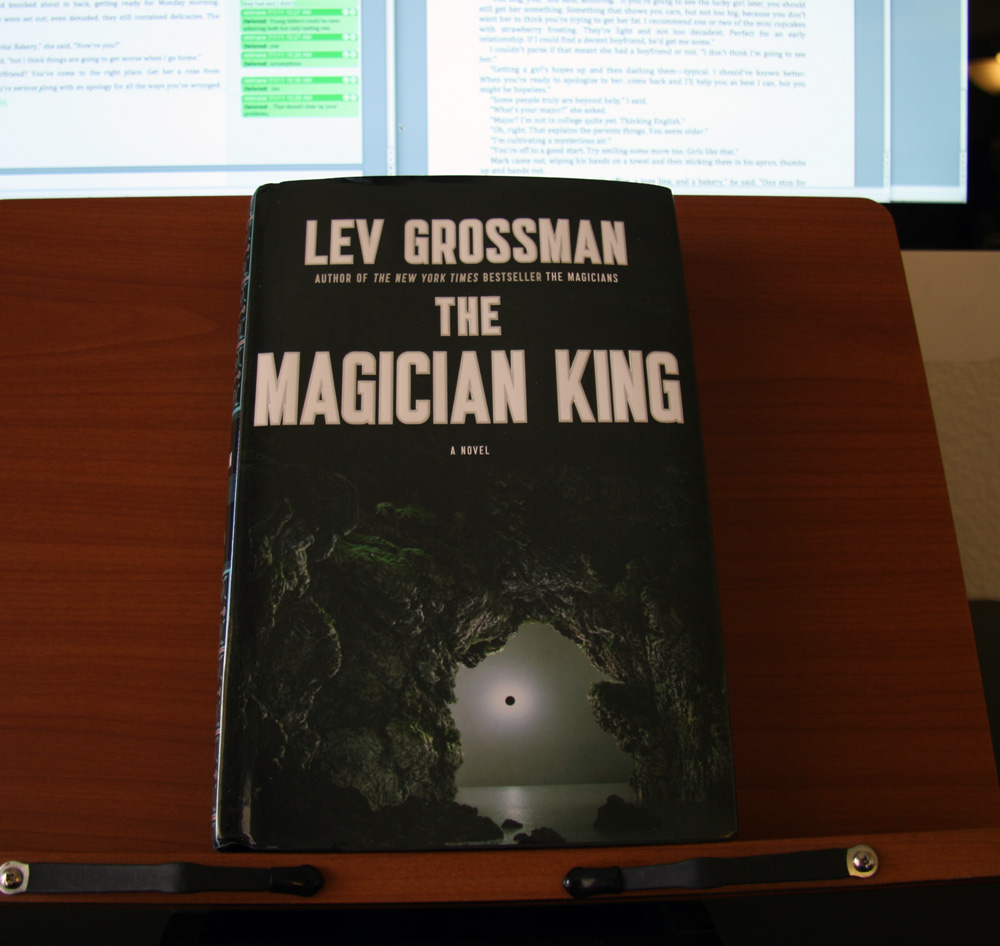
Lev Grossman's The Magician King arrives:

… alas, you won’t see any further comments on it until August 9—the publication date.

I’ve been getting more interesting books from publishers lately: Carolyn Cooke’s Daughters of the Revolution is sitting next to my bed, half-read and still promising, and now The Magician King.

Lev Grossman’s The Magician King arrives:

… alas, you won’t see any further comments on it until August 9—the publication date.

I’ve been getting more interesting books from publishers lately: Carolyn Cooke’s Daughters of the Revolution is sitting next to my bed, half-read and still promising, and now The Magician King.

Thoughts on Anita Shreve’s Testimony and Tom Perrotta’s Election

I recently read Tom Perrotta’s Election and Anita Shreve’s Testimony very closely because they’re similar to a novel I’m working on and relevant to an academic paper, which is a two-for-one deal. I like both novels, but reading Testimony a third time gave me some insight into how it functions; don’t keep reading if you fear spoilers:

1) Testimony is much looser than Election; I think Election is a better book for that reason. We get a better sense of character from it, and the motivations of each characters. I love the scene where Tammy is crying in front of the school counselor and says, “I’m in love,” but she loves her best friend, or former best friend, Lisa. The counselor says, “When you’re ready, you can tell me all about him.” Tammy thinks, “That’s when I realized how impossible it was, my whole life.” She’s right. That also gives motivation for everything else in the story, which looks inexplicable to everyone else. In Testimony, Silas and Rob in particular remain ciphers throughout the novel. That might be intentional.

2) There are more characters in Testimony; their voices are more different than the voices in Election, but too many of them are weak. Silas is or sounds like an idiot, although there’s an explanation in the sense that “he” wrote his sections in the cold, while he’s nuts with grief at his own behavior, and when he might be committing suicide because he can’t stand facing his family and Noelle. Noelle is little better as a character because she’s a little smarter. Sienna is like my dumber freshmen. Ellen, Rob’s mom, may be the most irritating: she speaks in the second person, and aside from her caring for Rob, she doesn’t have much of a function. I get the impression that she’s there to give conventional middle-class women someone to root for than because she moves the story along. Tammy and Paul’s mother does something similar in Election, but she has many fewer scenes.

3) Testimony has a much weaker sense of scene in general; the scenes it does have are much looser and less focused, as noted above. The abstract observations in Election are grounded in the immediate actions of the characters. The ones in Testimony sometimes aren’t. The Ellen character in particular has this problem. Still, some the lyrical sections in Testimony are quite nice.

4) Both novels have choppier timelines than I realized when I first read through them. Readers can probably follow more dodges and weaves than I fully realized previously, and they can handle moving backward and forward in time without explicit direction.

5) The teenage characters mentioned in point two show the danger of letting teenagers speak as teenagers; I’m fond of quoting Salon‘s review of “90210” and “Gossip Girl” on the subject: “Where Blair and Serena’s lines snap, crackle and pop with wit and cleverness, the soggy stars of “90210” stumble over one cliché after another. “Awkward!” Annie blurts at Ethan after they encounter Ethan’s ex Naomi, then Annie does her best impression of the cynical teenage eye roll, as Ethan mutters, “Good times!” Oof. [. . .] But every scene is filled with such teen-bot tripe.” That’s not true of Testimony, but the novel flirts with this problem. Mike anchors the story sufficiently that we don’t get lost among the inarticulate. Noelle is also more knowledgable than the others, and we’ve all met Siennas. The reason for Silas’s meanderings get explained at the end.

6) I’m impressed that Shreve kept the knowledge that only Mike, Anna, Owen, and Silas have from leaking into the other characters. Silas’s actions remain mysterious to us until we learn his mother is having an affair with Mike. The idea that this would cause him to get drunk and bang a hot 14-year-old girl stretches plausibility but doesn’t tear it.

7) The “professional” characters are very flat, and factual, like the reporter, Colm, and the lawyer; these are supposed to provide a counterpoint to the highly emotionally charged scenes from the teenagers, who aren’t articulate and don’t know what’s happening to them. Except for Noelle, who is looking back, and J. Dot, who is aloof, an asshole, and perhaps right.

8) There are only really two major events in the novel: the making of the tape and the Mike / Anna romance. Virtually everything else is lead up, reaction to, or speculation regarding those two things. Contrast that with Election’s romances: there’s Tracy-Jack. Paul-Lisa. Tammy-Lisa, and Tammy’s crush on Dana. There are other events: Mr. M encourages Paul to run. The Warren family constellation, with its tensions. Tracy’s desire to be president, or be something, with President being a reasonable proxy. The election itself ensures that the novel is about more than just who’s with who. There’s a lot more narrative and less “This is how I feel.” It’s also shorter novel. The longer book doesn’t have quite enough narrative to sustain it. There are a number of places where I say things like, “This chapter is fairly useless.” That’s for a reason.

9) The entries / chapters for Testimony are much longer than the ones for Election because each chapter is much, much longer. I don’t think a greater or smaller number of chapters is inherently better, but in this case I think the game goes to Perrotta; Election has 100 “chapters” or unique voices who speak, while Testimony has 53.

10) Looking over this, I’m too harsh on Testimony. It’s still a very finely written book. I read very few books twice, let alone more than twice, let alone think about them consciously as models for a novel or worth writing an academic article about.

Thoughts on Anita Shreve's Testimony and Tom Perrotta's Election

I recently read Tom Perrotta’s Election and Anita Shreve’s Testimony very closely because they’re similar to a novel I’m working on and relevant to an academic paper, which is a two-for-one deal. I like both novels, but reading Testimony a third time gave me some insight into how it functions; don’t keep reading if you fear spoilers:

1) Testimony is much looser than Election; I think Election is a better book for that reason. We get a better sense of character from it, and the motivations of each characters. I love the scene where Tammy is crying in front of the school counselor and says, “I’m in love,” but she loves her best friend, or former best friend, Lisa. The counselor says, “When you’re ready, you can tell me all about him.” Tammy thinks, “That’s when I realized how impossible it was, my whole life.” She’s right. That also gives motivation for everything else in the story, which looks inexplicable to everyone else. In Testimony, Silas and Rob in particular remain ciphers throughout the novel. That might be intentional.

2) There are more characters in Testimony; their voices are more different than the voices in Election, but too many of them are weak. Silas is or sounds like an idiot, although there’s an explanation in the sense that “he” wrote his sections in the cold, while he’s nuts with grief at his own behavior, and when he might be committing suicide because he can’t stand facing his family and Noelle. Noelle is little better as a character because she’s a little smarter. Sienna is like my dumber freshmen. Ellen, Rob’s mom, may be the most irritating: she speaks in the second person, and aside from her caring for Rob, she doesn’t have much of a function. I get the impression that she’s there to give conventional middle-class women someone to root for than because she moves the story along. Tammy and Paul’s mother does something similar in Election, but she has many fewer scenes.

3) Testimony has a much weaker sense of scene in general; the scenes it does have are much looser and less focused, as noted above. The abstract observations in Election are grounded in the immediate actions of the characters. The ones in Testimony sometimes aren’t. The Ellen character in particular has this problem. Still, some the lyrical sections in Testimony are quite nice.

4) Both novels have choppier timelines than I realized when I first read through them. Readers can probably follow more dodges and weaves than I fully realized previously, and they can handle moving backward and forward in time without explicit direction.

5) The teenage characters mentioned in point two show the danger of letting teenagers speak as teenagers; I’m fond of quoting Salon‘s review of “90210” and “Gossip Girl” on the subject: “Where Blair and Serena’s lines snap, crackle and pop with wit and cleverness, the soggy stars of “90210” stumble over one cliché after another. “Awkward!” Annie blurts at Ethan after they encounter Ethan’s ex Naomi, then Annie does her best impression of the cynical teenage eye roll, as Ethan mutters, “Good times!” Oof. [. . .] But every scene is filled with such teen-bot tripe.” That’s not true of Testimony, but the novel flirts with this problem. Mike anchors the story sufficiently that we don’t get lost among the inarticulate. Noelle is also more knowledgable than the others, and we’ve all met Siennas. The reason for Silas’s meanderings get explained at the end.

6) I’m impressed that Shreve kept the knowledge that only Mike, Anna, Owen, and Silas have from leaking into the other characters. Silas’s actions remain mysterious to us until we learn his mother is having an affair with Mike. The idea that this would cause him to get drunk and bang a hot 14-year-old girl stretches plausibility but doesn’t tear it.

7) The “professional” characters are very flat, and factual, like the reporter, Colm, and the lawyer; these are supposed to provide a counterpoint to the highly emotionally charged scenes from the teenagers, who aren’t articulate and don’t know what’s happening to them. Except for Noelle, who is looking back, and J. Dot, who is aloof, an asshole, and perhaps right.

8) There are only really two major events in the novel: the making of the tape and the Mike / Anna romance. Virtually everything else is lead up, reaction to, or speculation regarding those two things. Contrast that with Election’s romances: there’s Tracy-Jack. Paul-Lisa. Tammy-Lisa, and Tammy’s crush on Dana. There are other events: Mr. M encourages Paul to run. The Warren family constellation, with its tensions. Tracy’s desire to be president, or be something, with President being a reasonable proxy. The election itself ensures that the novel is about more than just who’s with who. There’s a lot more narrative and less “This is how I feel.” It’s also shorter novel. The longer book doesn’t have quite enough narrative to sustain it. There are a number of places where I say things like, “This chapter is fairly useless.” That’s for a reason.

9) The entries / chapters for Testimony are much longer than the ones for Election because each chapter is much, much longer. I don’t think a greater or smaller number of chapters is inherently better, but in this case I think the game goes to Perrotta; Election has 100 “chapters” or unique voices who speak, while Testimony has 53.

10) Looking over this, I’m too harsh on Testimony. It’s still a very finely written book. I read very few books twice, let alone more than twice, let alone think about them consciously as models for a novel or worth writing an academic article about.

What’s wrong with Harry Potter? Sophistication.

In The Atlantic, David Thier describes How the ‘Harry Potter’ Movies Succeeded Where the Books Failed. I haven’t seen all the movies or read all the books, so I can’t comment on their relative merit, but notice this in Their’s post:

The basic story in Harry Potter is an old one, and a good one. The boy of destiny is plucked from ordinary circumstances and becomes incredulous when he’s told the truth behind his real identity. Some training, trials, and a crisis of self-confidence later, he emerges as the true hero ready to defeat ultimate evil.

In real life, it seems like the problem isn’t often defeating ultimate evil: it’s identifying ultimate evil. Or recognizing that ultimate evil doesn’t exist very often, and more often there are banal evils, or inadvertent evils, or people just trying to get along but harming others as they do, or working in favor of malign self-interest, or some variation on these themes. Adult literature tends to recognize this. Children’s literature seldom does. Even The Lord of the Rings spends a lot of time trying to decide how to respond and who should wield power. Harry Potter seldom does that, from what I can recall: Harry is destined from birth. I don’t appear destined from birth to do much of anything; neither does anyone else (more on that below).

Robin Hanson says something similar to the preceding paragraph in “Beware Morality Porn:”

[. . .] movies usually focus more on whether characters have the strength of will to do what is obviously right than on whether they have the wisdom to discern what is right. And movie characters rarely have to choose between the praise of associates and doing the right thing – key associates usually support doing the right thing.

He uses Lord of the Rings as an example, although I don’t think it’s as appropriate as some others. The book version of The Lord of the Rings makes a point of showing how Aragorn, Gandalf, and other “good” characters work to limit their own power and define what the “right” thing is, beyond the defeat of Sauron. In the past, the Elves and Númenóreans repeatedly treated with Sauron, to their detriment. It’s not completely obvious what the “right” thing to do is: in the “Council of Elrond” chapter in The Fellowship of the Ring, proposals about using the Ring against Sauron are debated. It’s true that, by the time we get to The Fellowship of the Ring, it’s pretty clear Sauron’s the bad guy, but only because of past book-time experiences with him.

As mentioned above, I think movies and books have a larger problem (and one that, if I recall correctly, Harry Potter does address to some extent): virtually no one is “destined” to do anything. People who accomplish major deeds often just have the right combination of circumstances, luck, tenacity, and ability. Arguably only the last two are influenced by the person themselves. Taken together, the problems with pre-destiny and automatic right/wrong might go under the header of “sophistication.” More sophisticated novels (or movies) will tend to recognize and/or deal with these problems. Less sophisticated novels (or movies) won’t.


If you’re interested in Harry Potter, A.S. Byatt’s “Harry Potter and the Childish Adult” is worth reading.

What's wrong with Harry Potter? Sophistication.

In The Atlantic, David Thier describes “How the ‘Harry Potter’ Movies Succeeded Where the Books Failed.” I haven’t seen all the movies or read all the books, so I can’t comment on their relative merit, but notice this in Thier’s post:

The basic story in Harry Potter is an old one, and a good one. The boy of destiny is plucked from ordinary circumstances and becomes incredulous when he’s told the truth behind his real identity. Some training, trials, and a crisis of self-confidence later, he emerges as the true hero ready to defeat ultimate evil.

In real life, it seems like the problem isn’t often defeating ultimate evil: it’s identifying ultimate evil. Or recognizing that ultimate evil doesn’t exist very often, and more often there are banal evils, or inadvertent evils, or people just trying to get along but harming others as they do, or working in favor of malign self-interest, or some variation on these themes. Adult literature tends to recognize this. Children’s literature seldom does. Even The Lord of the Rings spends a lot of time trying to decide how to respond and who should wield power. Harry Potter seldom does that, from what I can recall: Harry is destined from birth. I don’t appear destined from birth to do much of anything; neither does anyone else (more on that below).

Robin Hanson says something similar to the preceding paragraph in “Beware Morality Porn:”

[. . .] movies usually focus more on whether characters have the strength of will to do what is obviously right than on whether they have the wisdom to discern what is right. And movie characters rarely have to choose between the praise of associates and doing the right thing – key associates usually support doing the right thing.

He uses Lord of the Rings as an example, although I don’t think it’s as appropriate as some others. The book version of The Lord of the Rings makes a point of showing how Aragorn, Gandalf, and other “good” characters work to limit their own power and define what the “right” thing is, beyond the defeat of Sauron. In the past, the Elves and Númenóreans repeatedly treated with Sauron, to their detriment. It’s not completely obvious what the “right” thing to do is: in the “Council of Elrond” chapter in The Fellowship of the Ring, proposals about using the Ring against Sauron are debated. It’s true that, by the time we get to The Fellowship of the Ring, it’s pretty clear Sauron’s the bad guy, but only because of past book-time experiences with him.

As mentioned above, I think movies and books have a larger problem (and one that, if I recall correctly, Harry Potter does address to some extent): virtually no one is “destined” to do anything. People who accomplish major deeds often just have the right combination of circumstances, luck, tenacity, and ability. Arguably only the last two are influenced by the person themselves. Taken together, the problems with pre-destiny and automatic right/wrong might go under the header of “sophistication.” More sophisticated novels (or movies) will tend to recognize and/or deal with these problems. Less sophisticated novels (or movies) won’t.


If you’re interested in Harry Potter, A.S. Byatt’s “Harry Potter and the Childish Adult” is worth reading.

Why don’t novels with love stories describe how characters come to like each other?

I was talking to a friend about Anita Shreve’s Testimony, which has a bunch of characters who fall in love or lust with one another, including the four whose taped orgy unleashes emergent destructive forces on everyone around them. Or, rather, the reaction to the video unleashes those forces; the video itself is harmless save for how others treat it. The important thing for this post, however, is how those moments of love or lust are depicted. The short version is that they aren’t. In one sentence, characters are going about their business; in another, they are noticing one another in a potentially erotic way; many sentences later, they’re in bed with each other. But the moments when real interest develops are never really portrayed, save maybe through action or sudden thought. It’s like trying to describe the moment when an idea hits: we can resort to metaphor, but we can’t truly describe what it’s like to be in a state of flow.

My best guess to the question posed by the title is that in real life very few people decide they like or love each other. It just. . . happens, like an idea. You might see manifestations of it; in Testimony, the relationship between Mike and Anna really starts with the touch of a hand. The one between Silas and Noelle begins with them spending more time together. The attractive is partly physical and partly something else. The “something else” interests me.

I wouldn’t be surprised if, in evolutionary terms, we’re not even supposed to understand or analyze our feelings; they’re just supposed to guide us to survival and reproduction. Based on the large number of studies cited in The Evolutionary Biology of Human Female Sexuality and elsewhere that show how much we understand subconsciously, this probably shouldn’t surprise us. But it does, especially in the context of stories, since so many of them have or should have reasons behind the characters’ action in them. When we push those reasons, however, we begin to see that they’re not so firm as we might once have imagined. I’d like to know about the limits of stories and how they reflect the way people act because sussing the limits helps us figure out how, if at all, we can or should transcend them.