Behind the Beautiful Forevers — Katherine Boo

Behind the Beautiful Forevers is a lesson in perspective. I’ve never felt as rich as I did reading it, which is a compliment to its writer. Forgetting the sheer material wealth virtually all Americans have, even the poorest, is so easy. We become acclimated. If we don’t have the latest iPhone, many of us stupidly think ourselves failures. The acquisitive impulse masters us. Boo forces us out of that acclimation and acquisitiveness and forces us to see the status and survival fights among India’s poorest, who don’t have a (mostly) functioning judicial system.

Behind_the_beautiful_foreversThat’s hard to confront, and the difficulty of doing something is also hard to confront. If massive charities like World Vision can’t conquer India’scorruption, what can a random individual do? Some things, at the margins, but cultures and institutions don’t happen overnight. Much of the West has been building its (functioning) cultures and institutions for centuries. India hasn’t.

But I’m addressing Behind the Beautiful Forevers from the wrong perspective, and making a mistake the book studiously doesn’t make. Boo almost always writes about individuals. To follow one thread about corruption, consider this sequence, the first about Manju, an idealistic teenage girl being schooled in her mother’s effective ways of survival and status:

When Manju first asked about the rumor [that Corporator Subhash Sawant had been accused in court of electoral fraud], Asha had shrugged it off. Her patron had previously made two murder charges disappear. ‘Court cases can be managed in Mumbai,’ as the Corporator put it.

The euphemism—”managed”—is so apt, and so cruel to those who don’t have the power to manage cases. Asha, Manju’s mother, is on the brink of acquiring that power. Later, we find this characterization: “The Indian criminal justice system was a market like garbage, Abdul now understood. Innocence and guilt could be bought and sold like a kilo of polyurethane bags.” It’s a lesson that everyone in Annawadi learns at some point in this book, whether they are corrupt themselves or deal with the corrupt.

Later still, Manju anticipates receiving a B.A. and then a B.Ed., which will qualify her to be a teacher. But “She had no hope of securing a permanent job at a government school, since such jobs typically required paying enormous bribes to education officials.” That’s the sort of story any American papers, even the husks that remain, would love to carry, and that would generate outrage and indictments. In Manju’s world, it’s the world. We see that “When a new school opened in the pink temple by the sewage lake, many of them [the children Manju taught] gravitated to it, but it closed as soon as the leader of the nonprofit had taken enough photos of children studying to secure the government funds.”

But the inhabitants of Annawadi are there because a Mumbai slum is an improvement on the other major option, which is living in a rural farming village. Two teen girls see as much: “To both Meena and Manju, marrying into a village family was like time-traveling backward” (one of them will survive to the end). Living in a place where “Sewage and sickness looked like life” is an improvement. At the beginning of the book, Annawadians are sharing in the global boom. But the book covers the end of that boom, too; as the economic crisis takes hold,

2009 arrived in the slum under a blanket of poverty, the global recession overlaid by a crisis of fear. More Annawadians had to relearn how to digest rats. Sonu deputized Sunil to catch frogs at Naupada slum, since Naupada frogs tasted better then sewage-lake ones.

Rats are an improvement on starvation, but eating rats and frogs means a status demotion, much as finding an exit from the garbage trade (this will make sense in the context) and then re-entering it means that social status goes up, then goes more painfully down. Status, like wages, is stick.

Starvation is omnipresent in part because charitable donations and government efforts that start at the top of Indian society rarely make their way fully to the bottom, where the Annawadians live, and where Meena and Manju want to time travel forward. Their views are the product of place: “In Meena’s opinion, any mother who financed her daughter’s college education, rarely slapped her, and hadn’t arranged her marriage at age fifteen could be forgiven for other failings.”

Boo mostly reports. She is too canny a writer to lard her book with these observations, however; they would make the book preachy and dull. I had assumed it would be, based on its publicity; I only read a copy because it was forced on me by a friend, and now I understand why. Boo has subject and content. She uses novelistic techniques, most obviously a close third-person narrator, to create, unfairly but compellingly, the minds of her characters / subjects. None of her characters are economists; all are struggling in various capacities.

Yet they are making choices to try and improve their lives: “In an area with little unclaimed space, a sodden, snake-filled bit of brushland across the street from the international terminal seemed like the least-bad place to live.” Boo is so good with language: she knows that “least-bad” conveys more than “best,” because there are no good options. She calibrates the sentence to the mental state of the people making the decision about where to live. It’s a small example of the skill Boo shows on practically every page. The immediate desire upon finishing Behind the Beautiful Forever is to reread for the virtuosity of Boo’s language skills while not wanting to because of the terrible struggles she describes. Death is everywhere, like the obstacles imposed by the police and political bureaucracy.

The police seek bribes and know they can, because “To be poor in Annawadi, or in any Mumbai slum, was to be guilty of one thing or another.” Constant guilt means that it is harder to seek official redress for wrongs. For instance:

Abdul’s family knew many of the officers at the local station, just enough to fear them all. When they learned that a family in the slum was making money, they visited every other day to extort some. The worst of the lot had been Constable Pawar, who had brutalized little Deepa, a homeless girl who sold flowers by the Hyatt. But most of them would gladly blow their noses in your last piece of bread.

The image of the police blowing “their noses in your last piece of bread” conveys the vast gap in power: for people who eat rats, bread is valuable and scarce. To gratuitously ruin shows a lack of empathy seldom seen outside psychopaths. The image, like so many in Behind the Beautiful Forevers, lingers.

There is a temptation in books like this to deplore the conditions in which people live, cultural indifference, and widespread corruption. Boo doesn’t. She lets the events speak, as she does in the example of Abdul collecting garbage. Her book is an example to writers, and so is her assessments of status subtleties.

The end of chapter ten is devastating in its understatement; I don’t want to reveal why here because doing so will destroy part of the story, but death appears, as it often does, with the suddenness of its presence in life.

I haven’t seen anyone criticize the quality of Boo’s writing, which is superb throughout. She doesn’t waste words. On her themes and content, the best criticism I’ve seen is here, in Paul Beckett’s piece for the Wall Street Journal’s Indian Edition, where he points out that Boo doesn’t indicate how life looks from the perspective of the cops, the judges, the doctors, or Sister Paulette, or she doesn’t indicate that they turned her away. Boo also did an interview with Bill Gates.

Behind the Beautiful Forevers is a testament to skilled reporting, a pleasure, and an inspiration for writers who should always want to do better.

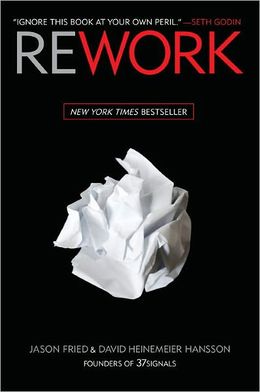
Rework — Jason Fried and David Heinemeier Hansson

Rework is the rare book that could and even should be longer than it is: Fried and Hansson even say, “Writers eliminate good pages to make a great book. We cut this book in half between the next-to-last and final drafts. From 57,000 words to about 27,000 words. Trust us, it’s better for it.” I do trust them, but they may have lost some of the fun stories that might give the book more texture. They’re overfond of assertion without demonstration. But so what? The book as a whole is still worth reading. It’ll take an hour or two to get through the whole thing, which is peppered with little moments like, “You’re better off with a kick-ass half than a half-assed whole” or “Don’t sit around and wait for someone else to make the change you want to see. And don’t think it takes a huge team to make that difference today.”

ReworkIn other words: do it now, whatever the “it” happens to be. Waiting is your worst enemy, doing your best friend, and anything that stops you from doing something should be ignored or overcome. Friedman and Hansson are speaking of business, but they’re also speaking of art, science, and almost everything good in this world. They say, “What you do is what matters, not what you think or say or plan.” This is equally true of writing, but a lot of would-be writers seem to like the idea of writing more than the actual writing itself. I often offer this challenge to people who say they want to or wish they could write a novel:

1) Turn off your Internet access and cell phone.

2) Write chapter one over three days (or so; the actual timeframe doesn’t matter, as long as it’s short); continue if you want to.

3) Send me the result. I’ll read it and send it back.

So far, I think one person has taken that challenge, and I never got chapter two. I interpret this as meaning that most people who say they want to write a novel (or write anything else, or learn the guitar, or get laid, or lose weight, or start cooking, or any number of other skilled endeavors) don’t actually want to, because if they did, they would start today. If you shoot for, say, 500 words a day, you’ll have a pile of around 80,000 in six months, leaving some room for missed days, editing, and so forth.

If you shoot for 1,000 words a day, you’ll have it in three months.

This, however, is only the start, which I didn’t realize when I was nearer to the start than I am now. But if you’re not putting in the seat time, writing, you’re not going to do anything and all your intentions aren’t going to matter. Fried and Hansson are pointing this out in the context of business, where it’s equally valid, and there are probably an equal number of people saying, “I should start a business” and “I should write.” Most of them are probably better off not acting on their impulses. But if they do, why not start?

They’re giving you permission you don’t need to be given, but they’re doing it in a way that feels fun. They elevate fun to a cardinal virtue, and they want to get rid of things that aren’t fun or don’t add value to people’s lives. At one point, for instance, they say:

The business world is littered with dead documents that do nothing but waste people’s time. Reports no one reads, diagrams no one looks at, and specs that never resemble the final product. These things take forever to make but only seconds to forget.

Who would want to stand up and proudly proclaim that they write “dead documents?” In this framing, no one. But sometimes a guy with a document that says why thing x is better than thing y wins. Sometimes dead documents serve important signaling functions. That’s the thing about Rework: read it, but don’t assume it’s always right.

Over the last two months I’ve been on a binge of business or quasi business books: Rework, Anything You Want, How to Win at the Sport of Business: If I Can Do It, You Can Do It, Delivering Happiness: A Path to Profits, Passion, and Purpose, all of them good in their own way, and all of them subtly contradicting each other in various ways.

If Steve Jobs had written a book about business the Apple way, he’d probably contradict all of them. Yet the writer of each book is successful in their own field. If my Dad and I wrote “Doing Business the Seliger + Associates way,” we’d probably say some things that are similar to what Hansson and Fried say but some things that are very different because of the peculiarities of our field. Every business situation is slightly different. What works in one field may not work in another.

The meta lesson may be that no two successes are exactly alike, and that, while you should read these books, you should also realize that you might use pieces of them but you’re unlikely to use all of them. They’re all to be subjected to interrogation, not venerated.

I can say, however, that each of the books above inspires in its own way, and sometimes inspiration has an importance that goes beyond the immediate truth value of a piece.

Confessions of a Pickup Artist Chaser — Clarisse Thorn

Since 2005 and Neil Strauss’s The Game: Penetrating the Secret Society of Pickup Artists, the number of blogs, books, and forums devoted to teaching men how to get with women has, as they say, exploded, and pickup offers a seductive conceit: with the right words, posture, and attitude, average guys can sleep with attractive women. The seductive conceit tends not to play out all that well: by the time one learns enough and changes enough to sleep with lots of attractive women, a random guy isn’t the guy he was when he started.

Confessions_Most of these guys are guys, both writers and readers. Clarisse Thorn, “a feminist S&M writer and activist,” obviously isn’t. She doesn’t want to sleep with more women today! She wants something that, from an intellectual perspective, is more interesting: understanding. In Confessions of a Pickup Artist Chaser, she offers an introduction similar to the one I wrote in the first paragraph of this post:

There’s a huge subculture devoted to teaching men how to seduce women. Within the last half-decade or so, these underground ‘pickup artists’ have burst into the popular consciousness, aided first and foremost by Neil Strauss’s bestselling 2005 book The Game.

One real question: Why do so many men need to learn “how to seduce women?” What aren’t men being taught in schools? By their fathers? Friends? Culture? Anything that needs to be consciously learned and taught isn’t being absorbed from other avenues. Why did “Game” emerge when it did, as opposed to 1970, or 1950, or 1850? To my mind, the sexual revolution and the Internet play large parts: the former reduced monogamy, encouraged more people to sleep with more people, and made women more independent of their families, while the latter allows outsiders to congregate and discuss matters that can’t find mainstream publishers and outlets.

I can say that, at least in my case, I noticed the same sorts of things many guys notice in high school: the same handful of guys seem to get 80 or 90% of female attention, and, as usual, that “chicks dig jerks” and that they eschew “nice guys.” The question eventually becomes, again, “Why?”

Bad answers tend to be, “women are inscrutable” or “just because.” Better answers are out there. I think a lot of guys glom onto pickup ideas not only because some specific tactics work, but because the ideas themselves help explain behavior that seems otherwise mysterious and self-defeating. As Thorn says, “When there’s no standard etiquette or well-understood social channels for how to meet women, then it seems obvious that a bunch of dudes would start getting together trying to figure out how to do that.” If there was “standard etiquette,” it’s gone now, along with standard corporate jobs-for-life.

The role of evolutionary biology and psychology is also underrated in the growth of pickup artists. That field provides answers about what people, or at least people from some cultures, find attractive, and helps to explain why people find what they find attractive. Without that intellectual ballast, I doubt we’d see the surface phenomenon of the pickup artist; that’s merely the mast and the deck. The stuff keeping the ship upright is down below, out of sight. Bad, sloppy, or reductivist evolutionary psychology is easy to discredit, and it should be discredited, but there’s an intellectual core that remains.

Pickup shows, or attempts to show, guys how to get with women in modern environments; as Thorn says, “often, the discussions and the seminars and the meetups are one big group of people who break down seductive behaviors as precisely as they possibly can.” Some pickup artists see what they do as part of self-improvement and enhancement. Others, in Thorn’s view, are “Darth Vader” pickup artists; Thorn describes one this way: “whatever would be more evil and more powerful than Darth Vader, that’s Roissy. [. . .] he is almost comically villainous.” She’s right in that last description, and “comically villainous” has a weird, almost 18th Century ring that’s appropriate for Roissy’s commentary and fundamental harmlessness (he writes a blog and lives in DC, after all, and it’s hard to take his more hyperbolic assertions seriously).

Nonetheless, men like Roissy are the ones Thorn seeks out. There’s a thread of honesty, of self-criticism, that runs through Confessions of a Pickup Artist Chaser: “I can’t deny that I myself pay more attention to hot men [. . .] I can’t deny that I wanted PUAs’ approval.” The wanting “approval” makes sense: if you don’t want approval, it’s easy enough to rant ignorantly about a subject. Plus, when a phenomenon is sufficiently widespread, it’s worth understanding it, and your own relationship to it, before criticizing it. Thorn does both.

She also gave an interview in which she said that, while she sees feminism as telling us a lot about the macro aspects of gender in our society (in work and school, for example), feminism does very little to describe, let alone evaluate, how micro, day-to-day interactions are structured. Pickup artists, or whatever one may want to call guys who are consciously building their skills at going out and getting women, are describing the specific comments, conversations, styles, and venues women respond to. The pickup artists are saying, “This is how you approach a woman in a bar, this is how you strike up a conversation at the grocery store, and so forth.” In other words, they’re looking at how people actually go about the business of getting laid. Their work is often very detailed, and the overall thrust is toward the effectiveness of getting laid rather than how male-female interactions work in theory. Feminism, in Thorn’s view, appears to be silent, or mostly silent, on the day-to-day interactions.

Women also haven’t tended, so far as I or Thorn knows, to produce the same material about why they pick the guys they pick, what they say, what happens in the lead-up to sex, and what happens afterward. Men produce these sometimes voluminous field reports (Reddit’s “seduction” community is full of them), to the point where the occasional woman appears to ask why no one is producing pickup material for women. Nothing is stopping women from doing so, but the average woman appears less interested in how to “pick up” guys and more interested in relationships (which one can see from, say, The Rules versus The Game, or romance novels versus porn). The average of many people’s desires doesn’t say anything about a particular individual’s desires or proclivities, but we do see patterns emerge through aggregation.

It’s virtually impossible to be a thinking person and not notice the disjuncture between behavior in bars / clubs / parties and academic / Internet feminist thinking. It’s hard to reconcile 50 Shades of Gray, submissive S&M preferences, and romance novels with feminist thinking (Janice Radway’s Reading the Romance is excellent for its observations, but her preexisting ideological framework automatically assumes everything about gender preferences is the fault of a pervasive “patriarchy” that, if it once existed, didn’t by the time I came of age).

People like Thorn are trying to bridge that gap, which I admire. What academic feminists think average women should want (and what average men are like) seems very different from what many normal women want. It’s hard if not impossible to legislate desire, or change it through haranguing, though people certainly have tried and continue to try. One thing I think most people have in common is hypocrisy and lying, either to themselves or others, and sexual behavior is certainly rife with both hypocrisy and lying. My favorite public example are the closeted Republicans who fulminate against being gay and then get caught in a “wide stance,” tapping their foot in a men’s bathroom. But they’re so pathetic a target that they’re not really worth discussing on an intellectual level.

Thorn’s book is worth that discussion, and running through Confessions of a Pickup Artist Chaser is a simple conundrum: we don’t know who someone really is, versus when someone is who we want them to be (example: “When I met Neil [Strauss] in Chicago, he seemed low-key and authentic, but I suppose that’s just what he’d want me to think”). The authenticity question isn’t unique to Confessions: it runs through literature, especially in literary fiction and science fiction, through psychology, through sociology, and through everyday life. Our personalities themselves aren’t stable, and they’re influenced by situations. We want to believe ourselves to be authentic, and we want to believe that we can fully understand other people, but those beliefs whither in the face of both academic evidence and the evidence of everyday life and social interaction.

We just don’t know. Pickup wants men to believe that we can mold ourselves into something better; that molding is simply of a particular kind, oriented in a particular direction. To be good at pickup is as hard as being good at anything else: it might start with learning some clever lines and some confidence, but it ends with the entire state of one’s social and physical being, from wardrobe to workout to interests to speaking skills to dancing to friends. Maybe the scariest thing of all to women is the extent to which men will change their personalities to attract women, or the extent to which attracting women is a skill that can be learned, contrary to the dominant cultural paradigm of love at first sight, “it just happened,” and the belief in romantic destiny. Women, however, don’t like to feel as if they’re being “gamed.” By definition, the best pickup artists conceal their craft. If you know you’re being gamed, the game itself has failed.

Good pickup also means empathy, which men and women lack in equal measure. Thorn writes:

Age 15 may also have been when guys began shouting gross comments at me in the street, but I’m not sure. It was a few years before I started going to parties and clubs where some guys would approach and refuse to leave me alone, no matter how obvious I thought I made it that I wasn’t interested. These experiences, among many others, contributed to the development of what a PUA would call my “bitch shield”: my instinctive tendency to be cold and unfriendly during unexpected interactions with unfamiliar guys.

Many women have bitch shields to some degree — when we don’t, we get a lot more “I’ve been watching you and your nice breasts” comments. PUAs devote a lot of mental energy to figuring out how to quickly convince women.

Pickup teaches, or should teach, men to appreciate why “Many women have bitch shields to some degree.” I’m not sure that there’s a female equivalent to make pickup that helps women realize just how much rejection being a male entails. Pickup is also about teaching you to imagine how you appear, or should appear, to others; Thorne correctly notes that “‘Just be yourself’ is terrible advice if you are naturally unbelievably awkward.” The self you should be, whether you want to form relationships or just get laid, is something else.

Although the better pickup types don’t promise something for nothing, the worst ones do. The reality with pickup is the same reality that confronts anyone who wants to truly a master a skill, whether that skill be programming, knitting, writing, music: it takes time, effort, and intensive effort. “No art, however minor, demands less than total dedication if you want to excel in it,” as Leon Battista Alberti said, and seducing women is an art like any other. Some men appear to be “naturally” good at it, which usually means that they have some inborn predisposition combined with unconscious training

I discussed ideas and trends in the first part of this essay because those are the most interesting and useful parts of the book. A lot of Thorn’s writing, however, is weak. At one point she says of pickup artists, “some of them were so smart it blew my mind.” Such clichés should be excised like a demon: swiftly, surely, and religiously. Chapter 3 starts with Thorn saying, “I’m a feminist sex-positive activist. For me, that means that I try to raise awareness of social problems around sexuality.” But, again, anyone with decent reading comprehension skills will already know that, because she mentioned it several times. Some sections are too long and should be cut, and it becomes easier to skip sections the longer one reads. The word “super” is overused as an intensifier: “I acknowledged times in the past when I’ve been super awkward;” “He’s super-analytical too;” “his consent was super important to me;” “he wasn’t going to be a super-major relationship no matter what.” That’s only a handful of examples. Like “very” or salt, “super” should be used sparingly. Too many super things aren’t super at all.

The word “problematic” is similarly problematic: instead of arguing why an idea or a concept is a problem, “problematic” simply asserts that it is; as word, it conceals more than it reveals, and it conceals a lot: “some men are so starved of knowledge about masculinity that they idolize Roissy and overlook some of the more problematic things he has said;” “the seduction community is very heteronormative: it really buys into problematic gender standards;” “all the words that I put in quote marks above are concepts that I consider incredibly problematic;” “while the advice in The Rules is often problematic, much of it works;” a woman named Kristen J says “[ad] agencies understand the effects of problematic norms on women.” Using a weasel word like “problematic” once or twice falls within the author’s license not to explain everything. Using it more than half a dozen times means the next version should be edited with greater care.

While I’m here, let me talk for a moment about Kristen J. I’m not convinced advertisers exploit women, or know that they do, but the bigger issue is that advertisers want to do whatever works; if ads didn’t work, at all, advertisers would quit trying. She says that “The thing is, advertising isn’t just a consequence of problematic norms… it’s a creator of them, too.” Maybe. But the norms emerge from collective individual choices, and I think advertiser are mostly reacting to what they see as being effective. It’s certainly more fun to blame ad agencies than to look around and say the blame for the effectiveness of advertising lies, at least a little bit, in each of us, and in our aggregate preferences (for more on this topic, see Geoffrey Miller’s Spent: Sex, Evolution, and Consumer Behavior). I mentioned a similar idea in a different context above, but the same principle applies here.

Technical problems with Thorn’s writing aren’t limited to the level of the sentence, either. She assumes the reader’s stupidity:

Here we are again at the end of a chapter! Did you read it all? Was it too long for you? It’s okay if you didn’t read it all, because I hereby bestow upon you some ‘Too Long; Didn’t Read’ bullet points!

“Was it too long for you?” sounds vaguely pornographic out of context while simultaneously being infantilizing: if you’re not in middle school, a couple thousands words on a compelling topic shouldn’t be too long. If it is too long, the writer should cut words. The best writing advice I’ve ever heard is “omit unnecessary words.” In Confessions, Chapter 12 begins this way: “This is the last chapter, and I won’t offer a “Too Long; Didn’t Read” section at the end. My Grand Theory of The Ethical Game cannot be reduced to mere bullet points!” This implies that the preceding 11 chapters can “be reduced to mere bullet points”—but if they can, why bother writing extended narratives? Why not just shorten the book to the bullet points? I don’t think the preceding chapters can be reduced to bullets, which is frustrating both about the bullets themselves and the way they disrupt the book’s flow.

Confessions is slack. It’s hard to describe precisely what tautness entails, but in vague terms it means feeling like every part of the book connects to every other part, or at least to a linear, forward-moving narrative or level of understanding. Too many of the conversations in Confessions feel superfluous—not on their own, but put in the context of each other. Fixing this kind of problem is a long and difficult effort, and I don’t have a good sense of how rising action in each chapter or scene should function.

But I know it when I don’t see it, and too often I didn’t see it. Neil Strauss’s The Game builds in a classic fashion, portraying his journey from outsider to neophyte to expert to transcending the limits of his field. Confessions sort of has that structure, but it’s more digressive, more random, and not in ways that feel like they build. In the middle of the book I began skipping sections that felt repetitive, as issues about pickup, game, and feminism were analyzed from angles that seemed nearly indistinguishable from how they’d been previously analyzed. There was a feeling of “almost, but not quite;” I want the stories to be tighter than they are.

Tautness can’t be quoted. It can be observed: Gillian Flynn’s Gone Girl has it. Philip Pullman’s His Dark Materials has it. Tucker Max’s stories have it. So do Chelsea Handler’s better stories. Confessions needs it.

I may also be more attuned to tautness because for a long time I had a major problem with it in my own writing. To some extent all writers worth a damn struggle with tautness; the ones who don’t care either write tautly unconsciously or risk boring their readers.

Even the best non-narrative, nonfiction is intellectual taut, with ideas that build on one another towards their conclusions. Jonathan Haidt’s The Righteous Mind has this quality, even though it’s not a narrative book. observing the issue may be worthwhile: nonfiction writers need to think about the tautness issue, because readers will recognize when a work builds and when a work should be restructured in a way that makes it more compelling.

The first couple chapters were the most compelling, followed by the Neil Strauss chapter. I’m spending so much time on stylistic weaknesses because I want the book to be better. The subject interests me and Thorn’s vantage is fresh. Only the execution is lacking. Thorn is doing something I admire: reporting. For a self-published writer, this is unusual. She goes out to meet and talk to people involved in her subject. She only needs her Robert Gottlieb, her Maxwell Perkins.

I hope Thorn finds him, or her.

Language weirdness: young people and old people

Why is “young people” a socially and politically palatable term, but not “old people?”

APE: Author, Publisher, Entrepreneur — Guy Kawasaki and Shawn Welch

ape_cover_KawasakiFor decades, books got published something like this: you, the writer, wrote and polished your book; you submitted a query letter and perhaps sample chapters to literary agents; an agent read the full manuscript; an agent took you on; the agent pitched your book to large publishing houses in New York; the editor, or ideally more than one editor, made an offer; the agent negotiated; and you got a book deal. This system worked kind of okay, and there wasn’t a better way to do it, but a lot of writers, including me, got hung up in the “an agent took you on” step.

Now, self-publishing has a realistic chance of success—defined as getting your work to readers and getting some amount of money from those readers—which offers opportunities and headaches. Big publishers know change is coming. The opportunities are obvious, and the headaches stem from having to learn a lot of stuff that publishers used to do, like cover design, knowing what a “widow” is, and figuring out how to hire a copy editor. APE: Author, Publisher, Entrepreneur wants to explain the new world, and it’s a book for a very specific group: people who are, for whatever reason, deeply interested in the publishing industry, and people who want to write a book, have written a book, or want to publish the book they’ve written. If you’re sure you don’t fall into those categories and aren’t likely to, stop reading. You’re probably wasting your time. If you want to know, keep going.

A few months ago I noted this, from Tim Parks’s “Does Money Make Us Write Better?“, in a links post:

When they are starting out writers rarely make anything at all for what they do. I wrote seven novels over a period of six years before one was accepted for publication. Rejected by some twenty publishers that seventh eventually earned me an advance of £1,000 for world rights. Evidently, I wasn’t working for money. What then? Pleasure? I don’t think so; I remember I was on the point of giving up when that book was accepted. I’d had enough. However much I enjoyed trying to get the world into words, the rejections were disheartening; and the writing habit was keeping me from a “proper” career elsewhere.

These kinds of stories infect writer interviews, as do tales of heroic perseverance. John Barth and William Goldman almost quit writing too. But more interesting still are the dark matter writers, the ones we don’t hear about because they gave up and aren’t being interviewed or writing introductions to reprints of their older books. I don’t want to be one of them. And I bet I can make more than £1,000, though I don’t know how long ago Parks began writing: adjusted for inflation, £1,000 might be a lot of money.

Kawasaki and Welch explain how to avoid being a dark matter writer. They say, “Will your book add value to people’s lives? This is a severe test, but if your answer is affirmative, there’s no doubt that you should write a book.” Still, people write books for all sorts of reasons, though I suspect the major reasons are related and twofold: the book they’d like to read doesn’t already exist, and they have something to say. Answers like “to add value to people’s lives” are good reasons to write a book, and good reasons to do many things. There is still some doubt. Writing a book can consume all your mental energy. It might add value to, say, two people’s lives, which might not justify the costs. Not everyone has the impetus towards book writing; to get through the difficulties of writing a book, I think that writing itself has to be fun, or fun at times (more on that later).

But the number of people who could write books and aren’t, in part because of the daunting publishing process, is much larger than the number who do write books. And that pool is getting larger. One challenge is that writers are going to have to think more like publishers, and publishers are going to have to think more like entrepreneurs. APE is about these transformations, and it takes its place near J.A. Konrath and Jack Kilborn’s The Newbie’s Guide to Publishing (Everything A Writer Needs To Know) and Kristine Kathryn Rusch’s Surviving the Transition: How Writers Can Thrive in the New World of Publishing (one thing writers evidently do, once they spend the painful time learning to self-publish, is write guides so that others can learn the same).

How useful APE will be to you depends on how much other reading you’ve done in the how-to-be-a-writer genre. I have trouble resisting it, and so sections of APE are less useful; some, like chapters 6, were fun but already well-known to me. The later ones, on the finer point of Kindle, Nook, and iBooks publishing, were exceedingly useful. I follow digital publishing closely, because I’m going to do it, but I still learned things: for example, I didn’t realize that Google Play exists. Google Play might not matter for me, or for you, but uploading to it requires little time beyond the effort necessary for iBooks and Barnes and Noble’s Nook.

Kawasaki and Welch also have overly strong views on tools (which may make sense given Kawasaki’s background: “For four years I evangelized Macintosh to software and hardware developers and led the charge against world-wide domination by IBM;” the word “evangelized” is key here, implying religious fervor that’s been transferred from God to Mac). I’ve learned some about photography in the last two years, perhaps a reaction against the extreme amount of reading and writing I’ve done, and in cameras, there’s a continual debate between the people who want the newest, coolest gear and who argue that the latest gear enables them to get shots they couldn’t have gotten before. Their intellectual adversaries argue that the most important tool is between the photographer’s ears and that composition, subject matter, and skill with what you have matters more than the newest cameras and the best lenses.

I’ve read impassioned pleas from both sides, and agreed fully with one side, then read the opposite, and agreed fully with them. There isn’t a right answer. One cliche in the photography community holds that every image you’ve admired was captured with worse gear than what you’ve got. Yet there’s also no reason to ignore the tools you’re using and the potential that new tools may unlock.

Kawasaki and Welch write, “In our book (again, pun intended), you should use a Macintosh. No computer makes you more creative and productive, because a Macintosh becomes part of you whereas you need to overcome other operating systems.” I don’t think it matters that much, which is somewhat funny because I’m writing this on an iMac. But pretty much any computer made in the last ten years will due, because, the most important parts of the writing process are a) a word processor and b) there is no b.

There are some nifty tools I use extensively, like Devonthink Pro, and some nifty tools that I’ve used less extensively but still helpfully at times, like Scrivener. Nonetheless, 95% of the real “work” of writing still happens on the level of the sentence and paragraph (though Kawasaki and Welch say of Scrivener, “I pride myself in having an organized mind, but my mind isn’t this organized”)*. A Mac is not going to give you great sentences. Neither is Windows or Linux or the tea you drink or the cafe you write at or the hot literary groupie offering you head or the pen you use. Great sentences, like change, come from within.

They also say, “We have never met anyone who regretted buying a Macintosh.” I have—like those who need perfect Exchange synchronization, or people who are seduced by the Mac’s cool factor, only to realize that the paying-the-rent factor is even more important. These are quibbles. Still, in one chapter the writers quote Zoe Winters, and I would repurpose her advice to apply to technology: “There is no shortcut to awesome.” Writing well is always a longcut, not a shortcut, and self-publishing arguably makes the road longer. There’s no real alternative, through software, hardware, or anything else.

The road may be long, but one can find comfort and encouragement along the way. Kawasaki and Welch write, “If You Want to Write by Brenda Ueland [. . .] changed my life by empowering me to write even though I didn’t consider myself a writer.” This is a common feeling, but it’s also one that’s long puzzled me: I spend very little, if any, time considering whether or not I’m “a writer.” I just do it. I didn’t need permission to be a writer, and neither do you. Alternately, if you do need permission, let me bestow it on you: a random stranger on the Internet has now dubbed thee a writer. Feel better?

You should. You should also realize that writing may be lonely in the moment, but it’s a way of bringing people together over time. This tension is implied in moments like these:: “Authors who write to impress people have difficulty remaining true to themselves. A better path is to write what pleases you and pray that there are others like you.” I would also add that few people are likely to be impressed anyway, and those who might be impressed will be more impressed if your book is written, at least some of the time, because you’re having fun and seeing where things go. Think about your favorite sexual experiences: few of them probably arose because you were putting a lot of pressure on yourself or your partners to have a Great Sexual Experience. Most of them probably arose because you and your partner(s) were relaxed and ready to have a good time by seeing where things go. So too with writing, and many other activities.

Sometimes writing will be painful, as Kawasaki and Welch note. I won’t deny it. But parts should be fun, and the fun will show in the final product.

In a few places, I’d like to see better writing in a book about writing. One chapter begins, “This section explains how to take a manuscript and turn it into a book. We assume that you have a rock-solid draft of your book.” “Rock-solid” turns up 74 million hits on Google. It’s a cliche. A book about writing should itself be impeccably written. This one is close—very close. Perhaps the next update will fix that.

Elsewhere, the writers say, “For example, The Schmoe Way by Joe Schmoe from Schmoe Press doesn’t cut it.” And “Pure text posts don’t cut it in the highly visual world of social media.” And “While printed books may never die (an ebook of Annie Leibovitz’s photographs won’t cut it) [. . . .]” What does “cut it,” and what is being cut? All of these could be improved: for example, “an ebook of Annie Leibovitz’s photographs is as useful as sheet music for someone who wants to hear Beethoven’s Fifth.” Maybe that’s a little clunky too, but it’s still an improvement because the metaphor is fresh. One could say, “Pure text posts in the highly visual world of social media make more sense than a pure text movie, but both are improved by images.”

Some words are wasted. The last sentence in this paragraph:

Undaunted, [Amanda] Hocking decided to self-publish her novels with Kindle Direct Publishing to pay for the $300 trip. She started with My Blood Approves, and by October 2010, she made over $20,000. Over the next twenty months, she made $2.5 million. The rest, as the saying goes, is history.

could be removed. I can only think of two similar nonfiction books that had no wasted words: Rework (the 37signals book, and one of the few books I’ve read that should be expanded) and Derek Sivers’ Anything You Want (where Sivers even talks about brevity and clarity in “You should feel pain when unclear“—”Writing that email to all customers would take me all day, carefully eliminating every unnecessary word, and reshaping every sentence to make sure it could not be misunderstood”). The best writing advice I’ve ever received is “omit unnecessary words.” Almost everyone is guilty of this crime at times, including me, in this post, in this blog, and in my other writing.

Their advice on serial commas is askew; Kawasaki and Welch favor serial commas (“A serial comma (or Oxford comma, as they say across the pond) prevents confusion when you are listing several items”), but serial commas can also create ambiguity.

These are minor issues, but I bring them up because nonfiction should aspire to be art. Kawasaki and Welch agree—they say, “Metaphors and similes beat the crap out of adjectives and adverbs, so use them when you can. For example, rather than saying, ‘Hockey is very violent,’ you could say, ‘Hockey is war on ice.'” Perhaps I’m overly fastidious about the War Against Cliche. Others who are highly attuned to language will notice too.

Some sections of APE linger in the mind long after they’re read, like this:

There are two kinds of people: eaters and bakers. Eaters think the world is a zero-sum game: what someone else eats, they cannot eat. Bakers do not believe that the world is a zero-sum game because they can bake more and bigger pies. Everyone can eat more. People trust bakers and not eaters.

It expresses a sentiment I’ve discussed in many contexts, but in a way I hadn’t conceived. My closest approximation came in “How to think about science and becoming a scientist:”

while society needs a certain number of lawyers to function well, too many lawyers leads to diminishing returns as lawyers waste time ginning up work by suing each other over trivialities or chasing ambulances.

By contrast, an excess of scientists and engineers means more people who will build the stuff that lawyers then litigate over. Scientists and engineers expand the size of the economic pie; lawyers mostly work to divide it up differently. Whenever possible, work to be a person who creates things, instead of a person who tries to take stuff created by someone else.

Kawasaki and Welch are bakers. They’re creators. They want to help you be one too. Still, according to them, you have to be the kind of writer who wants to “take control of their fate and embrace the ideas here in order to maximize their success.” A fair number of writers don’t appear to care about being able to “maximize their success” as measured by sales and finances, and in some literary circles cachet comes from not marketing one’s book, or appearing not to market it; sometimes not marketing becomes marketing, as examples like J. D. Salinger and Cormac McCarthy show.

This underlying model of success can seem claustrophobic, and, just I gave you permission to be be a writer above, I give you permission to be selective with social networks here: plans for Facebook, Twitter, LinkedIn, e-mail, Google+, and more would leave me with less writing time. I want to do things that really interest me, and that’s mostly long-form writing. Facebook and Twitter aren’t interesting, and I want the mental space they would otherwise occupy to be occupied by better things. I’m also reluctant to trust Facebook and Google+ because that gives those companies so much control over what I do and who I talk to. There was a recent kerfuffle when Facebook “turned down the volume” of businesses that had Facebook pages. That’s good for Facebook’s users but terrible for anyone who spent time and money encouraging people to interact on Facebook.

Facebook is, of course, where the people are. Using it is good advice, but it might also be useful to ask what you can say no to. In Anything You Want, Derek Sivers has a chapter called “No more yes. It’s either HELL YEAH! or no,” where he says that your reaction to most propositions should be one of those two extremes. To me, Facebook, Google+, and Twitter are in the lukewarm middle. Kawasaki and Welch “recommend using Google+ as a blogging platform.” Does it allow one to export nicely-formatted XML that will allow you to easily switch, if necessary? That’s a prerequisite, at least to me.

Kawasaki and Welch might be overly enamored of social media, and me underly enamored, but unless you want a Salinger-like existence you probably need to do something. There are few alternative to social media, e-mail, and other promotional efforts, and those efforts are a boon to outsiders. The authors say, “I’ve never come across an author who was happy with the marketing efforts of his publisher.” That might be because publishers have one thing that can’t be replicated by outsiders: distribution. Publishers are set up for a world where they control distribution. That advantage is eroding over time.

The chapters about social networking show you how to make sure you have access to new advantages.

The downside is that learning the business consumes time like space shuttles consume jet fuel. At the moment, however, APE is a relatively easy, comprehensible way of learning about all the steps that one should take to move from “guy with a story” or “guy with a long document” to “writes books that other people value and read.”


* I’ve only used Scrivener for one novel, called THE HOOK, that has different, named narrators at different times, like Tom Perrotta’s Election, Anita Shreve’s Testimony, or William Faulkner’s As I Lay Dying. Scrivener was an ideal tool for this task because it made rearranging sections easy, and it made reading each speaker’s full narrative, in order, easy. I can also see it being very useful for non-narrative nonfiction and or dissertations / academic books (James Fallows is a convert). For most fiction, I think the bigger problem is making the story cohere, not rearranging it.

The Generals — Tom Ricks

The Generals has one of the best qualities a general nonfiction book can have: it’s about a specific topic that it covers well, but its lessons and ideas also transcend its topic and apply to many others. Let me explain. Take this section, about General Patton:*

Even now, more than six decades after his death, Patton remains one of our most remarkable generals. ‘You have no balance at all,’ Marshall’s wife once scolded the young Patton, correctly, years before World War II. Maj. Gen. Ernest Harmon, one of his peers, wrote that he was ‘strange, brilliant, moody.’ The blustery Patton behaved in ways that would have gotten other officers relieved, but he was kept on because he was seen, accurately, as a man of unusual flaws and exceptional strengths. Marshall concluded that Patton was both a buffoon and a natural and skillful fighter.

Knowledge, skill, and expertise in one domain don’t necessarily transfer to other domains. A brilliant physicist may be a terrible marriage therapist, and vice-versa. Someone who is a “buffoon” might also have a compensating skill that makes up for their possible deficits. Paul Graham implicitly writes about this in Is It Worth Being Wise?:

‘wise’ means one has a high average outcome across all situations, and ‘smart’ means one does spectacularly well in a few. [. . .] The distinction is similar to the rule that one should judge talent at its best and character at its worst. Except you judge intelligence at its best, and wisdom by its average. That’s how the two are related: they’re the two different senses in which the same curve can be high.

A lot of people seem to have trade-offs between peaks and averages. Steve Jobs comes to mind: Walter Isaacson’s biography is rife with examples of Jobs being wrong, cruel, and occasionally outright stupid. His lows were low. But he got big, important stuff right—and not just right, but very, spectacularly right. He found (or made) the right environment for his skills. It’s almost impossible to imagine Jobs being a good employee at, say, Wal-Mart, or any large company that values homogeneity over creativity.

It’s obviously possible to have high averages and high peaks, but that doesn’t appear to be common. Really spectacular peaks often come in unusual packages. Those unusual packages are often easy to dismiss by someone not paying attention.

Unfortunately, as Ricks points out, America since the Korean War hasn’t judged its generals by their peaks or their averages: in fact, we haven’t judged generals on their competence much at all. That’s a tremendous, underappreciated problem. In Ricks’ description, the generals cut from the Marshall style were primarily “team players” who needed to work effectively with others and defer to the group. That’s not necessarily a bad thing; as Ricks says:

Perhaps those who rose highest in World War II were organization men. But for the most part they were members of a successful organization, with the failures among them weeded out instead of coddled and covered up. That would not be in the case in our subsequent wars, in which it would be more difficult to know what victory looked like or even whether it was achievable.

Different time periods reward different forms of industrial organization. If World War II rewarded “organization men,” many of today’s organizations reward people who figure out the weaknesses of large organizations, and then offer alternatives. But that can’t happen in the military, where the closest analogue to startups might be defense contractors and private, Blackwater-style armies. Those, however, have their own problems.

There’s also an analogy to teaching: almost no public school teacher is fired, ever, for bad teaching. Not being able to fire transparently terrible teachers is an impediment to getting better teachers, as almost anyone who’s ever been in a public school knows.

Organizations also need to focus on making sure that they’re focused on their major purpose, not on primarily serving the interests of the people inside them:

Trying to be fair to officers can be lethal to the soldiers they lead on the battlefield. The Army was using the Korean War to give the staff officers of the earlier war ‘their chance’ to command in combat—with disastrous results. Well before Chosin, the Army had recognized that it had a problem with inexperienced combat leadership in the war.

The problem is “inexperienced combat leadership,” but the solutions became worse in some respects than the problem itself. Fairness to one group can mean extreme unfairness to others, who often have much less of a voice. No one speaks for the enlisted men who are led by incompetent generals. (No one speaks for those led by an incompetent president, either, but that’s a separate issue related to larger American society.)

Misaligning incentives creates a deeper sense of rot; Ricks says that generals, by the post-Korean-War era,

were acting less like stewards of their profession, answerable to the public, and more like keepers of a closed guild, answerable mainly to each other. Becoming a general was now akin to winning a tenured professorship, liable to be removed not for professional failure but only for embarrassing one’s institution with moral lapses.

Notice what this says about Ricks’s view of the university: by comparing one system that advances mediocrity with tenure, he implies that tenure advances mediocrity. He doesn’t go on to explain why he uses the metaphor, because he assumes that his readers already believe as much. But tenured professors aren’t putting their students in life-or-death situations, and students can choose to pick a different department or university. Service members can’t. During World War II, as Ricks says, the road to victory and home led through Berlin and Tokyo. In recent wars, the road to victory has been murkier, the politico-military establishment mostly hasn’t selected generals adept at operating in the murk. The consequences are clear.

The Generals is too detailed for people who aren’t deeply interested in military affairs and history. It probably isn’t detailed enough for those who are immersed.

But it’s also the best intellectual explanation of why one should be wary of enlisting in today’s American military: you might get killed by someone incompetent but unaccountable on the basis of performance. Contemporary generals who lose wars and cost soldiers their lives are fêted. They “retire” to lucrative consulting gigs with defense contractors and lobbying firms. The soldiers are disabled or dead. To me that argues against becoming a soldier or junior officer. In most businesses, if you think your boss is an asshat, you can quit and start a rival firm. In the military, obeying is the only option, and no one is making sure that your boss is actually good at his job.

EDIT: B.J. Khalifah has an interesting letter in The Atlantic:

Thomas Ricks overlooked something important. Sadly, nobody becomes a general (or equivalent) in the military until they have served for many years. Most colonels are 50 by the time they get promoted. Many younger officers have experience and drive; as a group, they adapt well. Older officers are more cautious, members of the “cover your ass and do not make waves” category. They know how to manipulate the good-old-boy game. The service should be, but is not, a strict meritocracy. In effect, it follows union-style rules of seniority and time in grade. From second lieutenant to first lieutenant to captain is automatic. Some lousy officers have made it past captain to become major by being on court-martial or combat duty when they are promoted. The rules are not negotiable.

This contrasts hugely with startup and good corporate cultures, which judge people almost purely on merit. Successful startups have famously been founded by 18 year olds. Even law firm partners can be promoted within as little of five years of hiring, while associates frustrated by a firm’s practices can start their own. The military apparently doesn’t do that, and I haven’t seen any evidence that 50-year-old generals will necessarily be better than 26-year-old (hypothetical) generals. Certainly among startups this isn’t true.

The comparison isn’t perfect—markets reward innovators for making things people want, and the military doesn’t have a clear feedback loop. But at the moment almost no one is even discussing the issue, or making the comparison.


* The movie Patton is also remarkably good, especially the speech at the beginning. Patton doesn’t have the American character down correctly—Americans don’t love the sting of battle unless we’re provoked—but the speech demonstrates a lot about the man doing the speaking.

The bit about loving a winner and not tolerating a loser is also fascinating in light of The Generals: we’ve tolerated a lot of losers, like Donald Rumsfeld and Tommy Franks, and sacked winners like Eric Shinseki.

A discussion of a weird grammar quirk: tense and Mark McGurl’s The Program Era

In Mark McGurl’s excellent The Program Era: Postwar Fiction and the Rise of Creative Writing, he writes this about Vladimir Nabokov:

In fact, one of his best-known quirks was a scientific passion for a certain family of butterflies, the Blues.

The word “was” is interesting, because Nabokov’s quirks are still well-known, in the present. But Nabokov’s quirks happened in the past—he’s obviously dead. So there’s a moment of verb tense weirdness in this sentence, which might otherwise read something like, “In fact, one of his best-known quirks is the scientific passion Nabokov had for a certain family of butterflies, the Blues.”

There’s no particular point to this post other than a writer’s duty to notice language, and the opportunity to observe a specific example of language’s sometimes bizarre ambiguity.

(Those of you who are reading the last sentence and thinking about its own weirdness, be aware: that is intentional.)

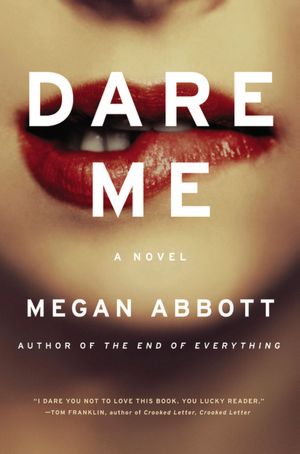
Dare Me — Megan Abbott

There’s something compelling about Dare Me that shouldn’t be compelling: stripped of its narrative voice, Dare Me is about teenage cheerleaders and their coach, who may as well be a teenager, competing to be the neighborhood’s queen bee. It’s unfair to summarize a novel like this—Lord of the Ring could be reduced to, “Midget chucks ring into mountain; local vagrant crowned king”—but it’s also useful, because interesting novels usually have characters who are trying to learn something about the world and who have larger ambitions to do things that will have more than just local effects.

Addy narrates the novel in an insistent present-tense voice that offers a sense of immediacy. Her primary aspiration, however, is to maintain her status on the cheer squad, chiefly as the “lieutenant” of the captain, Beth, who is the chief bad girl and doer of drugs, men, and deeds that Addy might want to do but can’t bring herself to. Beth, however, is stripped of her captaincy by the new Coach, who demands more from the girls than their previous coach:

Back then, we could hardly care, our moves so sloppy and weak. We’d just streak ourselves with glitter and straddle jump and shake our asses to Kanye. Everybody loved us. They knew we were sexy beyotches. It was enough.

But part of life is the “it” not being enough: skills count, more than merely being admired. Plus, contrary to what Addy thinks, it’s unlikely that “Everybody loved us.” The cheerleaders in Dare Me love themselves much more than any outsiders could possibly love them. And the cheerleaders never quite ask if they should want to be anything more than “sexy beyotches.” They certainly have a strong sense of sexuality, although sexuality in the novel is primarily used to express dominance among the various girls (and their Coach), rather than as an end in itself. The novel’s prime source of antagonism is between Beth and the new Coach, whom Beth describes this way: “Colette French [. . . ] Sounds like a porn star, a classy one who won’t do anal.” Beth tells us more about herself than she does about Coach: that she thinks about porn stars, that she has a dirty yet moralistic streak at the same time.

Most of the girls do. They want what most of us want, but that doesn’t stop them from castigating others. None of them recognize their own hypocrisy, and they probably wouldn’t care if someone did point that hypocrisy out to them. At one moment, Addy says, “Beth and I made loud comments across the gym about how Brinnie’s slutty sister got caught making out with the assistant custodian until Brinnie ran off to the far showers to cry.”

Women really do slut-shame each other much more vigorously than men slut-shame women. Addy doesn’t notice that, however. She only notices how she can use what she perceives to be raw power: the “loud comments” and the derogatory adjective, “slutty,” forming without much thought about what’s underneath her ideas. Despite what the two say about Brinnie’s sister, Addy also reports that “In eighth grade, no, summer after, at a beer party, Beth put her scornful little-girl mouth on Ben Trammel, you know where. I remember the sight.” Why is Beth’s mouth scornful? We don’t find out. But she says a moment later that “We don’t judge,” when the page prior Beth and Addy were judging Brinnie’s sister.

Dare Me, however, isn’t about consistency. It’s about inconsistency, expressed through power and dominance. Beth versus Coach, but sexuality is the weapon—not fists. The girls use it against each other, although I won’t describe how here. The only character who apparently isn’t competing is Addy. She doesn’t really get much in the novel, and she gives a weak excuse about why: “There’s not a lot to interest me at Sutton Grove High.” That’s another way of saying that being alone and being the cheer squad’s resident observer is more valuable to her than the experience of a “real” relationship. About Jordy, a boy at the school, the best Addy can summon is that “He looks like he’s thinking things [. . .] Like maybe he actually thinks about things.” Does that mean Addy and her friends don’t? And, if so, perhaps we again shouldn’t be reading about them. She does get with him, after a fashion, and his giving in disappoints Addy: “His wanting, so easily won—well, it bores me.” Everything does. The boredom she feels at his being “so easily won” is how guys end up affecting cruel uninterest in order to win women. But that’s another thing Addy doesn’t know. Her lack of sophistication is realistic but grating; there are answers to the questions she doesn’t know to ask.

She does know, however, that a military recruiter is aloof and thus desirable. He has a nickname that denotes his position: “Sarge, though, is above all this. All the girls are hurling themselves at him, but he never blinks, not once. He smiles, but his smile doesn’t really seem like a smile but the kind of thing you do with your mouth when you know everyone is watching.” He’s smiling that way because he has to, and he knows that the penalties for indulging in “the girls” who “are hurling themselves at him” is probably worse than the pleasure that he might gain from indulging them. There’s also a link between the two: by apparently standing above the girls making offers, he’s making himself more alluring. He contrasts with the “easily won” Jordy. The harder the prize, the sweeter the accomplishment, at least in Addy’s eyes, and hence the challenge of being a better cheerleader is the challenge of doing harder stunts, of doing more than “shak[ing] our asses to Kanye.”

The physicality of motion counts for a lot, and so does the wanting eyes Addy imagines her body inspiring. Addy thinks, “This is my body, and I can make it do things. I can make it spin, flip, fly.” She can also make it the object of male adoration, which, regardless of what else cheerleading might do, does that first. Addy also doesn’t perceive the way the boredom of her own life is partially of her own making, as when she says

Ages fourteen to eighteen, a girl needs something to kill all that time, that endless itchy waiting, every hour, every day for something—anything—to begin.
‘There’s something dangerous about the boredom of teenage girls.’

This is given like a law of the universe, an ahistorical fact that must be true of all times and places, like respiration. It isn’t. For all I know, in many hunter-gatherer tribes fourteen year olds were often mothers, or members of adult societies: their life had already begun. Addy is really commenting on contemporary Western society, even if she doesn’t have the language to realize it.

Has she read Paul Graham? Boredom is endemic to the high school experience. But boredom itself is dangerous to the mind, because it’s a waste of the planet’s most valuable resource: minds. I don’t need to rely on vague assertions like “There’s something dangerous;” I know what’s dangerous, in part because I was reading enough at the time to eventually learn how to use words to express complex ideas. Addy hasn’t gotten there yet.

That should make her an uncompelling narrator, but she isn’t. She’s naive in some ways, which shouldn’t be a surprise given her age, but she also observes the bad-girl behavior around her, and that bad-girl behavior is underappreciated in much of the larger society. Addy can also see what boys see, at times, as when she describes her teammate: “Emily whose balloony breasts and hip-cascades are the joy of all the boys, their ga-ga throats stretched to follow her gait, to stretch around corridor corners just to see that cheer skirt dance.” Addy’s awareness is a form of power, but it’s a limited form of power, and it’s counteracted by the limits that she accepts. The “endless itchy waiting” is imposed in part because we, collectively, don’t want to believe in the bad girl and want to see fourteen to eighteen year olds of both sexes as children, even when they’re clearly not. So we, collectively, take their autonomy away and are surprised when they’re unhappy. To return to Graham, in “Why Nerds Are Unpopular:”

What bothers me is not that the kids are kept in prisons, but that (a) they aren’t told about it, and (b) the prisons are run mostly by the inmates. Kids are sent off to spend six years memorizing meaningless facts in a world ruled by a caste of giants who run after an oblong brown ball, as if this were the most natural thing in the world. And if they balk at this surreal cocktail, they’re called misfits.

Addy doesn’t even bother with the “memorizing meaningless facts,” but she does accept high school as “the most natural thing in the world.” In her own way, she’s a misfit by believing in “this surreal cocktail,” and believing that the world of cheer is the only one that counts.

The only real hope of the society is that the “teenage girls” who Addy represents don’t realize the power of their bodies over men. Addy realizes it. Beth does too. They find cheer to be ridiculously helpful: Addy says that “It made things matter. It put a spine into my spineless life and that spine spread, into backbone, ribs, collarbone, neck held high.” If cheer is enough to make things matter, she must have a dull life—but she’s already established that she does.

She says that “Coach gave it all to us.” Meaning, in other words. And that “She was the one who showed me all the dark wonders of life, the real life, the life I’d only seen flickering from the corner of my eye.” But whose fault is it that Addy hasn’t seen “real life” before? And what is this “real life” that Addy keeps mentioning? It sounds like something she herself has constructed.

The questioning of what is “real,” however, reappears again and again in the novel. Addy says, “Could [Coach] see past all of that to something else, something quivering and real, something poised to be transformed, turned out, made?” Addy’s repeated use of “real” makes her seem convinced of her own unreality (“By Saturday practice [. . .] we’re already—some of us—starting to look forward to that pain, which feels like something real”). If it takes pain to be “real,” something in your life might be amiss. When the girls learn to do a pyramid, Addy says that “the momentum makes you realize that you are part of something. Something real.” Was she not part of something before? Does she have any theory or coherence beyond her theory of reality? She doesn’t, not really, and it takes death and rivalry to make something real.

Addy could say no to cheer and yes to Python, or sculpture, or the guitar, buts he doesn’t. She isn’t really interested in being real, in doing the things that other people might value. The only real value she, and Beth, offer to the world is sexuality, but they don’t even ask, really ask, what their sexuality means. At one point Beth says that “I’m not even interested in our lives.” This, however, raises an important point: Why should readers be? Addy as a narrator is one answer. The fact that she constructs a story out of something other than who gets to take the most popular boy to Prom is another. Her moments of inchoate realization is a third:

We’re all the same under our skin, aren’t we? We’re all wanting things we don’t understand. Things we can’t even name. The yearning so deep, like pinions over our hearts.

She should learn the names, and the things that most people most desire are obvious, money, sex, and social status, in some tangled, interdependent triangle. For a smaller but still significant number of people, intellectual curiosity is as or more important as those first three. Those things can be understood, especially by people who want to understand them. Addy doesn’t, or doesn’t have the intellectual context she needs to understand them. As someone very happy to be out of high school, I see a lot of the things that Addy doesn’t, though she should: she’s narrating the story from an unnamed future point, even as she drops into the present tense.

One problem with Addy or her narration is that we don’t know what any of these characters are like, other than mean and, in a petty, squabbling fashion, stupid. But Addy’s voice carries the novel, along with her fascination with Beth, which in Addy’s view is like staring at a serpent: fascinating, even as you hope it doesn’t bite. What do Addy and Beth do when they’re not cheerleading? What is Beth’s favorite color? If she had to answer the question, “What do you want to do when you grow up,” what might she say? Is the prospect of college or a technical school anything more than a distant glimmer in their eyes, along with a source of older boys?

To the extent Beth and Addy have character beyond their sexuality and social status, we don’t see it. If the slice of character we see is their primary character, then they’re not very nice people, and, perhaps worse, they’re not very interesting people. Beth is willing to violate taboo by sleeping with older men, which speaks well of her low opinion of convention, but is she willing to extend taboo violation to, say, playing the corporate game as hard as the cheer game, or cutting across gender stereotype to build web apps for bad girls? The interesting thing is not just her as a bad girl, but what she can do with being a bad girl.

Perhaps that kind of question is for the sequel. Dare Me deals in a surprisingly plausible murder plot, with Addy and the reader the last to know what all the other characters seem to. The frustrations of Addy and Beth as characters doesn’t prevent the book from being compelling, in part because the girls’ blindness to anything important seems characteristic of their age, time, and generation. That should be scary.

Coach’s husband, Matt French

There are men in the novel: the aforementioned Sarge, is one. The other major male character, Matt French, is Coach’s husband. He misallocates resources. Coach says, “Oh, you know him, he’s working. He never, ever stops.” On the next page: “He is always on his cell phone and he always looks tired.” Addy says, “He works very hard, and he’s not interesting at all.” This misallocation of time and energy leads his wife to seek sexual solace elsewhere, as it so often does, and Matt apparently doesn’t realize that she, like most women, need tending. If he won’t keep the garden, someone else will.

Predictably, someone else does. When the girls catch Coach in the act with another man, she explains that “what [. . .] I have is a real thing [. . .] A true thing.” By that standard, what she has with Matt must not be a true thing. It must not count. She excuses herself by saying, “I never thought I’d feel like this,” as if the invocation of feelings trumps any and every other consideration. The girls don’t challenge her. They probably believe the same thing.

But the affair is a commentary on Matt’s folly. He should cut work and increase sex. We never learn why he doesn’t, or anything about his job. He’s a pathetic ghost of a man who enables the fake world of high school, which his wife joins. Addy and Beth show little interest in him, while they show a lot of interest in Will. The only exception comes at a moment when Addy tries to imagine what Matt is like:

Poor Matt [French], in some airport or office tower in Georgia, some conference room someplace where men like Matt French go to do whatever it is they do, which is not interesting to any of us, but maybe it would be if we knew. Though I doubt it.

Except sometimes I think of him, and the soulful clutter in his eyes, which is not like Will’s eyes because Will’s eyes always seemed about Will. And Matt French’s seem only about Coach.

That he is only about Coach, and not about anything else, makes him seem weak and replaceable to her; still, Addy’s analysis appears to be wrong because Matt is really about work, at least as measured by time spent doing an activity. We don’t get enough information about Matt French’s thought process to understand why he ignores his wife in favor of constant work that appears to weaken, not strengthen, his relationship, and leave his wife bored and frustrated. It should be obvious to anyone who has observed the people around them or been in serious relationships that bored, sexually frustrated people will find ways to get their needs met.

To return to the point I raised in the first paragraph, the problem with realistic but limited perspective Beth, Addy, and Coach have is with the scope of their vision and concerns. Adam Gopnik’s essay “The Unreal Thing” encapsulates some of their problems:

In a long article on the first “Matrix” film, the Princeton philosopher James Pryor posed the question “What’s so bad about living in the Matrix?,” and, after sorting through some possible answers, he concluded that the real problem probably has to do with freedom, or the lack of it. “If your ambitions in the Matrix are relatively small-scale, like opening a restaurant or becoming a famous actor, then you may very well be able to achieve them,” Pryor says. “But if your ambitions are larger—e.g., introducing some long-term social change—then whatever progress you make toward that goal will be wiped out when the simulation gets reset. . . . One thing we place a lot of value on is being in charge of our own lives, not being someone else’s slave or plaything. We want to be politically free.”

For Beth, Addy, and Coach, political freedom isn’t important. Competing with each other is the only important thing. Their ambitions are so “small-scale” that they don’t matter. Their achievements will be “wiped out” when they leave high school, which is its own Matrix-like simulation, and the smarter, more aware residents know it. So do adults who remember what high school was like: Paul Graham says in “Lies We Tell Kids:”

By 15 I was convinced the world was corrupt from end to end. That’s why movies like The Matrix have such resonance. Every kid grows up in a fake world. In a way it would be easier if the forces behind it were as clearly differentiated as a bunch of evil machines, and one could make a clean break just by taking a pill.

I don’t think it’s a coincidence that he uses The Matrix as an analogue for high school. Both high school and The Matrix put a natural cap on ambition, which the better high school students will challenge. Beth, Addy, and Coach don’t challenge that system; Addy even thinks that it’s the only thing that matters: “God it must be terrible not to be on cheer. How would you know what to do?” You wouldn’t know what to do, but pretty much anything you do in lieu of cheer, aside from watching T.V., vegging out, or playing on Facebook is likely to be more substantive than cheer. But Addy is so firmly plugged in that she doesn’t recognize her “fake world,” to use Graham’s term, and maybe she can’t. Maybe, if she were a different sort of person, someone would point it out to her, like the teacher in The Perks of Being a Wallflower implicitly does. Cheer for Addy is a kind of Matrix-within-a-Matrix, a way of further shrinking her social and competitive world. Addy wants to give up the kind of political freedom Gopnik and Pryor are describing. Abrogating freedom makes her seem like a fool, or a slave to the conformity imposed most obviously by Beth; perhaps this is why Addy wants to be Beth’s lieutenant, and why she doesn’t aspire to be the top girl.

Not wanting to be the top girl makes sense. But wanting to be in a social milieu where all that matters is being the top girl makes less sense; it’s like aspiring to slavery, or perpetually wearing glasses with a red tint, such that you can’t experience the full richness of the world. Addy doesn’t realize that she’s wearing those glasses, and that, finally, makes her seem sad. She’s missing so much, and she doesn’t even realize it.

Warning: Don’t buy James Scott Bell’s Plot & Structure: (Techniques And Exercises For Crafting A Plot That Grips Readers From Start To Finish)

I bought Plot & Structure because the issue of how a novel’s narrative moves seems to be understudied by academics, who tend to produce jargon-laden, overly analytical nonsense, and by novelists themselves. I’d really like an equivalent of How Fiction Works, but for an important matter that James Wood disdains (“the novel soon showed itself willing to surrender the essential juvenility of plot”). My ideal book would, as Wood says, ask “a critic’s questions and [offer] a writer’s answers.”

Unfortunately, Bell asks few questions and offers fewer answers. This is frustrating to me because, when I started writing, plot was a major weakness. The first two novels I actually wrote to completion had no real plots and thus weren’t very good novels (my Dad pointed out the former and let me infer the latter). Since then I’ve spent a lot of time thinking about plot, and being dissatisfied that I’ve never seen it addressed well elsewhere. Self-consciously literary writers and critics tend to discount it (as Wood does), sometimes to the detriment of their own work.

Genre writers tend to understand plot but either aren’t known to me, critically speaking, or write so poorly on a sentence-by-sentence level that their work isn’t interesting. To me, the best novels combine plot/story and language in a single, cohesive package. That, however, is difficult to do, and the difficulty may explain why we see so many arid academic-feeling novels about, oh, I don’t know, language and pure consciousness and What It Means To Be Alive Today, while so many genre novels with ticking bombs and handsome heroes and buxom heroines who put out surprisingly easily and simple words laid out in simple ways that won’t confuse anyone.

Not only is this dearth annoying because of my own flaws, but because I can’t point aspiring writers to a particular book and say, “Read this.” I can talk about some of my own techniques—I’ve written plot outlines for a number of books I admire, like an artist tracing his favorite paintings in order to imbibe their spirit and technique. With scenes, I’ve learned to ask what each character wants, what stands in his or her way, and why he or she is doing to overcome that barrier. I don’t always have answers—the characters often don’t have them, either—but at least asking the questions provides some structure to what might otherwise be a misaligned mess.

One can’t, of course, separate plot from character, setting, narrating, and other technical features in a novel. It would be stupid to try. But plot is a great blindspot in Wood’s criticism, and it’s a blind spot I aspire to see, or to see someone else seeing.

Bell, however, is blind.

Summary Judgement: Sweet Tooth — Ian McEwan

For a novel about a spy, Sweet Tooth is surprisingly slack. Maybe it’s slack in defense of realism. The cause eludes me, since the writing is as customarily crisp as the story isn’t. Excellent quotes are easy, from the first page, with this description of Serena’s father, an Anglican Bishop: his “belief in God was muted and reasonable, did not intrude much on our lives and was just sufficient to raise him smoothly through the Church hierarchy and install us in a comfortable Queen Anne House.” The parents are distant to the point of barely believable indifference: much later in the novel, Serena thinks, “Would the Bishop even notice I’d been away?” She’s free of parents, like an orphan in a 19th Century novel or a teenager in a contemporary TV show.

That doesn’t detract from the aforementioned beauty, like this, to go back to the second page: “We liked to think of ourselves as bad girls, but actually we were rather good.” Serena, on learning about the difficulties of writing, “went for important walks,” the silliness and accuracy of the phrase “important walks” working so well to conceptualize her state of mind and what many people with intellectual dispositions end up doing.

But the beauty of sentences eventually feels like backdrop when a second or third act fails to develop. The novel ends with a great, revisionary secret, the sort of secret that powers PhD dissertations more often than it does readerly love. We’ve seen these surprise techniques before—most notably in Atonement, but also, after a fashion, On Chesil Beach.

Like many writers, including this one, McEwan, through Serena, is at least interested in and perhaps obsessed by what reading and books do to people. Serena works in books as much as she’s a spy and sleeps with authors (which is the sort of practice I’d like to encourage). She notes what she reads and how she reads it. The book becomes about a love of books, but it does so to the point that the occupant of this book becomes dull. What does the book talk add up to? I’m a person sympathetic to books and book talk, but in Sweet Tooth the answer is “not much.” It becomes easy to lose focus midway through. Sure, for Serena, reading is how she both constructs and understands her world, but then you have to, you know, go do something. That’s not to say that she isn’t artful or funny. Consider this problem, about Jeremy, Serena’s first lover who turns out, predictably, to prefer men:

I wanted him to have a secret and shameful desire that only I could satisfy. I wanted to make this lofty, courteous man all mind. Did he want to smack my backside, or have me smack his? Was he wanting to try on my underwear? This mystery obsessed me when I was away from him, and made it all the harder to stop thinking about him when I was supposed to be concentrating on the maths. Colette was my escape.

Colette was her escape, but into what and from what? From mysteries? From something she can’t quite articulate, perhaps. And Serena, as a narrator, is also willing to ostentatiously tell us that she’s older and wiser now: “What I took to be the norm—taut, smooth, supple—was the transient special case of youth. To me, the old were a separate species, like sparrows or foxes. And now, what I would give to be fifty-four again!” This intrusion of the future self reminds us that we’re reading something from the future of events, with two pairs of eyes: the eyes of the undergraduate Serena and the eyes of the much older Serena, imagining her younger self from a position of greater articulacy and knowledge. Done too often, though, it becomes tedious. The notes in my copy trail off as the novel advances, and as I hope for Serena to become more than an acted-upon reporter of events. Her own life feels like it happened to someone else. Later in the novel, much later, the reason for this is revealed. But the view at the end of a long trail doesn’t always redeem the journey. The reason is clever, cerebral, not expected and not forced, and doesn’t make me want to read Sweet Tooth again, unless the next reading is part of some academic project about the usual sorts of academic things.

Serena says this of her reading habit:

All thanks to my mother, I didn’t stop reading. I’d never read much poetry or any plays at school, but I think I had more pleasure out of novels than my university friends, who were obliged to sweat over weekly essays on Middlemarch or Vanity Fair. I raced through the same books, chatted about them perhaps, if there was someone around who could tolerate my base level of discourse, then I moved on. Reading was my way of not thinking about maths. More than that (or do I mean less?), it was my way of not thinking.

Reading can be a powerful way of not thinking. I know from experience, even if most people think of reading as a highbrow, intensely intellectual activity these days. It isn’t, necessarily. And the assigned essay can be a chore instead of a pleasure. Serena wants it to be a pleasure:

My needs were simple. I didn’t bother much with themes or felicitous phrases and skipped fine descriptions of weather, landscapes, and interiors. I wanted characters I could believe in, and I wanted to be made curious about what was to happen to them. Generally, I preferred people to be falling in and out of love, but I didn’t mind so much if they tried their hand at something else. It was vulgar to want it, but I liked someone to say ‘Marry me’ by the end. Novels without female characters were a lifeless desert. Conrad was beyond my consideration, as were most stories by Kipling and Hemingway. Nor was I impressed by reputations. I read anything I saw lying around. Pulp fiction, great literature and everything in between—I gave them all the same rough treatment.

Simple intellectual and erotic needs might be easier to fulfill than complex ones, in one sense, but also harder, in the way that a simple task executed perfectly may be harder than a complex task executed with a margin for error. Still, Serena should have known that it isn’t vulgar to want love and marriage and plot. It’s vulgar that professors and highbrow critics might make her think it is vulgar to want those things, to want fiction that might be, to use that overused term, “relatable.” That one might be able to follow effectively. Serena isn’t a close reader, or someone practicing towards being a professional.

But she is someone who learns how to be through books, which makes her different from someone who learns how to be from in other ways, or someone who never learns how to be. She says, “I caused amusement among my Newnham friends studying English when I told them that Valley of the Dolls was as good as anything Jane Austen ever wrote. They laughed, they teased me for months. And they hadn’t read a line of Susann’s work.” Her friends are snobby and dismissive. Given the choice between snobby and unrefined but passionate, I’ll take the latter. The difference between those becomes a running issue, as when Serena begins to write a little column, and, like bloggers, something unfortunate happens: “I had written half a dozen jaunty pieces when something went wrong. Like many writers who come by a little success, I began to take myself too seriously.”

It’s a narrow act, the stance that straddles too serious and not serious enough. When I’m waffling between them, I try for “not serious enough:” after all, we’re talking about fiction here, not life and death. But for Serena the two become bound together because of her work. That’s an interesting theme; if only the plot were drilled more vigorously through the loam of Serena’s mind and story.