Laptops, students, distraction: hardly a surprise

I originally wrote this in 2008 but just updated it.

The Story's Story

This post grew out of a comment responding to the question, “What Restrictions Should Student Laptops Have?” It’s of interest to me because I’m a graduate student who teaches English 101/102 and takes classes at the University of Arizona. In addition, this post dovetails nicely with “Desktops versus laptops.”

I hadn’t realized that the questioner in the original Slashdot post referred to high school students who would keep the computers.

The short version: leave restrictions or lack thereof to the teachers or instructors.

For background, read Why I ban laptops in my classroom, I Don’t Multitask, professor vs laptop and then Paul Graham’s Disconnecting Distraction followed by Is Google Making Us Stupid? in The Atlantic. If Paul Graham finds the Internet ceaselessly distracting, what hope do freshmen have? I hear from friends that they feel like they can’t go more than a half hour…

View original post 1,015 more words

The Spellman Files — Lisa Lutz

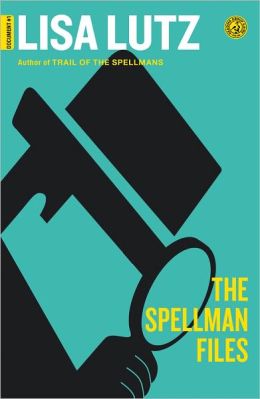
I laughed (which could be an ideal two-word review of every comedic novel), especially during the first half of The Spellman Files, and laughter balms many errors. Unlike most mystery or nominal mystery stories The Spellman Files is worth reading, but on a sentence level the novel is a mass of clichés, though the premise is interesting and the narrative proceeds intelligently. One can only wish that the same intelligence that structured the narrative also be used to consider the sentences.

Spellman_filesClichés accumulate like snow in Boston: “Finker was none the wiser” (8). Or: “But for many years, my attributes (for what they’re worth) were obscured by my defiant ways” (19). We don’t need “for what they’re worth;” attributes, like most other nouns, are only there for what they’re worth, not for what they’re not worth (though negating that cliché does raise interesting intellectual possibilities; alas that we don’t see such possibilities deployed here). Parents take a child’s story “with a grain of salt” (252). These are the sorts of problems that should’ve been edited out yet they weren’t.

The language gets a little better as the novel proceeds, but the initial problems are never resolved. Too bad. There’s a better novel in this one, and this one isn’t terrible. As with many plot-dependent books the outcome is less satisfying than the buildup. Yet the dialogue consistently shines:

“Nice duds,” I said as Daniel put his briefcase on the floor and slid into the car.
“Thanks. This is my drug-buying outfit,” Daniel said dryly.
“Did you bring the money?” I asked.
“Yes, I brought the drug money,” he said.
“You can just say ‘money’; you don’t have to say ‘drug money.'”
“Yes, I brought the money.”

I feel like I too would mistakenly say “drug money.” I’ll note too that in The Spellman Files Family dysfunction meets family work meets a sexually adventurous protagonist whose adventurousness is not played for drama. It’s an unusual combination on the plot and character level.

Family businesses exert a special pull on those not involved in them, perhaps because they wrap economic and psychological forces unusually closely together. Work also means status: “While I had already made a name for myself as the difficult child, my status as employee redeemed many of my other less-than qualities.” To those involved, family businesses may be annoying and even weirdly repulsive for precisely the same reasons. Combining the family business with the detective story is a winning mutation.

Other sentences work: “like so many other alpha males, my brother thinks monogamy is something you do somewhere between age forty and retirement” (71). Interesting that Isabel, the narrator, has enough data to generalize about the nature of “alpha males” and that she casually uses the term. Perhaps it’s seeping into the general lexicon.

Finally, one smaller note, not wholly about The Spellman Files: Novels are compendiums of social negotiation and fuck-ups; the fuck-ups tend to be more interesting in fiction and sometimes in real life, though in life one lives with the consequences.

Tiny Beautiful Things: Advice on Love and Life from Dear Sugar — Cheryl Strayed

Tiny Beautiful Things is not an Apple product but a mid-sized beautiful book that you should read. I say this even as someone with reservations about some of the content; as with many books that deal with love advice I wish more had been known and said about evolutionary biology. Yet it may be that we’ve evolved to not want to confront truths we perceive as ugly: better to turn away and signal our own goodness than to say we’re often incentivized to do things that current social conditions tell us are wrong.

TinybeautifulthingsThe end of the preceding paragraph if intentionally vague, but let me say that the book is beautifully written, bizarrely so given that it’s an advice column collection; perhaps any form, attended to with enough care, can become beautiful.

It’s hard to quote a section from Tiny Beautiful Things, even a long section, that conveys its tone. Most possible quotes sound treacly out of context (“You are loved”) or don’t appropriately convey Strayed’s mix of stories (she worked with high-risk middle-school girls and used that experience as a parable) and abstract points (see the previous mention: “You are loved”). Then again too, many people are not loved in the ways they want to be loved or by the people they want to love them. Strayed’s first answer to the first question in the book is, “The last word my mother ever said to me was ‘love.'” She starts with stories—parables, really—and in doing so she follows a millennia-old strategy; people remember the stories from the Christian Bible and the Torah but forget the tedious sections that recount lineages or offer specific rules about worship or other practices. Stories and math are eternal. A lot of specific instruction remains bound by time.

In the same opening question, she says too:

There’s a saying about drug addicts that they stop maturing emotionally at the age they started using, and I’ve known enough addicts to believe this to be true enough. I think the same thing can happen in longtime monogamy. Perhaps some of your limited interpretations about what it means to say the word “love” are left over from what you thought it meant all those years ago, when you first committed yourself to your ex-wife. That was the past, as you say, but I suspect that a piece of yourself is still frozen there.

One could alternately say, “We are all growing or dying.” The amazing thing is the number of people who choose the latter, intellectually and psychologically.

Some sections feel stoic, in the best way, as when Strayed says, “Suffering is what happens when truly horrible things happen to us.” I’d add, too, that sometimes suffering means nothing except itself. Much suffering teachings nothing and ennobles nothing. It just is, though we live in a culture in which everything must mean something. It often doesn’t.

Then there are the sections where Strayed could go deeper than she does. In one, a woman writes that the man who knocked her up isn’t terribly interested in being involved with her or the baby. They have a tenuous relationship and he leaves—probably seeking another nulliparous woman. Charles Murray’s Coming Apart applies here, but it isn’t story-driven or personal enough to merit inclusion. The fundamental forces are there but ignored.

I write this often, but I wish Strayed had read more evolutionary biology; seemingly inexplicable and cruel romantic acts and betrayals become explicable. Since I began—first I think with Geoffrey Miller’s The Mating Mind and then with others, like David Buss’s TheEvolution of Desire.

But Darwin has still not propagated outwards towards pop culture. Maybe we’ve evolved to rejection the insights evolutionary biology offers. We’re storytelling animals, and we want to reject stories that make us question our own consciousness and decision-making process. (Blindsight, though brilliant, may be unpalatable in this respect.) Railing is more fun, though, than looking for fundamentals. Words like “feel” and “feelings” are everywhere. Words like “incentives” are nowhere.

Yet the beauty reminds. So does rock-like reality: “We get work done on the ground level. And the kindest thing I can do for you is to tell you to get your ass on the floor.” A lot of us want the adoration and the success and the whatever without getting our asses on the floor.


I wrote more about Strayed in “Standard At-Risk Youth or Ex-Offender Empowerment Program: Improve Lives Through ‘X!’“, though that post may be more specialized than you’re seeking.

Thoughts on “The Anthropology of Childhood” by David Lancy

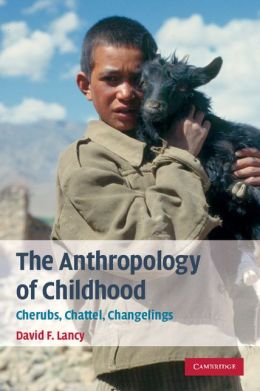
As noted previously, The Anthropology of Childhood is excellent, and now I can say that it is excellent throughout. There are too many points to summarize the book effectively or even to hit many of its main points. One could productively read it with Bryan Caplan’s Selfish Reasons to Have More Kids, since both books argue, sometimes implicitly, that upper-middle class Western child-raising practices have become crazed, neurotic, and conceivably even counter-productive (and almost certainly counter-productive in life-satisfaction terms). Consider this example, from Anthropology:

An interesting contrast can be made with WEIRD [Western, Educated, Industrial, Rich, and Democratic] society, where girls are not usually assigned sibcare [sibling care] duties and where young mothers labor alone without the guidance of their old female relatives. “The relative isolation of the nuclear family . . . means that each woman rears her newborn infant from scratch” and young, urban mothers are unprepared for squalling, active, and very unhappy babies (Hubert 1974: 46–47). The foibles of clueless parents have proven to be quite entertaining, as evidenced by “reality” TV shows such Nanny 911, which aired in the USA between 2004 and 2007, and Supernanny (2004 – 2011), in which a competent nanny brings order and harmony to dysfunctional families.

anthro_of_childhoodYet almost no one considers this point, or many similar points.

Wealth may enable a wide range of non-adaptive behaviors and beliefs that can be sustained primarily because we’re rich enough to sustain them. Bedrock beliefs held by many Westerners about the nature of humans and families are actually culturally selected, and some of those beliefs surprised me. Nerds, however, may be unpopular because nerds often attempt to interject facts into belief- and feeling-based conversations; I suspect many citations to The Anthropology of Childhood, and especially the sections on infanticide, will not go down well.

Still, self-deception also helps explain why so many people adapt seemingly non-functional behaviors; Charles Murray describes many of those behaviors in Coming Apart: The State of White America, 1960-2010, a book that like many true books that puncture popular beliefs is deeply unpopular in many quarters. Most people can, if they choose to, easily see whether their partners exhibit traits related to fidelity, tenacity, conscientiousness, grit, and so forth—but many if not most of us choose to ignore these obvious signals. Our values are observed everywhere.

There seems to be a growing bifurcation in American society between crazed, neurotic, and anxious upper-middle class two-parent households in which little Madison needs ice-skating lessons, soccer practice, oboe lessons, and round-the-clock enrichment activities, or else she’ll never be a “success” and will become a drug-addicted prostituted without even a public-school degree, and single-parent low-income households in which any babysitter is a good babysitter and survival is everything. The former need to chill out and the latter… I actually don’t see a good public policy for the latter, though both the political left and right have many strongly held opinions, neither of which have done much to countervail the larger trends Murray describes. Another writer, Michel Houellebecq, describes them as well, though much more obliquely.

The Anthropology of Childhood is, as Michael Erardjan suggests in the New York Times, going to become my go-to baby gift for those who have recently spawned, though careful readers may find sections disconcerting:

Another common tactic used by new mothers is to exaggerate the resemblance between the newborn and their husband [. . .] In spite of the confidence with which humans claim “he looks just like his father,” experimental studies show that babies cannot be reliably paired to their parents on the basis of appearance (Pagel 2012: 315). Studies in our monogamous, adultery-condemning society have shown that 10 percent of men designated as the biological father of a particular child are not (Buss 1994: 66–67), so the baby’s anonymous appearance confers a survival advantage.

If 10 percent of men designated as the biological father of a particular child are not, one has to ask what kinds of fictions prevent a society in which DNA testing is cheap and easy from automatically doing so as a matter of standard practice. The answers may get very ugly very fast.

I want badly for Lancy to write an advice column; something like Cheryl Strayed’s Tiny Beautiful Things: Advice on Love and Life from Dear Sugar is beautifully written and yet so utterly conditioned by contemporary American beliefs, and so utterly unfamiliar with cross-cultural comparisons or evolutionary biology. Read it anyway—that beauty! that feeling!—but read it with Lancy. Compare and contrast. Imagine what Lancy might say about the myriad of problems medicated, neurotic Americans experience, or think we experience. Most contemporary advice columnists are as much repositories of conventional thinking as religious figures were a century or two ago. Lancy is different. Lancy knows things. But the things he knows we instinctively want to reject—which is why reading him is so valuable.

How do you judiciously help someone whose work isn’t very good?

This question keeps reappearing in various guises: How do you help someone whose work isn’t very good? Simply saying “This sucks” isn’t helpful and is usually taken with offense. A sufficiently screwed up work may also be unrecoverable. But making minor changes and saying, “It’s great!” often isn’t helpful either, because the work isn’t great and false praise is a lie. Those seeking criticism should be tactful enough not to ask, “Is it good?”, but often they aren’t and it leaves critics and editors in an awkward position.

I’m a writer, so I tend to see stuff from bad writers, but the same principles apply to other people with other domains of expertise. I developed my method of commenting on bad writing years ago, when a former student and now friend asked me to read a few stories she’d written for a creative writing class. Given her age they weren’t terrible; I made some comments, fixed a couple of minor things, and suggested some books that might speak to her.*

She asked if I thought the stories were good, but fortunately she asked via email so I had a few minutes to think about my response. I replied that I’d reframe the question: if she keeps writing, reading about writing, and developing her own sense of good writing, in four or five years she’ll reread her stories and be able to decide for herself whether her work was any good. I mentioned that when I was 26 or so, I no longer thought the stuff I’d written from 18 – 22 was any good. She got the point, I think, and seemed to appreciate what I was saying without saying.

And what I told her was and is true: I don’t think much of that early work now. But I also wouldn’t be where I am today without having written what I did then. In addition to being true, that sort of advice has the advantage of being tactful. I think John Irving said that every writer who seeks feedback really wants to be told, “It’s perfect. Don’t change a thing.” But of course nothing is perfect and editors exist for a reason (so do therapists; the reasons may be more closely related than we’d like to commonly assume).


* Anyone interested in writing ought to look at this list, which I still think good. I periodically re-read every book on it. In some sense no good writer ever fully stops being a beginner.

Defining fiction

“The relentless definition of feelings, states, and relationships” could be one definition of literature.

I’m reading Paul Hawkins’s The Girl on the Train, and it includes this: “In Cathy’s flat I always feel like a guest at the very out limit of her welcome.” It’s a brilliant description of a feeling I’ve both had and inflicted on others and never thought explicitly about before. The description, while brilliant, is also brilliant like millions of similar descriptions in millions of other books; I’m not singling it out because it’s extraordinary, but because it’s ordinary, and for whatever reason it triggered in my mind the description that composes the first paragraph of this post.

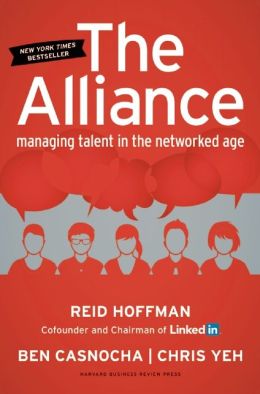
The Alliance: Managing Talent in the Networked Age — Hoffman, Casnocha, and Yeh

It is especially odd to read The Alliance next to “A longtime proponent of marriage wants to reassess the institution’s future,” since the book and the article describe the same suite of ideas but apply them to different arenas: business and love/marriage/sex, respectively. One could do a find and replace for key words and phrases in The Alliance and have an entirely different book. The structure of dating markets and economic markets are more similar than is commonly supposed (though that may be changing).

The_AllianceThe Alliance is excellent and should be read; the authors note that the “family” model many corporations deploy when describing employees is at best dishonest and at worst fraudulent in a way likely to engender tremendous, justified ill-will. Individuals can’t rely on companies to look out for them (“Both parties act in ways that blatantly contradict their official positions”). Despite this, however, a world of strict, consultant-like free agents is not a happy one either, per the Coase Theorem—though Coase is not cited directly. The solution proposed is an “alliance” that doesn’t promise lifetime employment but does attempt to set explicit expectations for employer-employee interactions.

The book is not as heavily researched as I might have hoped but there are numerous useful bits, like this:

The Towers Watson 2012 Global Workforce Study found that even though about half of employees wanted to stay with their current employer, most of them felt that they would have to take a job at a different company in order to advance their careers.

And those workers are probably right. Still, “A business without loyalty is a business without long-term thinking.” Stock options do a little to ameliorate short-term thinking, but not enough; one reason for startups may be to enforce long-term thinking by putting companies in the control of founders. Large companies, however, are here to stay, and The Alliance offers a way to navigate through them.

As the quotes above show, the book is not gorgeously written, but it is competently written and held my attention throughout. It begs to be given.

Why we like characters who battle institutions

David Brin’s “Our Favorite Cliché: A World Filled With Idiots… or Why Film and Fiction Routinely Depict Society and its Citizens as Fools” is great, and you should read it. He observes that novels, TV shows, and movies routinely depict heroic individuals standing up to corrupt or evil institutions or organizations. This tendency is “a reflex shared by left and right” to associate villainy with organization. Moreover, “Even when they aren’t portrayed as evil, bureaucrats are stupid and public officials short-sighted.” Brin notes some exceptions (Contagion is another, and the link goes to an article titled “Bureaucratic Heroism”), but those exceptions are exceptionally exceptional.

Nonetheless, I’d like to posit a reason why institutions and organizations are often portrayed as evil: they behave in ways that are evil enough with shocking regularity, and few of us have the means or fortitude to resist broken, evil, or corrupt institutions. The most obvious and salient example, much taught in schools, is Nazi Germany; while some individuals fought against the state murder apparatus, the vast majority went along with it, leading pretty much everyone who learned afterwards about the Holocaust to ask, “What would I do in that situation?” Most of us want to think we’d be heroic resisters, but the push to conform is strong—as the Milgram Experiment and Philip Zimbardo’s research shows. The Soviet Union murdered tens of millions of its own citizens.

Other examples exist closer to home: the Civil Rights movement fought corrupt institutions in the U.S. All the President’s Men exposed criminal actions, cruelty, and simple mendacity at the heart of the White House. The Vietnma War got started based on the invented Gulf of Tonkin. More recently, the Bush Administration made up evidence (or incompetently accepted made-up evidence) to justify the Iraq War. On a smaller basis, many of us have gotten caught in various nasty government bureaucracies in schools, universities, or elsewhere. Here’s one example from Megan McArdle’s struggles with the DMV.

Brin observes:

Now imagine that your typical film director ever found herself in real trouble, or the novelist fell afoul of deadly peril. What would they do? They would dial 9-1-1! They’d call for help and expect — demand — swift-competent intervention by skilled professionals who are tax-paid, to deal with urgent matters skillfully and well.

He’s right. I called the cops when a random asshole pounded on my door and threatened to kill me. They did show up (albeit later than I would’ve hoped!) and did arrest the guy. I’m grateful to them and for the police in that circumstance. But a lot of us are less grateful to cops, as reading Alice Goffman’s amazing book On the Run: Fugitive Life in an American City. Police as an institution have largely failed inner cities. Ask black people about their interactions with the police, and you’ll get a very different view of police than that of many white Americans.

So we may be getting stories of (exaggerated) institutional incompetence both due to history and due to everyday experience with institutions that (sometimes) don’t work well. Nonetheless it’s worthwhile for those of us who write stories to contemplate the truth of Brin’s observations about cliché on the level of plot, because we should try to be aware of our own dependence on cliché and to break that dependence whenever possible.

On “50 Shades of Grey” and Alan Moore’s “Lost Girls”

There are good parts of 50 Shades but it feels like a luxury “lifestyle”* commercial, written and executed by people with no experience of actual rich people imagining what rich people might be like. It also feels like a bondage story by people with no experience of actual BDSM imagining what BDSM people might be like. Reality is of course often not the primary purpose in a given movie but reality can be bent in an intelligent way to make a significant point or in an unintelligent way that detracts from the point.

fifty-shades-of-grey_poster50 Shades of Dull” gets it right: boredom is the movie’s real enemy, and the movie is unwilling to go “all the way,” with “all the way” defined broadly. The male lead is like a walking piece of injection-molded plastic. The woman is better but both have an essentially impossible acting test. On the way out of the theater I mentioned that he seems more like a serial killer than lover, and someone else said that he’d actually played a serial killer before. Makes sense.

The real fairy tale or fantasy aspect is that a guy like Christian Grey would pick out and obsess over a girl with nothing special about her. This is an interesting reversal of many movies and TV shows, in which a pretty girl improbably picks the quirky, initially low-status guy (“Don’t follow Hollywood movie examples if you want to get laid” analyzes this well, though I don’t endorse everything in the post or indeed much of the site). Anastasia is annoying and generically pretty, without any personality, and yet this very high status guy chases her around—and in ways that, if he were low status, would elicit a restraining order. “Creepy” is a term most often used to describe someone sexually interested in someone who does not reciprocate that interest. Both of us agree that the roommate and brother seem like they’re having a better time and are much more fun than the protagonists.

Still, the lighting was astoundingly good, particularly compared to the movie’s likely relevant comparison pieces. An unrated DVD edition may be a better movie. Much analysis focuses on the audience / societal signals the movie’s popularity emits, rather than the qualities of the movie itself, because the latter are so weak and the former much richer and more interesting. Something is being said, but by the consumers much more than the producers.

Auden said that “the proof that pornography has no literary value is that, if one attempts to read it in any other way than as a sexual stimulus, to read it, say, as a psychological case-history of the author’s sexual fantasies, one is bored to tears.” By this standard 50 Shades is porn but another book, commonly described as porn, is not: Lost Girls.
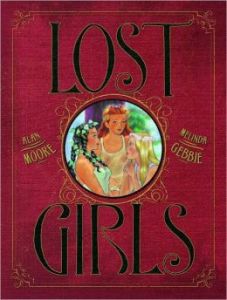
lost_girls_mooreLost Girls describes the way entire societies decided they hated each other much more than they loved themselves. The really horrific, shocking acts in the book are not threatened rape or young girls or incest; they’re wholescale industrialized death. Next to the latter the former may be serious and vile on an individual level but death is so final, and the delusions around war are even more powerful than the delusions around erotic life. Lost Girls is much weirder, scarier, and truer than 50 Shades and for that reason it will never be as popular, at least in its own time. But 50 years from now, I suspect people will still pick up Lost Girls and the rest of the Moore oeuvre. Like American Sniper, Lost Girls is vehemently anti-war, but it comes to an anti-war place from a much different direction and cannot be reliably read as a pro-war movie, as many have read American Sniper.

Lost Girls is also a novel or set of novels that bend reality in interesting ways that convey the characters’s psychological states, fears, desires, and lives. In this sense too it is not pornography. Sexuality is not automatically pornographic, and though this point is often made I don’t think most people act or interpret as if it’s been accepted.

Lost Girls is art and 50 Shades is commerce. Neither is really porn. Readers of either or watchers of 50 Shades should read Geoffrey Miller’s book Spent: Sex, Evolution, and Consumer Behavior, in which Miller points out that most women judge men much less on their material possessions and much more on their health, bodies, and minds. Men tend to do the same. For most people most of the time it’s not about the money, though the money is nice. Men who say women only want money are usually covering for their own deficiencies (this embarrassing post may be relevant).

As usual, books can go deeper and have fewer restrictions on them than movies. Even today there is a freedom-to-depict in books that doesn’t extend into movies and TV, at least in the U.S. It’s also possible to turn a book that’s not very good on the level of the sentence into a movie (or TV show) that’s better.

50 Shades’s great antecedent is the Marquis de Sade; like de Sade, the movie is actually funny when read properly. But the movie is unlikely to be read properly (Tyler Cowen’s post “Two misunderstood movies, two Rorschach tests” is relevant here. Camille Paglia’s chapter on de Sade is excellent.

Despite the above I didn’t regret seeing 50 Shades and you probably won’t either. It’s a very popular movie but not a stupid one, unlike, say, Transformers, or many action movies. I wonder if (following link NSFW) X-Art.com is doing unusual business this weekend.


Here is the NYT on the movie’s director. Here is a characteristically elegant evisceration, from The New Yorker. The London Review of Books is also good: “When it comes to erotic writing, the more explicit it gets – the more heaving, the more panting – the more I want to laugh.” There was much laughter in my theater.

* The term “lifestyle” is so vague and yet so popular among marketers. If you hear a real person use it, be wary. She’s probably been  corrupted by marketers and marketing language. Despite saying this I feel like participating in modern life makes everyone who pays attention a connoisseur of marketing talk.
The Anthropology of Childhood and the common rejoinder to your friends’s parenting delusions

The only baby book you’ll ever need” has been widely shared for good reason, and as of this writing I’m about 15% through The Anthropology of Childhood but know it’s going to become the default gift to reproducing friends. Something about American culture seems to bring out neuroticism in people doing what billions of others have done before them; see also Jennifer Senior’s All Joy and No Fun: The Paradox of Modern Parenthood. Expensive, large-scale programs like New York’s Universal Pre-Kindergarten (UPK) or the national Early Head Start (EHS) get launched under the assumption that more schooling, earlier, is better for children, it is not obvious that that is true: “While schooling for us may begin with the fetus (if you can believe the hype about expectant mothers listening to Mozart), most societies don’t see children as readily teachable until their cognitive and linguistic skills have mature. This change usually occurs during the fifth to seventh year [. . .]” (16).

anthropology_of_childhoodInsights occur at the national and personal level. I for example was a mostly unhappy child and adolescent, not I think due to my parents or circumstances or whatever but due to inner disposition, and I interestingly became happier when I realized that we’ve not evolved to be happy: we’ve evolved to survive and reproduce. I wish someone had pointed that out earlier. Happiness may or may not be a byproduct and our default “happiness point” probably varies substantially by individual. Furthermore, in an evolutionary sense happiness may be much more contingent than it is widely considered to be in contemporary America: “In the decision to create a child – whether in an Ethiopian village or elsewhere – their wellbeing and happiness is rarely the issue” (26). And farmer societies tend to take small children and put them to work, while forager societies tend to take steps to limit the number of total children had because children take much longer to become economically viable.

To return to my own experience, even as a child I found other children brutal and stupid. Yet almost no one speaks to this idea. Lancy notes that “Our own society views children as precious, innocent, and preternaturally cute cherubs. However, for much of human history, children have been seen as anything but cherubic.” That was my intuition and still is to some extent; few others, apart from Camille Paglia and Robertson Davies have made this point. It may be wrong but it’s barely part of the debate. Many cultures consider babies and small children “sub-human” (16). To be clear, I’m not arguing that American society should do so, but I am arguing that we should know more about our species’s own history and the contingency of our own widespread practices and assumptions.

This topic may, however, be especially resistant to inquiry; childhood and parenting may be particularly fraught because almost everyone has opinions on them (and every adult has been a child) but few of us try to figure out what the research says. The Anthropology of Childhood is a $40 academic book and thus may not be a particularly accessibly way of entering the mainstream, but it should be better known.

It is the sort of book that will repay rereading many times over; this post was meant to be a link, but the writing kept pouring forth until it was a post. Lancy writes that the book began as a short article that was 500 words over his journal’s limit, and he just kept going. It could be read in conjunction with Melvin Konner’s The Evolution of Childhood successfully.