The creator’s mindset and lawyers’ destructiveness in Cryptonomicon

Rereading Cryptonomicon is always an absurdly pleasurable experience that yields ideas I should’ve noticed before but didn’t. For example, hacker Randy Waterhouse undergoes a life change characteristic not only of numerous nerds I know, who often swerve from the mind-numbingly pointless activities to fantastically enriching ones even though both spring from the same drive, but that also demonstrates the difference between someone who’s just happy to make something and lawyers, who do sometimes deserve their bad rap and rep:

[Randy’s] life had changed when Charlene had come along, and now it changed more: he dropped out of the fantasy role-playing game circuit altogether, stopped going to meetings of the Society for Creative Anachronism, and began to spend all his free time either with Charlene or in front of a computer terminal. All in all, this was probably a change for the better. With Charlene, he did things he wouldn’t have done otherwise, like getting exercise, or going to see live music. And at the computer, he was learning new skills, and he was creating something. It might be something completely useless, but at least he was creating.

“Things he wouldn’t have done otherwise” probably also include showering regular and buying clothes when the old ones develop holes, if Randy is anything like the majors nerds I’ve known and, occasionally, been. Most importantly, he’s making stuff. And that’s what distinguishes Randy, whatever his other problems might be, from everyone else. Lots of people talk about doing things and relatively few do. When you find someone who does stuff, it’s notable, even if the thing “might be something completely useless.”

In Randy’s case, he writes a game based in part on information gleaned from a crazy grad student named Andrew Loeb, and, when Andrew finds out, he ends up suing Randy; when the university whose computers Randy used finds out, they sue him too. Naturally, this is only a very light gloss on how it goes down, like the difference between lipstick and car paint, but events ultimately leave Randy here:

In the end, just to cut his losses and get out of it clean, Randy had to hire a lawyer of his own. The final cost to him was a hair more than five thousand dollars. The software was never sold to anyone, and indeed could not have been; it was so legally encumbered by that point that it would have been like trying to sell someone a rusty Volkswagen that had been dismantled and its parts hidden in attack dog kennels all over the world.

Which, apparently, is what happens when deranged, unreasonable people meet certain kinds of lawyers, or come from them. Randy eventually comes to “decide that Andrew’s life had been fractally weird. That is, you could take any small piece of it and examine it in detail and it, in and of itself, would turn out to be just as complicated and weird as the whole thing in its entirety.” But we have no society-wide immune system to people whose lives are “fractally weird” and want to makes others’ lives miserable, via abusing the legal system or some other means. The people who will make others’ lives miserable don’t really understand the mindset of creators, who’re just trying stuff out to see what happens. And they often don’t realize what other people are like, either, because they haven’t developed the intellectual immune system necessary to protect them from crazy assholes. Creators often live in a gift economy while others live in a commercial economy. So they get in situations like Randy does, having “to hire a lawyer” and cut their losses.

Reading over this post, I realize that, as usual, it’s not really possible to excerpt Cryptonomicon effectively, because the scene in question lasts four densely forested hardcover pages and delves into a level of nuance appropriate for Emacs users. And Stephenson’s novels are fractal too: you can examine almost any segment, from the sentence on up, and find that any part is as detailed and intense as the whole. I haven’t begun to dissect what comparing software, a non-tangible entity that can be infinitely copied with near zero cost, to a Volkswagen, which is quite finite and has many other characteristics separating it from software, actually says about both software and Volkswagens.

Through Randy, however, Stephenson is trying to explain hackers, or at least show one in action, since they’ve been conspicuously absent in literary fiction while probably doing more to change the world than virtually any other group over the last 30 or so years. You can’t really explain their core in a short space, which is why Stephenson devotes about a quarter of a 1,000 page book to examining one, and another quarter or so to examining one’s literal and figurative predecessor. But I could imagine an academic paper examining the construction of a hacker’s temperament, how it differs from the straw-man average man’s temperament, and how an eventual awareness of that difference forms the hacker’s outlook. Randy’s encounter with Andrew can be read as the awareness of that difference coming to the fore, rather as a comic book hero comes to realize that his special powers separate him from his classmates. The difference is that comic book heroes usually have their villains pre-selected and presented as suitably villainous, whereas in life it’s pretty unusual to come across someone as conveniently villainous as Andrew is here.

Umberto Eco at the New York Public Library for The Prague Cemetery

In a talk with Paul Holdengräber, Umberto Eco said that “I have no particular interest in psychoanalysis,” but the interviewer kept pressing. Eco said, “My problem with psychoanalysis is due to my pride.” He’d be too eager to “trick” the analyst. It’s a writerly comment, and I get the impression that he’s playing tricks with and on readers (and listeners) too, continually pulling himself back from definitive statements and teasing one with the power of narrative (did you guess the murderer and his reasons in The Name of the Rose? Can you reconstruct the weirdly chopped narrative in The Prague Cemetery? For me the answers are no.)

In addition: Eco said he’s not tempted by psychoanalysis because it’s too expensive, which is rather hilarious given his obvious wealth and the relative lowness of monetary concerns compared with the abstract, aesthetic or intellectual concerns around intellectual power and honesty. I identify with Eco, and if I were in psychoanalysis I’d want to trick the therapist too, which might defeat some of the purpose. Besides, Eco says he “doesn’t offer cures,” which is good: novelists should offer stories. Eco’s are tall, and he has the glint of a precocious child caught in a lie but still amused and chuckling at his ability to trick you, and he has that childlike sense of the very intelligent and curious, akin to your favorite professor in college; I’m trying to cultivate the same attitude, but it’s a bit like trying to grow tomatoes in Seattle.

Eco revealed other things: he loves the English words “discombobulation” and “flabbergasted,” both of which I also admire, though not as much as “specious” and “callipygian.” He says “stupidity is fascinating,” which is true, especially because stupidity can often be harder to define, and one can go from feeling pleased with one’s own intelligence to feeling quite the fool with astonishing quickness—which is one of the delights in The Name of the Rose, when William realizes that his vaunted mind has created connections where none exist and that he has been led astray by his own certainty. In The Prague Cemetery, Simonini the forger preys on the trust and paranoia of others. Eco calls him a character without any kind of morality. I would add that he has no epistemological foundation, which lets him ply his trade; Eco says “the world is full of Simoninis,” which also implies we should watch for them and the conditions, like war and paranoia, that allow them to prosper.

The Prague Cemetery is set in the 19th Century, but, like all novels set in a time not our own, it invariably comments on our own. Eco cited the imagined Iraqi weapons that gave a pretext for the second Iraq War in 2003 as an example of Simoninis at work. We tend to have too much credulity. Generalization is a scourge and specifics beautiful—except, of course, for this generalization.

Hearing and reading Eco shows a powerful and finely calibrated mind at work, which is a great and too rare pleasure. Listening to the talk and reading Eco’s work makes me want to be a better writer—and a better reader, since the two can’t be separated from each other. Another point: I can’t convey most of Eco’s hilarity. It’s too dependent on delivery and comic timing. Eco uses timing effectively, and he’s willing to let agonizing silence hang.

In Reflections on The Name of the Rose, Eco said that novels are born of a single, seminal idea; in the case of that novel, the desire to see a monk murdered (he originally wrote that he wanted to poison a monk, but he has since made the subtle but important change to take some of the agency out of his hands). So Holdengräber asked about the seminal idea in The Prague Cemetery. Eco said he didn’t have one. Things change. It might be futile to ask a writer about their methods, since writers, like lovers, might be motivated by all sorts of things at different times and places.

Eco said in the talk that “The novel is always a way of discovering something,” but I wonder if novels are really means of discovering how little we know and how strange things really are if we look closely enough. We really are strangers to ourselves, but we often don’t recognize it. Eco, I sense, does, and that may explain his uninterest in psychoanalysis. He’s essentially wary of the mind’s associative tendencies, which he associates with conspiracy theorists. The idea of conspiracy enters those of his novels I’ve read: The Name of the Rose, where William imagines a possible conspiracy, Foucault’s Pendulum, where Casaubon and the editors make up a conspiracy for their own amusement, The Prague Cemetery, which, so far, is overrun with characters whose dubious ability to infer causal relationships where none exist enables Simonini to flourish.

The end of the talk was disappointing: Holdengräber asked about the role of the Internet in changing research and the role of libraries in the age of the Internet, Eco offered platitudes long familiar to New York Review of Books readers, and, besides, no one really knows what’s going to happen over time.

I haven’t deeply discussed The Prague Cemetery in this post because he didn’t speak much about it. In addition, I’m about halfway through the novel and continue to dislike it—not because of its protagonist, a man as close to wicked, evil deception (as opposed to the humorous kind Eco practices) as Eco can probably make, but because of is narrative structure. The novel is divided between three major narratives, two of which may be multiple personalities from the same person, and much of it is told in diary form. It’s hard to track who is doing what and why he’s doing it.

Narrative games are a long-standing interest of Eco’s; to return to Reflections on the Name of the Rose:

Another problem: the encasement of the voices, or, rather, of the narrative points of view. I knew that I was narrative a story with the words of another person, having declared in the preface that this person’s words had been filtered through at least two other narrative points of view, that of Mabillon and that of the Abbé Vallet, even if they had supposedly operated only as philologists (but who believes that?). The problem arose again, however, within Adso’s first-person narration. Adso, at the age of eighty, is telling about what he saw at the age of eighteen. Who is speaking, the eighteen-year-old Adso or the eighty-year-old? Both, obviously; and this is deliberate. The trick was to make the old Adso constantly present as he ponders what he remembers having seen and felt as the young Adso.

But “the encasement of the voices” is easily followed in The Name of the Rose, and the various voices in Foucault’s Pendulum are anchored by Casaubon. One can follow what someone is doing and, more or less, why they are doing it. That’s not especially true in The Prague Cemetery, where the protagonist, Simonini is mostly writing a “diary,” while other voices track what he’s doing.

Does this sound confusing? I’ve reread the last couple paragraphs a couple times and find no way to simplify my explanation. The novel begins to feel more like an exploration of narrative games, along the lines of late Henry James, Herman Hesse, or Philip K. Dick, and less like a story. In Reflections, Eco writes that “Unquestionably, the modern novel has sought to diminish the amusement resulting from the plot in order to enhance other kinds of amusement. As a great admirer of Aristotle’s Poetics, I have always thought that, no matter what, a novel must also—especially—amuse through its plot.” Maybe he is no longer convinced “a novel must also [. . .] amuse through its plot,” or he has expanded his definition of “amuse,” or Eco has changed his mind, as he has about the need for a novel to come from a seminal image.

I keep reading Eco because I hope for a novel as powerful as The Name of the Rose or Foucault’s Pendulum. I hope to get one.

Initial thoughts on Ann Patchett's State of Wonder

I started State of Wonder last night. Today I needed to finish a lot of work. Some got done. A lot didn’t. The novel held me: by the power of its story, by the hypnosis of trying to figure out just who Dr. Swenson was and is, by the dilemmas each character faces, by the writing, by the agony of jungle life. The writing isn’t showy, exactly, but it’s good, strange and normal at the same time, with very average seeming sentences like these: “Marina shrugged. It was a peculiar kind of therapy, lying flat out with the child you had only now realized you wanted while being asked if you had wanted a child.” The wants and desires of the second sentence wrap in on each other, implying paradox in a book full of paradoxes and choices just on the verge of being transcended. A paragraph below there’s this: “That was Dr. Rapp’s great lesson in the Amazon, in science: Never be so focused on what you’re looking for that you overlook the thing you actually find.”

Yes: Marina overlooks everything and finds everything. Not many characters in novels do. Not many people do. Not many characters or people articulate trade-offs like the ones in State of Wonder. Not many live their trade-offs so fully. Too few novels have characters who care about something, anything, with real depth. In State of Wonder, everyone who counts cares.

The last 100 pages are extraordinary, and if the early middle section is sometimes confusing (thanks in part to Marina’s use of Lariam (Wikipedia: “The FDA product guide states it can cause mental health problems including: anxiety, hallucinations, depression, unusual behavior, and suicidal ideations among others”)), the end more than makes up for perceived early deficits. With a novel like this I can’t help but wonder if the sections I perceived as confusing were essential in some way I haven’t grasped.

“Ravishing” is an overused and often stupid word critics use, but I will use it here.

I have other reading to be done but I am still stuck pondering Drs. Swenson and Singh; this doesn’t happen very often.

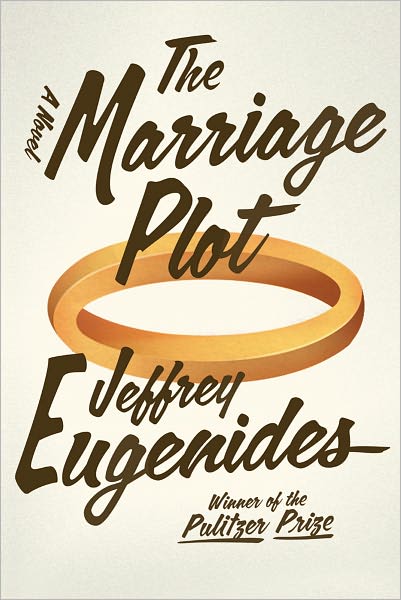
The Marriage Plot — Jeffrey Eugenides

The Marriage Plot is very competently done, and there’s nothing particularly wrong with it; some things may even be done particularly well. The problem is, as my faint praise indicates, a novel isn’t a student essay: it’s not enough for nothing to be particularly wrong. Something has to be smashing and fantastic for it to really matter. The Virgin Suicides, with its ceaseless questioning of what happened to the Lisbon sisters and its unusual narrative structure in the form of a chorus of outsider men who were once boys attempting to understand something they never quite can, had this quality. There’s a haunting, melancholy quality to the story and the way its told. Middlesex is imaginatively powerful because of Cal’s parents’ unusual relationship (does love conquer all, including biology?) and Cal’s own inter- or transexual state, which is so unusual amid novels that mostly cover straight people, occasionally cover gay people, but very seldom cover people whose bodies and minds don’t quite match like they should.

I keep copies of both Eugenides’ earlier novels, but I’m selling my copy of The Marriage Plot. I can’t imagine rereading it. In The Curtain, Milan Kundera wrote something that has long stayed with me because of how right he is:

Every novel created with real passion aspires quite naturally to a lasting aesthetic value, meaning to a value capable of surviving its author. To write without having that ambition is cynicism: a mediocre plumber may be useful to people, but a mediocre novelist who consciously produces books that are ephemeral, commonplace, conventional—thus not useful, thus burdensome, thus noxious—is contemptible.

Eugenides has that ambition. I concede The Marriage Plot might outlast its author. But I’m skeptical it will: the religious stuff Mitchell experiences doesn’t measure up, and the mostly banal problems faced by recent college graduates doesn’t quite live up to anything. Leonard is the only person with real problems, both in terms of his ailment (manic depression) and his work (as a biologist: he is confronting the natural world, and some of the most interesting sections describe both his efforts in taming yeast and his status in a science lab). Madeleine, like so many of us, is committed to love with a person who maybe isn’t worth it. In listening to her sister’s trouble, we find this: “like anyone in love, Madeleine believed that her own relationship was different from every other relationship, immune from typical problems.” She isn’t, and her relationship is more like that of other people than she’d like to imagine it to be. And The Marriage Plot is more like other novels than I want it to be.

There are long sections of background that we might not need. We find that “Leonard had grown up in an Arts & Crafts house whose previous owner had been murdered in the front hall.” Grisly, but not vital to the story. “[. . . ] Madeleine took the opportunity to make herself more presentable. She ran her hands through her hair, finger-combing it.” Nothing wrong with this: it’s just average. Maybe too Victorian. Later: “Ground personnel rolled a metal stairway up to the plane’s first door, which opened from inside, and passengers began disembarking.” Do we need this? Or can it be eliminated? On their own, these sentences are okay, and I’ve committed such sentences many times, despite Martin Amis warning me not to. I want to put this book on a diet, to convince it to render only the essential. Too much of it makes me want to cut more; I can also now say that the only thing worse than taking an essay test of your own is reading about someone else’s essay test, especially when that essay test involves religion.

There are also some strange sentences; this one makes me wonder if the last word is a typo: “Years of being popular had left her with the reflexive ability to separate the cool from the uncool, even within subgroups, like the English department, where the concept of cool didn’t appear to obtain.” What does “appear to obtain” mean? Perhaps it’s supposed to be “appear to apply.” The good ones are still good, though: “Dabney had the artistic soul of a third-string tight end.” I’ve met Dabneys. And I get what Madeleine gets: people who declaim one kind of hierarchy or status system are always setting up another, whether they recognize it or not. I also find it intriguing that Madeleine can be an intense reader and also intensely popular. The two seldom appear together in fiction. Perhaps the combination makes her an astute social reader of everyone but herself.

She also understands Mitchell, who acts as a beta orbiter for most of the novel. He provides her with extra male romantic attention mostly because he’s a fool, and she knows it on some level: “Mitchell was the kind of smart, sane, parent-pleasing boy she should fall in love with and marry. That she would never fall in love with Mitchell and marry him, precisely because of this eligibility, was yet another indication, in a morning teeming with them, of just how screwed up she was in matters of the heart.” Being “smart, sane” and “parent-pleasing” is another way of saying “boring.” He also doesn’t make a move when he’s effectively asked to. At one point, Madeleine takes Mitchell home and goes to his attic room wearing only an old shirt—then resents him for not making a move when he obviously wants to and she does too.

She has a point.

When Mitchell is too eligible, that “eligibility” gets held against him. And he buys into ideologies that encourage him to remain a fool. A priest says to Mitchell: “Listen, a girl’s not watermelon you plug a hole in to see if it’s sweet.” Tell that to most women who do the same of men. There are plenty of sexist assumptions in this statement alone to get a feminist writing an angry paper about women, innocence, desire, and sexuality. Perhaps you shouldn’t take romantic advice from someone sworn to a life of celibacy and thus ignorance in a realm that most of us take to be vitally important. To be fair, Mitchell mostly doesn’t, but that he’s seeking knowledge from a source like that tells us he doesn’t even know where to begin to look for help. And Madeleine exploits this weakness. She says, “[. . .] one night the previous December, in a state of anxiety about her romantic life, Madeleine had run into Mitchell on campus and brought him back to her apartment. She’d needed male attention and had flirted with him, without entirely admitting it to herself.”

Rather nasty. Even worse than he falls for it. The optimal solution for Mitchell: find another girl, ideally one hotter than Madeleine, and use the other girl as leverage. Moping around doesn’t get the girl. As Sean Connery says in an otherwise lousy movie called The Rock, “Losers always whine about their best. Winners go home and fuck the prom queen.” Mitchell hasn’t realized or internalized this. Contrast Mitchell’s neediness with that of his rival’s distance: “The more Leonard pulled away, the more anxious Madeleine became.” She’s desperate for Leonard, which enables him to make her like him even more. Mitchell is on the opposite side of this recusive dynamic. He should read Radway’s Reading the Romance, which describes how women like to read romance novels in which the heroine falls for major alpha males. Radway doesn’t use this term, of course, and works to explain away women’s preferences for alpha males, but the descriptions still shine through.

Still, there are funny bits to The Marriage Plot; on the same page where Madeleine assesses Mitchell as a beta, her mother says that she “saw a program about Indian recently,” as if “a program” on TV could convey much about the country—but wanting to say she’s seen it does convey a lot about her. She goes on to say, “It was terribly depressing. The poverty!” Mitchell says “That’s a plus for me [. . .] I thrive in squalor.” The unexpected reaction to Madeleine’s mother and reframing of expected values makes this funny and shows us that Mitchell isn’t the stiff he might otherwise appear to be. And the book isn’t the stiff it might otherwise be. It’s just not funny consistently enough or deep consistently enough. It’s a muddle, even when I do laugh at lines like, “Madeleine’s love troubles had begun at a time when the French theory she was reading deconstructed the very notion of love.” Love isn’t so easily eliminated, however: it only takes belief to sustain it.

And the characters are more self aware than I’ve sometimes depicted them here. Madeleine, for instance, knows that graduating from college, for a certain class of person who is expected to go to college, just isn’t that hard. On graduation day, “she wasn’t proud of herself. She was in no mood to celebrate. She’d lost faith in the significance of the day and what the day represented.” If college is mostly a test of showing up, it’s hard to blame her; and majoring in English probably isn’t very hard for most hard-core readers (it wasn’t for this one, anyway; to me reading was fun, which meant that I did so much more of it than most of my classmates that class itself wasn’t very hard). And she finds that the deconstructing education she receives isn’t much use when she’s confronted with the messy reality of interpersonal relationships, including her relationship with Leonard. Saying manic depression is a socially constructed discourse won’t get help like lithium will, even with lithium’s side effects.

Leonard’s stay at Pilgrim Lake, a biological research facility something like Cold Springs Harbor Laboratory, is among the novel’s most interesting sections. I would’ve liked it longer and Mitchell’s Indian sojourn shorter. Leonard is researching reproduction in yeast; this yields a predictable but impressive number of metaphors for human dilemmas. His work also can’t be solved by appeals to socially constructed discourse, and I suspect many of the scientists at the lab are more interesting than Madeleine at Mitchell. For example, Madeleine observes one of the very few female research scientists and observes:

Madeleine guessed that MacGregor [who just won a Nobel Prize] made people uneasy because of the purity of her renunciation and the simplicity of her scientific method. They didn’t want her to succeed, because that would invalidate the rationale for their research staffs and bloated budgets. MacGregor could also be opinionated and blunt. People didn’t like that it anyone, but they liked it less in a woman.

Tell us more about the “simplicity of her scientific method.” How does that relate to literary theory? Could we see MacGregor take more of an interest in Madeleine? Who are the people who “didn’t want her to succeed,” and how does she react to them? I wouldn’t want to turn the novel into Atlas Shrugged, but there are rich idea veins here that go unmined in favor of Mitchell’s noodlings. My suggestions are somewhat unfair, as I’m violating Updike’s first rule of book reviewing—”Try to understand what the author wished to do, and do not blame him for not achieving what he did not attempt”—but I think an exploration of gender in science more interesting than an exploration of gender and mating habits among relatively average 20-somethings. Maybe because I fit into that group I’m too close to the subject to find it remarkable, but I think the novel has a smaller-than-life quality to it, in the same way B. R. Myers describes Jonathan Franzen’s novel Freedom at the link:

One opens a new novel and is promptly introduced to some dull minor characters. Tiring of them, one skims ahead to meet the leads, only to realize: those minor characters are the leads. A common experience for even the occasional reader of contemporary fiction, it never fails to make the heart sink. The problem is not only one of craft or execution. Characters are now conceived as if the whole point of literature were to create plausible likenesses of the folks next door. They have their little worries, but so what? Do writers really believe that every unhappy family is special? If so, Tolstoy has a lot to answer for—including Freedom, Jonathan Franzen’s latest. A suburban comedy-drama about the relationship between cookie-baking Patty, who describes herself as “relatively dumber” than her siblings; red-faced husband Walter, “whose most salient quality … was his niceness”; and Walter’s womanizing college friend, Richard, who plays in an indie band called Walnut Surprise, the novel is a 576-page monument to insignificance.

The Marriage Plot is a much better novel than this, but one detects the same kinds of maladies at work: “dull minor characters,” a problem beyond “craft or execution” (which are, again, well done here), “little worries” for the most part (until an unconvincing ending), and a general feel that life is elsewhere. Around the same time, Bill Gates, Steve Jobs, Bill Joy, Richard Stallman, and many others were coalescing around Silicon Valley to change the world. I wouldn’t be communicating with you right now via this medium if it weren’t for their work. Which isn’t to say every novel set in the late 70s or early 80s should be about computers, technology, or technologists: but in the face of banality, I can’t help drifting toward thoughts of people whose work really, incredibly, resolutely matters.

Eugenides is clearly interested in the inner workings of people—the problem is that Mitchell and Madeleine do not have particularly interesting or engaging insides. Mitchell needs a copy of The Game to be time-warped to him, stat, and Madeleine needs to better realize what reading nineteenth-century novels should prime her to know: that she’s not the first person in the universe with unwise love decisions or family problems. Why doesn’t she better analyze her own situation in terms of the novels she loves so much? Why doesn’t she better realize that, yes, her life could be one of the fragments in Roland Barthes’ A Lover’s Discourse? It could be, as Eleanor Barkhorn says in “What Jeffrey Eugenides Doesn’t Understand About Women,” that Madeleine doesn’t have any real female friends, but I’m not convinced: I’ve met women who have few or no real female friends, and I don’t think that aspect of Madeleine’s life is unrealistic. The bigger problem is her lack of friends in general, so those friends can’t say the obvious to her: Why Leonard? Do you realize what you’re giving up? And if she does, and she gives up much of herself anyway, then the problem is her own blindness—a topic that I don’t find tremendously satisfying to read about, since it basically implies Madeleine is stupid. Characters can only be stupidly blinded by love for so long before one removed the “blinded” and turns “stupidly” back into a noun.

Most of my problems with the novel aren’t with its prose on a micro level, although it has those issues: it’s with the dearth of real ideas in the novel. It doesn’t quite go with the literary-theory-as-life metaphors, which drop out partway through. It doesn’t quite go with the alpha-beta-male decision that Madeleine faces. It doesn’t quite go with the manic-depression-as-serious-issue-maybe-linked-with-creativity issue that Leonard has. It’s a host of “almosts” that reminds me some of a sunnier version of Michel Houellebecq, especially in The Elementary Particles and Platform.

Houellebecq, however, is willing to engage in a kind of brutal realism—for lack of a better phrase—that Eugenides doesn’t get to. Yet that’s what the characters need: less understanding of their petty problems and more context, or a harder eye, or someone to smack Mitchell and Madeleine, then explain both their problems. I could explain their problems. I’ve met a million Mitchells and Madeleines. Hell, I used to be one in some respects. But the world has a habit of correcting your faults, if you’re paying attention to the signals the world is giving. Mitchell and Madeleine aren’t. That’s what makes them so unsatisfying. As three of the characters go, so does the very, very competent novel that doesn’t get past competence and into transcendence.


You can read my initial impressions here.

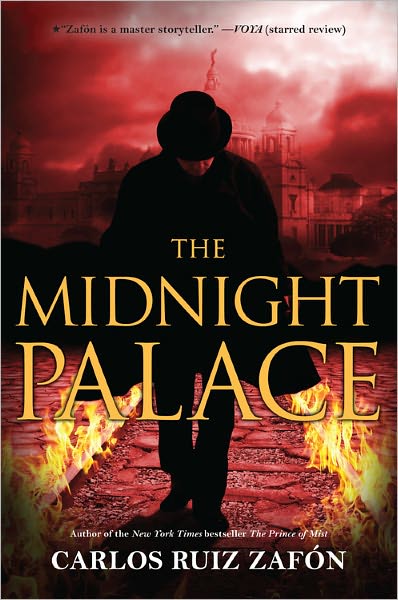
Carlos Ruiz Zafón's The Midnight Palace and The Prince of Mist show moments of promise, and yet. . .

I bought Carlos Ruiz Zafón’s The Midnight Palace and The Prince of Mist because I loved The Angel’s Game and The Shadow of the Wind so much. But The Midnight Palace and The Prince of Mist are disappointing. The most fascinating thing isn’t their generally low quality, however. It’s the moments when the later Zafón pokes through, showing what’s to come. I left The Prince of Mist and The Midnight Palace at my parents’ house, and when my Dad started reading one, he stopped and mentioned how awful they were. But they have moments where Zafón shows what he’ll later become—where he describes places, engages and rewrites cliches, talks about shocking family secrets, reveals the semi-supernatural villain. Unfortunately, cliches dominate, the writing is flat, and characters hold the interest of small-town human interest stories. But his later work gets those things right.

I wrote a whole post describing why the young adult novels are bad and pointing out the germs that later sprouted into his stronger, later work. But you know what? All those examples don’t matter. The books are weak for all kinds of reasons that are obvious on a first reading. I deleted all my earlier commentary because I realized that Zafón is an example of an experimental artist, as defined by David Galenson in his fascinating book Old Masters and Young Geniuses: The Two Life Cycles of Artistic Creativity. Zafón’s books are important only because they also show the danger of assessing an author based on a single work: Zafón’s young adult novels came out before his later, better novels. If I’d read them first, I doubt I would’ve read what came next. Fortunately, however, those books weren’t translated until after Zafón became successful.

In Galenson’s distinction, experimental artists tend to grow slowly; their early work is very seldom considered their important work. By contrast, Galenson describes conceptual artists who tend to do important early work that totally redefines their field; their later work tends not to have the punch it might otherwise have. Experimental artists often don’t have a single defining work, but rather a large body of production that often feels like a unified whole. Conceptual artists often have one or a small number of significant works. The theory is much elaborated from this unfortunate sketch, which naturally loses many of the details that make Galenson good. But you can graft his analysis directly onto Zafón. If I thought the earlier books were worth the effort, I would take your time and mine to do a major compare and contrast between them. They’re not, however. What is important is the lesson one can draw about not prematurely judging a writer based on premature work that might not show the late emergence of talent based on experience and extensive effort in a field.

I’m not going to read Zafón’s other young adult novels; he wrote four prior to The Shadow of the Wind. But when his next novel in the Shadow of the Wind and Angel’s Game sequence emerges, I’ll gladly clear the decks to read it.

The Magician King — Lev Grossman

I love The Magicians. I like The Magician King.

The Magician King has many of the qualities that made The Magicians special: twists on standard fantasy tropes; impressive language in many sentences, although not quite as impressive its predecessor; and a consistent willingness to instill a sense of wonder about the world and about what the characters might be able to accomplish. Happy endings aren’t foreordained, which is to be admired.

But The Magician King lacks the surprising urgency of The Magicians and feels like another lap after the race is over. Consider a passage from page six, after Quentin, Julia, Janet, and Eliot have returned to Fillory as benevolent if distracted monarchs. They’re hunting a magic hare who can see the future, which sounds like a bum gig; life’s excitement comes from not knowing what happens next:

The point wasn’t really to catch the hare. The point was—what was the point? What were they looking for? Back at the castle their lives were overflowing with pleasure. There was a whole staff whose job it was to make sure that every day of their lives was absolutely perfect. It was like being the only guests at a twenty-star hotel that you never had to leave.

Does this sound familiar? If you read The Magicians, it should, since The Magicians is endlessly concerned with the questing for meaning that can’t be imposed from without. I’m going to spend the next couple paragraphs looking at similar rhetoric from The Magicians; if this sort of thing bores you, skip to the paragraph that starts with a series of bolded words. Rhetorical comparisons aren’t everyone’s forte, but they’re essential for understanding how The Magician King is too often a rehash of the same problems presented in The Magicians but without a new angle on those problems.

In The Magicians, Quentin thinks:

You just had to get some idea of what mattered and what doesn’t, and how much, and try not to be scared of the stuff that doesn’t. Put it in perspective. Or something like that. Otherwise what was the point?

“What was the point” is a decent question for someone with an adolescent temperament. Quentin spends the rest of the novel ineffectively trying to answer the question. He doesn’t answer it, not perfectly, but somewhat understands that you make the “point” for yourself. You make meaning for yourself, because meaning can’t be imposed by external social forces, and death itself gives meaning to life. One would think the sheer realism of The Magicians’s end would show Quentin as much. When the party reaches Ember’s Tomb at the end of The Magicians, two large, evidently hostile animals charge, and we find our hero panicking: “Oh my God, Quentin thought, this is really happening. This is really happening.” You don’t make something merely by saying it, although the prospect of death wakes him from the upper-middle class reverie where he’s been living. Death, especially violent death, is not beautiful or noble—it is terrifying and shocking. It reminds you of why so many people move to the quiet suburbs and get jobs in middle management. Beats the hell out of getting the hell beaten out of you.

The repetition of “This is really happening” is like a refrain designed to keep Quentin awake. He watches the death of the Ferret and thinks, “He wasn’t ready for this. This wasn’t what he’d come here for.” He wasn’t ready then and he never will be—unlike Alice, whose maturity contrasts with his throughout The Magicians. She says, “[…] don’t talk to me about death. You don’t know anything about it.” She’s right. The disappointing thing is that he still doesn’t in The Magician King. He hasn’t internalized the central fact that death is connected to finding meaning because death and its predecessor aging can’t be avoided. I am not opposed to characters who don’t realize this; I am opposed to characters who don’t realize this, have a series of events that should cause an epiphany, appear to realize it, and then forget that they’ve realized it in the next novel.

Early in The Magicians, Quentin is still in a mostly mundane reality and thinks that

He’d spent too long being disappointed by the world—he’d spent so many years pining for something like this, some proof that the real world wasn’t the only world, and coping with the overwhelming evidence that it in fact was. He wasn’t going to be suckered in just like that. It was like finding a clue that somebody you’d buried and mourned wasn’t really dead after all.

And now, in the time of The Magician King, he’s a king in Fillory and still dissatisfied. You can’t get no satisfaction, Quentin, but the problem eventually shifts from the world’s fault to your own. He is still “looking for something else. He didn’t know what it was.” You were looking for something else in Brooklyn and now you’re looking for something else in Fillory. No one, not even a Seeing Hare, can tell Quentin. Whenever “Life was good” for Quentin, it was time to fuck it up for no particular reason. Seeing someone fuck up a perfectly good life through understandable hubris and dumb social dynamics is thrilling and sickening once, as it is in Donna Tartt’s The Secret History. Seeing someone do so twice is just daft.

In The Magician King, Quentin is still in awe of where he is: “You really knew you were in a magical fantasy otherworld when a beautiful woman wearing a skimpy dress made of leaves suddenly jumped out of a tree.” But he’s been seeing magic constantly for, presumably, years. Are talking animals not enough? Still, the novel’s fidelity to the bureaucratic grit of life is impressive—Janet says of Dryads, “I spend enough time listening to them bitch about land allocation.” Ruling Fillory becomes associated with petty zoning squabbles of the sort you can find at City Hall if you’re so inclined. That Grossman includes such ideas is part of what makes The Magicians and its sequel special. But it also raises expectations, and when he includes something that’s wrong, it’s disquieting, as with this:

Fillory wasn’t England. For one thing the population was tiny—there couldn’t have been more than ten thousand humans in the whole country, plus that many talking animals and dwarves and spirits and giants and such.

A population that small wouldn’t be sufficient to get Fillory into medieval-level specialization; at best, 20,000 people could support a slightly elevated hunter-gatherer lifestyle. Plus, why is the land so infertile that it can only feed 10,000 people? Prior to the Industrial Revolution, the Malthusian paradox ensured that populations grew to approximately the size of the agricultural capacity of the land itself. With only 10,000 people and 10,000 magical non-people, there couldn’t have been much arable land, and certainly not enough to sustain any kind of specialization network (for more on similar topics, see, for example, Mokyr’s The Enlightened Economy and Clark’s A Farewell to Alms, along with the vast corpus of economic and historical literature about historical development patterns and the Industrial Revolution). Fillory is big enough to have a navy. Countries of 20,000 don’t even have an army, and the knowledge necessary to grow a ship-building industry must span thousands if not hundreds of thousands of people. Suddenly, I’m jolted out of a fictional universe and into the various economics textbooks I’ve read by a seemingly trivial detail.

And this isn’t the only scene of questionable economics. Quentin goes on a quest to collect taxes from an outer island with a single-digit population, and while there an uncanny resident says:

Tomorrow I’ll take you out to see the gold beetles. They’re amazing: they eat dirt and poop out gold ore. Their nests are made of gold!

If a source of apparently infinite gold is available via a short ship ride from the mainland, the logical thing to do is to begin farming and set up a trading route. Why hasn’t anyone done so? The Spanish imported so much silver from the Americas in the age of colonization that some economists believe it caused inflation in the European economy. People are very good at acting on incentives and exploiting commodities. Why aren’t the Fillorians? It could be because the novel states that there’s an abundance of everything, again for reasons that aren’t obvious, but that’s not a terribly satisfying explanation.

You could get over these errors and others by waving your hand and saying, “It’s magical”—Quentin says “Magic was part of the ecosystem”—but it still rankles in a book devoted to showing the “real” side of magical living. These are minor details, but they stand out in a book devoted to realism.

Quentin has a small-l liberal, educated, and modern knowledge of how group formation works (a hilarious sample of his liberalism: “If I were a Fillorian I would depose me as an aristocratic parasite”), as shown by his unwillingness to identify with the putative patriotism embodied in a tapestry

that depicted a marvelously appointed griffin frozen in the act of putting a company of foot soldiers to flight. It was supposed to symbolize the triumph of some group of long-dead people over some other group of long-dead people whom nobody had liked, but for some reason the griffin had cocked its head to one side in the midst of its rampage and was gazing directly out of its woven universe at the viewer as if to say, yes, granted, I’m good at this. But is it really the best use of my time?

“The triumph of some group of long-dead people over some other group of long-dead people:” your own fears, prejudices, and beliefs will one day probably appear the same way to many others. Are your beliefs so strong and important that the issues they represent will still be important 100 years from now? Five hundred? A thousand? Or will you be another long-dead person of limited importance, with ridiculous but firmly held allegiances to minor causes that turn out to be historical blips?

Many parts of The Magician King are funny: “Quentin had some idea that Australians were fun-loving and easy-going, and if that was true he could see why Poppy had gotten the hell out of Australia.” Quentin draws his sword, but he has trouble: “Nothing made you look like more of a dick than standing there trying to find the end of your scabbard with the tip of your sword.” Although The Magician King is, alas, less sexed than its predecessor, one doesn’t need Freud to realize Quentin is talking about more than a sword, especially when he thinks: “Let somebody else be the hero. He’d had his happy ending” (if that isn’t enough, Eliot also makes a sword-related double entendre on page 29). I guess it takes a while to recharge after a happy ending, even for a king.

The humor both conceals and reveals vital truths. Quentin has never really been the hero, so thinking he should let somebody else be the hero is presumptuous. This is played for comedy, and successfully. The comedy naturally and appropriately falls away as the novel progresses into darker days, much as it does in The Magicians, but the jokes make the novel fun. So do the moments of self-recognition, like this one:

Quentin couldn’t think who Benedict reminded him of until he realized that this was what he had probably looked like to other people when he was sixteen. Fear of everybody and everything, hidden behind a mask of contempt, with the greatest contempt of all reserved for himself

Quentin’s diagnosis the problems of others more easily than his own: “Maps of places, rather than actual places, were obviously where young master Benedict preferred to live.” Replace “Maps of places” with “The Internet” and “actual places” with “the real world,” and you’ve got a decent description of a lot of contemporary adolescents. The novel is very good at these mappings onto the real world.

The “good,” however, is not consistent; even the novel’s first line has an “almost, but not quite” feel: “Quentin rode a gray horse with white socks named Dauntless.” Is Dauntless the name of the white socks or the gray horse? The context makes it obvious, but I had to double check. There are also reflections of contemporary society—the quartet, who are listlessly hunting a magic rabbit, “moved in silence, slowly, together but lost in their separate thoughts.” Rather like people and their cell phones: if you look around, you’ll often find couples or groups all of whom are looking into their phones, as if searching crystal balls for answers. Do they find them? I sometimes want to ask. But I don’t. Usually.

There aren’t as many of those spectacular sentences as there were in The Magicians; there are some, like this: “Casually, like she was calling over a waiter, Julia summoned a tiny songbird to her wrist and raised it up to her ear.” Nice: the metaphor makes magic seem normal, a part of her life, which contrasts with Quentin’s continued shock at magic. The magic blends with the technological; a paragraph later, Quentin notices how Julia “was always giving and getting little secret messages from the talking animals. It was like she was on a different wireless network from the rest of them.” Talking animals and wireless networks correspond to fantasy/fairy tale and to science fiction / literary fiction, but these two sentences join them. If you’ve ever accidentally tried connecting an 802.11b device to an 802.11n network, you’ll understand the frustration of knowing that everyone around you can use, theoretically, up to 130 Mbs / second while you’re stuck at 11 Mbs / second (Grossman makes the technological metaphorical; I extend the metaphor). A few days ago, my class was talking about James Baldwin’s short story “Sonny’s Blues,” and I wrote on the board that music functions like TCP/IP. Did anyone notice? I’m not sure.

The wireless network comparison reminds me of this description from The Magicians, of Eliot: “That guy was a mystery wrapped in an enigma and crudely stapled to a ticking fucking time bomb. He was either going to hit somebody or start a blog.” The equivalence between hitting someone and starting a blog, which one senses many do because they wish they had the courage to hit someone, is so biting, so surprising. More surprising than the wireless network, however appropriate the wireless network comparison is.

Grossman hides a lot in a small space. The Magician King opens in Fillory while The Magicians closes in New York. That gap is filled in swiftly: “But then he and the others had pulled themselves together again and gone back to Fillory. They faced their fears and their losses and took their places on the four thrones of Castle Whitespire and were made kings and queens.” There’s a whole novel in those lines. The passage is also strange because pulling themselves together has never been a strong suite for the collected magicians; they seem much better at tearing each other pointlessly apart.

You could argue that much of this review consists of quibbles, small points, and things easily ignored. You’d be partially right. Taken on their own, many of the things I’ve written about are unimportant. Taken together, they begin to form a pattern. I don’t expend this kind of energy on every good but somewhat disappointing book that comes my way; most I don’t write about at all, let alone at this length. I’m writing about this one because of how good The Magicians was. You don’t hold a college athlete, even an accomplished one, to the same standards as an Olympian, and The Magician King should be competing at the Olympic level but instead settles for keeping one eye on the NCAA rankings, hoping to make it to Nationals. That’s not quite ambitious enough, however impressive competing at the college level might be.

In The Magicians, Julia was an object of Quentin’s misdirected adolescent lust at the start and reappeared at the end, riding a broomstick and rescuing Quentin from himself. Quentin does need to be rescued from himself routinely; this pattern holds in The Magician King. Hell, Julia even says, “Sometimes you just have to do things, Quentin [. . .] You spend too much of your time waiting.” Yes. We know.

Her story takes up a large narrative chunk of The Magicians, which is really two threads in two separate time registers: Quentin’s, moving forward on his self-conscious quest, and Julia’s regarding her progression as a magician outside the Brakebills track. But her story lacks urgency. In an interview, Grossman said: “It was almost an engineering project to retrofit that particular timeline. Because in Magician King, we go over the same period of time that happened in The Magicians, and we fit Julia’s story in there.” The engineering shows where it should be hidden, and, more than that, it feels. Since you—the reader—already know Julia becomes a magician, there’s not much narrative tension until the scene where she loses some of her humanity (which I won’t describe further here, though it’s shocking and powerful). Otherwise, she’s going through a bizarro-world version of what Quentin has already done. Since we know she learns magic, the means of getting there aren’t all that important. Neither are the various somewhat arbitrary hoops she goes through, which resemble the spiraling downward of despair one sees in drug addiction narratives. The culmination of the narrative is strong, but the getting there is too long and feels too much like padding. Or engineering, if you prefer.

More on that in the next section.

Don’t read the rest of this post if spoilers irritate you. A friend wrote to say this, and only this, in an e-mail with the subject line “Just finished the Magician King:”

Magical fox-rape cum… really???!!!

The worst.

I’m actually not opposed to the scene my friend is referencing: it is hard to read and vile, but then so is rape, and rape is part of the world, and the world should be the novelist’s subject. I think my friend is fixated on a scene she would’ve respected or accepted in a different context—a context that was a main story, not a subsidiary one. The scene is the culmination of Julia’s powers and makes us understand what she’s given up, so to speak, to get where she is. It’s a powerful point. But the temporal shifting of the scene, from Julia’s distant past to her present, isn’t as important as it should be because it’s grafted onto Quentin’s saving Fillory quest. The Julia story should’ve been told in its own book, with its own details and tensions, and the larger Magician King story should’ve been a third, standalone novel. Conflating them makes an awkward chimera of a novel.

So we get a somewhat ungainly hybrid, with the false crescendo of the fox-God rape being a prelude to the true ending. It doesn’t work as well as it should. Which isn’t to say the scene doesn’t work at all: it does. It’s only disappointing because of the sense that the scene and its story could’ve been so much better—like The Magician King itself. The novel is good. As I said in the first line of this review, I like it. But The Magician King doesn’t have that essential feeling, that power, that grip that made me say to friends who like fantasy or want book recommendations, “Heard of Lev Grossman’s The Magicians? No? Get a copy.” Now those friends have heard of Lev Grossman, and they want to know how the new ones is. I tell them it’s okay—and it is—but I also ask: have you already read Philip Pullman? Ursula K. le Guin? Tolkien? Elmore Leonard? If not, start there. I wish Quentin had new problems. The world is full of unmet needs and desires. Why can’t he realize that? Read The Magician King if you have the time and inclination. But literature is very big, life is short, and sometimes incredible writers don’t produce the book you most hope for.

Well, there goes the weekend, thanks to Neal Stephenson’s Reamde

I have a late Henry James novel to finish and a paper to write about it. And  paper to write on John Updike. Plus some miscellaneous other writing I should be doing. But then the UPS guy shows up with this:

And I realize: thanks to Reamde, my plans have changed. If you’re reading this and thinking, “What’s the big deal?”, I’ll just say: start with Cryptonomicon.

Well, there goes the weekend, thanks to Neal Stephenson's Reamde

I have a late Henry James novel to finish and a paper to write about it. And  paper to write on John Updike. Plus some miscellaneous other writing I should be doing. But then the UPS guy shows up with this:

And I realize: thanks to Reamde, my plans have changed. If you’re reading this and thinking, “What’s the big deal?”, I’ll just say: start with Cryptonomicon.

Never the Face: A Story of Desire — Ariel Sands

Never the Face starts with the narrator recalling a dream. Or, rather, the dream seeks here, and she “found myself hurtling back across the years, back to a spring morning in California when I was—
Awake.”

This implies she isn’t awake while she’s writing. Notice too how she’s abrogated responsibility for her actions: she “found [herself] hurtling back across the years,” instead of going there willingly. She doesn’t make the choice, implying that she’s metaphorically asleep, waiting for someone to wake her again because she can’t awaken on her own. Dreams run throughout the novel (although this novel feels more like a memoir, given its intimacy and tone). On its penultimate page, the narrator is “Afraid that those fabulous, shimmering dreams he had dreamt for me—for us—were about to shatter.” She’s right, since dreams can’t last forever outside of science fiction. Even at the end of A Midsummer Night’s Dream, the characters must leave Titania’s forest. The same is true of Never the Face, but maintaining the dream isn’t the responsibility of the protagonist—notice how David, the “he” of this love story, is the one who “had dreamt for me—for us.” He does this through sexual bondage. The details are interesting but essential; read the book if you want them. Read this post if you want some of them and some idea of what they might mean.

The narrator says that she had dreams about David, and not about anything else. Still, there’s hesitation: “a dream was one thing. Did I want the reality? Assuming that it was real?” Judging by the 200 pages to follow, we can guess the answer is yes. She feels more real when she’s told what to do. When they begin having sex, David instructs the narrator to open herself. She does. He speaks to her like an animal:

‘Good girl. Now, what do you say?’
I said nothing.
‘You say, “Please fuck your bitch.” ‘
With the involition of someone in a dream, I heard my voice saying, ‘Please fuck your bitch.’

David “accepted the invitation.” The narrator is giving up agency, which gives the encounter its power. We have an effectively infinite array of choices. To have them removed is taboo, and in violating the taboo she feels pleasure. She is both dreaming and awake. Later, the narrator says that she “climbed into bed and surrendered myself to dark dreams, dreams I didn’t like to acknowledge even to myself. I am chained up, spread-eagled. But my lover is ignoring me. Another woman kneels in front of him, and he is fondling her breasts, he is about to—” We don’t know what. The “dark dreams” end, and the narrator “pulled my mind back.” It’s too much, which is strange, given what her fantasy life is like. She says, “I felt as if I was cradling a bomb that at any moment might explode and blow my head off. I pulled the blankets tight around my body.” Maybe she’s missing a sense of danger, and while some might fill that sense of danger with climbing mountains, she fills it with sex. One is socially valorized, the other socially castigated. The sentences the narrator ends with an em-dash represents those places even she feels she can’t go, the places where she needs to break off.

Those points of breaking off leave things to the imagination. At one point, David tells the narrator to “Tell me your fantasies.” She resists, momentarily, but that resistance feels perfunctory, like all or almost all of her descriptions of resistance. She says that she “took a deep breath, snuck up to my place of dark dreams, and opened the door. I am tied up, legs spread. Men, I cannot see their faces—” She says aloud that that she fantasizes about “Rape. Especially gang rape. That’s probably my most common fantasy.” Another metaphor appears here, this time about opening doors instead of sleeping / wakening. Such metaphors point to understanding, growth, development, knowledge, whatever word you want to choose. Of becoming by being.

The narrator notes that she doesn’t “really want to be raped,” and David says, “I know you don’t, Kitten. No one does. It’s the idea that’s powerful. Giving up control.” It’s not just giving up control, however, but giving it up to the right person; in their book Why Women Have Sex, David Buss and Cindy Meston describe some of the research around rape and say that “In erotic rape fantasies, the male is typically attractive, dominant, and overcome with sexual desire for the woman […] the fantasy typically contains no realistic violence.” Those are all traits the narrator sees in David. In addition, you don’t fully need fantasy to become reality; you need enough fantasy to alter your reality. It’s hard to imagine the narrator going back to the Bobbies of the world after she’s been with a David.

Bobby was the narrator’s former lover. While the narrator is speaking with a friend, she says:

A memory from years before came into my head. I am naked. Bobby is whispering, “I’m going to kiss you all over.” He begins kissing my neck, my shoulders, my ears. I know I am supposed to find this sexy, romantic. But while my body is lying there being kissed (now he’s at the small of my back, now at the back of my knees), my mind is thinking about calculus problems, and whether anyone might have taken my clothes out of the dryer.

Note the contrast between what the narrator is “supposed” to feel and what she actually feels. That conflict generates the narrator’s erotic tension; so does the way she wants to live in the radical present. David achieves that through pain. Bobby doesn’t: he lets her mind think “about calculus problems,” instead of jerking her mind into the now, away from the daily grind and towards the moment. She wants to live in the present tense, which is incredibly hard for some people. The narrator understands this to some extent: she says thinks it difficult “To generate a feeling of safe danger.” She’s looking for an oxymoron, and someone who can deliver it is special. She is “Exploring places you don’t normally go, scary places, with someone you trust. It’s very controlled.” The places are slightly physical but mostly mental; they’re about making the mind and body fuse. It helps that David has the traits of a romantic hero: he is self-assured, powerful, knowledgeable. She thinks, “I wonder if he’s good at [going down on women]. He’s good at everything else” (Emphasis in original). Being skilled and competent is attractive; he’s also conveniently rich, a man who “was on the waiting list” for a country club with “a joining fee of $70,000.” Maybe she thinks it easier to trust someone rich.

Regardless, his competence lets her trust. David tells her that what they’re doing “is about surrender, giving up control. It has nothing to do with liking pain or wanting to be hurt.” That’s specious: if it had nothing to do with pain, pain wouldn’t be the mechanism used to achieve the end David perceives as surrender. He would use some other mechanism. You can’t separate ends from means no matter how much you might want to. You don’t beat someone without that beating being somewhat about beating. In this case, the beating also serves as contrast, with poor Bobby being the punching bag. Midway through the novel, the narrator says:

I thought of Bobby, how he always fell asleep after he came. For a moment, I conjured him, sprawled on top of me as if I was part of the bed. He could sometimes manage sex twice a day. But David—

He’s superhuman. No: Superman. I’m fucking Superman!

Or, rather, she makes him into Superman. One wonders if Bobby could’ve been molded in the same way. Still, Bobby’s kisses are quite different than sex with David. When David comes in, he “twisted my hand in my hair, forced my face upward, and kissed me. The kiss was rough, violent.” He leaves, and the narrator’s body reacts in a way that will grow predictable but still perturbs her on some level: “Trying to ignore how aroused I was, I turned back to my books.” She can’t control the way her body feels, which is part of what she likes. It’s part of her divided mind. David has a theory about this: “Pain quiets your mind and opens you to pleasure.” Under this theory, pain is a borderland between normal existence and extraordinary existence. The question remains: how do we get to extraordinary existence? How can we travel there through experience? He says: “It’s that when you cry, I know I’ve got you. I know you’re completely present, a body reacting and responding. You’re not thinking about anything, or worrying: you’re just there.” It’s so hard to live in the present, especially among a certain segmented of the highly educated, highly repressed, highly skilled part of the population. It takes an effort to live in the specious present. You wouldn’t want to live there all the time, but for a while, it can be extraordinarily powerful because we do so so infrequently. Habit becomes stultifying: we need to break from it, at least if we’re unusually open to new experiences. This passage, a conversation between the narrator and her friend Sally, captures the idea:

“Well. I don’t know what your experience has been—do you find that sex with most guys is more or less the same?” I said.
“Yes,” she said, rolling her eyes slightly. “Yes.” She laughed. “Some of them like to carry you about more than others. But that’s about it.”
“This was different. Totally different.”

Difference can be scary; it also can’t be fully explained. Sally wants explanation; the narrator can’t fully give it. She prevaricates, because what else can she do? It’s a bodily experience unlike almost any other. The narrator knows how it would be judged, and she’s internalized her friends’ reactions; at one moment, she says, “I thought of what Sally would say if I told her, ‘You wore his wife’s skirt? To a restaurant? Are you insane?’ ” But that’s the point: to transgress. You aren’t supposed to have affairs, even with the wife’s blessing; you aren’t supposed to be a masochist, even if you are; if you do those two things, you definitely aren’t supposed to wear the wife’s skirt. The question starts to become, where are the lines? If you don’t have any, you become scary. Dangerous. The sort of person who might steal someone else’s mate, who is threatening the foundations of social order. Hence you have to be labeled as “insane.” The idea is hardy a new one: Hester Prynne gets her famous Scarlet Letter for transgression. She’s achieved the state David Axelrod describes in his article “Laws of Life:”

‘Internalization’ is the word psychologists use to describe the compliance with norms out of feelings of right and wrong. A norm is internalized if violating it is psychologically painful even when the consequences are otherwise beneficial. Thus, cheating on an exam might result in persistent guilt even if it were not punished and did succeed in raising the student’s grade […] if everyone [strongly] internalized a norm […], there would be no incentive to defect and the norm would remain stable.

Families and societies work hard to achieve exactly this effect, especially in educating the impressionable young, and they sometimes succeed. Still, it is rare for a norm to be so thoroughly internalized that no one in a group is tempted to defect.

Violation is psychologically painful but also satisfying. In Never the Face, the narrator’s main manifestation of guilt comes from the writing of the novel, and we can’t help but think that guilt is awfully minor. She doesn’t look into where that guilt comes from, but the usual suspects are out there: society, other women, religion, schools. In “Sexual Economics: Sex as Female Resource for Social Exchange in Heterosexual Interactions,” Roy Baumeister and Kathleen Vohs posit that in many societies women are responsible for restricting female sexual agency. They might be right. But Ariel Sands isn’t asking those questions, even though they arise in my mind. Dan Savage said that “When it comes to human sexuality [. . .] deviation from imaginary and tyrannical ‘norms’ is the norm.” He’s probably right. Books like Never the Face make you think “probably” might not be strong enough.

The narrator says that “Those desires, those dark desires that lurked in the shadows of my mind—most of the time I tried to hide them, even from myself. I had never let myself speak of them.” She hasn’t, and relatively few others have. David has a theory, that at her “core,” the narrator is “Someone who wants to surrender, to be taken.” She “started to protest” but doesn’t. What is there to be said? This novel also arouses the fear that, if these “dark desires” lurk in the mind, others might too. What happens if they are awakened? What might we find there? The worst answer might be “nothing.”

While David leaves, the narrator “stood on the sidewalk, thighs and buttocks smarting, my body alive with desire.” If it’s alive with desire, is it dead the rest of the time? Or asleep? If so, then she should be glad: we like being woken up. It disturbs us to be asleep, to be unaware; that’s why so many stories deal with entering an unknown and previously unperceived world. In “The Unreal Thing: What’s wrong with the Matrix?“, Adam Gopnik writes that, in The Matrix, “reality is a fiction, programmed into the heads of sleeping millions by evil computers.” In this book, we get the sense that reality is, if not a fiction, then at least a tedious drag, programmed into the heads of sleeping millions by social convention that binds us without our knowing it. Notice how Gopnik, too, resorts to the language of slumber to convey his point. He goes on to point out the idea’s history:

The basic conceit of “The Matrix”—the notion that the material world is a malevolent delusion, designed by the forces of evil with the purpose of keeping people in a state of slavery, has a history. It is most famous as the belief for which the medieval Christian sect known as the Cathars fought and died, and in great numbers, too. The Cathars were sure that the material world was a phantasm created by Satan, and that Jesus of Nazareth—their Neo—had shown mankind a way beyond that matrix by standing outside it and seeing through it. The Cathars were fighting a losing battle, but the interesting thing was that they were fighting at all. It is not unusual to take up a sword and die for a belief. It is unusual to take up a sword to die for the belief that swords do not exist.

The idea of “what you see is what you get” probably goes back even further: hence the idea of what we might now term magical thinking among many pre-agrarian hunter-gatherers, who so often believe that spirits control and animate the world. Or contemporary people who send mental notes conventionally referred to as prayer, to a fellow who goes by various names but sits (if we imagine him being corporeal) in a cloud, seeing everything and noting down a demerit every time you masturbate. Whether you’r the narrator of Never the Face, Neo in The Matrix, a hunter-gatherer tribesperson, or a modern monotheist, you don’t want your everyday existence to be all there is. You want something more, but how do you get there? Through kinky sex, appeals to the spirits, gathering in a group of people and reciting chants / songs? Given the choice, I know which one I’d choose, but the similarity of the goal—transcendence, extra-normal power—makes me wonder what could connect all these practices, especially given how practitioners often dislike those using other methods. The highly kinky and heavily religious do not appear to have much overlap.

One thing that sets The Matrix apart from the innumerable comic book movies in which good guys and bad guys try to kick each other’s asses is the underlying idea that reality might not exist (Gopnik says the sequel “is, unlike the first film, a conventional comic-book movie, in places a campy conventional comic-book movie”). One thing that sets Never the Face apart from the innumerable books of erotica that describe, in detail, how things feel is the discomforting sense that maybe we never really will awaken from everyday life without the assistance of some activities described in the book; I shy away from using the book’s direct language—do I feel I haven’t earned it? Gopnik says that “the idea that the world we live in isn’t real is one that speaks right now to a general condition,” and I would posit that Sands feels the same way, or that her narrator does. But for her, the fake world is fake because it has been stripped of sensuality, of tactile sensations, of intensity; those feelings have been denuded by Big Macs, large personal spaces, telephones, and a social sense that forbids discussing erotic life for fear of any number of things, including political correctness. We don’t want to acknowledge what we might want if we really freed our minds.

It’s notoriously hard to look past our cultural and biological conditioning, even when part of our cultural conditioning is to recursively question our cultural conditioning. But we try anyway, because a certain number of us don’t like not being to think something that we could possibly think. To return to Gopnik, “In a long article on the first “Matrix” film, the Princeton philosopher James Pryor posed the question “What’s so bad about living in the Matrix?,” and, after sorting through some possible answers, he concluded that the real problem probably has to do with freedom, or the lack of it.” The “freedom” answer, however, still smells to me of cultural conditioning, but I buy it. Plus, it seems like cultures that value “freedom” appear to be better, on average, at getting along with their neighbors and not murdering their neighbors.*

And I buy the value of Never the Face not just for the dirty bits, but also because it seems like we should be free to want to be hit if we want to be hit, regardless of the important political and social convictions we might justifiably hold in other aspects of our lives. As Paul Graham says in his essay “What You Can’t Say,” “To do good work you need a brain that can go anywhere. And you especially need a brain that’s in the habit of going where it’s not supposed to.”** Freedom applies to sexual freedom too, and being able to explore your desires so long as those desires don’t hurt others.

For the narrator, sex and the activities around it let her live in the now. She says, “As usual after a savage beating, I was in a daze. My mind had gone blank; the internal monologue was silent. I as just there, in the now, without thought.” With Bobby, she thought about calculus; with him, she thinks nothing, which might be the greatest challenge for intellectuals. You wouldn’t want to go blank all the time, but for the moment it’s thrillingly, astonishingly different. In the novel’s rhetoric, it wakes her up, as discussed above.

Being awake lets the narrator see and feel things she wouldn’t otherwise. She sees the essential. She feels it. David says that beating someone is “Way more intimate than fucking. [. . .] Because it strips away pretense and self-consciousness, it reduces you to your essence.” The sex and bondage the narrator experiences isn’t, under this reading, about sex and bondage; they’re about understanding yourself and the world around you. The same thing that sports books say sports are about and that art books say art is about. The difference is that sports and art are valorized by society, while sexual exploration isn’t and probably never will be. It’s not just about the sex, either; as David explains in a perhaps self-serving way, the bondage “takes trust [. . .] You don’t need to trust someone to fuck them. But to put yourself in someone else’s power, to make yourself that vulnerable—that takes trust. [. . .] That’s why it brings such closeness.”

Is he right? The question is beside the point: he’s right in the narrator’s eyes. If he wasn’t, she wouldn’t stay with him. She wouldn’t want their relationship to continue when he breaks it off to stay with his wife, who knows about his relationship with the narrator. She encourages it. But the novel ultimately implies that such an arrangement can’t last. Society must be paid its dues. Plus, one challenge is simple: where does it end? Towards the novel’s end, the narrator says that David “had set upon me with if possible, a new level of ferocity.” Eventually, the logical conclusion becomes death, which I doubt the narrator wants. Neither does David. But you have to reach some maximum this side of the underworld.

Normally, I wouldn’t include spoilers in an essay about a book, but in this case “what happens” is besides the point, and the narrative tension doesn’t really exist. The book isn’t about what happens, but how and why it does. The answer is ultimately pre-verbal, like the reason for the adventure that propels Donna Tartt’s The Secret History. We can use language to approximate the feelings invoked by experience, but in this case the approximation is wider than most art. That, I think, is what feels so subversive: Never the Face suggests that you will never understand without trying it for yourself. If you do try for yourself, you will be indulging a set of possible desires that social life tells you you shouldn’t have, and if you do have them, they should be repressed, and if they can’t be repressed, they at least shouldn’t be spoken, and if they are spoken, they at least shouldn’t be written and distributed, and if you write and distribute them, you at least shouldn’t let others read it. The layers of taboo violation go deep.

She says that she had dreams about David, not about anything else. Still, there’s hesitation: “a dream was one thing. Did I want the reality? Assuming that it was real?” Judging by the 200 pages to follow, we can guess the answer is yes.


* Neal Stephenson discusses how our culture propagates itself visually in “In the Beginning was the Command Line,” which should be required reading for people who want to know how things work.

** Graham, later: “If you can think things so outside the box that they’d make people’s hair stand on end, you’ll have no trouble with the small trips outside the box that people call innovative.”

This Beautiful Life — Helen Schulman

I heard about This Beautiful Life in a New York Times review and immediately worried: the novel sounded similar to the novel I’m working on that doesn’t have a title (I’m referring to it as “The Teacher Novel”). But reading This Beautiful Life makes me happy because the Teacher Novel is definitely not worse and almost certainly better. This Beautiful Life is too frequently boring; it’s disconnected from itself (the very short first and last chapters are effective and engaging, however). Anita Shreve’s Testimony and Tom Perrotta’s Election cover similar territory far, far better.

Other comparisons work too. Reading the first long section of This Beautiful Life, which belongs to Liz, the mother, made me reread the first three chapters of The Great Gatsby, because Gatsby isn’t just better, it’s on a whole different plane, even though it’s also covering the banal problems of rich New Yorkers. Gatsby retains its ability to amaze, especially at how deftly Fitzgerald transitions from scene to scene. He’s so damn technically good that 1) I wonder / doubt if I’ll ever do anything as good and 2) Schulman looks unfortunate in comparison (funnily enough, Jake, the 15-year-old boy, reads Gatsby towards the end; I wonder if he learns anything).

Schulman avoids transitions by not writing much in scenes. There are some good sentences (one example: Liz, Jake’s mother, notes his height and says that “It was as if, suddenly, three extra vertebrae had been added to the staircase of his spine”) and amusing bits, but most of the novel isn’t composed of scenes, and the writing isn’t quite enough to make up for that. I feel like I’m reading weekend New York Times articles on overly yoga-ified Upper East Siders. The novel lacks the fiery pop at the end of Election‘s chapters, as it does tension. The father, Richard, has the strongest section, mostly because he actually does something, instead of sitting around being acted on.

Like Testimony, This Beautiful Life has the problem of having a single, main event, without any other plot points or subsidiary issues, but Testimony has more voice. It has more knowledge of itself. This Beautiful Life also got a moral problem: a 13-year-old girl named Daisy sends a 15-year-old guy named Jake a sex tape, and he forwards it to one person. Who cares? She did it willingly, and although she’s young it’s apparent she has sufficient knowledge and agency of what she’s doing to make the question of her agency unimportant. The novel is set in 2003, which is essential: if it were set closer to the present, the idea of a sex tape becoming a social conflagration beyond the confines of high school would be wildly improbable.

I feel like the New York Times reviewer, Maria Russo, read an entirely different book than I did, or hasn’t read This Beautiful Life’s predecessors. Schulman teaches in New York, and I wonder if getting the cover of the book review was a sweetheart deal with Russo, her agent, and/or the book review editor (if so, I’d love such a deal). Not everything that makes the NYT Book Review cover is aesthetically or intellectually interesting (here I’m thinking of Angelology, an utterly forgettable book). Russo assume that social and cultural mores are permanent (“What can the future hold for unformed, vulnerable kids who bumble their way into the lowliest realm of the permanent record that is the Internet? (Or, in Daisy’s case, reach it by simulating sex with a toy baseball bat.) Should their parents be held responsible, or are they equally victimized by the seductions and traps of digital life?”) instead of fluid. Russo gets to the idea that cultural mores, but not until the last paragraph. I would’ve liked a stronger historical sense. These criticisms may be due to the brevity of the venue: the NYT only allows so many words, and I think her review is in the neighborhood of 1,200.

I suspect that, if it hasn’t happened already, sexting will be pretty normal and not enough to drive plots in the near future. For guidance on changing mores, look to the past. In 1900 – ~1965, you could drive plots using the question of whether teenagers have sex, given how much of society was set up against that. Today, if you did the same, you’d have to use religious prohibition or something similar to drive the plot, which isn’t very satisfying because the solution (“stop being a religious wacko; your parents are unreasonable”) is obvious. Caitlin Flanagan get some, but not all of this—I’ve seen her work in The Atlantic. We’re seeing the phenomenon of “shocking” behavior becoming normal much faster than we used to, which makes me worried about the Teacher Novel, because it might not age well if behavior considered daring or inappropriate today becomes obvious tomorrow. Fortunately, I think the central questions avoid sex tape plots, but still: looking at changes throughout history make me wonder what’ll happen next.

For example, one grad seminar assigned Dreiser’s famous novel Sister Carrie, which was apparently shocking for its day (IIRC, it was published in 1900, though it might be a little later—1910?). Reading it now is banal. Who cares if a woman divorces one guy and marries another? I wonder if these narratives about teenage sex tapes will have the same effect in the nearish future, once people who’ve grown up with sending naked pictures of yourself as a standard practice; Penelope Trunk gets this, but she’s uncommonly opened minded, and I sense a generation gap (am I on the wrong side, I wonder?).

The first and last pages of This Beautiful Life are very good and describe Daisy. The sex acts that begin this novel (and Testimony) are effective attention-getters because most people don’t believe or want to believe that 12- and 14-year-old girls can be sexual (raising the question: have most people forgotten what it’s like to be 12 – 14?). The second paragraph is a single sentence: “Still think I’m too young?” It’s a provocation, but the description isn’t sexy: she has “a hunky ponytail” and “A little roll of ivory fat nestled above the waistband” of her skirt. The suggestion is powerful anyway, and the pages to follow are largely the lead-up and comedown from the two that begin the novel. This has the unfortunate side effect of draining narrative tension; Election avoids this problem through a shadow story about how the party happens, which isn’t revealed until the very end of the novel. This, along with the sheer diversity of voices, makes it a better novel.

Still, This Beautiful Life is a reminder that the novel as a genre is still going places movies and TV can’t or won’t. If a director portrayed a video of a girl who in this scene: “The breasts inside were small, and at first she covered them with her palms, fingers splayed like scallop shells. Then she unhooked the bra in front and they popped out as if on springs”, she’d be arrested for depicting someone under 18 in a sexualized circumstance with nudity. The director could hint and imply but couldn’t show what the novel describes.

I have to read the first paragraph of the second section ironically: “As with so many things of consequence, it all began with a party.” It seems highly unlikely that many “things of consequence” started with a party; an idea, a conversation, a scribble in a notepad, maybe, but a party? Seems improbable. Pages 10 and 11 of the hardcover have a lot of superfluous stuff. I took a picture of a page with my edits, where I remove sentences the book doesn’t need. In rereading of Gatsby, part of what’s so amazing is how essential most of it feels. So mysterious. We don’t even meet Gatsby until chapter three, and then by accident. One of the novel’s letdowns is in Chapter 6, where Nick suddenly regurgitates a bunch of stuff about Gatsby’s supposed background (this is similar to what Mark Sarvas mentioned in 2007: that it’s important not to become overawed by the great). Too much of the novel should be tightened like the face of the mothers Liz lives among. On page 100, “Richard felt the skin on his face tighten.” You could remove that sentence and lose nothing. There’s also a strange mistake: Schulman writes URLs as “feigenbaum/blogspot.com,” when Blogspot URLS are always in the form feigenbaum.blogspot.com. It’s minor, but it galls.

So do aspects of the characters. Take this early scene from Liz:

It’s your butt or your face—you can’t have both, Liz thought. Some movie star had said this; she’d read it or heard something like it somewhere, and had stored a smudged replica of the quote in the hash of celebrity trivia her brain had accumulated without effort, along with all the other stuff and nonsense that passed for knowledge these days from print magazines and whatever: TV, the Net, idle chitchat, the air . . . But it was true, about your butt or your face.

The “hash of celebrity trivia” is what’s so odd to me about Liz: she used to be an art historian. She got a PhD in art history. Yet little to no knowledge of art, art theory, aesthetics, or related subjects trickles into her thought. By now I’ve met lots and lots of academics, and the ones who stick it out to the PhD don’t do so for the money, which is practically nonexistent; they do do so for the love of their subject. It’s bizarre that Liz imparts so little of this in her thinking; she says that “her dissertation had distinguished itself because she’d focused on the synthesis of art, design, and dance in a new and radical way” {Schulman “Beautiful”@38}. But what way is that? How does it differ? Liz “couldn’t remember the subtitle” of that dissertation, which is understandable: titles are easy to forget. But much of the content appears to have gone the way of that subtitle. If art plays a real role in her present life, it’s well-hidden.

People’s professions cast shadows over their conversation, but Liz’s appears to be a veneer that lies no deeper than the letters after her name. What happened to all the knowledge she must have acquired? Why doesn’t she ever think in ideas? Characters content to surf on the world of everyday minutia are boring; one thing that sets science fiction apart from other kinds, at least in the view of Neal Stephenson, is its focus on ideas. He elaborates in this Salon interview, where he defines science fiction’s big tent as

Fiction that’s not considered good unless it has interesting ideas in it. You can write a minimalist short story that’s set in a trailer park or a Connecticut suburb that might be considered a literary masterpiece or well-regarded by literary types, but science fiction people wouldn’t find it very interesting unless it had somewhere in it a cool idea that would make them say, “That’s interesting. I never thought of that before.” If it’s got that, then science fiction people will embrace it and bring it into the big-tent view of science fiction. That’s really the role that science fiction has come to play in literature right now. In arty lit, it’s become uncool to try to come to grips with ideas per se.

Knowing something of celebrity gossip doesn’t automatically preclude one from having ideas, thinking about ideas, or thinking about what might go beyond the tiny halo of an individual life. Thinking about ideas also isn’t incompatible with worry about the body, sexual attractiveness, how others respond to the body, and so forth. But this moment is emblematic of why Liz, as a character, tends to be boring: she doesn’t have access to those ideas. The writing isn’t as crisp and mysterious as Fitzgerald’s (but then again, whose is?). The structure isn’t as sharp as Shreve’s or Perrotta’s.

If Liz had really been the house intellectual, the person who understands the deeper cultural structures underlying what her family is going through, she could’ve been a fascinating character. Instead she seems to have hung up her mind when she became a former. I suspect not all women do. The noun she uses in the passage above—”trivia”—is the problem: her life appears to have become trivia. This isn’t a fact that dooms her altogether, but if you can’t rise beyond trivia, then why bother? And I’m not asking that she cite Foucault or tedious theoretical windbags; I’m just asking for more awareness of her own situation. Give me some cool ideas about what things are about. Literature that endures has ideas; Jane Austen, whatever her faults, is constantly questioning how families and social relationships should work. Her characters are attuned to the minutest questions of status. I’d like to see the same here.

Liz has some faint idea of her problem, since she notes the “nonsense that passed for knowledge.” But it doesn’t pass for knowledge “from print magazine and whatever:” it passes for knowledge because she consumes it. Anytime she wants, she can skip US Weekly and pick up The Atlantic. But she doesn’t.

This passage isn’t bad on its own; if it were embedded in a story with more power, I’d take from it what I think Schulman was shooting for: Liz’s struggle with the wealthy but stultifying environment she’s in and can’t easily leave without harming her family and her husband’s work. It’s a worthy struggle, but a frustrating one because Liz should have the intellectual and financial tools to understand it. But she chooses not to use them, and a character who seems pointlessly helpless is a tedious character too. And Liz does have some real thoughts. In this scene of self-criticism, she’s looking at her ex-flings writing and says:

He was smart, funny, but still immature. He hadn’t seemed to have developed distance from his own dilemmas or learned how to structure a narrative. At what point did potential, budding and nascent, turn into stagnancy? At what point did stagnancy equal tragedy? Is that what made midlife unendurable for so many? Is that what made each and every day feel so damaging?

All this is plausible, and notice how she moves from the guy’s writing to her own life: she stats off talking with him, and by the second sentence you still think she’s talking about him. By the third—”At what point did stagnancy equal tragedy?”—you get the idea that she’s not talking about someone else. She’s talking about herself, as critics so often are when they write criticism. So she gets some self-analysis by the end of the story.

So does her son. Jake is uncommonly knowledgeable, like so many adolescents in fiction; he notes how teenagers mostly “walked around, calling out to one another, ‘S’up. S’up.’ It was rhetorical, not ever a question. Nothing was up, usually, unless something was. They were kids; they were terminally looking for something to do.” They don’t find it. At the very least, this passage feels dangerous, knowing what we know about the novel from the dust jacket and the first two pages. There’s a sense of a transgression. But you’ve read these scenes before, especially if you’re a regular young adult reader, but Jake’s crush on a girl of Chinese descent is endearing; he notices what she wears and “thought Audrey’s haircut made her look French, although he had no idea really what that meant.” Who does, really? Maybe someone who’s read La Seduction. That he wants Audrey drives him forward and toward Daisy, who wants him and sets about luring him via video. Lesson: people do strange things for love. Perhaps it’s a lesson we already know, but so it goes.

He understands Daisy slightly better than his mother does: Liz says of Daisy, “That poor, wretched, stupid girl. Marjorie says the mother’s always away somewhere, that even when she was little she was always picked up by a nanny.” As if someone who wasn’t picked up by a nanny would automatically never make a sex tape. Plus, Daisy presumably wouldn’t have made the tape if she didn’t think it was a good idea; perhaps she has a high discount rate, and adults, with lower discount rates, are thus unhappy because they’re judging someone they don’t understand. Her husband does the same thing, but intentionally, to a reporter. He says that of the video “It looked like a junior league Debbie Does Dallas. I don’t know where the girl learned this stuff.” The answer is obvious: the Internet. Of course, lots of people “learn” stuff of this nature from the Internet and turn out to be perfectly okay, as Daisy does.

But Richard understands something that he doesn’t want to define; he watches the video (all the adults do, and one gets a prurient swirl of surveillance). When he does, he uses standard moralistic language, but he also notes, basically, that it’s also hot, a way similar to some of the comments in Testimony, when either Mike or Rob is describing the tape of Sienna. If someone is being intellectually honest, they have to acknowledge that erotic power isn’t flipped on like a switch when one turns 16 or 18. In some people it develops early. When Richard sees the video, he also says:

And for all the video’s dismal raunch, its tawdriness, for all its sexual immaturity and unknowingness, there is something about the way this girl has revealed herself, the way that she has offered herself, truly stripped herself bare, that is brave and powerful and potent and ridiculous and self-immolating and completely nuts.

He’s right; the nuttiness, the sense of going beyond the bounds, gives the video its power (does this language sound familiar? It’s similar to how I described Ariel Sands’ Never the Face). In the end, there can be something about such a video. Richard doesn’t understand everything; he says that “It looked like a junior league Debbie Does Dallas. I don’t know where the girl learned this stuff.” The answer is obvious: the Internet. Of course, lots of people “learn” stuff of this nature from the Internet and turn out to be perfectly okay, as Daisy does. The novel needs to be set in 2003, because if it were set in 2011, a viral sex tape wouldn’t be so shocking, and I’m somewhat confident that high school students have developed antibodies for the event (from what students tell me, that’s true).

What’s normal today may not be normal tomorrow, and, thus, the worries about the tape might eventually be as strange to us as Seventeenth Century European schisms and wars. Manufactured drama around sex can make the amorality of Gossip Girl attractive by comparison. What would Blair say to Jake and Daisy?

Virtually everyone in this novel is reacting to things. Jake reacts to Daisy. Liz reacts to circumstances. Richard reacts to Jake. The only person who really acts on their own volition in the novel is Daisy; if anyone’s the hero, she is. That the hero gets to say so little is unfortunate. Notice how The Great Gatsby is driven by several great wants: Gatsby’s for Daisy; Daisy for excitement or some way out of her stultifying life with Tom (he who cites The Rise of the Coloured Empires), Nick’s for figuring out who Gatsby really is. Without all that want, like the voice of “I want, I want” in Henderson the Rain King, you wouldn’t have a story in The Great Gatsby. You’d have a series of still lifes. This Beautiful Life is more animated than a still life but less than The Great Gatsby. It shows so much promise, and The Great Gatsby keeps creeping up in it.


She’s gotten a lot of good press. The NYT review is above; the Paris Review blog interviewed her. The Washington Post has a banal review not worth linking to. Reading such reviews reminds me of why I like James Wood so much, even when I disagree with his assessments.