“All the best essays are epistemological journeys from ignorance or curiosity to knowledge.”
—Geoff Dyer, and the whole interview is great.
“All the best essays are epistemological journeys from ignorance or curiosity to knowledge.”
—Geoff Dyer, and the whole interview is great.
Volunteering is primarily driven by the need of the volunteer to feel good about themselves, not to do the most good; the way to really do the most good is to know how to do something valuable, like make a computer do what a person wants, or building things. Not that many people can or choose to learn how to do something really valuable, but many people can rehab trails or serve meals to the homeless.
Nonprofit and public agencies know this and many don’t really want volunteers, though they also can’t really turn volunteers away for PR reasons.* Nonprofit and public agencies want cash, which is fungible and can then be spent hiring professionals who don’t consume a lot of time and energy. Programmers know that the smallest number of programmers possible should work on a given project, because each additional programmer increases the communication overhead of the project. Sufficiently large projects often collapse because programmers cannot communicate effectively and ensure their code works coherently together. Volunteers face a similar problem, albeit to a lesser extent.
Low-wage labor is also widely available. Someone with a skill that can be sold for a couple hundred dollars an hour is better off doing that, and then donating their wages to hire at least ten people for ten dollars an hour. That’s much more useful to society as a whole. We’re in the habit of automatically admiring volunteers and volunteerism, to the extent that claiming volunteer hours has become yet another way of gaming college admissions through dubious altruism.
The primary way to usefully volunteer is to have a specialized skill that can be effectively deployed by the organization, but that rarely seems to happen. If the organization really needs a given skill, it tends to pay for it, because it needs that skill delivered reliably and, often, to precise specifications.
Mastering a complex skill, however, is a labor-intensive process; it’s famously been said to take ten years. Maybe one can master a skill in less time, but certainly it takes thousands of hours of dedicated practice. No one can wake up and decide to write a (good) novel or (good) operating system or whatever. One can go off and seal envelopes or make cold calls or serve meals for a couple hours.
One sees this at work in the misguided efforts to send expensive American teenagers to developing countries to build houses. Developing countries by and large do not have a shortage of effective construction workers (the U.S. imports plenty of Mexican construction workers)—they have a shortage of money. The thousands of dollars it takes to feed, secure, and transport American teenagers or twenty-somethings would be much more effectively spent on local labor and materials. But the purpose of volunteer trips is of course not about building houses but about making the volunteers feel good and useful.
Still, if the choice is between volunteering or watching T.V., volunteering is probably a “better” thing, but if the choice is between volunteering and mastering a unique skill, master that skill (and perhaps teach it to others). Be an example to others by becoming an expert, instead of by sacrificing time that should be optimally spent doing something useful for a large number of people.
* I’m a grant writing consultant. Many nonprofit and public agencies will admit in private that they don’t want volunteers. I suspect all or nearly all professions generate uncommon or counter-intuitive knowledge. The Internet is pretty good at letting people discuss that knowledge in a pseudonymous environment.
Annihilation works and lives up to its hype but may not live up to predecessors like Solaris or Peter Watt’s brilliant, bizarre novel Blindsight. I say “may not” because Annihilation is a simpler book, which I say descriptively rather than derogatorily, written in an easy-to-understand style that isn’t as demanding as Blindsight. Because the protagonist of Annihilation knows very little, she doesn’t have the knowledge or vocabulary to explain what is happening to her. Most of the characters in Blindsight speak in sentences like this: “The geometry—it’s not so symmetrical. Looks almost like the Phaistos Disk.” The what disk? And the chapters skip confusingly around.
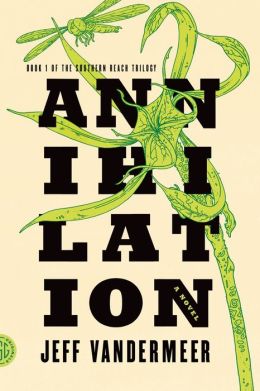 Blindsight is much harder SF, but the last third, like the novel as a whole, is as good as any fiction I’ve read, ever. It is a book that needs to be started again from the beginning to be understood, which is both a strength and weakness. One could say that Ulysses is the greatest novel ever written—I don’t think so, despite the commonness of the view—but it is also not for everyone or even most people.
Annihilation and Blindsight should be compared because they share an important theme: what happens when we can’t trust our own senses. Annihilation is scary not just because it’s about exploring the unknown but because the protagonist can’t trust memory, which can be directly manipulated in the novel. In a world without reliable memory it becomes impossible to know what you know or don’t. There is no real way to make sense of human life or to receive meaningful feedback from the environment.
This isn’t a totally new fear—Lovecraft’s stories often involve cosmic horror overcoming the senses of humans and causing madness in them, such that they can no longer rationally evaluate what they see and process with their senses. Descartes asked how we know what we know and how we can trust it in 1641’s First Meditation. The difference between then and the near future is the possibility of being able to systematically alter memories. Contemporary science fiction (and, increasingly, science), however, points out that we’re getting much closer to the point at which direct brain or sensory manipulation could be used to make it impossible to trust one’s senses. That sort of thing existing as a fantastical horror scenario is very different from knowing that it could be done to you and, almost as bad, you might not even know.
The narrator’s epistemological gaps are wide. She says: “We had also been assured that it was safe to live off the land if necessary.” Who had done the assuring? When? Why? The party reaches “the camp” and “set about replacing obsolete or damaged equipment.” What equipment is gone and what remains? The narrator doesn’t say. She hears “a lot, powerful moaning at dusk,” but no one tries to figure out what it is. Blindsight is a voyage of discovery; Annihilation is a voyage of strange passivity.
The part of the brain that deals with curiosity seems to have disappeared, and a few pages later the narrator says as much: that “Curiosity could be a powerful distraction.” For someone exploring the unknown, however, curiosity is a motivator, not a distraction. The term “unreliable narrator” is common, but it doesn’t describe Annihilation’s narrator, who better be termed “wildly delusional.” She seems not to search for explanations when the explanation might save her life and its lack might kill her. At times she is anti-rationalist:
I found the psychologist’s faith in measurements and her rationalization for the tower’s absence from maps oddly. . . endearing? Perhaps she meant only to reassure us, but I would like to believe she was trying to reassure herself. Her position, to lead and possibly to know more than us, must have been difficult and lonely.
Almost no one could know less than the narrator. She knows nothing at the beginning of the novel: of one of her party, she says “I think we all believed she came from some kind of management background.” I’d want to know more about someone I hired to edit proposals, let alone someone I’m accompanying into an unknown area long cut off from the rest of the world and human society. She realizes that “we might now be living in a kind of nightmare,” and that sense never goes away. Neither do questions about the narrator’s reliability; towards the end of the novel, she says:
It may be clear by now that I am not always good at telling people things they feel they have a right to know, and in this account thus far I have neglected to mention some details about the brightness. My reason for this is, again, the hope that any reader’s initial opinion in judging my objectivity might not be influenced by these details.
Worries about “objectivity” are standard fare in novels. The quality of the writing in Annihilation, on a sentence-by-sentence basis, is average, but the novel remains fun, even if the narrator’s ineptness is not to my taste. That the ineptness may be an artifact of whoever sent her is scarier than the things she sees, or think she sees, in Area X.
“They regarded art not as a quest for aesthetic perfection but a joyful inquiry into the inexhaustible variety of the world, closely allied with history, natural science and the arguments of everyday life.”
From Jonathan Rée’s “A Few Home Truths,” hidden alas behind a paywall.
“Groups create supernatural beings not to explain the universe but to order their societies.”
—Jonathan Haidt, The Righteous Mind.
I’m a bit late to this chat—”real work” keeps obnoxiously interfering with blog writing and other activities—but Charlie Stross discusses the latest publishing imbroglio in “Amazon: malignant monopoly, or just plain evil?“, but like George Packer before him he is distinctly anti-Amazon. It’s a somewhat justified point of view, but I think his followup, “A footnote about the publishing industry,” is less vituperative and consequently more interesting. As usual with these kinds of stories Stross ignores an important point: Amazon is great news for readers and writers who don’t have (or, sometimes, want) a big publisher (like yours truly) but not particularly good news for those who already have a publisher.
But there’s a more interesting and often overlooked point embedded:
But [the reading business is] still a more or less global zero sum game (competing for readers eyeball-hours). And because the rate of individual production is relatively low and the product is still produced artisanally by cottage industries, product lead time is measured in years, time to achieve net positive revenue is also measured in years, and it’s important to keep the back list on tap because it can take decades to grow an author’s career. Stephen King was an overnight success with “Carrie” after a decade of learning to write, but Terry Pratchett took about 15 years to finally break big. J. K. Rowling took 3 books to really get rolling, and she grew eye-wateringly rapidly by industry standards. And some authors are slow-burn successes: my big breakthrough book was my tenth novel in print (“Halting State”). J. R. R. Tolkien’s Lord of the Rings was in print for a decade or more before it really took off in the 1960s. If you practice ruthless commercial Darwinism, weeding out any hopeful mutants that aren’t immediately successful, you will miss out on a lot of huge opportunities.
So reforming the publishing industry is a very non-trivial undertaking.
Which is also why Jeff Bezos picked it as his #1 target when he founded Amazon. He set out to disrupt an incumbent mature industry using the internet, and picked publishing because it was obviously the most dysfunctional. After all, if he’d gone after groceries he’d be competing with sharks like Tesco and WalMart.
It takes an incredibly long time for writers to get good, and publishers may have lost interest in that process. The process also seems especially long relative to what’s happening on the Internet, which is still in its Cambrian explosion phase. In ten years everything touched by Moore’s Law gets a thousand times better, but writers still do our thing at about the same pace. Learning the craft is long, and a lot of it still occurs in a very slow, very old-school master-apprentice fashion. It may be that self-publishing or de-factor self-publishing takes the place of the previous publishing model, and that the publishing of novels becomes more like the publishing of poetry, which the big houses haven’t been doing in earnest for at least twenty years and possibly longer.
Not everyone shares Stross’s views about the evilness of Amazon; here is James Fallows posting an anonymous e-mail from a small publisher who likes Amazon for the same reasons similar to mine (“Amazon is the best deal going for a small publisher: a better price and better reach than any other options”). I’m also not real worried about Amazon-as-monopoly; if there’s a book I really want to read, it’s not hard to get it from Barnes & Noble (for now), or the various other sites that have popped up to help authors (Lulu, etc.). Amazon is fighting in a thin-margin business with highly differentiated products in which almost no product is a perfect substitute for another, with the possible exception of some specific genres (romance, thrillers).
EDIT: I forgot to add that most writers are still helped along by editors, and that the self-publishing system doesn’t really help with that. It’s possible to find sympathetic readers, but I’m not sure sympathetic readers can take the place of professional editors for most people. I don’t really foresee a good solution to this problem. MFA programs are one possible measure, but only for some people who do some kinds of writing.
“Houellebecq graduated as an agronomist in 1980, got married and had a son; then he divorced, became depressed and took up writing poetry.”
—According to his Wikipedia entry.
* If you read nothing else today read “Financial Hazards of the Fugitive Life, which concerns Alice Goffman’s brilliant book On the Run: Fugitive Life in an American City.
* Loving what I used to hate, note especially the section on weight lifting, and also this: “We don’t need to preserve our first opinions as if they are our pure, untarnished, true nature.” It’s good in combination with “Being wrong, and a partial list of ways I’ve been wrong.”
* “So You’re Not Desirable …:”
The old axiom says beauty is in the eye of the beholder. When it comes to initial impressions, this statement is not really true: Consensus about desirable qualities creates a gulf between the haves and have-nots. But the truth of this maxim increases over time: As people get to know each other, decreasing consensus and increasing uniqueness give everyone a fighting chance.
* Speculative but fits my experience: “Women Call Other Women ‘Sluts’ to Guard Their Social Standing.”
* Man claiming to have been an “All-Source Intelligence Analyst, with the BDE S2 shop” describes the Bowe Bergdahl incident in ways largely ignored in the rest of the media; I would not call this the final word.
* Another Redditor describes the breakdown of Venezuelan society.
* Sugar is incredibly, unbelievably bad for you; “The data says that the dose on average that is safe is six to nine teaspoons of added sugar per day. Currently, Americans are at 22 teaspoons of added sugar per day. That excess is driving obesity, diabetes, lipid problems, heart disease, cancer, dementia, fatty liver disease — virtually every chronic metabolic disease that you can think of is being driven by this excess of sugar.”
* “Social porn: why people are sharing their sex lives online.” (Maybe.)
* “Prisoners of Sex,” interesting on many levels including this mention of “the tension between our culture’s official attitude toward sex on the one hand and our actual patterns of sexual and romantic life on the other.” Also useful in the context of the link immediately above.
When founders are starting out, partnership inquiries sound really exciting. In theory, a successful partnership with a larger company could help your company get more customers. What you realize, though, is that partnerships are rarely a real thing. When you work with another company, either they are your customer or you are their customer. Anything other than that usually just eats up time and energy.
—From Brad Flora’s “I Sold My Startup for $25.5 Million: Here’s how I did it,” which is interesting throughout despite the sensationalist title.
At Seliger + Associates we’ve learned that anyone who talks about partnerships is wasting our time (and theirs). People who need a good or service and can pay for the good or service are usually prepared to move quickly. They don’t need much if any convincing from third parties. And they don’t need an intermediary between them and the good or service provider.
Think of it this way: if your friend knows you love Thai food and tells you that there’s a great Thai restaurant nearby, you’re not going to wait for your friend to take you there. You’re just going to go. By the same token, when existing clients make referrals, they often don’t even tell us. They just do it. The referral isn’t hard and it isn’t complex and it usually involves very little negotiation.
Being in business taught me that there are two factors that matter more than anything else: who is paying me money and who I am paying money to. “Partnerships” or “alliances” that don’t involve contracts and money and services or goods don’t mean anything.
“[Stefan] Zweig himself attributed his popularity to ‘a personal flaw’: radical impatience. In words that sound startlingly contemporary, Zweig expressed irritation at any work that didn’t maintain a breathless clip from beginning to end. Ninety percent of what he read, Zweig reported, struck him as padded arid, high-flown—just not thrilling enough.”
—George Prochnik, The Impossible Exile: Stefan Zweig at the End of the World; the book is not likely to be of general interest but its peaks are notable.
 The Story's Story