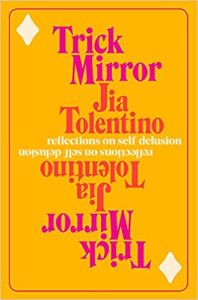
Trick Mirror — Jia Tolentino

I read one of the essays in a magazine, but the book as a whole is dubious. Take the introduction: she writes that she wrote the book “between the spring of 2017 and the fall of 2018” which was, she says, “a stretch of time when daily experience seemed both like a stopped elevator and an endless state-fair ride, when many of us regularly found ourselves thinking that everything had gotten as bad as we could possibly imagine, after which, of course, things got worse.” “As bad as we could possibly imagine?” That’s a real deficit of imagination, then. As bad as things were during the Cuban Missile Crisis? As during the Able Archer exercise, which the Soviet Union almost took as preparation for nuclear war? As bad as even the Great Recession in 2009? Has Tolentino and “many of us” read Steven Pinker’s book Enlightenment now?
Tolentino writes that one of her essays is “about ‘optimization,’ and the rise of athleisure as late-capitalist fetishwaear.” First, athleisure is not, to my knowledge, associated at all with fetish sexual practices (I could be wrong on that but didn’t see any citations or experiences to the contrary in the essay). Second, I’m not sure I’ve ever seen “late capitalism” intelligently defined, or that I’ve ever read a sentence that was improved by including the phrase. How do we know we’re in late capitalism? Is it possible we’re experiencing early capitalism? She later writes that our world is “utterly consumed by capitalism.” What’s that mean? What’s the alternative? We’ve seen examples of the state directing all or almost all economic activity (the Soviet Union, Venezuela), and the result is not good.

It’s also neither clear nor evident that “capitalism” is the best way to analyze many of the Internet platforms. To the extent capitalism involves monetary exchange, I don’t pay Twitter and Twitter doesn’t pay me; same with Facebook or Google. If I’m a business, advertising, I might. And if you don’t like the social media advertising business models, you can also host your own blog. That almost no one does, tells us something, but it’s something Tolentino doesn’t want to get to.

There are assertions like “Mass media always determines the shape of politics and culture.” Really? “Mass media?” Why not technology? Or why don’t politics and culture shape mass media? What way does the causal arrow run?

A while ago, “Nice for What? A comic’s look at dating now” appeared:

As Arts & Letters Daily puts it, “When did campy misandry become contemporary shorthand for communicating one’s feminist bona fides?” A favorite line: “Having a relationship is a lot like writing: To be good at it, you have to be interested in other people and believe you have something interesting to offer them in return. Many people who pursue either do so poorly because they are actually interested only in themselves.”

You can apply a lot of “Nice for What’s?” analysis to Trick Mirror, but with “the Internet” (exalted and degraded, parent and child, god and satan) standing in for men. Trick Mirror is a very well done version of the Brooklyn hipster writer worldview. Whether that worldview is correct, I will leave to readers.

It’s always been hard to make it in the arts. In some ways, the Internet makes it harder (the supply of writing, video, and photo is way up); in some ways, it makes it easier (it’s possible to become visible in a way that wasn’t in 1980). Today, writing is an incredible secondary skill but a harder primary skill: I see that in Seliger + Associates, where the blog is now a primary marketing mechanism. I also see it in the way every third English major I knew tried to make it as a freelance writer after college. Excess supply relative to demand has predictable effects on prices.

As a reader, the Internet is great: cheap books in the world’s largest used bookstore (finding ones really worth reading is the hard part). Niche interest books are written and made available like they couldn’t be before.

Many people take to the Internet to complain about the Internet. We can choose to live predominantly offline. What should we infer from the fact that many of us, including, it seems, Tolentino, choose not to?

As is too common, the author needs to read more evolutionary biology. Who are women competing for? Why? How does women’s intrasex competition tend to work? Then do the same with men. Many of the answers are out there, but they’re rarely discussed in MFA and English programs. Trick Mirror is a book partially about unexamined assumptions that nonetheless seems to import an awful lot of unexamined assumptions of its own. It’s got a better book lurking inside it, and that’s why it’s frustrating. A bad book is easy to dismiss and a good book is easy to love.

Almost all the reviews I’ve read have been too dutiful and too fawning. Over time it’s become apparent that many book reviews are written for insiders and by insiders, so the exceptions stand out.

Links: English in Europe, social media in America, the nature of language, and more!

* “America’s social-media addiction is getting worse.” No word on America’s novel-reading addiction.

* Relatedly, “The Last Great American Novelist: Toni Morrison and the fate of fiction in an age of distraction.”

* “Death of the Neighborhood Bar.” See also me on The Great Good Place — Roy Oldenburg. Most regulators don’t seem to think about social connection and fabric, or the connection of both to licensure.

* “Don’t Believe a Word by David Shariatmadari review – the truth about language.” Annoyingly, this one won’t be published in the U.S. until January. Pre-ordered.

* “Copenhagen has taken bicycle commuting to a whole new level.” I’m jealous of their clean air and pleasant streets.

* The Suicides in South Korea, and the Suicide of South Korea.

* “Do You Want My Garbage?” “There is a fine line between respecting others’ right to their bad taste, and opting to participate in it.”

* “The Real Problem At Yale Is Not Free Speech.” Lots of things I suspect are incorrect in this one, but the takeaway may be that Yale seems like an unpleasant place to be. So why not go somewhere else, somewhere that is not consumed with bizarre status rituals? Unless you’re on scholarship, in which case it’s likely worth putting up with.

* “As Student Debt Rises, Teens Are Rethinking the College Experience.” Lots of anecdote, little data.

* Big Money Starts to Dump Stocks That Pose Climate Risks.

* Amazon and publishing. None of the other players did anything about this and none of them have the technical teams, experience, or culture to match Amazon. This is another example of software eating the world.

* Was email a mistake? On synchronous vs asynchronous communication and many other topics. I may put this one in my email signature.

* The Power of a Community College.

* “Why solar and wind aren’t enough.” The only plausible energy source compatible with global climate change is nuclear.

* “Parlez-Vous Anglais? Yes, of Course. Europeans speaking perfect English sounds like good news for native speakers, but it may also be a threat.” Good news, says I. And if we can’t compete with their English BA courses, we deserve to lose.

Links: Saving Barnes & Noble, the financial structure of higher ed, the need for excellence, and more!

* “Comcast households watched 6 hours/25 minutes a day of traditional TV, up 6% from the same time period a year before.” The culture you find on this blog, is not mainstream culture.

* To End Student Debt, Tie Tuition to Post-Graduation Salaries?

* Why 16?, on the history age of consent laws—a topic rarely discussed. See also the end of this post, about the racial and gender disparities from such laws:

As Judith Levine notes in Harmful to Minors: The Perils of Protecting Children from Sex: “One striking pair of contradictory trends: as we raise the age of consent for sex, we lower the age at which a wrongdoing child may be tried and sentenced as an adult criminal. Both, needless to say, are ‘in the best interests’ of the child and society.” We want teenagers to be adults when they commit crimes and “children” when they have sex, which tells you more about our culture than about teenagers.

* Perhaps congruent with the link above, “Diversity, Inclusion and Anti-Excellence: A former dean of the Yale Law School sounds a warning.”

* Samuel Pepys’s diary.

* Insured price $2,758, cash price $521. We ought to do something about this?

* How to fix the baby bust.

* The hypersane are among us? I’m still not sure we have a great definition of “hypersanity.”

* Universal Basic Income (UBI) plans don’t work mathematically, as presently advocated by politicians. I’m open to UBI arguments, but I’d like to see us first improve real spending power through comprehensive land use reform. Housing is the most expensive part of most people’s budget and we’re not doing anything like what we can and should be doing in this domain, which makes me think we’re not remotely serious about improving real spending power, let alone getting to UBI.

* “ What If We Haven’t Met Aliens Yet Because They’ve Messed Up Their Planets Too?” Could climate destruction explain the Fermi Paradox?

* How Tyler Cowen chooses fiction. Plus, Tyler on Peter Thiel as intellectual. On Twitter, there was a thread about why many people in academia (and I’m not talking about the humanities exclusively) seem to have disproportionate antipathy to tech people. The author’s thesis was that many tech people have greater, or at least growing, real-world and intellectual influence than academics—something that might not have been true 20 years ago. I’m not endorsing this thesis, but it’s not a ridiculous one, either.

* “China and the Difficulties of Dissent.” Don’t be dissuaded by the title.

* “‘The Big Error Was That She Was Caught’: The Untold Story Behind the Mysterious Disappearance of Fan Bingbing, the World’s Biggest Movie Star.” Implementing a “brain drain” (and talent drain) policy on China, via encouraging Chinese emigration to the United States, is an important argument almost no one is making, or thinking about. This is a trade war we might actually win.

* Open source textbooks are changing higher ed. What took so long?

* “Academia: An Outsider’s Perspective.” Unflattering, but possibly accurate.

* “The Return of Doomsday: The New Nuclear Arms Race—and How Washington and Moscow Can Stop It.” See also my post, “Trump fears and the nuclear apocalypse.”

* “The Nihilist in Chief.” I’m not fond of this topic but this one is good.

* Can Britain’s No. 1 Bookseller Save Barnes & Noble?

Links: The end of beef, the science of progress, the need to walk, the nature of language, and more!

* “We Need a New Science of Progress.” Best piece in this batch.

* “What is Amazon?” This is congruent with the link above.

* “Lessons from the East Asian Economic Miracle.” This is congruent with both links above.

* “‘It’s a superpower’: how walking makes us healthier, happier and brainier.” Despite this, for some reason we’ve designed our cities around cars.

* “Stupid, Self-Defeating U.S. Immigration Policy Hands Canada an Opening in Tech.” Obvious to the attentive.

* “Dipsea: the Audio App That’s Transforming Erotica.” This may be a bogus trend story, but it is an interesting one.

* “‘Panic Attack’ review: a wake-up call the woke won’t read.” Surprising venue for this one.

* Why We Call Things ‘Porn’.

* “Gin, Sex, Malaria, and the Hunt for Academic Prestige.” On Margaret Mead’s many adventures. The degree to which her reputation zooms up and down probably says bad things on the net about anthropology as a discipline; I ordered the book.

* “Spare Me the Purity Racket.” Can I get an “Amen?” “The politics of purism makes people stupid. And nasty.” This is one of the problems in some university precincts, too.

* On Norman Rush. Mating is that good.

* Awkward Cause: A Calgary man tries to live an extremely low-carbon lifestyle.

* The beginning of the end for the beef industry?

* “The SLS rocket may have curbed development of on-orbit refueling for a decade.” This is damned depressing if it’s true.

Once Upon A Time … in Hollywood

There are lots of individually funny scenes, but the movie doesn’t add up to much; some people will be more bothered by lack of plot than others. The Sharon Tate figure is peripheral and it’s really a male buddy friendship movie, plus a love letter to old Los Angeles—before Prop 13 screwed up the city and traffic made it almost unlivable.* I saw Once Upon a Time in 70mm, but I think the projector was screwed up—perhaps out of proper focus—because the movie rarely looked right and there was too much judder. The old days were not better, at least when it comes to image quality, and it’s still surprisingly hard to beat Arri Alexas‘s image quality.

I didn’t realize until later than I should have how much the movie itself is a fantasy, perhaps Rick’s fantasy or perhaps Cliff’s. What seems to be peripheral to a given frame may be more important than what’s seemingly central. Despite some carping in the first paragraph, I laughed more than not, though about 40 minutes before the end, I was wondering where the end is. I think writers have learned things about storytelling over the last 50 years, and digital editing systems make it much easier to simply have as many cuts as are needed to assemble the best movie or TV show possible.

The more Rick and Cliff are together in scenes, the better the movie is. But the movie also wanders; there’s a comparison to be made with The Nice Guys, another movie set in a similar time period and another movie in love with LA—but The Nice Guys has a plot.

Most of the reviews have been okay, but this one is better. I think Cliff represents Hollywood’s underlying humanity and Rick, Hollywood’s underlying cruelty.


* Is car-free L.A. plausible now, though? The regional connector should be done in 2022, a Purple Line extension should be done in 2023, and the Crenshaw/LAX Line should be done in 2020. Electric vehicles should also make L.A. more livable, by reducing smog and pollution. To be sure, L.A. today is better than L.A. in 1970, but “better” is far from “optimal.”

Links: The mistakes of relying on cars, a man with a big library, publishers and literature, and more!

* Was the automotive era a terrible mistake? Yes it was.

* “Satellite Images Show Vast Swaths of the Arctic On Fire.” What could go wrong?

* “Farewell Richard Macksey, legendary polymath and ‘the jewel in the Hopkins crown’ (1931-2019).” 70,000 books! Check out those pics!

* “Why the ‘Weird Internet’ of the GeoCities Era Had to Die.” Did it have to, though? Or did we all choose new and easier spaces, myself included?

* Did publisher consolidation change literature? The original title of this piece is bad, so don’t rely on it.

* Robert Caro’s Working. Good book, good article—it highlights his anti-theoretical, anti-generalizing nature, which I’d not thought explicitly about.

* College might have gotten easier: time spent studying is down but GPAs are up. The article touches research areas that have been out there for years.

* “‘Unsex Me Here’ and Other Bad Ideas. We have nothing to lose except our long-ago lost sense of proportion.

* “The Robot Apocalypse Has Been Postponed.” Its absence may also explain some of our current economic, social, and political malaise. Hear also the first episode of The Portal, Eric Weinstein’s podcast; Peter Thiel is the first guest and has much to say about economics, malaise, and, surprisingly, violence.

* “The Hollywood Three Tries to Save Western Civilization.” Lots of political commentary congruent with what you read here, in Jonathan Haidt, and so on. You don’t persuade people by yelling at them or conveying that you’re more morally pure than they are.

* “Sleeping Through the Alarm: With virtually no democratic oversight and over 6,500 missiles in the United States alone, the use of nuclear weapons is almost inevitable. So why is it so hard to think about nuclear war?”

* “Please Touch Me: Has intimacy gone so far out of style that it’s poised for a comeback?” It’s like no one asks about the costs of social shifts happening among small sectors of the intelligentsia.

* “‘The Era of People Like You Is Over’: How Turkey Purged Its Intellectuals.” Short on Turkey.

* “The Charney Report: 40 years ago, scientists accurately predicted climate change.” And our response has been anemic ever since. By the way, “In the US, wells being drilled ever deeper as groundwater vanishes.” I wonder why groundwater is vanishing? Also, “Alaskan glaciers melting 100 times faster than previously thought.”

* New books about walking, one of them on 36 writers and walking. I already favor walking, so this is not for me.

* “Helen Gurley Brown Only Wants to Help“—from 1970. Has a lot changed, or not so much?

* ITER, the World’s Largest Nuclear Fusion Experiment, Clears Milestone. For background, see “Star in a Bottle” from 2014.

* “Immigration Officials Snatch 9-Year-Old U.S. Citizen Heading To School, Hold Her For 2 Days.” Things are great in this domain, right?

Briefly noted: Fleishman is in Trouble, Empty Planet, The Uninhabitable Earth

* Fleishman is in Trouble (Taffy Brodesser-Akner): It’s like Martha McPhee’s Dear Money, but with more sex and bad behavior and a pathetic protagonist. I laughed at times, but somehow it doesn’t feel like it adds up to much. Both books are set in NYC and one unstated lesson might be, “Don’t live in NYC,” as the city’s wealthy have terrible values around money and mimetic contagion is rife, uncontrolled, and unrecognized by the people in its grip. No one has read Girard (a Christian; could some religious practices help with partial inoculation against excessive inquisitiveness?). Extremely wealthy people constantly envy even more extremely ridiculously wealthy people; maybe one could read this as a Staussian and argue that both novels are deliberately critical of their settings, but I don’t really see it.

Consider: “Again I’ll say it: Life is a process in which you collect people and prune them when they stop working for you. The only exception to that rule is the friends you make in college.” There is some truth to the notion of pruning people who you’re no longer compatible with—I’m sure we’ve all done it—but this also makes people sound expendable, and like the moment someone “stops working for you,” it’s time for them to go. That’s a pretty utilitarian view of friends—and the observation is coming from someone who has utilitarian leanings. Some of its truths are universal, though, like, “People who say they like jazz are lying.”

A lot of these people have too much money and are simultaneously too focused on money: a point I’ll return to in a future post that started as an email rant to a friend. One character, wealthy and successful, argues at the novel’s end that everything “sucks.” Sucks—compared to what? One reading could be that humans are discontented strivers; another reading could find that none of these people have any perspective.

Evolutionary biology is the unnamed shadow lurking beneath many characters’s experiences, though I still prefer the “Don’t live in NYC” reading. The best character is Wilson’s Disease.

* Empty Planet: The Shock of Global Population Decline (Darrell Bricker and John Ibbitson). This is a book that stolidly does what it promises and for that reason it will be of interest to some of you. “Demography is destiny,” they say, and, if that’s true, we might all be fucked. Many Western social welfare systems were put into place when populations were booming and implicitly assume they’ll continue to boom; one of the dysfunctions in the present-day United States and Europe comes from the way the old are sucking resources from the too-few young, and the young aren’t bothering to vote against the sucking. Empty Planet is also a book that’s designed to be cited as either prophetic or a cautionary tale about forward projection, with the latter well-represented by books like Paul Ehrlich’s, one of the most famously wrong people of all time.

Articles like, “Can China recover from its disastrous one-child policy?” are becoming more prominent, and they’re congruent with Empty Planet. The book is written intelligently but style is not its strong point.

* The Uninhabitable Earth (David Wallace-Wells). An excellent book and it too does what it says—I already buy its premise, though. The point remains that essentially no one (or a number that is statistically distinguishable from “no one”) is changing their behavior in response to books like this. Which is pretty depressing; what should we infer from it? Even the superficially liberal people who lives in cities and say they care about the environment won’t stop getting on planes; basically, everyone who is busy recycling wine bottles doesn’t stop to think about how “per passenger a typical economy-class New York to Los Angeles round trip produces about 715 kg (1574 lb) of CO2 (but is equivalent to 1,917 kg (4,230 lb) of CO2 when the high altitude ‘climatic forcing’ effect is taken into account).” There are some personal things we can do, beyond the obvious ones around transit and food, like sign up for Climeworks subscriptions, but it doesn’t seem like we’re running, en masse, to do this.

We’re 40 years from the Charney Report, which accurately forecasted global warming and accurately predicted its link to CO2, and we’re still dithering, at best. We can’t say we’ve not been warned. We’ve just collectively chosen not to act.

* Then It Fell Apart by Moby (the musician), is like a non-fiction Michel Houellbecq novel; as with virtually all of Houellebecq’s characters, Moby grows up in an affectless, dysfunctional home. In Moby’s case, his mom has a rotating cast of boyfriends and is too dysfunctional to maintain employment; Moby says he “grew up in the middle of hippie chaos” that scarred him emotionally. His childhood is so bad that he doesn’t mind being a charity case among his friends’s parents “so long as I got to spend time in warm houses with carpets.” Or when his “mom’s friends didn’t seem to have jobs, although they complained sometimes about not getting enough money from their parents back in Connecticut.” Getting a job, showing up on time, and all those bourgeois values look really good in this book. Bourgeois values live, because what’s the alternative? Squalor? Kids with lives like Moby’s? I have a post about Hollywood’s Eve on deck, and that’s another book that’s implicitly critical of people who don’t keep an eye on their offspring.

Coverage of this book has been sadly focused on the least-interesting aspects of celebrity gossip.

* Three Women (Lisa Taddeo). I found it kind of boring. One of the characters is boring and lacks self-efficacy (she needs Stoic philosophy and a stronger sense of personal autonomy); another is not doing anything wrong (if you fail to maintain your vegetable patch, don’t be surprised when someone else volunteers to); and the third and most interesting should have been the focus of Three Women. I’m looking for representative quotes and not finding any—which tells you something. If you’re tempted to read Three Women based on other reviews, try the collected works of Esther Perel instead. Toni Bentley calls it: “The result of Taddeo’s investigation, however, is not a book about the vast terra infirma of female desire, but, rather, an excruciating exposé of the ongoing epidemic of female fragility and neediness in the romantic arena — a product of our insecurity, ignorance and zero self-regard.”

Links: The power of the angry, DuckDuckGo and privacy, the erosion of freedom, and more!

* “What Conservatives Get Wrong about the Campus Wars.” “Teapot tempests” would be better than “wars,” but this is congruent with “Ninety-five percent of people are fine—but it’s that last five percent.” Something about the nature of the Internet has enabled and empowered a smallish number of crazy people, sometimes for good reasons (startups) and sometimes for not-good ones.

* “DuckDuckGo, a Feisty Google Adversary, Tests How Much People Care About Privacy.” The answer is, “Not very much.” Switching search engines to DDG is one of the simplest, lowest-cost things a given person can do to improve their online privacy and basically no one does it. What should we infer from that?

* “ICE Is Dangerously Inaccurate: Even American citizens are not immune from immigration raids.”

Davino Watson is a U.S. citizen who was 23 years old when ICE held him for more than three years. A New Yorker, he was eventually dropped off in Alabama with no explanation and no money. After he was released, Mr. Watson filed a complaint and a court awarded him compensation in 2016. The next year, an appeals court decided the statute of limitations for that complaint had expired while he was still in ICE custody.

Then there was Peter Sean Brown, who was born in Philadelphia and lived in the Florida Keys. ICE faxed a request to Florida authorities to hold him. He was in jail for weeks. Guadalupe Plascencia, a naturalized citizen, won a $55,000 settlement after ICE wrongfully detained her. Ada Morales and Sergio Carrillo earned their citizenship decades before they were detained. The list goes on.

I would say this is unbelievable, but who we decide to vote for is unbelievable; the consequences are ones we’re living with now.

* “China’s rising tech scene threatens U.S. brain drain as sea turtles return home.” Almost no one is talking about this aspect of immigration policy and the cultural climate, but we should.

* “Harvard Study: ‘Gender Wage Gap’ Explained Entirely by Work Choices of Men and Women.” Not the last word on this issue, certainly, but also not something that’s likely to be popular in certain circles.

* “The High Price of Multitasking.” Obvious yet still underrated.

* Our present age of amnesia. Or is this just a “kids these days” argument?

* “Border officers are arrested 5 times more often than other US law enforcement.” As stated on Twitter: “The border is a place where sadistic people can join the security forces in order to abuse people in a legal gray zone. This needs to stop.”

* The Financial Calamity That Is the Teaching Profession. This is also a story about the way zoning has raised the cost of living for just about everyone.

* Neal Stephenson converses with Tyler Cowen.

* Oregon vowed not to become California — and passed sweeping housing crisis legislation.

* Josh Harris, the author of a wildly popular manifesto on abstinence before marriage, is separating from his wife. Sure, this is a kind of basic (and low) blow about hypocrisy, but it’s also the kind of “how did that thing turn out?” journalism that we could use more of.

* “Returning Due Process to Campus.” It’s interesting that the abandonment of long-understood legal principles has had just the outcomes that those principles are supposed to prevent.

The State of Affairs — Esther Perel

The State of Affairs is another book that, like Mating in Captivity, touches topics of wide interest that almost no one wants to address directly. Perel says, “Few events so encompass the breadth of human drama” as the one she’s writing about, and, while that may be overstated, she’s not wrong in her trust. She also says, “my goal is to introduce a more productive conversation about the topic,” and the “productive” being an interesting choice here: What is being produced? What efficiency is being brought to the problem or product space? She says too, that she wants to “ultimately strengthen all relationships by making them more honest and resilient.” Do most people want honesty? I used to think so and am now less sure. Many more of us may want to want honesty than truly want honesty.

That said, Perel also says, “Because I meet with partners alone as well as together, I have been afforded an unusual window into the experience of the unfaithful partner.” The “unusual window” is the view she affords us, somewhat voyeuristically. We used to have to rely primarily on novels and gossip for the view into the unusual window, but now we have Perel, standing at the side with a laser pointer and a stick, telling us about the flora and fauna inside. She nicely sidesteps what she calls the “for or against?” question and moves into a large number of questions about framing, motivation, and stories. As she says, “Catastrophe has a way of propelling us into the essences of things.” She hits a lot of essences. She also acknowledges what a lot of non-novel-readers might easily forget: “We are walking contradictions.” Some theories of consciousness hold that consciousness arose to mediate contradictory impulses. If so, we’ve been struggling with the results ever since.

Perel is with opinions, though. She’s not a total relativist, describing without opining. She finds that the “best friend” model of romance and modern relationships is often stifling, unworkable, and historically unlikely. Throughout most of history, spouses and lovers didn’t even need to be friends; they needed to produce children, inherit property, continue their culture—that kind of thing. Today, she says, many of us make one person play every single role in our lives, or try to—usually without total success. I think she’d agree with many of the ideas in Lost Connections. We’re collectively suffering from loneliness and degraded social connections, and when we try to get our spouse, partner, or lover to make up for those losses, we’re setting ourselves up for disappointment. She says, “Every day in my office I meet consumers of the modern ideology of marriage. They bought the product, got it home, and found that it was missing a few pieces.” “Consumers:” that’s pretty close to the questions about “productivity” she mentions in the introduction, and that I mention in the first paragraph. I read in Nassim Taleb an interesting idea (it may not be original to him) that went something like this: Communism for the immediate family, socialism for the extended family, market economies for the larger community, and outright capitalism for the polity at large. I think his point is that different kinds of structures apply at different scales. Perel’s point may be that a consumer-first, hedonism-first, and satisfy-me mindset may not apply very well to small-scale relationships. “Not apply very well” is probably an understatement: those mindsets may poison small-scale relationships. But we never think about them. Why not? Why does almost no one except Perel talk about this?

If there’s something I want more of from the book, it’s evolutionary psychology and biology. They make an appearance—”Evolutionary psychologists recognize the universality of jealousy in all societies. They post that it must be an innate feeling, genetically programmed, ‘an exquisitely tailored adaptive mechanism that served the interests of our ancestors well and likely continues to serve our interests today.'”

This is a good New Yorker discussion of the book. And here is another piece, in Tablet. If you want to go back further, consider Tony Tanner’s Adultery in the Novel: Contract and Transgression, a book I admire—but it came out in 1979 and discusses works from considerably earlier, so it, like so much writing produced by humanists, is missing evolutionary biology.

We still have no idea what’s really going on, and maybe we never will, because technology is moving faster than human norms, human social structures, and human legal structures. That mismatch may be the driving force behind a lot of weird social stuff we don’t really understand. The State of Affairs pulls us out of the day-to-day and pushes us towards what lies beneath. Most of us don’t want to go there and don’t want to understand, but if you do want to understand read it. There are lots of stories and not a lot of data; if that’s going to bother you, there are lots of nice other choices in adjacent genres that will feed you what appears to be good data (though turning data into truth is always tricky at best).

Also, if you ever get a chance to hear Perel live, do it. I did she’s one of these magnetic public speakers who’s also quick-witted (much more so than the audience members asking her questions that just standard political talking points—if you do this, you may be unhappy with the result).

Links: The fear, the basic house, the hard-but-popular college course, and more!

* Iran to begin enriching Uranium again. Some of you may recall my 2016 post, “Trump fears and the nuclear apocalypse,” which is relevant here.

* “Want a basic house? Prepare for a bidding war.” Businesses have begun noticing that, if individuals can reap supernormal returns by artificially restricting the supply of housing via zoning, then businesses can do the same by buying the same asset, then renting it, and waiting for increasing demand to raise its underlying value. As we all know, however, Oregon is doing something concrete about this dynamic by reforming zoning.

* Why can’t NYC control its construction costs? It also can’t do even very simple things like through-running commuter rail, which Paris started doing in the ’80s and London in the ’90s.

* “A Remarkably Hard College Course Proves Remarkably Popular.”

* “The Deepening Crisis in Evangelical Christianity: Support for Trump comes at a high cost for Christian witness.” This is something I’ve wondered about: few of us are fully internally consistent and all of us can be hypocrites at time, but the scale and apparentness of this one strikes me as odd, even by the standards of someone who’s read The Elephant in the Brain.

* “Progressive Boomers Are Making It Impossible For Cities To Fix The Housing Crisis: Residents of wealthy neighborhoods are taking extreme measures to block much-needed housing and transportation projects.” Not far from what you’ve been reading here for years, but the news is getting out there.

* “Rep. Justin Amash quits the Republic party for principled reasons.” See also the link about evangelical Christian support for Trump.

* “The Gangs of Kalorama,” on the private school and college madness. A piece that reinforces Bryan Caplan’s book The Cast Against Education.

* “US FBI, ICE using state driver’s license photos for facial-recognition searches.” Privacy? Anyone? Privacy? Anyone who is worried about Google or Facebook ought to be 10x as worried about this.

* “Live carbon neutral with Wren: Offset your carbon footprint through a monthly subscription.”

* “Americans Shocked to Find Their Rights Literally Vanish at U.S. Airports.” Yet for some reason we keep vanishing for this, too.

* “Americans Shouldn’t Have to Drive, but the Law Insists on It: The automobile took over because the legal system helped squeeze out the alternatives.” The number of people who die by the car is shocking, yet no one seems to give a damn.

* “Breaching a ‘carbon threshold’ could lead to mass extinction.” Perhaps we ought to not do that?

* The slow death of Hollywood. Did you know that “[Netflix] now routinely ends shows after their second season, even when they’re still popular?” Me neither. Or how much Hollywood has consolidated since the ’90s? I’m still annoyed, by the way, that The Larry Sanders Show isn’t available on Blu-ray, and the DVD version doesn’t look good.