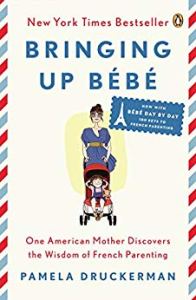
Bringing Up Bébé – Pamela Druckerman

This is really a book about how to do things, and about how the way we do things says things about who we are. Fiction is often about culture and so is Bringing Up Bébé. Cross-cultural comparisons are (still) underrated and we should do more of them; you can think of Michel Houellebecq’s work as being about the dark side of France and Druckerman’s as being about the light side of France (noting that she’s a transplanted American). Bringing Up Bébé is a parenting book, yes, but also a living book—that is, how to live. I bought it, let it sit around for a while, and only started it when I couldn’t find anything else to read, only to be delighted, and surprised. Let me quote from a section of the book; each new paragraph is a separate section, but put them together and one can see the differences between American-style families and French-style families:

French experts and parents believe that hearing “no” rescues children from the tyranny of their own desires.

As with teaching kids to sleep, French experts view learning to cope with “no” as a crucial step in a child’s evolution. It forces them to understand that there are other people in the world, with needs as powerful as their own.

French parents don’t worry that they’re going to damage their kids by frustrating them. To the contrary, they think their kids will be damaged if they can’t cope with frustration.

Walter Mischel says that capitulating to kids starts a dangerous cycle: “If kids have the experience that when they’re told to wait, that if they scream, Mommy will come and the wait will be over, they will very quickly learn not to wait. Non-waiting and screaming and carrying on and whining are being rewarded.”

“You must teach your child frustration” is a French parenting maxim.

As with sleep, we tend to view whether kids are good at waiting as a matter of temperament. In our view, parents either luck out and get a child who waits well or they don’t.
Since the ’60s, American parents seem to have become less inclined to say no and let kids live with some frustration, and yet we need some frustration and difficulty in order to become whole people. I’m sure many teachers and professors are reading the quotes above and connecting them to their own classroom experiences. The tie into Jean Twenge’s book iGen and Jonathan Haidt’s The Coddling of the American Mind is almost too obvious to state; Haidt and Twenge’s books concern what smartphones are doing to the state of education, educational discourse, and educational institutions, and, while they cover smartphones and social media, those two technologies aren’t occurring in isolation. Excessive permissiveness appears to create neuroticism, unhappiness, and fragility, and excessive permissiveness seems to start for American parents somewhere between a few weeks and a few months after birth—and it never ends. But most of us don’t recognize it in the absence of an outside observer, the same way we often don’t recognize our psychological challenges in the absence of an outside observer.

In Druckerman’s rendition, French parents are good at establishing boundaries, saying “no” and, with babies, implementing “the pause”—that is, not rushing to to the baby’s aid every time the baby makes some small noise or sound. She writes about how the way many children are “stout,” to use the French euphemism for “fat,” comes from not having established mealtimes but instead of having continuous snacking, in part because parents won’t say “No, you need to wait” to their kids.

Failing to create reasonable boundaries from an early age leads to the failure to develop emotional resilience. “Reasonable” is an important word: it is possible to be strict or to let kids struggle too much, just as it’s possible to do the opposite, and the right mix will likely depend on the kid or the situations.

French parenting culture spills into schools:

When Benoît took a temporary posting at Princeton, he was surprised when students accused him of being a harsh grader. “I learned that you had to say some positive things about even the worst essays,” he recalls. In one incident, he had to justify giving a student a D. Conversely, I hear that an American who taught at a French high school got complaints from parents when she gave grades of 18:20 and 20:20. The parents assumed that the class was too easy and that the grades were “fake.”

The whines I got from students also make sense: in many U.S. schools, there’s not as strong a culture of excellent as there is a culture of “gold stars for everyone.” I understand the latter desire, having felt it myself in many circumstances, but it’s also telling how important a culture of excellence is once the school train tracks end and the less-mapped wilderness of the “real world” (a phrase that is misused at times) begins.

I routinely get feedback that class is too hard, likely because most classes and professors have no incentive to fight grade inflation, and the easiest way to get along is for them to pretend to learn and us to pretend to teach. Real life, however, is rarely an “everybody gets an A” experience, and almost no one treats it that way: most people who eat bad food at a bad restaurant complain about it; most people whose doctor misses a diagnosis complain about the miss (and want excellence, not just kindness); most people prefer the best consumer tech products, like MacBook Airs or Dell XPS laptops, not the “good try” ones. Excellence itself is a key aspect of the real world but is often underemphasized in the current American education system (again, it is possible to over-emphasize it as well).

In my own work as a grant writing consultant, “good job” never occurs if the job is not good, and “you suck” sometimes occurs even if the job is good. Clients demand superior products and most people can’t write effectively, so they can’t do what I do. I’m keen to impart non-commodity skills that will help differentiate students from the untrained and poorly educated masses, but this demands a level of effort and precision beyond what most American schools seem to expect.

Having read Bringing Up Bébé, I’m surprised it’s not become a common read among professors and high school teachers—I think because it’s pitched as more of a parenting book and a popular “two different cultures” book. But it’s much subtler and more sociological than I would have thought, so perhaps I bought into its marketing too. There is also much to be said for how to teach and think about teaching in this book. The French are arguably too strict and too mean to students. Americans are probably not strict enough, not demanding enough, and don’t set adequate standards. The optimal place is likely somewhere between the extremes.

Druckerman is also funny: “I realize how much I’ve changed when, on the metro one morning, I instinctively back away from the man sitting next to the only empty seat, because I have the impression that he’s deranged. On reflection, I realize my only evidence for this is that he’s wearing shorts.” Could shorts not be an indication of derangement? And Druckerman cops to her own neuroticisms, which a whole industry of parenting guides exists to profit from:

What makes “Is It Safe?” so compulsive is that it creates new anxieties (Is it safe to make photocopies? Is it safe to swallow semen?) but then refuses to allay them with a simple “yes” or “no.” Instead, expert respondents disagree with one another and equivocate.

Bébé is a useful contrast from the France depicted in Houellebecq novels. Same country, very different vantages. In Druckerman’s France, the early childhood education system works fairly well, not having to have a car is pleasant, food isn’t a battle, and pleasant eroticism seems to fuel most adults’s lives—including parents’s. “Pleasant” is used twice deliberately. In Houellebecq’s France, empty nihilism reigns, most people are isolated by their attachment to machines, and and most actions are or feel futile.

So who’s right? Maybe both writers. But Druckerman may also point to some reasons why France, despite pursuing many bad economic policies at the country level, is still impressively functional and in many ways a good place to live. The country’s education system is functioning well and so is its transit systems—for example, Paris’s Metro is being massively expanded, at a time when the U.S. is choking on traffic and struggling with absurdly high subway costs that prevent us from building out alternatives. New York’s last main trunk subway line was completed before World War II. Small and useful extensions have been completed since, but there is no substitute for opening a dozen or more new stations and 10+ miles at a time. Improved subway access reduces the need for high-cost cars and enables people to live better lives—something France is doing but the U.S. seems unable to achieve. AAA estimates the average total cost of an American car to be $9,282. If French people can cut that to say $3,000 (taxes included) for subways, the French may be able to do a lot more with less.

France’s bad macro policies and overly rigid labor market may be offset by good childcare and transit policies; Bébé could help explain why that is. Druckerman says, “Catering to picky kids is a lot of work” (“cater” appears four times in Bébé). If the French don’t do that, Americans may be spending a lot of hours at work, rather than leisure, that the French aren’t spending—therefore raising the total quality of French life. Mismeasurement is everywhere, and, while I don’t want to praise France too much on the basis of a single work, I can see aspects of French culture that make sense and aspects of American culture that, framed correctly, don’t.

Links: The diversity mafia, research blogs, learning, moving, and more!

* “Guy Gavriel Kay: ‘I learned a lot about false starts from JRR Tolkien.’

* “The National Book Foundation Defines Diversity Down.” You may notice (or not notice) that I stopped following book awards a long time ago: most of them are way too political and yet simultaneously intensely boring. Notices of most book awards on book covers put me off. Fiction sales have been falling since 2013 or so—around the time smartphones became ubiquitous. This seems bad to me in various ways, but we also seemed to be locked in a cycle where the bigger publishers focus on a narrower set of reading constituents, so other potential reading constituents don’t read as much, which tells publishers not to focus on them. Or we could just be seeing a secular change in how people deploy time.

* “Why New York Times Readers Love to Hate Bret Stephens: What the columnist writes is not what his detractors read.” Moral pollution and the desire for moral purity makes us disdain ideas we ought to entertain.

* “Why I keep a research blog.”

* How we lost the right to move freely.

* “The Twitter Electorate Isn’t the Real Electorate.” Our cultural and institutional immune systems need to develop antibodies against the tyranny of the minority. So far they haven’t.

* “The hottest new thing in sustainable building is, uh, wood.”

* On Napoleon Chagnon.

* Home ownership is the West’s biggest economic-policy mistake.

* Deceit, Desire, and the Literature Professor: Why Girardians Exist.

* “A ‘radical proposition’: A health care veteran tries to upend the system and bring drug prices down.”

* “Why Twitter May Be Ruinous for the Left: It’s a machine for misunderstanding other people’s ideas and identities. How do you even organize that?”

* “Internet use reduces study skills in university students.”

* Talk about book reviewing and book reviewers. I’ve read too much on the topic, but this is pretty good.

Briefly noted: The Devil’s Candy, Maigret and the Old People, Fantastic Fungi

* I was looking for a book and not finding any to satisfaction, so I grabbed The Devil’s Candy, which is still great, and it’s also refreshingly devoid of PC nonsense. It’s the story of the making of Bonfire of the Vanities, the movie, which details how no single decision is bad, exactly, yet the accretion of good-seeming-at-the-time decisions leads to a bad movie. It’s got lots of droll humor, like a visit to the American Film Institute’s (AFI) annual tribute dinner, where “Occasionally the bold experimenters honored there [by the AFI members] were in the odd position of accepting praise from the very people who had ruined their careers, the studio executives who pretended to admire daring films but didn’t want to finance them.” Today, cameras are digital, but little seems to have changed. Hollywood is supine to China and Netflix exists, but the basic story shape remains.

* The Dutch House by Ann Patchett; this book is almost relentlessly boring, yet I kept reading for some reason. It’s more family saga, blah blah blah, lots of feelings, I guess. The sort of book that explains why murder stories are so popular; one years for darkness, intrigue, a knife in the back, shocking and horrible family secrets (what is the real relationship between Maeve and the narrator?), but all we get is dribs and drabs of things.

* Fantastic Fungi, edited by Paul Stamets: Think of it as a collection of mushroom photography, though it has many short essays too. Speaking of forest ecology and the relationship of mushrooms and mycelium, one contributor says, “Mushrooms are literally ‘the tip of the iceberg.'” That’s not true: mushrooms are figuratively the tip of the iceberg. Stamets writes, “We’re going down a slippery slope. As we deforest the planet and cut down old-growth forests, we accelerate carbon loss…” Forests in the United States are actually growing, and the same is true of Europe. So we’re not universally cutting down forests; that’s a huge problem in Brazil, but the U.S. and Europe are heading in a net positive direction. Another contributor says, “Nature has kept us alive since the beginning of human life.” Sort of: you could also say “nature” has been trying to kill us since the beginning of human life and just hasn’t succeeded yet (nature also gives us uranium, which we can use to kill ourselves en masse). Another writer says, “every decision comes down to the bottom line because the world is run by economists and accountants.” More accurately, the world is run by consumers and voters. Someone cites Bolt Threads’s efforts to create “leather” from mushrooms, but the company seems to have begun putting out press releases in 2016 and no products seem to be on the market today. I could go on. There is too much sleight-of-mind in Fantastic Fungi.

I’ve not seen the film.

* Maigret and the Old People by Georges Simenon: A fine Maigret. As usual, characters claim things like, “I know hardly anything,” and then turn out to know things. Maybe a lot of detective fiction is appealing because everyday people turn out to be essential in a way that is not felt in a lot of everyday life. The old people of the title turn out to be decrepit titled European “nobility,” and one does not have to stretch far to see the book poking at the absurdity of hereditary titles.

Links: Flickr’s fall, focus as competitive advantage, state capacity, reshaping Britain, and more!

* “The rise, fall and resurrection of Flickr.” About other topics too.

* How focus became more valuable than intelligence. Ties well into Cal Newport’s books on this subject.

* “The telling conservative backlash to a Virginia zoning reform proposal, explained.” Reforming land-use controls is the single best way to improve the average person’s life with minimal cost. If someone is talking about “income inequality” and similar topics without discussing how much land-use controls are costing the average person, they are not serious.

* The Swinging 1660s.

* What libertarianism has become and will become – State Capacity Libertarianism. Surprising on many points.

* “America Is Now the Divided Republic the Framers Feared.”

* AI and adaptive learning in education. This could and should be a big deal.

* “Denser Housing Is Gaining Traction on America’s East Coast: Maryland joins Virginia with a new proposal to tackle the affordable housing crisis. And it’s sweeping in its ambition.” Lowering the cost of housing is the easiest and most readily solvable problem in the United States today, because the problems are almost entirely legal and regulatory, rather than technological.

* Dan Wang on science, technology, China, and many other matters of interest.

* What Jordan Peterson Did for Rob Henderson.

* Has J.K. Rowling figured out a way to break our cancel culture? One hopes so. A little bit of “no” and ignoring the fools goes a long way.

* Letting nurse practitioners be independent increases access to health care? See also my most-read essay, “Why you should become a nurse or physicians assistant instead of a doctor: the underrated perils of medical school.”

* “Dominic Cummings’s plan to reshape the state.” Cummings communicates via blog, in complete sentences and complex thoughts. I don’t know of any other politician or high-level government official in any country who does the same.

* “ Concentrate! The challenge of chess – learning how to hold complexity in mind and still make good decisions – is also the challenge of life.”

* Ricky Gervais teaches Hollywood what speaking truth to power really means.

* “The inside story of how scientists produced an Ebola vaccine.” An impressive story with an undercurrent of the question, “Why can’t more vaccines be produced in a process closer to the Ebola vaccine process?”

* “Dating apps need women. Advertisers need diversity. AI companies offer a solution: Fake people.”

* Overly long and complain-y essay about turning books and magazine articles into movies. Or, more often, they get optioned and then disappear. Still useful for people curious about journalism, fiction, and TV shows.

* America’s National Climate Strategy Starts with NEPA. Unglamorous but important.

* If Libertarianism Hollowed Out, Why?

“Education” is not the same as “learning” or “quality”

Millenials are supposedly “Playing Catch-Up in the Game of Life” and approaching “Middle Age in Crisis,” if one is to believe the Wall Street Journal; this stood out most to me: “Even with record levels of education, the troubles of millennials have delayed traditional adult milestones in ways expected to alter the nation’s demographic and economic contours through the end of the century” (emphasis added). But is all “education” created the same? How many people have degree not required for the job they’re working? Has the writer read The Case Against Education, which argues that much if not most of what we call “education” is wasteful?

If education is mostly about signaling, then the more people acquire the signal, the less the signal means anything—which seems to explain a lot of the reason why people moved from not needing high school to needing high school and from not needing college to “needing” college. We’re in an expensive credentialing arms race, which is great for college administrative staff but may not confer real skills and abilities on many of those who have “record levels of education” but whose education may also have record levels of “not meaning anything.”

We’ve also systematically raised the cost of housing in most municipalities, by erecting legal barriers to building more of it. This artificially raises the prices of the assets of people who bought in the ’70s into the ’90s but hurts the rest of us. Millenials spend more money and time in education, while regulatory barriers push up the cost of housing, and yet the reporter in this story doesn’t quite connect these features with each other.

Links: Psychedelics, “trash” may outlast us, where humans can afford to live, and more!

* The things humans have left and are leaving behind.

* Blight wiped out the American chestnut. Parallel efforts are close to bringing it back. Chestnuts are underrated as food sources. I have read that, in the 19th and early 20th Century, the US was a popular immigration destination because vast chestnut forests meant that it was (relatively) difficult to starve to death in the US: one could eat chestnuts.

* “Socialism: The Failed Idea That Never Dies.” One thing I note: “Under Chavismo, there were genuine attempts to create alternative models of collective ownership and democratic participation in economic life. In particular, the formation of worker cooperatives and various forms of social enterprises was heavily promoted.” There is such a thing as too much organizational hierarchy but there is also such a thing as too little—or as an organization being too democratic. Worker cooperatives consistently get out-competed by more hierarchical and conventional organizations; what should we draw from that fact?

* “California population growth slowest since 1900 as residents leave, immigration decelerates..” There is a simple solution to this: legalize the building of a lot more housing. We have the technology and have had it for a century. This is purely a political and legal problem, which means it’s very solvable.

* “From the Age of Persuasion to the Age of Offense.” Persuasion is better. I am also offensive.

* From Woodstock to Brexit: What happened to the middle class? An interesting take that’s not precisely mine; as with so many analyses it leaves out the corrosive effects of land-use restrictions that artificially and substantially raise the cost of housing. See for example “Britain’s Housing Crisis” and “To End U.K. Housing Shortage, Build More Houses. Duh.” Britain has the same problems the U.S. does and the solution is simple and effective.

* The 2010s were supposed to bring the ebook revolution. It never quite came.

* “The Sound and the Story: Exploring the World of Paradise Lost.” By Philip Pullman.

* “My semester with the snowflakes.” A 52-year-old veteran goes to Yale and has many of his expectations overturned. I’d emphasize that the “snowflake” and “social justice warrior” phenomenon, along with the battles against free speech, come from a small minority of students. The seemingly strange thing is administrator willingness to tolerate attacks on free speech and thought—or willingness to tolerate demands for infantilization. But these things make more sense when one realizes that higher education is now run like a business and administrators are managers responding to consumer complaints. The managerial mindset needs to address every complaint, regardless of validity or contrariness to the organization’s real mission.

* Humans might be maladapted for space, which would either stop us from going to Mars or substantially complicate efforts.

* “‘Garages aren’t even cheap anymore:’ Bay Area exodus drives lowest growth rate in years.” Many cities are destroying themselves via restrictive zoning, as noted above.

* “I asked my students to turn in their cell phones and write about living without them.

* “Government Standards Are Making 5-Year-Olds and Kindergarten Teachers Miserable.” Bureaucracy wins again.

* Magic mushroom compound psilocybin found safe for consumption in largest ever controlled study.

Links: Loneliness in American society, things British and American, gifting books, and more!

* “Mr. Berlusconi was able to govern Italy for as long as he did mostly thanks to the incompetence of his opposition. It was so rabidly obsessed with his personality that any substantive political debate disappeared; it focused only on personal attacks, the effect of which was to increase Mr. Berlusconi’s popularity. His secret was an ability to set off a Pavlovian reaction among his leftist opponents, which engendered instantaneous sympathy in most moderate voters. Mr. Trump is no different.” Lessons for today.

* And, also, “The Blundering Brilliance of Boris Johnson.” Many interesting ideas and also important lessons for the next elections. Twitter is not the real world.

* “Etiquette of gifting books.” My philosophy is different: give for yourself, not for the person who gets the book, and have zero expectations. Don’t ask about it or ask for it back. Just give it and let it be. Conversations in book form are great; write in your book, give it to your friend, and accept your friends’ annotated books. It’s an all-round win.

* Having Kids, by Paul Graham, so you know it’s going to be interesting. May also connect with the last link, regarding social connection and loneliness.

* Growth is good. Ideas too rarely entertained, even by people who still oppose them in the end.

* California oceans acidifying at alarming rate, study finds.

* “A CT scan costs $1,100 in the US — and $140 in Holland.” You’ve heard it before, but: price transparency now. See also, however, “Doctors Win Again, in Cautionary Tale for Democrats: Surprise billing legislation suddenly stalled. The proposal might have lowered the pay of some physicians.”

* The politics of exhaustion. Maybe.

* “When will the Netherlands disappear?” I’m surprised by the continued in-migration to Florida, Arizona, and Texas: all states that are susceptible to major climate disruptions.

* “Mossberg: Tim Cook’s Apple had a great decade but no new blockbusters.” Would prefer greater focus on computers.

* Sex Differences in Personality are Large and Important. Obvious to almost everyone, except people in certain media and academic precincts.

* The End of Econ Blogging’s Golden Age. In almost all fields the reliance on “peer reviewed journals” is overdone.

* The left is having an identity crisis. Better essay than the title implies.

* Is undersea mining going to happen?

* “Men are banding together in class-action lawsuits against discrimination in Title IX cases.” Once the genie of treating people as primarily members of oppressed groups gets out of the bottle, it’s hard to stuff back in.

* Efforts to bring back to the chestnut tree.

* Alienated, Alone and Angry: What the Digital Revolution Did to Us. Maybe. I think we’re going to have to learn digital hygiene.

* “A Lonely Plea: ‘Anybody Need a Grandma for Christmas?’ A woman from Tulsa, Okla., with no place to go for the holidays became a painful reminder of the isolation felt by many older Americans.” A microcosm for American society’s grim news, perhaps, and compatible with Lost Connections by Johann Hari—an impressive and recommended book.

Links: Lessons to unlearn, carbon capture and storage, status and signaling, and more!

* The Lesson to Unlearn. It is dangerous to have someone like Graham focused on the weaknesses of the education industry, because he’s well positioned to accelerate changes. I believe Lambda School is (or was) funded by Y Combinator.

* Update on carbon capture and storage, which is probably the most important link in this batch. Climeworks offers CO2 storage subscriptions and we can infer from their popularity or lack thereof how many people actually give a damn about global climate change.

* The New Yorker on William Gibson. Haven’t gotten into the last few Gibsons, but I still admire Pattern Recognition.

* Medical billing: where all the frauds are legal. We need price transparency, now.

* Oklo launches Aurora advanced fission clean energy plant in US.

* 2019: the year the revolt went global. From Martin Gurri.

* Women wearing leggings at work. Who cares?

* Why white-collar workers spend all day at the office. It’s a signaling race. Most writers know we have 2 – 4 decent hours in us, for example.

* “The Cynic’s Guide to Reading Business Books.” An excellent meta-read of books more generally.

* “The lonesome Irishman.” On the movie The Irishman; the essay almost makes me want to watch it, but not quite enough, because I feel like I’ve seen enough mob movies. After The Sopranos, Goodfellas, The Godfather, and probably some more, plus reading Diego Gambetta’s Codes of the Underworld: How Criminals Communicate, I think that universe is pretty played out. Killing people is also bad. Many of the things that thrive in the underworld should be legalized, like gambling has been and marijuana is being. If gambling, prostitution, and most non-opioid drugs are legal, there’s not much left for the mob to do, and it will be starved of revenue, because most activities are best done using conventional means and corporate or legal structures.

Maybe cars are just really bad, but they’re normal, so we don’t pay attention to how bad

In the United States, 30,000 – 40,000 people are killed by and in cars every year; hundreds of thousands more are maimed. Think of ten to twelve 9/11s, every year—yet death-by-car gets little airplay, despite its importance. No one thinks systematically about how we might do better. Perhaps we ought to be working a lot harder to build a society less dependent on murderous cars. Almost everyone knows someone who’s been killed or maimed in a car crash. But, for whatever reason, most of us don’t think about the sheer amount of death and destruction attached to cars—maybe because the numbers are too vast. So I’m listing some of the car crash victims whose names and/or stories I’ve come across. I’m not looking for them, but I keep noticing how many writers casually mention death in and by cars. Right now, today, it’s Maybe You Should Talk to Someone: A Therapist, Her Therapist, and Our Lives Revealed:

John sighed. He asked Margo to look at the caller ID and tell him who had called, but she shook her head and turned away. John reached for the phone with his right hand. Then they collided with a black SUV coming straight at them.

Strapped in their booster seats were five-year-old Gracie and six-year-old Gabe. Irish twins, born just a year apart and inseparable. The loves of John’s life. Gracie survived along with John and Margo. Gabe, seated directly behind John and at exactly the point of impact, died at the scene.

Two paragraphs, one death. We need to do a “five whys” analysis. Inattentiveness due to the phone is the proximate cause, yes. But why is everyone in cars? Why are so many distracted amateurs operating these machines? Why is our society built around them? What would an alternate transit setup look like (one that valued human life)? Cities that could help cut the car-based death rate refuse to do so. We have a bad strategy and our collective decision is to keep pursuing it. Despite the way death appears everywhere, every day:

* “In the summer of 2019, we had been T-boned by a drunk and high driver going 90 miles an hour in a 50-mile-an-hour zone. My wife, Gail, and I had survived the crash, but our two teenage children in the back seat, Ruby and Hart, had not.”

* “Three years earlier, my husband, Eric, and I had lost our 22-month-old son, Seamus, when they were struck in a crosswalk by a careless driver.” From “When Sturdy Love Is What You Need.”

* “A few months later the young woman came to see me. She and her boyfriend had had a terrible car crash. He had died, and his family had turned her out of the house they had lived in together” (137). From The Sexual Life of Catherine M., a memoir by Catherine Millet. Everyone knows someone who has died this way.

* “About a decade ago, Derek Sarno, the elder of the pair at 48, was working as a chef and restaurateur in New Hampshire when his longtime partner was killed in a car accident.” From “The Vegetarians at the Gate.”

* “I was back in my hometown cruising the makeup aisles of a 24-hour drugstore around midnight on the eve of my sister’s funeral. I was 23 and my 22-year-old sister had died in a car accident five days earlier.” From “When Lips Speak for Themselves.”

* Miss France Hopeful Morgane Rolland Dies After Being Struck by a Tractor-Trailer.

* Interview with actress Anjelica Huston: “You were 17 and your brother Tony was 18 when your mother was killed in a car [crash] in France.”

* Kevin Hart reportedly able to walk after serious car crash. This one isn’t a fatality, but wouldn’t he have liked to not have been in a car wreck?

* Mother Dies After Halloween Crash That Killed Husband and Toddler. “Joseph and Raihan Awaida were walking home with their 3-year-old son on Halloween night when the entire family was hit by an SUV.” Maybe we should work harder to segment uses and discourage driving: one SUV kills an entire family.

* “Then, in her thirties, [Joanna Parfit] died in a car crash.”

* “In September 1996, after turning thirty-four years old, Paul [Simons] donned a jersey and shorts, hopped on his… bicycle, and set off on a fast ride through Old Field Road in Setauket, near his boyhood home. Out of nowhere, an elderly woman backed her car out of the driveway, unaware [Paul] was riding past. She hit Paul, crushing and killing him instantly, a random and tragic accident. Several days later, the woman, traumatized by the experience, had a heart attack and died.” (159) That’s from The Man Who Solved the Market, a biography of Jim Simons. The writer, Gregory Zuckerman, is not astute enough to realize and then argue that this was not a totally random event: it’s an event engineered by systematic choices made over the course of decades, if not a century, to prioritize car and car travel over life. The elderly should not be driving, yet we’ve decided to ignore their inabilities because cars are so woven into the urban fabric of life.

* “‘I’ve never felt such heartbreak and anger’: Toronto family mourns 23-year-old cyclist Alex Amaro, killed last week on Dufferin St.” The street is apparently notoriously and horribly dangerous, and yet Toronto has done nothing about it, despite the danger and deaths (plural).

* “Lars Vilks: Muhammad cartoonist killed in traffic collision.” This guy survived 15 years of extremist Muslims threatening to kill him, and then died in what appears to be a generic car crash.

* “On a January evening in 1992, I was sitting in our kitchen, reading a comic book. My older sister Claudia went out to run an errand at a nearby minimart, just before it closed. Her keys jingled as she said goodbye and pulled the door shut. I heard her slam the garage door after she had pulled out her bicycle. Moments later, I heard a loud thud from down the street. I also thought I heard a muffled scream. I was 10. A  speeding car had hit Claudia while she was crossing the street. She didn’t die on the spot.”

* Michael Lewis’s daughter Dixie died in a car crash near Lake Tahoe, California.

We should all be striving for life after parking, however utopian that sounds today (getting everyone to quit smoking probably seemed utopian 50 years ago, but here we are). Unfortunately, absurdly expensive infrastructure costs inhibit the development of better transit systems. I’ve changed my view on this issue substantially between when I was younger and today. Housing and transit issues are tremendous determinants of the quality of human life, as well as the quality of our politics, and many of the screeds you read about “income inequality” (a term I dislike because we really want everyone to have a decent baseline quality of life, regardless of whether someone is super rich), education, and health are really about housing and transit—we just don’t, for the most part, think of them this way. Very few reporters or “intellectuals” (a word worthy of scare quotes) connect the dots. So I’m going to connect them here, even though others don’t, and keep adding to this list. Maybe it will personalize the idea that cars are bad in a way that the raw data does not.

We can and should do better: instead of expecting millions of distracted amateurs to correctly pilot fast, multi-ton machines, we should be working towards a world

Links: The challenges of intracity travel, the dark side of progress, streaming life, unknown SF writers, and more!

* A scenario for Google’s collapse. I don’t buy it, but could it have a 10% or 15% chance of being accurate? I get some reader pushback about some links and ideas, so I’ll note again here that I post things that are interesting, intellectually stimulating or novel, and have at least some chance of being true—even if I don’t agree with them.

* The dark side of progress?, among other topics. A rare take and, like the scenario for Google’s collapse, not my main view.

* Is it possible that bad AI inputs will doom some authoritarian governments?

* Mark Zuckerberg Interviews Patrick Collison and Tyler Cowen on the Nature and Causes of Progress. Many topics will be familiar to regular readers, but I’m posting this for the sake of completeness.

* “The Inside Story of Christopher Steele’s Trump Dossier.” Or, the challenges of writing spy/espionage fiction, because the real world is so weird.

* Jennifer Ringley: The first woman to stream her life.

* The Zen of Weight Lifting.

* “The Real Class War:” more interesting than its title implies, though it’s missing one key idea: the way we’ve increased housing costs far faster than inflation via land-use restrictions.

* The Resurrection of John M. Ford, the Greatest Sci-Fi Writer You’ve Never Read. Strange timing for this, though, as the new editions don’t come out till 2020 and aren’t available on Amazon.

* Is there a limit to what our brains can understand? I tend to think yes, just based on everyday observation, and based on reading about the Von Neumanns of the world. We still don’t understand much about consciousness.

* What If Companies Get Big Because They’re Better?

* “America’s Rivalry With China Is Nothing Like the Cold War.” I’m not totally convinced but the view is well-stated and the evidence is strong.

* Even 50 year old climate models correctly predict global warming.

* Ken Liu and Chinese science fiction. In China literary fiction that touches political issues is mostly forbidden or censored, so the energy needed to make sense of the world flows elsewhere.

* “This Is Why Your Holiday Travel Is Awful.” A history of Penn Station, Robert Moses, and the growth of veto choke points that prevent anyone from doing anything anywhere.

* “Tumblr’s First Year Without Porn.” It went poorly for the site.

* “Oceans running out of oxygen.” Humanity shrugs.

* I Was Once a Socialist. Then I Saw How It Worked.