“David Brooks and the Intellectual Collapse of the Center”

David Brooks and the Intellectual Collapse of the Center” is excellent. I may be a small part of that intellectual center, to the point of writing a presidential endorsement post in October—something I’ve never done before, because the climate has never seemed to merit it. But given the potential for catastrophe, it seemed necessary. Some readers have complained about the increasing amount of political content on The Story’s Story, but given the worldwide political darkness that has been descending it seems necessary to attempt to understand it. I would like to go back to mostly ignoring politics apart from straightforward analysis.

And the problem of false equivalence is real, as Chait makes clear at the link: “official centrists would simply relocate themselves to the midpoint of wherever the parties happened to stand.” Yet official centrists should do more than triangulate. They (or we) haven’t done that. They (or we) have also been somewhat asleep over the last six or so years.

I certainly have been and am now attempting to make up for that slumber, in part because I’ve been so wrong about what I thought was politically possible or feasible. Though I’ve read The Myth of the Rational Voter, I didn’t entirely internalize its lessons. Though I’ve read about the extent to which irrationality pervades most human cognition, I didn’t think that we’d become so wildly irrational on a large-scale, public basis. Though I understand that most people know little about history, I didn’t appreciate the extent to which “little” really means “nothing.”

But knowing and understanding things may not matter very much, since we may be living in a post-literate age and I’m writing material that may go largely unread, especially by the people who most need to understand what’s happening.
Life: Jokes and philosophy edition

“[Heidegger’s students] found him funny, but he did not share the joke because his sense of humour was somewhere between peculiar and non-existent. It didn’t matter: his clothes, his rustic Swabian accent and his seriousness only heightened his mystique.”

—Sarah Bakewell, At the Existentialist Cafe, a delightful book I almost didn’t read and a much more pleasurable, informative read than the philosophers it describes.

Links: Political failure, love in the age of smartphones, academic influence, space, and more!

* “What Americans Against Trump Can Learn from the Failures of the Israeli Opposition.”

* “She phubbs me, she phubbs me not: Smartphones could be ruining your love life.” See also me, from 2012, “Facebook and cellphones might be really bad for relationships

* “Maybe America is simply too big,” something I too have been wondering.

* Potential Conflicts Around the Globe for Trump, the Businessman President.

* “Goodbye to Barack Obama’s world: It is the failing of liberal technocrats to think reason governs how people act.”

* Let’s colonize Titan.

* “Oil Industry Anticipates Day of Reckoning: Prospect of ‘peak demand’ prompts debate and long-term planning by global producers.” Good.

* “College Students Want to Kill Foreign Language Requirements.” It would seem that whatever utility it once served has gone away, and the arguments as to why it should remain are weak.

* Why academics are losing relevance in society – and how to stop it.

* “Trump’s lies have a purpose. They are an assault on democracy.

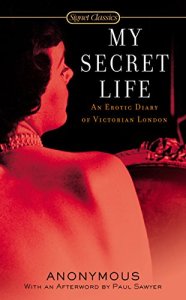
My Secret Life — Anonymous

My Secret Life is a bizarre, disturbing, amazing, fascinating work of Victorian-era pornography. It is anachronistic to label it with a “trigger warning” but it is the rare work that actually deserves the warning; it recounts in great detail the author’s erotic experiences from youth to old age. My Secret Life feels like a book sort of thing that probably wouldn’t get assigned to undergrads today. Still, it is strange and curious enough for me to write about it here (I learned of it via The Voyeur’s Motel, a book that may be considered part of the same genre as My Secret Life). Originally published in or around 1902, it was 11 volumes (!), and the abridged edition I linked to is a single volume that still feels exhausting by its end.

my_secret_lifeIt’s hard to believe that all of My Secret Life is true, and it’s also hard to believe that it is wholly imagined. Today one might call it “creative nonfiction,” which seems to be a phrase that loosely means or connotes truthy, or specious, or “I need to make shit up to make the narrative more compelling.”

The interest in and curiosity about matters generally veiled was great then and remains great now, though today it maybe takes different shapes. There are ceaseless reportorial sections in My Secret Life, and moments when the narrator finds that someone, “One evening being unusually communicative,” explained the matter of “buggery.” That explanation comes from a woman named Camille; the narrator “went there when I wanted a quiet chat and information about sexualities.” That interest appears insatiable, even as its nuances eventually dull the reader’s senses due to repetition.

The need to report and imagine seem relentless. During one extended period with a single woman, the narrator says that “when not thinking of Charlotte, [I] spent my time in writing baudy words and sketching cunts and pricks with pen and ink.” So he is either engaged in the act or considering it in some other way. His work is almost Internet-ready, going even to anonymity.

Some challenges seem eternal, as when the narrator praises a women in this way:

Moreover she was not always plaguing me for money—asking me to pay this, or to lend her to pay that—which is the common habit and trick of harlots from high to low—I felt at sea when Sarah was gone, and recollect that for a month or so I was chaste.

That “chaste” month seems unusual in the narrator’s life, though his whole life seems unusual; that it may be more usual than is usually assumed may be part of the book’s frisson. Still, one hopes that the many vile things the narrator does are not eternal.

My Secret History is an easy book for skipping sections, as the narrator never seems to grow, change, learn, or seriously struggle. As he is at seven, so he is at seventy. But maybe the larger point is that the nature of humanity as a whole may change less than we might like, and that non-technological progress is rarer than we like to think and perhaps barely existent at all.