
Slam — Nick Hornby

Slam starts with great promise: a list of bullets that show a lot of Sam’s life in a short space and show why it’s going well (“For example: Mum got rid of Steve, her rubbish boyfriend.”) It’s got a fun, fantastical conceit in that Tony Hawk talks to the narrator and comes to represent a kind of externalized consciousness, giving Sam a dialogic way of bouncing ideas off another person. But the novel itself meanders. I look for the great sentences and don’t find them. To be fair, there are strong sections.; for example, in analyzing (as best he can) his family, Sam says:

The story of my family, as far as I can tell, is always the same story, over and over again. Someone—my mum, my dad, my grandad—starts off thinking that they’re going to do well in school, and then go to college, maybe, and then make pots of money. But instead, they do something stupid, and they spend the rest of their lives trying to make up for the mistake they made. Sometimes it can seem as though kids always do better than their parents. You know—someone’s dad was a coal miner, or whatever, but his son goes on to play for a Premiership team, or wins Pop Idol, or invents the Internet. Those stories make you feel as though the whole world is on its way up. But in our family, people always slip up on the first step. In fact, most of the time they don’t even find the stairs.

Notice the metaphor at the end: most of the world “is on its way up,” without noting the transportation method (flight? an elevator?), but his family doesn’t “even find the stairs.” It’s a bittersweet passage, with him not exactly castigating his family but still fundamentally aware of social class. Yet why not start the metaphor at the beginning of the paragraph? His family’s story is always the same, with them looking up as other people go by, or being on the ground floor of a building whose top they can’t even conceptualize, or something to that effect? You could do much better than the ideas I’ve come up with in 30 seconds, but the point is that there’s no reason not to extend the metaphor—maybe throughout not just the paragraph but the book. We appreciate that Sam’s awareness is a step on the road to change, but he could be slightly more aware without harming the fundamental structure of the story.

Perhaps not surprising, some of the story’s tension involves whether Sam will continue the family tradition or break it. He meets a higher class, very attractive girl named Alicia. They talk music. He works to avoid being subservient to her, but later thinks that “I knew that I didn’t want to be [Alicia’s] friend, if you know what I mean, and I was worried that her being friendly to me meant that I didn’t stand a chance with anything else. I know that’s wrong. Mum is always telling me that friendship has to come first, before anything else.” Sam knows the score even when his mother doesn’t, or doesn’t want him to know. She is, in essence, pitching him the idealized version of romance, which he has internalized to the extent that he says he knows that not wanting to be Alicia’s conventional friend is “wrong,” imputing a sense of morality on an act that’s more about strategy than morality. In a different world, friendship would come first. If you search Google for “Friend Zone, you’ll find a wide array of articles with advice on how to avoid becoming “just a friend.” Sam’s Mum is trying to give him advice that isn’t highly applicable to the real world.

If you’re already aware of these dynamics, however, the novel will feel like old news. It’s not bad, exactly, but it’s not exciting, either. A lot of the book is fun. It just feels average, unlike Francine Prose’s Touch. I’m looking for ways that make it more than average and not finding them. Hornby’s best book, by far, is still High Fidelity. Maybe it always will be. I often think about it when writing contemporary novels that feature love stories; he fundamentally understands that such love stories tend towards comedy, that indecision is the great modern problem, and that love stories need more than just a should-I-or-shouldn’t-I plot. Whenever I read High Fidelity, I’m impressed again at how surprisingly well constructed it is. I keep trying his other books (A Long Way Down, How to be Good, Slam) in search of the same kind of mastery. I keep not finding it.
Lessons in Language from the TSA and George Orwell's "Politics and the English Language"

Flying these days not only reminds you of how nice it is to stay home but also offers lessons in euphemism. Unnaturally chirpy voices order you to “report suspicious behavior.” Like what? I have no idea, unless it means, say, someone screaming “Allahu Akbar” as they press the detonator or someone else claiming that Fox News is genuinely “fair and balanced.” But if you’re a verbally aware type, you can also learn some things, as I did when I went through security. At the airport checkpoints, security consists of backscatter radiation machines that can take naked pictures of you and are of somewhat dubious safety value. Instead of using them, you can elect have a TSA person fondle you in lieu of going through the machine:

Me: “I’ll opt for the molestation.”
TSA person, in surprisingly good humor: “Molestation? We don’t have any of that here.”
Me: “Well, I don’t want to go through the backscatter machine.”
TSA person: “You can opt out. Male opt-out!”

A couple minutes later:

TSA cop (I think he had a gun): “I have to explain the rules. I am going to touch you—”
Me, spreading my arms: “Yeah, I’ve heard them before. Go to town.”

A minute later:

TSA cop: “I’m going to use the back of my hand to access sensitive areas.”
Me: “I think ‘genitals’ is the commonly used word.”
TSA cop: Laughs. “We have to say it.”
Me: “Have you ever read George Orwell’s ‘Politics and the English Language?’ ” (Note: there was no hyperlink in the actual conversations.)
TSA cop: “No.”
Me: “Woah. I usually have to pay for experiences like this. Anyway, I assign it to my freshmen every semester, and it’s about how controlling language allows one to control political beliefs and actions.”
TSA cop: “Sounds interesting.”

In “Politics and the English Language,” Orwell argues that language is “an instrument which we shape for our own purposes.” He says thought and the language used to express thought are intertwined; thus, language “becomes ugly and inaccurate because our thoughts are foolish, but the slovenliness of our language makes it easier for us to have foolish thoughts.” Fortunately, he also says “The point is that the process is reversible.” But reversing the process requires that one make some effort to describe the activities involved in language that actually reflects them.

Given that the only way to fly these days is via the naked picture radiation machine or the TSA officer molestation, I’d choose the latter, even if the word I choose is too extreme for the activity. But so too is “opt out” too euphemistic for what the TSA agent does to you. Orwell said in 1946 that “The whole tendency of modern prose is away from concreteness.” Modern advertising and government is like that only more so. “Opt out” is reassuringly vague if inaccurate. That’s why TSA uses the term in lieu of something that incorporates the vaguely sexual overtone of what they’re doing.

In the meantime, pilots’ unions have gotten backscatter exemptions and EPIC is suing to learn more about the backscatter machines’ radiation risks (no word on their dignity risks). It’s apparently impossible to get technical specs for the machines so physicists and engineers can figure out what precisely they do and whether they’re really safe (I have more technical knowledge than a goldfish and less than a electrical engineering undergrad, so I’m a bad person for this task). But if I were designing the TSA’s training curriculum, I’d be tempted to use “Politics and the English Language” to explain why TSA employees need to use the language they do: to ensure that people think they’re free, when they should actually be asking their government why security theater persists.

Lessons in Language from the TSA and George Orwell’s “Politics and the English Language”

Flying these days not only reminds you of how nice it is to stay home but also offers lessons in euphemism. Unnaturally chirpy voices order you to “report suspicious behavior.” Like what? I have no idea, unless it means, say, someone screaming “Allahu Akbar” as they press the detonator or someone else claiming that Fox News is genuinely “fair and balanced.” But if you’re a verbally aware type, you can also learn some things, as I did when I went through security. At the airport checkpoints, security consists of backscatter radiation machines that can take naked pictures of you and are of somewhat dubious safety value. Instead of using them, you can elect have a TSA person fondle you in lieu of going through the machine:

Me: “I’ll opt for the molestation.”
TSA person, in surprisingly good humor: “Molestation? We don’t have any of that here.”
Me: “Well, I don’t want to go through the backscatter machine.”
TSA person: “You can opt out. Male opt-out!”

A couple minutes later:

TSA cop (I think he had a gun): “I have to explain the rules. I am going to touch you—”
Me, spreading my arms: “Yeah, I’ve heard them before. Go to town.”

A minute later:

TSA cop: “I’m going to use the back of my hand to access sensitive areas.”
Me: “I think ‘genitals’ is the commonly used word.”
TSA cop: Laughs. “We have to say it.”
Me: “Have you ever read George Orwell’s ‘Politics and the English Language?’ ” (Note: there was no hyperlink in the actual conversations.)
TSA cop: “No.”
Me: “Woah. I usually have to pay for experiences like this. Anyway, I assign it to my freshmen every semester, and it’s about how controlling language allows one to control political beliefs and actions.”
TSA cop: “Sounds interesting.”

In “Politics and the English Language,” Orwell argues that language is “an instrument which we shape for our own purposes.” He says thought and the language used to express thought are intertwined; thus, language “becomes ugly and inaccurate because our thoughts are foolish, but the slovenliness of our language makes it easier for us to have foolish thoughts.” Fortunately, he also says “The point is that the process is reversible.” But reversing the process requires that one make some effort to describe the activities involved in language that actually reflects them.

Given that the only way to fly these days is via the naked picture radiation machine or the TSA officer molestation, I’d choose the latter, even if the word I choose is too extreme for the activity. But so too is “opt out” too euphemistic for what the TSA agent does to you. Orwell said in 1946 that “The whole tendency of modern prose is away from concreteness.” Modern advertising and government is like that only more so. “Opt out” is reassuringly vague if inaccurate. That’s why TSA uses the term in lieu of something that incorporates the vaguely sexual overtone of what they’re doing.

In the meantime, pilots’ unions have gotten backscatter exemptions and EPIC is suing to learn more about the backscatter machines’ radiation risks (no word on their dignity risks). It’s apparently impossible to get technical specs for the machines so physicists and engineers can figure out what precisely they do and whether they’re really safe (I have more technical knowledge than a goldfish and less than a electrical engineering undergrad, so I’m a bad person for this task). But if I were designing the TSA’s training curriculum, I’d be tempted to use “Politics and the English Language” to explain why TSA employees need to use the language they do: to ensure that people think they’re free, when they should actually be asking their government why security theater persists.

Are Moleskines pretentious? Yup. Guildhall Notebooks and Rhodia Webbies are worse

Someone found this blog through the search query, “are moleskines pretentious”. The answer is so obvious (“yes”) that it worries me someone had to search for it. On the other hand, if you’re going to be a writer / artist / thinker type (see, for example, Rands in Repose for a hacker’s view), they’re pretty handy and probably worth the derisive, deserved stares and commentary you’ll get. Keep using them because you don’t know when a sentence will turn into a book. Or a post. Or something else important.

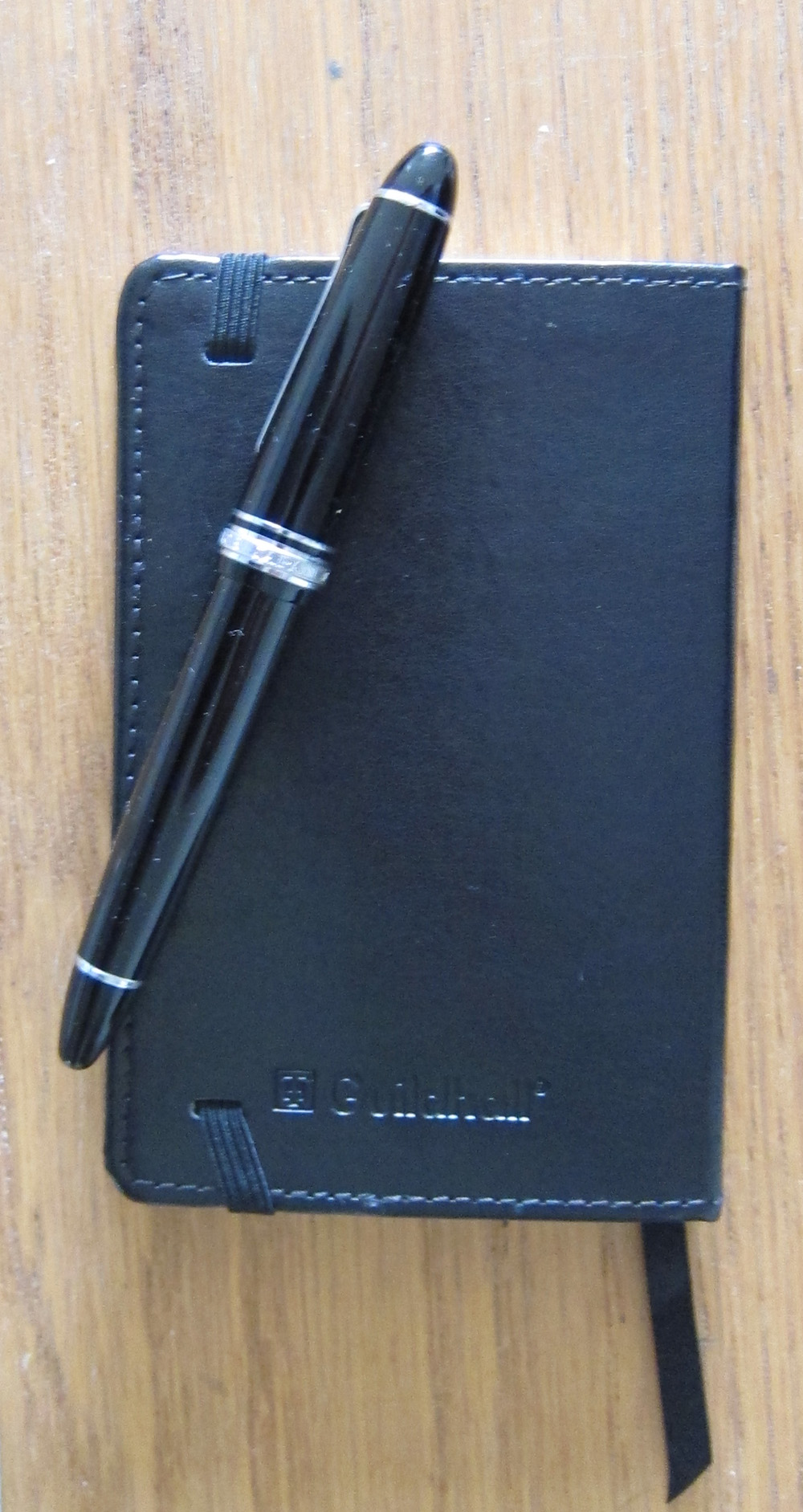
But I’m getting off-topic, which is how both moleskine notebooks (in the sense of the cover material) and Moleskine™ Notebooks (in the sense of the massive conglomerate that markets such notebooks) are pretentious. It might be even worse to posted about your dissatisfaction with recent Moleskines, along with pictures of the stack you’ve acquired over the years. At the moment, I’ve started using a Guildhall pocket notebook, which is a pain in the ass to find because they’re apparently discontinued (or so says their distributor, Exaclair). If you’re looking for one, start here. But for me, the real question is how well it’ll hold up after six to nine months of rigorous scientific testing that consists of travel in my pocket, backpack, and so forth. Maybe no notebook can, but the older Moleskines seemed to survive quite nicely. We’ll see if the Guildhall does.

One reason using a Moleskine can seem or be pretentious is simple: you appear to be more worried about appearance than what you’re actually doing with it, and writing blog posts, even recursively self-aware blog posts, enhances this problem. I don’t have a solution to this aspect of the issue beyond a suggestion that you actually produce something (posts, novels, paintings, patches to the Linux kernel, hedge funds, etc.) that your notebook habit contributes to.

By the way: after an exhaustive study of notebooks, I’ve discovered that the Rhodia Webbie is optimal. It even beats a $70, hand-made Japanese notebook that’s lovely but has overly thin paper. So if you’re looking for the right notebook, skip my persnickety, endless testing and go straight to the right one.