Life

“You live on the surface,” Lia told me years later. “You sometimes seem profound, but it’s only because you piece a lot of surfaces together to create the impression of depth, solidity. That solidity would collapse if you tried to stand it up.”

—Umberto Eco, Foucault’s Pendulum

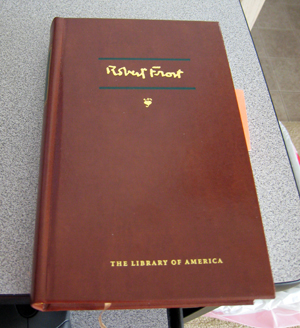
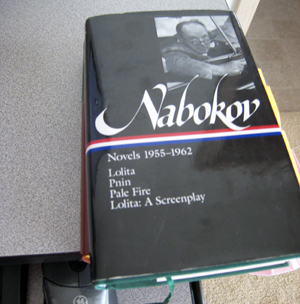
Mid-June links: The Library of America and the book as an object

* John Lanchester writes that he finds it hard to read those gorgeous Library of American volumes.

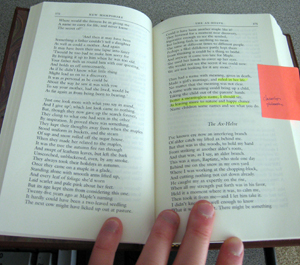
No such compulsion here! While I understand his feeling, I highlight when the need arises:

That’s one way of ensuring that the books exist to be read, not fetishized. Lanchester says, “A paperback is a paperback; the collected writings of a writer, any writer, have the air of belonging to Culture in the abstract. That’s off-putting.” I agree: responding to the author in the book itself is one way of ameliorating that problem.

Sometimes I write a fair amount, as in Lolita:

Screw resale value. Then again, Amazon knocks about a third off the price, and the Library of America had a fire sale (haha) of Frost, perhaps explaining part of my cavalier attitude.

EDIT 6/18/08: Gabriel Zaid’s So Many Books explains more about books as monuments than I do here.

* Kingsley Amis’ fairly extensive writing about alcohol has now been published in a single volume called Everyday Drinking, as the New York Times reports.

“Serving good drinks,” he wrote, “like producing anything worth while, from a poem to a motor-car, is troublesome and expensive.”

And, as with good food or good writing, good drinks are best prepared for those who will appreciate them.

Although I’m tempted to buy Everyday Drinking, I’m afraid I’ve already laden myself with enough contrarian books, ranging from The Joy of Drinking to The Book of Vice. In addition, despite my apparent dedication to such topics, I feel that drinking is better experienced in person than through the medium of literature, even if reflection deepens the experience once sufficient experience has been had.

Transpose those thoughts to other endeavors at your own peril.

* Nigel Beale writes about “How to re-establish evaluative criticism as central to the academic study of literature.” Since I’m about to start graduate school in English, it’s a topic near to my mind. What he doesn’t mention, however, is that evaluative criticism does exist to a greater extent than he gives it credit for, and it even has its own place in English departments—just under the heading “creative writing,” and “MFA,” rather than in the usual classes.

* Nigel Beale part deux—he says a good book needs:

1) to find and revel in funny, beautiful, thought-provoking phrases, 2) dwell on profound paragraphs that contain useful truths about life and human nature, 3) lose myself in the lives of exceptional characters.

They correspond roughly to professionalism and aesthetic delight, searching for meaning in life, and pleasure at being able to occupy someone else’s mind. Defining what those mean will quickly bloat any discussion of them to the size that Beale is trying to avoid with brevity.

* Jason Fisher on Rereading Madeleine L’Engle’s A Wrinkle in Time. It’s on my to be read list, along with 100 other books.

* Since science fiction has been in the air, Marc Andreessen’s top books of the 00s (“oughts?”) can land here.

* Read this concerning genre and that great bender Michael Chabon.

* Lester Hunt speculates on the decline of the Western:

[…] a major source of the charm of westerns is that they are set in a situation in which the presence of the state is minimal or non-existent. In the wild West, you often have to enforce your own rights. If you wait for civil society to do it, you’ll be dead. In a word, westerns are about anarchy. They are fiction’s only constitutionally anarchist genre. As such, they represent a wild sort of freedom. Maybe, like the romance of property, that’s not such a popular idea any more, either.

Notice that one of the most popular genres nowadays is the police procedural, in which the protagonist is a government employee. Yecch! Is there any way you could get further away from the ethos of the western? (Try to imagine Ethan Edwards even saying the word, “procedural.”)

This might explain why I don’t much care for police procedurals. Still, I’d note that many of them portray the police as corrupt and incompetent, while the heroes often act outside the traditional police structure.

* By way of Anecdotal Evidence, William Maxwell on reading and aging.

* That the TSA is denying the ability to fly to people without papers is infuriating. Have they not read the innumerable books about dystopias (1984, Brave New World, We…) and history/society (Foucault) on the subject of state surveillance? Evidently not. Slashdot commenters are unusually articulate about the issue. See my thoughts on its relation to reading here.

Reading: Wheaties, marijuana, or boring? You decide.

Eventually one must tire of reading the debates about reading and prefer to just read, or, if you’re the sort of person who doesn’t, watch T.V., or whatever—though if you don’t like reading, I’m rather puzzled that you’re at this site. Regardless, you should read this long, worthwhile, and non-polemical look at the decline of reading from Heather Harris (hat tip Books, Inq.):

One of the great pastimes of the literati, aside from complaining about the Bush administration and attending live tapings of A Prairie Home Companion, is collective hand-wringing about the sad fact that Americans no longer read. Apparently, most of us would sooner watch Rock of Love–Bret and Ambre are so not going to make it–than pick up a novel. Enter Mikita Brottman: Maryland Institute College of Art professor, Oxford scholar, author, and patron saint of the tome-averse masses in her new book The Solitary Vice: Against Reading. Brottman is the latest in a long line of philosophers and writers to question reading’s value, and in this day of reading campaigns and self-important book clubs, the question of whether reading per se is a virtuous activity is timely.

I’ve been collecting examples of quotes and articles concerning the decline of reading, as the debate about whether reading is good or bad for you seems to have been rolling around since the origins of the English novel. Other required reading on reading is Steven Johnson’s Dawn of the Digital Natives, whose perspective is closer to Brottman’s than the unnamed literati of the article.

I fall into more of the rah-rah reading crowd, both for personal and societal reasons. The argument about writing and reading changing our culture resonates with me, as even people who never read have been affected by the innumerable writers and reformers of various kinds whose work extends perpetually backwards in time. In addition, as Foucault argues, power and knowledge are inherently bound, and the most efficient way to transmit knowledge seems to be reading.

Why have we dismantled most forms of racial discrimination or many of the barriers to women in the workforce or other kinds of discrimination based on things other than ability? Why do we let atheists maintain their beliefs openly? It’s largely because some people were willing to challenge the larger culture, chiefly through writing, and enough people were interested in reading to have absorbed those principles or ideas, which now come at us through a thousand outlets. I just read in Alain Badiou’s ‘Ethics: An Essay on the Understanding of Evil (Wo Es War): “When Nietzsche proposes to ‘break the history of the world in two’ by exploding Christian nihilism and generalizing the great Dionysian ‘yes’ to Life […]” I thought, really? Although I don’t necessarily buy the “exploding Christian nihilism” bit (what nihilism?), count me as a late convert to the Dionysian principle. Without books, it’s doubtful that I would’ve made it there, and it’s in part my own trajectory that leads me to believe, perhaps irrationally, in the transformative value of thinking about the world through reading.

To delve into personal territory, books helped me leave the social carapace that hardened when I was 10 or 11, not create it, as Brottman says happened to her. Books were a recovery from an unhappy move and from video games and helped me articulate more of a worldview and change my behavior, and while I don’t think of books as therapy, they do have some therapeutic aspects to them. To bring the level of seriousness back to an appropriate level, consider what Richard Feynman said in Surely You’re Joking, Mr. Feynman!: “And Von Neumann gave me an interesting idea: that you don’t have to be responsible for the world that you’re in. So I have developed a very powerful sense of social irresponsibility as a result of Von Neumann’s advice. It’s made me a very happy man ever since. But it was Von Neumann who put the seed in that grew into my active irresponsibility!”

Without reading, I might lack this powerful sense of social irresponsibility and instead just have accepted accepted received wisdom instead of revising received wisdom. Let this be a lesson, by the way, to the natterers, including myself, on getting young people to read—instead of pushing reading ceaselessly like whole wheat bread, maybe it’s time to forbid it, and stock copies of Henry Miller and Bret Easton Ellis in the liquor store, thereby necessitating that teenagers get their older siblings or boyfriends or whatever to buy it for them. They might pass copies of Lost Girls around like furtive bongs at parties. I call this the “gateway drug” approach to reading, as opposed to the “whole wheat” approach.

Still, on a marginally more serious note, if no one reads, then who will write the challenges to cultural, legal, social, and technical problems? And who will read them? That, implicitly, is what many of hand-wringers worry about. Steven Johnson might argue, perhaps correctly, that those challenges will come from visual media, and that’s possible—but I doubt most visual media can match the depth of depth of text. I’m convinced that reading causes you to think—as Caleb Crain’s Twilight of the Books argues—differently and gives you the tools to argue against bad public policy, bureaucracies, and the like. To me, reading is linked to freedom itself, and I don’t think it’s mere correlation that the initial moves toward democracy coincided with the rise of what evidence we have for written languages, or that repressive governments fear and try to control books and knowledge. Thus, I see reading as important in the personal sphere for individual growth and in the societal sphere for correcting the excesses of organizations with power. And they’re fun—Feynman often criticized such organizations through his social irresponsibility, and has helped transmit that sense to others. Reading doesn’t have to be antisocial, and I usually find being social around people who read is more fun than being around people who don’t, simply because the readers get more and get it faster. Once again, the correlation/causation issue arises, but from my perspective, it doesn’t matter—I’ll take the reader over the non-reader, and many people not in positions of, say, government authority would probably do the same. Without falling prey to Godwin’s Law, I’ll note that many authoritarian regimes try to control knowledge and specific manifestations of knowledge, like books and professors. As a result, I see reading as both a public and private good, although one that, paradoxically, might be best inculcated in young people by trying to show it as dangerous, rather than good for you like Wheaties.

This argument might not matter, since surveys keep appearing that claim people read less and less, but like any believer, I’m still convinced of the faith’s importance. I’m not as much a proselytizer as someone who thinks others should come to it on their volition—I’m less of a Christian missionary and more of a Buddhist monk. Or maybe I’ve just got an economic interest in reading, since I spend an enormous amount of time writing. I think it’s deeper than that, although I won’t be so ridiculously grandiose as to say things like, “The future depends on it!” like a character from a bad superhero movie, I will say that reading still matters as a component of free thought and free life, and it doesn’t have to come at the expense of sociability. It can be good for you but shouldn’t necessarily be pitched that way. The culture, however, will move in whatever way it does, and I suspect those in the debate will be increasingly on the margins of the culture as a whole.


EDIT: Added last paragraph on 6/11/08.

Reunion

Alan Lightman’s Einstein’s Dreams is as good as his novel Reunion is bad. They share some superficial characteristics: both are meditations on the nature of time, both are short, and both strive for depth. The key differences are that Einstein’s Dreams achieves its depth, while Reunion does not; Einstein’s Dreams illuminates the character of Einstein, while Reunion skims Charles, illuminating only the fundamental banality of his existence; Einstein’s Dreams makes us ponder the nature of time, while Reunion makes us ponder why we’re reading this novel.

In buying it I made two mistakes: I didn’t read the first page and I relied solely on the author’s previous reputation. The first three sentences might’ve spared me the six bucks:

Sheila lies on top of me, snoring, her heavy breasts heavy on my chest, her stomach on my stomach, her hair damp in the afternoon heat, a shard of light through the white shutters she closes when we make love, the slow beat of the overhead fan, the tiny sound of a radio from the street. I too am falling asleep.
I fly above mountains, dizzy, frightened.

What isn’t wrong here? I’m not sure—maybe that the sentences are easily parsed. The wrongness piles up: the weird repetition of the word “heavy,” the mere description of breasts as “heavy,” which is as much a cliché as “pendulous,” the next several clichés (“damp in the afternoon heat” and a “shard of light”), the awkward time shift inherent in telling us of the “white shutters she closes when we make love,” indicating that the event happened previously, and a generic scene that’s been described in thousands of novels and filmed in thousands of movies. “Light” and “white” are jarring slant rhymes. The idea of flying in dreams or reveries is equally hackneyed, and as a metaphor for time passing it fails.

I’m willing to continue. But the clichés of thought and language continue too, as when Charles tells us:

Just the other day I was reading some article about the relativity of values. I mention this because it applies directly to the question of the Honduran hurricane victims on TV. Even if they are not mere electronic data points, those people are not nearly as bad off as they seem.

Right: the people are far away and only presented on TV, and therefore aren’t as real. See, e.g., The Matrix (link goes to a fascinating New Yorker essay), Philip K. Dick, and too many others. The theme continues a few pages later when a hippie turned general is described here:

The Nick on TV wasn’t any more real than the Gulf War itself, a made-for-TV war, a video game, another digitized disembodied nothingness like the Honduran hurricane victims, created to sell deodorants and premium beers and cellular phones. On my sixteen-inch television screen, red boxes neatly circumscribed bomb targets.

That’s an easy point of view to take if you’re living in the U.S., but I’m guessing that the soldiers who were there and the civilians living in Iraq didn’t consider themselves digitized disembodied nothingness. The sheer self-indulgence of this “what is reality?” idea is frustrating because it repeats without amplifying or altering one made earlier in the novel. It’s so bad that I almost miss the one bright spot, which is Lightman’s use of the verb “circumscribed” to describe bomb targets, which is both accurate and unusual. Its resonance with the word “circumcised” is also appropriate, given the men in charge of wars whose target is so often other men.

Those are the first few pages. It doesn’t get better.

Reunion is built around an older man going to a college reunion, where he chiefly feels uncomfortable and then slips into a reverie about the girl who slipped away. He remembers their love affair; she might have a tawdry affair with a person in a position of power; the reader wishes that some scenes weren’t worthy of the Literary Review’s Bad Sex Award. In novels, no sex is always preferable to bad sex. As for this novel, you’re better off with John Banville’s The Sea, or almost anything by Ian McEwan, or Proust’s Swann’s Way, or any of the other innumerable novels about an older person remembering his or her affairs. It’s a justly rich and weighty sub-genre, and with so much to choose from, you could do far better.

In short, Reunion serves two related purposes: to show through contrast how good Einstein’s Dreams is and to remind readers who haven’t otherwise heard of that novel to read it instead of and not in addition to Reunion.

Life: oddball university edition

“It’s a rite that must have arisen in the old days of the college, when Princeton was a men’s institution and mass nudity was an expression of the male prerogative, like pissing upright or waging war.”

—Ian Caldwell and Dustin Thomason, The Rule of Four

(It’s amazing how sometimes otherwise indifferent books can hit a real zinger of a sentence; these authors do it about once a chapter. Another example: “Somehow these rituals were then transmitted intact down to the present, profiting from that immunity to time and fortune which the university, like an ancient tar pit, confers on everything that lumbers unwittingly into it and dies.”)

Science Fiction, literature, and the haters

Why does so little science fiction rise to the standards of literary fiction?

This question arose from two overlapping events. The first came from reading Day of the Triffids (link goes to my post); although I don’t remember how I came to the book, someone must’ve recommended it on a blog or newspaper in compelling enough terms for me to buy it. Its weaknesses, as discussed in the post, brought up science fiction and its relation to the larger book world.

The second event arose from a science fiction novel I wrote called Pearle Transit that I’ve been submitting to agents. It’s based on Conrad’s Heart of Darkness—think, on a superficial level, “Heart of Darkness in space.” Two replies stand out: one came from an agent who said he found the idea intriguing but that science fiction novels must be at least 100,000 words long and have sequels already started. “Wow,” I thought. How many great literary novels have enough narrative force and character drive for sequels? The answer that came immediately to mind was “zero,” and after reflection and consultation with friends I still can’t find any. Most novels expend all their ideas at once, and to keep going would be like wearing a shirt that fades from too many washes. Even in science fiction, very few if any series maintain their momentum over time; think of how awful the Dune books rapidly became, or Arthur C. Clarke’s Rama series. A few novels can make it as multiple-part works, but most of those were conceived of and executed as a single work, like Dan Simmons’ Hyperion or Tolkien’s The Lord of the Rings (more on those later).

The minimum word count bothers me too. It’s not possible for Pearle Transit to be stretched beyond its present size without destroying what makes it coherent and, I hope, good. By its nature it is supposed to be taunt, and much as a 120-pound person cannot be safely made into a 240-pound person, Pearle Transit can’t be engorged without making it like the bloated star that sets its opening scene. If the market reality is that such books can’t or won’t sell, I begin to tie the quality of the science fiction I’ve read together with the system that produces it. Heart of Darkness—forerunner to modernism and one of the deepest and most mysterious novels I’ve read—had only about 40,000 words. In those 40,000 words, it contains more than the vast majority of novels I’ve read with four times as many. The Great Gatsby isn’t very long either—60,000 words, perhaps?—and yet by the standards of contemporary science fiction, apparently neither would be publishable. If this is true, then the production system for science fiction might be harming the ability of writers to produce fiction at the highest possible level.

The other rejection came from an agent who read the entire manuscript. He said he liked it and thought the writing was sharp—an adjective I’ve seen before in rejection letters—but that it was “too literary” and shouldn’t be as “complex.” It can’t bode well for science fiction in general if its gatekeepers are allergic to the idea of literariness, that ineffable quality that haunts this post even as I don’t or can’t define it. To be sure, it’s possible that the agent who called Pearle Transit “too literary” was being nice or using a euphemism and really saying he thought it was boring, or stuffy, or something to that effect, but even if he was, I still think his word choice is illustrative.

The two rejection letters and the literary quality of Day of the Triffids show specific examples of a general phenomenon regarding science fiction. It’s unfortunate that the entire genre gets tarred as junk by some critics and readers when in reality it’s not entirely junk—if it were, I wouldn’t write a long essay describing it. I have a theory as to why science fiction often gets labeled as junk: it values other qualities than aesthetic novelty/skill and deep characterization. It’s more concerned with ideas rather than how ideas are expressed, while the greatest literary fiction sees ideas and their expression as inextricably linked. At the same time, though, I think that science fiction’s defenders might bring on the literary snobs’ ire by doing things like calling them literary snobs when many aren’t actually snobs, but just have standards that science fiction too infrequently reaches in part for the reason I just stated. This is also why, I suspect, science fiction has trouble achieving the critical and academic recognition it should probably have, especially given its larger impact on the culture. I’m one of the defenders of good writing being good writing regardless of where it comes from, but the more science fiction I read, the more I realize so much of it just doesn’t have the skill in narrative, detail, character, sympathy and complexity, language, and dialog that readers of literary fiction demand. I still like a lot of science fiction, but most of it now causes me to roll my eyes and skip pages: characters have no life, the books have no lifeness, clichés abound, and strong setups devolve into variations on cowboys and indians.

There are very significant exceptions, as I said regarding Day of the Triffids:

The only science fiction novels I’m aware of that could stand on their own as a literary achievement is Stanislaw Lem’s Solaris and Ursula K. Le Guin’s The Left Hand of Darkness. Some others are serviceable and worthwhile, like Dan Simmons’ Hyperion, Frank Herbert’s Dune, Robert Heinlein’s Stranger in a Strange Land, William Gibson’s Neuromancer, Walter Michael Miller’s A Canticle for Leibowitz, and Philip K. Dick’s better novels. But none are great novels, though Gibson comes closest, and while I don’t think the genre is incapable of housing real greatness, the relative lack of literary merit gives me pause when I continue searching for satisfying science fiction.

Jason Fisher of Lingwë – Musings of a Fish wrote an e-mail pointing out that Brave New World, 1984, and Fahrenheit 451 probably belong in the “exception” category too. I agree, as long as they’re fully included in the science fiction umbrealla—while Orwell and Huxley were kind of writing science fiction, their books were much closer to the traditions of allegory and satire, even if they happened to use some of science fiction’s trappings. Someone like Stanislaw Lem or Le Guin, on the other hand, produced genuine science fiction. Bradbury I’d forgotten about, but it’s been too long since I read his books to judge them. Granted, this argument might turn into boundary dispute regarding what’s science fiction and what isn’t, but I think there is something to be said for the science fiction that’s grounded solidly in the “science” as in the technological future world, whereas I see Orwell, especially, and Huxley, to a lesser extent, as being closer to something like Gulliver’s Travels.

Typing “Top science fiction novels” in Google reveals lists like these: the top 50 science fiction novels, the top fifteen great science fiction books, and the top 100 sci-fi books (never mind that some science fiction writers and readers hate the term sci-fi for reasons that are still unclear to me). Most of the novels on those lists don’t meet conventional—an inappropriate word, given that great literature is by definition unconventional—literary standards, with the exceptions already mentioned. Dan Simmons’ Hyperion gets close—very close—but still has that “not quite” feeling.

That Michael Crichton gets on any lists is a bad sign: the best review I’ve seen of his wildly popular and equally wildly uneven, and usually bad, work is in Martin Amis’ The War Against Cliché, when he praises Crichton at his best as “a blend of Stephen Jay Gould and Agatha Christie” and then discusses what’s wrong in the context of The Lost World, but it could be transposed to most of his Crichton’s novels:

The job of characterization has been delegated to two or three thrashed and downtrodden adverbs. ‘Dodgson shook his head irritably’; ‘ “Handle what?” Dodgson said irritably.’ So Dodgson is irritable. But ‘ “I tell you it’s fine,” Levine said irritably.’ ‘Levine got up irritably.’ So Levine is irritable too. ‘Malcolm stared forward gloomily.’ ‘ “We shouldn’t have the kids here,” said Malcolm gloomily.’ Malcolm seems to own ‘gloomily’; but then you irritably notice that Rossiter is behaving ‘gloomily’ too, and gloomily discover that Malcolm is behaving ‘irritably.’ Forget about ‘tensely’ and ‘grimly’ for now. And don’t get me started on ‘thoughtfully.’

So many science fiction novels suffer from the same problems: adverbs that proliferate like triffids, characters who are more alive silent than when they speak, and descriptions that deserve the Amis treatment, above.

Even Philip K. Dick, who aspired to be a literary writer prior to turning to science fiction, gets mixed notices, which Adam Gopnik explores in the New Yorker:

As an adult reader coming back to Dick, you start off in a state of renewed wonder and then find yourself thumbing ahead to see how much farther you are going to have to go. At the end of a Dick marathon, you end up admiring every one of his conceits and not a single one of his sentences. His facility is amazing. He once wrote eleven novels in a twenty-four-month stretch. But one thing you have to have done in order to write eleven novels in two years is not to have written any of them twice.

That’s probably why Dick’s reputation as a serious writer, like Poe’s, has always been higher in France, where the sentences aren’t read as they were written. And his paint-by-numbers prose is ideally suited for the movies. The last monologue in “Blade Runner” (“All those moments will be lost in time like tears in rain. Time to die”), improvised by Rutger Hauer on the set that day, has a pathos that the book achieves only in design, intellectually, because the movie speech is spoken by a recognizable person, dressed up as a robot, where Dick’s characters tend to be robots dressed up as people.

Gopnik is right. Dick himself wrote How to Build a Universe That Doesn’t Fall Apart Two Days Later, which Jason sent me. It’s a wonderful essay more about ideas and coherency than skill in conveying ideas through words. It’s hard to imagine him writing something like Kundera’s The Art of the Novel or E.M. Forster’s Aspects of the Novel. Maybe Aspects of the Science Fiction Novel, but that cordons science fiction from the greater literary sphere. I dislike the cordon, and yet the more I realize regarding what science fiction seems to value and what literary fiction seems to value, the more I wonder if it’s really undesirable. In his essay, Dick is ready to join literary writers when he says: “The problem is simply this: What does a science fiction writer know about? On what topic is he an authority?” I read much bemoaning of what place, if any, the author has in times of national strife, like 9/11. The answer seemed to be, “not much.” So Dick has something in common with literary authors. In his essay, however, Dick proceeds on a metaphysical binge rather than the deeper realms of what makes great fiction, as James Wood does in How Fiction Works, or Jane Smiley does in 13 Ways of Looking at the Novel, or Francine Prose does in Reading like a Writer. He writes with great verve and depth about the nature of reality, our place in it, and societal problems—but he doesn’t handle aesthetic problems or people as manifestations of those problems well. Characters come off as manifestations of problems instead of people, which is another way of saying what Gopnik did.

Other writers, like Roger Zelazny in the first section of The Great Book of Amber, is more bad than good, and his writing is frequently irritating for its James Bond tone in passages like this:

I forced my mind back to the accident, dwelled upon it till my head hurt. It was no accident. I had that impression, though I didn’t know why. I would find out, and someone would pay. Very, very much would they pay. An anger, a terrible one, flared within the middle of my body.

The lack of a conjunction between “accident” and “dwelled” doesn’t work here and is jarring, along with the running together of the sounds “it” and “till,” especially when followed by the alliteration of “head hurt.” Finally, the endlessly repeated action-hero trope of “someone would pay,” is expressed exactly the same as it has been thousands if not millions of times before. Occasionally Zelazny wanders in the land of exquisite, terse writing, almost by accident, as when he says: “The night was bargaining weakly with the sun.”

I’ve discussed a few of the novels that appear on those top science fiction lists and I’ve read most of them, although some, I admit, not recently. I like many though love few and suspect I would like far fewer had I not read them in that formative period where novelty is much easier to achieve simply because you haven’t read all that much relative to how much you will. I think there is also something in the modern adolescent temperament that science fiction and fantasy appeals to: the idea that you’re being held back and oppressed and that with time you will acquire devices or skills that lend you great power to overcome forces that seem to be evil. Later, unfortunately, you discover that those forces are not so much malicious as incompetent and lazy and that the structure of the world is very hard to change; what those novels often don’t show is how the heroic quest is symbolic in the real world not of battling demons but of study, thought, and work. As Paul Graham says:

But if a kid asks you “Is there a God?” or “What’s a prostitute?” you’ll probably say “Ask your parents.”

Since we all agree [about lies to tell kids and forbidden questions], kids see few cracks in the view of the world presented to them. The biggest disagreements are between parents and schools, but even those are small. Schools are careful what they say about controversial topics, and if they do contradict what parents want their kids to believe, parents either pressure the school into keeping quiet or move their kids to a new school.

The conspiracy is so thorough that most kids who discover it do so only by discovering internal contradictions in what they’re told. It can be traumatic for the ones who wake up during the operation.

[…]

I remember that feeling. By 15 I was convinced the world was corrupt from end to end. That’s why movies like The Matrix have such resonance. Every kid grows up in a fake world. In a way it would be easier if the forces behind it were as clearly differentiated as a bunch of evil machines, and one could make a clean break just by taking a pill.

And when you’re 15, you also have a lower threshold for art because, at least in the United States, most 15-year-olds aren’t all that well-formed and haven’t experience much; hell, I’m 24 and still don’t feel all that well-formed. Still, if you get someone with plots about breaking through the surface world into some other world underneath, you’re going to speak, in many cases, much more convincingly to 15-year-olds than you are to disgruntled adults who have the freedom to seek whatever they think the truth of the world is and choose not to exercise it, or who are responsible for keeping those 15-year-old dreamers fed and going to school on time. I’ve left out a small but very important group of adults who are still dreaming of greatness and trying to pierce the veil of reality, but I suspect they are entirely too small a group, and those who might join it are often invested in ideologies or systems or other simplifiers of what is a world too complex to explain through simple chants, or what Alain Badiou calls simulacrum and betrayal in his book Ethics: An Essay on the Understanding of Evil.

I still like Heinlein’s Stranger in a Strange Land, and I still appreciate some of the criticisms he directed at judgmental society. But if I read him for the first time today, I would’ve already encountered his ideas, and there wouldn’t be the depth of characterization or the skill in writing to carry me through. Then, it seemed original, and I wasn’t old enough to perceive Stranger’s paper-thin chatter masquerading as philosophy. Even Brave New World, for all its virtues, has some of those problems, as when the savage discusses Shakespeare.

This essay discusses science fiction, but its sister, fantasy, suffers from some of the same problems, which I alluded to in my review of The Name of the Wind and The Daughter of the Empire. In contrast to those writers, Tolkien gets deeper and stronger as you get older and more sophisticated, and I suspect Lord of the Rings is a well that will never run dry. First-rate fantasy seems to pop up more often than science fiction—here I’m thinking of Le Guin with Earthsea, or Philip Pullman with His Dark Materials. Even then, it’s still common for writers to churn out elements in different configurations instead of trying, like Paul Muad’Dib in Dune, to break the nature of the genre publishing system itself. How ironic that a genre dedicated to transcending the scrim of reality relies on endless repetition of its core language and features.

After almost 3,000 words, I’ve described a problem, diagnosed some of its causes, shown some ways it operates, but not come to any conclusions. I’m not sure any exist, given the marketplace and reader incentives involved with both the production and consumption of science fiction. And if there is a solution, I hope readers of this are looking for it, and that I can be a part.


EDIT: A follow-up post deals with some of the issues raised in the comments and via e-mail.
June links: libraries edition

* Bowker says that “276,649 new titles and editions” appeared in the U.S. in 2007, up slightly from the year before. So Many Books: Reading and Publishing in an Age of Abundance, anyone? (Note: I haven’t actually read Gabriel Zaid’s book yet). And where’s the space for mine? Perhaps being taken up by Tolkien reprints, leading to the next item…

* Nick Owchar reports on still more efforts to wring cash out of J.R.R. Tolkien. The good news, however, is that the publication of Tales from the Perilous Realm will “gather […] several of the master’s shorter works–“Farmer Giles of Ham,” “Leaf by Niggle,” “Smith of Wootton Major” and “Roverandom”–as well as a book of poems, “The Adventures of Tom Bombadil.”” In other words, this will make it far easier for those of us who study Tolkien and avoid perhaps the foul smell of Children of Húrin.

* My dream, achieved by someone else. He has 30,000, and I only 260 – 270. It’s not the size, but how you use it, right?

(Hat tip ALN.)

* More personal library reflections from the Wall Street Journal:

I still possess a great many books. I’m not a book collector, though, not at all — and much less a bibliophile. The discreet charms of the first edition have always eluded me, although I can appreciate a nicely bound volume — as a consequence I own many second and third printings, which generally cost about 95% less. When I have a choice I go for interesting jackets, elegant typefaces, acid-free paper, but above all I prize compactness. Whenever possible I go for omnibus editions. The more books can fit in a single volume, the happier I am. And I mourn the passing of the pocket-sized paperback, which was once allowed to contain all sorts of material and is now strictly reserved for the kinds of books that inspire gold-embossed titles and peekaboo die-cuts. I like to carry books in my pockets, and trade paperbacks are an awkward fit, except in the dead of winter.

Anyway, I like the entire variety of books: thin little plaquettes, 16-volume histories, drugstore potboilers, privately printed crank pamphlets, ancient volumes in unknown languages, sleek new art editions with lots of white on the pages, forgotten doctoral dissertations from German universities in the 1880s, pornography bought by sailors in Tijuana, technical publications with wildly recondite diagrams… I remember a cartoon I saw as a child in which the books jumped off the shelves and had themselves a party in the bookstore in the middle of the night.

* XKCD strikes with this comic.

Day of the Triffids — John Wyndham

John Wyndham’s The Day of the Triffids is another early post apocalyptic novels that’s more interesting as a historical curiosity than for aesthetic merit. It suffers from many of science fiction’s deficiencies in terms of writing quality and characterization. These problems might stem in part from science fiction’s focus on novelty in plot, technology, and world, rather than in linguistic or cultural achievement; perhaps fiction is innovative either in what it says or how it says only seldom both. The only science fiction novels I’m aware of that could stand on their own as a literary achievement is Stanislaw Lem’s Solaris and Ursula K. Le Guin’s The Left Hand of Darkness. Some others are serviceable and worthwhile, like Dan Simmons’ Hyperion, Frank Herbert’s Dune, Robert Heinlein’s Stranger in a Strange Land, William Gibson’s Neuromancer, Walter Michael Miller’s A Canticle for Leibowitz, and Philip K. Dick’s better novels. But none are great novels, though Gibson comes closest, and while I don’t think the genre is incapable of housing real greatness, the relative lack of literary worth gives me pause when I continue searching for satisfying science fiction.

This long introduction is designed to put The Day of the Triffids in a context it doesn’t transcend. The plot begins with a fantastic meteor shower that strikes all who watch it blind combined with the invasion of an insidious species known as triffids, which kill anyone within a few feet via a stinging lash. These walking carnivorous plants become symbolic repositories for our fears and our collective inability to see what’s in front of our faces; as Bill Masen, the overly prim and competent protagonist observes, ” ‘There’s a kind of conspiracy not to believe things about triffids.’ ” There is, and I felt some horror as I learned more about them, but it was an overly familiar feeling from all those end-of-the-world stories: George Stewart’s Earth Abides, which predates The Day of the Triffids by two years, the aforementioned A Canticle for Leibowitz, Larry Niven’s Lucifer’s Hammer, and even Stephen King’s The Stand. Except for A Canticle for Leibowitz, they all share the same styles, themes, and motifs concerning humanity’s capacity for darkness and ignorance (“Horrible alien things which some of us had somehow created, and which the rest of us, in our careless greed, had cultured all over the world,” we learn in The Day of the Triffids. Notice the lack of subject or article at the beginning of the sentence, where it seems that one or both should appear). I just wish there were more originality in this, although to be fair Earth Abides and The Day of the Triffids are forerunners to the later developments in the sub-genre of apocalyptic stories.

As in many such works, Bill Masen is little more advanced emotionally and intellectually than the nameless narrator of H.G. Wells’ The War of the Worlds. A curious mixture of competence, chivalry, and sexism, Bill Masen wants to protect his women and while keeping them, you know, in their role. Still, to his credit he thinks about a ten-year-old, “[…] the world in which she was going to grow up would have little use for the overniceties and euphemisms that I had learned as a child […]” Still, he’s not perceptive enough to think that perhaps those “niceties” aren’t of use in the current world, as Paul Graham cogently argues. “[His] quest was personal,” although that quest is just to find a girl he randomly encountered, and even then it feels not so much personal as generic and something expected by a certain type of society. I sometimes feel the same way when closing time approaches at a bar. Augie March is on a personal quest, but Bill Masen, alas, is not.

Elsewhere, he almost verges on something vaguely resembling insight when he says that, “There is an inability to sustain the tragic mood, a phoenix quality of the mind. It may be helpful or harmful, it is just a part of the will to survive—yet, also, it has made it possible for us to engage in one weakening war after another.” Maybe so, but even here the awkwardness of the writing, with the disjointedness created by the first comma in both sentences, weakens the sense of flow and as a result the sentiment that is being expressed. And yet his fundamental argument about the resilience of humanity is not a bad one, even if it is not expressed well, and I would’ve liked for more on the subject.

As I said, The Day of the Triffids is most interesting as a historical document: Cold War symbolism abounds, and as disaster befalls England one girl “[…] had an utterly unshakeable conviction that nothing serious could have happened to America, and that it was only a matter of holding out for a while until the Americans arrived to put everything in order.” Contrast this belief with what Fareed Zakaria persuasively argues about the views of America abroad in The Post-American World. In Day of the Triffids, this exchange takes place a few pages after the first quote:

“Try to imagine a world in which there aren’t any Americans—can you do that?”
The girl stared at him.
“But there must be,” she said.
[…]
“There won’t always be those stores. The way I see it, we’ve been given a flying start in a new kind of world.”

Although the girl who believes in America is presented as a fool, it’s still nice to imagine that this sentiment was reasonably widespread during the Cold War. I remain hopeful and perhaps even confident, like Zakaria in The Post-American World, that it will be again in the near future. In the meantime, Day of the Triffids remains dead history rather than living fiction that still speaks loudly to us today, as great literature does.

Doctor Faustus

I tried to read and like Thomas Mann’s Doctor Faustus—I really did—but quit after perhaps 80 leaden pages. It wasn’t a bad novel, to be sure, but just one that never seemed to unshackle itself from the page. Alex Ross brought it to my immediate attention through his allusions to Doctor Faustus in The Rest is Noise, but that initial enthusiasm didn’t prove sustaining. High school travesties like Ethan Frome came to mind, as an endless bowl of unsweetened oatmeal becomes dreary, no matter its healthfulness.

That image of the endless bowl is apt given how many sentences in Doctor Faustus were long and tedious, without the sustaining beauty in Swann’s Way. From the start of chapter VIII, a page I flipped to at random: “But [Kretzschmar] had early felt the pull back to the Old World, from where his grandparents had once emigrated and where both his own roots and those of his art were to be found; and in the course of a nomadic life, whose stations and stopovers seldom lasted longer than one or two years, he had come to Kaisersaschern as our organist—it was only one episode that had been preceded by others (for he had previously been employed as a conductor at small municipal theaters in the German Reich and Switzerland) and would be followed by others.” Two words shy of 100, and all of it, so far as I can tell, irrelevant to understanding the character of Kretzschmar or Adrian Leverkühn or anything else. Sometimes digressive novels work fabulously well, as Cryptonomicon did, but in Doctor Faustus there’s so much artistry that I’m being stifled.

Another annoyance that starts small and grows: the constant tendency of the narrator to discuss how he tells the story. At the start of chapter IX, he says: “I shall not glance back—far be it from me to count how many pages have piled up between the last Roman numeral and the one I just wrote. A mishap—a totally unexpected mishap, to be sure—has occurred, and it would be pointless to indulge in self-accusation and apologies on its account.” Good: then don’t indulge in either, and don’t tell us about it. I will count how many pages have passed: 25, and in those 25 I skipped larger and larger blocks of text as I looked for something, anything, to happen. But nothing does, except for telling us how the story will be told and about the early life of a great composer. I never got to a point where I said, “Ah ha! This is where I would’ve started the novel.”

If you want to see a morally compromised figure interested music, try Robert Penn Warren’s All the King’s Men, where the surgeon Adam Staunton is also an amateur pianist whose music is associated with madness or otherworldliness. Its many pages flow like corrupt money through Willie Stark’s machine, and to me is a stronger work that begins with movement and never stops. What made All the King’s Men go and Doctor Faustus not is a topic I’ve been pondering; James Wood comes at it from the angle of character when he contemplates “[…] how to push out? How to animate the static portrait?” in How Fiction Works. Like him, I can’t formulate rules so strong that novels can’t wriggle out of them, and so I feel forced to observe what I can’t explain, like astronomers and dark matter. Yet, just as Supreme Court Justice Stewart said regarding pornography, “I shall not today attempt further to define the kinds of material I understand to be embraced . . . [b]ut I know it when I see it,” so too I know problematic novels when I see them. Still, I’ve also learned to be wary of decisive conclusions on novels that have superseded their times and are still widely regarded as good, and so I’m keeping Doctor Faustus in anticipation of revisiting it sometime in the distant future, and I hope I don’t look back ruefully on this essay.