NBCC Good Reads in Seattle

The National Book Critics Circle’s Good Reads discussion hit Third Place Books in Seattle on Feb. 18, bringing together four panelists who showed through the quality of their thought just how much they really, really love books, as well as the importance of the ecosystem around books. The ecosystem problem echoes debates I’ve written about before—see, for example, here, here and here—and all four speakers offered eloquent, brilliant defenses of book criticism that will be, I suspect, ignored, as previous efforts have been. When I opened my browser last night, a New York Times headline said, “For Publisher in Los Angeles, Cuts and Worse,” and book reviewing will probably be part of the cuts. But critics, thinkers and scholars beat on, boats against the current, and that events like Good Reads happen shows the continuing vitality of the book.

As the blurb on Critical Mass states, the panelists were “Charles Johnson, Jonathan Raban, Seattle Weekly editor Brian Miller, and Seattle Times Book editor & NBCC Board Member Mary Ann Gwinn.” All four shone. Gwinn moderated and first passed the mic to Raban, who talked about the quality of book criticism when he was a younger man and now, saying we aren’t in a “great age” of book reviews. Although this might sound like an example of The Wonderful Past, I think it’s not, given how relatively little press coverage books generate—as demonstrated by the links in the first paragraph. Raban directed particular ire at the habit of “grading” novels, citing Michiko Kakutani as a prominent offender. Although I agreed with him concerning the importance of engaging books, I also think it important to consider how one should decide which books only deserve notices or grades versus which ones are worth engagement. I asked that question later, and Johnson gave my favorite answer when he said that he uses many criteria, including the quality of their writing, and above all whether a book succeeds in “showing us something we haven’t seen before.” You can hear an echo of the modernists’ credo, “Make it new.” Johnson didn’t define what that “something” is, and I can’t blame him: you don’t know what’s not there until someone shows you what should be. Furthermore, as Johnson said, you have to evaluate each book individually, which makes it difficult to generalize about what books are worth study.

None of that should detract from Raban’s main point about the importance of quality reviews. Johnson followed up by saying that a “fine review puts a book into context,” which I also try to do (see more here), and that there are fewer places to read good reviews. This practice harms both readers and writers, with the latter hurt because, as Johnson said, the “best way to learn about something is to write about it.”

They went on to give wonderful anecdotes and examples of problems in book reviewing and recommendations, which I would repeat if I didn’t think the power and humor of their stories would be lost in my reconstruction. Their delivery was that of adepts. Still, I think it important to note two things: Johnson said that reviewing is like pointing a finger at the moon, and not the moon itself–which is the book. In addition, Gwinn said 500 books hit her desk in a week. Five hundred. The number boggles me, and she said that the publishing industry seems to use the “shotgun” method for book sales, and fire a lot of pellets just to see what hits. Some books do, and she cited The Kite Runner as an example. She also said that not all is or should be doom and gloom, as last year book sales were up seven percent. That might just be a Harry Potter bounce, but I liked hearing it regardless.

Johnson also put the book reviewer, reader, and others, as being in part of a “matrix” or “web of education,” with books alluding to each other and readers building a kind of map or network. He echoed The Name of the Rose (a quote: “Books are not made to be believed, but to be subjected to inquiry. When we consider a book, we mustn’t ask ourselves what it says but what it means […]” and one more: “Now I realized that not infrequently books speak of books: it is as if they spoke among themselves. In the light of this reflection, the library seemed all the more disturbing to me. It was then a place of long, centuries-old murmuring, an imperceptible dialogue between one parchment and another, a living thing, a receptacle of powers not to be ruled by a human mind, a treasure of secrets emanated by many minds, surviving the death of those who had produced them or had been their conveyors.”) Yes, and we’re constantly trying to keep up with the worthy books of the past while trying to find good ones from the present and connect those with the past. Those older ones are easier to identify: you have publishers’ special imprints as well as the benefit of teachers, professors, and others, and they have by definition withstood time. Judging those from the present is harder, and much of the conversation revolved around that difficulty. In the end, finding good criteria is impossible and, as Gwinn said, part of a lifelong education. Or, to put it in Johnson’s phrasing, we’re trying to discover what it means to be educated and civilized. I wish there were better answers to these impossible questions, but regardless of those answers, it’s great fun hearing strong minds bandy the issues.

No one talked much about recommended reads, but the alternate discussion about art, reviewing, and life more than made up for the lack of recommendations. Some came up anyway: The Geography of Thought by Richard Nisbett, which Johnson liked, Riddle of the Sands by Erskine Childers, which Raban said every boat should have onboard, and several from Miller that he spoke too fast for me to catch. None were on bestseller lists but all sounded worthy, and that’s the point of the NBCC’s effort: to find books that are likely to matter but that aren’t at the grocery store and deserve more attention than they get.
The Wonderful Past

I’ve mentioned Grant Writing Confidential several times recently and will do so once more again, this time because I wrote a post that my father and co-writer there, Isaac Seliger, suggested would be well-suited here as well. He saw the many literary references in The Wonderful Past—to The Name of the Rose, My Name is Red, Plato, and traditional Romance. To be sure, the post focuses on grant writing, but it also illustrates a tendency in literature and culture: idealizing the past or recalling a golden time that may or may not have ever been. Novels like The Name of the Rose wink at this, especially because Adso of Melk lived in 1321 and “wrote” from the perspective of sometime around 1380 – 1400, and the eras he recalled appear ridiculous to modern readers and are distorted by the limits of knowledge then. Nonetheless, this theme is developed seriously in many novels, it’s one that The Lord of the Rings deals with explicitly: the passing of the Elves and their works of great beauty at the end of the Third Age are a time of necessary sorrow. There are many references to fading, passing, and parting, as much of what was fair is subject to one of those fates, but the strength of The Lord of the Rings comes from its mingled sense of hopefulness, necessity, and remembrance, which keep it from becoming morose or sentimental. Its tone is tempered and balanced, with hope present even as the past fades.

Perhaps the most obvious example of an entire book devoted to idealizing the past, especially in comparison to a lessened future, is John Banville in The Sea. I began my commentary on it by noting: “It is not clear what we should take from The Sea.” Almost a year later I’m still not sure what we should take, but its sense of wistfulness over the past is the primary feeling I’ve taken away. As such, I have no good explanation about it, though for a novel that I didn’t love it is often in my thoughts, and I perceive similar themes to lesser or, rarely, greater degrees in so many novels. Yet any explanation I give for it will, I feel, be uncertain or overly speculative at best, but such thoughts about the past remain, and remain noticeable.

The Name of the Rose — Umberto Eco

Since beginning The Name of the Rose a month ago, it has become the answer to requests for recommendations. It is a vast, engaging novel that makes me feel its greatness: the subject matter is complex but presented well, the plot moves swiftly, no word feels wasted, and the prose is original—I’ve never before seen through the eyes of a fourteenth-century monk. Even if modern ideas about how to interpret ideas and test hypotheses are discussed, I believe the perspective of a monk, especially because Adso of Melk’s interpretation of the world goes through the Biblical lens. It comes from other places too: the references to how great distance really felt then, in the value of books that took individuals working alone years to copy (which makes one appreciate how relatively little they cost today), and how important food was. Contrast this with The Other Boleyn Girl, a world as foreign as a TV show about attractive Californians in swimsuits.

But The Name of the Rose deals too with eternal human longings: lust for power, lust for control, lust for knowledge, and plain, unadorned lust, all of which appear in many guises. If there is a taxonomy of evil implicit in the narrative, then it finds true evil is that of excess, and the forms of “lust” as I use them in the preceding sentence stretches into a synonym for excess. The reasons for the murders tie back into those base desires, although Eco implies that the desire to control knowledge is the penultimate sin. The library, librarian, and abbot conspire together to control knowledge, though their nominal task is to spread it; instead, William of Baskerville trise to unlock the secrets created by man, and his journey toward knowledge—of murder, most directly, and of philosophy at another level, and many others as well, as David Lodge makes clear in his introduction. I never thought I would write that about a novel with long sections devoted to theological debate as it relates to murders, and yet underlying the theological debate is the pursuit of naked power. To discern what characters mean in The Name of the Rose is a great and powerful challenge.

I can’t stop linking to Carrie Frye (see here and here), and I’ll do so again now: Frye quoted A.S. Byatt talking to The New York Times on Possession, and Byatt said: “It’s like the books people used to enjoy reading when they enjoyed reading … It has a universal plot, a classic romantic plot and a classic detective plot. And the plot was more important than anything else in it. People can get the sort of pleasure out of it they got out of the old romantic novel.” It’s just as true of The Name of the Rose, which, like Robert Penn Warren’s All the King’s Men, reminds me of why I like to read. All three can be read them for plot, or for symbol, or for ideas more suited to potential future graduate students like me. A few things implied at that abstract level:

* What is the nature of the detective story?

* How do we know what we know?

* What is the nature of faith?

* How do we search for the truth (and Truth)?

You might also ask why I don’t attempt to give a deep answer to these questions, and the chief reason is that to say anything of substance demands another reading at the very least and probably much more. The Name of the Rose is already so interconnected and works at so many levels of abstraction and symbol that it is impossible to imbibe more than a tiny amount of it on a first reading. And it relates to so much else: I’ve already found two passages that led to posts for my work-related blog, Grant Writing Confidential, one on the tendency to idealize the past and the other on how movements grow and fall apart, as well as the nature of rule versus principle adherence to ideals. The latter is related to William of Baskerville’s vision, which is to pursue truth wherever it leads and try to advance knowledge as well as the principles of good, which come from learning, understanding, and empathizing.

This is in opposition to Bernard Gui, the inquisitor who wields rules as implements of terror. In the most marvelous trial scene I have ever read, Adso describes Gui: “His gaze was really fixed on the accused, and it was a gaze in which hypocritical indulgence (as if to say: Never fear, you are in the hands of a fraternal assembly that can only want your good) mixed with icy irony (as if to say: You do not yet know what your good is, and I will shortly tell you) and merciless severity (as if to say: But in any case I am your judge here, and you are in my power).” He twists rules and principles that are supposed to lead toward goodness into their opposite. The characters representing relative good in the world of Adso are those from the Church, but over time it becomes apparent that their rigid compliance and enforcement with rules can cause them to become evil in the same way as whoever is killing monks.

The resonances among the various strands of idea and plot within the novel create an enormous and phenomenal harmony with enough dissonant notes in it for contrast. Thank Alex Ross for these musical metaphors, but they’re worthwhile: the deepest pieces of music seem to have depth that we cannot fully plumb or understand, and the same is true of the deepest novels. I can explain aspects of them, isolate individual parts so as to better admire them, but never encapsulate the whole by taking it apart. One definition of a great novel might be that no dissection of it can ever leave pieces that add up to the sum of the parts. Lesser novels yield their secrets, and novels even lesser still are not even worth the mental energy of the inquiry. At times I point such novels out—though I don’t enjoy slamming books into which writers have poured their energies—and with the greater novels I try to begin the process of understanding them, and with the greatest novels I begin to formulate ideas that might play out over far longer works than just blog posts.

This is so unusual a novel that it has turned this into an unusual post: one where, rather than asserting something about the structure or scope of a novel, or assaying its merit, I can only point to how amazing it is, try to interrogate what I mean by “amazing,” and scratch a hole into the vast mountain of meaning between two covers. This is a post I have anticipated but also dreaded writing—dreaded because there is so much that can be said about The Name of the Rose and so much that has been. I keep mentioning (here too) The Name of the Rose because it is so big that I reach for commentary on it immediately after finishing—I don’t want to give it up, which is a rare thing. I’m going to start The Key to The Name of the Rose shortly. I don’t think there is a genuine key, but I will search for the pleasure and enlightenment I can find in what I anticipate will be many future readings.

Orhan Pamuk interview

Orahn Pamuk gives a fantastic interview at the Brooklyn Rail. A sample:

The novel, beginning in the 18th century, began to take over all the previous literary forms. In fact, we can even say it was the early form of globalization. The world, in so many ways, is so culturally globalized that our ways of seeing it are very similar to the post-Renaissance, let’s say from the invention of perspective in Italian and Dutch painting to the invention of photography and thereafter; we still see the world in a similar manner. We are likewise all globalized in our literary imagination, in the forms that we use, and I would say the literary globalization of the world had been completed years ago, when nobody was talking about globalization.

This resonates with Milan Kundera’s The Curtain, a book that deals much with the inherent internationalism in literature. I’m especially prone to such arguments because I’ve been reading so much in translation lately: a post on The Name of the Rose is due tomorrow, I finished Pamuk’s My Name is Red not long ago, right after that I finished Madame Bovary, The Curtain itself was originally written in French by a Czech author, and I’ve even finished books I didn’t especially like translated from Spanish: The Bad Girl and The Savage Detectives. And I began Doctor Faustus a few days ago, though I fear I will have to put it aside for a time so I can work on an academic project. Nonetheless, given the above, what Pamuk says about the globalization of literature is well-taken.

(Link stolen, as usual, from TEV.)

Life

“Books are not made to be believed, but to be subjected to inquiry. When we consider a book, we mustn’t ask ourselves what it says but what it means […]”

—Umberto Eco, The Name of the Rose

The Mysterious Flame of Queen Loana

Umberto Eco’s The Mysterious Flame of Queen Loana is a mishmash of high and pop culture, and I wish it were more a mishmash of action and philosophy. Instead, the latter predominates, and the “novel” becomes a mediation on the nature of memory with only incidental, minimal plot. The obvious comparison is to Proust, who Eco alludes to or references at least several times that I caught and probably more that I didn’t. The comparison is not flattering for Eco, however, and I can’t help but like the precision and the depth of Proust over the comic book and literary metaphors used by Eco. Long descriptions of books and records jar me from what story of Yambo I try to find and grasp. Yes, I understand that I’m supposed to be following his story through the stories he inhabited as a child, but the device too often became tedious instead of enlightening.

The novel starts with the scattered observations of Yambo as he returns to consciousness, and at first we get a stream of his impression. Then the narrative takes on some of the traits of a conventional, structured first-person perspective, dipping in and out of descriptions of comics, books, and politics, until it descends again into a hallucinatory realm as Yambo plunges back toward the memories he has forgotten. In this dreaming coma it is hard—intentionally so, I’m sure—to follow what happens, and in time I gave up the attempt to follow the narrative thread as images and disjointed philosophy became everything.

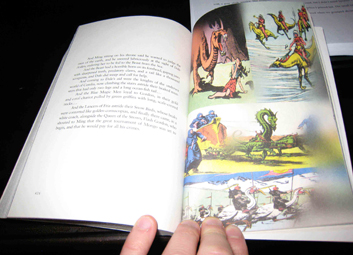
The division between life and books, whether comic or otherwise, breaks down toward the final pages, as heroes and villains from comic books (sometimes literally depicted, as shown in the image below) become symbols in Yambo’s struggle to regain the memory of the distant Lila. His banal schoolboy infatuation becomes the focus of the struggle that plays out against comic book characters, and he realizes that he has been searching for Lila for his entire life—she is the eternal feminine. I’m not sure that I buy this yearning; in a writer like Robertson Davies, it would be seen in retrospect as suspect or fleeting, as the feelings of David Staunton are, or those of Dunstan Ramsay with Diana. For Yambo, the memory is everything, but its pursuit through the perpetual obsession of symbols/people who define life grows tired, especially because Yambo does not recognize that he lets himself be defined by these ludicrous characters. The power of the comic book characters is not truly being able to fly and such, but in their ability to reflect the reader back, who, in this case, is Yambo, and he in turn reflects us.

Queen_Loana_Panel

All very clever, but also rather irritating, especially with the comic art depicting the struggle. Maybe my criticism is unfair, as I just read The Name of the Rose and it is not really fair to hold a regular novel, even a literary one, against a masterpiece. So I cannot blame Eco, as his early novel sets the bar too high for The Mysterious Flame of Queen Loana. Towards the end I also see how the blurbs chosen for The Mysterious Flame of Queen Loana’s jacket work: The Sunday Times writes that “As always with Eco, there is much to admire,” but perhaps some not to be admired, and the Observer writes that The Mysterious Flame of Queen Loana “confirms Eco as an outstanding writer of philosophy dressed fiction.” The dressing is too flimsy for the fiction section.

I also have to compare The Mysterious Flame of Queen Loana to Orhan Pamuk’s My Name is Red, as I read them back-to-back and both are obsessed with memory and meaning to an almost Proustian degree. I don’t recommend the two consecutively, and I ended up with them thanks to more bookstore oddities.

Both novels also implicitly ask how we know what we know. My Name is Red has characters who constantly refer to “common knowledge” that is anything but common and to whether they will be remembered; Shekure, the vain woman, says that “[…] Perhaps one day someone from a distant land will listen to this story of mine,” though later in the same paragraph she says, “If I happen to tell a lie or two from time to time, it’s so you don’t come to any false conclusions about me.” Marlowe of Heart of Darkness is a better liar and the amnesia of The Mysterious Flame of Queen Loana a better dissembler, but all three tell as much about telling tales as they do about the tale itself through the way they seek memory. But Heart of Darkness has something the other two lack: a strong, consistent narrative drive. My Name is Black doesn’t have one by its multiple-perspective design, which becomes disorienting, as though the reader needs to understand not just the murder or clues to the murder but who is speaking and giving the murder. It gave me a sense of vertigo I didn’t like, but My Name is Black also has the sense of a novel that will satisfy much more the second time around, like Faulkner. So try it and Heart of Darkness and The Name of the Rose, but let Loana remain mysterious.

One more link post

Book|Daddy has a great essay on the otherwise (mostly) silly debate about blogs, books, and criticism. You can see evidence of its percolating here and here. What caught me is this quote:

As Jessa Crispin of Bookslut said during the panel on literary criticism that book/daddy moderated at the Texas Book Fesival in Austin over the weekend, the major review outlets keep reviewing all of the same authors, and few of the kinds of books and authors she likes were getting attention, so she started writing about them on her website.

Seriously. Who is writing about Robertson Davies, and who is commenting on B.R. Myers? Somehow I’ve never found a demand that I read The Name of the Rose, a novel that encapsulates why I read in the first place: to be so blown away that it’s hard to discover where I should start writing. I linked to some of the other books that come close to that effect here.

Life

“Now I realized that not infrequently books speak of books: it is as if they spoke among themselves. In the light of this reflection, the library seemed all the more disturbing to me. It was then a place of long, centuries-old murmuring, an imperceptible dialogue between one parchment and another, a living thing, a receptacle of powers not to be ruled by a human mind, a treasure of secrets emanated by many minds, surviving the death of those who had produced them or had been their conveyors.”

—Umberto Eco, The Name of the Rose