Little Green Men — Christopher Buckley

Little Green Men not only holds up well, but might even improve with age and the stream of stories about lunatic politicians. The novel supposes that “alien” abductions are happening at the directive of a secret government agency named MJ-12. The rationale was originally to a) scare the Russians and b) inflate the defense budget, both of which seem so plausible that I wouldn’t be surprised if such a thing had or is taking place.

MJ-12 functions well enough that “Fifty years and more after the first UFO sightings, the vote was in: a full 80 percent of Americans believed that the government knew more about aliens than it was letting on.” Yet most serious thinkers dismiss aliens as a crackpot phenomenon. A computer program maintains this tension by abducting people unlikely to be believed; as a low-level bureaucrat named Scrubbs says, “the credibility algorithm seemed to have a bias toward overweight women. It would be nice if just every once in a while it picked, well, Claudia [Schiffer—who was then a desirable model] would be nice.” Once again, Buckley knows too much about government and the boredom so many government jobs entail, getting the details of tedium so right that I almost wonder if Little Green Men wouldn’t also be at home in a political science syllabus. Little details about Scrubbs, and the ridiculousness of the situation in general, provide the efficient comic combustion fueling the novel: it mocks both government, the media, and Washington D.C. at just the right levels.

Our friendly bureaucrat Scrubbs decides not to be as feckless as we suspected him to be, and he orders the abduction of a talk show host blowhard named John Banion not just once, but twice, causing Banion to make alien abduction his main topic, much to the ire of his sponsors, friends, and others, who respond with “Slammed doors, trenchant sarcasm, dripping scorn. He wondered if this was what the disciples went through.” Middle East peace and the Russia situation never seemed so simple.

Imagining himself as part of Jesus’ retinue is perfectly appropriate for a man whose ego has so long been inflated by punditry that he probably does imagine himself leading the sheep who are his audience. And yet at the same time, a series of byzantine turns causes him to get a much lower brow, higher rated show that, as one character observes, is more interesting anyway because his followers take action instead of pondering the universe over their morning coffee.

These followers might have some trouble with the intellect, however, as Banion’s messiah-like speech to them on the subject of government secrecy indicates:

People! [Banion says.] Do you know what we are?
Tell us! We want to know! What are we, anyway?
Mushrooms!
From the sea of perplexed looks, it was clear that Banion’s metaphor was not immediately apparent.
You know what you do with mushrooms, don’t you? Stick ’em in the dark! Feed ’em a lot of shit!
Ah! Yes, now we get it! It’s a metaphor!

A lower class but a larger volume: that’s Banion’s power. But his ability to change Washington itself is suspect; a presidential election following a NASA fiasco brings new faces to Washington who claim that they’ll crack down on influence peddling. One politico observes: “They all say that when they’re running. Then they get to town and see how it works and we all become best friends.” Banion steps outside the circle. What follows is hilarious because it’s both real and surreal, and things even stranger than fake UFO abductions happen in Washington when one departs the well-worn path. No wonder so few do.

Being Written — William Conescu

Being Written ought to be better than it is.

The idea is clever: someone is trying to go about his life aware that he’s being written as a character in a book. Some of the writing is clever, as when one character thinks “everyone at the table appears to Monty as if they’ve dressed for different occasions.” I’ve been to those parties. But other times the prosaic invades, as when we find, on the same page, that “pinstripes complement Natalie’s pale blue silk evening dress.” Is such an adjective train really necessary?

The novel bogs down. Quickly. The second person isn’t used as skillfully as it is in, say, Jay McInerney’s Bright Lights, Big City. Its self-consciousness becomes irritating, as when a chapter begins, “This doesn’t seem like the kind of book you’d want to read. There’s so much talk. You prefer books like the new Richard Corrone novel that you’ve set across the table from you as an incentive.” The truth is that Being Written does seem like the sort of book I’d want to read. But there’s too much blather about what it is to be a writer and tell story, with too little actual story.

Chapters alternate between different characters’ points of view and the second person “you” chapters, as if the writer is writing you. The former tend to be more successful but more boring and the latter more interesting but frustrating. He’s not the first writer with similar problems. About The Trick of It, Kate of Kate’s Book Blog wrote:

I found the premise of the novel irresistible: a young scholar meets and marries the novelist whose work is the primary focus of his academic career. This seemed to me a very clever way to explore the vexing interrelationship between fiction, biography, and literary criticism. And it was. But I’m not sure that the book ever transcended its premise to become something more than a clever idea.

That’s how I feel about Being Written, except I didn’t love the premise, which reminded me too much of 60s experimentation gone wrong, right down to the cover, which pictures a guy bent double with a pencil on his back. Yeah, I get the idea: we’re all in the process of being written by the stories of our lives even if we don’t necessarily hear the voice that the narrator does, but this doesn’t feel original even if I can’t immediately cite an obvious predecessor. Still, I did like it enough that I’ll keep an eye out for Conescu’s next novel, since this one shows promise, while many novels fail even that test.

Note: this novel was provided by its publisher.

Life: On learning

Gandalf: “I was talking aloud to myself. A habit of the old: they choose the wisest person present to speak to; the long explanations needed by the young are wearying.”

—J.R.R. Tolkien, The Two Towers

Fifteen books in fifteen minutes

Via Terry Teachout and CAAF: “The rules: Don’t take too long to think about it. Fifteen books you’ve read that will always stick with you. First fifteen you can recall in no more than fifteen minutes.

My list:

Robert Penn Warren’s All the King’s Men
Tolkien’s The Lord of the Rings
Neal Stephenson’s Cryptonomicon
Philip Zimbardo and John Boyd’s The Time Paradox
Elmore Leonard’s Get Shorty and Out of Sight (I count them as one book—so what?)
John Barth’s The Sot-Weed Factor
Rebecca Goldstein’s The Mind-Body Problem
Jane Jacobs’ The Death and Life of Great American Cities
Philip Pullman’s His Dark Materials Trilogy
Umberto Eco’s The Name of the Rose
Umberto Eco’s Foucault’s Pendulum
Robertson Davies’ The Deptford Trilogy
Robertson Davies’ The Cornish Trilogy
Alain de Botton’s On Love
Richard Russo’s Straight Man

(I purposefully didn’t read either Terry’s list or CAAF’s before writing mine. If I had to add a 16th, I’d probably take How to Think Like a Computer Scientist, which definitely doesn’t fit with the list above.)

Life: New Yorker edition

“… to emigrate is to become a foreigner in two places at once.”

—”Briefly Noted”, the New Yorker, 1 June 2009

Dune — Frank Herbert

Unlike, say, Ray Bradbury and or Dan Simmons’ novels, the Dune series is probably best appreciated before one’s literary taste has better developed. It still offers some treats like a plot that moves worlds, which begins with a deadly test that, even if we know Paul Muad’dib will pass, still offers immediate tension reminiscent of the later His Dark Materials trilogy.

Granted, some of the motives regarding moves and action don’t stand up to great scrutiny—why go to Arrakis in the first place, again?—but writing that isn’t actively abhorrent. Dune does some things really, really well—most notably its descriptions of cognitive states, which have the subtlety and nuance absent from the many, many moments when the book drops into characters’ mind to telegraph what they’re feeling instead of letting us infer it. Thufir Hawat, one of the many guards and weapons masters, thinks:

He might be at that, Hawat thought. That witch-mother of his is giving him the deep training, certainly. I wonder what her precious school thinks of that? Maybe that’s why they sent the old Proctor here—to whip our dear Lady Jessica into line.

Somehow we need to be immersed in the world and given information about it, but this seems a clumsy and transparent way of doing it—and it persists through the novel, and most of the time it conveys that we’re not smart enough to understand the characters without their little soliloquies. We’re constantly hearing about how “This must not get out of hand” even when the need is already obvious. The Harry Potter series is guilty of the same problem, as revealing too much about characters while simultaneously making them flat, stealing the mystery that might otherwise make us interesting. Hamlet’s soliloquies make him less scrutable and more real; Hawat and Paul’s have the opposite effect.

Perhaps not surprisingly, much of the dialog clangs, whether it’s within or spoken. Early on, we’re treated to standard fantasy/sci-fi pablum about independence and caring:

“The old woman’s voice softened. “Jessica, girl, I wish I could stand in your place and take your sufferings. But each of us must make her own path.”
“I know.”
“You’re as dear to me as any of my own daughters, but I cannot let that interfere with duty.”

We could be in a Marine barracks, or a royal court, or a foreign planet, or a softball game, or any number of other places. This extends to the characters. The villains are irredeemably evil and cruel, taking obvious delight in those traits like a child with an over-sized ice cream. They’re more laughable than anything else, but they never laugh at themselves—how could they and maintain their dignity?—but no one else laughs at them either.

The entire absence of laughter makes Dune harder to take than it might have been in the past. The poignancy of its lack is most notable when references appear, like this one: “Paul held himself apart from the humor, his attention focused on the projection and the question that filled his mind.” But Paul never becomes part of the humor, and neither does the reader. We’re too busy being bombarded with relentless seriousness and nobility, like a 15th Century morality play. Destiny is so important that one can ignore life. Honor and codes are everything.

We’ve taken that 15th Century attitude and brought it forward thousands of years; Paul kills a woman’s husband and is asked by one of the many Noble Savages on Arrakis, “Do you accept Harah as woman or servant?” Maybe one should ask her. Maybe she should read The Feminine Mystique and ask herself if she should submit to cultural imperatives making her property to whichever buck has the biggest horns. But it’s not her place to grow—not in this narrative, or at least not in a meaningful way, and we’re not supposed to feel for her: we’re with Paul Muad’dib and his seductive powers, which give Dune its chief pleasures as he overcomes obstacle after obstacle, both physical mental, the two forming a dialectical cycle that, once begun, will of course break all the rules, as we would like to.

The issues I raise aren’t new ones, and their basic contours were known long before Dune was published. Anatomy of Criticism, Northrop Frye writes:

It is… quite possible to take the alazon [which Frye says “means imposter, someone who pretends or tries to be something more than he is”] at his own valuation: this is done for instance by the creators of the inscrutable gloomy heroes in Gothic thrillers, with their wild or piercing eyes and their dark hints of interesting sins. The result as a rule is not tragedy so much as the kind of melodrama which may be defined as comedy without humor.

Alas, that’s Dune to the experienced reader: comedy without humor because the characters are too busy posturing to perceive their ridiculousness; they can’t see their own situation and so are affected by grandiose myopia. That seems common in descriptions of modern dictators as well; Mark Bowden’s Tales of the Tyrant describes Saddam Hussein as suffering from the same ailment. In Dune the heaviness of “dark hints of interesting sins,” or at least knowledge, is pervasive, though I didn’t have language in which to put the problem properly until I read Frye, giving better form to the ideas that had plagued me without resolution.

Although it’s unfair to say so, it seems that a great deal of fantasy has the humor problem, and for all its flaws one advantage of Harry Potter is that momentous prophecy is leavened with a sense of schoolyard folly. Lord of the Rings has Sam Gamgee and other hobbits to alleviate the gloom. Dune becomes ponderous by comparison, with characters’ religious roles of honor, death, need, and codes, as if the whole of 20th Century criticism and aesthetics hadn’t happened. This is, I suspect, the quality that science fiction and fantasy detractors point to when denigrating those two forms of literature, but just because the forms the genres tend to take are weak doesn’t mean the genres themselves have to be: their best practitioners avoid the Dune problems, or outgrow them. Some phrases, like the famous mantra that fear is the mind killer, have staying power.

Dune still has flair, but not the sense of inexhaustible possibility that a novel needs to endure over a lifetime or through generations. On re-reading it, the book feels exhausted, superseded, an artifact from an earlier age rather than a living story. I wish it were otherwise.

EDIT: See also this post on Dune and its laughable honor code.

T.C. Boyle — The Women

(Note: I posted along interview with Boyle about his new novel here.)

T.C. Boyle’s The Women begins towards the end, chronologically speaking, and yet it ends with a different kind of end in the form of a fire, which reminds one of the transience of all artistic endeavors. The novel’s structure is appropriate for such a wittily recursive work, in which diva-esque architect Frank Lloyd Wright is examined chiefly through the perspectives of the various women who attracted him (and vice-versa). Those women represent an evolution of his own being, but they never just function symbolically; even the throwaway characters have fabulously apt descriptions attached to them, as when the vindictive Miriam’s attorney is described as having “a low, considered voice, deeply intimate, as if he’d been born to collusion.”

The Women is “written” by the imaginary Wright apprentice Tadashi Sato, and the sophisticated but clear narrative structure could have long academic papers written about it. Tadashi’s his grandson, however, is Irish and has “translated” the book, meaning that Tadashi’s frequent footnotes sometimes deal with the translated aspects of the story, giving at least four levels of frame: from Wright to his wives and lovers to Tadashi to O’Flaherty-San. One need not notice these narrative games to enjoy the novel and its presentation of numerous reactions to the great and greatly narcissistic man at its core. Even calling him a narcissist might be unfair: he’s more a man obsessed by his art, and in that respect virtually everything else comes second or lower. Consequently, what seems like narcissism might simply be drive.

We see Tadashi’s influence in moments like this:

Of course, all this happened a very long time ago and I’m aware that it is peripheral to the task at hand, which is to give as full a portrait of Wrieto-san as I can, and I don’t wish to dwell on the negative, not at all. Suffice to say that I stayed on at Taliesin, grudgingly at first (and perhaps I should have defied Wrieto-San and Daisy’s father and all the rest of the world…).

That, anyway, is the line of reasoning that excuses his sometimes ill behaviors. A less forgiving reader might see him as taking “from the rich and [giving] to himself and he didn’t give a damn about anybody so long as he got what he wanted,” as Miriam thinks in one of her bitter stages. The same could apply to her, since she’s constantly belittling those she considers inferior—which is virtually everything. Miriam thinks of herself as “high, higher than any of them,” with little reason that’s apparent to us. Still, her charges are not utterly baseless despite her grandiose posturing, and the alternate view of Wright sees him using his abilities as a cloak against charges of making and breaking promises with impunity and discarding people like excess building material.

Building metaphors occur throughout The Women and make for an obvious commentary on the artistic process more generally, but Boyle is too canny a writer to make Wright’s “process,” if he has one, explicit. The New Yorker chastised him for this, saying “Unfortunately, the novel avoids any sustained consideration of Wright’s relationship to his art—a passion arguably more important in forming his genius than any of the women in his life were.” But I think that’s part of the novel’s point: an artist’s relationship to his art can’t really be explained or depicted. We can only see its effects, like a black hole whose presence we discern by the debris around it. The metaphor isn’t perfect, since artists throw off light while black holes absorb it, but in Wright’s case he might absorb the personalities of the women and disciples around him. The novel’s fundamental tension revolves around how Wright “really” is versus how he’s perceived, and the novel’s strength comes from leaving that tension unresolved: we’re left with a debate more than a resolution, as we so often are in life. That’s mimesis to the world and faithful to the view of the great artist as inexplicable.

Tadashi sometimes strikes an aggressive posture for a seemingly passive character, but all of his passion shows through passive aggressiveness—perhaps the act of “writing” a history of Frank Lloyd Wright that often doesn’t show him in a flattering light is his ultimate revenge, and one we are meant to see through as we proceed through the novel, and especially in its last pages. Tadashi also undermines some of the novel’s claims; Miriam, Wright and others ceaselessly vilify and try to use the press. At one point, Miriam thinks that, “The papers were full of the story, headlines trumpeting disaster, the least detail pried from the wreckage by the ghouls of the press…” This description might be one of the more charitable considerations of the press. One wonders if Wright would have thought of Boyle what he does of the press, but Boyle has the advantage of writing long after the fact, when a reinterpretation of a figure who slides perilously towards myth can, in turn, re-appropriate that figure for the present. Boyle succeeds in doing so with panache that fortunately defies my analytic descriptions.

April Links: EBooks, Zombies, Writing, and more

* Terry Teachout’s prescience regarding e-books deserves to be noted and commended, despite my reservations.

* Speaking of ebooks, Randall Monroe describes how to read a Kindle while in bed. Personally, I prefer to just hold my forearms up with a book in front of me.

* It’s hard for me not to like this description, from Amazon’s review page, of Pride and Prejudice and Zombies:

“It is a truth universally acknowledged that a zombie in possession of brains must be in want of more brains.” So begins Pride and Prejudice and Zombies, an expanded edition of the beloved Jane Austen novel featuring all-new scenes of bone-crunching zombie mayhem.

* Although I disagree with the conclusions in Life On Venus: Europe’s Last Man, I find it fascinating:

Precisely because novels are not, and should not be, political documents, they offer a less guarded, more intuitive report on the inner life of a society. And when novelists from different European countries, writing in different languages and very different styles, all seem to corroborate one another’s intuitions, it is at least fair to wonder whether a real cultural shift is under way.

Kirsch cites three major novelists—Ian McEwan, who is one of my favorites, W.G. Sebold, and Michel Houellebecq—as major examples of modern European-ness, and then looks at a book by each:

Three more different writers could hardly be invented. Which makes it all the more suggestive, I think, that their portraits of the spiritual state of contemporary Europe are so powerfully complementary. They show us a Europe that is cosmopolitan, affluent, and tolerant, enjoying all the material blessings that human beings have always struggled for, and that the Europeans of seventy years ago would have thought unattainable. Yet these three books are also haunted by intimations of belatedness and decline, by the fear that Europe has too much history behind it to thrive. They suggest currents of rage and despair coursing beneath the calm surface of society, occasionally erupting into violence. And they worry about what will happen when a Europe, gorged on historical good fortune, must defend itself against an envious and resentful world.

This, however, could also describe a great deal of science fiction since the 1970s, or any number of major American writers, who often take it upon themselves to demystify the American dream—and here I’m thinking of Philip Roth’s later novels, much of much of Melville, and so on.

(Once again, I found this somewhere on the web and forgot to write down the original linker. Sorry!)

* William Zinsser on On Writing Well, a book I often recommend to those interested in, well, writing well:

I would write from my own convictions—take ’em or leave ’em—and I would illustrate my points with passages by writers I admired. I would treat the English language spaciously, as a gift waiting for anyone to unwrap, not as a narrow universe of grammar and syntax. Above all, I would try to enjoy the trip and to convey that enjoyment to my readers.

(Hap tip to somewhere, but I forgot where. Sorry!)

On Writing Well is, along with James Wood’s How Fiction Works and Francine Prose’s How to Read Like a Writer, an important discovery in my own writing life. T.C. Boyle said you can’t teach writing, and maybe he’s right, but you can learn the principles that’ll make it easier to learn through experience and teaching yourself.

* Men, women, and reading:

A study of reading habits showed almost half of women are ‘page turners’ who finish a book soon after starting it compared to only 26 per cent of men.

The survey 2,000 adults also found those who take a long time to read books and only managed one or two a year were twice as likely to be male than female.

(For a really fun time, now debate whether this is cultural or biological.)

(Hat tip Marginal Revolution.)

* Although I’ve praised Amazon’s prices elsewhere, those prices come at, um, a price:

Is Amazon.co.uk targeting Britain’s indie publishers with an offer they have little choice but to accept? That’s what the trade group the Independent Publisher’s Guild is saying after a Friday meeting with Amazon in which the American internet retail giant refused to negotiate a new demand for greater discounts from the indies.

* Rouss Douthat on The Tough-On-Crime Trap.

* Regarding Literacy and Suicide, from Alan Jacobs:

Dr Andrej Maruai, a Slovene psychiatrist involved in organizing the conference, presented a paper called “Suicide in Europe: Genetics, Literacy and Poverty” which convincingly shows the links between the social factors of literacy and poverty, and suicidal behavior. . . .

According to Maruai’s theory, the higher any given country’s literacy rate and the lower that country’s GNP, the more likely the country is to have a high suicide rate. The theory can be convincingly applied to the countries with the highest suicide rates in Europe, namely the three Baltic states, Hungary and Slovenia, where literacy is at almost 100 percent and where the GNP and standard of living have been adversely affected by the transition process.

* I love this quote, provided courtesy of Daring Fireball: “My muse for the session was this quote from Walt Disney: “We don’t make movies to make money, we make money to make more movies.” To me, that’s it. That’s the thing.”

* Alexander McCall Smith writes “Lost in Fiction” for the WSJ, saying that

This, and many other similar experiences, has made me think about the whole issue of the novelist’s freedom — and responsibility. The conclusion that I am increasingly drawn to is that the world of fiction and the world of real flesh-and-blood people are not quite as separate as one might imagine. Writing is a moral act: What you write has a real effect on others, often to a rather surprising extent.

I don’t buy the moral act comment, or at least not in all cases (see additional comments here). As for Smith, he wrote “The No. 1 Ladies’ Detective Agency” books, of which I read, or, rather, tried to read the first two, and I quit because they were tremendously boring and kitschy. I wonder if his political views on fiction are part of the reason; later in the same article, Smith writes, “It is one of the jobs of fiction to report on the sorrows and tragedies of this world. This must be done, though, from a morally acceptable standpoint.” That line could require an entire essay to refute, but I would say rather than part of what a novel does is a) explore what is and b) explore what “morally acceptable” means, rather than reinforcing what is already considered by most of society as morally acceptable. And a novel doesn’t have to accomplish a) and b) at once, and it could accomplish neither and still be an excellent novel. I would argue that Lolita is such a novel.

* Megan McArdle asks, Whither GM? Notice this:

As GM moves through its forecast period, its cash needs associated with legacy liabilities grow, reaching approximately $6 billion per year in 2013 and 2014. To meet this cash outflow, GM needs to sell 900,000 additional cars per year, creating a difficult burden that leaves it fighting to maximize volume rather than return on investment.

This seems, if not impossible, then at least very close to it. Someone is going to write The Reckoning for this time period.

* Check this out: “The School Edition:”

One way to see the difference between schoolbooks and real books like Moby Dick is to examine different procedures which separate librarians, the custodians of real books, from schoolteachers, the custodians of schoolbooks. To begin with, libraries are usually comfortable, clean, and quiet. They are orderly places where you can actually read instead of just pretending to read.

[…]

Real books conform to the private curriculum of each author, not to the invisible curriculum of a corporate bureaucracy. Real books transport us to an inner realm of solitude and unmonitored mental reflection in a way schoolbooks and computer programs can’t. If they were not devoid of such capacity, they would jeopardize school routines devised to control behavior. Real books conform to the private curriculum of particular authors, not to the demands of bureaucracy.

* On The Radical Honesty Movement:

Once again, I felt the thrill of inappropriate candor. And I felt something else, too. The paradoxical joy of being free from choice. I had no choice but to tell the truth. I didn’t have to rack my brain figuring out how to hedge it, spin it, massage it.

“Just being honest,” I shrug. Nice touch, I decide; helps take the edge off. She’s got a thick skin. She’ll be okay. And I’ll tell you this: I’ll never get a damn gift certificate from her again.

* Alain de Botton: Brilliant or poseur? I tend towards “brilliant” with a dash of “neither.” But I think he speaks to modernity better than many other writers, and you can expect a post on his novel On Love shortly.

(Hat tip Mark Sarvas.)

* Although I haven’t actually read any of the novels mentioned in this paragraph, I’ve read about all of them prior to reading further about them in Slate’s thoughtful “Readin’ Dirty: Wetlands is the ‘2 Girls 1 Cup’ of novels.

Looking in the most obscure corner of the Grove/Atlantic library, you might notice that the publishing house has imported such hits as 100 Strokes of the Brush Before Bed, an “erotic coming-of-age novel” crafted by a Sicilian authoress of jailbait age; The Sexual Life of Catherine M., a French art critic’s Foucauldian analysis of having many trains pulled upon her; and Baise-Moi, a revenge thriller that is somewhat an odd duck in this subgenre as it boasts an actual plot. While studies have shown that every boat on the sea will be floated by something, even Helen’s grill tools, these books don’t rate as erotica; seldom does anything like an Anaïs Nin fever shiver through them, except perhaps Catherine M., which is kind of hot. On the whole, these books do not intend to arouse but to titillate, and, in this respect, Wetlands is the epitome of the form.

* The battle against barbarism continues, per “Video of girl’s flogging as Taliban hand out justice: Mobile phone movie shows that militant influence is spreading deeper into Pakistan” from The Guardian. The horrific video attached is difficult to watch.

* That battle isn’t just far away, either, since the Phoenix police raid[ed the] home of [a] blogger whose writing is highly critical of them. Apparently no one can find out any specifics regarding the alleged reason the police raided Miller’s house, as this Arizona Republic article shows.

Get Shorty and Out of Sight redux — Elmore Leonard

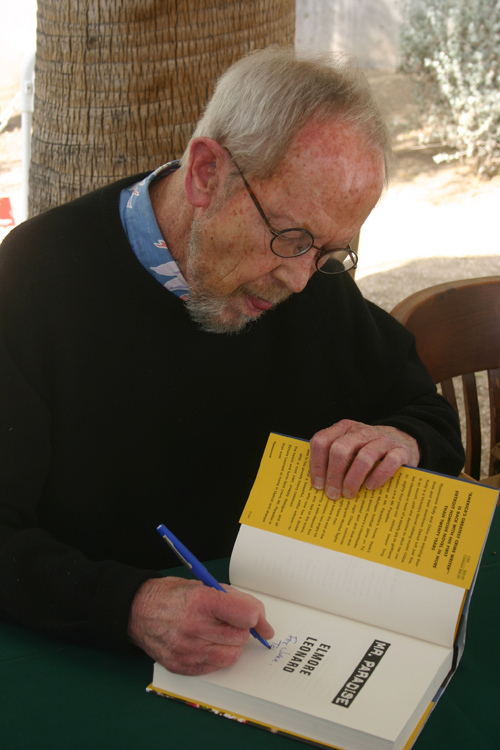
Two years and change ago I wrote a short post about Elmore Leonard, introducing him by asking “Why is Elmore Leonard so damn good when he’s at his best?” (the linked post has a long passage that’s still among my favorites for its verisimilitude in terms ofs form and content). I still have no answer, but seeing him at the Tucson Festival of Books inspired me to reread Out of Sight, Get Shorty, and Mr. Paradise. At boring panels when I couldn’t gracefully leave, the mass-market paperback edition of Out of Sight helped pass the time, but it’s not the sort of novel one can quit after 60 pages.

Leonard writes women with teeth, which numerous reviewers have noted; as Peter Wolf wrote in 1990, “Since Stick (1983), [Leonard’s] female characters have taken on a dimension rivaling that of his men; as a result, they generate more plot movement and spring more surprises than their earlier counterparts.” Describing just how Leonard does it might demand an entire academic paper; one of my favorite examples popped up in Out of Sight when Karen Sisco, the Marshall, says that, “Once you’re into it and you’re pumped up and you know who the guy is and you know you can’t give him one fucking inch . . . he has the choice, you don’t.” That might be as accurate a comment on human affairs as anyphilosophy book ever written. Or it might be empty pop commentary; another such moment happens when Sisco compares her bank robbing lover, Jack Foley, to Harry Dean Stanton in affect but not looks, saying that they were “both real guys who seemed tired of who they were, but couldn’t do anything about it.” One pleasure of the pulps is the blurred and indistinct line between the profound and silly, and one gets the impression that Leonard doesn’t care about the difference, if there is one.

The same kind of realism pervades Get Shorty. In describing Harry Zimm, Leonard says, “Forty-nine movies and [Harry] looked more like a guy drove a delivery truck or came to fix your air-conditioning when it quit, a guy with a tool kit.” Dropping the “who” and other connectors is a classic Leonard move; it looks ostentatious in a single sentence, as if the novel was poorly edited, but in the context one quickly adapts to the rhythms of speech. Martin Amis’ Money is the only other novel I can think of with so distinctive and vigorous a voice that also succeeds. And notice that description of Harry the movie guy: it’s so good because it’s accurate and tells us that many producer and production people are essentially technicians, and the skills they employ aren’t fundamentally different in deployment than the guy who fixes your car or Xerox. Leonard compresses into a sentence what Julie Salamon conveys without stating in all of The Devil’s Candy: The Bonfire of the Vanities Goes to Hollywood.

Harry is desperate and foolish; when he makes a mistake he’ll rationalize, as he does here after disobeying Chili Palmer’s advice regarding discretion:

“I had to,” Harry said, sounding pretty definite about it. “I’ve got a chance to put together a deal that’ll change my life, make me an overnight success after thirty years in the business. . . . But I need a half a million to get it started.”

In Chris Matthew’s wonderful nonfiction account/short story collection/political primer (the book has elements of all three) Hardball, he has an entire chapter called “Don’t talk unless it improves the silence.” Chili knows that. Harry doesn’t. And yet that quote conveys all of Harry’s greed, desperation and vanity all in one spot, and the link between Hollywood hustlers and drug/mob hustlers is so pervasive and intertwined with this novel that merely pointing it out is almost gratuitous. And yet the section is compelling because one always thinks of that big chance to change your life—what would you do to accomplish it? It’s an enduring question and reminds me of Scott Smith’s A Simple Plan, where the answer seems to stretch a little bit more with each passing act until the answer effectively becomes, “anything.”

Earlier I mentioned that Leonard probably wouldn’t care for elaborate discussion about the difference, if any, between genre and literary fiction. You almost hear his derision through one of his characters when Karen Flores, the woman consistently underestimated as the bimbo, says

I got the feeling the studio forced the script on her and she has to go with it. She said… [the story is] involving, reflective, has resonance, a certain texture—those are all story department words.

All of them are weak, empty synonyms for “I like it.” Why not just say that? Leonard would. Maybe that’s why he can write a novel that so effectively mocks Hollywood, feels some bizarre compulsion to dress its rationalizations—there’s that word again—in jargon to try and prevent people from seeing beneath them. Leonard doesn’t, and I think that’s part of the reason his female characters are so effective when they’re so often props in wiseguy novels: he writes them in with their own desires and hopes and goals, beyond mooning after the hero. They’re competent. So are many of his heroes: competent but flawed describes them well. His writing, on the other hand, is so competent that it transcends competence and becomes nearly flawless. I have a short list of writers whose new books I will buy almost automatically, and Leonard is on it for good reason.

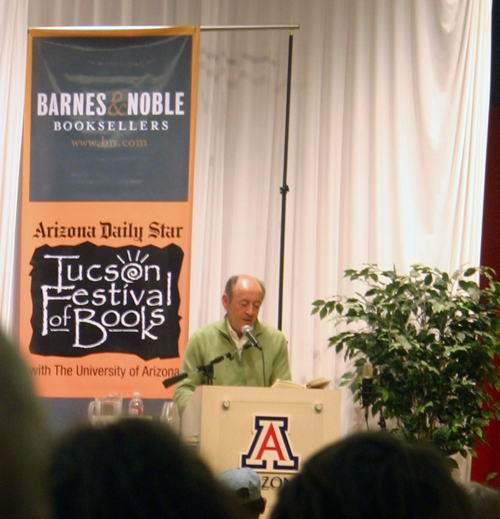
Billy Collins and Elmore Leonard at the Tucson Festival of Books

The Tucson Festival of Books began with a mystery friend—the designation is at the request of said friend—and I wandering the booths. Some monkish types tried to convince me to buy a copy of the Bhagavad Gita that I already had. We attended a nonfiction panel where one member spoke of the danger of “Not realizing the potential of the moment” and capturing “the spirit of the event” and asking “what is truth?” During the talk, I read the first 40 pages of Out of Sight.

The food tent came next, and with it most notably some excellent caramel corn:

caramel-corn2

A few hundred people heard Elmore Leonard, but the guy who interviewed him wasn’t particularly skillful (with questions about Westerns—Leonard hasn’t written them in decades—and ones that boil down to, “What writers have influenced you?” His answer, which I could’ve predicted, was The Friends of Eddie Coyle; see this post) and called Leonard a “man who needs no introduction.” Then why introduce him? Anyway, Leonard did say that he shifted from writing Westerns to “Easterns” and that Arizona highways in the 50s were filled with good stories that he used in his novels and stories.elmore_leonard_signing2

The novel he’s writing now is set on the East Coast of Africa, which is a greater stretch for Leonard than some previous novels because he doesn’t know how to relate to the story as well. But his forthcoming novel, Road Dogs, will be released in May and follows the more familiar teerritory Jack Foley of Out of Sight along with a few other characters from books I haven’t read. Expect to read more about Road Dogs in this space.

Leonard’s best response came from a question about his characters’ morality or lack thereof, when Leonard said “I have a kind feeling of all my characters… I like my characters, but I think most of them are just dumb.” He’s also difficult to imitate because “you have to imitate the emotions behind them,” which too many people seem to discount. An audience member asked about redemption and Leonard answered about money; he also repeated the advice he’s given to directors of movies based on his books: When someone delivers a funny line that’s not intentionally funny, don’t cut to someone laughing. To Leonard, that’s part of what ruined the movie version of Be Cool, which is better as a book.

The last speaker on Saturday, Billy Collins was a quiet riot, knowing that the better part of jokes often consists of holding back and the better part of delivery consists of practice. His reading was like a big-deal boxing match, with a few palookas warming up the crowd before the main card that served chiefly to highlight Collins’ skill. He took Leonard’s advice by not smiling as he said, “If it’s wrong to be writing to a reader, I don’t want to be right.” Next month is apparently national poetry month, and Collins said, “If you name a day or a week or a month after something, you know it’s in decline.” There is no national TV week.

His poems were wonderful; in “Tension,” one got the impression that Collins is a rule-breaker of the best sort. He’s wry and self-aware, as in “The Trouble with Poetry:”

the trouble with poetry is
that it encourages the writing of more poetry,

[…]

And how will it ever end?
unless the day finally arrives
when we have compared everything in the world
to everything else in the world

and there is nothing left to do
but quietly close our notebooks
and sit with our hands folded on our desks

He’s contributing to the proliferation of poetry, so it’s obviously not so great a problem, and yet the poem shifts into a brief comment on life, when he mentions a book that “I carried in a side pocket of my uniform / up and down the treacherous halls of high school,” implying that perhaps poetry helped him to become a poetic thief and thus to encourage “the writing of more poetry.”billy_collins2

The tongue-in-cheek aspect continued through Collins’ poems; he read one called “On Turning Ten” that he said he wrote because he “wanted to make fun of poets who write midlife crisis death poems.” So there’s an elegy to all that’s lost upon attaining one’s tenth year. In “The Lanyard,” looking up the word “lanyard” in a dictionary functions as a “cookie nibbled by a French novelist.” The poem compares a child making a lanyard for his mother in payment for all she’s done:

She gave me life and milk from her breasts,
and I gave her a lanyard.
SHe nursed me in many a sickroom,
lifted teaspoons of medicine to my lips,
set cold face-cloths on my forehead,
and then led me out into the airy light
and taught me to walk and swim,
and I, in turn, presented her with lanyard.
Here are thousands of meals, she said,
and here is clothing and a good education.
And here is your lanyard, I replied,
which I made with a little help from a counselor.

The mock conceit reminds one of the disparity that must exist between most parents and their children, which can only be repaid by passing it on. But for Collins, the issue isn’t a heavy burden, or if it is, it should be addressed lightly, in a poem like “The Lanyard” that is aware of its own absurdity and therefore becomes more real in exchange of “thousands of meals” for a lanyard, “which I made with a little help from a counselor.”

I wish Collins’ attitude had been shared by the nonfiction panel. Alas: we can’t all be so reasonable.

If nothing else, being induced to read Collins made the Festival worthwhile. Hopefully I learned something and, to paraphrase something its participants said, this post captures the spirit of the event.