“In the war of attrition which raged ceaselessly against the human spirit, anti-climax was a heavy weapon.”
—Evelyn Waugh, Officers and Gentlemen
“In the war of attrition which raged ceaselessly against the human spirit, anti-climax was a heavy weapon.”
—Evelyn Waugh, Officers and Gentlemen
Michael Chabon opines on Richard Price in the New York Review of Books. As usual regarding that publication, the essay is too long and digressive, but it’s worth reading anyway. A sample:
Lush Life is a good, worthwhile, and in many ways satisfying novel. No matter how routinely and highly praised it may be, Price’s ear for dialogue, his ability to capture and reproduce the rhythm, tone, and evanescent vocabulary of urban life, cannot be overpraised: with all due respect to Elmore Leonard, Price is our best, one of the best writers of dialogue in the history of American literature. Resorting with miraculous infrequency to the use of dialect spellings and other orthographical tricks, Price gets his characters’ words to convey subtle nuances of class, occupation, education, even geographical gradations of neighborhood, while also using them as a powerful vehicle for the transmission, in fits and starts, evasions and doublings back, of their interior lives. He is a perfect magpie for slang, and like its predecessors this novel is rich in fascinating bits of law-enforcement and street-criminal argot.
I’m on the record praising Lush Life. I still hold that Leonard is the better dialog writer, however, although Chabon’s position is entirely defensible. And I also hold that you don’t need to spell “dialog,” “dialogue.”
I’m finally back from Vermont and Massachusetts and in shape to work again: Alaska Airlines cancelled my Wednesday flight and left me stuck in a Boston hotel Till Thursday. The good news, however, is that I found Mark Sarvas‘ Harry, Revised:
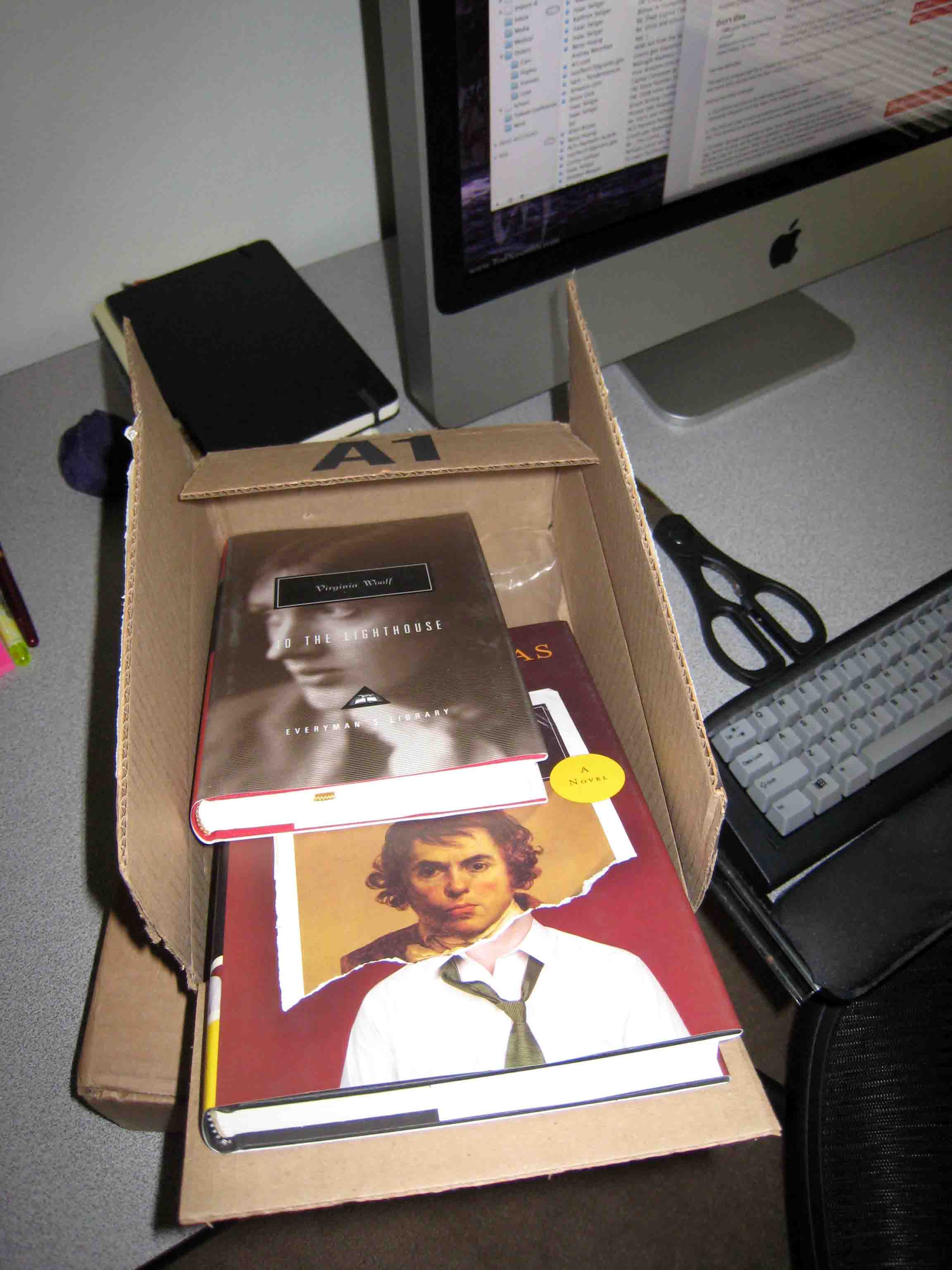
He’ll be in Seattle on May 8 at the University Bookstore—7:00 p.m. Expect to see us there!
EDIT: I wrote a full review of Harry, Revised here.
Richard Price’s Lush Life is a study in power—who has it, who doesn’t, who is trying to get it—and dignity, which, sooner or later, almost every character loses. Those who have power and dignity in one sphere, as detective Matty Clark mostly does in the police world, lose it in another, as Matty does at home. He is uncomfortably close to a stock genre detective, but the lush language of Lush Life gives Matty others such life that they are people, and people who reflect their social and media environment.
Lush Life begins not with a murder but with the “Quality of Life Task Force,” a group of four white cops who are lowering, not raising, the quality of life. The idiotic speculation of one is juxtaposed with an image representing one of the book’s central concerns:
“Who the fuck puts a Howard Johnson’s down here?” Scharf gestures to the seedy-looking chain hotel, its neighbors an ancient knishery and a Seventh-Day Adventist church whose aluminum cross is superimposed over a stone-carved Star of David. “What was the thinking behind that.”
Groups overlap in Price’s Lower East Side, with the influence of the earlier group never fully erased, just as the Star of David is still faintly visible. People linger, which Price spoke about when he visited Seattle in March, saying that there are “six groups of people who don’t realize they’re not there anymore.” Moreover, as he says, “nobody knows anybody, nobody sees anything,” especially relating to crime, which leads to the perceived necessity of the Quality of Life Task Force and the real necessity of detectives like Matty.
The intersection of two particular groups leads murder, one group being the relatively wealthy suburban kids—I think of them as kids though one, Eric Cash, is a 35 waiter and would-be screenwriter—who move back to the areas their grant parents fled and provide the victim. The other group is the poor urban kids who might have provided the perpetrators. None come off well. Nor do their parents, who range from uninterested in actively hostile. The murder of Isaac Marcus, for example, inspires his divorced parents to shack up again in a hotel, and when Matty arrives afterward and opens a curtain, “both of them staring at him with the unself-consciousness of animals, with unblinking pie-eyed shock.” But are they in shock at the light, Matty, themselves, or the situation? I’m not sure, which is part of the novel’s beauty.
Ambiguity is everywhere, as characters hope and dream of higher places. Eric is a friend, loosely defined, of Isaac Marcus, his desire to get into the movies is a much lighter version of Sean Touhey from Clockers. Lush Life in general is a better, subtler, richer version of Clockers, which is a tremendous compliment, for Clockers itself is a strong novel. But Lush Life goes beyond it, artistically and socially. Where Clockers is all cops and robbers, Lush Life encompasses everyone from the rich kids and the nominally upper echelons of society to the street dregs. It captures the former better than, say, Claire Messud’s good if indulgent The Emperor’s Children, which also focuses on them, and the latter with the skill Price has already established. You see a fantastic collision on page 92, when Eric tries to describe his work, of which he is vaguely ashamed, especially in the face of the skeptical cops. And with good reason: Matty belittles him, the scene is so effective I a) hesitate to quote it and yet b) want to so badly*. The scene works so well because you know Matty’s description is what Eric thinks of himself if he’s being intellectually honest.
To the extent there are novelistic rules about plot, characterization, movement, motion, and the like, I don’t think Price breaks them—he simply wields novelistic conventions better than almost anyone else and uses his talent on language itself. One dangerous thing about writing a long post and then leaving it till much later for proofreading is that you never know when James Wood is going to come along and preempt you. But his discussion of Price’s dialog is worth reading, and I note that he also found the excruciating interrogation scene and quoted the same scene. Wood focuses on the dialog, but the brilliant descriptions and contrasts also help:
Despite its stark opulence, the place was the size of a shoe box, with barely a foot clearance between that huge bed and the three-sided terrace, which offered an imperial overview of the area: a sea of cramped and huddled walk-ups and century-old elementary schools, the only structures out there aspiring to any kind of height the randomly sprouting bright yellow Tyvek-wrapped multistory add-ons, and farther out, superimposed against the river, the housing projects and union-built co-ops that flanked the east side of this grubby vista like siege towers.
All that in one endlessly rolling sentence: by the time you’re at the end, you’ve forgiven him for using the shoebox cliché. Notice the missing verb between “height” and “the:” but it’s okay, the verb would only interrupt the flow of the speech, and I hadn’t realized its absence until after I quoted it here. The sentence tells you how the landscape reflects the people, with the age of it providing a backdrop of substance in lives that often seem to lack it.
Imperfections in Lush Lifeare minor: Tristan is flat, which is perhaps appropriate given his youth and the cruel environment in which he lives. Some allusions are improbable; would Eric or the third-person narrator mention the dancing of Tevye? Maybe, but despite Eric being Jewish I’m skeptical. Two pages later, though, and Price is hitting the high notes again, hiding and eliding and showing: “Seated with Minette on the front steps of the now deserted Langenshield, Matty went through the motions of rattling off a cursory progress report, omitting, of course, the continuing press gag, the scuttled seventh-day recanvass, and the unreturned phone calls.” We get a picture of the bureaucracy, are reminded of the plot, and learn about Matty in his role of cop in one swift, seamless recap; a page later, Matty’s lack of enthusiasm about his children is obvious: “He said, ‘Yeah,’ but Minette read the tell, searched his eyes for what he wasn’t saying.” As previously mentioned, Matty does fit the template of emotionally wounded but dedicated cop too well, just as his sidekick, Yolanda, is too close a fit to the wisecracking assistant, but these are things only recognized afterwards, as I discovered that the characters lead lives of what appear to be squalor from the outside. But Lush Life gives the sense that maybe their lives are redeemed by moments of happiness or small success. As the conflicts between cultural and social classes, law and desire, and power and language play out, Lush Life brought me along like a literary but streetsmart guide. I mentioned how few novels have moved me recently, and it’s a pleasure to find one that does so with such panache and skill.
The crowd at his reading, or at least the verbal part of it, seemed less interested in discussing the novel itself and the aforementioned panache and skill than the Lower East Side. A number of older transported New Yorkers came to talk, apparently, about geography and places.
But Price talked about ideas, too—about the residents who don’t want to complain too much because they’re immigrants, the families who came to the Lower East Side as immigrants and fled as soon as possible, and the ones now going back because of the real estate costs elsewhere in New York. One thing Price avoids is The Wonderful Past, as he said the Lower East Side “has always been a hellhole,” and sentimentality about it is only useful for the preservationists and such. One ironic point Price made is that a tenement museum exists not far from actual tenements, which I can believe.
I asked about the connection between Tom Wolfe, whose The Bonfire of the Vanities bears many similarities to Lush Life, and his own work. Price thought I referred to “Stalking the Billion-footed Beast” as mentioned here, but I said I meant that or Wolfe’s fiction. Price said it wasn’t explicitly on his mind but that Tom Wolfe had a point with his essay, and that there’s a whole world out there and you’re not obligated to make yourself its center. Instead of searching one’s interior, Price said “you can find yourself by getting lost,” and that’s been doing so for 15 years by following his gut wherever it takes him.
I got the impression that Price doesn’t really like Wolfe but respects him; in Lush Life, Price is a more consciously literary version of Elmore Leonard, which is a very good thing. Regardless of literary influences, however, Price has written as good a book as I’ve read recently and one that will, I imagine, prove even more resilient than Clockers.
* Okay, I can’t resist, but you’ve been warned that I recommend you skip it so the passage blows you away in the context. Matty tells Eric: “I have listened to your shit in here all day. You are a self-centered, self-pitying, cowardly, envious, resentful, failed-ass career waiter. That’s your everyday jacket. Now, add to that a gun and a gutful of vodka? I don’t believe that shooting last night was an accident. I think you were a walking time bomb and last night you finally went off.”
“The Past was tied to him like a tin can to a cat’s tail, and even the smallest effort he made to advance produced a shaming din behind him.”
—John Banville writing as Benjamin Black, The Silver Swan
One good link deserves another: I mentioned a Cynthia Crossen column in my post on The Red Leather Diary. A few weeks ago, however, she wrote about the binary views John Kennedy Toole’s A Confederacy of Dunces inspires:
I managed to get through 100 pages before I let myself off for time served. My sides didn’t split, my belly didn’t ache, my eyes didn’t water. With its wooden dialogue, one-ply characters and a plot as twisty as a clothesline, “A Confederacy of Dunces” left me wondering who were the dunces on the Pulitzer jury in 1981.
Some readers had predicted I might not appreciate Mr. Toole’s humor. James Mosrie of West Palm Beach, Fla., wrote, “In my experience, people either love or hate this book. I can never quite gauge what reaction they will have because I’ve known people of so many varying types and tastes be so extreme with their views on the book.”
Another reader wrote, “This may be the most polarizing book of all time. I know approximately 15 people (counting you) who have read it. Without exception, the book has either (a) immediately entered the reader’s “top-five all-time” list or (b) so turned off the reader that they couldn’t finish it. For whatever reason, there is no middle ground with this book.”
I’m in category (b): I tried to read A Confederacy of Dunces, saw nothing redeeming, and couldn’t finish it. Like Crossen and Terry Teachout, however, I wish funny books got more literary respect, especially because some of my favorite novels include Richard Russo’s Straight Man, Rebecca Goldstein’s The Mind-Body Problem, Elaine Dundy’s The Dud Avocado, and Kingley Amis’ Lucky Jim. Only one of those makes it on Crossen’s list of recommended funny books, which appears at the bottom of her column.
Charles Bock was more fun to hear speak than to read; alas, I began Beautiful Children with anticipation that went unfulfilled. Problems manifested early: descriptions of video games modeled on Doom sounded vaguely off, and I’ve never seen “hard drives the size of mini-fridges.” Yet I could ignore linguistic problems when I find also find a perfect description of many would-be artists: “He had aspirations to nothing less than the creation of sensitive, artistic, emotionally honest pictures that, just maybe, would get him laid.” In another section, evocations of common ground seem strained, as when the father of lost boy Newell Ewing says that “He got […] trapped in another Politics of Marriage Conversation.” Status is everywhere in Beautiful Children, but more often stated than shown, or shown via consumption. But whenever I was about to stop reading, I’d find something like this:
Propped up against the base of the casino wall like an abandoned doll, the body was bulky in places, but still frail enough to look as if it might be carried along by a good wind. Electricity glossed over its mess of hair—kinked and matted strands of indistinct, artificial colors, clumped in all directions.
Er: it’s almost right, but “electricity” feels wrong because it’s not electricity but electric light that illuminates hair. This is a microcosm of Beautiful Children: it feels like it should be more right than it is. Clichés distract—someone “was bleeding like a stuck pig” and elsewhere a stripper named Cheri goes on “about character arcs and emotional journeys until the friggin’ cows came home.” Perhaps this is how the character would think, but the problem of how banal, uneducated characters think and speak versus the literary needs of the author is never really resolved*. If teenagers sound like teenagers they’re often boring or vapid; if they sound like adults, they don’t sound real. If there is a satisfactory solution to this problem, it is not obvious in Beautiful Children; in other novels it involves a “precocious” or abnormally literary narrator. Instead, Beautiful Children opts for long transcriptions of teenage argot that eventually had me flipping pages in a quest for substance. It was hard enough to find when a character thinks, “You cannot possibly fathom an end to your observations about the status of your physical decline, a final finality. Such things are beyond you, as they are beyond anyone; and yet the evidence permeates your days, unavoidably present, oozing from the southwestern decor of a master bedroom […]” I can’t see Robertson Davies going into such despair. Perhaps John Banville would, but much more artfully.
Banville and Davies, however, wrote many novels over the course of their careers, and, at least in Davies’ case, his early novels were not as masterful as his later ones. Beautiful Children is a first novel that Bock says took 11 years to write and, presumably, publish, and I can’t help but thinking he would’ve been better served to finish it or have otherwise built his skills elsewhere. Beautiful Children is not a bad novel and perhaps it is even good, but not 11 years good. It has an admirable range of cultural references, from Blake to The Outsiders (a “young adult” novel assigned to me in middle school) to visual media detritus. Like Richard Price’s Ladies’ Man, Beautiful Children heralds better things to come. Now that Price comes to mind, Lush Life covers ground not dissimilar from Beautiful Children and does it better. And he wrote it in four years. Bock said Beautiful Childrentook so long because it was an “ambitious book, and I just didn’t know what I was doing for a lot of it.” Many novels gestate for a long time, and he rattled some off: Catch-22 stayed with me, but there were many others. Alas, I don’t think Beautiful Children will have the lasting power of Catch-22 or Carson McCullers’ The Heart is a Lonely Hunter, another superb first novel. And in those novels, I doubt anything is “unceremoniously rejected,” as something is at the beginning of 3.3 in Beautiful Children.
Bock seems to have better novels in him; in Seattle, he said, “[Beautiful Children is] a dark book, but I believe the darkness is there to illuminate some of the wonderful parts of humanity […] also, I think there’s some pretty good jokes in there too.” There are, and he was wonderfully candid when someone asked why the dialog seemed so good and, by implication, authentic: “I have no idea.” Although he elaborated, I suspect the real truth came first. Still, I’m not sure I agree with the premise of the question: sometimes the dialog clicked and sometimes not, like much of the rest of the novel.
In another answer, Bock said he used Ponyboy because he’s an “iconic young adult character” and that he intentionally “recycles—Vegas is a place where they fake the Eiffel Tower and the great monuments of the world and turn them into casinos.” There is “no end to the uses of pop culture,” though he tries not to name drop. The recycling theme is heavy in Beautiful Children and perhaps a topic for some future graduate student. Today, someone looking for pleasure and depth could do worse than Beautiful Children—but they could do better. In “Books Briefly Noted,” the New Yorker has its own take on the novel’s problems, starting with praise and then moving to: “Yet [Beautiful Children] doesn’t quite achieve its intended emotional resonance; there is too much shaky dialogue and improbable Vegas kitsch (breast implants with candle-wax-filled nipples, for a pyrotechnic striptease), and the boy at the center of the plot is thinly drawn and so obnoxious that his disappearance is not unwelcome.” I read “Books Briefly Noted” after writing the first draft of this post, and realized that I structure my commentary the same way the New Yorker did its.
* The best description of I’ve read of this issue comes from James Wood’s How Fiction Works.
The Book of Ebenezer Le Page is the kid you didn’t really want to befriend in middle school but liked well enough as a harmless oddity. The novel is a long account of Ebenezer Le Page’s life , a resident on Guernsey, a Channel Island. Le Page’s glory days, such as they are, occur mostly in the first half of the twentieth century and come slightly before the author’s, as G.B. Edwards died in 1976 with his only novel unpublished. This edition comes from The New York Review of Books, which appears to be using the story as part of the novel’s appeal.
Le Page is an insular man with some folk wisdom; he notes that “I have never known the rights and the wrongs [of some Guernsey residents…] That’s the trouble of trying to write the true story of my relations; or of myself, for that matter.” On the page opposite, he is merely strange: “I like my two china dogs. When I write down anything wicked, one of them look very serious; but the other one, he wink.” This lack of pluralization is apparently an example of the Guernsey patois, and it becomes comprehensible and even normal over the course of the novel. As for the china dogs, their symbolic appeal is obvious, though whether the narrator understands is not.
Among these bursts of ideas, however, are along recitations of occurrences on Guernsey. They become tedious as we learn about the couplings (mostly in marriage) and uncouplings (mostly not) of the people of Guernsey, and the results of this action. But I could never come to care about either, and to me the land itself and how it shaped the people seemed more interesting than its inhabitants. Oddly enough, I saw Guernsey mentioned in The Wall Street Journal not long after finishing the novel:
Though it’s registered in Guernsey, U.K., and trades in Amsterdam, Carlyle Group runs Carlyle Capital out of its New York offices. Early Thursday in Amsterdam, the shares plunged 70% to $0.83 each. The stock has lost around 83% since the company first disclosed its funding problems last week.
These would be the financial types Le Page rails against for changing his island from a rural, inward focused area to a hot tourist and financier destination. Guernsey’s former dialect seems to have been absorbed into general English and French since the events of the novel, and the destruction of its linguistic character seems unfortunate if inevitable. But maybe it will also reduce some of the smug satisfaction of residents like le Page, who learns he can’t sell his gold easily because of restrictions placed by Britain. In response, he says: “‘The balance of Credit? […] I haven’t the vaguest idea what that mean; but I do know whoever it was made that law are a lot of rogues and vagabonds! I worked for every penny of those sovereigns!’ I was real angry.” Maybe so, but even justified ignorance is seldom attractive, it should also be noted that the dropped words are in the original. On the same day, le Page says: “I slept like a log and woke up late.” The somewhat pleasing alliteration is not enough to make up for the cliche. It’s one I don’t think I’d see in Robertson Davies, who is an obvious comparison to Edwards in content and, to a lesser extent, style. In content the two share an interest in the rural and somewhat isolated products of Britain. But Davies became the better writer, though his Salterton Trilogy was weaker than much of his later work. Had Edwards produced later works, he might have shown the same upward trajectory, but we are left with an original novel that makes me wish it had led to second, third, and fourth novels that rendered this one a footnote in Edwards’ career.
Richard Price will be at Elliott Bay Books on Friday, March 21 at 7:30; he’s the author of Clockers, which I haven’t read but the National Book Critics Circle loves, Ladies’ Man, which I read but didn’t love, and, most recently, Lush Life, which I plan to read and the New York Times loves.
Joshua Ferris will also be at Elliott Bay, but on Monday, March 24 at 7:30; he wrote Then We Came to the End.
Barring disaster, I’ll be at both.
John Fowles’ The Magus is one-third to half again as long as it should be; that it is among the most uneven novels I’ve read is, I think, a consequent of length. At places its greatness nearly overwhelms, while in others melodramatic banality utterly underwhelms. I think the latter is a symptom of length and the necessity of having numerous reversals of character psychology. Each time we think the narrator, Nicholas, has uncovered the truth of the characters’ interactions, yet another layer emerges. Over time this became tedious, as declarations of love were made—again—only to have me glance at the thick stack of pages remaining and know without even needing to guess that the would-be lovers are not about to sail off the Greek island, back to England, and embark on raising two kids in the suburbs. Incidentally, this problem does argue well for something like the Kindle if for no other reason than not having a page count might maintain suspense, especially because so many sections in The Magus felt like they heralded “The End” only to have the marathon continue to the point of punishment.
The Magus begins with the end of a love affair between Nicholas and Alison, which coincides with a strange offer for Nicholas to teach at a boys’ school on a Greek remote island. The offer is taken and the affair ends, or perhaps the other way around, as it’s hard to track the order of events in a novel where so much and so little happens. Causes and effects become entangled somewhere towards the middle, when you lose track of what’s known and what isn’t and who has declared love and retracted it and who will again. Much of this is intentional: Nicholas takes the job and is entreated by a strange man who would be named Prospero if the Shakespeare allusion weren’t too obvious. Instead his name is Conchis, and he runs a game/theater on Phraxos, which appears to be a fictional island. I’m willing to roll with the premise, though I’ve yet to run into a megalomaniacal rich person who wants to play twisted emotional games with real people, which should be relatively easy given Seattle’s proximity to Microsoft. But I’ll assume that such people exist and that they have enough manipulation for 656 pages.
Like Nicholas, I kept getting caught on an unseen bramble when I came to passages like “The old man had surrendered” (359) or “‘It’s how you made me feel'” (363), only to know that all wasn’t well because of aforementioned stack of 300 pages left. All that is after a woman declares, “‘I don’t know what I feel, Nicholas. Except that I want you to feel like that'” (355). Ah, yes: the hardest travel of all is to the heart, but The Magus is a travel novel for what happens to its characters and because it would be an excellent companion—it’s fairly compact but very long and would be marvelous in exotic places like the ones it describes. In addition, you would have some opportunity to forget or forgive the more ridiculous passages and savor the meatier ones. The melodrama wouldn’t gall as much, and the overly cute bits could be taken with the seriousness they appear to shoot for. The Magus is clever but takes too many pains to be clever: I understand the commentary it makes implicitly and explicitly about the shimmering, leaping, uncertain border between life and art, but I just wish it weren’t so damn annoying about it. And that the characters would just get it on or break it off already.
Finally, on a personal note, the oddest thing about The Magus for me was the eerie resonance some passages had with some of the writing I’ve been working on. Especially in first third of The Magus, I kept having to shake off the bizarre feeling of being preceded by an author I’d never read and knew little about. And yet my novel is done, and so to find aspects of it in The Magus unsettles. But I do think I avoided many of its pitfalls and kept some of the qualities that made The Magus delightful.

 The Story's Story