Thoughts on J. J. Abrams’ movie Super 8

1) It’s surprisingly good. I say “surprisingly” because most heavily advertised summer blockbusters are terrible. See it in the theater if you can, ideally on an IMAX screen. I did.

2) The movie is very good at conveying a lot in a small space—the cluttered domestic scenes set up family tension. Details proliferate at the edge of the movie. Watch for video cameras and film-related objects.

3) I identify with the fat kid because he’s the artist. He’s not the hero and doesn’t get the girl. When mysterious things begin happening, he’s the one who still cares most about getting the shot. Good for him. Intense focus on “production values!” (his rallying cry) never hurts.

4) Like Umberto Eco’s The Name of the Rose, this text speaks to other texts. For some reason, I always love the scenes where animals run away while doofus humans tarry. Someone says, “You heard what old man Woodward said,” as if the movie was a Scooby Do variant.

5) Super 8 feels like one the 12-year-old Abrams would’ve liked to make, if he’d had the skill; now he does. It’s nice to see adolescent dreams rise.

6) Ignore the plot holes and implausibilities, which are numerous.

7) Anything that disrupts electricity and electrical devices is scary. If you’re writing a novel with any kind of supernatural element, remember this. We’re still afraid of the dark, and we’re dependent on an electrical grid few of us understand.

8) Embrace the impetus to explore.

9) This is a kids’ movie primarily because there weren’t real consequences; I will leave that statement ambiguous for those who haven’t seen the movie.

EDIT: Even if you don’t normally read the comments, see those left by Jason Fisher.

Missing the point with Guy Ritchie’s Sherlock Holmes — like Rambo with poetry

My Dad watched the latest version of Sherlock Holmes (the one with Robert Downey Jr. in it) and observed that Guy Ritchie missed the whole point of the novels: Holmes doesn’t solve crimes by kicking ass; he solves them by being smarter than everyone else and noticing things. Holmes is fundamentally cerebral, which made and makes him different. My Dad’s observation: it’s like having Rambo recite poetry. The change completely defeats the point of the character.

The IMDB blurb says, “Detective Sherlock Holmes and his stalwart partner Watson engage in a battle of wits and brawn with a nemesis whose plot is a threat to all of England” (emphasis added). When the brawn outweighs the wits, you’ve done something fundamentally wrong.

Missing the point with Guy Ritchie's Sherlock Holmes — like Rambo with poetry

My Dad watched the latest version of Sherlock Holmes (the one with Robert Downey Jr. in it) and observed that Guy Ritchie missed the whole point of the novels: Holmes doesn’t solve crimes by kicking ass; he solves them by being smarter than everyone else and noticing things. Holmes is fundamentally cerebral, which made and makes him different. My Dad’s observation: it’s like having Rambo recite poetry. The change completely defeats the point of the character.

The IMDB blurb says, “Detective Sherlock Holmes and his stalwart partner Watson engage in a battle of wits and brawn with a nemesis whose plot is a threat to all of England” (emphasis added). When the brawn outweighs the wits, you’ve done something fundamentally wrong.

If I were a movie studio, I’d make streaming a priority — based on a recent experience with Assholes Finish First

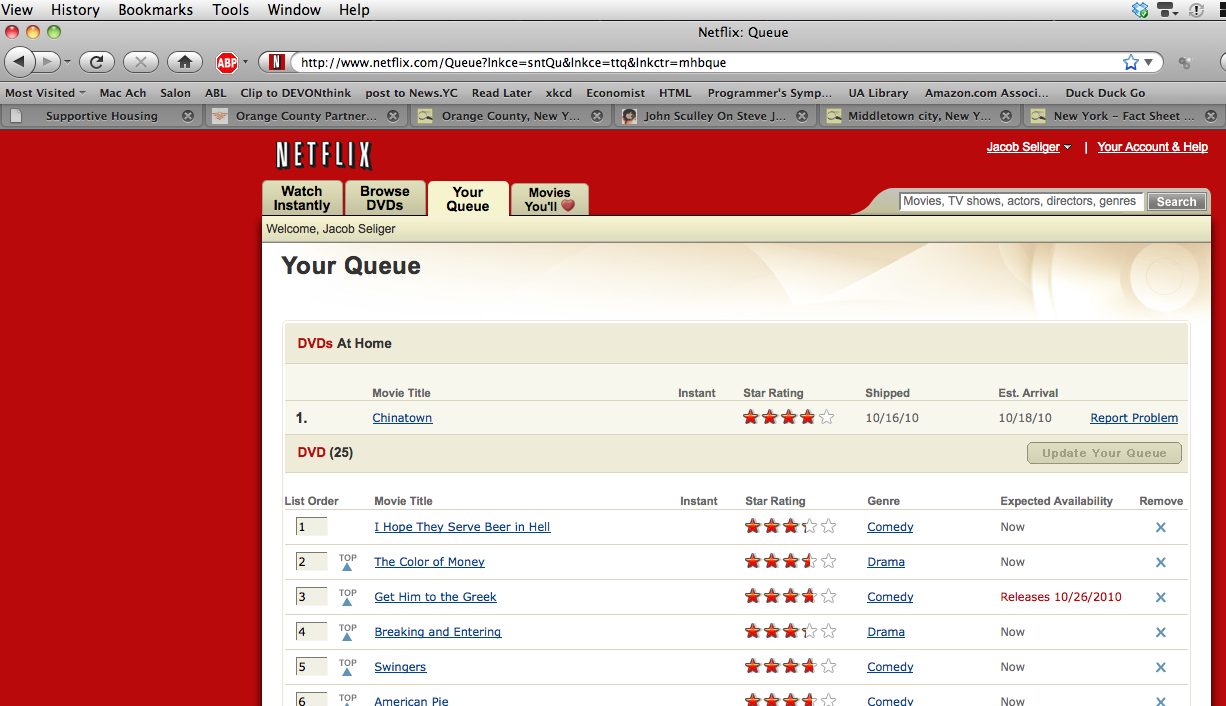
I recently interviewed professional writer and asshole Tucker Max about his second book, Assholes Finish First. He also wrote I Hope They Serve Beer In Hell, which was made into the eponymous movie. Like any diligent journalist, I wanted to get as much background on his work as I could—including the movie, which I put on my Netflix queue without enough time to get it. My queue looked something like this the day before the interview:

Notice the little buttons that say “Play” (EDIT: Oops: the movies at the top of my queue don’t have that button. Take my word for it: some do, and they play immediately). If I want to watch those movies, they automagically play via Microsoft Silverlight, which is probably just a nefarious and tardy attempt to compete with Flash but which I installed because it was there and easy. Notice that there isn’t a button that says “Play” next to I Hope They Serve Beer in Hell. But I was interviewing Tucker and couldn’t wait.

So I searched for I Hope They Serve Beer in Hell using a BitTorrent search engine that will remain unidentified here but is easily found using conventional search engine tools. Sure enough, it had a copy of I Hope They Serve Beer in Hell. A few clicks later and it began downloading. Two or three hours later and it was done. The quality wasn’t especially high—it was compressed all the way down to 700 MB—and the process wasn’t as smooth as clicking “play” and starting the stream. But it worked reasonably well. If I were the kind of person I was in high school, when I didn’t have a credit card but did have Internet access, I might have done a lot more of this. And if I were a less, uh, scrupulous person, I’d been tempted to just go the BitTorrent route all the time.

Apparently others have noticed this general trend—in “Why Is Netflix Disclosing Less About Its Business?” for The Atlantic, Jonathan Berr writes:

According to Netflix, 66 percent of subscribers instantly watched more than 15 minutes of a movie or a TV episode in the third quarter compared with 31 percent in the year-ago period and 61 percent in the second quarter. This underscores the company’s transition from DVD rentals to streaming video.

If I were a movie studio, I’d be trying to make sure that what happens to me is different from what happened to the music business. I’d be doing everything I can to make sure that my movies were available on Netflix, the iTunes store, Amazon, Barnes and Noble, Bob’s crab shack, whatever. Available and easy. In “The Other Road Ahead,” Paul Graham says, “Near my house there is a car with a bumper sticker that reads “death before inconvenience.’ ” That’s basically how I feel much of the time.

And I’m not the only one (who feels like streaming is handy):

[. . .] Netflix accounts for 20 percent of downstream Internet traffic during peak home Internet usage hours in North America. That’s an amazing share—it beats that of YouTube, iTunes, Hulu, and, perhaps most tellingly, the peer-to-peer file-sharing protocol BitTorrent, which accounts for a mere 8 percent of bandwidth during peak hours. It wasn’t long ago that pundits wondered if the movie industry would be sunk by the same problems that submarined the music industry a decade ago—would we all turn away from legal content in favor of downloading pirated movies and TV shows? Three or four years ago, as BitTorrent traffic surged, that seemed likely. Today, though, Netflix is far bigger than BitTorrent, and it seems sure to keep growing.

If Netflix wants to stay bigger than BitTorrent, however, the movie studios need to climb aboard. If they’re smart, they will. If not, they have predecessors who have been massacred by the Internet, and they no doubt will have successors who are too.

Oh, and the movie? It’s not very good. Skip it and read the book.

Thoughts on Aaron Sorkin's The Social Network

1) The movie, especially the first 30 minutes, is very good: the dialog is astonishingly quick. The details are right (I’ve been to AEP parties and used Emacs). The movie isn’t boring, and this is especially surprising since most of it is guys talking to each other. The various narrative threads are a good example of Steven Berlin Johnson’s essay “Watching TV Makes You Smarter” in action.

2) I suspect The Social Network hears about the same relationship to reality that Braveheart does to early Scotland or War and Peace does to Napoleon, which is to say very little. “The Face of Facebook” in The New Yorker shows this.

3) Lawrence Lessig’s review is mostly negative and says that the movie misses the point. In fact, he moves in the same kind of direction I do:

[…] what’s important here is that Zuckerberg’s genius could be embraced by half-a-billion people within six years of its first being launched, without (and here is the critical bit) asking permission of anyone. The real story is not the invention. It is the platform that makes the invention sing. Zuckerberg didn’t invent that platform. He was a hacker (a term of praise) who built for it. And as much as Zuckerberg deserves endless respect from every decent soul for his success, the real hero in this story doesn’t even get a credit. It’s something Sorkin doesn’t even notice.

This is true, but it’s also a bit like criticizing Romeo and Juliet for failing to accurately depict the real political scene of Italy: that’s not the point. The point is the love story. But Lessig is probably right, although I’m not sure there’s a way to depict “the platform that makes the invention sing” and still tell a compelling story around human characters.

4) Compare Lessig’s review to those of Scott Adams (“It is the best movie I have ever seen”), David Denby (“This brilliantly entertaining and emotionally wrenching movie is built around a melancholy paradox”), and Fred Vogelstein. The latter is more about the reaction to the movie than the movie itself but is still worth reading.

5) The Social Network is that rare movie about the people who are doing the most to change the world in the shortest amount of time of any group ever: nerds and hackers, who’ve largely built the world we now inhabit. Very few movies bother depicting nerds at all, and when they do, those nerds are usually peripheral to the action or not really nerds or completely untrue to nerds in real life. This isn’t just true in movies—it’s also true in fiction. One nice thing about novels like Neal Stephenson’s Cryptonomicon is that it incorporates hackers and a hacker’s mindset as few other novels I’ve read have. There are a zillion movies and books about love stories, bildungsroman, soldiers, criminals, cops, and lawyers. All these are lovely subjects for narrative art, but the incredibly dearth of such books about the hacker sub-culture is notable. I’m trying to fix this in my own small way; we’ll see if I’m successful.

Note that Gabriella Coleman wrote a piece for The Atlantic on The Anthropology of Hackers that’s good reading for anyone interested in the modern world.

6) Building off points 3 and 5, although The Social Network gets a lot of stuff right, especially the drama, I’m not convinced that it’s the best possible portrayal of nerds and nerd subcultures. I would also guess that Zuckerberg, more than anything else, cares about code, which I don’t think most people can or want to understand. Maybe artists can, because I think a lot of the best artists care about their art more than anything else, which can be frustrating to people around them.

7) The tech and hacking communities are well aware of how the legal system and patent law are out of control and, in many respects, stifling innovation. Although patents never come up in The Social Network, perhaps it will raise awareness of the problems posed by the legal system.

8) I feel like I’ve met Zuckerberg. Not the literal Zuckerberg, of course, but I’ve met plenty of hardcore engineer and hacker types whose lack of social graces is probably not a cause or effect of their technical prowess, but may be an ancillary byproduct of wanting to make art or write code more than be socially adept.

EDIT: I wrote this October 13; on October 15, the New York Times published “Hey, That’s Me Up On That Screen,” which says, “For the newest class of entrepreneurs developing the next generation of Web-based companies, “The Social Network” is the first time many have seen their startup culture splashed on the big screen.” Compare that to my sixth point.

Thoughts on Aaron Sorkin’s The Social Network

1) The movie, especially the first 30 minutes, is very good: the dialog is astonishingly quick. The details are right (I’ve been to AEP parties and used Emacs). The movie isn’t boring, though most of it consists of guys talking to each other. The various narrative threads are a good example of Steven Berlin Johnson’s essay “Watching TV Makes You Smarter” in action.

2) I suspect The Social Network hears about the same relationship to reality that Braveheart does to early Scotland or War and Peace does to Napoleon, which is to say very little. “The Face of Facebook” in The New Yorker shows this.

3) Lawrence Lessig’s review is mostly negative and says that the movie misses the point. He moves in the same kind of direction I do:

[…] what’s important here is that Zuckerberg’s genius could be embraced by half-a-billion people within six years of its first being launched, without (and here is the critical bit) asking permission of anyone. The real story is not the invention. It is the platform that makes the invention sing. Zuckerberg didn’t invent that platform. He was a hacker (a term of praise) who built for it. And as much as Zuckerberg deserves endless respect from every decent soul for his success, the real hero in this story doesn’t even get a credit. It’s something Sorkin doesn’t even notice.

This is true, but it’s also a bit like criticizing Romeo and Juliet for failing to accurately depict the real political scene of Italy. The point is the love story. But Lessig is probably right, although I’m not sure there’s a way to depict “the platform that makes the invention sing” and still tell a compelling story around human characters.

4) Compare Lessig’s review to those of Scott Adams (“It is the best movie I have ever seen”), David Denby (“This brilliantly entertaining and emotionally wrenching movie is built around a melancholy paradox”), and Fred Vogelstein. The latter is more about the reaction to the movie than the movie itself but is still worth reading.

5) The Social Network is that rare movie about the people who are doing the most to change the world in the shortest amount of time of any group ever: nerds and hackers, who’ve largely built the world we now inhabit. Very few movies bother depicting nerds at all, and when they do, those nerds are usually peripheral to the action or not really nerds or completely untrue to nerds in real life. This isn’t just true in movies—it’s also true in fiction. One nice thing about novels like Neal Stephenson’s Cryptonomicon is that it incorporates hackers and a hacker’s mindset as few other novels I’ve read have. There are a zillion movies and books about love stories, bildungsroman, soldiers, criminals, cops, and lawyers. All these are lovely subjects for narrative art, but the incredibly dearth of such books about the hacker sub-culture is notable. I’m trying to fix this in my own small way; we’ll see if I’m successful.

Note that Gabriella Coleman wrote a piece for The Atlantic on “The Anthropology of Hackers;” it is good reading for anyone interested in the modern world.

6) Building off points 3 and 5, although The Social Network gets a lot of stuff right, especially the drama, it’s not an accurate portrayal of nerds and nerd subcultures (it can be a good movie without being an accurate portrayal). I would also guess that Zuckerberg, more than anything else, cares about code, which I don’t think most people can or want to understand. Maybe artists can, because I think a lot of the best artists care about their art more than anything else, which can be frustrating to people around them.

7) The tech and hacking communities are well aware of how the legal system and patent law are out of control and, in many respects, stifling innovation. Although patents never come up in The Social Network, perhaps it will raise awareness of the problems posed by the legal system.

8) I feel like I’ve met Zuckerberg. Not the literal Zuckerberg, of course, but I’ve met plenty of hardcore engineer and hacker types whose lack of social graces is probably not a cause or effect of their technical prowess, but may be an ancillary byproduct of wanting to make art or write code more than be socially adept.

EDIT: I wrote this October 13; on October 15, the New York Times published “Hey, That’s Me Up On That Screen,” which says, “For the newest class of entrepreneurs developing the next generation of Web-based companies, “The Social Network” is the first time many have seen their startup culture splashed on the big screen.” Compare that to my sixth point.

My new hero and The Hollywood Economist

“Paramount studio head Robert Evans has described [screenwriter Robert Towne] as ‘lethargic, scattered, perpetually late.’ ”

Towne is my new hero.

The quote is from Edward Jay Epstein’s The Big Picture: Money and Power in Hollywood, which is fascinating throughout, though not as much as his newer The Hollywood Economist: The Hidden Financial Reality Behind the Movies, which shares much of the same DNA (by which I mean anecdotes and facts) and goes a long way towards explaining why so many movies are so awful. It also shows how Hollywood is about deals just as much as hedge funds are, how studios use those hedge funds, and how studios need to project an aura of profligacy while counting down to the last dollar. One thing of many that I didn’t know: how vital insurance companies are to making movies.

(500) Days of Summer with, as a bonus, Alain de Botton's On Love

(500) Days of Summer is about the mating habits of angsty hipsters. Said hipsters are endlessly concerned with the nature of love in a deep, romantic fashion when they should be thinking more about the mechanics of how and why someone is actually attracted to another person. To heal the anxiety that hipsters feel about attraction and love, I would prescribe Belle de Jour, Neil Strauss’ The Game, and Kundera’s The Unbearable Lightness of Being, which, taken together, remind one that the important thing about love is having enough game to get someone else to love you, not merely mooning over another person—which is more likely to drive them away than attract them.

In (500) Days of Summer, Tom does the mooning and Summer is indifferent and perhaps callous to his puppyish attention. Tom wants romance so bad that his 11-year-old sister says, “Easy Tom. Don’t be a pussy” at one point. We’re thinking the same thing, although perhaps not in those words, which are given to the sister chiefly, I assume, for getting a laugh out of the incongruity of hearing her say them. In the next scene, Tom asks Summer, “What are we doing?” The better question, at least for the audience, is, “Should we care?” If Tom doesn’t get with Summer—who manifests no special or particular interests, talents, abilities, thoughts, capability, or expertise—there are another thousand girls right behind her, exactly like her, who are also part of the quirk genre, as described in the linked Atlantic article:

As an aesthetic principle, quirk is an embrace of the odd against the blandly mainstream. It features mannered ingenuousness, an embrace of small moments, narrative randomness, situationally amusing but not hilarious character juxtapositions (on HBO’s recent indie-cred comedy Flight of the Conchords, the titular folk-rock duo have one fan), and unexplainable but nonetheless charming character traits. Quirk takes not mattering very seriously.

Quirk is odd, but not too odd. That would take us all the way to weird, and there someone might get hurt.

Over time, quirk gets boring and reminds you why you like the real feeling of, say, King Lear, or the plot of The Usual Suspects. The mopey plight of undifferentiated office workers is less compelling, and, once sufficiently repeated, it feels like disposable culture: another story about two modern people with no serious threats to their existence save the self-imposed ones that arise chiefly from their minds.

Love stories about the relatively pampered can work: I watched (500) Days of Summer because a bunch of students mentioned it in relation to Alain de Botton’s On Love. But the novel is better: a philosophically minded and self-aware narrator is fascinating precisely because he is aware of the ridiculousness of his own predicament and the randomness of love. He has a therapist and a philosophy professor in his mind. The dichotomy between how he should feel (she’s just another girl) and how he does (transformed through love!) fuels much of the comedy, as does the narrator’s tendency toward self-sabotage thanks to Marxism as applied to love: he would never want to be a member of any club that would have him as a member. Tom would, apparently, sign up to be a member of any club that would have him as a member. His lack of interiority makes him boring. His lack of exteriority makes the movie boring.

Whoever wrote (500) Days of Summer must have read On Love (Tom is a wannabe architect and gives Alain de Botton’s The Architecture of Happiness as a gift) and wanted to do a film version, or at least steal from it. Stealing from On Love, by the way, is a brilliant idea: the novel still leaves much territory to be explored, and it’s probably impossible to draw a complete map to represent the problems that love provide. But the interior commentary that makes the novel special can’t be effectively represented on screen. So we’re stuck with two people whose averageness is painful and unleavened by any real sense of awareness of their own situation. One of my favorite passages from On Love goes:

But there wasn’t much adventure or struggle around to be had. The world that Chloe and I lived in had largely been stripped of possibilities for epic conflict. Our parents didn’t care, the jungle had been tamed, society its disapproval behind universal tolerance, restaurants stayed open late, credit cards were accepted almost everywhere, and sex was a duty, not a crime.

On Love is acknowledging that the stuff that makes good fiction has largely been evacuated from modern love stories. In doing so, I laughed with recognition and at the narrator’s neuroticism about his own love stories. Moments like this abound in On Love and make it such a wonderful novel. Moments like this are absent in (500) Days of Summer, which make it a tedious movie.

Thoughts on James Cameron's Avatar and Neal Stephenson's "Turn On, Tune In, Veg Out"

Despite reading Greg Egan’s brilliant review of Avatar, I saw the movie. The strangest thing about Avatar is its anti-corporate, anti-technological argument. Let me elaborate: there are wonderful anti-corporate, anti-technological arguments to be made, but it seems contrived for them to be made in a movie that is, for the time being, apparently the most expensive ever made; virtually all mainstream movies are now approved solely on their profit-generating potential. So a vaguely anti-corporate movie is being made by… a profit-driven corporation.

The movie is among the most technically sophisticated ever made: it uses a crazy 2D and 3D camera, harnesses the most advanced computer animation techniques imaginable, and has advanced the cinematic state-of-the-art. But Avatar’s story is anti-technological: humans destroyed their home world through environmental disaster and use military might to annihilate the locals and steal their resources. Presumably, if Avatar’s creators genuinely believed that technology is bad, the movie itself would never have been made, leading to a paradox not dissimilar for those found in time travel movies.

Avatar also has a bunch of vaguely mythical elements, including some scenes that look like the world’s biggest yoga class. The Na’avi, an oppressed people modeled on American Indians, or at least American Indians as portrayed in 20th Century American movies, fight against an interstellar military using bows, arrows, horses, and flying lizards. They live in harmony with the world to an extent that most Westerners can probably barely conceive of, given that more people probably visit McDonald’s than national parks in a given year.

So why are we fascinated with the idea of returning to nature, as though we’re going to dance with wolves, when few of us actually do so? Alain de Botton’s The Architecture of Happiness may offer a clue: he cites Wilhelm Worringer’s essay, “Abstraction and Empathy,” which posits that art emphasizes, in de Botton’s words, “[…] those values which the society in question was lacking, for it would love in art whatever it did not possess in sufficient supply with in itself.” We live (presumably) happy lives coddled in buildings that have passed inspection, with takeout Chinese readily available, and therefore we fantasize about being mauled by wild beasts and being taken off the omnipresent grid, with its iPhones and wireless Internet access. We live in suburban anomie and therefore fantasize about group yoga. We make incredibly sophisticated movies about the pleasures of a world with no movies at all, where people still go through puberty rituals that don’t involve Bar Mitzvahs, and mate for life, like Mormons.

Neal Stephenson wrote a perceptive essay called “Turn On, Tune In, Veg Out,” which examines the underlying cultural values in the older and newer Star Wars films. I would’ve linked to it earlier but frankly can’t imagine anyone returning here afterwards. Therefore I’ll quote an important piece of Stephenson:

Anakin wins that race by repairing his crippled racer in an ecstasy of switch-flipping that looks about as intuitive as starting up a nuclear submarine. Clearly the boy is destined to be adopted into the Jedi order, where he will develop his geek talents – not by studying calculus but by meditating a lot and learning to trust his feelings. I lap this stuff up along with millions, maybe billions, of others. Why? Because every single one of us is as dependent on science and technology – and, by extension, on the geeks who make it work – as a patient in intensive care. Yet we much prefer to think otherwise.

Scientists and technologists have the same uneasy status in our society as the Jedi in the Galactic Republic. They are scorned by the cultural left and the cultural right, and young people avoid science and math classes in hordes. The tedious particulars of keeping ourselves alive, comfortable and free are being taken offline to countries where people are happy to sweat the details, as long as we have some foreign exchange left to send their way. Nothing is more seductive than to think that we, like the Jedi, could be masters of the most advanced technologies while living simple lives: to have a geek standard of living and spend our copious leisure time vegging out.

The tedious particulars of modern technological life are both embraced and avoided in Avatar too. The villain, rather than being political chaos, organized oppression, ignorance, entropy, or weak/ineffective institutions, to name a few of the real but abstract contemporary bad guys, is instead replaced by an army / mercenary commander who might be at home in Xe Services / Blackwater USA. The military villainy and disdain for superior firepower in Avatar is especially odd, given that the United States has held the technological advantage in major wars for at least a century; the people watching Avatar are probably also the ones who support our troops. The studio that made Avatar probably cares more about quarterly statements than about the environment. The movie villains, however, apparently aren’t being restrained by an intergalactic EPA.

Avatar is really a Western about the perils of modernity, but it gets contemporary politics utterly wrong—or perhaps it would be more accurate to say that contemporary politics are utterly absent. There is no intergalactic criminal court or committee for the protection of indigenous peoples, which seems like a probable development for a race nursed on Star Trek and post-colonialism and that is advanced enough to travel the stars. In the contemporary United States, a bewildering array of regulations govern activities that might have an environmental impact on communities; the National Environmental Policy Act (NEPA), for example, requires that federal agencies to monitor and report on their activities. Such regulations are growing, rather than shrinking. They’re a staple bogeyman of right-wing radio.

But in Avatar, decisions aren’t made at the future equivalent of the Copenhagen summit. Instead, they’re fought in battles reminiscent of World War I, or the Civil War, leavened with some personal combat. The battles are jarring but anachronistic, although maybe Iraq War II: The Sequel would’ve turned out better if George Bush and Saddam Hussein had dueled with swords, but that’s not how wars are fought any more. And when one side has machine guns and the other side doesn’t, you get something as nasty as World War I, where all the élan, spirit, and meditation in the world didn’t stop millions of people from dying.

My implicit argument isn’t perfect: Avatar does criticize our reliance on oil through the parable of the cleverly named “unobtainium,” but the thrust of the movie is unambiguous. We want to fantasize that solutions are as simple as putting a hole in the right guy, which will make things right again. That’s probably a comforting notion, and an easy one to fit into a two- to three- hour movie with a three-part arc, but it’s also a wrong one, and one that ignores or abstracts the world’s complexity. The people who tend to rule the world are the ones who pay attention to how the world really is, rather than how it was, or how they would like it to be. The real question is whether we are still people who see how the world is.

James Cameron's Avatar

“Sometime in the next twenty years or so, the technology that enabled Avatar will become cheap enough to risk employing alongside a moderately intelligent script.”

—Alas: it appears that James Cameron’s Avatar is all technical achievement and no story. This is the cinematic equivalent of what I wrote about here with regards to literature.

EDIT: I saw the movie anyway and wrote about it here.