The importance of signaling and Kickstarter: It’s not just the money

Movie star Zach Braff raised two million dollars on Kickstarter, and in the process a bunch of people on the Internet (and some who should know better) wrote critical commentary—this Reddit post is a decent summary of the slightly angry “Why is a rich celebrity seeking other people’s money?” point of view. Some people also used the Kickstarter to write reasonable, illuminating commentary, as Dan Lewis did in “Zach Braff, Amanda Palmer, and the New 90-9-1 Rule: The Indifferent, the Haters, and the Ones who Love You.

But, for the most part, one important and subtle factor about Kickstarter got lost: Kickstarter functions as an easy-to-use signaling mechanism. Lots of people on Internet forums and real life say, “I want to see Garden State II or Season 3 of popular TV show X” or whatever. But the cliché is true: talk is cheap, and lots of people will say lots of things when they have nothing at stake.

Kickstarter, however, lets people put their money where their mouths are: instead of saying, “I want to see or read X,” they can say, “I want to see or read X so bad that I’m willing to pay $10 to make it happen.” That $10 is much louder than 10,000 posts. The money is important in and of itself, yes, but it also demonstrates that your fans care enough to give the creator something valuable.

Although I didn’t especially care for Garden State when I saw it in college, I can see why it appeals. My favorite movies are definitely worth way more to me than the relatively small amount of money I paid to see them. (Or, as economists would say in their racy, lascivious language, my consumer surplus is high, while it was pretty low for a movie like Spring Breakers and outright negative for awful movies.) How much is a movie like Blade Runner or the underrated Kiss Kiss Bang Bang worth to me? I don’t know, but if the team behind a movie Kiss Kiss Bang Bang wanted to make another movie and tried Kickstarter, I’d give them some money (in Lewis’s term, I’m somewhere in the 9% of people interested but not super-fans; maybe I’m in the 12th to 15th percentile).

We’re still in the infancy of crowd-source funding, and it’s possible that we’ll see crowd-source funding morph towards being seen as an important signal too, and this blog post is a step in that direction.

Thoughts on Debt: The First 5,000 Years — David Graeber

Mike Beggs’ review of Debt expresses my reservations about the book better than I can. In Debt there are many solid-seeming micro-insights but the overall narrative doesn’t cohere (I say “solid-seeming” because of Graber’s many errors—see the last paragraph of this post). Beggs describes the problems with Debt better than I can.

One point: Graeber notes religious prohibitions on debt—”The Catholic Church had always forbidden the practice of lending money at interest, but the rules often fell into desuetude[. . .]” (10)—and religiously-inspired depictions—”Looking over world literature, it is almost impossible to find a single sympathetic representation of a moneylender—or anyway, a professional moneylender, which means by definition one who charges interest” (10)—but my understanding is that those prohibitions arose prior to the Industrial Revolution and Enlightenment—in other words, times when growth could be negative for decades, and when growth, even when it did occur, was usually under 1% a year.

In that atmosphere, taking on debts would be ruinous for the vast majority of people. Today, by contrast, many people can use debt safely and successfully for things like education or business. I don’t know how much of that is a just-so story and how much is empirically supported, however.

It is also easy to find many nasty representations of women in world literature, and especially of prostitutes, but, if I may stereotype for a moment, that doesn’t mean that a bunch religious lunatics from the Middle Ages should control modern conceptions of femininity or sexuality. Depictions of groups, professions, or practices from the past may be revealing or important, but they don’t and shouldn’t bind what we think in the future.

Another point: Graeber writes that, in recent times, “the bankers were doing it [that is, making “utterly irresponsible loans”] on an inconceivable scale: the total amount of debt they had run up was larger than the combined Gross Domestic Products of every country in the world [. . . ]” (16). I agree that having “too-big-to-fail” banks is a problem and that the U. S. federal government should get out of the business of subsidizing and guaranteeing mortgages, which are practices that contributed to the size of the financial sector but were probably not decisive to it, but that doesn’t stop me from also noting that every lender needs a borrower. So far as I know, few borrowers had guns held to their head with orders to borrow. Borrowers took loans freely. The story of the last five years should not be a homily about the evils of bankers; they played a role but did not act alone. Everyone who could have taken out a large mortgage in the 2000s but chose to rent instead knows this.

Graeber appears to successfully bury the idea, often mentioned in economic textbooks, that money systems arose from barter. But I don’t think that conception is essential to many, if any, modern ideas in economics. He seems to want to deliberately misstate what economics does:

for there to even be a discipline called ‘economics,’ a discipline that concerns itself first and foremost with how individuals seek the most advantageous arrangement for the exchange of shoes for potatoes, or cloth for spears, it must assume that the exchange of such goods need have nothing to do with war, passion, adventure, mystery, sex, or death. (32–33)

This misunderstands economics to a degree that seems like willful ignorance: economics is a discipline that studies how people respond to incentives and trade-offs.

The book is frustrating because it has many fascinating descriptions of how native peoples barter and trade, but those observations are marred by moments like this one. Graeber describes positively how native peoples develop ongoing business relationships, and that indeed sounds good, but having ongoing relationships with every single person with whom one wants to trade for goods and services would be incredibly time-consuming in a modern economy. The social arrangements that work well for native people will not necessarily work well for modern people dealing with clerks at Walgreens.

Some points are viable and important: for example, Graeber brings up the example of third-world debt incurred by autocratic leaders and enforced after those leaders are deposed. In instances like that he’s right: the people of third-world countries shouldn’t be forced to repay debts created by dictators. But that doesn’t mean all debt everywhere is automatically bad. Nor am I convinced that the sexual-economic practices of indigenous people, though interesting, necessarily tell us how we should arrange sexual-economic practices today.

Many indigenous people seem to have more fun than most Americans, and in that respect maybe we should emulate, but I can’t judge whether Graeber is cherry-picking examples. The U.S. could improve its sexual culture in many ways, and take some cues from indigenous people, but those cues can be lifted without taking along economic practices.

Debt ends this way:

A debt is just the perversion of a promise. It is a promise corrupted by both math and violence. If freedom (real freedom) is the ability to make friends, then it is also, necessarily, the ability to make real promises. What sorts of promises might genuinely free men and women make to one another? At this point, we can’t even say. It’s more a question of how we can get to a place that will allow us to find out. And the first step in that journey, in turn, is to accept that in the largest scheme of things, just as no one has the right to tell us our value, no one has the right to tell us what we truly owe. (391)

But a debt isn’t really “the perversion of a promise;” it’s a particular kind of promise. If you don’t like “math and violence,” then don’t take debt. It’s not all obvious, even after almost 400 pages, how Graeber gets from the first two sentences in the paragraph to the last sentence—is anyone “tell[ing] us our value?” Who is this person? And when we start life, “no one has the right to tell us what we truly owe,” but if we want to buy a car for $0 down and $499 a month, then someone does have the right to tell us what we owe, because we gave it to them. There are many edge cases, which you can read about in Contracts law textbooks, but the overall principle is reasonable.

It is hard for me to imagine wanting to re-read Debt.

(I title this post “Thoughts on” because I don’t have sufficient knowledge for a comprehensive review, and because the book is sufficiently broad in scope that a real review would probably need to be thousands of words even if many of them are citations.)

EDIT: See also Brad DeLong on Graeber’s many errors of fact.

Summary Judgement: Hard to Get — Leslie C. Bell

Hard to Get: Twenty-Something Women and the Paradox of Sexual Freedom sounds promising but makes the classic mistake of reporting opinions expressed in a cold state, which is ver different from the hot or aroused state in which many people make their actual sexual decisions. Unless I missed it, Bell did not cite Alexander and Fisher, “Truth and Consequences: Using the Bogus Pipeline to Examine Sex Differences in Self-Reported Sexuality,” which she should have. She doesn’t consider what Clarisse Thorn does, about the micro-interactions and decisions people make.

An exercise: imagine that the genders in Hard to Get are reversed, and that male writers are talking about their relationships with women. Most commentators, both male and female, would probably make fun of them, whether overtly or through condescension, just as they would a virgin dispensing sex advice.

There is much discussion about “having it all” that I do not think troubles men, or male discourse, nearly as much. For most people, I suspect “having it all” is incoherent and/or paradoxical: it is difficult if not impossible to have copious free time and a time-intensive career; there is an inherent trade-off between the security of a relationship and the thrill of the new. In many domains choosing one path precludes others. But so what? That’s life.

The author never asks what may to be men the most important question of all: how women choose which men they want to sleep with, although one, “Phoebe,” described as a tall, attractive redhead, knows it’s just not that hard, as long as you’re height-weight proportionate (and maybe even if you’re not), to get guys: “Basically, you talk to them” (108). Is this hard to understand? It was hard for me to talk to girls when I was in middle school but like most people I got over it.

The writing is weak or boring on a sentence-by-sentence level; there is a strongly “academic” feel.

I wanted to like the book.

Summary judgment: Planet of Cities — Shlomo Angel

Planet of Cities is for a specialized audience, but it has one very big point that I didn’t realize:

New empirical evidence on the average population density of cities across space and time confirms that these densities have been in decline almost everywhere for a century or more. The new evidence is counterintuitive, since numerous academic researchers believe that urban densities have been on the increase. Were that true, it would lend encouragement and support to those favoring densification. However, urban density decline has been persistent and global in scope, and it predated the automobile. It is not restricted to the United States or other industrialized countries, but is pervasive in developing countries as well. [. . .]

The forces driving density decline—rising per capita incomes, cheap agricultural lands, efficient transport, and income inequality—are quite formidable. Accordingly, absent a highly effective policy intervention or a steep increase in travel costs in the future, there is little reason for the global decline in densities to slow down anytime soon.

Planet-of-citiesI like living in cities (if New York were less expensive—as it was until the ’90s—I’d happily live here forever) and attack legal rules that prohibit higher buildings. But the research Angel has both conducted and cited indicates that, even in the absence of such rules, cities would still probably be getting less dense, or at most evening out. That is news to me; he also says, “No matter how we choose to act, however, we should remain aware that conscious and conscientious efforts to increase the density of our cities require the reversal of a powerful and sustained global tendency for urban densities to decline.” Newer cities, like Phoenix or Dallas, are even less dense than older cities, which is an innovation problem for the reasons described in Steven Berlin Johnson’s Where Good Ideas Come From and Edward Glaeser’s The Triumph of the City.

Cities like New York and Boston remain so important because creating dense neighborhoods like those found in both areas is effectively impossible in today’s climate of urban land-use controls. Building such areas doesn’t have to be impossible, but we, collectively, make it so. Take Seattle, a city I’m very familiar with. In downtown Seattle, rents have effectively increased by 40 – 50% from 2002 – 2012, even though some construction has been permitted. Rapid increase indicates that much more could be commercially built, and that many people want to live there and will pay to do so.

Some cities have attempted to limit horizontal urban sprawl, and presumably increase vertical urban height. Portland is a case in point, because it created an “urban growth boundary” (UGB) and thus has been a test case for some city planning. By density, which is arguably the most important measure of whether an UGB succeeds, the UGB failed:

The chief aim of the UGB was to contain urban sprawl and preserve the natural beauty of the surrounding countryside within reach of city residents. Sprawl was not defined precisely, but presumably it included both low-density development and fragmentation. After examining the change in built-up area density within the UGB between 1973 and 2005, we found that densities decreased rather than increased.

Even cities that have explicitly attempted to contain sprawl by increasing density have not fully succeeded. This points to the obvious need to plan for sprawl, and to plan for less centralization:

The possibility that cities worldwide are now in a process of transformation from a monocentric to a polycentric spatial structure poses an interesting challenge. It suggests that if public transport is to be a viable option in areas of expansion to economize on the energy expended and to limit greenhouse gas emissions, then it cannot be limited to continued reliance on radial routes to the city center. The transport network must be two-dimensional, providing frequent and reliable service among suburban destinations over the entire metropolitan area, rather than a one-dimensional network of radial routes into the city center. Some public transport systems that already provide such service are the bus lines of Edmonton and Toronto in Canada.

To provide reliable point-to-point service throughout metropolitan areas and to function effectively, bus lines or new transportation technologies will need to operate on a grid of arterial roads.

Again, this is certainly true in Seattle: I can’t find a citation, but for a time there was more Class-A office space in downtown Bellevue than downtown Seattle. In the greater Seattle area, there are major population and employment centers in Seattle itself, Bellevue, downtown Kirkland, Redmond (where Microsoft is headquartered) and Renton (where Boeing has or had many facilities). Many people I went to high school with live on the Eastside and seldom cross Lake Washington, and they can live a relatively urban experience in downtown Bellevue or Kirkland. Seattle as a city still imposes severe height limits in areas adjacent to downtown, and, as a result, some of the development and population infill that might otherwise take place, say, east of 12th Avenue or North of Olive / John on Capitol Hill, instead moves to Kirkland and Bellevue.

The style in Planet of Cities is unimpressive, verging on non-existent, as the quotes above demonstrate. But its insights impress, as does its re-evaluation of the conventional wisdom about rising densities in cities. As I wrote in the first paragraph, it’s a specialist book for specialist interests. Still, most people hold naive views on city planning, even if they don’t realize they hold such views. Planet of Cities replaces naiveté with knowledge. It could use panache, but that’s true of almost all textbooks and monographs.

EDIT: Anthony Flint of the Lincoln Institute of Land Policy wrote to ask me to note that the Lincoln Institute of Land Policy published this book. I’m not sure why this is important, but here it is.

Why corporations?

Arnold Kling asks: “Why Large Corporations?” I left a comment citing Peter Thiel’s answer:

Companies exist because they optimally address internal and external coordination costs. In general, as an entity grows, so do its internal coordination costs. But its external coordination costs fall. Totalitarian government is entity writ large; external coordination is easy, since those costs are zero. But internal coordination, as Hayek and the Austrians showed, is hard and costly; central planning doesn’t work.

The flipside is that internal coordination costs for independent contractors are zero, but external coordination costs (uniquely contracting with absolutely everybody one deals with) are very high, possibly paralyzingly so. Optimality—firm size—is a matter of finding the right combination.

This applies to corporations more generally, but large corporations presumably persist because they continue to solve this class of problem. Corporations also solve or ameliorate succession and other problems; one way of re-stating Thiel’s point is that corporations help align the interests of a lot of people in approximately the same direction. This mechanism obviously isn’t perfect, but it’s better than alternatives.

IMG_0298Skepticism of corporations is useful, but only when skeptics understand the problems corporations solve. I took a grad seminar on the Modernism / Postmodernism divide and was assigned the movie The Corporation, which is heavy on innuendo and rhetorical slight-of-hand and light on intellectual acuity. When the seminar discussed the movie, my classmates were happy to assume that corporations are evil—but they couldn’t identify why they exist, let alone offer coherent alternatives that don’t have obvious drawbacks. I’m not in love with the corporate legal form as some kind of ideal, but without a plausible alternative, feeling-based criticism isn’t terribly helpful. It’s like people who criticize coal power plants. . . and nuclear. . . and other viable, large-scale options.

In the seminar’s discussion, other students and the professor conflated publicly-traded corporations with privately traded ones and LLCs with C Corps, etc. (Incidentally, if you want to listen to something hilarious yet depressing, get a bunch of English grad students and professors together and tell them to talk about business). They also thought that all corporations exist solely to make money. That’s not true: Corporations do what their shareholders tell them to do. As far as I know, courts have decided that publicly traded companies need to maximize shareholder value, but single-owner corporations can do whatever the single owner or small group of owners wants them to.

Thiel says this about the advantages of starting a new corporation to accomplish some task:

The easiest answer to “why startups?” is negative: because you can’t develop new technology in existing entities. There’s something wrong with big companies, governments, and non-profits. Perhaps they can’t recognize financial needs; the federal government, hamstrung by its own bureaucracy, obviously overcompensates some while grossly undercompensating others in its employ. Or maybe these entities can’t handle personal needs; you can’t always get recognition, respect, or fame from a huge bureaucracy. Anyone on a mission tends to want to go from 0 to 1. You can only do that if you’re surrounded by others to want to go from 0 to 1. That happens in startups, not huge companies or government.

Usually, developing “new technology” dovetails with making money, but it doesn’t necessarily have to: you could in principle start a nonprofit technology company to conduct research or develop a product (in some businesses, competition between for- and non-profits is common: think of healthcare, or gyms). That no one or almost no one goes this route means that it could be an under-explored avenue for creative and technological success. Or it could be a deadend, and no one goes down it because doing so would be stupid.

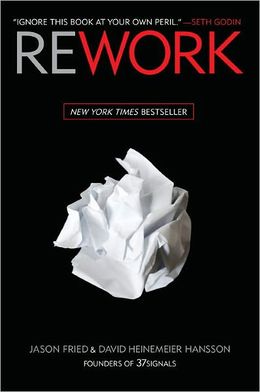
Rework — Jason Fried and David Heinemeier Hansson

Rework is the rare book that could and even should be longer than it is: Fried and Hansson even say, “Writers eliminate good pages to make a great book. We cut this book in half between the next-to-last and final drafts. From 57,000 words to about 27,000 words. Trust us, it’s better for it.” I do trust them, but they may have lost some of the fun stories that might give the book more texture. They’re overfond of assertion without demonstration. But so what? The book as a whole is still worth reading. It’ll take an hour or two to get through the whole thing, which is peppered with little moments like, “You’re better off with a kick-ass half than a half-assed whole” or “Don’t sit around and wait for someone else to make the change you want to see. And don’t think it takes a huge team to make that difference today.”

ReworkIn other words: do it now, whatever the “it” happens to be. Waiting is your worst enemy, doing your best friend, and anything that stops you from doing something should be ignored or overcome. Friedman and Hansson are speaking of business, but they’re also speaking of art, science, and almost everything good in this world. They say, “What you do is what matters, not what you think or say or plan.” This is equally true of writing, but a lot of would-be writers seem to like the idea of writing more than the actual writing itself. I often offer this challenge to people who say they want to or wish they could write a novel:

1) Turn off your Internet access and cell phone.

2) Write chapter one over three days (or so; the actual timeframe doesn’t matter, as long as it’s short); continue if you want to.

3) Send me the result. I’ll read it and send it back.

So far, I think one person has taken that challenge, and I never got chapter two. I interpret this as meaning that most people who say they want to write a novel (or write anything else, or learn the guitar, or get laid, or lose weight, or start cooking, or any number of other skilled endeavors) don’t actually want to, because if they did, they would start today. If you shoot for, say, 500 words a day, you’ll have a pile of around 80,000 in six months, leaving some room for missed days, editing, and so forth.

If you shoot for 1,000 words a day, you’ll have it in three months.

This, however, is only the start, which I didn’t realize when I was nearer to the start than I am now. But if you’re not putting in the seat time, writing, you’re not going to do anything and all your intentions aren’t going to matter. Fried and Hansson are pointing this out in the context of business, where it’s equally valid, and there are probably an equal number of people saying, “I should start a business” and “I should write.” Most of them are probably better off not acting on their impulses. But if they do, why not start?

They’re giving you permission you don’t need to be given, but they’re doing it in a way that feels fun. They elevate fun to a cardinal virtue, and they want to get rid of things that aren’t fun or don’t add value to people’s lives. At one point, for instance, they say:

The business world is littered with dead documents that do nothing but waste people’s time. Reports no one reads, diagrams no one looks at, and specs that never resemble the final product. These things take forever to make but only seconds to forget.

Who would want to stand up and proudly proclaim that they write “dead documents?” In this framing, no one. But sometimes a guy with a document that says why thing x is better than thing y wins. Sometimes dead documents serve important signaling functions. That’s the thing about Rework: read it, but don’t assume it’s always right.

Over the last two months I’ve been on a binge of business or quasi business books: Rework, Anything You Want, How to Win at the Sport of Business: If I Can Do It, You Can Do It, Delivering Happiness: A Path to Profits, Passion, and Purpose, all of them good in their own way, and all of them subtly contradicting each other in various ways.

If Steve Jobs had written a book about business the Apple way, he’d probably contradict all of them. Yet the writer of each book is successful in their own field. If my Dad and I wrote “Doing Business the Seliger + Associates way,” we’d probably say some things that are similar to what Hansson and Fried say but some things that are very different because of the peculiarities of our field. Every business situation is slightly different. What works in one field may not work in another.

The meta lesson may be that no two successes are exactly alike, and that, while you should read these books, you should also realize that you might use pieces of them but you’re unlikely to use all of them. They’re all to be subjected to interrogation, not venerated.

I can say, however, that each of the books above inspires in its own way, and sometimes inspiration has an importance that goes beyond the immediate truth value of a piece.

Life: Comedy edition

“The comic impulse, then, is about a willingness to dwell in the awkward, shameful places we’d prefer not to dwell. It’s what allows us to face the truth of ourselves on behalf of others.”

—Steve Almond, “Funny is the New Deep,” from The Writer’s Notebook II: Craft Essays from Tin House

Anytime someone describes sexual behavior as “dumb,” ask: Dumb in what timeframe?

In writing about the David Petraeus non-scandal, Adam Gopnik says, correctly, that “Benghazi is a tragedy in search of a scandal; the Petraeus affair is a scandal in search of a tragedy,” and, perhaps less correctly, this:

The point of lust, not to put too fine a point on it, is that it lures us to do dumb stuff, and the fact that the dumb stuff gets done is continuing proof of its power. As Roth’s Alexander Portnoy tells us, “Ven der putz shteht, ligt der sechel in drerd”—a Yiddish saying that means, more or less, that when desire comes in the door judgment jumps out the window and cracks its skull on the pavement.

But whether lust “lures us to do dumb stuff” depends on timeframe we’re looking at: if we do “dumb stuff” that results in our genes still existing, say, 200 years from now, then what’s dumb in the context of the next month may be “smart” from the context of a couple centuries from now. We’re evolutionarily primed to propagate our genes—that’s Richard Dawkins’ point in The Selfish Gene.

We also have to ask what happens in the very short term: presumably, in the minutes to hours that Petraeus and Broadwell were doing it (or anyone is “doing it”), they were making a very smart decision for themselves over those few minutes. One might be able to look at the quality of their decision making in terms of Philip Zimbardo and John Boyd’s The Time Paradox, and as being very good for the immediate present when they were doing it, not very good in the months or years after the scandal comes to light, and, depending on conception, very good over the very long term.

Don’t read this post and the books linked, then go out and cheat on your significant other only to say that your selfish genes and hedonistic time perspective “made” you do it. But do think about the intellectual context in which Portnoy’s claim exists, and how desire can function in the very long and short run.

The specious reasoning in Lawrence M. Mitchell’s “Law School Is Worth the Money”

Lawrence M. Mitchell’s “Law School Is Worth the Money” is one of the best examples of specious writing I’ve seen outside of writing produced by the federal government. It seems appropriate for me to comment Mitchell’s ideas, given how I praised Paul Campos’s book Don’t Go To Law School (Unless): A Law Professor’s Inside Guide to Maximizing Opportunity and Minimizing Risk. I’m going to respond to Mitchell’s major points:

The starting point is the job market. It’s bad. It’s bad in many industries. “Bad,” in law, means that most students will have trouble finding a first job, especially at law firms. But a little historical perspective will reveal that the law job market has been bad — very bad — before. To take the most recent low before this era, in 1998, 55 percent of law graduates started in law firms. In 2011, that number was 50 percent. A 9 percent decline from a previous low during the worst economic conditions in decades hardly seems catastrophic. And this statistic ignores the other jobs lawyers do.

Most other jobs don’t require the assumption of tens or hundreds of thousands of dollars of debt to get a legally-mandated piece of paper that lets them perform those jobs. That’s the real catastrophe. Law school only has one purpose: to prepare people to be lawyers. If half aren’t able to become lawyers, that’s a catastrophe for those with the debt burdens that deans like Mitchell aren’t lining up to forgive.

Looking purely at the economics, in 2011, the median starting salary for practicing lawyers was $61,500; the mean salary for all practicing lawyers was $130,490, compared with $176,550 for corporate chief executives, $189,210 for internists and $79,300 for architects. This average includes many lawyers who graduated into really bad job markets.

Notice the weasel words: “the median starting salary for practicing lawyers.” What about the 50% of graduates who can’t find law work? The same is true in the second half of the sentence: “the mean salary for all practicing lawyers was $130,490.” People who get law degrees and then can’t practice are screwed. This is a classic example of How to Lie with Statistics. Mitchell is fishing for the credulous.

Thirty years ago, getting a law degree made a lot more economic sense: the tuition was much lower, and so low that people who got law degrees but didn’t practice weren’t effectively signing up for a decade if not decades of perpetual student loan payments.

The average student at a private law school graduates with $125,000 in debt. But the average lawyer’s annual salary exceeds that number. You’d consider a home mortgage at that ratio to be pretty sweet.

Again, notice the bit about “the average lawyer’s annual salary,” which ignores how many lawyers, and especially recently graduate lawyers, are unemployed. It also ignores the misery of being an associate at a big firm, and the fact that not all or even most big-firm associates are going to make partner. Some of those average lawyers aren’t going to be lawyers for their entire careers.

The graying of baby-boom lawyers creates opportunities. As more senior lawyers retire, jobs will open, even in the unlikely case that the law business doesn’t expand with an improving economy.

People have been saying this about professors since at least the early 90s, and it’s been untrue for professors for at least that long. As Paul Campos points out, there are about twice as many J.D.s being graduated as there are jobs. That means an excess of lawyers and potential lawyers that’s only growing with time.

In the meantime, the one-sided analysis is inflicting significant damage, not only on law schools but also on a society that may well soon find itself bereft of its best and brightest lawyers.

Mitchell’s analysis could only make sense to someone arguing a legal case; it makes no sense to someone trying to assess the truth. He says, “For at least two years, the popular press, bloggers and a few sensationalist law professors have turned American law schools into the new investment banks.” That’s apt, because his essay reads like an investment banker making an idealized case for investment banking, despite the evidence all around us.

Links: The Amis obsession, Roosh’s hate mail, quiet, feminism and Ke$ha, and Alan Jacobs on taste

* The Amis Obsession.

* Roosh: “This is the fourth time where I’ve woken up and had an entire country mad at me. It does make the day a little more interesting…”

* “The Quiet Ones.” This describes me, and wanting quiet sometimes makes me feel increasingly out of place, or out of time. The Hacker News discussion is also good, and Paul Graham said this:

I think the fundamental problem with noisy people is not that they’re inconsiderate, but that they don’t have any train of thought to interrupt, and they thus don’t realize the havoc they’re wreaking.

When I was living in Providence, working on On Lisp, I told my loud but well-meaning neighbors that I was writing a hard computer book, and that made them be quiet. Ordinary people can understand that you need quiet if you’re working on some specific, hard task, like doing math homework. What they don’t grasp is that someone would want their mind to work that way all the time, as a matter of course.

* “The attention paid to terrorism in the U.S. is considerably out of proportion to the relative threat it presents. That’s especially true when it comes to Islamic-extremist terror. Of the 150,000 murders in the U.S. between 9/11 and the end of 2010, Islamic extremism accounted for fewer than three dozen.” My favorite annoying question when I hear people discussing the contemporary impact of terrorism is this: About how many Americans die in car accidents every year? If they don’t know the answer, they probably aren’t all that serious about evaluating real dangers and priorities. Sometimes it takes re-framing an issue to make sense of it.

* A highly dubious yet interesting observation:

If prominent feminist thinkers of the last century or so were to get together and design their composite “woman of tomorrow,” what would she be like?

Weirdly enough, she might look and act kind of like… um, Ke$ha.

* Alan Jacobs: “Ranking the Writers,” on how literary tastes change over time.