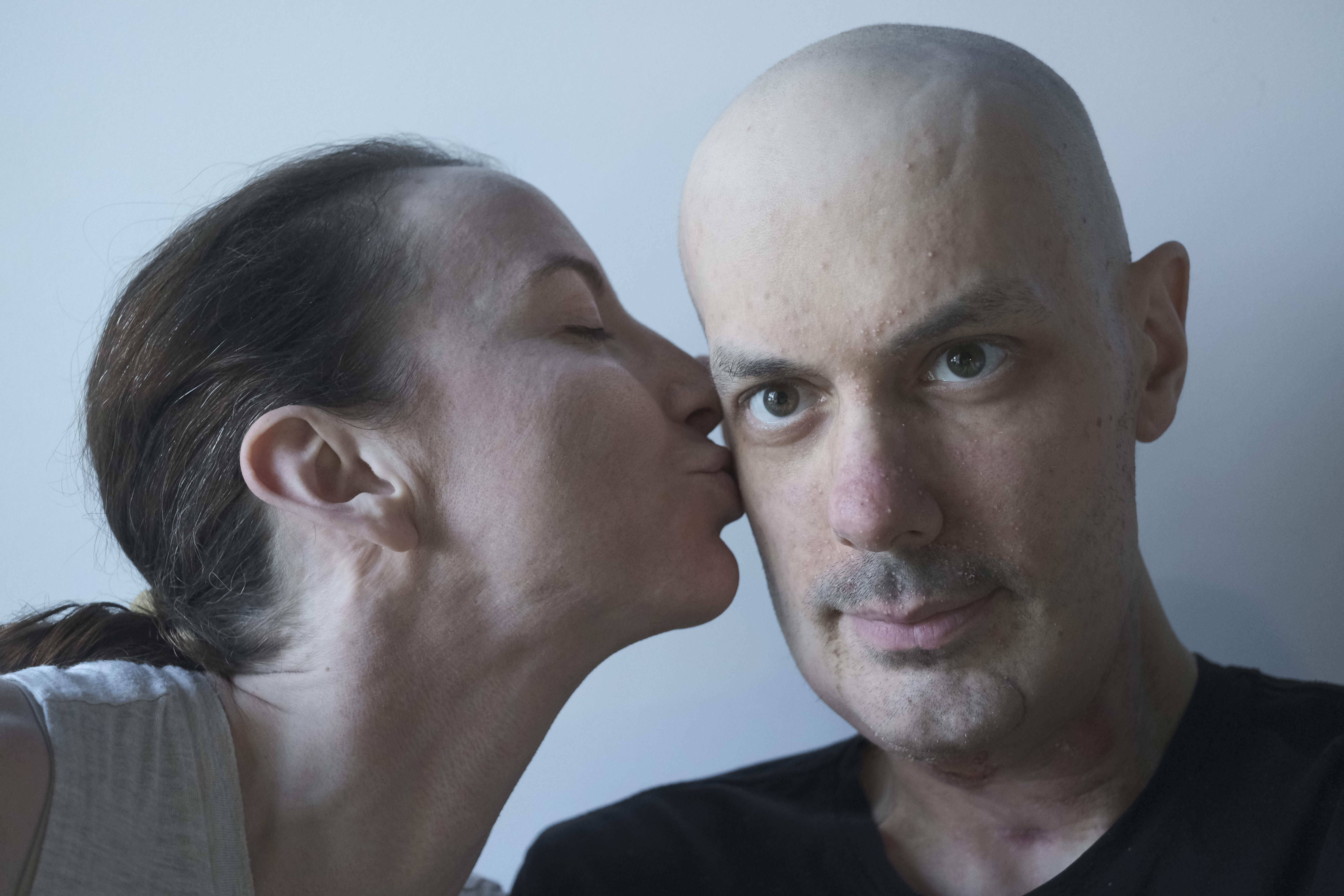
Tentative, fluttering optimism: The R & D ferment in head and neck cancer treatment

An oncologist at UCLA told Bess and me that “Head and neck cancer has become a hot R & D area in the last year,” which I find exciting: moving from “a death sentence” to a “a hot R & D area” is great, since I have recurrent and metastatic neck cancer. It started in my neck and has since reached my lungs; if it reaches much further, no clinical trial will be able to help me. I’ve read and quoted research summaries like this one: “Recurrent / metastatic SCCHN [squamous cell carcinoma of the head and neck] have poor prognosis with a median survival of about 12 months despite treatments.” Sounds bad, right? Based on those research summaries, and based on my tumor’s aggression, hitting the median survival range of twelve months seemed unlikely, and in response to those research summaries I wrote essays like “I know what happens to me after I die, but what about those left behind?” But now I’m starting to feel some tentative, fluttering optimism.

Some of that tentative, fluttering optimism is downstream of the Nov. 15 news that petosemtamab / MCLA-158 is shrinking the tumors in my neck and lungs. A UC San Diego (UCSD) Medical Center radiologist estimated that my overall tumor burden shrunk an average of 12.5% between Sept. 5 and Nov. 15. That’s great news. In a phase 1 trial, petosemtamab’s median duration of response was six months, implying that, if I’m the median responder, I have until March – April until the drug stops working and my tumors start growing again. Relative to dying, I’m pleased with the results so far, the median duration of response implies that it’d be a good idea to have a gameplan for what to do next before the crisis. The medical system can move fast at times, but it’s best not to rely on it moving fast: some appointments take weeks or longer between initial contact and the actual appointment.

I’ve been taking the advice that Bess and I give in “Please be dying, but not too quickly: The patient’s perspective: The right hand doesn’t know what the left hand is doing,” in which Bess writes of the challenging, arduous bureaucracy that is the modern medicine clinical trial system:

Continue reading

The quality of your life is the quality of the people you get to know: Illuminating the David Brooks way

What’s the purpose of life? The question is annoying and contingent and probably unanswerable, but it’s also important and vital and guides our actions. I’ve been thinking about the purpose of life lately, for obvious reasons related to me prematurely dying, and my answer is congruent with the Brooks answer: life is about other people and our relationships—defined broadly—to them. Okay, if that’s the answer then can we be dismissed and go home to watch TV? Probably not, because the answer demands more elaboration, though most of us sweep it under the rug sometime in our late teens or early 20s and prefer not to revisit it, as if it’s an elderly relative who is no longer really here.

The “What’s the purpose of life?” question is not only annoying but also frequently uncomfortable, since it foregrounds the end, which is, at current technological levels, inevitable. We don’t like the question because we don’t want to ask: are we living up to our potential? Are we achieving our purpose(s)? If the answer is “no,” it’s comforting to ask other, less important questions, like who won the game last night. We can’t always be asking the big questions. Often, we have to be asking: “What’s for dinner tonight, and who’s going to make it?” But we should sometimes ask them, and try to answer.

If our everyday actions are incompatible with what the purpose of our lives ought to be, that argues for course correcting. Course correcting is hard, too, relative to continuing to do what we’re already doing. I’m guilty of coasting because it’s easy. I’m also guilty, though, of a certain fondness for both absurdity and excessively avoiding banalities, both of which lend themselves to not only thinking about hard, unanswerable things, but sorting people in those who are like me and those who are repelled by me. Lately I’ve been dying of squamous cell carcinoma, and when casual acquaintances or distant almost-friends have asked how I am, I’ve tended to answer: “I’m dying; how about you?” (Bess has an essay on this that she’s been noodling around on for a while). Maybe casually and sunnily saying that I’m dying makes me anti-social. Maybe it makes me pro-social. There’s a more serious point lurking beneath the dark humor, though: Let’s skip the small talk and get at something real, whatever “real” means. I don’t wholly know what it means but I often see what it doesn’t mean.

David Brooks’ book How to Know a Person: The Art of Seeing Others Deeply and Being Deeply Seen has an answer about the purpose of life that I more or less agree with, albeit with some caveats and some noticing-of-omissions: he writes that, for a lot of us, the purpose of life is to know other people (and to find the love of a good woman, or perhaps good women, depending). In saying that the purpose of life is other people, Brooks is pushing against the flow of American society, which is becoming lonelier and more disconnected from others than it was a few decades ago:

“The percentage of Americans who said they have no close friends quadrupled between 1990 and 2020. In one survey, 54 percent of Americans reported that no one knows them well. The number of American adults without a romantic partner increased by a third.”

Why are we lonely and prone to suicide? Lots of reasons, presumably, and Brooks says we need not just other people but the specific skills to connect with other people:

People need social skills. We talk about the importance of “relationships,” “community,” “friendship,” “social connection,” but these words are too abstract. The real act of, say, building a friendship or creating a community involves performing a series of small, concrete social actions well: disagreeing without poisoning the relationship; revealing vulnerability at the appropriate pace; being a good listener; knowing how to end a conversation gracefully; knowing how to ask for and offer forgiveness; knowing how to let someone down without breaking their heart; knowing how to sit with someone who is suffering; knowing how to host a gathering where everyone feels embraced; knowing how to see things from another’s point of view.

Brooks also says: “These are some of the most important skills a human being can possess, and yet we don’t teach them in school. Some days it seems like we have intentionally built a society that gives people little guidance on how to perform the most important activities of life.” I find myself agreeing, and yet it seems that most people don’t agree with Brooks or me, or we’d see more change and less loneliness.

Revealed preferences show most, or many, people prefer the problems of loneliness to the problems of connection and relationship. Given the data, maybe loneliness is a symptom of large-scale learned helplessness; unhappiness and isolation begets more unhappiness and isolation as the modern status-quo. Technology also makes being alone relatively more fun than it was, say, 30 years ago, which may push people towards not cultivating the weak social ties that eventually become close friends, lovers, and confidants. Facebook, however, is not going to help you when you need it most—but Facebook also isn’t going to demand help of you. Real connection means reciprocity, which is bidirectional, and it seems a lot of us can’t be bothered.

Continue reading

Finally, some good tumor news, but, also, hacking up blood is probably bad

On Wednesday at Mayo I got unscheduled CT scans, and they show that the squamous cell carcinoma tumors in both my neck and lungs are (mostly) smaller, relative to August 13. There are some new tumors in the lungs,* which is obviously not ideal, but the shrinkage of most tumors is really good. Two tumors in my neck appear somewhat larger, but that could be secondary to the biopsies performed on those tumors as part of the UCSD petosemtamab clinical trial, since biopsies can cause an inflammatory response that can’t be distinguished from new tumor burden via CT.

One other significant piece of evidence supports the theory: that I remain headache-free is a mark in the “this is likely inflammation” column. Regular readers may recall that I didn’t have any treatment for most of September, due to the six-week washout period 🤮 required for the petosemtamab trial, and by the end of that washout period I was getting ominous headaches that later resolved without intervention, apart from the petosemtamab. 

Bess sent a CD containing the CT scan data files to UCSD, because I assume Dr. Sacco, my oncologist there, will want the UCSD radiologists to look at them too.** It’s conceivable that the UCSD radiologists will have a materially different read than the Mayo ones, but I’d guess differences will be small. Considering how many of my guesses about the cancer have been wrong, I should probably quit guessing, but I’m still doing it. If my cancer were a prediction market using real money, I’d be broke by now from getting so much wrong.

“But Jake,” you might ask after reading the preceding paragraphs, “you said previously that your CT scans are scheduled for today? What gives?” 

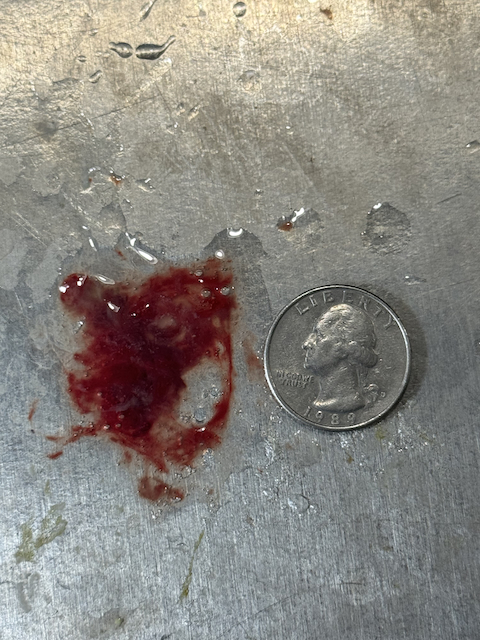
I’m glad you ask, or might ask, or accept me putting words in your mouth for purposes rhetorical: on Wednesday morning I woke up and, per the usual, trundled half-asleep to the kitchen. As I’ve done hundreds of times since the May surgery that took my tongue, I drank some water and expelled the mucus plugs in my throat. I grabbed the faucet to wash away the results, but said results woke me right up because I saw something bizarre: the mucus plugs were…red. Red? Why red? Is that blood? Sure looks like blood. Looks like blood came out of my throat. There more where that came from? What’s the cause? 

I called to my personal physician: “Can you come look at something?” Much later, Bess said that “Can you come look at something?” has become her least-favorite query, especially if it’s coming from the bathroom or, now, the kitchen, because it usually means something confusing or bad (or both) is on my body, in my body, or coming out of my body. In the moment, Bess examined the bottom of the sink and said, authoritatively, indeed with all the authority that comes from medical school and a decade and a half in medicine: “That looks like blood.” I concurred, though without her authority. If you’re the sort of person who wants to see for yourself, scroll to the very bottom of this essay for the pictures. They’re deliberately way down there so that people who don’t want to see them are less likely to.

She dropped immediately into doctor mode and started quizzing me, to the point that I felt like I was a multiple-choice medical exam. I told her: no pain, no trouble breathing, no idea apart from the obvious where it’s coming from. She used a phone light to look in my mouth. Nothing. For the first time in a while, she didn’t poke anything with or without warning me first. Possibly, because she was afraid of irritating whatever was the source of this morning’s exciting new symptom. I spit some more, hacking much more gently this time, and we didn’t see much that was bloody, but we didn’t have a cause. I tasted a little blood in the back of my throat. I’ve probably not become a vampire with an insatiable desire for humans, unless the vampire part of my nature also includes amnesia (Bess’s reports of fang marks on her upper arm are patently false: fake news, nothing to see here). 

What to do? We planned to go to the ER, because active bleeding in the throat is not good. I’ve not been to medical school except through proximity, but “active bleeding in the throat is not good” was my expert medical opinion. As we got ready, Bess thought to call the Mayo ear, nose, and throat (ENT) department, because the likely outcome of the ER visit would be an ENT consult, in which an ENT resident comes down to the ER and does a “scope.” A “scope” means spraying some numbing medication into the nose and then sliding a tiny camera up there and then snaking it down the throat. If you’ve cleared a drain, the action is not dissimilar. It’s not a fun, comfortable process, but I’ve now had it done a bunch of times and it’s not the worst procedure either. 

Before we left for the ER, Bess got an ENT appointment with a PA at 11:00 a.m. Great: easier than the ER—cuts out the middleman. I sent a Mayo portal message to Dr. Hinni’s account, which is usually monitored by a nurse. Dr. Hinni is the surgeon who led both my surgeries; coincidentally, I’d seen him Monday for a routine follow-up. He’d looked around in my mouth with a little mirror and said I look great. It must be disappointing to be a doctor, doing all this great work, only to have the great work you’ve done up and die on you. Maybe it’s like carving pumpkins or ice sculptures, knowing that the work is doomed to transience. Anyway, the hoi polloi like yours truly use the Mayo portal, but Bess is among the exalted elect who work for Mayo, and on whom the Mayo light shines down always, so she sought her favorite backdoor: she checked Microsoft Teams, that blesséd communication tool of Mayo insiders, and saw that Dr. Hinni’s PA, Tony Mendez, was online, so she shot him a message, along with the photos showing what had come out of me. 

Tony replied within a few minutes saying we could come right in, but Bess didn’t see that message, so we went in for the 11:00 a.m. appointment. Fortunately, Tony was available then, which matters for continuity of care and speed of care, since he’s already familiar with me and my many maladies. We’d have a lot less catch-up with him than with someone new. 

Tony scoped me, as expected, and the scope didn’t show much; he didn’t even spot the fangs that I of course don’t have. He saw some granulation tissue in one or two spots, which indicates something healing or scabbing over. Granulation tissue is relatively good, Tony explained, because tumors don’t granulate over. Tumors just cause more problems, and it didn’t immediately appear like a tumor was pushing into my throat. It does not take advanced degrees to know that is good.

He pressed firmly on each of the tumors on either side of my neck without warning (what is it with medicals poking you without telling you first?) while the scope was in my throat, and he was relieved to see that the necrotic tumor tissue that’s been draining out of the left side of my neck since the events narrated in “What in the hole is this? A medical mystery story” wasn’t draining inward. One side of the throat showed some peculiar ridges that could be the result of a tumor pressing in, but that could also be from any number of other things, including a problematic hyoid bone. A hyoid bone horn could be poking in. That day I learned that not only rhinoceroses, Satan, and brass instrument sections have horns: the hyoid bone does too. 

Not finding active bleeding was good, but Tony was concerned that an artery could be leaking blood. The lingual artery ends prematurely and was cauterized as part of the massive May 25 surgery, so it was a prime candidate. In medicine there’s a term called a “sentinel bleed,” which basically means a relatively small bleed from a vessel that precedes a massive, very dangerous bleed from that same vessel. It’s like noticing a small leak in a submarine and going, “That leak is not likely to stay small.” It’s like hearing the floor creak in a horror movie moments before the jump shot of the monster bursting forth from the closet. It’s like all sorts of terrible metaphors—the sound of shattering glass, a strange flash of light, the sudden smelling of toast— that would make you say “huh, that’s strange” before everything collapses.

Anyhow, metaphors aside, sentinel bleeds can happen with aneurysms in particular: a little blood in the brain causes a headache, and that precedes the fatal aneurysm. If you ever suddenly feel “the worst headache of your life,” get you to an ER ASAP and tell the triage nurse “I’m feeling the worst headache of my life,” cause it might herald an aneurysm.

In my case, Tony wanted to check for bleeding with a contrast-enhanced CT scan, that would make the vessels light up and reveal any leaks or signs of a tumor eroding into the vessel. He didn’t think that such a bleed was likely, but it was possible, and fatal if it occurs. Catching it would allow emergency surgery to tie off or attempt to cauterize the vessel, or, more likely, to give interventional radiology a chance to perform an “embolization,” in which they use a catheter to seal off the vessel with a coil or some kind of plugging material (I am told that “spackle” is not the correct term). Even so, the surgery or embolization could fail because tissue behaves badly secondary to radiation and tumors. If I were bleeding and elected for surgery, I might still die, but I’d have a shot. Bess and I told Tony that on Monday, Nov. 20 (that is, today), I was supposed to get some CT scans anyway, so he threw the chest and abdomen CTs on too. Why get contrast injected twice in a ~five-day span?  

So Bess and I walked to scheduling, where a nice woman named Jenny mounted a spirited effort to get me a CT scan slot. Mayo is good at many things, but getting scans done expeditiously is often not one. Jenny wore bright blue contact lenses over her brown eyes, which gave her a kind of uncanny-valley-meets-mystical appearance, and it felt a little like she’d been hired direct from Arrakis to work the Mayo front desk. She sent me to have my creatinine—a measure of kidney function—drawn by the lab, since healthy creatine levels are a requirement for receiving the IV contrast I’d require for the scans.

The only available CT appointment was initially 5:10 p.m., but Bess worked the system some by intimating, vociferously but not inaccurately, that, if I needed emergency surgery, it would be best to find out during business hours. Jenny got the Mayo Scottsdale campus to slide me in. Score! We drove over. I wanted to stop on the way at J L Patisserie for snacks,*** but J L was barely yet distinctly too far out of the way. At Mayo Scottsdale I got into the CT area quickly, although the IV necessary to deliver contrast had me crying and whimpering from the pain of needle insertion. My veins are by now well scarred: they may be prominent, but they’re horribly damaged, like some political figures. Anyway, the IV did its job and I got scanned. 

The first paragraphs of this essay relay what the scans found, since that’s the most important thing and in almost all writing, you should start with the most important thing.  People are TERRIBLE at this. I remember this conversation between Tyler Cowen and Dave Barry on the subject

BARRY: There are certain fundamental things that businesspeople have trouble with [in their writing].

COWEN: What’s the main thing they get wrong from the business mentality?

BARRY: OK, the most consistent mistake . . . not mistake, but inefficiency of business writing — and it was very consistent — is the absolute refusal on the part of the writer to tell you right away what message he or she is trying to deliver. I used to say to them, “The most important thing you have to say should be in the first sentence.” And “Oh, no, you can’t. I’m an engineer. We did a 10-year study, this is way too complicated.”

And inevitably, they were wrong. Inevitably, if they really thought about it, they were able to, in one sentence, summarize why it was really important. But they refused to do that because the way they found out was by spending 10 years of study and all this data and everything, and that’s the way they wanted everyone to look at what they did. They wanted their supervisors to go plowing through all they had done to come to this brilliant conclusion that they had come to.

Today’s top takeaway, for example, is that the tumors in my body are mostly smaller, so I lead with it. The tumors-being-smaller thing is good from a longevity perspective and alleviates some immediate logistical challenges because I’ll continue petosemtamab for two additional months, barring the unexpected. Being ill admittedly means expecting the unexpected; I didn’t have “hacking up some blood from my throat” on my expectations list for last week. The good news about the CT scans is more important than the fact that we got the results of the CT scans while we were in the parking lot of a juice place called Kaleidoscope, picking up a cherry smoothie whose cherry pieces Bess thought looked a little too much like the blood I’d brought up that morning. She thought the observation a little gross, but interesting from a thematic perspective (ER doctors routinely compare foods to things they’ve seen at work, which does not always make them popular dinner guests). 

After Bess and I got home, Tony called us to say that he showed the CT scans to Dr. Hinni, and together they traced the arteries in the neck and concluded that there don’t appear to be any bleeds there, or any tumor eroding or compressing the vessels. Great news! The radiologist, Tony, and Hinni have all looked carefully at my insides, from the outside, and concluded that important parts of my insides are likely to stay in their proper channels.

So what happened? We’ll never know for sure. Some causes could include that 1. I’ve been hacking too hard in attempts to expel mucus, or 2. the petosemtamab is affecting the skin inside my throat as well as the skin on my body, or 3. granulation tissue (which can show up even months after surgery, particularly in people who have already been messed up by radiation). Whatever the cause or causes, if the bleeding doesn’t seriously recur, then the blood I hacked up somewhat random episode in an illness that’s been a relentless parade of boredom and pain, punctuated by terrifying and annoying episodes.

Instead of doing the writing Bess and I were supposed do on Wednesday, we spent a bunch of time in the hospital. To be sure, I don’t want to sound ungrateful for that, and not dying was and is good. Things went about as well and as fast as they could have, given the circumstances. We both got lucky, and the system worked. Tony was great! As he’s been since we met him. And yet we were still gone for like six hours, taking care of business—the business, that is, of healthcare. “The more things go wrong, the more things going wrong,” which went up last week, is highly congruent with the recent episode.

That night, to celebrate the good news from the scans Bess picked up some takeout from what used to be one of our favorite restaurants, FnB, and the food was…okay. The last bunch of times we’ve either been there (Bess) or gotten takeout from there (me), the food has felt a little phoned in. It’s never been bad, but we find ourselves looking at a dish of, say, shaved kohlrabi, cheddar cheese, lettuce, and horseradish, and we think: “Well shit, we can make that in a few minutes and for a lot less than $20.” The food used to be consistently magical, and in the last, I don’t know, six months, maybe more, it’s been less exciting. By now it’s hit that nexus of “less exciting” and “more expensive” that make us look elsewhere. Bess confirms that, although the months of disappointment with FnB correlate to my months without a tongue, the food quality has declined even when the dishes are eaten with physiologic structures intact. The Arizona challenge remains, however, in that there aren’t a lot of good or even interesting-looking restaurants, let alone really good ones, let alone great ones. I may have spent two months unable to eat via mouth, and now I can only do slurries, but I want to at least try for interesting slurries, while I can.

I have to fly to Houston on Nov. 27 to see MD Anderson on Nov. 28, and then fly home Nov. 29. Today we’re going to San Diego for a petosemtamab infusion, the week after, Houston, the week after that, San Diego again. Being sick is a full-time job—Wednesday’s adventure is thematically consistent with this—except one that you pay for instead of being paid. At least the CT scans indicate that I’ll get to spend more time with Bess, and with you, for which I’m grateful. 

If you’ve gotten this far, consider the Go Fund Me that’s funding ongoing care.


* In radiologist-speak: “New areas of nodularity and patchy airspace disease in the lung bases.” It appears that the radiologist caught two new nodules: “New 6 mm nodule in the right lower lobe” and “New nodularity and patchy airspace disease in the posterior left lower lobe.” But if a bunch are also “stable or decreased from prior,” that’s pretty good.

** That the most-efficient way to send medical imaging is still via plastic disc is insane, but that insanity is not today’s topic and it will have to wait for another time. The whole “share medical records via the EHR system” thing still doesn’t work seamlessly, to put it lightly.  

*** Bess says that I am “like a Labrador retriever in human form.” This furthers her argument, I realize. My tail does wag at the prospect of one of their chocolate cookies.

Read more: Finally, some good tumor news, but, also, hacking up blood is probably bad

The more things go wrong, the more things going wrong

When you’re robust and things go wrong, recovery happens quickly: the hamstring aches for a few days, then returns to functionality. The broken arm is an annoyance, but the cast comes off and it’s not hard to hit the gym and build back strength. The cold or flu might linger, but it dissipates. I used to be robust and, like most robust people, I unconsciously assumed robustness as the natural state of my world. Now I’m not, and the painful premature slide from robustness to fragility is foregrounded every day. After my initial Oct. 20, 2022 surgery, I recovered relatively fast; sure, I woke up with a piece of my tongue gone, but I could swallow watery smoothies the night of. I rapidly got up and walked unaided. Though the surgery aftermath and recovery were uncomfortable, I could perform the bodily functions necessary for discharge from the hospital—namely, peeing. So, I peed the night of, which got marked in my medical chart, and the day after the surgery I got to go home. I achieved independence fast.

Back then I had a lot of physical margin for illness: I lifted weights, I didn’t eat much sugar, I used a Levels Health glucose monitor (rice is much worse for glucose levels than I’d realized). The surgery could have been much harder and thus the subsequent recovery harder, but it wasn’t and my baseline level of health made me better prepared than if I’d ignored nutrition and motion. I had some social margin, too: I was in a relationship with my now-wife, Bess,* who helped tremendously: it’s hard to do life alone, and it’s harder still when sick.

Bess was there when the news came down that the tumor showed bad features, like “perineural invasion” (PNI) and “extension through the base of the mouth into the geniohyoid,” and I got assigned radiation therapy to the head and neck. During the roughest stretch I was taking 10 – 15mg of Oxycodone every three hours, on top of gabapentin,** Tylenol, and ibuprofen. Yet I’d prepped for radiation, too, as best I could: I resumed going to the gym as soon as I could, and I ate as much as I could get down in order to try gaining weight.

During an education session about the radiation process, Dr. Patel, the radiation oncologist, emphasized the need to conscientiously comply with radiation mitigation strategies and avoid, if possible, hospitalization for radiation side effects. He said something interesting—well, he’s an interesting person who says many interesting things, but this one stood out—the people who wind up hospitalized and struggling are usually the ones who are alone. No one is watching and helping, and they consequently don’t have the strength or ability to mitigate the potentially devastating radiation side-effects. Having stumblingly endured radiation with help, I see how and why someone without help wouldn’t be able to do all that needs to be done. Apparently, there are a lot more of those people than I’d naively thought. The articles and books about the increasingly loneliness and disconnection of Americans are manifested in the healthcare system.

During radiation I suffered from many maladies, but not loneliness or lack of aid. Bess, for example, made me a steady diet of Kodiak Cakes and smoothies. The Kodiak Cakes were the unanticipated, relatively high-protein staple of my diet. Usually I cook, but Bess ensured that I ate even when the thought of food made me feel a range from “ennui” to “dread.” Thanks to Bess and my family, I had not only the physical robustness, but some social and financial robustness, too.

When you’re fragile, one thing going wrong cascades into other things going wrong. That first cancer surgery wasn’t pleasant, and I wouldn’t recommend it to friends, but it was successful, in that Dr. Hinni, the ENT who performed the surgery, got clean margins and removed lymph nodes (none cancerous) from the left side of my neck. The radiation series left me with a literally stiff neck and other weaknesses, but, as I wrote in “Life, swallowing, tasting, and speaking after a total glossectomy (meaning: I have no tongue)” the damage leaned cosmetic more than structural. I tried to recover from the radiation, and I did well enough to teach an English class that began the first week of February, 2023.

In Antifragile: Things That Gain From Disorder, Nassim Taleb claims that “Some things benefit from shocks; they thrive and grow when exposed to volatility, randomness, disorder, and stressors and love adventure, risk, and uncertainty. Yet, in spite of the ubiquity of the phenomenon, there is no word for the exact opposite of fragile.” He’s right in that “Some things benefit from shocks” (emphasis added) but, if the human body benefits from the shock of having part of one’s tongue removed, and then radiation therapy, I’m not aware of it and haven’t experienced any benefit. Some stressors, like the squat and deadlift, are good for the body. Others, like tongue removal or chemotherapy, are not, though they’re better than cancer. Taleb says that “Complex systems are full of interdependencies—hard to detect—and nonlinear responses.” Cancer likely qualifies as the sort of thing that creates a nonlinear, negative response. Friends and acquaintances have expressed shock and worry that I’m the one who got hit with squamous cell carcinoma (SCC) of the tongue: I have no risk factors and a bunch of relatively healthy habits.

After the recurrence and the “salvage surgery” that left me tongue-less, I’ve become fragile. Immediately after the surgery, I couldn’t walk unaided, because a huge piece of muscle and tissue had been removed from my left thigh to create the “flap” of tissue that inertly replaced my tongue. A fall would likely have been fatal. The last essay I wrote, “What in the hole is this? A medical mystery story,” is essentially about the dangerous medical cascades I’m prone to. Someone poor experiences a financial shock as a disaster someone with more money can withstand or even barely notice; someone sick experiences even a minor medical problem as a disaster, because, after a certain critical mass of illness, no setback is actually minor:

As of October 20, I’ve undergone a year of medical harassment / treatment, though I’m unlikely to undergo another. I’ve been conditioned by experience to always expect a new problem. Perhaps the most recent is Augmentin causing a fungal infection in a place where one really does not want a fungal infection.

The preceding paragraph also helps explain why travel is no fun. Friends have asked if I want to do a dream vacation. I see where they’re coming from, but until recently I was relentlessly exhausted by surgery, chemotherapy, and infection. I’m doing somewhat better, but I still feel on the verge of catastrophe. Weight is part of it: I’ve lost around 40 lbs and worry about starvation. That is not a joke. Most of my calories are injected into my peg tube, and I “eat” from pouches of Liquid Hope. The TSA won’t let Liquid Hope pouches through airport security theater, so I have to check them in a bag. If I show up somewhere and my bag—containing the food I have to eat, the syringes I have to use to inject it, and so forth—doesn’t, that’s an immediate crisis. I can’t buy peg-tube food in a grocery store. If I don’t have, or lose, medications like antibiotics when I need them, that’s a crisis. I don’t know what the next potential crisis might be, but I want to avoid it. Acquiring Covid on an airplane or in an airport could result in a crisis.

Crisis, disaster: those are always lurking in my mind, sometimes consciously and sometimes unconsciously, and everything I do or, more often, don’t do is controlled and informed by the disaster worry. The number of things I can do shrinks, and the number I can’t grows. I mourn what I could do in the past and can’t now, though I seek to emphasize the positive aspects of the here and now. Fragility means feeling like my body is betraying me, every day. It’s looking in the mirror and seeing a half-dead ghoul looking back. It’s the cruelty of disfiguration. It’s the choking on food. It’s the full body rash and my skin cracking and peeling from the petosemtamab infusions, it’s the cuts on my thumbs and heels that won’t heal properly. It’s the fear of catching a cold, because I already have so many problems with mucus. It’s the social isolation, “social isolation” being another term for “social fragility,” because speaking is now so hard that casual chat isn’t casual and subsequently doesn’t happen. The words coming out of my mouth trip over each other like drunks incoherently trying and failing to get out of a car successfully.

The sick really inhabit their own—our own—world. Beyond being isolating, it’s the world of missed connections. I read the David Brooks book How to Know a Person: The Art of Seeing Others Deeply and Being Deeply Seen, and it describes the fragility of true, intimate connection and how you can miss a momentary something and inadvertently degrade the moment:

I realized that I have to work on my ability to spot the crucial conversational moments in real time. I have to learn how to ask the questions that will keep us in them, probing for understanding.

It’s easy to miss these moments in conversations with friends, and it’s almost impossible to force them. We can try to set up conditions for the crucial conversations, but truly having those conversations is unpredictable, like good ideas: good ideas sometimes arrive at the most unexpected moments, but the people who are actively seeking them out and trying to harvest them are more likely to find them. My ability to seize the promising conversational moments has been retarded, though not yet entirely eliminated. I’m still trying to have Brooks’ crucial conversations with friends, however much I sense the relentlessly missed connections. I say something that’s too garbled to be understood; my friend stops and asks for clarification; we never quite achieve the right rhythm. Brooks speaks of talking to a dinner partner who said that: “He’d be in the middle of an important meeting with someone and his mind was always going back to reconsider something that had already happened or leaping forward to think about something he had to do later in the day.” Too late, Brooks realizes:

That was an important confession! I should have stopped him to ask him how he had become aware that he had this weakness, had this flaw marred his relationships, how did he hope to address the problem?

The moment is lost to time. For me, fragility means so many of those moments are lost to time, or they never happen due to exhaustion, nausea, and the challenges of speaking at all. I try to compensate via writing, but the writing is still a compensation. Most people don’t like writing and can’t maintain relationships primarily through text. I have a few friends who are like me and can, but I recognize that that ability is rare and weird.

My life feels like it has, and I have, been reduced and reduced and reduced. One friend wrote to me that: “NO, SUFFERING DOES NOT MAKE YOU LESS HUMAN.” He’s probably right, and yet I waver in believing him. Suffering might be the human condition, the link that binds us, but in limiting the way I connect with other humans, it somehow makes me feel both far from everyone else and also further from myself. Maybe my friend is right and being human means being isolated by the unique experience of our own personal decline and mortality. We ultimately face it alone, together.

Still, it’d be nice to feel like the “together” part isn’t being degraded by my deficits. You miss something in the conversation, and that miss degrades the connection a little. The parallel to the body’s fragility is probably obvious, but, to make it explicit, fragility means that missing something might initiate a crisis that ruins your body altogether. It might mean dying. It means losing days and days to medical treatment. A single ER visit for a dislodged PEG tube, the replacement of which takes two minutes now that the tract is fully formed, still somehow eats up at least five hours of a day. That’s five hours I don’t have to spare, but at least the PEG tube replacement is a simple repair (I know: I sound like a bike in the shop). At what point is something beyond repair? At what point am I reaching the point of no return? Do you always know the tipping point? I don’t think I do, not now, but the final tipping point is close, and at some unknown, lurking point soon I’ll fall forever.

If you’ve gotten this far, consider the Go Fund Me that’s funding ongoing care.


* She has her own Substack, too, per the link.

** Gabapentin dampens nerve response and consequently has the unfortunate side effect of dampening sexual ability and response to near non-existent, so it’s testament to the discomfort of radiation that I continued to take every dose on a fixed schedule.


Check out that petosemtamab rash: apparently, most EGFR inhibitors cause rashes.

What in the hole is this? A medical mystery story

Three weeks ago, Bess and I noticed what we assumed to be three large whiteheads on the right side of my neck. “Weird,” we thought, “but the petosemtamab is provoking an acne-like rash, and whatever that is, since it looks like acne, it’s probably part of the rash caused by the drug.” I’m sensitive to growths on my neck, given that there are four or more tumors in there, and I’ve received radiation on it, and it’s been operated on multiple times. My range of neck motion is maybe 30% of what it was before cancer. Anyway, Bess and I talked to Dr. Sacco, my oncologist at UCSD, about the apparent whiteheads before the last petosemtamab infusion, and Dr. Sacco gave Bess the go-ahead to lance the whiteheads with a sterile needle.

A procedure! ER docs like Bess love procedures. She once did a thoracotomy, which requires the doctor cut through the patient’s fourth and fifth intercostal space, spread the ribs with a “rib spreader” (it is what you think), and use their hands to manually pump the heart. In movies and novels, it’s always the villain who wants to hold someone else’s still-beating heart in their hands, but in real life sometimes the heroes get to do it. Anyway, this procedure was less involved. Bess cadged a needle from an appropriate source that’ll go unnamed here and gleefully lanced me the day after we saw Dr. Sacco, cackling the whole time about how “she who wields the sword, has the power.”* I was afraid but did not die, though a bunch of gunk flowed out when Bess massaged the area after the lancing. Bess didn’t know precisely what the gunk was. It seemed thicker, more copious, and less odorous than would be expected from a small abscess. Whatever it might have been, it was out and we hypothesized that that was probably good. The experience was moderately painful, and I tried to think about other, positive things, like mild sun on the beach, or a viewquake, or nutritious-yet-tasty foods like peanut butter.

As you’d assume from a lifetime of imbibing competently created narratives, I am not in fact introducing the idea in the previous paragraphs only to let it peter out. I more or less successfully focused on matters other than my neck until a week from last Friday night, or, more technically, Saturday morning, when I woke up at 4:00 a.m. I went through the usual drink-water-and-hack-up-mucus drill, which is unpleasant but also now a consistent part of my life, and I was getting ready to inject a small amount of nature’s sleep aid into my peg tube when I reached up to scratch my shoulder and felt something wet and slimy.

Even my sleep-addled brain registered “wet and slimy” as notable. “Shit,” I thought. “What’s that?” Wet spots out of place (heretofore known as WSOP) are often medically ominous. In the bathroom, I flipped the light on, annoyed that I was probably destroying my ability to get back to sleep, but I also saw hummus-like goo along my right shoulder and neck. I understood that there was almost no way the WSOP could be hummus, which has never dripped on me from the ceiling; to enjoy hummus, I’ve always had to work for it, and I’ve never had it, or chocolate, or peanut butter, drip spontaneously on me, or from me, for my own delectable satisfaction.

“Whatever that is, it can’t be good,” I thought. I went to the bedroom and woke Bess, but I mixed up the order of things I told her: instead of saying: “I am okay, but can I show you something?”, like I ought to have, I said: “Can I show you something?” Seeing her go from “sleepy” to “alarmed” in the space of my sentence, I properly added: “I am okay.” Considering how quickly she jumped out of bed, I don’t think she believed me. She’s highly skeptical of anything that comes out of a patient’s mouth (or mine), in the manner of most ER doctors. Doctors hear too many medically implausible or impossible stories. She followed me into the bathroom and examined the WSOP running along my neck and shoulder, and she agreed that that couldn’t be good. Learning that she too thought that that couldn’t be good made me feel better about my medical judgment., but not better about the actual situation. Though it couldn’t be good, Bess also couldn’t say exactly what it was (useless ER doctors). It wasn’t fluid like pus, and it didn’t smell like necrotic tissue. It also, thankfully, wasn’t bleeding, or squirting or spurting or any other number of alarming gerunds that would have required a call to 911. She called upon her considerable medical prowess to confirm that 1. there was a small hole and deduced that 2. the small hole was where the substance was coming from. I felt reassured.

She pressed on the area around the hole without warning, also in the manner of ER doctors, to see if more would come out. More did. The mystery was at least partially solved. Apart from the hole, the right side of my neck had also been getting steadily redder over time, and we couldn’t help noticing that the redness seemed to have accelerated. Yet I was breathing, didn’t have a fever, and wasn’t showing any signs of septic shock, so a 4:00 a.m. ER trip wasn’t merited. We cleaned up the WSOP goo that had erupted from the side of my neck and went back to bed. Once we’d determined the need for immediate, emergent medical intervention wasn’t necessary, the next-best clinical step was “ignore it and go back to bed.” We’d look again in the morning.

Saturday morning, we saw that the goo had continued to leak all over me in the night. I’d gone from the general “feeling bad” that I’d been suffering to “feeling totally awful, as if I was being colonized by some alien organism.” The hole was still there and the skin around it had gotten redder and angrier, which made me think I’d have to go the ER despite not wanting to. The bottom half of my face was hideously swollen, too. Choose your animal analogy: rabbit, chipmunk, bulldog. Bess assumed a skin infection. I was wondering: “Why does this shit always happen to me on the weekend?” The peg tube has spontaneously come out of stomach twice, and both times on a Saturday, necessitating ER visits when interventional radiology (IR) wasn’t readily available to put a new tube in the hole. Going to the ER is expensive and time consuming, and it’s where the sick people are.

Bess tried to contact UCSD’s oncology department, but, it being Saturday, no one was home, so she tried ear, nose, and throat (ENT). Got a resident! He said the hummus-spewing volcano might be a necrotic, infected lymph node, and as soon as Bess heard that she realized that that read could be right. If the problem was a necrotic lymph node, that also means an abscess running deeply and dangerously into my neck was less likely. The resident asked us to send pics and said he’d call his attending, Dr. Califano,** and get back to us. Bess took a bunch of pics in which I look close to as hideous as I’ve ever looked.

Hours passed. Bess and I debated going into the ER despite having already begun the grinding of the medical gears. A CT could rule out a deep abscess, and I was feeling increasingly bad. But going to the ER sucks even if you’re being paid to work there, and it sucks worse as a patient paying to be there. Around 2:00 p.m., we got antsy and Bess called the ENT back. The resident picked up and said he was about to call us back—a likely story— to say Califano agrees that it’s likely a necrotic lymph node surrounded by a raging skin infection and that I should start an antibiotic called Augmentin.

We didn’t manage to acquire the Augmentin until 6 p.m. that night, and I injected it into my peg tube right away. By Sunday morning, I was feeling better and the swelling had declined some. Despite the experience being bad, it probably would’ve been worse if it’d happened Tuesday, when I was scheduled to fly to San Diego. I was being infused with petosemtamab on Wednesday and then, conveniently, seeing Dr. Califano for a repeat biopsy required by the study. There was (and still is) an enormous tumor growing out from the left side of my neck anyway, so I figured it ought to be easy to punch.***

“Easy,” I read in the preceding paragraph. “How much of the cancer and treatment experience so far has been easy?” I’m not a believer in fate, and yet I superstitiously felt like I was whacking Fate with a rolled-up magazine and daring it to bite me. (For once, Fate did not bite me, and the biopsy was in fact easy.)

With the infection identified—and the hummus-like WSOP determined to be whatever goo makes up an angry lymph node—I also understood why I’d been so torporous in the preceding weeks. I kept getting up absurdly late and being unable to function for hours. At most I’d have a few hours of relative energy. I’d berate myself and say: “This isn’t you. This isn’t like you. Who are you?” And then I’d sit in an exhausted haze instead of doing that which needs to be done. I read an inspiring book called Grant’s Final Victory: Ulysses S. Grant’s Heroic Last Year (you might’ve heard it alluded to in the Daily Stoic podcast), and Grant appears to have died from a squamous cell carcinoma of the tongue, caused by cigars. Grant spent much of that year writing his memoirs, hoping they’d provide financial security to his family. He and I are unalike in many ways, but this we have in common.

Grant wrote with a pen, I write with a Kinesis Advantage 360 keyboard featuring Box White switches, but the basic thrust of trying to write a memoir in hopes that it helps those who come after is similar. I get, too deeply, this problem:

Of the doctors, at this point the microbiologist and surgeon George Shrady spent the most time with Grant. He tried to keep his visits brief, because he sensed how much Grant wanted to press on with his daily writing.

Doctors back then and doctors today suck up a damned lot of time! Fortunately, my personal physician is also my best editor and reader. She is in fact reading this over my shoulder right now, as is her wont.

Anyway, Grant was worse off than me in many dimensions, and yet his writing example is one I need to better follow. The infection took a lot out of me, and Bess speculates that it was an “indolent” infection. My ears perked when she said that, because “indolent” typically means something like “wanting to avoid activity or exertion; lazy.” I’d been feeling indolent for weeks, but I’d not known that bacterial infections could also be lazy. But, ah-ha, there is a second definition! “Medicine (of a disease or condition) causing little or no pain. (especially of an ulcer) slow to develop, progress, or heal; persistent.” The infection caused little pain and didn’t progress much, thus allowing it to linger and sap me of vitality.

Being ill makes me feel like there’s always something: surgery, chemotherapy, travel, and now infection. Or maybe I should add: “and now Augmentin,” because the Augmentin is doing bad things to my stomach and digestive tract. Better than death but still frustrating. At the end of Tom Wolfe’s novel The Bonfire of the Vanities, Sherman McCoy, former bond trader and master of the universe, protests to reporters that “I have nothing to do with Wall Street and Park Avenue. I’m a professional defendant. I’ve undergone a year of legal harassment, and I’ll undergo another.” I’m now a professional patient, which is to say a professional sick person. As of October 20, I’ve undergone a year of medical harassment / treatment, though I’m unlikely to undergo another. I’ve been conditioned by experience to always expect a new problem. Perhaps the most recent is Augmentin causing a fungal infection in a place where one really does not want a fungal infection.

The preceding paragraph also helps explain why travel is no fun. Friends have asked if I want to do a dream vacation. I see where they’re coming from, but until recently I was relentlessly exhausted by surgery, chemotherapy, and infection. I’m doing somewhat better, but I still feel on the verge of catastrophe. Weight is part of it: I’ve lost around 40 lbs and worry about starvation. That is not a joke. Most of my calories are injected into my peg tube, and I “eat” from pouches of Liquid Hope. The TSA won’t let Liquid Hope pouches through airport security theater, so I have to check them in a bag. If I show up somewhere and my bag—containing the food I have to eat, the syringes I have to use to inject it, and so forth—doesn’t, that’s an immediate crisis. I can’t buy peg-tube food in a grocery store. If I don’t have, or lose, medications like antibiotics when I need them, that’s a crisis. I don’t know what the next potential crisis might be, but I want to avoid it. Acquiring Covid on an airplane or in an airport could result in a crisis. Some opportunities, if they aren’t seized in the moment, are forever foreclosed. I don’t want to sound boring, but a lot of my life entails trying to think a little ahead of health problems. For me, the best days are ones with maximum energy and minimum problems. Ideally, ones where my lymph nodes don’t explode. I hope to have more of those, before the end.

If you’ve gotten this far, consider the Go Fund Me that’s funding ongoing care.


* Okay, this didn’t actually happen, but it’d be funny if it had.

** I keep mistyping his name as “Dr. California.”

*** As in, punch biopsy. I’m not suggesting that Dr. Califano was going to punch me in the neck with his fists. He seems like a lover, not a fighter, but I can’t be sure, and will try not to elicit violence from him.

Puzzles about oncology and clinical trials

Some things about the clinical trial process—and the behaviors of the drug companies, hospitals, and oncologists that are part of the clinical trial process—puzzle me, because I notice problems and common, suboptimal practices that seem easy to fix and yet, from what I’ve experienced and observed, they persist. That slows medicine and science, which is euphemistic way of saying: “more people die, sooner, than would by using better practices and processes.” Patient care and outcomes suffer. Hard-to-fix problems like the FDA aren’t readily solved because those fixes likely demand congressional action, and most congresspeople aren’t pressured to act by voters, and the potential voters most interested in FDA reform have probably already died, or are in the process of dying, and thus are unable to make it to their local polling place.*

“Puzzles about oncology and clinical trials” is a companion to “Please be dying, but not too quickly: A clinical trial story and three-part, very deep dive into the insanity that is the ‘modern’ clinical trial system. Buckle up.” The clinical trial system could be a lot worse, and many treatments obviously get through the system, but, in its current state, the clinical trial system far from optimal, to the point that I’d characterize it as “pretty decently broken.” Interestingly, too, almost all parties involved appear to acknowledge that it’s broken, but no one can seem to coordinate enough pieces to generate substantial improvement. While the clinical-trial field is being seduced by AI models and large-scale tech “solutions,” most of which don’t yet work, some of the problems I’ve noticed and am listing here could be, if not solved altogether, then at least substantially ameliorated at the level of the individual or department, rather than the level of states, the country as a whole, or the FDA:

1. Many oncologists don’t appear to know the clinical trial landscape, even in their sub-specialty. As you might’ve read in Bess’s “Please be dying, but not too quickly” essay / guide, almost none of the head and neck oncologists Bess and I talked to knew the head and neck clinical trial landscape well. Most barely seemed to know it at all, apart from vague reputation (“MD Anderson has a lot of trials” or “Try the University of Colorado” or “I’ve heard good things about Memorial-Sloan Kettering (MSK)”). A lot of that advice was helpful, and I don’t want to scorn it or the oncologists giving it, but that advice also wasn’t at the ideal resolution.

It’s puzzling that more oncologists don’t learn the clinical trial landscape, given how many patients must, like me, reach the end of conventional treatments and want or need to try whatever might be next. To a non-expert outsider, the trial landscape is a bizarre, confusing world that takes enormous time and effort to understand. But to an oncologist or someone else working in the field, it shouldn’t take more than a few hours once every month or two or even three to keep abreast of what’s happening.

In head and neck squamous cell carcinoma (HNSCC), the ailment that’s killing me, there are a lot of trials, though most aren’t highly relevant and perhaps 30 – 50 “good” trials are recruiting at any given moment. The “good ones” mean ones in which a drug company is investing heavily in the drug and the drug is at least in phase 1b and more likely phase 2. Moreover, trials can last years, with varying periods of enrollment, so once an oncologist understands the “good” trials, those trials are likely to be relevant for years. Keeping up with the better trials, even via clinicaltrials.gov, shouldn’t consume lots of time. It took Bess an unbelievable amount of effort and energy to get up to speed from nothing, but the trial situation is like riding a bike: starting from a stop is much tougher than maintaining speed.

Bess spent 50+ hours a week for six straight weeks trying to learn the head and neck clinical landscape, and, with the help of a great consultant named Eileen Faucher, she basically did. Though Bess is a doctor, she’s not an oncologist and doesn’t have the baseline expertise that comes from treating head and neck cancer patients as a career. Bess doesn’t attend the yearly ASCO: head and neck conference where breakthroughs and the research landscape are discussed. Yet she, despite being in the emergency room, somehow became better versed in both the most promising experimental molecules and the up-to-date clinical trial offerings than any other single physician we spoke with (a few were well-informed, to be sure, and if you are well informed and gathering up your outrage, please release it!). The big picture wasn’t obvious at first, but it was discoverable to a determined, non-expert ER doc, and therefore it should be to experts.

Although I’m now in a trial hosted by UCSD’s Moores Cancer Center for a bispecific antibody called MCLA-158 / petosemtamab, Bess just reached out to her contacts at back-up trials, because I’m getting scans on Nov. 21, and those scans may show that petosemtamab is failing and we should try something else, instead of waiting to die. The rate of return for a few “how’s it looking?” e-mails or calls from Bess to trial coordinators and oncologists seems exceptionally high. In my view, community oncologists should do the same thing every couple months. UCSD has probably the best and most extensive program in the west. It would be easy for an oncologist like mine at the Mayo Clinic Phoenix, Dr. Savvides, to send an email every three or four months that says: “Any new trials I should know about, in order to better help my patients?” Instead, he seems to know almost nothing about the clinical trial landscape. There are also some good research centers in Arizona: HonorHealth Research in Scottsdale, Ironwood Cancer Centers, or the University of Arizona Cancer Center in Tucson.

Problems like mine are common, and HNSCC patients commonly experience recurrence and/or metastases (“About 50% of these patients will experience a recurrence of disease. Recurrent/metastatic SCCHN have poor prognosis with a median survival of about 12 months despite treatments”).

If a lot of patients wind up failing conventional treatments, like me, then it would seem logical that helping those patients find a good clinical trial should be part of the standard of practice, and even standard of care, for HNSCC oncologists.

Discussing how clinical trials work with a patient before the patient needs one is also important for improving the number of trials a patient is eligible for—and the speed with which the patient gets into a trial. If a conscientious oncologist knows that their patient is open to a clinical trial and knows what clinical trials are available at the time of a patient’s recurrence, they might be able to get that patient directly into a trial. Early action is particularly helpful because a number of phase 1b/2 clinical trials combine the experimental treatment with standard of care, but only if the patient has not yet received standard of care. How can the patient into a study so quickly? Their oncologist has to know about it at the time of diagnosis.

To use myself as an example, at Ironwood Cancer Center there’s a promising phase 2 trial of an anti-CD47 antibody called magrolimab for HNSCC patients. It combines the antibody itself with chemo and pembrolizumab (Keytruda), but only patients who haven’t had pembro are eligible. I have had pembro, so I’m not. Given the circumstances under which I had it—as a crash measure to try and improve matters before the massive May 25 surgery that wound up taking my whole tongue—I wasn’t a great candidate due to timing problems. Other patients, though, who don’t need or get surgery fast as I did, might benefit greatly from the magro trial. I got a “hot” PET scan on April 26. If I’d been told on or near that day: “Get an appointment to establish care at Ironwood Cancer Center and HonorHealth Research; if that hot PET scan is confirmed, you want to be in a position to combine a clinical-trial drug with pembro,” I would’ve done so. Pembro on its own only helps about ~20% of HNSCC patients, according to the big KEYNOTE-048 study.

Not telling patients to get ready to attempt clinical-trial drugs in the event of recurrence is insane.

I will note the important caveat that a lot of cancer patients who reach the end of conventional treatments aren’t good candidates for the kind of intensive clinical trial search and entry that Bess and I did. Most clinical trials require patients who have good mobility, life expectancies longer than 12 weeks, no metastases in places like the brain or spine, etc. A lot of cancer patients are elderly and immobile; for them, discontinuing care and making their peace makes sense. The financial challenges are also substantial. I’ve been fortunate to get a lot of support via a Go Fund Me that my brother set up, but a lot of people are likely prevented from doing out-of-state clinical trials due to financial challenges. but not everyone.

So what’s going on? Do most oncologists know their area’s clinical trials, and my read of the situation is wrong? Is HNSCC unusual? Is my assumption that most oncologists will see a reasonable number of people who fail conventional treatments and want to do the best trials wrong?

It’s possible that oncologists are just lazy, but after four years of med school, three of internal medicine residency, and three of oncology fellowship, I’m going to discount “lazy.” A much larger number are likely burned out, a subject I address some in “Why you should become a nurse or physicians assistant instead of a doctor: the underrated perils of medical school” from back in 2012. Maybe few patients demand help with clinical trials, and consequently few oncologists provide real help?

2. Hospital center sites and/or drug companies don’t appear to do much outreach to community or even specialist oncologists. It wouldn’t take much for hospital research centers and/or drug companies to find oncologists, or even oncology support staff, in the larger region of a given trial site and try to say: “Hey, here are the better and more promising phase 1b / phase 2 trials we’ve got.” Bess and I were told, repeatedly and independently, that it’s not worth traveling or moving for typical phase 1a does-finding trials, which seems accurate, but for us it sure is worth moving or commuting for the most promising trials. There are likely many others in our position, too.

In terms of outreach, let’s use HNSCC as an example. How many head and neck cancer doctors can there be in the greater Phoenix area? 15, 20, maybe 30? It’s a highly specialized field. HNSCC is the sixth- or seventh-most common type of cancer, so it’s up there but far from number one. Phoenix, Tucson, Las Vegas, and Reno are all within easy commuting distance by plane to San Diego, and someone who prefers driving could commute that way. The petosemtamab trial I’m in at UCSD is probably the best available experimental treatment for HNSCC, and UCSD also has the BCA101 trial, which is another promising EGFR attack \ bispecific antibody. UCSD doesn’t seem to conduct a lot of deliberate outreach, or, if they are, it’s not reaching the oncologists Bess and I have been talking to. I don’t want to pick on UCSD—they’ve been great—and it seems that no clinical trial sites are doing substantial outreach.

If I were UCSD, I’d keep a list of the community oncologists of all the incoming patients. I’d send emails to those oncologists and their PAs every two or three months. It could be simple: “Hey Dr. Savvides—your patient Jake Seliger is doing well on the petosemtamab trial, and instead of dying rapidly, as expected due to the growth of his tumors, he’s able to live a somewhat okay life. If you have similar patients, please send them our way!” Yes, I know about HIPAA, and UCSD should get patient permission to do something like this.

I’ve seen speculation that hospital systems don’t want their oncologists sending patients outside the hospital system. So Mayo wants to keep its patients in-house, HonorHealth does the same, and so on with big hospital systems in every area. To put it bluntly, this is just keeping a patient and their insurance card close, only to watch them die.

It would not be hard for trial sites to hire search engine optimization (SEO) specialists and target pages at keywords likely to be of interest to persons searching for clinical trials. It wouldn’t be hard to bid on Google or Facebook ads targeting patients. To my knowledge, no trial sites do.

HonorHealth has been really good about keeping in touch with Bess and me via email and phone calls, which I appreciate.

3. Clinical trial sites don’t try to get their doctors licensed in other states.

If I were the boss at UCSD, I’d be paying for and facilitating my oncologists getting licensed in, say, Arizona and Nevada. If I were the boss at somewhere like HonorHealth Research, I’d want my docs licensed in California and Nevad. It’s not that hard or that expensive to get licensed in other states. Bess has done it! A lot of states are now taking part in the “licensing compact,” so that a doctor who gets licensed in state x can also practice in ten other states if they’re willing to pay the license fees.

Being licensed across state lines would allow those oncologists to see patients and screen them for potential trials at their institution from those states, likely via telemedicine. If insurance companies won’t pay for care across state lines, then it might be worth either eating the cost of the initial visits or charging a relatively nominal cash fee, like $100 or maybe a couple hundred bucks. This is, again, pretty low-hanging fruit of the kind that I’d expect a lot of businesses to be able to identify and knock down.

I’ve been told that a lot of clinical trial sites want to keep their patient rosters high and face pressure to get enough patients. I’ve heard from many principal investigators (PIs) that it’s difficult to fill a trial. It’s got to be hard to fill spots if patients are being aggressively disincentivized from joining at every step. How many are doing any of the things listed above? How many have created search-engine optimized pages for their trials? This isn’t costly relative to the expense of doctors, hospital care, intake, etc. The kinds of relatively minor changes I’m talking about won’t cost millions. An Arizona medical license can be obtained for $550 and a fingerprinting fee, and then it’s good for a couple of years.

On Facebook, one doctor said that there’s a lot of concern about “coercion,” and one doctor noted:

“Granted, hands are tied in lots of instances because it can’t come across as coercion. I would love to give your “insights” to our patients. Thank you for thinking of others while you are in the midst of everything.”

I’m not sure what specifically she means by “it can’t come across as coercion,” and when Bess asked she didn’t get a reply. Also, come across to who? How? Is the author worried about drug companies, the FDA, IRBs, or some other actor? Too much “coercion” is probably bad, but it doesn’t seem to me that trying to inform oncologists about relevant clinical trials is coercive. I personally would like some more coercion in this field, if it means I might learn about treatments that could save my life and the lives of people who come after me.

Still, I think that doctor is right about the way a lot of doctors think, or, worse, how a lot of administrators think; it’s easy to blame “HIPAA” or “coercion” or, worse, “medical ethics” for stasis. What passes for “medical ethics” is basically a joke, as shown most obviously during the pandemic, and when people cite “medical ethics,” they are almost always bizarrely non-specific about what “medical ethics” they mean, where those “medical ethics” come from, who upholds and interprets them, how they are evaluated, what “medical ethics” say about trade-offs, etc. There also seems to a be powerful, poorly supported paternalism that runs through the notion of “medical ethics.”

In my first public essay about me dying from recurrent / metastatic HNSCC, I talked about the FDA’s role in blocking medicines and consequently killing patients. The FDA’s villainy, which like so much villainy calls itself “good,” as in, “We’re denying you rapid access to potentially life-saving treatments for your own good, so please enjoy being protected while you die,” is the focus of that essay, but if we discount our ability to change the FDA, where else should we focus our attention? Changes at the margins ought to be possible, like those I’m proposing here. So far, this comment is one of the best I’ve seen about why change is hard.

It may be that most people are okay with the current state of affairs. Complacency and “good enough” define our age. There are real improvements over time—pembro is a miracle drug for a lot of people, to use one example, and although mRNA cancer treatments will probably arrive too late for me, they are likely to arrive at some point. If those real improvements move more slowly than they ought to, most people are okay with that, at least, until they or their loved one is dying of the disease.

This is kind of like how the crappy transit systems in the United States are enabled by widespread cost disease. Transit nerds know that NEPA is a huge problem for both transit applications and clean energy applications, but NEPA reform remains frustratingly out of reach. Even the few cities that really depend on good transit, like New York, can’t generate the institutional motion to reduce the cost of building out subways and thus allow the building of more. The U.S. can and should do better at transit, but the median voter can go get in his or her car and drive to wherever. Sure, the traffic might suck. Sure, there might be better ways. But the current way is good enough, and good enough has become good enough in a lot of the United States. Sometime in the 1970s, we became culturally uninterested in the future, in the possibilities of material abundance, and in making the world better for our children. I think we should switch back to having a sense of urgency and importance about the future, including the future of medicine.

I’ve already lost my tongue. My neck mobility is probably 30% of what it used to be, and it’s criss-crossed by constricting scars. I’ve lost forty pounds that I can’t seem to gain back. Even the treatments that are in clinical trials right now are only likely to slightly prolong my life, not save it. I’m a dead man walking, but maybe the next person won’t lose his tongue. In another world, petosemtamab (or Transgene’s TG-4050) was already widely available in October 2022.

In that imaginary world, I got the first surgery, which removed only a part of my tongue, and then got petosemtamab orders along with radiation. The petosemtamab killed enough of the remaining cancer cells that I kept my tongue and didn’t need the second surgery. I’m working normal hours and eating normal food. I’m not concerned about the child Bess and I are working on creating will enter this world after his or her father departs it. That alternate world exists in a space where the FDA moves faster and there’s greater urgency around moving treatments forward.

I’m open to and interested in explanations other than the ones Bess and I have posited.

If you’ve gotten this far, consider the Go Fund Me that’s funding ongoing care. In addition, for more on these subjects, see “Reactions to ‘Please be dying, but not too quickly’ and what clinical trials are like for patients.” 


* Even absentee ballots probably won’t help much.

Puzzles about oncology and clinical trials: what we've learned from examining the field

The isolating gap between speaking and being heard  

Before the massive surgery that left me without a tongue, I used to read to Bess at night to get her to fall asleep; I mentioned that practice in “I know what happens to me after I die, but what about those left behind?“:

Some books, like my copies of The Lord of the Rings or The Name of the Rose, she’ll obviously want. They’re favorites of mine, and I read both out loud to her—Bess is a nervous, difficult sleeper, and reading to her helps her relax into sleep. For The Lord of the Rings, I gave Pippin an absurdly lisping voice that often made Bess protest that I should “read him normally,” as if her nightly protests weren’t part of the fun. For The Name of the Rose, I spoke all of William of Baskerville lines in my best Scottish accent, poorly but enthusiastically imitating Sean Connery.

I got started reading to Bess when we lived in New York City and she was working emergency medicine “locums tenens” shifts* upstate, where the pay and schedule were better than the City’s. I can’t remember what inspired me, but one night we were on the phone, and I picked up a copy of Robertson Davies’ The Deptford Trilogy and began reading to her. They’re peculiar books that I shouldn’t like, about dysfunctional Canadian beta males trying to explain away their lack of libidinous zest, and yet I do: it must be the writing. Whatever draws me to The Deptford Trilogy worked on Bess too, and even when she returned from the upstate wilds I kept reading to her. I sleep readily and easily, so it was easy for me to offer up a few pages, pausing when Bess would start squawking and reacting to the story. She often accused me of inserting absurdisms into the text, and she’d insist on seeing the page itself. More often than not the text was there, but sometimes it mysteriously vanished between the moment I read it and the moment Bess looked for it.

I’d read until Bess seemed to be asleep or on her way to sleep. She finds my voice soothing, if sometimes monotone, which might be what made it such a useful soporific. The following night, I’d often have to rewind a few paragraphs to find the last spot Bess remembered. Sometimes I’d teasingly demand a summary of the previous night’s action, and express dismay if she’d forgotten key points.

Apart from Bess traveling,** sustained interruptions to the reading were rare before Oct. 20 2022, when I got the first surgery on my tongue. That surgery went relatively smoothly and easily: I didn’t have to have a “flap” composed of muscle tissue grafted onto the remains of my tongue. The surgical margins on the tongue itself were clear. I lost the lymph nodes on the left side of my neck, but none were cancerous. The day after the surgery I got discharged from the hospital. I could swallow. I don’t remember how long it took me to regain speech, but I did expeditiously, and radiation therapy was supposed to eliminate any errant cancerous cells that the surgery might have missed. I seemed to be on the road to wellness.

Regular readers know the outcome: instead of moving on with my life, the cancer recurred, a salvage surgery failed but took my tongue, and now there is a race between experimental treatments that might keep me alive for some extra months and the cancer that will almost certainly kill me soon. My body is doing poorly along many dimensions, although on a day-to-day basis I’m feeling somewhat better than I was after the savage May 25 salvage surgery, or during the two rounds of chemo.

Instead of working with my body, I constantly feel like I’m fighting it. I’ve also learned something essential about life management: I should take a sleeping aid, like Benadryl or marijuana, when I wake up in the middle of the night and can’t get back to sleep. Most nights I wake up after two to four hours needing to clear my airway of mucus, a violent, noisy act not conducive to gliding back into a relaxing bed. Too little sleep leaves me half alive in the morning, and then in a gray fog all day, and thus not very communicative. Speaking demands a lot of conscious attention in a way it didn’t used to, and when I’m already exhausted I find generating that speech hard. It’s difficult to have positive overall days without enough sleep. Bess has offered to read to me at night, but being read to doesn’t hold the same appeal.

Today I can speak again, after a fashion and with that conscious attention I mentioned, though I can tell that people hear me and wonder if I’m mentally disabled. My voice has that “is this guy okay?” quality. I used to pitch clients over the phone, but, even if I somehow, improbably live long enough for work to become an issue again, I won’t be able to. Not easily, and not without warning clients that I don’t have a tongue and sound very strange. A lot of life has been digitized, but the internet hasn’t fully resolved the problem of people wanting to have an actual conversation before they wire five figures to someone who is scarcely more than a website and phone number. Pitch calls offer the opportunity to showcase skills on the fly, too; I’ve learned enough about batteries, geothermal energy, and related topics to tell war stories about past jobs. But for me, most conversations with new people entail a lot of them saying “what?” or “can you repeat that?” A lot of them pretend to understand. I’ve gotten used to incomprehension in casual contexts, but incomprehension in business contexts means not making the sale. Who and what am I then?

The main type of person I run into who is impressed with my ability to speak is ear, nose, and throat surgeons. Them, and head and neck cancer oncologists. Those two groups understand that, relative to most people who have their whole tongues removed, I sound great! Spectacular, even. Drs. Hinni and Nagle, who removed the tongue and constructed the “flap” that I now have in place of a tongue, did incredible work. I’m their Statue of David, their Sistine Chapel. Their artistry is to be commended and appreciated. Even Jessica Gregor, the Mayo Clinic speech therapist, was amazed by my oratorial prowess at our first post-operative session, although “prowess” may be too strong a word for “being more than vaguely intelligible.” But she sees a lot of glossectomy patients and so knows the range of outcomes far better than me. I thought she was just being kind and optimistic, but it turns out the vast majority of patients struggle to be understood even by those closest to them. But to the non-cognoscenti, when I start talking I can see the “Is this guy developmentally disordered?” question being silently asked. Almost any ambient noise renders me incomprehensible. A shop or restaurant plays music? Forget it, no one will understand more than a few words I manage to emit, in my turkey-like gobble.

Technology can ameliorate the problem a little, and apps like Speechify can translate text to voice in a way that mimics natural speech and intonation. Those apps can even recreate famous voices. Maybe I would actually increase client retention if I used the “Snoop-Dogg” voice for business. More realistically, I find myself wondering what work and career might look like if some miracle clinical trial drug combination manages to keep me alive, against the odds, for years rather than months. I should’ve gotten disability insurance, but it’s too late for “should’ve.” It’s not my nature to give up, yet right now I also don’t see a great path forward. The past me is gone, and now I have to deal with the present me, however broken I may be.

I halfheartedly tried voice banking before the surgery. There’ve been clunky, inefficient programs around for ALS patients for the last five years or so. But “voice banks,” which make recordings of specific phonemes via scripts you read aloud and recreates a voice that sort-of sounds like you tend to stutter and sound robotic. I also didn’t prepare for losing my tongue and didn’t expect to lose it. The night before my unexpected total glossectomy, I downloaded one such voice bank app but only had an opportunity to record 100 sentences—enough to sound slightly like I was trapped in a computer but couldn’t get out. It was a little uncanny valley, a little horror flick, and too slow to be useful. Apple is coming out with an app soon that’ll do the same thing, and if it’s based on voicemails and recordings, that could conceivably help.

None of these programs help with inevitable latency. Latency kills the cadence of a conversation. Good conversation is a delicate thing; great conversation even more so. I’ve tried to converse vis keyboard and speech-to-text, but the rhythm is almost always all wrong. A sympathetic friend and I can do it, but we’re people who, instead of dancing, keep walking into each other and falling into holes. Just as losing my ability to eat disconnects me from a key part of the human experience, so too does losing the ability to have a simple conversation.

I can still read a little bit to Bess. Though it’s painful to ask the muscles of my mouth and throat to strain and move so strangely by speaking, it’s probably good for me to keep exercising my voice, particularly in a world where my universe has shrunk so much. Many sick people report shrinking universes, and I’m among them. The shrinkage is everywhere except for medical appointments: I don’t teach undergrads any more; I don’t pitch clients; I rarely catch up with friends on the phone, because I’m so hard to understand; even issuing commands to my car via voice, like “navigate to Sky Harbor Airport” doesn’t work. For some peculiar reason, the car has always preferred spoken commands from Bess, even before the surgery. A bunch of phonemes are still hard or impossible for me; “k” sounds, for example, I can’t enunciate. “L” and “w” are also tricky. A lot of people smile and look at me blankly when I speak, clearly unable to interpret the sounds, but not wanting to admit it. Interestingly, the group that seems to best comprehend what I’m trying to say seems to be people who work with a lot of international talent and who are thus used to a variety of accents. I did appear on The Daily Stoic podcast, which is fun, and that podcast gives you a sense of what I sound like. Bess thinks that I sound clear and intelligible.

In “How do you say goodbye?” I said:

Bess hears subtleties in my voice that I feel are overshadowed by the struggle of enunciating the phonemes themselves, especially with no tongue to help me phonate. Bess hears me more than anyone else and understands the sounds I emit better than anyone else, through pure exposure. Much like parents can understand the seemingly unintelligible squawks of their toddlers via practice and exposure, Bess will translate what I’m saying to those who can’t make out the syllables I’m trying to pronounce. How are they supposed to understand my tone when they can hardly understand my words, garbled by a lack of tongue? Somehow, Bess can. Further complicating the difficulty of saying goodbye is the physical challenge of speaking.

Last night, I tried reading to Bess before bed. She was feeling antsy, and we were halfway through a copy of Elmore Leonard’s novel Be Cool before the surgery, so I picked it up. She lay there with an eye mask on her eyes and the half-smile she gets when she’s expecting to be entertained. I did the “Chili Palmer” voice the best I could—a staccato, sort of hyped-up New Jersey Sopranos reject-actor voice. Bess laughed at me. She’s reliably amused by the absurd voices, although the one I do for Chili Palmer isn’t as mirth-inducing as the one I did for Pippin.

One of the great things about Bess: if I find something that makes her laugh, I can just keep pushing that same button, seemingly forever, and she’ll enjoy it every time. Bess followed my reading, though, or seemed to, and when I switched to a female character she noted, amused, that “every woman you’ve ever read to me sounds the same.” Which felt like a ridiculous thing to say—of course I don’t sound the same as I did, and my female characters must sound different too. I have no tongue. My words slurred and I strained. But Bess has said she doesn’t see me like a cancer patient most of the time, and so perhaps she doesn’t hear me as one either. I’ll never sound “normal” again, and probably I’ll never meaningfully work again, but, at least with Bess, I know she listens when I speak, which makes a difference in helping to just feel like, well, myself. Maybe it’s not principally how you speak that matters: maybe it just helps to know that someone really hears you.

If you’ve gotten this far, consider the Go Fund Me that’s funding ongoing care. If you or someone you know is going through cancer and needs to understand the clinical trial process, this is what happened to me.


* I don’t know why the absurd Latin phrase persists in the field, apart from path dependence, but doctors who work “locums” shifts aren’t employed full-time at the hospital. A placement agency usually finds the docs, qualifies the docs, and gets the docs credentialed at a given site. Since there’s a shortage of doctor and residency slot because of the lobbying from the American Medical Association (AMA), docs get higher pay than they would without that shortage. Most docs don’t suffer through four years of med school and three or more of residency to live in rural areas, so rural areas are continually importing docs from fun cities.

** She frolicked at Burning Man one summer, and I didn’t read to her at all while she was there. In retrospect, I should’ve recorded a couple hours of book and told her to listen to 10 or 15 minutes a night.

How do you say goodbye?

I’ll admit a disappointing answer up front: I don’t know. Because I’m dying, I’ve been saying goodbye a lot, but even after a bunch of practice I still don’t know how to say it. Humans have to learn how to say all sorts of unpleasant and unhappy things; as I write this, terrorists have broken into Israel and murdered hundreds, if not thousands, of civilians. Someone will have to call their families and say: “Your brother | sister | son | daughter | cousin | friend is dead.” One Israeli 13-year old’s whole family was murdered. Someone had to tell him. And then time continues its perpetual beat, and the people who’d been living and animate will transition from the small percentage of humans who are alive to the much larger percentage who are not. I get the relative luxury of saying goodbye, of thinking about how it should be done.

I wrote in “How do we evaluate our lives, at the end? What counts, what matters?“:

One estimate finds that about 117 billion anatomically modern humans have ever been born; I don’t know how accurate the “117 billion” number really is, but it seems reasonable enough, and about 8 billion people live now; in other words, around 7% of the humans who have ever lived are living now. I’ve had the privilege to be one. At current levels of technology, however, the gift must be given back, sooner or later, willingly or unwillingly, and sadly it seems that I will be made to give it back before my time. I have learned much, experienced much, made many mistakes, enjoyed my triumphs, suffered my defeats, and, most vitally, experienced love. So many people live who never get that last one, and I have been lucky enough to. The cliche goes: “Don’t be sad because it’s over; be happy that it happened.” That is what I’m trying to do, at some moments more successfully than others. I try to focus on those ways I am so lucky and blessed, but I am often failing.

Despite not knowing how to tell people I’m dying, I feel like I have to, because the alternative is worse; I’ve heard of cancer patients who tell no one, and then the shock strikes their friends and family at the end. All else equal, I prefer to do it via essay: one gets a fullness and richness that speech or text message seem to lack. There’s a consistency, too, when sharing the same document with friends and family, in that everyone I love understands what I’m thinking and feeling. Probably I should read these essays aloud and upload them. Overall, I’ve learned to do it plainly and straightforwardly, if possible. It’s a stunning blow to most people who know me, but it’s better delivered with minimal rhetorical cover. Then there is time for the rest. I’ve told many people that I’m dying and yet I still feel like I’m no good at it.

I may have learned this “do it now, and fast” lesson from Bess: she told a story called “How to say it,” in which she describes her (sadly extensive) experience in telling people grisly news: your abdominal pain isn’t gas, it’s cancer; the cancer you thought you’d defeated is back and has metastasized everywhere; the infection that was in your bladder is now in your blood; there is nothing more medicine can effectively do for you other than refer you to palliative care; and, most notably, with declaring death:

I take your family to a quiet room, with Kleenex. Then I say the word “dead.” Not “expired,” because you were a person, not milk. And not “passed on,” because families always want to believe you were just transferred to another hospital. “Dead.” I have to say it.

That’s all they really taught us in medical school about how to deliver bad news. A one-hour lecture. So we learned by watching our teaching physicians. We were their constant audience in a sort of theater of the bereaved: lurking near doorways and family rooms and the hospital’s ER, noting how soft they made their voices, when they patted someone on the back, how much technical jargon did they use before getting to the word “dead.”

When you train to become a doctor, they don’t really teach you about death. They tell you how to prevent it, how to fight it, how to say it—but not how to face it.

Doctors are often the border agents of life and death. A lot of modern, industrialized people, like yours truly, don’t have a lot of direct experience with birth and death. Fertility rates are tragically low (housing prices and exclusionary zoning stifle them), and most of us avoid death where we can. My family is tiny, so I missed the passing of elderly relatives when I was young. Bess is an emergency medicine doctor, though, and so she often has to say it. The word “dead” is key. She doesn’t take on the emotional challenge of the dying, though, because to do so would render her ineffective at preventing premature death as best she can:

The first time I had to be the one to break bad news to a family, I was in my last year of residency training. I remember having to do it in the patient’s room, because his adult daughter refused to leave his bedside. So I said, “I’m sorry. He’s dead. We did everything we could.” Then I was supposed to give her a few moments alone, but I was paralyzed. Rooted to the spot by a feeling of failure and loss. When I looked at the bed, I was imagining what it would be like if that was my father. My supervisor must have realized what was happening, because she grabbed me by the arm and dragged me out the door.

“Don’t you ever do that again,” she said. “Don’t pretend that grief is yours when it’s not. One day, you’ll be where she is. But if it’s not the person you love on the table, say you’re sorry, mean it, and then you have to walk away.”

Her emergency medicine attending physician was right, and now Bess is, in a sense, where that patient’s family was. At work, she’s learned to deliver the bad news calmly but firmly, stamp out any ill-conceived hope born of desperation, and offer to get social work or the chaplain in to help the family. Then she goes onto the next patient, who might have come in for something as minor as an ingrown toenail. Their grief can’t be hers. Patients who get bad news about cancers get passed to oncologists, who have to be tragically familiar with saying goodbye. Lots of doctors have to figure out how to say it.

I like the way Dr. Hinni did it: when I got the horrible news about the recurrence, Bess or I texted him with the news. Telling him seemed polite: he’d done so much impressive work on me, and so we thought he’d want to know how the story turns out. We messaged him on Friday, July 21, and the first chemo round was scheduled for Monday, July 24. Our friend Fiona flew into town for it. Dr. Hinni must either not have been operating that day or had a relatively minor operation—I was once, in October 2022, a relatively minor operation by his standards—because he stopped by in the afternoon. I was snowed under by anti-nausea drugs and so was asleep when he got to the infusion center; I woke up and said hi. He may have been holding Bess’s hand. He came over and held my hand and said he was sorry. I understood: he’d done everything he could.

I asked a futile question I was pretty sure I already knew the answer to: “I assume there’s nothing else to do surgically, right?” My neck already felt like I was in a tight noose. The first surgery and then the radiation had taken so much out of me. The second surgery felt like it had taken whatever margin was left. Dr. Hinni confirmed that, no, he couldn’t do anything more: any attempt to remove the tumors would likely spread them further. He understood, and I understood. I don’t know how long he’s been a surgeon, but I have to think he’s in his 50s, and thus he’s seen a lot of patients whose cases didn’t go the way he’d like. Beyond the confirmation of the obvious and the statement that he’s sorry, there wasn’t much to say. There was the comfort of a hand being held, and the sense of tragedy, and then he wished us well and went out into the world, to help those who can still be surgically helped.

There’s something to the low-speech approach.

“Words are inadequate” many friends and acquaintances have (correctly) said to me; they know I’m a writer, but I don’t think that’s why they say they don’t have the words. I agree with them about how there are no words, apart from the simple and elemental ones, like “I love you” or “I know I will be gone, but I will also miss you.” The big elemental feelings don’t handle contractions, I guess. Maybe that’s one way to say goodbye: with fewer contractions, and more feeling in the voice. “Feeling in the voice” is hard for me, because, without my tongue, I sound like a goose being strangled whenever I speak, or a trumpet manipulated by a poor musician.

Bess claims that I actually have more vocal modulation now than I did before, an assertion I’m extremely skeptical of. She says—and I mostly deny—that I had a tendency to be monotone, responding often to her sharing of exciting news with the reply, “great,” said in a tone similar to that of someone learning their sexual prowess is best described as “resoundingly okay.” Bess further claims she could identify my emotional timbre based on other cues, but that vocal tone was never my primary form of emotional conveyance.* Yet back when I still had a tongue and read novels to her at night to help her sleep, the voices that I gave to the characters often made her laugh. (“Yes, but you made their voices purposefully different than your personal default,” she protests when she reads this.)

The point is, even today Bess hears subtleties in my voice that I feel are overshadowed by the struggle of enunciating the phonemes themselves, especially with no tongue to help me phonate. Bess hears me more than anyone else and understands the sounds I emit better than anyone else, through pure exposure. Much like parents can understand the seemingly unintelligible squawks of their toddlers via practice and exposure, Bess will translate what I’m saying to those who can’t make out the syllables I’m trying to pronounce. How are they supposed to understand my tone when they can hardly understand my words, garbled by a lack of tongue? Somehow, Bess can. Further complicating the difficulty of saying goodbye is the physical challenge of speaking.

There’s the difficulty of how to find the right words to say goodbye and the things that I don’t want to leave unsaid before the end. Maybe my struggle with physical speech is one reason I feel like I get closer to the core of what I’m trying to say when I write the email updates to friends and family—or these essays. I don’t have to stop to repeat myself, or have Bess explain what I said, or manage the frustrations of premonitory small talk (a while ago, I declared a “moratorium on banality”). Speaking is also physically painful, and although I have a “use it or lose it” approach, there’s still an opportunity cost to conversation. Writing the right words also means that the people they’re intended for can read them now, and again later, whether I’m here or not. They’re less ephemeral than a chat, though I’m aware too that they often don’t generate the same feeling as spoken speech. Yet some written words generate a lot of feeling; for example, Bess has a little shoebox in which she’s kept every card and note I’ve ever written for her. I imagine she’ll go back to those in the years to come when she wants to feel my love for her. She’ll probably re-read these essays too, as they’re a kind of summa of my life and feelings and sensibility. Textually, there will always be a chance to have another goodbye, in a way that spoken words can’t achieve (unless they’re recorded, I guess). My words might be inadequate, but having them is still better than not—both for me and for those who I leave behind.

There are other ways I’ve tried to say goodbye: I’ve been making videos for Bess. She’s given me a list of things she things she thinks she’ll need to hear (figuring out what those things might be is a harder project than she anticipated), so that she can pull up one of the short videos I’ve made for her on the topic and listen to it when she needs to hear me and hear me telling her she can do it. I’ve made videos for when she’s feeling lonely, or when she needs encouragement, or when she can’t sleep.

My siblings asked for a copy of my signature, and then tattooed it on their forearms so that I’m somewhat literally “signing off.” Rachel and Sam say this way, I’ll always quite literally be with them.** And this month, Bess and I are (hopefully successfully) making embryos for IVF so that, while I am taking leave of this life, we’re also making a new one and sending the beauty of human consciousness into the future. This is a particularly hard way to say goodbye, but it’s also a hopeful one. There’s a future to look forward to, even if I’m not in it in the way that Bess and I anticipated, or hoped.

There are probably more ways to say goodbye that I haven’t tried, or thought of, and I’m open to hearing what people need. If friends and family have something in particular that would satisfy them, and I can manage it, I’ll do it. Saying goodbye isn’t something that I have to figure out solely by myself, even though I’m the one going. I said in the essay about psychedelics easing the path to the other side that I find myself comforting others about my impending demise more than I get comfort from them. Goodbye could be the opposite: I take more than give. Goodbye is relational. It’s something that is figured out between myself and the person—or people— I’m saying it to. Death is forever, but the memory of me and of saying goodbye will live on as long as the people I have known and love do.

So that’s my take on how to say goodbye: I said I don’t know at the start this essay, and I still don’t (really) know at the end. If you know, let me know. I’ll be here for a bit, but soon I’ll be saying those truly final goodbyes and then it will be too late. So don’t wait: I don’t have time. Could be that you don’t, either. None of us do, not really, which is why you should do the thing you’ve always wanted to do while you can (provided it doesn’t harm other people or have significant negatives). On July 21, I didn’t know whether I had only weeks left to live, and so maybe I jumped the starter gun on saying goodbye. But I wanted to tell the people who are important to me what I felt while I could. Tell people you love that you love them. Encourage them to live in blessedness and to live generative lives. Doing so won’t take many words, but “I love you” is what matters, in death as in life.

Maybe goodbye is not really something that’s said, but something that’s done, and I’m trying to do goodbye, which seems to be done most often speechlessly, sitting with people, our thoughts on one another but few words coming out, because those words don’t work. I’m reminded of a scene when, at the end of The Lord of the Rings, the elves are passing out of Middle-earth forever, and with them will go Gandalf and many fair things and the memories of the Elder Days; after the fall of Sauron, Celeborn and Galadriel are traveling with some of the remaining Fellowship members:

They had journeyed thus far by the west-ways, for they had much to speak of with Elrond and with Gandalf, and here they lingered still in converse with their friends. Often long after the hobbits were wrapped in sleep they would sit together under the stars, recalling the ages that were gone and all their joys and labours in the world, or holding council, concerning the days to come. If any wanderer had chanced to pass, little would he have seen or heard, and it would have seemed to him only that he saw grey figures, carved in stone, memorials of forgotten things now lost in unpeopled lands. For they did not move or speak with mouth, looking from mind to mind; and only their shining eyes stirred and kindled as their thoughts went to and fro.

I’m not a grey figure carved in stone or a memorial of forgotten things now lost in unpeopled lands, but this part of my life feels a lot like a living memorial to the rest of it. Though Bess and I are, hopefully, starting vital new works, there’s a strong sense that I have far more past than future. A miracle is possible, but I’m assuming I’ll remain in line with the statistics describing my disease progression. And so I’m trying to say goodbye, even if that speech is often done not by speaking from the mouth, but by being with friends and family and each of us looking from mind to mind, and wishing that the end were not here so prematurely.

Sometimes words work, as when Bess and I sealed our covenant with “I do” before the night of the total glossectomy surgery that she justifiably thought might take me from her forever. It didn’t, though, and that’s why we’re in what soccer fans call “added time.” Or, as I’ve been calling it, our “bonus time.” Time I’m using as best I can, despite the sense that the words “as best I can” still aren’t adequate, and the cruelty of premature departure cannot be assuaged.

If you’ve gotten this far, consider the Go Fund Me that’s funding ongoing care.


* Often I show affection via cooking: that I can’t eat anything apart from blended slurries hurts particularly in my case.

** My brother, Sam, wrote this:

The location itself was also deliberate, at least for me. Those who survived the Holocaust often pointed to their arms when saying “never forget.”

When people see my right arm, they often ask: “What’s the meaning behind those tattoos?” And I tell them: one of them is the Tree of Life encircling the world, and the other is the Seed of Life from sacred geometry/eastern mysticism. The theme of my tattoos on my right arm was always supposed to be representative of life. But there is no life without death, and now I have your signature there too.

When people ask me, “what’s that scribble on your forearm?” I can now answer: my brother’s signature. And then I will tell them about you, who you are (were), who you aspired to be.

I guess it’s my way to never forget.

How do you say goodbye

The characteristic petosemtamab rash covers my face; a tumor is visibly erupting on my neck.

How To Efficiently Advance Your Software Engineering Career [Guest Post]

This guest essay is by my former student Nathan Lin.

At age 30 I was able to retire from my software engineering career to pursue my interest in day trading. I had advanced rapidly as a software engineer, climbing through multiple promotion cycles. Combined with some good luck and timing, by my 30th birthday I had enough of a bankroll saved for the next 5 years.

I didn’t start my career in Big Tech, although I did end my almost decade-long career there. I’ve worked in various sized companies with as few as 50 engineers to over 30,000. What I discuss here should work regardless of the size of company.

I didn’t knowingly create this framework of expectation management at the time. Only by reflecting back on my career and identifying the recurring themes am I now able to put a name and a method to it. It’s largely inspired by Jake’s essay on How to get coaching, mentoring, and attention, which I read in college, and changed the trajectory of my academic and professional career.

My framework of expectation management is built on the same foundations, and is like a “Part 2” applied to software engineering. 

Cycles

A key part of the framework of expectation management requires you to understand cycles. Cycles continuously repeat themselves throughout your career, and it is imperative that you understand:

  1. What cycle are you at in your career? (The primary cycle)
  2. What cycle are you at in your specific job? (The secondary cycle)

Just as the seasons change and pass, so too does your location in the cycle change, and that location determines how you must manage expectation and performance. Note that the primary cycle also applies to other corporate 9 ­– 5 jobs:

  1. The novice (0-2 years)
  2. The intermediate (2-4 years)
  3. The expert (4-10 years)
  4. The guru (10+ years)

These cycles apply not only to you where you are at in your career, but also where you are at in your job. I discovered this first-hand as I followed the software engineering maxim of moving every 18 months to maximize compensation. There’s always a “rampup period” where, even though you may have a few years of industry experience, you’re given time to learn your new employer’s technology stack.

After that period, you’re expected to perform at a meaningful level. And after even more time, you’ll be expected to handle expert-level questions and solve tough problems. The cycle is compressed from years to months compared to the career cycle. I call this the secondary cycle:

  1. The novice (1-4 months)
  2. The intermediate (4-12 months)
  3. The expert (12 – 36 months)
  4. The guru (36+ months)

If you want to advance rapidly, you must know your location in both cycles, and destroy the expectations placed on you. The expectations are cycle-driven and tacitly acknowledged. The industry itself is aware of these cycles, as this is how roles and expectations are defined. However, these cycles are never really explicitly discussed, which is what makes exceeding expectations and rapidly advancing difficult. I’m trying to make tacit knowledge explicit. Most CS programs don’t include class called “the software engineer career,” but maybe they should.

The secondary cycle is reflexive, based on your location in the primary cycle. So, if you’re a novice who just graduated college as a 22-year old, you may be given 4 months at your first job to be brought up to speed. Some companies will even give slightly more. But as you progress to intermediate and expert, you’ll be expected to ramp up faster.

After all, if you’ve been in software for 8 years, why would it take you 4 months to ship your first meaningful pull request?

Expectations

Understanding the actual expectations is the last piece before getting to the framework. The framework itself is quite easy to apply once you understand cycles and expectations.

You must understand the cycle you’re in so that you figure out the expectations for both the primary and secondary cycles. They’re pretty much identical, so I’ll discuss the primary cycle:

  1. The novice – junior engineer
    1. Requires supervision and frequent check-ins
    1. Needs to be told what to do next
    1. Sees the 10 foot view
  2. The intermediate – midrange engineer
    1. Requires minimal supervision
    1. Capable of self-direction and identifying the next task in a larger project
    1. Sees the 100 – 1,000 foot view
  3. The expert – senior engineer
    1. Supervises intermediates and novices
    1. Plans entire projects to solve business needs
    1. Sees the 1,000 – 10,000 foot view
  4. The guru – staff/principal engineer
    1. Supervises experts, intermediates and novices
    1. Plans large-scale initiatives that break down into projects, coordinates with multiple teams to do so
    1. Sees the 10,000 – 100,000 foot view

Another way of viewing the cycle: at the novice level, you’ll always have someone you can ask for help. If you get stuck, ask your mentor/team lead/a senior engineer. But as you advance, you work on harder and harder problems and the number of people you can ask for help approach 0 at the expert and guru levels.

When you get to those levels, you are the one person you can approach for help, and you must ultimately figure out the answers by yourself. Note that you can (and should) consult other experts for ideas. Peers often spark new perspectives and ideas. In the end, however, you’ll have to do the heavy lifting yourself.  

The Framework

The framework is actually very straightforward:

  1. Find your location in the career cycle
  2. Find your location in the secondary cycle
  3. Exceed expectations

Now, you don’t necessarily have to exceed expectations. This really depends on your goals and how motivated you are. You don’t have to do it the way I did it, working 60+ hours a week to climb furiously. I had a goal in mind and I was determined to get after it. 

If you enjoy the 9-5 corporate life, there’s nothing wrong with meeting, instead of exceeding, expectations as the third step. The 9 – 5 corporate life can yield a great career, and if you know which companies have a healthy work life balance, you can have a very fulfilling job.

How do you exceed expectations? I only gave a high-level summary, so you may have some trouble with the details. But the rough idea can be found in Jake’s essay: prove to your team, especially your team lead and manager, that you’re here to get shit done. 

And the only way to prove that is to actually do it. This is where the rubber meets the road, and where the buck stops. Delivering results is the measure by which all top-level performers measure themselves and others by. So you must start speaking their language. The easiest way to do this is to deliver a small result as fast as possible, in your first week if you’re experienced, or your first month if you are a new graduate.

I’ve found fixing a low-risk bug, or improving test coverage especially reliable.

This is where the concept of cycles comes into play if you want to do this efficiently. You can quickly demolish expectations when you first arrive at a new job. Expectations are low, your team is giving you space to learn, so this is therefore the most logical place for you to make a first impression.

The beautiful thing is that this small result compounds. You’ve established a foothold in the codebase, and it’s now easier to work outwards from there. There may be some starting effort to establish the initial foothold, but it’ll pay off as the next pull request becomes easier. And as you continue to add code and make improvements, you’ll end up holding entire swaths of the codebase in your head.

Word on the team will travel fast. Good engineers are hard to find, and your mentor will mention your results to your manager. Your manager will begin to pay attention to your development. You may end up working on projects designed to promote you to the next level. And you may work with the heavy hitters on your team, and it won’t be a coincidence.

Skills compound over time. Mentorship opportunities open up to those most worthy of them. Life isn’t always fair, but over time, merit wins more often than not.

Promotions

If you want a promotion you must exceed expectations. At a certain point in time, you must begin signaling the attributes of the next rank above you, which requires two things. First, you must be proficient in your existing role, and second, you must begin to model the people on your team who are already at that next level.

Reverse engineer the next role, and ask yourself: “What does someone in that role do that I don’t?” So if you’re a junior engineer and you wish to become a midrange engineer, start proactively taking on tasks. Identify the next logical step to do without waiting for your mentor/team lead to give you the task. 

There’s an element of critical thinking here where you should ask, “What’s the next thing I should work on to efficiently move the project towards the finish line?”

Ship some code, then go back and refactor it, or move to the next task: “This is in a part of the codebase I was just in, I’m already familiar with these files.” 

Model the people who are already at the level you want to be at. If you think the way they think and code the way they code, then you’ll automatically begin operating at their level. They’ll see how you do it in code review and they’ll think, “Wow, she coded it the same way I would have. She’s pretty smart”. These people are also usually the ones your manager will solicit to determine if you’re ready. 

This brings me to my promotion rule: The more frequently you signal you are ready, the faster you’ll get promoted.

The Resting Rate

I haven’t talked about when to take a break. If you continue to smash expectations day after day, week after week, you’ll undoubtedly burn out (I speak from experience). When’s the ideal time to take a breather? There are actually a few places to strategically do so.

The first is after your team ships a major project. Everyone is happy: the project is complete, the deadline has been met. On most teams, the workload lightens substantially. Don’t do what I did and take on more work to keep padding your resume. There will be plenty of that down the line, so take a breather.

The second is after advancing through a phase in the cycle. But doesn’t this look bad if you get promoted and your work output drops? No, because never in my career have I seen someone demoted or put on a plan right after they were promoted. Your manager and skip level have gone through weeks/months of work to promote you, HR is involved with your compensation increase, so demotion or similar would look terrible on all parties involved. 

Now, I’m not saying to slack off and do nothing. But take a breather. If it doesn’t get done today, that’s okay. Your career will last for decades. This is something I did not really understand. 

I thought that in order to advance, I had to signal I was at the next step every single day. I suspect this is something that plagues a lot of other high performers in tech, causing burn out.

It’s true that the more you signal you’re at the next level, the faster you’ll get noticed and promoted. But there’s also a ceiling to the amount of signal you give off. There’s a point at which all the additional signal you produce will be ignored.

This is due to factors outside of your control, such as bureaucracy or company/HR policy. So you should really push as close as you can to this ceiling, and then no further. Additional effort at this point will be wasted. If you want to make it to staff/principal level, this is really important. You don’t want to be burned down to the ground by the time you make it. 

Why It Works

Several key quotes from Jake’s essay have stood the test of time in my career and life in general:

“…professors (and others with knowledge and competence) are most inclined to help people who won’t waste their time.”

“If a student really wants to learn, the professor will usually help, but most students don’t—so the professor builds a wall between herself and her students to make sure that the only students who breach the wall are the ones who do care about learning.”

“Secondarily, your professor will often recommend reading to test your seriousness…If you go away and don’t come back, you’ve demonstrated that you would’ve wasted her time had she spent an extra hour talking to you outside of class and office hours.”

This is why I recommend you immediately fix a small bug or improve code coverage. You’re going to be asked to do this anyway. Everyone is busy, and no one has time to sit you down (unless you are a recent grad) and walk you through the codebase. If you do this proactively, you’ll have taken one more item off their plate and shown, in a small way, that you’re worth their time.

The wall to getting a top performer to mentor you might even be more difficult to breach than a professor. Every minute of time spent talking to you is a minute she could be spending on advancing her career for a big raise or promotion.

You’ll often be shooed away with a simple bug fix. And if you come back asking trivial questions that can be answered by the README or a cursory glance at the code, their guard immediately goes up. How are you worth their time if you demonstrate you’re not capable of the basics?

But if you come back with a pull request, and a follow-up question about the architectural design of the system, now you’re showing you’re worth their time. You’ve produced the result and you’ve dug deep enough into the code to ask a harder question.

You have shown you are worth their time, maybe they could learn something from you. 

“People who really want to do something… do it. Or they make changes so they can… But most people say they want to do something and then they don’t. Over time, others notice this (like me), and they start to assume that most people who say they want to do or know something are full of shit.”

This is why you must signal you are at the next level for a promotion, and why you must signal often. 

Do you know how many times a year your manager gets asked for a promotion? It happens all at once, during the annual performance review, and it won’t get brought up again until the next year. Most people will get rejected and complain to their spouse, “Ah my damn manager doesn’t want to give me that promotion”.

But if you make it a recurring theme in your 1:1s, and you ask, “How am I progressing towards the next level?”, then the question sounds very different. Don’t just ask your manager to be put on a project. Find a problem that needs to be solved, come up with a plan of attack, and then build a proof of concept.

People react in one of two ways when expectation does not match reality. When reality is worse, they’re angry and disappointed. When it’s better, they are happy and excited. And that’s why expectation management works, because you’re demonstrating that reality is better. 

Completing The Cycle

I don’t want to drag this out and turn it into career management advice, so I’ll end on a few notes on advancing as efficiently as possible. 

First, you have to advance through the cycle no matter what. You can’t remain a novice forever or you’ll get fired. At best you’ll never reach your potential. If you’ve been in the industry for 10 years but produce the results of a novice, you’ll be viewed with suspicion because you’re breaking the expectation in the wrong direction.

Second, you don’t have to push as hard as I did if you don’t want to. The key is to work backwards and figure out your goals, then match your signaling frequency to that goal. 

There will be so many more projects down the line. Don’t tunnel vision on padding your resume and working 24/7. It’s okay to rest, and relax, because this is the natural cycle of things. 

Third, you have to know when, where, and how much to signal. 

When you are fighting to make it to expert status, you will need to signal more often. You have the energy and vitality to do so when you’re young. When you reach expert status, the game is more about conserving energy. You can decide whether or not you want to reach true guru status, or stay at your current level. Both are acceptable.

Thanks for reading. I hope this helps you, both in your career, and in your life, the way Jake’s essay helped me. 

The body’s betrayal and the struggle to gain weight

I stand on the scale and it flashes 137.8 lbs, which elicits cursing because 137.8 lbs is dangerously low and I’ve been trying, futilely, to gain. Though I’m dying at an accelerated rate from metastatic squamous cell carcinoma of the tongue, inadequate calorie intake risks accelerating the death timeline, which makes the day-by-day eating stakes high. Most of us eat in ways that are optimized for pleasure and convenience, not longevity, and we eat too much food because it’s delicious. When we down that extra bowl of pasta and grab that cookie, we don’t think those choices will be fatal soon. For me, though, there’s a tight feedback loop between missing scheduled calorie intake and hitting a dangerously low weight that leads to body shutdown.

I have to remind myself that missing meal injections—most calories are infused into my body via a peg tube that inserts directly into my stomach—will quickly become a serious problem. Chemotherapy especially leads people to under-eat, and, while I don’t have more chemo immediately scheduled, I’d be surprised if I’m totally done with chemo. Surgeries and chemotherapy have, together, severed much of the mind-body connection between food and me, and the results are weird, since I don’t feel hunger despite losing weight. Most of us, I think, live within some kind of tolerable harmony with our bodies, as I did prior to losing my tongue and neck lymph nodes and much else; instead of fighting some external foe, I feel like I’m constantly fighting myself—and losing.

I feel like I’m losing against my body and slowly losing my ability to live. A year ago I weighed 175, but since that time I’ve been sliding into the abyss of illness. Though I try to get out, each step is like a step into scree, such that even the efforts to get out of the abyss merely causes me to slide further in. It’s a peculiar experience: one day, before the first surgery, I’m healthy, and then there’s a brief interregnum (like, I imagine, a city that knows the war will soon arrive), and then, because of the surgery and recovery time and subsequent treatments, I’m never healthy again. There are a few moments when I seemed to be improving, but never back to the pre-surgery baseline, and my new “baseline” keeps changing for the worse after each major surgery or new treatment. However much I try, cancer and responses to cancer beat me down and make a normal relationship with my body a memory.

I got diagnosed with squamous cell carcinoma of the tongue in Sept. 2022, followed by the removal of the initial 9mm tumor on Oct. 20. Radiation therapy followed in December and January; radiation therapy didn’t work but, predictably, caused unwanted weight loss. That weight loss wasn’t so big a deal until a routine PET scan on April 26, 2023 showed a hot spot in my neck that eventually and tragically led to a total glossectomy (“total glossectomy” is the fancy medical term meaning “removing the whole tongue”). During cancer and similar medical maladies, many if not most people feel their body is betraying them, and I’m not excepted. Until that total glossectomy, I managed to maintain weight effectively enough given the circumstances.

The total glossectomy surgery was an order of magnitude worse than anything I’d ever been through, and I didn’t expect it, either: I thought I would lose half my tongue, not the whole thing. But the tumor had burrowed into the blood vessels in my tongue, meaning that the whole organ had to go. The surgery’s immediate aftermath was and, as of this writing, still is the darkest period of my life; during the first recovery week in the Mayo post-surgery ward, I felt like I should be dead despite being technically, formally alive. The sense of living death made me not want to exist at all. When I went into the hospital on May 25, I was close to 160 lbs, despite that radiation treatment on my head and neck. I apparently did relatively well at radiation (I say, as if it’s some personal virtue rather than random chance): the inside lining of my mouth, tongue, and throat didn’t slough off, and, with enough oxycodone and viscous lidocaine for the mouth, I could eat some chia pudding and some Kodiak cakes dipped in maple syrup. To the surprise of the radiation oncology team, a few solid or solid-ish foods were easier than smoothies, which burned.

Between January and May I tried to eat more than I typically would, and I trained with barbells, yet I didn’t gain much weight. I wasn’t worried, though, because the ear, nose, and throat (ENT) surgeon who performed the October surgery and the radiation oncologist who supervised what you’d expect given his specialty thought I was cured. I assumed they, and the Mayo Clinic tumor board at which my case was discussed, would be right. I’d not read things like this: “Most patients are diagnosed with a locally advanced disease and treated with strategies integrating surgery, chemotherapy, and radiotherapy. About 50% of these patients will experience a recurrence of disease.” I’m not sure what qualifies as “locally advanced,” but, although my tumor showed evidence of “perineural invasion” (meaning: it had invaded nerves in the tongue), it hadn’t spread to lymph nodes in the neck. I was considered stage 2, only because the tumor very slightly extended into the floor of my mouth. Not all news from the first surgery was good, yet my presentation wasn’t as bad many people’s, and I didn’t realize that recurrence is more common than I’d been led to believe.*

By the time I got out of the hospital on June 5, after 11 days and without a tongue, I weighed just 146 lbs. Getting calories in was that hard. For the first days after surgery, a tube went in my nose and into my stomach, and an edible food-like substance called “Nutren” or “Nutren 2.0” could be injected through the nose tube. Being fed through the nose is as comfortable as it sounds, and injecting food that way reliably triggered nausea, even with zofran, so I didn’t get many calories. Imagine the feeling of swallowing nasal backdrip as the only way to access nutrients and you’ll have a sense of the “nasogastric tube” diet experience. Early on, too, I was just barely hanging on, and food injections weren’t a top priority. Maybe a week after the surgery I got a PEG (percutaneous endoscopic gastrostomy) tube placed in my stomach, but the nausea persisted—I think I’d gotten out of the practice of eating.

Once I got out of the hospital, the Case Managers at the Mayo Clinic Phoenix, where I was being treated, couldn’t get me the infusion pump I needed, and Bess and I made a critical mistake in not buying one ourselves. For vital equipment, I discovered the hard way that it’s better to buy an extra one than risk not having it. A “Moog Infinity Pump” is the right pump, it turns out, and costs about $600—yet it took us two weeks to get one. The ordeal of getting out of the hospital with a new PEG tube, a tracheostomy tube, and limited preparation for everyday life is too long and elaborate to get into here. But during those two weeks I wasn’t getting enough calories, and I dropped to around 137 lbs. Each drop seemed shocking and dangerous—how much more could lose before I went into organ failure? one pound? two? five?—and yet I remained corporeal. Now I’ve stabilized in that 140 lbs range—still far too light, but, for the time being, slightly functional.

Why can’t I gain weight? Bess speculates that my tumors may be highly catabolic, which means that they’re using a lot of calories and essentially stealing them from the rest of my body: “Cancer-associated malnutrition is driven by reduced dietary intake and by underlying metabolic changes (such as inflammation, anabolic resistance, proteolysis, lipolysis and futile cycling) induced by the tumour and activated immune cells.” So it may be that, just as I’m at war with my body, my body is at a civil war with itself.

I mentioned that the mind-body connection was, if not severed, then attenuated. I don’t or rarely feel hunger. I don’t feel satiation, which is the other side of hunger. In late July I learned to swallow slurries again, which meant I could get some of the pleasure of taste, but everything I swallow has to be mixed with enough water for me to get the food down, and the water reduces calorie density. Sweet food, more than savory food, seems to activate the taste receptors that remain (in the back of my throat, esophagus and hard palate). In the war against the tumors that are extracting calories and nutrients from my fat and muscle and food, I have to inject calories and eat, but it’s an intellectual knowledge, like knowing I need to practice with spaced-repetition software to augment long-term memory, or someone who is wavering on their instrument needing to pick it up and play. The immediate animal sense of hunger is absent.

The food cravings that have characterized my life, and most people’s lives, don’t exist, or barely do; today, when they come on, I have to suppress them. I can’t eat pizza. Bess did pick up a pie from Doughbird and blended it, but the result didn’t satisfy. I can’t handle spicy, so the noodles, buns, and other food at nearby Din Tai Fung in San Diego are probably out. At Taste of the Himalayas, I’ll have to ask for the food not to be spicy. Anything that depends on texture doesn’t work that well. The VitaMix’s real utility is turning things like broccoli and cheddar into the same texture as pudding, once enough water is added to the blending container. Food blended into a slurry is far better than not being able to consume anything by mouth, but it lacks the satisfactions of normal eating. Food has become a major art form in the United States, perhaps taking the place of visual art (which descended into visual noise decades ago: industrial design has supplanted “visual art”) or music (which has become ubiquitous and caught in re-treats), and it was an art form I happily participated in. Now I’m excluded from it, permanently. Not having food cravings that can be satisfied sets me apart from the typical life experience, too. Most Americans are trying to keep their weight stable or lose weight; it’s the cancer patients like me who struggle in the opposite direction.

Most days I feel gnarly, which further discourages me from eating. I want the headaches and exhaustion to go away; the persistent, shooting pain that’s been brewing and expanding in my right ear distracts me even now, as I write this sentence.

I can’t lift weights much any more either. I used to go to the gym a couple times a week, alternating two major lifts with one or two minor lifts. It worked well enough, though I never got really good and have struggles with hamstring, hip, and lower back mobility—too much time sitting and not enough time stretching. Since May, I’ve spent more time in beds and sitting on couches than I ever have before. Keytruda seems to exhaust me. Life seems to exhaust me. Maybe it’s the tumors stealing all those calories that exhausts me. Whatever it is, the burning drive to lift weights has abated, along with the sense of my future.

I sit too much. A lot of what calories I get in me come via pump, and the pump takes half an hour to an hour to inject food. Sitting seems like the most natural position when this happens. But then I get the muscle, joint, and ligament problems that come from sitting. And my left quadricep hasn’t recovered from being raided for material to make the “flap” that takes the place of my tongue. I’ve tried to lightly jog to make a crosswalk light, and my left leg nearly buckles underneath me. I can’t pant properly through my mouth. Maybe this is a gym-related issue, but my mouth dries out almost instantly when I try to breathe through it. The bodily indignities add up.

The mucus in my throat has been bad enough to make me consider auto-termination. It makes eating worse, because food gets caught in the mucus, which chokes me, sometimes to the point where I actually can’t breathe for an alarming period of time, and then I have to hack the mucus up, and I can see the swallowed food caught in it. No matter how much water I drink, no matter how much I nebulize saline when it comes time to hack up the morning’s mucus, I can still see flecks of whatever I ate the night before in it.

There are a lot of moments in cancer treatment when you don’t know whether you’re experiencing victory or defeat. The weight issue is one of those: I celebrate when I see it peak above 140, and yet I can’t seem to get it sustainably, consistently above there. The tumor seems to increase metabolic demand and thus consume the calories that should be going to the rest of my body.

Despite all I’ve written above, in some ways I was well-prepared for the physical misery of cancer and cancer treatment. For the last 15 years, I’ve eaten minimal sugar or simple carbs like bread. In high school and college I ran; in the last decade, I’ve shifted to lifting weights, though poor mobility meant persistent struggles with the squat and deadlift, however—it turns out that some people, like me, can’t turn decades of time sitting or running into good squat mechanics without mobility training. When real physical adversity came, I could lose a lot of weight and still physically function. As hard as walking was that first month out of surgery, I was better prepared than most people for walking by the physical training preceding surgery. My struggle against my body is brutal, and yet likely easier than the average person’s because of the reserve I built before becoming ill.

I wish I could find some poetic, beautiful way to end this essay—an epiphany, a wrapping up, a hopeful note on the triumph of the human spirit over tumoric adversity. I can’t right now, though, maybe because I’m too tired, too wasted away, and too unlikely to ameliorate either condition before the end. The struggle will go on, but I’m pretty sure there’s no victory for me. At the end of The Lord of the Rings, Frodo is too damaged by the weapons and devices of the enemy to stay in and enjoy the Shire, which he spent six books and 500,000 words attempting to save. He takes ship from the Grey Havens to Valinor, where he can find peace. I don’t live in Middle-earth and for me there no Grey Havens, no ships, no Valinor, and, in all likelihood, no victory over this foe residing in my neck and lungs. That is my burden, and I try not to dwell on aspects of it that will not change, but I also acknowledge the unabating misery that wars with the love for and connection to other people, the things which keep me here even when I long for a peace that I darkly suspect will come only one way.

If you’ve gotten this far, consider the Go Fund Me that’s funding ongoing care.


* I’m now in a clinical trial that’s testing a bispecific antibody called “petosemtamab.” If you’d like to see a lot of preliminary data on petosemtamab, this presentation from April 2023 offers it: 29 out of 49 patients were still alive after 11.5 months, which is an amazing rate in recurrent / metastatic (R /M) HNSCC. The goal, I think, is to be able to offer petosemtamab, and/or Moderna’s mRNA-4157, before and after the first surgery—upon or close to initial patient presentation. That should reduce recurrence rates, and petosemtamab and mRNA-4157 don’t have the toxicity profile of chemotherapy or radiation, so they should be able to be given even to patients like me, who seemed to be at lower recurrence risk. It’s too late for me, but I hope there are many fewer “total glossectomies” in the future than there are now, thanks to early petosemtamab and/or Keytruda/pembrolizamab.