Behind the Beautiful Forevers — Katherine Boo

Behind the Beautiful Forevers is a lesson in perspective. I’ve never felt as rich as I did reading it, which is a compliment to its writer. Forgetting the sheer material wealth virtually all Americans have, even the poorest, is so easy. We become acclimated. If we don’t have the latest iPhone, many of us stupidly think ourselves failures. The acquisitive impulse masters us. Boo forces us out of that acclimation and acquisitiveness and forces us to see the status and survival fights among India’s poorest, who don’t have a (mostly) functioning judicial system.

Behind_the_beautiful_foreversThat’s hard to confront, and the difficulty of doing something is also hard to confront. If massive charities like World Vision can’t conquer India’scorruption, what can a random individual do? Some things, at the margins, but cultures and institutions don’t happen overnight. Much of the West has been building its (functioning) cultures and institutions for centuries. India hasn’t.

But I’m addressing Behind the Beautiful Forevers from the wrong perspective, and making a mistake the book studiously doesn’t make. Boo almost always writes about individuals. To follow one thread about corruption, consider this sequence, the first about Manju, an idealistic teenage girl being schooled in her mother’s effective ways of survival and status:

When Manju first asked about the rumor [that Corporator Subhash Sawant had been accused in court of electoral fraud], Asha had shrugged it off. Her patron had previously made two murder charges disappear. ‘Court cases can be managed in Mumbai,’ as the Corporator put it.

The euphemism—”managed”—is so apt, and so cruel to those who don’t have the power to manage cases. Asha, Manju’s mother, is on the brink of acquiring that power. Later, we find this characterization: “The Indian criminal justice system was a market like garbage, Abdul now understood. Innocence and guilt could be bought and sold like a kilo of polyurethane bags.” It’s a lesson that everyone in Annawadi learns at some point in this book, whether they are corrupt themselves or deal with the corrupt.

Later still, Manju anticipates receiving a B.A. and then a B.Ed., which will qualify her to be a teacher. But “She had no hope of securing a permanent job at a government school, since such jobs typically required paying enormous bribes to education officials.” That’s the sort of story any American papers, even the husks that remain, would love to carry, and that would generate outrage and indictments. In Manju’s world, it’s the world. We see that “When a new school opened in the pink temple by the sewage lake, many of them [the children Manju taught] gravitated to it, but it closed as soon as the leader of the nonprofit had taken enough photos of children studying to secure the government funds.”

But the inhabitants of Annawadi are there because a Mumbai slum is an improvement on the other major option, which is living in a rural farming village. Two teen girls see as much: “To both Meena and Manju, marrying into a village family was like time-traveling backward” (one of them will survive to the end). Living in a place where “Sewage and sickness looked like life” is an improvement. At the beginning of the book, Annawadians are sharing in the global boom. But the book covers the end of that boom, too; as the economic crisis takes hold,

2009 arrived in the slum under a blanket of poverty, the global recession overlaid by a crisis of fear. More Annawadians had to relearn how to digest rats. Sonu deputized Sunil to catch frogs at Naupada slum, since Naupada frogs tasted better then sewage-lake ones.

Rats are an improvement on starvation, but eating rats and frogs means a status demotion, much as finding an exit from the garbage trade (this will make sense in the context) and then re-entering it means that social status goes up, then goes more painfully down. Status, like wages, is stick.

Starvation is omnipresent in part because charitable donations and government efforts that start at the top of Indian society rarely make their way fully to the bottom, where the Annawadians live, and where Meena and Manju want to time travel forward. Their views are the product of place: “In Meena’s opinion, any mother who financed her daughter’s college education, rarely slapped her, and hadn’t arranged her marriage at age fifteen could be forgiven for other failings.”

Boo mostly reports. She is too canny a writer to lard her book with these observations, however; they would make the book preachy and dull. I had assumed it would be, based on its publicity; I only read a copy because it was forced on me by a friend, and now I understand why. Boo has subject and content. She uses novelistic techniques, most obviously a close third-person narrator, to create, unfairly but compellingly, the minds of her characters / subjects. None of her characters are economists; all are struggling in various capacities.

Yet they are making choices to try and improve their lives: “In an area with little unclaimed space, a sodden, snake-filled bit of brushland across the street from the international terminal seemed like the least-bad place to live.” Boo is so good with language: she knows that “least-bad” conveys more than “best,” because there are no good options. She calibrates the sentence to the mental state of the people making the decision about where to live. It’s a small example of the skill Boo shows on practically every page. The immediate desire upon finishing Behind the Beautiful Forever is to reread for the virtuosity of Boo’s language skills while not wanting to because of the terrible struggles she describes. Death is everywhere, like the obstacles imposed by the police and political bureaucracy.

The police seek bribes and know they can, because “To be poor in Annawadi, or in any Mumbai slum, was to be guilty of one thing or another.” Constant guilt means that it is harder to seek official redress for wrongs. For instance:

Abdul’s family knew many of the officers at the local station, just enough to fear them all. When they learned that a family in the slum was making money, they visited every other day to extort some. The worst of the lot had been Constable Pawar, who had brutalized little Deepa, a homeless girl who sold flowers by the Hyatt. But most of them would gladly blow their noses in your last piece of bread.

The image of the police blowing “their noses in your last piece of bread” conveys the vast gap in power: for people who eat rats, bread is valuable and scarce. To gratuitously ruin shows a lack of empathy seldom seen outside psychopaths. The image, like so many in Behind the Beautiful Forevers, lingers.

There is a temptation in books like this to deplore the conditions in which people live, cultural indifference, and widespread corruption. Boo doesn’t. She lets the events speak, as she does in the example of Abdul collecting garbage. Her book is an example to writers, and so is her assessments of status subtleties.

The end of chapter ten is devastating in its understatement; I don’t want to reveal why here because doing so will destroy part of the story, but death appears, as it often does, with the suddenness of its presence in life.

I haven’t seen anyone criticize the quality of Boo’s writing, which is superb throughout. She doesn’t waste words. On her themes and content, the best criticism I’ve seen is here, in Paul Beckett’s piece for the Wall Street Journal’s Indian Edition, where he points out that Boo doesn’t indicate how life looks from the perspective of the cops, the judges, the doctors, or Sister Paulette, or she doesn’t indicate that they turned her away. Boo also did an interview with Bill Gates.

Behind the Beautiful Forevers is a testament to skilled reporting, a pleasure, and an inspiration for writers who should always want to do better.

Links: Silicon Valley as a city, Parfit on Kant, language weirdness, Kevin Kelly, notebooks, and more

* “A Grand Plan to Make Silicon Valley Into An Urban Paradise: Maybe the suburban land of the tech giants could become a thriving dense metropolis.” Sounds good if improbable to me.

IMG_1878* I added to “On bad writing in philosophy: Derek Parfit on Kant.”

* Awesome: “Tenants’ Deal Removes Bar To New Tower.”

* A weird language moment, from the article “The Winners and Losers in the Fiscal-Cliff Deal:” “The Obama administration has gotten a lot done since Inauguration Day 2009, but what it’s never done is give strong partisan Democrats the kind of to-the-mattresses battle against the GOP that they crave” (emphasis added). The professional minutia of imagined gangsters is apparently well-known enough to use without any explanation of what a “to-the-mattresses battle” is, and how it differs from a non-to-the-mattresses battle.

* Kevin Kelly: The Post-Productive Economy and why we’ve barely seen growth from computing and the Internet, at least yet.

* Why women reject eager men.

* The death of the American shopping mall. Good.

* A random thought: It’s hard to be alive and intellectually engaged without contemplating our relationship with technology.

* Perhaps related to the above, WordPress picked up “Why little black books instead of phones and computers,” and I must say that bloggers are chatty: there are 112 comments on the post (and rising), which beats “Unicomp Customer / Space Saver and the IBM Model M.” That one may have had many more readers, but it only has 68 comments.

* “Prostitutes in Brazil Take Free English Classes Ahead of 2014 World Cup;” the best quote is “I don’t think we will have problems persuading English teachers to provide services for free [. . .] We already have several volunteer psychologists and doctors helping us.”

How not to choose a college: Frank Bruni ignores the really important stuff

Frank Bruni wrote an essay called “How to Choose a College” without mentioning the most important fact about college for the life outcomes of many students: debt. That’s liking writing about the Titanic and ignoring the whole iceberg thing.

In How to Win at the Sport of Business, Mark Cuban writes, “financial debt is the ultimate dream killer. Your first house, car, whatever you might want to buy, is going to be the primary reason you stop looking for what makes you the happiest.” He’s right about debt often being “the ultimate dream killer,” but he should add student loans to his roster of “whatever you might want to buy,” especially because student loans are effectively impossible to discharge through bankruptcy. I don’t think most 18 year olds really understand what tens or hundreds of thousands of dollars of debt will really mean to them five years, ten years, twenty years after they graduate.

To me, the most interesting metric a university could offer these days is the mean, median, and mode debt of students upon graduation.

Money shouldn’t be the only factor in choosing a college, but it should be a major one, unless one has uncommonly wealthy parents.

Rework — Jason Fried and David Heinemeier Hansson

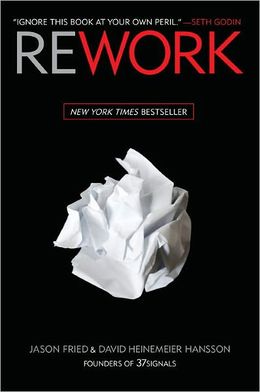
Rework is the rare book that could and even should be longer than it is: Fried and Hansson even say, “Writers eliminate good pages to make a great book. We cut this book in half between the next-to-last and final drafts. From 57,000 words to about 27,000 words. Trust us, it’s better for it.” I do trust them, but they may have lost some of the fun stories that might give the book more texture. They’re overfond of assertion without demonstration. But so what? The book as a whole is still worth reading. It’ll take an hour or two to get through the whole thing, which is peppered with little moments like, “You’re better off with a kick-ass half than a half-assed whole” or “Don’t sit around and wait for someone else to make the change you want to see. And don’t think it takes a huge team to make that difference today.”

ReworkIn other words: do it now, whatever the “it” happens to be. Waiting is your worst enemy, doing your best friend, and anything that stops you from doing something should be ignored or overcome. Friedman and Hansson are speaking of business, but they’re also speaking of art, science, and almost everything good in this world. They say, “What you do is what matters, not what you think or say or plan.” This is equally true of writing, but a lot of would-be writers seem to like the idea of writing more than the actual writing itself. I often offer this challenge to people who say they want to or wish they could write a novel:

1) Turn off your Internet access and cell phone.

2) Write chapter one over three days (or so; the actual timeframe doesn’t matter, as long as it’s short); continue if you want to.

3) Send me the result. I’ll read it and send it back.

So far, I think one person has taken that challenge, and I never got chapter two. I interpret this as meaning that most people who say they want to write a novel (or write anything else, or learn the guitar, or get laid, or lose weight, or start cooking, or any number of other skilled endeavors) don’t actually want to, because if they did, they would start today. If you shoot for, say, 500 words a day, you’ll have a pile of around 80,000 in six months, leaving some room for missed days, editing, and so forth.

If you shoot for 1,000 words a day, you’ll have it in three months.

This, however, is only the start, which I didn’t realize when I was nearer to the start than I am now. But if you’re not putting in the seat time, writing, you’re not going to do anything and all your intentions aren’t going to matter. Fried and Hansson are pointing this out in the context of business, where it’s equally valid, and there are probably an equal number of people saying, “I should start a business” and “I should write.” Most of them are probably better off not acting on their impulses. But if they do, why not start?

They’re giving you permission you don’t need to be given, but they’re doing it in a way that feels fun. They elevate fun to a cardinal virtue, and they want to get rid of things that aren’t fun or don’t add value to people’s lives. At one point, for instance, they say:

The business world is littered with dead documents that do nothing but waste people’s time. Reports no one reads, diagrams no one looks at, and specs that never resemble the final product. These things take forever to make but only seconds to forget.

Who would want to stand up and proudly proclaim that they write “dead documents?” In this framing, no one. But sometimes a guy with a document that says why thing x is better than thing y wins. Sometimes dead documents serve important signaling functions. That’s the thing about Rework: read it, but don’t assume it’s always right.

Over the last two months I’ve been on a binge of business or quasi business books: Rework, Anything You Want, How to Win at the Sport of Business: If I Can Do It, You Can Do It, Delivering Happiness: A Path to Profits, Passion, and Purpose, all of them good in their own way, and all of them subtly contradicting each other in various ways.

If Steve Jobs had written a book about business the Apple way, he’d probably contradict all of them. Yet the writer of each book is successful in their own field. If my Dad and I wrote “Doing Business the Seliger + Associates way,” we’d probably say some things that are similar to what Hansson and Fried say but some things that are very different because of the peculiarities of our field. Every business situation is slightly different. What works in one field may not work in another.

The meta lesson may be that no two successes are exactly alike, and that, while you should read these books, you should also realize that you might use pieces of them but you’re unlikely to use all of them. They’re all to be subjected to interrogation, not venerated.

I can say, however, that each of the books above inspires in its own way, and sometimes inspiration has an importance that goes beyond the immediate truth value of a piece.

Product Review: Rhodia “Webbie” Webnotebook

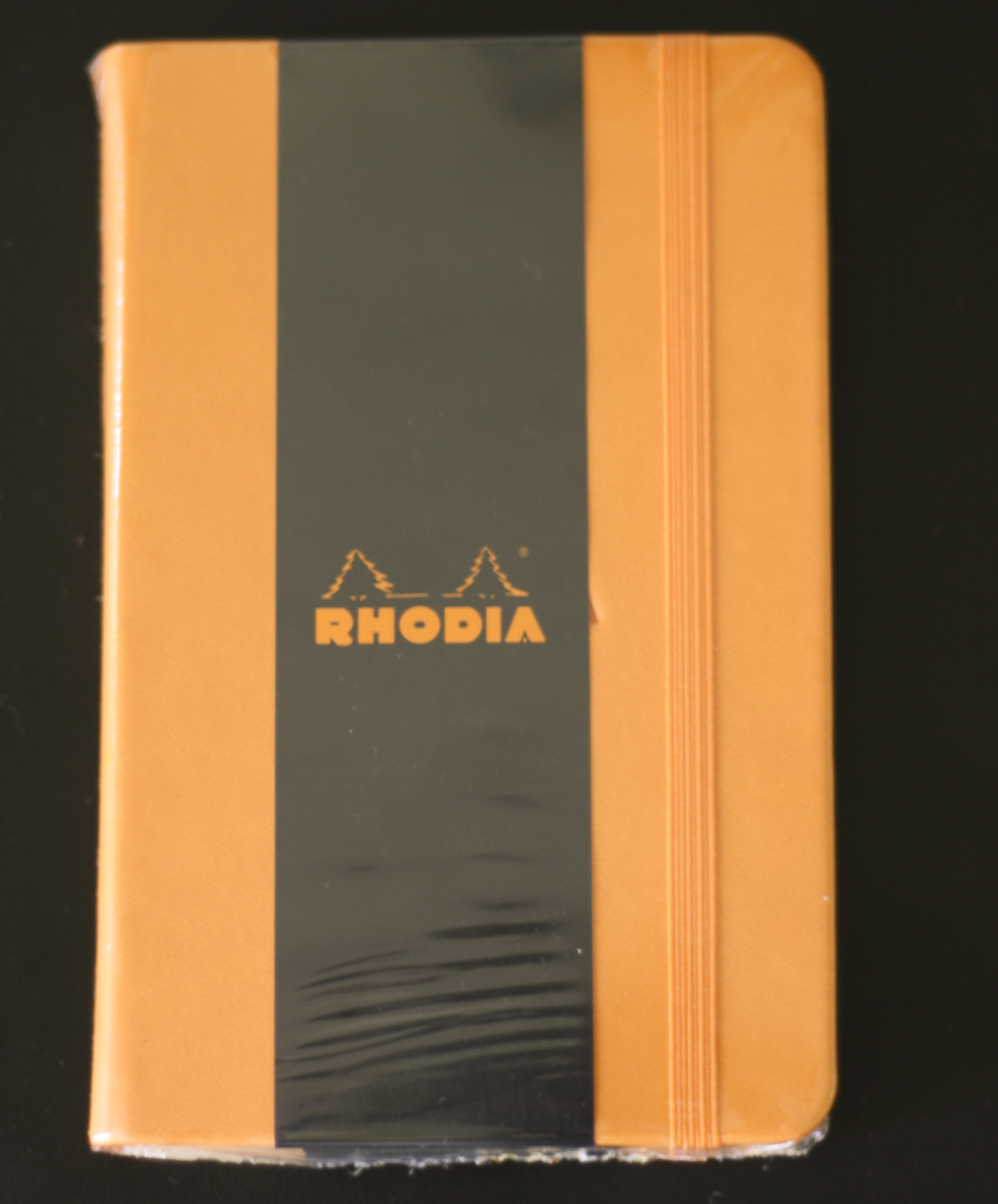
The Rhodia Webnotebook (or, as people online have dubbed it, the “Webbie”) has an asinine name, but that name shouldn’t prejudice you against the object itself, which is the best notebook I’ve tried since switching away from Moleskine.

Numerous rapturous threads are devoted to this notebook on the Fountain Pen Network (“FPN” to the regulars), which is one of these sites that prove how well-suited the Internet is to connecting people with bizarre, niche hobbies to one another. Being one of those people, I say that with affection. Many, many FPN writers are ecstatic at the prospect of a mass-market notebook whose pages will not let ink bleed through.

Ink bleed was never a problem with Moleskines for me, because I use extra-fine nibs and apparently don’t use inks that saturate paper like rivers do handkerchiefs. Regardless, the Rhodia’s paper is excellent. It’s supposedly acid free too, so the paper won’t degrade before you do under normal use. I’m happier about the durability: I’ve used three Rhodias. None have come close to breaking. A Moleskine broke (though many earlier ones didn’t). An insanely expensive Design.Y notebook broke. A Leuchtturm 1917 has perforated back pages and will probably break.

_MG_8481The Rhodia isn’t perfect. The lines are spaced slightly too wide, at 6.35 mm per line (or .25 inches); they might be great for someone learning how to write, but for someone who already knows, they’re not as useful, and it’s harder to connect ideas on one page to ideas on another. An ideal notebook should be closer to 6 mm per line. Moleskine gets this right. The edge of the cover should be flush with the paper, not a couple millimeters out, forming an unsightly lip. The lines should run to the edge of the page; the current design wastes space, and this is the most important design flaw in the Webnotebook.

They’re small problems that I’d like to see addressed but that don’t detract from the big things. Speaking of size, you can also buy A7-sized notebooks (which are about 4.7 x 3″) from Europe or Australia if you’re willing to pay the obscene shipping. I am, because they’re perfect.

I sent an e-mail to Goulet Pens to ask if they could get A7 notebooks, and Sam Vaughn responded to say that they “can do a special French order for them,” but “when ordering direct from France we have to order by the carton which in this case would be 40 notebooks.” Alas, 40 notebooks would probably be $500 and last for decades. The A7 is a more pocketable size than the 3.5 x 5.5″ American version. Choose it if you can.

Then stop looking and start writing.

EDIT: Rhodia makes much larger, 5.5 x 8.5 notebooks as well. I don’t have any use for them, but visual artist types might.

Life: Comedy edition

“The comic impulse, then, is about a willingness to dwell in the awkward, shameful places we’d prefer not to dwell. It’s what allows us to face the truth of ourselves on behalf of others.”

—Steve Almond, “Funny is the New Deep,” from The Writer’s Notebook II: Craft Essays from Tin House

Why little black books instead of phones and computers

“Despite being a denizen of the digital world, or maybe because he knew too well its isolating potential, Jobs was a strong believer in face-to-face meetings.” That’s from Walter Isaacson’s biography of Steve Jobs. It’s a strange way to begin a post about notebooks, but Jobs’ views on the power of a potentially anachronistic practice applies to other seemingly anachronistic practices. I’m a believer in notebooks, though I’m hardly a luddite and use a computer too much.

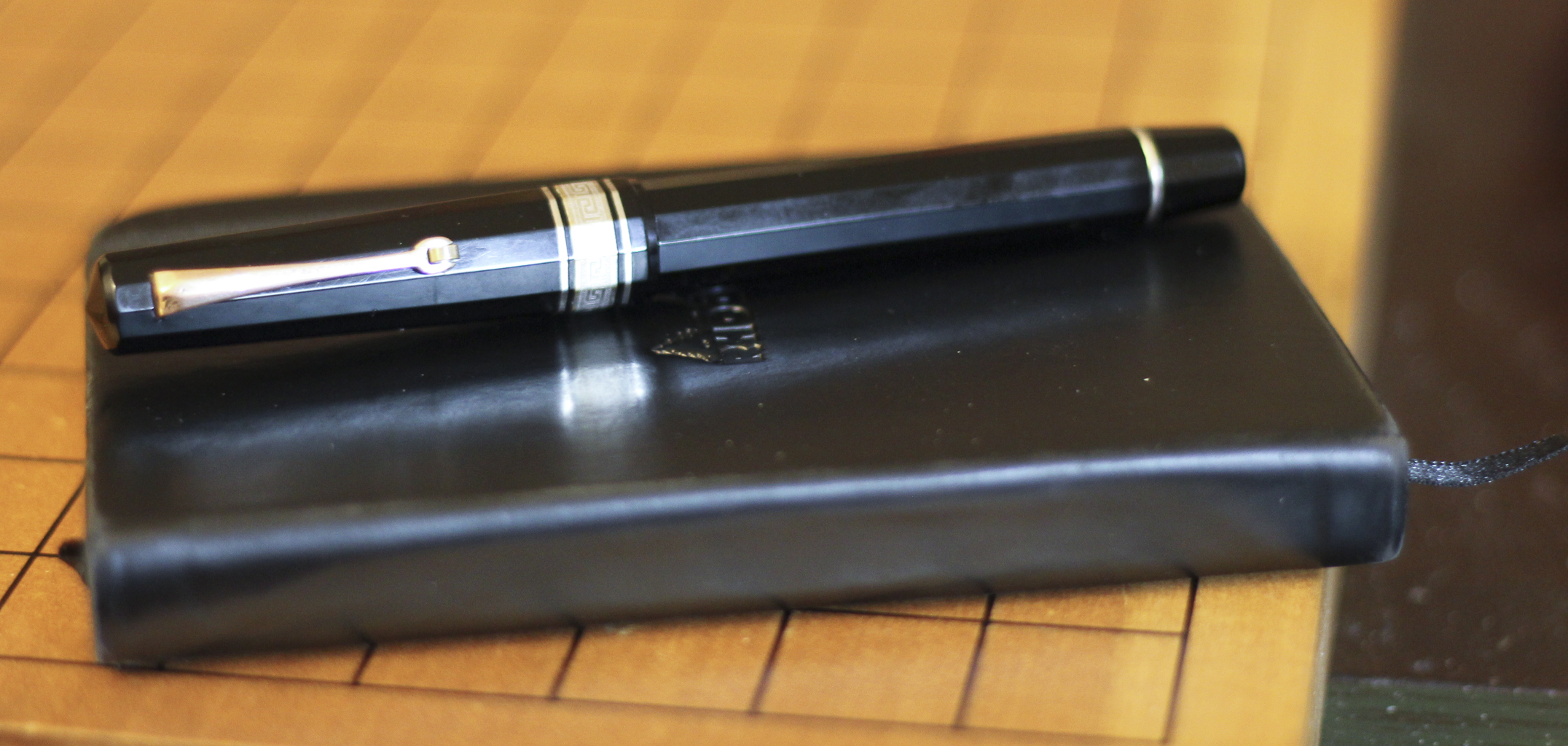
The notebook has an immediate tactile advantage over phones: they aren’t connected to the Internet. It’s intimate in a way computers aren’t. A notebook has never interrupted me with a screen that says, “Wuz up?” Notebooks are easy to use without thinking. I know where I have everything I’ve written on-the-go over the last eight years: in the same stack. It’s easy to draw on paper. I don’t have to manage files and have yet to delete something important. The only way to “accidentally delete” something is to leave the notebook submerged in water.Notebook stack

A notebook is the written equivalent of a face-to-face meeting. It has no distractions, no pop-up icons, and no software upgrades. For a notebook, fewer features are better and fewer options are more. If you take a notebook out of your pocket to record an idea, you won’t see nude photos of your significant other. You’re going to see the page where you left off. Maybe you’ll see another idea that reminds you of the one you’re working on, and you’ll combine the two in a novel way. If you want to flip back to an earlier page, it’s easy.

The lack of editability is a feature, not a bug, and the notebook is an enigma of stopped time. Similar writing in a computer can function this way but doesn’t for me: the text is too open and too malleable. Which is wonderful in its own way, and that way opens many new possibilities. But those possibilities are different from the notebook’s. It’s become a cliche to argue that the technologies we use affect the thoughts we have and the way we express those thoughts, but despite being cliche the basic power of that observation remains. I have complete confidence that, unless I misplace them, I’ll still be able to read my notebooks in 20 years, regardless of changes in technology.

In Distrust That Particular Flavor, William Gibson says, “Once perfected, communication technologies rarely die out entirely; rather, they shrink to fit particular niches in the global info-structure.” The notebook’s niche is perfect. I don’t think it’s a coincidence that Moleskine racks have proliferated in stores at the same time everyone has acquired cell phones, laptops, and now tablets.

In The Shallows, Nicholas Carr says: “The intellectual ethic is the message that a medium or other tool transmits into the minds and culture of its users.” Cell phones subtly change our relationship with time. Notebooks subtly change our relationship with words and drawings. I’m not entirely sure how, and if I were struggling for tenure in industrial design or psychology I might start examining the relationship. For now, it’s enough to feel the relationship. Farhad Manjoo even cites someone who studies these things:

“The research shows that the type of content you produce is different whether you handwrite or type,” says Ken Hinckley, an interface expert at Microsoft Research who’s long studied pen-based electronic devices. “Typing tends to be for complete sentences and thoughts—you go deeper into each line of thought. Handwriting is for short phrases, for jotting ideas. It’s a different mode of thought for most people.” This makes intuitive sense: It’s why people like to brainstorm using whiteboards rather than Word documents.

IMG_2100I like to write in notebooks despite carrying around a smartphone. Some of this might be indicative of the technology I grew up with—would someone familiar with smartphone touchscreens from age seven have sufficiently dexterous fingers to be faster than they would be with paper?—but I think the obvious answer to “handwriting or computer?” is “both, depending.” As I write this sentence, I have a printout of a novel called ASKING ANNA in front of me, covered with blue pen, because editing on the printed page feels different to me than editing on the screen. I write long-form on computers, though. The plural of anecdote is not data. Still, I have to notice that using different mediums appears to improve the final work product (insert joke about low quality here).

There’s also a shallow and yet compelling reason to like notebooks: a disproportionate number of writers, artists, scientists, and thinkers like using them too, and I suspect that even contemporary writers, artists, scientists, and thinkers realize that sometimes silence and not being connected is useful, like quiet and solitude.

In “With the decline of the wristwatch, will time become just another app?”, Matthew Battles says:

Westerners have long been keenly interested in horology, as David Landes, an economic historian, points out in Revolution in Time, his landmark study of the development of timekeeping technology. It wasn’t the advent of clocks that forced us to fret over the hours; our obsession with time was fully in force when monks first began to say their matins, keeping track of the hours out of strict religious obligation. By the 18th century, secular time had acquired the pressure of routine that would rule its modern mode. Tristram Shandy’s father, waiting interminably for the birth of his son, bemoans the “computations of time” that segment life into “minutes, hours, weeks, and months” and despairs “of clocks (I wish there were not a clock in the kingdom).” Shandy’s father fretted that, by their constant tolling of the hours, clocks would overshadow the personal, innate sense of time—ever flexible, ever dependent upon mood and sociability.

The revolution in electronic technology is wonderful in many ways, but its downsides—distraction, most obviously—are present too. The notebook combats them. Notebooks are an organizing or disorganizing principle: organizing because one keeps one’s thoughts, but disorganizing because one cannot rearrange, tag, and structure thoughts in a notebook as one can on a screen (Devonthink Pro is impossible in the real world, and Scrivener can be done but only with a great deal of friction).

Once you try a notebook, you may realize that you’re a notebook person. You might realize it without trying. If you’re obsessed with this sort of thing, see Michael Loper / Rands’ Sweet Decay, which is better on validating why a notebook is important than evaluating the notebooks at hand. It was also written in 2008, before Rhodia updated its Webbie.

Like Rands, I’ve never had a sewn binding catastrophically fail. As a result, notebooks without sewn bindings are invisible to me. I find it telling that so many people are willing to write at length about their notebooks and use a nominally obsolete technology.

Once you decide that you like notebooks, you have to decide which one you want. I used to like Moleskines, until one broke, and I began reading other stories online about the highly variable quality level.

So I’ve begun ranging further afield.

I’ve tested about a dozen notebooks. Most haven’t been worth writing about. But by now I’ve found the best reasonably available notebooks, and I can say this: you probably don’t actually want a Guildhall Pocket Notebook, which is number two. You want a Rhodia Webnotebook.

Like many notebooks, the Guildhall starts off with promise: the pages do lie flat more easily than alternatives. Lines are closely spaced, maximizing writable area, which is important in an expensive notebook that shouldn’t be replaced frequently.

IMG_3900I like the Guildhall, but it’s too flimsy and has a binding that appears unlikely to withstand daily carry. Mine is already bending, and I haven’t even hauled it around that much. The Rhodia is somewhat stiffer. Its pages don’t lie flat quite as easily. The lines should go to the end of each page. But its great paper quality and durability advantage make it better than the alternatives.

The Rhodia is not perfect. The A7 version, which I like better than the 3.5 x 5.5 American version, is only available in Europe and Australia, which entails high shipping costs. The Webbie’s lines should stretch to the bottom of the page and be spaced slightly closer together. The name is stupid; perhaps it sounds better in French. The notebook’s cover extends slightly over its paper instead of aligning perfectly. Steve Jobs would demand perfect alignment. To return to Isaacson’s biography:

The connection between the design of a product, its essence, and its manufacturing was illustrated for Jobs and Ive when they were traveling in France and went into a kitchen supply store. Ive picked up a knife he admired, but then put it down in disappointment. Jobs did the same. ‘We both noticed the tiny bit of glue between the handle and the blade,’ Ive recalled. They talked about how the knife’s good design had been ruined by the way it was being manufactured. ‘We don’t like to think of our knives as being glued together,’ Ive said. ‘Steve and I care about things like that, which ruin the purity and detract from the essence of something like a utensil, and we think alike about how products should be made to look pure and seamless.

I wish the Rhodia were that good. But the Rhodia’s virtues are more important than its flaws: the paper quality is the highest I’ve seen, and none of the Rhodias I’ve bought have broken. If anyone knows of a notebook that combines the Rhodia’s durability with the qualities it lacks, by all means send me an e-mail.


More on the subject: The Pocket Notebooks of 20 Famous Men.

EDIT: See also Kevin Devlin’s The Death of Mathematics, which is about the allure of math by hand, rather than by computer; though I don’t endorse what he says, in part because it reminds me so much of Socrates decrying the advent of written over oral culture, I find it stimulating.

Thoughts on the movie Rust and Bone

* It’s hard to watch movies about stupid, careless people making stupid, careless choices. When the obvious solution to your problem is “stop doing stupid things,” a person’s predicaments don’t generate much sympathy. It’s painful to watch unforced errors in real life and it might be even more so in fiction. The protagonist’s child is the only real victim. It’s also hard to sympathize with characters who hit children or animals.

* Rust and Bone is like watching a French version of Charles Murray’s Coming Apart: The State of White America 1960 – 2010. The language is different, as is the attitude towards work and employer relations (see below), but the basic social and individual pathology is similar and cross-cultural. Dysfunction has consequences.

* This is tangential to the movie, but bad romantic choices tend to have more severe repercussions for women than for men, and for children most of all; the fantasy of this movie, however, happens when transparently bad romantic and career choices work out in a fairy-tale fashion. In the real world, sometimes the Fairy Godmother Department is on the clock, but usually the Practical Joke Department runs things. Women who try to corral uninterested players—like men who try to “save” crazy, destructive women—very seldom succeed, yet this is the default template for romance novels.

* France’s notoriously rigid labor markets are practically a character; one sub-plot involves employers sneaking cameras into retail stores to “catch” employees who aren’t hewing to the letter of laws or contracts. This makes no sense: if the employee is unhappy, they should leave; if the employer is unhappy, they should fire the employee. In France the labor market apparently doesn’t function like this, so employers resort to dirty tricks that shouldn’t be necessary in the first place.

In another scene, a truck driver moves from working to a company to being independent to working for a company again, and he describes himself as “exploited,” or joining the ranks of the exploited. He may have been joking (which would mean that I missed the subtext), but if he wasn’t, he has a foreign attitude toward employment. A lot of people today would be happy to be “exploited” via a job. Villainous managers are described as wearing “three-piece suits.”

* Another character refers to employers and employees as being on two “sides,” which is the exact opposite of the mentality startups and tech companies inculcate. Such rhetoric seems outdated, a relic of Marxism or industrial unions. Is it common in France or an artifact of this movie? If you think you can run a business better than your employer does, start your own firm (assuming you’re in a market where entrance is possible; in, say, telecoms, it isn’t).

* To the protagonists, the most important parts of life appear to be winning in zero-sum street fights and looking hot in clubs. Note that I’m not necessarily opposed to either, in isolation. No one in Rust and Bone has any ideas.

* That said, the movie was compelling, though I don’t think I’d recommend it for most people. I was rarely bored but often exasperated.

* Rust and Bone itself wasn’t stupid, although its characters often were. It was reminiscent of high-brow reality TV, but it didn’t resemble most other movies. The sex scenes were done well and arguably too brief, especially in a French movie. Until the last five minutes, Rust and Bone shares some spiritual values with Michel Houellebecq’s work.

Confessions of a Pickup Artist Chaser — Clarisse Thorn

Since 2005 and Neil Strauss’s The Game: Penetrating the Secret Society of Pickup Artists, the number of blogs, books, and forums devoted to teaching men how to get with women has, as they say, exploded, and pickup offers a seductive conceit: with the right words, posture, and attitude, average guys can sleep with attractive women. The seductive conceit tends not to play out all that well: by the time one learns enough and changes enough to sleep with lots of attractive women, a random guy isn’t the guy he was when he started.

Confessions_Most of these guys are guys, both writers and readers. Clarisse Thorn, “a feminist S&M writer and activist,” obviously isn’t. She doesn’t want to sleep with more women today! She wants something that, from an intellectual perspective, is more interesting: understanding. In Confessions of a Pickup Artist Chaser, she offers an introduction similar to the one I wrote in the first paragraph of this post:

There’s a huge subculture devoted to teaching men how to seduce women. Within the last half-decade or so, these underground ‘pickup artists’ have burst into the popular consciousness, aided first and foremost by Neil Strauss’s bestselling 2005 book The Game.

One real question: Why do so many men need to learn “how to seduce women?” What aren’t men being taught in schools? By their fathers? Friends? Culture? Anything that needs to be consciously learned and taught isn’t being absorbed from other avenues. Why did “Game” emerge when it did, as opposed to 1970, or 1950, or 1850? To my mind, the sexual revolution and the Internet play large parts: the former reduced monogamy, encouraged more people to sleep with more people, and made women more independent of their families, while the latter allows outsiders to congregate and discuss matters that can’t find mainstream publishers and outlets.

I can say that, at least in my case, I noticed the same sorts of things many guys notice in high school: the same handful of guys seem to get 80 or 90% of female attention, and, as usual, that “chicks dig jerks” and that they eschew “nice guys.” The question eventually becomes, again, “Why?”

Bad answers tend to be, “women are inscrutable” or “just because.” Better answers are out there. I think a lot of guys glom onto pickup ideas not only because some specific tactics work, but because the ideas themselves help explain behavior that seems otherwise mysterious and self-defeating. As Thorn says, “When there’s no standard etiquette or well-understood social channels for how to meet women, then it seems obvious that a bunch of dudes would start getting together trying to figure out how to do that.” If there was “standard etiquette,” it’s gone now, along with standard corporate jobs-for-life.

The role of evolutionary biology and psychology is also underrated in the growth of pickup artists. That field provides answers about what people, or at least people from some cultures, find attractive, and helps to explain why people find what they find attractive. Without that intellectual ballast, I doubt we’d see the surface phenomenon of the pickup artist; that’s merely the mast and the deck. The stuff keeping the ship upright is down below, out of sight. Bad, sloppy, or reductivist evolutionary psychology is easy to discredit, and it should be discredited, but there’s an intellectual core that remains.

Pickup shows, or attempts to show, guys how to get with women in modern environments; as Thorn says, “often, the discussions and the seminars and the meetups are one big group of people who break down seductive behaviors as precisely as they possibly can.” Some pickup artists see what they do as part of self-improvement and enhancement. Others, in Thorn’s view, are “Darth Vader” pickup artists; Thorn describes one this way: “whatever would be more evil and more powerful than Darth Vader, that’s Roissy. [. . .] he is almost comically villainous.” She’s right in that last description, and “comically villainous” has a weird, almost 18th Century ring that’s appropriate for Roissy’s commentary and fundamental harmlessness (he writes a blog and lives in DC, after all, and it’s hard to take his more hyperbolic assertions seriously).

Nonetheless, men like Roissy are the ones Thorn seeks out. There’s a thread of honesty, of self-criticism, that runs through Confessions of a Pickup Artist Chaser: “I can’t deny that I myself pay more attention to hot men [. . .] I can’t deny that I wanted PUAs’ approval.” The wanting “approval” makes sense: if you don’t want approval, it’s easy enough to rant ignorantly about a subject. Plus, when a phenomenon is sufficiently widespread, it’s worth understanding it, and your own relationship to it, before criticizing it. Thorn does both.

She also gave an interview in which she said that, while she sees feminism as telling us a lot about the macro aspects of gender in our society (in work and school, for example), feminism does very little to describe, let alone evaluate, how micro, day-to-day interactions are structured. Pickup artists, or whatever one may want to call guys who are consciously building their skills at going out and getting women, are describing the specific comments, conversations, styles, and venues women respond to. The pickup artists are saying, “This is how you approach a woman in a bar, this is how you strike up a conversation at the grocery store, and so forth.” In other words, they’re looking at how people actually go about the business of getting laid. Their work is often very detailed, and the overall thrust is toward the effectiveness of getting laid rather than how male-female interactions work in theory. Feminism, in Thorn’s view, appears to be silent, or mostly silent, on the day-to-day interactions.

Women also haven’t tended, so far as I or Thorn knows, to produce the same material about why they pick the guys they pick, what they say, what happens in the lead-up to sex, and what happens afterward. Men produce these sometimes voluminous field reports (Reddit’s “seduction” community is full of them), to the point where the occasional woman appears to ask why no one is producing pickup material for women. Nothing is stopping women from doing so, but the average woman appears less interested in how to “pick up” guys and more interested in relationships (which one can see from, say, The Rules versus The Game, or romance novels versus porn). The average of many people’s desires doesn’t say anything about a particular individual’s desires or proclivities, but we do see patterns emerge through aggregation.

It’s virtually impossible to be a thinking person and not notice the disjuncture between behavior in bars / clubs / parties and academic / Internet feminist thinking. It’s hard to reconcile 50 Shades of Gray, submissive S&M preferences, and romance novels with feminist thinking (Janice Radway’s Reading the Romance is excellent for its observations, but her preexisting ideological framework automatically assumes everything about gender preferences is the fault of a pervasive “patriarchy” that, if it once existed, didn’t by the time I came of age).

People like Thorn are trying to bridge that gap, which I admire. What academic feminists think average women should want (and what average men are like) seems very different from what many normal women want. It’s hard if not impossible to legislate desire, or change it through haranguing, though people certainly have tried and continue to try. One thing I think most people have in common is hypocrisy and lying, either to themselves or others, and sexual behavior is certainly rife with both hypocrisy and lying. My favorite public example are the closeted Republicans who fulminate against being gay and then get caught in a “wide stance,” tapping their foot in a men’s bathroom. But they’re so pathetic a target that they’re not really worth discussing on an intellectual level.

Thorn’s book is worth that discussion, and running through Confessions of a Pickup Artist Chaser is a simple conundrum: we don’t know who someone really is, versus when someone is who we want them to be (example: “When I met Neil [Strauss] in Chicago, he seemed low-key and authentic, but I suppose that’s just what he’d want me to think”). The authenticity question isn’t unique to Confessions: it runs through literature, especially in literary fiction and science fiction, through psychology, through sociology, and through everyday life. Our personalities themselves aren’t stable, and they’re influenced by situations. We want to believe ourselves to be authentic, and we want to believe that we can fully understand other people, but those beliefs whither in the face of both academic evidence and the evidence of everyday life and social interaction.

We just don’t know. Pickup wants men to believe that we can mold ourselves into something better; that molding is simply of a particular kind, oriented in a particular direction. To be good at pickup is as hard as being good at anything else: it might start with learning some clever lines and some confidence, but it ends with the entire state of one’s social and physical being, from wardrobe to workout to interests to speaking skills to dancing to friends. Maybe the scariest thing of all to women is the extent to which men will change their personalities to attract women, or the extent to which attracting women is a skill that can be learned, contrary to the dominant cultural paradigm of love at first sight, “it just happened,” and the belief in romantic destiny. Women, however, don’t like to feel as if they’re being “gamed.” By definition, the best pickup artists conceal their craft. If you know you’re being gamed, the game itself has failed.

Good pickup also means empathy, which men and women lack in equal measure. Thorn writes:

Age 15 may also have been when guys began shouting gross comments at me in the street, but I’m not sure. It was a few years before I started going to parties and clubs where some guys would approach and refuse to leave me alone, no matter how obvious I thought I made it that I wasn’t interested. These experiences, among many others, contributed to the development of what a PUA would call my “bitch shield”: my instinctive tendency to be cold and unfriendly during unexpected interactions with unfamiliar guys.

Many women have bitch shields to some degree — when we don’t, we get a lot more “I’ve been watching you and your nice breasts” comments. PUAs devote a lot of mental energy to figuring out how to quickly convince women.

Pickup teaches, or should teach, men to appreciate why “Many women have bitch shields to some degree.” I’m not sure that there’s a female equivalent to make pickup that helps women realize just how much rejection being a male entails. Pickup is also about teaching you to imagine how you appear, or should appear, to others; Thorne correctly notes that “‘Just be yourself’ is terrible advice if you are naturally unbelievably awkward.” The self you should be, whether you want to form relationships or just get laid, is something else.

Although the better pickup types don’t promise something for nothing, the worst ones do. The reality with pickup is the same reality that confronts anyone who wants to truly a master a skill, whether that skill be programming, knitting, writing, music: it takes time, effort, and intensive effort. “No art, however minor, demands less than total dedication if you want to excel in it,” as Leon Battista Alberti said, and seducing women is an art like any other. Some men appear to be “naturally” good at it, which usually means that they have some inborn predisposition combined with unconscious training

I discussed ideas and trends in the first part of this essay because those are the most interesting and useful parts of the book. A lot of Thorn’s writing, however, is weak. At one point she says of pickup artists, “some of them were so smart it blew my mind.” Such clichés should be excised like a demon: swiftly, surely, and religiously. Chapter 3 starts with Thorn saying, “I’m a feminist sex-positive activist. For me, that means that I try to raise awareness of social problems around sexuality.” But, again, anyone with decent reading comprehension skills will already know that, because she mentioned it several times. Some sections are too long and should be cut, and it becomes easier to skip sections the longer one reads. The word “super” is overused as an intensifier: “I acknowledged times in the past when I’ve been super awkward;” “He’s super-analytical too;” “his consent was super important to me;” “he wasn’t going to be a super-major relationship no matter what.” That’s only a handful of examples. Like “very” or salt, “super” should be used sparingly. Too many super things aren’t super at all.

The word “problematic” is similarly problematic: instead of arguing why an idea or a concept is a problem, “problematic” simply asserts that it is; as word, it conceals more than it reveals, and it conceals a lot: “some men are so starved of knowledge about masculinity that they idolize Roissy and overlook some of the more problematic things he has said;” “the seduction community is very heteronormative: it really buys into problematic gender standards;” “all the words that I put in quote marks above are concepts that I consider incredibly problematic;” “while the advice in The Rules is often problematic, much of it works;” a woman named Kristen J says “[ad] agencies understand the effects of problematic norms on women.” Using a weasel word like “problematic” once or twice falls within the author’s license not to explain everything. Using it more than half a dozen times means the next version should be edited with greater care.

While I’m here, let me talk for a moment about Kristen J. I’m not convinced advertisers exploit women, or know that they do, but the bigger issue is that advertisers want to do whatever works; if ads didn’t work, at all, advertisers would quit trying. She says that “The thing is, advertising isn’t just a consequence of problematic norms… it’s a creator of them, too.” Maybe. But the norms emerge from collective individual choices, and I think advertiser are mostly reacting to what they see as being effective. It’s certainly more fun to blame ad agencies than to look around and say the blame for the effectiveness of advertising lies, at least a little bit, in each of us, and in our aggregate preferences (for more on this topic, see Geoffrey Miller’s Spent: Sex, Evolution, and Consumer Behavior). I mentioned a similar idea in a different context above, but the same principle applies here.

Technical problems with Thorn’s writing aren’t limited to the level of the sentence, either. She assumes the reader’s stupidity:

Here we are again at the end of a chapter! Did you read it all? Was it too long for you? It’s okay if you didn’t read it all, because I hereby bestow upon you some ‘Too Long; Didn’t Read’ bullet points!

“Was it too long for you?” sounds vaguely pornographic out of context while simultaneously being infantilizing: if you’re not in middle school, a couple thousands words on a compelling topic shouldn’t be too long. If it is too long, the writer should cut words. The best writing advice I’ve ever heard is “omit unnecessary words.” In Confessions, Chapter 12 begins this way: “This is the last chapter, and I won’t offer a “Too Long; Didn’t Read” section at the end. My Grand Theory of The Ethical Game cannot be reduced to mere bullet points!” This implies that the preceding 11 chapters can “be reduced to mere bullet points”—but if they can, why bother writing extended narratives? Why not just shorten the book to the bullet points? I don’t think the preceding chapters can be reduced to bullets, which is frustrating both about the bullets themselves and the way they disrupt the book’s flow.

Confessions is slack. It’s hard to describe precisely what tautness entails, but in vague terms it means feeling like every part of the book connects to every other part, or at least to a linear, forward-moving narrative or level of understanding. Too many of the conversations in Confessions feel superfluous—not on their own, but put in the context of each other. Fixing this kind of problem is a long and difficult effort, and I don’t have a good sense of how rising action in each chapter or scene should function.

But I know it when I don’t see it, and too often I didn’t see it. Neil Strauss’s The Game builds in a classic fashion, portraying his journey from outsider to neophyte to expert to transcending the limits of his field. Confessions sort of has that structure, but it’s more digressive, more random, and not in ways that feel like they build. In the middle of the book I began skipping sections that felt repetitive, as issues about pickup, game, and feminism were analyzed from angles that seemed nearly indistinguishable from how they’d been previously analyzed. There was a feeling of “almost, but not quite;” I want the stories to be tighter than they are.

Tautness can’t be quoted. It can be observed: Gillian Flynn’s Gone Girl has it. Philip Pullman’s His Dark Materials has it. Tucker Max’s stories have it. So do Chelsea Handler’s better stories. Confessions needs it.

I may also be more attuned to tautness because for a long time I had a major problem with it in my own writing. To some extent all writers worth a damn struggle with tautness; the ones who don’t care either write tautly unconsciously or risk boring their readers.

Even the best non-narrative, nonfiction is intellectual taut, with ideas that build on one another towards their conclusions. Jonathan Haidt’s The Righteous Mind has this quality, even though it’s not a narrative book. observing the issue may be worthwhile: nonfiction writers need to think about the tautness issue, because readers will recognize when a work builds and when a work should be restructured in a way that makes it more compelling.

The first couple chapters were the most compelling, followed by the Neil Strauss chapter. I’m spending so much time on stylistic weaknesses because I want the book to be better. The subject interests me and Thorn’s vantage is fresh. Only the execution is lacking. Thorn is doing something I admire: reporting. For a self-published writer, this is unusual. She goes out to meet and talk to people involved in her subject. She only needs her Robert Gottlieb, her Maxwell Perkins.

I hope Thorn finds him, or her.

Language weirdness: young people and old people

Why is “young people” a socially and politically palatable term, but not “old people?”