Social news sites and forums should encourage users to blog

In online forum culture, there’s a strong bias against linking to a poster’s own blog. That bias often slides into strict rule enforcement that degrades the quality of the forum itself, because most people who regularly produce substantive writing will want their own, ideally non-transient, forum for such writing. A blog provides that and most websites don’t. That means sites like Reddit—which has an overly strong opposition to what they call “blogspam”—tend towards intellectual vacuousness.

I’ve seen people on Slashdot, Hacker News, and most notably Reddit decry blogspam. The decrying is sometimes justified: writing a weak, sloppy post and linking to or submitting it is a play for readers at the expense of the reader’s time. But there’s a very good to encourage linking to longer, more thoughtful writing: it’s often higher quality than most of what one finds in online forums.

Let’s use myself as an example. Some posts here take hours to write and reflects many more hours of deliberate research—which few (though not zero) forum posts do. Forums and social media encourage the ad-hoc and fast (that’s sometimes appropriate). While blogs can do the same, there’s a stronger cultural tendency, especially since the rise of Facebook and Twitter, to write more thoughtfully, more essayistically. Clearly this is not universal. It’s possible to find deeply thoughtful forum posts and dumb blog posts, but as a general tendency the rule holds. Even those who don’t consciously make the distinction between work on a free-standing blog and a temporary forum post probably intuitively feel the difference, though they may not have articulated it.

And there’s a good reason for people writing blogs to prefer depth: on blogs, the writer controls, or should control, their own content. I can export all my WordPress posts and take them with me to whatever the blogging platform of 2020 might be. That’s not true of Reddit. Anyone who invested heavily in a Slashdot identity circa 1999 – 2004 now feels like an idiot: that identity is basically worthless. Few people read Slashdot anymore. Any substantive comments are trapped there, invisible in the eyes of Google and Bing (which is like being invisible in the eyes of God).

By contrast, many of the substantive blogs out there are still out there. Work I published in 2009 can, and often is, still be relevant, while I can’t even keep track of the forum posts I wrote in 2009. They’re too disparate. Blogs act as repositories. Social news sites live in a perpetual present, with little sense of history or books. Few evidence any sign of outside reading, or knowledge that they’re not the first to contemplate most issues or problems.

In addition, the proliferation of social media sites means that the comparative advantage for blog writers has been moving towards depth, since on social media sites one-liners or short responses rule.

Online culture comments obsessively on itself. This is one such form of commentary, and it’s really about the way form tends to shape data—or, to use McLuhan’s often misunderstood formulation, the way medium affects message. There are many subtle gradations of online media, and I find the near-war between quasi social sites like Reddit and blogs to be fascinating.

The dislike on Reddit for blogs makes the discourse shallower and, to me, more boring. It’s too bad and also ensures that many people who do know a lot—who are experts—won’t bother going. If mods can kill a post that someone spent ten hours writing and editing, so that morons who could answer their own queries with a simple Google search can ask yet another inane question, why bother?

I’m being deliberately inflammatory in the preceding paragraph, but that’s what the situation deserves. People who know a lot will tend to avoid areas with a lot of novices or fools, and as novices grow into being experts, the fora that gave them their start will tend to be abandoned.

(Universities, incidentally, are usually too focused on depth at the expense of breadth and impact. They should focus more on rewarding impact, since much of the nominal “depth” in humanities departments if faux, but that’s another issue.)

I’m going to use Reddit as an example: most of the semi-specialized sub-Reddits, like the ones devoted to photography and writing, are only useful to absolute novices. Anyone who gets past that phase will get tired of the same basic questions and issues arising again and again. At the same time, those sections prevent or discourage users from posting their own material. Consequently, as users become more sophisticated, they drift away and gather their own audience, often in blogs or Flickr accounts or elsewhere. What’s left are a steady stream of novices, which is very useful when one is a novice but not at all useful when one outgrows the novice phase and wants to explore the deeper implications of a subject, art, or craft.

The past is no fun and self-publishing is the worst: Ted Heller and solipsism

Those of you who are thinking about publishing your own books or already have—and I know you’re out there—should read Ted Heller’s “The future is no fun: Self-publishing is the worst” for a couple reasons, the most important being that it highlights the way self-publishing is probably not a path to fame and fortune for most of us. But Heller should also highlight that, for most of us, conventional publishing wasn’t a path to fame and fortune either.

He writes that he conventionally published three books between 2001 and 2011, then found that he couldn’t get a publisher for his fourth, West of Babylon. If he’d begun publishing in 1991 and had the same experience in 2001, that would’ve been it: self-publishing didn’t exist in a practical form, and now it does, which means his book at least has a chance.

It’s also clear that Heller is doing it wrong. He writes about sending review copies to newspapers and magazines (“I do everything I possibly can in about four or five paragraphs to inspire interest in whomever the email is sent to”), but that’s like me wanting to become a gigolo for female clients: the world just doesn’t work that way. Me wanting the world to work that way isn’t going to make the world work that way either. Newspapers and magazines barely review conventionally published books any more, and self-published books are explicitly forbidden by most of them; to the extent newspapers and magazines write about such books, it’s after they’ve become best-sellers (like 50 Shades of Grey).

Heller appears to have few personal connections with anyone at newspapers or magazines (“When I finally found contact information for someone at the show I’d been on, they did email me back [. . .] to politely tell me that they would not be having me back onto their show”), which means he’s wasting his time by sending out random P.R. e-mails. I know this. Why doesn’t he?

Heller doesn’t have a blog, as far as I can tell. He doesn’t say that he scraped the e-mails of everyone he’s ever corresponded with and sent a quick e-mail blast about his book. He apparently hasn’t been collecting the e-mail addresses of his readers. The price for West of Babylon —$8—is too high. It should be $3 – $5. The book sounds at best mildly appealing. Though the topic–has-been, 60-year-old rockers—makes me want to look elsewhere, it could be pulled off. Still, based on the description, I wonder: what’s at stake? Do I care about whether these guys can “pull the tour off?”

The Salon piece also makes Heller sounds like. . . I’m look for a euphemism but none come to mind. . . an asshole:

If there is one positive thing about this self-publishing business it is this: You separate the wheat from the chaff among your friends and acquaintances. Who is willing to lend a hand and who cannot wait to abandon you? Who will nudge someone they know and get your book to them and who just won’t even acknowledge your desperation or is laughing at you behind your back? Some people have been remarkable, others’ names are now forever etched onto my Eternal Personal Shit List.

Look, if your friend doesn’t like your book, it doesn’t mean shit, other than that your friend doesn’t like your book. I’m neutral towards 60% of the books I read, actively dislike 30%, and find 10% magical. Playing the straight odds, when a friend publishes a book, there’s a 90% shot that I’ll be neutral towards or dislike their book. The probability of me liking their book is probably lower, because the vast majority of books I read are books I choose.

When I start self-publishing, I doubt all my friends will like what I write. Which is okay. Having cancer and seeing who supports you and who doesn’t separates “the wheat from the chaff among your friends and acquaintances.” Publishing a book that you friends don’t love is hardly a reason to be “forever etched onto my Eternal Personal Shit List.”

Let’s examine the upside for a moment. Heller has a real chance to get his book in front of readers, which he wouldn’t have had ten years ago. He’s playing a game with low odds of success. Thousands of other writers, and maybe hundreds of thousands, are in the same game. But he’s living in a time when it’s possible to get in the game, and that itself is still something to celebrate.

EDIT: I should add that, based on what I’ve read, most writers at most major publishing houses get very little real marketing / PR help. The ones who do are the lucky exceptions. Throwing a stone into the ocean of literature and having it sink to the bottom is normal. Throwing a stone into the ocean of literature and having it turn into a cruise ship is not.

If you have a “passion for writing” and never do it, you don’t have a passion for writing

I signed up for writing-related Meetup.com notifications, and one said this:

Do you have a passion for writing but find it hard to carve out time to engage in the practice of it? It can be hard to find a local writing group convenient for your schedule. If you love to write and would like to be surrounded by others who motivate you, this is the place for you

If “you have a passion for writing,” you don’t need other people around you, any more than if you have a passion for masturbation you need a group wank. You just do it, and masturbation might arguably be the world’s most common leisure activity (among the young at the very least).

IMG_1269For 99% of people, if you “find it hard to carve out time to engage in the practice of [writing],” the solution is simple: redirect time spent on TV and Facebook to writing. If I recall correctly, William Gibson said that he doesn’t write all the time; he’s merely reallocated the time most people spend watching TV to writing. I’m not arguing that would-be writers should never watch TV, but I am arguing that needing extrinsic motivation is, in most circumstances, inferior to having intrinsic motivation.

People also may underestimate how much can be done in small blocks of time. This post, for example, has only taken me a couple of minutes. I haven’t been posting much because I’ve been self-editing a novel and writing proposals. Blogging gets crowded out by those activities. Yet it’s still possible for me to write a short post that says something substantive in about 15 minutes. Cory Doctorow has said in various places that he writes 250 words of fiction every day. A “typical” novel is about 80,000 – 90,000 words. At 250 words per day, you can write a novel in 320 days.

If you have a “passion” for writing, you can express it every day, just like many of you love yourselves every day. You don’t need a group to do it. The need for a group is identical to the need for excuses.

I’m not opposed to writers’ groups in all shapes and forms, and the right group at the right time could in principle provide valuable feedback for the right person (and the right person could give valuable feedback to others). But the raw work should be done alone, and the door opened to others when that work is done.

Why little black books instead of phones and computers

“Despite being a denizen of the digital world, or maybe because he knew too well its isolating potential, Jobs was a strong believer in face-to-face meetings.” That’s from Walter Isaacson’s biography of Steve Jobs. It’s a strange way to begin a post about notebooks, but Jobs’ views on the power of a potentially anachronistic practice applies to other seemingly anachronistic practices. I’m a believer in notebooks, though I’m hardly a luddite and use a computer too much.

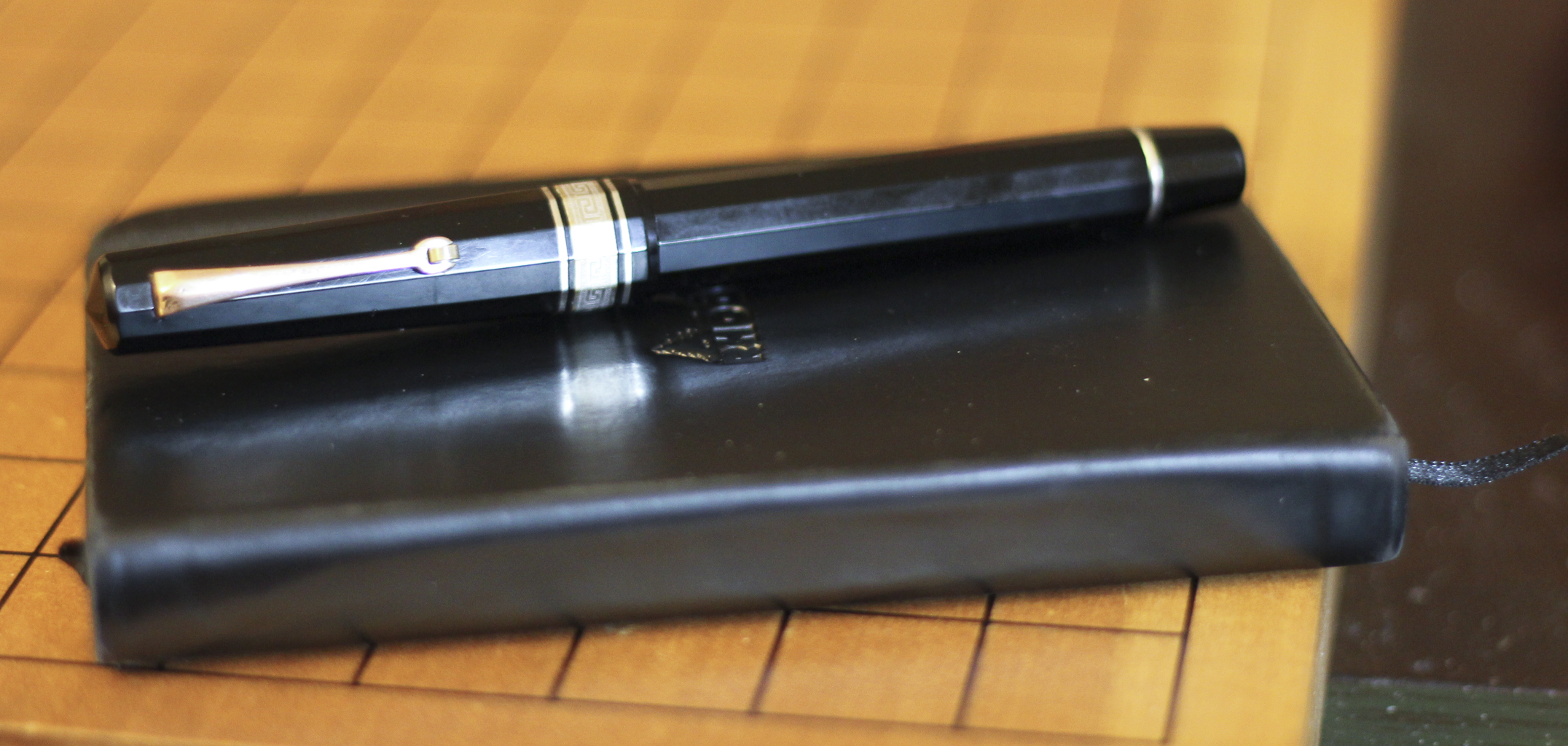
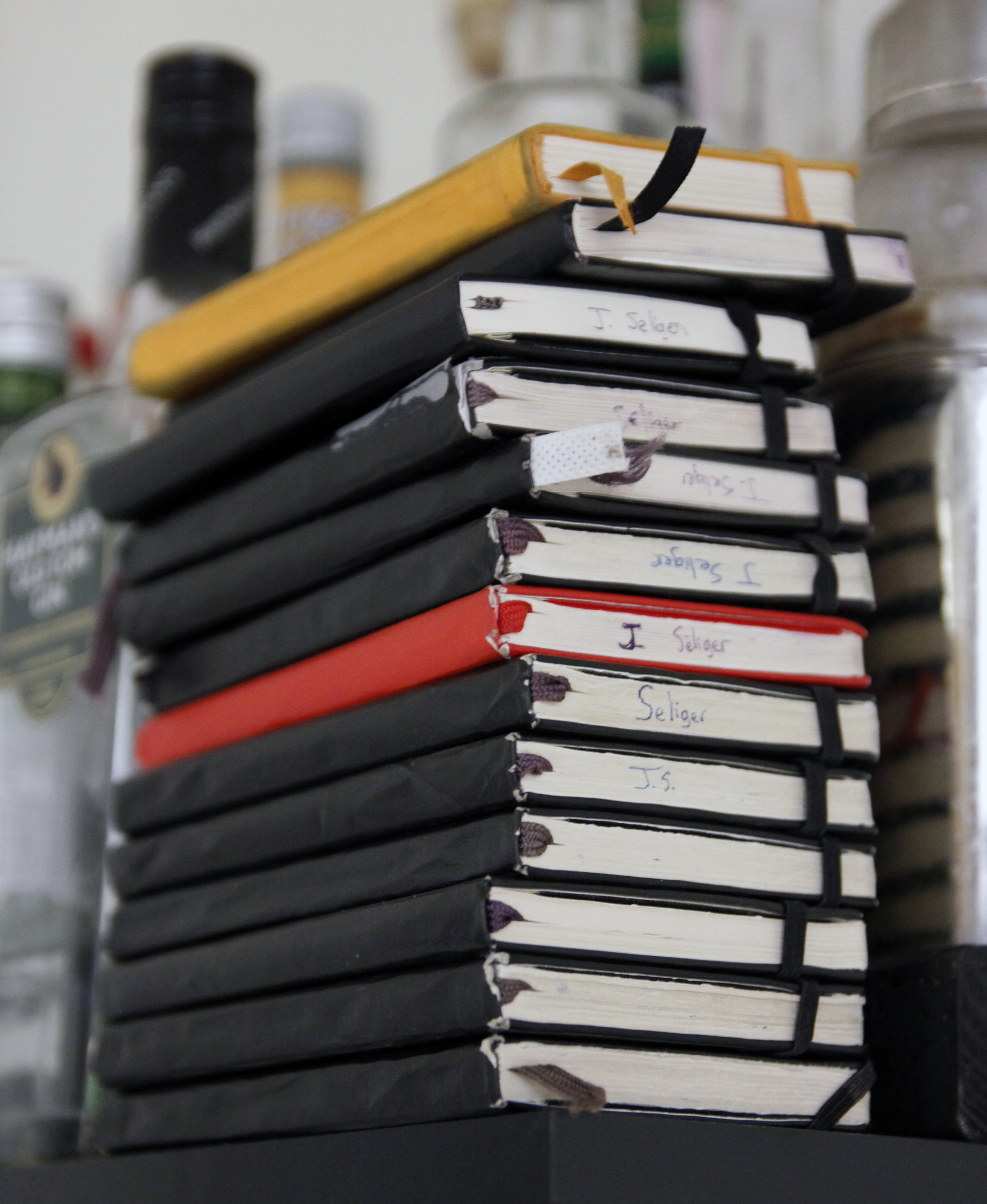
The notebook has an immediate tactile advantage over phones: they aren’t connected to the Internet. It’s intimate in a way computers aren’t. A notebook has never interrupted me with a screen that says, “Wuz up?” Notebooks are easy to use without thinking. I know where I have everything I’ve written on-the-go over the last eight years: in the same stack. It’s easy to draw on paper. I don’t have to manage files and have yet to delete something important. The only way to “accidentally delete” something is to leave the notebook submerged in water.Notebook stack

A notebook is the written equivalent of a face-to-face meeting. It has no distractions, no pop-up icons, and no software upgrades. For a notebook, fewer features are better and fewer options are more. If you take a notebook out of your pocket to record an idea, you won’t see nude photos of your significant other. You’re going to see the page where you left off. Maybe you’ll see another idea that reminds you of the one you’re working on, and you’ll combine the two in a novel way. If you want to flip back to an earlier page, it’s easy.

The lack of editability is a feature, not a bug, and the notebook is an enigma of stopped time. Similar writing in a computer can function this way but doesn’t for me: the text is too open and too malleable. Which is wonderful in its own way, and that way opens many new possibilities. But those possibilities are different from the notebook’s. It’s become a cliche to argue that the technologies we use affect the thoughts we have and the way we express those thoughts, but despite being cliche the basic power of that observation remains. I have complete confidence that, unless I misplace them, I’ll still be able to read my notebooks in 20 years, regardless of changes in technology.

In Distrust That Particular Flavor, William Gibson says, “Once perfected, communication technologies rarely die out entirely; rather, they shrink to fit particular niches in the global info-structure.” The notebook’s niche is perfect. I don’t think it’s a coincidence that Moleskine racks have proliferated in stores at the same time everyone has acquired cell phones, laptops, and now tablets.

In The Shallows, Nicholas Carr says: “The intellectual ethic is the message that a medium or other tool transmits into the minds and culture of its users.” Cell phones subtly change our relationship with time. Notebooks subtly change our relationship with words and drawings. I’m not entirely sure how, and if I were struggling for tenure in industrial design or psychology I might start examining the relationship. For now, it’s enough to feel the relationship. Farhad Manjoo even cites someone who studies these things:

“The research shows that the type of content you produce is different whether you handwrite or type,” says Ken Hinckley, an interface expert at Microsoft Research who’s long studied pen-based electronic devices. “Typing tends to be for complete sentences and thoughts—you go deeper into each line of thought. Handwriting is for short phrases, for jotting ideas. It’s a different mode of thought for most people.” This makes intuitive sense: It’s why people like to brainstorm using whiteboards rather than Word documents.
IMG_2100I like to write in notebooks despite carrying around a smartphone. Some of this might be indicative of the technology I grew up with—would someone familiar with smartphone touchscreens from age seven have sufficiently dexterous fingers to be faster than they would be with paper?—but I think the obvious answer to “handwriting or computer?” is “both, depending.” As I write this sentence, I have a printout of a novel called ASKING ANNA in front of me, covered with blue pen, because editing on the printed page feels different to me than editing on the screen. I write long-form on computers, though. The plural of anecdote is not data. Still, I have to notice that using different mediums appears to improve the final work product (insert joke about low quality here).

There’s also a shallow and yet compelling reason to like notebooks: a disproportionate number of writers, artists, scientists, and thinkers like using them too, and I suspect that even contemporary writers, artists, scientists, and thinkers realize that sometimes silence and not being connected is useful, like quiet and solitude.

In “With the decline of the wristwatch, will time become just another app?”, Matthew Battles says:

Westerners have long been keenly interested in horology, as David Landes, an economic historian, points out in Revolution in Time, his landmark study of the development of timekeeping technology. It wasn’t the advent of clocks that forced us to fret over the hours; our obsession with time was fully in force when monks first began to say their matins, keeping track of the hours out of strict religious obligation. By the 18th century, secular time had acquired the pressure of routine that would rule its modern mode. Tristram Shandy’s father, waiting interminably for the birth of his son, bemoans the “computations of time” that segment life into “minutes, hours, weeks, and months” and despairs “of clocks (I wish there were not a clock in the kingdom).” Shandy’s father fretted that, by their constant tolling of the hours, clocks would overshadow the personal, innate sense of time—ever flexible, ever dependent upon mood and sociability.

The revolution in electronic technology is wonderful in many ways, but its downsides—distraction, most obviously—are present too. The notebook combats them. Notebooks are an organizing or disorganizing principle: organizing because one keeps one’s thoughts, but disorganizing because one cannot rearrange, tag, and structure thoughts in a notebook as one can on a screen (Devonthink Pro is impossible in the real world, and Scrivener can be done but only with a great deal of friction).

Once you try a notebook, you may realize that you’re a notebook person. You might realize it without trying. If you’re obsessed with this sort of thing, see Michael Loper / Rands’ Sweet Decay, which is better on validating why a notebook is important than evaluating the notebooks at hand. It was also written in 2008, before Rhodia updated its Webbie.

Like Rands, I’ve never had a sewn binding catastrophically fail. As a result, notebooks without sewn bindings are invisible to me. I find it telling that so many people are willing to write at length about their notebooks and use a nominally obsolete technology.

Once you decide that you like notebooks, you have to decide which one you want. I used to like Moleskines, until one broke, and I began reading other stories online about the highly variable quality level.

So I’ve begun ranging further afield.

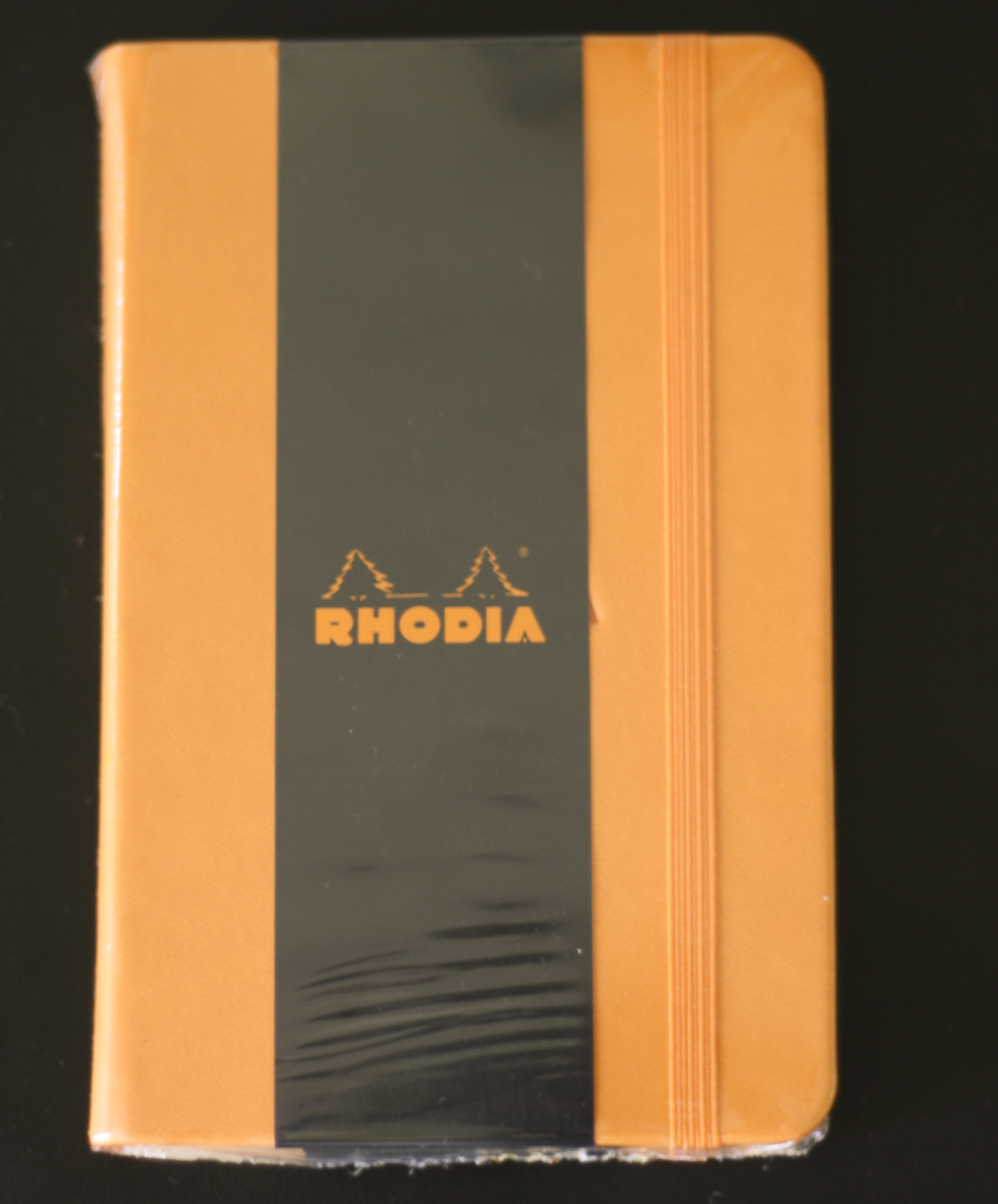
I’ve tested about a dozen notebooks. Most haven’t been worth writing about. But by now I’ve found the best reasonably available notebooks, and I can say this: you probably don’t actually want a Guildhall Pocket Notebook, which is number two. You want a Rhodia Webnotebook.

Like many notebooks, the Guildhall starts off with promise: the pages do lie flat more easily than alternatives. Lines are closely spaced, maximizing writable area, which is important in an expensive notebook that shouldn’t be replaced frequently.
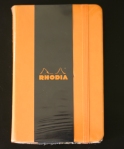
IMG_3900I like the Guildhall, but it’s too flimsy and has a binding that appears unlikely to withstand daily carry. Mine is already bending, and I haven’t even hauled it around that much. The Rhodia is somewhat stiffer. Its pages don’t lie flat quite as easily. The lines should go to the end of each page. But its great paper quality and durability advantage make it better than the alternatives.

The Rhodia is not perfect. The A7 version, which I like better than the 3.5 x 5.5 American version, is only available in Europe and Australia, which entails high shipping costs. The Webbie’s lines should stretch to the bottom of the page and be spaced slightly closer together. The name is stupid; perhaps it sounds better in French. The notebook’s cover extends slightly over its paper instead of aligning perfectly. Steve Jobs would demand perfect alignment. To return to Isaacson’s biography:

The connection between the design of a product, its essence, and its manufacturing was illustrated for Jobs and Ive when they were traveling in France and went into a kitchen supply store. Ive picked up a knife he admired, but then put it down in disappointment. Jobs did the same. ‘We both noticed the tiny bit of glue between the handle and the blade,’ Ive recalled. They talked about how the knife’s good design had been ruined by the way it was being manufactured. ‘We don’t like to think of our knives as being glued together,’ Ive said. ‘Steve and I care about things like that, which ruin the purity and detract from the essence of something like a utensil, and we think alike about how products should be made to look pure and seamless.

I wish the Rhodia were that good. But the Rhodia’s virtues are more important than its flaws: the paper quality is the highest I’ve seen, and none of the Rhodias I’ve bought have broken. If anyone knows of a notebook that combines the Rhodia’s durability with the qualities it lacks, by all means send me an e-mail.


More on the subject: The Pocket Notebooks of 20 Famous Men.

EDIT: See also Kevin Devlin’s The Death of Mathematics, which is about the allure of math by hand, rather than by computer; though I don’t endorse what he says, in part because it reminds me so much of Socrates decrying the advent of written over oral culture, I find it stimulating.

Warning: Don’t buy James Scott Bell’s Plot & Structure: (Techniques And Exercises For Crafting A Plot That Grips Readers From Start To Finish)

I bought Plot & Structure because the issue of how a novel’s narrative moves seems to be understudied by academics, who tend to produce jargon-laden, overly analytical nonsense, and by novelists themselves. I’d really like an equivalent of How Fiction Works, but for an important matter that James Wood disdains (“the novel soon showed itself willing to surrender the essential juvenility of plot”). My ideal book would, as Wood says, ask “a critic’s questions and [offer] a writer’s answers.”

Unfortunately, Bell asks few questions and offers fewer answers. This is frustrating to me because, when I started writing, plot was a major weakness. The first two novels I actually wrote to completion had no real plots and thus weren’t very good novels (my Dad pointed out the former and let me infer the latter). Since then I’ve spent a lot of time thinking about plot, and being dissatisfied that I’ve never seen it addressed well elsewhere. Self-consciously literary writers and critics tend to discount it (as Wood does), sometimes to the detriment of their own work.

Genre writers tend to understand plot but either aren’t known to me, critically speaking, or write so poorly on a sentence-by-sentence level that their work isn’t interesting. To me, the best novels combine plot/story and language in a single, cohesive package. That, however, is difficult to do, and the difficulty may explain why we see so many arid academic-feeling novels about, oh, I don’t know, language and pure consciousness and What It Means To Be Alive Today, while so many genre novels with ticking bombs and handsome heroes and buxom heroines who put out surprisingly easily and simple words laid out in simple ways that won’t confuse anyone.

Not only is this dearth annoying because of my own flaws, but because I can’t point aspiring writers to a particular book and say, “Read this.” I can talk about some of my own techniques—I’ve written plot outlines for a number of books I admire, like an artist tracing his favorite paintings in order to imbibe their spirit and technique. With scenes, I’ve learned to ask what each character wants, what stands in his or her way, and why he or she is doing to overcome that barrier. I don’t always have answers—the characters often don’t have them, either—but at least asking the questions provides some structure to what might otherwise be a misaligned mess.

One can’t, of course, separate plot from character, setting, narrating, and other technical features in a novel. It would be stupid to try. But plot is a great blindspot in Wood’s criticism, and it’s a blind spot I aspire to see, or to see someone else seeing.

Bell, however, is blind.

Elmore Leonard on what it means to write

“I’m glad I’ve always had a commercial bent. I want to make money doing this. I had no dream of going to the Iowa Writing School, or whatever it’s called, and learning to write that way. When The New Yorker guy asked me to send him a story, I said, ‘I don’t write New Yorker stories. The stories I write I can always understand.’ And I can. My stories always have a definite ending, a payoff. I think he was a little insulted.”

—Elmore Leonard, in an interview with Keith Taylor for Witness

The place of literary criticism

A second Zadie Smith quote, also from Changing My Mind: “Here’s the funny thing about literary criticism: it hates its own times, only realizing their worth twenty years later.” This is remarkably close to what I wrote to a friend not long ago, concerning why I like blogging despite the fact that I’m also enmeshed in an academic context that only values peer-reviewed articles and books: “English profs always show up to a fire long after the house has been burned down and the fire already long extinguished.”

Blogging, if the blogger is any good, offers the possibility of getting to the fire when it’s still going, or even building a fire of your own. Maybe in twenty years this will be more widely recognized.

The Facebook Eye and the artist’s eye

“We are increasingly aware of how our lives will look as a Facebook photo, status update or check-in,” according to Nathan Jurgenson in “The Facebook Eye,” and the quote stood out not only because I think it’s true, but because this kind of double awareness has long been characteristic of writers, photographers, artists, and professional videographers. Now it’s simply being disseminated through the population at large.

I’m especially aware of this tendency among writers, and in my own life I even encourage and cultivate it by carrying around a notebook. Now, a notebook obviously doesn’t have the connectivity of a cell phone, but it does still encourage a certain performative aspect, and a readiness to harvest the material of every day life in order to turn it into art. Facebook probably isn’t art—at least to me it isn’t, although I can imagine some people arguing that it is—and I think that’s the key difference between the Facebook Eye and what artists are doing and have been doing for a very long time. I’ve actually been contemplating and taking notes on a novel about a photographer who lives behind his (potentially magic) camera instead of in the moment, and that might be part of the reason why I’m more cognizant of the feeling being expressed.

Anyway, Michael Lewis’s recently gave an NPR interview about his recent Obama article (which is worth reading on its own merits, and, like Tucker Max’s “What it’s like to play basketball with Obama,” uses the sport as a way of drawing larger conclusions about Obama’s personality and presidency). In the interview, Lewis sees Obama as having that writer’s temperament, and even says that “he really is, at bottom, a writer,” and goes on to say Obama is “in a moment, and not in a moment at the same time.” Lewis says Obama can be “in a room, but detach himself at the same time,” and he calls it “a curious inside-outside thing.” As I indicated, I don’t think this is unique to writers, although it may be more prevalent or pronounced in writers. Perhaps that’s why writers love great art and, in some ways, sex, more than normal people: both offer a way into living in the present. If writers are more predisposed towards alcoholism—I’m not sure if they are or not, though many salient examples spring to mind—getting out of the double perspective might be part of the reason why.

I think the key differences between what I do, with a notebook, and what Facebook enables via phones, are distance and perspective. My goal isn’t to have an instantaneous audience for the fact that I just did Cool Activity X. Whatever may emerge from what I’m observing is only going to emerge in a wholly different context that obscures its origins as a conversation, a snatch of overheard dialogue, a thing read in a magazine, or an observation from a friend. The lack of immediacy means that I don’t think I’m as immediately performative in most circumstances.

But the similarities remain: Jurgenson writes that “my concern is that the ultimate power of social media is how it burrows into us, our minds, our consciousness, changing how we consciously experience the world even when logged off.” And I think writing and other forms of art do the same thing: they “burrow into us,” like parasites that we welcome, and change the way we experience the world.

Still, the way we experience the world has probably been changing continuously throughout human history. The idea of having “human history” is a relatively recent idea: most hunter-gatherers didn’t have it, for example. The changes Facebook (and its analogues; I’m only using Facebook as a placeholder for a broader swath of technologies) is bringing seem new, weird, and different because they are, obviously, new. For all I know, most of my students already have the Facebook Eye more than any other kind of eye or way of being. This has its problems, as William Deresiewicz points out in “Solitude and Leadership,” but presumably people who watch with the Facebook Eye are getting something—even a very cheap kind of fame—out of what they do. And writers generally want fame too, regardless of what they say—if they didn’t, they’d be silent.

I think the real problem is that artists become aware of their double consciousness, while most normal people probably aren’t—they just think of it as “normal.” But then again, very few us probably contemplate how “normal” changes by time and place in general.


Thanks to Elena for sending me “The Facebook Eye”.

Life: How the writer progresses

“If a writer is not simply going to repeat himself (which isn’t always a bad thing to do), he has to keep changing, more or less reinventing himself. He hopes that the changes are ‘developments’; that his ‘stages,’ like a rocket’s, are all pushing the same payload toward heaven, in their different ways. He hopes too—since some legs of the trip are liable to be rougher than others—that his audience will stay with him across the troll-bridges and that they’ll reach the sweet cabbage fields together. It may be that there is more troll than cabbage in these pieces; I hope not.”

—John Barth, The Friday Book