Clublife: Thugs, Drugs, and Chaos at New York City’s Premier Nightclubs — Rob the Bouncer

Clublife is a rare example of a book weaker than the originating, (and eponymous) blog. The blog used to be filled with posts containing subtle and sometimes surprising points about bouncers and standard bump-n-grind clubs. The book has some of that, though perhaps less subtle (“I’ve never met anyone who goes to clubs who’s worth a shit” or “They come to these places and toss aside the conventions of a civilized society, doing shit you wouldn’t see them do anywhere but there”) than the source material. Many of the later blog are about blogging instead of bouncing.

The major fringe benefit of being a bouncer appears to be hitting on the women in the clubs, or being hit on by them. If you’re not interested in that—and Rob isn’t—one of the prime reasons to work in that environment goes away. It’s like staffing a restaurant where you don’t like the food. Many people don’t want and aren’t interested in casual sex with strangers. Which is okay, but disliking that activity is naturally going to make clubs seem bizarre and stupid; English departments must seem bizarre and stupid to people who don’t like to read. Regardless of the quality of the experience to someone who enjoys the experience, it’s going to be crap for the wrong sort of person.

Rob is the wrong sort of person. Everyone else at the club seems to be working an angle, either sexually (in Rob’s words: “looking for a place to park their genitals for a night”) or by selling drugs. Not working one of those two angles defeats the point of the club experience. I want to encourage Rob to read Camille Paglia, who is so fond of socially sanctioned Dionysian excess.

Rob depicts the business this way at the end of the book:

Taking, after all, is what the nightclub business is all about. It takes and takes and takes, and gives nothing back. The entire thing is a setup. It’s a scam. It’s a great big mound of shit, all painted up in pastels and fluorescents and hosed down with enough cologne and perfume to disguise the stink.

The scatological metaphor is effective—Rob is good and often very good on a sentence-by-sentence level—but he’s only partially right about nightclubs: they do take. But they also give people a place to sleep with or attempt to sleep with strangers. How many men in particular achieve their purpose there is less clear: presumably some do but many don’t. The minute you don’t want that, then a club is “a scam.”

The book eschews the random, disconnected format of a blog and instead uses a memoir narrative that shows Rob getting into the business and going through the lifecycle of a single club. But the narrative seems forced and false, and a Diary of an Unlikely Call Girl-style reprint might’ve been an improvement.

The Rob we see in the book has a long “history of screwing things up for myself,” which is okay, but he seems to hate everything about what he’s doing and to have built a decent shell of bitterness and resentments that may or may not reflect the real person. He especially hates the many “guidos” who populate New York nightlife for whom he “stands on a box and plays zookeeper [with] for eight hours.” His disdain for guidos occurs primarily because disdain for most racial and ethnic groups is now politically incorrect, and for good reason; imagine that every time he uses the word “guido,” he uses the term “black.”

Still, there’s a lot to be said for first-person accounts of unusual, poorly understood market niches. To some extent my father and I are doing that for grant writing and nonprofits in Grant Writing Confidential, but the dearth of lascivious or potentially lascivious detail means that few people who aren’t involved in trying to get the money are going to be interested. There are things to like in Clublife.

T.C. Boyle’s The Inner Circle reconsidered

The Inner Circle is better than I remember it, and subtler: it uses Alfred Kinsey’s pioneering sex research to explore what happens to a man who isn’t his own man but instead belongs, always, to someone else. The narrator, John Milk, tells the story retrospectively, but, like the butler Stevens from The Remains of the Day, he has learned very little from his experience. In the first lines, Milk says that he doesn’t think he was “ever actually ‘sex shy,'” but he does admit that “I was pretty naive when I first came to him, not to mention hopelessly dull and conventional.”

He ends the novel the same way, only instead of being under the power a great man and guru like Kinsey, he is under the power of his wife—a perhaps more common masters for many colorless men who need direction from some external source. He says initially that “As for sex, I was eager but inexperienced, and shy in the usual way—unsure of myself and just about as uninformed as anyone you could imagine.” At the end he is experienced and informed yet still knows nothing. The ignorance regarding sexuality is enforced by law, custom, and culture at the start of the novel, but ignorance about character and individuality is not, at least for those who care to notice. Milk gets superficially important matters—like the way “all women are every man’s type, under the right circumstances,” but not how he molds himself to the needs of others.

Milk does note, accurately, that “this isn’t about me, this is about Prok”—but it’s about the Prok that Milk experiences. Prok is a stereotypical surrogate father, but he fulfills other roles: to Milk, Prok has a tremendous power:

It was uncanny. The longer we spoke, and it was almost speaking with your inner self or confiding in the family doctor behind closed doors, the more he seemed to know what I was thinking and feeling.

It was probably very canny—Milk just doesn’t realize that he’s in the presence of a charismatic man. And for a young man starved of sexual attention or knowledge, the probable range of basic needs and desires is probably not hard to conceive. Moreover, Milk is predictable as a person, by his own admission—”I always did what was expected”—though the word “was” is sneaky here: who is doing the expecting? What Kinsey, or Prok as the novel calls him, expects is very different from what others expect. Prok expects extensive sexual experience, homosexual and heterosexual, and a level of sexual transparency few people even today are comfortable with. How many porn stars, even, wish for every aspects of their sexual lives to be known? And glamor, as Viginia Postrel argues, partially emerges from intriguing silence.

Still, the novel’s main theme keeps circling back to Milk and his lack of autonomy. If you want to be your own dog you should be your own dog; if you want to be someone else’s dog, you should do so. And there’s nothing wrong with or dishonorable about being someone else’s dog: fitting into a hierarchical organization and making the unit stronger than the sum of its parts is rarely lionized in our highly individualistic society but is still a valuable skill. Milk’s problem, as a person and as a narrator, is that he belongs to and is an extension of Kinsey, but Iris doesn’t want him to be: she wants him to be an extension of herself, and devoted to her above all. Yet she knew or should have known, before she married, that Milk was Kinsey’s first, and given the group’s proclivities towards group sex, she would end up being Kinsey’s. She is, on some level, however little she wants to be by the end of the novel, and regardless of the way she ultimately rejects Kinsey.

Iris pulls Milk away from Kinsey, though it’s not complete: Milk reminds us, as fictional characters often do, that “in life, as distinct from fiction, things don’t always tie up so neatly.” Still, the battle of the novel is the battle, between Kinsey and Iris, for Milk. I see what Kinsey sees in Milk but don’t see what Iris sees. Milk never really has anything he wants, apart from appeasing Prok or Iris. The obvious question arises: how many of us are Milks, and how many are Proks? Milk narrates; most of us probably don’t stand up. Maybe we’re better off that way.

The Inner Circle is a little flatter, a little less tense than I remember: knowing the outcome is an inherent problem in historical fiction. Yet it is still compelling. Many of Milk’s misconceptions, about great men and other matters, are still common today—like when he mentions that he’d “been awkward with girls, terrified of them—I’d placed them on a pedestal and never saw them as sexual beings just like me, who had the same needs and desires as I.” Plenty of men need to overcome the same issues; the Internet is filled with their complaints. Maybe those complaints will exist as long as people are people; at the very least, I expect that the Milks of the world, blind to their places, will.

Tampa — Alissa Nutting

Tampa starts with a bang, so to speak—the first line says, “I spent the night before my first day of teaching in an excited loop of hushed masturbation”—and also explains the narrator’s curious, never-resolved marital predicament: “I find it hilarious that people think Ford and I are the perfect couple based solely on our looks.” I find it curious that the narrator, who is obsessed with teenage boys, wanted to marry Ford or stay married to him. Her marriage exists for no reason outside of the needs of plot mechanics; there are occasional references to Ford’s money, but based on the novel Celeste has a single overriding focus on sex.

That focus doesn’t take a lot of money to maintain, and indeed it would be greatly enhanced by her divorcing Ford, or never marrying him. The closest we get to some kind of rationale, emotional or otherwise, is that “I hoped his wealth might provide me with a distraction, but this backfired—it left me with no unfulfilled urges but the sexual.” In 1900, it might have been very hard to “fulfill” sexual urges, but today that is not the case, and someone so single-mindedly focused on sex doesn’t need to be and shouldn’t be married. The “wealth” doesn’t seem to matter to her: other than name-checking one or two luxury items, money doesn’t seem to matter for Celeste. Explaining her husband to her teenage lover, she “didn’t have to feign indifference” and tells him “He’s just a husband.” Why bother? When Humbert Humbert married, he at least had a reason.

To be sure people are rarely fully rational and most of us are riven by conflicting desires, by Celeste’s desire to marry or stay marry makes little sense at the beginning of the novel and less as it goes on. Ford’s presence offers useful plot mechanic friction.

A novel like Dare Me works more effectively than Tampa because its protagonists are supposed to be vacuous twits. A twenty-six-year old with a classics degree, even a very horny one, should have more going on between her ears than Celeste does, and what’s between her ears shouldn’t harm what’s going on between her legs. She says, for example, that “At university I began throwing myself into classics studies, finding brief solace from my sexual frustrations in texts depicting ancient battles of fervent bloodshed.” But for someone interested in classics, she references them very rarely; her studies seem to have left no mark in her mind. Contrast that with a novel like Donna Tartt’s The Secret History, where Greek appears and an obsession with the past fuels the characters’ actions in the present. Those are characters whose thought is fully colored by classics. Here, classics get mentioned as empty window dressing, like material objects.

Toni Bentley deals with the money issue in The Surrender, her memoir of anal sex, where she says:

You let a man into your bowels—your deepest space, the space that all your life you are taught to ignore, hide, keep quiet about—and consciousness is born. Who needs diamonds, pearls, and furs? Those who’ve never been where I have been. The promised land, the Kingdom.

In asking “Who needs diamonds, pearls, and furs?”, she could be speaking for Celeste, who is also indifferent-seeming to possessions because she has her own “promised land,” albeit of a different though even more forbidden sort than Bentley’s (I say “even more forbidden” because while Bentley’s favorite act used to be illegal, it now mostly isn’t; while Celeste’s used to be not prosecuted, these days it is, thanks to feminists seeking equality in an instance where many teenage boys would probably be happy without it).

There are bizarrely hilarious moments in Tampa, as when Celeste narrates:

Sex struck me as a seafood with the shortest imaginable shelf life, needing to be peeled and eaten the moment the urge ripened. Even by sixteen, seventeen, it seemed that people became too comfortable with their desires to have any objectivity over their vulgar moments. They closed their eyes to avoid awkward orgasm faces, slipped lingerie made for models and mannequins onto wholly imperfect bodies.

Actually, sex is not at all like sea food in the sense Celeste describes, but we do see how Celeste totally misconceptualizes the world and thus a lot about her own, non-universal, proclivities. She also asks rhetorically, “Why did anyone pretend human relationships had value?”, when the better question is why she pretends they do, since most of us who aren’t sociopaths have obvious, readily available answers. Yet the metaphor is compelling, like enough of the writing in Tampa to make the book writing about. There are interesting questions about the extent to which desire clouds judgment, but that assumes the characters have any kinds of judgment in the first place, and the ones in Tampa mostly don’t.

Like Humbert Humbert, her obvious antecedent and another character with desire problems, Celeste is obsessed with guys on the cusp of manhood, and her chosen crush gets described in ways similar to Humbert’s nymphets: “I loved the lanky-limbed smoothness, the plasticity of his limbs, the way his frame shunned both fat and muscle.” The alliteration is there, but that kind of poetic style isn’t sustained. There is room in literature for a female Humbert, but she is not Celeste, and Jack is not Dolly. It is a novel with no animating soul beyond the purely carnal. I can appreciate the purely carnal but Celeste doesn’t even both arranging her life in ways that make sense (which may be why carnality is so often depicted in adolescents, who are still faced with strictures of schools and parents).

It is painful reading a book in which there is an obvious solution to an obvious problem that the protagonist doesn’t notice; Celeste’s situation in Tampa doesn’t rise to the TV trope “Too Dumb to Live,” but there should be a lesser term for characters who fail to perceive simple ways of dramatically improving their lots. In addition, Ford appears happy not having sex with—or having bad sex with—his wife. Marrying someone hot but sexually uninteresting doesn’t seem like a great deal, but we see little of him either.

I wanted Tampa to be a better novel; it wasn’t bad yet it feels wrong. I’m writing at length about the book because it’s not badly written and has a lot of promise. Tampa is not bad but should be better than it is. Books like that often generate the most response in me, because truly bad books aren’t worth bothering about and one runs out of empty superlatives with the good ones. There is so much promise, but Tampa isn’t quite executed in a way that makes sense. The supposed shock of what Celeste wants is a good premise that doesn’t go anywhere useful.

Thoughts on Tyler Cowen’s “Average Is Over”

You should read Average Is Over, which makes many subtle and unexpected (to me) points.

* This: “If you and your skills are a complement to the computer, your wage and labor market prospects are likely to be cheery. If your skills do not complement the computer, you may want to address that mismatch” is a useful way of thinking about things, but if you read books (like Average Is Over) you’re more likely to already know about skill changes and adjust appropriately based on new, incoming information. Yet I am fond of citing the fun fact that people watch an average of four to five hours of TV per day, and by some measures Americans are reading fewer books (or were in 2007) than at any time in the last century or so. Reading skills don’t appear to be high. Basic reading and reading skills may be the low-hanging fruit for many if not most people, especially since reading skills help develop writing skills.

In How to Win at the Sport of Business: If I Can Do It, You Can Do It, Mark Cuban describes how reading conferred on him an information advantage: “Everything I read was public. Anyone could buy the same books and magazines. The same information was available to anyone who wanted it. Turns out most people didn’t want it” (though he doesn’t like fiction, which may also speak to the fields in which he works).

* Cowen writes, “Adult males are seceding from the workforce—or being kicked out—in frightening numbers. Few of these individuals are wealthy playboys. It is no surprise that popular culture today has this image of the male slacker, a young man who lives at home, plays video games, is indifferent to holding down a job, and maybe doesn’t run after young women so hard.” That’s probably true, but a lot of guys have probably realized that marriage markets are stacked against them (see also “How DNA Testing Is Changing Fatherhood“), that relatively few women appear to value guys getting mid-level jobs relative to guys who are cool / fun / have strong game, and there are better alternatives to working for 50 hours a week in a not-that-interesting job. For many guys, learning game and guitar is a more viable route to romantic success than improving a career.

The above, and its absence from contemporary media discussions, may say much about actual power in contemporary society.

* “[M]any of these young earners are threshold earners, meaning earners who are content just to get by and who do not push ambitiously for a higher wage or stronger credentials at every step. Williamsburg, Brooklyn is full of young threshold earners, although rising rents are starting to push them out into other parts of the city, such as the further reaches of Brooklyn or the Bronx.” This goes back to the question above: what are we being productive for?

Stumbling on Happiness says that income above about $50,000 appears to do surprisingly little for the quality of one’s life. In your 20s, perhaps the best investment in happiness-per-dollar is the condom; condoms + an OKCupid account may be the most efficient use of turning resources into fun. Large incomes also expose earners to higher and higher marginal taxes. For someone making, say, $30,000 or $40,000 a year, it might make more sense to stay at a relatively low income OR try to make a very high income of say $200,000 a year. But the middle may be not worth much, especially if the job necessary to stay there is highly time consuming.

In Otherwise Known as the Human Condition, Geoff Dyer says that “I have also been able to live on very little money without any sense of sacrifice (a valuable skill, almost a privilege, for anyone wishing to become a writer). Going without things that most of my contemporaries took for granted never felt like hardship. I spent years living on the dole, more than happy with the trade-off: little money, lots of time.” The Dole provided a generation of artists with enough money for food. We may be heading towards or already at that sort of thing in the U.S. Being a Brooklyn writer is already a cliché. Some people living artists’s lifestyles are writing software instead of prose. Someone like Notch, creator of Minecraft, falls into this category, as do some open-source software writers.

* Early Facebook resembled an art project more than a business, and until recently a lot of people thought Facebook would never make substantial money. The same spirit that animated its creation animates the “threshold earners” in Brooklyn. Many contemporary programmers are closer to painters and writers than is commonly realized.

* I’ve heard friends discuss the benefits of gray economy living (though they don’t use the term “gray economy”), and they usually cite taxes—for good reason. Paying both sides of the Social Security tax eats 15% of a paycheck. Add in Medicare and Medicaid, and even low-wage earners can end up with 20 – 25% of their paychecks eaten by payroll taxes. Someone earning $10 in hard-to-trace cash babysitting in the gray economy is getting a de facto $12 – $12.50, which is a huge improvement, and I see the trends Cowen discusses pushing more people in that direction. When discussing these jobs, I have increasingly heard people ask a simple one-word question: “Cash?” The forecasts Cowen makes on page 236 probably increases the number of threshold earners, since it’s not worth making more if the state is going to take more.

Then there are the sex workers I’ve met; those who earn a lot usually report much but not all of their income, and they pay for pretty much everything they can in cash. They can earn surprisingly high real incomes by minimizing reported income and using a lot of untraceable cash to pay for goods and services.

* Learning discipline and conscientiousness are major themes in Average Is Over, and towards that end I expect pre-binding commitment software like Mac Freedom and Anti-Social to proliferate. While writing this post I reached a point that I didn’t know how to express, so I wandered over to Hacker News and then to a photography forum. I forgot the context, so it took five or ten minutes for me to get re-focused on the sentence—which I still needed to resolve. Micro attention problems may be growing for many people. It is easier and more fun to “waste” time on the Internet, and for most of us there are rapidly diminishing returns to random reading and browsing, although those activities may feel work-like.

* Software is becoming increasingly good at grading student essays and other written work, and Cowen says that “These programs still need to work out some bugs (a clever student can game them with coherent-sounding nonsense).” Some humanities journals can also be gamed with coherent sounding nonsense. Many corporate and government bureaucracies produce huge amounts of coherent-sounding nonsense, so gaming the system in this way may actually be a job skill.

* The restaurant industry soaks up a lot of low- to mid-skill labor, and I’m struck by the extent to which many chefs treat food as art. In New York there is a de facto infinite variety of interesting food, and even someone who restricts themselves to $10 – $20 meals will find innumerable interesting, tasty options. That being said, I see diminishing returns here for all but the most adventurous and exotic of eaters—how much more interesting chefs can get? (I would be happy to be proven wrong here.) Already a lot of menu items look more like differentiating gimmicks than dishes I really want to eat.

The world’s stock of new foods or consumable substances does not appear to be growing rapidly. Genetic engineering may change that, giving chefs a host of new, interesting ingredients to experiment with.

Food has the advantage in that it’s made and then gone; the chefs of today are not competing against the chefs of twenty years ago in the way that, say, writers or musicians are. At bars and clubs I still routinely hear Michael Jackson, Madonna, and Britney Spears.

* I found the first and third sections of Average Is Over much more interesting and useful than the second, which uses games and especially chess to illustrate larger points about human-machine cooperation and the future of the labor market. It could have been shorter, and one (unstated, I think) takeaway is that it’s better to be the person making the machines than the person using them.

* “The ability to mix technical knowledge with solving real-world problems is the key [to new businesses and employability], not sheer number-crunching or programming for its own sake” sounds like something Paul Graham would say, or at least the first sentence does.

* “[W]hen income and wealth disparities are pronounced, everyone who isn’t at the very top will be scrambling for the attention of those who are” is an outcome I hadn’t considered and yet seems true, especially in light of how service industries cater to the very wealthy. Even something like “Pilates studios” may fit this criteria.

* Many things now considered to be “productive” used to be considered useless (like quantum mechanics when it was first discovered). It is also worth pondering what we are trying to be productive for. The long-run answers may be “for its own sake,” or for various kinds of sexual marketplace signaling or kids. Nonetheless, most people do not seem to be asking, or coherently trying to answer: “What are we being productive for?” Cowen writes that “When economists investigate human rationality, they are often too dependent on arbitrary stipulations about what is rational and what is not, expressed in the form of models.” Economist may also be too dependent on productivity and income as proxies for the quality of life (though I do not think this true of Cowen). For example, Philip Greenspun’s post “Danish happiness: bicycle infrastructure” notes that bikes don’t contribute nearly as much to measured GDP as cars, but for many people are a real improvement in terms of the quality of their life.

* Many people have not listened to labor market signals: “the slacker twenty-two-year old with a BA in English, even from a good school, no longer has such a clear path to an upper-middle-class lifestyle. At the same time, Facebook, Google, and Zynga are now so desperate for talent that they will buy out other companies, not for their products, but rather to keep their employees. It’s easier and cheaper to buy the companies than to try to replicate their recruiting or lure away their best employees.” Thinking about men, however, many of the slacker twenty-year olds with BAs in English do substantially better with women and get laid a lot more. There may be a correlation-is-not-causation issue here, however.

* Wow: “Kaiser Family Foundation estimates that a health insurance premium today for a family of four averages over $15,000 and within ten years’ time could be $32,000 or more. That’s more than a lot of workers are worth. Keep in mind that the 2010 median wage in the United States for an individual (not a household) was about $26,363.”

* “Just as Adam Smith and Friedrich Hayek and Michael Polyani stressed that a market economy evolves to the point where it is very difficult to understand the overall interrelationships of production, so can the same be said for many branches of science.” This leaves space for Houellebecq novels and other works about modern alienation, since we often lack a sense of impact in an important way.

* This: “It will become increasingly apparent how much of current education is driven by human weakness, namely the inability of most students to simply sit down and try to learn something on their own” has long been apparent to me and probably to other teachers, and it is largely missing in a lot of the elite online technical discourse about education found on sites like Slashdot, Reddit, and Hacker News, where atypical, highly self-motivated people tend to congregate.

* I’m more skeptical of many conventional consulting firms than Cowen (discussed on page 42 – 44), and I see the proliferation of generic consulting firms employing 22 – 30 year olds with little industry experience as symptomatic of the problems in many very large employers—a symptom that may be cured by startups or other competitive means. Do large, well-run companies like Google hire consultants to present PowerPoints?

* “Some of what is going on in today’s global economy is a reorienting of economic activity toward where most of the people are, and obviously, most people live in Asia.” One way to make the U.S. stronger is to bring more people to the U.S., as Cowen says, but that is made difficult by political resentments, misunderstandings, and fears of the other. We are still a highly tribal species.

* “When it comes to technology, progress is usually good, but gradual progress is usually better.” That’s because gradual progress lets people adjust. I’d also ask where, and on what timescales, rapid progress ends and gradual process begins.

Summary Judgment: Confessions of a Sociopath — M. E. Thomas

Confessions of a Sociopath came from Tyler Cowen’s recommendation, and it’s the perfect book to get from a library: I learned from it but am unlikely to want to re-read it. There isn’t enough depth to justify purchase but there is more than enough to justify reading. Like Cowen I would read this as closer to a novel or memoir—which is usually a way of saying “I make shit up but don’t want to admit it”—than a work of strict nonfiction.

Confessions of a sociopathI kept hoping for more lascivious content but the author appeared at first to have led a sedate life in that respect, perhaps due to her affiliation with the Mormon church, although there is a late chapter on this subject. Her sex life is dealt with in a way that seems decorous by modern standards, despite her affairs with women.

This passage in particular stood our as characteristic of the way people can attack the modern tendency towards explicit rules:

While she [a somewhat unattractive, insecure supervisor] regularly billed as many hours as humanly possible, I exploited our [law] firm’s non-existent vacation policy by taking three-day weekends and weeks-long vacations abroad. People were implicitly expected not to take vacations, but I had my own lifelong policy of following only explicit rules, and then only because they’re easiest to prove against me. She could sense that I flouted this and other unspoken rules with little consequence by a quick look at my time sheets and my less-than-formal office attire.

Explicit rules can often be turned against the people who aren’t following them. Working around governments and universities has given me special aptitude for figuring out what the explicit rules are and how people break them, because explicit rules are often impossible to follow completely, or following them completely is stupid in the real world, or both. Nonetheless our present bureaucratic world is rife with rules created by well-meaning bureaucrats, and those rules are ripe for exploitation by anyone who takes the time to read them.

Confessions of a Sociopath demonstrates how people acting in bad faith can activate biases and bureaucratic institutions for destructive ends; Thomas tells stories about repeatedly manipulating people and institutions through sexuality and sexual harassment claims and innuendoes, and in this she is in some ways recapitulating ideas from Francine Prose’s Blue Angel, although that novel is about a straightforward though misunderstood quid pro quo gone bad.

Thomas has an unusually direct understanding of her own apparent condition in a way that many professionals don’t; this section shows something important about professors—Thomas is a law professor—and why people (like me!) want to be them, and something important about Thomas:

People are often surprised to learn that I teach less than six hours a week, less than eight months out of the year. In many way it’s a dream job for someone inherently lazy and unable to do grunt work like me, but eventually I’m sure I’ll get bored of it too. After I do, I don’t know what, but I’m sure things will work out. They always do.

Being a law professor doesn’t appear to be a particularly challenging job from a teaching perspective, since the professor is continually repeating information mastered long ago to students with no familiarity, in an environment in which the professor has absolute power over the student but not vice-versa (sample moment from the book: “They can try to fight me, but in that classroom I am God. I write the test. I give them the grade”). The professor is part of a legal regime that prevents lawyers from existing save through credentialing from other lawyers. People who want an honest test of their skills sell to markets; people who can’t handle an honest test of their skills go to school.

To be sure school does sometimes offer honest tests of skill and imparts important skills but that appears to be the exception, not the rule, based on my experiences on both sides of the desk. It’s not clear how to make utility and intellectual interest the norm instead of the exception.

The distinction between social and personal power may be relevant here; as the authors of the linked paper say, “social power [is] power over other people and personal power [is] freedom from other people.” Sociopaths appear particularly good at the latter, since they don’t appear to care what other people think except to the extent it affects them.

I am not convinced that we aren’t seeing huge selection bias problems with sociopaths, which limits broadly applicable ideas. Note that I wrote this sentence before re-reading Cowen’s linked post above, in which he said essentially the same thing.

The editing is good and the book moves; few sentences or ideas are essential in and of themselves.There could have been more and/or better research citations, but the stories were consistently entertaining, and challenging; she describes seeing a struggling baby opossum in a pool and then, instead of helping it as most of us would have, drowning it. That’s towards the beginning of the book and the opossum story dares us to keep reading. Its placements in this blog post is not an accident, given that my overall impression of the book is positive.

Daily Rituals: How Artists Work — Mason Currey

Daily Rituals is charming, and almost every entry feels like the right length; if anything, I would have liked each to be slightly longer, perhaps because the quirks and weirdnesses of the famous artists described provide justification for the quirks and weirdnesses of non-famous artists.

daily_ritualsThe answer to the title is “divergently,” but with some patterns. Many like walks, routines, and stimulants. Exasperation with TV is common, and even the non-writer artists tend to read. Many artists also exasperated lovers and spouses through their compulsions and tics. Given the low remunerative value of art and the low probability of success through recognition, being an artist is a compulsion for many of those described within—Currey even uses the word in his description of Patricia Highsmith: “Writing was less a source of pleasure for her than a compulsion, without which she was miserable.” Daily Rituals may be best read by anyone romantically entangled with or biologically related to artists, as well as any artists who want to justify their own weird predilections. I love it when people explain myself to me.

Currey wants to answer questions like, “are comfort and creativity incompatible, or is the opposite true: Is finding a basic level of daily comfort a prerequisite for sustained creative work?” But they don’t have answers, because artists work in all sorts of places in all sorts of ways. It’s like asking about alcoholics: people who really want to drink will drink in elegant bars like Pouring Ribbons or chug Natty Lites in a dark Chinatown alley. Most might prefer the former to the latter but will settle for the latter when necessary. Currey also writes:

“The book’s title is Daily Rituals, but my focus in writing it was really people’s routines. The word connotes ordinariness and even a lack of thought; to follow a routine is to be on autopilot. But one’s daily routine is also a choice, or a whole series of choices.

Most of the artists in here establish routines whenever they can, much like the writers in Writers on Writing. The number of people who need routine, who need defaults, speaks to its utility, among artists or anyone trying to accomplish a task with an artist’s dedication (like entrepreneurs, who might be the artists of the modern age). Distraction might also be handier than ever, giving rise to essays like “Disconnection Distraction:

Some days I’d wake up, get a cup of tea and check the news, then check email, then check the news again, then answer a few emails, then suddenly notice it was almost lunchtime and I hadn’t gotten any real work done. And this started to happen more and more often.

If you get into that habit, you’ll be well-informed on unimportant news and less likely to make the thing that becomes the news. One question you might ask is: “Are you reading or making the news?” Aim for the latter. The former isn’t wrong, exactly, and it’s worth reading a lot, but as a secondary, not a primary, activity. Reading the news on the Internet or checking e-mail are especially dangerous in this regard because they can feel like working though they’re not.

I mentioned the compulsive aspect of art. That reappears again and again. Currey writes of Simone de Beauvoir that “when she took her annual two- or three-month vacations, she found herself growing bored and uncomfortable after a few weeks away from her work.” Long, pointless idleness is is boring, like binging on TV, but that’s because most artists seem to like what they do, or like it like an addict likes. Voltaire’s secretary “estimated that, all told, they worked eighteen to twenty hours a day. for Voltaire, it was a perfect arrangement. ‘I love the cell,’ he wrote.”

Such stories may be why, in Currey’s words, “Looking at the achievements of past greats is alternately inspiring and utterly discouraging.” The line made me laugh because of the juxtaposition of opposites, but also because he’s expressing a fundamental truth: if you look at the work as work, it can be “discouraging,” since so many artists do so much of it, but if you look at it as an extended form of play, it should be “encouraging.” It should also be “encouraging” because you can do it too—if you want to. Which means the limiting factor between you and art is you—which oscillates back to discouragement.

Still, Daily Rituals is at its heart a manual for dealing with and/or understanding someone with an artistic disposition, which might be described as imagination and execution. A surprisingly large number of people seem to imagine that being an artist is all about the “imagination” part and not much at all about the execution part; wandering around coffeeshops, bars, and parties, doffing a funny hat, and making enigmatic pronouncements is not the majority of what being an artist, broadly defined, is about. It’s about results, and Daily Rituals is about getting them and enabling the conditions necessary to get them. “Necessary” is the key word: a condition may be necessary but not sufficient, and it’s possible to treat a daily ritual as an empty ritual with no real output.

There are also a fairly wide range of ways to succeed. Some artists do spend a lot of time drunk or at parties. At least one prefers to work hungover, which would make me crazy. The artists appear approximately split between those who like noise and those who prefer quiet. I’m among the latter and can barely believe that anyone really gets anything done in noisy coffeeshops, tapping on laptops, but enough successful writers have testified to the contrary that I’m forced to believe them. The fundamental idea remains, however, that artists are artists because of their output. That’s it.

Some passages in Daily Rituals are funny; you wouldn’t expect this book to be a comedy and yet I laughed frequently. Two examples:

[John Cheever] had what appears to have been an unusually robust sex drive (the actress Hope Lange, who had a brief affair with Cheever, said that he was ‘the horniest man [she] ever met’) combined with frequent bouts of impotence, probably brought on by his alcoholism but no doubt made worse by his sexual guilt and a frequently rocky marriage. All of this was distracting from his work, especially since Cheever placed a high value on the salutary effects of erotic release. He thought that his constitution required at least ‘two or three orgasms a week’ and he believed that sexual stimulation improved his concentration and even his eyesight: ‘With a stiff prick I can read the small print in prayer books but with a limp prick I can barely read newspaper headlines.’

or:

The German poet, historian, philosopher, and playwright [Friedrich Schiller] kept a drawer full of rotting apples in his workroom; he said that he needed their decaying smell in order to feel the urge to write.

Rereading Nick Hornby’s High Fidelity

I still laughed aloud many times at High Fidelity, although the jokes are almost all context-dependent and so can’t be quoted without causing a quizzical look that says, “You really think that’s funny?” Flipping through it doesn’t yield anything obvious, but I kept smiling at many moments. This is the closest I can get:

There were some nights with Laura when I’d kind of nestle into her back in bed when she was asleep, and I’d be filled with this enormous, nameless terror, except now I have a name for it: Brian. Ha, ha. OK, not really a name, but I can see where it came from, and why I wanted to sleep with Rosie the pain-in-the-arse simultaneous orgasm woman, and if that sounds feeble and self-serving at the same time—oh, right! He sleeps with other women because he has a fear of death!—well, I’m sorry, but that’s the way things are.

Rob’s voice and attitude carry the book, as does the writing, which is largely about nothing yet still moves rapidly from incident to incident, creating plot, which is easily overlooked in novels like this, such as Wilson’s Flatscreen. The continuous happening in the plot contrasts with the non-happening in many of the characters’ lives.

There are moments of astute observation too, as when Laura says “sometimes you need someone to lob into the middle of a bad relationship like a hand grenade and blow it all apart.” Which is true, even if the hand grenade is often made out to be the bad guy (or girl) in the relationship. Often the grenade is the bad guy. But sometimes he (or she) is the catalyst for doing what should have been done long before. When big, life-changing transitions stop happening on a regular basis, (from high school to college, college to grad school and/or work), it becomes distressingly easy to slip into a single path and lose the willingness necessary to make radical changes, whether in work, the mind, or love.

Rob basically knows as much:

None of us is young anymore, but what has just taken place could have happened when I was sixteen, or twenty, or twenty-five. We got to adolescence and just stopped dead; we drew up the map then and left the boundaries exactly as they were.

Life changes even if you don’t. This should be obvious. It takes Laura to tell him what he should already know; when Rob asks “So what should I be doing?”, she replies:

I don’t know. Something. Working. Seeing people. Running a scout troop, or running a club even. Something more than waiting for life to change and keeping your options open. You’d keep your options open for the rest of your life, if you could. You’d be lying on your deathbed, dying of some smoking-related disease, and you’ll be thinking, ‘Well, at least I’ve kept my options open.’

She’s right. Whatever else you’re doing, you should be doing something. But Rob doesn’t, mostly, and as a result his problems are largely self-imposed. He says:

It’s only beginning to occur to me that it’s important to have something going on somewhere, at work or at home, otherwise you’re just clinging on. [. . .] You need as much ballast as possible to stop you from floating away; you need people around you, things going on, otherwise life is like some film where the money ran out, and it’s just one bloke on his own staring into the camera with nothing to do and nobody to speak to, and who’d believe in this character then?

Rob lacks that intellectual ballast. He only listens to music and doesn’t play; at his level of obsession, connoisseurship and taste should pale compared to making (Rob hooks up with an American singer named Marie and says of her place, “thrillingly, there are two guitars leaning against the wall.” He could have two guitars leaning against his wall, although I think one would suffice). Still, I am struck by the extent to which many YouTube videos can be reduced to “one block on his own staring into the camera with nothing to do,” except talk to an audience that isn’t present. Jenna Marbles is a useful approximation of this idea.

There are moments of poignance and useful articulations of the obvious, as when Rob says:

You run the risk of losing anyone who is worth spending time with, unless you are so paranoid about loss that you choose someone unlosable, somebody who could not possibly appeal to anyone else at all.

Being overly fearful of loss increases the likelihood of loss, and Rob is disproportionately anxious. As a college student dating Charlie Rob is “fretful about my abilities as a lover,” and fifteen or so years later he is still fretful about his abilities as a lover. Eventually shouldn’t he just let the anxiety go and figure out what he’s doing? Though he apparently hasn’t in his economic life so perhaps his love and economic lives reflect each other. Rob is a sort of what-not-to-do when it comes to women. He even says, “There are still enough of the old-style, big-mouthed, self-opinionated egomaniacs around to make someone like me appear refreshingly different.” That might work for him, but the big-mouthed egomaniacs are the way they are because what they do tends to work (link is text but potentially NSFW).

For a guy who thinks a lot about his love life, and pop songs that are almost entirely about love, sex, and romance, Rob appears to know very little about actual women. Most pop culture, however, appears to be highly misleading on this score, which may explain why a pop-culture junkie like Rob is or has been highly misled. People who don’t make a concerted effort to learn about actual women. But this is true of much narrative art, especially American narrative art.

In my reading over the last few days, I’m struck by how much more pathetic Rob seems: as I said before, his problems are largely self-imposed, or imposed by his personality, and the solutions also must come from within. Rob fears the women he’s attracted to, like a fifteen-year-old; he goes to a small gig where Marie plays and afterwords she sells CDs: “We all buy one from her, and to our horror she speaks to us.” Most guys are happy to be talking to the people they’re attracted to, and the same obviously applies to women.

In addition, High Fidelity feels like a period piece: Rob owns a record store in an era when CDs and records are mainstream, and people who want to hear a particular song must track down a physical copy of it. Though I was born into that era it feels very long ago and foreign. So does the difficulty of getting ahold of people through the phone. The default state of more people as “alone” then. Computers are almost totally absent. It also feels highly PC, as when Rob recounts “a terribly unsound joke” that is only mildly funny and not really offensive. Why qualify it by saying that it’s “terribly unsound” when it’s not and when interesting humor by its nature is “unsound,” using Rob’s definition?

Vow: A Memoir of Marriage (and Other Affairs) — Wendy Plump

Vow is about adultery, and two people married to each other who both routinely commit it, and yet the most obvious question isn’t addressed until page 245 of 258:

People have asked me why Bill and I didn’t just have an open marriage. The answer is simple. We didn’t want an open marriage. If an open marriage is the route both spouses choose to go, that is one choice. It’s very cosmopolitan. I know a local couple who tried this for years, and it worked out to some degree. They had a lax attitude toward sleeping around. [. . .] But the idea doesn’t have much appeal to me. If we were able to do it, we would all do it. Almost no one I know could do it.

For a practice that “doesn’t have much appeal to me,” Plump sure did a lot of it; most people who don’t like Pilates don’t keep going to the classes. She effectively had an open marriage without labeling it as such, or getting the benefits, like hot threesomes. Not addressing the open marriage until the end is bizarre. Plumps and her husband appear to like the drama of lies more than the simplicity of truth.

A book like Never the Face (my essay about it is at the link) is about fundamentally more honest people: on its fifth page, David says to the narrator of his wife Maria, “She knows about it, and she’s okay with it.” The paragraph breaks: “What?“, the narrator thinks. Then: “For the next two days, my mind argued with itself.” Even if the narrator can’t conceptualize or accept the possibility of uncommon arrangements, her partner can. That’s what Plump and her husband are missing. Instead they get recriminations, and the problem of simultaneously wanting the other person to be monogamous while they don’t have to be. Cognitive dissonance is a bitch, and so is hypocrisy.

The overall effect yields the strangeness of art, from the level of the sentence to the level of the whole, which is why I feel compelled to write about Vow amid other projects and other purposes.

Still, Vow is spectacularly well written and yet spectacularly frustrating, because the simple, obvious solution to the problems between Plump and her husband is simply off the negotiating table. They don’t even try events like this one, slightly NSFW, described in Time Out New York.

Plump says that “I assume Bill approached the altar with every intention of doing the right thing. Don’t we all? I’m not sure that I did. Even as I took my vows, I was aware of some mocking little voice in my head, particularly when I got to that part about forsaking all others” (120). Then. . . don’t get married? Again, it’s the obvious solution to a book that’s about looking at the obvious and then doing something else.

Consequently, on some level Vow is one long yowl of cognitive dissonance and “I want.” Plump cheats, basically, because she feels like it: “So I was thrown off balance when I first met Tommy and felt an attraction so compelling I no longer cared that I was married” (8). That’s it, and at bottom it’s the reason most cheaters cheat. In Plump’s universe, feelings trump emotion; I’m not sure about the extent we should extrapolate her comments to all women, or all people, but there’s definitely a temptation to do so, though I’m going to refrain.

At one moment Plump writes:

I have tried many times to deconstruct allure. It is the least romantic of tasks, but it is marginally useful, if only to prove a point. When you take attraction apart, when you look back on what developed and how, you find that it is a physical impulse for about eight seconds before it moves on to something bigger. (50)

Many people, mostly guys, have worked to take attraction apart and to learn how to build it up. Neil Strauss is the most famous, but many others, like Roosh, have also field-tested what works in attraction, in allure. Women are now also producing their own material on overt allure. Note that I’m not necessarily endorsing Strauss, Roosh, or the linked Female Pickup Artists, but I am saying that they are attempting, through observation, trial, error, and research, to develop methods for attracting women or men—in other words, “to deconstruct allure.” Chances are that the peculiar alchemy involved in attraction will never be completely standardized, but pretending that there’s no way to “deconstruct allure” is just pointless and incorrect romantic mystification.

Plump says that “Immediately on standing next to Steven I felt a frisson snapping between us. Some neuron in my brain knocked itself loose and began rapping on my awareness, saying, Yo, are you still in there? Pay attention. You’re doing it again.” Chances are good that Steven was doing something, consciously or unconsciously, to make that attraction happen. Maybe he was just really hot. But maybe he’d begun systematically learning about what to do around women. Plenty of guys do.

Why does she sleep with these guys instead of some other guys? She doesn’t really say. What do they do? How do they behave? It’s lost to Plump, who isn’t asking why she likes what she likes: she’s just liking it. It’s the triumph of feeling and the reason so many guys, and some number of women, read The Game.

There’s also a lot of “I” in Vow: a lot of “I loved not only the way I felt with Steven, I loved who he was with me, as well.” There’s not a lot of thinking about what other people are thinking or feeling. That may explain the quality of Plump’s marriage, which demands “we” and “you” as much or more than “I.”

One also wonders why her husband, Bill, can’t or chooses not to understand presumed shifts in his relationship with his wife: “Sex with Bill became unwanted by comparison, through no fault of his. It changes utterly from an act of love and passion to an act of crushing obligation” (41). Perhaps she shouldn’t be married, then? Perhaps he should recognize what’s going on and leave? The obvious questions pile up, and Plump is telling us that she has no answers. Maybe there are none. There are only contradictions. She says that “Through it all, again, I was certain of one thing. I did not want our marriage to end. I was crushed but not finished.” For someone who doesn’t want her marriage to end, Plump behaves in strange ways.

Some niggling intellectual points bother; Plump, for example, must not have read much evolutionary biology: she writes that “They [friends] think I must have been aware that Bill was having an affair, as if suspicion were linked to some primal instinct we all have. I have no idea what imperative suspicion would serve Neanderthals such that it would repeat upward through the species to find its expression in us” (4). Leaving aside the question of mistaking Neanderthals for a major modern human ancestor, I can very easily imagine “what imperative suspicion would serve:” for men, suspicion is one way of ascertaining paternity. If you check a woman’s fidelity, her offspring are more likely to be yours. For women, jealousy is a form of resource guarding: if you want your mate’s resource capacity to be primarily devoted to you, and not to the hussy a few huts over, you want to make sure he’s not knocking her up (The Evolution Biology of Human Female Sexuality discusses these issues and empirical findings around them).

These obviously aren’t absolute, and the anthropological literature is filled with alloparenting, group sex, and other arrangements, but the basic utility of jealousy as an adaptation remains. Plump does note that her husband’s child with another woman “moved us into a whole new circle of deceit, into that tortured fraternity of women and men [ . . .] who are heaved by their loving spouses into the dirtiest of vortices—women who find out their husbands have fathered children elsewhere; men who find out their children are not biologically their own” (31). Right. It’s the “dirtiest of vortices” because of the tremendous resources invested in children. To have someone who is supposed to be investing your children investing in someone else’s is the cruel problem that jealousy is there, in part, to address.

I’m keeping Vow, though it’s the sort I would normally sell.

Summary Judgement: Hard to Get — Leslie C. Bell

Hard to Get: Twenty-Something Women and the Paradox of Sexual Freedom sounds promising but makes the classic mistake of reporting opinions expressed in a cold state, which is ver different from the hot or aroused state in which many people make their actual sexual decisions. Unless I missed it, Bell did not cite Alexander and Fisher, “Truth and Consequences: Using the Bogus Pipeline to Examine Sex Differences in Self-Reported Sexuality,” which she should have. She doesn’t consider what Clarisse Thorn does, about the micro-interactions and decisions people make.

An exercise: imagine that the genders in Hard to Get are reversed, and that male writers are talking about their relationships with women. Most commentators, both male and female, would probably make fun of them, whether overtly or through condescension, just as they would a virgin dispensing sex advice.

There is much discussion about “having it all” that I do not think troubles men, or male discourse, nearly as much. For most people, I suspect “having it all” is incoherent and/or paradoxical: it is difficult if not impossible to have copious free time and a time-intensive career; there is an inherent trade-off between the security of a relationship and the thrill of the new. In many domains choosing one path precludes others. But so what? That’s life.

The author never asks what may to be men the most important question of all: how women choose which men they want to sleep with, although one, “Phoebe,” described as a tall, attractive redhead, knows it’s just not that hard, as long as you’re height-weight proportionate (and maybe even if you’re not), to get guys: “Basically, you talk to them” (108). Is this hard to understand? It was hard for me to talk to girls when I was in middle school but like most people I got over it.

The writing is weak or boring on a sentence-by-sentence level; there is a strongly “academic” feel.

I wanted to like the book.

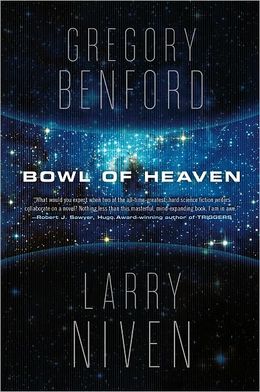
Bowl of Heaven — Larry Niven and Gregory Benford

Bowl_of_heavenIt’s almost always a mistake to represent alien consciousness in science fiction. Aliens, if we ever encounter them, are likely to be so alien that we can’t or won’t understand them—not at first, and conceivably not ever. The bigger problem with representing alien consciousness in science fiction comes from the language that is doing the representing.

Language, as pretty much everyone who has ever learned a foreign one knows, shapes what and how you think, as does the culture that carried by that language. Languages, though translatable, have different flavors. And the aliens in Bowl of Heaven sound like the humans, who sound like each other, and all of whom sound like Americans. They can’t do much better than call the human-built spacecraft “boldly simple.” These are aliens who, even more than most aliens in fiction, feel like humans dressed in exotic garb and wielding exotic technology.

Arthur C. Clarke wisely avoided this problem in Rendezvous with Rama, which is one reason the first one is so good and the latter ones less so.

It’s very hard to create fully differentiated human characters, each with a style all their own. Few accomplish this, which is why most writers choose a single first-person narrator, or a limited third-person narrator. One accomplishment in a novel like Anita Shreve’s Testimony is that the characters don’t sound alike, as they do in, say, Tom Perrotta’s Election, or many of Elmore Leonard’s novels. Hell, the style of, say, Remains of the Day, Jonathan Strange & Mr Norrell, and Atonement are as different as they are because each of their authors is trying to achieve (and achieving) a very specific effect and way of thinking. Niven and Benford aren’t.

I got into Bowl of Heaven because Peter Watts blurbed it and wrote about it in Circling the Bowl. I should’ve paid more heed to the way he described it: “Bowl of Heaven resonates with me, not so much as a work of fiction but as an artefact of the publishing industry.” I can see why it wouldn’t resonate with him “much as a work of fiction,” because by that standard it doesn’t succeed well. I should’ve read his post more carefully and noticed that sentence, though he also notes that “Bowl of Heaven seems to have done just fine with the advance reviewers.”

_MG_9690-1Watts looked at Amazon reviews for the book and noticed that “27% of the reviews complain about sloppy editing and continuity errors.” I’m going to complain about sloppy editing too: a lot of my pages looked like the one on the right, in which extraneous words and sentences are crossed out. This is the sort of thing nearly all authors do on their own (many pages of my own work are filled with cross-outs), and that line and copy editors do too. Generally I ignore extraneous sentences in novels, because everyone commits a couple. But when page after page looks like the one depicted to the right, I get annoyed.

Anyway, Watts’s recommendation kept me reading despite editing problems, but I quit reading when the English-speaking aliens appeared, with all of their Capitalized Proper Nouns (“For Memor was not amid the fevered straits of the Change;” there are also mentions of “the Dancing,” “the Watchers,” and capital-A “Astronomers”). There’s better work out there: before Bowl of Heaven, make sure you’ve read Blindsight and Starfish first: those are Watts novels, and I don’t remember where I first learned about them, and both are hard to read at their beginnings but dazzling by their ends as pieces click into place.

To return to the language issue, novels like Bowl of Heaven tend to give SF a bad rep among lit-fic types, who are obsessively attentive to language and how people use language in very particular way. As I noted above, these authors aren’t attentive to those issues, and they also seem to have a confused point of view—and not one that’s intentionally confused for artistic effect, like Virginia Woolf. The effect feels like a mess: it seems like the novel is following Cliff from a first-person limited view, but then it slips into a paragraph or two with only things that Redwing, or other characters, could know. It’s the sort of thing that undergrads learn about in creative writing classes.

Maybe there’s an artistic purpose here, but if so I’m not seeing it. If not, it’s just a mistake, and seeing novels with many simple mistakes praised by many eminent science fiction writers will tend to subtly and unfairly devalue the genre as a whole.