Follow-up to the eBook and publishing post

See the original post here, and pay special attention to the thoughtful and informed comments (which are a pleasant change from the usual Internet fare). They also bring up some points I’d like to address:

1) I don’t think publishers will go away altogether, even if they persist in some as mere quality signals or brands. Among the millions of self-published books coursing through the Internet, making informed decisions as a reader gets even harder than it is now. In the previous post, I mentioned the problem of false negatives—books that should’ve been published but are rejected—without reiterating that most negatives are true negatives—that is, books that are rejected because they’re bad. Readers are having and will continue to have problems in this regard. As Laura Miller says in “When anyone can be a published author: How do you find something good to read in a brave new self-published world?“:

You’ve either experienced slush or you haven’t, and the difference is not trivial. People who have never had the job of reading through the heaps of unsolicited manuscripts sent to anyone even remotely connected with publishing typically have no inkling of two awful facts: 1) just how much slush is out there, and 2) how really, really, really, really terrible the vast majority of it is.

2) As a result of 1), I wouldn’t be surprised if “publishing” morphs into a much smaller, broader-based business in which editor-agent hybrids take on promising writers in a somewhat traditional manner but don’t offer advances or some of the conventional “perks.” Instead, they’ll work with writers to improve the writers’ writing, structure, and so forth, in exchange for somewhere in the neighborhood of 10 – 20% of the book’s profits.

Be very wary of writers who say they don’t need editors. Maybe Nabokov didn’t need an editor, but pretty much every other writer did and does. And editors are expensive—I know because I’ve looked into what hiring one would cost—and writers, especially young, untested writers, don’t have a lot of money. So I don’t think lump-sum upfront payments will work for most writers, particularly fiction writers. Editors might judge who is worth investment based on signals like, say, blog posts.

Laments like this one by Kristine Kathryn Rusch make me wonder about what function editors are performing now; I can’t excerpt it effectively, but it observes the extent to which junior editors at publishing houses treat her like an idiot. If the experience described in her post is routine or commonplace, I think it bodes ill for conventional publishing houses (assuming, of course, there’s not some mitigating factor she’s not describing in the post).

A lot of writers say publishers aren’t doing that much to promote their book as it is, which may be true, but they do at least send a quality signal. I wonder, though, about the cost of books—especially hardcovers, and still think this cost is going to fall. Which leads me to. . .

3) I think self-published writers are, over time, going to put pricing pressure on conventionally published books. If you’re a random mystery reader and don’t have especially high quality standards for prose quality or prose originality and consume a very large number of mysteries, self-published ones that aren’t as polished as commercially published fiction might be just as good. If you’re buying books for $2.99 on a Nook instead of $5.99 – $9.99 via Nook or mass-market paperback, then you get a lot more word for your buck. This is especially true, it seems to me, in genre publishing, where series are common and so are relatively rapid and similar books.

Being the kind of “informed” reader discussed in # 1 doesn’t stop most people from being not very discriminating.

4) Desperation is underrated as an inspiration to change. Jeff observes in a comment: “As an author just barely at the bottom of the midlist, if my choice is between self-publishing and not publishing and all, I’ll choose the former.” Me too, although, like him, I’d choose conventional publishing at this point in time, given the choice. But writers without a “choice” will increasingly lean towards self-publishing.

5) Blogs and other non-publisher signals of quality may become more important over time. If readers are debating an author’s merits, looking at their blog or other online writing may be a useful way to decide whether a writer is worth the time it takes to begin a novel. I suspect most non-established writers know or suspect this by now, but it’s worth reiterating anyway. These days, when people say things like, “I want to be a writer” to me, I ask if they have a blog. If the answer is “no,” that signals they’re probably not very serious about writing. Even if the blog only has one post a month, if that post is a substantial or interesting one I take it as a positive sign.

6) If you’re interested in how the publishing industry works now and why, despite the media portrayals, it works better than it’s sometimes depicted, take a look at Charlie Stross’s series of posts Common Misconceptions About Publishing, which were last updated in May 2010 but are still required reading for anyone interested in the subject.

7) I don’t think most of my analysis is terribly original, and you could find similar analyses elsewhere. Nonetheless, I find the changing business interesting both as a reader and writer / would-be writer.

8) I’m not sure much, if any of this, matters to readers, but it should matter a lot to writers who care at all about making some money from their work.
On "Amazon Signs Up Authors, Writing Publishers Out of Deal"

Seemingly everyone in the book “blogosphere” has something to say about Amazon Signs Up Authors, Writing Publishers Out of Deal, which points to Amazon’s growing presence not just in book retailing but in book publishing (“Amazon will publish 122 books this fall in an array of genres, in both physical and e-book form. [. . .] It has set up a flagship line run by a publishing veteran, Laurence Kirshbaum, to bring out brand-name fiction and nonfiction”). And that’s just its big-name efforts: it now offers a platform for any moron, including this one, to upload and publish eBooks.

Naturally, as someone mulling over options, I’ve been thinking about this stuff:

1) There are a couple of problems publishers have. One big problem is simple: they offer lousy standard royalties on eBooks. Publishers apparently offer a measly 17.5%, before the agent cut. Amazon, Barnes & Noble, Apple, and so forth will offer 70% (if the author is using an agent, presumably the agent gets a cut). Big-name authors can presumably get better deals, but probably not 70% deals. So an author can sell many, many fewer eBooks and still make more money.

2) Smart authors are probably thinking about whether publishers are going to be in business at all in anything like their current form five years from now. This means authors, especially younger ones, might not want to lock in their eBooks at a 17.5% royalty rate for the rest of their lives only to discover that, five or ten years from now, virtually no one is reading paper books and virtually no one is using conventional publishers in conventional ways. If you’re a writer and you have a longer-than-the-next-quarter outlook, this makes a lot of sense.

3) On a subject closer to home, publishers and agents probably have too many false negatives—that is, people who they should offer representation to but don’t. For a long time, those people simply had no real recourse: they went away or kept trying through the rejections. Lots of now-famous writers went through dozens or hundreds of rejections. If I one day become a now-famous writer, I’ll have the same rejection story. But we don’t know about the could-have-been-famous writers who had to give up for various reasons. Today, if writers are sufficiently determined, they can start selling on their own (I may fall into this category shortly) and see what happens. Chances are good that “nothing” happens, but chances are good that “nothing” happens in traditional publishing land too. But if something happens, it would be hard to imagine that writers used to taking home 70% will happily roll over and let publishers give them 17.5%.

4) Publishers more generally are facing a classic Innovator’s Dilemma-style problem: what happens when the old model is fading but the new one is less profitable in the short to medium term? You run the risk of startups and new-model companies overtaking your business, leaving you in the position of Kodak, old-school IBM, Polaroid, everyone who ever competed with Microsoft prior to about 2004, and innumerable other companies who’ve been killed by shifting markets.

5) Since the massive bloodletting at publishing companies in the 2008 – 2009 neighborhood, it seems to have gotten even harder to get the attention of publishers, which exacerbates numbers 3 and 4, and probably drives more people toward self-publishing, thus accelerating the overall dynamic.

The major publishers aren’t daft and know all this. But they are constrained and can’t do much about it. They can’t distinguish between standard slush and what I’d like to think is my own worthwhile stuff, because if they could, they wouldn’t say no to duds and pass on hits. So this may simply be the sort of thing everyone can see coming and no one can do anything about.

EDIT: This, from Jamie Byng, is worth remembering too: “Publishing is also about finding new talent, rigorous editing, championing the books you believe in, and all that doesn’t just disappear with digital books.” The essential challenge of writing remains even if the distribution changes.

EDIT 2: Literary agent Jane Dystel:

Last week while I was following up on a proposal I had out on submission to publishers, I heard back from a senior editor at one of the top six publishing houses. This person is someone who I consider to be very smart and who has great taste. I had sent him a proposal which he acknowledged was very well done and which covered a subject he was interested in. In turning it down, he sounded discouraged and demoralized as he said that the higher ups in his company were no longer allowing him to buy mid-list titles that in the past he had been able to turn into bestsellers. Rather, he said, they were only allowing him to buy “sure things,” which I took to mean books that can’t fail.

If this story is actually indicative of a general trend in publishing, the number of false negatives should be going up and, concomitantly, the number of writers willing to try new things should too.

On “Amazon Signs Up Authors, Writing Publishers Out of Deal”

Seemingly everyone in the book “blogosphere” has something to say about Amazon Signs Up Authors, Writing Publishers Out of Deal, which points to Amazon’s growing presence not just in book retailing but in book publishing (“Amazon will publish 122 books this fall in an array of genres, in both physical and e-book form. [. . .] It has set up a flagship line run by a publishing veteran, Laurence Kirshbaum, to bring out brand-name fiction and nonfiction”). And that’s just its big-name efforts: it now offers a platform for any moron, including this one, to upload and publish eBooks.

Naturally, as someone mulling over options, I’ve been thinking about this stuff:

1) There are a couple of problems publishers have. One big problem is simple: they offer lousy standard royalties on eBooks. Publishers apparently offer a measly 17.5%, before the agent cut. Amazon, Barnes & Noble, Apple, and so forth will offer 70% (if the author is using an agent, presumably the agent gets a cut). Big-name authors can presumably get better deals, but probably not 70% deals. So an author can sell many, many fewer eBooks and still make more money.

2) Smart authors are probably thinking about whether publishers are going to be in business at all in anything like their current form five years from now. This means authors, especially younger ones, might not want to lock in their eBooks at a 17.5% royalty rate for the rest of their lives only to discover that, five or ten years from now, virtually no one is reading paper books and virtually no one is using conventional publishers in conventional ways. If you’re a writer and you have a longer-than-the-next-quarter outlook, this makes a lot of sense.

3) On a subject closer to home, publishers and agents probably have too many false negatives—that is, people who they should offer representation to but don’t. For a long time, those people simply had no real recourse: they went away or kept trying through the rejections. Lots of now-famous writers went through dozens or hundreds of rejections. If I one day become a now-famous writer, I’ll have the same rejection story. But we don’t know about the could-have-been-famous writers who had to give up for various reasons. Today, if writers are sufficiently determined, they can start selling on their own (I may fall into this category shortly) and see what happens. Chances are good that “nothing” happens, but chances are good that “nothing” happens in traditional publishing land too. But if something happens, it would be hard to imagine that writers used to taking home 70% will happily roll over and let publishers give them 17.5%.

4) Publishers more generally are facing a classic Innovator’s Dilemma-style problem: what happens when the old model is fading but the new one is less profitable in the short to medium term? You run the risk of startups and new-model companies overtaking your business, leaving you in the position of Kodak, old-school IBM, Polaroid, everyone who ever competed with Microsoft prior to about 2004, and innumerable other companies who’ve been killed by shifting markets.

5) Since the massive bloodletting at publishing companies in the 2008 – 2009 neighborhood, it seems to have gotten even harder to get the attention of publishers, which exacerbates numbers 3 and 4, and probably drives more people toward self-publishing, thus accelerating the overall dynamic.

The major publishers aren’t daft and know all this. But they are constrained and can’t do much about it. They can’t distinguish between standard slush and what I’d like to think is my own worthwhile stuff, because if they could, they wouldn’t say no to duds and pass on hits. So this may simply be the sort of thing everyone can see coming and no one can do anything about.

EDIT: This, from Jamie Byng, is worth remembering too: “Publishing is also about finding new talent, rigorous editing, championing the books you believe in, and all that doesn’t just disappear with digital books.” The essential challenge of writing remains even if the distribution changes.

EDIT 2: Literary agent Jane Dystel:

Last week while I was following up on a proposal I had out on submission to publishers, I heard back from a senior editor at one of the top six publishing houses. This person is someone who I consider to be very smart and who has great taste. I had sent him a proposal which he acknowledged was very well done and which covered a subject he was interested in. In turning it down, he sounded discouraged and demoralized as he said that the higher ups in his company were no longer allowing him to buy mid-list titles that in the past he had been able to turn into bestsellers. Rather, he said, they were only allowing him to buy “sure things,” which I took to mean books that can’t fail.

If this story is actually indicative of a general trend in publishing, the number of false negatives should be going up and, concomitantly, the number of writers willing to try new things should too.

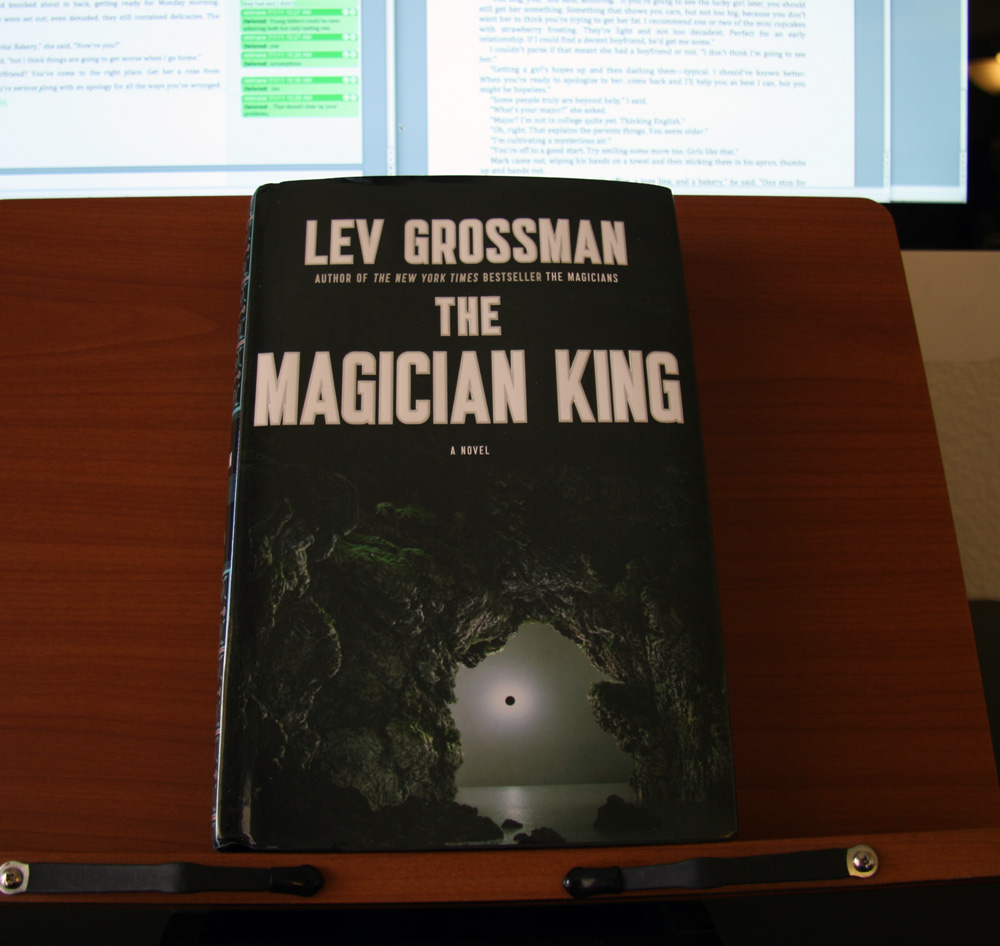
Lev Grossman's The Magician King arrives:

… alas, you won’t see any further comments on it until August 9—the publication date.

I’ve been getting more interesting books from publishers lately: Carolyn Cooke’s Daughters of the Revolution is sitting next to my bed, half-read and still promising, and now The Magician King.

Lev Grossman’s The Magician King arrives:

… alas, you won’t see any further comments on it until August 9—the publication date.

I’ve been getting more interesting books from publishers lately: Carolyn Cooke’s Daughters of the Revolution is sitting next to my bed, half-read and still promising, and now The Magician King.

Why publishers are scared of ebooks — the standard reasons and Amanda Hocking as symbol

Amanda Hocking, the now-famous indie writer, has an interesting post where she says, “Here’s another thing I don’t understand: The way people keep throwing my name around and saying publishers are “terrified” of me and that I really showed them.” They aren’t terrified of her, specifically, as an individual (which she notes), but they are scared of her as a symbol and what she represents: a world where you don’t need publishers as much. She just happens to be an early example of how to make it financially via ebooks. At the moment, publishers have one big advantage that no writer, no matter how skills, can replicate: distribution. If you take that advantage away, a lot of the raisons d’état of publishers goes away.

Later, she says: “And just so we’re clear – ebooks make up at best 20% of the market.” But that’s up from virtually nothing in 2006. In 2001, discs sold on shiny platters made up the vast majority of the music business. In 2011, the “music business” as it existed from the days of the first records until about ten years ago is gone. You still need a big record label if you want to be Lady Gaga, but almost no one else does. Music industry profits have never recovered. This is great for people who want to listen to music but not so good for people who want to make money from music, especially if they can’t actually make music themselves. Media executives, including publishers, know this, which is why they’re watching what happens in book-land so carefully.

“Nobody knows what makes one book a bestseller. Publishers and agents like to pretend they do, but if they did, they would only publish best sellers, and they don’t.” That’s the scariest thing of all: no one knows. This has long been a truism in lots of forms of art. William Goldman’s Adventures in the Screen Trade came in 1982, if I recall correctly, and he said almost the same thing about movies: “Nobody knows anything. Not one person in the entire motion picture field knows for a certainty what’s going to work. Every time out it’s a guess—and, if you’re lucky, an educated one.” Or, Scott Adams, if you prefer someone with even less movie experience than Goldman or me:

Evaluating whether an idea is good enough for a movie is a bit like an automobile expert saying a certain brand of car doesn’t taste good. It’s absurd. You can only hold the opinion that a particular movie concept is a good or bad idea if you don’t understand what a movie is or what an idea is.

Movies have a slight advantage in that making movies technically pretty (which requires foley artists, on-set locations, lots of actors, careful detail to light, and lots of other stuff) is still pretty expensive. A lot of people also still go to movie theaters, so that advantage hasn’t completely disappeared. With books, all you really have is the book.

There are probably lots of undiscovered bestsellers out there, which, if writers get tired of submitting to agents and all the rest, they can now relatively cheaply and easily put online and let the market sort it out. Again: if enough people succeed at this, publishers go away.

Big publishers might be dying in the way Paul Graham describes Microsoft being dead. Microsoft will continue making lots of money for the foreseeable future, but it’s no longer leading anything in tech. (Enough people misinterpreted him that he wrote the Cliff’s Notes version too.) They’re not dying in the sense that whoever owns Alfred A. Knopf is going to be gone tomorrow, or the day after. But if their relevance starts to slip, they could fail with surprising speed. Look at what happened to Blockbuster: Netflix undermined them, and within a decade of Netflix on the scene all the Blockbusters near me have “going out of business” signs on them.

Back to Hocking: “Traditional publishing and indie publishing aren’t all that different, and I don’t think people realize that.” They might not be as different as some make them out to be, but from the perspective of shareholders they’re very, very different, in that shareholders can make money off publishers in one model and they probably can’t in the same way in the other. From the perspective of the writer, she’s certainly right, as she goes on to say: writers still have to put in an enormous amount of time and effort. As I’m only too aware.

I’m not the only one saying this. Here’s what Kevin Kelly says: “I don’t think publishers are ready for how low book prices will go. It seems insane, dangerous, life threatening, but inevitable.” It’s scary because $.99 isn’t going to support cushy Manhattan offices, long lunches, interns, marketing departments, and everything else modern publishers do. It’s not going to support 5–10% growth every year, which most investors assume before they part with their money. As mentioned elsewhere, publishers can see what trend lines are like and they’ve all read The Innovator’s Dilemma, like everyone else who does anything business-related. The upshot of the book is that incumbents often recognize disruptive technologies and products and then fail to respond to them effectively anyway. Think of Microsoft and the Internet, or record labels and the Internet, or newspapers and the Internet. Yeah, I keep using “the Internet” as an example, but you can see this in other areas, like American car companies when the Japanese first entered the U.S. market. Microsoft is probably the best example, since the famous “Cornell is WIRED!” e-mail alerted them to the threat, and they responded with Internet Explorer.

Today, 17 years after that e-mail was sent, I’m typing this on an iMac, Google and Facebook are arguably the dominant Internet players, and Microsoft failed utterly to foresee the importance of search, like a lot of other people. Publishers know that they can’t really compete with $.99 – $2.99 ebooks, and that, in most genres, readers just aren’t that picky. Publishers know the sound of a market shifting underneath them because some of them have been to Harvard Business School or hired people who have been to tell them about the history of companies failing to adapt to new models and environments. That’s scary.

I pay some attention to this stuff because I’m about to take the latest plunge in the crocodile pit that is agent land. If I fail, sometime in the next two years or so I’ll probably say, “Screw it, I’m self-publishing.” Chances are, I’ll be the person who wastes a lot of money and time doing so, but that’s also true of traditional publishing. There’s still that small chance I’ll succeed. Although I’m hardly the best judge of these things, I think I would want to read my own novels, and at some point, I won’t have anything to lose by not self-publishing, if the choice is between that and letting my work sit on my hard drive. There might be other people who want to read my work too. Publishers don’t know. I don’t know. But Amazon, Barnes and Noble, and Apple will make it easier for me to find out than Alfred A. Knopf ever did.

How could Twitter not change how protests happen?: Egypt and the history of the novel

There’s been a lot of talk about the role Twitter, text messaging, and other communication mediums are playing in the unfolding drama in Egypt. Malcolm Gladwell basically says the role isn’t great: “People with a grievance will always find ways to communicate with each other. How they choose to do it is less interesting, in the end, than why they were driven to do it in the first place.”

But I am not convinced this is true: by lowering the friction of communication, thus making it real-time and instantaneous, Twitter and other technological tools are almost certainly changing what is said. Quantity has a quality all its own, and how we speak has a habit of changing what we say.

Gladwell’s post (and others) remind me of the arguments in English literature the field around the development of the novel as a genre (see, for example this post on Steven Moore’s The Novel: An Alternative History). Basically, a lot of people want to argue about the development of the novel without taking into account the printing press.

To me this is silly because mass cheap printing was a precondition to the novel as we know it. Without that, we would have fictional prose narratives of some length, but we probably wouldn’t have them alluding to one another, we wouldn’t have large portions of the population reading them, and we wouldn’t have (relatively) large portions of the population with enough disposable income to avoid them. If you look at surviving works that we would now classify as fiction that were written prior to ~1600, almost all of them are religious in nature because only the church had the resources to fund writing, maintain large collections of writing, and bother writing anything down.

After ~1600 (or ~1500, if you prefer, but that’s about it), you have a lot of things written that would previously not have been considered “worth” writing down because writing and copying manuscripts was so expensive and time consuming. Technology did change what was said. How something was said changed what was said. Technology is doing the same thing now. I don’t know how the current drama will play out; if you looked at the printing press around the time it was first created, it was mostly used to print religious stuff (hence the “Gutenberg Bible”). Elizabeth Eisenstein’s The Printing Press as an Agent of Change describes some of this. By the nineteenth century, however, writers are grappling with the idea of a world without God, per J. Hillis Miller’s Form of Victorian Fiction, or a world where “God is dead,” to use Nietzsche’s famous and misunderstood proclamation: he wasn’t saying that people would stop believing in God or that would religion would stop being a force society, but rather that religious studies were a dead end and people would cease to attribute everything in their life to God or God’s will.

In 1500, the material published via printing press looked basically continuous with what came about in 1400. By 1850, things are looking pretty different, and the diversity of printed materials has fundamentally changed what people could say. The printing press allowed people with grievances, to use Gladwell’s formulation, to communicate with each other much more efficiently than they previously could, which leads to a lot of political, social, scientific, and philosophical developments that most of us living today approve of. How many of us want to return to being illiterate serfs toiling in fields for distant masters?

Gladwell is right in one sense: the media is probably overstating the importance of Twitter and SMS. But both of those still play an important role in what’s going on. Somehow, people with grievances against monarchs and dictators weren’t all that successful on average in the years prior to ~1600. After that, they got more and more successful, to the point where a fair bit of world’s population now lives without dictators. Part of the reason is because ideas about freedom and good governance could be disseminated cheaply, where before they couldn’t, and everyone spent most waking hours covered in shit, farming, and hoping they’re not going to starve to death in late winter / early spring.

Mark at the computing education blog says, “A particularly interesting anecdote for me is the below: That the Internet was turned off in Egypt, but the protests continued. So what role was Facebook and Twitter playing, really?” Depends on the timeframe. Various technological tools helped people initially organize and helped the conditions for organization come about. They will probably do so again in the future. In the long term, such tools will probably create the conditions for much larger projects that we only dimly perceive now. I would predict what those will be, but things have a habit of turning out much stranger than random prognosticators like me can predict.

Why unpublished novelists keep writing: why not? An answer as to why this one does

Alix Christie’s “We Ten Million” asks why unpublished novelists write, the number being an estimate of the number of unpublished novels out there (hat tip Heather Horn). Very few books get published; very few that do get any attention; very few of those even make any money; and delusion is a vital skill for many who continue writing. Rationally, most of these would-be writers would probably be better off if they quit writing and did something more economically and socially more productive with their time, like working for Wal-Mart, digging holes and filing them up, writing blogs about their cats, etc.

According to Horn, possible answers include: the idea of a craft, the importance of literature (even if it’s unread?), the need for story, and art as courage. I’m not sure I buy any of those, or any of Christie’s answers. I think the real reason is simpler: novelists keep writing because they basically like the act of writing novels. Publishing, fame, fortune, and all the rest would be nice, as they certainly would be for this unpublished writer with an inbox full of requests for fulls and partials (industry lingo for “send me the full manuscript” or “send me some chapters”) from agents, but the possibility of future and unlikely accolades don’t fuel the work on a daily basis. Instead, the daily drive to succeed is about the material itself. I’ve mentioned this famous quote before and will do so again: “Robertson Davies, the great Canadian novelist, once observed: ‘There is absolutely no point in sitting down to write a book unless you feel that you must write that book, or else go mad, or die.’ ”

The people writing unpublished novels are presumably doing so in lieu of going mad or dying. They feel they have to or need to write.

In a recent post, I wrote about an exchange with a friend who’s an undergrad:

A lot of my motivation comes from a fantasy of myself-as-_____, where the role that fills the blank tends to change erratically. Past examples include: writer, poet, monk, philosopher, womanizer. How long will the physicist/professor fantasy last? 

I replied:

This is true of a lot of people. One question worth asking: Do you enjoy the day-to-day activities involved with whatever the fantasy is? For me, the “myself-as-novelist” fantasy continues to be closer to fantasy than reality, although “myself-as-writer” is definitely here. But I basically like the work of being a novelist: I like writing, I like inventing stories, I like coming up with characters, plot, etc. Do I like it every single day? No. Are there some days when it’s a chore to drag myself to the keyboard? Absolutely. And I hate query letters, dealing with agents, close calls, etc. But I like most of the stuff and think that’s what you need if you’re going to sustain something over the long term. Most people who are famous or successful for something aren’t good at the something because they want to be famous or successful; they like the something, which eventually leads to fame or success or whatever.

“I basically like the work of being a novelist,” including the writing and so forth. That’s why I keep going. I think anyone who continues for any other reason is probably already mad, to use Davies’ term. Alternately, a lot of the would-be novelists out there are probably writing not because they want to get published, but to work out their inner demons, or signal something, or because they don’t know what else to do with their lives, or because they’re misinformed. They’re doing something other than really trying to write something that someone else might want to read.

I’m reminded of a passage from Norah Vincent’s nonfiction book Self-Made Man, in which she describes dressing like and passing as a man. Vincent, dressed as a man named “Ned,” describes going out with a woman met on an online dating site, who “was either the most conversationally inconsiderate person I’d ever met or the most socially impervious:”

Clearly she wasn’t ready to start dating again. She wasn’t looking for a relationship. She was looking for distraction and an ear to tell her troubles to. She didn’t have enough emotional energy left to get seriously involved with Ned [. . .]

A lot of would-be writers are probably doing much the same. I’d guess that relatively few of those ten million novels are publishable, or that many of the writers of those novels have any clue what something like publishable might mean (I didn’t when I started, which might’ve helped me; more on that below). As Laura Miller says regarding the “slush pile” of unsolicited queries agents and publishers get:

You’ve either experienced slush or you haven’t, and the difference is not trivial. People who have never had the job of reading through the heaps of unsolicited manuscripts sent to anyone even remotely connected with publishing typically have no inkling of two awful facts: 1) just how much slush is out there, and 2) how really, really, really, really terrible the vast majority of it is. Civilians who kvetch about the bad writing of Dan Brown, Stephenie Meyer or any other hugely popular but critically disdained novelist can talk as much trash as they want about the supposedly low standards of traditional publishing. They haven’t seen the vast majority of what didn’t get published — and believe me, if you have, it’s enough to make your blood run cold, thinking about that stuff being introduced into the general population.

So you can probably knock off at least 90% of those unpublished novels as not even being serious attempts, where “serious” means “at least thinking about what makes good novels good and bad novels bad.” Of those serious attempts, a lot of them are probably written by people who will one day be good but aren’t yet (Charlie Stross, the SF writer: “[. . .] I was averaging 1-2 novels a year, for very approximate values of “novel”. (They weren’t publishable. I was writing my million words of crap. You don’t want to read them, honest.)”). John Scalzi says something similar: “Writing an entire novel is something most people have to work up to,” and it’s really hard.

I started four novels and wisely abandoned them. I finally wrote two feature-complete novels in the sense that they started and had ends and had middles that led to the ends, kind of, but they were terrible, and I sent them to agents and got deservedly rejected. If you were one of those slush pile readers, I apologize, but those attempts were so far in the past that you’ve probably forgotten them. Then I wrote the last three novels over the last three or so years and started getting those requests for fulls and partials, which was a lot like the typical dating experience in that they ended with variations of “I like you, but not in that way.”

Nonetheless, I would like to think I can stand far enough back from myself to say that, at the very least, they’re publishable, and I think quite fun. Eventually I assume I will write something that gets a literary agent or press to agree with me—or I’ll go mad or die before that die arrives. Between now and the, I keep writing mostly because a) I’m an idiot (this shouldn’t be discounted) and b) I mostly like the work, as I described above. The second might seem a minor variation on what Christie says—”the only reason is my belief that I have got a story that I must tell”—but it’s a sufficiently important one that I’ll forward it here.

The function of stories in society and some of that other stuff is good, but I’m still guessing that my real reason (and, probably, hers) is that I like to write, which is slightly different from having a story to tell. I suspect the same is true of most artists and intellectuals and hackers; even most hacker/programmer types probably like the fact that they can change the world with their code, and so forth, but their big motivation is probably solving problems and writing code. Notice how the verb “writing” takes on a noun—code—that “writing prose” has lost. The word shows the similar impetus underlying both activities.

I’m not a hacker because, although I’ve written a little bit of code, I don’t like doing it all that much. If I did, it would’ve been vastly smarter to pursue that than it is to continue what I’m doing now. At least I’ve done enough to appreciate how hard it is to write code. And those write good code are rewarded for their skill. Good hackers, programmers, or computer scientists (pick your choice, each with its shades of connotation but denoting more or less the same activity) make a lot of money, and the smart ones often have an immediate, tangible effect on the world. This is sometimes but not always true of writers. But when I began writing fiction with some level of seriousness, I didn’t sit down and say to myself, “What is the optimal path?” I had some ideas and began typing. A depressingly large number of years later, I’m still doing the same basic thing in a way that might be detrimental to my own best interests. So why do I keep going? Why am I part of the ten million?

Because I like the work.

Working out the plot with the Rejector, Carlos Ruiz Zafón, and other friends

Over at the Rejecter, someone is asking whether an MFA program will teach her how to structure her novels. Actually, she’s asking about the professional and intellectual utility of MFA programs, but I want to focus on the plot issue, since that’s what the Rejecter doesn’t address. I had the same problems as the correspondent, but I don’t think I have them any more.

Specifically, the problem:

I have been writing novels since I was about seven. I literally think about it all the time. However, try as I might I have never been able to get beyond the 40,000 word mark before losing the plot and momentum of my story and deciding to start something else entirely. I’m a journalist on a big women’s glossy in the UK so it’s not getting the words down on paper that’s the problem, it’s rather getting my plot from A to B that stumps me.

That sounds really similar to me: the first two novels I actually completed are now, in retrospect, unpublishable, although I didn’t know that at the time and couldn’t have articulated why. Now I know: nothing happened. The novels had interesting premises but no action. There were a lot of bits of clever dialog and some good scenes, but nothing that held those scenes together. The novels lacked narrative tension.

The next two I wrote were and are publishable; they got a lot of agent activity and requests but no agents who took me on. Ditto for the latest, currently titled Asking Alice, which is still out. Look for my name in lights shortly.

One big thing changed between the first two unpublishable novels and the later three: I started writing outlines, which I’d previously considered unnecessary because I’m so smart that I can hold everything in my head (oops). Those outlines were and are pretty loose and fluid, but they’re outlines nonetheless, in which I asked myself essential questions about each chapter: what happens in it? Why? Why this chapter and not some other? What’s the central tension? What does each character worry about? These kinds of questions guided me toward writing better plots because I thought about how information was doled out and what kinds of things the characters are struggling to achieve. In addition, I thought about how drama works: is something important happening in this chapter? What is it?

If I can’t identify what’s important or why the characters should care, I’m probably doing something wrong.

This doesn’t mean each chapter has to end with someone getting shot, or the heroine declaring her love, or the revelation of a shocking fact, or an alien invasion.* But it does mean that I have to at least think about what the scene or chapter is conveying to the reader, what is happening to the characters, how it relates to the previous scene or the next scene, and, perhaps most importantly, what dilemmas it raise that have to be resolved in the future.

Every scene or almost every scene needs some kind of tension or uncertainty. Once again, this doesn’t necessarily mean a guy holding a gun: it could be highly cerebral. In Adam Foulds’ The Quickening Maze, the tension in some scenes concerns the interior dialog and sanity of John Clare: is he sane? Are we seeing the mind of someone else, or are we seeing his mind, which has assumed the shape of someone else? Those scenes can be quite tense but also quite subtle. Others can hinge on a piece of information, as when Randy Waterhouse realizes he’s actually building a datahaven in Cryptonomicon.

Over time, through reading and writing, you’ll learn where to end scenes and how the form of the novel works, and by “you” I mean “me.” You have to learn if you’re the kind of writer who wants to break that form successfully. I remember being on the high school newspaper and going to journalism contests. A lot of traditional news articles end with a whimsical or funny quote that’s not essential but does a good job of encapsulating the story. I’d read enough articles to have picked that idea up, and at one of the competitions I remember taking notes as a source spoke and putting a star next to something he said and thinking, “that’s my final quote.” I wrote the piece and later looked at what the judges had to say; I don’t think that was one of the times I won anything, but I do remember them commenting on the money quote at the end.

They did it because I’d successfully synthesized a principle no one had explicitly stated but that nonetheless made my article a little bit better.

Learning to write scenes is similar: you can’t enumerate all the principles involved, but over time you start to feel them. Once you become attuned to reading novels for what each scene does or what tensions exist in a scene, you’ll probably become better at plotting them for yourself—if you’re anything like me, at least. And you might start telling stories that build plots. I talked out a lot of Asking Alice, the novel making the rounds with agents right now, with a friend. It didn’t hurt and might’ve helped. Sometimes it’s also fun to make up a plot when you’re out. Michael Chabon portrays this in Wonder Boys, when the blocked English professor Grady Tripp and his gay editor, Crabtree, are in a bar:

‘Hey,’ said Crabtree, ‘look at that guy.’ […]
‘Who? Oh my.’ I smiled. ‘The one with the hair sculpture.’ […]
‘He’s a boxer,’ I said. ‘A flyweight.’
‘He’s a jockey,’ said Crabtree. ‘His name’s, um, Curtis. Hardapple.’
‘Not Curtis,’ I said.
‘Vernon, then. Vernon Hardapple. The scars are from a—from a horse’s hooves. He fell during a race and got trampled.’
‘He’s addicted to painkillers.’
‘He’s got a plate in his head.’

And they go on from there. They could be building a plot (telling the story of Hardapple’s rise and fall as a jockey) or they could be building the background. Either way, they’re doing something useful. Where do stories come from? Everywhere and nowhere. They’re not talking about plot, not just yet, but they begin moving in that direction.

The original querier to the Rejector has identified a particular weakness, which is a good start. My proposed solution: read some novels she admires; pick them apart and write outlines that focus on why characters do what they do, what information they reveal when, and so on. Some writers who I think do this particularly well: Ruiz Zafón, as mentioned; Elmore Leonard, especially in Get Shorty and Out of Sight, which I still think are his best; Anita Shreve in Testimony; Graham Greene in The End of the Affair; Umberto Eco in The Name of the Rose. Mystery and detective novels are often very good at plot because all they have is plot. Note that this path is not recommended.

If anyone out there is sufficiently interested, drop me an e-mail and I’ll send you my quick-and-dirty outline of The Angel’s Game, although I wouldn’t recommend reading it until after you’ve read the novel. Ruiz Zafón is astonishingly good at making each scene count in both this novel and The Shadow of the Wind; one shocking thing about reading The Prince of Mist is how weak that novel is in comparison. Ruiz Zafón is clearly someone who’s learned a lot about writing over the course of his publishing career, and he’s an example that makes me more hesitant to condemn not-very-good first novels—even those that gets published. People learn over time. I’ve read Saul Bellow’s The Dangling Man and thought it was okay—but no Herzog.

That’s not a slam: very few artists of any kind in any medium do their best work on their first try. Like anyone else in any other activity, artists learn as they go along, and they have to assimilate a huge body of material.

Anyway, I’m not sure how many MFA programs teach plot or tell their students some ways to think about plot; if I end up teaching in one, you can bet I’ll talk about it some. As an undergrad, I took a lovely novel writing course from a guy named Bill Tapply, who passed away last year. Although I got a lot out of his class, he seldom talked much about plot, which in retrospect I find curious because his Brady Coyne mysteries work very well in this respect. From chatting with others who’ve taken fiction writing classes, I gather that this is common: they talk about language and ideas and description and all kinds of things, but not plot. If I ever end up teaching one, I’m going to talk about plot—not to the exclusion of everything else, certainly, but enough to give a sense of what my 19-year-old self needed to hear. And, from what the correspondent to the Rejecter says, what she needs to hear too.

This is important because I’ve read so many novels with dynamite first halves and dreary second halves, especially in literary fiction (one reason I like Carlos Ruiz Zafón and have been writing about him a lot lately: his novels hold together). Sometimes otherwise very good novels fall apart plot-wise. I started Sam Lipsyte’s The Ask a few days ago, based on an agents advice,** but gave it up because it feels too episodic and disconnected; the novel strays so fair that it loses me as I find my mind wandering and myself thinking, “So what? What’s at stake here?” By halfway through, the answer frequently felt like “nothing.” Too bad: the first page of The Ask is terrific. A lot of the droll humor works. It just lacks…

something.

Too bad I can’t better define what that something is. But I can talk around it enough to know when it’s missing.***


* For the record, zero of my novels thus far have featured an alien invasion, although I’m not opposed to that sort of thing on principle and my eventually deploy it. One of my ambitions is to eventually write a novel that begins as a fairly straightforward love story about modern urban couples / triangles and angst that suddenly shifts, about halfway through, when aliens attacks. I think this would be totally awesome.

** It was a rejection, but not a form rejection, which counts for a lot when they pile up and you’re looking for some pattern with no more success than people who see secret signals in the white noise of a random universe: “I hope you receive that as no more damning than had I written ‘I like hamburger dill pickles, but I love capers.’ ”

*** I’d like a book on plot that’s as good as How Fiction Works, which I could then add to my post on The very very beginning writer. Suggestions would be appreciated. The books I’ve found that deal with plot tend to be of the “heroine reveals her love” variety that I mocked above, instead of the, “this is how literature might work” variety that James Wood and Francine Prose offer.

Someone has probably already written a lot of what I wrote above. I just don’t know who that person is or where their work is.

How to request review copies or products if you're a blogger

A number of people have written to ask how/why Kinesis, Metadot Corporation (which makes the Das Keyboard), and others send review keyboards or books. The short answer is that I asked, had a reasonable purpose in trying to review keyboards or books, and have a significant enough forum to make it worthwhile. To do the same, bloggers need a number of key features: credibility, good writing, some connection to the topic, and manners.

Credibility

Don’t write to manufacturers two weeks after starting your blog when they can still see the “hello world” post. Anyone can register joeblow.wordpress.com and write a couple of posts, then start clamoring for “free stuff.” If you’re going to request review items, make sure your blog has enough history to make it plausible that you’re a) committed to writing and b) have enough readers. “Enough” is a bit slippery because a blog with the right 50 readers a day who come for a specialized subject might be more useful than a blog with 500 or even 5,000 readers—it’s probably easier to get 500 hits by posting pictures of scantily or unclad teenage girls than it is to get 50 writing about the art of the novel, but if you want to review fiction, the latter group is probably of greater interest to publishers.

Still, all things being equal, more popular blogs are often more popular because they’re better, which causes people to link to them, which causes more readers to find that blog, which causes more people to link, and so forth. You don’t need to be on the Technorati top 100 blogs, but make sure you’ve written enough for people to evaluate your writing skill and for some kind of audience to have found you. As a loose rule, I’d say that you should write at least one substantive post a week for about a year before you request review items.

Write a good review, not a positive review

In How to Get Free Books to Review on Your Blog, “Nick” says:

Note that I didn’t say [that you should write a] positive review. I said a good review. You should not feel inclined to write positive things about the book just because you received a free copy. If you write a fair, honest, and professional review, most publishers will respect your opinion.

He’s correct: you’ll lose credibility with readers if you’re nothing more than a shill, especially in an age when sophisticated readers have their bullshit detectors justifiably set on “maximum.” Bloggers are best when they’re honest, or as honest as they can be; that’s one reason why I include the disclaimer at the bottom of keyboard reviews if the keyboards come from the manufacturer, rather than bought by me: at least readers know the provenance of the items I’m looking at.

I don’t usually do this with books because it’s less important: the cost of a book, usually between $10 – $20, is lower, and publishers don’t expect or want review copies back. But when I write reviews, I make sure they’re meaty enough to justify my effort in producing them and the reader’s effort in reading them by citing as many specific characteristics as possible that justify whatever opinion I’m expressing or conclusion that I’m coming to.

Be (or become) a good writer

There’s nowhere to hide on the Internet and it’s easy to judge the quality of a blogger’s writing simply by reading their work. If the writer can’t explain what they like or dislike and why, they’re probably not a very good writer; many, many bloggers (and mainstream reviewers too) just write “this is awesome!” or “this sucks!” without much elaboration. That tendency towards shallowness is one reason I started writing in-depth keyboard reviews: because they didn’t exist or, if they did, they weren’t readily available. Some novelists have said they write novels that they would like to read but that no one else has written, which is how I often feel about my reviews (and much of my other work).

If you don’t know what good writing looks like, or dispute the very idea that there can be good writing (as some of my students do), you’re probably not a good writer. If you want to become one, there are many, many resources out there to help you, mostly in book form. A few that I like and that have helped me include William Zinsser’s On Writing Well, Francine Prose’s Reading Like a Writer, James Wood’s How Fiction Works, Harold Bloom’s How to Read and Why, and the New York Times’ collections, Writers on Writing. In addition, one thing that separates good from bad writers is that good writers read a lot and write a lot.

One note: being a good writer doesn’t mean that your grammar has to be perfect or your blog typo-free, but your posts shouldn’t be riddled with typos and elementary grammar errors either. I’m sure many of my posts, especially the long ones, have typos, but they tend to be minor and easily overlooked; if readers send me notes or leave comments pointing out typos, I silently correct them.

Connection

If you’re writing a blog about, say, cats, and you request a hard drive review unit, you’re probably doing something wrong. If you write hard drive reviews and request a new kind of kitty litter, you’re also probably doing something wrong. Seek things that relate to your niche.

In my case, I started a blog about books and literature because I like to read and like to write; to me, most of the posts on this site are leisure, not work. The first time I got a free book (or “review copy” in industry jargon), a publicist contacted me regarding Lily Koppel’s The Red Leather Diary because I’d written a post about the New York Times article that led to the book. I was surprised: since when do publishers chase bloggers, rather than vice-versa?

I don’t know when the shift happened, but it did, which is why I now include my mailing address in the “About” section of The Story’s Story, and I take a look at everything that passes my desk even if I don’t always write about them. Sometimes I request books that pique my interest.

All this is to show that I have a) a narrowly focused blog and b) the things I request—books—fall into that narrow focus.

The keyboards are tangential to books but still related, and I stumbled into reviewing them by accident: I read about the famous IBM Model M keyboard on Slashdot, the geek tech site, and started doing some research into it and other quality keyboards, like the Apple Extended II. Most of the reviews and comments were not very helpful, especially for Mac users, but they pointed to Unicomp, which manufactures the Customizer Keyboard, and to Matias, which produces the Tactile Pro. I tried both and wrote extensively about my experience with them.

I’m interested in keyboards because I spend a lot of time writing professionally, both as a grad student in English literature and as a grant writer with Seliger + Associates. Writers and programmers are probably more likely to be interested in keyboards than most people because keyboards are a fundamental part of their toolset, and when you use a tool a lot, you want it to be right.

To understand literature, I think it helps at least somewhat to have an understanding of literary production: the publishing environment, the historical circumstances in which a work was/is produced, and so forth. Such factors can’t supersede the work itself, but they nonetheless matter. They also matter for practicing writers, and if a good keyboard means that a writer can or wants to go for an extra half hour or hour a day, that’s a tremendous difference over the course of a year, a decade, or a lifetime. Writing about the tools writers use, therefore, seems sufficiently related to writing and books that I think keyboard reviews are worth posting.

Use your real name

Penelope Trunk’s Guide to Blogging is useful, and one of her posts is on the subject of why you should blog under your real name, and ignore the harassment.

I agree. Your real name lends credibility and makes you seem like (slightly) more than another random Internet squawker; public relation or press people are more likely to want to send something to site run by Jake Seliger than they are to HoneyBunny or l33t48 or whatever. In looking through my RSS feed, I can see that most of the bloggers I read use their real names. Anonymity has its place in blogging, as it does in journalism, but if you’re going to review things you should have your name attached to that review. Some blogs demand anonymity, as Belle de Jour did until recently, but they should be the exception.

Manners

In the Internet age, we’re all supposedly turning into barbarians with the attention span of fruit flies. That’s the stereotype, anyway, and although it has some truth to it I think it largely wrong, at least among the better bloggers. Still, one way to catch people’s attention is to do the opposite of what bloggers represent in the popular imagination. I’ve already covered the importance of attention spans in the section about “good” versus “positive” reviews, but I’ll deal with the “barbarians” idea here.

When you make contact with a publisher or company, figure out how they want to be contacted. There’s usually a public relations, media, or press contact. You should write to that person with a short note that says, briefly, what you want, why, and who you are. Covering those shouldn’t take more than two or three paragraphs. Don’t include your life’s story and don’t be vague: the contact person will decide if they want to send a review model more based on your writing than based on your e-mail, and they’ll be used to dealing with people who are professionals or at least act like them.

In my case, that means sending keyboard makers a note saying that I’d like review their keyboard because I’ve reviewed a number of other keyboards, which causes people to write asking for comparisons, which causes me to seek review models. This bleeds into the “who am I” issue, where I state that I write The Story’s Story and contribute to Grant Writing Confidential, with links to both. From there, they can figure out as much or as little as they like.

If they send the keyboard, I say thanks, review it, and send it back, with another brief note that says “thanks, I appreciate you sending it.” I do that because it’s how I’d ideally like to be treated were our situations reversed, and also so that in the future, if I want to review a new model or whatever, they’ll be positively disposed towards me.

Don’t start a blog for free stuff

If I counted the number of hours I’d spent working on The Story’s Story versus the “pay” I’ve gotten in books or Amazon referral cash, I’m sure I’d be making well under a buck an hour. It’s probably closer to a cent an hour. If your purpose for starting a blog is to get free stuff, you’re doing something terribly wrong because you’re very unlikely to make real money as a blogger. Write because you want to, not because you expect direct monetary rewards. They definitely won’t come in the form of books or hardware; indeed, my bigger problem now is wading through and dealing with the books I don’t want, rather than cackling at the booty from the stuff I do want.