Game of Thrones and the tedium of Season 2’s war episode, “Blackwater”

Scott Meslow writes that “In ‘Game of Thrones,’ War Changes Everyone: The stunning, episode-long Battle of Blackwater* leaves no character untouched,” and while he might be correct, the episode, like its predecessor, is surprisingly tedious. Meslow thinks that “it’s clear that each character has been forced, in the heat of battle, to confront who they really are,” but I’m not so convinced. Last night, before I read his piece, I sent an e-mail to a friend who wanted a copy; although the e-mail was hyperbolic—the episode wasn’t actually “bloody terrible,” just bloody and dull—the substance stands:

Episode 9 of “Game of Thrones” was bloody terrible. The show has many advantages over the book: most notably, the characters’ externality prevents some of Martin’s most insipid, obvious writing. The major disadvantage, however, comes in the form of large-scale battles, which are too expensive to shoot properly and not all that dramatically interesting. One can only watch so many extras hacking one another with swords (the number of unclothed lovelies one can enjoy, however, are infinite) before the murder is tiresome. A whole episode of battle preparations that could have been better presented with extra footage from Braveheart: alas.

Meslow says that “Due partially to plot structure and partially to budgetary restraints, Game of Thrones has spent very little time in the battlefield.” There’s a very good reason: most of Game of Thrones looks brilliant and subtle. They don’t show budget constraints. The battle scenes do. They had many obvious crosscuts between things that weren’t happening in the same time and place. The show’s financiers obviously didn’t have the cash for many extras or the computer-generated graphics that could replace them.

“Blackwater” reminded me of this season’s Daenerys scenes, which in turn felt like dumb Syfy channel shows—all bad actors spouting silly names and pointless gibberish. The many subtler, cleverer moments were lost, with the exception of Cersei’s tutelage of Sansa in the ways of female empowerment. (For more along those lines, try Belle de Jour’s Secret Diary of a Call Girl.)

I read through book 3 of the novels before the spiraling, increasingly silly plots lost me. The reviews of book 4 are not charitable, the plot summaries of book 5 leave me rolling my eyes. When sprawling, epic fantasy is too sprawling, it overruns the optimal exploration space for its primary characters and their fundamental dilemmas. At that point, such fantasy series merely become tedious. In Game of Thrones, it appears that, sooner or later, “White Walkers” are going to invade the south and Daenerys is going to arrive in Westeros with dragons. The White Walkers are conveniently vulnerable to fire. Dragons breathe fire. The various contenders will have to stop struggling with one another long enough to confront an external existential threat, sort of like how India and Pakistan have to realize that nuclear holocaust is not an optimal way to resolve the narcissism of minor differences. Delaying the confrontation in Westeros has its pleasures. Delay the confrontation too long, however, and boredom sets in. I’ll probably read or skim the last book, if it comes out before, say, the end of the decade.

The TV show, I have to assume, will eventually burn itself out through incoherent plot threads, much like the books.


* The allusion to Academi, the company formerly known as Xe, which was formerly known Blackwater, the mercenary company famously described in Blackwater: The Rise of the World’s Most Powerful Mercenary Army, is deft. Apparently the publicity was bad enough to encourage multiple name changes. I recommend that they next re-brand as Altria. Or perhaps Cayce Pollard should be hired as a consultant?

Movies, February: Contagion, The Usual Suspects, and Traffic

* Contagion: Incredibly intense and fast-moving; it’s reminiscent in that respect of The Social Network. I was never bored. It’s also scarier than any slasher movie and does an extraordinary job of putting large-scale social events like disease into a narrative context. The preceding sentence makes Contagion sound boring, but it’s not, and very few works of narrative art accomplish anything like this.

Contagion demonstrates that Hollywood can, in fact, make good, original movies, though they don’t come along all that frequently.

* The Usual Suspects: Holds up over time and still has impressive narrative complexity. Rewards re-watching mostly because, knowing the trick ending, one sees the lead-up.

Traffic: Extremely intense and socially aware. Both it and Contagion seem highly informed by economics in a way that’s rare for movies. Somewhat melodramatic, but not in an overly distracting way. I wish more movies were this intense. The script is “woven” together effectively.

Thoughts on the movies “Shame” and “Sleeping Beauty”

1) Both movies substituted sex for plot; this might’ve kind of worked in an era before Internet porn and HBO (and both also show why HBO’s original shows are successful), but these days people who want to see naked people are only a click away.

2) I mostly agree with Dan Kois in “Shame should be ashamed of itself,” especially when he compares it to The Social Network, which didn’t seem to have inherently riveting material—it’s a movie about a bunch of guys who type for a living—but is riveting. Notice this paragraph:

Shame [. . .] feels fraudulent in every way, from its gleaming surfaces to its laughably overblown soundtrack to the perfect teardrop rolling over Michael Fassbender’s perfect cheekbone in that perfect lounge where, in real life, no one would ever let Carey Mulligan sing a shoe-gaze “New York, New York.” Oh and what about the scene where he jogs to classical music? Or the part where his addiction drags him so deep into hell that he (gasp) gets a blowjob from a dude in a dimly-lit sex club? (As the writer Bryan Safi noted on Twitter, “I’d love to see a movie where a strung-out gay guy sinks so low and degrades himself so much for his addiction, he hooks up with a woman.”)

Shame has nothing to do with actual addiction, or the actual New York, or even actual human beings.

Yet Shame has gotten decent reviews, for reasons not obvious to me. Ditto for Sleeping Beauty. Are critics merely happy to have something other than blowing-shit-up-and-punching-bad-guys movies? To be fair, this is part of what inspired me to see them.

3) There’s no particular reason the movies had to be plotless; they look more like examples of giving up.

4) I’m reminded of my own process when I’m starting a novel and writing down ideas, premises, and characters—but long before I’m starting to link and weave those ideas, premises, and characters. Unfortunately, the people behind shame appear to have stopped at the first step. They were more like shorts than features, which is a problem I’m too aware of in novels, where the short-story-writers-cum-novelists sometimes don’t know where to go with 70,000 – 90,000 words.

5) For an example of movies like these (nudity, psychological tension, internal turmoil manifested in external ways) but better, try Swimming Pool.

6) Music is a complement to, not a substitute for, character development.

7) Is it a comedy and we are missing the joke?

“Free Agents,” the TV show, proves itself dumb in the first three minutes through the “slut” debate

Free Agents, the TV show, begins with two characters in bed, and one opens a full condom drawer. The guy sees and says something like, “What are you—a slut?” The woman replies, and they have an excruciating discussion whose underlying content is a typical rehash of an ancient calumny about female sexuality. The scene is neither funny nor genuine, and the two problems are related.

If your characters are old enough to have a B.A., they’re old enough not to care about the idea of the “slut.” Younger characters, especially ones in high school, might still be interested in whether someone is a “slut,” but that’s mostly because a) teenagers are projecting uncertainty and fear regarding their own sexuality on others, b) many have parents who engage in various forms of daughter-guarding and other forms of shame internalization, and c) girls, especially, will use social approbation and shaming as a form of mate guarding behavior. If older characters like those in Free Agents are still concerned about the same problems as high school students, they’ve not matured enough to even be interesting. Even a show like Californication, whatever its other flaws, has moved beyond the “slut” question.

Like Free Agents, it’s also about someone with a stunted emotional life, but at least Californication is intellectually honest enough not to go for the “slut” question. Rather, it assumes that people who want to do it, do it, and people who don’t, don’t, which seems like the way the world is heading. Besides, by college graduation or thereabouts, most people will never really know about their partners’ past, and, again, by the time one graduates from college or reaches the age at which college graduation occurs, everyone is someone’s sloppy seconds. The median age for first sex in the United Sates is somewhere in the neighborhood of 17 (see Google for more); by the time a person hits their 30s, asking number questions becomes pointless if potentially amusing.

I’m not annoyed only because the concept behind word “slut” does, as Mark Liberman put it, “project bad associations based on a framework of ideas that I don’t endorse.” Even if you do do endorse that framework, endorsing it with someone you’re about to have sex with probably isn’t the optimal place to engage the issue. It only makes you look like a hypocrite and a fool, but, from what I can tell, that wasn’t what Free Agents was going for. It played the issue straight. To go back to Liberman—who is himself also writing about a TV show, albeit Sex and the City—”The word slut itself clearly retains strong negative connotations, quite apart from one’s opinions about sexual morality, but such things can change if enough people want them to.” TV shows aren’t necessarily a medium that promotes social and intellectual

I can see why TV show writers might go for the “slut”: they think it can create dramatic tension. But it’s a false dramatic tension, which is why I said the issue isn’t “genuine,” and false dramatic tension leads to jokes that aren’t funny either, because such jokes don’t engage any substantive ideas; really funny jokes often or usually do. Pretty much every single person with the proverbial half a brain has condoms around. Their presence doesn’t mean anything more than, “I’m prepared for the best,” which is a refreshing change compared to people who are prepared for the worst. It would be stranger if the woman in the show was single and didn’t have condoms.

So the “slut” problem reduces to one of two issues: the writers are lazy, so they introduce being a “slut” or not to create artificial tension; or the writers are dumb because they deal with a dead issue. Neither bodes well for the show. But it does hold an important lesson for narrative writers, whether visual or written: don’t focus on dead or dying issues. Focus on live ones. Feminists have been arguing against the “slut” framework of ideas since at least the 1960s if not earlier; Leora Tanenbaum wrote whole book on the subject, subtitled “Growing Up Female with a Bad Reputation.” People’s behavior, if not their rhetoric, shows the issue to be dead. So instead of using it, why not skate to where the puck is going, instead of where it’s been?

The question is supposed to be rhetorical, but I’m going to answer it anyway: knowing the puck’s present location is easy. Knowing where it’s going is much, much harder, and a lot of the big media businesses, including TV, are too big and too expensive to take major risks on the unknown. Better to leave those big risks to dingy writers living in their parents’ basements or hiding from the real world in graduate school. That solution probably worked pretty well in a pre-Internet era. By now, however, people who want to take intellectual, social, and artistic risks can coalesce on the Internet. While Hollywood dithers and debates about sluts, the innovators are moving or have moved online. Don’t be surprised if the audience follows. And if you’re the kind of person who wants to be in the vanguard, don’t watch so much TV. Check out the bookstores and libraries instead. You’ll find it there. TV used to be the medium of the future, but in some ways it feels like the medium of the past.


EDIT: It appears Free Agents is heading towards cancellation. I’m tempted to say something like puerile like “good riddance,” but the problems described above transcend this show and will no doubt be repeated by successors, in more or less subtle guises.

"Free Agents," the TV show, proves itself dumb in the first three minutes through the "slut" debate

Free Agents, the TV show, begins with two characters in bed, and one opens a full condom drawer. The guy sees and says something like, “What are you—a slut?” The woman replies, and they have an excruciating discussion whose underlying content is a typical rehash of an ancient calumny about female sexuality. The scene is neither funny nor genuine, and the two problems are related.

If your characters are old enough to have a B.A., they’re old enough not to care about the idea of the “slut.” Younger characters, especially ones in high school, might still be interested in whether someone is a “slut,” but that’s mostly because a) teenagers are projecting uncertainty and fear regarding their own sexuality on others, b) many have parents who engage in various forms of daughter-guarding and other forms of shame internalization, and c) girls, especially, will use social approbation and shaming as a form of mate guarding behavior. If older characters like those in Free Agents are still concerned about the same problems as high school students, they’ve not matured enough to even be interesting. Even a show like Californication, whatever its other flaws, has moved beyond the “slut” question.

Like Free Agents, it’s also about someone with a stunted emotional life, but at least Californication is intellectually honest enough not to go for the “slut” question. Rather, it assumes that people who want to do it, do it, and people who don’t, don’t, which seems like the way the world is heading. Besides, by college graduation or thereabouts, most people will never really know about their partners’ past, and, again, by the time one graduates from college or reaches the age at which college graduation occurs, everyone is someone’s sloppy seconds. The median age for first sex in the United Sates is somewhere in the neighborhood of 17 (see Google for more); by the time a person hits their 30s, asking number questions becomes pointless if potentially amusing.

I’m not annoyed only because the concept behind word “slut” does, as Mark Liberman put it, “project bad associations based on a framework of ideas that I don’t endorse.” Even if you do do endorse that framework, endorsing it with someone you’re about to have sex with probably isn’t the optimal place to engage the issue. It only makes you look like a hypocrite and a fool, but, from what I can tell, that wasn’t what Free Agents was going for. It played the issue straight. To go back to Liberman—who is himself also writing about a TV show, albeit Sex and the City—”The word slut itself clearly retains strong negative connotations, quite apart from one’s opinions about sexual morality, but such things can change if enough people want them to.” TV shows aren’t necessarily a medium that promotes social and intellectual

I can see why TV show writers might go for the “slut”: they think it can create dramatic tension. But it’s a false dramatic tension, which is why I said the issue isn’t “genuine,” and false dramatic tension leads to jokes that aren’t funny either, because such jokes don’t engage any substantive ideas; really funny jokes often or usually do. Pretty much every single person with the proverbial half a brain has condoms around. Their presence doesn’t mean anything more than, “I’m prepared for the best,” which is a refreshing change compared to people who are prepared for the worst. It would be stranger if the woman in the show was single and didn’t have condoms.

So the “slut” problem reduces to one of two issues: the writers are lazy, so they introduce being a “slut” or not to create artificial tension; or the writers are dumb because they deal with a dead issue. Neither bodes well for the show. But it does hold an important lesson for narrative writers, whether visual or written: don’t focus on dead or dying issues. Focus on live ones. Feminists have been arguing against the “slut” framework of ideas since at least the 1960s if not earlier; Leora Tanenbaum wrote whole book on the subject, subtitled “Growing Up Female with a Bad Reputation.” People’s behavior, if not their rhetoric, shows the issue to be dead. So instead of using it, why not skate to where the puck is going, instead of where it’s been?

The question is supposed to be rhetorical, but I’m going to answer it anyway: knowing the puck’s present location is easy. Knowing where it’s going is much, much harder, and a lot of the big media businesses, including TV, are too big and too expensive to take major risks on the unknown. Better to leave those big risks to dingy writers living in their parents’ basements or hiding from the real world in graduate school. That solution probably worked pretty well in a pre-Internet era. By now, however, people who want to take intellectual, social, and artistic risks can coalesce on the Internet. While Hollywood dithers and debates about sluts, the innovators are moving or have moved online. Don’t be surprised if the audience follows. And if you’re the kind of person who wants to be in the vanguard, don’t watch so much TV. Check out the bookstores and libraries instead. You’ll find it there. TV used to be the medium of the future, but in some ways it feels like the medium of the past.


EDIT: It appears Free Agents is heading towards cancellation. I’m tempted to say something like puerile like “good riddance,” but the problems described above transcend this show and will no doubt be repeated by successors, in more or less subtle guises.

Thoughts on the movie Objectified

I watched the documentary Objectified last night and would recommend the first 30 or so minutes via Netflix streaming, if you have a Netflix account. If not, check out the Jonathan Ives portion on YouTube, which feels like an ad but still has content. The movie gets slower as it goes on and the real content is in the first half hour. Some other thoughts:

1) A lot of these designers (or the filmmakers) are really, disproportionately interested in chairs. As far as I can tell, outside of office chairs made by Herman Miller, Steelcase, Humanscale, and a couple of others, not much has really happened to chairs in the last couple decades. Most of the chairs shown in the film looked uncomfortable, especially the ones by the guys in Paris.

EDIT May 2012: Apparently I’m not the only one to have noticed the designer fascination with chairs: see also “Against Chairs.” Note that I’ve switched to a Herman Miller Embody, which I like less than the Aeron and may sell.

2) Speaking of the guys in Paris, they were really annoying. I’m not sure why.

3) The movie got slower as it went on.

4) Some comments made me think of Paul Graham’s essay Stuff, which begins: “I have too much stuff. Most people in America do.” I think he’s right. I don’t want more stuff. I want the right stuff. Too much of the movie focused on “more” rather than “right.” I don’t want to be a consumer.

5) Someone asked something very close to, “do you rule your stuff, or does your stuff rule you?” In the movie, it seemed like only designers were really capable of ruling their stuff. Graham: “once you’ve accumulated a certain amount of stuff, it starts to own you rather than the other way around.”

6) The bit about peelers at the very beginning was fascinating, especially because of the prototypes and CAD drawings.

7) The movie should have focused more on technology.

8) There was a guy who said he was depressed as a teenager, so he looked at his alarm clock, which made him feel better somehow and presumably acted like Paxil. I was depressed as a teenager too, which was alleviated somewhat by losing my virginity.

9) See number four again. I’ll quote Graham more: “the people whose job is to sell you stuff are really, really good at it.” Is this movie’s goal to sell me stuff, or make me want to buy, or to really explain the stuff in my life? The makers would no doubt argue the latter, but I think the former might be the actual outcome.

Thoughts on J. J. Abrams’ movie Super 8

1) It’s surprisingly good. I say “surprisingly” because most heavily advertised summer blockbusters are terrible. See it in the theater if you can, ideally on an IMAX screen. I did.

2) The movie is very good at conveying a lot in a small space—the cluttered domestic scenes set up family tension. Details proliferate at the edge of the movie. Watch for video cameras and film-related objects.

3) I identify with the fat kid because he’s the artist. He’s not the hero and doesn’t get the girl. When mysterious things begin happening, he’s the one who still cares most about getting the shot. Good for him. Intense focus on “production values!” (his rallying cry) never hurts.

4) Like Umberto Eco’s The Name of the Rose, this text speaks to other texts. For some reason, I always love the scenes where animals run away while doofus humans tarry. Someone says, “You heard what old man Woodward said,” as if the movie was a Scooby Do variant.

5) Super 8 feels like one the 12-year-old Abrams would’ve liked to make, if he’d had the skill; now he does. It’s nice to see adolescent dreams rise.

6) Ignore the plot holes and implausibilities, which are numerous.

7) Anything that disrupts electricity and electrical devices is scary. If you’re writing a novel with any kind of supernatural element, remember this. We’re still afraid of the dark, and we’re dependent on an electrical grid few of us understand.

8) Embrace the impetus to explore.

9) This is a kids’ movie primarily because there weren’t real consequences; I will leave that statement ambiguous for those who haven’t seen the movie.

EDIT: Even if you don’t normally read the comments, see those left by Jason Fisher.

Missing the point with Guy Ritchie’s Sherlock Holmes — like Rambo with poetry

My Dad watched the latest version of Sherlock Holmes (the one with Robert Downey Jr. in it) and observed that Guy Ritchie missed the whole point of the novels: Holmes doesn’t solve crimes by kicking ass; he solves them by being smarter than everyone else and noticing things. Holmes is fundamentally cerebral, which made and makes him different. My Dad’s observation: it’s like having Rambo recite poetry. The change completely defeats the point of the character.

The IMDB blurb says, “Detective Sherlock Holmes and his stalwart partner Watson engage in a battle of wits and brawn with a nemesis whose plot is a threat to all of England” (emphasis added). When the brawn outweighs the wits, you’ve done something fundamentally wrong.

Missing the point with Guy Ritchie's Sherlock Holmes — like Rambo with poetry

My Dad watched the latest version of Sherlock Holmes (the one with Robert Downey Jr. in it) and observed that Guy Ritchie missed the whole point of the novels: Holmes doesn’t solve crimes by kicking ass; he solves them by being smarter than everyone else and noticing things. Holmes is fundamentally cerebral, which made and makes him different. My Dad’s observation: it’s like having Rambo recite poetry. The change completely defeats the point of the character.

The IMDB blurb says, “Detective Sherlock Holmes and his stalwart partner Watson engage in a battle of wits and brawn with a nemesis whose plot is a threat to all of England” (emphasis added). When the brawn outweighs the wits, you’ve done something fundamentally wrong.

If I were a movie studio, I’d make streaming a priority — based on a recent experience with Assholes Finish First

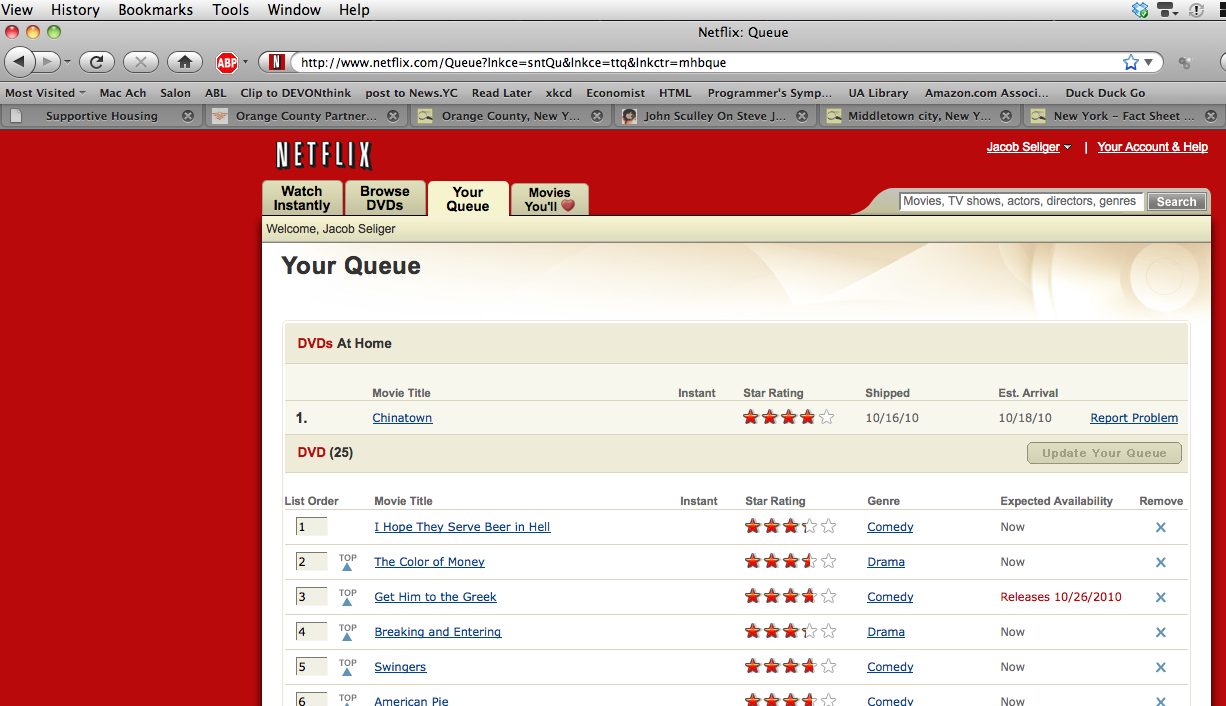
I recently interviewed professional writer and asshole Tucker Max about his second book, Assholes Finish First. He also wrote I Hope They Serve Beer In Hell, which was made into the eponymous movie. Like any diligent journalist, I wanted to get as much background on his work as I could—including the movie, which I put on my Netflix queue without enough time to get it. My queue looked something like this the day before the interview:

Notice the little buttons that say “Play” (EDIT: Oops: the movies at the top of my queue don’t have that button. Take my word for it: some do, and they play immediately). If I want to watch those movies, they automagically play via Microsoft Silverlight, which is probably just a nefarious and tardy attempt to compete with Flash but which I installed because it was there and easy. Notice that there isn’t a button that says “Play” next to I Hope They Serve Beer in Hell. But I was interviewing Tucker and couldn’t wait.

So I searched for I Hope They Serve Beer in Hell using a BitTorrent search engine that will remain unidentified here but is easily found using conventional search engine tools. Sure enough, it had a copy of I Hope They Serve Beer in Hell. A few clicks later and it began downloading. Two or three hours later and it was done. The quality wasn’t especially high—it was compressed all the way down to 700 MB—and the process wasn’t as smooth as clicking “play” and starting the stream. But it worked reasonably well. If I were the kind of person I was in high school, when I didn’t have a credit card but did have Internet access, I might have done a lot more of this. And if I were a less, uh, scrupulous person, I’d been tempted to just go the BitTorrent route all the time.

Apparently others have noticed this general trend—in “Why Is Netflix Disclosing Less About Its Business?” for The Atlantic, Jonathan Berr writes:

According to Netflix, 66 percent of subscribers instantly watched more than 15 minutes of a movie or a TV episode in the third quarter compared with 31 percent in the year-ago period and 61 percent in the second quarter. This underscores the company’s transition from DVD rentals to streaming video.

If I were a movie studio, I’d be trying to make sure that what happens to me is different from what happened to the music business. I’d be doing everything I can to make sure that my movies were available on Netflix, the iTunes store, Amazon, Barnes and Noble, Bob’s crab shack, whatever. Available and easy. In “The Other Road Ahead,” Paul Graham says, “Near my house there is a car with a bumper sticker that reads “death before inconvenience.’ ” That’s basically how I feel much of the time.

And I’m not the only one (who feels like streaming is handy):

[. . .] Netflix accounts for 20 percent of downstream Internet traffic during peak home Internet usage hours in North America. That’s an amazing share—it beats that of YouTube, iTunes, Hulu, and, perhaps most tellingly, the peer-to-peer file-sharing protocol BitTorrent, which accounts for a mere 8 percent of bandwidth during peak hours. It wasn’t long ago that pundits wondered if the movie industry would be sunk by the same problems that submarined the music industry a decade ago—would we all turn away from legal content in favor of downloading pirated movies and TV shows? Three or four years ago, as BitTorrent traffic surged, that seemed likely. Today, though, Netflix is far bigger than BitTorrent, and it seems sure to keep growing.

If Netflix wants to stay bigger than BitTorrent, however, the movie studios need to climb aboard. If they’re smart, they will. If not, they have predecessors who have been massacred by the Internet, and they no doubt will have successors who are too.

Oh, and the movie? It’s not very good. Skip it and read the book.