“He said to her one day that she had too many ideas and that she must get rid of them.”
—Henry James, The Portrait of a Lady
I often feel the same way about ideas discard mine in the Internet.
“He said to her one day that she had too many ideas and that she must get rid of them.”
—Henry James, The Portrait of a Lady
I often feel the same way about ideas discard mine in the Internet.
“Walking into Nathan and Kristi’s empty house was a reminder of why stuff doesn’t really matter: We make the inanimate objects come to life, and not vice versa. Similarly, it reminded me that the fond feelings I have for this place are all wrapped up in the people. There was certainly no charm to those bare walls, studded with hooks where pictures once hung.”
—Alan Paul, “The Annual Expat Exodus Never Gets Any Easier“
This is an appropriate quote given a friend’s recent e-mail asking if I’d become overly enamored of computers, given what she called an “almost pornographic” shot of my desk. It’s not dissimilar from Faramir’s comment in The Lord of the Rings, when he separates tools from their uses this way in The Two Towers: “[…] I do not love the bright sword for its sharpness, nor the arrow for its swiftness, nor the warrior for his glory. I love only that which they defend […]”
So too I feel about tools, be they computers or pens, or books themselves, which I see not as objects of reverence, but as bulbs that only shed light when read and shared. This could in part be a decadent opinion born of economic opportunity: five hundred years ago, or even fifty years ago, I might not have been so blithe, as books were far more expensive than they are today and have been declining in relative price for almost all of the 20th Century. Regardless of that, I’m lucky enough to live in a time when books are relatively inexpensive; though a book might have symbolic meaning, it is the thing or potential within, not the thing itself, that appeals, and it’s only to the extent that the exterior thing has the potential to manifest what’s within that I’m interested.
A year and a half ago, I uploaded a picture of my writing space. Things have changed, and Nigel Beale’s challenge inspires me to post another:
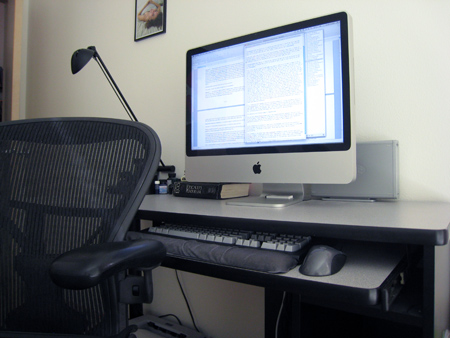
Notable features include an Aeron, the ultimate chair, ink bottles, a backup hard drive used with Time Machine, a gargantuan, wonderful iMac, and a Unicomp Customizer keyboard that inspired this rave—it’s now the most trafficked post on my site.
From Nigel’s blog I went to the Guardian and found out that Alain de Botton has an Aeron too, which obviously enhances the psychic connection established when I shook his hand and discussed Cooper Minis with him in Seattle. His fun novel Kiss & Tell was on my senior year AP English exam.
Notice also the ink bottles hiding between the lamp, book, and base of the computer. I have an anachronistic bend toward fountain pens, and these days I most often use an ink mix of Noodler’s luxury blue blended with Diamine Mediterranean Blue. Juxtaposing inks that Chaucer might have recognized with the computer he probably would not seems an appropriate homage to old and new.
I’d post bookshelves pictures too were my books not substantially packed in preparation for moving.
“You live on the surface,” Lia told me years later. “You sometimes seem profound, but it’s only because you piece a lot of surfaces together to create the impression of depth, solidity. That solidity would collapse if you tried to stand it up.”
—Umberto Eco, Foucault’s Pendulum
“It’s a rite that must have arisen in the old days of the college, when Princeton was a men’s institution and mass nudity was an expression of the male prerogative, like pissing upright or waging war.”
—Ian Caldwell and Dustin Thomason, The Rule of Four
(It’s amazing how sometimes otherwise indifferent books can hit a real zinger of a sentence; these authors do it about once a chapter. Another example: “Somehow these rituals were then transmitted intact down to the present, profiting from that immunity to time and fortune which the university, like an ancient tar pit, confers on everything that lumbers unwittingly into it and dies.”)
“But the flower leaned aside
And thought of naught to say,
And morning found the breeze
A hundred miles away.”
—Robert Frost, “Wind and Window Flower“
James Wood wrote a typically fascinating piece to Nigel Beale defending “lifeness,” or sophisticated realism. As mentioned in my recent link post, it’s worth reading in full. I have to quote at length to set up my response:
It is perfectly possible to agree with Roland Barthes that realism is a set of codes and conventions (for all writing is a set of such codes, after all) and still try to defend that element in fiction — what I call “lifeness” — that eludes the nerveless grip of code. This is a defence both of that evanescence called ‘reality’ and of the artifice that makes it — and makes it up — and there is no contradiction in this doubleness: we read fiction with two eyes, as it were, one world-directed and one text-directed.
The review I just wrote about Joseph O’Neill’s superb novel,”Netherland,” in “The New Yorker,” praises the novel both for its deep and wise interest in life and lives, and for its high degree of artifice and style. That doubleness is entirely in keeping with my attacks on people like Tom Wolfe, John Irving, the more formulaic elements of John Updike, and so on, and in keeping with my praise, in essays and reviews, of writers like Cormac McCarthy (when he is not trying to write a genre thriller like “No Country for Old Men”), Saul Bellow, Roberto Bolano, Muriel Spark, Jose Saramago, W.G. Sebald, Philip Roth, Alan Hollinghurst, Milan Kundera, Norman Rush, V.S. Naipaul, Edward P. Jones, Michel Houellebecq, Anne Enright, David Means, Peter Carey, J.M. Coetzee, Bohumil Hrabal, Harold Brodkey (I was an early and pretty isolated English champion of Brodkey’s), not to mention earlier writers like Henry Green, Italo Svevo, Giovanni Verga, Knut Hamsun, J.F. Powers, and many others.
(Link added by me).
I see this in part as a facet of the long-running debate between whether one should understand the exterior world as reflective of the interior or whether the interior is perpetually hidden and most revealed through its own, psychological terms. This tension manifests itself in literary periods: the exterior world was more popular in the 18th Century with writers like Pope and Swift, and naturally lends itself to satire, while the Romantics brought acute focus back to the interior world through their poetry, while many of the modernists tried to reflect this shift to the inside through the shape of their prose itself. Some contemporary novelists think they’re doing one when they’re actually doing the other; although I hadn’t realized this at the time I wrote my review, it’s a malady Bridge of Sighs suffers from. And the greatest novels can go one way (Ulysses, I would argue, is radically interior) or find a middle path, as I think Bellow often does, but even he often veers interior, as in Henderson and Herzog, as opposed to the exterior-focused world of The Adventures of Augie March; I’m not sure where Ravelstein fits, but I take that subject up again later.
To be sure, some of these generalizations are overly broad, as they almost must be when describing grant literary trends. But some writers—like Tom Wolfe—can subvert the code they appear to be hewing to, and at his best in The Bonfire of the Vanities Wolfe accomplishes this and is a more sophisticated and better writer than many critics assume through his use of examining how the exterior reflects the interior. Being just slightly off makes him misfire completely: I Am Charlotte Simmons is a bad novel that parodies itself, and Wolfe’s symbolic and social purposes are utterly transparent, some of his details are wrong, and the whole effect falls apart. Wolfe has more lifeness than Wood credits him with, though perhaps not so much as some of the later writers on his list.
One way of avoiding the interior and exterior problem is to have a narrator observing someone else, thus allowing one to see the interiority of the narrator and the exteriority of the person being observed. I want to write a dissertation on what I call the nominal object or nominal subject, in which you have a first-person narrator observing another person who is the nominal object or subject of the story: think Ishmael and Ahab in Moby Dick, Carraway and Gatsby in The Great Gatsby, or Jack Burden and Willie Stark in All the King’s Men. All three novels exhibit what I think Wood means by “lifeness,” and although they don’t achieve exclusively that effect through this technique, it can, when used well, give a sense of interiority from the narrator and exteriority in the object. Ravelstein has the same technique, alone as far as I know in Bellow’s novels.
Which is right, the interior or exterior focus? I haven’t the slightest idea and suspect the answer is “neither,” but the debate’s terms are so often manifested in specific examples but not often stated in more general form. To me, novels that elude codes, ideologies, formulas, and other kinds of algorithmic writing—the ones that are truly novel—are the ones most worth reading, provided that they don’t try to evade codes merely to evade codes, but rather as a way of advancing the story, expanding our understanding of reality, and the like. This is the distinction I draw between someone like Bellow and someone like Alain Robbe-Grillet, who seemed interested in difference only for the sake of being different.
“And at a height of three miles, sitting above the clouds, I felt like an airborne seed. From the cracks in the earth the rivers pinched back at the sun. They shone out like smelters’ puddles, and then they took a crust and were covered over. As for the vegetable kingdom, it hardly existed from the air; it looked to me no more than an inch in height. And I dreamed down at the clouds, and thought that when I was a kid I had dreamed up at them, and having dreamed at the clouds from both sides as no other generation of men has done, one should be able to accept his death very easily.”
—Saul Bellow, Henderson the Rain King
(Notice James Wood’s remark in How Fiction Works: “Bellow had a habit of writing repeatedly about flying partly, I guess, because it was the great obvious advantage he had over his dead competitors, those writers who had never seen the world from above the clouds: Melville, Tolstoy, Proust.”)
“What happened was this: I got an image in my head that never got out. We see a great many things and can remember a great many things, but this is different. We get very few of the true images in our heads of the kind I am talking about, the kind which become more and more vivid for us as if the passage of the years did not obscure their reality but, year by year, drew off another veil to expose a meaning which we had only dimly surmised at first. Very probably the last veil will not be removed, for there are not enough years, but the brightness of the image increases and our conviction increases that the brightness is meaning, or the legend of meaning, and without the image our lives would be nothing except an old piece of film rolled on a spool and thrown into a desk drawer among the unanswered letters.”
—Robert Penn Warren, All the King’s Men
“For, sin’s so sweet,
As minds ill bent
Rarely repent,
Untill they meet
Their punishment”
—Ben Jonson, “My Picture left in Scotland”
 The Story's Story