The Logic of Life and Tim Harford in Seattle

Tim Harford’s The Logic of Life is another book intended at least in part to capitalize on the success of Freakonomics, which has sold a bazillion copies and been translated into numerous languages (I saw its distinctive cover in Hebrew). Economics are at work: one thing sells, people realize that previously unrealized demand exists, and then rush into the market. “Rush” is a relative term for the publishing industry, as Freakonomics came out in 2005. Since then, you’ve heard the steady beat: Tyler Cowen’s Discover Your Inner Economist hit a few months ago, and Dan Ariely’s Predictably Irrational: The Hidden Forces that Shape Our Decisions is due February 19. I’m sure more will follow. The same thing happened with Da Vinci Code clones, and the fantasy section of the bookstore has novels like The Name of the Wind and worse lining itself shelves. Those comparisons aren’t entirely fair: there’ve been poorly executed books about conspiratorial secret societies for a long time, and if I recall correctly Edmund Wilson mocked one in a essay. Although Tolkien has inspired hundreds of thousands of lousy novels about Elves who speak as if coming straight from King Arthur’s Court, he is also partly responsible for His Dark Materials and The Earthsea Trilogy.

Maybe it’s unfair to describe so much of the apparatus around Harford’s book prior to the book itself, but all that digression sets up a point, which is that The Undercover Economist is interesting enough on its merits to check out from the library but not so interesting that it’s worth buying. The largest problem is that much of its content is already available online in one form or another: you can read Harford on his blog, or get similar stories from Marginal Revolution (Tyler Cowen, its author, also wrote Discover Your Inner Economist), or go back to Freakonomics or its blog. Plus there’s Steven Landsburg’s More Sex Is Safer Sex: The Unconventional Wisdom of Economics and Robert Frank’s The Economic Naturalist: In Search of Explanations for Everyday Enigmas. So we have three blogs and five books with overlapping content. The blog components are free: you don’t have to be an economist to begin asking the question, “If I’m interested in the subject, why am I buying the book?” A few days ago, Slate posted a Harford article called Amazing Racism that covers similar ground to “Chapter Six: The Dangers of Rational Racism.” Marginal Revolution is hosting a discussion on The Logic of Life, which you can read about here and here, for example. The combination of Harford’s website, Marginal Revolution, and Freakonomics don’t complement The Logic of Life—they substitute for it.

Overall, The Logic of Life is enjoyable enough but never mind-blowing, as something like A Farewell to Alms was—it reoriented the way I perceive aspects of the world. The Logic of Life just piled on the econ-for-dummies stack. Harford is a good writer but his style—pithy, and scattered, yoking together concepts like metaphysical poets but without their artistry—is better suited for the magazines and newspapers he usually publishes in than he is for a book. The magazine and newspaper articles are naturally short, pithy, and to the point, and Hardford is often very funny when he doesn’t have to extend humor that works well in 800 words to a book of more than 40,000. The book feels more like a series of blog posts than a book, which is yet another reason to read the econ blogs, because its chapters are held together only by the tenuous thread of finding something that appears “irrational” and then showing how it makes more sense than it might first appear. As an introduction to some aspects of game theory it’s okay, but the feeling of disjointedness persists even within sections: in Chapter Two: Las Vegas: The Edge of Reason, the narrative skips from a Las Vegas hotel dateline to a discussion of the history of math and game theory to Camp David in September 1961 to Thomas Schelling more generally. Yet those individuals threads aren’t fully developed and don’t come together well.

The two great heroes of this book are Thomas Schelling and Gary Becker. The latter has a blog whose general tone is modeled on the Congressional Budget Office annual report and both are Nobel Laureates. They both also blurb the book, as does Tyler Cowen and Stephen Dubner who co-wrote Freakonomics. Suddenly I find myself commenting on the material around the book more than the book itself yet again, but that’s because 1) I can’t escape the feeling of being pulled into a marketing ploy and 2) find the book largely made redundant by other available material. Consequently, I will reiterate that this isn’t a bad book, and it’s lively enough to keep the reader moving from one idea to the next, but it’s also not terribly original in content or in packaging. I mention “packaging” because that’s what the book essentially is: repackaging of academic work for a non-specialist audience. This is undoubtedly a useful service for those who, like me, are unlikely to read economics journals, but it’s not as useful for those who, like me, are likely to read economics blogs for laypeople. In fact, I must have read too many blog entries because I just used the term “laypeople.” Sorry for that, I’ll try not to let it happen again. It’s the sort of thing Harford avoids, but at the cost of depth—and the cost seems too high. The Logic of Life is too simple and the kinds of material it contains too readily available elsewhere to make it a good purchase.

If The Logic of Life does anything really well, it’s in Harford being a cheerleader for an important and too-often-overlooked field. He was a professor, cheerleader, and pub friend at the University Bookstore in Seattle on Jan. 30, where he told stories, acknowledged the weaknesses in trying to see a rational world when ours isn’t always, and questioned his own metaphors. As a speaker he was fun and also speculated that the the econ-for-dummies books I generally like have done well because “people feel like they’re learning something about the world without having to know hard maths.” Note the “s” on “maths”—Harford is British, and made a joke about how he’s been studying America since being here. I asked what he noticed, and he launched into a short and thoughtful response about how our presidential election system is more rational than he first thought because early voters in Iowa and New Hampshire have a great incentive to learn about the candidates, who in turn advise the rest of the country. I wonder if Harford has read The Myth of the Rational Voter. Its content hasn’t been replicated online.
What's that about technophobic English professors?

* I graduated from Clark University in the not-too-distant past, though back then we read by candlelight and there was no department blog. The blog issue being resolved—as the preceding link demonstrates—also helps kill what a common enough conception that a poster at Rate Your Students summarized:

Unfortunately, the business world stereotypes English profs as probably the least useful among all academics: tweed-clad, bookish anachronisms who, if they’re interesting at all, drive 1960’s English sports cars (but can’t find the gas cap) and make witty chit-chat at parties (but are flummoxed by modern fads like telephones, ball-point pens, and air travel).

Not at Clark! But witty chit-chat is still vogue. Whether this former student’s blog is a testament to the department or a mark of shame has yet to be decided.

* In other news, The New York Times published “Eureka! It Really Takes Years of Hard Work,” about the nature of sudden realizations and creativity:

Epiphany has little to do with either creativity or innovation. Instead, innovation is a slow process of accretion, building small insight upon interesting fact upon tried-and-true process. Just as an oyster wraps layer upon layer of nacre atop an offending piece of sand, ultimately yielding a pearl, innovation percolates within hard work over time.

The same is true of literature and criticism: the great novel always comes after long reading and effort, and the great insight about the great novel doesn’t usually come from the first reading, even if the germ of it can.

* Finally, in still other New York Times news, an essay discussesyet again—the supposed divide between highbrow / lowbrow literature. My dream? That one day we can just discuss what’s good and bad, rather than what section of Barnes & Noble a book appears in.

What’s that about technophobic English professors?

* I graduated from Clark University in the not-too-distant past, though back then we read by candlelight and there was no department blog. The blog issue being resolved—as the preceding link demonstrates—also helps kill what a common enough conception that a poster at Rate Your Students summarized:

Unfortunately, the business world stereotypes English profs as probably the least useful among all academics: tweed-clad, bookish anachronisms who, if they’re interesting at all, drive 1960’s English sports cars (but can’t find the gas cap) and make witty chit-chat at parties (but are flummoxed by modern fads like telephones, ball-point pens, and air travel).

Not at Clark! But witty chit-chat is still vogue. Whether this former student’s blog is a testament to the department or a mark of shame has yet to be decided.

* In other news, The New York Times published “Eureka! It Really Takes Years of Hard Work,” about the nature of sudden realizations and creativity:

Epiphany has little to do with either creativity or innovation. Instead, innovation is a slow process of accretion, building small insight upon interesting fact upon tried-and-true process. Just as an oyster wraps layer upon layer of nacre atop an offending piece of sand, ultimately yielding a pearl, innovation percolates within hard work over time.

The same is true of literature and criticism: the great novel always comes after long reading and effort, and the great insight about the great novel doesn’t usually come from the first reading, even if the germ of it can.

* Finally, in still other New York Times news, an essay discussesyet again—the supposed divide between highbrow / lowbrow literature. My dream? That one day we can just discuss what’s good and bad, rather than what section of Barnes & Noble a book appears in.

Life

“A true collection of art, the sign of its being a true personal collection, would be that it was motley.”

—Normal Rush, Mortals. (He also wrote Mating.)

Alex Ross in Seattle

Alex Ross, author of The Rest is Noise (see my initial comments), visited Seattle to “curate” Icebreaker IV: The American Future, a Seattle concert and festival of young composers. Before the main show, he spoke about The Rest is Noise and how it’s targeted especially at those who have interest in but know little about classical music, as well as how the lives of composers were interwoven with history, society, and culture. As I wrote before, he is “telling the story of music in the most tumultuous century along with its politics and art. Or does it cover politics and art through music? You can’t entirely tell, which must be intentional in a book lively and quick as a gliding melody.” Right: and it goes from the last years of what Ross calls the “marble bust” society through today, covering transformation in art and life.

Perhaps the most important thing Ross stressed was plurality: in approaches in art and music as well as how there isn’t a single path toward progress. Different composers worked in different modes, and what appeared stodgy to many critics—like Sibelus, who with Shostakovich is toward the book’s intellectual heart—became seen as more innovative, while revolutionary music like Stravinsky’s eventually became part of the dominant mainstream. The matter just behind plurality in importance how Ross sees classical music is a great 1,000 year old tradition that is still alive and evolving. Modern composers, performers, and others should realize this emphasize the emotional dimension of music and not just its intellectual dimension.

At first Ross seemed nervous, wringing his hands and shifting his weight, but as he spoke passion and confidence emerged, growing as he talked about the excitement in the classical music world. Ross said his “whole task as a writer has been to draw attention to composers,” and I would extend to the classical and other kinds of music in general. This is a particularly important task because he says classical music is underserved at the media level (sound familiar?), which no longer tracks composers. True enough, as I didn’t recognize most of the names after 1960, and the same problems plague writers. But Ross isn’t “doomy” as many are, due in part because of the aforementioned excitement.

And it’s hard not to get excited at The Rest is Noise, which he says is divided in three sections. The first is devoted to the changes in the early part of the twentieth century, with new sounds, a diversity of approaches, the rising power of pop music, and modernism all arising. The second part most explicitly discusses politics, with World War II and Communism affecting composers the world over, who struggled to survive like many others. This is where he most “use[d] music to write [… an] alternate history.” Finally, the third section, which seemed the weakest and least cohesive to me, he says is “wild” and all over the place. “You can’t write history about events that are still unfolding,” explaining why that section appealed less to me. To be sure, the third section was weak only relative to the strength of the other two, as it still surpassed most writing in general.

Then came the concert, with seven pieces by seven composers; the pieces ranged from ones for a pure quartet to others that incorporated electronic music to those that demanded a larger group to one that was described as being built around bits from Michael Jackson songs (and I enjoyed the pastiche.) Afterwards the composers spoke. They didn’t resemble the stereotype that first leaps to my mind when I think of “composer,” which bears a striking resemblance to the guys in stipple portrait on dollars. Rather, they were more akin to the hipsters I’m used to seeing at bars, reflecting the way their music ranged across modes. They answered questions akin to the one I hate most at readings. My favorite answer was glib when he said that, “I take walks till I’m ready to start,” then he hits his head against his computer, then takes more walks as he composes. Other people asked “questions” designed to show the erudition of the questioner instead of elicit information. Overall, though, it was a good session, even if I couldn’t tell to what extent the composers were trying to describe their artistic process and to what extent they blew smoke.

I keep drawing parallels between literature and music because throughout the evening these parallels were so apparent, and the language used to describe phenomena in both mediums so similar. Much of what I wrote above concerning change, styles, and influence could apply equally well to books and literature, and probably to other artistic and even scientific forms as well. The Rest is Noise is extraordinarily deep and yet malleable. This also makes it hard to define: it is about classical music but also music in general, as well as history and art. Only infrequently does one find a book that does so much while being so much fun to read. The book, like Ross’s talk, shows so much contagious enthusiasm that I can’t help catching it.

The Mysterious Flame of Queen Loana

Umberto Eco’s The Mysterious Flame of Queen Loana is a mishmash of high and pop culture, and I wish it were more a mishmash of action and philosophy. Instead, the latter predominates, and the “novel” becomes a mediation on the nature of memory with only incidental, minimal plot. The obvious comparison is to Proust, who Eco alludes to or references at least several times that I caught and probably more that I didn’t. The comparison is not flattering for Eco, however, and I can’t help but like the precision and the depth of Proust over the comic book and literary metaphors used by Eco. Long descriptions of books and records jar me from what story of Yambo I try to find and grasp. Yes, I understand that I’m supposed to be following his story through the stories he inhabited as a child, but the device too often became tedious instead of enlightening.

The novel starts with the scattered observations of Yambo as he returns to consciousness, and at first we get a stream of his impression. Then the narrative takes on some of the traits of a conventional, structured first-person perspective, dipping in and out of descriptions of comics, books, and politics, until it descends again into a hallucinatory realm as Yambo plunges back toward the memories he has forgotten. In this dreaming coma it is hard—intentionally so, I’m sure—to follow what happens, and in time I gave up the attempt to follow the narrative thread as images and disjointed philosophy became everything.

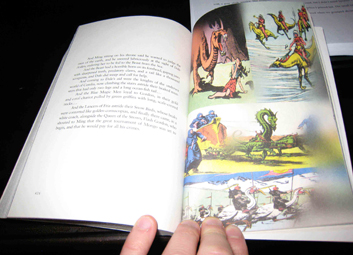
The division between life and books, whether comic or otherwise, breaks down toward the final pages, as heroes and villains from comic books (sometimes literally depicted, as shown in the image below) become symbols in Yambo’s struggle to regain the memory of the distant Lila. His banal schoolboy infatuation becomes the focus of the struggle that plays out against comic book characters, and he realizes that he has been searching for Lila for his entire life—she is the eternal feminine. I’m not sure that I buy this yearning; in a writer like Robertson Davies, it would be seen in retrospect as suspect or fleeting, as the feelings of David Staunton are, or those of Dunstan Ramsay with Diana. For Yambo, the memory is everything, but its pursuit through the perpetual obsession of symbols/people who define life grows tired, especially because Yambo does not recognize that he lets himself be defined by these ludicrous characters. The power of the comic book characters is not truly being able to fly and such, but in their ability to reflect the reader back, who, in this case, is Yambo, and he in turn reflects us.

Queen_Loana_Panel

All very clever, but also rather irritating, especially with the comic art depicting the struggle. Maybe my criticism is unfair, as I just read The Name of the Rose and it is not really fair to hold a regular novel, even a literary one, against a masterpiece. So I cannot blame Eco, as his early novel sets the bar too high for The Mysterious Flame of Queen Loana. Towards the end I also see how the blurbs chosen for The Mysterious Flame of Queen Loana’s jacket work: The Sunday Times writes that “As always with Eco, there is much to admire,” but perhaps some not to be admired, and the Observer writes that The Mysterious Flame of Queen Loana “confirms Eco as an outstanding writer of philosophy dressed fiction.” The dressing is too flimsy for the fiction section.

I also have to compare The Mysterious Flame of Queen Loana to Orhan Pamuk’s My Name is Red, as I read them back-to-back and both are obsessed with memory and meaning to an almost Proustian degree. I don’t recommend the two consecutively, and I ended up with them thanks to more bookstore oddities.

Both novels also implicitly ask how we know what we know. My Name is Red has characters who constantly refer to “common knowledge” that is anything but common and to whether they will be remembered; Shekure, the vain woman, says that “[…] Perhaps one day someone from a distant land will listen to this story of mine,” though later in the same paragraph she says, “If I happen to tell a lie or two from time to time, it’s so you don’t come to any false conclusions about me.” Marlowe of Heart of Darkness is a better liar and the amnesia of The Mysterious Flame of Queen Loana a better dissembler, but all three tell as much about telling tales as they do about the tale itself through the way they seek memory. But Heart of Darkness has something the other two lack: a strong, consistent narrative drive. My Name is Black doesn’t have one by its multiple-perspective design, which becomes disorienting, as though the reader needs to understand not just the murder or clues to the murder but who is speaking and giving the murder. It gave me a sense of vertigo I didn’t like, but My Name is Black also has the sense of a novel that will satisfy much more the second time around, like Faulkner. So try it and Heart of Darkness and The Name of the Rose, but let Loana remain mysterious.

One more link post

Book|Daddy has a great essay on the otherwise (mostly) silly debate about blogs, books, and criticism. You can see evidence of its percolating here and here. What caught me is this quote:

As Jessa Crispin of Bookslut said during the panel on literary criticism that book/daddy moderated at the Texas Book Fesival in Austin over the weekend, the major review outlets keep reviewing all of the same authors, and few of the kinds of books and authors she likes were getting attention, so she started writing about them on her website.

Seriously. Who is writing about Robertson Davies, and who is commenting on B.R. Myers? Somehow I’ve never found a demand that I read The Name of the Rose, a novel that encapsulates why I read in the first place: to be so blown away that it’s hard to discover where I should start writing. I linked to some of the other books that come close to that effect here.

The New York Times on the Kindle

A New York Times article called “Freed From the Page, but a Book Nonetheless” discusses the Amazon Kindle, which I don’t like. But I agree with the article’s conclusion:

The object we are accustomed to calling a book is undergoing a profound modification as it is stripped of its physical shell. Kindle’s long-term success is still unknown, but Amazon should be credited with imaginatively redefining its original product line, replacing the book business with the reading business.

I just analogize the Kindle to mp3 players before the iPod in the sense that it shows promise but just isn’t there yet. When it is there—less expensive, better interface, easier content management and acquisition (and what a vile phrase that is)—I will be too.

Hugging the Shore

I found John Updike’s Hugging the Shore through Critical Mass’s the Critical Library series of posts, where this collection repeatedly came up. It’s out of print and, I suspect, a book that shaped older critics but is no longer essential and feels too much likes its opinions, like most, have either become accepted or unimportant. Like many revolutions, the ideas in Hugging the Shore seem to have become part of the ossified landscape. Some of the pieces still thrill: the one on Ursula K. Leguin is short but good, while those on Bellow seem to both stretch and not be able to wrap themselves around Bellow. Many of Updike’s opinions I respect, but, at the same time, I flip to the next essay halfway through the one I’m on.

To me, something like Martin Amis’s The War Against Cliché: Essays and Reviews 1971 – 2000 feels more vital, for lack of a better term, and maybe Amis’s verbal pyrotechnics show off, but they also convince. Give me it instead of Hugging the Shore, and throw in Orwell’s Essays (more on Orwell here) to give an overview of many of the same topics but better. I like Hugging the Shore, but with criticism even more than novels the essential is everything.

The Other Boleyn Girl and Starship Troopers

How odd it was, standing in a bookstore 7,500 miles from home and pondering the choices in a small but reasonably good English section of an airport bookshop. The most appealing books I’d already read: On Chesil Beach, The Golden Compass, The Name of the Rose (oddly enough, given that I’d read it on the first leg of the plane ride). The choices left dwindle to John le Carré’s* latest or Philippa Gregory’s The Other Boleyn Girl. I take the latter, figuring that once I’ve read four or five of le Carré’s novels I’ve read them all. Earlier I described them as “trust no one and everyone, including you, is guilty of something, or would be in the right situation,” novels, and I eventually tire of their torrid, in-the-know sentences.

And so I chose The Other Boleyn Girl and came to a novel I dread writing about because it is awfully, unabashedly bad, filled with adverbs as egregious as the two I just used, and I was stuck with it for too many hours on a plane. Normally I would’ve stopped after a few chapters. Trapped as though in the Tower of London, I had nowhere to go but on with the story, reading endlessly of the narrator, Mary Boleyn, reminding herself of how she is a Howard, and having other characters constantly tell her that as well. Most of the characters speak in platitudes, as though aware of history’s spotlight on them, and yet the characters are simultaneously self-absorbed to a degree tiresome in anyone, including monarchs and their playthings.

Then there is the writing: on page six a “moment of pure envy swept through me,” and on 90 a horse is coiled like a spring. Adverbs proliferate like the plague and, worse for me, I just finished The Name of the Rose, a novel with a powerful, inflammatory inquisition scene that lights up like an inferno, while Gregory offers a brief, sputtering description on page 716 of my mass-market paperback. The theological discussions are similarly opposite, with The Name of the Rose like a gorgeous Ph.D. thesis and The Other Boleyn Girl like the musings of a pupil. There is much discussion of wit and little evidence of it, just as there is much discussion of what it means to be part of the family and little evidence of it meaning anything more than being part of a band of nitwit navel gazers.

There are bizarre anachronisms in the novel, as when characters use the term slut, which, as Geoffrey Pullum’s quote from the Oxford English Dictionary in this post on contemporary usage shows, slut has meant that “bad housekeeping, loose sexuality, general uppitiness and terms of endearment have been all mixed together since the middle of the 17th century.” The Other Boleyn Girl is set towards the beginning of the sixteenth century. Likewise, despite repeated references to skill in French and Latin, no characters display any knowledge of either language or its literatures; Anne’s linguistic ability extends to saying “Bien sur!” once. Indeed, the characters seem caught purely in their own times, as if history was absent and the future as well. No culture exists outside of mentions about Thomas More and jousting. If not for the device of the king and the mention of horses, this novel could be set in a frat house, or any number of contemporary settings.

All this is frustrating because The Other Boleyn Girl shows rare moments of genuine feeling, as when Mary acknowledges to her brother that she cannot wed the man she wants. These few evoking moments come amid the tedious descriptions of royal maneuverings that read like the post-season situation in basketball. By the end of the flight I wanted to take back all those snide thoughts about le Carré, who is by comparison a writer of tremendous greatness.


The other novel I bought during a layover back in the United States: Starship Troopers, which I think a family member has lying around somewhere but I also knew would make for good and quick reading. As a teenager I missed its political context, which startled me now because that is the entire novel. Sure, the politics are simplistic and lack even the depth of Stranger in a Strange Land, but I can see why arguments for independence and power appeals to boys. There are even flashes of Wilde-like aphorisms, as when a comment from the protagonist’s History and Moral Philosophy instructor is repeated: “He says that you are not stupid, merely ignorant and prejudiced by your environment.” Glimmers of tolerance in an otherwise militaristic novel appear, when the narrator says “But don’t make the mistake of thinking that the Bugs are just stupid insects because they look the way they do and don’t know how to surrender.” Grudging, yes, but you get it.As I come back to Heinlein I see his many flaws and the reasons literati snub him, and were I to read him for the first time now I don’t think I would have much use for him. But for all his weaknesses he serves a need, much like the often-hated Ayn Rand. On a plane, when you’re inclined to skip over the more foolish discussions, Heinlein is pretty good—just as he is when you’re 12.

The title of this post may startle you, but there is a slim connection between a novel about sex and power in the sixteenth century and one about militarism and politics in the distant future.

I haven’t yet commented on The Name of the Rose, mentioned here, but that’s only because it’s so good that I both want to save the best for last and struggle to formulate something to say, as the novel is so vast that it’s hard merely to decide which aspects of it to discuss.

* For a fascinating essay on le Carré, see—as usual—B.R. Myers’ essay in The Atlantic.