Briefly noted: Underground Airlines — Ben H. Winters

You may have seen the good reviews, but I gave up after 50 pages, many of which look like this:

Underground Airlines

The premise is clever—the Civil War is averted and slavery persists in four states up to the present day—but the writing is not. One wishes to read instead Elmore Leonard, who is a master of the kind of style attempted here. Almost every page is overwritten. Many of the pieces in Martin Amis’s The War Against Cliche apply here too.

Good books I read in 2016

A reader pointed out that I didn’t write a “best of 2016” post, which is correct, but “best of” strikes me wrong, so I’m going to write about good books that I happened to read in 2016 and that you should read too.

* The Undoing Project: A Friendship That Changed Our Minds by Michael Lewis, probably the best book I read all year, except maybe for Blindsight, but that is so different that the two aren’t really comparable.

* Perfect Rigor: A Genius and the Mathematical Breakthrough of the Century by Masha Gessen, another narrative nonfiction book, though this one emerged and escaped my notice in 2009.

* The Map and the Territory by Houellebecq, still weird and likely always weird; Houellebecq has his misses, especially The Possibility of an Island, but his hits are strong, weird, and different—with “different” too often meaning “bad,” but not in his case.

* Cryptonomicon by Neal Stephenson, one of those amazing books worth re-reading whenever you can’t find a new book to read.

* The Song Machine: Inside the Hit Factory by John Seabrook, which is novelistic in detail and beautifully reported. I didn’t fully know where the music everyone listens to comes from and now I do.

I’ve been having trouble finding really good novels, though my tastes are idiosyncratic and I don’t have rules for what makes a good novel besides the tautological, “Be really good.” If you have suggestions drop me a line.

The most-visited post I wrote last year is “The race to the bottom of victimhood and ‘social justice’ culture.”

The Trespasser — Tana French

I don’t remember where I first learned about French, but “Women Are Writing the Best Crime Novels” inspired me to read The Trespasser. The novel is not bad and if you like the genre you might dig it—it’s not offensively written—but halfway through one feels like nothing much has happened, the dead girl, Aislinn, remains a cipher, and maybe a bunch of stuff will add up to something but maybe it won’t. Comparisons to Gone Girl are not quite apt because in that novel something changes virtually every chapter, and around halfway through the big reveal occurs.

trespasserIn The Trespasser things meander to no particular end. From a marketing perspective the endless comparisons to Gone Girl makes sense, but from a narrative perspective they rarely do. Gone Girl does seem to break the narrative pattern in a way that’s difficult to repeat, and that may help explain why it is so read and still so good.

Still, reading a competently executed book is refreshing, and there are crisp descriptions like, “Breslin likes thinking he’s Mr. Indispensable; he’ll show up just as fast for a shitty domestic as he would for a skin-stripping serial killer, because he knows the poor victim is bollixed until he gets there to save the day.” Arguably the part of the sentence before the semicolon could be omitted, with the reader left to infer it, but one gets a sense of someone whose virtue is motivated by self-love more than caring for mankind. We also get a lot of standard detective-fiction patter, like “I didn’t use to be like this. I’ve always had a temper on me, but I’ve always kept it under control, no matter how hard I had to bite down.” Why are tempers always under control and not over control? What does control of a temper mean, versus a temper having control? The kinds of standardized language one finds in the novel never gets to those questions. It’s actually hard to find really characteristic quotes because The Trespasser doesn’t stray far enough from its genre:

The point is, this isn’t the telly, where cops are all blood brothers and anyone who gets on the wrong side of a cop ends up dead in a ditch while the rest of us lose the evidence. I don’t have any squad loyalty.

The writing is often good but not quite good enough to justify the plot. I still await “the next Gone Girl.”

A surprisingly large amount of the novel describes the bureaucracy of police departments (which is a surprisingly large amount of many contemporary detective novels and maybe novels set more generally in offices). Bureaucracy may be the characteristic fact of life. See also “Bartlebys All.”

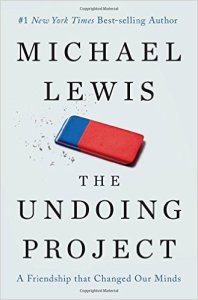
The Undoing Project: A Friendship That Changed Our Minds — Michael Lewis

The Undoing Project is entertainingly written, appears well-researched, and is also tremendously important—three things that, while not intrinsically opposed, occur together too infrequently. It’s so funny that I burst out laughing during class, while students were engaged in peer review, and every pair of eyes turned to me. I wanted to stop myself but couldn’t. It’s the best book I’ve read in recent memory and you should stop whatever else you’re doing to read it.

undoing_projectThe “tremendously important” part is important for many reasons, one being that most people don’t seem to even know the (many) biases humans are prone to, let alone that knowing the biases often isn’t enough to change the behavior. We can understand the problems and still not turn understanding into action.*

Still, there are steps we can consciously take to attempt to minimize or combat our biases. For example, “People had trouble seeing when their minds were misleading them; on the other hand, they could sometimes see when other people’s minds were misleading them.” That means we have to minimize hierarchy in many situations; empower people to speak up when they perceive problems; and listen to those who have differences of opinion, even if we want to immediately assume they’re wrong.

There are too many good sections in the book to cite them all. One example:

People did not choose between things. They chose between descriptions of things. Economists, and anyone else who wanted to believe that human beings were rational, could rationalize, or try to rationalize, loss aversion. But how did you rationalize this? Economists assumed that you could simply measure what people wanted from what they chose. But what if what you want changes with the context in which the options are offered to you?”

Conveying the humor in The Undoing Project is hard, maybe impossible, because so much of it is embedded in larger stories.

“Amos approached intellectual life strategically, as if it were an oil field to be drilled, and after two years of sitting through philosophy classes he announced that philosophy was a dry well. ‘I remember his words,’ recalled Amnon. ‘He said, “There is nothing we can do in philosophy. Plato solved too many of the problems. We can’t have any impact in this area. There are too many smart guys and too few problems left, and the problems have no solutions.”’”

I wonder if English lit suffers from the same (or a similar) problem. There’s been little progress since the advent of close reading, and the development of “critical theory” or “theory” is often if anything a step back. If there is anything interesting going on right now it seems to be in some aspect of applying computers to literature, but that is likely more a CS problem than an English lit problem.

We do get an ethnology of academia, too. Like:

Economists were brash and self-assured. Psychologists were nuanced and doubtful. ‘Psychologists as a rule will only interrupt a presentation for clarification,’ says psychologist Dan Gilbert. ‘Economists will interrupt to show how smart they are.’ ‘In economics it is completely normal to be rude,’ says economist George Loewenstein. ‘We tried to create a psychology and economics seminar at Yale. We had our first meeting. The psychologists came out completely bruised. We never had a second meeting.’ In the early 1990s, Amos’s former student Steven Sloman invited an equal number of economists and psychologists to a conference in France. ‘And I swear to God I spent three-quarters of my time telling the economists to shut up,’ said Sloman. ‘The problem,’ says Harvard social psychologist Amy Cuddy, ‘is that psychologists think economists are immoral and economists think psychologists are stupid.’

There seems to be no solution.

There also seems to be no solution for the systematic errors in human cognition. As I noted above, awareness is not enough. Even imagining possible futures is not enough, because one may come to predominate and stifle the others before they can be explored:

What people did in many complicated real-life problems—when trying to decide if Egypt might invade Israel, say, or their husband might leave them for another woman—was to construct scenarios. The stories we make up, rooted in our memories, effectively replace probability judgements. ‘The production of a compelling scenario is likely to constrain future thinking,’ wrote Danny to Amos. ‘There is much evidence showing that, once an uncertain situation has been perceived or interpreted in a particular fashion, it is quite difficult to view it in any other way.

The parallels to present world politics are too clear. We have forgotten the lessons of totalitarianism in just a generation and a half. We are too fond of constructing Kahneman’s rosy scenarios, which replace probability judgments. The probability of nuclear conflagration has grown in recent times. Yet we discount it. Recent elections in the U.S., U.K., Poland, and Hungary are systematic cognitive errors writ large.

The number of cognitive errors we’re subject to staggers. It’s “not just that people don’t know what they don’t know, but that they don’t bother to factor their ignorance into their judgments” (192). This book should above all make us doubt ourselves more, and especially doubt ourselves even when we think ourselves sophisticated. Over and over, we see people who receive training in statistics make basic statistical errors. We see people violate the law of small numbers.

I cannot recall all the times I’ve explained sample bias problems to people—rarely clients but more often students or friends—only to sense that no one is getting what I’m saying, or, if they do get it, they don’t care. The more one understands recurring cognitive weaknesses the more one sees them, the more I worry about succumbing to them myself. I myself succumbed to them in the last election, by substituting the opinions of people who are readily observable around me for the opinions of the much larger political body. And I myself wonder how often people have explained cognitive biases to me, or pointed out cognitive biases in action, only for me to ignore them.

The secret to the successful friendship between Kahneman and Tversky seems to have been pleasure: “‘We just found each other more interesting than anyone else,’ said Danny. ‘Even if we had just spent the entire day working together.’ They’d become a single mind, creating ideas about why people did what they did, and cooking up odd experiments to tests them.” The joint mind: It seems beautiful. I wonder how many of us accomplish such a feat. Lewis does cite a writer who began a book about productive pairs but never finished it. Another writer, Joshua Wolf Shenk, wrote and published Powers of Two: Finding the Essence of Innovation in Creative Pairs.

Lewis quotes his beautifully articulate subjects: “It is sometimes easier to make the world a better place than to prove you have made the world a better place.”

This is a kind of boring NYT review. This is a better New Yorker review, from Cass Sunstein and Richard Thaler, who are both cited repeatedly in the book itself. For example:

[Cass] Sunstein was particularly interested in what was now being called ‘choice architecture.’ The decisions people made were driven by the way they were presented. People didn’t simply know what they wanted: they took cues from their environment. They constructed their preferences. And they followed paths of least resistance, even when they paid a heavy price for it.

How are you paying?


* Maybe the robots do deserve to win.

Briefly noted: Dreamland: The True Tales of America’s Opiate Epidemic — Sam Quinones

Dreamland is well-reported and consistently interesting, but its chapters are chopped into tiny pieces that interrupt narrative flow—the word dream is disrupted. Many if not most chapters are around 800 to a thousand words, yet the book covers several important threads: the rise and marketing of Oxycontin maker Purdue Pharmaceutical; the drug sales practices of Xalisco natives who figure out how to game the U.S. legal and immigration systems; and the insatiable love Americans have for drugs.

dreamlandDespite the chopped narrative problem, however, Dreamland covers important developments around opioid addiction and its origins. The better sections are arresting; for example, the description of the Xalisco traffickers could be from a business case study, as the Xalisco organizations respond to a number of different factors: supply and demand, a difficult regulatory environment, and unique managerial challenges (the best business case studies are themselves little novels, with the artistry that implies).

In many forgotten cities, most of the wealthy top has left or disappeared, most of the productive middle has moved to a relative handful of cities and suburbs, and many of those who remain are poor. While elite cities accrue service-sector advantages and develop information economies, many other places that existed for agriculture or manufacturing are suffering, and there’s no real way to help them. As a result, “Remaining behind was a thin slice of educated people. They found work in the schools or the hospitals, in some way or other tending to those for whom the factory closings were the beginning of an American nightmare.” “Nightmare” is too strong a word here—one thinks of Behind the Beautiful Forevers—but the challenges seem insurmountable over the short term.

“Nightmares” is not the only linguistic misfire. Some of the writing is cliché: “Two Portsmouths exist today.” You will have heard the “two [geographic area]” terminology. Some sentences are merely banal. Too many say things like, “I learned, too, that envidia—envy, jealousy—was a destructive force in the rancho.” Is there any society for which that is not true? Every society experiences envy, hate, jealousy, striving, signaling, and so on.

In the Two Portsmouths,

One is a town of abandoned buildings at the edge of the Ohio River. The other resides in the memories of thousands in the town’s diaspora who grew up during its better years and return to the actual Portsmouth rarely, if at all.

Heroin remains a statistical phenomenon for me, maybe because of where I live. I’ve never known anyone who has admitted to doing it and I’ve never been offered it. No one I know has died from it. It’s just… out there, somewhere, mostly in the media (which is maybe a reason to read less news, not more). Yet it’s killing tens of thousands of people a year. Dreamland takes this data from statistical abstraction to specific people.

Be ready to notice more after you’ve read Dreamland. For example, the Wall Street Journal just published “For Small-Town Cops, Opioid Scourge Hits Close to Home,” this time about a common drug named fentanyl.

Dreamland’s ending disappoints, maybe because there is no real solution short to the problem. Decriminalization and better treatment options may help but will not cure. The policy recommendations Quinones offers amount to “more of the same.” We may see improvements at the margins but are unlikely to see a solution to the problem of humans liking mind-altering substances.

Here is Isaac’s take on Dreamland. Here is Tyler Cowen on rural America, suggesting we “Support a voluntary temperance movement for zero alcohol, zero drugs.” It’s not for me but I take the reasoning seriously and it’s clear that large numbers of people can’t handle alcohol or drugs, for whatever reasons, and that the pharmacological utopians of the ’60s and ’70s were wrong, or wrong about the experiences of many people.

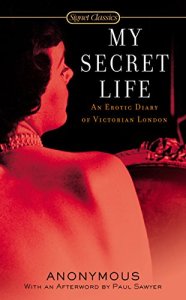
My Secret Life — Anonymous

My Secret Life is a bizarre, disturbing, amazing, fascinating work of Victorian-era pornography. It is anachronistic to label it with a “trigger warning” but it is the rare work that actually deserves the warning; it recounts in great detail the author’s erotic experiences from youth to old age. My Secret Life feels like a book sort of thing that probably wouldn’t get assigned to undergrads today. Still, it is strange and curious enough for me to write about it here (I learned of it via The Voyeur’s Motel, a book that may be considered part of the same genre as My Secret Life). Originally published in or around 1902, it was 11 volumes (!), and the abridged edition I linked to is a single volume that still feels exhausting by its end.

my_secret_lifeIt’s hard to believe that all of My Secret Life is true, and it’s also hard to believe that it is wholly imagined. Today one might call it “creative nonfiction,” which seems to be a phrase that loosely means or connotes truthy, or specious, or “I need to make shit up to make the narrative more compelling.”

The interest in and curiosity about matters generally veiled was great then and remains great now, though today it maybe takes different shapes. There are ceaseless reportorial sections in My Secret Life, and moments when the narrator finds that someone, “One evening being unusually communicative,” explained the matter of “buggery.” That explanation comes from a woman named Camille; the narrator “went there when I wanted a quiet chat and information about sexualities.” That interest appears insatiable, even as its nuances eventually dull the reader’s senses due to repetition.

The need to report and imagine seem relentless. During one extended period with a single woman, the narrator says that “when not thinking of Charlotte, [I] spent my time in writing baudy words and sketching cunts and pricks with pen and ink.” So he is either engaged in the act or considering it in some other way. His work is almost Internet-ready, going even to anonymity.

Some challenges seem eternal, as when the narrator praises a women in this way:

Moreover she was not always plaguing me for money—asking me to pay this, or to lend her to pay that—which is the common habit and trick of harlots from high to low—I felt at sea when Sarah was gone, and recollect that for a month or so I was chaste.

That “chaste” month seems unusual in the narrator’s life, though his whole life seems unusual; that it may be more usual than is usually assumed may be part of the book’s frisson. Still, one hopes that the many vile things the narrator does are not eternal.

My Secret History is an easy book for skipping sections, as the narrator never seems to grow, change, learn, or seriously struggle. As he is at seven, so he is at seventy. But maybe the larger point is that the nature of humanity as a whole may change less than we might like, and that non-technological progress is rarer than we like to think and perhaps barely existent at all.

Perfect Rigor: A Genius and the Mathematical Breakthrough of the Century — Masha Gessen

Perfect Rigor is the best and most fascinating book I’ve read recently, and it is the sort of book I often seek but too rarely find. The story concerns Grigory Perelman, the man who solved the Poincaré Conjecture and whose eccentricities and life history may or may not be related to his mathematical faculty but certainly make for bizarre, enlightening, and entertaining reading.

perfect_rigorPerelman was born into Soviet Russia, a place where the professional study and practice of math were frequently under peril. Soviet math survived Stalinism and the horror of the Soviet Union more generally in part from luck and in part from need, but they suffered from being cut off from the rest of the math world. Still, as Gessen writes:

mathematicians as a group slipped by the first rounds of purges because mathematics was too obscure for propaganda. Over the nearly four decades of Stalin’s reign, however, it would turn out that nothing was too obscure from destruction.

Plus, modern wars cannot be fought successfully without mathematicians. Many, many mathematicians. Math has another useful property from the perspective of Communists living in a resource-deprived, poorly organized society: good math can be done even in conditions of relative privation (which may not be true of, say, engineering).

So math in Russia survived Stalin, even while many other fields suffered. There is a fascinating historical counter-narrative in which Russia evades Communism and Germany evades Nazism via World War I not happening, or not happening the way it did. In that alternate world, tens of millions of people live and contribute to the betterment of humanity. Instead of that world, however, we have the world that World War I bequeathed us and the countless people lost to murderous state machines.

Perelman and his direct family at least were not killed. And in the Soviet Union, math continued to be practiced freely, or mostly freely:

In the after-hours lectures and seminars, the mathematical conversation in the Soviet Union was reborn, and the appeal of mathematics to a mind in search of challenge, logic, and consistency once again became evident. “In the post-Stalin Soviet Union it was one of the most natural ways for a freethinking intellectual to seek self-realization,” said Grigory Shabat, a well-known Moscow mathematician. “If I had been free to choose any profession, I would have become a literary critic. But I wanted to work, not spend my life fighting the censors.”

It was good to do math because there was so little else to do. The many pleasures offered by American or Western European work were not available. Creative freedoms were minimal. Math was among the few places a person could be creative.

Some sections Perfect Rigor are just novel and unknown to me, descriptions of a sub-culture that I’d never thought properly about:

Competitive mathematics is more like a sport than most people imagine. It has its coaches, its clubs, its practice sessions, and, of course, its competitions. Natural ability is necessary but entirely insufficient for success: the talented child needs to have the right coach, the right team, the right kind of family support, and, most important, the will to win. At the beginning, it is nearly impossible to tell the difference between future stars and those who will be good but never great.

I wonder how necessary “the will to win” is, especially given how much later in the book Gessen describes the professional world of math in different terms: “The mathematics community in the United States, and even the world, is very small and very peaceful.” Still, leaving that potential issue aside, the analogy to sport is a powerful one, since sports are more familiar to the average person than math.

More details: Gessen writes of herself:

My own first-grade teacher, in a neighborhood on the outskirts of Moscow that looked just like Perelman’s neighborhood on the outskirts of Leningrad, actually made me pretend my reading skills were as poor as the other children’s, enforcing her own vision of conforming to grade level.

Russia’s many afterschool math clubs did non conform to this bizarre, Harrison Bergeron vision. Which may be why Russia could continue to produce prodigious mathematicians even as much of the rest of its society decayed under the cruelties and absurdities of Communist rule. Those cruelties and absurdities are well-known, and they emerge in the way the Soviet Union sought contradictory goals:

The entire Soviet system of secondary education was based on the concept of uniformity: everyone was to be taught the same thing at the same time, using the same textbooks. But the Soviet Union still craved international prestige—in fact, that need became more and more pronounced as the technological rivalries of the second half of the century heated up.

Uniformity and excellence are mutually exclusive. As often happens, when ideology and reality diverge, ideology gives way, as it did to some extent for Perelman’s school. His school

let him avoid confronting the fact that he lived among humans, each with his or her own ideas and thoughts, to say nothing of emotions and desires. Many gifted children realize with a start as they mature that the world of ideas and the world of people compete for their attention and energy.

Perelman, it appears, never had to choose one over the other. He’s spent his life firmly in the world of ideas, rarely dealing with the world of humans. It is hard to say whether the world or humans or ideas is stranger; presented properly, either can seem strange. Perelman’s life seems strange but also pure and beautiful in a way that I would at times like to emulate but cannot, any more than I think he could emulate my life.

Perfect Rigor speculates some about Perelman’s motives and personality, or personalities, but cannot know them certainly. Sergei Rukshin is Perelman’s first serious math coach, and even very early he is happy with one of Perelman’s interests, or lack of interests: “He was never interested in girls,” unlike many of his classmates, who were caught “doing something as undignified and distracting as kissing a girl.” Life is about trade-offs and on some level Perfect Rigor encourages us to consider some of the tradeoffs some high-level mathematicians make (though not all: Feynman, for example, devotes some stories in Surely You’re Joking, Mr. Feynman! to understanding women).

Maybe lack of sexual interest is in part from the demand side as much as the supply side. Perelman himself is, when he is young, “an ugly duckling among ugly ducklings,” though that changes a little when he is older. One wonders about the links, if any, between physical appearance and math (or other intellectual) skill. The vigorous rejection of “surface” matters seems common among high achievers, though I wonder if I’m letting myself be subject to the availability heuristic.

Used copies of Perfect Rigor on Amazon are gloriously cheap. I don’t know how I missed the book when it first appeared in 2009.

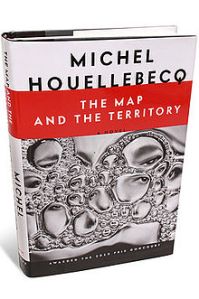
Briefly noted: The Map and the Territory — Houellebecq

The number of ideas in The Map and the Territory is too high to enumerate, and the novel is structurally weird, but it’s weird in a way that’s still functional. Like all of Houellebecq it’s fascinating, though not in a way that’s easy to describe, and it touches many Houellbecqian themes: The weakness of contemporary France; the need for tourism; the fight between stability and novelty; the status of the artist; the faux accepted role of the market as the arbiter of all value; the need to express sexuality and form relationships despite the futility of both acts. At least in this one a shocking unexpected terrorist bloodbath is not the denouement, however fitting and brutal it was in one of Houellebecq’s other novels.

Consider this:

Barely amiable in the first few minutes, the stocky estate agent went into a lyrical trance when he learned that Jed was an artist. It was the first time, he exclaimed, that he’d had the opportunity to sell an artist’s studio to an artist! Jed feared for a moment that he would declare his solidarity with authentic artists against the bourgeois bohemians and other such philistines who inflated prices, thus making artist’s studios inaccessible to artists, but what can you do? I can’t go against the truth of the market: it’s not my role. But fortunately this did not happen.

the_map_and_the_territoryThe notion of the “artist” has been made into a nostgalia item that was long ago marketized. Today’s artists still need cheap space, but they won’t find it in most “major” Western cities.

It may be that the best medium for a given time shifts. It was painting in the Renaissance, novels and what we now call classical music in the 19th Century, movies and what we now call pop music in the 20th Century, and maybe something like design in the 21st. Still, real artists ship and show their work:

You can work alone for years, it’s actually the only way to work, truth be told; but there always comes a moment when you feel the need to show your work to the world, less to receive its judgment than to reassure yourself about the existence of this work, or even of your own existence, for in a social species individuality is little more than a short piece of fiction.

Are we just neurons in a massive, transhuman brain, each of us thinking we are individual but actually just part of the mess, sending encoded messages from person to person via sound, light, or other mean? One sees Houellebecq’s taste for moving from the level of the individual outwards to the level of society or species. It’s a favorite move and one I see remarked on too infrequently.

It’s hard to convey the feeling of a Houellebecq novel from blockquotes alone, as the way sections connect do not feel like the way sections connect in other novels. Sometimes long times pass; few causal relationships, if any, are established. In that sense Houellbecq is a kind of anti-thriller, where everything is cause-effect in a way the real world isn’t.

Houellebecq’s pessimism seems easier to countenance given recent political events. One wonders if he will eventually be seen as a deeply political writer who connects the personal and political in ways that most trendy or PC writers don’t, or can’t.

Future Sex — Emily Witt

If there’s a word to characterize Witt’s overall tone or psychology, it’s “ambivalent.” She seems ambivalent about everything, except perhaps finding a life, which she wants, but she doesn’t know what she wants it to contain. On the first page she writes that “I had not chosen to be single but love is rare and it is frequently unreciprocated.” I’m not sure the first clause is true and am fairly sure the second isn’t: To some extent people choose love, at least once they leave adolescence where angst, drama, and pop music convince one that love is something that as an adult starts to seem ridiculous. She may experience a Marxism problem, like many women and not a few men. For her or her generation or her friends, “We were here by accident, not intention.” She goes to a bar where she “waited to be approached” (so much for 50 years of feminism?). Or:

To declare that I would organize my sexuality around the principle of free love seemed at times a pointless statement. I was unsure a declaration of pursuit had any effect on lived experience.

future_sex_wittMaking a “declaration” might not have any effect, but choosing to live one’s life the way one wants should presumably have an effect—or it would in a person of greater determination. In the blockquote above the word “organize” is also interesting. Is sexuality like a sock drawer, to-do list, or essay? Part of me hopes not but part of me wonders whether it might be.

Throughout Future Sex one wants more agency: things don’t just happen. You make them happen (or don’t). There is too much stumbling helplessly around. This will sound odd at first, but one could compare Future Sex to the Elon Musk biography, since Musk and Witt have opposite views about agency (and their ages are not so far apart). Musk views the future as something that individual humans make happen in the way those humans want to make happen. Witt views the future as something that’s imposed and that “just happens.” By using this framing device, one can probably intuit the side I prefer.

To be sure, it is fair that a person may not know exactly what they want, but if the moment of clarity hits then it’s time to make the future happen. Witt has something like that moment but appears to do nothing with it. Perhaps if she had, she’d have written a different book, about chasing down and spearing Mr. Right.

There are some paragraphs that feel oddly obvious, or maybe overly gender specific:

For a significant number of men, sex had its own intrinsic value and quantitative metrics, independent of the qualifications that determined whether you wanted to live with someone and adopt babies wit him. [. . . ] Someone like me, in contrast, believed that if I enjoyed going to a museum with a man the sexual attraction would just follow, without anybody having to talk about it.

I’d argue that that first clause applies to a significant number of women too. Or maybe Witt and I know different women.

Some sections are just outright hilarious. In maybe the best one, on Internet porn, Witt rivals David Foster Wallace’s “Big Red Son” for being a stranger in a strange land. Which is often funny:

I gathered that for performers, making more extreme pornography was like being a writer’s writer, where the value of the work was most apparent to other people immersed in the same field, and the respect one earned was of a different, more meaningful order than mainstream acclaim.

A perfect sentence perfectly expressed.

One chapter describes polyamory, or having sustained relationships with more than one person at a time, which sounds exhausting, leaving aside whatever merits the arrangement may have. Who has the energy? You may recall that Neil Strauss tried something along those lines in The Truth, although without thinking much about what he was doing or the personalities of those involved. Witt’s friends avoid some of that problem but not all of it; they still seem oddly flat.

Let me speak more of oddities: Oddly for a book about sex mores, wit an overlay of technology, there is no mention of the HPV vaccine, or the promising herpes vaccine, or the ongoing work on HIV vaccines. There is research into a chlamydia vaccine, based on work initially done for the koala vaccine. None are guaranteed but it is axiomatic that if you reduce the cost of a good or service you will increase the amount of it consumed. Reducing the “cost” of sex changes consumption: “From shame to game in one hundred years: An economic model of the rise in premarital sex and its de-stigmatisation” describes how and why mores changed in response to the development of antibiotics that turned many STIs from fatal or debilitating into minor ailments, along with increasing access to reliable condoms. All of these technologies change the way people behave by changing the associated risk curves. The polyamorous San Franciscans of today, who Witt writes about, would not be doing what they do without the life-saving antibiotics of yesterday. The vaccines of tomorrow will likely further shape behavior and preferences.

Maybe it is churlish to blame an already-complex book for what it chooses not to emphasize, but technology is more than smartphones and apps and Internet dating and porn videos. Technology is those things, yes, yet it’s much more than them.

Here’s an interview with Witt. And here’s the New Yorker, with an article that’s more summary than review. Witt is also on the Longform podcast, where she sounds different than I imagined but still tentative (like I imagined). There is an odd kinship between Future Sex and Michel Houellebecq’s novels, in that both discuss a present that once was a utopian future but has turned out to be less utopian than forecasters imagined.

The book. It’s okay. Which is kinda ambivalent. I liked it and am glad I read it. If you leave a copy sitting around your place you can expect the cover to start conversations with guests.

Links: Adjuncts, materialism, the cost of parking, Zadie Smith, dictators, Robin Hanson, and more!

* “Travels in [Feminist?] Pornland,” in Granta and by Andrea Stuart.

* Mr. Money Mustache buys an Electric Car.

* “Adjunct vulnerability is at the heart of the safe space debate;” I actually have a different reading, and the title imperfectly reflects the deeper content of the article. The “safe space” debate and political correctness more generally is an overreaction to past ills (and real ills). Too much of an initially good thing can make the thing bad, and yet too few people point this out.

* “Non-materialistic millennials and the Great Stagnation,” or, how the smartphone in particular has replaced a lot of “stuff.” In 2007 Paul Graham wrote “Stuff,” which seems truer today than ever.

* “The High Cost of Residential Parking: Every time a new building includes space for cars, it passes those costs on to tenants.”

* Too many old people may explain stagnant economies and innovation.

* “Reading Jane Jacobs Anew,” an excellent piece and don’t be discouraged by the title.

* “Zadie Smith’s ‘Swing Time’—a successful return to her roots” (and much talk about Smith’s ambivalent relationship to the novel that made her name). I’ve tried White Teeth twice and given up each time.

* “Why People Fall for Charismatic Leaders: A new book explores how fear, uncertainty, and group psychology lead people to believe leaders who say false things.”

* “The Unintended Consequences of Law: How did the entire state of California price itself out of the market for entry-level home buyers?”

* Is Robin Hanson too far ahead of his time?

* “The Government’s Addiction to ‘Secret Law.’

* Parking Lots Are an Incredible Waste of Space. Here’s How to End Them.

* “It Could Happen Here: Democracy is facing setbacks around the world, but there hasn’t been reason to doubt America’s resilience—until now.” That’s part of the reason why this election has been uniquely dangerous.

* “Natural selection in our species during the last two millennia;” evolution has not stopped and modern life may actually accelerate it.

* “Will the United States become a nation of renters?” I find the relentless focus on property ownership bizarre, given all the drawbacks it entails, and indeed most of the people who seem to think it a good idea cannot even articulate the (many) drawbacks.