Links: Dell and Linux and freedom, chestnuts, inequality and online dating, and more!

* Dell Opens Up About Its Linux Efforts And Project Sputnik. I gotta say, though, Dell’s website and comparison tools are insanely confusing. I feel like there has to be a better way. Like Apple’s way.

* On the greatness of the chestnut.

* The Northeast Is Becoming Apartment Country.

* How Europe learned to fear China. Too late, it seems.

* “Breaking up Big Tech would be a big mistake.” The problem is less with the companies involved than in us, the users.

* The anatomy of online dating has been revealed in unprecedented detail. Much of what’s been found is politically incorrect but simultaneously obvious. Also, “Attraction Inequality and the Dating Economy.” Does this sound familiar? In 2014 I wrote The inequality that matters II: Why does dating in Seattle get left out?“, and it stands up well today.

* “In L.A., Birthplace of Sprawl, Homes on Transit Fetch More.” Why would they not? Driving sucks and parking is expensive (not always in directly monetary terms, either).

* “Michel Houellebecq: Prophet or Troll?” Not the best essay and full of undergraduate errors, but parts resonate.

* “The Need That Democrats Aren’t Addressing: Candidates must challenge the public to give, not just promise the public more of what it gets.” This is consistent with my read. Likewise “How Not to Lose to Donald Trump.” A lot of what I read and hear in the media plays well to California and New York and academia and almost nowhere else, despite the fact that the vast majority of electoral college votes are in those other places.

* Linus Torvalds on social media (majority of the interview covers other topics, but I like his rant):

I absolutely detest modern “social media”—Twitter, Facebook, Instagram. It’s a disease. It seems to encourage bad behavior.

I think part of it is something that email shares too, and that I’ve said before: “On the internet, nobody can hear you being subtle”. When you’re not talking to somebody face to face, and you miss all the normal social cues, it’s easy to miss humor and sarcasm, but it’s also very easy to overlook the reaction of the recipient, so you get things like flame wars, etc., that might not happen as easily with face-to-face interaction.

This rant is consistent with Cal Newport’s book Digital Minimalism. A lot of people seem to be living crappier lives than they otherwise would due to social media.

* “The Corruption of the Republican Party.” I’d like to see a better Republican and Democratic party, as you can probably tell from this batch of links. If you identify too much with one party or the other, you are probably not thinking for yourself enough.

* Philip Pullman on loosening the chains of the imagination. We seem to be tightening those chains.

* A striking, unusual reading of modern British life, although it is not framed that way.

* The new, good decaf, yet it can’t get any respect. Dare I admit I like it?

* Boeing’s lax, fucked-up corporate culture and how it contributes to airline crashes. This is another example.

* The Legend of Keanu Reeves?

* A college president stands up for academic freedom. That this is notable, is depressing.

* Why we stink at tackling climate change. I’ve gotten reader pushback regarding stories about technological ways to ameliorate climate change. While I get the pushback, the current trajectory seems to be, “Let’s not do much of anything,” which has problems of its own.

Is literature dead?

Is Literature Dead? The question can be seen as “more of the same,” and I’ll answer no: plenty of people, myself included, still find most video-based material boring. It’s not sufficiently information-dense and represents human interiority and thought poorly. A reasonable number of people in their teens or 20s who feel the same way, despite growing up in iGen. Fewer, maybe, than in previous generations, but still some and still enough to matter.

Literature has probably always been a minority pursuit, and it has been for as long as I’ve been alive and cognizant. It’ll continue being a minority pursuit—but I don’t think it will go away, in part for aesthetic reasons and in part for practical ones. Reading fiction is still a powerful tool for understanding other people, their drives, their uncertainties, their strengths—all vital components of organizations and organizational structures. TV and movies can replace some fraction of that but not all of it, and it’s notable how often video mediums launch from literary ones, like a parasite consuming its host.

That said, the marginal value of literature may have shrunk because there’s a lot of good written material in non-literature form—more articles, more essays, more easily available and read. All that nonfiction means that literature, while still valuable, has more competition. I’ve also wondered if the returns to reading fiction diminish at some point: after the thousandth novel, does each one after stop being as meaningful? Do you see “enough” of the human drama? If you’ve seen 92%, does getting to 92.5% mean anything? I phrase this as a question, not an answer, deliberately.

The biggest problem in my view is that a lot of literature is just not that good. Competition for time and attention is greater than it was even 20 or 30 years ago. Literature needs to recognize that and strive to be better: better written, better plotted, better thought-out, and too often it does not achieve those things. The fault is not all with Instagram-addled persons. I still find readers in the most unlikely of places. They—we—will likely keep showing up there.

The Song of Achilles — Madeline Miller

The Song of Achilles is extremely brutal at the beginning and the end, although for different reasons—though know some elements of the The Iliad already, this version is told from Patroclus’s perspective. He’s born to a woman who is “simple” but whose family tricked Patroclus’s father into marrying her. On the first page:

When I was delivered, a boy, he plucked me from her arms and handed me to a nurse. In pity, the midwife gave my mother a pillow to hold instead of me. My mother hugged it. She did not notice a change had been made.

Brutal for the child denied his mother’s affection and brutal for the mother who doesn’t realize what’s happened to her. One can view The Song of Achilles as a U-shape, with extreme brutality at the start and end. One can also view it as being about the process of learning to speak; when Patroclus is to be a suitor to Helen, he makes a declaration and then “I had no more to say. My father had no instructed me; he had not thought that Tyndareus would ask me to speak.”

Patroclus was a prince who becomes a nobody who becomes Achilles’ central relationship, and in the process becomes somebody by proximity. In this telling, Patroclus always seems wrong-footed, not a warrior and not with a place in the political world. He is Achilles’s friend and lover and maybe a stand-in for the reader everyman: the person not special, but in this case near the special one.

Like the poem it’s based on, The Song of Achilles eschews a lot of psychological interiority. Characters do things because they do things—the modern love of motivation is mostly absent. Whether this is good or ill I cannot say, though to me it seems foreign—intentionally so, I have to think. So do other ideas: “In our lands a bow was mocked as the weapon of cowards.” This is curious, as it’s also the weapon of winners; if you can kill the other guy before he can kill you, you win.

It’s notable that in the ancient world many people focused on warfare and few if any focused on innovation. To me, winning is, in most circumstances, more important than winning the right way. Not here. As a novel, The Songs of Achilles feels closer to the humans than The Odyssey feels, whatever The Odyssey‘s other virtues (for a story to be passed through millenia, it must have some vital virtues apart from age itself). Yet overall I don’t know what to do with The Song of Achilles. I neither love nor hate it, reading it to the end and having it echo still in my mind, even as many other books have faded. There is something here, I think, but I cannot say what. Figurative language is restrained and metaphors rare. I look for evocative passages and find few. The fault might be in me.

Links: The outrageous medical bills, the great psychedelic debates, the mystery of fertility rates, the rise and fall of nations, and more!

* “We Make Tenure Decisions Unfairly. Here’s a Better Way.” This is really a “why to end tenure and move to long-term contracts” article, though it is not pitched that way.

* How to fight an outrageous medical bill, explained.

* On the Eve of the Great Psychedelic Debate.

* Putin Exodus. Makes sense to me. Russia’s future seems bleak. For almost all of Russian history, the smartest thing a Russian person could do is leave, and today that is still true.

* Why Do Fertility Rates Rise and Fall?

* “Why I remain a Never Trumper, and what it means.” Makes sense to me.

* “The Streets Were Never Free. Congestion Pricing Finally Makes That Plain..” Seems obvious to me.

* Christensen Scorecard: Data visualization of US postsecondary institution closures and mergers.

* What the private school counseling office grind is really like.

* “#NotMe: On Harassment, Empowerment, and Feminine Virtue.” The rare reasonable and cogent essay in this field.

* “What happens after rich kids bribe their way into college? I teach them.” Pretty close to my experience. Look at the incentives!

* “Student activists demand the punishment of a dissenting professor Samuel Abrams: The university’s response signals a worrying tendency in academia.” Remind me why we have tenure again, per link #1?

* “The invigorating strangeness of Friedrich Nietzsche.” He looks like another word game (or word salad) writer, who, when you investigate him deeply enough, you find nothing.

* The Memetic Tribes of Culture War 2.0. Much more interesting than the title implies.

* “The Corporations Devouring American Colleges.” I would frame this as college sellout more than anything else, but it is useful. I’ve been arguing for a while that colleges have incredible marketing, perhaps the best marketing of any industry in the United States.

* Another piece on why rent control fails.

* The symbiotic growth of the automobile industry and law enforcement..

* The age of robot farmers? Not quite yet, but impressive progress is being made.

* Halle Butler’s novel The New Me sounds good (review at the link) but also too depressing for me to read. If you brave it, report back.

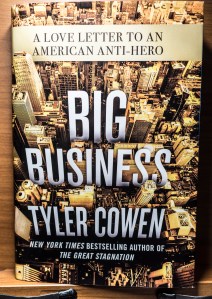
Big Business: A Love Letter to an American Anti-Hero — Tyler Cowen

The question underlying Big Business: A Love Letter to an American Anti-Hero is, “How can problems best be identified and solved?” (Although the book is much more interesting than my question may imply.) Sometimes individuals acting alone are the best agents; sometimes groups of individuals who agree to be lassoed together under a corporate aegis are the best agents (that is a long way of saying “business”); sometimes government(s) are the best agents, depending on the type, scale, and fixability of the problem(s). Many political arguments are essentially arguments that want to move problem domains or solutions from one of these classes to another.
Pages 22 – 23 deal with industries that exist despite selling products that, at the very least, likely don’t do what proponents say they will do—industries like dentistry, stockbrokers, sales reps, and food. The food industry is particularly notable, as a lot of food is what Michael Pollan calls “edible foodlike substances.” Another way of looking at those products, though, is that they’re selling hope or reassurance, and people like buying hope much more than they like buying evidence-backed products. Consumer Reports is not all that popular and their evaluations rarely if ever go viral. Perhaps most importantly, a lesson from industries Cowen cites, like dietary supplements, is that most people have bad epistemic hygiene—and, in most circumstances, don’t care about it. I spent much time attempting to teach undergraduates research strategies and how to evaluate claims and sources, and most of the time I wasn’t very successful. It took too long for me to realize that, rather than start with peer review, publication reliability, and that kind of thing, I need to start with a question: “How do you know what you know?” From there, it’s possible to build out towards epistemic hygiene, but the overwhelming majority of students seemed not to give a shit, and, indeed, if you go around asking normal people questions like, “How do you know what you know?” they will at best look at you strangely and at worst leave to talk to someone else about fun topics—at least, I speculate that that may happen.

Human rationality is often not that strong, and we like to give ourselves reasons for our failures while castigating others for theirs. People working in businesses are often engaging in similar activities and ways of arguing.

“How do you know what you know?” is a context question, and Cowen is a great expert in context. He asks us to “step back and consider what standard we are measuring business against. The propensity of business to commit fraud is essentially just an extension of the propensity of people to commit fraud.” The problem is mostly within us, rather than in the specific structures of business.

The chapter “Is Work Fun?” resonates:

I am not trying to whitewash the burdens of the workday and the workplace. Nonetheless, a lot of the other evidence points us toward the more positive side of work. Work provides us with a lot of what we value in life, including affirmation of our social worth, a structure for problem solving combined with rewards, and an important source of social interactions [. . .]

Yet we can rarely say as much in public or among our friends. Why not?

This paragraph is also characteristic of Cowen’s thought, where words like “but” and “nonetheless” play key roles. He’s really trying to get us to rejigger our levels. The “burdens” are real, but so are the benefits, even if those aren’t emphasized. Cowen is great at connecting ideas that are underemphasized and not often foregrounded. Chapter 9 asks us, “If Business Is So Good, Why Is It So Disliked?” Many possible answers are advanced. I will add one that I didn’t see or that I missed: it is easier to blame abstract “business” than ourselves.

I want to quote the book’s last sentence and paragraph but would prefer you to experience it after reading all of Big Business.

One chapter discusses tech companies; many of the criticisms against tech companies are misguided, as you’ve read here. More vitally, I see those criticisms as really being criticisms of individual people. If we, collectively, wanted to, we could all switch to DuckDuckGo for search—a boon for privacy—and many of us could be using Linux as a primary desktop operating system, especially today, when so much software is delivered via the browser. Dell offers high-quality Linux laptops, and using Linux is probably an improvement for privacy; homing beacons and tracking seem much less prevalent in open-source software. Yet most of us—including me when it comes to Linux—don’t choose the privacy-focused option. We don’t choose free software. We choose convenience. Is that the fault of tech companies or individual choices? To me, it looks a lot like we see the faults of tech companies when we look in the mirror in the morning. The number of people who really care about freedom, broadly defined, seems to be small, and far smaller than the number of people who say they care about freedom. Most people want convenience more than freedom or privacy, just as most people want junk food more than they want physical health. To return to my photography examples, most people want greater sharing convenience than the best image quality or artistic effect.

It’s possible to imagine an even more pro-business book than this one; a company like Amazon is amazing, for example, in that what I order, almost always shows up, and it’s convenient too. Contrast that with the many dealings I’ve had lately with New York’s tax office; I could go into detail, but the reader would likely want to stab their eyes out, as I have often wanted to do.

Cowen touches on alternatives to for-corporations:

Another possible way to test the honesty of business would be to compare nonprofit and for-profit organizations. If you think profits induce corruption, you might then conclude that nonprofits should be especially trustworthy. The evidence, however, will show that for-profits and nonprofits, at least if we are comparing enterprises in the same basic economic sector, usually operate in pretty similar ways.

This has been my experience; it’s also apparent to me, having worked for nonprofits for years, that nonprofits are much more like businesses than most people realize. I’ve also spent a lot of time working in and around universities, and they are the ultimate businesses: just try taking classes for grades if you can’t pay tuition. Try returning a low-value, high-cost degree. For a while I’ve been advancing the argument that many parts of the university system are self-interested (and sometimes just bad) actors that have great marketing skills. Most people react to that argument skeptically, but as evidence of student loan burdens grows, the skeptical reaction seems to be declining.

I’m not against nonprofits and the best ones are very important. The science research function at most universities still works fairly well, despite having some well-known incentive problems. The gap between university-in-theory and university-in-practice, though, remains wide, and most universities don’t want to publicize some obvious truths—like the idea that not everyone should go, or that not everyone has the conscientious and IQ necessary to thrive in an academic setting.

Among nonprofits, one possible purpose of the grant system is to keep nonprofits both honest and effective. It is possible to be honest without being particularly effective, and vice-versa. Ideally one wants both. Few of us do both perfectly, despite the way we often demand that others do both perfectly.

One chapter asks whether CEOs are paid too much: Cowen mostly says no, they’re not, and he cites a lot of empirical evidence on the subject. But he also says, “it’s hard to find someone who can both run the day-to-day operations of a company and do these other things [like social media and PR, communication, Congressional and other testimony].” I wonder if it’s really hard to find people who can do those things, or if there’s a kind of weird selection and vetting process going on through which only a small number of people are considered by the relevant people, and thus the number seems smaller than it is because those doing the selecting won’t broaden their search criteria. Think of it as the CEO equivalent of companies that only want to hire from certain schools that reject as many qualified applicants as they admit. I also wonder what level of compensation, if any, is necessary for satiation: many CEOs seem to reach, and to have reached, that level long before. Can we shift from money to some other yardstick? If so, how?

Is the business world changing faster than it used to? If so, is agility more important than it used to be? Many businesses may not be “set it and forget it” anymore (if they ever were). My personal favorite example is camera companies: standalone camera shipments have been dropping for the last six years, and the response of photo company CEOs has mostly been to shrug. No companies have made substantial efforts towards making their camera bodies into smartphones combined with superior image sensors. As a result, Apple and Google have come to dominate the imaging and video worlds, while camera makers seem to lack the agility necessary to compete. In many consumer industries, competition seems to be increasing; to cite another example I’m familiar with, large bike companies like Trek are facing a host of Internet startups like State, Priority, and numerous others that source direct from China and Taiwan. Innovators in electric bikes have not been the biggest companies. Low agility may result in eroding market share and profits. The future is happening and it doesn’t seem to be happening evenly, to everyone.

The modesty of many Big Business claims stand out: “[CEO pay in the aggregate] could be better, but it works much more effectively than many people think.” “Much more effectively than many people think” could still be not all that effective; in this and in many other sections, Cowen is trying to move the needle a bit. He’s describing situations with a large number of potential analogue, intermediary places, and in this he’s moving against the modern Twitter tendency to see things as binary: good or bad, zero or one, shit or brilliant. Most of things in the most of the world are in this intermediary space, including all humans, however virtuous all Twitters may portray themselves to be (in contrast to their vile enemies).

Big Business is much more story-based than one might expect from Cowen, who argues that we should be more suspicious of simple stories. Fortunately, Big Business is not a simple book.

As with all the Cowen books I’ve read, there’s much to think about and much more I could write here; he is very good at finding the space where “rarely argued/articulated” and “possibly correct” intersect. Common arguments and ideas are common, and incorrect or ridiculous ideas are common, but finding the Cowen quadrant is too rare. I sometimes worry that my own ideas are too common to be worth repeating. Finding ones that hit the Cowen quadrant is satisfying, like a deadlift PR.

The world is filled with problems and our goal as humans is to solve them until we die. We very rarely see life formulated in that way, but maybe we should say this explicitly more often. “What problems have you solved recently?” may be a more valuable question than, “What do you believe?”
Links: Free speech, free persons, smart is not enough, biking is fun, and more!

* “Unpopular Speech in a Cold Climate.” It’s like we have to learn all over again why we have free speech, the right to be represented by an attorney, etc.

* “Gwern’s AI-Generated Poetry.” I wonder how many people would be able to pick out “real” poems compared to AI-generated poems. I’m not sure I always can.

* How to Create Reality: “So a funny thing happened on Twitter this week, which almost changed the world a little bit. Someone sent me a beautiful 3-D mockup of a fictional, car-free city of 50,000 people, set in the scenic nook of land* between Boulder, Colorado and Longmont, where I live.”

* “Science, Small Groups, and Stochasticity.” In short, we are doing the structure of science wrong.

* “Defense Disaster: Russia and China are Crushing the U.S. Military in War Games.” Are we still fighting the last war?

* U.S. Firms Are Helping Build China’s Orwellian State.

* “The Art of Being Single,” a depressing article that is congruent with Lost Connections.

* A Big Little Idea Called Legibility. A great essay.

* “Nihilist in Chief: The banal, evil, all-destructive reign of Mitch McConnell.” He is the truest villain in modern politics, yet no one seems to notice. Also, “How Not to Lose to Donald Trump.” Lessons the left may not have learned.

* “Smart Is Not Enough: What Marc Benioff Taught Me When I Was 15 Years Old.”

* Owning a Car Will Soon Be as Quaint as Owning a Horse? I’m less optimistic, but the analogies are interesting.

* Writing Sex for Money is Hard F*cking Work.

* Funny screed against Bret Easton Ellis’s recent book, although it sounds like the reviewer is doing many of the same things Ellis is doing. Pot, kettle, black, and all that. I’m also not a fan of attacking writers based on demographic categories, though that seems to be on the rise.

* “Vitalik Buterin Is Embracing a New Role: Political Theorist.” There are either details missing in this story or I’m not fully getting it.

* “Write of Passage, a new online course on how to accelerate your career by writing online.”

* US cities need to learn from Copenhagen, stat. Likelihood of this happening? Low.

* “The corporations devouring American colleges.” Based on a decade working in them, I’d observe that colleges are businesses with extremely good PR and marketing arms.

Links: The cost of construction, writing really long fiction, computerized farms, and more!

* Why American Costs Are So High.

* “What’s Left of the Center-Left?” Depressing. Also depressing, Clinton-era centrist Democrat Brad DeLong explains why the center-left is dead.

* Charlie Stross: Lessons learned: writing really long fiction.

* “What if All the World’s Economic Woes Are Part of the Same Problem?“, and that problem is demographic: an aging workforce is less innovative, takes fewer risks, and is more sclerotic overall.

* “Leaked Documents Show the U.S. Tracking Journalists Through a Secret Database.” How is this the country we’ve ended up living in?

* “Why Do People Love to Hate Steven Pinker? By proclaiming the gospel of human progress, the Harvard psychologist has made a lot of enemies.” I see a lot of straw-manning Pinker and almost no steel-manning of him.

* “Progressivism and the West;” we are our own worst enemies!

* “This is Roquette Science: How computerized arugula (aka roquette) farms take over the world.”

* But at least one random writer thinks Biden will win, which sounds like a good, electable outcome to me.

* An essay against Taleb’s Antifragile.

* “The Industrial Revolution of Shame.” Does this enhance rewards to shamelessness?

* On the new translation of The Odyssey.

* Attraction Inequality and the Dating Economy.

* “US to build six nuclear power plants in India.” Total comedy given the seeming inability of the US to build nuclear power plants in the US.

The college bribery scandal vs. Lambda School

Many of you have seen the news, but, while the bribery scandal is sucking up all the attention in the media, Lambda School is offering a $2,000/month living stipend to some students and Western Governors University is continuing to quietly grow. The Lambda School story is a useful juxtaposition with the college-bribery scandal. Tyler Cowen has a good piece on the bribery scandal (although to me the scandal looks pretty much like business-as-usual among colleges, which are wrapped up in mimetic rivalry, rather than a scandal as such, unless the definition of a scandal is “when someone accidentally tells the truth”):

Many wealthy Americans perceive higher education to be an ethics-free, law-free zone where the only restraint on your behavior is whatever you can get away with.

This may be an overly cynical take, but to what extent do universities act like ethics-free, law-free zones? They accept students (and their student loan payments) who are unlikely to matriculate; they have no skin in the game regarding student loans; insiders understand the “paying for the party” phenomenon, while outsiders don’t; too frequently, universities don’t seem to defend free speech or inquiry. In short, many universities are exploiting information asymmetries between them and their students and those students’s parents—especially the weakest and worst-informed students. Discrimination against Asians in admissions is common at some schools and is another open secret, albeit less secret than it once was. When you realize what colleges are doing to students and their families, why is it a surprise when students and their families reciprocate?

To be sure, this is not true of all universities, not all the time, not all parts of all universities, so maybe I am just too close to the sausage factory. But I see a whole lot of bad behavior, even when most of the individual actors are well-meaning. Colleges have evolved in a curious set of directions, and no one attempting to design a system from scratch would choose what we have now. That is not a reason to imagine some kind of perfect world, but it is worth asking how we might evolve out of the current system, despite the many barriers to doing so. We’re also not seeing employers search for alternate credentialing sources, at least from what I can ascertain.

See also “I Was a College Admissions Officer. This Is What I Saw.” In a social media age, why are we not seeing more of these pieces? (EDIT: Maybe we are? This is another one, scalding and also congruent with my experiences.) Overall, I think colleges are really, really good at marketing, and arguably marketing is their core competency. A really good marketer, however, can convince you that marketing is not their core competency.

Links: Breakthrough technologies, breaking technology habits, the nature of language, and more!

* How one guy ditched his phone and unbroke his brain.

* America’s Professional Elite: Wealthy, Successful and Miserable. Maybe.

* “Better babblers.” This rings true:

After eighteen years of being a professor, I’ve graded many student essays. And while I usually try to teach a deep structure of concepts, what the median student actually learns seems to mostly be a set of low order correlations. They know what words to use, which words tend to go together, which combinations tend to have positive associations, and so on. But if you ask an exam question where the deep structure answer differs from answer you’d guess looking at low order correlations, most students usually give the wrong answer.

* Related to the above, “Humans Who Are Not Concentrating Are Not General Intelligences.” This may argue for more in-depth books and articles and less Twitter.

* Thoughts on pre-Facebook, pre-Twitter Internet culture.

* “University of California system terminates subscriptions with world’s largest scientific publisher in push for open access to publicly funded research.” Unabashedly good news.

* The New ‘Dream Home’ Should Be a Condo. An obvious point to regular readers, but here it is.

* Money Out of Nowhere: How Internet Marketplaces Unlock Economic Wealth.

* “‘Men Are Scum’: Inside Facebook’s War on Hate Speech.” Some of the framing is bad but the overall article is far superior to most of its type.

* “A Radically Moderate Answer to Climate Change.” You may be getting tired of reading about nuclear power, yet we still seem as a culture not to be paying attention to it. See also “Nuclear goes retro — with a much greener outlook.” By the way, Vacant-land mythology impedes serious energy discussions, so renewables are not a panacea.

* “‘Do you ever think about me?’: the children sex tourists leave behind.” Brutal, fascinating.

* “The Era of Limited Government Is Over.” This is bad news even for people who favor greater government control.

* “Alexandria Ocasio-Cortez’s chief of staff ran $1M slush fund by diverting campaign cash to his own companies.” The greater the purity facade, the more entertaining the fall.

* “Arizona State University: From party school to global brand.” The story is poorly organized but despite that, there are interesting nuggets throughout. The story’s quality and venue may also indicate why people interested in ideas migrated away from most newspapers.

* “Markets Aren’t Buying Denial on Climate Change: Investors who put money at risk behave as if it’s not a hoax.”

* 10 Breakthrough Technologies 2019, curated by Bill Gates.

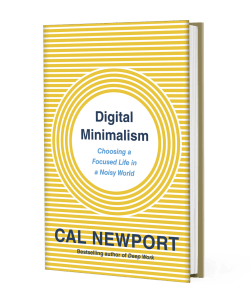
Digital Minimalism — Cal Newport

All of Cal Newport’s books could be titled, “How to Be an Effective Person.” Or, maybe, “How to Be an Effective Person In This Technological Epoch.” Digital Minimalism is, like Deep Work: Rules for Focused Success in a Distracted World, about why you should quit or drastically limit the digital distractions that have proliferated in much of modern life. To me, it seemed obviously necessary to do so a long time ago, so there’s a large component of preaching-to-the-choir in me reading and now recommending this book. I’m barely on Facebook or most other social networks, which seem anathema to doing anything substantive or important.

A story. A friend sent me an email about Newport’s article “Is email making professors stupid?” I told him that, even in grad school, I’d figured out the problems with email and checked it, typically, once per day—sometimes every other day. The other grad students were in awe of that (low?) rate. I was like, “How do you get any writing done otherwise?” I leave it as an exercise to the reader to square this circle. You may notice that some of my novels are out there and their novels are not.

In my experience, too, most profs actually like the distraction, the work-like feeling without having to do the hard part. In reality, it is not at all hard to open your email every other day and spent 90%+ of your time focused on your work. If you don’t do this, then, as Newport says, “The urge to check Twitter or refresh Reddit becomes a nervous twitch that shatters uninterrupted time into shards too small to support the presence necessary for an intentional life.” And yet many of us, as measured by data, do just that. I buy many of Newport’s arguments while also being skeptical that we’ll see large-scale change. Yet we should seek individual change; many of the online systems are psychologically bad for us:

The techno-philosopher Jaron Lanier convincingly argues that the primacy of anger and outrage outline is, in some sense, an unavoidable feature of the medium: In an open marketplace for attention, darker emotions attract more eyeballs that positive and constructive thoughts. For heavy Internet users, repeated interaction with this darkness can become a source of draining negativity—a steep price that many don’t even realize they’re paying to support their compulsive connectivity.

Is “the primacy of anger and outrage” really “an unavoidable feature?” I like to think not; I like to think that I try to avoid anger and outrage, making those tertiary features at best, and instead I try to focus on ideas and thinking. So I like to think that I’m avoiding those things.

Still, compulsive connectivity online may also be costing us offline, real-world connection. That’s a point in Johann Hari’s book Lost Connections: Uncovering the Real Causes of Depression, which you should also read.

The book describes how modern social media systems and apps exploit our desire for random or intermittent positive reinforcement. Because we don’t know what we’re going to get anytime we boot up Twitter or similar, we want to visit those sites more often. We lose perspective on what’s more important—finishing a vital long-term project or checking for whatever the news of the day might be, however trivial. Or seeing random thoughts from our friends. Newport doesn’t argue that we shouldn’t have friends or that social networking systems don’t have some value—he just points out that we can derive a huge amount of the value from a tiny amount of time (“minimalists don’t mind missing out on small things; what worries them more more is diminishing the large things they already know for sure make life good”). But our “drive for social approval” often encourages us to stay superficially connected, instead of deeply connected.

In the book, we also get visits to the Amish, suggestions we take a 30-day break from digital bullshit, and case studies from Newport’s readers. I don’t think “Solitude and Leadership” is cited, but it might as well have been.

Another version of this book might be, “opportunity costs matter.” If there’s anything missing, it’s a deeper exploration of why, if many digital social media tools are bad for us, we persist using them—and what our use may say about us. Perhaps revealed preferences show that most of us don’t give a damn about the intentional life. Probably we never have. Maybe we never will. Arguably, history is a long drive towards greater connectivity, and, if this trend is centuries, maybe millennia, old, we can expect it to continue. Many older religious figures worried deeply that technologies would take people away from their religious communities and from God, and those figures were actually right. Few of us, however, want to go back.

For a book about craft and living an intentional life, the paper quality of this book is oddly bad.