You may have been fooled by the New Yorker profile of Sally Rooney, as I was, but don’t be: Conversations with Friends is boring—there’s nothing horribly wrong with it but little right with it either. There is some juvenile BS on almost every page; if you haven’t read the books listed here quit this review now and go pick up some of. It’s hard to find representative sentences in Conversations because they’re all representative, and flat: “He never usually trailed off his sentences this way. He started to feel agitated. I said again I didn’t mean to be distant with him. I didn’t understand what he was trying to say and I was afraid of what it might have been.” We get pages and pages like this. Also: “never usually?” Or, “I felt his body then, his heat and complex weight.” Complex weight? As opposed to simple weight?
The book is about a girl’s affair with a married man, and she kinda sorta tries polyamory lite, but without thinking much about it or having any social or community structure for it. Conversations a “kinda sorta” sort of book, which is why it’s so unsatisfying. The sentences are short and it’s easy to skip sentences, paragraphs, pages, without losing anything. Still, Conversations gives hope to unpublished writers, because if it can get published and pushed, you might be able to too.
I want the protagonist to get a job on a fishing boat, or building rockets for SpaceX, or working in an emergency room, or doing anything, anywhere, apart from interning for literary agents and spending too much time listening to professors or living in libraries. There is a world beyond university humanities departments, thankfully, but it is opaque to Frances and her friends. Conversations are fine, but conversations among people with no goals, no dreams, and no purpose lead one to wonder why they aren’t short stories.
Not every book needs to challenge and this one doesn’t. It’s the literary equivalent of an anodyne meal at a “new American” restaurant that does the same thing thousands of similar establishments do. It won’t offend or wow anyone. If this is the “millennial novel,” we have nothing to fear but our own emptiness, and the social media we use to try and stuff the emptiness into some shape. But you could do worse; I read to the end but am also trying not to do the classic bad critic move of generalizing from specific individuals to much larger groups. If I were to do that, I would draw much different sociological or demographic conclusions than have others I’ve read. So much art really is read as simply confirming our priors.
* “Our Planet May Be Barreling Toward a Tipping Point.” In the meantime, we can’t even execute climate-friendly strategies like removing urban height limits and parking minimums, or building low-emission nuclear power plants.
* Roth/Updike, in case you want to hear more about the topic; both of them have under-plotted books, and the lack of plot makes their work less interesting. I’ve read lots by both, but little sticks. I kept wanting them to get to a point, but the point never arrived. Both are best in shorter works, where lack of plot drags less.
This guy was wrongly and somewhat insanely accused of sexual impropriety by two neo-puritans; stories about individual injustice can be interesting, but this one seems like an embodiment of a larger trend, and, although the story is long and some of the author’s assumptions are dubious, I think there’s a different, conceivably better, takeaway than the one implied: don’t go into academia (at least the humanities) or journalism. Both fields are fiercely, insanely combative for very small amounts of money; because the money is so bad, many people get or stay in them for non-monetary ideological reasons, almost the way priests, pastors, or other religious figures used to choose low incomes and high purpose (or “purpose” if we’re feeling cynical). Not only that, but clerics often know the answer to the question before the question has even been asked, and they don’t need free inquiry because the answers are already available—attributes that are very bad, yet seem to be increasingly common, in journalism and academia.
Obviously journalism and academia have never been great fields for getting rich, but the business model for both has fallen apart in the last 20 years. The people willing to tolerate the low pay and awful conditions must have other motives (a few are independently wealthy) to go into them. I’m not arguing that other motives have never existed, but today you’d have to be absurdly committed to those other motives. That there are new secular religions is not an observation original to me, but once I heard that idea a lot of other strange-seeming things about modern culture clicked into place. Low pay, low status, and low prestige occupations must do something for the people who go into them.
Once an individual enters the highly mimetic and extremely ideological space, he becomes a good target for destruction—and makes a good scapegoat for anyone who is not getting the money or recognition they think they deserve. Or for anyone who is simply angry or feels ill-used. The people who are robust or anti-fragile stay out of this space.
Meanwhile, less ideological and much wealthier professions may not have been, or be, immune from the cultural psychosis in a few media and academic fields, but they’re much less susceptible to mimetic contagions and ripping-downs. The people in them have greater incomes and resources. They have a greater sense of doing something in the world that is not primarily intellectual, and thus probably not primarily mimetic and ideological.
There’s a personal dimension to these observations, because I was attracted to both journalism and academia, but the former has shed at least half its jobs over the last two decades and the latter became untenable post-2008. I’ve enough interaction with both fields to get the cultural tenor of them, and smart people largely choose more lucrative and less crazy industries. Like many people attracted to journalism, I read books like All the President’s Men in high school and wanted to model Woodward and Bernstein. But almost no reporters today are like Woodward and Bernstein. They’re more likely to be writing Buzzfeed clickbait, and nothing generates more clicks than outrage. Smart people interested in journalism can do a minimal amount of research and realize that the field is oversubscribed and should be avoided.
When I hear students say they’re majoring in journalism, I look at them cockeyed, regardless of gender; there’s fierce competition coupled with few rewards. The journalism industry has evolved to take advantage of youthful idealism, much like fashion, publishing, film, and a few other industries. Perhaps that is why these industries attract so many writers to insider satires: the gap between idealistic expectation and cynical reality is very wide.
Even if thousands of people read this and follow its advice, thousands more persons will keep attempting to claw their way into journalism or academia. It is an unwise move. We have people like David Graeber buying into the innuendo and career attack culture. Smart people look at this and do something else, something where a random smear is less likely to cost an entire career.
We’re in the midst of a new-puritan revival and yet large parts of the media ecosystem are ignoring this idea, often because they’re part of it.
It is grimly funny to have read the first story linked next to a piece that quotes Solzhenitsyn: “To do evil a human being must first of all believe that what he’s doing is good, or else that it’s a well-considered act in conformity with natural law. . . . it is in the nature of a human being to seek a justification for his actions.” Ideology is back, and destruction is easier the construction. Our cultural immune system seems to have failed to figure this out, yet. Short-form social media like Facebook and Twitter arguably encourage black and white thinking, because there’s not enough space to develop nuance. There is enough space, however, to say that the bad guy is right over there, and we should go attack that bad guy for whatever thought crimes or wrongthink they may have committed.
Ideally, academics and journalists come to a given situation or set of facts and don’t know the answer in advance. In an ideal world, they try to figure out what’s true and why. “Ideal” is repeated twice because, historically, departures from the ideal is common, but having ideological neutrality and an investigatory posture is preferable to knowing the answer in advance and judging people based on demographic characteristics and prearranged prejudices, yet those traits seem to have seeped into the academic and journalistic cultures.
Combine this with present-day youth culture that equates feelings with facts and felt harm with real harm, and you get a pretty toxic stew—”toxic” being a favorite word of the new clerics. See further, America’s New Sex Bureaucracy. If you feel it’s wrong, it must be wrong, and probably illegal; if you feel it’s right, it must be right, and therefore desirable. This kind of thinking has generated some backlash, but not enough to save some of the demographic undesirables who wander into the kill zone of journalism or academia. Meanwhile, loneliness seems to be more acute than ever, and we’re stuck wondering why.
* “Here’s the weird thing about a post-Christian Christendom.” That’s WEIRD as in Western, Educated, Industrialized, Rich, and Democratic. We’re quite different than most people have been, ever, and we’re not properly appreciating it, or how differently we’ve been acculturated.
* “How the Insufferably Woke Help Trump: Democrats are insulting and condescending to the swing-state voters they need the most.” More of the obvious, yet here we are.
* Christianity has some aspects that are good that we don’t give it credit for. And, if you take the Christianity out of the American political right, you might be left with something closer to authoritarianism and ethno-nationalism, both of which are much worse than Christianity. By the way, I didn’t see this development coming either, and almost no one did.
* Apple engages in planned obsolescence. Apple also just released a 16″ Macbook Pro, for those of you in the market for such things, and it has a functional keyboard again.
* “Sometimes, Straussians hide truths in plain sight. When they do, they’re concealed in unpopular characters, such as devils, beggars, and buffoons. Pseudonymous Twitter accounts are the new Straussian philosophers, but with one important twist. Instead of sharing their names and hiding the truth, today’s Straussians hide their names, but share the truth.”
* “An online tool that can break political deadlock.” Seems optimistic to me and I think most people screaming online like political hatred and rancor. Most normal people don’t do a lot of Twitter or political Facebook. I tend to like people more, the less I see of them on Facebook, and for that reason I want to stay away from Facebook.
* “The death of the great cultural critic.” I also observe that many great cultural critics were caught up with grad schools in various ways that now seem pretty implausible.
* Two form of despair, in case you haven’t yet read enough academia quit-lit. I have, but I thought I’d pass this along for those of you who still like the genre. This one has some unusual religious infusion.
* “Every Child Can Become a Lover of Books.” The series starts with a note on how “In the next five years, most of America’s most experienced teachers will retire. The Baby Boomers are leaving behind a nation of more novice educators. In 1988, a teacher most commonly had 15 years of experience. Less than three decades later, that number had fallen to just three years leading a classroom.” But the word “zoning” never appears; in many cities and first-tier suburbs, outrageous land-use laws drive up the cost of housing and make it impractical for teachers to live a normal financial existence. There are undoubtedly many reasons teachers leave, but the financial climate is one, and it’s one we can’t easily buy our way out of—but we sure can reform land-use laws.
* “Apple’s new Catalina operating system won’t run old versions of Word.” We have been thinking about migrating off Macs at some point; Windows seems to be better than it used to be, and Windows laptops were almost universally terrible ten years ago. Today, the Dell XPS line and Microsoft’s Surfaces both look really nice. Many of the “Just works” aspects of OS X (or, today, MacOS) seem to have declined or disappeared.
* A long piece on Facebook and its dilemmas, that conveniently forgets the role of the media in the 2016 election (remember those thousands of “Clinton email” stories?).
It disregards what we would like to say, and be, and appear to be. Tolstoy complained that with Anna Karenina, he sat down to write a condemnatory tale about a woman incapable of self-restraint but that she herself would not permit it. She demanded the more difficult, socially unacceptable and errantly human truth about herself be heard instead. Luckily Tolstoy’s talent proved equal to the challenge and knew he had to follow where she led.
This is why the novel matters, why it always has and why, in dark times, it matters more than in cheerier ones. By its nature the novel cannot be a rush of lights and pictures and noise.
If a tree falls in a forest, does it make a sound? If so few people read novels, do they “matter” in a larger, global,
The teacher pay gap is a myth? Maybe. This one has a different spin than the typical unthinking “teachers are underpaid” articles (it argues they’re not, and yes there is data to support the assertion), which is why I point to it specifically, but I think both sides are underestimating an important point about flexibility and possibility in any given career; teaching has a relatively low pay ceiling and even if a given teacher wants to work twice as hard and make twice as much money, that’s really difficult and potentially impossible. High IQ and high conscientiousness persons in other professions, meanwhile, can maximize incomes to a much greater extent than teachers. For example, as a consultant there are various avenues I can explore to further raise my income, but if I taught high school I couldn’t. In big metro areas, too, there are also many more employers to choose from than most teachers can choose from, since there’s usually one district, or a handful in nearby areas; at the same time, high rents in many superstar cities make teaching less attractive, so the “teacher pay” story is also a story about land-use regulations that raise the cost of housing—it’s just never discussed in those terms.
Teaching has other challenges: bureaucracy is a real problem and so is low morale, perhaps related to bureaucracy. In most sectors, if you don’t like the bureaucracy at one company you can switch to another, but this is considerably harder for teachers, since most districts are local monopolies. Financial returns to IQ also seem to be going up and at the same time we’re making housing in many cities and first-tier suburbs out-of-control expensive—so teachers are really taking it financially, from both the cost-of-living side and from the payment side. I have heard through the grapevine, for example, that pretty much every new public school teacher in Seattle says the same thing about how she got there: “My husband got a job at Amazon and…” That’s no doubt an exaggeration, but how much of one?
To use myself as an example, my parents moved from California to a boring suburb when I was a kid, and they left California because the cost of housing was so high. I checked how much they paid for the house in the boring suburb; in inflation-adjusted terms, they paid about $350,000 in today’s dollars. The same house is estimated to be worth about $700,000 today, so the cost has just about doubled in real terms, but that suburb forbids townhouses in the vast majority of its land, so no one can buy the house, knock it down, and put two houses on the same lot. If that were legal, we’d not have the housing crisis we do in many high-productivity cities and their suburbs. If we could lower the overall cost of living, struggles around teacher pay would seem less dire. Oregon, for example, has legalized duplexes and fourplexes statewide, so it will offer a natural experiment in lowering housing costs.
Let’s return to the original link:
shortages exist precisely where expected in a nationwide labor market that pays an increasing premium for STEM and other specialized skills. When researchers have examined the teaching vacancies that districts say they have trouble filling, they find that elementary, English, and social-studies teachers are not the problem. In fact, the Department of Education found that 20 states and the District of Columbia produced over twice as many elementary-education graduates as they had elementary-teaching positions to fill. At the same time, some districts struggle to fill STEM and special-education positions.
It’s hard to measure teacher “productivity” and yet almost no one bothers trying. So the most productive teachers are incentivized to move somewhere they can be paid in line with their productivity, which can’t be at most schools. Talk about an adverse selection problem! We have problems in data and definitions in both health care and teaching; rarely have two fields absorbed so much concentrated thought and produced so little change. The data and definition problems make it much harder to evaluate quality, inputs, and outputs than in other fields, especially those related to manufacturing. In most businesses, a major goal is simple (profit) and measurement is comparatively simple. The output of high-quality teaching may not manifest itself for decades, and very little of the value improvement is captured by the educator. By contrast, if you build a better widget, there’s a decent chance you’ll be able to capture more of the widget value beyond the cost of production.
Because we’re not measuring, or able to measure, teacher quality effectively, most schools also seem to pay based on years of experience. Anecdotally, I’ve been told that it can be very hard to get hired by another public school after 10 – 15 years of experience, because then you’re too expensive and most schools would rather hire cheaper teachers. So this is another way of ossifying the labor market.
There’s also a narrative about teachers working a lot of hours per week, but Bureau of Labor Statistics data consistently show that teachers work 40 hours a week. One example, although I have seen many other similar ones. Anecdotes consistently run one way, and data consistently runs another.
Overall, however, it seems that the number of people trying to have a completely honest conversation around this topic is not high, and many who argue that we should pay teachers “more” don’t know what “more” looks like. We may also see lots of composition effect problems, in which people who can get higher wages or better working conditions leave and get them, while those who can’t stay at school districts and take what they can get, which is at least consistent with some of the teachers I had in high school, but that may not be desirable at the societal level.
* Patricia Lockwood on John Updike, which is much better than I thought it’d be (like Updike she does great sentences), and the title, “Malfunctioning Sex Robot: Updike Redux” is funny too. But there’s still too much air-of-superiority-don’t-we-all-agree-about-everything.
* “Three decades ago, Americans lost religion. Why?” The short-term political expediency of twining one political party with religion may have bad long-term consequences. We also seem to have taken up new religions—a common theme on this blog.
* Research and “gender wars.” I don’t think most of the rhetoric has anything to do with facts or research; it’s mostly tribal and value signaling, so I’m not real optimistic on this one. When an issue takes on tribal valence, quality of discourse and thinking tends to decline.
* “The Atavism of Cancel Culture: Its social rewards are immediate and gratifying, its dangers distant and abstract.” Another of these, “And we somehow like this?” articles.
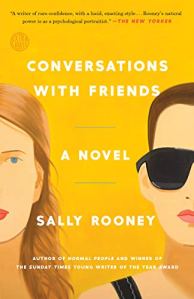 The book is about a girl’s affair with a married man, and she kinda sorta tries polyamory lite, but without thinking much about it or having any social or community structure for it. Conversations a “kinda sorta” sort of book, which is why it’s so unsatisfying. The sentences are short and it’s easy to skip sentences, paragraphs, pages, without losing anything. Still, Conversations gives hope to unpublished writers, because if it can get published and pushed, you might be able to too.
 The Story's Story