Links: Geopolitical shakes, energy still matters, Robert Stone, and more!

* “Xi fears Japan-led manufacturing exodus from China: The year of the metal rat returns every 60 years — and brings calamity with it.”

* The Limits of Clean Energy.

* Higher education economic problems. Some of the framing and political jabs can and should be ignored, but the material points remain.

* Lockdown socialism will collapse. A good post and something too few of us are acknowledging. I think we’re also not admitting that we’re going to see a real standards-of-living reduction.

* The anti-Trump Republicans. We call these “the honest ones.”

* On Robert Stone.

* Gem Fatale, on the movie Uncut Gems. I started Uncut Gems but one of the protagonist’s early decisions seemed so foolish (giving that important item to Garnett, for example) that I quit. Too much shouting, too. Some good scenes. The author of the linked essay is Clancy Martin, who wrote How to Sell. Given Hollywood’s desire to make everything into a movie or TV show, I’m surprised no one has taken up How To Sell.

* We’ve Built Cities We Can’t Afford.

* “Build Cities for Bikes, Buses, and Feet–Not Cars.” Seems obvious. Few people who understand induced demand or the dangers of small particle air pollution believe otherwise.

* It’s time to build for good. Congruent with the above two links.

* 68 bits of advice from Kevin Kelly, who is unusually interesting.

Briefly noted: Inadvertent, Normal People, and Un-wifeable

* Inadvertent (Why I Write), by Karl Ove Knausgaard: Lots of subtle ideas in this one, and those ideas have been stated before, but they’re stated well here: “Literature is not primarily a place for truths, it is the space where truths play out. For the answer to the question —that I write because I am going to die – to have the intended effect, for it to strike one as truth, a space must first be created in which it can be said. That is what writing is: creating a space in which something can be said.” I’m not sure about the run-on in the first sentence, but the idea that literature not being about “truths” (plural), but about being “the space where truths play out” seems accurate: once you get away from the hard truths of math and physics, and get into the squishy contingent truths of jostling human societies, there isn’t “a” truth—there are a bunch of them, many rivalrous with one another, and part of art is the wrangling of those truths.

Finnegans Wake and Mallarmé are mentioned on one page (63), Game of Thrones (64) the next. Why does he keep watching? For emotional ideas, yes, but, also, “What we seek in art is meaning.” Are we seeking that in social media, too? Is Twitter art? Why or why not? The problem with talking about art is that it generates infinitely more talk about art. Or maybe that’s a solution. This book has lots of truths, or, if they’re not truths, idea-generating statements.

* Normal People, by Sally Rooney: It’s a much better book than the first one, Conversations with Friends

There’s much about social power in the novel—”If she wanted, she could make a big show of saying hello to Connell in school. See you this afternoon, she could say, in front of everyone. Undoubtedly it would put him in an awkward position, which is the kind of thing she usually seems to enjoy. But she has never done it,” but most of that social power goes unused. If the protagonists could care less about what other people, who they don’t care about, think of them, they’d get on quite well, but there’d also not be a novel. The bits observing adolescence are sharp, like “Marianne had the sense that her real life was happening somewhere very far away.” “Real life” gets mentioned four times. “Weird” gets used 32 times: there’s nothing worse in modern upwardly mobile life than being “weird,” it seems. I found myself drifting back to thoughts of Peter Thiel’s book Zero To One, where he speculates that part of the reason successful startup founders often are on or seem to be on the autism spectrum is because that enables them to ignore what other people think and pursue novel ideas other people make fun of. Learning to ignore other people might be a very useful skill in a massive, globally connected world where one can come into contacted with ignorant strangers constantly—including the ignorant strangers at school.

Normal People‘s climax—this is not giving anything substantial away—involves Connell getting into an MFA program, no doubt expensive, in New York. It’s like watching the student loan monster, holding a knife, creep up on the protagonist in a Stephen King: Connell is going to end up being 30, with a bunch of degrees but no assets or marketable skills, like many thousands of other “bright” people of his age and class. Somehow, I think this climax is supposed to be a triumph, rather than a tragedy. No one seems to understand that accumulating pricey degrees in one’s 20s is not necessarily a thing to aspire to. It was, maybe, 30 or 40 years ago, but the world has changed.

I read another novel, The Glass House, in which student loans are among the villains, and the student loans that plague so many people of my generation mirror the ponzi scheme propelling and perpetrated by Jonathan Alkaitis. That’s a more realistic depiction of the academic system. In The Glass House, Alkaitis’s job is fraud and Vincent’s job is sex work, although being a trophy wife is never quite described as such. They’re both good novels, but Normal People feels like a fairy tale—not because of love’s triumph, or maybe adulthood’s triumph but because of institutional arrangements, while The Glass House feels grittily real; student loans and attitudes towards schools are the key differentiators.

At the end of Normal People, Marianne is brushing the knots from her hair, but really she’s trying to brush the knots out of her life—which is probably impossible, but worth attempting.

* Un-wifeable by Mandy Stadtmiller: Being at the edges of the celebrity economy sounds really unpleasant—even being in the center doesn’t sound real pleasant. Lots of celebrities have said and written as much, but somehow it sinks in more here, when we’re seeing the sort of person who writes the pointlessly mean celebrity takedowns. The persons doing the takedowns have something poisonous in their own lives and souls, naturally, and Un-wifeable is, among other things, a chronicle of the poison. I have my problems, but next to Stadtmiller’s stories they seem minor.

Some of the lessons are obvious, like “getting drunk is also often bad, particularly around strangers who don’t wish you well.” And not only for Stadtmiller: “How many times have I said cruel things—including to my ex-husband—that I may not even remember because I was in a rage blackout? I need to turn everything around. I cannot continue this cycle of victimization.” One admirable part of this memoir is that Stadtmiller doesn’t primarily cast herself as a victim, which she could have; the temptation was probably there, but she resisted.

New York has no glamor in Un-wifeable, unless perhaps you recognize the various celebrities named. Stadtmiller finishes her decade or so in the city with tons of credit card debt and no family, although she doesn’t seem to want the former and does seem to want the latter. I don’t understand how Stadtmiller drinks as much as she does and writes, though, to be fair I don’t understand how Fitzgerald or Hemingway did either. Drinking and writing are incompatible for me.

A lot of Stadtmiller’s stories are about the downsides of no boundaries. People, and especially children, need boundaries and connections. Stadtmiller lacks the former and that impedes the latter. Her parents are unconventional, to the point that they’ve “studied at the Esalen Institute, birthplace of the human potential movement,” like characters in a Houellebecq novel. Did you read “A Bellow From France” carefully? Have you read Houellebecq? Stadtmiller is a female Houellebecq character, except that instead of giving up and shrugging, she still cares and is struggling against herself (“The column affords me the perfect way to superficially seek love while never exploring the more difficult questions about what true love for oneself and others really takes.”) As a culture, I don’t think we want to explore “the more difficult questions.” I don’t, mostly.

One takeaway might be, “Don’t move to New York if marriage and family are important to you.” Obviously people in New York get married and have families, but the city is not geared for that, and Stadtmiller is pushing against the hardest gear to get herself uphill. Ideally one chooses to do a hard thing the easiest one way can, rather than attempting to do a hard thing made harder by environment.

What’s happening in the hospitals?

And not just in the emergency rooms and intensive care units:

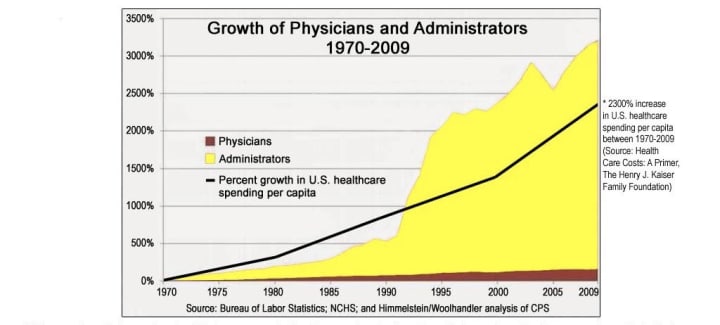
Doctors learn the business of the body, not the business of medicine. But modern health care is an industry with a bottom line measured in dollars, not wellness. As we train, we’re told to “stay in our lane”—an important lane, to be sure—and just worry about being good healers. The rest, the pesky business of how the wheel turns, can be managed by the rapidly expanding pool of administrators. In “staying in our lane,” we don’t feel the insidious ways the business of medicine has eroded the value of the doctor-patient relationship. Instead, patients have become a commodity and physicians a cog. We’re blind to the chaos and danger around us. We might note how focused administrators are on metrics of efficiency and patient satisfaction scores, even if efficiency doesn’t mean quality, and higher patient satisfaction scores are linked to higher overall mortality rate. But we’re hired to provide the services approved by the hospital, and insurers, which is frequently not to our own standards of patient care.

I see this dynamic continuing in the midst of the COVID crisis. As hospitals and politicians continue calling for help in public, the rhetoric has been that there are too few doctors to manage the crisis. They said this even as doctors were fired or told to leave midshift for wearing their own protective equipment. Colleagues who were pointing out dangerous practices for both employees and patients were asked or pressured into leaving. Colleagues who were lower risk and looking for fairly paid work were passed over because other health care workers—who were made to believe there were no other doctors available to work—were being brought in as unpaid labor. They were told there was no money to be found, despite high reported revenues and administrative salaries in the multimillions.

Much more at the link; look for the April 17 entry, which is the most substantive part.

Links: History of computing companies, marginalia, Orwell, demographics, computers, and more!

* Compaq and coronavirus.

* On writing in books, which has a great opening: “If a new book is a monologue, a used book is a conversation. Underline a passage or write a note in the margin and you have left a message for future readers, or for future versions of yourself.”

* Orwell: The cant hunter. Genuinely independent thought seems to have been rare then and still seems to be rare today.

* The trials of Sarah Longwell, a never-Trump Republican. I admire her tenacity. See also the link immediately above about the rarity of independent thought.

* Everything you wear is athleisure?

* Aging and the Demographic Transition. Underpopulation is likely the real challenge going forward, not overpopulation.

* New Macbook Air is a fine, good, and boring update. The price drop is nice.

* “The endless hunt for the perfect flu vaccine: We’ve seen off smallpox, polio and measles – so why does a truly reliable flu jab still elude us?” Most of us probably imagined a flu pandemic, not a coronavirus pandemic, and, if we are lucky, one legacy of the pandemic will be that we take vaccine research far more seriously—and fund it far better.

* “Trump Has Broken the Republican Party—and Conservatism—for Good. There is no going back.” I hope not: I am so old that I can remember the days when “Republic intellectual” was not an oxymoron.

* The Precipice. I ordered a copy. Looks good and reminds me of The Ends of the World, an excellent book you should read if you’ve not already.

* Why the US will outcompete China.

* The erosion of deep literacy, found in an unexpected place.

* “‘Scared to Death’ by Arbitration: Companies Drowning in Their Own System.”

* On novelist Robert Stone. I read one of his late novels and didn’t love but will give some of the earlier ones a shot. Late Elmore Leonard is not his best and some of his late books are ridiculous.

* On the movie Chinatown and the larger culture around it.

“Nurses Die, Doctors Fall Sick and Panic Rises on Virus Front Lines”

Nurses Die, Doctors Fall Sick and Panic Rises on Virus Front Lines: The pandemic has begun to sweep through New York City’s medical ranks, and anxiety is growing among normally dispassionate medical professionals” is congruent with what I have been told privately, and if it’s happening in New York (and Seattle) today, it will be happening wherever you are in 10 days. The gap between hospital administrators and doctors seems to be quite wide, with the former not having sufficient skin in the game. Ordering doctors, nurses, and others to work sick is insane, because that’s how medical workers are going to keep spreading the virus to themselves and to their patients.

Medicine has a “work sick” culture that has struck me as insane since I first learned about it. That culture needs to end and now is an excellent time to end it.

Links: Writing pseudonymously, the life of the mind, the life of Mars, chickpeas, and more!

* “Why You Should Write Pseudonymously.” I’m failing at this, obviously.

* “The Bleak Job Landscape of Adjunctopia for Ph.D.s.” Obvious, and not much has changed since 2012, when I offered my contribution to the extensive “grad school is bad” literature.

* Mitch Daniels has frozen Purdue’s tuition—at less than $10,000—for seven straight years. The fundamentals of Baumol’s Cost Disease plus the prestige and status-seeking enterprise means that improvement will be hard.

* Inside Elon Musk’s plan to build one Starship a week—and settle Mars.

* Why the US sucks at building public transit. If we could get better at this, we could slash many households’s transit costs and thus free up more money for anything and everything else.

* “My life with Oliver Sacks: ‘He was the most unusual person I had ever known.’

* More on the novel’s suppose ddecline. As long as people wonder about the human condition, I think there will be a place for the novel. But a lot of current literary culture is overly PC, rarefied, and disconnected from reality and from the human condition.

* “Why Japan is obsessed with paper.” I have complained periodically about American publishers not being obsessed with paper at all, and the crappy paper quality used in most books. The New York Review of Books books are among the notable exceptions.

* “In the Future, Everything Will Be Made of Chickpeas.” One hopes. An Instapot helps.

* “What the ‘meat paradox’ reveals about moral decision making:” Something that I have wondered about.

* On writers block. I don’t know that it’s real, but people say it’s real. More often I worry about “people block,” that is, people who continually try to bombard a writer or would-be writer with text messages, poorly timed chitchat, and that kind of thing.

* “The Accusations Were Lies. But Could We Prove It?” More on Title IX madness. These stories are not so different than the ones implied by Francine Prose’s novel Blue Angel. It’s like the people who set up these systems never thought to learn from the centuries of effort expended on setting up existing legal systems that strive to balance rights of the accused with rights of the accusers.

* No SARS-CoV-19/coronavirus talk in this batch, which might seem strange, but from what I have seen you can get all you want of that and more pretty much everywhere, so I’m going to do some of the things not being done elsewhere right now. I don’t have much novel to add: The CDC’s early behavior around testing and testing certification is appalling, as is the response, or non-response, from the Executive Branch. But these reactions are obvious for anyone who has been paying attention. Twitter, oddly, comes out looking good: the Cassandras who are usually wrong with their vaguely conspiratorial statements and insinuations were right, and early.

Links: Supposed UFOs, psychedelics and con men, and lots of history and context

* Inside the Pentagon’s Secret UFO Program. Supposedly.

“Andy Roberts’s provocative new biography of Hollingshead, Divine Rascal, suggests that there is something seriously wrong with this standard history. Roberts uncovers the fact that Hollingshead was not simply a benevolent trickster who turned people on with his beloved mayonnaise jar; he also possessed a dark side — one that does not appear in the various historical accounts of the psychedelic movement. In Divine Rascal, Roberts, an eminent historian of British psychedelic culture (e.g., Albion Dreaming: A Popular History of LSD in Britain [2012]), views Hollingshead with sober eyes.”

From “Psychedelic Pioneer and Confidence Man.” It may be that the people drawn to psychedelia are also more likely than average to be overly credulous and gullible, and wherever those people gather, con men follow.

* Machine learning for antibiotics.

* Paul Graham on “How to write usefully.” I like the implication that many of us write uselessly. Plus, Graham’s writing routines.

* The US rental housing market. If NIMBYs can use zoning to get supernormal rates of return on housing, so can large capital pools. I wonder if, or when, voters will notice and respond appropriately.

* Bryan Caplan’s case for open borders. The book looks good but I’m also prejudiced against comic books, graphic nonfiction, or whatever one may wish to call the genre.

* “Why Did the Coronavirus Outbreak Start in China?” On the weaknesses of China’s government.

* “A Bellow from France,” which has a great first line: “‘Fatalism and Fellatio’ is the title the Süddeutsche Zeitung gave last fall to a scathing essay about Michel Houellebecq’s seventh novel, Serotonin.” “Great title” does not necessarily mean “accurate title,” however.

* The perverse panic over plastic. Most recycling efforts are a waste of time but make people feel good. Substantial changes that would be useful are mostly being avoided, like congestion pricing, zoning reform, not flying, or signing up for Climeworks carbon burying. What should we infer about human nature from this?

* The health system we’d have if healthcare economists ran things. It doesn’t look that different from the one we have now: there is no such thing as a free lunch.

* “Thoughts about transparency in college admissions.” It is amusing how many heavily marketed schools squawk about equality, diversity, helping the poorest, and so forth, and how many of them actively practice policies that do the exact opposite.

* History of the distribution of sex-related information and contraception. Familiar to some of you already, no doubt.

* The dating “market” is getting worse? Maybe? Maybe the paradox of choice is real, but the data cited here aren’t totally convincing.

* “Venezuela Is the Eerie Endgame of Modern Politics: Citizens of a once-prosperous nation live amid the havoc created by socialism, illiberal nationalism, and political polarization.” Voters can make awful choices; Chávez was originally fairly democratically elected. In the U.S., voters have put McConnell in the Senate and helped elevate him to Senate Majority Leader. Regarding the executive branch, see this.

* Israel’s Rihanna, Nasrin, Is Arab and Jewish. Maybe pop music and culture unites the world, or can.

* Book Review: The Seven Principles For Making Marriage Work.

* Nuclear Tests Marked Life on Earth With a Radioactive Spike.

Links: Building into the good life, family structure, Red Scare, encryption, and more!

* “Build Build Build Build Build Build Build Build Build Build Build Build Build Build: When California’s housing crisis slammed into a wealthy suburb, one public servant became a convert to a radically simple doctrine.” This is the actual NYT header and sub-head.

* “Was the nuclear family a mistake?” This one appeared in the last links post too, but it’s really good. Also, “What Comes After the Nuclear Family?” I don’t have answers. If the great novels of the 19th and 20th Centuries are about individuals chafing against the confines of communities, will the great novels of this century be about community building, or re-building?

* “Jonathan Haidt, Ezra Klein and the Nature of Wicked Problems.” Arguably we should work on problems that can be solved, like lowering barriers to scientific progress and reforming zoning.

* “Meet the ‘ladies’ of Red Scare, the most gleefully offensive podcast on the internet.” I have listened some and it’s pretty tame; “gleefully offensive” is way too exaggerated.

* Inside Critics’ Circle by Phillipa K Chong review – rickety scaffolding. The review seems much funnier and more useful than the book.

* “The CIA secretly bought a company that sold encryption devices across the world. Then its spies sat back and listened.” A very long story; one lesson may be, “Don’t trust Huawei with telecom infrastructure.”

* Peter Thiel on the new Ross Douthat book: “Back to the Future.”

* The way we read now: another elegy for the novel. I like the first half better than the second. Novels will continue to be written and read as long as things can be said and explored in them that can’t be said or explored in other media.

* A watershed moment for protein structure prediction.

* Mark Zuckerberg’s lost notebooks.

* Could micro-credentials compete with traditional degrees?

* “The new dot com bubble is here: it’s called online advertising.” One could alternately ask, “What do we really know about the effectiveness of digital advertising?” The answer seems to be, “Not much.” The idea that many companies throw away tens or hundreds of millions of dollars annually, and in some cases more, seems barely believable.

* Humanity’s Methane Problem Could Be Way Bigger Than Scientists Thought.

* January was the warmest January on record.

Links: Some politics stuff, Chinatown, fame, what’s really real, and more!

* “If Elizabeth Warren really wants to unrig the system, she should focus on the Dream Hoarders.” The big problems are restrictive, exclusionary zoning and restrictive, exclusionary occupational licensure—both things that large swaths of the upper middle class really like and fight to entrench. Warren will not alienate her own base with real change, when there are convenient bogeymen to attack instead. It is always appealing to make someone else the villain and ensure us that we’re the good guys and we just need to get those bad guys over there.

* Forget It, Jake: It’s the Definitive Book on Chinatown.

* Reasons not to become famous, by Tim Ferriss.

* Let’s quit fetishizing the single-family home. The author has had some bad takes that demonstrate a lack of intellectual curiosity, but this one is good.

* “Something Is Happening to Norway” Climate change is here, now, and our collective response is to shrug.

* Over-long piece covering the decline of journalism. I’ve read too many like it, but this is another.

* Ross Douthat’s new book on the age of decadence. Recommended.

* No one seems to have a good theory about why the economy is still relatively strong.

* “‘We’re losing our damn minds’: James Carville unloads on the Democratic Party.” A useful piece and congruent with my thinking.

* “Librem 5 phone hands-on—Open source phone shows the cost of being different.” I like the Librem 5 as an idea but it is still very far from being usable.

* Mozilla’s plan to fix internet privacy.

* Was the nuclear family a mistake? A fascinating essay on loneliness, community, zoning, and many other topics.

* Will Spotify ruin podcasting?

Links: Educated fools, appeals to the center, the social media trap, the enemies of writing, and more!

* I was a ’60s socialist. Today’s progressive’s are in danger of repeating our mistakes.

* “America’s Radioactive Secret: Oil-and-gas wells produce nearly a trillion gallons of toxic waste a year. An investigation shows how it could be making workers sick and contaminating communities across America.” And yet the uninformed are wrongly worried about nuclear.

* “Why Democrats Still Have to Appeal to the Center, but Republicans Don’t.” In short, geography and demography mean that Republicans can appeal to a smaller number of people, especially in terms of senators, and still hold power.

* Carbon Capture and Storage is necessary to keep global warming below 2°C. A good way to participate in this yourself is via Climeworks. That almost no one is participating, tells us important information.

* Bookstores are doing better, and there’s some positive news around reading.

* On the Chinese education system and philosophy. See also me on Bringing Up Bébé.

*

* “What polarization data from 9 countries reveals about the US.” Polarization, if this data is correct, isn’t coming purely from the Internet.

* Review of Ross Douthat’s new book. Doesn’t have enough to say about how housing costs are distorting households and politics but is useful overall.

* The social media trap.

* Starlink is a big deal. Most people don’t appreciate or get this.

* Ezra Klein on Why We’re Polarized, among many other topics.

* The Enemies of Writing. See also Wokeademia, about how some enemies of writing have gotten enmeshed in the university system, among other things.

* “Against Against Billionaire Philanthropy.” Donations by rich people are better than not, and criticism is misguided.

* Classics loved and hated by Goodreads users.

* How negativity can ruin relationships.

* The Chinese population crisis: underpopulation is the real problem there, as with most other countries.

* The latest James Wood collection.

* “Educated Fools.” One sample: “it’s unthinkable that the college-educated base of the party would trust a high school graduate without a four-year degree to run for or hold a serious office. We don’t trust them, and would never vote for one of them. Why should they trust or vote for one of us?

It used to be otherwise.”