* Astral Codex Ten (so it’s not the stupidity you may expect from the title): “How Should We Think About Race And ‘Lived Experience’?” The problem is that if we reward real goods, like jobs or tenure or money, based on race or “race,” we incentivize a lot of obsession over that topic, over boundary policing, and so on. As long as there’s money and jobs at stake, we’re going to get bitter fights, as well as silly behavior, on these topics.
* “DEI killed the CHIPS Act.” Interesting and plausible, though I can’t verify whether it’s true. Still, the DEI requirements are an example of the problems with everything-bagel liberalism. I bet China has extensive DEI requirements in its government and companies, and that’s why they’re able to build so fast.
* “Katie Herzog’s Plan B: In a new book, Katherine Brodsky explains how members of the ‘silenced majority’ find new audiences after enduring episodes of public mobbing.”
* “I Make Great Hot Sauce. State Regulations Ensure You’ll Never Taste It.” We should have more ferment in the space between home cooks and outright restaurants.
The four tumors in my neck grew by an average of about 20% from Jan. 16 to Mar. 11—and that’s after they shrank by about 20% between Sept. 27, when I got my first dose of the bispecific antibody petosemtamab, and Jan. 16. Existing published data shows that “Of the patients who responded [to petosemtamab], the median DOR was 6.0 months.” I’m a bit under the six-month mark, and three neck tumors are substantially larger:
* 38 x 27 mm -> 43 x 33 mm
* 29 x 16 mm -> 35 x 18 mm
* 22 x 14 mm -> 29 x 21 mm
(I don’t understand how radiologists evaluate a three-dimensional object like a tumor with two-dimensional measurements,[1] but radiologists are, like pathologists, part of the hidden, antisocial,[2] subterranean section of the medical system, rarely interacting with humans (or light), sleeping by day and waking by night, and subsisting on a diet primarily of human blood, supplemented by small mammals when none is available.[3] So I’ve not gotten a chance to ask what’s up with the two-measurements thing when there ought to be three.)
No tumor is yet impinging on critical structures, which is nice, although one is poking out of my neck, which is less nice. One oddity is that my lung tumors are stable and one even seems to have resolved, despite the growth of the tumors in my neck. Dr. Sacco, my oncologist at UCSD, said she’s never seen a patient’s lung and neck tumors diverge in response like mine. If that means anything, I don’t know what.
So now Bess and I back to scrambling for a new trial—and “scrambling” is the right word, despite all of our effort to avoid having to scramble. Most trials mandate a 30-day washout period,[4] and I got my last petosemtamab infusion on March 13, and thus a goal is to receive the new trial drug by Monday, April 15. I thought I had two good options for a Seagen trial of an antibody-drug conjugate (ADC): one at UCSD at one at MD Anderson (“MDA”) in Houston. I thought (incorrectly, it appears) that UCSD would host Seagen’s “A Study of SGN-PDL1V in Advanced Solid Tumors,” but there are two issues: one is that there are actually two different Seagen trials that I’m eligible for. The other is that there’ve been delays in opening a Seagen trial at UCSD. My tumors are growing too fast to wait around to see when it might open. Some trial sites report years’ worth of delays for something as finicky as “the drug company doesn’t like the hospital’s supplier of saline,” or something equally ludicrous. Maybe an astrologer told Seagen now isn’t an auspicious time?
You may have read the above paragraphs and thought: “Seagen trial one, Seagen trial two, who cares?” But the difference may be critical to whether I live or die. Few people understand how maddening and challenging the clinical-trial system can be, which is part of the reason I’m describing what’s happening to me. The SGNTV trial is one that, back in August or September, a research oncologist who hosted an SGNTV trial site told us wasn’t looking so good.
We listen carefully to oncologists and take what they say seriously. But data from 2022 says that “Tisotumab Vedotin Shows Promising Efficacy and Manageable Toxicity Profile in Phase 2 Study of SCCHN:” “Results from the phase 2 innovaTV 207 study (NCT03485209) showed a confirmed objective response rate (ORR) of 16% and an overall disease control rate of 58%, along with a tolerable safety profile.” By the standards of recurrent/metastatic squamous cell carcinoma (R / M HNSCC), 60% is pretty good. An abstract from 2023 reports that “15 pts with SCCHN were treated” and “Confirmed ORR was 40%.” “Stable disease” also qualifies as “pretty good” by R / M HNSCC, and “ORR” doesn’t include patients who have “stable disease.” “Stable disease” is anything that is plus or minus thirty percent in size from the original. The disease control rate of petosemtamab was around 70%, and petosemtamab is arguably the most promising drug for what I have.
Should I try for PDL1V, or SGNTV? Although finding an open trial site is a challenge, so is ranking the trials. PDL1V is being held at MDA, where I also established care back in November (I wrote about that in “Finally, some good tumor news, but, also, hacking up blood is probably bad”). But the physician with whom I established care there is out of town until Mar. 25. MDA has, let us say, not made it easy to consult with someone else about a PDL1V trial slot. Waiting two weeks and then finding out that there isn’t a slot available at MDA could be fatal. Bess and I are working to figure out if we can talk to someone else at MDA about a PDL1V trial slot. None of the other 12 places I established care are hosting either of these trials, so we’re back to searching on clinicaltrials.gov for other host sites and trying to beg our way in quickly.
Is SGN-PDL1V likely to be better than SGNTV-001? PDL1V began in 2022, and SGNTV began in 2018, so PDL1V is newer. Are clinical trials like graphics cards, in that newer is better? I don’t know. The oncologist who said SGNTV didn’t look great said so in 2023, but more data has presumably been generated between September and now.
The third drug is NT219. We’re trying to get an appointment at Cedars-Sinai hospital in LA to learn more about it. There’s hardly any published data about NT219. UCSD had an NT219 trial, but that’s not open any more. Has NT219 failed? On clinicaltrials.gov, no sites are listed as recruiting. Drug companies keep early data close to their chests. The best bet is to talk to a clinical investigator involved in the trial and hope they drop an information nugget, or make a vague hand motion indicating whether a drug is doing well or poorly. Many, but not all, are loath to say, “My observation is that x% of patients are responding to the drug,” and the ones who do play a heavily weighted role in my deciding how best not to die.
“Not dying” is hard. I’ve got an appointment at a PDL1V site in Salt Lake City, Utah, at South Texas Accelerated Research Therapeutics (START)—Rocky Mountain. The organization’s name may be “South Texas” but that the site is in Utah. I’m also working on getting into START—San Antonio. The variability among hospitals in terms of intake and acceptance is massive—both START sites, like UCSD, have made getting appointments and getting into their systems straightforward. It’s almost as if they realize they’re a research institution and want research subjects. I can’t decide if it’s mostly individual initiative within the systems that accounts for differences, or if organizational culture between different hospital organizations accounts for how patient-friendly versus patient-hostile hospital sites are. A lot of clinical trial insiders complain about the difficulty of patient recruitment, and, given how hard it is to get into a study after saying “Hey, I’d really like to be in this study,” I have a few ideas as to why.
If I were in charge of clinical trials, I’d be working hard to make patient intake easy—a subject I talk about in “Puzzles about oncology and clinical trials.” Those puzzles continue to puzzle. Among businesses that sell to consumer, there’s a rabid obsession with user interface and user experience (UI/UX), because getting those wrong can lead to outcomes that range from “make less money” to “go bankrupt.” In a lot of medical situations, there seems to be no conscious, deliberate effort at improving UI/UX or intake. And after a decade and a half of promises about health-record sharing via electronic medical records (EMRs), I still wind up sending a ton of PDFs to intake coordinators, who then, I assume, manually attach them to the local EMR. One PDL1V site, UC Davis, requires that all records be faxed to them. This is not a joke. The records they request run to 100+ pages. UC Davis, as the name implies, is part of the University of California system—as is UCSD. I’d imagine they’d be able to pull records from another UC hospital, but no. Fax or die. Faxing it is.
You may think that me describing the clinical-trial process is pointlessly, tediously boring, but I’m doing it most of all for other people in similar situations. Don’t give up! Persevere despite the struggle. You are not alone. The system should be fixable, and, though I personally can’t fix them, I can explain my experience and thus hopefully shed light on the process in a way that helps others.
Between late December and March, life had slowly slid into a new normal. Although I’m not physically well compared to where I was before the cancer recurrence, I had more energy than I did in that bleak period of surgical recovery and systemic chemotherapy. A low bar, but one I managed to shuffle over. I’ve managed to do a lot of writing, and to help Bess do a lot of writing. I’ve been emailing advice and guidance to other people with cancer who are navigating clinical trials. I’ve been trying to live a positive, meaningful life.
It feels like my Interregnum Is over, and I’m back to wondering If this Is It. I know, intellectually, that I may be able to survive the month-long washout period, and that the next trial drug may work. But I also know that the month-long washout period may be long enough to get bone or brain metastases. The next trial drug may not work. And, even if it does, after the PDL1V trial, there is no other highly promising trial that I’m aware of. There are some okay trials in phase 1a, but most 1a trials don’t really work. NT219 requires that participants have had no more than two systemic lines of therapy, and SGNTV has the same requirement. So doing PDL1V means I won’t be able to do the other two. I might have to move to New Jersey for a drug called RAPA-201.
There are a huge number of issues to track, and limited information. We’re seeking more information but often not getting it. Life is usually an incomplete-information game. It’s more statistics and less calculus. Sometimes, one makes life-or-death decisions based on incomplete information.
I recently read an interesting though flawed memoir called The Trading Game, by Gary Stevenson, and the narrator describes the eponymous game that helps get him a job as a currency trader:
The trading game was supposed to be a simulation of trading, but actually, it was just a numbers game.
It ran using a special deck of seventeen numbered cards: some higher, some lower. In case you ever want to play it yourself, the full deck of cards was a -10, a 20, and all the numbers 1 through 15. Each player is dealt their own card, which they could look at, and then another three cards are placed, face down, in the center of the table. The game works by players essentially making bets against each other on what will be the total numerical value of the eight cards in the game (each of five players has one card, plus the three in the middle).
Conceptually, you can think of it like this: you are all buying and selling some asset and the total value of that asset is the sum of the cards in the game. You only have certain information (your own card); more information (the cards in the middle) is revealed as the game goes on. If you have a high card, say the 15, or the 20, then that gives you inside information that the total will probably be quite high, so you want to make “buy” bets that it’s a high total. If you have a low card like the -10 you probably want to make “sell” bets that the total is low. If you get a middle card like a 6 or a 7, then I guess you’ll have to make something up.
The betting system Is mainly what made the game a “trading game,” Ie It was designed to mimic the way that traders make bets in the markets: “price-making” and “price-taking” using “two-way markets.”
I feel like I’m playing the clinical-trial game. Instead of numbers on cards, I know there’s a large pot of hidden efficacy data that I can’t access. It’s siloed in databases run by hospitals or drug companies. Occasionally, some of that data is released publicly, and it becomes common knowledge. Often, however, I don’t know whether a given clinical trial is -15, or 20, or, most commonly, somewhere in between. Petosemtamab was close to a 20—maybe a 15 or something. I’m trying to trade on what public data exists, and what I can glean from conversations with oncologists, to make the optimal decision.
The analogy is inexact, but I wonder what happens to the people who don’t fully realize the kind of “game” that’s being played with their lives. If their oncologist even brings up the option of clinical trials (few actively refer patients to studies), it’s probably to whatever happens to be available at the hospital where they practice, regardless of the quality of the drug.
And the FDA doesn’t care; the FDA’s goal is to make itself look good, or as not-bad as possible, regardless of the number of people who fill the invisible graveyard while waiting for potential treatments to fatal disease. People running the trials are at the mercy of the incentives set by the FDA within the system. Some individuals within the system are amazing, and that fact is part of the reason I’ve been telling people with head and neck cancer to establish care at UCSD if doing so is feasible and reasonable. My top-level feeling, though, remains what I wrote about in “Who cares about your healthcare? What’s commonly overlooked in the ‘health’ care system:” no one is going to care as much as you and your family.
If you’ve gotten this far, consider the Go Fund Me that’s funding ongoing care. As you can infer, I probably have a lot of flights in my future.
[1] Bess read this and said that radiologists look at the two longest vectors. But that leaves a lot of room for the third axis, doesn’t it?
[2] I kid: I assume radiologists are as social as any other sort of doctor, though I can’t be sure because I hardly ever interact with them.
[3] Although I was kidding about the antisocial thing, this part is serious.
[4] During the washout period, I’ll ideally also be “screened” for study eligibility—CTs, MRIs, PET scans, labs, palm reading, awaiting drug-company sponsor approval. Not having to go through the process of waiting for appointments to establish care at new cancer centers can shave a few weeks off the process.
* Zvi’s housing roundup. He notes that “If we built enough housing that life vastly improved and people could envision a positive future, they would be far more inclined to think well about AI” and also that:
If you let people build minimum viable homes to house those who would not otherwise have anywhere to live, outright homelessness is rare. Mississippi is poor but has very little homeless. NYC had close to zero homeless in 1964. We could choose to cheaply provide lots of tiny but highly livable housing, which would solve a large portion (although not all) of our homeless problem, and also provide a leg up for others who need a place to sleep but not much else and would greatly benefit from the cost reduction. Alas.
* Airbus announces an electric air taxi. Maybe we didn’t just get 140 characters, and we’re also going to get flying cars. Or maybe this is vaporware. Hard to say. I’d be surprised if the U.S. gets flying cars first, given our cultural sclerosis and a regulatory environment that’s an expression of complacency and sclerosis.
* “Too Late for ‘Late Capitalism.’” The simple answer is that a lot of humanities academics are silly if not outright dumb. I should have come to this conclusion before I went to grad school in English, but, alas, mistakes were made.
* “The Surprising Left-Right Alliance That Wants More Apartments: The YIMBY movement isn’t just for liberals any more. Legislators from both sides of the political divide are working to add duplexes and apartments to mandatorily single-family neighborhoods.” Good.
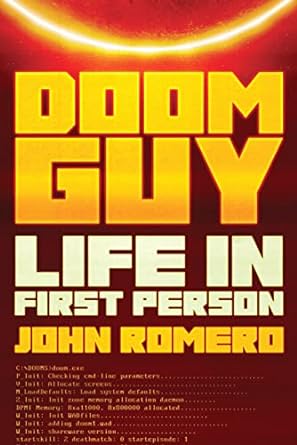
Let’s start with the Doom Guy money shot, which occurs about two-thirds through the book:
As a child, when things got bad, out of necessity, I stayed quiet and waited for it to pass. When Carmack sent out his report card, I stayed quiet and waited for it to pass. When people were upset at things happening within Ion Storm, I stayed quiet and waited for it to pass. Everything that happened at Ion Storm is a direct result of that flaw in my character. Had I taken action, had I talked to people, had I prevented issues from developing when they were just emerging, so many things in my career and in my life would have been different and so many people would have been spared the difficulties this flaw created.
That’s a, and perhaps the, key takeaway from Doom Guy: inaction is itself a form of action and character is closer to destiny than many of us would like to admit. Our flaws are often as invisible as water is to fish, and it often takes catastrophe to reveal them in undeniable ways. Most of us are masters at ignoring or excusing our flaws, and I don’t excuse myself from that generalization, and I admire Romero for his willingness to state what he did wrong, so that the rest of us can learn from him.[1] Id software and then Ion Storm may have stayed small in part because of the flaws of their leaders. No one is without flaws, but the more I live and the more I see of the world, the more I think that the most effective people are also often the ones with the greatest capacity to see their own flaws and either ignore them (by focusing on strengths) or mitigate them.
He got to the high points, though, by being an incredible programmer—and he attributes success to his ability to memorize and synthesize information. Romero says he is hyperthymesic, which Merriam-Webster defines as “the uncommon ability that allows a person to spontaneously recall with great accuracy and detail a vast number of personal events or experiences and their associated dates: highly superior autobiographical memory.” Romero’s not sure of the extent to which he was born with it and the extent to which he created it via practice: “There is an argument to be made that I sharpened my memory, that I created my condition due to my obsession with programming and games.” People who try to cultivate an ability will see that ability improve, and then perhaps attribute that ability to something inborn. Derek Sivers has written about using spaced-repetition software to memorize programming facts and ideas (“I wanted to deeply memorize the commands and techniques of the language, and not forget them, so that they stay at the forefront of my mind whenever I need them”).
For Romero, “Having the ability to absorb massive amounts of detail and retain that information was a great advantage,” and he “was obsessed with retaining everything I learned.” Maybe more people should be obsessed with retaining everything they learned: it’s not possible to learn higher-order concepts without a bedrock of primitives. Yet many people believe this, seemingly, including younger me.[2]
I’m not as accomplished as Romero or Sivers, but I do get asked how I connect so many disparate ideas and sources in my writing. One answer is “reading a lot.” Another answer is that I put many notes, quotes, and ideas into Devonthink Pro, using the strategies I describe here, and use that when I write. For example, when I plug the first quote in this essay into Devonthink Pro, I don’t find anything incredibly useful, but I do find: “Perhaps, in a period when we are communicating more than ever, the difficulties of communication are growing more obvious,” which is from 2014, and also “[George Gershwin] was dismissive of inspiration, saying that if he waited for the muse he would compose at most three songs a year. It was better to work every day. ‘Like the pugilist,’ Gershwin said, ‘the songwriter must always keep training.'” Neither is germane to this essay, but both are interesting and, in re-reading them, I’m more likely to cite them in the next few weeks. I also have a text file with top-level ideas from books I’ve read, and a file with key takeaways from podcasts I’ve listened to. I periodically read through those files, although without the aid of Anki or similar spaced-repetition software. What I do is enough to make some readers amazed at my apparent memory. I’m not sure I have an especially good memory, but I do diligently use memory-aid systems to augment my memory and that creates the effect of me having a wizardly command of unexpected connections. I hate to reveal my secrets, but in doing so I’m hoping to help others in the same way others have helped me.
Romero also came of age in a different epistemic environment than the one that exists now. In the ’80s, Romero “realized information on programming was hard to come by, so I forced myself to retain technical information and memorize the internal details of computers—memory maps, ROM locations, hardware switches, and tons more stuff. I did it quickly, which, in turn, expanded my ability to retain and access precise memories of almost everything else.” Today, memorizing details still matters, because memory is so much faster than looking information up—even via systems like ChatGPT. The more one knows, the less one has to pause to look things up, which reduces latency and increases clockspeed.
What characterized Facebook’s method was the speed with which new code got pushed out. For instance, when Agarwal was at Oracle, he worked for months before he was allowed to make his first “commit” to the code base, and even then, his work went through four reviewers to make quadruple sure that the changes wouldn’t affect anything. Even then, the actual change didn’t appear to customers for years, because products were on a two-year release cycle.
At Facebook, they pushed out code four or five times a day.
There’s an analogy to what I do in that I’ve been asked how I write so fast. I’m again not sure that I write fast, but I write a lot, and when I start, I aim to remove the typical Internet distractions and keep racing ahead until I’m done. “Finish it” is one the most important things anyone trying to achieve anything can do, and many wannabe writers err in waiting for inspiration or the right level of energy or something else outside the individual’s control. Professional writers know that inspiration is nice but rare, and the key is finishing something, getting feedback on it, and iterating. People who can’t finish things are especially deleterious to any kind of team effort. In 1986, Bill Gates gave an interview[3] that bears both on this problem and on Doom Guy:
Before Paul and I started the company, we had been involved in some large-scale software projects that were real disasters. They just kept pouring people in, and nobody really knew how they were going to stabilize the project. We swore to ourselves that we would do better. So the idea of spending a lot of time on structuring groups has always been very important.
The best ideas are the obvious ones: Keep the group small, make sure everybody in the group is super smart, give them great tools, and have a common terminology so everybody can communicate very effectively. And outside the small groups, have some very experienced senior people around who can give advice on problems. There is an amazing commonality in the types of difficulties you run into. In design reviews, I really enjoy being able to provide advice, based on programs that I have done.
“Pouring people in” often doesn’t work because those people need time to get to the frontier of the project, and, worse, if they’re the wrong people, they’ll not finish things fast enough. There are a lot of markets in which the maniacal obsessives win big, and video games appear to be one of those, particularly in the ’80s and early ’90s, when individuals or tiny groups could still massively succeed. Microsoft wasn’t a game company but it massively succeeded, maybe in part because of practices like this:
In the first four years of the company, there was no Microsoft program that I wasn’t involved in actually writing and designing. In all those initial products, whether it was BASIC, FORTRAN, BASIC 6800, or BASIC 6502, not a line of code went out that I didn’t look over. But now we have about 160 programmers, so I mostly do reviews of products and algorithms.
Gates was early and so was Romero. Romero says that “In 1983, the average adult had no real idea about computers. I was so far ahead of the curve that I wasn’t just a novelty, I was an in-demand rarity.” Scarce skills command premiums. Common skills don’t. He recognized an important trend early and was rewarded for it (“the remaining id founders were fortunate to be millionaires”).
Developing and deploying those skills has a cost, in terms of time and attention.[4] Romero wasn’t only obsessed with memorization:
Once again, we were on a 10-to-2 death schedule. In hindsight, I know this schedule sounds nuts, and the fact that we did this to ourselves may seem even nuttier, but at the time this didn’t at all feel like work. We were chasing greatness, and we ran as fast as we could. We knew someone would get to the finish line, and we wanted to get there first.
I doubt most people can or would do this—”10-to-2” refers to “ten a.m. to two a.m.” That seems challenging, but the team consisted of guys in their 20s, and so their clock speed could be incredible (“The biggest determinant for success in a technology company is the speed at which it operates and learns”).
Doom Guy is a very Silicon Valley story, but without much of it occurring in Silicon Valley. Back in the ’80s, small software teams could cohere almost anywhere; they still can, obviously, and yet the biggest tech companies are clustered in Northern California. Decades of poor government policy in California haven’t dislodged them, maybe because California bans non-competes, and most municipalities don’t (yet). The non-compete is a drag on progress and innovation and it ought to be banned globally, although starting with a national ban in the U.S. would be good.
Should you read Doom Guy? I’m not sure, particularly if you’re outside the software industry. There’s a reason why people like Phil Knight or Andre Agassi hire J. R. Moehringer. Writing a compelling, fast-moving book is hard—notice how, for example, the quoted passage from Levy’s book uses “even then” in two consecutive sentences. Doom Guy is useful for specialists interested in building tech companies, software development in the ’80s and ’90s, and people who played id software games as a kid and want to learn more about where those games came from.
Romero had a painful childhood and dysfunctional parents, but I don’t see a causal link between that and his later success. Some people come from dysfunction and succeed; some people come from warm, loving homes and succeed; and the inverse of both is also true. I note that, as a child Romero “learned to escape into my imagination as a protective device.” I did something similar, except with books and stories rather than video games; emotional privation may have facilitated an imaginative capacity that let me conceive of a world better than the one I was living in, though at the time I didn’t understand why I thought what I thought (what kid does? few adults do).
Doom Guy‘s end is sad: decades later, Romero is designing Doom levels again. A person ideally takes on new challenges and develop new ideas over the course of his life, but Romero is retreating to retread ancient history. The contrast with his former partner John Carmack is instructive: Carmack worked on video games, and then on a rocket company (Armadillo Aerospace), and then on Facebook’s Oculus, and now an AI company called Keen Technologies. Each major period builds on and extends the one before. He kept growing. Will you?
[2] More teachers, especially in high school STEM courses where the question “Why do we need to know this?” is rarely answered, should emphasize the utility of rote memorization. Too many students, who are encouraged to “find what they’re interested in,” are—not shockingly—not interested in memorizing a bunch of data points. Until more Richard-Feynman-like professors teach intro courses, it’d be helpful to demonstrate what a student can eventually do with the basics as motivation to slog through the early process of learning a new scientific language.
[3] Hat tip (h/t) Byrne Hobart at The Diff. Byrne writes a lot more than I do: his clock speed is impressive. Whenever someone thinks I’m fast, I think of the good writers faster than me. I feel dragged down by the fatigue that’s dogged me since I got radiation treatment in Dec. – Jan. 2023-3. It got much worse after the May 25 surgery that took my tongue. And then chemo. And now petosemtamab, a clinical trial drug that is keeping me alive, but that may also be keeping me tired.
[4] Based on Doom Guy, it would be interesting to read Romero’s kids’ impressions of their childhood and their relationships to Romero.
Cooking used to play a huge role in my life, and then I lost my entire tongue to cancer. For months, every calorie had to be injected directly into my stomach through a PEG tube and, as you’d imagine, that was not a satisfying way to live. Maybe one day human metabolic processes will be fulfilled through expeditious, non-food means, but it seems to me that we’re far from that day, and until then we have to rely on food. A huge part of human culture is built on and around food. Not being able to eat is painful for the obvious reasons, and for subtler ones, like being excluded from the huge part of human culture that I’d once prided myself on understanding and navigating.
In July 2023 I swallowed again for the first time, and found that the taste buds in my cheeks, hard palate, and esophagus still work, which is a lot better than not being able to taste at all, but still a lot worse than having a tongue. Over time I’ve gotten better at swallowing: two months of nothing by mouth, combined with surgical trauma, took far longer than two months to remedy. Every swallow demanded great concentration: to mess up through inattention meant choking and surviving or, possibly, choking and dying. As children we learn to eat and swallow, and by middle childhood doing so is automatic. I had to re-learn so much: walking, talking, eating, swallowing. I read the header of this section, “food by mouth,” and realize it sounds redundant: isn’t all food taken by mouth? But no, it turns out, food for people with PEG tubes happens differently.
I didn’t have to re-learn cooking, although I can’t easily taste test. Cooking has become an exercise in trying to throw and catch a ball with one eye closed—I may bobble the ball at times, but I’m familiar with the physics, and one eye enables me to try, anyway. One of my earliest useful acts happened in June 2023, probably too soon after I got home from the hospital. I was waking up every morning between 5 and 6 a.m., because mucus attacks prevented me from sleeping properly and consistently. In those early hours, Bess was usually still in some exhausted, unrestful, but essentially unconscious, state, so I couldn’t interact with her. My brain was still beset by recovery fog. However, I could by then walk short distances, and a Sprouts grocery store is about five minutes from our apartment. Being located next to a grocery store was a matter of luck rather than intent.[1] One of many follies of “urban planning” in the United States is that we prioritize parking lots over people, and parking lots over convenience. Most people have to drive a couple thousand pounds of metal to pick up a few pounds of groceries. One of the great virtues of our apartment is that we’re so close to a grocery store. We ought to stop forcibly segregating residential and commercial uses, so that many more people can live on top of, or near, grocery stores, bars, and so forth. The not-in-my-backyard (NIMBY) crowd has wildly and sadly won since the ‘70s, making the way Bess and I have been able to live—within walking distance of groceries—a rare privilege instead of an invisible commonplace. The polio vaccine makes the disease unnoticed by modern people; if we gave people the freedom to build what they want on the land they own, living within an easy walk of a grocery store might be similarly unremarkable. Instead, we raise GDP while lowering quality of life by demanding that most of us drive everywhere, all the time. No wonder our healthcare expenditures are insane: we make illegal or impractical a common, easy form of healthy action.
Given my physical abilities in June, Sprouts was just within walking distance, so that I could consider a recipe, note the ingredients, get over there, and get home before Bess woke up. I’d start the meal when she got up, to avoid waking her due to the noise from chopping or clanging pans. Hours later, the slow cooking would finish and Bess would eat, while I would inject food. Much later, she told me that she barely ate between May 25 and whenever I began cooking again: she felt that me making food was a signal for her to start consuming things again. At some point her parents gave us a Vitamix, and I used it to thoroughly blend the food I made into something with the consistency of Liquid Hope, and then injecting it into my PEG tube. Liquid Hope is good, but a diet consisting entirely of it can’t be ideal. I tried to run it through the Infinity Pump, which used a pressure mechanism to push a bag of Liquid Hope (the Liquid Hope in turn hung in a plastic 500cc bag on an IV pole) through a long piece of tubing attached to my PEG tube. The pump was forever getting clogged, getting clogged and beeping, getting clogged and beeping and exploding Liquid Hope everywhere, and generally driving my life and patience past frustration and into a ditch.
Everyone has a philosophy of food, whether articulated or implicit, whether “I mostly eat microwaved pizza and instant noodles” or “I’ve never had Kazakh food: let’s try it.” Most of us probably don’t think that much about why we eat what we eat, and change comes from the relatively small, but vocal and experimental, group of people who do. Most often we do whatever’s most convenient, which is to say whatever most people around us are doing. To deliberately change is to incur high costs in terms of time and attention—time and attention that some people don’t want to devote to food, despite phrases like “you are what you eat” or the importance of food to health. Health, as I know too well, is one of these things that, once gone, is sometimes impossible to recapture, like a cat that gets out the door and darts into the bushes, destined for a coyote’s belly. I’ve never been a complete maniac for the absolute healthiest food, or healthy-coded food (I used to enjoy gluten, although it doesn’t blend well, so I’m not non-consensually bread-free), but a lot of healthy food tastes good, too, particularly if someone isn’t completely in thrall to the supercharged, overwhelming tastes of modern processed foods.
Before the cancer, and even now that I can swallow again, I’ve tried to eat, and make, a variety of things. Different foods are fun: all of us need variety in our lives, along numerous dimensions. Some of us need more variety than others, depending on the dimension in question (I have run into people who eat within a tiny range—often just simple carbs like pasta or pizza). Beyond being fun, I also connect variety in foods with Michael Pollan’s books and articles. In one famous article, for example, he says “We also eat foods in combinations and in orders that can affect how they’re absorbed.” Plus:
“The trace of limestone in the corn tortilla unlocks essential amino acids in the corn that would otherwise remain unavailable. Some of those compounds in that sprig of thyme may well affect my digestion of the dish I add it to, helping to break down one compound or possibly stimulate production of an enzyme to detoxify another. We have barely begun to understand the relationships among foods in a cuisine.”
One of the (many) problems with a mono diet is that we don’t know how foods interact with each other. Most Americans appear to get most of their calories from a tiny number of sources: mass-produced wheat;[2] sugar and “edible food-like substances” like high-fructose corn syrup; beef, chicken, and pork; and some oils/fats, like safflower oil. That tiny number of sources is listed in the number of calories. Yet “humans are omnivores, requiring somewhere between 50 and 100 different chemical compounds and elements to be healthy. It’s hard to believe that we can get everything we need from a diet consisting largely of processed corn, soybeans, wheat and rice.” It is hard to believe, and I don’t believe it. Grocery stores are stocking more foods than ever, for the minority of people who want to take advantage of them, while the majority of people are subsisting—not even thriving—on a tiny number of foods.
We can and should do better. I’m trying to continually expand the range of things I make and eat. Sometimes my range contracts—I used to eat a lot more lettuce than I do now, since lettuce neither blends nor cooks well. But, as noted previously, I’ve got access to a far greater variety of beans thanks to Rancho Gordo. Rancho Gordo sells xoconostle, too, which I’ve put in mole de olla, along with a spicy black bean and sweet potato soup that Bess loves. I’ve been experimenting with different chiles. I saw something called “golden berries” in Sprouts and bought those: they have a kind of a tangy-tart flavor in smoothies. Frozen passionfruit is available, so I picked up some of them. Dragonfruit are overly expensive but go on sale often enough that I can snag some and put them in smoothies, too.
Maybe none of this matters, and I see the comedy in the guy dying of cancer who is nonetheless concerned about whatever micronutrients golden berries or obscure dried peppers might impart. Clearly, whatever I’ve done isn’t working, since my interest in nutrition hasn’t stopped me from getting cancer and then cancer recurrences. But I like to think my choices matter, for Bess if not so much for me, now that my time is short.
Cooking, Bess tells me, is part of what attracted her to me at first: for our second date, I made her potato paneer curry from the Moosewood cookbook. I didn’t have paneer, so I substituted cottage cheese. She maintains that I got frustrated with how long the potatoes needed and served the dish with the potatoes still partially raw. I’m doubtful of that rendition but my mind was not chiefly on the potatoes; I had other issues to occupy me. Whatever I did seemed to have worked, and to continue working.
She was in med school then, and thus chronically harried for time. Despite lacking time, she’s always been someone who likes to eat, but, from what I’ve observed, she’s also someone who won’t do much of it unless someone else is nudging her to. She’ll subsist on a thing of takeout for a whole day, or buy a smoothie and sip it for hours. For some bizarre reason her parents never used a dishwasher when she was growing up, and when I first met her, she never used the dishwasher in her apartment. It took my example for her to realize that, as anyone would expect, a dishwasher is a great device. People who like to cook like—really like—dishwashers. One reason takeout is so popular in New York is the quality of takeout there, but the lack of dishwashers in old buildings is another. New York should really allow landowners to construct new buildings with modern contrivances like dishwashers.
The other day, I got back from an infusion in San Diego and wondered if the birria-style soup I’d left with her had been enough. Bess assured me it had, and yet when I looked in the fridge, it seemed like most of the birria was still there. I told her I was worried about her, and worried about what would happen to her after I’m gone; I said that it seems like she’d eat two gyoza and an olive and call that dinner. She looked spooked and confessed that the day before she’d eaten like twelve gyoza, and three olives, for dinner. An eternal golden braid connects our minds, and I guess something must’ve slipped over that braid.[3]
We share food and a philosophy of food, which is large part of our shared philosophy of life (which includes similar views on walking, parking minimums, and predatory zoning restrictions). I once tried to date a woman who wouldn’t eat much more than chicken, pizza, French fries, and pasta—she was still young enough that this diet hadn’t yet caught up with her. We went out to dinner with friends once, and she was unhappy that people laughed when she ordered French fries at whatever real restaurant we were at. I replied with something like: “Then order something else!” An adult who eats like a child can’t be surprised when other people are surprised by childlike behaviors.
As I mentioned, Bess barely ate while I was in the hospital and after I got home, until I began trying to be minimally generative in the form of cooking. I encouraged Bess to eat. Although I couldn’t eat then, I didn’t want to deny the pleasures of the table to her, or to anyone else. Bess knew I didn’t begrudge her eating, but she said that eating when I couldn’t left her feeling emptier than before she filled her stomach. We did meals together, and she later confessed that doing something so fundamental to our connection alone felt like she was choosing to leave me behind, as if she was practicing for a future of tables set for one.
Instead, Bess said she imagined the time like I was running late for a restaurant reservation. She didn’t want to start without me. I appreciated her not wanting to shove that which I could no longer have in my face, but I wanted her to take care of herself. I also wanted, eventually, the connection that feeding people provided, even if my own relationship to eating had to change. Just because I couldn’t do something doesn’t mean others shouldn’t. Life will go on after me, and that is good. Many parts of life that I can’t partake in continue now, and that is the way of the world. In some grand sense our lives are temporary, and it’s what we pass to the next generation that most matters—including consciousness and life itself.
I’m against unnecessary suffering and in favor of creating a better world, whether through food or other means. A big part of creating a better world is creating that better world for those who come after me: that is why I’m against NIMBYism, in favor of building a better future in literal and figurative ways, and for bigger, better, and great technology and technological progress. There’s a selfish element to that last bit, in that medical technology is the only thing that might extend my life, but even medical technology is too late to save my tongue, and I’ll suffer from tonguelessness until the end. Freedom and technology create a better, positive-sum world for everyone. The people who are against lowering housing costs or restricting infrastructure are mistaken in their views of human flourishing. If I’d been smarter, I’d have focused my life on building the future, instead of reading books. We all make errors and that’s one of mine.
I don’t know why, but I still like reading restaurant reviews. It’s like a eunuch watching pornography, I guess: pointless. Yet I do it anyway. I don’t know why. There aren’t even good reviews of restaurants in Phoenix, so I tend to read reviews of New York restaurants—a place I don’t live and an experience I can’t have, which is doubly pointless. I guess I’m activating memories of times past. Proust has his madeleines, while I have Pete Wells’ reviews. But it’s not as good as doing the thing. I can blend and swallow takeout, now, which is a lot better than nothing, but even if I live far longer than expected, I’ll likely never eat in a restaurant again.
If there’s a thesis in my writing about food, it may be that food is often not just about food. I meant to write about food—the cooking of it, the learning about taste and texture profiles, the skills I’ve developed in the kitchen—but instead, I kept being drawn to the topics that food helps enable—to the stuff of life, which is to say, our relationships with other people. That’s what so much of food and culture are about. Write about one thing, and, as you weave that thread, it turns out that you—and by “you” I mean “I”—write about the whole world.
[1] Oddly, some people in my complex still drive to Sprouts, despite walking being faster and more pleasant. I think of such things when I read that 40% of American adults are obese, and another 30% are overweight. Ozempic is great, but how behavioral changes are possible, even at current margins?
[2] That article is titled “Bread Is Broken: Industrial production destroyed both the taste and the nutritional value of wheat. One scientist believes he can undo the damage.” As that writer says:
Before the advent of industrial agriculture, Americans enjoyed a wide range of regional flours milled from equally diverse wheats [the plural is deliberate], which in turn could be used to make breads that were astonishingly flavorful and nutritious. For nearly a century, however, America has grown wheat tailored to an industrial system designed to produce nutrient-poor flour and insipid, spongy breads soaked in preservatives.
Perhaps we should try something different—but, as with most things, that’ll require greater demand for better products from people, and most people are content with McDonald’s, frozen pizzas, Taco Bell, and so on. Sweetgreen’s market cap as of this writing is $1.2 billion; Yum Brands, which owns Taco Bell and other super commercial fast food chains, is worth $36 billion.
[3] If there are any spycams in our apartment, I didn’t install them.
* “Moon landing: US clinches first touchdown in 50 years.” News that is actually important. Sort of like the guy with Astro Mechanica who says he’s invented a jet engine that is “efficient at every speed. Because it’s efficient at every speed, we can use it in a new way: as the first stage of an orbital launch vehicle.” Wow. Though I have no ability to evaluate the technical plausibility.
* “Google Gemini and Revisiting James Damore.” If that doesn’t satiate your interest in Google matters, try “Google’s Culture of Fear,” although it has a lot of pointlessly incendiary framing. Still, the Google search monopoly is under more serious threat than it’s been in the company’s history, and that may inspire real change. Amusingly, I used Google search to try and find a video of Sergey Brin saying that he’s un-retired to come back to work on AI, and Google search didn’t easily find it—but it turned up a bunch of spammy YouTube videos.
* If this is true, it helps explain why I found the first Dune movie underwhelming: “Denis Villeneuve says ‘movies have been corrupted by television.'” Corrupted by? Villeneuve goes on: “Frankly, I hate dialogue. Dialogue is for theatre and television. I don’t remember movies because of a good line, I remember movies because of a strong image. I’m not interested in dialogue at all. Pure image and sound, that is the power of cinema, but it is something not obvious when you watch movies today. Movies have been corrupted by television.”
When I watched the first Dune movie, I was like: “Who are these people? What are the stakes? Who cares?” I can answer from the books, but the movie felt oddly flat. Meanwhile, the director was thinking: “Ooooohhh pretty.” And it is very pretty. Also, the actor who plays Paul Muad’Dib doesn’t work as a warlord. He’d be a great Oscar Wilde, but Paul Atreides? Eh.
* Why Jalapeño Peppers Are Less Spicy Than Ever. About much more than Jalapeños. I read some of the articles about making fermented hot sauce and now I have a jar full of jalapeños fermenting on my counter.
* “A hymn to hot sauce.” This, combined with the article above, convinced me to buy some fermenting lids and give fermented chiles a go. What could go wrong, aside from dying?
* “Open-Source Software Is Worth a Lot More Than You Pay for It” (bloomberg, $). The source paper is here and claims that “We estimate the supply-side value of widely-used OSS is $4.15 billion, but that the demand-side value is much larger at $8.8 trillion. We find that firms would need to spend 3.5 times more on software than they currently do if OSS did not exist.” Wow!
* China may dominate electric cars. The U.S.’s short-sightedness on this subject is amazing and depressing. Notably: “‘It’s a global game. It has been a global game,’ Le said. ‘Motherfuckers just haven’t been paying attention.'” And the wsj writes of “How China Is Churning Out EVs Faster Than Everyone Else.” ($) Without Tesla, American and European car companies would be ever further behind than they are.
* “Republicans can’t stop swallowing Russian propaganda: Obsessed with Hunter Biden and the Moscow Metro instead of solving problems.” This also seems bad but I don’t know how to induce a healthier epistemology. It seems that most people optimize for entertainment rather than what I’d consider effectiveness.
* What obsesses academia these days (NY’er, $), at least the administrative classes and certain academic departments. Academia is losing public support and yet many departments are devoted to internal virtue signaling spirals rather than knowledge production or dissemination, and this is the response. “Rearranging the deck chairs on the Titantic” comes to mind. Way back when I was foolishly seeking an English PhD, I planned a dissertation about academic novels, many if not most of which were satires. Even then, the ability to satirize an absurd cultural reality was fading; by now, it’s almost impossible to satirize academia in fiction, because how can a novelist be more absurd than reality?
* “Will Democrats Ever Embrace Charter Schools Again? The data shows that independently run public schools perform better than conventional ones, yet Biden has been conspicuously silent” (bloomberg, $). Weird that the party putatively in favor of helping the poor and disadvantaged has aligned against an important policy that will disproportionately help the poor and disadvantaged.


 The Story's Story