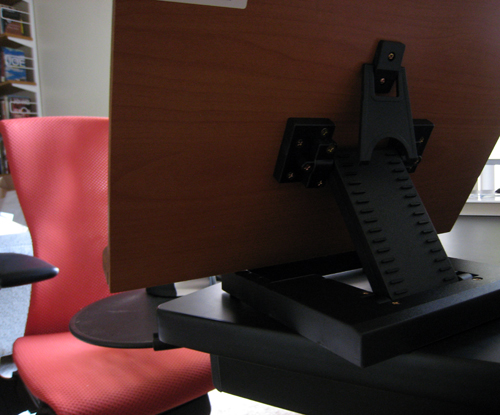
Precisely how I often feel about the classics:

“[Martin] Amis always feels able to acknowledge greatness without denying that it can be boring and make insolent demands on one’s time.”

—Frank Kermode, Bury Place Papers, a book which reminds one that scholarly critics can have a light, delightful and yet erudite touch, their reputation to the contrary.

September links: How to do literary criticism, yet another piece on changing literary standards, and ch-ch-changes with publishing and reading

* The Literary Critic as Humanist: Frank Kermode, 1919-2010, exemplified an ideal that is dying.

* Essential reading: The New Social Novel.

* John Grisham: “Boxers, Briefs and Books,” which is about how hard and rewarding writing is, even when it doesn’t necessarily look it.

* Of Two Minds About Books, from the New York Times.

* The great book glut of 2010. This is a great time to be a reader, especially if you’re buying used from Abe Books, Amazon, or an equivalent, for reasons described here:

Lastly there are those riding the glut by listing 100s of thousands of cheap books and making money even on books listed at one penny (it’s the postage–they like light books). These are mainly ISBN ( I Sell By Numbers) sellers who catalogue with a barcode reader and buy books by the pallet at breathtakingly low prices. These are held in vast warehouses ( the ‘fulfillment’ sheds are near Luton.) A long way from the rambling old second hand bookshop.

* A brilliant idea for New Yorkers (and, hopefully, the rest of us): RentEnforcer. You say where you live, how much you pay, and your apartment size, then find out if what you’re paying is similar to or different from what others are paying.

* How Censoring Craigslist Helps Pimps, Child Traffickers and Other Abusive Scumbags.

* The Washington Post exploits “owning a substantial share of the public debate” by pushing its own financial interests. I hadn’t actually realized this is true.

* How did I end up living in a state as crazy as Arizona?

* This post on the changes in reading because of the physical experience that reading on a Kindle entails basically describes me.

* Don’t Quit!: “Very, very few novelists get to stay home writing all day.”

* There’s another of these posts about how the publishing industry is doomed or at least changing—but, this one, by Paul Carr, is not mindlessly “rah-rah ebooks.”

A quote from Seth Godin: “The timeframe for the launch of books has gone from silly to unrealistic. Today, even though all other media has accelerated rapidly, books still take a year or more [to be published].” But the amount of time from acceptance to bookstores isn’t really about the technology: it’s about marketing, finding space on bookstore shelves, etc.

At some point between now and 25 years from now I don’t doubt that publishers will have changed, perhaps to the point of redundancy. But this just isn’t happening that fast.

This one from the Carr: “And so yes, Seth, you’re right: you definitely should consider what the shelf-life of your idea is. And if you find it’s so short that it’ll be redundant in a few weeks, let alone a few months, then you shouldn’t – mustn’t – wait!” Yeah—and if your idea is so insubstantial that a few weeks might obviate its necessity or importance, perhaps that idea is so trivial as to be unimportant. That’s my basic problem with Twitter.

The article continues:

For all of the reasons above, there are really only two types of person for whom it makes a jot of sense to tear up their book deal and abandon the professionalism, billion-dollar print market, and immeasurable cachet of traditional publishing. The first is highly skilled self-promoter likes Godin who have successfully identified their entire (niche) audience and who know they will only ever sell a certain number of copies of their books to that same audience. […]

The second type of person is more tragic: authors who, for whatever reason, fear they’re about to be dumped by their publisher (or at best paid a tiny advance for their next book) and who want to save face by using innovation as an excuse.

And here’s both the problem and the solution at the moment, at least from the perspective of a novelist: “The catch-all argument is that, thanks to today’s technology, publishers are redundant: anyone can write, publish and market an ebook.” Anyone can write, publish, and market an ebook, but no one is doing any kind of quality control on those books. I’ve been sent a variety of self-published books, and one thing stands out: they were universally awful. Most of them weren’t even laid out well, visually. That’s why, as Carr points out, publishers aren’t going anywhere for the time being.

* Should you self-publish? See above. Short answer: only if you already have an obvious readership.

What an unappealing book description looks like: Jean-Christophe Valtat's 03

In an essay about Jean-Christophe Valtat’s novella 03, James Wood writes that the work is an “eight-one-page monologue, written in one unbroken paragraph, about a teenage boy’s unrequited love for a mentally handicapped girl he sees every day at the bus stop […]”

Although I can’t give a complete theory of what makes a novel unappealing, I do know that Wood’s description of 03 has many elements I might include: very little probably happens in terms of narrative, if the story occurs chiefly a bus stop. A whole book composed of a “monologue” sounds unappealing: the dialogic aspects, to use Bakhtin’s conception, of novels makes them fun and gives their stories urgency as people’s desires collide. I want plot. And “one unbroken paragraph” reads to me suspiciously like a gimmick, and, beyond seeming like a gimmick, this would make the book hard to read. The title, 03, also has the whiff of a gimmick or of existentialism.

The short description Wood offers tells me one major thing: I don’t want to read this book. I would much rather read Wood writing about this book than the book itself; he offers insights that are probably more important, in this case, than the work he’s writing about, which is never a good sign for a novel.

Various writers have raised the rally cry against writers who engage in confusing postmodern game playing for its own sake: this, more or less, describes B.R. Myers’ A Reader’s Manifesto, Tom Wolfe’s “Stalking the Billion-Footed Beast“, Lev Grossman’s “Good Books Don’t Have to Be Hard,” and, most recently, Justin Peacock’s “The New Social Novel,” which actually isn’t new, but I’m willing to spot him the adjective in this case. Although I wouldn’t endorse everything every writer says in each of these essays, I do think they point towards a general idea: give us novels of substance, although we don’t always know what we mean by novels of substance and can’t necessarily define them.

I’m guessing 03 isn’t one, however.

What an unappealing book description looks like: Jean-Christophe Valtat’s 03

In an essay about Jean-Christophe Valtat’s novella 03, James Wood writes that the work is an “eight-one-page monologue, written in one unbroken paragraph, about a teenage boy’s unrequited love for a mentally handicapped girl he sees every day at the bus stop […]”

Although I can’t give a complete theory of what makes a novel unappealing, I do know that Wood’s description of 03 has many elements I might include: very little probably happens in terms of narrative, if the story occurs chiefly a bus stop. A whole book composed of a “monologue” sounds unappealing: the dialogic aspects, to use Bakhtin’s conception, of novels makes them fun and gives their stories urgency as people’s desires collide. I want plot. And “one unbroken paragraph” reads to me suspiciously like a gimmick, and, beyond seeming like a gimmick, this would make the book hard to read. The title, 03, also has the whiff of a gimmick or of existentialism.

The short description Wood offers tells me one major thing: I don’t want to read this book. I would much rather read Wood writing about this book than the book itself; he offers insights that are probably more important, in this case, than the work he’s writing about, which is never a good sign for a novel.

Various writers have raised the rally cry against writers who engage in confusing postmodern game playing for its own sake: this, more or less, describes B.R. Myers’ A Reader’s Manifesto, Tom Wolfe’s “Stalking the Billion-Footed Beast“, Lev Grossman’s “Good Books Don’t Have to Be Hard,” and, most recently, Justin Peacock’s “The New Social Novel,” which actually isn’t new, but I’m willing to spot him the adjective in this case. Although I wouldn’t endorse everything every writer says in each of these essays, I do think they point towards a general idea: give us novels of substance, although we don’t always know what we mean by novels of substance and can’t necessarily define them.

I’m guessing 03 isn’t one, however.

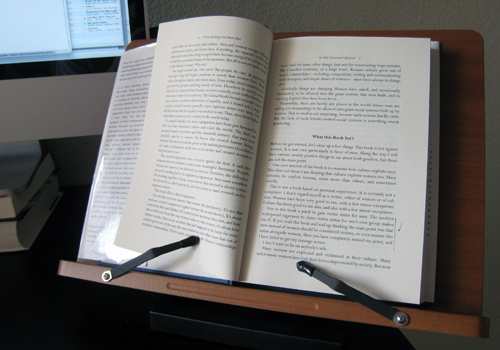
Highly recommended — the Best Book Stand "Jasmine"

A few months ago I realized that I needed a better way to hold books as I copy passages for both reviews on this blog and for my academic work. A bit of Googling found some really janky looking products that led me to sigh and rig a solution that consisted of a bunch of heavy anthologies (those of you who were English majors might remember the infamous Nortons; they’ve finally become useful again, albeit in a way slightly different from their intent) to lean a book against, while the heaviest of them all sat slightly in front to hold the relevant book up.

Then Kevin Kelly’s blog Cool Tools came to the rescue through a review of the Freesia Book Stand:

This is a simple but well-designed book stand that does exactly what it sets out to do. It is sturdy enough to hold big, heavy textbooks, but [it] looks nice. It is impressively adjustable, allowing for nearly any reading angle . Amazingly, despite the ability to hold heavy books, the stand itself is relatively light (around 3 lbs). The stand has an anti-skid coating on the bottoms so that it stays where I put it.

Exactly what I wanted. Thank you, Stephanie Misono, for suggesting this. She says, “I now wish I had gotten it years ago.” Me too; I chose the Best Book Stand Jasmine, and it would’ve been insanely useful as an undergrad, when I spent many hours looking at computer science textbooks in particular, going back and forth from page to screen.

The Freesia version is too big, so I ordered the smaller version. I have something similar for standalone printed papers, but even that isn’t nearly as satisfying; I was making edits to a novel earlier, and I flipped from one page to another with greater ease by using the Jasmine. So it’s not only good for copying passages from books, but for holding edited pages.

Does this sound minor? Maybe it is, but managing to find the perfect tool to fulfill a major need is incredibly satisfying, and this is perhaps the best solution I’ve found to a major problem in my life since reading “Tool for Thought” by Steven Berlin Johnson, which concerns DevonThink Pro. Although these tools are useful on a micro level, they probably also change the nature of what I do; as Nicholas Carr says in The Shallows:

Even as our technologies become extensions of ourselves, we become extensions of our technologies […] every tool imposes limitations even as it opens possibilities. The more we use it, the more we mold ourselves to its form and function. […] Whenever we use a tool to exert greater control over the outside world, we change our relationship with that world.

I’m probably more likely to copy marginal passages from books now that it’s become marginally easier both to do so and to organize the output once I have done so. The Jasmine hasn’t yet faded to the point of it reaching what Heidegger called “readiness-to-hand” or “Zuhandenheit,” which, to use Graham Harman’s formulation, “refers to objects insofar as they withdraw from human view into a dark subterranean reality that never becomes present to practical action any more than it does to theoretical awareness.” I’m entirely aware of the Jasmine, which is part of its pleasure, but when it fades “into a dark subterranean reality,” it will be really incorporated into my work (I suspect that writing the dissertation might force this state on me, as one book after another checks in and check out).

The Jasmine cost about $30, with about $10 in shipping. I probably would’ve paid $100 for it. Maybe more. It’s difficult to overstate its usefulness, given the kind of work I do. Students, academics, and bloggers are an obvious audience, but I’m sure other groups would find it useful too.

Highly recommended — the Best Book Stand “Jasmine”

A few months ago I realized that I needed a better way to hold books as I copy passages for both reviews on this blog and for my academic work. A bit of Googling found some really janky looking products that led me to sigh and rig a solution that consisted of a bunch of heavy anthologies (those of you who were English majors might remember the infamous Nortons; they’ve finally become useful again, albeit in a way slightly different from their intent) to lean a book against, while the heaviest of them all sat slightly in front to hold the relevant book up.

Then Kevin Kelly’s blog Cool Tools came to the rescue through a review of the Freesia Book Stand:

This is a simple but well-designed book stand that does exactly what it sets out to do. It is sturdy enough to hold big, heavy textbooks, but [it] looks nice. It is impressively adjustable, allowing for nearly any reading angle . Amazingly, despite the ability to hold heavy books, the stand itself is relatively light (around 3 lbs). The stand has an anti-skid coating on the bottoms so that it stays where I put it.

Exactly what I wanted. Thank you, Stephanie Misono, for suggesting this. She says, “I now wish I had gotten it years ago.” Me too; I chose the Best Book Stand Jasmine, and it would’ve been insanely useful as an undergrad, when I spent many hours looking at computer science textbooks in particular, going back and forth from page to screen.

The Freesia version is too big, so I ordered the smaller version. I have something similar for standalone printed papers, but even that isn’t nearly as satisfying; I was making edits to a novel earlier, and I flipped from one page to another with greater ease by using the Jasmine. So it’s not only good for copying passages from books, but for holding edited pages.

Does this sound minor? Maybe it is, but managing to find the perfect tool to fulfill a major need is incredibly satisfying, and this is perhaps the best solution I’ve found to a major problem in my life since reading “Tool for Thought” by Steven Berlin Johnson, which concerns DevonThink Pro. Although these tools are useful on a micro level, they probably also change the nature of what I do; as Nicholas Carr says in The Shallows:

Even as our technologies become extensions of ourselves, we become extensions of our technologies […] every tool imposes limitations even as it opens possibilities. The more we use it, the more we mold ourselves to its form and function. […] Whenever we use a tool to exert greater control over the outside world, we change our relationship with that world.

I’m probably more likely to copy marginal passages from books now that it’s become marginally easier both to do so and to organize the output once I have done so. The Jasmine hasn’t yet faded to the point of it reaching what Heidegger called “readiness-to-hand” or “Zuhandenheit,” which, to use Graham Harman’s formulation, “refers to objects insofar as they withdraw from human view into a dark subterranean reality that never becomes present to practical action any more than it does to theoretical awareness.” I’m entirely aware of the Jasmine, which is part of its pleasure, but when it fades “into a dark subterranean reality,” it will be really incorporated into my work (I suspect that writing the dissertation might force this state on me, as one book after another checks in and check out).

The Jasmine cost about $30, with about $10 in shipping. I probably would’ve paid $100 for it. Maybe more. It’s difficult to overstate its usefulness, given the kind of work I do. Students, academics, and bloggers are an obvious audience, but I’m sure other groups would find it useful too.