Before the massive surgery that left me without a tongue, I used to read to Bess at night to get her to fall asleep; I mentioned that practice in “I know what happens to me after I die, but what about those left behind?“:
Some books, like my copies of The Lord of the Rings or The Name of the Rose, she’ll obviously want. They’re favorites of mine, and I read both out loud to her—Bess is a nervous, difficult sleeper, and reading to her helps her relax into sleep. For The Lord of the Rings, I gave Pippin an absurdly lisping voice that often made Bess protest that I should “read him normally,” as if her nightly protests weren’t part of the fun. For The Name of the Rose, I spoke all of William of Baskerville lines in my best Scottish accent, poorly but enthusiastically imitating Sean Connery.
I got started reading to Bess when we lived in New York City and she was working emergency medicine “locums tenens” shifts* upstate, where the pay and schedule were better than the City’s. I can’t remember what inspired me, but one night we were on the phone, and I picked up a copy of Robertson Davies’ The Deptford Trilogy and began reading to her. They’re peculiar books that I shouldn’t like, about dysfunctional Canadian beta males trying to explain away their lack of libidinous zest, and yet I do: it must be the writing. Whatever draws me to The Deptford Trilogy worked on Bess too, and even when she returned from the upstate wilds I kept reading to her. I sleep readily and easily, so it was easy for me to offer up a few pages, pausing when Bess would start squawking and reacting to the story. She often accused me of inserting absurdisms into the text, and she’d insist on seeing the page itself. More often than not the text was there, but sometimes it mysteriously vanished between the moment I read it and the moment Bess looked for it.
I’d read until Bess seemed to be asleep or on her way to sleep. She finds my voice soothing, if sometimes monotone, which might be what made it such a useful soporific. The following night, I’d often have to rewind a few paragraphs to find the last spot Bess remembered. Sometimes I’d teasingly demand a summary of the previous night’s action, and express dismay if she’d forgotten key points.
Apart from Bess traveling,** sustained interruptions to the reading were rare before Oct. 20 2022, when I got the first surgery on my tongue. That surgery went relatively smoothly and easily: I didn’t have to have a “flap” composed of muscle tissue grafted onto the remains of my tongue. The surgical margins on the tongue itself were clear. I lost the lymph nodes on the left side of my neck, but none were cancerous. The day after the surgery I got discharged from the hospital. I could swallow. I don’t remember how long it took me to regain speech, but I did expeditiously, and radiation therapy was supposed to eliminate any errant cancerous cells that the surgery might have missed. I seemed to be on the road to wellness.
Regular readers know the outcome: instead of moving on with my life, the cancer recurred, a salvage surgery failed but took my tongue, and now there is a race between experimental treatments that might keep me alive for some extra months and the cancer that will almost certainly kill me soon. My body is doing poorly along many dimensions, although on a day-to-day basis I’m feeling somewhat better than I was after the savage May 25 salvage surgery, or during the two rounds of chemo.
Instead of working with my body, I constantly feel like I’m fighting it. I’ve also learned something essential about life management: I should take a sleeping aid, like Benadryl or marijuana, when I wake up in the middle of the night and can’t get back to sleep. Most nights I wake up after two to four hours needing to clear my airway of mucus, a violent, noisy act not conducive to gliding back into a relaxing bed. Too little sleep leaves me half alive in the morning, and then in a gray fog all day, and thus not very communicative. Speaking demands a lot of conscious attention in a way it didn’t used to, and when I’m already exhausted I find generating that speech hard. It’s difficult to have positive overall days without enough sleep. Bess has offered to read to me at night, but being read to doesn’t hold the same appeal.
Today I can speak again, after a fashion and with that conscious attention I mentioned, though I can tell that people hear me and wonder if I’m mentally disabled. My voice has that “is this guy okay?” quality. I used to pitch clients over the phone, but, even if I somehow, improbably live long enough for work to become an issue again, I won’t be able to. Not easily, and not without warning clients that I don’t have a tongue and sound very strange. A lot of life has been digitized, but the internet hasn’t fully resolved the problem of people wanting to have an actual conversation before they wire five figures to someone who is scarcely more than a website and phone number. Pitch calls offer the opportunity to showcase skills on the fly, too; I’ve learned enough about batteries, geothermal energy, and related topics to tell war stories about past jobs. But for me, most conversations with new people entail a lot of them saying “what?” or “can you repeat that?” A lot of them pretend to understand. I’ve gotten used to incomprehension in casual contexts, but incomprehension in business contexts means not making the sale. Who and what am I then?
The main type of person I run into who is impressed with my ability to speak is ear, nose, and throat surgeons. Them, and head and neck cancer oncologists. Those two groups understand that, relative to most people who have their whole tongues removed, I sound great! Spectacular, even. Drs. Hinni and Nagle, who removed the tongue and constructed the “flap” that I now have in place of a tongue, did incredible work. I’m their Statue of David, their Sistine Chapel. Their artistry is to be commended and appreciated. Even Jessica Gregor, the Mayo Clinic speech therapist, was amazed by my oratorial prowess at our first post-operative session, although “prowess” may be too strong a word for “being more than vaguely intelligible.” But she sees a lot of glossectomy patients and so knows the range of outcomes far better than me. I thought she was just being kind and optimistic, but it turns out the vast majority of patients struggle to be understood even by those closest to them. But to the non-cognoscenti, when I start talking I can see the “Is this guy developmentally disordered?” question being silently asked. Almost any ambient noise renders me incomprehensible. A shop or restaurant plays music? Forget it, no one will understand more than a few words I manage to emit, in my turkey-like gobble.
Technology can ameliorate the problem a little, and apps like Speechify can translate text to voice in a way that mimics natural speech and intonation. Those apps can even recreate famous voices. Maybe I would actually increase client retention if I used the “Snoop-Dogg” voice for business. More realistically, I find myself wondering what work and career might look like if some miracle clinical trial drug combination manages to keep me alive, against the odds, for years rather than months. I should’ve gotten disability insurance, but it’s too late for “should’ve.” It’s not my nature to give up, yet right now I also don’t see a great path forward. The past me is gone, and now I have to deal with the present me, however broken I may be.
I halfheartedly tried voice banking before the surgery. There’ve been clunky, inefficient programs around for ALS patients for the last five years or so. But “voice banks,” which make recordings of specific phonemes via scripts you read aloud and recreates a voice that sort-of sounds like you tend to stutter and sound robotic. I also didn’t prepare for losing my tongue and didn’t expect to lose it. The night before my unexpected total glossectomy, I downloaded one such voice bank app but only had an opportunity to record 100 sentences—enough to sound slightly like I was trapped in a computer but couldn’t get out. It was a little uncanny valley, a little horror flick, and too slow to be useful. Apple is coming out with an app soon that’ll do the same thing, and if it’s based on voicemails and recordings, that could conceivably help.
None of these programs help with inevitable latency. Latency kills the cadence of a conversation. Good conversation is a delicate thing; great conversation even more so. I’ve tried to converse vis keyboard and speech-to-text, but the rhythm is almost always all wrong. A sympathetic friend and I can do it, but we’re people who, instead of dancing, keep walking into each other and falling into holes. Just as losing my ability to eat disconnects me from a key part of the human experience, so too does losing the ability to have a simple conversation.
I can still read a little bit to Bess. Though it’s painful to ask the muscles of my mouth and throat to strain and move so strangely by speaking, it’s probably good for me to keep exercising my voice, particularly in a world where my universe has shrunk so much. Many sick people report shrinking universes, and I’m among them. The shrinkage is everywhere except for medical appointments: I don’t teach undergrads any more; I don’t pitch clients; I rarely catch up with friends on the phone, because I’m so hard to understand; even issuing commands to my car via voice, like “navigate to Sky Harbor Airport” doesn’t work. For some peculiar reason, the car has always preferred spoken commands from Bess, even before the surgery. A bunch of phonemes are still hard or impossible for me; “k” sounds, for example, I can’t enunciate. “L” and “w” are also tricky. A lot of people smile and look at me blankly when I speak, clearly unable to interpret the sounds, but not wanting to admit it. Interestingly, the group that seems to best comprehend what I’m trying to say seems to be people who work with a lot of international talent and who are thus used to a variety of accents. I did appear on The Daily Stoic podcast, which is fun, and that podcast gives you a sense of what I sound like. Bess thinks that I sound clear and intelligible.
In “How do you say goodbye?” I said:
Bess hears subtleties in my voice that I feel are overshadowed by the struggle of enunciating the phonemes themselves, especially with no tongue to help me phonate. Bess hears me more than anyone else and understands the sounds I emit better than anyone else, through pure exposure. Much like parents can understand the seemingly unintelligible squawks of their toddlers via practice and exposure, Bess will translate what I’m saying to those who can’t make out the syllables I’m trying to pronounce. How are they supposed to understand my tone when they can hardly understand my words, garbled by a lack of tongue? Somehow, Bess can. Further complicating the difficulty of saying goodbye is the physical challenge of speaking.
Last night, I tried reading to Bess before bed. She was feeling antsy, and we were halfway through a copy of Elmore Leonard’s novel Be Cool before the surgery, so I picked it up. She lay there with an eye mask on her eyes and the half-smile she gets when she’s expecting to be entertained. I did the “Chili Palmer” voice the best I could—a staccato, sort of hyped-up New Jersey Sopranos reject-actor voice. Bess laughed at me. She’s reliably amused by the absurd voices, although the one I do for Chili Palmer isn’t as mirth-inducing as the one I did for Pippin.
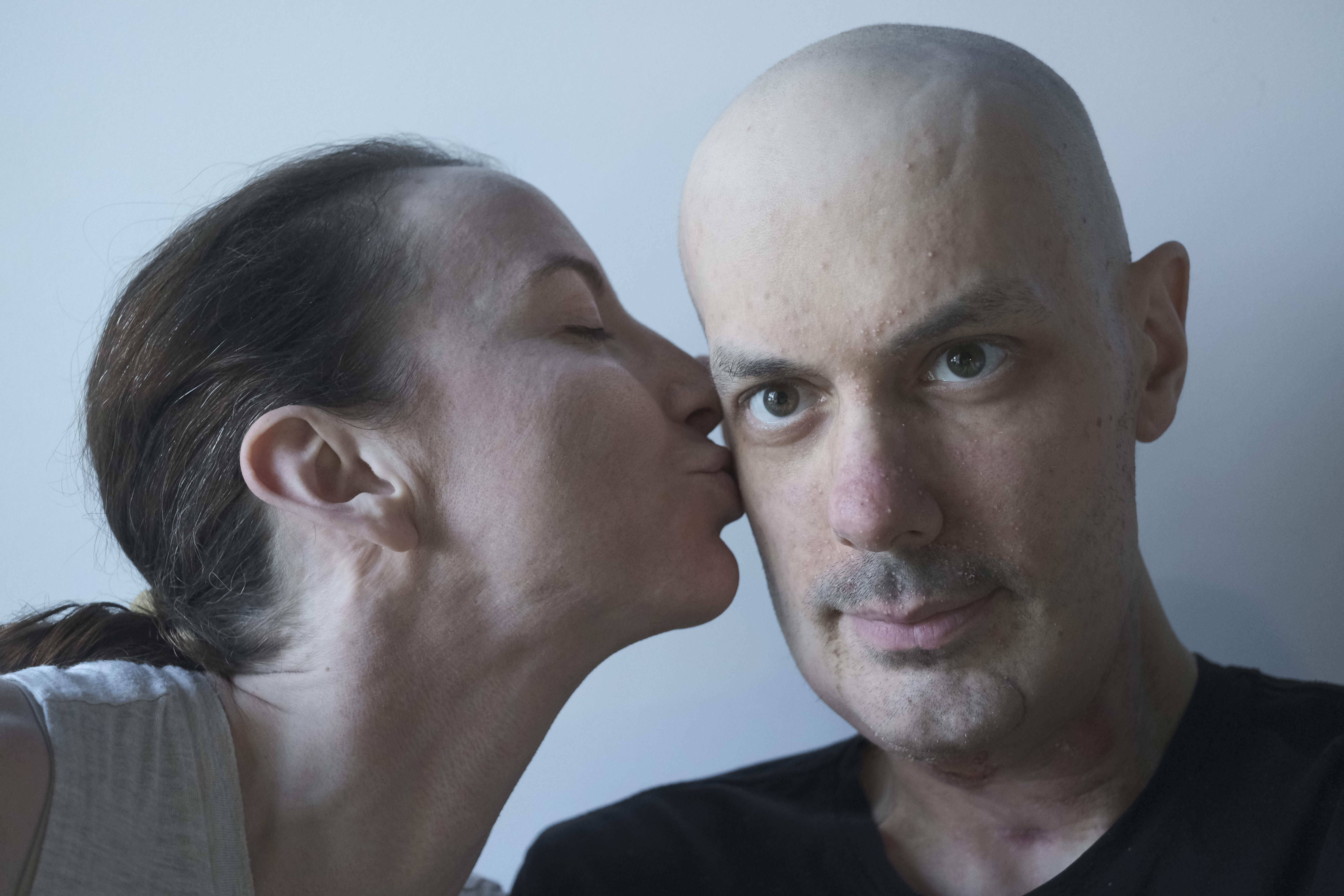
One of the great things about Bess: if I find something that makes her laugh, I can just keep pushing that same button, seemingly forever, and she’ll enjoy it every time. Bess followed my reading, though, or seemed to, and when I switched to a female character she noted, amused, that “every woman you’ve ever read to me sounds the same.” Which felt like a ridiculous thing to say—of course I don’t sound the same as I did, and my female characters must sound different too. I have no tongue. My words slurred and I strained. But Bess has said she doesn’t see me like a cancer patient most of the time, and so perhaps she doesn’t hear me as one either. I’ll never sound “normal” again, and probably I’ll never meaningfully work again, but, at least with Bess, I know she listens when I speak, which makes a difference in helping to just feel like, well, myself. Maybe it’s not principally how you speak that matters: maybe it just helps to know that someone really hears you.
If you’ve gotten this far, consider the Go Fund Me that’s funding ongoing care. If you or someone you know is going through cancer and needs to understand the clinical trial process, this is what happened to me.
* I don’t know why the absurd Latin phrase persists in the field, apart from path dependence, but doctors who work “locums” shifts aren’t employed full-time at the hospital. A placement agency usually finds the docs, qualifies the docs, and gets the docs credentialed at a given site. Since there’s a shortage of doctor and residency slot because of the lobbying from the American Medical Association (AMA), docs get higher pay than they would without that shortage. Most docs don’t suffer through four years of med school and three or more of residency to live in rural areas, so rural areas are continually importing docs from fun cities.
** She frolicked at Burning Man one summer, and I didn’t read to her at all while she was there. In retrospect, I should’ve recorded a couple hours of book and told her to listen to 10 or 15 minutes a night.
 The Story's Story