The past is no fun and self-publishing is the worst: Ted Heller and solipsism

Those of you who are thinking about publishing your own books or already have—and I know you’re out there—should read Ted Heller’s “The future is no fun: Self-publishing is the worst” for a couple reasons, the most important being that it highlights the way self-publishing is probably not a path to fame and fortune for most of us. But Heller should also highlight that, for most of us, conventional publishing wasn’t a path to fame and fortune either.

He writes that he conventionally published three books between 2001 and 2011, then found that he couldn’t get a publisher for his fourth, West of Babylon. If he’d begun publishing in 1991 and had the same experience in 2001, that would’ve been it: self-publishing didn’t exist in a practical form, and now it does, which means his book at least has a chance.

It’s also clear that Heller is doing it wrong. He writes about sending review copies to newspapers and magazines (“I do everything I possibly can in about four or five paragraphs to inspire interest in whomever the email is sent to”), but that’s like me wanting to become a gigolo for female clients: the world just doesn’t work that way. Me wanting the world to work that way isn’t going to make the world work that way either. Newspapers and magazines barely review conventionally published books any more, and self-published books are explicitly forbidden by most of them; to the extent newspapers and magazines write about such books, it’s after they’ve become best-sellers (like 50 Shades of Grey).

Heller appears to have few personal connections with anyone at newspapers or magazines (“When I finally found contact information for someone at the show I’d been on, they did email me back [. . .] to politely tell me that they would not be having me back onto their show”), which means he’s wasting his time by sending out random P.R. e-mails. I know this. Why doesn’t he?

Heller doesn’t have a blog, as far as I can tell. He doesn’t say that he scraped the e-mails of everyone he’s ever corresponded with and sent a quick e-mail blast about his book. He apparently hasn’t been collecting the e-mail addresses of his readers. The price for West of Babylon —$8—is too high. It should be $3 – $5. The book sounds at best mildly appealing. Though the topic–has-been, 60-year-old rockers—makes me want to look elsewhere, it could be pulled off. Still, based on the description, I wonder: what’s at stake? Do I care about whether these guys can “pull the tour off?”

The Salon piece also makes Heller sounds like. . . I’m look for a euphemism but none come to mind. . . an asshole:

If there is one positive thing about this self-publishing business it is this: You separate the wheat from the chaff among your friends and acquaintances. Who is willing to lend a hand and who cannot wait to abandon you? Who will nudge someone they know and get your book to them and who just won’t even acknowledge your desperation or is laughing at you behind your back? Some people have been remarkable, others’ names are now forever etched onto my Eternal Personal Shit List.

Look, if your friend doesn’t like your book, it doesn’t mean shit, other than that your friend doesn’t like your book. I’m neutral towards 60% of the books I read, actively dislike 30%, and find 10% magical. Playing the straight odds, when a friend publishes a book, there’s a 90% shot that I’ll be neutral towards or dislike their book. The probability of me liking their book is probably lower, because the vast majority of books I read are books I choose.

When I start self-publishing, I doubt all my friends will like what I write. Which is okay. Having cancer and seeing who supports you and who doesn’t separates “the wheat from the chaff among your friends and acquaintances.” Publishing a book that you friends don’t love is hardly a reason to be “forever etched onto my Eternal Personal Shit List.”

Let’s examine the upside for a moment. Heller has a real chance to get his book in front of readers, which he wouldn’t have had ten years ago. He’s playing a game with low odds of success. Thousands of other writers, and maybe hundreds of thousands, are in the same game. But he’s living in a time when it’s possible to get in the game, and that itself is still something to celebrate.

EDIT: I should add that, based on what I’ve read, most writers at most major publishing houses get very little real marketing / PR help. The ones who do are the lucky exceptions. Throwing a stone into the ocean of literature and having it sink to the bottom is normal. Throwing a stone into the ocean of literature and having it turn into a cruise ship is not.

Links: Publishing, BDSM (these two are not related, surprisingly), Chekhov the player, Lasch, parking, L.A., the ten-year hoodie, and more

* “The [Non] Death of Publishing,” which argues that publishers used to the recession to consolidate their positions and make more money; I can’t evaluate most of the claims, but they seem plausible.

* “BDSM in the mainstream.” (Maybe.)

_MG_8952-1* “The No-Limits Job” is dumb, but it’s also in the NYT’s Fashion & Style section, where rigor goes to die. The basic problem is that the industries described glamor industries, which means lots of people want to get in because people think they’re cool. This drives the salaries down (to zero, in the case of internships). You may notice that there are no examples of programmers working 70 hours a week for $22,000 a year, and the words “supply” and “demand” never appear. I’ve seen this basic supply / demand principle in action, since I went to grad school in English Lit, where many, many people want jobs (because they’re fun) and relatively few jobs are available, with the result being that supply and demand meet at a low number. Solution: Don’t go into glamor industries. If you do, don’t complain about the trade-offs you’ve made.

* Chekhov: a lifetime of lovers. Demonstrating that writers can be players too.

* Christopher Lasch: Scourge of the elites.

* Don’t subsidize parking. This should be obvious.

* Has L.A. fallen behind? (Hat tip Marginal Revolution). To me, the car-centric culture and traffic are the worst parts, and I don’t see those improving without some combination of removing or raising urban height limits wherever subways or light rails are built or planned.

* Upgrade or die.

* The ten-year hoodie on Kickstarter; I “backed” the Flint and Tinder underwear project and though the outcome okay but not exceptional.

* The case for a true Mac Pro successor.

* How New York Could [and should] Get More Affordable Housing.

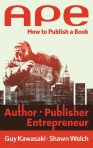
APE: Author, Publisher, Entrepreneur — Guy Kawasaki and Shawn Welch

ape_cover_KawasakiFor decades, books got published something like this: you, the writer, wrote and polished your book; you submitted a query letter and perhaps sample chapters to literary agents; an agent read the full manuscript; an agent took you on; the agent pitched your book to large publishing houses in New York; the editor, or ideally more than one editor, made an offer; the agent negotiated; and you got a book deal. This system worked kind of okay, and there wasn’t a better way to do it, but a lot of writers, including me, got hung up in the “an agent took you on” step.

Now, self-publishing has a realistic chance of success—defined as getting your work to readers and getting some amount of money from those readers—which offers opportunities and headaches. Big publishers know change is coming. The opportunities are obvious, and the headaches stem from having to learn a lot of stuff that publishers used to do, like cover design, knowing what a “widow” is, and figuring out how to hire a copy editor. APE: Author, Publisher, Entrepreneur wants to explain the new world, and it’s a book for a very specific group: people who are, for whatever reason, deeply interested in the publishing industry, and people who want to write a book, have written a book, or want to publish the book they’ve written. If you’re sure you don’t fall into those categories and aren’t likely to, stop reading. You’re probably wasting your time. If you want to know, keep going.

A few months ago I noted this, from Tim Parks’s “Does Money Make Us Write Better?“, in a links post:

When they are starting out writers rarely make anything at all for what they do. I wrote seven novels over a period of six years before one was accepted for publication. Rejected by some twenty publishers that seventh eventually earned me an advance of £1,000 for world rights. Evidently, I wasn’t working for money. What then? Pleasure? I don’t think so; I remember I was on the point of giving up when that book was accepted. I’d had enough. However much I enjoyed trying to get the world into words, the rejections were disheartening; and the writing habit was keeping me from a “proper” career elsewhere.

These kinds of stories infect writer interviews, as do tales of heroic perseverance. John Barth and William Goldman almost quit writing too. But more interesting still are the dark matter writers, the ones we don’t hear about because they gave up and aren’t being interviewed or writing introductions to reprints of their older books. I don’t want to be one of them. And I bet I can make more than £1,000, though I don’t know how long ago Parks began writing: adjusted for inflation, £1,000 might be a lot of money.

Kawasaki and Welch explain how to avoid being a dark matter writer. They say, “Will your book add value to people’s lives? This is a severe test, but if your answer is affirmative, there’s no doubt that you should write a book.” Still, people write books for all sorts of reasons, though I suspect the major reasons are related and twofold: the book they’d like to read doesn’t already exist, and they have something to say. Answers like “to add value to people’s lives” are good reasons to write a book, and good reasons to do many things. There is still some doubt. Writing a book can consume all your mental energy. It might add value to, say, two people’s lives, which might not justify the costs. Not everyone has the impetus towards book writing; to get through the difficulties of writing a book, I think that writing itself has to be fun, or fun at times (more on that later).

But the number of people who could write books and aren’t, in part because of the daunting publishing process, is much larger than the number who do write books. And that pool is getting larger. One challenge is that writers are going to have to think more like publishers, and publishers are going to have to think more like entrepreneurs. APE is about these transformations, and it takes its place near J.A. Konrath and Jack Kilborn’s The Newbie’s Guide to Publishing (Everything A Writer Needs To Know) and Kristine Kathryn Rusch’s Surviving the Transition: How Writers Can Thrive in the New World of Publishing (one thing writers evidently do, once they spend the painful time learning to self-publish, is write guides so that others can learn the same).

How useful APE will be to you depends on how much other reading you’ve done in the how-to-be-a-writer genre. I have trouble resisting it, and so sections of APE are less useful; some, like chapters 6, were fun but already well-known to me. The later ones, on the finer point of Kindle, Nook, and iBooks publishing, were exceedingly useful. I follow digital publishing closely, because I’m going to do it, but I still learned things: for example, I didn’t realize that Google Play exists. Google Play might not matter for me, or for you, but uploading to it requires little time beyond the effort necessary for iBooks and Barnes and Noble’s Nook.

Kawasaki and Welch also have overly strong views on tools (which may make sense given Kawasaki’s background: “For four years I evangelized Macintosh to software and hardware developers and led the charge against world-wide domination by IBM;” the word “evangelized” is key here, implying religious fervor that’s been transferred from God to Mac). I’ve learned some about photography in the last two years, perhaps a reaction against the extreme amount of reading and writing I’ve done, and in cameras, there’s a continual debate between the people who want the newest, coolest gear and who argue that the latest gear enables them to get shots they couldn’t have gotten before. Their intellectual adversaries argue that the most important tool is between the photographer’s ears and that composition, subject matter, and skill with what you have matters more than the newest cameras and the best lenses.

I’ve read impassioned pleas from both sides, and agreed fully with one side, then read the opposite, and agreed fully with them. There isn’t a right answer. One cliche in the photography community holds that every image you’ve admired was captured with worse gear than what you’ve got. Yet there’s also no reason to ignore the tools you’re using and the potential that new tools may unlock.

Kawasaki and Welch write, “In our book (again, pun intended), you should use a Macintosh. No computer makes you more creative and productive, because a Macintosh becomes part of you whereas you need to overcome other operating systems.” I don’t think it matters that much, which is somewhat funny because I’m writing this on an iMac. But pretty much any computer made in the last ten years will due, because, the most important parts of the writing process are a) a word processor and b) there is no b.

There are some nifty tools I use extensively, like Devonthink Pro, and some nifty tools that I’ve used less extensively but still helpfully at times, like Scrivener. Nonetheless, 95% of the real “work” of writing still happens on the level of the sentence and paragraph (though Kawasaki and Welch say of Scrivener, “I pride myself in having an organized mind, but my mind isn’t this organized”)*. A Mac is not going to give you great sentences. Neither is Windows or Linux or the tea you drink or the cafe you write at or the hot literary groupie offering you head or the pen you use. Great sentences, like change, come from within.

They also say, “We have never met anyone who regretted buying a Macintosh.” I have—like those who need perfect Exchange synchronization, or people who are seduced by the Mac’s cool factor, only to realize that the paying-the-rent factor is even more important. These are quibbles. Still, in one chapter the writers quote Zoe Winters, and I would repurpose her advice to apply to technology: “There is no shortcut to awesome.” Writing well is always a longcut, not a shortcut, and self-publishing arguably makes the road longer. There’s no real alternative, through software, hardware, or anything else.

The road may be long, but one can find comfort and encouragement along the way. Kawasaki and Welch write, “If You Want to Write by Brenda Ueland [. . .] changed my life by empowering me to write even though I didn’t consider myself a writer.” This is a common feeling, but it’s also one that’s long puzzled me: I spend very little, if any, time considering whether or not I’m “a writer.” I just do it. I didn’t need permission to be a writer, and neither do you. Alternately, if you do need permission, let me bestow it on you: a random stranger on the Internet has now dubbed thee a writer. Feel better?

You should. You should also realize that writing may be lonely in the moment, but it’s a way of bringing people together over time. This tension is implied in moments like these:: “Authors who write to impress people have difficulty remaining true to themselves. A better path is to write what pleases you and pray that there are others like you.” I would also add that few people are likely to be impressed anyway, and those who might be impressed will be more impressed if your book is written, at least some of the time, because you’re having fun and seeing where things go. Think about your favorite sexual experiences: few of them probably arose because you were putting a lot of pressure on yourself or your partners to have a Great Sexual Experience. Most of them probably arose because you and your partner(s) were relaxed and ready to have a good time by seeing where things go. So too with writing, and many other activities.

Sometimes writing will be painful, as Kawasaki and Welch note. I won’t deny it. But parts should be fun, and the fun will show in the final product.

In a few places, I’d like to see better writing in a book about writing. One chapter begins, “This section explains how to take a manuscript and turn it into a book. We assume that you have a rock-solid draft of your book.” “Rock-solid” turns up 74 million hits on Google. It’s a cliche. A book about writing should itself be impeccably written. This one is close—very close. Perhaps the next update will fix that.

Elsewhere, the writers say, “For example, The Schmoe Way by Joe Schmoe from Schmoe Press doesn’t cut it.” And “Pure text posts don’t cut it in the highly visual world of social media.” And “While printed books may never die (an ebook of Annie Leibovitz’s photographs won’t cut it) [. . . .]” What does “cut it,” and what is being cut? All of these could be improved: for example, “an ebook of Annie Leibovitz’s photographs is as useful as sheet music for someone who wants to hear Beethoven’s Fifth.” Maybe that’s a little clunky too, but it’s still an improvement because the metaphor is fresh. One could say, “Pure text posts in the highly visual world of social media make more sense than a pure text movie, but both are improved by images.”

Some words are wasted. The last sentence in this paragraph:

Undaunted, [Amanda] Hocking decided to self-publish her novels with Kindle Direct Publishing to pay for the $300 trip. She started with My Blood Approves, and by October 2010, she made over $20,000. Over the next twenty months, she made $2.5 million. The rest, as the saying goes, is history.

could be removed. I can only think of two similar nonfiction books that had no wasted words: Rework (the 37signals book, and one of the few books I’ve read that should be expanded) and Derek Sivers’ Anything You Want (where Sivers even talks about brevity and clarity in “You should feel pain when unclear“—”Writing that email to all customers would take me all day, carefully eliminating every unnecessary word, and reshaping every sentence to make sure it could not be misunderstood”). The best writing advice I’ve ever received is “omit unnecessary words.” Almost everyone is guilty of this crime at times, including me, in this post, in this blog, and in my other writing.

Their advice on serial commas is askew; Kawasaki and Welch favor serial commas (“A serial comma (or Oxford comma, as they say across the pond) prevents confusion when you are listing several items”), but serial commas can also create ambiguity.

These are minor issues, but I bring them up because nonfiction should aspire to be art. Kawasaki and Welch agree—they say, “Metaphors and similes beat the crap out of adjectives and adverbs, so use them when you can. For example, rather than saying, ‘Hockey is very violent,’ you could say, ‘Hockey is war on ice.'” Perhaps I’m overly fastidious about the War Against Cliche. Others who are highly attuned to language will notice too.

Some sections of APE linger in the mind long after they’re read, like this:

There are two kinds of people: eaters and bakers. Eaters think the world is a zero-sum game: what someone else eats, they cannot eat. Bakers do not believe that the world is a zero-sum game because they can bake more and bigger pies. Everyone can eat more. People trust bakers and not eaters.

It expresses a sentiment I’ve discussed in many contexts, but in a way I hadn’t conceived. My closest approximation came in “How to think about science and becoming a scientist:”

while society needs a certain number of lawyers to function well, too many lawyers leads to diminishing returns as lawyers waste time ginning up work by suing each other over trivialities or chasing ambulances.

By contrast, an excess of scientists and engineers means more people who will build the stuff that lawyers then litigate over. Scientists and engineers expand the size of the economic pie; lawyers mostly work to divide it up differently. Whenever possible, work to be a person who creates things, instead of a person who tries to take stuff created by someone else.

Kawasaki and Welch are bakers. They’re creators. They want to help you be one too. Still, according to them, you have to be the kind of writer who wants to “take control of their fate and embrace the ideas here in order to maximize their success.” A fair number of writers don’t appear to care about being able to “maximize their success” as measured by sales and finances, and in some literary circles cachet comes from not marketing one’s book, or appearing not to market it; sometimes not marketing becomes marketing, as examples like J. D. Salinger and Cormac McCarthy show.

This underlying model of success can seem claustrophobic, and, just I gave you permission to be be a writer above, I give you permission to be selective with social networks here: plans for Facebook, Twitter, LinkedIn, e-mail, Google+, and more would leave me with less writing time. I want to do things that really interest me, and that’s mostly long-form writing. Facebook and Twitter aren’t interesting, and I want the mental space they would otherwise occupy to be occupied by better things. I’m also reluctant to trust Facebook and Google+ because that gives those companies so much control over what I do and who I talk to. There was a recent kerfuffle when Facebook “turned down the volume” of businesses that had Facebook pages. That’s good for Facebook’s users but terrible for anyone who spent time and money encouraging people to interact on Facebook.

Facebook is, of course, where the people are. Using it is good advice, but it might also be useful to ask what you can say no to. In Anything You Want, Derek Sivers has a chapter called “No more yes. It’s either HELL YEAH! or no,” where he says that your reaction to most propositions should be one of those two extremes. To me, Facebook, Google+, and Twitter are in the lukewarm middle. Kawasaki and Welch “recommend using Google+ as a blogging platform.” Does it allow one to export nicely-formatted XML that will allow you to easily switch, if necessary? That’s a prerequisite, at least to me.

Kawasaki and Welch might be overly enamored of social media, and me underly enamored, but unless you want a Salinger-like existence you probably need to do something. There are few alternative to social media, e-mail, and other promotional efforts, and those efforts are a boon to outsiders. The authors say, “I’ve never come across an author who was happy with the marketing efforts of his publisher.” That might be because publishers have one thing that can’t be replicated by outsiders: distribution. Publishers are set up for a world where they control distribution. That advantage is eroding over time.

The chapters about social networking show you how to make sure you have access to new advantages.

The downside is that learning the business consumes time like space shuttles consume jet fuel. At the moment, however, APE is a relatively easy, comprehensible way of learning about all the steps that one should take to move from “guy with a story” or “guy with a long document” to “writes books that other people value and read.”


* I’ve only used Scrivener for one novel, called THE HOOK, that has different, named narrators at different times, like Tom Perrotta’s Election, Anita Shreve’s Testimony, or William Faulkner’s As I Lay Dying. Scrivener was an ideal tool for this task because it made rearranging sections easy, and it made reading each speaker’s full narrative, in order, easy. I can also see it being very useful for non-narrative nonfiction and or dissertations / academic books (James Fallows is a convert). For most fiction, I think the bigger problem is making the story cohere, not rearranging it.

Links: Looking Up, change, real estate crowdsourcing, publishing, porn, men, game, and more

* Jeff Sypeck: “Some books you plan to write; others simply happen:” about Looking Up: Poems from the National Cathedral Gargoyles.

* How People Change.

* “The Real Estate Deal That Could Change the Future of Everything:” letting local people invest small amounts in local projects. The barriers are primarily regulatory.

* “Study: Porn stars aren’t ‘damaged:’ A report finds adult actresses are happier than the rest of us — and that being naked might lead to self-esteem.”

* Guy Kawasaki’s APE: Author, Publisher, Entrepreneur–How to Publish a Book describes what I’m going to be doing and what you might be thinking about doing.

* The 5-Year Humanities Ph.D.: finally.

* The Rules Revisited: Men Don’t Have Commitment Problems.

* The Game life cycle.

* Standup desks gain favor in the workplace. I’m using one, and I’d file this under under the “obvious development” category.

* Awesome: Soaring Rents Drive a Boom in Apartments.

* If Peter Thiel And Garry Kasparov Are Right, Then We’re In Trouble. The essay mentions their book, The Blueprint: Reviving Innovation, Rediscovering Risk, and Rescuing the Free Market, which I pre-ordered; it’s likely the sort of book that, even if it’s wrong, will still be interesting.

Complaints about Amazon’s rise ignore how long it has taken the company to rise

The latest raft of articles about Amazon and its power over the publishing industry appeared in the last couple of days (“Amazon, Destroyer of Worlds,” “What Amazon’s ebook strategy means,” “Booksellers Resisting Amazon’s Disruption”), and the first two note what is the most significant thing about Amazon, at least to my mind: how much better an experience Amazon is than the things it replaces (or complements, depending on your perspective).

Like any incumbents, publishers, as far as I can tell, want the status quo, but readers (and consumers of electronic gear) are happy to get something for less than they would’ve otherwise. Stross gets this—”Bookselling in 1994 was a notoriously backward-looking, inefficient, and old-fashioned area of the retail sector. There are structural reasons for this” and so does Yglesias—”But for consumers, it’s great. An Amazon Prime membership is the most outrageously good deal in commerce today. But competitors should be afraid.” Stross is suspicious of Amazon, and so is the New York Times writer. Their suspicions are worth holding, but the basic issue remains: Amazon is successful because it’s good.

Their books are cheap and arrive fast. Their used section is really great, for both buying and selling. Prior to Amazon and its smaller analogues, used bookstores simply wouldn’t buy books with writing in them. Amazon used buyers, however, don’t care, as long as the book is described honestly. I’m getting ready to move, which means that I’m selling or giving away somewhere between a couple hundred and a thousand books. I sold about 15 through Amazon, resulting in about $100 that I wouldn’t have otherwise. That efficiency is great, but it’s great in a way that publishers don’t like, because publishers would rather have everyone buying new books.

Amazon looks particularly good to me because I’ve spent a lot of time trying to wrangle a literary agent and failing. Five or six years ago, that meant my work would’ve spent its life on my hard drive, and that’s about it. But now that I’m done with comprehensive exams, I have time to hire an editor and a book designer and see what happens through self-publishing. The likely answer is “nothing,” but the probability of nothing happening is 1.0 if I leave the novels and other work on my hard drive forever.

Most of this was predictable: in 1997, Philip Greenspun wrote “The book behind the book behind the book…“, in which he observed: “Looking at the way my book was marketed made me realize that amazon.com is going to rule the world.” I’m sure others predicted the same thing. The publishing industry’s collective response was to shrug. I guess no one read The Innovator’s Dilemma. If publishers once were innovators, they’re not anymore.

Stross is averse to profit to the point that I think he’s signaling mood / group affiliation to some extent, but his basic economic analysis is good. Stuff like this: “piracy is a much less immediate threat than a gigantic multinational [. . .] that has expressed its intention to “disrupt” them, and whose chief executive said recently “even well-meaning gatekeepers slow innovation” (where ‘innovation’ is code-speak for ‘opportunities for me to turn a profit’)” could be rephrased; Amazon selling for less means more consumer surplus, and it appears that Amazon’s whole modus operandi is to very low, if any, profit margins; if it had margins as high or higher than what publishers and retailers shoot for, it wouldn’t be such a threat.

Anyhow, I too don’t want an Amazon monopoly or monopsony, but I don’t see a good alternative to Amazon. Barnes and Noble is, at best, second-best; their online prices finally became competitive with Amazon’s a year or two ago, but they still they’re chasing the leader instead of striving to be the leader.

If DRM on ebooks actually dies—as Stross thinks it will—that will make Barnes and Noble and other players more viable, in the same way that killing DRM on music made Amazon a viable purveyor of music (although a lot of people still use the iTunes Music Store).

Links: Chairs, publishing, Game of Thrones, midlists, and vocational education

* Against chairs. Yes! Way against! I might buy a Geekdesk soon, in part because I can’t get this Herman Miller Embody adjusted right. See also my thoughts on the movie Objectified and designers’ obsession with chairs. EDIT: I bought a Geekdesk.

* Bertrand Russell’s 10 Commandments for Teachers; I try to follow them, especially the one about arguing via authority.

* The Real E-Publishing Story: It’s Not the Millionaires, It’s the Midlist.

* Why publishers hate the midlist: taxes and depreciation.

* How Thor Power Hammered Publishing.

* J. A. Konrath: Harlequin Fail. Interestingly, I’ve begun contemplating whether it would be possible for me to sell 10,000 ebooks per book, and the answer might be “yes.”

* What’s HBO Go’s Problem? There is no word for “cord cutter” in Dothraki. The linked cartoon basically describes me; I’ve tried to buy HBO Go, only to find that I have to have a cable subscription, which I don’t have because I don’t have a TV. I’ve tried Amazon and iTunes. Nothing. However, although I’m an inveterate respecter of copyright, I have discovered certain alternate means that allow me (and sometimes friends in my position) to watch the show, and then allow me to write posts like this one.

* Learning that works: rethinking vocational education. This is positive step, and I’m noticing more and more people making these kinds of arguments. Worthless mentions this too.

March links: Dissertation changes, jazz, security theater, publishing, and the LSAT

* Dissing the Dissertation: MLA considers radical changes in the dissertation. This seems obvious, necessary, long overdue, and welcome.

* The Social Conservative Subterranean Fantasy World Is Exposed, and It’s Frightening; notice this: “Comedians may, in fact, be even bigger beneficiaries than Democratic politicians who are watching a stampede of women voters into their welcoming “we don’t hate you because you’re sexually active” arms.”

* On Jazz; “Listening to Jazz is like simultaneously hearing all the footsteps on the sidewalk of a city. . .”

* The real reason health insurers won’t cover people with pre-existing conditions.

* The Unwelcome Mat, on security Theater and how the U.S.’s idiotic stance border is hurting itself.

* With This Machine, You Can Print Your Own Books at the Local Bookstore; translation: self-publishing is going to grow as this kind of machine spreads.

* Who cares if book publishers are colluding with Apple to raise e-book prices?; as Matt says elsewhere, “the publishing industry is facing intense competition and disruptive change no matter what these guys do, and the DOJ may as well leave them alone.”

* A comment from my friend, “Laila:” “It seems somehow appropriate that your follower was a prostitute.” Oh?

* Fewer people are taking the LSAT—and, if they’re smart, fewer will go to law school.

Amazon.com, Daniel Kahneman, and the future of publishing

Amazon Will Destroy You” says, among other things: “Amazon is going to destroy the Big 6, destroy bookstores, destroy 95% of all agents, destroy distributors (Ingram, Baker & Taylor), and revolutionize the publishing industry by becoming the dominant force. . . . Amazon INNOVATES. That’s the thing you whiners don’t understand.”

My own (very limited) adventures in publishing make me inclined to think this is basically correct; having now dealt a fair amount with agents, I’ve observed enough about their behavior to be suspicious: most appear to simply be judging submissions based on “gut instincts” of dubious predictive value. An increasing body of research shows how horseshit gut instincts are as a guide to most kinds of behavior, and how little we know about the decisions we make. You only have to read Daniel Kahneman and Dan Ariely to understand this. You can see the same principles in Moneyball, book or movie. Virtually every field that has pitted empirical data or tests against the beliefs of supposed “experts” has found that the data win. In the case of Amazon, the company is basically running a massive experiment by letting anyone who wants to publish, publish, and letting readers sort out who’s good.With the gates open, entrants are numerous—and more numerous than conventional publishers could ever hope to match.

Literary agents and publishers are now in the same position as baseball managers were in the pre-Moneyball era: completely missing the data revolution going on around them.

The gatekeepers are just wrong too much. You can tell as much from the innumerable stories about beloved, or at least popular, books that were rejected dozens or hundreds of times before finding a publisher. This isn’t the fault of agents or publishers directly: if I were an agent and saw the manuscripts for Harry Potter, Twilight, or The Da Vinci Code, I’d have rejected them—and I’d have been wrong, at least as measured by revenue. When publishers had a lock on distribution, however, they could afford to be wrong, because it was virtually impossible for writers to use alternate mechanisms to sell their books. A wrongly rejected book went in the drawer. A lucky break just happened to be a lucky break.

Increasingly, though, writers aren’t going to rely on gatekeepers. They’re going to let the market decide; publishers and agents will step in after a writer is popular. The problem is, once a writer is sufficiently successful via Internet metrics, I’m not sure that agents or publishers will be in much of a position to negotiate.

Amazon knows this. Its strategy is simple: let everyone in and let readers sort ’em out. This will shake out many of the false negatives given by agents and publishers. Conventional publishers, who pay for expensive Manhattan office space and distribution warehouses and paper, can’t afford to do this using traditional methods.

Agents and publishers probably know this, but they know it in the same way Blockbuster knew it had to compete with Netflix.

The world is moving away from mystical hand-waving and towards data / experimentation. Businesses on the wrong side of that divide are going to suffer.

EDIT: I’m reading Culture: Leading Scientists Explore Societies, Art, Power, and Technology and, weirdly, came across this contribution, by Cory Doctorow, which discusses a different context that applies to my analysis of the literary marketplace:

We’re bad futurists, we humans. We’re bad at predicting what will be important and useful tomorrow. We think the telephone will be best used to bring opera to America’s living rooms. We set out nobly to make TV into an educational medium. We create functional hypertext to facilitate the sharing of draft physics papers.

If you need to convince a gatekeeper that your contribution is worthy before you’re allowed to make it, you’d better hope the gatekeeper has superhuman prescience. (Gatekeepers don’t have superhuman prescience.) Historically, the best way to keep the important things rolling off the lines is to reduce the barriers to entry. Important things are a fraction of all things, and therefore, the more things you have, the more important things you’ll have.

The worst judges of tomorrow’s important things is today’s incumbents. If you’re about to creatively destroy some incumbent’s business-model, that incumbent will be able to tell you all kinds of reasons why you should cut it out. Travel agents had lots of soothing platitudes about why Expedia would never fly. Remember travel agents? Wonder how that worked out for them.

Links: William Gibson, publishing (self and legacy), teaching, boring playgrounds

* William Gibson eloquently describes why I write a blog, from Distrust That Particular Flavor:

In writing speeches, curiously, one sometimes finds out what one thinks, at that moment, about something. The world at large, say. Or futurity. Or the impossibility of absolutely grasping either. Generally they make me even more uncomfortable to write than articles, but later, back in the place of writing fiction, I often discover that I have been trying to tell myself something.

In writing almost anything, “one sometimes finds out what one thinks,” especially if the readers of that writing pose interesting, informed questions. Which I often think about, even when I don’t respond directly. Note that I often respond directly, too.

* Speaking of blogs, I updated the “About” page of this one, for the first time in years.

* How Thor Power Hammered Publishing, which I didn’t know. Incidentally, this may also explain some of the shift towards ebooks, since publishers don’t like paper inventory.

* “My US Border Nightmare;” would you want to return to a country after this?

* Scholars Seek Better Ways to Track Impact Online.

* Self-Publishing Your Own Book is the New Business Card.

* Barnes & Noble and the Collapse of the Publishing Ecosystem; I am not convinced:

Macmillan CEO John Sargent tries to persuade Bosman that the chain goes all the way to the writers. “Anybody who is an author, a publisher, or makes their living from distributing intellectual property in book form is badly hurt,” he said, “if Barnes & Noble does not prosper.”

What about all those writers who aren’t involved in legacy publishing and can’t get their books in stores? Besides, I don’t think readers care about who “makes their living from distributing intellectual property;” they care about whether a book is any good.

* Con’d: Will Amazon Kill Publishing? And, if so, will anyone not being employed by a publisher mourn?

* Con’d, part 3: “Writers are essential. Readers are essential. Publishers are not.

* The Great Divorce, on Charles C. Mann’s Coming Apart: The State of White America, 1960-2010, which sounds like a book better read about than read. See also Tyler Cowen’s take.

* Teaching with authenticity and authority, which I try to do.

* Great idea: “Legislation in Florida would allow parents to vote to restructure a public school into a private or charter model.

* Make playgrounds safe but boring and kids won’t use them. When I was a kid, I loved dodgeball, which is apparently also out of style.

On "Amazon Signs Up Authors, Writing Publishers Out of Deal"

Seemingly everyone in the book “blogosphere” has something to say about Amazon Signs Up Authors, Writing Publishers Out of Deal, which points to Amazon’s growing presence not just in book retailing but in book publishing (“Amazon will publish 122 books this fall in an array of genres, in both physical and e-book form. [. . .] It has set up a flagship line run by a publishing veteran, Laurence Kirshbaum, to bring out brand-name fiction and nonfiction”). And that’s just its big-name efforts: it now offers a platform for any moron, including this one, to upload and publish eBooks.

Naturally, as someone mulling over options, I’ve been thinking about this stuff:

1) There are a couple of problems publishers have. One big problem is simple: they offer lousy standard royalties on eBooks. Publishers apparently offer a measly 17.5%, before the agent cut. Amazon, Barnes & Noble, Apple, and so forth will offer 70% (if the author is using an agent, presumably the agent gets a cut). Big-name authors can presumably get better deals, but probably not 70% deals. So an author can sell many, many fewer eBooks and still make more money.

2) Smart authors are probably thinking about whether publishers are going to be in business at all in anything like their current form five years from now. This means authors, especially younger ones, might not want to lock in their eBooks at a 17.5% royalty rate for the rest of their lives only to discover that, five or ten years from now, virtually no one is reading paper books and virtually no one is using conventional publishers in conventional ways. If you’re a writer and you have a longer-than-the-next-quarter outlook, this makes a lot of sense.

3) On a subject closer to home, publishers and agents probably have too many false negatives—that is, people who they should offer representation to but don’t. For a long time, those people simply had no real recourse: they went away or kept trying through the rejections. Lots of now-famous writers went through dozens or hundreds of rejections. If I one day become a now-famous writer, I’ll have the same rejection story. But we don’t know about the could-have-been-famous writers who had to give up for various reasons. Today, if writers are sufficiently determined, they can start selling on their own (I may fall into this category shortly) and see what happens. Chances are good that “nothing” happens, but chances are good that “nothing” happens in traditional publishing land too. But if something happens, it would be hard to imagine that writers used to taking home 70% will happily roll over and let publishers give them 17.5%.

4) Publishers more generally are facing a classic Innovator’s Dilemma-style problem: what happens when the old model is fading but the new one is less profitable in the short to medium term? You run the risk of startups and new-model companies overtaking your business, leaving you in the position of Kodak, old-school IBM, Polaroid, everyone who ever competed with Microsoft prior to about 2004, and innumerable other companies who’ve been killed by shifting markets.

5) Since the massive bloodletting at publishing companies in the 2008 – 2009 neighborhood, it seems to have gotten even harder to get the attention of publishers, which exacerbates numbers 3 and 4, and probably drives more people toward self-publishing, thus accelerating the overall dynamic.

The major publishers aren’t daft and know all this. But they are constrained and can’t do much about it. They can’t distinguish between standard slush and what I’d like to think is my own worthwhile stuff, because if they could, they wouldn’t say no to duds and pass on hits. So this may simply be the sort of thing everyone can see coming and no one can do anything about.

EDIT: This, from Jamie Byng, is worth remembering too: “Publishing is also about finding new talent, rigorous editing, championing the books you believe in, and all that doesn’t just disappear with digital books.” The essential challenge of writing remains even if the distribution changes.

EDIT 2: Literary agent Jane Dystel:

Last week while I was following up on a proposal I had out on submission to publishers, I heard back from a senior editor at one of the top six publishing houses. This person is someone who I consider to be very smart and who has great taste. I had sent him a proposal which he acknowledged was very well done and which covered a subject he was interested in. In turning it down, he sounded discouraged and demoralized as he said that the higher ups in his company were no longer allowing him to buy mid-list titles that in the past he had been able to turn into bestsellers. Rather, he said, they were only allowing him to buy “sure things,” which I took to mean books that can’t fail.

If this story is actually indicative of a general trend in publishing, the number of false negatives should be going up and, concomitantly, the number of writers willing to try new things should too.