Links: Values, nuclear fusion, hospital prices, psychology, and more!

* After years of doubts, hopes grow that nuclear fusion is finally for real.

* [Scott Aaronson’s] values, howled into the wind: an essay I identify with.

* “Three Miles and $400 Apart: Hospital Prices Vary Wildly Even in the Same City.” Frustrating, given how hard it still is to extract honest pricing from hospitals, even though pricing is, or should be, as easy as an SQL lookup.

* “Burn the Universities and Salt the Earth.” An overstated rant, but not wholly inaccurate, either. This is overstated: “Liberal arts programs in major universities issued hobby degrees to women who would be taken care of economically by their newly found husbands, or hobby degrees to men who would inherit the family business. Outside of doctors, lawyers, engineers, and accountants, nothing of economic value was taught, but university attendance was still mandatory to stay rich, because the university was not merely a place of knowledge, it was the 20th century equivalent of a networking and dating site for rich people,” but then many polemics can be directionally right while getting some specifics wrong, or overly simplified.

* “Covid Panic is a Site of Inter-Elite Competition.” The back end, especially, is not about Covid, but about people. Freddie is missing any statements about hospitals or hospital capacity, however. None of us exist in isolation, and it seems to me that most Americans still expect to be able to go to a hospital, be evaluated relatively quickly, and be seen relatively quickly, even though those conditions have become substantially worse in the last two weeks. We’re getting some press coverage of this, but not, in my view, what we should be getting.

* “This is what peak culture looks like:” a reading of culture progressing more like technology than some critics might want to admit. I remember occasionally pitching ideas like this in grad school, where “old” is somehow automatically considered better than “recent.”

* “Review | In ‘Old Poets,’ Donald Hall dished on Robert Frost, T.S. Eliot and more.”

* “Innovation Liability Nightmare.” Important, though you may not immediately think so.

* Why the James Webb Space Telescope (JWST) matters. Better than the usual and yet still needs to slip in a bit of woke garbage, about 80% into the article.

Links: On college teaching, the audio revolution, Mel Brooks, and more!

* “The Quiet Scandal of College Teaching.” This one, at least, has the good sense to situate itself historically: people have been complaining about teaching quality for just about as long as there’ve been things like schools (Martin Amis and Philip Larkin have some funny bits, I think in letters, complaining about JRR Tolkien, who was a soft-spoken mumbler as in instructor). Amusingly: “In a study in 2010 at the Air Force Academy, where a mandatory curriculum allows for convenient natural experiments, professors who gave higher grades received higher student evaluations — but their students did worse in subsequent classes. Professors who graded more strictly got lower evaluations, but their students performed better later on. In short, student evaluations do not protect against poor teaching [. . . .] If anything, they make it even worse.” I wrote “What incentivizes professors to grade honestly? Nothing” a few years ago. How much has changed?

* “The Audio Revolution,” which may be part of the reason selling print books doesn’t work any more, among many other things.

* “Mel Brooks on losing the loves of his life: ‘People know how good Carl Reiner was, but not how great.'” Among other topics.

* “18 steps to a democratic breakdown.” Which we may be heading towards. Which is bad. The article is also written by someone who studies coups, as opposed to someone who’s taken their views from Twitter and TV.

* “The Second Great Age of Political Correctness: The P.C. culture of the ’80s and ’90s didn’t decline and fall. It just went underground. Now it’s back.” I’ve speculated that journalists and academics may have become modern-day clerics, a thought echoed in Andrey Mir’s book Postjournalism.

* “What’s So Great About Great-Books Courses?” The essay cites historical precedent, which is good, but also neglects cost of school today, versus historically, which is less good. And the attacks against the Great Books have taken on a different tenor in the last decade. A different writer argues that “The Left Should Defend Classical Education,” an unusual point today; that it is unusual may be sad.

* The Arc Institute is “for curiosity-driven biomedical science and technology” and it’s got “open positions for Technology Center group leaders, research scientists, and operational staff” right now. It’s designed to be on people more than particular projects.

* “Digg’s v4 launch: an optimism born of necessity.” A beautiful and hideous story containing my favorite line: “but the optimism it entailed was tinged with madness.”

* “U.S. foreign policy is a big, dumb machine?”

Links: The feeling of feelings, the nature of modern institutions, the individual versus the group

* “A drama professor told students they got their feelings hurt too easily. They decided to fight back.” Another of these stories on “What’s amiss in higher education. ”

* “How to build stronger institutions in an age of wokeness” is a better title than the one given. It’s congruent with my “Dissent, insiders, and outsiders: Institutions in the age of Twitter.”

* “New mothers, not married: Technology shock, the demise of shotgun marriage, and the increase in out-of-wedlock births.” Not the usual, but possible and maybe even persuasive.

* “The global pandemic has deepened an epidemic of loneliness in America.” See also Lost Connections: Uncovering the Real Causes of Depression by Johann Hari, which still seems like a great book to me.

* The cost of Ohio State’s diversity bureaucrats.

* “Perhaps You Should Not Spend All Day Ridiculing Others From Afar.” Seems highly reasonable.

* “Facing Hostile Chinese Authorities, Apple CEO Signed $275 Billion Deal With Them.” The article is stashed behind a paywall, but it’s useful and revealing to note Apple’s attitude towards U.S. operations and government, versus its attitude to China operations and government.

* “How the University of Austin Can Change the History Profession.” That would, it would seem, be good.

* “ Why Washington Won’t Fix Student Debt Plans That Overload Families: Lawmakers know federal Plus loans burden millions of parents and graduate-degree earners with balances they can’t afford, yet Congress repeatedly punts on changing the programs. Here are five reasons.” There are the usual insane examples, like “Rhiannon and Michael Funke, both 43, owe a combined $778,000 in federal student loans for multiple graduate and undergraduate programs. Dr. Funke is in law school. Ms. Funke says she earns less than $100,000 annually as an attorney and that ‘We feel like we are shackled.’” How many colleges and universities, deeply concerned about the poor and underrepresented minorities, have foregone student-loan funding models?

* “Democrats Are Losing the Culture Wars: Echoing the New Democrats of the Clinton era, some liberal critics are begging Democrats to change course.” Obvious.

Links: On Bitcoin, medical fears, order and disorder, and more!

* “Bitcoin and Electricity.”

* “Doctors Warn New Medical School Guidance Would Lead to Unqualified Physicians and Unscientific Medicine.”

* “The Culture of the Single Millennial.” The sort of thing that reminds us of why Substack is useful.

* Attempts to create a universal flu vaccine.

* “San Diego Hasn’t Surrendered to Disorder:” one reading of events.

* “The Overwhelming Underwhelmingness of Academia: Three Reasons to Leave:” on the epistemological crisis in the social “sciences.”

* Is academia becoming less masculine? And further comment. Matches my anecdotal impressions.

* “A Multigenerational Home in Amsterdam Can Be Reconfigured for Changing Demands.” This is the sort of thing that overly restrictive mandatory single-family zoning in the United States prevents. Much of the U.S. tech and entrepreneurial sectors are creative, fast-paced, and adaptive, while anything related to land use and housing is slow, sclerotic, and ossified. We can and should do better.

* Why Michael Bloomberg is backing charter schools.

* “Alumni Withhold Donations, Demand Colleges Enforce Free Speech.” Possibly a bogus trend story.

* “When the Crime Wave Hits Your Family: Our nanny’s living room in Oakland was sprayed with bullets. It didn’t even make the local news.” It’s hard not to foresee a political backlash in California and elsewhere.

Links: The University of Austin, subcultures, H.G. Wells, complication over simplification, and more!

* “I’m Helping to Start a New College Because Higher Ed Is Broken” by Niall Ferguson. More on the University of Austin.

* Apply for an ACX grant.

* “Inflation Is Up, But the Inflation Truthers Are Still Wrong.” Maybe.

* “The Melancholy of Subculture Society.” Gwern, and thus detailed.

* H.G. Wells, the prophet of the future, among other things. Unfortunately, this: “First, after two World Wars, his belief in perpetual progress came to seem fatuous, and then, in the age of Woolf and Joyce, his Victorian style looked baggy and gassy” matches my reading experience: I’ve at least skimmed The War of the Worlds, The Time Machine, and a few other of his novels, and wished for a better editor. I don’t think it’s his belief that seems fatuous; I think that, if he had a tighter prose style, he’d still be read.

* “Individuals matter,” by Dan Luu: seems obvious, and yet simultaneously something I never hear.

* “Marriott refused to host Uyghur conference, citing ‘political neutrality.’” Supporting genocide is an interesting definition of “political neutrality.”

* “The importance of complicated sex.”

* “How I got wealthy without working too hard: Specialize, Don’t live in big cities, Go full-remote.” Work in tech, too.

* “College professors have a right to provoke and upset you. It’s a part of learning. Whether from the right or from the left, calls to silence faculty voices on America’s campuses are inconsistent with the values of a university.” Seems obvious to me, though I still think it important to encourage students to think, without telling them what to think. I worry about the propensity towards telling students what to think, especially politically. See also “A drama professor told students they got their feelings hurt too easily. They decided to fight back.” One has to wonder about the student-loan burden and repayment experience of students in that department.

* Guy works impressively hard to upgrade the soldered RAM on his Dell laptop. A great tale but also note the conclusion: “I’ve now got an XPS13 with 16GB of memory. But next time I think I’ll just buy the 16GB variant upfront.”

* Emergent Ventures’ life-changing actions.

Links: How to learn, the University of Austin launch, “simping,” and much more

* “Willingness to look stupid.”

* “Launching the University of Austin; the headline says: “We Can’t Wait for Universities to Fix Themselves. So We’re Starting a New One. I left my post as president of St. John’s College in Annapolis to build a university in Austin dedicated to the fearless pursuit of truth.” Maybe it’s slightly related that the WSJ says: USC Pushed a $115,000 Online Degree. Graduates Got Low Salaries, Huge Debts: The prestigious private university hired a for-profit firm to recruit students to its social-work master’s program; ‘You don’t feel like you’re part of an elite school.’” Making the University of Austin announcement on Substack also seems like a sign and harbinger.

* Andrew Sullivan: “The Betrayal Of Our Gay Inheritance.”

* “Simping and the Sexual Marketplace.”

* “How Alan Sokal Won the Battle but Lost the ‘Science Wars.’” It seems that, the richer we are, the more able we are to adopt some maladaptive beliefs.

* “Is College Worth It? A Comprehensive Return on Investment Analysis.” Depends on degree, above all else.

* “The Evangelical Church Is Breaking Apart: Christians must reclaim Jesus from his church.” Martin Gurri is never mentioned, but this may be another example of the challenge of maintaining institutional coherence in the social media age: “What happened at McLean Bible Church is happening all over the evangelical world.” Splintering and incoherence and attacks on institutions, without trying to build new ones, seem common.

* The diary of Claude Fredericks, who is the model for Julian Morrow in The Secret History; it’s the last bit that makes him interesting, as he seems to have been an indifferently skilled writer, overall.

* “I’m Still Here: the same old materialist civil libertarian Marxist I’ve always been.” The title makes it sound awful, but the emphasis on moral universalism, civil liberties, and the need for true material progress are welcomed; it seems strange that those positions might be associated with something like the Libertarian right today, when not long ago they were more associated with the left. Perhaps there’s a possible left-right synthesis around the need to build stuff. Also from Freddie: “Two Examples of the State Enforcing Social Justice Norms.”

* Tales From the Diversity, Equity, and Inclusion (DEI) bureaucracies. Taken together, they are an argument for not becoming involved in academia.

* “Liberals Read, Conservatives Watch TV,” among many other ideas.

* Is Protonmail worthless?

Links: MacBook Pros, party censorship, the history of scandal, and more!

* New Macbook Pro review 1; another one; others have been trickling out. Consensus is “expensive, but also amazing.”

* “At Yale Law School, a party invitation ignites a firestorm.” Law students are typically age 22 and up, and law school administrators are typically older still. One has to wonder not only what is wrong with these people, but what is wrong with the institution they inhabit, and the institutional incentives of the bureaucrats involved.

* On the Fatty Arbuckle scandal and how it presages modern scandals or pseudo-scandals; notice this: “The next day, Universal wrote a morality clause into its contracts, mandating nonpayment to performers who ‘forfeit the respect of the public,’ and other studios followed. (Morality clauses have made a comeback in recent years.)” That which is old is new again, or, alternately, that which is new has older roots.

* Francis Fukuyama’s Defense of Liberalism.

* Efforts by an Australian mining and minerals baron to go green(er). Detailed.

* “‘I Don’t Know That I Would Even Call It Meth Anymore’: Different chemically than it was a decade ago, the drug is creating a wave of severe mental illness and worsening America’s homelessness problem.” Also detailed, although I can’t tell how much of it may be a scare story. Still, the war on drugs continues to fail, and we continue to collectively fail to try different approaches.

* “Beware shoveling money at overpriced service industries.” A reasonable point, which means that politicians (and by extension the voters electing them) will likely mostly ignore it.

* What to learn. Don’t be dissuaded by the title.

* “How Alan Sokal Won the Battle but Lost the ‘Science Wars:’ A brilliant parody was the harbinger of a dreadful future.” On the other hand, the total number of humanities majors has fallen substantially: a lot of people presumably see through the nonsense and respond accordingly. Sokal may have “won” in some sense.

* “What Could Drive China to War?

Links: California’s housing reform, surprising pleas, some China things, energy, and more!

* “Where the Suburbs End,” regarding California’s efforts to increase the supply of housing. California is moving, albeit with agonizing slowness, on this front.

* “We Are Republicans With a Plea: Elect Democrats in 2022

* “Washington Is Getting China Wrong: A crisis at a property company exposes deep, dangerous, and often unrecognized weaknesses in the Chinese economy.” Part of the answer too may be that no one knows what the future holds, and thus: “Prepare for the worst and hope for the best.”

* “Credit-card firms are becoming reluctant regulators of the web.” This is bad and, also, I’m not sure the word “reluctant” belongs in the title.

* “Please Don’t Give Up On Having Kids Because Of Climate Change,” a more detailed version of what I’d say. The level of innumeracy required for that fundamental belief is striking, and the kinds of people likely to be persuaded by such an argument are also likely the kinds of people who’d have kids who’d make fundamental breakthroughs in energy and chemistry. Note too:

So 20 tons of near-term carbon offset at $500/ton, plus 350 tons of long-term carbon offset at $50/ton = $10000 + $17500. Round up for uncertainty, and my guess is you can offset your child’s lifetime carbon emissions for about $30,000.

This is a lot of money, but most of the people considering not having children for climate reasons are pretty well-off. Most privileged parents are already resigned to having to pay $100,000 – $200,000 to get their kid into the best college; surely they should also be willing to pay $30,000 to let their kid exist at all.

A person sufficiently worried about CO2 emissions right now can do a lot about it, given sufficient money.

* “In Global Energy Crisis, Anti-Nuclear Chickens Come Home to Roost.” The metaphor and imagery may be confused, but the point is well taken.

* “That One Side Would Like to Utterly Destroy the Other Side Seems Significant, To Me: Democratic messaging debates are bizarre because one group has been empowered to terrorize those they disagree with.” Fairly accurate. I like his description of the left’s ecology, including: “There’s an island of misfit toys of left and leftish critics of social justice politics like me.”

* The great feminization of the larger society?

* “The Triumph and Terror of Wang Huning.” If you’re like me, you thought: “Huning who?” But the essay turns out to be about China, yes, but also about the rest of the world and the United States. If you want to skip to the U.S.-centric parts, search for the phrase “A Dark Vision,” and read from there, about Wang’s experiences in the United States. Allan Bloom appears as a key influence.

* “A Yale Law Student Sent a Lighthearted Email Inviting Classmates to His ‘Trap House.’ The School Is Now Calling Him To Account.” Yes, it’s an outrage story, and you might’ve read enough of those already, but the article also seems like part of a larger trend, and one consistent with Haidt and Lukianoff’s book The Coddling of the American Mind.

Links: Ghostwriters, the social order in local terms, the seduction of Silicon Valley, and more!

* Jonathan Kay’s life as a ghostwriter, with lots of entertaining bits. The celebrity memoirs and business how-tos that make up much of the publishing industry are mostly written by ghostwriters: you’ve likely interacted with their work, without necessarily realizing it.

* Free parking is killing cities, and driving up the costs of housing.

* “American Gentry: Local Power and the Social Order.”

* “The Economic Mistake Democrats Are Finally Confronting,” an important piece that covers how attempting to increase demand with extra funding won’t work if supply doesn’t concomitantly increase. Housing is the star of this story but education is similarly strangled.

* “Head Start grant writers and early childhood education program staffing woes:” a grant-related post, but one that may be of general interest.

* “China Is a Declining Power—and That’s the Problem: The United States needs to prepare for a major war, not because its rival is rising but because of the opposite.” An alternate theory to the ones you’ve read around here before.

* “So You’re About To Be Cancelled: A group called Counterweight assists people whose bosses and co-workers are forcing them to endorse ‘social-justice’ beliefs.”

* How Miami seduced Silicon Valley.

* “The White Backlash That Wasn’t: Opposition to critical race theory is broad and bipartisan.” Don’t like the overly divisive framing of the headline, but there is some substance within.

* “‘Don’t leave campus’: Parents are now using tracking apps to watch their kids at college.” This seems insane to me, and one has to hope it’s not real, or rarely real.

* “On American campuses, students are biting their tongues: Students of all kinds are self-censoring, especially if they don’t agree with the perceived campus wisdom about race and criminal justice.”

* On the roots of progress and how to achieve greater technological progress now.

* Good New Yorker report on the state and history of nuclear fusion. Proof-of-concept is conceivable by 2025, with actual contributions to the power grid conceivable by 2030.

* Twitter thread from a former marine about what the Taliban knew about us, versus what we knew about them, along with cultural mismatch and many other topics.

* “At the heart of Shor’s frenzied work is the fear that Democrats are sleepwalking into catastrophe.” Not just the usual political bs. Note: “Senate Democrats could win 51 percent of the two-party vote in the next two elections and end up with only 43 seats in the Senate.” About David Shor and many other topics.

The death of literary culture

At The Complete Review, Michael Orthofer writes of John Updike that

Dead authors do tend to fade fast these days — sometimes to be resurrected after a decent interval has passed, sometimes not –, which would seem to me to explain a lot. As to ‘the American literary mainstream’, I have far too little familiarity with it; indeed, I’d be hard pressed to guess what/who qualifies as that.

Orthofer is responding to a critical essay that says: “Much of American literature is now written in the spurious confessional style of an Alcoholics Anonymous meeting. Readers value authenticity over coherence; they don’t value conventional beauty at all.” I’m never really sure what “authenticity” and its cousin “relatability” mean, and I have an unfortunate suspicion that both reference some lack of imagination in the speaker; still, regarding the former, I find The Authenticity Hoax: How We Get Lost Finding Ourselves persuasive.

But I think Orthofer and the article are subtly pointing towards another idea: literary culture itself is mostly dead. I lived through its final throes—perhaps like someone who, living through the 1950s, saw the end of religious Christianity as a dominant culture, since it was essentially gone by the 1970s—though many claimed its legacy for years after the real thing had passed. What killed literary culture? The Internet is the most obvious, salient answer, and in particular the dominance of social media, which is in effect its own genre—and, frequently, its own genre of fiction. Almost everyone will admit that their own social media profiles attempt to showcase a version of their best or ideal selves, and, thinking of just about everyone I know well, or even slightly well, the gap between who they really are and what they are really doing, and what appears on their social media, is so wide as to qualify as fiction. Determining the “real” self is probably impossible, but determining the fake selves is easier, and the fake is everywhere. Read much social media as fiction and performance and it will make more sense.

Everyone knows this, but admitting it is rarer. Think of all the social media photos of a person ostensibly alone—admiring the beach, reading, sunbathing, whatever—but the photographer is somewhere. A simple example, maybe, but also one without the political baggage of many other possible examples.

Much of what passes for social media discourse makes little or no sense, until one considers that most assertions are assertions of identity, not of factual or true statements, and many social media users are constructing a quasi-fictional universe not unlike the ones novels used to create. “QAnon” might be one easy modern example, albeit one that will probably go stale soon, if it’s not already stale; others will take its place. Many of these fictions are the work of group authors. Numerous assertions around gender and identity might be a left-wing-valenced version of the phenomenon, for readers who want balance, however spurious balance might be. Today, we’ve in some ways moved back to a world like that of the early novel and the early novelists, when “fact” and “fiction” were much more disputed, interwoven territories, and many novels claimed to be “true stories” on their cover pages. The average person has poor epistemic hygiene for most topics not directly tied to income and employment, but the average person has a very keen sense of tribe, belonging, and identity—so views that may be epistemically dubious nonetheless succeed if they promote belonging (consider also The Elephant in the Brain by Robin Hanson and Kevin Simler for a more thorough elaboration on these ideas). Before social media, did most people really belong, or did they silently suffer through the feeling of not belonging? Or was something else at play? I don’t know.

In literary culture terms, the academic and journalistic establishment that once formed the skeletal structure upholding literary culture has collapsed, while journalists and academics have become modern clerics, devoted more to spreading ideology than exploring the human condition, or to art, or to aesthetics. Academia has become more devoted to telling people what to think, than helping people learn how to think, and students are responding to that shift. Experiments like the Sokal Affair and its successors show as much. The cult of “peer review” and “research” fits poorly in the humanities, but they’ve been grafted on, and the graft is poor.

Strangely, many of the essays lamenting the fall of the humanities ignore the changes in the content of the humanities, in both schools and universities. The number of English majors in the U.S. has dropped by about 50% from 2000 to 2021:
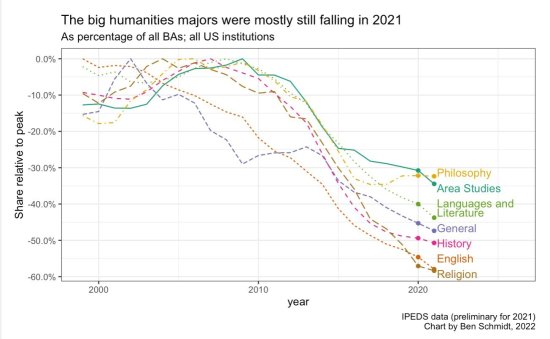
Decline of English majors

History and most of other humanities majors obviously show similar declines. Meanwhile, the number of jobs in journalism has approximately halved since the year 2000; academic jobs in the humanities cratered in 2009, from an already low starting point, and have never recovered; even jobs teaching in high school humanities subjects have a much more ideological, rather than humanistic, cast than they did ten years ago. What’s taken the place of reading, if anything? Instagram, Snapchat, TikTok, and, above all, Twitter.

Twitter, in particular, seems to promote negative feedback and fear loops, in ways that media and other institutions haven’t yet figured out how to resist. The jobs that supported the thinkers, critics, starting-out novelists, and others, aren’t there. Whatever might have replaced them, like Twitter, isn’t equivalent. The Internet doesn’t just push most “content” (songs, books, and so forth) towards zero—it also changes what people do, including the people who used to make up what I’m calling literary culture or book culture. The costs of housing also makes teaching a non-viable job for a primary earner in many big cities and suburbs.

What power and vibrancy remains in book culture has shifted towards nonfiction—either narrative nonfiction, like Michael Lewis, or data-driven nonfiction, with too many examples to cite. It still sells (sales aren’t a perfect representation of artistic merit or cultural vibrancy, but they’re not nothing, either). Dead authors go fast today not solely or primarily because of their work, but because the literary culture is going away fast, if it’s not already gone. When John Updike was in his prime, millions of people read him (or they at last bought Couples and could spit out some light book chat about it on command). The number of writers working today who the educated public, broadly conceived of, might know about is small: maybe Elena Ferrante, Michel Houllebecq, Sally Rooney, and perhaps a few others (none of those three are American, I note). I can’t even think of a figure like Elmore Leonard: someone writing linguistically interesting, highly plotted material. Bulk genre writers are still out there, but none who I’m aware of who have any literary ambition.

See some evidence for the decline of literary cultures in the decline of book advances; the Authors Guild, for example, claims that “writing-related earnings by American authors [… fell] to historic lows to a median of $6,080 in 2017, down 42 percent from 2009.” The kinds of freelancing that used to exist has largely disappeared too, or become economically untenable. In If You Absolutely Must by Freddie deBoer, he warns would-be writers that “Book advances have collapsed.” Money isn’t everything but the collapse of already-shaking foundations of book writing is notable, and quantifiable. Publishers appear to survive and profit primarily off very long copyright terms; their “backlist” keeps the lights on. Publishers seem, like journalists and academics, to have become modern-day clerics, at least for the time being, as I noted above.

Consider a more vibrant universe for literary culture, as mentioned in passing here:

From 1960 to 1973, book sales climbed 70 percent, but between 1973 and 1979 they added less than another six percent, and declined in 1980. Meanwhile, global media conglomerates had consolidated the industry. What had been small publishers typically owned by the founders or their heirs were now subsidiaries of CBS, Gulf + Western (later Paramount), MCA, RCA, or Time, Inc. The new owners demanded growth, implementing novel management techniques. Editors had once been the uncontested suzerains of title acquisition. In the 1970s they watched their power wane.

A world in which book sales (and advances) are growing is very different from one of decline. It’s reasonable to respond that writing has rarely been a path to fame or fortune, but it’s also reasonable to note that, even against the literary world of 10 or 20 years ago, the current one is less remunerative and less culturally central. Writers find the path to making any substantial money from their writing harder, and more treacherous. Normal people lament that they can’t get around to finishing a book; they rarely lament that they can’t get around to scrolling Instagram (that’s a descriptive observation of change).

At Scholar’s Stage, Tanner Greer traces the decline of the big book and the big author:

the last poet whose opinion anybody cared about was probably Allen Ginsberg. The last novelist to make waves outside of literary circles was probably Tom Wolfe—and he made his name through nonfiction writing (something similar could be for several of other prominent essayists turned novelists of his generation, like James Baldwin and Joan Didion). Harold Bloom was the last literary critic known outside of his own field; Allan Bloom, the last with the power to cause national controversy. Lin-Manuel Miranda is the lone playwright to achieve celebrity in several decades.

I’d be a bit broader than Greer: someone like Gillian Flynn writing Gone Girl seemed to have some cultural impact, but even books like Gone Girl seem to have stopped appearing. The cultural discussion rarely if ever revolves around books any more. Publishing and the larger culture have stopped producing Stephen Kings. Publishers, oddly to my mind, no longer even seem to want to try producing popular books, preferring instead to pursue insular ideological projects. The most vital energy in writing has been routed to Substack.

I caught the tail end of a humane and human-focused literary culture that’s largely been succeeded by a political and moral-focused culture that I hesitate to call literary, even though it’s taken over what remains of those literary-type institutions. This change has also coincided with a lessening of interest in those institutions: very few people want to be clerics and scolds—many fewer than wonder about the human condition, though the ones who do want to be clerics and scolds form the intolerant minority in many institutions. Shifting from the one to the other seems like a net loss to me, but also a net loss that I’m personally unable to arrest or alter. If I had to pick a date range for this death, it’d probably be 2009 – 2015: the Great Recession eliminates many of the institutional jobs and professions that once existed, along with any plausible path into them for all but the luckiest, and by 2015 social media and scold culture had taken over. Culture is define but easy to feel as you exist within and around it. By 2010, Facebook had become truly mainstream, and everyone’s uncle and grandma weren’t just on the Internet for email and search engines, but for other people and their opinions.

Maybe mainstream literary culture has been replaced by some number of smaller micro-cultures, but those microcultures don’t add up to what used to be a macroculture.

In this essay, I write:

I’ve been annoying friends and acquaintances by asking, “How many books did you read in the last year?” Usually this is greeted with some suspicion or surprise. Why am I being ambushed? Then there are qualifications: “I’ve been really busy,” “It’s hard to find time to read,” “I used to read a lot.” I say I’m not judging them—this is true, I will emphasize—and am looking for an integer answer. Most often it’s something like one or two, followed by declamations of highbrow plans to Read More In the Future. A good and noble sentiment, like starting that diet. Then I ask, “How many of the people you know read more than a book or two a year?” Usually there’s some thinking, and rattling off of one or two names, followed by silence, as the person thinks through the people they know. “So, out of the few hundred people you might know well enough to know, Jack and Mary are the two people you know who read somewhat regularly?” They nod. “And that is why the publishing industry works poorly,” I say. In the before-times, anyone interested in a world greater than what’s available around them and on network TV had to read, most often books, which isn’t true any more and, barring some kind of catastrophe, probably won’t be true again.

Reading back over this I realize it has the tone and quality of a complaint, but it’s meant as a description, and complaining about cultural changes is about as effective as shaking one’s fist at the sky: I’m trying to look at what’s happening, not whine about it. Publishers go woke and see the sales of fiction fall and respond by doubling down, but I’m not in the publishing business and the intra-business signaling that goes on there. One could argue changes noted are for the better. Whining about aggregate behavior and choices has rarely, if ever, changed it. I don’t think literary culture will ever return, any more Latin, epic poetry, classical music, opera, or any number of other once-vital cultural products and systems will.

In some ways, we’re moving backwards, towards a cultural fictional universe with less clearly demarcated lines between “fact” and “fiction” (I remember being surprised, when I started teaching, by undergrads who didn’t know a novel or short stories are fiction, or who called nonfiction works “novels”). Every day, each of us is helping whatever comes next, become. The intertwined forces of technology and culture move primarily in a single direction. The desire for story will remain but the manifestation of that desire aren’t static. Articles like “Leisure reading in the U.S. is at an all-time low” appear routinely. It’s hard to have literary culture among a population that doesn’t read.

See also:

* What happened with Deconstruction? And why is there so much bad writing in academia?

* Postmodernisms: What does that mean?