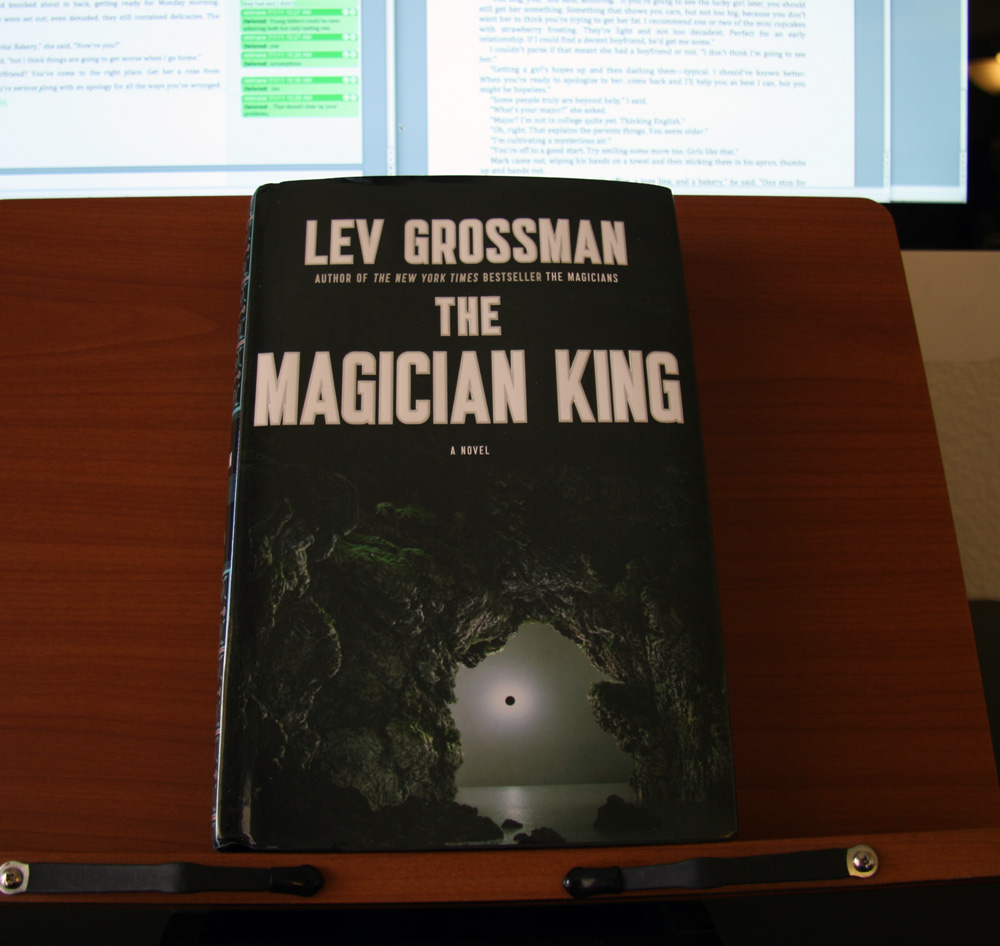
Lev Grossman’s The Magician King arrives:

… alas, you won’t see any further comments on it until August 9—the publication date.

I’ve been getting more interesting books from publishers lately: Carolyn Cooke’s Daughters of the Revolution is sitting next to my bed, half-read and still promising, and now The Magician King.

Mac OS 10.7 is out today, and I don't care because "In the Beginning was the Command Line"

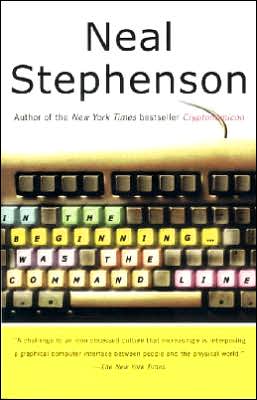
A few days ago, I was reading Neal Stephenson’s incredible essay “In the Beginning was the Command Line,” which you can download for free at the link. His work can’t really be summarized because the metaphors he develops are too potent and elaborate to flatten into a single line that describes what he does with them; by the time you finish summarizing, you might as well recreate the whole thing. Despite the folly in attempting summarization, I want to note that he’s cottoned on to the major cultural differences between Windows, Macs, and Unixes like Linux, and by the time you’re done you with his essay realize the fundamental divide in the world isn’t between right and left or religions and secular, but between contemporary “Morlocks” and “Eloi,” the former being the ones who run things and the latter being the ones who mostly consume them (you can see similar themes running through Turn On, Tune In, Veg Out and Anathem). In the meantime, visual culture has become a poorly understood but highly developed global force bathing virtually everyone in its ambiance, and that might not be such a bad thing most of the time. The last issue doesn’t have that much to do with this particular post, but if you want to understand it, and hence an aspect of the world, go read “In the Beginning was the Command Line.”

He wrote the essay in 1999, and the problem with operating systems, or “OSes” in nerd parlance, is that none of them were very good. They crashed frequently or were incredibly hard to use, especially for Eloi, or both. In the last ten years, they’ve gotten much less crashy (OS X, Windows) or much easier to use (Linux) or both, to the point where the differences to a random user who wants to write e-mails, look at YouTube videos, browse for adult material, and look at FaceBook status updates probably won’t notice the quirks of each operating system. Games are a major difference, since OS X and Windows have lots of modern games available and Linux doesn’t, but if you don’t care about games either—and I don’t—you’ll want to discount those.

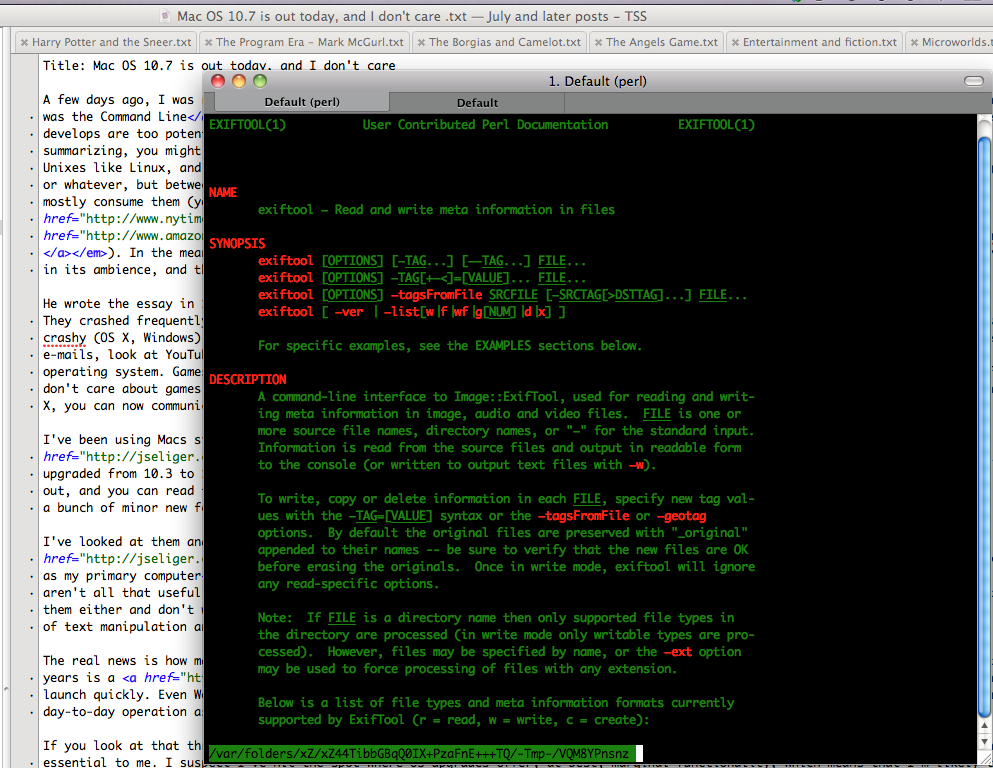
Some of the major technical differentiators have shrunk: on OS X, you can now communicate with your machine using the Terminal; on mine, I’ve changed the color scheme to trendy green-on-black. Windows has a system called PowerShell, and Linux has various ways to hide the stuff underneath it. But the cultural differences remain. Windows machines still mostly come festooned with ugly stickers (“These horrible stickers are much like the intrusive ads popular on pre-Google search engines. They say to the customer: you are unimportant. We care about Intel and Microsoft, not you”) and a lot of crap-ware installed. OS X machines look like they were designed by a forward-thinking 1960s science fiction special effects person for use by the alien beings who land promising peace and prosperity but actually want to build a conduit straight into your mind and control your thoughts. Linux machines still sometimes want you to edit files in /src to get your damn wireless network working. Given the slowness of cultural change relative to technical change, it shouldn’t be surprising that many of Stephenson’s generalizations hold up even though many technical issues have changed.

This throat clearing leads to the subject of today’s much-hyped launch of Apple’s latest operating system, which is an incremental improvement to the company’s previous operating system. I’ve been using Macs since 2004. I started with an aluminum PowerBook that you can see in this appropriately messy picture. In that time, I’ve steadily upgraded from 10.3 to 10.6, but the move from 10.5 to 10.6 didn’t bring any tangible benefits to my day-to-day activities. It did, however, mess up some of the programs I used and still use regularly, which made me more gun-shy about OS updates than I have been previously. Now 10.7 is out, and you can read the best review of it here. It’s got a bunch of minor new features, most of which I won’t use and are overhyped by Apple’s ferocious marketing department, which most people call “the press.”

I’ve looked at those features and found nothing or nothing compelling. Many are aimed to laptops, but I don’t use a laptop as my primary computer or have a trackpad on my iMac, and it seems like the “gestures” that are now part of OS X, while useful, aren’t all that useful. Apple is also integrating various Internet services into the operating system, but I don’t really care about them either and don’t want to pay for iCloud. I don’t see the point for the kinds of things I do, which mostly tend towards various kind of text manipulation and some messing around with video. It’s not that I can’t afford the upgrade—Apple is only charging $30 for it. I just don’t need it and simultaneously find it annoying that Apple will only offer it through their proprietary “app store,” which means that when I need to reinstall because the hard drive dies I won’t be able to use disks to start the machine.

Still, those are all quibbles of the kind that start boring flame wars among nerds on the Internet. I’ve saved the real news for the very bottom of the page: it’s not about Apple’s OS upgrade, which, at one point, I would’ve installed on Day 1. I remember when OS X 10.4 came out, offering Spotlight, and I was blown away. Full-text search anywhere on your machine is great. It’s magical. I use it every day. Even 10.5 finally had integrated backup software. But 10.6 had a lot of developer enhancements I don’t use directly. Now, 10.7 has improved things further, but in a way that’s just not important to me. The real news is about how mature a lot of computer technology has become. By far the most useful hardware upgrade I’ve seen in the last ten years is a solid state drive (SSD), which makes boots times minimal and applications launch quickly. Even Word and Photoshop, both notorious resource hogs, launch in seconds. New OS versions used to routinely offer faster day-to-day operation as libraries were improved, but it’s not important to move from “fast enough” to “faster.” The most useful software upgrades I’ve seen were moving from the insecure early versions of Windows XP to OS X, and the move from 10.3 to 10.4. The move to 10.7 is wildly unexciting. So much so that I’m going to skip it.

If you look at the list of features in 10.7, most sound okay (like application persistence) but aren’t essential. I rather suspect I’m going to skip a lot of software and hardware upgrades in the coming years. Why bother? The new iterations of OSes aren’t likely to enable me to be able to do something substantial that I wasn’t able to do before, which, in my view, is what computers are supposed to do—like most of the things we make of buy. If you’re an economist, you could call this something like the individual production possibility curve. Installing Devonthink Pro expanded mine. Scrivener might have too. Mac Freedom definitely has, and I’m going to turn it on shortly after I post this essay. The latest operating system, though? Not so much. The latest software comes and goes, but the cultural differences—and discussions of what those differences mean—endure, even as they shrink over time.

EDIT: Somewhat relevant:

Further thoughts on the Kinesis Advantage, Unicomp Space Saver, and Das Keyboard—two years later

EDIT: Since writing this, I’ve switched, as of 2023, to a Kinesis 360 keyboard. Someone who wants to try a Kinesis keyboard more cheaply should check eBay and sell the keyboard to someone else if it doesn’t work out.

The series of reviews I wrote in my search for the perfect keyboard continue to rack up dozens or hundreds of hits per week; the most extensive posts cover the Kinesis Advantage, Unicomp Customizer / Space Saver, and the Das Keyboard. The Unicomp review in particular has become a repository for thoughts on the keyboard, with 60 comments so far and new ones popping up regularly.

By now I’ve spent two years using the Advantage as my primary keyboard, and since then people have e-mailed me an array of questions about it. The latest comes from a guy who is curious about how it compares to the Das Keyboard, especially regarding the key switches, and whether his size (at more than 6′ 7″) might make the keyboard impractical.

The keys on the Kinesis Advantage are “Cherry Brown” switches, and those on the Das Keyboard are “Cherry Blue” switches (if you didn’t see the Das Keyboard Review, look now, especially at the video). There’s some difference between the Browns and Blues, but I think if you gave me the Coke-Pepsi challenge by blind-folding me, putting a keyboard with Browns under my fingers and then swapping it for an identical one with Blues, I doubt I’d care, apart from the Blues being nosier. In terms of feel, they’re a distinction without a difference.

If you said, “Here’s a Kinesis Advantage with Model M-style buckling springs,” I’d take it. But the difference between the buckling springs and Cherry switches is slight at this level of quality. It’s like the Nikon, Canon, and Sony camera aficionados duking it out over recent DSLRs. The differences between Canon’s Rebels and the Nikon’s  consumer “D” series cameras are marginal. Most people wouldn’t notice. And since most pictures are being shrunk for Flickr or Facebook anyway, the importance of marginal quality improvements declines further.

I’ve used the Advantage close to every day for years, and I can’t see or feel any difference in the keys over time. Normal keyboards, like the ones that ship with generic desktop computers, get “sticky” or otherwise problematic after a lot of use. This one doesn’t. Searching for “Kinesis Advantage longevity” and similar strings (like durability) doesn’t bring up any horror stories. The Advantage doesn’t have the extreme reputation that IBM Model Ms have, but Kinesis also hasn’t been making them since the 1980s and the Advantage is, by its cost and the commitment necessary to retrain yourself, a much more niche product.

I’m 6’1″, not 6’7″, but I don’t very tall guys are likely to have problems with the Kinesis. Maybe if you have Shaq-size hands you might need or want larger keys, but that’s a niche case. My elbows aren’t turned in at all when I use the Advantage; yours might have to slightly, if you’ve got especially broad shoulders, but again, I don’t think the effect will be too pronounced. I’ve also seen women as short as 5’4″ use the keyboard (note: this is not a euphemism) without any obvious ergonomic problems.

Anyone having trouble with wrists, should get a desk / chair combination that keeps the elbows at a 90 degree angle, likely via a sit-stand desk. The top of the screen should be at your eye level. I have three books stuck under my iMac, lifting the screen to the desire height, and a Humanscale Keyboard tray to accomplish this. If you’re using a laptop and it spends most of its life in one place, try to get an external monitor, and get the external monitor at the desired height, or buy a laptop stand (the Griffin Elevator is popular). This might not be practical or might be too expensive, depending on where you work, but if you can do it you’ll have a better overall experience. Just adjusting the height of your monitor and chair might do more for you than a very expensive keyboard.

EDIT: There’s a worthwhile Hacker News discussion about this essay; sometimes HN will generate thousands of visitors who leave virtually no comments, because they comment on HN itself. The top two comments say the Kinesis Advantage is quite durable, and both people report that they’ve keyboards for more than ten years. One says Kinesis will repair keyboards that’ve been caught “drinking” soda. They allay the longevity worry, especially if Kinesis offers service. It would be a major bummer to have to re-buy a $300 keyboard every five years because it breaks, but $300 also buys high-quality keys that can take a lot of clacking.

Thoughts on Anita Shreve's Testimony and Tom Perrotta's Election

I recently read Tom Perrotta’s Election and Anita Shreve’s Testimony very closely because they’re similar to a novel I’m working on and relevant to an academic paper, which is a two-for-one deal. I like both novels, but reading Testimony a third time gave me some insight into how it functions; don’t keep reading if you fear spoilers:

1) Testimony is much looser than Election; I think Election is a better book for that reason. We get a better sense of character from it, and the motivations of each characters. I love the scene where Tammy is crying in front of the school counselor and says, “I’m in love,” but she loves her best friend, or former best friend, Lisa. The counselor says, “When you’re ready, you can tell me all about him.” Tammy thinks, “That’s when I realized how impossible it was, my whole life.” She’s right. That also gives motivation for everything else in the story, which looks inexplicable to everyone else. In Testimony, Silas and Rob in particular remain ciphers throughout the novel. That might be intentional.

2) There are more characters in Testimony; their voices are more different than the voices in Election, but too many of them are weak. Silas is or sounds like an idiot, although there’s an explanation in the sense that “he” wrote his sections in the cold, while he’s nuts with grief at his own behavior, and when he might be committing suicide because he can’t stand facing his family and Noelle. Noelle is little better as a character because she’s a little smarter. Sienna is like my dumber freshmen. Ellen, Rob’s mom, may be the most irritating: she speaks in the second person, and aside from her caring for Rob, she doesn’t have much of a function. I get the impression that she’s there to give conventional middle-class women someone to root for than because she moves the story along. Tammy and Paul’s mother does something similar in Election, but she has many fewer scenes.

3) Testimony has a much weaker sense of scene in general; the scenes it does have are much looser and less focused, as noted above. The abstract observations in Election are grounded in the immediate actions of the characters. The ones in Testimony sometimes aren’t. The Ellen character in particular has this problem. Still, some the lyrical sections in Testimony are quite nice.

4) Both novels have choppier timelines than I realized when I first read through them. Readers can probably follow more dodges and weaves than I fully realized previously, and they can handle moving backward and forward in time without explicit direction.

5) The teenage characters mentioned in point two show the danger of letting teenagers speak as teenagers; I’m fond of quoting Salon‘s review of “90210” and “Gossip Girl” on the subject: “Where Blair and Serena’s lines snap, crackle and pop with wit and cleverness, the soggy stars of “90210” stumble over one cliché after another. “Awkward!” Annie blurts at Ethan after they encounter Ethan’s ex Naomi, then Annie does her best impression of the cynical teenage eye roll, as Ethan mutters, “Good times!” Oof. [. . .] But every scene is filled with such teen-bot tripe.” That’s not true of Testimony, but the novel flirts with this problem. Mike anchors the story sufficiently that we don’t get lost among the inarticulate. Noelle is also more knowledgable than the others, and we’ve all met Siennas. The reason for Silas’s meanderings get explained at the end.

6) I’m impressed that Shreve kept the knowledge that only Mike, Anna, Owen, and Silas have from leaking into the other characters. Silas’s actions remain mysterious to us until we learn his mother is having an affair with Mike. The idea that this would cause him to get drunk and bang a hot 14-year-old girl stretches plausibility but doesn’t tear it.

7) The “professional” characters are very flat, and factual, like the reporter, Colm, and the lawyer; these are supposed to provide a counterpoint to the highly emotionally charged scenes from the teenagers, who aren’t articulate and don’t know what’s happening to them. Except for Noelle, who is looking back, and J. Dot, who is aloof, an asshole, and perhaps right.

8) There are only really two major events in the novel: the making of the tape and the Mike / Anna romance. Virtually everything else is lead up, reaction to, or speculation regarding those two things. Contrast that with Election’s romances: there’s Tracy-Jack. Paul-Lisa. Tammy-Lisa, and Tammy’s crush on Dana. There are other events: Mr. M encourages Paul to run. The Warren family constellation, with its tensions. Tracy’s desire to be president, or be something, with President being a reasonable proxy. The election itself ensures that the novel is about more than just who’s with who. There’s a lot more narrative and less “This is how I feel.” It’s also shorter novel. The longer book doesn’t have quite enough narrative to sustain it. There are a number of places where I say things like, “This chapter is fairly useless.” That’s for a reason.

9) The entries / chapters for Testimony are much longer than the ones for Election because each chapter is much, much longer. I don’t think a greater or smaller number of chapters is inherently better, but in this case I think the game goes to Perrotta; Election has 100 “chapters” or unique voices who speak, while Testimony has 53.

10) Looking over this, I’m too harsh on Testimony. It’s still a very finely written book. I read very few books twice, let alone more than twice, let alone think about them consciously as models for a novel or worth writing an academic article about.
Thoughts on Anita Shreve’s Testimony and Tom Perrotta’s Election

I recently read Tom Perrotta’s Election and Anita Shreve’s Testimony very closely because they’re similar to a novel I’m working on and relevant to an academic paper, which is a two-for-one deal. I like both novels, but reading Testimony a third time gave me some insight into how it functions; don’t keep reading if you fear spoilers:

1) Testimony is much looser than Election; I think Election is a better book for that reason. We get a better sense of character from it, and the motivations of each characters. I love the scene where Tammy is crying in front of the school counselor and says, “I’m in love,” but she loves her best friend, or former best friend, Lisa. The counselor says, “When you’re ready, you can tell me all about him.” Tammy thinks, “That’s when I realized how impossible it was, my whole life.” She’s right. That also gives motivation for everything else in the story, which looks inexplicable to everyone else. In Testimony, Silas and Rob in particular remain ciphers throughout the novel. That might be intentional.

2) There are more characters in Testimony; their voices are more different than the voices in Election, but too many of them are weak. Silas is or sounds like an idiot, although there’s an explanation in the sense that “he” wrote his sections in the cold, while he’s nuts with grief at his own behavior, and when he might be committing suicide because he can’t stand facing his family and Noelle. Noelle is little better as a character because she’s a little smarter. Sienna is like my dumber freshmen. Ellen, Rob’s mom, may be the most irritating: she speaks in the second person, and aside from her caring for Rob, she doesn’t have much of a function. I get the impression that she’s there to give conventional middle-class women someone to root for than because she moves the story along. Tammy and Paul’s mother does something similar in Election, but she has many fewer scenes.

3) Testimony has a much weaker sense of scene in general; the scenes it does have are much looser and less focused, as noted above. The abstract observations in Election are grounded in the immediate actions of the characters. The ones in Testimony sometimes aren’t. The Ellen character in particular has this problem. Still, some the lyrical sections in Testimony are quite nice.

4) Both novels have choppier timelines than I realized when I first read through them. Readers can probably follow more dodges and weaves than I fully realized previously, and they can handle moving backward and forward in time without explicit direction.

5) The teenage characters mentioned in point two show the danger of letting teenagers speak as teenagers; I’m fond of quoting Salon‘s review of “90210” and “Gossip Girl” on the subject: “Where Blair and Serena’s lines snap, crackle and pop with wit and cleverness, the soggy stars of “90210” stumble over one cliché after another. “Awkward!” Annie blurts at Ethan after they encounter Ethan’s ex Naomi, then Annie does her best impression of the cynical teenage eye roll, as Ethan mutters, “Good times!” Oof. [. . .] But every scene is filled with such teen-bot tripe.” That’s not true of Testimony, but the novel flirts with this problem. Mike anchors the story sufficiently that we don’t get lost among the inarticulate. Noelle is also more knowledgable than the others, and we’ve all met Siennas. The reason for Silas’s meanderings get explained at the end.

6) I’m impressed that Shreve kept the knowledge that only Mike, Anna, Owen, and Silas have from leaking into the other characters. Silas’s actions remain mysterious to us until we learn his mother is having an affair with Mike. The idea that this would cause him to get drunk and bang a hot 14-year-old girl stretches plausibility but doesn’t tear it.

7) The “professional” characters are very flat, and factual, like the reporter, Colm, and the lawyer; these are supposed to provide a counterpoint to the highly emotionally charged scenes from the teenagers, who aren’t articulate and don’t know what’s happening to them. Except for Noelle, who is looking back, and J. Dot, who is aloof, an asshole, and perhaps right.

8) There are only really two major events in the novel: the making of the tape and the Mike / Anna romance. Virtually everything else is lead up, reaction to, or speculation regarding those two things. Contrast that with Election’s romances: there’s Tracy-Jack. Paul-Lisa. Tammy-Lisa, and Tammy’s crush on Dana. There are other events: Mr. M encourages Paul to run. The Warren family constellation, with its tensions. Tracy’s desire to be president, or be something, with President being a reasonable proxy. The election itself ensures that the novel is about more than just who’s with who. There’s a lot more narrative and less “This is how I feel.” It’s also shorter novel. The longer book doesn’t have quite enough narrative to sustain it. There are a number of places where I say things like, “This chapter is fairly useless.” That’s for a reason.

9) The entries / chapters for Testimony are much longer than the ones for Election because each chapter is much, much longer. I don’t think a greater or smaller number of chapters is inherently better, but in this case I think the game goes to Perrotta; Election has 100 “chapters” or unique voices who speak, while Testimony has 53.

10) Looking over this, I’m too harsh on Testimony. It’s still a very finely written book. I read very few books twice, let alone more than twice, let alone think about them consciously as models for a novel or worth writing an academic article about.
What's wrong with Harry Potter? Sophistication.

In The Atlantic, David Thier describes “How the ‘Harry Potter’ Movies Succeeded Where the Books Failed.” I haven’t seen all the movies or read all the books, so I can’t comment on their relative merit, but notice this in Thier’s post:

The basic story in Harry Potter is an old one, and a good one. The boy of destiny is plucked from ordinary circumstances and becomes incredulous when he’s told the truth behind his real identity. Some training, trials, and a crisis of self-confidence later, he emerges as the true hero ready to defeat ultimate evil.

In real life, it seems like the problem isn’t often defeating ultimate evil: it’s identifying ultimate evil. Or recognizing that ultimate evil doesn’t exist very often, and more often there are banal evils, or inadvertent evils, or people just trying to get along but harming others as they do, or working in favor of malign self-interest, or some variation on these themes. Adult literature tends to recognize this. Children’s literature seldom does. Even The Lord of the Rings spends a lot of time trying to decide how to respond and who should wield power. Harry Potter seldom does that, from what I can recall: Harry is destined from birth. I don’t appear destined from birth to do much of anything; neither does anyone else (more on that below).

Robin Hanson says something similar to the preceding paragraph in “Beware Morality Porn:”

[. . .] movies usually focus more on whether characters have the strength of will to do what is obviously right than on whether they have the wisdom to discern what is right. And movie characters rarely have to choose between the praise of associates and doing the right thing – key associates usually support doing the right thing.

He uses Lord of the Rings as an example, although I don’t think it’s as appropriate as some others. The book version of The Lord of the Rings makes a point of showing how Aragorn, Gandalf, and other “good” characters work to limit their own power and define what the “right” thing is, beyond the defeat of Sauron. In the past, the Elves and Númenóreans repeatedly treated with Sauron, to their detriment. It’s not completely obvious what the “right” thing to do is: in the “Council of Elrond” chapter in The Fellowship of the Ring, proposals about using the Ring against Sauron are debated. It’s true that, by the time we get to The Fellowship of the Ring, it’s pretty clear Sauron’s the bad guy, but only because of past book-time experiences with him.

As mentioned above, I think movies and books have a larger problem (and one that, if I recall correctly, Harry Potter does address to some extent): virtually no one is “destined” to do anything. People who accomplish major deeds often just have the right combination of circumstances, luck, tenacity, and ability. Arguably only the last two are influenced by the person themselves. Taken together, the problems with pre-destiny and automatic right/wrong might go under the header of “sophistication.” More sophisticated novels (or movies) will tend to recognize and/or deal with these problems. Less sophisticated novels (or movies) won’t.


If you’re interested in Harry Potter, A.S. Byatt’s “Harry Potter and the Childish Adult” is worth reading.

What’s wrong with Harry Potter? Sophistication.

In The Atlantic, David Thier describes How the ‘Harry Potter’ Movies Succeeded Where the Books Failed. I haven’t seen all the movies or read all the books, so I can’t comment on their relative merit, but notice this in Their’s post:

The basic story in Harry Potter is an old one, and a good one. The boy of destiny is plucked from ordinary circumstances and becomes incredulous when he’s told the truth behind his real identity. Some training, trials, and a crisis of self-confidence later, he emerges as the true hero ready to defeat ultimate evil.

In real life, it seems like the problem isn’t often defeating ultimate evil: it’s identifying ultimate evil. Or recognizing that ultimate evil doesn’t exist very often, and more often there are banal evils, or inadvertent evils, or people just trying to get along but harming others as they do, or working in favor of malign self-interest, or some variation on these themes. Adult literature tends to recognize this. Children’s literature seldom does. Even The Lord of the Rings spends a lot of time trying to decide how to respond and who should wield power. Harry Potter seldom does that, from what I can recall: Harry is destined from birth. I don’t appear destined from birth to do much of anything; neither does anyone else (more on that below).

Robin Hanson says something similar to the preceding paragraph in “Beware Morality Porn:”

[. . .] movies usually focus more on whether characters have the strength of will to do what is obviously right than on whether they have the wisdom to discern what is right. And movie characters rarely have to choose between the praise of associates and doing the right thing – key associates usually support doing the right thing.

He uses Lord of the Rings as an example, although I don’t think it’s as appropriate as some others. The book version of The Lord of the Rings makes a point of showing how Aragorn, Gandalf, and other “good” characters work to limit their own power and define what the “right” thing is, beyond the defeat of Sauron. In the past, the Elves and Númenóreans repeatedly treated with Sauron, to their detriment. It’s not completely obvious what the “right” thing to do is: in the “Council of Elrond” chapter in The Fellowship of the Ring, proposals about using the Ring against Sauron are debated. It’s true that, by the time we get to The Fellowship of the Ring, it’s pretty clear Sauron’s the bad guy, but only because of past book-time experiences with him.

As mentioned above, I think movies and books have a larger problem (and one that, if I recall correctly, Harry Potter does address to some extent): virtually no one is “destined” to do anything. People who accomplish major deeds often just have the right combination of circumstances, luck, tenacity, and ability. Arguably only the last two are influenced by the person themselves. Taken together, the problems with pre-destiny and automatic right/wrong might go under the header of “sophistication.” More sophisticated novels (or movies) will tend to recognize and/or deal with these problems. Less sophisticated novels (or movies) won’t.


If you’re interested in Harry Potter, A.S. Byatt’s “Harry Potter and the Childish Adult” is worth reading.

Early July Links: Neal Stephenson's Remade, Amanda Knox, procrastination, sex / violence double standard, marriage (with infidelities), the Rolling Stones and art, and more

* How did I miss this?! Neal Sephenson has a new novel coming out in September, this one called Remade. I only discovered it through Amazon’s see-also feature from The Magician King‘s page.

* The Neverending Nightmare of Amanda Knox: How a naive kid from Seattle was coerced into confessing to a brutal murder and wound up sentenced to 26 years in an Italian jail. The story of justice gone wrong is, frankly, bizarre.

* From “What does procrastination tell us about ourselves?”

. The philosopher Mark Kingwell puts it in existential terms: “Procrastination most often arises from a sense that there is too much to do, and hence no single aspect of the to-do worth doing. . . . Underneath this rather antic form of action-as-inaction is the much more unsettling question whether anything is worth doing at all.” In that sense, it might be useful to think about two kinds of procrastination: the kind that is genuinely akratic and the kind that’s telling you that what you’re supposed to be doing has, deep down, no real point. The procrastinator’s challenge, and perhaps the philosopher’s, too, is to figure out which is which.

* Court reaffirms: Sex much worse than violence, and Americans are afraid of sex. Not that you needed a court to point this out.

* Browse the Artifacts of Geek History in Jay Walker’s Library.

* Marriage, with Infidelities, an NYT discussion of Dan Savage.

* The bicycle dividend, which may occur in part because there’s lots of low-hanging fruit, so to speak, in creating bike lanes, while pretty much every area that could be efficiently paved for car traffic already has been.

* Transformers negs delivered by critics are hilarious; my possible favorite: “To [Bay’s] credit, during the first hour and a half or so of this two-and-a-half-hour epic, there are several lucid stretches … At times, the chaos he creates within the film frame is so abstract and exaggerated — think of him as Action Jackson Pollock — it can feel exhilarating, but the relentlessness is exhausting.”

* Cisco helps China spy on its citizens. I wonder what it would’ve done during the Holocaust.

* Another critique of a dumb WSJ editorial.

* Robin Hanson:

[. . . ] movies usually focus more on whether characters have the strength of will to do what is obviously right than on whether they have the wisdom to discern what is right. And movies usually show key associates as supporting the moral action, so characters rarely have to choose between praise of associates and doing the right thing.

* Final thought: is the culture of spurious credentialism is toxic to intellectual exploration? Discuss. Charlie Stross, hilarious.

* There’s a fascinating WSJ article about the Rolling Stones that’s really about the artistic temperament. I noticed two bits:

As for Mr. Richards, he wasn’t much interested in toying with history. “My point of view on the new stuff,” he said, “is I didn’t want to repaint the smile on the Mona Lisa.”

In other words, you’re not beholden to the past, even if you should be aware of it. The other:

“Once the band got to work,” he said, “it never mattered to me or the other guys.”

Working through the night, recording songs, partial songs and riffs that had the potential to develop into a song, the Nellcôte sessions dragged on. Said Mr. Chess, “The way the Rolling Stones works is the opposite of deliberate.” Reconnecting with their musical influences at times provided a sort of focus. “They were reacting to soul music. All of their influences are in there.”

In other words, be productive. If you keep doing whatever your art is, you might be surprised by what you find in your own work.

* Apartment developers bypass suburbs, target Seattle.

* CIA’s ‘Facebook’ Program Dramatically Cut Agency’s Costs.

Early July Links: Neal Stephenson’s Remade, Amanda Knox, procrastination, sex / violence double standard, marriage (with infidelities), the Rolling Stones and art, and more

* How did I miss this?! Neal Sephenson has a new novel coming out in September, this one called Remade. I only discovered it through Amazon’s see-also feature from The Magician King‘s page.

* The Neverending Nightmare of Amanda Knox: How a naive kid from Seattle was coerced into confessing to a brutal murder and wound up sentenced to 26 years in an Italian jail. The story of justice gone wrong is, frankly, bizarre.

* From “What does procrastination tell us about ourselves?”

. The philosopher Mark Kingwell puts it in existential terms: “Procrastination most often arises from a sense that there is too much to do, and hence no single aspect of the to-do worth doing. . . . Underneath this rather antic form of action-as-inaction is the much more unsettling question whether anything is worth doing at all.” In that sense, it might be useful to think about two kinds of procrastination: the kind that is genuinely akratic and the kind that’s telling you that what you’re supposed to be doing has, deep down, no real point. The procrastinator’s challenge, and perhaps the philosopher’s, too, is to figure out which is which.

* Court reaffirms: Sex much worse than violence, and Americans are afraid of sex. Not that you needed a court to point this out.

* Browse the Artifacts of Geek History in Jay Walker’s Library.

* Marriage, with Infidelities, an NYT discussion of Dan Savage.

* The bicycle dividend, which may occur in part because there’s lots of low-hanging fruit, so to speak, in creating bike lanes, while pretty much every area that could be efficiently paved for car traffic already has been.

* Transformers negs delivered by critics are hilarious; my possible favorite: “To [Bay’s] credit, during the first hour and a half or so of this two-and-a-half-hour epic, there are several lucid stretches … At times, the chaos he creates within the film frame is so abstract and exaggerated — think of him as Action Jackson Pollock — it can feel exhilarating, but the relentlessness is exhausting.”

* Cisco helps China spy on its citizens. I wonder what it would’ve done during the Holocaust.

* Another critique of a dumb WSJ editorial.

* Robin Hanson:

[. . . ] movies usually focus more on whether characters have the strength of will to do what is obviously right than on whether they have the wisdom to discern what is right. And movies usually show key associates as supporting the moral action, so characters rarely have to choose between praise of associates and doing the right thing.

* Final thought: is the culture of spurious credentialism is toxic to intellectual exploration? Discuss. Charlie Stross, hilarious.

* There’s a fascinating WSJ article about the Rolling Stones that’s really about the artistic temperament. I noticed two bits:

As for Mr. Richards, he wasn’t much interested in toying with history. “My point of view on the new stuff,” he said, “is I didn’t want to repaint the smile on the Mona Lisa.”

In other words, you’re not beholden to the past, even if you should be aware of it. The other:

“Once the band got to work,” he said, “it never mattered to me or the other guys.”

Working through the night, recording songs, partial songs and riffs that had the potential to develop into a song, the Nellcôte sessions dragged on. Said Mr. Chess, “The way the Rolling Stones works is the opposite of deliberate.” Reconnecting with their musical influences at times provided a sort of focus. “They were reacting to soul music. All of their influences are in there.”

In other words, be productive. If you keep doing whatever your art is, you might be surprised by what you find in your own work.

* Apartment developers bypass suburbs, target Seattle.

* CIA’s ‘Facebook’ Program Dramatically Cut Agency’s Costs.

Why don't novels with love stories describe how characters come to like each other?

I was talking to a friend about Anita Shreve’s Testimony, which has a bunch of characters who fall in love or lust with one another, including the four whose taped orgy unleashes emergent destructive forces on everyone around them. Or, rather, the reaction to the video unleashes those forces; the video itself is harmless save for how others treat it. The important thing for this post, however, is how those moments of love or lust are depicted. The short version is that they aren’t. In one sentence, characters are going about their business; in another, they are noticing one another in a potentially erotic way; many sentences later, they’re in bed with each other. But the moments when real interest develops are never really portrayed, save maybe through action or sudden thought. It’s like trying to describe the moment when an idea hits: we can resort to metaphor, but we can’t truly describe what it’s like to be in a state of flow.

My best guess to the question posed by the title is that in real life very few people decide they like or love each other. It just. . . happens, like an idea. You might see manifestations of it; in Testimony, the relationship between Mike and Anna really starts with the touch of a hand. The one between Silas and Noelle begins with them spending more time together. The attractive is partly physical and partly something else. The “something else” interests me.

I wouldn’t be surprised if, in evolutionary terms, we’re not even supposed to understand or analyze our feelings; they’re just supposed to guide us to survival and reproduction. Based on the large number of studies cited in The Evolutionary Biology of Human Female Sexuality and elsewhere that show how much we understand subconsciously, this probably shouldn’t surprise us. But it does, especially in the context of stories, since so many of them have or should have reasons behind the characters’ action in them. When we push those reasons, however, we begin to see that they’re not so firm as we might once have imagined. I’d like to know about the limits of stories and how they reflect the way people act because sussing the limits helps us figure out how, if at all, we can or should transcend them.