Puzzles about oncology and clinical trials

Some things about the clinical trial process—and the behaviors of the drug companies, hospitals, and oncologists that are part of the clinical trial process—puzzle me, because I notice problems and common, suboptimal practices that seem easy to fix and yet, from what I’ve experienced and observed, they persist. That slows medicine and science, which is euphemistic way of saying: “more people die, sooner, than would by using better practices and processes.” Patient care and outcomes suffer. Hard-to-fix problems like the FDA aren’t readily solved because those fixes likely demand congressional action, and most congresspeople aren’t pressured to act by voters, and the potential voters most interested in FDA reform have probably already died, or are in the process of dying, and thus are unable to make it to their local polling place.*

“Puzzles about oncology and clinical trials” is a companion to “Please be dying, but not too quickly: A clinical trial story and three-part, very deep dive into the insanity that is the ‘modern’ clinical trial system. Buckle up.” The clinical trial system could be a lot worse, and many treatments obviously get through the system, but, in its current state, the clinical trial system far from optimal, to the point that I’d characterize it as “pretty decently broken.” Interestingly, too, almost all parties involved appear to acknowledge that it’s broken, but no one can seem to coordinate enough pieces to generate substantial improvement. While the clinical-trial field is being seduced by AI models and large-scale tech “solutions,” most of which don’t yet work, some of the problems I’ve noticed and am listing here could be, if not solved altogether, then at least substantially ameliorated at the level of the individual or department, rather than the level of states, the country as a whole, or the FDA:

1. Many oncologists don’t appear to know the clinical trial landscape, even in their sub-specialty. As you might’ve read in Bess’s “Please be dying, but not too quickly” essay / guide, almost none of the head and neck oncologists Bess and I talked to knew the head and neck clinical trial landscape well. Most barely seemed to know it at all, apart from vague reputation (“MD Anderson has a lot of trials” or “Try the University of Colorado” or “I’ve heard good things about Memorial-Sloan Kettering (MSK)”). A lot of that advice was helpful, and I don’t want to scorn it or the oncologists giving it, but that advice also wasn’t at the ideal resolution.

It’s puzzling that more oncologists don’t learn the clinical trial landscape, given how many patients must, like me, reach the end of conventional treatments and want or need to try whatever might be next. To a non-expert outsider, the trial landscape is a bizarre, confusing world that takes enormous time and effort to understand. But to an oncologist or someone else working in the field, it shouldn’t take more than a few hours once every month or two or even three to keep abreast of what’s happening.

In head and neck squamous cell carcinoma (HNSCC), the ailment that’s killing me, there are a lot of trials, though most aren’t highly relevant and perhaps 30 – 50 “good” trials are recruiting at any given moment. The “good ones” mean ones in which a drug company is investing heavily in the drug and the drug is at least in phase 1b and more likely phase 2. Moreover, trials can last years, with varying periods of enrollment, so once an oncologist understands the “good” trials, those trials are likely to be relevant for years. Keeping up with the better trials, even via clinicaltrials.gov, shouldn’t consume lots of time. It took Bess an unbelievable amount of effort and energy to get up to speed from nothing, but the trial situation is like riding a bike: starting from a stop is much tougher than maintaining speed.

Bess spent 50+ hours a week for six straight weeks trying to learn the head and neck clinical landscape, and, with the help of a great consultant named Eileen Faucher, she basically did. Though Bess is a doctor, she’s not an oncologist and doesn’t have the baseline expertise that comes from treating head and neck cancer patients as a career. Bess doesn’t attend the yearly ASCO: head and neck conference where breakthroughs and the research landscape are discussed. Yet she, despite being in the emergency room, somehow became better versed in both the most promising experimental molecules and the up-to-date clinical trial offerings than any other single physician we spoke with (a few were well-informed, to be sure, and if you are well informed and gathering up your outrage, please release it!). The big picture wasn’t obvious at first, but it was discoverable to a determined, non-expert ER doc, and therefore it should be to experts.

Although I’m now in a trial hosted by UCSD’s Moores Cancer Center for a bispecific antibody called MCLA-158 / petosemtamab, Bess just reached out to her contacts at back-up trials, because I’m getting scans on Nov. 21, and those scans may show that petosemtamab is failing and we should try something else, instead of waiting to die. The rate of return for a few “how’s it looking?” e-mails or calls from Bess to trial coordinators and oncologists seems exceptionally high. In my view, community oncologists should do the same thing every couple months. UCSD has probably the best and most extensive program in the west. It would be easy for an oncologist like mine at the Mayo Clinic Phoenix, Dr. Savvides, to send an email every three or four months that says: “Any new trials I should know about, in order to better help my patients?” Instead, he seems to know almost nothing about the clinical trial landscape. There are also some good research centers in Arizona: HonorHealth Research in Scottsdale, Ironwood Cancer Centers, or the University of Arizona Cancer Center in Tucson.

Problems like mine are common, and HNSCC patients commonly experience recurrence and/or metastases (“About 50% of these patients will experience a recurrence of disease. Recurrent/metastatic SCCHN have poor prognosis with a median survival of about 12 months despite treatments”).

If a lot of patients wind up failing conventional treatments, like me, then it would seem logical that helping those patients find a good clinical trial should be part of the standard of practice, and even standard of care, for HNSCC oncologists.

Discussing how clinical trials work with a patient before the patient needs one is also important for improving the number of trials a patient is eligible for—and the speed with which the patient gets into a trial. If a conscientious oncologist knows that their patient is open to a clinical trial and knows what clinical trials are available at the time of a patient’s recurrence, they might be able to get that patient directly into a trial. Early action is particularly helpful because a number of phase 1b/2 clinical trials combine the experimental treatment with standard of care, but only if the patient has not yet received standard of care. How can the patient into a study so quickly? Their oncologist has to know about it at the time of diagnosis.

To use myself as an example, at Ironwood Cancer Center there’s a promising phase 2 trial of an anti-CD47 antibody called magrolimab for HNSCC patients. It combines the antibody itself with chemo and pembrolizumab (Keytruda), but only patients who haven’t had pembro are eligible. I have had pembro, so I’m not. Given the circumstances under which I had it—as a crash measure to try and improve matters before the massive May 25 surgery that wound up taking my whole tongue—I wasn’t a great candidate due to timing problems. Other patients, though, who don’t need or get surgery fast as I did, might benefit greatly from the magro trial. I got a “hot” PET scan on April 26. If I’d been told on or near that day: “Get an appointment to establish care at Ironwood Cancer Center and HonorHealth Research; if that hot PET scan is confirmed, you want to be in a position to combine a clinical-trial drug with pembro,” I would’ve done so. Pembro on its own only helps about ~20% of HNSCC patients, according to the big KEYNOTE-048 study.

Not telling patients to get ready to attempt clinical-trial drugs in the event of recurrence is insane.

I will note the important caveat that a lot of cancer patients who reach the end of conventional treatments aren’t good candidates for the kind of intensive clinical trial search and entry that Bess and I did. Most clinical trials require patients who have good mobility, life expectancies longer than 12 weeks, no metastases in places like the brain or spine, etc. A lot of cancer patients are elderly and immobile; for them, discontinuing care and making their peace makes sense. The financial challenges are also substantial. I’ve been fortunate to get a lot of support via a Go Fund Me that my brother set up, but a lot of people are likely prevented from doing out-of-state clinical trials due to financial challenges. but not everyone.

So what’s going on? Do most oncologists know their area’s clinical trials, and my read of the situation is wrong? Is HNSCC unusual? Is my assumption that most oncologists will see a reasonable number of people who fail conventional treatments and want to do the best trials wrong?

It’s possible that oncologists are just lazy, but after four years of med school, three of internal medicine residency, and three of oncology fellowship, I’m going to discount “lazy.” A much larger number are likely burned out, a subject I address some in “Why you should become a nurse or physicians assistant instead of a doctor: the underrated perils of medical school” from back in 2012. Maybe few patients demand help with clinical trials, and consequently few oncologists provide real help?

2. Hospital center sites and/or drug companies don’t appear to do much outreach to community or even specialist oncologists. It wouldn’t take much for hospital research centers and/or drug companies to find oncologists, or even oncology support staff, in the larger region of a given trial site and try to say: “Hey, here are the better and more promising phase 1b / phase 2 trials we’ve got.” Bess and I were told, repeatedly and independently, that it’s not worth traveling or moving for typical phase 1a does-finding trials, which seems accurate, but for us it sure is worth moving or commuting for the most promising trials. There are likely many others in our position, too.

In terms of outreach, let’s use HNSCC as an example. How many head and neck cancer doctors can there be in the greater Phoenix area? 15, 20, maybe 30? It’s a highly specialized field. HNSCC is the sixth- or seventh-most common type of cancer, so it’s up there but far from number one. Phoenix, Tucson, Las Vegas, and Reno are all within easy commuting distance by plane to San Diego, and someone who prefers driving could commute that way. The petosemtamab trial I’m in at UCSD is probably the best available experimental treatment for HNSCC, and UCSD also has the BCA101 trial, which is another promising EGFR attack \ bispecific antibody. UCSD doesn’t seem to conduct a lot of deliberate outreach, or, if they are, it’s not reaching the oncologists Bess and I have been talking to. I don’t want to pick on UCSD—they’ve been great—and it seems that no clinical trial sites are doing substantial outreach.

If I were UCSD, I’d keep a list of the community oncologists of all the incoming patients. I’d send emails to those oncologists and their PAs every two or three months. It could be simple: “Hey Dr. Savvides—your patient Jake Seliger is doing well on the petosemtamab trial, and instead of dying rapidly, as expected due to the growth of his tumors, he’s able to live a somewhat okay life. If you have similar patients, please send them our way!” Yes, I know about HIPAA, and UCSD should get patient permission to do something like this.

I’ve seen speculation that hospital systems don’t want their oncologists sending patients outside the hospital system. So Mayo wants to keep its patients in-house, HonorHealth does the same, and so on with big hospital systems in every area. To put it bluntly, this is just keeping a patient and their insurance card close, only to watch them die.

It would not be hard for trial sites to hire search engine optimization (SEO) specialists and target pages at keywords likely to be of interest to persons searching for clinical trials. It wouldn’t be hard to bid on Google or Facebook ads targeting patients. To my knowledge, no trial sites do.

HonorHealth has been really good about keeping in touch with Bess and me via email and phone calls, which I appreciate.

3. Clinical trial sites don’t try to get their doctors licensed in other states.

If I were the boss at UCSD, I’d be paying for and facilitating my oncologists getting licensed in, say, Arizona and Nevada. If I were the boss at somewhere like HonorHealth Research, I’d want my docs licensed in California and Nevad. It’s not that hard or that expensive to get licensed in other states. Bess has done it! A lot of states are now taking part in the “licensing compact,” so that a doctor who gets licensed in state x can also practice in ten other states if they’re willing to pay the license fees.

Being licensed across state lines would allow those oncologists to see patients and screen them for potential trials at their institution from those states, likely via telemedicine. If insurance companies won’t pay for care across state lines, then it might be worth either eating the cost of the initial visits or charging a relatively nominal cash fee, like $100 or maybe a couple hundred bucks. This is, again, pretty low-hanging fruit of the kind that I’d expect a lot of businesses to be able to identify and knock down.

I’ve been told that a lot of clinical trial sites want to keep their patient rosters high and face pressure to get enough patients. I’ve heard from many principal investigators (PIs) that it’s difficult to fill a trial. It’s got to be hard to fill spots if patients are being aggressively disincentivized from joining at every step. How many are doing any of the things listed above? How many have created search-engine optimized pages for their trials? This isn’t costly relative to the expense of doctors, hospital care, intake, etc. The kinds of relatively minor changes I’m talking about won’t cost millions. An Arizona medical license can be obtained for $550 and a fingerprinting fee, and then it’s good for a couple of years.

On Facebook, one doctor said that there’s a lot of concern about “coercion,” and one doctor noted:

“Granted, hands are tied in lots of instances because it can’t come across as coercion. I would love to give your “insights” to our patients. Thank you for thinking of others while you are in the midst of everything.”

I’m not sure what specifically she means by “it can’t come across as coercion,” and when Bess asked she didn’t get a reply. Also, come across to who? How? Is the author worried about drug companies, the FDA, IRBs, or some other actor? Too much “coercion” is probably bad, but it doesn’t seem to me that trying to inform oncologists about relevant clinical trials is coercive. I personally would like some more coercion in this field, if it means I might learn about treatments that could save my life and the lives of people who come after me.

Still, I think that doctor is right about the way a lot of doctors think, or, worse, how a lot of administrators think; it’s easy to blame “HIPAA” or “coercion” or, worse, “medical ethics” for stasis. What passes for “medical ethics” is basically a joke, as shown most obviously during the pandemic, and when people cite “medical ethics,” they are almost always bizarrely non-specific about what “medical ethics” they mean, where those “medical ethics” come from, who upholds and interprets them, how they are evaluated, what “medical ethics” say about trade-offs, etc. There also seems to a be powerful, poorly supported paternalism that runs through the notion of “medical ethics.”

In my first public essay about me dying from recurrent / metastatic HNSCC, I talked about the FDA’s role in blocking medicines and consequently killing patients. The FDA’s villainy, which like so much villainy calls itself “good,” as in, “We’re denying you rapid access to potentially life-saving treatments for your own good, so please enjoy being protected while you die,” is the focus of that essay, but if we discount our ability to change the FDA, where else should we focus our attention? Changes at the margins ought to be possible, like those I’m proposing here. So far, this comment is one of the best I’ve seen about why change is hard.

It may be that most people are okay with the current state of affairs. Complacency and “good enough” define our age. There are real improvements over time—pembro is a miracle drug for a lot of people, to use one example, and although mRNA cancer treatments will probably arrive too late for me, they are likely to arrive at some point. If those real improvements move more slowly than they ought to, most people are okay with that, at least, until they or their loved one is dying of the disease.

This is kind of like how the crappy transit systems in the United States are enabled by widespread cost disease. Transit nerds know that NEPA is a huge problem for both transit applications and clean energy applications, but NEPA reform remains frustratingly out of reach. Even the few cities that really depend on good transit, like New York, can’t generate the institutional motion to reduce the cost of building out subways and thus allow the building of more. The U.S. can and should do better at transit, but the median voter can go get in his or her car and drive to wherever. Sure, the traffic might suck. Sure, there might be better ways. But the current way is good enough, and good enough has become good enough in a lot of the United States. Sometime in the 1970s, we became culturally uninterested in the future, in the possibilities of material abundance, and in making the world better for our children. I think we should switch back to having a sense of urgency and importance about the future, including the future of medicine.

I’ve already lost my tongue. My neck mobility is probably 30% of what it used to be, and it’s criss-crossed by constricting scars. I’ve lost forty pounds that I can’t seem to gain back. Even the treatments that are in clinical trials right now are only likely to slightly prolong my life, not save it. I’m a dead man walking, but maybe the next person won’t lose his tongue. In another world, petosemtamab (or Transgene’s TG-4050) was already widely available in October 2022.

In that imaginary world, I got the first surgery, which removed only a part of my tongue, and then got petosemtamab orders along with radiation. The petosemtamab killed enough of the remaining cancer cells that I kept my tongue and didn’t need the second surgery. I’m working normal hours and eating normal food. I’m not concerned about the child Bess and I are working on creating will enter this world after his or her father departs it. That alternate world exists in a space where the FDA moves faster and there’s greater urgency around moving treatments forward.

I’m open to and interested in explanations other than the ones Bess and I have posited.

If you’ve gotten this far, consider the Go Fund Me that’s funding ongoing care. In addition, for more on these subjects, see “Reactions to ‘Please be dying, but not too quickly’ and what clinical trials are like for patients.” 


* Even absentee ballots probably won’t help much.

Puzzles about oncology and clinical trials: what we've learned from examining the field

“Please be dying, but not too quickly: a clinical trial story”

Please be dying, but not too quickly: a clinical trial story” is Bess’s latest essay, and it describes 1. how I got into the petosemtamab clinical trial, which is among the better I could have gotten in; 2. how the process of finding a good clinical trial functions, which is useful for anyone in a position similar to the one Bess and I were in July, and 3. how the clinical trial process can and should be improved. People are dying (I’m one of them) while patients, doctors, and drug companies struggle against a system that appears to have evolved in a dysfunctional direction. We can and should do better.

Regrets:

I read Ryan Holiday’s “24 Things I Wish I Had Done Sooner (or my biggest regrets)” and thought I’d steal adapt the format; I wrote these quickly, with the goal of getting out answers—sort of like “Influential books (on me, that is).”

* Not trying to have kids sooner—much sooner.

* Not fundamentally growing up sooner—much sooner.

* Wasting time in humanities grad school (this is identical to the second point). It was fun at the time but the opportunity cost was so, so high.

* Student loans (which is also related to the second point). Not realizing that large parts of the higher ed system are powerful, important, and legitimate, but large parts of it are scams. Schools themselves obfuscate this basic point, which now seems so obvious to me; despite how obvious this is, no one cares enough to fix it. The student-loan system means schools have no skin in the game and incredible incentives to get students in the door, but no incentives to care what happens after they graduate. This is bad.

* There are lots of things that no one cares enough to fix, or that have established interest groups preventing fixes, and sometimes that’s just how the world is. Bullshit often wins, but it’s a mistake to let it win in your life.

* Not being able to connect normally with other humans (a family failure and one that, when young, I couldn’t even identify, let alone rectify). Diagnosis is a critical part of improvement and it took me way too long to diagnose some of those underlying problems. This regret is linked to a lot of other ones.

* Choosing what I rightly perceived to be the easy way with work.

* Short-term priorities over long-term ones.

* What matters long term? Family and people.

* What doesn’t? Stuff you buy. Status of a shallow sort. Whatever you imagine other people think of you (it doesn’t matter; all that remain is how you make them feel).

* Not knowing about or accessing the power of psychedelics. For a long time I imbibed and accepted the ’60s or ’70s narrative that psychedelics were for losers and could make you go mad. Michael Pollan’s book How To Change your Mind was essential here.

* Being afraid to be a beginner again.

* Chasing the projects of youth too far and too long.

* Being overly accepting of the “age is just a number” idea. There’s some truth in this saying, but a lot of cope, and it’s possible to get the truth without the cope. Most of us prefer the cope, however.

* There’s a lot I can’t control—including most things—but I can control my attitude. If I choose to. The “choosing to” is hard.

* You’re the sum of the five people you’re closest to and with whom you spend the most time. So choose well. I’ve often not.

* Smart, competent people congregate in particular places, and I wish I’d spent more time in those places and less time not in those places.

* Pretty much no one accomplishes as much alone as they do in groups dedicated in common goals and mutual improvement. I’ve spent a lot of my life searching for and not quite finding those kinds of groups, which makes me think about what I could’ve done differently.

* In different times and places, different important things are happening. I got overly interested in the dying dregs of literary culture, and have underinvested in what’s uniquely happening now. There’s still some utility in literary culture, but there’s a lot more elsewhere.

* You can’t do two things at once and multitasking is closer to no-tasking. Pick whatever you’re working on and ride it out. Cultivate flow.

* Some people are not going to get it and need firm boundaries. When you, or I, identify those people, pick the boundaries and hold them. The people who don’t get it also often least understand and respect boundaries.

* Life’s complicated and people have all kinds of things going on. Whatever people are doing probably makes sense from their perspective. Which doesn’t make what they’re doing right, but it may make it comprehensible.

* I don’t regret time spent building, making, and doing things. I do regret excess time passively consuming, particularly video.

* Habits compound. Including bad ones. The bad ones I regret, although I won’t list them here.

* Impatience with the right people is really bad. So is losing one’s temper with the right people.

* Incentives matter.

* Abundance is good and scarcity bad. Work towards abundance but don’t be ruled by material things either.

* No one, including me, gets to the end and is happy about staying on top of email. But don’t totally neglect logistics either. They have their place, typically at the end of the day.

* The people who win are the ones who love and master the details. And the ones who master the right ones. I too often mastered the wrong ones (like the aforementioned investing in the dregs of literary culture).

* Something else I don’t regret, and a common pitfall avoided: wasting a lot of time on “social” media, TV, and other forms of semi-addictive junk. I’ve made mistakes

* Being mean when I didn’t need to be, which is almost all of the time.

* Understanding that tact can, properly used, enable directness.

* Not looking into that thing on my tongue in July 2022, when I first noticed it, but that is very specific to me and probably not generalizable.

Reading through these, I realize that a lot of them are more about my generation than me as an individual: I made a lot of the same dumb mistakes a lot of other people made. When I was young, I thought I was different, and totally in control of my own destiny—and everyone else probably thought so too. And yet it turns out that I erred in extremely common, boring ways.

If you’re involved in drug development and have first-hand knowledge of the FDA’s torpor, get in touch

The title says it: if you’re involved in drug or medical development and have experienced the FDA’s torpor, or vengeance, consider getting in touch; anonymously is fine. I want to make explicit something a few people caught in “I am dying of squamous cell carcinoma, and the treatments that might save me are just out of reach:” many of the people with first-hand knowledge of the costs of the FDA’s slowness don’t want to speak out about it, even anonymously. They’re justifiably worried about their lives and careers, as well as what appears to be the FDA’s penchant for punishing companies or individuals who criticize or want to reform it. So the people who know most about the problem are incentivized not to speak up about it, kind of like the way mafioso were discouraged from discussing what they knew for fear of retribution. Some of them will talk about their experiences and knowledge over beer or coffee, but they won’t go further than that.

There are reform efforts and at least three serious people I now know of who are working on books about the invisible graveyard that I’m likely to join soon—and perhaps become a mascot for: a million deaths are a statistic but one is a tragedy, as they say. If the life and death of one man can stand for the millions who have died, maybe people will pay more attention. So if you have any direct experience that you’re willing to share, including anonymously, consider doing your bit for reform.

Some of that experience might include:

* General FDA slowness and lack of responsiveness.
* The sense of vendetta—that criticizing the FDA in public, especially over specific decisions, will lead to retribution later.
* Patients who wish to try drugs but can’t.
* Scientists, doctors, or companies that deliberately slow down what they’re doing.
* Whatever else I might be missing.

Many observers are aware of these problems but also the extent to which many people with rich specifics are reluctant to share those specifics, for good reason. I will respect anonymity and am aware of people working on projects designed to help FDA reform—and, hopefully, to save the lives of people like me, who are suffering from maladies that are likely curable with existing technologies, if the FDA made those technologies legal to consistently test and try, and if the FDA worked harder to make the existing trial process faster, easier, and more transparent.

The FDA situation is a specific example of the country’s love of process and bureaucracy, rather than a love of effectiveness and success. We’re suffering from huge bureaucratic drag in doing anything; we see the same general problem recur in building out subways or other forms of transportation infrastructure, in building new electricity transmission lines, in permitting new electrical generating capacity, in building new housing, in the Nuclear Regulatory Commission (NRC), and in the FDA. Works in Progress is a good publication covering these kinds of issues. We’re stuck with the sclerotic processes implemented in the ’70s instead of the dynamic, transparent, and far faster processes we should have today. We’re all suffering the results, some of us more acutely (like yours truly, who is doing for lack of large-scale, deployed, and debugged customized vaccine technology) and some of us less directly.

Anything that is small enough to build in a factory and ship via container is cheap and abundant; anything that requires opaque regulatory approvals or that goes into the body is expensive and tragically scarce. Ezra Klein and Derek Thompson are writing a book presently titled Abundance: What Progress Takes, which is about this subject and which I’d write about if I were likely to last until April 2024.

Practitioners on the ground, like doctors, see the deaths of their patients. The FDA is more concerned about political issues. There’s nothing like watching people die to alter your risk tolerance.

The author may be doing poorly, but he still exists, as of Aug. 2, 2023.

Global warming is here and it’s everyone’s fault

Maybe you’ve seen: “The 15 hottest days, in the world’s hottest month.”

It’s not like we weren’t warned: Nasa scientist James Hansen testified to Congress in 1988 about what was coming. We ignored it. By now, it’s everyone’s fault.

It’s the fault of:

* People who have spent decades voting against nuclear power.

* People who support NEPA. People who have never heard of NEPA.

* NIMBYs who work and vote to keep the vast majority of domiciles car-dependent.

* NIMBYs who make sure we can’t build more housing in dense, green cities like NYC (where I used to live, but moved, due to affordability issues).

* People who vote against bike lanes.

* People who could have picked the smaller vehicles and didn’t.

* People who could have picked up the bikes and didn’t.

* People who could have installed solar and didn’t.

* People who vote against mass transit (“It will never be practical”).

* Me. I only have so much effort to push into resisting the efforts of hundreds of millions if not billions of other people who are enacting the system. I try to resist but it’s hard for one person.

* People who realize that they’d like to live differently but are pushed into that single exurban direction by the legal and regulatory structure of American and, often, Canadian life.

Even the people who’d like to live greener—without a car, without relentless parking lots blighting the landscape, without having to live in single-unit housing—mostly can’t, in the United States. Or if we can, we’re merely moving the next marginal candidate who’d like to live densely into the exurbs of Phoenix, Dallas, Houston, Miami, and so on. Those are the places where it’s legal to build housing, so that’s where most people are going. I’ve moved from New York to Phoenix because I can afford the latter and can (barely) afford the former. Most of Phoenix is impossible without a car, and dangerous on a bike. It’s tragic, and I’d love to see change, but the system is forcing me in a particular direction and it’s incredibly expensive to try resisting it.

It’s the fault of no one, and everyone. There are some green shoots of change happening, albeit slowly, but we needed to get serious about nuclear power and the removal of non-safety zoning restrictions decades ago. We didn’t, and now the price is showing up. We need to get serious today, but we’re not.

Because fault is diffused, most of us, me included, feel there’s nothing substantial we can do—so we do nothing. Years pass. The problems worsen, though we can justify to ourselves that the problems are just headlines. Insurance becomes hard to get. The deniers set up their own alternative universes, where information only confirms and never disconfirms their worldviews. The bullshit asymmetry principle plays out: “The amount of energy needed to refute bullshit is an order of magnitude bigger than that needed to produce it.”

“What if scientists have over-predicted the consequences of global warming?” people ask. The flipside is never considered: “What if they’re underpredicting the consequences?”

The system goes on. Maybe solar, wind, and geothermal get cheap fast enough to partially save us. Maybe direct air capture (DAC) of carbon dioxide proceeds fast enough.

But maybe it doesn’t. And then the crisis will be all of our faults. And no one’s.

A life-changing encounter with a man named Dan

This essay is by my brother, Sam.

In 2009, I had a life-changing encounter with a man named Dan; he was the top salesman at our company and left an indelible mark on my career. Dan was an impressive figure, standing at six feet four with a heroic build, fierce red hair, and striking green eyes. He possessed an air of confidence, always dressed impeccably, never seen with a loosened tie, even during late nights working on proposals. His crisp, white shirt occasionally had its sleeves rolled up, but he always exuded professionalism and ownership. People naturally gravitated towards him, stepping aside to listen to his words. Dan treated everyone with a warm smile and friendliness, be it the company president or the person serving us lunch at Subway. His positive attitude was unparalleled. Whenever asked how he was doing, his unwavering response was, “I have never been better”—and he genuinely meant it.

Then, one day, Dan received devastating news about one of his children, who passed away. He took some time off from work, but, upon his return, he walked into the building with his laptop in hand, his tie tightly knotted, and a radiant smile on his face. As we were close colleagues, I felt concerned and decided to visit his office that morning, closing the door behind me.

“How are you really doing?” I asked sincerely. “Is there anything I can do for you? I mean it, anything, just ask.”

With a grin, Dan replied, “You know, I’ve never been better,” tossing his empty Starbucks cup into a trash can across the room. I stood there in silence, processing his words.

“How?” I finally managed to ask. “How can you maintain such a positive outlook? How can you genuinely claim that you’ve never been better?”

Dan leaned in and spoke softly, capturing my full attention. “Listen carefully,” he began. “You don’t truly know anything about me or my life. You only think you do. Here’s something you must remember, and I won’t mention it again. Your attitude sucks. Frankly, I’m surprised they tolerate it here. Your attitude defines everything. It shapes your life. You think things are bad? Let me tell you, buddy, they could be a lot worse. A lot worse. You’re standing there, upset because a meeting didn’t go your way, dressed in your shirt and cheap tie. Well, go out and start digging sewers and tell me how much that meeting mattered today. And maybe, after digging sewers, you’ll get laid off and find yourself living in one, eating from a dumpster. You don’t know anything. So, listen up. When someone asks how you’re doing, there’s only one answer: ‘I’ve never been better.’ And you live your life as if it’s true because here’s the stone-cold truth — no matter how bad you think things are right now, they can always be worse. So, wake up and change your attitude. Right fucking now.”

With that, he leaned back in his chair, his smile returning as if nothing had happened. I stood there in stunned silence, my shirt drenched in sweat.

“I need more coffee,” Dan happily announced. “Care to join me? It’s on me. Sales always buys the damn coffee!”

We went to Starbucks in his new Mercedes, and while everything seemed unchanged for him, everything had changed for me. I realized I couldn’t fulfill Dan’s request within that job: so I mustered the courage to quit, eventually finding a position at another company. It was a terrifying move, as I had spent my entire professional career at the previous company.

As I was walking into the new office, the receptionist greeted me with a smile and asked how I was doing.

“I’ve never been better,” I replied, sporting a wide grin.

“Well, that’s a fantastic attitude,” she beamed. “You’ll fit right in here if you can maintain that!”

And so it went. I became the most cheerful and upbeat person in the company. Though I became the subject of jokes, I also became a beacon of hope for those feeling downtrodden. Unbeknownst to me, I’d joined a company on the verge of collapse, but, as things worsened, my attitude gained more attention. I rapidly climbed the ranks, despite lacking expertise in the company’s technology. Layoffs hit, one after another, but I survived each round despite being the most junior member. Perplexed, I asked my boss how this was possible.

“Well,” he explained, “During meetings to discuss layoffs, your name consistently comes up. You’re inexperienced and new to the company, making you the logical choice. However, each time, everyone decides you should stay. Your attitude is so positive that everyone wants you here. The president even said he’d prefer one average employee with a great attitude over five brilliant but gloomy experts. Attitude sells. So, you don’t have to worry. You’ll still be here long after I’m gone, until they turn off the lights, if you want to be.”

And so it unfolded. As things deteriorated, my promotions accelerated. Within 18 months, I became the senior member of the sales team. I became the face of the company’s improbable turnaround. And when things reached their breaking point (the turnaround effort was not enough), a friend offered me a job, and that very day, I walked out.

From my experience with Dan and the job after Dan, I developed a list of three priorities necessary for success in the workplace. Having spent considerable time in the business world, let me share these priorities:

  • Firstly, your boss. Your number one priority is to make your boss look good. This is not a joke.
  • Secondly, your company. Your top priority is to increase revenue. Following closely is improving profitability. These two priorities should guide your thoughts and actions.
  • Finally, yourself. Your primary priority is to maintain an unwaveringly positive attitude, self-confidence, and the appearance of success.

The third item is crucial for your career and life. No amount of education or expertise surpasses its significance in most circumstances. An employee with average skills and a positive attitude holds greater value than five brilliant but unpleasant individuals. As pilots say, “your attitude determines your altitude.” Maintaining a positive attitude at all costs ensures your success, as surely as day follows night. Failure is not an option.

Since then, I’ve strived to adhere to these priorities. Where I succeeded, they brought me great achievements. Where I faltered, they resulted in failure and misery. Attitude stands as the foremost determinant of success in life. You must consistently exhibit a positive attitude, no matter the circumstances. Because it’s true—no matter how dire things may seem, they can always be worse. Your attitude will dictate how you navigate through it all.

If I could impart one thing to anyone, regardless of their stage in life, it would be to always display a positive attitude. It holds immeasurable power in the universe.

“The Internationalists” and making war illegal

At Astral Codex Ten, there’s a great review essay on The Internationalists, a book about “the 1928 Kellogg-Briand Peace Pact” (I hadn’t heard of it either), which sought to “declare war illegal.” There are some obvious ways in which war has continued, but the thrust of The Internationalists and the essay seems to be that things have overall been moving in the right direction. Even authoritarian countries like Russia work to play down their warfare and conquest aims, particularly to their own populations. Part of the reason countries appear to have historically gone to war is to get rich by stealing things from other people, and to get more “land” for one’s people. These reasons haven’t made sense for many decades, if they ever did; today, the largest companies in the world are tech companies, and you can’t steal Apple, Google, Microsoft, or Amazon through invasion. Even if these companies were in Ukraine, attempting to “steal” them through invasion wouldn’t work because the vast majority of their value is in their people and systems, who would flee (in the case of people) and which would disintegrate (in the case of systems) in the event of invasion.

China has gotten rich in the last few decades by making stuff people want, not by attempting to forcibly steal things through invasion. China might change this strategy through invading Taiwan, and in the process destroy companies like TSMC, but it’s almost certainly not going to get richer in the process, and will likely achieve the opposite. In many countries, including the United States, we could immediately become vastly richer by changing some of our laws, rather than invading other countries: Hsieh and Moretti, for example, “quantify the amount of spatial misallocation of labor across US cities and its aggregate costs. Misallocation arises because high productivity cities like New York and the San Francisco Bay Area have adopted stringent restrictions to new housing supply, effectively limiting the number of workers who have access to such high productivity. Using a spatial equilibrium model and data from 220 metropolitan areas we find that these constraints lowered aggregate US growth by 36 percent from 1964 to 2009.”

36 percent! That’s a huge amount of growth—imagine making 36% more per year than you are right now. Like a lot of countries (though not Japan), we can dramatically increase aggregate wealth by liberalizing land-use laws. Essentially all countries have plenty of “space” for people—if we choose to let land owners do what they want to with their land. We’ve decided to be collectively poorer by not doing so, which seems unwise to me, but I’m one guy.

In most countries, too, birthrates are now at or below replacement levels. We’re not collectively able to reproduce ourselves, let alone need to somehow go find more “space” for others. Polling consistently shows American women want two or three kids, but most are having one or two, perhaps because they feel they can’t afford to have more. Maybe we should try to make the cost of living lower, so that more people can enjoy it—that is, the “living.” Instead, we’re perversely doing the opposite. “Perversity” may be the theme of this essay.

The anonymous reviewer says that “The US keeps starting or engaging in wars, like in Libya, Afghanistan, and Iraq,” but he or she doesn’t go further: There’s an interesting counterfactual history of the United States in which we don’t invade Iraq, spending around $2 trillion (“trillion” with a “t”). Let’s say we spend 10% of that, or $200 billion, on other things, such as true energy independence. Although Iraq wasn’t really about “stealing” Iraqi oil, Iraq—like Russia and Iran—wouldn’t have the money to create globally significant mischief without selling oil. What could we have done instead of invading Iraq? We could have invested substantially in battery technology and manufacturing, thus driving the cost of batteries for car applications, five to ten years earlier than actually happened—and we could’ve cut gas and oil usage far faster than we did. We’d get environmental benefits, too, on top of the geopolitical ones.

There are arguments like this around nuclear fusion power plants:

“Fusion is 30 years away and always will be.”

What happened? Why has fusion failed to deliver on its promise in the past?

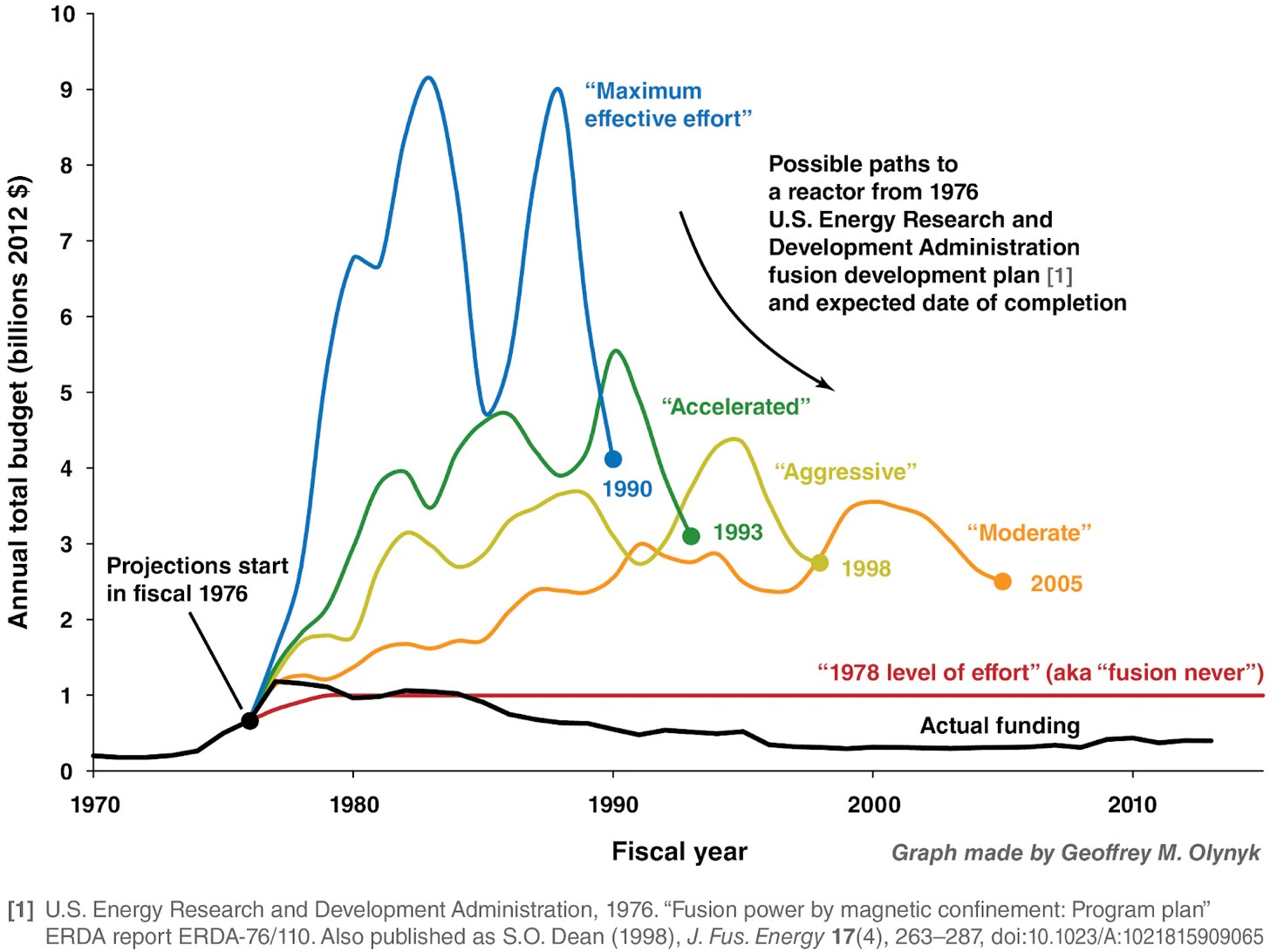
By the 1970s, it was apparent that making fusion power work is possible, but very hard. Fusion would require Big Science with Significant Support. The total cost would be less than the Apollo Program, similar to the International Space Station, and more than the Large Hadron Collider at CERN. The Department of Energy put together a request for funding. They proposed several different plans. Depending on how much funding was available, we could get fusion in 15-30 years.

How did that work out?

fusion_funding

Along with the plans for fusion in 15-30 years, there was also a reference: ‘fusion never’. This plan would maintain America’s plasma physics facilities, but not try to build anything new.

Actual funding for fusion in the US has been less than the ‘fusion never’ plan.

The reason we don’t have fusion already is because we, as a civilization, never decided that it was a priority. Fusion funding is literally peanuts: In 2016, the US spent twice as much on peanut subsidies as on fusion research.

We’ve been consistently spending less on fusion than we did in the ’70s. The largest fusion project, the International Thermonuclear Experimental Reactor (ITER), is now going to cost around $21 billion—or about half of the $40 billion in weapons we’re shipping to Ukraine (Russia is a petro state and, without income from oil and gas sales, it would be unlikely to be able to fund a true war effort). $21 billion is also about 1% of what we’ve spent on the Iraq war. Maybe we’d not have working, commercially viable nuclear fusion here in 2022, but we’d be far closer than we are. Instead of investing in true energy independence, we’ve been investing in warfare, which seems like a bad trade-off. MRNA vaccines have made the world billions if not trillions of dollars richer, apart from saving a million lives in the United States alone. Maybe we should do more of that (I’m using the word “maybe” with some archness).

There’s a world in which we take the long view in an attempt to stop funding authoritarian regimes and stop invading them, and we instead focus on trying to get to the future faster. Most of the wars involving the United States in the last 30 years have been at least partially traceable to oil and gas (Saudi Arabia being the home of 15 of the 19 9/11 attackers, and being a putative ally of the U.S. but not exactly the good guys). Instead of saying, “Hey, maybe we ought to think about this relationship between warfare and gas,” we’ve decided to keep fighting random wars piecemeal. As of this writing, we’re not fighting Russia directly, but we’re not not fighting Russia. Simultaneously, had Germany invested heavily in conventional nuclear fission plants, it would’ve imported billions less in gas from Russia, and it would be poised to switch to electric vehicles. Russia’s warfare capabilities would likely be far worse than they are. Germany’s emissions could be far lower than they are. (France, to its credit, gets most of its electricity from nuclear sources: contrary to stereotype, the country isn’t composed entirely of Houellebecqian bureaucrats, sex workers, and waiters.)

Making war illegal is good, but making it uneconomical is also good, and the latter may help encourage the former. War is dumb and people get richer without it—one hopes the Chinese Community Party (CCP) sees this, as we did not during 2001 – 2003. Making war even more uneconomical than it is now requires a civilization that thinks further than a few months into the future. Maybe we should get on that. Things that are illegal and dumb aren’t very enticing.

The death of literary culture

At The Complete Review, Michael Orthofer writes of John Updike that

Dead authors do tend to fade fast these days — sometimes to be resurrected after a decent interval has passed, sometimes not –, which would seem to me to explain a lot. As to ‘the American literary mainstream’, I have far too little familiarity with it; indeed, I’d be hard pressed to guess what/who qualifies as that.

Orthofer is responding to a critical essay that says: “Much of American literature is now written in the spurious confessional style of an Alcoholics Anonymous meeting. Readers value authenticity over coherence; they don’t value conventional beauty at all.” I’m never really sure what “authenticity” and its cousin “relatability” mean, and I have an unfortunate suspicion that both reference some lack of imagination in the speaker; still, regarding the former, I find The Authenticity Hoax: How We Get Lost Finding Ourselves persuasive.

But I think Orthofer and the article are subtly pointing towards another idea: literary culture itself is mostly dead. I lived through its final throes—perhaps like someone who, living through the 1950s, saw the end of religious Christianity as a dominant culture, since it was essentially gone by the 1970s—though many claimed its legacy for years after the real thing had passed. What killed literary culture? The Internet is the most obvious, salient answer, and in particular the dominance of social media, which is in effect its own genre—and, frequently, its own genre of fiction. Almost everyone will admit that their own social media profiles attempt to showcase a version of their best or ideal selves, and, thinking of just about everyone I know well, or even slightly well, the gap between who they really are and what they are really doing, and what appears on their social media, is so wide as to qualify as fiction. Determining the “real” self is probably impossible, but determining the fake selves is easier, and the fake is everywhere. Read much social media as fiction and performance and it will make more sense.

Everyone knows this, but admitting it is rarer. Think of all the social media photos of a person ostensibly alone—admiring the beach, reading, sunbathing, whatever—but the photographer is somewhere. A simple example, maybe, but also one without the political baggage of many other possible examples.

Much of what passes for social media discourse makes little or no sense, until one considers that most assertions are assertions of identity, not of factual or true statements, and many social media users are constructing a quasi-fictional universe not unlike the ones novels used to create. “QAnon” might be one easy modern example, albeit one that will probably go stale soon, if it’s not already stale; others will take its place. Many of these fictions are the work of group authors. Numerous assertions around gender and identity might be a left-wing-valenced version of the phenomenon, for readers who want balance, however spurious balance might be. Today, we’ve in some ways moved back to a world like that of the early novel and the early novelists, when “fact” and “fiction” were much more disputed, interwoven territories, and many novels claimed to be “true stories” on their cover pages. The average person has poor epistemic hygiene for most topics not directly tied to income and employment, but the average person has a very keen sense of tribe, belonging, and identity—so views that may be epistemically dubious nonetheless succeed if they promote belonging (consider also The Elephant in the Brain by Robin Hanson and Kevin Simler for a more thorough elaboration on these ideas). Before social media, did most people really belong, or did they silently suffer through the feeling of not belonging? Or was something else at play? I don’t know.

In literary culture terms, the academic and journalistic establishment that once formed the skeletal structure upholding literary culture has collapsed, while journalists and academics have become modern clerics, devoted more to spreading ideology than exploring the human condition, or to art, or to aesthetics. Academia has become more devoted to telling people what to think, than helping people learn how to think, and students are responding to that shift. Experiments like the Sokal Affair and its successors show as much. The cult of “peer review” and “research” fits poorly in the humanities, but they’ve been grafted on, and the graft is poor.

Strangely, many of the essays lamenting the fall of the humanities ignore the changes in the content of the humanities, in both schools and universities. The number of English majors in the U.S. has dropped by about 50% from 2000 to 2021:

Decline of English majors

History and most of other humanities majors obviously show similar declines. Meanwhile, the number of jobs in journalism has approximately halved since the year 2000; academic jobs in the humanities cratered in 2009, from an already low starting point, and have never recovered; even jobs teaching in high school humanities subjects have a much more ideological, rather than humanistic, cast than they did ten years ago. What’s taken the place of reading, if anything? Instagram, Snapchat, TikTok, and, above all, Twitter.

Twitter, in particular, seems to promote negative feedback and fear loops, in ways that media and other institutions haven’t yet figured out how to resist. The jobs that supported the thinkers, critics, starting-out novelists, and others, aren’t there. Whatever might have replaced them, like Twitter, isn’t equivalent. The Internet doesn’t just push most “content” (songs, books, and so forth) towards zero—it also changes what people do, including the people who used to make up what I’m calling literary culture or book culture. The costs of housing also makes teaching a non-viable job for a primary earner in many big cities and suburbs.

What power and vibrancy remains in book culture has shifted towards nonfiction—either narrative nonfiction, like Michael Lewis, or data-driven nonfiction, with too many examples to cite. It still sells (sales aren’t a perfect representation of artistic merit or cultural vibrancy, but they’re not nothing, either). Dead authors go fast today not solely or primarily because of their work, but because the literary culture is going away fast, if it’s not already gone. When John Updike was in his prime, millions of people read him (or they at last bought Couples and could spit out some light book chat about it on command). The number of writers working today who the educated public, broadly conceived of, might know about is small: maybe Elena Ferrante, Michel Houllebecq, Sally Rooney, and perhaps a few others (none of those three are American, I note). I can’t even think of a figure like Elmore Leonard: someone writing linguistically interesting, highly plotted material. Bulk genre writers are still out there, but none who I’m aware of who have any literary ambition.

See some evidence for the decline of literary cultures in the decline of book advances; the Authors Guild, for example, claims that “writing-related earnings by American authors [… fell] to historic lows to a median of $6,080 in 2017, down 42 percent from 2009.” The kinds of freelancing that used to exist has largely disappeared too, or become economically untenable. In If You Absolutely Must by Freddie deBoer, he warns would-be writers that “Book advances have collapsed.” Money isn’t everything but the collapse of already-shaking foundations of book writing is notable, and quantifiable. Publishers appear to survive and profit primarily off very long copyright terms; their “backlist” keeps the lights on. Publishers seem, like journalists and academics, to have become modern-day clerics, at least for the time being, as I noted above.

Consider a more vibrant universe for literary culture, as mentioned in passing here:

From 1960 to 1973, book sales climbed 70 percent, but between 1973 and 1979 they added less than another six percent, and declined in 1980. Meanwhile, global media conglomerates had consolidated the industry. What had been small publishers typically owned by the founders or their heirs were now subsidiaries of CBS, Gulf + Western (later Paramount), MCA, RCA, or Time, Inc. The new owners demanded growth, implementing novel management techniques. Editors had once been the uncontested suzerains of title acquisition. In the 1970s they watched their power wane.

A world in which book sales (and advances) are growing is very different from one of decline. It’s reasonable to respond that writing has rarely been a path to fame or fortune, but it’s also reasonable to note that, even against the literary world of 10 or 20 years ago, the current one is less remunerative and less culturally central. Writers find the path to making any substantial money from their writing harder, and more treacherous. Normal people lament that they can’t get around to finishing a book; they rarely lament that they can’t get around to scrolling Instagram (that’s a descriptive observation of change).

At Scholar’s Stage, Tanner Greer traces the decline of the big book and the big author:

the last poet whose opinion anybody cared about was probably Allen Ginsberg. The last novelist to make waves outside of literary circles was probably Tom Wolfe—and he made his name through nonfiction writing (something similar could be for several of other prominent essayists turned novelists of his generation, like James Baldwin and Joan Didion). Harold Bloom was the last literary critic known outside of his own field; Allan Bloom, the last with the power to cause national controversy. Lin-Manuel Miranda is the lone playwright to achieve celebrity in several decades.

I’d be a bit broader than Greer: someone like Gillian Flynn writing Gone Girl seemed to have some cultural impact, but even books like Gone Girl seem to have stopped appearing. The cultural discussion rarely if ever revolves around books any more. Publishing and the larger culture have stopped producing Stephen Kings. Publishers, oddly to my mind, no longer even seem to want to try producing popular books, preferring instead to pursue insular ideological projects. The most vital energy in writing has been routed to Substack.

I caught the tail end of a humane and human-focused literary culture that’s largely been succeeded by a political and moral-focused culture that I hesitate to call literary, even though it’s taken over what remains of those literary-type institutions. This change has also coincided with a lessening of interest in those institutions: very few people want to be clerics and scolds—many fewer than wonder about the human condition, though the ones who do want to be clerics and scolds form the intolerant minority in many institutions. Shifting from the one to the other seems like a net loss to me, but also a net loss that I’m personally unable to arrest or alter. If I had to pick a date range for this death, it’d probably be 2009 – 2015: the Great Recession eliminates many of the institutional jobs and professions that once existed, along with any plausible path into them for all but the luckiest, and by 2015 social media and scold culture had taken over. Culture is define but easy to feel as you exist within and around it. By 2010, Facebook had become truly mainstream, and everyone’s uncle and grandma weren’t just on the Internet for email and search engines, but for other people and their opinions.

Maybe mainstream literary culture has been replaced by some number of smaller micro-cultures, but those microcultures don’t add up to what used to be a macroculture.

In this essay, I write:

I’ve been annoying friends and acquaintances by asking, “How many books did you read in the last year?” Usually this is greeted with some suspicion or surprise. Why am I being ambushed? Then there are qualifications: “I’ve been really busy,” “It’s hard to find time to read,” “I used to read a lot.” I say I’m not judging them—this is true, I will emphasize—and am looking for an integer answer. Most often it’s something like one or two, followed by declamations of highbrow plans to Read More In the Future. A good and noble sentiment, like starting that diet. Then I ask, “How many of the people you know read more than a book or two a year?” Usually there’s some thinking, and rattling off of one or two names, followed by silence, as the person thinks through the people they know. “So, out of the few hundred people you might know well enough to know, Jack and Mary are the two people you know who read somewhat regularly?” They nod. “And that is why the publishing industry works poorly,” I say. In the before-times, anyone interested in a world greater than what’s available around them and on network TV had to read, most often books, which isn’t true any more and, barring some kind of catastrophe, probably won’t be true again.

Reading back over this I realize it has the tone and quality of a complaint, but it’s meant as a description, and complaining about cultural changes is about as effective as shaking one’s fist at the sky: I’m trying to look at what’s happening, not whine about it. Publishers go woke and see the sales of fiction fall and respond by doubling down, but I’m not in the publishing business and the intra-business signaling that goes on there. One could argue changes noted are for the better. Whining about aggregate behavior and choices has rarely, if ever, changed it. I don’t think literary culture will ever return, any more Latin, epic poetry, classical music, opera, or any number of other once-vital cultural products and systems will.

In some ways, we’re moving backwards, towards a cultural fictional universe with less clearly demarcated lines between “fact” and “fiction” (I remember being surprised, when I started teaching, by undergrads who didn’t know a novel or short stories are fiction, or who called nonfiction works “novels”). Every day, each of us is helping whatever comes next, become. The intertwined forces of technology and culture move primarily in a single direction. The desire for story will remain but the manifestation of that desire aren’t static. Articles like “Leisure reading in the U.S. is at an all-time low” appear routinely. It’s hard to have literary culture among a population that doesn’t read.

See also:

* What happened with Deconstruction? And why is there so much bad writing in academia?

* Postmodernisms: What does that mean?

Where are the woke on Disney and China?

I have sat through numerous talks and seen numerous social media messages about the evils of imperialism, and in particular western imperialism—so where’s the mass outrage over China today, and the efforts by Disney and Hollywood to court China? China is a literal, real-world imperialist power, today; China has crushed Hong Kong’s independent, imprisoned perhaps a million of its own people based on their race and religion, and invaded and occupied Tibet—and Taiwan may be next. But I never read “imperialist” or “racist” critiques from the usual suspects. Why not?

Search for “imperialism” on Twitter, for example, and you’ll find numerous people denouncing what they take to be “imperialism” or various kinds of imperialisms, but few dealing with China. This bit about Bob Iger’s complicity with Chinese government repression got me thinking about why some targets draw much “woke” ire while others don’t. My working hypothesis is that China seems far away from the United States and too different to understand—even though companies and individuals are regularly attacked for their associations with other Americans, they rarely seem to be for their associations with China. The NBA, to take another example, fervently favors police reform in the United States, but is largely silent on China (to be sure, I don’t agree with all the posturing at the link, but pay attention to the underlying point). My working theory is that the situation between the woke and China is analogous to the way that comparisons to your wife’s sister’s husband’s income can create a lot of jealousy while comparisons to the truly wealthy don’t.

In addition, could it be that Disney’s specialty in child-like stories of simple, Manichaean stories of good versus evil appeal to the same people, or kinds of person, most likely to be attracted to the quasi-religious “woke” mindset? To my knowledge, I’ve not seen these questions asked, and Disney products, like Star Wars movies and TV shows, seem to remain broadly popular, including on the far left. It’s also worth emphasizing that some have spoken about Disney’s action’s; the Twitter thread about Iger links to “Why Disney’s new ‘Mulan’ is a scandal.” But the issue seems to elicit relatively little ire and prominence, compared to many others. Few sustained movements or organizations are devoted to these issues.

What views make someone a pariah, and why? What associations make someone a pariah, and why? What views and associations elicit intense anger, and why? I don’t have full answers to any of these questions but think them worth asking. No one seems to be calling for boycotts of Disney, even though Disney is toadying to an actual imperialist state.

Dissent, insiders, and outsiders: Institutions in the age of Twitter

How does an organization deal with differing viewpoints among its constituents, and how do constituents dissent?

Someone in Google’s AI division was recently fired, or the person’s resignation accepted, depending on one’s perspective, for reasons related to a violation of process and organizational norms, or something else, again depending on one’s perspective. The specifics of that incident can be disputed, but the more interesting level of abstraction might ask how organizations process conflict and what underlying conflict model participants have. I recently re-read Noah Smith’s essay “Leaders Who Act Like Outsiders Invite Trouble;” he’s dealing with the leadup to World War II but also says: “This extraordinary trend of rank-and-file members challenging the leaders of their organizations goes beyond simple populism. There may be no word for this trend in the English language. But there is one in Japanese: gekokujo.” And later, “The real danger of gekokujo, however, comes from the establishment’s response to the threat. Eventually, party bosses, executives and other powerful figures may get tired of being pushed around.”

If you’ve been reading the news, you’ll have seen gekokujo, as institutions are being pushed by the Twitter mob, and by the Twitter mob mentality, even when the mobbing person is formally within the institution. I think we’re learning, or going to have to re-learn, things like “Why did companies traditionally encourage people to leave politics and religion at the door?” and “What’s the acceptable level of discourse within the institution, before you’re not a part of it any more?”

Colleges and universities in particular seem to be susceptible to these problems, and some are inculcating environments and cultures that may not be good for working in large groups. One recent example of these challenges occurred at Haverford college, but here too the news has many other examples, and the Haverford story seems particularly dreadful.

The basic idea that organizations have to decide who’s inside and who’s outside is old: Albert Hirschman’s Exit, Voice, and Loyalty: Responses to Decline in Firms, Organizations, and States is one great discussion. Organizations also used to unfairly exclude large swaths of the population based on demographic factors, and that’s (obviously) bad. Today, though, many organizations have in effect, if not intent, decided that it’s okay for some of their members to attack the good faith of other members of the organization, and to attack the coherentness of the organization itself. There are probably limits to how much this can be done, and still retain a functional organization, let alone a maximally functional organization.

The other big change involves the ability to coordinate relatively large numbers of people: digital tools have made this easier, in a relatively short time—thus the “Twitter mob” terminology that came to mind a few paragraphs ago; I kept the term, because it seems like a reasonable placeholder for that class of behavior. Digital tools ease the ability of a small percentage of total people to be a large absolute number of people. For example, if 100,000 people are interested in or somehow connected to an organization, and one percent of them want to fundamentally disrupt the organization, change its direction, or arrange an attack, that’s 1,000 people—which feels like a lot. It’s far above the Dunbar number and too many for one or two public-facing people to deal with. In addition, in some ways journalists and academics have become modern-day clerics, and they’re often eager to highlight and disseminate news of disputes of this sort.

Over time, I expect organizations are going to need to develop new cultural norms if they’re going to maintain their integrity in the face of coordinated groups that represent relatively small percentages of people but large absolute numbers of people. The larger the organization, the more susceptible it may be to these kinds of attacks. I’d expect more organizations to, for example, explicitly say that attacking other members of the organization in bad faith will result in expulsion, as seems to have happened in the Google example.

Evergreen College, which hosted an early example of this kind of attack (on a biology professor named Bret Weinstein), has seen its enrollment drop by about a third.

Martin Gurri’s book The Revolt of The Public and the Crisis of Authority in the New Millennium examines the contours of the new information world, and the relative slowness of institutions to adapt to it. Even companies like Google, Twitter, and Facebook, which have enabled sentiment amplification, were founded before their own user bases became so massive.

Within organizations, an excess of conformity is a problem—innovation doesn’t occur from simply following orders—but so is an excess of chaos. Modern intellectual organizations, like tech companies or universities, probably need more “chaos” (in the sense of information transfer) than, say, old-school manufacturing companies, which primarily needed compliance. “Old-school” is a key phrase, because from what I understand, modern manufacturing companies are all tech companies too, and they need the people closest to the process to be able to speak up if something is amiss or needs to be changed. Modern information companies need workers to speak up and suggest new ideas, new ways of doing things, and so on. That’s arguably part of the job of every person in the organization.

Discussion at work of controversial identity issues can probably function if all parties assume good faith from the other parties (Google is said to have had a freewheeling culture in this regard from around the time of its founding up till relatively recently). Such discussions probably won’t function without fundamental good faith, and good faith is hard to describe, but most of us know it when we see it, and defining every element of it would probably be impossible, while cultivating it as a general principle is desirable. Trying to maintain such an environment is tough: I know that intimately because I’ve tried to maintain it in classrooms, and those experiences led me to write “The race to the bottom of victimhood and ‘social justice’ culture.” It’s hard to teach, or run an information organization, without a culture that lets people think out loud, in good faith, with relatively little fear of arbitrary reprisal. Universities, in particular, are supposed to be oriented around new ideas and discussing ideas. Organizations also need some amount of hierarchy: without it, decisions can’t or don’t get made, and the organizational processes themselves don’t function. Excessive attacks lead to the “gekokujo” problem Smith describes. Over time organizations are likely going to have to develop antibodies to the novel dynamics of the digital world.

A lot of potential learning opportunities aren’t happening, because we’re instead dividing people into inquisitors and heretics, when very few should be the former, and very are truly the latter. One aspect of “Professionalism” might be “assuming good faith on the part of other parties, until proven otherwise.”

On the other hand, maybe these cultural skirmishes don’t matter much, like brawlers in a tavern across the street from the research lab. Google’s AlphaFold has made a huge leap in protein folding efforts (Google reorganized itself, so technically both Google and AlphaFold are part of the “Alphabet” parent company). Waymo, another Google endeavor, may be leading the way towards driverless cars, and it claims to be expanding its driverless car service. Compared to big technical achievements, media fights are minor. Fifty years from now, driverless cars will be taken for granted, along with customizable biology, people will be struggling to understand what was at stake culturally, in much the way most people don’t get what the Know-Nothing party, of the Hundred Years War, were really about, but we take electricity and the printing press for granted.

EDIT: Coinbase has publicly taken a “leave politics and religion at the door” stand. They’re an innovator, or maybe a back-to-the-future company, in these terms.