Why did cities freeze in the 1970s?

Home is where the cartel is” says that “divisive hot-button issues like inequality and immigration ultimately derive from housing dysfunction.” Yet Waldman points out that the prescription many commentators, including this one, want—housing market rationalization—is unlikely to be attractive to the mass of existing owners/voters. The piece is not easily excerpted and should really be read in full before you continue, but here is one important point:

The libertarian “deregulatory” rhetoric by which market urbanists sometimes make their case is counterproductive. Telling people to think of their homes as a commodity upon which market forces should be brought to bear in order to ensure production of housing services at competitive prices is obtuse. People purchase property, rather than renting, largely to gain security and control, to escape the vicissitudes of the market.

If Waldman is right, I’ve been framing the issue incorrectly—if I actually want to persuade most people. I’ve been mulling the Waldman article since I read it a couple days ago and finally realized what bothered me: Extreme zoning seems to have really gotten started in the ’70s or early ’80s. NYC is still so dense because people from the seventeenth century up until the ’70s had a fairly easy time replacing existing buildings more or less when they felt like doing so. If markets demanded higher buildings, land owners tended to build higher buildings.

(This is a periodic reminder that the term “market” is just a shorthand word for something like, “mediating what a bunch of disparate people want, and how their varying bids for goods and services get aggregated.” It’s kind of distressing to need to include this disclaimer / definition, but hey, that’s the modern Internet world.)

An observer can literally see physical evidence of the housing freeze in places like Seattle. Both Capitol Hill and the U-District had, for decades, one twenty-something-story building each, which were almost landmarks. They were built just before Seattle comprehensively banned most high-rises—a ban that lasted until the 2000s. Had the market been allowed to function normally, single family neighborhoods would’ve gradually transitioned into duplexes, townhouses, or small apartment buildings, and areas with small buildings would’ve gradually seen midrises and high rises grow.

But, instead of that, Seattle basically froze the market. So did L.A. and many other locales. In 1970, L.A. was zoned for ten million people. In 2010, when our technology was vastly inferior to the 1970s, L.A.’s zoning was down to 4.3 million. That is odd and helps explain why L.A. used to be the  land of opportunity and is now the land of exclusion. Parking requirements, which can increase housing costs in L.A. by as much as a third, also explain why the city is now so expensive. We build more dwellings for our cars than our humans.

[Note to people who keep emailing me: saying technology today is inferior to the ’70s is a joke.]

What changed in urban planning and/or city politics in the ’70s? That to me is a key question and one I can’t really answer. The diffusion of Jane Jacobs’s ideas is one possible answer, but her answer still found fertile political and legal soil. Perhaps the backlash from the Robert Moses of the world was a part of the problem. “S” wonders if it was white flight.

Up until the Petaluma City Plan, growth was (relatively) unconstrained, especially in cities. After Petaluma, it wasn’t. In many parts of what we now think of as high-cost cities, the city feels frozen in time since… the ’70s.

Cities have always had rich neighborhoods and poor neighborhoods, but freezing cities seems to have occurred relatively recently. So has the most vociferous talk of “gentrification.”

I primarily bring this up because if parochial land-use policies were only adopted in the last couple decades, they may be more reversible and less a part of human or political nature than is sometimes assumed. I don’t think human nature or human DNA has changed substantially since the ’70s.  But Waldman’s point about the politics of contemporary land-use controls remains and I don’t know how to overcome the dynamics he points out. Not all problems have solutions.

But we are all paying zoning’s steep price, to use the title of the paper at the link. It’s a PDF.

I’ve seen people online say that people should just “move to cheaper cities” or to rural areas. This ignores the massive productivity differences among different places—and the massive cultural differences. It is better to create abundant housing everywhere than it is to tell people to move to less-productive places.

Jeff Fong has one excellent response and you should read it.

EDIT: Via Twitter, Dan Keshet suggests I read William Fischel’s Zoning Rules, which may answer the questions above. See also “When the Market Built Housing for the Low Income.” That era was not long ago! We can change if we want to.

Fischel says that in the 1970s:

the growth-control movement was born and spread almost as rapidly as zoning originally did [in the 1910s and 1920s], though its effects were regionally selective. I argue that a combination of modern forces induced this change, but the most important was the 1970s period of inflation, which helped transform housing from a consumer good to an investment and thus gave rise to a political class I have called “homevoters.” (163)

Homevoters ensure that “zoning can go too far and prevent economically desirable increases in density and hinder what many people regard as the desirable mixing of socioeconomic groups within communities” (164).

If you see anyone arguing about what happened in the 1970s without even engaging in Fischel’s ideas, you know they a) aren’t thinking in terms of comparative history, b) don’t understand the history of the period, and c) likely don’t know what they’re talking about.

Guest post: The Match.com date NIMBY who’s intolerant of tolerance and Airbnb

My dad, Isaac, wrote this post.

Faithful readers will know that Jake is fairly obsessed with the impact of NIMBYs on increasing the cost of housing and generally mucking up urban development, no matter how beneficial new housing/development is to the community. Years ago, in a former life as a community development director for several California cities, I had plenty of experience running public hearings in which the Citizens United Against Everything would show up with pitchforks and torches to oppose anything new. Admittedly there were no literal pitchforks and torches, but they definitely had ever-present attorneys and demands for Environmental Impact Reports (EIRs). I agree with Jake that the whole NIMBY stuff is not only counter-productive but also gets tiresome quickly.

These days I find myself trolling Match.com and JDate in search of yet another “new life partner,” as those of us of a certain age say about the singles world. Most of my bad date experiences are typical of the online dating process and not worthy of your time to read about. One, though, shows the incredible hypocrisy of the NIMBY phenomenon.

I met my date, a banking executive, at a Beverly Hills wine bar. She was reasonably attractive and interesting, and the date was going pretty well until the conversation shifted beyond standard first date interview questions (like, “How is it that all three of your ex-husbands died suddenly?” or “I’m curious as to how it is that you remember watching the Liston/Ali fight if you’re actually 51?”).

My date said she owned a house in the Beverlywood adjacent* neighborhood, and for years she’s led neighborhood opposition to various development projects like group homes** and, of all things, the Museum of Tolerance (MOT), which was built a few years a years ago near her neighborhood. The MOT is affiliated with the Simon Wiesenthal Center, an internationally renowned Jewish human rights organization, and it’s dedicated to helping visitors understand the Holocaust.

I was amazed when my date told me proudly that she led her neighborhood group in opposing construction of MOT and held up the project for three years at a cost of $3,000,000 to the Simon Wiesenthal Center. Given Mr. Wiesenthal’s work as perhaps the most dedicated Nazi hunter, it’s hard to think of an organization or project that deserves more support, rather than roadblocks, than MOT, particularly in a largely Jewish neighborhood. The date began to go downhill when I pointed out to her that her opposition to MOT made her “intolerant of tolerance” (and guilty of wasting good money).

I soldiered on, as I was increasingly fascinated by her amazingly strong NIMBY convictions. I ordered a second glass of wine so I could listen to more. Her current NIMBY passion is several nearby houses that are being rented out on Airbnb. In Beverlywood adjacent, like much of prime LA, the relatively modest post-WWII houses in her neighborhood are being torn down and replaced by McMansions, which means lots of empty bedrooms and huge mortgage payments. Since Beverlywood adjacent is handy to Beverly Hills, West Hollywood, UCLA and Santa Monica, and hotel rooms in the area can easily top $500/night, it’s a natural habitat for Airbnb, from both owner and renter perspectives. This somehow offends her and she’s trying to use the City of LA regulations to put a stop to the moral outrage that is Airbnb. So far she’s had no success in this curious crusade, which just makes her more angry in the finest NIMBY tradition.

While my date was busy complaining about Airbnb in her neighborhood, she also offhandedly said that she often uses Airbnb herself when she travels! The date ended quickly when I pointed out the inherent irony/hypocrisy of this absurd juxtaposition, which she’d apparently never recognized. But NIMBYs are rarely actually interested in the greater good—they want their neighborhood/city frozen in time like a bee in amber. This odd aspect of NIMBYs is true even if they moved into the neighborhood last week, as they invariably want to be the last one across the drawbridge before it’s raised.


* In LaLA land, it’s not usual for relatively modest neighborhoods to seek added cachet by adding “adjacent,” as in Beverlywood adjacent, Bel Air adjacent, Santa Monica adjacent and so on. This is often used in real estate listings, even if the property is miles away from the actual glittering neighborhood.

** Since I’m a former community development director, it was my sad duty to tell my date that group homes can be placed in any residential neighborhood in California, without any special permits, as long as the home has no more than six beds. The one she was concerned about is “sober living home” for recovering alcoholics, but it could just as easily be a half-way house for convicted murderers. She should count her blessings.

Do millennials have a future in Seattle? Do millennials have a future in any superstar cities?

Over in the Seattle section of Reddit someone asked, “Millennials of Seattle: Do you believe that you have a future in this city?”* My answer started small but grew until it became an essay in and of itself, since “Seattle” is really a stand-in for numerous other cities (like NYC, LA, Denver, and Boston) that combine strong economies with parochial housing policies that cause the high rents that hurt younger and poorer people. Seattle is, like many dense liberal cities, becoming much more of a superstar city of the sort Edward Glaeser defines in The Triumph of the City. It has a densely urbanized core, strong education facilities, and intense research, development, and intellectual industries—along with strict land-use controls that artificially raise the cost of housing.

Innovation, in the sense Peter Thiel describes in Zero to One, plus the ability to sell to global markets leads to extremely high earning potential for some people with highly valuable skills. But, for reasons still somewhat opaque to me and rooted in psychology, politics, and law, (they’re somewhat discussed by Glaeser and by Tyler Cowen in Average is Over), liberal and superficially progressive cities like Seattle also tend to generate the aforementioned intense land-use controls and opposition to development. This strangles housing supply.

The combination of high incomes generated by innovation and selling to global markets, along with viciously limited housing supply, tends to price non-superstars out of the market. Various subsidy schemes generate much more noise than practical assistance for people, and markets are at best exceedingly hard to alter through government fiat. So one gets periodic journalistic accounts of supposed housing price “crises.” By contrast to Seattle, New York, or L.A., Sun Belt cities are growing so fast and so consistently because of real affordable housing. People move to them because housing is cheap. Maybe the quality of life isn’t as high in other ways, but affordability is arguably the biggest component of quality of life. Issues with superstar cities and housing affordability are well-known in the research community but those issues haven’t translated much into voters voting for greater housing supply—probably because existing owners hate anything that they perceive will harm them or their economic self-interests in any way.

Enlightenment_heathSomewhat oddly, too, large parts of the progressive community seem to not believe in or accept supply and demand. Without understanding that basic economic principle it’s difficult to have an intelligent discussion about housing costs. It’s like trying to discuss biology with someone who neither understands nor accepts evolution. In newspaper articles and forum threads, one sees over and over again elementary errors in understanding supply and demand. I used to correct them but now mostly don’t bother because those threads and articles are ruled by feelings rather than knowledge, per Heath’s argument in Enlightenment 2.0, and it’s mentally easier to demonize evil “developers” than it is to understand how supply and demand work.

Ignore the many bogeymen named in the media and focus on market fundamentals. Seattle is increasingly great for economic superstars. Most of them probably aren’t wasting time posting to or reading Reddit. If you are not a superstar Seattle is going to be very difficult to build a future in. This is a generalized problem. As I said earlier, voters don’t understand basic economics, and neither do reporters who should know better. Existing property owners prefer to exclude rivalrous uses. So we get too little supply and increasing demand—across a broad range of cities. Courts have largely permitted economic takings in the form of extreme land-use control.

Seattle is the most salient city for this discussions, but Seattle is also growing because San Francisco’s land-use politics are even worse than Seattle’s. While Seattle has been bad, San Francisco has been (and is) far worse. By some measures San Francisco is now the most expensive place in the country to live. For many Silicon Valley tech workers who drive San Francisco housing prices, moving to Seattle immediately increases real income enormously through the one-two punch of (relatively) lower housing prices and no income tax. Seattle is still a steal relative to San Francisco and still has many of the amenities tech nerds like. So Seattle is catching much of San Francisco’s spillover, for good reason, and in turn places like Houston and Austin are catching much of Seattle’s spillover.

See also this discussion and my discussion of Jane Jacobs and urban land politics. Ignore  comments that don’t cite actual research.

Furthermore, as Matt Yglesias points out in The Rent Is Too Damn High: What To Do About It, And Why It Matters More Than You Think, nominally free-market conservatives also tend to oppose development and support extensive land-use controls. But urban cities like Seattle almost always tilt leftward relative to suburbs and rural areas. Why this happens isn’t well understood.

Overall, it’s telling that Seattlites generate a lot of rhetoric around affordable housing and being progressive while simultaneously attacking policies that would actually provide affordable housing and be actually progressive. Some of you may have heard the hot air around Piketty and his book Capital in the 21st Century. But it turns out that, if you properly account for housing and land-use controls, a surprisingly large amount of the supposed disparity between top earners and everyone else goes away. The somewhat dubious obsession that progressives have with wealth concentration is tied up with the other progressive policy of preventing normal housing development!

This is a problem that’s more serious than it looks because parochial land-use controls affect the environment (in the sense of global climate change and resource consumption), as well as the innovation environment (close proximity increases innovation). Let’s talk first about the environment. Sunbelt cities like Phoenix, Houston, Dallas, and Atlanta have minimal mass transit, few mid- and high-rise buildings, and lots and lots of far-flung sub-divisions with cars. This isn’t good for the amount of carbon in the atmosphere, or for the amount of driving that people have to do, but warped land-use controls have given them to us anyway, and the easiest way to get around those land-use controls is to move to the periphery of an urban area and build there. Instead of super energy efficient mid-rises in Seattle, we get fifty tract houses in Dallas.

Then there’s the innovation issue. The more general term for this is “economic geography,” and the striking thing is how industries seem to cluster more in the Internet age. It is not equally easy to start a startup anywhere; they seem to occur in major cities. It isn’t even equally easy to be, say, a rapper: Atlanta produces a way disproportionate number of rappers (See also here). California’s San Fernando Valley appears to be where anyone who does porn professional wants to go. New York still attracts writers, though now they’re exiled to distant parts of the boroughs. My own novels say, “Jake Seliger grew up near Seattle and lives in New York City” (though admittedly I haven’t found much of a literary community here, which is probably my own fault). And so on, for numerous industries, most of them too small to have made a blip on my radar.

These issues interest me both as an intellectual matter and because they play into my work as a grant writer. Many of the ills grant-funded programs are supposed to solve, like poverty and homelessness, are dramatically worsened by persistent, parochial local land-use policies. Few of the superficial progressives in places like Seattle connect land-use policies to larger progressive issues.

So we get large swaths of people priced out of those lucrative job markets altogether, which (most) progressives dislike in theory. Nominal progressives become extreme reactionaries in their own backyards, which ought to tell us something important about them. Still, grant-funded programs that are supposed to boost income and have other positive effects on people’s lives are fighting against the tide . Fighting the tide is at best exceedingly difficult and at worst impossible. I don’t like to think that I’m fighting futile battles or doing futile work, and I consider this post part of the education process.

Few readers have gotten this far, and if you have, congratulations! The essence of the issue is simple supply and demand, but one sees a lot of misunderstanding and misinformation in discussions of it.

In addition, I don’t expect to have much of an impact. Earlier in this essay I mentioned Joseph Heath’s Enlightenment 2.0: Restoring sanity to our politics, our economy, and our lives, and in that book he observes that rationalists tend to get drown out by immediate, emotional responses. In this essay I’m arguing from a position of deliberate reason, while emotional appeals tend to “win” most intuitive arguments.

By the way: In Seattle itself, as of 2015 about two-thirds of Seattle’s land mass is reserved for single-family, detached houses. That’s insane in almost any city, but it’s especially insane in a major global city. Much of Seattle’s affordability problem could be solved or ameliorated by something as simple as legalizing houses with adjoining walls and no setback requirements. The housing that many people would love is literally illegal to build.

Finally, one commonly hears some objections to any sort of change in cities:

* “It’s ugly / out of character for the neighborhood:” As “How Tasteless Suburbs Become Beloved Urban Neighborhoods” explains, it takes about 50 years for design trends to go from “ugly” or “tacky” to “historic.” It’s hard to rebut people saying “that is ugly!” except by saying “no it isn’t!”, but one can see that most new developments are initially seen as undesirable and are eventually seen as normal. “Character” arguments, when made by owners, are usually code for “Protect my property investment.” It’s also not possible to protect the “character” of neighborhoods.

* “Foreigners and their money are buying everything up and making them more expensive:” Actually, real estate is, properly considered, an incredible export:

The key is to let more development happen in the in-demand, centrally located areas where the economic benefits are largest and the ecological costs the smallest, not just “transitional” neighborhoods and the exurban fringe. Take the existing stacks of apartments for rich people and replace them with taller stacks. Then watch the money roll in.

* “Gentrification is unfair:” Oddly, cities began to freeze in earnest, via zoning laws, in the 1970s. One can see this both from the link and from Google’s Ngram viewer, which sees virtually no references to gentrification until the late 70s, and the term really takes off later than that.

If gentrification is unfair—and maybe it is—the only real solution is to build as much housing as people want to consume, which will lower real prices towards the cost of construction. Few contemporary cities pursue this strategy, though. No other strategy will work.

EDIT: See also “How Seattle Killed Micro-Housing: One bad policy at a time, Seattle outlawed a smart, affordable housing option for thousands of its residents.” The city’s devotion to exclusionary housing policies is amazing. It’s not as bad as San Francisco, but compared to Texas it’s quite terrible.


* I’m reading “Millennials” as referring to people under age 30 who have no special status or insider connections. Few will have access to paid-off or rent-controlled housing in superstar cities. They’ll be clawing their way from the bottom without handouts. In cities like New York and San Francisco, a few older people have voted themselves into free stuff in the form of rent control. Most Millennials won’t have that.


Life: What is Los Angeles? edition

“One day the whole world was going to look like Los Angeles, he decided, not a city, nor the absence of a city, just ruined countryside, with houses squeezed between highways which never tired of whispering the lie that it was more interesting to go somewhere than to be here. The entire westward drive of American history seemed to have piled up on the beach, and the descendants of wagon-crazed pioneers, refusing to accept completely the restraint of the world’s widest ocean, frantically patrolled the edge of the West, like lemmings in therapy.”

—Edward St. Aubyn, On the Edge, which is good but still only a lead up to Bad News.

As for Los Angeles in specific and the California temperament in general, “Refusing to accept restraint” is a good thing: it drives technology, progress, and the whole human enterprise. No wonder Silicon Valley is in Silicon Valley and not somewhere else, somewhere where restraints are accepted rather than challenged.

Unfortunately in many domains California is now quite willing to accept restraint, to the detriment of everyone.

How the politics of envy (or “income inequality”) work in the broadest sense

Tyler Cowen writes in “Paul Krugman on the political salience of inequality” that

I see the inequality issue as having high salience for NYT readers, for Democratic Party donors, and for progressive activists. It has very little salience for the American public, especially with say swing voters in southern Ohio or soccer moms. Unlike in Singapore or South Korea, where the major concentrations of wealth are pretty hard to avoid for most people, American income inequalities are well hidden for the most part.

McLean is one of the wealthiest towns in Virginia, but if you drive through the downtown frankly it still feels a bit like a dump. I’ve never wanted to live there, not even at lower real estate prices. You don’t stumble upon the nicest homes unless you know where to look. Middleburg is wealthier yet, but it has few homes, feels unreal, and most people don’t go there anyway. If they do, they more likely admire well-groomed horses and still read Princess Diana biographies. They are not choking with envy over the privileges of old money rentiers, and there is no Walmart in town to bring in the masses (who probably would not care anyway).

(Emphasis added.)

This describes greater Seattle as well: how many people outside the area have heard of Medina, city of mansions? Even within the area, most people who mention it only do so as “the place where Bill Gates lives,” despite the many other freakish palaces there. Those who live in Issaquah (further east, away from Seattle proper) don’t appear to care what happens in Medina and even if they did their political ability to affect Medina is limited. Seattle is not exactly like Cowen’s Virginia—Bellevue now has a real downtown where people want to live and go, for example—but the similarities are real.

The only place I’ve lived which seems to generate envy of major concentrations of wealth is New York, perhaps because a) of the demographics, or at least the people I tend to hang out with and b) many average people see / walk by very expensive buildings. I regularly walk by the new skyscraper on 23rd and Park or Lex where Rupert Murdoch is reputed to have bought a $80 million penthouse. Though he seems unlikely to invite me up for a martini and canapés, his dwelling is much more in your face than Medina or other wealthy places in Seattle; when I live in and near Seattle I never walked by or even got near Bill Gates’s house.

Among those I know who have been to Bill Gates’s house, all were Microsoft interns who are more likely to want to be the next Gates than they are to resent him. Gates and other tech zillionaires also appear to generate very little ill will locally. That may be another difference from New York, since tech zillionaires are widely seen as having earned their money by providing value, while finance riches may not be seen in the same way.*

Later in the post Cowen also links to Seattle’s $15 minimum wage debate, despite the many well-known problems of the minimum wage. If Seattle were serious about making poor and lower-middle class people better off, the city would be focused on providing more housing and not in effect putting gates in front of current and potential residents. But the same people who want higher minimum wages are the ones who hate and protest housing supply increases. There are many ways to make people materially better off and some ways, like building, are much closer to being Pareto efficient. The same political dysfunctions that afflict Seattle are common elsewhere too, in places like Santa Monica.


* I don’t have a strong opinion on those because I don’t know enough to judge, though I have heard plausible views about why finance increases liquidity and enables capital to find useful purposes and plausible views about how finance is an increasingly zero-sum game focused on enriching insiders and corrupting the political process.

Thoughts on New York life as seen through the lens of Britain

Megan McArdle’s “American Household Gadget Exceptionalism,” which is about the rapid dissemination of labor saving devices, but even in the U.S. that dissemination is not even. It seems to have missed much of New York, where a lot of apartments lack stuff that I’ve always taken for granted, like dish washers. In this respect New York is apparently like Britain:

The British housing stock was older and less easily adapted to the new electric wonderworld. Obviously, this is not a permanent obstacle–I live in a 1905 rowhouse with a very nice dishwasher. But such retrofitting is expensive–especially if your house never had electricity in the first place.

Much of Britain lagged behind the U.S. in adopting household gadgets. This data matches my own experience with the UK, which I wrote about in 2010. Since living in New York, however, I’ve noticed that New York also lags the rest of the U.S. Until moving here I don’t think I’ve ever known anyone without a dishwasher. Now most New Yorkers I know don’t have dishwashers.

On New York in general, Penelope Trunk is right: a lot of people fundamentally don’t belong here. Beyond the not-so-good apartments, I observe:

* The subway system is incredible if you happen to live near a major node, like the Barclays Center, the downtown hubs, or Union Square. But many of the major nodes are surprisingly under-built: to continue with the Union Square example, buildings on avenues from 4th to 1st are rarely more than four or five stories tall, when they should be forty.

* The heat in the summer and cold in the winter has a much greater effect on daily life because so many people walk. In addition, much of the housing stock lacks air conditioners and modern furnaces; many apartments are too hot or cold.

* Despite or perhaps because of the high rents, there is more interesting, more cheap, and more available food than anywhere else I’ve ever seen in the U.S.

* New Yorkers are stereotyped as rude, but that hasn’t been my experience at all, with the exception of various flavors of municipal workers, bureaucrats, and quasi-bureaucrats. People working in, at, and around airports are almost always awful but the New York seem worse than average.

* There is “something to do” every night if you’re the sort of person who has a broad definition of “something.”

* Most people acclimate to wherever they live.

* In Seattle many tourists and immigrants are Asian; in New York there are obviously many Asian tourists and immigrants, but they seem outnumbered by Europeans, perhaps due to the relative proximity of Seattle to Asia and New York to Europe.

* New York seems to collect people who hit the trifecta of smart / beautiful / successful. Most places specialize in at most two of those.

* Almost no one really “knows the city;” they know their own neighborhoods and maybe a few others very well, have sporadic knowledge of a couple others, and that’s it.

One other point, not by me but by Paul Graham:

People who like New York will pay a fortune for a small, dark, noisy apartment in order to live in a town where the cool people are really cool. A nerd looks at that deal and sees only: pay a fortune for a small, dark, noisy apartment.

That’s in an essay about how to be Silicon Valley, but paying a fortune for a small, dark, noisy apartment is still true and perhaps even more true than it was in 2006. NIMBYs are still shockingly powerful. People still love living in New York and we see evidence of this in the form of high rents. One interesting thing, however, is that Silicon Valley has become at least as expensive as New York, if not more so. Living there now costs a small fortune.

Let me return to the dishwasher problem for a moment: I hate washing dishes relative to the time it takes, so this may simply be a pet peeve. But it’s one of these notable things that probably isn’t obvious until one lives here. (I’m also not spending a lot of time with hedge fund titans who are presumably renting more expensive places. Still, the lack of what I consider normal appliances in Manhattan is startling, as is the number of noisy radiators that don’t quite work correctly.)

The reason for the lack of dishwashers (and power outlets, and non-claustrophobic kitchens, and so on) also comes from another shared Britain-New York feature: it’s hard to build stuff. It’s very, very hard to build new stuff in Britain, which means that buildings designed around modern life are pretty scarce—just as they are in NYC. And scarcity implies higher prices. New York, however, has a key advantage: it’s very easy to leave it and move to another state. In places that are gaining population (like Texas), building is pretty easy, so lots of people have dishwashers and AC that works and so on.

Hipsters haven’t ruined Paris; Parisian voters have

Last week’s New York Times has a somewhat dumb article by Thomas Chatterton Williams called “How Hipsters Ruined Paris,” which describes how Paris is changing:

Today, the neighborhood has been rechristened “South Pigalle” or, in a disheartening aping of New York, SoPi. Organic grocers, tasteful bistros and an influx of upscale American cocktail bars are quietly displacing the pharmacies, dry cleaners and scores of seedy bar à hôtesses that for decades have defined the neighborhood.

Elsewhere, the usual complaints appear: “Our neighborhood, though safe and well on its way to gentrification…” But demand to live in Paris is rising while the supply of housing remains constant, or close to constant—which means prices rise, and richer people move into once-poorer neighborhoods, and bring with them their predilections for high-end coffee and fancy bars and all the similar stuff I and my ilk like. If you want more diverse neighborhoods, you have to get lower rents, and the only effective way to accomplish that is through taller buildings—which, quelle horreur, destroy the character of the neighborhood!

Matt Yglesias wrote about this basic problem in The Rent is Too Damn High, which continues to go unread and uncited by people writing about neighborhoods, whose work would be improved by knowledge.

Why would you want to own a car if you could avoid it?

My Dad sent “Who’s Buying ‘Youth’ Cars? Seniors Aging Boomers Are Prime Buyers for Small Vehicles That Auto Makers Target at Hipsters,” because he bought a Mini Cooper a few years ago, which is probably targeted at “young” people. But I replied with a larger point:

Why would you want a car if you could avoid having one?

Young people don’t care about cars. They care about smartphones. See here for more:

Why are younger Americans driving less?

Brad Plumer considers several good hypotheses, including the recession, gas prices, student debt, tougher legal requirements, and a stronger desire to live in places such as Brooklyn. I would add one other factor to his list: because they are working less. A more speculative additional hypothesis would be “because it is easier to have sex without driving to get it.”

Ugh

Ugh

A nice car is still a status symbol but a much less important status symbol than it used to be. Cars are expensive, dirty, and cause a lot of traffic. Old people like you (wrongly) associate cars with freedom and the open road, because when you grew up the roads were relatively empty.

Young people today associate cars with traffic and their parents and death. Cars are like jails. In ye olde days getting laid meant cruising to drive-ins or malls or whatever. Today getting laid means texting, Facebook, and OKCupid. Former students have talked about Tinder (sp?), which is Grindr for straight people. Going back to the status symbol point, is it more useful for a guy looking to get laid to work his ass off for a BMW or to learn guitar and get a YouTube channel? For someone with no financial constraints the obvious answer is “both,” but for someone choosing between them I suspect guitar + YouTube would win.

An iPhone is much cheaper than a car. Even an iPhone, iPad, and laptop together are much cheaper than a car. See also Philip Greenspun on this.

DUI laws are also now heavily enforced and draconian (A BAC of .1 is much more reasonable than .08) and everyone knows someone who’s had ten thousand dollars or more in court costs and hassles related to DUI. Even so, a cop can ruin your night and next day for pretty much any reason if he suspects you’ve had anything to drink. Gas is much more expensive in real terms than it was even in the late 90s / early 2000s.

No one with half a brain would want to drive more than they absolutely must, so I am skeptical that any “youth-oriented pitches” will succeed because really who cares? Driving sucks. Part of selling is having something to sell that people want. And, as you yourself pointed out, you spent much of your working life in high school and college trying to keep a car in working order. AAA estimates that the average car costs $10,000 TCO, or about one quarter of median income. Even knocking $2000 off for a cheaper car, I suspect a lot of people could allocate $2000 to transit / bikes / Zipcar / etc. and come out way ahead.

Almost anyone who can avoid commuting by car is better off ditching their wheels. Even you, Dad, would be much more financially secure by selling your car, renting your parking spaces, and getting a Zipcar subscription.

[Note: My Dad doesn’t have to drive to his office.]

Jane Jacobs is everywhere, even when you don’t see her

In a Reddit thread someone recently asked:

Who the hell actually thinks Jane Jacobs has any influence on Seattle’s urban planning?

Through The Death and Life of Great American Cities, Jacobs has influenced urban planning in every American city at the very least and perhaps every city in the world, though I can’t speak to the experience of other countries.

Jacobs correctly observed that city planners, most notably and famously Robert Moses, were bulldozing important areas for highways and other sub-optimal uses, and that communities should have more of a say in what happens regarding development, especially development that uses eminent domain. In addition, she correctly observed that city planners were frequently disconnected from the way people actually live, which is somewhat similar to the way academic literary critics today are disconnected from the way people actually read.

But by now the pendulum between “planners ruler” and “community veto” has swung too far in the opposite direction: today NIMBYs and People United Against Everything (PUAE) have too much power, and we’re seeing the consequences in most places anytime anyone tries to build subways, rail, or housing. In many places, with San Francisco and New York leading the pack, supply restrictions on building have led to enormous housing cost increases, but markets can’t effectively respond because a small number of incumbent property owners can block new, private developments.

I’m optimistic about cities over the medium term, but in the short term the real problem faced by cities is not too little “community” input but too much, usually represented by a relatively small number of NIMBYs and busybodies—the process privileges existing homeowners and the fact that “only socially and psychologically abnormal people want to waste their evening showing up to neighborhood hearings.”

Still, Jacobs’ influence remains, and this essay by Edward Glaeser, comparing Jacobs and Robert Moses, demonstrates how their ideas have come to define a great deal of what people think about cities. This is especially important:

Moses was also right that cities need infrastructure. People cannot just argue forever on an unpaved street corner. They need homes to live in and streets to travel along and parks for relaxation. Jacobs underestimated the value of new construction—of building up.

Jacobs didn’t understand one important part of basic economics, which is that restricting supply in the face of increasing demand raises prices. Someone like Jacobs can’t afford to live in Greenwich Village today because the housing is too expensive. Most of Manhattan and much of New York more generally has priced out the middle class, in part due to the rules and laws that stem from Jacobs’ victories; instead of living in the city, those people are now driving cars in Atlanta, Houston, and Phoenix. Places like Seattle and Portland are somewhere between Atlanta and New York, but even Seattle won’t allow sufficient development to allow for middle-class growth.

The language Jacobs uses in The Death and Life of Great American Cities is sometimes dangerous, as when she says that “streets or districts which do have good primary mixtures and are successful at generating city diversity should be treasured, rather than despised for their mixture and destroyed by attempts to sort out their components from one another.” She’s right about mixed-use areas being valuable, but the word “treasured” is a problem: a mixed-used building that is three stories tall can be equally good at being mixed-use with thirty stories. Treasuring buildings that already exist can lead to the San Francisco problem, and San Francisco itself is only the furthest along example of what happens when supply can’t meet demand.

There is one thing I think Glaeser gets wrong in his article:

Jacobs was right that cities are built for people, but they are also built around transportation systems. New York was America’s premier harbor, and the city grew up around the port. The meandering streets of lower Manhattan were laid down in a pedestrian age. Washington Square was urban sprawl in the age of the omnibus. The Upper East Side and Upper West Side were built up in the age of rail, when my great-grandfather would take the long elevated train ride downtown from Washington Heights. It was inevitable that cars would also require urban change. Either older cities would have to adapt, or the population would move entirely to the new car-based cities of the Sunbelt. [. . . ] No matter what Jacobs thought, there simply was not a car-less option for New York.

The issue with older cities is less about cars than about older cities doing what they do well: density, public interfaces, and so forth. Instead of trying to capitalize on the strengths of older cities, older cities built the massive highways and parking lots Jacobs and her acolytes eventually learned to fight. Sometimes the response to a technology shift isn’t to attempt to ape the shift but to make sure you focus on doing your core strength better—which many cities have utterly failed to do.

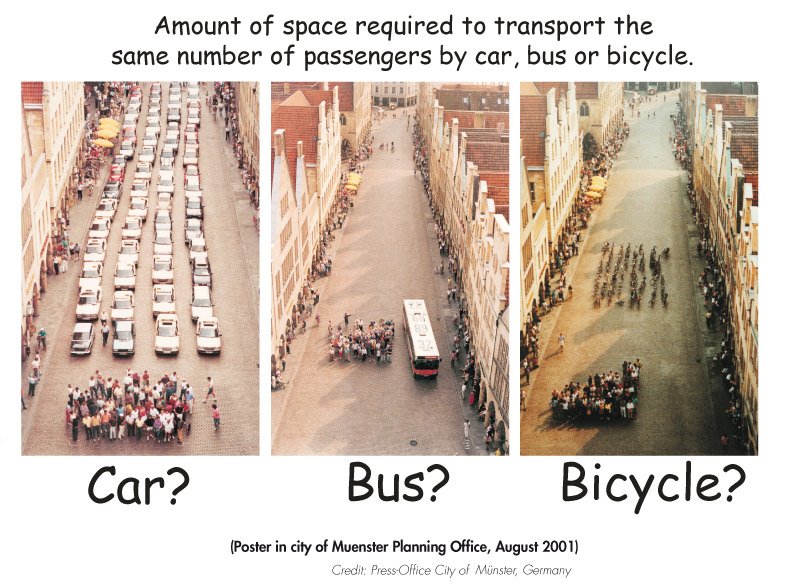
When the car began spreading in earnest in the 1920s, the total U.S. population was 106,021,537. In 1930 it was 122,775,046. Today it’s approximately 316,000,000. Moving to a highly car-dependent lifestyle made sense for a long time, but now a lot of urban areas are simply choked by them. This famous photo from the City of Muenster Planning Office succinctly demonstrates the problem, as does L.A. during rush hour:

Cities, buses, and bikes

Education is also part of the city puzzle, since it’s provided publicly and, usually, on a per-city basis. For much of the period from approximately 1970 – 2010, it was possible for parents to outrun well-meaning but poorly executed court degrees pertaining to school districting. It’s hard to measure the extent to which school busing and similar schemes drove many parents to the suburbs, even if they would’ve liked to stay in cities. This 2006 WSJ piece describes some of the pernicious consequences that are still reverberating in Seattle, which is a microcosm for the problems elsewhere. Schools and real estate both show the same basic principle: when principles meet self-interest, self-interest usually wins. Everyone favors low- and moderate-income housing in theory but don’t want it in their neighborhood, and everyone favors racial integration in theory unless their kid gets moved to the worse school.

Still, that’s tangential to Jacobs’s main points and how they affect contemporary decisions in cities. That I’m still citing Jacobs’ work more than 50 years later demonstrates its importance. To the extent any normal person has heard of anyone having anything to do with urban planning, they’ve heard of Jacobs and Moses. Pretty much anyone with any formal education in the subject has not only heard of them but read at least excerpts of their writing. It’s like being in English lit and wondering who this Shakespeare guy is.