The Rub of Time — Martin Amis

Language is imprecise. Push words too far and they fall apart. This is annoying, for obvious reasons, but also interesting, for artistic ones, and Amis does “a great deal of polishing” in these pieces, “trying to make myself clearer, less ambiguous, and more precise.” And sometimes, I think, imprecise or allusive in interesting ways. As a writer he also confronts the way words also contain a lot of historical residue. Amis mentions Northrop Frye, “a literary philosopher-king to whom I owe fealty.” Fealty: a curious word associated with the Middle Ages and a set of social-economic circumstances that don’t exist in Western Europe or the United States anymore. I’m sure Amis knows it’s a curious word and one that does strange work, here. A lot of Amis words do strange work and that’s part of the reason we like him.

To me, if you’ve not read nonfiction Amis, you’re best off starting with The War Against Cliché, which changed the direction and tenor of my own work. My affection for War may be a historical accident: right work, right time, right mind for a major collision. But it may be that good, and it offers some context for The Rub of Time. The essay that most stands out to me may be the one on Larkin: suddenly, I want to read him, and that’s a great effect of a great essay. “No: Larkin is not a poet’s poet. He is of course a people’s poet, which is what he would have wanted. But he is also, definingly, a novelist’s poet. It is the novelists who revere him.” I’d never thought so. Yet now I do.

Amis gets humor: this will make his own work age well, I think, particularly in an age when momentary political rage too often replaces humor. The humorous Amis is not readily quotable, though, because he’s too contextual. On Twitter, rage seems more common than comedy, when in life the opposite seems true. The smartest people I know seem much fonder of comedy than outrage. And the replacement by outrage of comedy in contemporary universities seems one of their problems, and yet one that no one is doing anything to address. Comedy pierces conventional pieties, of the sort that seem very popular on campus.

Some essays are, in my view, wildly skippable—like the one on a Republican National Convention, or the Trump one. Both the RNC and Trump are fact-free zones; to the extent either generates what might be termed “ideas,” those ideas are too unmoored from something like reality to be worth considering. The best one can hope for regarding the current incarnation of the Republican party is resounding defeat in 2018 and 2020, which leads to a reformation. Then again, I would’ve hoped for the same in 2014 and 2016, by which point the madness in the party had manifested itself, and it didn’t happen. A million intellectually sophisticated essays have done near zero to affect voting outcomes. Which is disheartening to someone who likes writing and reading such essays: if an essay falls in a forest, and no one reads it, does it make a sound?

And some Amis essays are just dated. The porn industry moves fast, and “In Pornoland” is useful historically and to someone interested in the history of the industry, but given that it was published in 2000, it feels its age. The first four paragraphs are hilarious, though, and I won’t quote them so as to not spoil the effect.

Amis is a noticer in his fiction and a noticer in his nonfiction: it’s fun to see the expert doing his thing. He’s done the reading, like most people haven’t. He’s got the context for the reading. He writes that, “Accusing novelists of egotism is like deploring the tendency of champion boxers to turn violent.” He also acknowledges when things have changed. He wrote a long piece on the actor John Travolta, but the postscript notes that “As it turned out, Travolta’s resurgence lacked staying power.” Lacking staying power, however, “is not to be compared with the death of Jett Travolta, in 2009 (a seizure, related to his autism). Jett was 16.” That’s how the piece ends, now: with perspetive, which can sometimes be absent in writing about celebrities.

Amis makes me want to be a better writer. I hope he does the same for you.

Adventures in the Screen Trade — William Goldman

I’ve cited Adventures before, and it seems to have aged 25 years since 2011. Still as a historical work, it’s of interest—like the way movies started as YouTube, shifted to what we’d call “movies” today, and maybe are shifting back towards YouTube:

By the year 1910, there were over nine thousand theatres in operation across the country.

Movies, of course, were shorter then. D.W. Griffith, in one five-year stretch, directed over five hundred ‘movies.’ Not only were they of less duration, they were also a good deal more simplistic than what we are used to today; one early hit consisted in its entirety of nothing but a horse eating hay. (The filmmaker who created the horse movie followed up with another smash—some footage of a pillow fight between his two daughters.)

Sound familiar? Animals eating, children being cute, no real story—it’s YouTube. YouTube gives us a distribution mechanism that takes us back towards the start of the film era. Had there not been laws and mores against it, one could imagine a good deal of pornography being shot and shown then: another topic of great interest today, albeit not directly on YouTube.

Goldman’s notion of “stars” may be changing too: the entitled behavior he describes seems to be going away, because today no one, or almost no one, goes to see a move just to see a particular actor. When Goldman wrote, narrative visual entertainment was limited to a small number of TV stations and movies. That was it. Today, narrative visual entertainment is effectively limitless. How people watch has changed, and that in turn has changed the industry.

Everyone has a take on Los Angeles; Goldman is not an exception.

But my particular crazies are not why I find writing so difficult. It’s more like this: Everything’s so goddamn nice out there. Sure, they bitch about their smog, but unless you’re a Hawaiian born and bred, the weather is terrific. And so many of the basic necessities of life are made so easy for you: The markets are often open twenty-four hours a day, nobody snarls at you in the stores when you’re trying to buy something. It’s all just . . . swell.

Is it still so swell? Some of those advantages have changed: I perceive Southern Californians as nice, but in a superficial way. The East Coast probably has 24-hour markets now—as many as California’s. Paul Graham even lists the California attitude as an advantage for startups:

What makes the Bay Area superior is the attitude of the people. I notice that when I come home to Boston. The first thing I see when I walk out of the airline terminal is the fat, grumpy guy in charge of the taxi line. I brace myself for rudeness: remember, you’re back on the East Coast now.

The atmosphere varies from city to city, and fragile organisms like startups are exceedingly sensitive to such variation. If it hadn’t already been hijacked as a new euphemism for liberal, the word to describe the atmosphere in the Bay Area would be “progressive.” People there are trying to build the future. Boston has MIT and Harvard, but it also has a lot of truculent, unionized employees like the police who recently held the Democratic National Convention for ransom, and a lot of people trying to be Thurston Howell. Two sides of an obsolete coin.

Today, though, California is less nice: cruel zoning and Prop 13 have made living there far more expensive than it was in Goldman’s day. Back then, maybe it was too nice. Now it’s slammed by traffic and the cost of housing is astronomical. The only people who can afford to live there are the rich and desperate to succeed. Maybe that makes the state better for startups (empirically, this seems to be true so far), but I wonder if the high cost of living, along with tighter profit margins, will eventually drive the movie talent cluster out.

Lost Connections: Uncovering the Real Causes of Depression — Johann Hari

Here is a typical narrator in a Michel Houellebecq novel—in this case, François from Submission, but most Houellebecq narrators express similar sentiments:

My life was marked by real intellectual achievements. In a certain milieu—granted, a very small one—I was known and even respected. Financially, I had nothing to complain about. Until I died I was guaranteed a generous income, twice the national average, without having to do any work. And yet I knew I was close to suicide, not out of despair or even any special sadness, simply from the degradation of “the set of functions that resist death,” in Bichat’s famous formulation.

One could posit various reasons for François’s feelings, ranging from the literary to the psychological to the spiritual, but Hari offers another explanation, or set of explanations.

Many people are suffering from crises of meaning. Man’s Search for Meaning addresses one set of possibilities for making meaning. Lost Connections offers another, more systematic but complementary to Frankl. It’s a fantastic book, but ignore the subtitle, which makes Lost Connections sound more like clickbait than it actually is; I’d not properly considered loneliness until I read this book, though I thought I had.

He gives context to problems I’d not fully perceived: “If you can be everywhere—in vehicles, or online—you end up. . . being nowhere.” That’s something artists know. Many, maybe most, of the best novels are set somewhere very particular, and perhaps that isn’t by chance. Even The Lord of the Rings is set somewhere very particular, albeit imaginary, and the provincialism of the Shire is necessary to offset the grandeur of many other locations.

He takes his own advice and sees specific people living specific ways—like the Amish. Hari also grew up not far from Orthodox Jews and scorned them, but, when he goes to visit the Amish, he finds himself “reflecting on some of the flaws in how we live,” and he “wondered if they might have something to teach me after all.” Maybe religion is underestimated by a lot of modern secularists, myself included. Tyler Cowen has been saying that the top thinkers of our age are or will be religious thinkers, and, although I’m skeptical, I’m less skeptical than I used to be.

Hari cites nine causes of depression, while stating that they’re not exhaustive, including disconnection from meaningful work; other people; meaningful values; childhood trauma; status and respect; the natural world; and a hopeful or secure future. If you counted the preceding list, you’ll notice that it has only seven items; eight and nine are “the real role of genes and brain changes.” These causes are linked with potential solutions. The chapters themselves are detailed. For example, he tells stories about the research into what makes work depressing; a number of factors exist, including indifference:

If these tax inspectors worked really hard and gave it their best, nobody noticed. And if they did a lousy job, nobody noticed, either. Despair often happens […] when there is a ‘lack of balance between effort and rewards.’ It was the same for Joe in his paint shop. Nobody ever noticed how much effort he put in. The signal you get from the world, in that situation, is—you’re irrelevant. Nobody cares what you do.

Ignore the slightly awkward shift into second person narration and attend to the idea: indifference can actually be worse than constructive criticism. If someone is trying to help a person improve, their job matters. If no one tries, it doesn’t. We think of depression as a disease of the mind, but it may be impossible to separate mind, body, and social environment.

Another possible solution, or piece of the solution? Psychedelics. Here is a current review of psychedelics research. Psychedelics are not a panacea, but neither are prescription antidepressants or the many other things currently being used to deal with depression/loneliness.

Loneliness is everywhere, but it’s striking how little I read or hear about it. It’s improper to admit deep loneliness on Facebook, or all those other repositories of digital loneliness. Loneliness is effectively enshrined into law through our building codes, which prevent us from constructing housing that encourages people to talk to each other. Yet it’s often felt and rarely discussed. Lost Connections could easily be named, Loneliness: Causes and Consequences. But loneliness is often a second-, third-, or fourth-order consequence of many other decisions, so we never get to it—we stay at the surface level, not the deeper levels, as Hari does. Lost Connections can be seen as an indictment of the way we live and the way we’ve built our society. But how many people are listening? I’m not sure the answer. The book is easy to read, in the sense of having a normal vocabulary and being wrapped in stories, but it’s hard to read, in the sense that many of us will recognize ourselves and our own life mistakes in it. It’s akin to Deep Work, another book about the mistaken ways we live.

It’s striking, too, that the Internet was supposed to connect us and make loneliness easier to cure. But if it’s had that effect on net, we’re not able to see it show up statistically or in depression data. There are obvious advantages to the Internet: I know lots of people who hooked up through online dating. I myself have met other nerds (or “intellectuals” if one prefers) through this blog. But:

The Internet was born into a world where many people had already lost their sense of connection to each other. The collapse had already been taking place for decades by then. The web arrived offering them a kind of parody of what they were losing—Facebook friends in place of neighbors, video games in place of meaningful work, status updates in place of status in the world. The comedian Marc Maron once wrote that “every status update is just a variation on a single request: ‘Would someone please acknowledge me?'”

It turns out the Internet is just a tool, and like so many tools it can be used well or poorly, to facilitate or attack loneliness. Or maybe, as Hari writes, it’s neither countervailed nor enhanced trends that “had already been taking place for decades.” Maybe the Internet has actually arrested the social isolation trends already at work.

There are many further insightful passages I could cite, at the risk of merely summarizing it, but I’ll say that I’m keeping the book and look forward to rereading it. In the last sections of Lost Connections, Hari lists possible solutions, and most seem wildly implausible—which is why anti-depressants are so popular. Anti-depressants are easy, cheap, and uniform (at least in formulation). Hari’s solutions are hard, expensive, and difficult to scale (from the perspective of a society or organization).

But hard things are often worth doing. It’s hard to build social networks and meaningful relationships. Rejection stings. It’s tempting to stop trying. Most of our world, from the way we zone cities to the way we get around the world in cars, is designed to cut social connections rather than build them (no one asks about the psychological cost of mandating single-family houses in suburban areas). To rebuild lost connections takes a lot of time and effort. Scanning Facebook is easier than getting a drink. The alternative to doing hard things is worse. Advertising and marketing cultures seduce us with promises of ease and convenience. We’re reluctant to embrace the difficult and inconvenient, which is to say the human and humane.

I don’t have final answers for creating a meaningful life, but I do think there are parts of the U.S. educational and cultural systems that are systematically misrepresenting what’s important in life. We spend 12 – 16 years in school and yet often never take a financial literacy class or psychology of meaning and satisfaction class. Sometimes psychology or English classes may accomplish the latter, but they do so on an ad-hoc basis and rely on instructor charisma and passion that is hard to systematize and reproduce. Instead, those of us curious about such topics have to learn about them on an ad-hoc basis, through books like Lost Connections. Lost Connections is good. Don’t expect to understand all of it during the first read. It’s a book that may grow with your life.

Thoughts on an encounter with Rene Girard

That encounter is through a couple of his books but mostly Things Hidden Since the Foundation of the World; in grad school I started Deceit, Desire, and the Novel a couple times but could never get past some of the more ridiculous assertions in it (more on that later). Cynthia Haven’s Evolution of Desire: A Life of Rene Girard is the impetus for the latest bout of reading, and I find the biography more satisfying than the primary reading: it softens and contextualizes the kind of claims that make me quit a book. But it’s still suitably inscrutable and koanic as to be interesting: “For Girard, however, literature is more than a record of historical truth; it is the archive of self-knowledge.” Which is great! But I’m not entirely sure what it means or if it’s true—which is descriptive, not critical.

He is an intellectual: “I once asked Girard what the biggest events of his life were. Oh, he assured me immediately, they were all events in his head. His thoughts were what mattered.” Haven isn’t fully convinced, maybe rightly, but I’m attracted to that idea—that it’s about the mind more than the environment. Girard’s method is also unusual, among social scientists, at least:

He studied human behavior as reflected in the greatest works of literature, and found in them a recurring analytical observation of the serious consequences of mimetic behavior. This discovery opened his eyes to the hidden dynamic of group violence.

Is literature the right place to look? To me, literature is the exceptional, bizarre, and unusual; the usual is too boring to include. I wonder if Girard is suffering from selection bias. (Haven does find a fun quote from Milan Kundera: “The art of the novel is anthropology.” Is the same true of film?)

Anyway, when I read Girard, I usually have the same problem I do with most philosophers: there are some interesting passages but too many ridiculous claims that make me close the book and go read someone else. Or I think too much about what’s true. Consider this, with Chris Blattman:

The only reason I’m aware of the René Girard worldview is because I glanced at the “What should I ask Chris Blattman?” questions. [laughs] I saw that name, and I thought, “Oh, I don’t know who that is.” My 10 minutes of investigation suggests that I find nothing about this idea resonates with my personal experience in particular wars.

So maybe “the greatest works of literature” are not a great guide to the real world or analyzing it. And I say this as someone who reads all the time. The great works may be more time-, technology-, class-, and culture-dependent than many of us literary types want to admit.

That said, when Girard’s ideas get in the head, one starts to see them in many places. I listened to Jon Ronson’s podcast / Audible series “The Butterfly Effect,” which is “sort of about porn, but it’s about a lot of other things. It’s sad, funny, moving and totally unlike some other nonfiction stories about porn – because it isn’t judgmental or salacious.” And that got me connecting. In Girard’s cycle of scapegoating and social cohesion, it may be that porn stars are the best examples of a modern group that are hated, loved, sacrificed—and reborn. They provide a service or set of works that are widely consumed but also widely reviled. People oscillate among extreme feelings regarding them. Most of polite society disparages what they do, even as they have a broad, though largely ignored, impact. The highly regulated, highly PR-driven healthcare, education, and government sectors largely revile people who do or make porn, but that’s in part because of a vague but pervasive social feeling about what is “appropriate.” Should we look first at what people do and want, then look at what is “appropriate?” Or should we try to imagine what’s appropriate? If we do that, we may be entering the separation and scapegoating cycle Girard posits.

That being said, to get to the point of connection, you may have to wade. Things Hidden, for example, as with most “philosophy,” is at least twice as long as it needs to be and half as clear, if that. I would’ve liked more footnotes and a style closer to Cowen or Thiel than to a style like academic philosophy. Long-time readers know that I have a certain fascination with and derision for philosophy (see here or here or here) for examples. Philosophy often seems to be a search for broad, generalizable rules that in my view don’t exist or rarely exist; I’d rather start with situations and dilemmas and attempt to reason from there, which may be why I like novels. Indeed, rather than start this essay from first principles I began from an encounter with a book and then reasoned forward.

Overall, very interesting, though Girard’s life was not, particularly. He lived in and for ideas, as near as one can tell, which is fine; my life is probably pretty boring, viewed from the outside. If exciting is World War II, boring and well-fed is pretty good. There are many problems today, and those problems are worth remembering, but many of us don’t think historically and forget what yesterday was really like.

Maybe this says something bad about me, but I feel like I’ve read enough Girard without reading much Girard.

Still, this post is too negative. There are many things to admire, like this, from Haven:

Girard told me that our judicial system is the modern antidote to the mob, with its cycles of accusation and vengeance, its contagious fears and ritual denunciations—and on the whole it works. It has an authority to impose a final punishment of its own—vengeance stops at the courtroom.

The judicial system is, to use a Kahneman term, very system 2—that is, it is slow, deliberate, and often not our first choice. We’d rather make instant heuristic decisions, then allow our internal press secretary to justify those decisions. The judicial system may attempt to short-circuit that fast and unconscious process.

There are also amusing moments in Evolution of Desire that reveal historical change, as when we find this, about the University of Indiana just after World War II: “While the expenses of a sorority were normally beyond the reach of a fatherless student, the local chapters were eager to bolster their academic reputation, so she was recruited to Delta Gamma.” “Academic reputation” does not appear to be a key factor in current college fraternities or sororities.

Grass Roots: The Rise and Fall and Rise of Marijuana in America — Emily Dufton

Grass Roots is about marijuana, yes, but it’s also about what it means to live in society and what it means to be:

The battle over the drug has always been about much more than whether individuals have the right to smoke, eat, or vape it for effect. Instead, questions about marijuana have long been tied to ideas about freedom and liberty, safety and security, and the rights of an individual versus the collective good—themes that are at the core of many other historical debates.

Much of the book is new to me: I didn’t know how much decriminalization happened in the ’70s, when 11 states decriminalized weed. I didn’t realize how much anti-drug hysteria occurred in the ’80s. I didn’t know the specific mechanisms that drove drug policy back and forth. Now I do, but I’ll warn that the book is often more detailed than most readers want. There is a lot of organizational discussion (“Given his former affiliation with the NFP, Turner encouraged the first lady to work specifically with that organization. PRIDE and FIA did good work, Turner knew, but the NFP was led by social conservatives…”); be ready to skip parts, unless you are uncommonly engaged by bureaucratic jousting—you may be. You may also read the book in conjunction with Daniel Okrent’s Last Call: The Rise and Fall of Prohibition. And of course the subtitle of Grass Roots is clever.

Evidence and knowledge play small roles in the periods that see relatively legal weed and relatively illegal weed. Dufton notes:

Despite its popularity, Just Say No did little to actually decrease youth drug use. In 1988 … the University of Michigan’s “Monitoring the Future” survey found that, although rates of adolescent drug use in the United States had dropped over the past seven years, they were still “the highest in the industrialized world.”

The United States is an outlier in many respects, and this is, or was, apparently one of them. I got “Just Say No” drug education in schools and it seems to have been, at least anecdotally, not productive. It’s also not productive to lump all illegal drugs together, as many “education” programs do: drugs vary considerably in their danger and uses. Michael Pollan’s new book, for example, describes the many ways psychedelics may be therapeutic. And thinking about actual danger is important; I don’t know that there are any documented cases of overdosing on marijuana, but the opioid epidemic is well-known and is killing tens of thousands of people per year. Why do we treat weed, LSD, and morphine and heroin similarly? They’re not.

Other aspects of ignorance drove and still drive drug policy. “A 1917 report from the Treasure Department noted that in Texas, only ‘Mexicans and sometimes Negroes and lower class whites’ smoked marijuana for pleasure and warned that ‘drug-crazed’ minorities could harm or assault upper-class white women.” Then, “films like Reefer Madness, released in 1936, associated marijuana use with murder, miscegenation, and suicide.” Which could only be convincing to someone who has never seen a person high on weed: they are dangerous only to pizza and other snack foods.

Money and sex play major roles in the Grass Roots story. The desire for tax revenue entices some states. And the desire to sell paraphernalia entices entreprenurs. Playboy offers some grants to marijuana-focused organizations; it exists at the nexus of sex and money. And some of the early advocates for marijuana have, uh, personal problems that retard their advocacy:

Two months after moving in with Stroup, Newman and Stroup’s wife took MDA, a powerful psychoactive amphetamine known for enhancing sex, and spent the night together while Stroup was visiting the Playboy Foundation in Chicago to solicit funds.

By 1978, we saw “a flood of additional states passing new marijuana laws and the president decriminalizing the drug at the federal level.” But “the downfall of Peter Bourne and the subsequent downfall of Keith Stroup brought the country’s first experiment with decriminalization to a close.” Sort of like Parnell and Kitty O’Shea in nineteenth-century Ireland. I wonder if anyone has yet written the definitive book on the role of sex scandals in world political history.

Another pro-pot politico working for the Carter administration got in media trouble through sex, or a perceived connection with sex; he was a doctor whose secretary was “struggling emotionally,” and

To help Metsky relax, Bourne wrote her a prescription for fifteen Quaaludes, a mild tranquilizer that, though often used to treat insomnia, was also known socially to enhance sex.

This eventually got to the press. My impression, too, is that, regardless of what is “known socially,” Quaaludes just make people sleepy or lethargic, which would not seem to offer the erotic boost that they apparently did in the popular imagination—another example, maybe, of the small role played by knowledge and evidence in the marijuana saga.

Dufton also writes, “Cannabis was believed to be so safe [in the late 1800s] that the drug was marketed to women through romantic postcard campaigns that showed concerned mothers applying a cannabis salve to soothe the gums of teething babies and relieve children’s colds. As a pain reliever, marijuana worked wonderfully.” Does it work better and more safely than Tylenol (which is extremely dangerous, though not addictive)? I wonder if we know that, today: conducting the research may itself be illegal.

Two things strike me as odd or missing (or I missed them). One is the absence of any discussion of lead in gas in the rise of drug use. This may sound esoteric, but leaded gas has been implicated in “violent crime, lower IQs, and even the ADHD epidemic.” Leaded gas may also have led to higher drug use in the ’60s and ’70s. The other is the absence of any discussion of age cohorts. In the ’60s and ’70s, baby boomers were teens and young adults—ages at which drug experimentation is common and favoring drugs is common. By the ’80s, many were parents themselves—and parents are much more conservative, especially about their own children (several chapters of Grass Roots focus intelligently on the role of parent movements), than experimental 21-year olds. I don’t think and wouldn’t argue that either factor is dispositive, and both can coexist with Dufton’s other work.

“The Storm Before the Storm” and parallels to modern American history

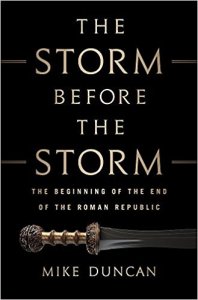
The Storm Before the Storm is a history of ancient Rome, and it’s explicit about its purpose: to draw parallels between then and contemporary American history. For obvious reasons, “how democracies die” is a salient question right now. The book is successful in its task and, beyond being good in itself, it makes a nice companion to Helen Dale’s Kingdom of the Wicked.

Still, I’m going to do the opposite and look at ways the current United States is not like ancient Rome. For one thing, ancient Rome was a largely agrarian society and we’re not agrarian today and haven’t been for a long time. For another, passages like this are common: “Norbanus instigated a riot that physically drove the rival tribunes out of the Assembly. Caepio was duly prosecuted, convicted, and sentenced to exile. Violence once again proved to be the last word in Roman politics.” In recent decades political violence has been mostly absent from American life, and that’s good. Political violence was very bad in ancient Rome and is very bad in many circumstances; consider, for example, “Rule by Fear: A new one-volume book offers an updated history of the rise and fall of the Third Reich:”

Childers is absolutely clear that this tactic was combined at all times with intense and pervasive violence on the streets, particularly from the brown-shirted stormtroopers, the strong-arm wing of the movement.

Right now there are many bad things happening in American politics, with widespread efforts at voter suppression of particular and underappreciated importance, but violence in the streets and private goon squads aren’t yet among them—and, one hopes, they never will be. But so many things have happened that I never thought would happen that I’m reluctant to say this one never will.

Ancient Rome was also relentlessly at war; after Hannibal invaded Italy, “the great hero of the war, Scipio Africanus, led an invasion of the Carthaginian homeland in North Africa.” The last time the U.S. all-out invaded a country, it did not go well, and American military leaders are notably absent in politics or political power. The current president is notable mostly for draft dodging, not effective command.

The U.S. is also not currently seeing problems based on slaves; “the continuous run of successful foreign wars brought slaves flooding into Italy by the hundreds of thousands.” Many were then made to work “growing estates.” If anything, the biggest problem the U.S. faces is too few people, not too many. Bryan Caplan may write books like Selfish Reasons to Have More Kids, but most people do not take his advice. Articles like, “The historically low birthrate, explained in 3 charts.”

There are others, but the absence of violence in American politics is likely the most significant. I’m not writing this piece to argue for complacency—the Roman Republican saw a long period of declining democratic norms, and the U.S. is also seeing just that—but it’s tempting to follow Duncan’s narrative and think the abyss is near. Whenever one looks at a metaphor or other comparison, however, it’s useful to ask, “How are these things alike, and how are they not alike?” Many forget to ask the latter questions, including me.

We have no or very few political murders; the article on the history of the Third Reich notes that “Childers’s view of the ill-fated liberal democracy of the Weimar Republic is correspondingly gloomy, stressing the continuity of political murders (376 from 1918 to 1922 alone).” We have many problems, but, again, it’s worth stressing the problems we don’t have—and why it’s important to oppose violent rhetoric when it is used. Violence, once unleashed, becomes practice by precedent, and even those who would think to use it for temporary advantage do not have the foresight necessary to understand where it will go.

It is notable, too, that the Third Reich seized the machinery of the state and then deployed it to terrorize the rest of the population, which was too cowed, disorganized, or simply inattentive to do anything. Is there any doubt that, today, the many ground-level aspects of the security and police apparatus wouldn’t resist decrees to do horrible things in the United States? Watching the response to some of the awful decrees coming out of the capitol now makes the answer clearer than I once believed.

Duncan writes that, “If history is to have any active meaning there must be a place for identifying those interwoven elements, studying the recurring agencies, and learning from those who come before us.” I agree, but it appears many voters do not. In 2016, “about a quarter of people said they read zero books, in any format.” One out of four. Contemplate that as you go about your day. The same survey finds the median “American has read 4 books in the last 12 months.” Can history have much active meaning in our situation?

Everybody Lies — Seth Stephens-Davidowitz

Stephens-Davidowitz is right:

One more important point that becomes clear when we zoom in: the world is complicated. Actions we take today can have distant effects, most of them unintended. Ideas spread—sometimes slowly; other times exponentially, like viruses. People respond in unpredictable ways to incentives.

Yet we seem to like simple stories and seem to believe that our actions will have simple, easy-to-understand consequences. Data complicates or invalidates many of those stories, so we ought to seek it whenever we can. Stephens-Davidowitz does just this in Everybody Lies: Big Data, New Data, and What the Internet Can Tell Us About Who We Really Are. An alternate sub-title could be, “Why most of us are full of shit.” You may suspect, intuitively, that most of us are full of shit, but it’s nice seeing it confirmed. The miracle of aggregation gives us a lot of new tools to look at human nature.

This book can be read as part of a series, as it’s congruent with Dan Ariely’s Predictably Irrational and especially Jon Birger’s Date-onomics, which doesn’t discuss data from porn, as Stephens-Davidowitz does, but it could have (albeit at the risk of making it longer and perhaps turning off some of its readers). We’re going to see a lot more books like Everybody Lies as the Internet allows us to aggregate huge amounts of data that tell us something about what we do—as opposed to what we say. What we say seems to be a very poor guide to understanding what we really think; while this has been obvious on some level for a long time, it’s useful to see the specific ways action and speech are mismatched.

Take one sensitive area:

Somewhat surprisingly, porn data is rarely utilized by sociologists, most of whom are comfortable relying on the traditional survey datasets they have built their careers on. But a moment’s reflection shows that the widespread use of porn—and the search and view data that comes with it—is the most important development in our ability to understand human sexuality in, well . . . Actually, it’s probably the most important data ever.

“Ever” might be an overstatement (what about Masters and Johnson’s live observations?), but calling it “very important” and perhaps most importantly “novel” is legitimate. While the observation is useful, it’s also useful to remember that what people want in a fantasy setting may be different from what they, or we, want in a reality setting. Many people like watching people get shot in movies without thinking we should shoot more people in real life.

Or, in the same domain, there is this, with the data from the General Social Survey:

when it comes to heterosexual sex, women say they have sex, on average, fifty-five times per year, using a condom 15 percent of the time. This adds up to about 1.1 billion condoms per year. But heterosexual men say they use 1.6 billion condoms every year. Those numbers, by definition, would have to be the same. So who is telling the truth, men or women?

Neither, it turns out. According to Nielsen, the global information and measurement company that tracks consumer behavior, fewer than 600 million condoms are sold every year. So everyone is lying; the only question is by how much.

A meta lesson may be, be very wary of survey data.

(If you recognize some of these ideas, you’ve probably read A Billion Wicked Thoughts or my essay on it.)

Other problems, this time outside the realm of sexuality, include estimation:

When relying on our gut, we can also be thrown off by the basic human fascination with the dramatic. We tend to overestimate the prevalence of anything that makes for a memorable story. For example, when asked in a survey, people consistently rank tornadoes as a more common cause of death than asthma. In fact, asthma causes about seventy times more death. Deaths by asthma don’t stand out—and don’t make the news.

Still, I wonder what would happen if researchers paid survey respondents for right answers. In surveys, people have little incentive to try to be right. In some other parts of life, they do.

Much of the data comes from Google, and we should remember something important: “Google can display a bias toward unseemly thoughts, thoughts people feel they can’t discuss with anyone else.” Which makes sense: before Google or the Internet more generally, many of those thoughts would never have left the mind in a way that in turn left a residue on the rest of the world. Now they do. Perhaps one lesson of Everybody Lies is that more of us should use Duck Duck Go, the search engine that famously doesn’t record its users’ search terms. I infer, from the prevalence of Google search and Gmail, that most people don’t give a damn about privacy—regardless of the numerous article about privacy one sees in the media. People’s revealed preferences seem to indicate they want convenience and familiarity far more than privacy.

Then there is this, which may be most useful for people doing Internet marketing:

The lesson of A/B testing, to a large degree, is to be wary of general lessons. Clark Benson is the CEO of ranker.com, a news and entertainment site that relies heavily on A/B testing to choose headlines and site designs. “At the end of the day, you can’t assume anything,” Benson says. “Test literally everything.”

By the way, the school(s) you attend also seems to matter little for any measurable life outcomes. The money spent on expensive private schools seems to be largely wasted, or, if not wasted, then at least should be considered a consumption expense, rather than an investment expense. The entire education industry has worked hard to convince you otherwise, but the papers Stephens-Davidowitz cites are convincing and congruent with similar research I’ve seen on the issue.

Stephens-Davidowitz ends by saying that data from the Amazon Kindle indicates that few people read to the end of books. This one is worth reading in full.

Skin in the Game – Nassim Taleb

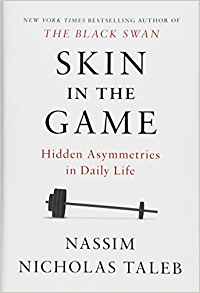
Skin in the Game is congruent with Tom Ricks’ book The Generals. Almost all generals and high-ranking officers in the U.S. military are now exempt from real risk, as Ricks argues—they are exempt even the risk of being fired or reassigned for simple incompetence (or being ill-suited to a role). Almost all enlisted men and junior officers, however, are heavily exposed to real risk, like being killed. That risk asymmetry should give pause to someone contemplating joining. The risk profile for generals prior to the Korean war, while not as a great as the risk profile for regular soldiers, was more reasonable than it is today. Military contractors are arguably the greatest beneficiary of the military today. If more people knew (and acted like they knew) this, we might see changes.

In Skin in the Game Taleb has many, many unusual examples, many of them good; he reads more like an old-fashioned philosopher (that is: one who wants to be read, heard, and understood, as opposed to one who wants tenure), and I mean that as a compliment. One of his rules is, “No person in a transaction should have certainty about the outcomes while the other one has uncertainty.” I wonder how this rule could be applied to colleges, especially under a student-loan system, in which the college is certain to be paid by the student, the student’s family, or the student’s bank (which is really to say, the bank’s student), while the student may see a variable return on investment—especially if the student is ill-equipped in the first place. Colleges may be selling credentials more than skills. But almost no one thinks about those things in advance.

Skin in the Game will, like Antifragile, frustrate you if you demand that every single sentence be true and useful. Some of Taleb’s micro-examples are bad, like his thing against GMOs:

In my war with the Monsanto machine, the advocates of genetically modified organisms (transgenics) kept countering me with benefit analyses (which were often bogus and doctored up), not tail risk analyses for repeated exposures

This view is incoherent because virtually every food eaten today has been “genetically modified,” inefficiently, through selective breeding. If you wish to learn just how hard this is, see The Wizard and the Prophet by Charles Mann. Transgenics speed the process. See this sad tale, and the links, for one researcher in the field who is giving up due to widespread opposition. He points out that, over and over again, transgenic have been shown to be safe.

Taleb is right that there are tail risks to transgenics… but that’s also theoretically true of traditional cross-breeding, and it’s also true of not engaging in transgenics. The alternative to high-efficiency transgenics is environmental degradation and, in many places, starvation. That’s pretty bad, and there’s a serious, usually unstated, environmental trade-off between signaling environmental caring and opposite transgenics (nuclear energy is the same).

Despite incorrect micro-examples, Skin in the Game is great and you should read it. It is less uneven than Antifragile. It’s also an excellent book to re-read (don’t expect to get everything the first time through) because Taleb gives so many examples and is overflowing with ideas.

Like: “If your private life conflicts with your intellectual opinion, it cancels your intellectual ideas, not your private life.” Something easily and frequently forgotten, or never considered in the first place. Look at what people do, not what they say. One of the many charming parts of Alain de Botton’s The Consolations of Philosophy is the apparently wide gap between what many philosophers wrote and how they appeared to live. Maybe the truest philosophers don’t write but do.

Or consider:

the highest form of virtue is unpopular. This does not mean that virtue is inherently unpopular, or correlates with unpopularity, only that unpopular acts signal some risk taking and genuine behavior.

A very Peter Thiel point: he asks what popular view is wrong and what unpopular views a given person holds.

Or consider:

The only definition of rationality that I’ve found that is practically, empirically, and mathematically rigorous is the following: what is rational is that which allows for survival.

This may be true, but most of us in the West now survive, unless we do something truly stupid, dangerous, or brave. So our wealth and comfort may enable us to be irrational, because we’re much less likely to pay the ultimate penalty than we once were. Darwin Awards aside, we mostly make it. We can worry more about terrorism than the much more immediate and likely specter of death in the form of the car, which kills far more people every year in the United States than terrorism.

To his credit, though, Taleb does write:

The Chernoff bound can be explained as follows. The probability that the number of people who drown in their bathtubs in the United States doubles next year [. . .] is one per several trillions lifetimes of the universe. This cannot be said about the doubling of the number of people killed by terrorism over the same period.

He’s right that the number who could be killed by terrorism is massive, especially given the risk of nuclear and biological weapons. But the disproportionate focus on terrorism takes too much attention from risks that seem mundane, like getting into cars. Everyone expects to get into car crashes. Perhaps we should be thinking more seriously about that. Too bad almost no one is.

Junkyard Planet — Adam Minter

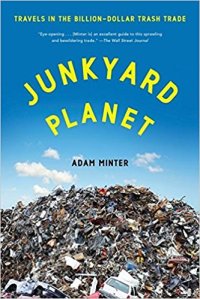
I wish I’d read Junkyard Planet: Travels in the Billion-Dollar Trash Trade when it came out: it’s both informative and, sometimes, strangely lyrical, which I wasn’t expecting in a book about the scrap metal business. You may think a book titled “Junkyard Planet” is boring, and I anticipated precisely that and was proved wrong. For Minter the scrap business is tied up with his family: he grew up in in the industry, so, like a writer from a restaurant family, he gets things most journalists don’t, or wouldn’t (“Some of my earliest and happiest memories are of wandering among the family junk inventory, often with my grandmother, finding treasures:” a sentence few of us can utter).

He’s also refreshingly direct about costs and benefits; many writers want to condemn the global recycling trade because of the obvious pollution produced in China. But Minter goes the extra step and asks: why do things exist as they do? Will exist this way in the future?

This book aims to explain why the hidden world of globalized recycling and reclamation is the most logical (and greenest) endpoint in a long chain that begins with the harvest in your home recycling bin, or down at the local junkyard. There are few moral certainties here, but there is a guarantee: if what you toss into your recycling bin can be used in some way, the international scrap recycling business will manage to deliver it to the person or company who can do so most profitably.

It turns out that “Huge, mind-bending, Silicon Valley-scale fortunes have been built by figuring out how to move the scrap newspapers in your recycling bin to the country where they’re most in demand.” Did you know that? Me neither. I learned from every page. It also turns out that for a couple decades following World War II, most dead cars were simply discarded in vast junkyards or chucked wherever they could be concealed. It took China decades in turn to go through all that American scrap (“the world’s most recycled product (by weight) isn’t a newspaper, a notebook computer, or a plastic water bottle—it’s an American automobile, most of which is metal”).

By the way, there are many important reasons to choose electric or plug-in electric cars, but one of them is the car’s valuable battery. Even in a decade or two, when the battery is likely to be too depleted for automotive use, it’s still likely to be valuable as grid storage. Seriously: “
Why Used Electric Car Batteries Could Be Crucial To A Clean Energy Future
.” Individual choices today are going to matter a decade or two from now.

For now, though, there are two major ways to get raw materials for new goods:

Digging mines was one way to obtain those raw materials; the other was to go to the United States, the place that many scrap traders call the Saudi Arabia of Scrap, the land where there’s more scrap than the people can handle on their own. It’s a funny nickname, Saudi Arabia of Scrap, but it’s not meant as a compliment. Rather, it’s an opportunity to exploit.

Think about this quote, too, every time you hear about a “shortage” of some commodity (nickel, cobalt, poorly named “rare earth” metals). A “shortage” usually means that someone doesn’t want to buy at a given price. You’ll know there’s really a shortage of something when you can sell old laptops, phones, or computers to Best Buy for a couple bucks. Right now, it’s not profitably enough to pay for out-of-date electronics. If and when it is profitable enough, you’ll be able to sell them—and profit will likely motivate more than green signaling.

By the way, what China is doing now is what the U.S. did more than a century ago; in the nineteenth century,

The U.S. was not yet scrapping its old infrastructure, [. . .] so it looked abroad to Europe [. . .] for raw materials. According to data culled by Carl Zimring, U.S. imports of scrap iron and steel grew from 38,580 tons in 1884 to 380,744 tons in 1887—a tenfold increase during, not coincidentally, a railroad building binge.

There are many more points of interest in the book. The total amount of recycling going on is much greater than I imagined, but it’s primarily happening behind the scenes and far behind the headlines.

In some ways, Junkyard Planet tells a circular story: each developing country goes from poor and a tremendous importer of “junk” (which is not actually junk), then moves up the value chain towards wealth and producing more apparent junk than it consumes. The obvious question is, “When will the world run out of poor, developing countries?” One hopes the answer is, “Soon.”

The Case Against Education — Bryan Caplan

The Case Against Education is a brilliant book that you should read, though you’ll probably reject its conclusions without really considering them. That’s because, as Caplan argues, most of us are prone to “Social Desirability Bias:” we want to say things that are popular and make people feel good, whether or not they’re true. Some true things may be socially desirable—but many false things may be too; the phrase “Don’t shoot the messenger” exists for a reason, as does the myth of Cassandra. We like to create scapegoats, and messengers are handy scapegoats. Simultaneously, we don’t like to take responsibility for our own ideas; and we like to collectively punish iconoclasts (at first, at least: later they may become idols, but first they must be castigated).

Caplan is an iconoclast but a data-driven one, and that’s part of what makes him unusual and special. And, to be sure, I myself am prone to the biases Caplan notes. Yet, as I read The Case Against Education, I couldn’t find many holes to poke in the argument. The book blends data and observation / anecdote well, and it also fits disturbingly well with my own teaching experiences. For example, Caplan notes that students find school boring and stultifying: “Despite teachers’ best efforts, most youths find high culture boring—and few change their minds in adulthood.” While “school is boring” seems obvious to most people, it’s also worth asking why. Many of the reasons Caplan gives are fine, but I’ll also add that “interesting” is often also “controversial,” and many controversial / interesting instructors will take heat, as I argue in “Ninety-five percent of people are fine — but it’s that last five percent:”

Almost no teacher gets in trouble for being boring, but a teacher can get in trouble or can get in trouble for being many values of “interesting.” Even I’ve had that problem, and I’m not sure I’m that interesting an instructor, and I teach college students.

It’s easy for outsiders to say that teachers should stand up to the vocal, unhappy minority. But it’s less easy to do that when a teacher relies on their job for rent and health insurance. It’s also less easy when the teacher worries about what administrators and principals will do and what could happen if the media gets involved or if the teacher gets demonized.

Despite the fact that no one actively wants school to be boring, the collection of forces operating on the school experience pushes it towards boredom. Many people, for example, are very interested in sex and drugs, but those topics also excite many students and parents, such that it’s difficult to say much that’s true about them in school.

As Caplan says, however, boredom is almost a feature, not a bug. Boring classes allow students to signal traits that employers value, like conscientiousness, intelligence, and conformity. Even if reading Ethan Frome is boring, being willing to tolerate Ethan Frome is important to people who would not themselves read Ethan Frome.

Caplan argues that most education is actually about signaling, not skill development. It’s notable how little we in as a society have improved education in the last two decades, when the Internet has opened up many new learning and signaling opportunities. Caplan has a theory about why: using weird counter-signaling efforts itself signals non-conformity and general weirdness (“‘alternative’ signals of conformity signal nonconformity”). So we’re stuck in a negative equilibrium.

He might be right. That said, I wonder if we’re just seeing a lag: twenty years is a long time by some standards, but in the history of education it’s a relatively short time. The problems with contemporary education also seem to argue that many employers would be well-served to ignore the signals sent by degree and search for alternate signals instead. Google claims to be doing this, but I don’t know of any researchers who’ve audited or studied Google’s internal data (if you do, please leave a pointer in the comments).

The people who most need to read this book are probably educators and high school students. The former probably won’t read it because it punctures some of the powerful myths and beliefs that keep them motivated. The latter probably won’t read it because high school students read very few books, and the ones most likely to read The Case Against Education are probably also likely to gain the most from higher education. So it’s another of these books that’s caught in a readerly catch-22.

Here is a Claudia Goldin paper, “The Race between Education and Technology: The Evolution of U.S. Educational Wage Differentials, 1890 to 2005;” as one person said on Twitter, “I agree with @bryan_caplan that the wage premium from education mainly comes from signaling, rather than learning vocational skills. But – I also believe widespread, generalist, higher ed can be a very good thing (as explained in [“The Race Between…”]).”

I also wonder about this: “employers throughout the economy defer to teachers’ opinions when they decide whom to interview, whom to hire, and how much to pay them.” Do they? Do most employers require transcripts and then actively use those transcripts? It seems that many do look for degrees but don’t look for grades.

One question, too, is why more people don’t go into various forms of consulting; smaller firms are less likely to be interested in credentials than larger ones. I do grant writing for nonprofits, public agencies, and some research-based businesses. Zero clients have asked about educational credentials (well, a few public agencies have superficial processes that ask about them, but the decision-makers don’t seem to care). Clients are much more interested in our experience and the skills demonstrated by our website and client list than they are in credentials. And when we’ve hired various people, like website programmers or graphic designers, we’ve never asked about education either, because we don’t care—we care if they can get the job done. In restaurants, I’ve never stopped a server or hostess to ask if the chef went to cooking school. So smaller firms may offer some respite from degree madness; if there is a market opportunity for avoiding expensive college and the credentials race (for individuals), it might be there.

Yet at the same time, I feel (perhaps wrongly) that school did help me become a better writer. “Feel” is a dangerous word—it’s hard to dispute feelings but easy to dispute data—yet I don’t know how else to describe it. When I read other people’s writing, especially other people’s proposals, I often think, “This helps explain why I have the job I do.” It’s possible to get through college and learn very little about writing. Occasionally managers will learn that I teach writing and say, “Why can’t college graduates write effectively?” An excellent question and one that requires 10,000 words of answer or no answer at all. But the alternative—not taking any writing classes—often seems worse.

Caplan also conducts many fascinating thought experiments, of sorts, although perhaps “contextualizes common practices and ideas” may be more accurate:

The human capital model doesn’t just imply all cheaters are wasting their time. It also implies all educators who try to prevent cheating are wasting their time. All exams might as well be take-home. No one needs to proctor tests or call time. No one needs to punish plagiarism—or Google random sentences to detect it. Learners get job skills and financial rewards. Fakers get poetic justice.

Signaling, in contrast, explains why cheating pays—and why schools are wise to combat it. In the signaling model, employers reward workers for the skills they think those workers possess. Cheating tricks employers into thinking you’re a better worker than you really are. The trick pays because unless everyone cheats all the time, students with better records are, on average, better workers.

Makes sense to me. I sometimes tell students that, if they manage to get through college without learning how to read and write effectively, no one comes back to ask me why. No college offers partial refunds to the unemployable who nonetheless graduate. The signal is the signal.

Many of you will not like The Case Against Education too because it is thorough. Caplan goes through his arguments, then many rebuttals, then rebuttals to the rebuttals. If you want a book that only goes one or two layers deep, this is the wrong book for you and you should stick to the Internet.

Many books also fail to convincingly answer the question, “What should we do about the problem identified?” Caplan doesn’t. He argues that public spending on education (or “education:” as much of what seems like education should be called signaling) should be eliminated altogether, while simultaneously acknowledging that this is only slightly more likely than someone jumping to the moon.

Caplan fulfills many of the conditions of myth, but probably not enough people will read this book to truly hate him. Which is a pity: as I said in the first line, the book is brilliant. But socially desirable persons will reject it, if they consider it at all. And the education machine will press on, a monstrous juice press squeezing every orange that enters its maw. Once I was the orange; now I am the press.

One other answer to “What education does?” may be “to keep options open” and “provide a base from which to build later.” Without some writing and numeracy skills, it’ll be hard to enter many careers; while school may do a lousy job of building them (as Caplan demonstrates), if the alternative to school nothing (i.e. Netflix, hanging out, and partying), school may be a better option than nothing.

As for optionality, I think of my friends, many artistically inclined, who got to their mid or late 20s and around that time got tired of working marginal jobs, struggling to pay rent, working in coffee shops, crashing on friends’ couches, etc. Things that seem glamorous at age 20 often seem depressing five or ten years later. Many of them have gone back to school of various kinds to get programming or healthcare jobs. In the former case, math is important, and in the latter case, biology and some other science knowledge is important. Those who blew off math or bio in high school or college struggle more in those occupations. So maybe education is about keeping at least some options open—or more options than would be open for someone who quits school or begins vocational ed in 8th grade.

Finally, education might be an elite phenomenon. We educate everyone, or, more realistically, attempt to educate everyone, in order to get a relatively small number of elite people into position to drive the entire culture forward. The people at the pinnacle of the scientific, technical, artistic, and social elites got there in part because they had access to education that was good enough to get them into the elite spheres where it’s possible to make a real difference.

I’m not sure I’m in those elite spheres, but I may be close, and at age 15 I probably didn’t look like such a good bet. Yet education continued and here I am, engaging in the kinds of conversations that could move the culture forward. If I’d been tracked differently at age 15 that might not’ve happened. Yes, the process is horrendously wasteful, but it’s useful to give many people a shot, even if most people go nowhere.

To be sure, I buy Caplan’s argument, but I’ve not seen this angle pursued by others, and it at least seems plausible. I also don’t know how one would measure the “education as elite phenomenon” argument, which is another weakness of my own point.

Still, I’ve become more of an elitist because of my involvement in the educational system, which shows that most students are in fact bored and don’t give a damn. When I started grad school I thought I could help students become more engaged by changing the nature of the short journal assignments: instead of just writing for me, students would start blogs that they would read and comment on. Education would become more peer-driven and collaborative. The material would seem relevant. Right?

After a semester or two of reactions that ranged from indifference at best to massive hostility at worst, I stopped and went back to the usual form of short written responses, printed, and handed in. That was easier on me and on the students, and it still at least exposed students to the idea of writing regularly. A few may have continued the practice. Most probably didn’t (and don’t). I learned a lot, maybe more than students, and I also learned that I’m a weirdo for my (extreme) interests in writing and language—but my own time in the education system and my own friend set had to some extent hidden that from me. Now, however, it’s so apparent that I wonder what 24-year-old me was thinking.

Caplan helps explain what I was thinking; many people who go into various kinds of teaching are probably optimists who themselves like school. They’re selected for being, in many cases, passionate weirdos. Personally, I like passionate weirdos and misfits and the people who don’t fit well into the school system (I’ve been all three). But I seem to be unusual in that respect too, though I wasn’t so weird that I couldn’t fit into the convention-making machine. A good thing, too—as Caplan notes, it’s individually rational to pursue educational credentials, even if the mass pursuit of those credentials may not be so good for society as a whole. Correlation is not causation, as you no doubt learned from your statistics classes and still understand today.

Here is a good critical review, not wholly convincing in my view, but worth thinking about.