Big Sex Little Death — Susie Bright's Memoir

Big Sex Little Death is weirdly boring. I say “weirdly” because you’d expect a book about sexual awakening, development, politics, and exploration to be more exciting; this Slate article on Bright and being wrong convinced me to buy the book. Skip it: read the reviews instead.

Big Sex Little Death has some clever lines and individual section, but as a whole the memoir feels prosaic. There’s an obligatory section on birth, parents, sides of the family, unlikely anecdotes; we find that “My mom didn’t drink” and that “My grandpa was a butcher and ran a chicken ranch,” which is eminently respectable in a memoir and somewhat tedious too. There’s a conventionally slightly broken childhood—isn’t it a requirement that people writing memoirs focus on childhood?—that leads to an adulthood that should hold the reason we’re reading the memoir. It does explain that, sort of, and tells a story about economic sexual censorship that I didn’t realize existed as late as the 1980s. Then again, looking at Amazon and Apple’s policies towards sexually frank books, maybe I shouldn’t be surprised. I also hasn’t realized that Bright’s women-run erotica magazine, On Our Backs, even existed.

In disentangling herself from the financial pit that On Our Backs turns out to be, Bright finds the only thing rarer than a hooker with a heart gold: a lawyer with a heart of gold, whom she has say, “Ms. Bright, I’m going to take care of this for you,” without making her pay. Reviews of memoirs often want to engage the question of how much is “true,” and I can believe the whole thing except perhaps for the exchange on page 310. Gun threats, underage and unwise sex, cruelty: all believable. Kind lawyers: less so.

There’s not a lot about the intellectual development that led Bright to work on On Our Backs, or that led her not just to get a lot of action but to write about getting a lot of action. Maybe it’s impossible, or nearly impossible, to describe what leads to intellectual engagement: “I read a lot, liked it, thought about it, and transformed thought in my mind” isn’t very satisfying. And it’s not easy to make actions symbolize intellectual development. If someone knows a good example of such changes shown effectively in literature, I’d love to hear them (one exception: The Adventures of Augie March. Bildungsromans might be as close as we get).

Once Bright gets past the parent bits, she describes how, as a teenager, she starts having sex with socialist, many of them older than her; she says that “lucky for me, some of them were really, really good in bed—and since everyone was down with women’s liberation and nonmonogamy, that made things extra good for me.” This continues:

I was in no one’s debt; I was no one’s property. What little I thought about school anymore involved feeling bad about how scared everyone was: scared of having sex, scared of leaving their gilded cage, scared of dreaming about anything that hadn’t been premeditated by their parents.

And they still are. It’s one of the moments in the book that translates across generations and feels right, since so many parents still treat their children as property. Elsewhere, Bright has finely observed moments, though they sometimes go slightly awry:

People always imagine there is something happening in Los Angeles because of the celebrities. They think that because they see a movie star buy a bag of marshmallows, it must be an event. They think wiping their ass with the same toilet paper that a movie star’s maid wiped her ass with is an accomplishment. This is a company town, and Hollywood is just as crushing as a Carnegie Steel mill. The vast majority of Angelenos have so much nothing in their lives that ‘celebrity nothing’ makes them feel like they have something.

This is almost true: people do imagine something is happening in L.A. But the next sentence is choppy, with all the “t” sounds and the repeated use of the word “they:” “They think that because they see. . .” Still, Bright understands the vacuousness of celebrity worship, but she’s wrong when she says L.A. is “a company town.” There are at least five major movie studios, compared to a single Carnegie Steel mill, and L.A.’s economy is much vaster and more diverse than Pittsburgh’s ever was. That’s part of the reason it was able to thrive; as Edward Glaeser describes in Triumph of the City, cities with diverse economic bases tend to thrive. L.A. is one, even if the movie studios—notice the plural—are very visible.

During that time in L.A., Bright says, “I could not take one more minute of trying to convince the people of Los Angeles that a workers’ revolution and a complete overhaul of society were a tiny bit more exciting than getting a bit role in a Burger King commercial.” I’d like to know what exactly a “workers’ revolution and a complete overhaul of society” means. Revolutions don’t have a great track record, since they tend to include a lot of mindless bloodshed and power struggles. The “workers’ revolution” in Russia that led to the Soviet Union might be the single bloodiest event in human history, according to Timothy Snyder’s Bloodlands. These demands aren’t a coherent political platform; they’re teenage angst writ large and the result of a mind that would be much assisted by taking some economics classics. I’ll take the Burger King commercial and maybe a faster CPU next year, thanks.

So her politic-politics might not be great, but her sexual politics and stories sometimes make more sense. Bright says that women making porn was shocking in the 1970s and 1980s. Apparently, however, women making porn for women is still news, and people are still going, “This is still news?!” I don’t see an end to this cycle. In the personal ream, Bright’s memoir could be titled, “Getting Some Ass From Unusual Places,” since relatively few people have gotten it from such diverse places: a union organizing camp; from college dropouts after she dropped out of high school; from lesbians; from men; and probably people in between. An appropriate subtitle might be, “And Then Thinking About It Afterwards,” Like Karen Owen, Bright has taken quite a survey of her escapes; unlike Owen, Bright isn’t alienated from herself or desires. She’s also more explicitly political, which can be both annoyingly polemical and deeper. Most people don’t think of their lives in overtly political terms, even when it might help them too, and it makes someone who does unusual.

That might be the biggest difference between Bright and many other writers about and havers of sex: she doesn’t regret what she’s done, has actualized her experience, and has never particularly bought into the sex-is-bad paradigm that, although weaker than it once was, still dominates culture for many people. We like everything leading up to sex—sexiness, attractiveness, revealing clothes, preening, buying expensive objects—but we still judge the people who move from signaling to action, despite or because of our own desires for action.

Bright imagines that, after the sexual revolution,

Women wouldn’t be catty. No one would bother to be jealous. Who would have the time? Sex would be friendly and kind and fun. You’d get to see what everyone was like in bed. You’d learn things in bed, and that would be the whole point. Romances would seem like candy cigarettes. You could have all the sex and friendship you wanted for free. Exclusivity would be for bores and babies.

I’m all for it. Alas, the pragmatist or realist in me sees this as so unlikely that I want to label it idealist in the worst sense of the word. Bright knows as much, however, and the eyes of experience looking backward demonstrates that she knows precisely how unlikely this is.

I wish there was more connective tissue between Bright’s experiences and better writing when she describes them. She knows the problems memoirs tend to have:

At the onset of my memoir, I thought I would bring myself up to date on the autobiography racket. I researched the current bestsellers among women authors who had contemplated their life’s journey. The results were so dispiriting: diet books. The weighty befores and afters. You look up men’s memoirs and find some guy climbing a mountain with his bare teeth—the parallel view for women are the mountains of cookies they rejected or succumbed to.

I think she gives men’s memoirs too much credit, since so many of them are equally inane and poorly written. And there are probably reasonably interesting memoirs written by women out there, but I think the bigger problem is “reasonably interesting memoirs” in general. Alas: I’m not sure Big Sex Little Death is one.


You can read more about Bright in this interview. Consider it and the other links in lieu of the book itself.

The Great Stagnation: How America Ate All The Low-Hanging Fruit of Modern History,Got Sick, and Will (Eventually) Feel Better — Tyler Cowen

Tyler Cowen’s The Great Stagnation: How America Ate All The Low-Hanging Fruit of Modern History, Got Sick, and Will (Eventually) Feel Better is, at $4.00, cheap and packed with ideas that have been circling Marginal Revolution for some time. The mix includes the trajectory of history, the current economic crisis, technology, and economics. These might sound like disparate topics, but they come together, and Cowen summarizes the current economic crisis this way: “We thought we were richer than we were” (emphasis his). The book is an attempt to explain why we, collectively, operated under this delusion and what continuing to operate under it might entail. Note that The Great Stagnation is only available on the Kindle and is blessedly short: you won’t find the kind of padding that would be necessary to make a traditional, commercial book. I wonder if he will write one or two more of these booklettes (for lack of a better term—do we really want to call them “Kindle shorts” or something like that?) and eventually publish the collection through traditional channels as well.

This description from Reihan Salam, pointed to by Cowen, is a good one: “I’m wary of summarizing [The Great Stagnation] — I really want you to read it for yourself — but the basic idea is very straightforward: Americans have grown accustomed to painless, automatic increases in prosperity.” I think this main point leaves out the idea of technological innovation as something underlying the fact that “Americans have grown accustomed to painless, automatic increases in prosperity,” but the point is good enough to observe.

Nonetheless, one unstated idea in The Great Stagnation is that by learning about the idea of stagnating industrial economies, we might learn how to get out of them. Cowen has one answer, which is to raise the social status of scientists (this is always a good idea but seems improbable to me: admiring athletes and celebrities seems like a nearly universe behavior). Once alerted to this large-scale danger, we might be able to take small-scale steps to get out of it. One might be to combine Cowen’s description of slowing technological change, which he explains thoroughly, to Steven Berlin Johnson’s Where Good Ideas Come From.

Johnson says good ideas often spring from the “adjacent possible” and that the idea of pure, lone genius may in some ways be overwrought. Notice the important weasel words in that sentence: Johnson is not opposed to the idea of genius, but it is not his chief concern. If we’re going to get more people together in the dense clusters that might lead to the major innovative breakthroughs necessary to power the economy, the solution might be to find a system or systems to implement some of Johnson’s major ideas. Universities already do a reasonably good job of this, but there may be other ways. For example, I imagine that Johnson would favor the idea of cities without major height restrictions, which would allow more people to interact and exchange ideas while spending less commuting time. I don’t think it a coincidence that Salam also thinks about transportation issues; he says “Commuting and congestion should be taken much more seriously then they are at present. Long commutes are a big source of misery for individuals and families” but mentions telecommuting as a possible solution. For many kinds of jobs I think that impractical; larger cities more amenable to families (through, for example, 50 story buildings with four bedrooms in each unit) might be a better option. If gas prices get high enough, this may become necessary, and it will have the side benefit of possibly increasing the number of Johnson’s adjacent possibles.

Cowen touches on how World War II may influence current American expectations. America was protected during World War II, while Europe destroyed itself; memories of the destruction are much more alive on the continent, which may lower their expectations for material success. I would have liked more of a discussion on how World War II may have driven scientists, artists, and others to the United States and thus driven some of the applied prosperity from 1945 – 1973. Is that part of the “low-hanging fruit” that is much discussed? If so, how great a component is it? Other aspects of immigration policy may have helped the U.S. in that regard too. Did the Immigration and Nationality Act of 1965, which, according to Oliver Wang, “created preference categories for science, math and engineering-trained immigrants to come over” lead to a substantial advantage to the United States in technology? Incidentally, the act in turn favored Asians with strong math and science backgrounds, which may be part of the reason Asians are stereotyped with strong skills in those areas.

One chapter deals with the Internet and how much it lessens the overall costs of fun while employing a relatively small number of people. Computers do an extraordinary job of leveraging the talents of a single highly skilled person; this is part of Paul Graham’s point in “How to Make Wealth” and “Inequality and Risk.” If politicians want to redistribute wealth because there won’t be as many spoils from growth, as Cowen as they are and will be tempted to do, they will largely be doing it from the kinds of people Graham is talking about. Graham is also unusual because he is putting his money and mouth where his time is through the creation of Y Combinator, a startup incubator / funder premised around the idea that a small number of people can have a disproportionately lucrative or effective tech business. So far Graham appears to be right. The very lean startups he funds probably employ relatively few people compared to large, existing companies, and they also provide the kinds of “cheap fun” Cowen writes about. If they’re not employing relatively unskilled people, who will? Possibly no one, except perhaps the Federal government; hence the zero marginal product ideas that have been discussed by Cowen and others. But if the cost of fun is cheaper, from the perspective of an individual we might be frustrated, but not as worse off as we might otherwise be.

Although Cowen doesn’t say this, the whole world might be moving toward a university model, where the people who are having ideas (professors) do not capture very much of the economic benefit of those ideas. The people who have lots of Facebook friends or who get many people to watch YouTube videos derive little income from those activities but still like to do them. Professors obviously derive some income, but most people with the tenacity and intelligence (in that order) to get through a PhD program and become a tenure-track or tenured professor could probably earn more elsewhere. But if this kind of thinking and these kinds of life choices—trading income for prestige and raw knowledge—become more pronounced throughout the economy, it may lead to lower tax revenues and make people who like traditional kinds of consumption (cars, houses, vacations) less happy than they would otherwise be. There would be less money to pay off special interest groups. People who like writing blog posts to the point of doing so for no effective payment, like your correspondent, are probably better off thanks to the Internet, which Cowen identifies as the major technological innovation of the last 30 years.

So using the Internet may take the place of other kinds of (expensive) consumption. Still, how satisfying is the Internet “fun” compared to other kinds? I would guess more satisfying than TV but perhaps not as satisfying as other kinds, which books like Hamlet’s Blackberry or Nicholas Carr’s The Shallows discuss. Does checking Facebook or e-mail 20 times a day make most of us better off, or do we have some kind of quasi-information addiction going on that leaves us hollow, like a conventional addiction of the coke / alcohol kind? I lean towards the Cowen large net benefit view but think the Hamlet’s Blackberry and “Disconnecting Distraction” view merit attention.

One other thing is worth noting: Cowen is more positive than normative. This is refreshing, since many people are primarily trying to write unsatisfying or simplifying polemics or argue about how a pie should be distributed instead of how to increase the pie’s size or why the pie looks like it does. Distribution makes some better off at the expense of others and may worsen status inequalities that often make people unhappy. Growth makes everyone better off. He is not overtly political, as when he describes how modern bureaucracies are enabled by record keeping and dissemination technologies. Such technologies can be deployed to great much larger organizations:

Despite the anticorporate bias of some left-wing thinkers, the New Deal and Progressive era initiatives were a direct result of the growth of big business and the rise of a consumer society. Big government and big business have long marched together in American history. You can call one good and the other bad (depending on your point of view), but that’s missing their common origin and ongoing alliance

He also observes:

Given that bubbles have popped in just about every asset market, and in many different countries, we can only understand the financial crisis by looking at some pretty fundamental and pretty general factors. It’s not about a single set of bad decisions or a single group of evil or misguided people It’s not Republicans or Democrats or farmers or bankers or old people or young people or stupid people or Christians or Muslims.

There are no boogeymen. There is (or was) a flawed system or set of system premised on false belief. Cowen explains some ways this happened and some ways we might react. The details of his ideas are too fine to continue discussing here.

Overall, The Great Stagnation does an impressive job of thinking at the margin, which very few people do, and in this respects may expand what we know and how we should think about the direction of the world. Still, it is hard for me to see it changing the overall shape of the debate in the U.S. There may not be an efficient way for individuals or small groups to change the debate, much as it is hard for a random person on their own to affect global climate change.

I still wonder how a particular individual should respond to The Great Stagnation, beyond working to raise the relative status of scientists and perhaps lowering the status of athletes and celebrities, approving of school reform efforts, and recognizing that high rates of growth may not return in the immediate future. If you’re trying to maximize income, you may want to think about learning more math and programming, since many jobs in growth fields now require them (I majored in English and am in English grad school but think I’ve picked up enough technical acumen to be slightly more dangerous than others in my field). You should also know that The Great Stagnation is non-technical and easy to read. Density of ideas in this case does not lead to impenetrable or overwrought prose.

A personal note: I’m pretty sure this is the first time I have reviewed a “book” that exists only in electronic form as I would another book. This may be a harbinger of things to come. In addition, based on how many other people are writing about The Great Stagnation, I suspect the eBook has spread to the chattering classes.

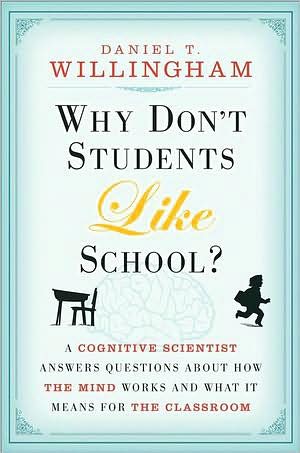
Why Don’t Students Like School? – Daniel T. Willingham

Daniel T. Willingham’s Why Don’t Students Like School: A Cognitive Scientist Answers Questions About How the Mind Works and What It Means for the Classroom is too long a title for a book that is surprisingly good, especially given how short it is. Although the title mentions the “classroom,” the book is useful not only for teachers and students, but for anyone who needs to be aware of the cognitive processes involving in learning—which should be anyone involved in the knowledge economy, since that economy is based almost entirely on being smarter and more efficient than the next guy. The only way to accomplish that is through education—and not only the kind that goes on in schools.

Although Willingham’s book focuses on the “school” part of the equation, his advice can be translated elsewhere, to anyone who has information that must be imparted to others. He says students don’t like school in part because they’re being taught poorly. This probably isn’t news to anyone who has ever attended school. The problem is what “poorly” means and how it might be improved, both on the level of an individual teacher and on the institutional level at which K-12 education and universities operate. The two aren’t often treated as a single unit for teaching purposes, in part because K-12 teachers are just supposed to teach, while university instructors are also supposed to be doing research. Nonetheless, both obviously struggle with student (and sometimes teacher) boredom.

The problem goes beyond the classroom and into life: “[. . .] unless the cognitive conditions are right, we will avoid thinking.” In essence, we avoid thinking more than we embrace it, on average, which makes a certain amount of sense: the more we have to think about a particular thing, the less we can think about anything else. I’ve been dimly aware of this for a reasonably long time, in part because of Paul Graham’s essay Good and Bad Procrastination, where he says:

There are three variants of procrastination, depending on what you do instead of working on something: you could work on (a) nothing, (b) something less important, or (c) something more important. That last type, I’d argue, is good procrastination.

Most of us probably spend most of our time on (a). In normal cognitive conditions, we’re probably at (b). Willingham (and teachers) want us to be at (c). He says, “Most of the problems we face are ones we’ve solved before, so we just do what we’ve done in the past.” But this does little for learning, and we have to find a space between what we already know and where we’d like to be. Too little, and we’re not really learning. Too much, and we’re likely to shut down because we don’t understand. You can’t really vector calculus to someone who doesn’t know geometry. You probably can’t teach regular calculus to someone who doesn’t.

People need opportunities to solve problems, not just be talked at. This is one reason lectures are often ineffective and/or boring: they evolved to solve the problem of paper being expensive and knowledge dissemination difficult. For their time and place in the Middle Ages, they were pretty effective. Today, however, when knowledge transmission in written form can be virtually free, lectures don’t make as much sense because in too many cases they don’t offer the chance to solve real problems. Yet teachers and professors keep using them in part out of habit.

Habit can be dangerous for both groups, unless the habit in question is the habit of breaking out of habits. Enthusiasm and boredom are both contagious. Willingham doesn’t talk about the two or how they interact, but most people like to be around those who are enthusiastic about doing something and dislike the opposite. When the person standing in front of a room doesn’t care, it’s probably not surprising that the room doesn’t care either. In my experience, better teachers have a childlike sense of wonder about the world, which makes them enthusiastic; weaker teachers don’t care. Apathy is the opposite of good teaching, and yet there are relatively few penalties against apathy in the school systems (the plural is important: there isn’t just one) operating in the United States. Willingham doesn’t discuss this, which might be a function of his method (he uses data whenever possible), an oversight, or simply beyond the scope of his argument.

He also doesn’t discuss one of the bigger problems with school: the relentless focus on GPAs and hoop jumping; Robin Hanson recently noted what might be the best advice I’ve ever read regarding studying in his post Make More Than GPA:

Students seem overly obsessed with grades and organized activities, both relative to standardized tests and to what I’d most recommend: doing something original. You don’t have to step very far outside scheduled classes and clubs to start to see how very different the world is when you have to organize it yourself.

Still, Willingham writes, “I don’t know why some great thinkers (who undoubtedly knew many facts) took delight in denigrating schools, often depicting them as factories for the useless memorization of information.” They probably did so because many schools were and are factories for the useless memorization of information. Just because one observes that, however, doesn’t mean that any memorization of facts is automatically useless. As he says on the next page, “Critical thinking is not a set of procedures that can be practiced and perfected while divorced from background knowledge.” But background knowledge is necessary, not sufficient, for critical thinking, and too many schools stop at background knowledge.

Perhaps the most useful thing teachers could to make school better is the same thing all professionals do: concentrate on ceaselessly improving their craft through incremental efforts at daily improvement. This is what we have to do for any kind of learning, and Willingham describes how we move from a state of no knowledge to shallow knowledge to deep knowledge in particular problem domains. People with no knowledge and who have some introduced tend not to retain that knowledge well; people who have shallow knowledge tend not to connect that knowledge to other knowledge; and people who have deep knowledge can fit new information into existing schemas, webs, or ideas much more effectively than those who can’t.

Books like Why Don’t Students Like School are a good place to start: I’ve changed some of my habits because of it, especially in terms of seeking feedback loops and engagement through things like polling, movement in physical space itself, and working toward asking questions that actively lead toward whatever it is I’m trying to get at—which usually involves close reading, understanding what the author is saying, or working toward analysis in papers. I focus more on the feedback loops involved in teaching, thinking, and memory. Those last two are important because “memory is the residue of thought.” This means we need to think if we’re going to remember things more effectively than we would otherwise, and this process requires dedicated practice: “If you don’t pay attention to something, you can’t learn it! You won’t remember much of the seminar if you were thinking about something else.” This might explain why I ban laptops from my classrooms: they encourage students to think about something else. But merely “thinking” isn’t enough: Willingham says “[. . .] a teacher’s goal should almost always be to get students to think about meaning.” One way to do this is simply by asking, but relatively few teachers appear to make this leap. Even that isn’t enough:

The emotional bond between students and teacher—for better or worse—accounts for whether students learn. The brilliantly well-organized teacher whom fourth graders see as mean will not be very effective. But the funny teacher, or the gentle storytelling teacher, whose lessons are poorly organized won’t be much good either. Effective teachers have both qualities. They are able to connect personally with students, and they organize the material in a way that makes it interesting and easy to understand.

We need practice to learn intellectually, just as we need practice at sports and music: “It is virtually impossible to become proficient at a mental task without extended practice.” But precisely what practice entails also remains unclear.

But the problems with Why Don’t Students Like School as a book remain. It a) has an irritating habit of using poorly formatted pictures and b) often feels under-researched. But the fact that its suggestions are real, concrete, and applicable make it useful to teachers in any capacity: many if not most of us have to teach something over the course of our lives, whether work processes to mentors, cooking to spouses, life skills to children, or technical skills to people on the Internet. And it’s sometimes vague: Willingham writes, “We are naturally curious, and we look for opportunities to engage in certain types of thought.” But what types do we try to think in? He doesn’t say. There are pointless pictures and graphs, no doubt designed to somehow make us remember things better but mostly an insult to our intelligence, as if we’re in high school instead of aspiring to teach high school and beyond.

Why Don't Students Like School? – Daniel T. Willingham

Daniel T. Willingham’s Why Don’t Students Like School: A Cognitive Scientist Answers Questions About How the Mind Works and What It Means for the Classroom is too long a title for a book that is surprisingly good, especially given how short it is. Although the title mentions the “classroom,” the book is useful not only for teachers and students, but for anyone who needs to be aware of the cognitive processes involving in learning—which should be anyone involved in the knowledge economy, since that economy is based almost entirely on being smarter and more efficient than the next guy. The only way to accomplish that is through education—and not only the kind that goes on in schools.

Although Willingham’s book focuses on the “school” part of the equation, his advice can be translated elsewhere, to anyone who has information that must be imparted to others. He says students don’t like school in part because they’re being taught poorly. This probably isn’t news to anyone who has ever attended school. The problem is what “poorly” means and how it might be improved, both on the level of an individual teacher and on the institutional level at which K-12 education and universities operate. The two aren’t often treated as a single unit for teaching purposes, in part because K-12 teachers are just supposed to teach, while university instructors are also supposed to be doing research. Nonetheless, both obviously struggle with student (and sometimes teacher) boredom.

The problem goes beyond the classroom and into life: “[. . .] unless the cognitive conditions are right, we will avoid thinking.” In essence, we avoid thinking more than we embrace it, on average, which makes a certain amount of sense: the more we have to think about a particular thing, the less we can think about anything else. I’ve been dimly aware of this for a reasonably long time, in part because of Paul Graham’s essay Good and Bad Procrastination, where he says:

There are three variants of procrastination, depending on what you do instead of working on something: you could work on (a) nothing, (b) something less important, or (c) something more important. That last type, I’d argue, is good procrastination.

Most of us probably spend most of our time on (a). In normal cognitive conditions, we’re probably at (b). Willingham (and teachers) want us to be at (c). He says, “Most of the problems we face are ones we’ve solved before, so we just do what we’ve done in the past.” But this does little for learning, and we have to find a space between what we already know and where we’d like to be. Too little, and we’re not really learning. Too much, and we’re likely to shut down because we don’t understand. You can’t really vector calculus to someone who doesn’t know geometry. You probably can’t teach regular calculus to someone who doesn’t.

People need opportunities to solve problems, not just be talked at. This is one reason lectures are often ineffective and/or boring: they evolved to solve the problem of paper being expensive and knowledge dissemination difficult. For their time and place in the Middle Ages, they were pretty effective. Today, however, when knowledge transmission in written form can be virtually free, lectures don’t make as much sense because in too many cases they don’t offer the chance to solve real problems. Yet teachers and professors keep using them in part out of habit.

Habit can be dangerous for both groups, unless the habit in question is the habit of breaking out of habits. Enthusiasm and boredom are both contagious. Willingham doesn’t talk about the two or how they interact, but most people like to be around those who are enthusiastic about doing something and dislike the opposite. When the person standing in front of a room doesn’t care, it’s probably not surprising that the room doesn’t care either. In my experience, better teachers have a childlike sense of wonder about the world, which makes them enthusiastic; weaker teachers don’t care. Apathy is the opposite of good teaching, and yet there are relatively few penalties against apathy in the school systems (the plural is important: there isn’t just one) operating in the United States. Willingham doesn’t discuss this, which might be a function of his method (he uses data whenever possible), an oversight, or simply beyond the scope of his argument.

He also doesn’t discuss one of the bigger problems with school: the relentless focus on GPAs and hoop jumping; Robin Hanson recently noted what might be the best advice I’ve ever read regarding studying in his post Make More Than GPA:

Students seem overly obsessed with grades and organized activities, both relative to standardized tests and to what I’d most recommend: doing something original. You don’t have to step very far outside scheduled classes and clubs to start to see how very different the world is when you have to organize it yourself.

Still, Willingham writes, “I don’t know why some great thinkers (who undoubtedly knew many facts) took delight in denigrating schools, often depicting them as factories for the useless memorization of information.” They probably did so because many schools were and are factories for the useless memorization of information. Just because one observes that, however, doesn’t mean that any memorization of facts is automatically useless. As he says on the next page, “Critical thinking is not a set of procedures that can be practiced and perfected while divorced from background knowledge.” But background knowledge is necessary, not sufficient, for critical thinking, and too many schools stop at background knowledge.

Perhaps the most useful thing teachers could to make school better is the same thing all professionals do: concentrate on ceaselessly improving their craft through incremental efforts at daily improvement. This is what we have to do for any kind of learning, and Willingham describes how we move from a state of no knowledge to shallow knowledge to deep knowledge in particular problem domains. People with no knowledge and who have some introduced tend not to retain that knowledge well; people who have shallow knowledge tend not to connect that knowledge to other knowledge; and people who have deep knowledge can fit new information into existing schemas, webs, or ideas much more effectively than those who can’t.

Books like Why Don’t Students Like School are a good place to start: I’ve changed some of my habits because of it, especially in terms of seeking feedback loops and engagement through things like polling, movement in physical space itself, and working toward asking questions that actively lead toward whatever it is I’m trying to get at—which usually involves close reading, understanding what the author is saying, or working toward analysis in papers. I focus more on the feedback loops involved in teaching, thinking, and memory. Those last two are important because “memory is the residue of thought.” This means we need to think if we’re going to remember things more effectively than we would otherwise, and this process requires dedicated practice: “If you don’t pay attention to something, you can’t learn it! You won’t remember much of the seminar if you were thinking about something else.” This might explain why I ban laptops from my classrooms: they encourage students to think about something else. But merely “thinking” isn’t enough: Willingham says “[. . .] a teacher’s goal should almost always be to get students to think about meaning.” One way to do this is simply by asking, but relatively few teachers appear to make this leap. Even that isn’t enough:

The emotional bond between students and teacher—for better or worse—accounts for whether students learn. The brilliantly well-organized teacher whom fourth graders see as mean will not be very effective. But the funny teacher, or the gentle storytelling teacher, whose lessons are poorly organized won’t be much good either. Effective teachers have both qualities. They are able to connect personally with students, and they organize the material in a way that makes it interesting and easy to understand.

We need practice to learn intellectually, just as we need practice at sports and music: “It is virtually impossible to become proficient at a mental task without extended practice.” But precisely what practice entails also remains unclear.

But the problems with Why Don’t Students Like School as a book remain. It a) has an irritating habit of using poorly formatted pictures and b) often feels under-researched. But the fact that its suggestions are real, concrete, and applicable make it useful to teachers in any capacity: many if not most of us have to teach something over the course of our lives, whether work processes to mentors, cooking to spouses, life skills to children, or technical skills to people on the Internet. And it’s sometimes vague: Willingham writes, “We are naturally curious, and we look for opportunities to engage in certain types of thought.” But what types do we try to think in? He doesn’t say. There are pointless pictures and graphs, no doubt designed to somehow make us remember things better but mostly an insult to our intelligence, as if we’re in high school instead of aspiring to teach high school and beyond.

Fool Me Once: Hustlers, Hookers, Headliners, and How NOT to Get Screwed in Vegas — Rick Lax

The only person being fooled in Las Vegas is the one who willfully wants to be fooled. That’s not quite the lesson, to the extent there is one, of Rick Lax’s Fool Me Once, but it’s an obvious moral to take from a book about moving to Vegas after law school and being something like a flaneur observing the scene (if there are other things going on, like work, they’re not part of the story). Vegas only works on you to the extent you let it, and for all of Las Vegas’ marketing and sexual innuendo, the city is really built on getting you to believe that it’s okay or even wise for you to lie to yourself about things you should know. You know, for example, that hookers still charge; the house always wins in gambling; you can run all you want and still not leave yourself behind.

Fool Me Once describes this dynamic. The chapters are vignettes with recurring themes: The hot roommate Oxana appears; a non-relationship with a girl named Zella culminates in a three-night hookup between her other shags, much like that one weekend you had in college; being a magician appears, disappears, and reappears; quasi life lessons come from a hooker named Kiana. The major weakness of Fool Me Once is its lack of a main narrative thread, since one section has little to do with another. This doesn’t make individual moments weaker, but one does start to wonder whether the book is going in any particular direction. Although I don’t wish to spoil the end, the answer is probably obvious. Still, parts are clever and the book is pretty funny: “My fellow law school graduates went off to Europe to ‘find themselves,’ ” and an asterisk says “I’m pretty sure this is code for do drugs.”

Elsewhere, a few sentences capture what hot clubs are like, or aspire to be like, and why they’re so irritating unless you’re “Girls Only,” which I never am: “JET had four separate lines: one for nobodies, one for people on the list, one for ‘Girls Only,’ and one for VIPs. The lines snaked and weaved and did everything else lines could do except move forward.” Better to realize this and understand the system than complain about it. Later, we find that “Men can’t comprehend that when it comes to monitoring professional sporting teams, I don’t have the attention span of a Buddhist monk on Ritalin.” I like the juxtaposition of images even more than I like the idea of someone who doesn’t care much about sports, since I don’t either. I reference “You Will Suffer Humiliation When The Sports Team From My Area Defeats The Sports Team From Your Area” from The Onion when the topic arises, since becoming rapturously involved in a group of large men I’ve never met, joined contractually together only by larger salaries to chase a ball doesn’t appeal to me. I understand that sports voyeurism functions as a form of social bonding and displaced primeval small group formation, but that doesn’t make sports any more tedious to watch (as opposed to playing, which I like).

Here’s a sample of one moment from our friendly hooker, Kiana, who says, “Vegas will be good for you. [. . .] It teaches you how the world works. But until you figure things out for yourself, here’s a general rule: If you think somebody you’re interested in is sleeping with somebody else, they are.” Statements about “how the world [supposedly] works” usually say more about the people making the statement than they do about the world. The world works differently for many of us, depending on what we show we value, and for hookers who probably see a lot of married men coming through town on business, the world probably looks quite different than it does for many, but not all, of the rest of us.

Such supposed wisdom is cheap: everyone thinks they know how the world works, but no one actually does, with the possible exception of physicists, who as a group probably don’t spend huge amounts of time gaming clubs in Vegas. A chapter is titled “How I’d Gone from Studying for the Illinois Bar Exam to Cavorting with Las Vegas Prostitutes and Con Men in Such a Short Period of Time.” The answer is pretty obvious: he flew or drove, which doesn’t take very long from anywhere in the lower 48. Neither prostitutes nor con men are hard to find, as long as they think you have money.

Lax has an eye for status distinctions and how they’re constructed, although he doesn’t talk about the subject as much as he might. For example, he tells us in a footnote, “Strippers pride themselves on not sleeping with guys for money; call girls pride themselves on not getting naked before large groups of men.” I believe it: people are very good at deluding themselves into thinking they can put someone nominally “below” them, even if the “below” in this case relies on female sexual fears. Going on Lax’s interest in deception (which becomes more nominal as the book goes on), I would guess the call girls are being more honest in the service they provide.

Lax mentions the Las Vegas motto of “What happens in Vegas stays in Vegas:”

[. . .] the ‘What happens’ ad campaign’s implication is crystal clear: If you come to Las Vegas and gamble away your children’s college fund and cheat on your wife with, say, two prostitutes you meet at the Palms food court [sic], the city’s tourism board will credit your bank account and fly you home in a time machine so you can un-cheat on your wife and preserve the sanctity of your marriage. That message hits home with a lot of people; every year 40 million visit Las Vegas, and do their best to hang on to their money in the process.

Does it still counts as “deception” if we know we’re going to be deceived? As the way I put it implies, the answer is “no.” Maybe Vegas helps us let out the person we want to be, but more likely it encourages a slightly different mindset than one might have otherwise (more on that later). Still, even as Vegas flouts its supposed difference, Fool Me Once punctures the bravado. There is a certain amount of ordinariness, despite how Vegas is supposed to be ludicrous; Lax dates a girl and says:

Zella seemed to really like me, but judging from what she told me about her ex-boyfriends, she also seemed to have really bad taste in men. I was careful not to discuss her most recent ex or the breakup [. . . ] We talked a lot about her and Austin [Zella’s boss at a club]. About what a strange, demanding guy he was. And the more she told me about him, the more worried I got.

I don’t think I’ve ever met a girl who said she has great taste in men; all of them seem “to have really bad taste in men.” Almost all of us who date have a “most recent ex” or breakup. Very few people love their bosses, primarily because in many circumstances bosses have interests that are antithetical to the employees: bosses need or want more work out of employees and employees need or want more money out of bosses. Many of us tell similar stories because the incentives we face cause the stories to turn out like Zella’s. Women often find indifferent bad boys who exhibit social proof and have game attractive for short-term flings but find them exasperating in longer relationships, then announce their “bad taste in men” as if that’s a surprise—when it’s actually a conflict between short- and long-term desires. This dynamic appears to be common throughout the dating world; maybe Vegas amps it somewhat, but the problem again remains built into relationships.

Lax describes some of the ways deception works and how people lie to each other. But lying is partially a function of repeated interactions with people over time, and William Flesch’s excellent book Comeuppance: Costly Signaling, Altruistic Punishment, and Other Biological Components of Fiction describes some of the ways deception, the punishment of deception, and signaling work in narrative—and in life. One of the most successful strategies that game theory describes is called “tit-for-tat,” which means that you react to others primarily based on how they present to you. I suspect that most of the world actually plays variations on the tit-for-tat game: if you are mostly honest with others, they will mostly be honest with you. If you are mostly dishonest with others, and looking for dishonesty in others, you will mostly find it, and the optimal way to avoid dishonesty is to punish those who defect from the honesty game by refusing to interact with them. This is probably the most evolutionarily stable strategy (ESS), and it ensures that authentic knowledge of real dishonesty means that most people will refuse interaction with the dishonest.

Furthermore, the “costly signals” in Flesch’s book and evolutionary biology in general are those that are hardest to fake because they’re expensive, or costly. The canonical example is the peacock’s tail, which can only be as large and beautiful as it is if the bird itself is very healthy and has excess calories to burn. An example closer to Fool Me Once might be the much reviled “bottle service:” most guys can’t really afford $500 for a $30 bottle of booze, so buying bottles is a more honest signal of wealth than, say, claiming to be wealthy.

Still, if you combine costly signaling with one-off transactions (especially those of a sexual nature), you begin to get Las Vegas. As Lax implicitly points out, tit-for-tat strategies don’t apply if you consciously seek out dishonesty, which is basically the purpose of Las Vegas: cultivated dishonesty in which you know that most people are lying to you in some form, which in turn enables you to lie to most people without normal consequences if you lie to someone who is basically operating on a normal tit-for-tat level. I think this is basically why I found Vegas more boring than not: in order to exit the market for dishonesty, I had to leave the city. I think I understood this dynamic intellectually before I went, but it’s one thing to understand it intellectually and it’s another to have it spangling you everywhere you look.

Lax notes this tendency, although he doesn’t wrap it in the language of game theory and evolutionary biology, as I do:

The city is filled with fakers, from celebrity impersonators to magicians. From casino hosts who tell high rollers that they’d ‘be happy to’ oblige their most obnoxious, demeaning requests to gambling addicts who tell their spouses they don’t have gambling problems. From strippers who, for a price, will shed their clothes and pretend that everything you say is charming and hilarious to escorts who, for a price, will pretend that everything you say is charming and hilarious and then shed their clothes and then sleep with you.

No wonder so many people hate Las Vegas.

I went to Las Vegas for the first time a few weeks ago (my brother got a lot of mileage out of telling people that I’m 27 and visiting Vegas for the first time; most responded with mock astonishment; I shrugged). If Vegas is “filled with fakers,” so is everywhere else: perhaps it has more magicians, strippers, and hookers per capita than elsewhere, but the essence of being one of those things (as well as being a novelist) remains. The major difference is that in Las Vegas, faking is institutionally encouraged in the form of casinos. But you can find gambling anywhere, if you want to seek it out. One could view going to Vegas as a form of seeking it out. And it’s never been hard to find people who will “pretend” sexual interest in you “for a price,” but something about travel makes people more willing to lie to others or themselves about what they’re doing and why. Self-deception and its cousin hypocrisy are so common that they begin to seem like part of that elusive animal, human nature, which so many commentators and philosophers chase but so few manage to shoot, let alone bring down.

“So many people hate Las Vegas” because hate is one way we punish defectors: by castigating them in vile terms, we try to convince others to stay away and activate our own repulsion system. Hate is a very expensive emotion: I went to Vegas, and although the above makes it obvious that I don’t love the place, I don’t hate it either, perhaps because I understand why it exists and that it fills a need. Lax gets some of that too: he says “I don’t hate deception and deceivers, though. In fact, in a strange way I’m drawn to them.” I’m drawn to them too, but more as an object of study and interest than anything else. Maybe the above criticism of Vegas stems in part from the fact that I’m not a particularly skilled deceiver, and whatever skills I possess are poorly suited for the Vegas / club / bar environment, where I’ve tended to do reasonably okay but not fabulously well. But if others privilege an environment where I don’t thrive, I probably should “hate” that environment as a way of discouraging others from entering it. But I would rather understand things than hate them, and I might lie to myself by saying that I understand why people fake things.

In the clubs, I think most people are dishonest, and their skill at dancing is consistently low, but there’s basically no penalty for it or reward for skilled dancing. In contrast, at salsa clubs or ballroom events, the penalty for low dancing skill and an unwillingness is a dearth of partners. The only major exception is, as in Vegas clubs, very attractive girls, who will still find partners who are often skilled dancers. A lot of the girls in Vegas weren’t good dancers. I’m not an especially good dancer, but at least I’ve learned enough to do more than grind, which was great as a 15-year-old at youth group but becomes somewhat tedious more than a decade later.

There’s this whole Vegas mythos that’s been encouraged by gangsters, writers, and corporations; the “What happens” campaign is an example. By writing this post and reading Fool Me Once, I’m partially reinforcing the mythos even as I pretend to reveal what’s beneath.

Despite all that, if someone asked me to go back again, I would.

The reason Lax gives for becoming interested in deception isn’t especially convincing: a girl he’s dating falls for a con man who offers her a dubious paralegal job that obviously doesn’t exist and probably is a setup to acquire sex. After this experience, Lax says that “my innate fear multiplied” and that “I’m terrified of being conned and I don’t want to be taken advantage of [. . . .]” But the circumstance that ignites this fear is so preposterously obvious that Lax, like the reader, knows it’s a setup. This is a bit like saying I never want to fly commercial airlines again because my buddy’s homemade hang glider resulted in injury: the difference in magnitude and kind between source and reaction are so large as to make the comparison spurious. Like Las Vegas. Like many other things, if you care to look for them. Lax addresses the issue:

I don’t think I was being overly paranoid. If you stop and think about how much deception there is in the world—in business, in advertising, in media, in politics, in romance—I think you’ll agree that my fear was justified.

I don’t agree: there is a certain amount of “deception” in the world, which one can find without looking very hard (it’s probably an ESS to lightly deceive), but deception is often enough a product of people trying to shade things rather than people trying to con you outright, as happens to the girl chasing the phony paralegal job. There’s a difference in kind between her experience and someone in a law firm implying the firm is more important than it is in order to motivate employees. The passage quoted above might be implausible, but it functions as an excuse to start the book with some kind of purpose, and though that purpose is lost, it still brings up a useful point: If we’re this worried about deception, we should react by not reading Fool Me Once, which contains this disclaimer in the front matter:

While the events described in this book are essentially true, I changed the names and identifying characteristics of certain individuals. In other cases, I used character composites. I also reconstructed dialogue and altered details of certain events, including their timing and location.

“Essentially true” might be another way of saying “not true.” “Character composites,” “reconstructed dialogue,” “altered details”—these are all synonyms for “made up.” If you stop and think about how much deception there is in the world of writing, I think you’ll agree that my fear of being taken by a lying author is justified. If we apply Lax’s standards of paranoia to his own work, the logical reaction is to stop reading it and read fiction, which we at least know is “made up”—unless, of course, it uses copious detail from “real life” to make its point, in which case I guess we can’t trust it, either. The argument about fiction’s relationship with reality goes very far back, to at least Don Quixote if not earlier (see Ortega y Gasset’s Meditations On Quixote for more on that subject; for the novel in general, various theorists have discussed this, including Watt in The Rise of the Novel and others who write about the enchantment of Romance).

The basic problem is that radical skepticism leads one to think in paradoxes, like there is no truth, including this statement, which therefore invalidates itself. It leads one to question all epistemology, and it leads one towards Descartes’ seventeenth century formulation; as Tom Sorell describes it in Descartes: A Very Short Introduction, “In the First Meditation Descartes makes himself doubt that he has an idea of any really existing thing. He rejects as false all his beliefs about material objects, even his faith in the reality of simple material natures.” But that point of view leaves us essentially nowhere: it’s like philosophers who sit around, decide there is no such thing as reality, and then go to lunch. That strain of thinking led towards pragmatism, which argues that what really matters is what ideas cause us to do differently.

Most of us have a reasonably pragmatic relationship to the truth: we know that Lax’s girlfriend is being conned, as does Lax, as should his girlfriend (unless she is willfully deceiving herself, which might otherwise be called stupidity—and the optimal way to deal with people we think stupid is often to exit the market, so to speak, with them). We also know that doubting the the truth of anything is “being overly paranoid,” which is why Lax has to tell us that he “thinks [we’ll] agree” that his fear is justified. We won’t, and claiming we will points to the fear we won’t. A professor once told me (or was it to an entire class? Memory is awfully faulty) that anytime a student writes something is “obviously” or “clearly” true, he looks more closely at the proposition being argued, because something marked as obvious isn’t, otherwise it wouldn’t need to be marked. Show me what you fear and I’ll show you what you lack, as the cliche goes. Or something like that.

Fortunately, this pragmatic philosophy also means that I’m inclined to accept Lax’s caveat: the events probably are essentially true, unless he’s pulling a James Frey or really lying to us. But I have no way to tell, and if I find out he is, I’ll put a disclaimer at the top of this post saying that he’s a liar and that you shouldn’t read his book. In short, I’ll punish him for the transgression, which I would find a significant one. But unless the lie is really egregious, I’ll let him go because he can point to the disclaimer that says he might be lying to me, but only in minor ways—much like pretty much anyone in a serious relationship is accepting that their partner has probably fudged at least a little in their past, putting an orange filter over the bright white stage lights of life. Whether we decide something is a serious transgression or minor quibble is mostly a matter of pragmatism, and it varies by person. Lax argues he’s not being overly paranoid, but I think he is—and I think you’ll agree with me, based on this post, or based on reading his book yourself.

Keith Richards’ Life and what the world used to look like

I skimmed Keith Richards’ memoir Life, which might be of interest to virulent Rolling Stones fans and people interested in how to live despite ingesting massive quantities of poisonous substances in search of altered states (answer: luck). Although most of the memoir is forgettable, this passage stands out because it describes a kind of insanity that feels completely foreign and bizarre to me:

It was 1975, a time of brutality and confrontation. Open season on the Stones had been declared since our last tour, the tour of ’72, known as the STP. The State Department had noted riots (true), civil disobedience (also true), illicit sex (whatever that is), and violence across the United States. All the fault of us, mere minstrels. We had been inciting youth to rebellion, we were corrupting America, and they had ruled never to let us travel in the United States again. It had become, in the time of Nixon, a serious political matter. He had personally deployed his dogs and dirty tricks against John Lennon, who he thought might cost him an election. We, in turn, they told our lawyer officially, were the most dangerous rock-and-roll band in the world.

Must be gratifying to be the most dangerous rock band in the world. It’s also astonishing to imagine that a rock-and-roll band could marshall this kind of attention; these days, the youth who were rebelling in the 1970s have grown up and assumed the reins of power, such that rock-and-roll has grown up with them, becoming rock-and-roll instead of rock ‘n’ roll.

Now it’s no longer subversive, so we have to turn our attention to other topics, like rap, but even that doesn’t inspire so much fear as Richards says the Stones did; rap is regularly reviewed in the New Yorker. Today, nothing is worse than being square. Almost anything goes. 1975 looks bizarre from the perspective of someone born after it: what was all the fuss about? The real question is what subjects generate all the fuss today that will be the same way in the future. I could generate a list of them but choose not to, per Paul Graham’s “What You Can’t Say,” but I bet regular readers could imagine a few things that might end up on the list.

There are other moments of bizarre provincialism too:

When I was growing up, the idea of leaving England was pretty much remote. My dad did it once, but that was in the army to go to Normandy and get his leg blown off. The idea was totally impossible. You just read about other countries and looked at them on TV, and in National Geographic, the black chicks with their tits hanging out and their long necks. But you never expected to see it. Scraping up the money to get out of England would have been way beyond my capabilities.

Although many people today no doubt feel the same, the rise of deregulated air service makes leaving virtually any industrialized country within the reach of a large proportion of the population. Not everyone, to be sure, but it’s much more normal now than it once was. Many fewer find the idea “totally impossible.” It’s easy, at least for me, to forget what the past was like. I think we all have a tendency to assume that the present is “normal,” along with whatever our situation is, and the past different. Then I read about someone who “never expected to see” a foreign country and remember that the time and place I live in is very different from those others have lived in. Such moments are the most revealing part of Life. The book made it on the New York Times bestseller list. Prediction: a large number of copies hit the used book market within six months. If you want to read the book, wait and snag a used copy cheap, or get it from the library.

The Authenticity Hoax: How We Get Lost Finding Ourselves — Andrew Potter

A lot of us are searching for something “real” and “authentic” in the same way that Jake Barnes is searching, fruitlessly, in The Sun Also Rises:

We ate dinner at Madame Lecomte’s restaurant on the far side of the island. It was crowded with Americans and we had to stand up and wait for a place. Some one had put it on the American Women’s Club list as a quaint restaurant on the Paris quais as yet untouched by Americans, so we had to wait forty-five minutes for a table.

As soon as Americans arrive, the place is spoiled, but, more importantly, a paradox emerges: when something is identified as “untouched,” it immediately becomes the focus of attention and is touched. The same phenomenon occurs with bullfighting: a nominally pure activity becomes contaminated by Americans seeking authenticity. Notice, however, that no one is directly responsible for putting Madame Lecomte’s on the list: it just happens. “Someone” does it, with no effort to identify that someone: the action is as natural as the dawn and perhaps as inevitable. There is no sense in fighting. It just is, which is part of the small joke, and a rare one in The Sun Also Rises. The meal ends: “After the coffee and a fine we got the bill, chalked up the same as ever on a slate, that was doubtless one of the ‘quaint’ features, paid it [. . .]” The supposed authenticity is inauthentic, and made so by people who are seeking the authentic. This leads us into a paradox that we can’t really get out of.

Unless we acknowledge that authenticity itself is a pernicious desire. That’s Andrew Potter’s main point in The Authenticity Hoax: How We Get Lost Finding Ourselves, which is as authentic a book I’ve read because it doesn’t strive to be authentic. He says:

In the end, authenticity is a positional good, which is valuable precisely because not everyone can have it. The upshot is that, like the earlier privilege given to the upper classes, or the later distinction gained from being cool, the search for the authentic is a form of status competition. Indeed, in recent years authenticity has established itself as the most rarified form of status competition in our society, attracting only the most discerning, well-heeled, and frankly competitive players to the game.
Any status hierarchy is socially pernicious when it is used to allocate scarce goods and resources on the basis of arbitrary or unearned qualities. It is good to be the kind, and almost as good to be a prince, or a duke, or a count, and on down the aristocratic chain. But not all forms of status are illegitimate: higher education is a status hierarchy that helps allocate wealth and privileges, yet for many people, the fact that the education system is for the most part a meritocracy makes it a fair, just, and even democratic form of status competition.

Once it becomes positional, it becomes fake. Still, I would argue that not everyone can have authenticity in the same way, but everyone can probably have it some way. Even the seemingly inauthentic can become authentic if pursued with sufficient vigor: think of the pop culture bubbles Paris Hilton or The Jersey Shore, in which crass commercialism becomes something like authentic. Las Vegas exists by being inauthentic and appropriating the styles of other places—and the pastiche has become a style of its own. Once aware, you can never become unaware:

Authenticity is like authority or charisma: if you have to tell people you have it, then you probably don’t. […] authenticity has an uneasy relationship with the market economy. This is because authenticity is supposed to be something that is spontaneous, nature, innocent, and ‘unspun,’ and for most people, the cash nexus is none of these. Markets are the very definition of that which is planned, fake, calculating, and marketed. That is, selling authenticity is another way of making it self-conscious, which is again, self-defeating.

The best you can do is fight back by not using the language of authenticity, because once one uses it, the thing itself becomes its opposite. Potter is pointing to something like The Gift, which deals with how people tend to have two modes: a commercial mode and a gift mode. Authenticity is supposed to correspond mostly to the gift mode, in opposition to the commercial one, except that this often doesn’t work out.

In The Sun Also Rises, there are long passages about “aficion” that can’t be stated exactly but can be seen. Once seen, it is not spoken of as such; it is only felt, as in this scene with Jake Barnes describing his friend Montoya introducing Jake to other aficionados:

Somehow it was taken for granted that an American could not have aficion. He might simulate it or confuse it with excitement, but he could not really have it. When they saw that I had aficion, and there was no password, no set questions that could bring it out, rather it was a sort of oral spiritual examination with the questions always a little on the defensive and never apparent, there was this same embarrassed putting the hand on the shoulder, or a ‘Beun hombre.’ But nearly always there was the actual touching. It seemed as though they wanted to touch you to make it certain.

In a world where the language of authenticity has been stolen by advertisers and whoever else happens along to appropriate it, we’re stuck striving for “conspicuous authenticity,” a play on Thorstein Veblen term, “conspicuous consumption.” Instead of merely consuming goods, we’re consuming status, which might come in the form of goods, but might also come in the form of experiences, behaviors, acts, postures, and the like. Potter gets this, and he hopes that once we get that the authenticity game—and it is a game—is a phony one, we’ll stop falling for it. And if we do, maybe we’ll also stop falling for some of the other major tropes of our time, in which everyone is striving to be unlike everyone else—and in the process is just like everyone else:

The idea that authority is repressive, that status-seeking is humiliating, that work is alienating, that conformity is a form of death. . . none of this is remotely original. We have heard every variation of the tune, from nineteenth-century bohemians to twentieth-century counterculturalists to twenty-first century antiglobalists, and we know every part by heart.

It is not the sheer persistence but rather the amazing popularity of the stance that ought to give us reason to pause and maybe reconsider our attitude toward modernity. Look around. Is there anyone out there who does not consider him or herself to be an ‘antihero of authenticity’? Anyone who embraces authority, delights in status-seeking, loves work, and strives for conformity?

My guess would be yes: people in the military or law enforcement embrace authority. A lot of celebrities or others of very high status seem to delight in status seeking. People who love work are common enough that we have a phrase for them: workaholics. And high school students either strive for conformity or for the anti-conformity of wearing all black as a group. But the overall point stands—like the point that

One reason I might find novels a more real or satisfying experience than cinema is because they feel further from the cash economy: although novels are obviously protected by copyright and charged for by their authors, many feel less crassly commercial. This is the problem with articles like “The Cobra: Inside a movie marketer’s playbook,” which detail exactly how calculating the movie industry is. Taken with Edward Jay Epstein’s The Hollywood Economist, and it’s hard not to feel bamboozled most of the time when you go to a big Hollywood movie.

Elif Batuman might agree with much of The Authenticity Hoax, especially after she spends a summer in Uzbekistan, which she describes this way in The Possessed: Adventures with Russian Books and the People Who Read Them:

I have never been so hungry in my life as I was that summer [in Uzbekistan]. I remember lying across the bed with Eric, fantasizing about buying anything we wanted from the twenty-four hour Safeway across from our apartment in Mountain View.
[…]
When we first moved to Mountain View, I used to think it was depressing to look out the window and see a gigantic Safeway parking lot, but that was before I spent any time in the ‘Fourth Paradise.’

If the authentic is starvation, give me McDonald’s. If the authentic is local vegetables, give me the avocados and bananas shipped halfway around the world so I can have salads and smoothies in December. In the case of Batuman, Safeway is banal and boring and symptomatic of soul-deadening consumer capitalism, right up to the point where you just want to buy some french fries and maybe one of those takeaway meals that aren’t very good, unless you’ve been subsisting on tea and rancid borscht in a third-world former Soviet republic. Modern life probably also looks sterile and boring up to the point when you’re kidnapped by pirates and die in the ensuring firefight. Some experiences are better left to the movies, unless you have to undergo them.

For example, one thing that makes The Lord of the Rings so effective is the reluctance of the hobbits to leave the Shire; they don’t really want to go on an adventure, or if they do they only half do, and would tarry a long time unless forced. Sam wants to go see Elves on an adventure chiefly because he doesn’t really conceive of what’s ahead. But if they must go, they will.

Their longing for home, rather than for power or for the misery that traveling entailed in a world before planes, trains, and automobiles, is what makes their experience so real. The Authenticity Hoax is partially about what happens if you try to take fantasy experiences and make them into messy realities without the many amenities that many people in developed countries now effectively assume will be there, invisibly woven into the fabric of our lives—like Safeway, and which so many generations have toiled so long in order to give us the standard of living we now enjoy (despite the anxiety still generated around status issues).

The book is worth reading, but skim sections. Some of the later chapters in The Authenticity Hoax are weak: there’s a gross misinterpretation of Harold Bloom’s The Anxiety of Influence at one point. The chapter “Vote for Me, I’m Authentic” is funny but overly focused on contemporary issues, like the 2008 election. At one point Potter says that “[…] it is dangerous for anyone, no matter what their partisan alliance, to have so much contempt for voters. Democracy is based on the premise that reasonable people can disagree over issues of fundamental importance, from abortion and gay rights to the proper balance between freedom and security.” The problem isn’t that voters disagree—the problem is how little voters know. If you read Bryan Caplan’s The Myth of the Rational Voter, it’s hard not to have contempt for voters: their ideology is incoherent, they don’t understand how economics or politics work, they know their individual votes are unlikely to affect the outcome and thus can vote irrationally or against their best interests without consequences, and they don’t know how the government they’re voting on is structured. As Caplan points out, the politicians who are elected are often substantially more knowledgeable than the people who elect them.

Later, Potter says that “[…] a great share of the blame [for politicians who massage the truth] lies with the media and its obsession with controversy and scandal at the expense of more difficult question of policy (sic) and other serious issues.” But the real issue is, once again, within us: a lot more people subscribe to People magazine than Foreign Affairs or The Atlantic, and a lot more voters (“consumers” might be a better word here) watch brain-dead network news shows than good-for-you special reports on the situation in Lebanon, or South Ossetia, or wherever. The problem isn’t the media or politicians—the problem is us. It always has been, and it probably always will be. You can gloss authenticity problems over political ones, but the political ones really point elsewhere.

Skip the last third of the book and pay great attention to the first half. If you read The Authenticity Hoax, maybe you’ll come out with a better conception of your self as an authentic person—which is to say, an inauthentic person. You’ll come out caring less. And when your friend comes back from an “exotic” location you’ll roll your eyes—as you should.

The Evolution of Childhood: Relationships, Emotion, Mind — Melvin Konner

I want to write a long post about how impressive and detailed Melvin Konner’s The Evolution of Childhood is, but to do so I would have to read it at least a couple times more and delve deeply into the bibliography. It ranks with The Evolutionary Biology of Human Female Sexuality by Randy Thornhill and Steven Gangestad in terms of its thoroughness and the density of its information. The Evolution of Childhood discusses, among other things:

  • how the environment shapes childhood
  • how group behaviors work
  • how group dynamics work
  • how life in evolutionary times differs from the present
  • problems with the Freudian interpretation of childhood
  • sexual play or expression among children is common (“Contrary to some claims of cultural historians, anthropologists find that liberal premarital sex mores are not new for a large proportion of the cultures of the ethnological record and that liberal sexual mores and even active sexual lives among adolescents do not necessarily produce pregnancies. In fact, a great many cultures permit or at least tolerate sex play in childhood (Frayser 1994)”).
  • why parent-child conflict is effectively inherent in the relationship

I lack the time to discuss what Konner says about each topic; here’s an example of the subtlety of his thinking:

Most explanations of behavior occur at one level only. But as pointed out by Tinbergen (1963), the question ‘Why did the animal do that?’ can be answered at different levels, four of which were immediately identified in his classic paper: phylogenic, ecological, developmental, and eliciting. These can be exemplified by categories of answers to a question about a short flight of a bird—say, a jay rising from a holly bush up to a longleaf pine. It flies because it is a bird; because flight gave it an advantage […] in its environment of evolutionary adaptedness; because its ontogeny gave it light bones, wings, feathers, and a motor neuron circuit oscillator for flight, through a genetically determined maturation pattern shaped by nutrition, exercise, and practice; and because a fox is chasing it.

This goes on to his own development of how the “causation” behind any given behavior might work. Arguments about the root causes of behavior often boil down to people arguing at different levels:

Levels 1 – 3: Remote or Evolutionary Causation

  • 1. Phylogenetic constraints: “Because an organism of a certain broad taxonomic type, it is constrained to some extent in the way it can solve the problems posed by its environment [. . .]”
  • 2. Ecological/demographic causes
  • 3. Genome

Levels 4 – 6: Intermediate or Developmental causation

  • 4. Embryonic/maturation process
  • 5. Formative early-environment effects
  • 6. Ongoing environments: “These are factors such as nutrition, stress, and reinforcement contingencies [. . .]”

Levels 7 – 9

  • 7. Longer-term physiology: “Though mainly hormonal, longer-term physiology also accounts for other metabolic effects [. . .]”
  • 8. Short-term physiology.
  • 9. Elicitors or releasers: “The immediate external causes of behavior, elicitors are the events in the stimulus envelope that precipitate the behavior; ethologists call this the releasing mechanism, and to the learning psychologist it is the conditions or unconditioned stimulus.”

I’d never consciously realized how levels like this work before. And I’d never consciously realized many of the subtle arguments Konner makes. The Evolution of Childhood is almost oppressively thorough; the woman I’m dating mentioned that I complain about books that are long magazine articles or that gloss their topics, and in doing so she implied that I should be thankful for The Evolution of Childhood’s move in the opposite direction. But I also came to the end, with the 100+ pages of citations, and felt that I’d come a long way since I began. Very few books feel like an intellectual journey in the most positive sense of the word. This one does.

Tucker Max Interview — Assholes Finish First and I Hope They Serve Beer in Hell

Tucker Max wrote I Hope They Serve Beer In Hell and, most recently, Assholes Finish First , both of which chronicle his experiences drinking, hooking up, and behaving like a self-proclaimed asshole. Think of the stories your friends tell the morning after, except edited (to maximize hilarity) and in book form.

Here’s an example from “Fucked-Up Pillow Talk, Part 2,” which is like the famous Abbott and Costello “Who’s On First?” routine, except for the subject matter:

—With some random girl who was really annoying:

Girl “Why don’t you last longer during sex? Ten minutes is not long enough for me.”
Tucker “I don’t understand. I lasted long enough for me to cum. Why would I go any longer?”
Girl “I want to cum too. What about me?”
Tucker “Who?”
Girl “Me.”
Tucker “Who are we talking about here?”
Girl “ME!”
Tucker “Who?”
Girl “I HATE YOU!”
Tucker “Who hates me?”

You can read other stories at TuckerMax.com. During the interview, Tucker’s friend, “Bunny” in Assholes Finish First, was present, along with Murph, his dog, and a bunch of law students from Arizona State University.

Jake Seliger: How’s your tour so far?

Tucker Max: Long and tiring but good.

JS: In another interview, you said that when you give speeches at colleges, you don’t tell stories and instead talk about what it is to live your dreams and take the path less traveled. So what is it to live your dreams, and what do you do, especially if you don’t know what your dreams are?

TM: Well you have to find out, don’t you? What I usually do in this speech—how old are you, dude?

JS: Twenty-six. I’m a grad student in English at the University of Arizona.

TM: All right, so—I need to get in interview mode.

JS: You don’t have to—it’s better to just do it like a conversation.

TM: I know, I’ve done this once or twice. So what I try to explain, when you’re an undergrad, generally you think you can do two things. You’re gonna have to get a job after you graduate or you gotta go do more school. Because everyone who’s giving you advice or telling you how to live your life are people who’ve done one of those two things. You don’t generally have anyone in your life who has gone out on their own and done something entrepreneurial or done something artistic or truly risky or truly taken the path less traveled, because those people—

JS: Aren’t in schools?

TM: —don’t work in academics. And don’t become cubicle monkeys. So what I try and explain in my speeches is that there’s a third way. Because a lot of people—I think most people—want to do something besides those two things. But they don’t really know how. They don’t know how to start, they don’t know how to get there, they don’t even know where to go. Unfortunately, there’s a map—if you want to stay in academia, it’s real fucking simple. There’s a map if you want to become a cubicle monkey. There’s no map for finding your dreams. There’s a process to it, and generally speaking, what you want to do, especially when you’re young, in college or right out of college when you have no debt, no responsibilities, no one relying on you, you’ve got all the freedom in the world. What you want to is experience as much as possible, see as much as possible, do as much as possible, hit as much as you can in the world. What you’re going to find are a whole list of things that you’re passionate about. And a whole list of things that you’re good at. And where those two circles overlap is where your life should fall. At least in terms of what you do for a living. And what you love and what creates value for other people. When you can find something that does both, that’s what you should focus on. That’s the sort of thing that people like me, people like Bunny, Tim Ferris, that’s what we did. We found a way to connect those two things. Taking that path is like a vision quest, so I can’t tell you, well, you need to be a surf coach in Brazil. What the fuck do I know, dude? I don’t know what your passion is, I don’t know what you’re good at, I don’t know what gets you up in the morning. I know generally how to approach that idea, and I know how hard it is, and I know the general things you’re going to have to overcome. But there is no map to that. And that’s what I try to explain in the speech.

JS: Your talk reminds me of Scott Adams, the creator of Dilbert, who observed that he’s not the funniest man in the world, and he’s not the best artist in the world, but he’s funnier than most people, and he’s a better artist than most people. And he combined those two things into Dilbert, and it worked really well for him.

TM: If I understand it correctly, it was a hard path. I don’t know his story real well, but if I remember correctly—I mean, here’s the problem. A lot of people who’ve succeeded either don’t remember or don’t understand how they got from where everyone else is to where they are.

JS: Or they make a narrative out of it, that takes out the ambiguity.

TM: They make the ex-post narrative, that simplifies it, and makes it look like it was inevitable. That’s not the way it works.

JS: Do you find that people who’re responding to your books create this kind of ex-post narrative?

TM: About me? Yeah, absolutely. Usually guys in their mid-twenties, 27 to 29, 30, whatever—

JS: That’s right where I am!

TM: Well, guys like that who read my stuff, there’s a certain type who—I’m not better looking, I’m not smarter, I’m not a better writer, but they’re stuck in a cubicle and I’m a star. And they get fuckin’ pissed off and can’t understand why—”Well, if I had a trust fund, I’d be able to do this.” I didn’t have a trust fund. I couldn’t eat for a couple years when I first started. I mean, you can ask [Bunny], who was my friend before anyone knew who I was in the world. There were times I was basically stealing food. And they’ll say—

JS: Hence the story about looking in the girl’s wallet?

[Laughter.]

TM: There were times, people are like, “Oh, well you already did it, if I had written my stories down—” dude, there is an unlimited market for funny stuff.

JS: It also helps to have a really strong sense of dialogue and pacing.

TM: My book agent, Byrd Leavell, estimates that he has seen 20,000 submissions since I Hope They Serve Beer in Hell came out in January of 2006. Twenty thousand submissions saying, “I’m the next Tucker Max, I’m the drunk Tucker Max, I’m the girl Tucker Max, I’m the monk Tucker Max, whatever.” Twenty thousand!

JS: Wait, I want to talk about the monk Tucker Max.

TM: But he hasn’t signed any of them, because they all suck as writers, or they’re not emotionally authentic, or it’s not funny, or whatever. People create all these narratives explaining away why they haven’t had the courage to take their personal path, or explaining away my success, or anyone else. Anyone who succeeds in anything, there’s always going to be people who don’t have the courage to do that. They get upset about it, either explain it away, or dismiss it away.

JS: It sounds like you almost found out by accident. In Assholes Finish First you say that when you and your friends graduated from law school, “We were slowly realizing that the ‘real life’ we’d chosen really fucking sucked. A lot.” Sounds like you’re trying to tell people how not to do that.

TM: As much as I’d like to sit here and be like, “Yeah, I had the courage to do all this stuff, and I had the vision to see where I was gonna go and I knew I would get there.” That’s fuckin’ bullshit. That’s not true. That’s the narrative I might tell when I’m 70, and I can’t remember all this stuff.

JS: Trying to inspire your grandkids?

TM: Right. The true, true story is it’s a combination of some determination and some talent on my part. Some talent, a lot of determination, a lot of luck, and a lot of serendipity. And a lot of failure. I was fired—

JS: There’s a section about failure in the book.

TM: I was fired from the legal profession, basically. I wasn’t just fired from Fenwick and West—you read the first book, the story’s in there. I got fired in such a public way that there was almost no way I was going to get back into law. I would have to go back and be a public defender or something if I wanted to be a lawyer. Seriously.

JS: Which these days, a lot of people would be happy with, because lawyers can’t find jobs—

TM: Yeah, yeah, exactly. But I was fired from the legal profession. I went to work for my father, he has a restaurant company in Florida. I went to work for him. A long, intricate story, it basically ends with me getting fired by my father.

JS: Didn’t you say the employees were more politically savvy than you were?

TM: My dad’s employees knew how to manipulate the situation better than I did. There was an internal battle, I wanted to take the company in one way, they wanted to maintain their job. They understood corporate politics, I didn’t. I thought because my name was on the door I was right, I would win. I was 25 years old, I was very naive, very naive. If either of those things had succeeded, I’m not sure I would have ever taken this path, because without that jolt of failure, you won’t ever stop and think. You know, if you’re on a train, you keep going on the train. You don’t stop to think, am I going to the right place. But failure forces you, failure crystalizes it. Failure forces you to think about it, about where you are, what your mistakes were, and where you’re going. And after those two failures, for me, it was like—I read A Heartbreaking Work of Staggering Genius by Dave Eggers, it’s this book—I don’t know if any of you read it—when it came out—

JS: Yeah.

TM: Well you’re an English major, I’m sure you’ve read it. When it came out, it was like—Eggers was like the hipster God. Everyone was like, “Oh, he’s the greatest writer of history, he’s funnier than Salinger, blah blah blah,” and I read this and I’m like, I can do better than this, I said it in a very arrogant, “I’m fuckin’ better than this” way. Now that I’ve done it, it sounds different. But at the time, it was totally posturing.

JS: Your friends were probably somewhat skeptical?

TM: Actually, my friends believed in me more than I did at the time. But that’s a different story. So instead of doing anything I just talked shit about them [the authors], whatever. And then I read Fight Club. I’d seen the movie, but I saw it when I was like 21, and I thought it was about fighting, I didn’t understand—like the way these 19-year-old idiots think my book is about drinking and fucking.

JS: Well, it is on one level. But it depends on how you wanna—

TM: Yeah, exactly. I read Fight Club, and it was like a slap in the face. The basic message of Fight Club is, “If you’re the man you think you are, then go out and be it. Go out and prove it.” And it was like, okay. All right. I’m going to go do this. At the same time—my buddy, who’s PWJ in the book. The first five stories or something like that of I Hope They Serve Beer in Hell started as e-mails to my buddies. “Sushi Pants,” I drove from that parking lot to my office at the time. I was living in Florida. I wrote that e-mail to my buddies. Almost verbatim. And PWJ was like, “Dude, this is what you should be doing. This is really good. This is the funniest shit I’ve ever read. You need to put this stuff up on a website, write a book, whatever.”

JS: Get it out there?

TM: He’s like, “Clearly, you don’t have the personality to work in law, to work in business, you are too much of an anti-authoritarian ass.”

JS: You seem like the sort of person who might start his own firm, though, and eventually roll with it. I don’t know if you’d insult clients too often.

TM: You know, if I was the type—I’m definitely the type, “I want my own kingdom.” But I was so reckless, so outa control, so obstinate, even at 23, 24, and 25—

JS: It seems to work really well with women.

TM: It does. Being the bad boy helps. I couldn’t exist in the normal business / legal system, because it’s so conformist and so anti-contrarian. And I’m such a contrarian. I was like literally pushed out of the system. And I ended up turning it around and making it work for me. But there’s no doubt that had that not happened, had I not failed so catastrophically and so completely, I’m not sure I would have ever had the half courage and half necessity. It’s like, if you break your leg in the middle of the forest and you crawl out, how much of that is courage and how much of that is survival? It’s kind of the same thing.

JS: And how much of that is luck being near the edge of the forest.

TM: Right, right. That was kind of the thing for me. It was half determination and half necessity. What the fuck else was I going to do? For me, it was either go follow your path and find your destiny, or accept the fact—change your behavior and become a monk. Become a cubicle monkey. And I went the other way.

JS: It’s interesting that you mention Fight Club and materialism, because there’s that line, I think it’s in Assholes Finish First, where you say you’re at a friend’s place with 19-year-old twins, and he’s worried about the wood floor or something like that.

TM: She was there, man!

JS: Can you say more about that party?

Bunny: Oh, they sucked. It was such a bizarre night, because those twins were just so weird. And so young.

TM: I mean, they were 19, but they acted like—

Bunny: The one in the car, when we were listening to, what was it—The Little Mermaid, “Under the Sea.” Oh my God.

TM: And you were makin’ fun of me.

Bunny: Yeah, and they showed up and they were just wasted. Totally wasted. They could barely walk.

TM: Cause they were so nervous.

Bunny: They were really cute girls, but it was so weird to have twins come to you in that manner.

JS: If it was normal, I guess it wouldn’t make a good story.

TM: Right, right, exactly.

JS: The Fight Club and materialism thing, there’s this line in [Assholes Finish First] where you say he had all this stuff, and yet he’s not having any fun, so what’s the point of having the stuff? [Direct quote: “All that money, all that stuff, and no freedom to just have fun.”]

TM: Yeah.

JS: I’m trying to academic-ize the question, but is that part of your philosophy? It sounds like Fight Club contributed to that.

TM: Look dude, what does it matter? I don’t want to regurgitate Chuck Palahniuk’s book, but what does it matter if you have a perfect apartment but you hate your life? He said it better than I ever could. He’s a much better writer, and that book is so brilliant. I mean, I wish I could write like that. I can’t. But I figured out somewhere in my mid-twenties that what mattered to me were experiences and relationships and ultimately what mattered was this: “Do I wake up every morning and love my life? And am I excited to do what I have to do?” Or: Am I waking up and hating what I have to do? And if I’m hating it, why the fuck am I doing it? Why don’t I change?

JS: I think the best lawyers and the best academics, even the ones working within the system, still love what they do. Otherwise they wouldn’t be at the top of it.

TM: You can love being a lawyer. I don’t have some scathing indictment of the entire legal system.

JS: That’s good, because we’ve got a bunch of lawyers sitting here.

TM: It’s not that you can’t like being a lawyer. But almost every job in law is predicated ultimately on exploitation or stealing. And even the way you do it, you do this awful, mind-numbing, grinding work. You’re cleaning up other people’s messes. And it fuckin’ sucks. That’s just not who I am. I’m a creator. I want to make something. I don’t want to clean up someone else’s shit. I would be a fuckin’ garbage man if that’s what I wanted, because at least I’d get exercise. It’s just like, yeah, what’s the point?

JS: If you start asking, “What’s the point?”, you can go very deep.

TM: When I moved to Austin, I got a bunch of royalty checks right in a row and I got a ton of money. I was trying to figure out what car—I’m not a huge material guy, but I wanted a nice car. I thought about getting a Maserati, a whatever. But I’ve got her [points to Murph]. And she’s a dog. And she doesn’t give a fuck if I buy a $200,000 car, she’s going to treat it the same as if I buy a $2,000 car. So if I buy a Maserati, I drop $150,000 on it, and it’s got some ridiculously expensive interior. If I’m yelling at her to keep her paws off, or I can’t bring her along, what the fuck good is that car? So I just bought a basic Range Rover and she fucks up the back, and it’s like, “I don’t care.” It’s a $60,000 car. It’s nice enough that I like driving it around, but it’s not so nice that I can’t use it. I can’t live in it. There’s no point in life if you can’t live it.

JS: Another interviewer said that you’re “one of those 21st-century media figures who has been interviewed so often it’s impossible to learn anything new.” To which I say—

TM: Depends on how good of an interviewer you are. I had a girl—I was hanging out with a girl a few nights ago, in San Francisco, and she asked me a question that I’d never been asked before. Stumped me. I was like, “Wow. I don’t ever get interviews like this.” No. I don’t give a fuck how many times someone’s been interviewed. You can always have a great interview if you—I tell interviewers this all the time. Don’t talk about what you want to talk about. If you want a great interview, talked about what the interviewee wants to talk about. And then you’ll get life out of them. You’ll get substance out of them. You’ll get unrehearsed answers out of them. And you might not get what your editor wants, but it’ll be a good interviewer.

JS: Nice. What do you want to talk about, besides, following your dreams?

TM: I mean, I don’t know. That’s part of your job, isn’t it, is to figure that out?

JS: That’s true, but sometimes the meta questions yield interesting answers too. The other part of my question was, is there anything new I should be asking about, or that others should be asking about?

TM: I’ll tell you, the question she asked me, was “What do you like best about yourself.” Seems like a simple question, right. But then when you think about it—it kinda threw me for a loop. I stuttered for a while, gave a bunch of start and stop answers. I eventually settled on—the thing I ultimately like about myself the most—about myself, not like, “I wrote this book.” I mean, that’s cool but—

JS: For writers, though, I think that often is the thing they like best about themselves—their work.

TM: Then they’re shallow, idiot pieces of shit. If you like the experiences that led to the book, or you like what the book creates, that’s one thing, but if you like just the object, that seems weird. The thing I ultimately rested on is, what I like best about myself is the fact that everything I’ve been through in my life, good, bad, almost every mistake you can make I’ve made—I’ve done so much stupid shit. All this stuff.

JS: Which become your books.

TM: Right. I turn it around. Or I turn it into something good. One of my defining characteristics, I guess, is my refusal to live someone else’s life. To let someone else put their boot on my neck. And everything I’ve ever done in my life, conscious or unconscious, has always been with this underlying desire to create my own path. And forge my own place in the world. And sometimes it’s been bad. Sometimes that’s led to me being arrogant, having too much hubris. I’ve had to climb a much harder path than I might’ve had to if I wasn’t such an arrogant know-it-all asshole when I was in my early twenties. But at the end of the day, because I refused to get off that path and refused to live someone else’s reality, I was able to create something out of nothing. Something good and valuable. Something I value, something other people value.

JS: Are you talking about life experience? Or are you talking about the writing.

TM: Both. I’ve taken the life experiences and made them into something. I’ve taken the failures and struggles and the successes, and I’ve made them into something tangible. Something valuable. I’ve created value for other people.

JS: Otherwise they wouldn’t buy the book, if it wasn’t valuable to them. So why do you think people are afraid of having fun, which seems like an underlying theme?

TM: I think some people are. I think the people who are, are so worried about what other people think of them, are so worried about—they have so much guilt over whatever sort of shit their parents have dumped on them, or other people, or friends, that they are afraid. They are afraid to be who they are, because they think that’s not okay. I’ve had a lot of issues in my life, that’s never been one of mine. I’ve always been willing to say, “Fuck you guys, I’m going to do what I want to do.” And I think that’s ultimately why people connect emotionally to my stuff. Because I’m honest and because I’m not afraid. And that other stuff, the funny, the drinking, whatever, that’s fun and cool and that’s there. But the people who emotionally connect—I mean, some people read it and laugh and that’s it—but the people who emotionally connect to it, that’s I think what they’re connected to.

JS: Maybe regarding the people who’ve emotionally connected to your work, what do you think is the most interesting thing a male fan has ever done in response to your work?

TM: Oh dude. It just happened in Denver. I gotta show you the picture, because this is not believable shit.

JS: It must have been something more than tattoos, then—

TM: Oh no. It’s a tattoo. This guy comes to the line in Denver. And he’s like totally tatted out, flaming homosexual. A dude you would never think would be a fan of my stuff. Huge fan. You know, super nice guy, he’s like, I want you to sign my chest. I’m like, “Signing a dude’s skin is a little weird.” He’s like, no, no, this is a little different. So he takes his shirt off, and he has a tattoo of a bra. A brassiere. A lacy fucking bra tattooed on him. It was fucking crazy. Not a henna tattoo—a fuckin’ tattoo. I was speechless. I was shocked. I didn’t know what the fuck to say, or how to think about this. I was so shocked.

JS: How often do you find yourself speechless? I’m guess not very frequently.

TM: Not very frequently, dude. It happens, but not often. I mean, I was able to render fuckin’ Dr. Drew speechless. So my bar is pretty fuckin’ high. But this dude bolted over it. He skipped over it. I’d never signed a dude’s skin. That’s just weird. But this guy, that was just so out there that I was like, “You got to, right.” So I signed TM. He loves it, gets a picture. He sends me a picture three days later—he went to a tattoo shop that night, got the tattoo guy to fill in where I signed. A permanent tattoo. He now has my signature tattooed—it’s on his back, thank God, it’s not on his dick or ass or something weird. That fuckin’ rendered me pretty, I was like, wow dude.

JS: What’s the most interesting or unusual thing a female fan has ever done?

TM: In Portland, there was a guy who dressed as Jesus. There’s this. A note that a girl passed me last night. I get phone numbers and shit from girls all the time, but she drew me a little cartoon. [Shows a pictured depicting fornicating stick figures.]

JS: Did it work?

TM: No. I hooked up with a different girl. It’s got me saying “Yay!” And we’re all cheering. And my penis is about 18 times larger than it is real life.

[Someone else suggests a woman who brought a condom bouquet of flowers. Or a bag with “whore trinkets” in it.]

JS: If you used to think you were legitimately a hyper-genius, as you said, what do you think now?

TM: Being a genius is overrated. However smart I am or am not, the amount of shit that I don’t know is vastly, infinitely larger than the amount of shit I do know.

JS: Which is true of everyone, because there’s more knowledge than there is time to learn.

TM: Exactly. So, even if I’m the smartest motherfucker on earth, I still don’t know shit.

JS: How old were you when you realized that, or came to that conclusion?

TM: That I wasn’t as smart as I thought I was? It was college. There was a lot that sucked about the University of Chicago, one of the good things was, there’s a lot of smart motherfuckers there. You go in there, and I thought I was the smartest person on earth when I walked in there. And then I was like, maybe I’m not. I can compete, but I’m not an all star there.

JS: I see the same kind of things in my students, since I’m teaching English Comp at the University of Arizona.

TM: Yeah, you get a kid like I was—the smartest kid in my high school. They’re like, great.

JS: The University of Chicago has a reputation for being very good at beating that out of you.

TM: It does. No doubt. I think, my first class or second class was David Bevington teaching The History of the Peloponnesian War. Bevington’s like the world’s premier Shakespeare scholar. And he was teaching a book that wasn’t even in his specialty, but he knows Thucydides really well. The first fuckin’ day, I walked out of that class and my brain fuckin’ hurt. This dude, he was so nuanced and so brilliantly subtle, it was like, “Fuck this guy is smart. Fuck!” I could keep up, but I had to run at a dead sprint to keep up with him going backwards. So I’m like, “All right, maybe I’m not as smart as I think.”

JS: How often do you think the stuff you’ve learned in school has been useful in, say, picking up girls at bars and what not?

TM: Being smart never hurts, at least for me. I’m not the type that being smart’s ever gotten in my way. A lot of people over-think stuff, whatever. That’s never been my issue. I’ve always been able to sort of cut the Gordian knot, to go in when it’s time to go in. Being smart, though, never hurts.

JS: You also said somewhere that you have a 100% discount rate, which I find somewhat hard to believe. If you do—

TM: You understand what that means?

JS: Yeah, yeah. I think anyone who would proclaim that doesn’t have one by default.

TM: Of course, of course.

JS: You ever read Philip Zimbardo and John Boyd’s The Time Paradox?

TM: No, I know the book, but I’ve never read it.

JS: It might be useful for you because it sounds like you’re a very present-oriented person—

TM: Definitely my point.

JS: —which might be an artifact of your writing.

TM: It’s also an artifact of my emotionally stressful childhood. Anytime you go through stress like that, you discount the future. Because it’s uncertain.

JS: Do you have any stories involving the University of Arizona or ASU that you haven’t told before, or that you’d like to share?

TM: SlingBlade used to live in Tucson—

JS: My apologies.

TM: Yeah, right. He works for the government. And his first posting was in Tucson, so I’ve been there a couple times, but not really. Who hangs out in Arizona?

JS: People who go to school in Arizona!

TM: Right, and I’m not at school in Arizona.

JS: You mentioned in Assholes Finish First, “I don’t have any legitimate excuse—”which is a funny phrase, because maybe you had an illegitimate excuse”—for what I did. I was stupid in my twenties, so what do you want from me?” Stories, evidently. But how about now? How do you think your 45-year-old self is going to look back on what you’re doing now?

TM: What I did at 25, or—

JS: What you’re doing now.

TM: Right now, dude, I think I’m kinda in a transitionary phase. When I was 25, five, six nights a week, I would’ve gone through a brick wall at the smell of pussy, I was an unguided missile of debauchery, dude. Now I’m much more measured. Also—it’s so easy for me now. It’s like, I’ve played this game, I’ve won it so well, it’s not even—it’s not fun anymore.

JS: Transcended the game?

TM: You played with GI Joes when you were 10, you play with yourself when you’re 20. GI Joes aren’t interesting anymore.

JS: Interesting comparing girls to GI Joes.

TM: I’m not comparing girls to GI Joes, I’m saying stages of life. This time, I’m on to other things. I’m still like one foot—I still like girls a lot, I still like hooking up, I still like drinking up, I like hanging out with my friends. I’m still coming out of one stage and coming into another, and I’m not fully out of one or fully into the other.

JS: I almost got to this earlier, but I’ll ask it to you explicitly because I ask it to every writer I interview: is there anything you wish interviewers would ask you that they don’t?

TM: The big thing with my interviewers, a lot of them, I think they take the wrong narrative from me. You get stupid questions, like “How long can you keep this up?” Do you ask that shit to Kid Rock? That motherfucker’s like 45, he’s drunk backstage at the CMTs last night, the afterparty started in eighth grade. Why doesn’t anyone ask him that?

JS: They probably do.

TM: They don’t.

JS: Really?

TM: They don’t. Because the narrative about rock stars is that they can do it. They can do all this stuff, it’s okay for them. But for some reason it’s not okay for me. I don’t know. It’s almost like—your interview is actually pretty good, if it sucked, I’d probably tell you, trust me.

JS: Thanks, I think.

TM: Most interviewers don’t get that there’s other stuff going on. And so they ask stupid questions like, “What do you think about inventing Fratire?” I don’t know, I didn’t even fuckin’ name it, go ask a literary critic. I get stupid questions like that, that don’t have anything to do with the substance. But this is actually not that type of interview, you covered most shit that I’d like to cover.

JS: Anything else you’d like to add or say?

TM: I think you got it man.


What Tucker said often resonated with what others said, but in very different contexts. For example, his comment about undergrad echoes Paul Graham’s third option mentioned in “A Student’s Guide to Startups:” “Till recently graduating seniors had two choices: get a job or go to grad school. I think there will increasingly be a third option: to start your own startup.” He’s also telling undergrads (and people in general) that there are more options than they imagine (“You Weren’t Meant to Have a Boss” is also on point).

Tucker is discussing work and one’s life, but one can see the same idea underlying his stories about sex: your own sex life doesn’t have to do what your parents, teachers, or friends think it should be. If you’re strong enough, you can go your own way. And his own way is funnier than most people’s.

Tucker also said regarding Fight Club, “I’d seen the movie, but I saw it when I was like 21, and I thought it was about fighting, I didn’t understand—like the way these 19-year-old idiots think my book is about drinking and fucking.” I teach English composition. Each semester is divided into three major units: the first is called “Questioning Authority and Assumptions,” the second is on novels, and the third is called “Rereading Romance.” The first is nominally about what the title implies, but it’s really about understanding how school and cultural systems are set up to create beliefs. We read a few Paul Graham essays, a few short stories, and some poems. The third is nominally about romance and love stories, but it’s really about how people respond to incentives, structures, and social situations. Most students don’t pick those things up until, on the last day of the third unit, I give a little speech about what they’re really about versus what they’re supposedly about. I don’t think very many of my students get the deeper point, which is okay because they’re 18 and 19. Maybe they eventually will.

In addition, the Fight Club section—along with the comments about the friend with the nice stuff—reminds me of this New York Times article on “minimalism,” or the practice of not caring about having a lot of shit.

This advice for interviewers is good: “Don’t talk about what you want to talk about. If you want a great interview, talked about what the interviewee wants to talk about,” but harder to implement in practice than it sounds. A lot of interviewees don’t know what they want to talk about, or they want to give the standard party line, and it’s a challenge to find what they want to talk about beyond that. Dating is often the same way: getting substance out of someone is hard immediately after you meet them. Hard, but doable. Ditto for interviews, which is what Tucker says: “That’s part of your job, isn’t it, is to figure that out?”

One other note from me: this was an unusual experience because I mostly interview writers who aren’t sufficiently famous that if you walked into a room and asked 20 people who they are, most wouldn’t know. But Tucker was the opposite, and I’ve never been in an environment that was more like interviewing a celebrity: dozens of people milling around; long lines; nervous expectation; and an obvious interview script that I probably didn’t really knock him off.

The Hollywood Economist: The Hidden Financial Reality Behind the Movies — Edward Jay Epstein

Edward Jay Epstein has perhaps the best, most consistent explanations of why a lot of movies are bad and how Hollywood actually works, which is quite different from how Hollywood is portrayed in the movies and media. The most recent excellent example of this isn’t in book form yet—it’s in an essential post called Role Reversal: Why TV Is Replacing Movies As Elite Entertainment, which explains why a lot of the better TV shows (The Sopranos, Rome, Entourage, True Blood—pretty much half of HBO’s output) are better than most movies: cable stations are now capable of targeting smaller, relatively discerning audiences, while movies, for the most part, aren’t. Until recently, the opposite was true. Read the post to learn why. See Alex Tarrabok’s post for an explanation that includes a nice demand curve graph.

Cable stations are, in essence, able to cater to adults. They’re not beholden to a censorship board that goes by the name MPAA. So they portray things like sex that many people are afraid of exposing teenagers to—better to let them see violence and explosions instead. As Epstein says in The Hollywood Economist: The Hidden Financial Reality Behind the Movies, “We may live in an anything-goes age, but if a studio wants to make money, it has to limit how much of ‘anything’—at least anything sexually explicit—it shows on the big screen.” Virtually everyone has seen porn by the time they graduate from high school, if not middle school today, but movies that want “to make money” can’t show people in real relationships, which tend to include sex.

This fact of studio life is a fact of life despite the dearth of real data on the supposed danger of sex; as Judith Levine points out in Harmful to Minors: The Perils of Protecting Children from Sex:

Evidence of the harm of exposure to sexually explicit images or words in childhood is inconclusive, even nonexistent. The 1970 U.S. Commission on Obscenity and Pornography, the ‘Lockhart commission,’ uncovered no link between adult exposure to pornography and bad behavior and called for dismantling legal restrictions on erotica. Not only did the panelists fail to find harm to children viewing erotic, moreover, they went so far as to suggest it could ‘facilitate much needed communication between parent and child over sexual matters.’

But is this a real change? Epstein says yes:

In the early days of Hollywood, nudity—or the illusion of it—was considered such an asset that director Cecil B. DeMille famously made bathing scenes an obligatory ingredient of his biblical epics. Nowadays, nudity may be a decided liability when it comes to the commercial success of a movie. The top twenty-five grossing films since 2000—including such franchises as Spider-Man, Lord of the Rings, Shrek, Harry Potter, Batman, and The Incredibles, contained no sexually oriented nudity. In fact, this absence of sex—at least graphic sex—is often key to the success of Hollywood’s moneymaking movies since it increases the potential audience of children in both the domestic and foreign markets. To be sure, directors may consider a sex scene artistically integral to their movie, but studios almost always have the right to exercise the final cut, and, if they want to maximize the potential revenue, they have to consider three factors.

Those factors include the rating system, the power Wal-Mart exerts on DVD sales (the company’s sales “accounted for nearly one-quarter of” DVD sales in 1997, and television censorship through the Federal Communications Commission, which regulates what can be shown on most non-cable TV stations. Taken together, these factors mean that Hollywood studios are most profitable when they don’t include nudity. But when they are most profitable, they are not necessarily producing the most artistically interesting material.

Note that merely showing nudity doesn’t make a movie artistic, and it’s obviously possible to make masterpieces without showing nudity. But the fact that Hollywood means that large-scale commercial movies are cut off from an important aspect of most people’s lives. And Hollywood executives wonder why their industry is being completely trashed by the Internet: not only can people pirates movies, but they can see as many naked people as they want with a single Google search. Sure, those naked people usually lack stories and decent lighting, but at least they’re available. To judge from what the average multiplex shows, you’d never know this, or you’d only know through implication. It’s like The Apartment happened and, while we’ve moved somewhat forward, we’ve not moved as much as we’d like to imagine.

Unless, of course, you’re watching HBO.

Epstein lists the “Midas Formula” that movie executives use:

1. They are based on children’s fare stories, comic books, serials, cartoons, or, in the case of Pirates of the Caribbean, a theme park ride.

2. They feature a child or adolescent protagonist (at least in the establishing episode of the franchise).

3. They have a fairy-tale-like plot in which a weak or ineffectual youth is transformed into a powerful and purposeful hero.

4. They contain only chaste, if not strictly platonic, relationships between the sexes, with no suggestive nudity, sexual foreplay, provocative language, or even hints of consummated passion. (This ensures the movie gets the PG-13 or better rating necessary for merchandising tie-ins and for placing ads on children’s TV programming.)

5. They include characters for toy and game licensing.

6. They depict only stylized conflict—though it may be dazzling, large-scale, and noisy, in ways that are sufficiently nonrealistic and bloodless (again allowing for a rating no more restrictive PG-13).

7. They end happily, with the hero prevailing over powerful villains and supernatural forces (and thus lend themselves to sequels).

8. They use conventional or digital animation to artificially create action sequences, supernatural forces, and elaborate settings.

9. They cast actors who are not ranking stars—at least in the sense that they do not command dollar-one gross-revenue shares.

Now, none of these are wrong in and of themselves—but they result in movies that deal with only a relatively small part of the human experience. Some movies, of course, get made that go beyond this, but the focus on such movies is probably detrimental to movies that aspire to be art. And a vicious cycle gets started: people who have real taste watch fewer movies because the movies are worse.

As movies get worse, studio executives realize they need to pander to teenagers, who can be lured out (“The studios zero in on teens not because they necessarily like them, or even because the teens buy buckets of popcorn, but because they are the only demographic group that can be easily motivated to leave their home”). Even this might no longer be as true, since video games are claiming a steadily larger proportion of teenage time, and every hour spent playing Halo is an hour not spent on a movie. As studios focus on comic book movies for teenagers, people with taste stop going to see them as often. They make sure they have subscriptions to HBO, if they care about that sort of thing. People like write unread blog posts like “Why are so many movies awful?” And the cycle continues. But at least The Hollywood Economist explains, clearly, lucidly, and quickly, why so many weekends in a row can pass with me wondering, “When will a movie I actually want to see come out?”