The past is no fun and self-publishing is the worst: Ted Heller and solipsism

Those of you who are thinking about publishing your own books or already have—and I know you’re out there—should read Ted Heller’s “The future is no fun: Self-publishing is the worst” for a couple reasons, the most important being that it highlights the way self-publishing is probably not a path to fame and fortune for most of us. But Heller should also highlight that, for most of us, conventional publishing wasn’t a path to fame and fortune either.

He writes that he conventionally published three books between 2001 and 2011, then found that he couldn’t get a publisher for his fourth, West of Babylon. If he’d begun publishing in 1991 and had the same experience in 2001, that would’ve been it: self-publishing didn’t exist in a practical form, and now it does, which means his book at least has a chance.

It’s also clear that Heller is doing it wrong. He writes about sending review copies to newspapers and magazines (“I do everything I possibly can in about four or five paragraphs to inspire interest in whomever the email is sent to”), but that’s like me wanting to become a gigolo for female clients: the world just doesn’t work that way. Me wanting the world to work that way isn’t going to make the world work that way either. Newspapers and magazines barely review conventionally published books any more, and self-published books are explicitly forbidden by most of them; to the extent newspapers and magazines write about such books, it’s after they’ve become best-sellers (like 50 Shades of Grey).

Heller appears to have few personal connections with anyone at newspapers or magazines (“When I finally found contact information for someone at the show I’d been on, they did email me back [. . .] to politely tell me that they would not be having me back onto their show”), which means he’s wasting his time by sending out random P.R. e-mails. I know this. Why doesn’t he?

Heller doesn’t have a blog, as far as I can tell. He doesn’t say that he scraped the e-mails of everyone he’s ever corresponded with and sent a quick e-mail blast about his book. He apparently hasn’t been collecting the e-mail addresses of his readers. The price for West of Babylon —$8—is too high. It should be $3 – $5. The book sounds at best mildly appealing. Though the topic–has-been, 60-year-old rockers—makes me want to look elsewhere, it could be pulled off. Still, based on the description, I wonder: what’s at stake? Do I care about whether these guys can “pull the tour off?”

The Salon piece also makes Heller sounds like. . . I’m look for a euphemism but none come to mind. . . an asshole:

If there is one positive thing about this self-publishing business it is this: You separate the wheat from the chaff among your friends and acquaintances. Who is willing to lend a hand and who cannot wait to abandon you? Who will nudge someone they know and get your book to them and who just won’t even acknowledge your desperation or is laughing at you behind your back? Some people have been remarkable, others’ names are now forever etched onto my Eternal Personal Shit List.

Look, if your friend doesn’t like your book, it doesn’t mean shit, other than that your friend doesn’t like your book. I’m neutral towards 60% of the books I read, actively dislike 30%, and find 10% magical. Playing the straight odds, when a friend publishes a book, there’s a 90% shot that I’ll be neutral towards or dislike their book. The probability of me liking their book is probably lower, because the vast majority of books I read are books I choose.

When I start self-publishing, I doubt all my friends will like what I write. Which is okay. Having cancer and seeing who supports you and who doesn’t separates “the wheat from the chaff among your friends and acquaintances.” Publishing a book that you friends don’t love is hardly a reason to be “forever etched onto my Eternal Personal Shit List.”

Let’s examine the upside for a moment. Heller has a real chance to get his book in front of readers, which he wouldn’t have had ten years ago. He’s playing a game with low odds of success. Thousands of other writers, and maybe hundreds of thousands, are in the same game. But he’s living in a time when it’s possible to get in the game, and that itself is still something to celebrate.

EDIT: I should add that, based on what I’ve read, most writers at most major publishing houses get very little real marketing / PR help. The ones who do are the lucky exceptions. Throwing a stone into the ocean of literature and having it sink to the bottom is normal. Throwing a stone into the ocean of literature and having it turn into a cruise ship is not.

Thoughts on Debt: The First 5,000 Years — David Graeber

Mike Beggs’ review of Debt expresses my reservations about the book better than I can. In Debt there are many solid-seeming micro-insights but the overall narrative doesn’t cohere (I say “solid-seeming” because of Graber’s many errors—see the last paragraph of this post). Beggs describes the problems with Debt better than I can.

One point: Graeber notes religious prohibitions on debt—”The Catholic Church had always forbidden the practice of lending money at interest, but the rules often fell into desuetude[. . .]” (10)—and religiously-inspired depictions—”Looking over world literature, it is almost impossible to find a single sympathetic representation of a moneylender—or anyway, a professional moneylender, which means by definition one who charges interest” (10)—but my understanding is that those prohibitions arose prior to the Industrial Revolution and Enlightenment—in other words, times when growth could be negative for decades, and when growth, even when it did occur, was usually under 1% a year.

In that atmosphere, taking on debts would be ruinous for the vast majority of people. Today, by contrast, many people can use debt safely and successfully for things like education or business. I don’t know how much of that is a just-so story and how much is empirically supported, however.

It is also easy to find many nasty representations of women in world literature, and especially of prostitutes, but, if I may stereotype for a moment, that doesn’t mean that a bunch religious lunatics from the Middle Ages should control modern conceptions of femininity or sexuality. Depictions of groups, professions, or practices from the past may be revealing or important, but they don’t and shouldn’t bind what we think in the future.

Another point: Graeber writes that, in recent times, “the bankers were doing it [that is, making “utterly irresponsible loans”] on an inconceivable scale: the total amount of debt they had run up was larger than the combined Gross Domestic Products of every country in the world [. . . ]” (16). I agree that having “too-big-to-fail” banks is a problem and that the U. S. federal government should get out of the business of subsidizing and guaranteeing mortgages, which are practices that contributed to the size of the financial sector but were probably not decisive to it, but that doesn’t stop me from also noting that every lender needs a borrower. So far as I know, few borrowers had guns held to their head with orders to borrow. Borrowers took loans freely. The story of the last five years should not be a homily about the evils of bankers; they played a role but did not act alone. Everyone who could have taken out a large mortgage in the 2000s but chose to rent instead knows this.

Graeber appears to successfully bury the idea, often mentioned in economic textbooks, that money systems arose from barter. But I don’t think that conception is essential to many, if any, modern ideas in economics. He seems to want to deliberately misstate what economics does:

for there to even be a discipline called ‘economics,’ a discipline that concerns itself first and foremost with how individuals seek the most advantageous arrangement for the exchange of shoes for potatoes, or cloth for spears, it must assume that the exchange of such goods need have nothing to do with war, passion, adventure, mystery, sex, or death. (32–33)

This misunderstands economics to a degree that seems like willful ignorance: economics is a discipline that studies how people respond to incentives and trade-offs.

The book is frustrating because it has many fascinating descriptions of how native peoples barter and trade, but those observations are marred by moments like this one. Graeber describes positively how native peoples develop ongoing business relationships, and that indeed sounds good, but having ongoing relationships with every single person with whom one wants to trade for goods and services would be incredibly time-consuming in a modern economy. The social arrangements that work well for native people will not necessarily work well for modern people dealing with clerks at Walgreens.

Some points are viable and important: for example, Graeber brings up the example of third-world debt incurred by autocratic leaders and enforced after those leaders are deposed. In instances like that he’s right: the people of third-world countries shouldn’t be forced to repay debts created by dictators. But that doesn’t mean all debt everywhere is automatically bad. Nor am I convinced that the sexual-economic practices of indigenous people, though interesting, necessarily tell us how we should arrange sexual-economic practices today.

Many indigenous people seem to have more fun than most Americans, and in that respect maybe we should emulate, but I can’t judge whether Graeber is cherry-picking examples. The U.S. could improve its sexual culture in many ways, and take some cues from indigenous people, but those cues can be lifted without taking along economic practices.

Debt ends this way:

A debt is just the perversion of a promise. It is a promise corrupted by both math and violence. If freedom (real freedom) is the ability to make friends, then it is also, necessarily, the ability to make real promises. What sorts of promises might genuinely free men and women make to one another? At this point, we can’t even say. It’s more a question of how we can get to a place that will allow us to find out. And the first step in that journey, in turn, is to accept that in the largest scheme of things, just as no one has the right to tell us our value, no one has the right to tell us what we truly owe. (391)

But a debt isn’t really “the perversion of a promise;” it’s a particular kind of promise. If you don’t like “math and violence,” then don’t take debt. It’s not all obvious, even after almost 400 pages, how Graeber gets from the first two sentences in the paragraph to the last sentence—is anyone “tell[ing] us our value?” Who is this person? And when we start life, “no one has the right to tell us what we truly owe,” but if we want to buy a car for $0 down and $499 a month, then someone does have the right to tell us what we owe, because we gave it to them. There are many edge cases, which you can read about in Contracts law textbooks, but the overall principle is reasonable.

It is hard for me to imagine wanting to re-read Debt.

(I title this post “Thoughts on” because I don’t have sufficient knowledge for a comprehensive review, and because the book is sufficiently broad in scope that a real review would probably need to be thousands of words even if many of them are citations.)

EDIT: See also Brad DeLong on Graeber’s many errors of fact.

The dubious effectiveness of D.A.R.E. and problems in nonprofits

The researchers even found a small ‘boomerang’ effect on suburban students; that is, suburban students who went through the D.A.R.E. program were more likely to gravitate toward drugs than their control group peers. The researchers offered a number of theories for this unexpected and unintended consequence, with the most plausible scenario emerging that suburban children were less knowledgable about drug use and drug paraphernalia going into the program and therefore could be unintentionally recruited into drug use by the information provided by the D.A.R.E. officers. In this view, a drug prevention education program became a drug use education program, with very unappealing implications.

That’s from Ken Stern’s With Charity for All: Why Charities Are Failing and a Better Way to Give, which is worth reading though shallow in some places. D.A.R.E. and similar programs also completely ignore why people like drugs (and sex) in the first place: because they’re fun.

That’s obvious to pretty much everyone who has tried them. If they weren’t fun, people wouldn’t do them and they wouldn’t go from recreation to problems. When people get old enough to try drugs and sex for themselves, they discover that the many terrible consequences warned of by D.A.R.E. officers don’t actually manifest themselves in most cases. Pot isn’t a gateway drug: most people who smoke it don’t go on to become heroin addicts (though many do go on to become college professors, as I discovered by talking to mine).

Yet there are real dangers in drugs and sex, and by lumping in the non-dangerous aspects with the dangerous aspects, programs like D.A.R.E. fail to draw the distinctions necessary to discern the dangers. Such programs also encourage lying more generally. I have written before about my own participation in the drug-fear-mongering-industrial complex:

There’s a wide and funny drift of self-knowing hypocrisy in these essays [from Sugar in my Bowl], many of which feel like the writer is talking to their younger selves, as when Ariel Levy says: “I smoked pot when I was twelve. I dropped acid when I was thirteen. Losing my virginity was the next logical step. It’s not like these things were necessarily fun. Well, the pot, actually, was great—unless you are reading this and you are twelve, in which case it was awful.” This reminds me of the first weekend I smoked pot, in high school (it wasn’t great: I don’t much care for the feeling, although I understand that many others do). The next week, a friend said she was going to the elementary school a block from my house to talk about D.A.R.E., which is a dumb and ineffective program. She invited me to go with her. Most importantly, this got me out of a couple classes. I went, spouted platitudes, felt like the world’s most terrible hypocrite. When we left, I told my friend about my experience with pot. She said, “I got wasted this weekend.”

So far as I know, we both turned out reasonably okay. So why not admit, unabashedly, “the pot, actually was great,” and leave the qualification out?

Greenhook_Ginsmith_GinDrugs can, in fact, be dangerous, and drug prohibition makes them more so by guaranteeing that you can’t really trust the quality of the drugs in the same way you can trust, say, the quality of gin (like the delicious Greenhook Ginsmith gin depicted in the photo on the right). If we could buy drugs like we can buy gin, condoms, or the other finer things in life, they wouldn’t be nearly as dangerous.

One other note: I’m somewhat skeptical that suburban kids lack knowledge about drug paraphernalia (although maybe this was more true prior to the age of the Internet). Have you seen the people who are usually knowledgable about drug paraphernalia? On the whole they do not strike me as a tremendously knowledgable, imaginative group in general. While there are obviously some exceptions, most are not exactly National Merit finalists, and if they can figure out how to construct a water bong, so can a reasonably bright AP Physics student, with or without his D.A.R.E. officer.

Summary Judgement: Hard to Get — Leslie C. Bell

Hard to Get: Twenty-Something Women and the Paradox of Sexual Freedom sounds promising but makes the classic mistake of reporting opinions expressed in a cold state, which is ver different from the hot or aroused state in which many people make their actual sexual decisions. Unless I missed it, Bell did not cite Alexander and Fisher, “Truth and Consequences: Using the Bogus Pipeline to Examine Sex Differences in Self-Reported Sexuality,” which she should have. She doesn’t consider what Clarisse Thorn does, about the micro-interactions and decisions people make.

An exercise: imagine that the genders in Hard to Get are reversed, and that male writers are talking about their relationships with women. Most commentators, both male and female, would probably make fun of them, whether overtly or through condescension, just as they would a virgin dispensing sex advice.

There is much discussion about “having it all” that I do not think troubles men, or male discourse, nearly as much. For most people, I suspect “having it all” is incoherent and/or paradoxical: it is difficult if not impossible to have copious free time and a time-intensive career; there is an inherent trade-off between the security of a relationship and the thrill of the new. In many domains choosing one path precludes others. But so what? That’s life.

The author never asks what may to be men the most important question of all: how women choose which men they want to sleep with, although one, “Phoebe,” described as a tall, attractive redhead, knows it’s just not that hard, as long as you’re height-weight proportionate (and maybe even if you’re not), to get guys: “Basically, you talk to them” (108). Is this hard to understand? It was hard for me to talk to girls when I was in middle school but like most people I got over it.

The writing is weak or boring on a sentence-by-sentence level; there is a strongly “academic” feel.

I wanted to like the book.

Summary judgment: Planet of Cities — Shlomo Angel

Planet of Cities is for a specialized audience, but it has one very big point that I didn’t realize:

New empirical evidence on the average population density of cities across space and time confirms that these densities have been in decline almost everywhere for a century or more. The new evidence is counterintuitive, since numerous academic researchers believe that urban densities have been on the increase. Were that true, it would lend encouragement and support to those favoring densification. However, urban density decline has been persistent and global in scope, and it predated the automobile. It is not restricted to the United States or other industrialized countries, but is pervasive in developing countries as well. [. . .]

The forces driving density decline—rising per capita incomes, cheap agricultural lands, efficient transport, and income inequality—are quite formidable. Accordingly, absent a highly effective policy intervention or a steep increase in travel costs in the future, there is little reason for the global decline in densities to slow down anytime soon.

Planet-of-citiesI like living in cities (if New York were less expensive—as it was until the ’90s—I’d happily live here forever) and attack legal rules that prohibit higher buildings. But the research Angel has both conducted and cited indicates that, even in the absence of such rules, cities would still probably be getting less dense, or at most evening out. That is news to me; he also says, “No matter how we choose to act, however, we should remain aware that conscious and conscientious efforts to increase the density of our cities require the reversal of a powerful and sustained global tendency for urban densities to decline.” Newer cities, like Phoenix or Dallas, are even less dense than older cities, which is an innovation problem for the reasons described in Steven Berlin Johnson’s Where Good Ideas Come From and Edward Glaeser’s The Triumph of the City.

Cities like New York and Boston remain so important because creating dense neighborhoods like those found in both areas is effectively impossible in today’s climate of urban land-use controls. Building such areas doesn’t have to be impossible, but we, collectively, make it so. Take Seattle, a city I’m very familiar with. In downtown Seattle, rents have effectively increased by 40 – 50% from 2002 – 2012, even though some construction has been permitted. Rapid increase indicates that much more could be commercially built, and that many people want to live there and will pay to do so.

Some cities have attempted to limit horizontal urban sprawl, and presumably increase vertical urban height. Portland is a case in point, because it created an “urban growth boundary” (UGB) and thus has been a test case for some city planning. By density, which is arguably the most important measure of whether an UGB succeeds, the UGB failed:

The chief aim of the UGB was to contain urban sprawl and preserve the natural beauty of the surrounding countryside within reach of city residents. Sprawl was not defined precisely, but presumably it included both low-density development and fragmentation. After examining the change in built-up area density within the UGB between 1973 and 2005, we found that densities decreased rather than increased.

Even cities that have explicitly attempted to contain sprawl by increasing density have not fully succeeded. This points to the obvious need to plan for sprawl, and to plan for less centralization:

The possibility that cities worldwide are now in a process of transformation from a monocentric to a polycentric spatial structure poses an interesting challenge. It suggests that if public transport is to be a viable option in areas of expansion to economize on the energy expended and to limit greenhouse gas emissions, then it cannot be limited to continued reliance on radial routes to the city center. The transport network must be two-dimensional, providing frequent and reliable service among suburban destinations over the entire metropolitan area, rather than a one-dimensional network of radial routes into the city center. Some public transport systems that already provide such service are the bus lines of Edmonton and Toronto in Canada.

To provide reliable point-to-point service throughout metropolitan areas and to function effectively, bus lines or new transportation technologies will need to operate on a grid of arterial roads.

Again, this is certainly true in Seattle: I can’t find a citation, but for a time there was more Class-A office space in downtown Bellevue than downtown Seattle. In the greater Seattle area, there are major population and employment centers in Seattle itself, Bellevue, downtown Kirkland, Redmond (where Microsoft is headquartered) and Renton (where Boeing has or had many facilities). Many people I went to high school with live on the Eastside and seldom cross Lake Washington, and they can live a relatively urban experience in downtown Bellevue or Kirkland. Seattle as a city still imposes severe height limits in areas adjacent to downtown, and, as a result, some of the development and population infill that might otherwise take place, say, east of 12th Avenue or North of Olive / John on Capitol Hill, instead moves to Kirkland and Bellevue.

The style in Planet of Cities is unimpressive, verging on non-existent, as the quotes above demonstrate. But its insights impress, as does its re-evaluation of the conventional wisdom about rising densities in cities. As I wrote in the first paragraph, it’s a specialist book for specialist interests. Still, most people hold naive views on city planning, even if they don’t realize they hold such views. Planet of Cities replaces naiveté with knowledge. It could use panache, but that’s true of almost all textbooks and monographs.

EDIT: Anthony Flint of the Lincoln Institute of Land Policy wrote to ask me to note that the Lincoln Institute of Land Policy published this book. I’m not sure why this is important, but here it is.

For Men Only by Shaunti and Jeff Feldhahn is missing evolutionary biology, behavioral economics, and psychology

For Men Only promises “A Straightforward Guide to the Inner Lives of Women,” but it’s missing any acknowledgment of the vast amount of research that shows:

  • We don’t know what we really want.
  • What we say or think we want often doesn’t match how we behave.
  • We behave different ways at different times and places.

For_men_onlyThe book would benefit from close study of work by Dan Ariely and Daniel Kahneman. For most guys, it’s worth reading, but reading skeptically. I say it’s worth reading because much of the book, especially regarding emotional engagement, matches my mistakes.

The writers, for example, say that “Women tend to process things by talking them through. [. . . while ] Men, however, tend to process things by thinking them through, and not saying anything until they full understand what they are thinking.” That is, on average, true in my experience, and it took a lot of trial and error—and more error—to realize that talking without knowing why one is talking isn’t necessarily a sign of intellectual fatuousness or weakness. It’s a sign that a lot of women are simply “processing,” to use the Feldhahns’s language.

Elsewhere, the Feldhahns say that “When our wife or girlfriend is upset, we do what we would do with other guys: We give her space to work things out. But with very few exceptions, when women are upset they don’t want space. They want a hug.” Space increases feelings of loneliness, not feelings of competence and control. They also say that women often don’t necessarily want solutions to emotional problems—they want empathy, and a listener:

She just wants you to listen = she does want and need you to understand how she’s feeling about the problem. ‘It‘ = an emotional problem. This listening rule does not apply to technical conundrums.

To me, this makes no sense: why share a problem unless you want it resolved? But I’ve learned the the hard way that their reading is correct in many situations, and I’ve tended to discount emotions in favor of trying to solve problems. When this strategy failed, or elicited tears from girls, I would wonder what the fuck is the matter. I mean, when I have problems, I want them fixed, right? But, as the Feldhahns point out, I’m missing that the problem isn’t the problem—it’s a placeholder, in many situations, for something else. I failed to read the situation metaphorically.

The Feldhahns also point out that men overestimate the need to be seen as a “provider” and earn money, while underestimating the need for emotional and sexual closeness (for a literary example of this, pay close attention to the portrayal of Matt French in Megan Abbott’s novel Dare Me; he spends his life working, or worrying about work, in order to buy a big, crappy house, and neglects his wife to the point that she starts sleeping with another guy who probably makes less money but is sexy and available). Notice the words “overestimate” and “underestimate:” money and ambition matter, but not as much as many men think. The Feldhahns say, “For her, ’emotional security’ matters most: feeling emotionally connected and close to you, and knowing that you are there for her no matter what. Sure, providing financially is appreciated, but for most women it’s nowhere near the top of the list.” Clearly Jeff Feldhahn hasn’t dated some of the cold fish I have, but we’ll leave those stories aside.

From what I can discern, those insights are correct, even if the process that led to those insights is bogus, or at least not optimal. The authors say, “Besides conducting hundreds of in-person interviews, we gathered huge amounts of anecdotal information at dozens of women’s events where Feldhahn was presenting materials from For Women Only.” What people say they want and what they actually do often differ severely, as anyone who has ever listened to girls complain about the “assholes” they sleep with, compared with the “nice guys” they don’t, can attest. But my favorite study on the topic of the discrepancy between what people state in various situations is Alexander and Fisher’s “Truth and consequences: Using the bogus pipeline to examine sex differences in self‐reported sexuality:”

Men report more permissive sexual attitudes and behavior than do women. This experiment tested whether these differences might result from false accommodation to gender norms (distorted reporting consistent with gender stereotypes). Participants completed questionnaires under three conditions. Sex differences in self-reported sexual behavior were negligible in a bogus pipeline condition in which participants believed lying could be detected [meaning that “participants are attached to a non-functioning polygraph and are led to believe that dishonest answers given during an interview or on a survey can be detected by the machine” (28)], moderate in an anonymous condition [where participants don’t believe their answers will be revealed at all], and greatest in an exposure threat condition in which the experimenter could potentially view participants’ responses. This pattern was clearest for behaviors considered less acceptable for women than men (e.g., masturbation, exposure to hardcore & softcore erotica). Results suggest that some sex differences in self-reported sexual behavior reflect responses influenced by normative expectations for men and women

In other words, what people say about their sexual habits and beliefs depend in part on who is listening and how the speaker believes what they say will be interpreted. Given that fact, “in-person interviews” and “anecdotal information at women’s events” are arguably the worst way one could gather data on what women “really” want. Every time the Feldhahns say things like, “70 percent of the women said they’d rather their husband take a lower-paying job that would require financial sacrifices if it allowed more family time” (emphasis added) I wanted to say, “they only say that.”

Beyond the issue of what people say in different contexts, there’s an issue about what people do in different states of mind. In Dan Ariely and George Loewenstein’s paper “The heat of the moment: the effect of sexual arousal on sexual decision making,” the authors show that college-aged guys in a “cold” state systematically underestimate their likely sexual preferences and acts when they are in a “hot” state (which the experimenters elicit through showing each individual man porn, encouraging him to masturbate, and then asking the same set of questions). In Predictably Irrational, Ariely describes the difficult of conducting that experiment in the first place because of his university’s human-subjects board, and he speculates that getting permission to operate the same experiment with female subjects would be more difficult still.

The women the Feldhahns speak to are, presumably, in a cold state. What they say they want at that moment, speaking to somewhat high-status writers, may or may not bear any relation to what they want in hot states, or what they want in the private sphere that still exists between their ears. We are all hypocrites, but some of us are better at acknowledging it, and incorporating that knowledge into our thinking, than others.

Perhaps the second-best romantic advice I’ve ever heard is simple: “Don’t pay any attention to what she says—just look at what she does.” (The first-best is “The worst thing she can say is ‘no.'” Alter the gender pronouns to fit your preferences, as needed.) The Feldhahns are paying a lot of attention to what she says.

Jeff also plays himself off as stupid, like many men: “I doubted that a woman could ever be understood. Compared to other complex matters—like the tides, say, or how to figure a baseball player’s ERA—women seemed unknowable. Random even.” That’s because he’s either a) an idiot or b) has bought into large-scale cultural nonsense. Women can be understood. Evolutionary biology is a good place to start: take a look at Geoffrey Miller’s The Mating Mind: How Sexual Choice Shaped the Evolution of Human Nature, then the new introduction to Sarah Blaffer Hrdy’s The Woman That Never Evolved, then Thornhill and Gangestad’s The Evolutionary Biology of Human Female Sexuality. All of them explain a lot about the pressures women feel, and, by extension, the pressures men feel in response (the pressures men and women feel are, of course, a feedback loop, with one side “responding” to the other).

Individual preferences can’t be understood based on group identification, because individual preferences can vary substantially, but understanding the basic evolutionary and cultural pressures operating on each sex will show why many people behave the way they do. Those “cultural pressures” I mentioned in the previous sentence are also important, and books like Neil Strauss’s The Game discuss them.

Let me return to Hrdy for a moment. In describing her path to the book, she says:

Competition between females is documented for every well-studied species of primate save one: our own. Once we leave the scientific realm, of course, and consider history, literature, and, for many of us, personal experience, examples of highly competitive, manipulative, and even murderous females flock to mind.

Competition between human females also exists—as “history, literature, and [. . .] personal experience” show us (we should get out of the lab and into culture if we’re going to study humans)—but it tends to exist along different dimensions than male competition. That’s why men tend not to notice it. In addition, male scientists suffer a failure of imagination, as Hrdy elegantly puts it: “The history of our knowledge about primate infanticide is in many ways a parable for the biases and fallibility that plague observational sciences: we discount the unimaginable and fail to see what we do not expect.”

Jeff doesn’t understand women because he doesn’t understand that women are also under competitive pressure, though he probably doesn’t realize what he doesn’t understand. Instead of thinking that women are “Random even,” he should be asking: What incentives operate on women that don’t on men? What’s it like to be female in our society? How can I learn more? He’s showing an empathy deficit and a research deficit.

Why are the authors ignorant about the vast literature on deception? They’re not researchers, and they don’t evince any interest in research, which is a major weakness. They’re may be inclined to massage their readers’ prejudice instead of challenging those views. They may also not want to know better, which I say because they say that “This book holds to a biblical world view. [. . . ] because Feldhahn and I view life through our Christian faith, we have seen that these findings are consistent with biblical principles.” In modern America, ensuring that “findings are consistent with biblical principles” is a code-phrase for militant, pointless ignorance. This is where I should point out that intellectual rigor and sophistication can (and should) co-exist with religious belief, but I don’t have the energy for culture-war crap.

The authors also sometimes evade important issues altogether, as their strategic use of passive voice shows here: “In this culture, women are not being protected emotionally. They are being humiliated.” Women are not being “protected emotionally” by who or what? “They are being humiliated” by who or what? As I tell students, cultures don’t just emerge from some amorphous cloud: they’re the result of aggregated individual decisions. Who should be doing the protecting? What does humiliation mean here? It’s hard to emotionally humiliate someone without their consent. This idea is simply asserted, and it’s asserted in a way that removes important information.

Behind the Beautiful Forevers — Katherine Boo

Behind the Beautiful Forevers is a lesson in perspective. I’ve never felt as rich as I did reading it, which is a compliment to its writer. Forgetting the sheer material wealth virtually all Americans have, even the poorest, is so easy. We become acclimated. If we don’t have the latest iPhone, many of us stupidly think ourselves failures. The acquisitive impulse masters us. Boo forces us out of that acclimation and acquisitiveness and forces us to see the status and survival fights among India’s poorest, who don’t have a (mostly) functioning judicial system.

Behind_the_beautiful_foreversThat’s hard to confront, and the difficulty of doing something is also hard to confront. If massive charities like World Vision can’t conquer India’scorruption, what can a random individual do? Some things, at the margins, but cultures and institutions don’t happen overnight. Much of the West has been building its (functioning) cultures and institutions for centuries. India hasn’t.

But I’m addressing Behind the Beautiful Forevers from the wrong perspective, and making a mistake the book studiously doesn’t make. Boo almost always writes about individuals. To follow one thread about corruption, consider this sequence, the first about Manju, an idealistic teenage girl being schooled in her mother’s effective ways of survival and status:

When Manju first asked about the rumor [that Corporator Subhash Sawant had been accused in court of electoral fraud], Asha had shrugged it off. Her patron had previously made two murder charges disappear. ‘Court cases can be managed in Mumbai,’ as the Corporator put it.

The euphemism—”managed”—is so apt, and so cruel to those who don’t have the power to manage cases. Asha, Manju’s mother, is on the brink of acquiring that power. Later, we find this characterization: “The Indian criminal justice system was a market like garbage, Abdul now understood. Innocence and guilt could be bought and sold like a kilo of polyurethane bags.” It’s a lesson that everyone in Annawadi learns at some point in this book, whether they are corrupt themselves or deal with the corrupt.

Later still, Manju anticipates receiving a B.A. and then a B.Ed., which will qualify her to be a teacher. But “She had no hope of securing a permanent job at a government school, since such jobs typically required paying enormous bribes to education officials.” That’s the sort of story any American papers, even the husks that remain, would love to carry, and that would generate outrage and indictments. In Manju’s world, it’s the world. We see that “When a new school opened in the pink temple by the sewage lake, many of them [the children Manju taught] gravitated to it, but it closed as soon as the leader of the nonprofit had taken enough photos of children studying to secure the government funds.”

But the inhabitants of Annawadi are there because a Mumbai slum is an improvement on the other major option, which is living in a rural farming village. Two teen girls see as much: “To both Meena and Manju, marrying into a village family was like time-traveling backward” (one of them will survive to the end). Living in a place where “Sewage and sickness looked like life” is an improvement. At the beginning of the book, Annawadians are sharing in the global boom. But the book covers the end of that boom, too; as the economic crisis takes hold,

2009 arrived in the slum under a blanket of poverty, the global recession overlaid by a crisis of fear. More Annawadians had to relearn how to digest rats. Sonu deputized Sunil to catch frogs at Naupada slum, since Naupada frogs tasted better then sewage-lake ones.

Rats are an improvement on starvation, but eating rats and frogs means a status demotion, much as finding an exit from the garbage trade (this will make sense in the context) and then re-entering it means that social status goes up, then goes more painfully down. Status, like wages, is stick.

Starvation is omnipresent in part because charitable donations and government efforts that start at the top of Indian society rarely make their way fully to the bottom, where the Annawadians live, and where Meena and Manju want to time travel forward. Their views are the product of place: “In Meena’s opinion, any mother who financed her daughter’s college education, rarely slapped her, and hadn’t arranged her marriage at age fifteen could be forgiven for other failings.”

Boo mostly reports. She is too canny a writer to lard her book with these observations, however; they would make the book preachy and dull. I had assumed it would be, based on its publicity; I only read a copy because it was forced on me by a friend, and now I understand why. Boo has subject and content. She uses novelistic techniques, most obviously a close third-person narrator, to create, unfairly but compellingly, the minds of her characters / subjects. None of her characters are economists; all are struggling in various capacities.

Yet they are making choices to try and improve their lives: “In an area with little unclaimed space, a sodden, snake-filled bit of brushland across the street from the international terminal seemed like the least-bad place to live.” Boo is so good with language: she knows that “least-bad” conveys more than “best,” because there are no good options. She calibrates the sentence to the mental state of the people making the decision about where to live. It’s a small example of the skill Boo shows on practically every page. The immediate desire upon finishing Behind the Beautiful Forever is to reread for the virtuosity of Boo’s language skills while not wanting to because of the terrible struggles she describes. Death is everywhere, like the obstacles imposed by the police and political bureaucracy.

The police seek bribes and know they can, because “To be poor in Annawadi, or in any Mumbai slum, was to be guilty of one thing or another.” Constant guilt means that it is harder to seek official redress for wrongs. For instance:

Abdul’s family knew many of the officers at the local station, just enough to fear them all. When they learned that a family in the slum was making money, they visited every other day to extort some. The worst of the lot had been Constable Pawar, who had brutalized little Deepa, a homeless girl who sold flowers by the Hyatt. But most of them would gladly blow their noses in your last piece of bread.

The image of the police blowing “their noses in your last piece of bread” conveys the vast gap in power: for people who eat rats, bread is valuable and scarce. To gratuitously ruin shows a lack of empathy seldom seen outside psychopaths. The image, like so many in Behind the Beautiful Forevers, lingers.

There is a temptation in books like this to deplore the conditions in which people live, cultural indifference, and widespread corruption. Boo doesn’t. She lets the events speak, as she does in the example of Abdul collecting garbage. Her book is an example to writers, and so is her assessments of status subtleties.

The end of chapter ten is devastating in its understatement; I don’t want to reveal why here because doing so will destroy part of the story, but death appears, as it often does, with the suddenness of its presence in life.

I haven’t seen anyone criticize the quality of Boo’s writing, which is superb throughout. She doesn’t waste words. On her themes and content, the best criticism I’ve seen is here, in Paul Beckett’s piece for the Wall Street Journal’s Indian Edition, where he points out that Boo doesn’t indicate how life looks from the perspective of the cops, the judges, the doctors, or Sister Paulette, or she doesn’t indicate that they turned her away. Boo also did an interview with Bill Gates.

Behind the Beautiful Forevers is a testament to skilled reporting, a pleasure, and an inspiration for writers who should always want to do better.

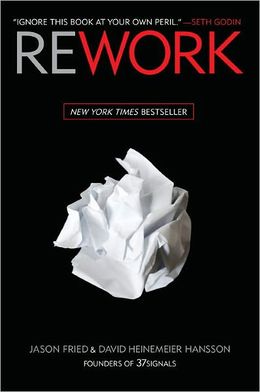
Rework — Jason Fried and David Heinemeier Hansson

Rework is the rare book that could and even should be longer than it is: Fried and Hansson even say, “Writers eliminate good pages to make a great book. We cut this book in half between the next-to-last and final drafts. From 57,000 words to about 27,000 words. Trust us, it’s better for it.” I do trust them, but they may have lost some of the fun stories that might give the book more texture. They’re overfond of assertion without demonstration. But so what? The book as a whole is still worth reading. It’ll take an hour or two to get through the whole thing, which is peppered with little moments like, “You’re better off with a kick-ass half than a half-assed whole” or “Don’t sit around and wait for someone else to make the change you want to see. And don’t think it takes a huge team to make that difference today.”

ReworkIn other words: do it now, whatever the “it” happens to be. Waiting is your worst enemy, doing your best friend, and anything that stops you from doing something should be ignored or overcome. Friedman and Hansson are speaking of business, but they’re also speaking of art, science, and almost everything good in this world. They say, “What you do is what matters, not what you think or say or plan.” This is equally true of writing, but a lot of would-be writers seem to like the idea of writing more than the actual writing itself. I often offer this challenge to people who say they want to or wish they could write a novel:

1) Turn off your Internet access and cell phone.

2) Write chapter one over three days (or so; the actual timeframe doesn’t matter, as long as it’s short); continue if you want to.

3) Send me the result. I’ll read it and send it back.

So far, I think one person has taken that challenge, and I never got chapter two. I interpret this as meaning that most people who say they want to write a novel (or write anything else, or learn the guitar, or get laid, or lose weight, or start cooking, or any number of other skilled endeavors) don’t actually want to, because if they did, they would start today. If you shoot for, say, 500 words a day, you’ll have a pile of around 80,000 in six months, leaving some room for missed days, editing, and so forth.

If you shoot for 1,000 words a day, you’ll have it in three months.

This, however, is only the start, which I didn’t realize when I was nearer to the start than I am now. But if you’re not putting in the seat time, writing, you’re not going to do anything and all your intentions aren’t going to matter. Fried and Hansson are pointing this out in the context of business, where it’s equally valid, and there are probably an equal number of people saying, “I should start a business” and “I should write.” Most of them are probably better off not acting on their impulses. But if they do, why not start?

They’re giving you permission you don’t need to be given, but they’re doing it in a way that feels fun. They elevate fun to a cardinal virtue, and they want to get rid of things that aren’t fun or don’t add value to people’s lives. At one point, for instance, they say:

The business world is littered with dead documents that do nothing but waste people’s time. Reports no one reads, diagrams no one looks at, and specs that never resemble the final product. These things take forever to make but only seconds to forget.

Who would want to stand up and proudly proclaim that they write “dead documents?” In this framing, no one. But sometimes a guy with a document that says why thing x is better than thing y wins. Sometimes dead documents serve important signaling functions. That’s the thing about Rework: read it, but don’t assume it’s always right.

Over the last two months I’ve been on a binge of business or quasi business books: Rework, Anything You Want, How to Win at the Sport of Business: If I Can Do It, You Can Do It, Delivering Happiness: A Path to Profits, Passion, and Purpose, all of them good in their own way, and all of them subtly contradicting each other in various ways.

If Steve Jobs had written a book about business the Apple way, he’d probably contradict all of them. Yet the writer of each book is successful in their own field. If my Dad and I wrote “Doing Business the Seliger + Associates way,” we’d probably say some things that are similar to what Hansson and Fried say but some things that are very different because of the peculiarities of our field. Every business situation is slightly different. What works in one field may not work in another.

The meta lesson may be that no two successes are exactly alike, and that, while you should read these books, you should also realize that you might use pieces of them but you’re unlikely to use all of them. They’re all to be subjected to interrogation, not venerated.

I can say, however, that each of the books above inspires in its own way, and sometimes inspiration has an importance that goes beyond the immediate truth value of a piece.

Confessions of a Pickup Artist Chaser — Clarisse Thorn

Since 2005 and Neil Strauss’s The Game: Penetrating the Secret Society of Pickup Artists, the number of blogs, books, and forums devoted to teaching men how to get with women has, as they say, exploded, and pickup offers a seductive conceit: with the right words, posture, and attitude, average guys can sleep with attractive women. The seductive conceit tends not to play out all that well: by the time one learns enough and changes enough to sleep with lots of attractive women, a random guy isn’t the guy he was when he started.

Confessions_Most of these guys are guys, both writers and readers. Clarisse Thorn, “a feminist S&M writer and activist,” obviously isn’t. She doesn’t want to sleep with more women today! She wants something that, from an intellectual perspective, is more interesting: understanding. In Confessions of a Pickup Artist Chaser, she offers an introduction similar to the one I wrote in the first paragraph of this post:

There’s a huge subculture devoted to teaching men how to seduce women. Within the last half-decade or so, these underground ‘pickup artists’ have burst into the popular consciousness, aided first and foremost by Neil Strauss’s bestselling 2005 book The Game.

One real question: Why do so many men need to learn “how to seduce women?” What aren’t men being taught in schools? By their fathers? Friends? Culture? Anything that needs to be consciously learned and taught isn’t being absorbed from other avenues. Why did “Game” emerge when it did, as opposed to 1970, or 1950, or 1850? To my mind, the sexual revolution and the Internet play large parts: the former reduced monogamy, encouraged more people to sleep with more people, and made women more independent of their families, while the latter allows outsiders to congregate and discuss matters that can’t find mainstream publishers and outlets.

I can say that, at least in my case, I noticed the same sorts of things many guys notice in high school: the same handful of guys seem to get 80 or 90% of female attention, and, as usual, that “chicks dig jerks” and that they eschew “nice guys.” The question eventually becomes, again, “Why?”

Bad answers tend to be, “women are inscrutable” or “just because.” Better answers are out there. I think a lot of guys glom onto pickup ideas not only because some specific tactics work, but because the ideas themselves help explain behavior that seems otherwise mysterious and self-defeating. As Thorn says, “When there’s no standard etiquette or well-understood social channels for how to meet women, then it seems obvious that a bunch of dudes would start getting together trying to figure out how to do that.” If there was “standard etiquette,” it’s gone now, along with standard corporate jobs-for-life.

The role of evolutionary biology and psychology is also underrated in the growth of pickup artists. That field provides answers about what people, or at least people from some cultures, find attractive, and helps to explain why people find what they find attractive. Without that intellectual ballast, I doubt we’d see the surface phenomenon of the pickup artist; that’s merely the mast and the deck. The stuff keeping the ship upright is down below, out of sight. Bad, sloppy, or reductivist evolutionary psychology is easy to discredit, and it should be discredited, but there’s an intellectual core that remains.

Pickup shows, or attempts to show, guys how to get with women in modern environments; as Thorn says, “often, the discussions and the seminars and the meetups are one big group of people who break down seductive behaviors as precisely as they possibly can.” Some pickup artists see what they do as part of self-improvement and enhancement. Others, in Thorn’s view, are “Darth Vader” pickup artists; Thorn describes one this way: “whatever would be more evil and more powerful than Darth Vader, that’s Roissy. [. . .] he is almost comically villainous.” She’s right in that last description, and “comically villainous” has a weird, almost 18th Century ring that’s appropriate for Roissy’s commentary and fundamental harmlessness (he writes a blog and lives in DC, after all, and it’s hard to take his more hyperbolic assertions seriously).

Nonetheless, men like Roissy are the ones Thorn seeks out. There’s a thread of honesty, of self-criticism, that runs through Confessions of a Pickup Artist Chaser: “I can’t deny that I myself pay more attention to hot men [. . .] I can’t deny that I wanted PUAs’ approval.” The wanting “approval” makes sense: if you don’t want approval, it’s easy enough to rant ignorantly about a subject. Plus, when a phenomenon is sufficiently widespread, it’s worth understanding it, and your own relationship to it, before criticizing it. Thorn does both.

She also gave an interview in which she said that, while she sees feminism as telling us a lot about the macro aspects of gender in our society (in work and school, for example), feminism does very little to describe, let alone evaluate, how micro, day-to-day interactions are structured. Pickup artists, or whatever one may want to call guys who are consciously building their skills at going out and getting women, are describing the specific comments, conversations, styles, and venues women respond to. The pickup artists are saying, “This is how you approach a woman in a bar, this is how you strike up a conversation at the grocery store, and so forth.” In other words, they’re looking at how people actually go about the business of getting laid. Their work is often very detailed, and the overall thrust is toward the effectiveness of getting laid rather than how male-female interactions work in theory. Feminism, in Thorn’s view, appears to be silent, or mostly silent, on the day-to-day interactions.

Women also haven’t tended, so far as I or Thorn knows, to produce the same material about why they pick the guys they pick, what they say, what happens in the lead-up to sex, and what happens afterward. Men produce these sometimes voluminous field reports (Reddit’s “seduction” community is full of them), to the point where the occasional woman appears to ask why no one is producing pickup material for women. Nothing is stopping women from doing so, but the average woman appears less interested in how to “pick up” guys and more interested in relationships (which one can see from, say, The Rules versus The Game, or romance novels versus porn). The average of many people’s desires doesn’t say anything about a particular individual’s desires or proclivities, but we do see patterns emerge through aggregation.

It’s virtually impossible to be a thinking person and not notice the disjuncture between behavior in bars / clubs / parties and academic / Internet feminist thinking. It’s hard to reconcile 50 Shades of Gray, submissive S&M preferences, and romance novels with feminist thinking (Janice Radway’s Reading the Romance is excellent for its observations, but her preexisting ideological framework automatically assumes everything about gender preferences is the fault of a pervasive “patriarchy” that, if it once existed, didn’t by the time I came of age).

People like Thorn are trying to bridge that gap, which I admire. What academic feminists think average women should want (and what average men are like) seems very different from what many normal women want. It’s hard if not impossible to legislate desire, or change it through haranguing, though people certainly have tried and continue to try. One thing I think most people have in common is hypocrisy and lying, either to themselves or others, and sexual behavior is certainly rife with both hypocrisy and lying. My favorite public example are the closeted Republicans who fulminate against being gay and then get caught in a “wide stance,” tapping their foot in a men’s bathroom. But they’re so pathetic a target that they’re not really worth discussing on an intellectual level.

Thorn’s book is worth that discussion, and running through Confessions of a Pickup Artist Chaser is a simple conundrum: we don’t know who someone really is, versus when someone is who we want them to be (example: “When I met Neil [Strauss] in Chicago, he seemed low-key and authentic, but I suppose that’s just what he’d want me to think”). The authenticity question isn’t unique to Confessions: it runs through literature, especially in literary fiction and science fiction, through psychology, through sociology, and through everyday life. Our personalities themselves aren’t stable, and they’re influenced by situations. We want to believe ourselves to be authentic, and we want to believe that we can fully understand other people, but those beliefs whither in the face of both academic evidence and the evidence of everyday life and social interaction.

We just don’t know. Pickup wants men to believe that we can mold ourselves into something better; that molding is simply of a particular kind, oriented in a particular direction. To be good at pickup is as hard as being good at anything else: it might start with learning some clever lines and some confidence, but it ends with the entire state of one’s social and physical being, from wardrobe to workout to interests to speaking skills to dancing to friends. Maybe the scariest thing of all to women is the extent to which men will change their personalities to attract women, or the extent to which attracting women is a skill that can be learned, contrary to the dominant cultural paradigm of love at first sight, “it just happened,” and the belief in romantic destiny. Women, however, don’t like to feel as if they’re being “gamed.” By definition, the best pickup artists conceal their craft. If you know you’re being gamed, the game itself has failed.

Good pickup also means empathy, which men and women lack in equal measure. Thorn writes:

Age 15 may also have been when guys began shouting gross comments at me in the street, but I’m not sure. It was a few years before I started going to parties and clubs where some guys would approach and refuse to leave me alone, no matter how obvious I thought I made it that I wasn’t interested. These experiences, among many others, contributed to the development of what a PUA would call my “bitch shield”: my instinctive tendency to be cold and unfriendly during unexpected interactions with unfamiliar guys.

Many women have bitch shields to some degree — when we don’t, we get a lot more “I’ve been watching you and your nice breasts” comments. PUAs devote a lot of mental energy to figuring out how to quickly convince women.

Pickup teaches, or should teach, men to appreciate why “Many women have bitch shields to some degree.” I’m not sure that there’s a female equivalent to make pickup that helps women realize just how much rejection being a male entails. Pickup is also about teaching you to imagine how you appear, or should appear, to others; Thorne correctly notes that “‘Just be yourself’ is terrible advice if you are naturally unbelievably awkward.” The self you should be, whether you want to form relationships or just get laid, is something else.

Although the better pickup types don’t promise something for nothing, the worst ones do. The reality with pickup is the same reality that confronts anyone who wants to truly a master a skill, whether that skill be programming, knitting, writing, music: it takes time, effort, and intensive effort. “No art, however minor, demands less than total dedication if you want to excel in it,” as Leon Battista Alberti said, and seducing women is an art like any other. Some men appear to be “naturally” good at it, which usually means that they have some inborn predisposition combined with unconscious training

I discussed ideas and trends in the first part of this essay because those are the most interesting and useful parts of the book. A lot of Thorn’s writing, however, is weak. At one point she says of pickup artists, “some of them were so smart it blew my mind.” Such clichés should be excised like a demon: swiftly, surely, and religiously. Chapter 3 starts with Thorn saying, “I’m a feminist sex-positive activist. For me, that means that I try to raise awareness of social problems around sexuality.” But, again, anyone with decent reading comprehension skills will already know that, because she mentioned it several times. Some sections are too long and should be cut, and it becomes easier to skip sections the longer one reads. The word “super” is overused as an intensifier: “I acknowledged times in the past when I’ve been super awkward;” “He’s super-analytical too;” “his consent was super important to me;” “he wasn’t going to be a super-major relationship no matter what.” That’s only a handful of examples. Like “very” or salt, “super” should be used sparingly. Too many super things aren’t super at all.

The word “problematic” is similarly problematic: instead of arguing why an idea or a concept is a problem, “problematic” simply asserts that it is; as word, it conceals more than it reveals, and it conceals a lot: “some men are so starved of knowledge about masculinity that they idolize Roissy and overlook some of the more problematic things he has said;” “the seduction community is very heteronormative: it really buys into problematic gender standards;” “all the words that I put in quote marks above are concepts that I consider incredibly problematic;” “while the advice in The Rules is often problematic, much of it works;” a woman named Kristen J says “[ad] agencies understand the effects of problematic norms on women.” Using a weasel word like “problematic” once or twice falls within the author’s license not to explain everything. Using it more than half a dozen times means the next version should be edited with greater care.

While I’m here, let me talk for a moment about Kristen J. I’m not convinced advertisers exploit women, or know that they do, but the bigger issue is that advertisers want to do whatever works; if ads didn’t work, at all, advertisers would quit trying. She says that “The thing is, advertising isn’t just a consequence of problematic norms… it’s a creator of them, too.” Maybe. But the norms emerge from collective individual choices, and I think advertiser are mostly reacting to what they see as being effective. It’s certainly more fun to blame ad agencies than to look around and say the blame for the effectiveness of advertising lies, at least a little bit, in each of us, and in our aggregate preferences (for more on this topic, see Geoffrey Miller’s Spent: Sex, Evolution, and Consumer Behavior). I mentioned a similar idea in a different context above, but the same principle applies here.

Technical problems with Thorn’s writing aren’t limited to the level of the sentence, either. She assumes the reader’s stupidity:

Here we are again at the end of a chapter! Did you read it all? Was it too long for you? It’s okay if you didn’t read it all, because I hereby bestow upon you some ‘Too Long; Didn’t Read’ bullet points!

“Was it too long for you?” sounds vaguely pornographic out of context while simultaneously being infantilizing: if you’re not in middle school, a couple thousands words on a compelling topic shouldn’t be too long. If it is too long, the writer should cut words. The best writing advice I’ve ever heard is “omit unnecessary words.” In Confessions, Chapter 12 begins this way: “This is the last chapter, and I won’t offer a “Too Long; Didn’t Read” section at the end. My Grand Theory of The Ethical Game cannot be reduced to mere bullet points!” This implies that the preceding 11 chapters can “be reduced to mere bullet points”—but if they can, why bother writing extended narratives? Why not just shorten the book to the bullet points? I don’t think the preceding chapters can be reduced to bullets, which is frustrating both about the bullets themselves and the way they disrupt the book’s flow.

Confessions is slack. It’s hard to describe precisely what tautness entails, but in vague terms it means feeling like every part of the book connects to every other part, or at least to a linear, forward-moving narrative or level of understanding. Too many of the conversations in Confessions feel superfluous—not on their own, but put in the context of each other. Fixing this kind of problem is a long and difficult effort, and I don’t have a good sense of how rising action in each chapter or scene should function.

But I know it when I don’t see it, and too often I didn’t see it. Neil Strauss’s The Game builds in a classic fashion, portraying his journey from outsider to neophyte to expert to transcending the limits of his field. Confessions sort of has that structure, but it’s more digressive, more random, and not in ways that feel like they build. In the middle of the book I began skipping sections that felt repetitive, as issues about pickup, game, and feminism were analyzed from angles that seemed nearly indistinguishable from how they’d been previously analyzed. There was a feeling of “almost, but not quite;” I want the stories to be tighter than they are.

Tautness can’t be quoted. It can be observed: Gillian Flynn’s Gone Girl has it. Philip Pullman’s His Dark Materials has it. Tucker Max’s stories have it. So do Chelsea Handler’s better stories. Confessions needs it.

I may also be more attuned to tautness because for a long time I had a major problem with it in my own writing. To some extent all writers worth a damn struggle with tautness; the ones who don’t care either write tautly unconsciously or risk boring their readers.

Even the best non-narrative, nonfiction is intellectual taut, with ideas that build on one another towards their conclusions. Jonathan Haidt’s The Righteous Mind has this quality, even though it’s not a narrative book. observing the issue may be worthwhile: nonfiction writers need to think about the tautness issue, because readers will recognize when a work builds and when a work should be restructured in a way that makes it more compelling.

The first couple chapters were the most compelling, followed by the Neil Strauss chapter. I’m spending so much time on stylistic weaknesses because I want the book to be better. The subject interests me and Thorn’s vantage is fresh. Only the execution is lacking. Thorn is doing something I admire: reporting. For a self-published writer, this is unusual. She goes out to meet and talk to people involved in her subject. She only needs her Robert Gottlieb, her Maxwell Perkins.

I hope Thorn finds him, or her.

APE: Author, Publisher, Entrepreneur — Guy Kawasaki and Shawn Welch

ape_cover_KawasakiFor decades, books got published something like this: you, the writer, wrote and polished your book; you submitted a query letter and perhaps sample chapters to literary agents; an agent read the full manuscript; an agent took you on; the agent pitched your book to large publishing houses in New York; the editor, or ideally more than one editor, made an offer; the agent negotiated; and you got a book deal. This system worked kind of okay, and there wasn’t a better way to do it, but a lot of writers, including me, got hung up in the “an agent took you on” step.

Now, self-publishing has a realistic chance of success—defined as getting your work to readers and getting some amount of money from those readers—which offers opportunities and headaches. Big publishers know change is coming. The opportunities are obvious, and the headaches stem from having to learn a lot of stuff that publishers used to do, like cover design, knowing what a “widow” is, and figuring out how to hire a copy editor. APE: Author, Publisher, Entrepreneur wants to explain the new world, and it’s a book for a very specific group: people who are, for whatever reason, deeply interested in the publishing industry, and people who want to write a book, have written a book, or want to publish the book they’ve written. If you’re sure you don’t fall into those categories and aren’t likely to, stop reading. You’re probably wasting your time. If you want to know, keep going.

A few months ago I noted this, from Tim Parks’s “Does Money Make Us Write Better?“, in a links post:

When they are starting out writers rarely make anything at all for what they do. I wrote seven novels over a period of six years before one was accepted for publication. Rejected by some twenty publishers that seventh eventually earned me an advance of £1,000 for world rights. Evidently, I wasn’t working for money. What then? Pleasure? I don’t think so; I remember I was on the point of giving up when that book was accepted. I’d had enough. However much I enjoyed trying to get the world into words, the rejections were disheartening; and the writing habit was keeping me from a “proper” career elsewhere.

These kinds of stories infect writer interviews, as do tales of heroic perseverance. John Barth and William Goldman almost quit writing too. But more interesting still are the dark matter writers, the ones we don’t hear about because they gave up and aren’t being interviewed or writing introductions to reprints of their older books. I don’t want to be one of them. And I bet I can make more than £1,000, though I don’t know how long ago Parks began writing: adjusted for inflation, £1,000 might be a lot of money.

Kawasaki and Welch explain how to avoid being a dark matter writer. They say, “Will your book add value to people’s lives? This is a severe test, but if your answer is affirmative, there’s no doubt that you should write a book.” Still, people write books for all sorts of reasons, though I suspect the major reasons are related and twofold: the book they’d like to read doesn’t already exist, and they have something to say. Answers like “to add value to people’s lives” are good reasons to write a book, and good reasons to do many things. There is still some doubt. Writing a book can consume all your mental energy. It might add value to, say, two people’s lives, which might not justify the costs. Not everyone has the impetus towards book writing; to get through the difficulties of writing a book, I think that writing itself has to be fun, or fun at times (more on that later).

But the number of people who could write books and aren’t, in part because of the daunting publishing process, is much larger than the number who do write books. And that pool is getting larger. One challenge is that writers are going to have to think more like publishers, and publishers are going to have to think more like entrepreneurs. APE is about these transformations, and it takes its place near J.A. Konrath and Jack Kilborn’s The Newbie’s Guide to Publishing (Everything A Writer Needs To Know) and Kristine Kathryn Rusch’s Surviving the Transition: How Writers Can Thrive in the New World of Publishing (one thing writers evidently do, once they spend the painful time learning to self-publish, is write guides so that others can learn the same).

How useful APE will be to you depends on how much other reading you’ve done in the how-to-be-a-writer genre. I have trouble resisting it, and so sections of APE are less useful; some, like chapters 6, were fun but already well-known to me. The later ones, on the finer point of Kindle, Nook, and iBooks publishing, were exceedingly useful. I follow digital publishing closely, because I’m going to do it, but I still learned things: for example, I didn’t realize that Google Play exists. Google Play might not matter for me, or for you, but uploading to it requires little time beyond the effort necessary for iBooks and Barnes and Noble’s Nook.

Kawasaki and Welch also have overly strong views on tools (which may make sense given Kawasaki’s background: “For four years I evangelized Macintosh to software and hardware developers and led the charge against world-wide domination by IBM;” the word “evangelized” is key here, implying religious fervor that’s been transferred from God to Mac). I’ve learned some about photography in the last two years, perhaps a reaction against the extreme amount of reading and writing I’ve done, and in cameras, there’s a continual debate between the people who want the newest, coolest gear and who argue that the latest gear enables them to get shots they couldn’t have gotten before. Their intellectual adversaries argue that the most important tool is between the photographer’s ears and that composition, subject matter, and skill with what you have matters more than the newest cameras and the best lenses.

I’ve read impassioned pleas from both sides, and agreed fully with one side, then read the opposite, and agreed fully with them. There isn’t a right answer. One cliche in the photography community holds that every image you’ve admired was captured with worse gear than what you’ve got. Yet there’s also no reason to ignore the tools you’re using and the potential that new tools may unlock.

Kawasaki and Welch write, “In our book (again, pun intended), you should use a Macintosh. No computer makes you more creative and productive, because a Macintosh becomes part of you whereas you need to overcome other operating systems.” I don’t think it matters that much, which is somewhat funny because I’m writing this on an iMac. But pretty much any computer made in the last ten years will due, because, the most important parts of the writing process are a) a word processor and b) there is no b.

There are some nifty tools I use extensively, like Devonthink Pro, and some nifty tools that I’ve used less extensively but still helpfully at times, like Scrivener. Nonetheless, 95% of the real “work” of writing still happens on the level of the sentence and paragraph (though Kawasaki and Welch say of Scrivener, “I pride myself in having an organized mind, but my mind isn’t this organized”)*. A Mac is not going to give you great sentences. Neither is Windows or Linux or the tea you drink or the cafe you write at or the hot literary groupie offering you head or the pen you use. Great sentences, like change, come from within.

They also say, “We have never met anyone who regretted buying a Macintosh.” I have—like those who need perfect Exchange synchronization, or people who are seduced by the Mac’s cool factor, only to realize that the paying-the-rent factor is even more important. These are quibbles. Still, in one chapter the writers quote Zoe Winters, and I would repurpose her advice to apply to technology: “There is no shortcut to awesome.” Writing well is always a longcut, not a shortcut, and self-publishing arguably makes the road longer. There’s no real alternative, through software, hardware, or anything else.

The road may be long, but one can find comfort and encouragement along the way. Kawasaki and Welch write, “If You Want to Write by Brenda Ueland [. . .] changed my life by empowering me to write even though I didn’t consider myself a writer.” This is a common feeling, but it’s also one that’s long puzzled me: I spend very little, if any, time considering whether or not I’m “a writer.” I just do it. I didn’t need permission to be a writer, and neither do you. Alternately, if you do need permission, let me bestow it on you: a random stranger on the Internet has now dubbed thee a writer. Feel better?

You should. You should also realize that writing may be lonely in the moment, but it’s a way of bringing people together over time. This tension is implied in moments like these:: “Authors who write to impress people have difficulty remaining true to themselves. A better path is to write what pleases you and pray that there are others like you.” I would also add that few people are likely to be impressed anyway, and those who might be impressed will be more impressed if your book is written, at least some of the time, because you’re having fun and seeing where things go. Think about your favorite sexual experiences: few of them probably arose because you were putting a lot of pressure on yourself or your partners to have a Great Sexual Experience. Most of them probably arose because you and your partner(s) were relaxed and ready to have a good time by seeing where things go. So too with writing, and many other activities.

Sometimes writing will be painful, as Kawasaki and Welch note. I won’t deny it. But parts should be fun, and the fun will show in the final product.

In a few places, I’d like to see better writing in a book about writing. One chapter begins, “This section explains how to take a manuscript and turn it into a book. We assume that you have a rock-solid draft of your book.” “Rock-solid” turns up 74 million hits on Google. It’s a cliche. A book about writing should itself be impeccably written. This one is close—very close. Perhaps the next update will fix that.

Elsewhere, the writers say, “For example, The Schmoe Way by Joe Schmoe from Schmoe Press doesn’t cut it.” And “Pure text posts don’t cut it in the highly visual world of social media.” And “While printed books may never die (an ebook of Annie Leibovitz’s photographs won’t cut it) [. . . .]” What does “cut it,” and what is being cut? All of these could be improved: for example, “an ebook of Annie Leibovitz’s photographs is as useful as sheet music for someone who wants to hear Beethoven’s Fifth.” Maybe that’s a little clunky too, but it’s still an improvement because the metaphor is fresh. One could say, “Pure text posts in the highly visual world of social media make more sense than a pure text movie, but both are improved by images.”

Some words are wasted. The last sentence in this paragraph:

Undaunted, [Amanda] Hocking decided to self-publish her novels with Kindle Direct Publishing to pay for the $300 trip. She started with My Blood Approves, and by October 2010, she made over $20,000. Over the next twenty months, she made $2.5 million. The rest, as the saying goes, is history.

could be removed. I can only think of two similar nonfiction books that had no wasted words: Rework (the 37signals book, and one of the few books I’ve read that should be expanded) and Derek Sivers’ Anything You Want (where Sivers even talks about brevity and clarity in “You should feel pain when unclear“—”Writing that email to all customers would take me all day, carefully eliminating every unnecessary word, and reshaping every sentence to make sure it could not be misunderstood”). The best writing advice I’ve ever received is “omit unnecessary words.” Almost everyone is guilty of this crime at times, including me, in this post, in this blog, and in my other writing.

Their advice on serial commas is askew; Kawasaki and Welch favor serial commas (“A serial comma (or Oxford comma, as they say across the pond) prevents confusion when you are listing several items”), but serial commas can also create ambiguity.

These are minor issues, but I bring them up because nonfiction should aspire to be art. Kawasaki and Welch agree—they say, “Metaphors and similes beat the crap out of adjectives and adverbs, so use them when you can. For example, rather than saying, ‘Hockey is very violent,’ you could say, ‘Hockey is war on ice.'” Perhaps I’m overly fastidious about the War Against Cliche. Others who are highly attuned to language will notice too.

Some sections of APE linger in the mind long after they’re read, like this:

There are two kinds of people: eaters and bakers. Eaters think the world is a zero-sum game: what someone else eats, they cannot eat. Bakers do not believe that the world is a zero-sum game because they can bake more and bigger pies. Everyone can eat more. People trust bakers and not eaters.

It expresses a sentiment I’ve discussed in many contexts, but in a way I hadn’t conceived. My closest approximation came in “How to think about science and becoming a scientist:”

while society needs a certain number of lawyers to function well, too many lawyers leads to diminishing returns as lawyers waste time ginning up work by suing each other over trivialities or chasing ambulances.

By contrast, an excess of scientists and engineers means more people who will build the stuff that lawyers then litigate over. Scientists and engineers expand the size of the economic pie; lawyers mostly work to divide it up differently. Whenever possible, work to be a person who creates things, instead of a person who tries to take stuff created by someone else.

Kawasaki and Welch are bakers. They’re creators. They want to help you be one too. Still, according to them, you have to be the kind of writer who wants to “take control of their fate and embrace the ideas here in order to maximize their success.” A fair number of writers don’t appear to care about being able to “maximize their success” as measured by sales and finances, and in some literary circles cachet comes from not marketing one’s book, or appearing not to market it; sometimes not marketing becomes marketing, as examples like J. D. Salinger and Cormac McCarthy show.

This underlying model of success can seem claustrophobic, and, just I gave you permission to be be a writer above, I give you permission to be selective with social networks here: plans for Facebook, Twitter, LinkedIn, e-mail, Google+, and more would leave me with less writing time. I want to do things that really interest me, and that’s mostly long-form writing. Facebook and Twitter aren’t interesting, and I want the mental space they would otherwise occupy to be occupied by better things. I’m also reluctant to trust Facebook and Google+ because that gives those companies so much control over what I do and who I talk to. There was a recent kerfuffle when Facebook “turned down the volume” of businesses that had Facebook pages. That’s good for Facebook’s users but terrible for anyone who spent time and money encouraging people to interact on Facebook.

Facebook is, of course, where the people are. Using it is good advice, but it might also be useful to ask what you can say no to. In Anything You Want, Derek Sivers has a chapter called “No more yes. It’s either HELL YEAH! or no,” where he says that your reaction to most propositions should be one of those two extremes. To me, Facebook, Google+, and Twitter are in the lukewarm middle. Kawasaki and Welch “recommend using Google+ as a blogging platform.” Does it allow one to export nicely-formatted XML that will allow you to easily switch, if necessary? That’s a prerequisite, at least to me.

Kawasaki and Welch might be overly enamored of social media, and me underly enamored, but unless you want a Salinger-like existence you probably need to do something. There are few alternative to social media, e-mail, and other promotional efforts, and those efforts are a boon to outsiders. The authors say, “I’ve never come across an author who was happy with the marketing efforts of his publisher.” That might be because publishers have one thing that can’t be replicated by outsiders: distribution. Publishers are set up for a world where they control distribution. That advantage is eroding over time.

The chapters about social networking show you how to make sure you have access to new advantages.

The downside is that learning the business consumes time like space shuttles consume jet fuel. At the moment, however, APE is a relatively easy, comprehensible way of learning about all the steps that one should take to move from “guy with a story” or “guy with a long document” to “writes books that other people value and read.”


* I’ve only used Scrivener for one novel, called THE HOOK, that has different, named narrators at different times, like Tom Perrotta’s Election, Anita Shreve’s Testimony, or William Faulkner’s As I Lay Dying. Scrivener was an ideal tool for this task because it made rearranging sections easy, and it made reading each speaker’s full narrative, in order, easy. I can also see it being very useful for non-narrative nonfiction and or dissertations / academic books (James Fallows is a convert). For most fiction, I think the bigger problem is making the story cohere, not rearranging it.