The dead and dying at the gates of oncology clinical trials

If you find this piece worthwhile, consider the Go Fund Me that’s funding ongoing care.

I was reading Tyler Cowen and Daniel Gross’s book Talent: How to Identify Energizers, Creatives, and Winners Around the World, and in it they write: “You can open doors for other people at relatively low cost (perhaps zero cost) to yourself just by making some options more vivid to them.… You embody something, and that something will stir some others into action” (237). That’s a lot of what Bess and I are doing when we write about clinical trials, where getting the wrong answer means death: thus, our extensive focus on it, and the healthcare system more broadly. We’re trying to open doors, especially for people who are sick or who don’t realize what their options are.

Right now, according to “The pharma industry from Paul Janssen to today: why drugs got harder to develop and what we can do about it,” apparently “Only 6% of cancer patients take part in clinical trials nationally in the US, for instance, and the number is generally lower in other countries and for other conditions.” A lot of cancer patients don’t need clinical trials and are healed by existing treatments, but, even granting that standard-of-care often works, 6% seems low—it may be low because of poor guidance combined with fatalism. If my experience is representative,[1] a lot of cancer patients aren’t getting adequate help understanding the system and finding a trial. Bess and I only succeeded in finding a clinical trial to keep me alive because of our own perseverance and obsessiveness; we were explicitly encouraged by multiple oncologists not to bother and to let me die. My primary oncologist at the Mayo Clinic Phoenix offered zero guidance, aid, or advice. I can’t tell how common this is, though feedback so far seems to indicate the answer might be “pretty common.” For a normal person without some of our traits, background, and resources, getting an optimal clinical trial would be far harder, if not impossible—and it was already hard for us. I’m still puzzled that more people with poor prognoses on standard-of-care treatments aren’t working to get the best clinical trials they can.

What’s the barrier? Mindset, and discouragement from oncologists, is probably one problem. A guy named Richard Chen, whose profile says he wrote two books on clinical trial recruitment, said: “First, FDA’s remit is not, and has never been, to get therapies to patients.” He also said: “Its primary mission first and foremost, is to prevent unsafe drugs from injuring patients.” If the FDA’s remit isn’t to get therapies to patients, that’s bad, and its remit should change. The second comment is pure, unintentional comedy. Right now, I’m a dead man walking. The FDA is preventing “unsafe” drugs from injuring me, so that I can be “injured”—which is to say, killed—by a recurrent/metastatic squamous cell carcinoma infestation. If I’m injured or killed by a drug, that’s not so different from my ultimate trajectory anyway, and the knowledge that can be created from my situation might accelerate treatments and save the next guy’s life.

Moreover, we already have an example of a medical area that works well with minimal FDA interference: surgery. Maxwell Tabarrok describes the situation in “Surgery Works Well Without The FDA: The best evidence against the FDA:”

Despite extreme information problems and a complete absence of federal oversight, surgery seems to work well. Compared to similar patients on the waiting list, 2.3 million life years were saved by organ transplants over 25 years. The WHO claims that “surgical interventions account for 13% of the world’s total disability-adjusted life years.” Coronary artery surgery extends lifespan by several years for $2300 a year. Cataract surgery and LASIK can massively improve quality of life for a few thousand dollars.

Regarding drugs, particularly drugs for people who are already effectively dead, like me, we should be moving closer to a surgical model.

I think Chen is a smart and well-meaning person. But he’s so bureaucratized, and he’s so imbibed the FDA’s line, that he doesn’t realize the Kafkaesque absurdity of telling me, a dying man who’s failed all standard therapies, that the FDA is protecting me from potentially unsafe drugs, so that I can safely die of cancer. If the FDA didn’t flex their paternalism quite so aggressively, terminal patients could at least consent to try something that might help them, which is better odds than trying nothing and waiting for a certain end. Look, if the FDA wants to have long trial periods for dubious drugs like those meant to lower cholesterol or whatever, fine. Once a person has a fatal diagnosis, however, that person is probably, like me, a lot more inclined to take a flyer on what’s available and see what happens. And we should be allowed to do that. We’re terminal, not without capacity. If the FDA’s remit is, ultimately, preventing patient injury, maybe they should ask themselves if they’re causing injury with their current approach?

Knowledge among patients and oncologists seems to be another barrier, according to “Why drugs got harder to develop:”

Many patients are willing to take part in clinical trials in principle, but awareness is poor. About 50% of the time when patients are invited to clinical trials they accept, but 90% are never invited to participate, mainly because most patients are not treated in settings that conduct trials. Patients are also not necessarily aware of or educated about the benefits of trials, and how they may enable them to access a high standard of care. Leading clinical research centres often have too many studies and not enough patients. When it comes to the trial itself, the site may be far from where the patient lives, requiring them to travel or even relocate for the duration of the trial — without adequate support for doing so.

Poor awareness is consistent with my experience—no one explicitly told me to seek clinical trials. Bess writes about the dearth of oncologists referring their patients to clinical trials in “Please be dying but not too quickly: part three” and I’ve written about this issue as well, but, as I mentioned above, if I’d followed my then-oncologist’s guidance, I’d have done some palliative chemo and then died. That doesn’t seem like an optimal outcome. If I die, Bess will be lonely. In spaces like oncology, I’d expect patients to be more like me—that is, highly motivated to attempt to not die. I don’t wholly understand what’s going on, which is why I titled my last essay on the subject “Puzzles about oncology and clinical trials.”

I guess (or infer from behavior) that most oncologists aren’t penalized or rewarded for helping their patients find and enter clinical trials. In the emergency room, a doctor who routinely misses heart attacks or strokes will find his or her license attacked and him or herself in a court room. In oncology, there’s apparently no real effort to consistently help patients who’ve exhausted standard treatments. It’s not, I guess, part of the professional elements of the profession, which I find surprising. Sure, many patients are likely elderly and too sick to pursue clinical trials, but a fair number must be like me: motivated and able to undertake somewhat arduous efforts to prevent or delay death.

One reason too few people participate may be logistical:

To get enough patients to fill up large trials companies need to conduct trials at multiple sites. The more sites involved in a trial, the greater the logistical complexities involved in coordinating that the protocol is executed appropriately across sites, the data is collected to a good standard, and the drug is distributed to all sites as needed. This all increases costs. More sites also increases variance in execution, and improper trial conduct can delay or even sink a development program. According to data from Tufts university, >80% of trials fail to recruit on time, actual enrolment times are typically around double the planned timelines, and ~50% of terminated trials result from recruitment failures. An estimated 11% of trial sites fail to recruit a single patient, and another 37% don’t reach their target enrollment criteria.

There are efforts to create “virtual” trial sites—in other words, to allow clinical trials to proceed at local sites that reach some minimum threshold of competence. To use myself as an example, if the petosemtamab trial I’m doing at UCSD included a real virtual site component, petosemtamab could be shipped to HonorHealth in Scottsdale or one of the Ironwood Cancer Centers in Chandler, and I could receive my infusions and monitoring locally, with the data reported to UCSD and/or Merus (the drug company). Although that would mean “more sites involved in a trial,” it also means less responsibility at each site. The “recruitment failures” issue is interesting in light of the fact that almost no trial sites seem to do basic, modern marketing.

I’m not hugely optimistic about fomenting real change. Real change is slow in a society like the United States, which has been characterized since the 1970s overwhelmingly by complacency, stasis, and status-quo bias. One sees that in our inability to build new housing, our inability to build new ships for the Navy, our refusal to accelerate subway development, our preference for interminable litigation over infrastructure, the Jones Act, the FDA, dishonest and tuition-seeking universities, and the innumerable other veto players who, like Richard Chen, are great at saying “no” and unable to say “yes.” I hope we can build O’Neill Habitats that will allow a re-opening of the frontier and a new space where the dreamers who are tired of hearing “no” can instead create a new polity where it’s possible to say “yes.” The United States is huge on safetyism instead of true safety—and human flourishing.[2] We can and should do better. I doubt we will, however, because the people who most need FDA reform are dead. They’re not writing. They’re not doing podcasts. They’re not agitating Congress.

Still, sometimes change happens, and the bureaucratic inertia is somehow overcome. For example, voucher and charter schools seem to continue to ascend, despite entrenched and intense monied union interests opposing them, and decades after their intellectual foundations were laid. Marijuana legalization seemed unlikely until it happened. Psychedelics look like they’re on the path to medical legalization, at the very least, and possible general legalization; based on my experiences, psychedelics are both safer and far more interesting than alcohol. SpaceX has revolutionized the space game, and I’d have incorrectly predicted failure. Tesla is the sole bulwark against state-affiliated and subsidized Chinese companies owning the entire electric car market. Who knows what’s possible? I don’t hope for this, but if someone in some senator or senior house member’s family gets cancer, and that senator or house member learns what I’ve learned, FDA reform might become a vital issue for that person. Few people I’ve seen online have defended the current system (there are some—just not a lot).

The fact that the current ossified, slow system has persisted as long as it has is an argument for it continuing. Good enough is good enough, right? Moreover, the way the press responds to events helps perpetuate stasis: if a drug has negative side effects, including potentially death, that gets plastered all over the news. Investigations are launched. Scapegoats are sought. If a drug works, and saves lives, the response is muted. The articles go unread. The beneficiaries are happy but don’t start campaigning for more and better medical treatment, faster. One person who dies from a drug outweighs one hundred who might be saved by another. It reminds me of all the press given to any kind of airline accident, even one without casualties, while 40,000 people a year die in car crashes, without most of them making headlines.

One person on LinkedIn said this about Bess’s clinical trial essay-guide:

An extraordinarily damning overview of the way things operate currently, that puts everything we complain about from within the industry into perspective. Thanks for sharing this Brad [Hightower—mentioned above] – as you say, a must read that underlines how we must all work together to improve things.

It might be a damning overview, but it also turns out that seemingly everyone working in or adjacent to clinical trials knows about the problems already. That includes everyone from the researchers themselves to the drug companies to the hospitals to the oncologists to the support staff. If a lot of people have known for a long time how bad the system is, and no one has managed to coordinate sufficiently to make substantial improvements, that implies that the problems will persist. Can Bess and I be the catalysts that finally galvanize some change? That’d be great, and yet I’m pessimistic. There’s a saying in investing: “The market can stay irrational longer than you can stay solvent.” Call this Seliger’s Law: “A broken system can stay broken for longer than people have the time, energy, and ability to try fixing it.”

Still, Bess and I would like to try to make the world a better place, to the extent we can, and within whatever limits our abilities and skills may impose, and trying to nudge the clinical trial system into a better equilibrium is part of our effort. It’s too late to save my tongue, but it may not be too late to save the tongues and lives of others. In an alternate world, petosemtamab, or a cancer vaccine, would’ve been approved and available in Oct. 2022. I’d have gotten surgery, and then petosemtamab, which is way less toxic than chemotherapy. Maybe that wouldn’t’ve saved my tongue—but maybe it would’ve. Oncologists are reluctant to use chemotherapy, but modern alternatives like petosemtamab should help people like me in the future.

Cancer vaccines exist, though trials are moving achingly slowly. A company called Transgene is testing a cancer vaccine called TG4050 on patients with initial head and neck cancer diagnoses—the same diagnosis I had in Oct. 2022.  TG4050 is moving to a Phase 1b and 2 trial; according to the company, “The compelling initial Phase I data presented with NEC at ASCO 2023 showed that all evaluable patients treated with TG4050 monotherapy developed a specific immune response and remained disease-free.” I wish I’d remained disease-free; instead, I have no tongue and am likely to die soon.  

Despite my pessimism, “Why drugs got harder to develop” says: 

Yet, even though there are major forces pushing against drug developers, there is a sense that the industry is still underperforming, and that it could do more. One reason for optimism can be seen in the recent flattening of the slope of Eroom’s law following decades of declining productivity. It remains to be seen whether the recent uptick is a sustained turnaround or not. The pessimistic view is that it is illusory, a result of how drugmakers have side-stepped fundamental productivity issues by focusing on developing drugs for niche subpopulations with few or no options where regulators are willing to accept less evidence, it’s easier to improve on the standard of care, and payers have less power to push back on higher prices: rare disease and oncology in particular. It’s no coincidence that investment has flowed into areas where regulatory restrictions have been relaxed and accelerated approvals are commonplace: 27% of FDA drug approvals in 2022 were for oncology, the largest therapeutic area category, and 57% were for rare/orphan diseases.

That seems better than nothing. Maybe Congress and/or the FDA is responding to the Richard Chin logic I note above. The FDA has created systemic problems, and it can also create systemic solutions. For example, the FDA doesn’t really account for the time-value of money,[3] which is especially important in a high-interest-rate environment:

As a more general point, it would help if regulators could be more predictable and transparent in their decision making. In a survey of drug and device industry professionals, 68% said that the FDA’s unpredictability discouraged the development of new products. It can be hard to predict how regulators will react to a certain dataset in the context of high unmet need, so companies can be inclined to ‘submit for approval and pray’, even after receiving negative feedback on the data package from regulators during prior interactions.

“Hard to predict” means that many people stop pushing a drug before they start. Companies are competing for investable cash with all other companies; the more time-consuming (read: expensive) the FDA makes the process, the fewer drugs will even be attempted. “Why drugs are harder to develop” suggests the FDA be more accountable to patients:

A straightforward start to improve transparency across the industry would be for the FDA to disclose the formal ‘complete response letters’ (CRLs) issued when they reject a drug which contain the reasons for rejection. Making this information public would give future developers insight into the regulator’s thinking on a disease, with minimal downsides. How companies represent their CRLs to the broader market today is often misrepresentative of the actual reasons for rejection, potentially misleading patients as well as future investors and drug developers in the indication.

I’m not the only one thinking about reform; pretty much everyone in the industry is. To return to a point I raised at the beginning of this essay, reforms could also make clinical trials easier for patients to access. Bess and I spent thousands of dollars and countless hours learning how the clinical trial system works and then how to participate. Initially, no one comprehensively helped us on this journey; my original oncologist at the Mayo Clinic Phoenix was and likely still is sluggish. Mayo Phoenix has a great ENT department but appears to be poor in oncology, which is surprising for an organization with a reputation for cancer care. Bess and I had to learn what we know piecemeal, which is part of the reason we’re trying to describe comprehensively what we’ve learned and how other people’s experiences can be made better.

The best trial for head and neck cancers is petosemtamab, and that trial is being hosted at UCSD. Bess and I are lucky enough to have the resources necessary to get me there twice a month from Arizona for infusions, thanks in large part to the generosity of friends and strangers who’ve contributed to the Go Fund Me. I’ve been saying that being sick for an extended period of time has at least three components to it: health itself; financial well-being; and managing healthcare. Drop any one of the three and the other two are likely to fall too. Very few people can help my health or healthcare directly, but the contributors to the Go Fund Me have made the financial challenges easier.

What’d make things better for everyone, however, is reforms like virtual trial sites. The healthcare team at UCSD has been great, but being infused locally would negate the need to be away from home six days a month, the cost of flights, hotel, and the huge energy expenditure all that entails. The process of getting a clinical trial medication can and should be less expensive and arduous than it is. I can see why most people who might want to participate in the better clinical trials for their illness run out of money and energy to pursue those trials. Bess and I were ready to move anywhere. Fortunately, we’ve not had to move somewhere expensive and far from family and friends. We were ready to, though. We may still have to one day—and maybe, but hopefully not, soon.

Both of us also wish that there were greater transparency around which trials are doing well in terms of patient outcomes and which trials aren’t doing so well. We’ve learned via experience that right now, there’s no substitute for establishing care at a bunch of sites and listening to the oncologists there. Oncologists running trials will often tell you how things are going for trials that’ve been running for a while. If they’re enthusiastic about a trial, it’s often because they see a lot of patients doing well on it. They have observational data that outside docs and institutions have to wait months, maybe years, to get wind of.

Sometimes they’ll also steer patients away from trials that aren’t producing enough positive results. I’m grateful to the docs who’ve quietly advised us against floundering drugs. Some oncologist meetings produce non-public intel about which trials are most promising, provided enough patients have received the drug in question; the oncologists won’t know much if you’re like the first or fifth or tenth human to be dosed with a novel substance, but a lot of these trials have built up years of data. If a site has run through dozens or as many as 100+ patients, the oncologists will have a sense of whether it’s working, even if nothing “official” has been released.

This is one of innumerable tiny facts and practices about effectively participating in clinical trials that we’ve discovered. I’ve never read anyone else who’s put out things like this, just like I’ve never read anything remotely like Bess’s clinical trial guide-essay, “Please be dying, but not too quickly.” Somehow, a lot of this essential information isn’t making it into the larger information ecosystem. The lack of quality information has been driving my writing over the last five months, including my last essay, “On not being a radical medicine skeptic, and the dangers of doctor-by-Internet.” We collectively can and should be doing better. I’m trying to be part of the solution. In reading this, and passing it to others, you’re part of the solution, too.

If you’ve gotten this far, consider the Go Fund Me that’s funding ongoing care.


[1] Which I hope it isn’t, and yet the emails I’ve been getting indicate that my experience is distressingly common.

[2] The book Where is My Flying Car? by J. Storrs Hall is good on this. We should have so many nuclear power plants that power is almost too cheap to meter, we should have O’Neill Habitats that re-open the political frontier in order to let the non-complacent gather and advance the human condition, and we should have progressed much further in curing cancer and making biology a variable rather than a constant. That we’re content to creep and crawl on the earth rather than soar into the heavens is an indictment of our whole society. Too many lawyers, too few makers.

[3] Bess asked what the time-value of money is. Briefly, it’s how much an investment or investor would lose or gain from alternatives. Take a simple example: you can invest a million dollars in a company running a clinical trial, or in a money-market fund paying 5% a year. If you invest in the money market fund, you wind up with $1,050,000 at the end of the year. If FDA delays cost you a year, you’ve effectively lost the $50,000—you have more like $950,000! Inflation matters in these calculations, too.

This is also why delays to housing construction are so evil.
Links: Canadian healthcare, the need for healthcare freedom, and more!

* Canadian healthcare: “She said she didn’t even see an oncologist with BC Cancer until two-and-a-half months later but at that point, she had already received treatment somewhere else.” I’m aware that there are also U.S. healthcare horror stories. I’ve also learned, the hard way, that for serious matters it’s almost always worth backchecking, as best one can, whatever one is told. That’s been our experience with the clinical trial process, for example, and backchecking doctors is much of the reason I’m 1. still alive at all today and 2. not on (palliative) chemotherapy right now.

* “Don’t Let the FDA Regulate Lab Tests!

* “Israel’s Impossible Dilemma: The IDF can hand Hamas either a Pyrrhic victory or a real one.”

* Low oil prices hurt Saudi Arabia, and presumably Russia, as well as some other autocratic countries. Good.

* U.S. math scores plunge. Recently I posted How Gabriel Mays is (re)learning math as an adult; it seems that there is more information and ability to learn than ever, but most people prefer short-form video and such.

* “Bari Weiss’s Surging News Startup, the FP, Lures Readers Miffed at Media Coverage of Israel” (wsj, $) One can see why: much of the legacy media’s coverage has ranged from “biased” to “abysmal.” See also “There Is No Right to Bully and Harass: Progressives who once argued that free speech is violence now claim that violence is free speech.”

* “People are realizing that the Arsenal of Democracy is gone.” The U.S. isn’t building enough in nearly all domains, and if China invades Taiwan, it’ll be too late to improve.

* “Most people don’t realize how much progress we’ve made on climate change.” We should be doing more, yes, but a sense of helpless doom is bad. Climeworks, for example, has a subscription product that lets individuals pay $28 to remove about 20 kg monthly. That’s not a tremendous amount but it’s not zero, either. Matt Yglesias has a paywalled post about how most people don’t actually care about climate, however, and he seems to be right.

* Search engine optimization (SEO), AI-generated text, and the death of the commons.

* “Inside Foxconn’s struggle to make iPhones in India.” More humane and surprising than expected.

* Coffee obsessives on making better coffee (video).

* Guy takes Ayahuasca to fix a vestibular balance problem associated with his left ear. YMMV. IMO we still know practically nothing about the brain or consciousness.

Will things get better? Suicide and the possibility of waiting to find out

If you find this piece worthwhile, consider the Go Fund Me that’s funding ongoing care.

Suicide is a one-way valve: once done, it can’t be undone. I’d known the May 25 surgery that took my tongue would be hard and have a long recovery period, but I didn’t understand what “hard” and “long” truly meant, and during that post-operative June and July, when the level of physical misery was not, for me, compatible with life—not long term—I told Bess about “the question.” But if I delayed, the choice could always be made later. Knowing the option for exit remained allowed me to keep living, or whatever that simulacrum of living was, to see how things played out, despite how bleak life was. Many burdens can be borne for a short time, provided that there’s legitimate hope for a brighter future. Maybe there was. Maybe there wasn’t. I wouldn’t know if I was dead.

Back then I’d look at the man in the mirror, bloated, hideous, covered with stitches and thought, though I knew the answer: who or what is that? I’d expected to lose half my tongue to cancer, but when I awoke from surgery, I discovered the whole thing gone, along with some important nerves in my neck. For more than a month, I wasn’t able to breathe comfortably. Mucus production dominated my life, apparently due in part to the loss of the cancerous nerves. The days I spent in the hospital after the surgery were among the darkest in my life, and all the darker because of a thought: What if it doesn’t get better than this? The question wasn’t rhetorical. I saw the answer whenever I looked into the void.

Though I knew the answer, I didn’t like it. Worse than what I saw in the mirror was what I felt: an inability to be comfortable, in any position, anywhere. Breathing hurt, and I felt like I was drowning all the time. It wasn’t possible to clear sufficient mucus from my airway or nasal passages to breathe. Waterboarding is a form of torture, and, while I hope never to experience it directly, the descriptions I’ve read of it resonate with what I felt after the surgery. I was dependent on machines to keep me relatively alive. One day I hope man and machine can merge in a beautiful symbiosis, but my partial merger with the machine world was not like that—yes, they kept me alive, but I was fighting them, and they were fighting me, rather than us working together towards some greater mechanical whole.

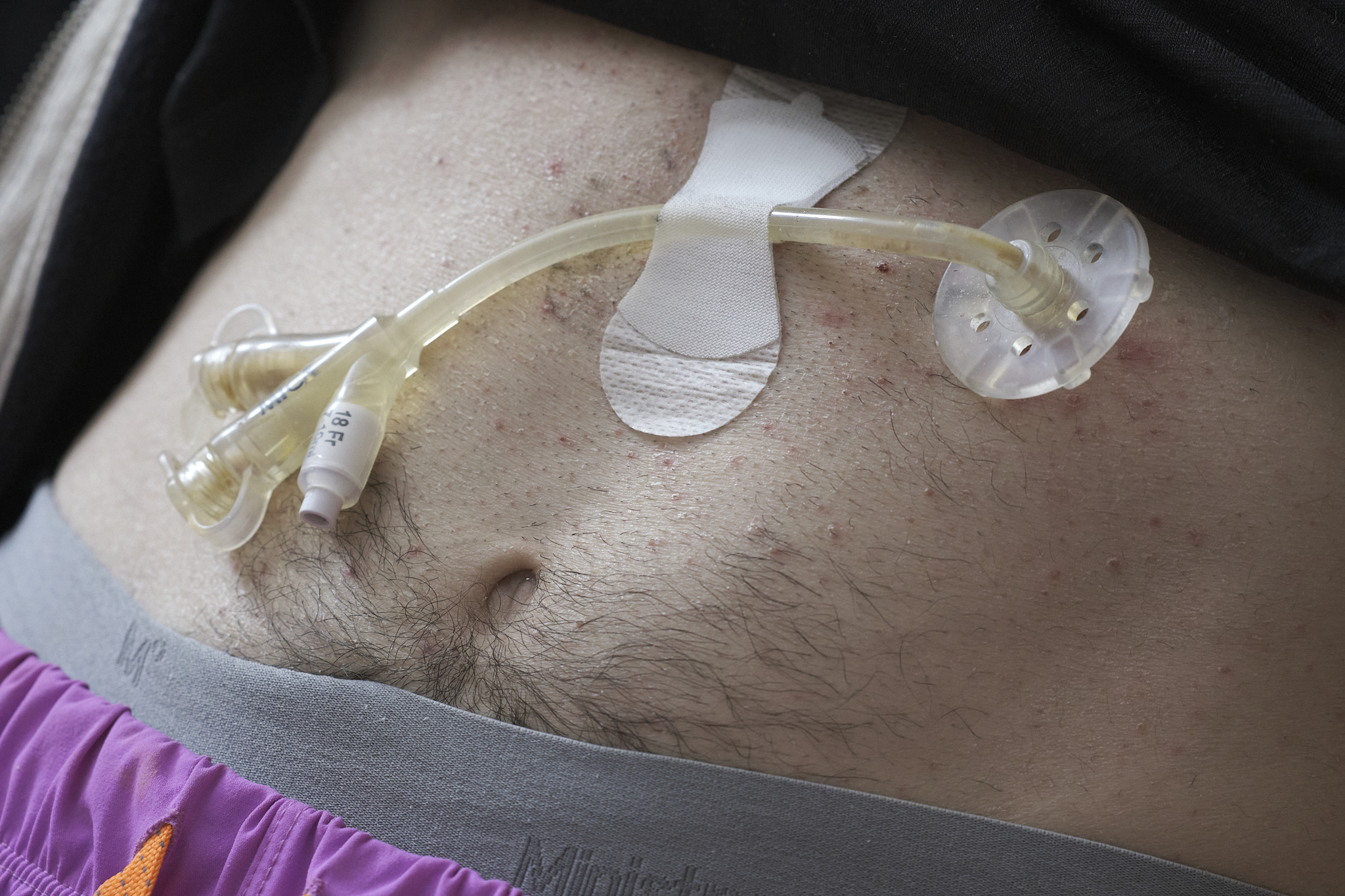
If anything kept me alive, it was Bess. Every moment hurt, but I saw how fiercely she clung to the idea that things might get better. She was so diligent about caring for my wounds, cleaning the surgical sites, and monitoring my progress; it had to be because she expected progress. She might’ve been subconsciously motivated because she’s a doctor and can’t ignore a medical task, or, alternately, she was deluded by love and false hope. But her own optimism helped me understand there was a chance things would get better, however much everything, moment by moment, hurt. Which was good, because things hurt. A lot. I breathed through a trache tube in my throat that was constantly clogging and suffocating me. Pushing bags of liquid food through my PEG tube using a pump was a relentless struggle. I barely had the energy to walk across the room. The level of absolute, continuous exhaustion is hard to convey to anyone who’s not been through something analgaous. With normal exhaustion, sleep is curative. I couldn’t even sleep well because I couldn’t breathe well.

The pain wasn’t solely physical; it was also the pain of trying to understand where I fit into the world and how to live; not just existentially but quite literally how to manage simple day-to-day tasks that were now impossible. When I got out of the hospital, I immediately faced a barrage of fucked-up bureaucracy: the hospital and medical suppliers kept calling me and wouldn’t talk to Bess without my verbal consent, which I couldn’t give, because I couldn’t speak. Insurance wanted to fight. We weren’t sent home with the right food pump. It took two weeks to get said pump. Most adults figure out how to exist in the sometimes-insufferably bureaucratic society we inhabit; I couldn’t do so, because I couldn’t speak, or think, or move. David Brooks just wrote an essay, “Death by a Thousand Papercuts,” that captures a little of what I felt:

[Administrators’] power is similar to what Annie Lowrey of The Atlantic has called the “time tax.” If you’ve ever fought a health care, corporate or university bureaucracy, you quickly realize you don’t have the time for it, so you give up. I don’t know about you, but my health insurer sometimes denies my family coverage for things that seem like obvious necessities, but I let it go unless it’s a major expense. I calculate that my time is more valuable.

My time wasn’t valuable[1] but I lacked the means to pay the time tax. I was already suffering so severely in the physical realm that I didn’t have the wherewithal to fight for the pump and the food and medications. Even now, I’m facing potential mystery bills generated by United Healthcare; the person at the Mayo Clinic who is supposed to interface with the specialty pharmacy says the specialty pharmacy won’t talk to her[2], and, while the specialty pharmacy hasn’t generated any bills directly to me yet, I sense that they’re coming. Maybe it sounds absurd to be talking of bureaucracy in an essay about suicide, but probably it makes sense to anyone whose entire life has ever been at the mercy of one[3]. Bureaucracy can be a form of exhaustion and misery. It eats at your resolve. It’s its own kind of slow death.

During the summer, I couldn’t see a way forward towards a better life, and I knew that if I couldn’t get to a better, more tolerable life, I wouldn’t want to live further. Bess worried horribly about me, though I did promise her that I wouldn’t leave without telling her first. She worked frantically to keep me here, and to make life as good as it could be, given the privations of the surgery and cancer. She did as well as anyone could. But the suffering persisted. I don’t know precisely where the line was between “tolerable” and “intolerable” except that I was on the wrong side immediately after the surgery. Probably each person has to decide for him or herself where the line is. I don’t generally favor suicide—I prefer hope to despair, life to death, success to failure—but I don’t consider it taboo or unthinkable, either. Life and human consciousness are in general good, and, as far as we can tell, rare in the universe. They should be fostered, though not at the expense of all other values and costs.

In the months after the surgery, I felt like I had no slack—no physical slack, no energetic slack, no intellectual slack. I hardly had the ability to do anything or to think anything. Commonplace tasks felt like climbing the Himalayas. And I was besieged by tasks: doctor appointments, wound care, antibiotics, food, managing the healthcare team and system. I didn’t have energy or attention for anything. Life’s pleasures, whether normal or small, weren’t available: sleep, rest, food, coffee, sex, showers. I was technically alive but felt like I shouldn’t be.

There’s a weird tendency for people to view others persisting despite suffering as if they’re watching the vapid inspiration videos infesting social media like so many varmints. They fantasize that suffering serves a purpose. It teaches us…something, beyond itself, I guess. Wisdom, or something. I think that’s true of some kinds of suffering, like completing a project at the limits of one’s abilities, or other activities that generate mental fortitude and knowledge. Other kinds of suffering, like medical suffering, seem more pointless. I’ve learned that medical suffering sucks, but I knew that going in. I don’t think I’m a better or wiser or more enriched person for having been through what I’ve been through; I’ve just been miserable. That kind of adversity isn’t worth the price of adversity.

I could construct a bogus story in which I’ve learned from the suffering of the last year, but I don’t think it’d be true. It’d just be a form of cope. Bess confirms that, for every person she sees who beatifically (and irrationally) convinces themselves that their suffering has a purpose, there are five more who are miserable and mean about the hand they’re dealt. She confirms I’m not miserable or mean,[4] but I am a realist. If I’ve learned anything, it’s what I already knew: technology is good; cancer is bad; using technology to defeat cancer and other forms of human immiseration is good. We should accelerate technological progress in the pursuit of improving human flourishing. In another world, a world with less FDA intransigence and blockage, I’d have gotten Transgene’s TG4050 cancer vaccine after my first surgery, and it would’ve prevented the recurrence that took my tongue. Fortunately, the FDA has been diligently protecting me from being harmed, and it has thus ensured that cancer will kill me. Thank you, FDA.

If suffering has done anything, it’s made me more willing to speak out for the importance of technological acceleration, and for the need to give people the option to take more risks and block fewer technologies. We can’t build AI to improve the human condition soon enough. Forty thousand people a year die in car crashes; if AI plus LIDAR leads to self-driving cars, great. MobileEye and Luminar are leaders in self-driving cars, but the other efforts to build out AI and, eventually, the machine god, shouldn’t be discounted.

I don’t know when I consciously realized that I might be doing well enough to ask myself more questions about how I might live as opposed to when I might choose to die—probably sometime in August or September. Improvements have been slow—so slow. I learned to swallow slurries again. For a long time, every swallow was a struggle. I choked so severely on water in late July or early August that I thought I might die. Bess witnessed it, and pounded on my back to attempt to help me, and said she found that episode terrifying, because the Heimlich maneuver isn’t efficacious against drowning.

As I became somewhat better able to breathe, and the number of medical appointments began to decline, I also planned for another set of privations in the form of chemotherapy. What happened on May 25 is called “salvage surgery.”[5] I guess the surgery salvaged my life, at the expense of my tongue, which had been replaced it with a flap of muscle from my thigh. But the flap felt like an inert, alien thing, that constantly alerted my brainstem to a foreign threat inside my own mouth. It was immobile and insensate and yet I felt it, constantly. Was I what had been salvaged? It sure didn’t feel like it.

Failure to eliminate head and neck cancer in the first go-round is extremely bad, though my surgeon, Dr. Hinni, got clean margins in May. The question became: should I do any chemotherapy in an attempt to eliminate any remaining cancer cells? No one gave us a clear answer, because one doesn’t exist: Bizarrely, no one had comprehensively studied the question. Almost all the oncologists Bess and I consulted with said they either didn’t know the answer, and most said that the choice was really 50/50. It seemed we had to “decide what we wanted,” which seemed like a great way to run a Montessori preschool, but a less great way to decide on life-altering cancer care. Oncologists are strangely loathe to provide real, data-driven recommendations. There’s a lot of misplaced hope and enthusiasm for debilitating therapies, while, at the same time, thinking outside the box seems to be viewed with unearned futility.

I looked at the odds of surviving a second recurrence—essentially zero—and decided to go for chemo. My first chemo infusion was scheduled for July 24, and on July 21 I got CT scans to see whether I could begin performing jaw exercises that might improve my mobility; those scans showed the recurrence and metastases. That horrible surgery had bought a mere two months. Chemo went from “maybe curative” to “palliative, and an attempt to buy time.” I was barely healed enough from surgery when the chemo began, and so the physical improvements were setback by chemo.

Yet even though the chemo was miserable, I’d gotten better enough to have pulled back from the brink. I was getting a little better at swallowing. I was able to breathe without constant, continual pain. The PEG tube that protruded from my stomach was a constant bother, but one that was manageable enough. Progress was just slow. Unbelievably slow. Every day, I pressed forward as best I could. I used the exercise bands. I walked a little farther. I tried to push in as much nutrition as possible. I adjusted medications to help me sleep. Most importantly, I spent time with Bess. The purpose of life is other people. For me, that’s presently instantiated by being with Bess, by being with friends and family, and by writing. The writing is an attempt to help others, especially the people who are facing their own cancers. Oncologists apparently aren’t, as a group, going to do enough to help people who need clinical trials, so I’m stepping into that gap.

There’s a common distinction between surviving and thriving. Many people who survive traumatic or horrifying events never thrive after. Esther Perel has spoken about the difference between Holocaust survivors who managed to thrive after, as her parents seemed to, versus those who didn’t, as two of my grandparents seemed not to.[6] I’ve been trying to thrive, as best as I can discern how, with the aid of Bess, and despite the challenges of the incurable disease that’s killing me, held at bay right now only by the clinical trial petosemtamab.

For now, not exiting was the right decision, thanks to the aid I received and am recreiving from many others around me. I’m trying to lead a generative, positive life with what time I have left, and writing is a key part of that effort. Few people understand how bad the FDA is, or the degree to which the FDA is retarding progress in oncology in particular, and consequently letting cancer patients die. Perhaps there are too few faces to associate with the statistics about cancer deaths, and so I’m attempting to associate a single person with the bureaucratic edifice that is the FDA, killing through its nominal mission to “protect.”

One day, maybe soon, may not, it will be time to enter the one-way portal. The preferred, antiseptic modern term is “death with dignity.” But the people around me and with me keep me alive, and show that we really do live for one another. The physical challenges are still great, but not as severe as they were last summer. I’m able to get up and engage in meaningful activity most days. I don’t want to be a burden—a burden on family, friends, or society, and by my own judgment I think myself not too great a burden for others. That line will likely be crossed in the next year, but it’s not been crossed yet. And the clinical trial I’m participating in—and the one after it, and, if that one is successful enough, the one after it—is generating the data necessary to make effective cancer drugs available to other people. My role is small—I’m not inventing the drug, I’m not manufacturing it, I’m not setting up the trials themselves—but it is a role, and it is one someone has to fulfill. Fulfilling it generates some meaning in my life, and meaning is an essential component of thriving. Maybe there will be other roles for me, before the end.

 I’ll probably never be as effective as I was before the cancer, but I’ve been working, every day, at being more effective and less of a burden to the degree that I can achieve either. There’s plenty of physical pain in my life—as I write this, I have cuts on the pads of my fingers that won’t heal, I’m bleeding or barely not bleeding from my toenails, and my lower lip cycles between cracking and bleeding from those cracks. But the pain is bearable enough. I can breathe well enough. I’m able enough to write. So much has been taken, though enough remains for me to remain. I still believe what I wrote in “I know what happens to me after I die, but what about those left behind?”:

At some point, the suffering may be too much, and then I hope to exit by my own hand, gracefully, not having been wholly unmanned by disease. “Unmanned:” it’s an old-fashioned word, and one that appears in the appendices of The Lord of the Rings, when it is time for Aragorn to department the world. His wife Arwen pleads with Aragorn “to stay yet for a while” because she “was not yet weary of her days.” Aragorn asks her if she would have him “wait until I wither and fall from my high seat unmanned and witless.” I didn’t imagine that I might face the same question so soon, and yet it’s here, before me, and I hope to depart before the pain robs me of my mind and leaves me witless and suffering. Aragorn says that “I speak no comfort to you, for there is no comfort for such pain within the circles of the world.” And that I fear is true of Bess, too, that there will be no true comfort for her pain. Her parents will help her, our friends will help her, she will not be alone—and yet the pain at the moment of my own departure will remain.

Aragorn and by extension Tolkien understood death with dignity. For a lot of the summer, I felt unmanned and witless. Now I’m sufficiently manned and witted to be writing this, to be cooking, and to consider a future I probably won’t get, but I might. I don’t want to be caught off guard by success, like a teen boy whose efforts to get laid work when he thought they never would. The incremental improvements have added up, and suicide is an all-or-nothing proposition. The decision not to die last summer was the right one. The show goes on. Life goes on. For now, I am a part of it.

If you’ve gotten this far, consider the Go Fund Me that’s funding ongoing care.


[1] In the monetary sense: my marginal product of labor then was $0/hour. Bess wants me to point out that my time is inherently valuable to me as a human being.

[2] The specialty pharmacy also told her that they won’t talk to us. “They don’t speak directly to customers.” When the bill comes, I guess I’ll just send it back with an explanation that if they won’t interface with me, I won’t interface with them. Something tells me that will change their policy.

[3] Or who has read Kafka.

[4] Some of the nurses on the post-surgery recovery floor told Bess I was nice. I was trying to do unto others as I’d have them do unto me, and I hope I succeeded.

[5] The term for the surgery after the first surgery to remove head and neck cancer, and associated adjuvant treatment like radiation, fails

[6] They died before I was born, so I have no ability to judge for myself.

Links: The nature of elites and elitism, the power of speech, math, and more!

* Escalation Theory: Compliance, Violence, and Overachievement In Society. Interesting, and perhaps overstated in places. Reminds me of reading The Last Psychiatrist. I’m subscribing to the RSS feed.

* “Status diffusion as a check on elite competition.” The title is about South Korea but the article’s most interesting material concerns how elites form and compete. It’s surprisingly congruent with the “Escalation Theory” article.

* “What Conversation Can Do for Us.” (NY’er, $)

* “How to be More Agentic.”

* “Bad stuff going down at the American Sociological Association,” which is trying to avoid open access to government-funded research. Crazy!

* All the Carcinogens We Cannot See (NY’er, $). By Siddhartha Mukherjee, impressive, and possibly germane to my own cancer situation, although in ways not obvious right now.

* “Book Stores Refuse To Host An Event For Rob K. Henderson’s Book.” If you’re wondering why a lot of bookstores now suck, read this article. Bess and I went to Changing Hands bookstore in Tempe, Arizona, maybe a year and a half or two years ago, and most of the books there were terrible: like the most inane woke syllabuses from the worst college classes had been turned into novels and nonfiction. If you are wondering why Substack often seems far more vital than books right now, this is a good choice, much like that one interview with Alex Perez.

The key word in the preceding sentence is “right now.” Good trends rarely last forever and the same is true of bad ones.

* ‘This Has Been Going on for Years.’ Inside Boeing’s Manufacturing Mess. (wsj, $) The sad story of Boeing being taken over by McDonnell Douglas, MBAs, and finance people, at the expense of engineers and engineering. Fundamentally the real world matters.

* “Smothered & Suppressed Gazan Voices & Perspectives.” Some material on Twitter punctures much of what one reads in the legacy media.

* How Gabriel Mays is (re)learning math as an adult. Consistent with Barbara Oakley’s essay “How I Rewired My Brain to Become Fluent in Math,” which I used to assign to students. You can be more agentic when it comes to math and many other topics!

* “What Happened to the US Machine Tool Industry?” Depressing, important.

* “Ultraviolet light can kill almost all the viruses in a room. Why isn’t it everywhere?

* “The Republican Party is Doomed?” The keys to the argument: “Increasing age and education polarization means that Republicans are rapidly losing the capacity to run public institutions at all levels other than electoral, and this trend cannot realistically reverse within a generation” and “even when Republicans win electoral power, they lack the human capital at all levels of governance to accomplish what they really want with it.” Not sure this is accurate—the Federalist Society has a lot of members—but it’s plausible.

Why don’t schools teach debugging, or, more fundamentally, fundamentals?

If you find this piece worthwhile, consider the Go Fund Me that’s funding ongoing cancer care.

A story from Dan Luu, from back when he “TA’ed EE 202, a second year class on signals and systems at Purdue:”

When I suggested to the professor that he spend half an hour reviewing algebra for those students who never had the material covered cogently in high school, I was told in no uncertain terms that it would be a waste of time because some people just can’t hack it in engineering. I was told that I wouldn’t be so naive once the semester was done, because some people just can’t hack it in engineering.

This matches my experiences: when I was a first-year grad student in English,[1] my advisor was complaining about his students not knowing how to use commas, and I made a suggestion very similar to Luu’s: “Why not teach commas?” His reasoning was slightly different from “some people just can’t hack it in engineering,” in that he thought students should’ve learned comma usage in high school. I argued that, while he might be right in theory, if the students don’t know how to use commas, he ought to teach them how. He looked at me like I was a little dim and said “no.” 

I thought and still think he’s wrong.

If a person doesn’t know fundamentals of a given field, and particularly if a larger group doesn’t, teach those fundamentals.[2] I’ve taught commas and semicolons to students almost every semester I’ve taught in college, and it’s neither time consuming nor hard. A lot of the students appreciate it and say no one has ever stopped to do so. 

Usually I ask, when the first or second draft of their paper is due for peer editing, that students write down four major comma rules and a sample sentence showcasing each. I’m looking for something like: connecting two independent clauses (aka complete sentences) with a coordinating conjunction (like “and” or “or”), offsetting a dependent word, clause, or phase (“When John picked up the knife, …”), as a parenthetical (sometimes called “appositives” for reasons not obvious to me but probably having something to do with Latin), and lists. Students often know about lists (“John went to the store and bought mango, avocado, and shrimp”), but the other three elude them.

I don’t obsess with the way the rules are phrased and if the student has gotten the gist of the idea, that’s sufficient. They write for a few minutes, then I walk around and look at their answers and offer a bit of individual feedback. Ideally, I have some chocolate and give the winner or sometimes winners a treat. After, we go over the rules as a class. I repeat this three times, for each major paper. Students sometimes come up with funny example sentences. The goal is to rapidly learn and recall the material, then move on. There aren’t formal grades or punishments, but most students try in part because they know I’m coming around to read their answers.

We do semicolons, too—they’re used to conjoin related independent clauses without a coordinating conjunction, or to separate complex lists. I’ll use an example sentence of unrelated independent clauses like “I went to the grocery store; there is no god.”

I tell students that, once they know comma rules, they can break them, as I did in the previous paragraph. I don’t get into smaller, less important comma rules, which are covered by whatever book I assign students, like Write Right!.

Humanities classes almost never teach editing, either, which I find bizarre. I suspect that editing is to debugging as writing is to programming (or hardware design): essential. I usually teach editing at the sentence level, by collecting example sentences from student journals, then putting them on the board and asking students: “what would you do with this sentence, and why?” I walk around to read answers and offer brief feedback or tips. These are, to my mind, fundamental skills. Sentences I’ve used in the past include ones like this, regarding a chapter from Alain de Botton’s novel On Love: “Revealed in ‘Marxism,’ those who are satisfying a desire are not experiencing love rather they are using the concept to give themselves a purpose.” Or: “Contrast is something that most people find most intriguing.” These sentences are representative of the ones first- and second-year undergrads tend to produce at first.

I showed Bess an early version of this essay, and it turns out she had experiences similar to Luu’s, but at Arizona State University (ASU):

My O-chem professor was teaching us all something new, but he told me to quit when I didn’t just understand it immediately and was struggling. He had daily office hours, and I was determined to figure out the material, so I kept showing up. He wanted to appear helpful, but then acted resentful when I asked questions, “wasting his time” with topics from which he’d already moved on, and which I “should already understand”.

He suggested I drop the class, because “O-Chem is just too much for some people.” When I got the second-highest grade in the class two semesters in a row, he refused to write me a letter of recommendation because it had been so hard for me to initially grasp the material, despite the fact that I now thought fluently in it. My need for extra assistance to grasp the basics somehow overshadowed the fact that I became adept, and eventually offered tutoring for the course (where I hope I was kinder and more helpful to students than he was).

Regarding Bess’s organic chemistry story, I’m reminded of a section from David Epstein’s book Range: How Generalists Triumph in a Specialized World. In his chapter “Learning, Fast and Slow” Epstein writes that “for learning that is both durable (it sticks) and flexible (it can be applied broadly), fast and easy is precisely the problem” (85). Instead, it’s important to encounter “desirable difficulties,” or “obstacles that make learning more challenging, slower, and more frustrating in the short term, but better in the long term.” According to Epstein, students like Bess are often the ones who master the material and go on to be able to apply it. How many students has that professor foolishly discouraged? Has he ever read Range? Maybe he should.

Bess went on:  

Dan’s story also reminds me of an attending doctor in my emergency medicine program; she judged residents on what they already knew and thought negatively of ones who, like me, asked a bunch of questions. But how else are you supposed to learn? This woman (I’m tempted to use a less-nice word) considered a good resident one who’d either already been taught the information during medical school, or, more likely, pretended to know it.

She saw the desire to learn and be taught—the point of a medical residency— as an inconvenience (hers) and a weakness (ours). Residency should be about gaining a firm foundation in an environment ostensibly about education, but turns out it’s really about cheap labor, posturing, and also some education where you can pick it up off the floor. When I see hospitals claiming that residency is about education, not work, I laugh. Everyone knows that argument is bullshit.    

We can and should do a better job of teaching fundamentals, though I don’t see a lot of incentive to do so in formal settings. In most K – 12 public schools, after one to three years most teachers can’t effectively be fired, due to union rules, so the incentive to be good, let alone great, is weak. In universities, a lot of professors are, as I noted earlier, hired for research, not teaching. It’s possible that, as charter schools spread, we’ll see more experimentation and improvement at the ˚K –12 level. At the college and graduate school level, I’d love to see more efforts at instructional and institutional experimentation and diversity, but apart from the University of Austin, Minerva, the Thiel Fellowship, and a few other efforts, the teaching business is business-as-usual.

Moreover, there’s an important quirk of the college system: Congress and the Department of Education have outsourced the credentialing of colleges and universities to regional accreditation bodies. Harvard, for example, is accredited by “The New England Association of Schools and Colleges (NEASC).” But guess who makes up the regional accreditation bodies? Existing colleges and universities. How excited are existing colleges and universities to allow new competitors? Exactly. The term for this is “cartel.” This point is near top-of-mind because Marc Andreessen and Ben Horowitz emphasized it on their recent podcast regarding the crises of higher education. If you want a lot more, their podcast is good.

Unfortunately, my notions of what’s important in teaching don’t matter much any more because it’s unlikely I’ll ever teach again, given that I no longer have a tongue  and am consequently difficult to understand. I really liked (and still like!) teaching, but doing it as an adjunct making $3 – $4k / class has been unwise for many years and is even more unwise given how short time is for me right now. Plus, the likelihood of me living out the year is not high.   

In terms of trying to facilitate change and better practices, I also don’t know where, if at all, people teaching writing congregate online. Maybe they don’t congregate anywhere, so it’s hard to try and engage large numbers of instructors.

Tyler Cowen has a theory, expounded in various podcasts I’ve heard him on, that better teachers are really here to inspire students—which is true regarding both formal and informal education. Part of inspiration is, in my view, being able to rapidly traverse the knowledge space and figure out whatever the learner needs.

Until we perfect neural chips that can download the entirety of human knowledge to the fetal cortex while still in utero, no one springs from the womb knowing everything. In some areas you’ll always be a beginner. Competence, let alone mastery, starts with desire and basics.

If you’ve gotten this far, consider the Go Fund Me that’s funding ongoing care.


[1] Going to grad school in general is a bad idea; going in any humanities discipline is a horribly bad idea, but I did it, and am now a cautionary tale for having done it.

[2] Schools like Purdue also overwhelmingly select faculty on the basis of research and grantsmanship, not teaching, so it’s possible that the instructors don’t care at all. Not every researcher is a Feynman, to put it lightly.

Links: Cancer in young people, preventing Epstein-Barr Virus, induction stoves, and more!

* “Cancer Is Striking More Young People, and Doctors Are Alarmed and Baffled: Researchers are trying to figure out what is making more young adults sick, and how to identify those at high risk.” I’m one of them, which makes this of particular interest to me. I notice especially this: “But doctors said obesity and lifestyle can’t fully account for the plight of the people arriving at their clinics. ‘A lot of the young patients are very healthy,’ said Dr. Y. Nancy You, a colorectal cancer surgeon at the University of Texas MD Anderson Cancer Center in Houston.” I fit the “very healthy” category and yet that didn’t help me. Bess saw this and observed that some research fingers microplastics as a possible culprit, but, as the article notes, there’s at least some evidence for almost everything under the sun.

* China’s demographic challenges.

* Hardly anyone makes money from writing books.

* Impressive test scores among NYC charter schools. Interesting that this sort of thing doens’t appear in most venues.

* Chipotle’s Steve Ells, the Fast-Food Obsessive Who’s Still Trying to Solve Lunch. I hope he does, though will Kernel work outside of parts of NYC, LA, and adjacent places?

* Denmark is not magically exempt from trade-offs.

* “The flight of the Weird Nerd from academia.” Sad, plausible-seeming.

* “Thousands of Students Seek $7,000 Payments Under Arizona Voucher Law: In nation’s largest voucher program, Arizona to pay more than $200 million for private-school and home-schooled children.” (wsj, $) I’m surprised by these developments.

* Impulse Labs’ battery-powered induction stove. If I owned a housing unit, I’d have pre-ordered this stove, which looks incredible. We’ve not seen substantial improvements in kitchen appliances in decades, but induction stoves are so much better than legacy electric or gas stoves. I have a standalone induction stove called a Breville|PolyScience Control Freak. The name is not the best but the device is amazing. It, an Instant Pot, and a rice cooker have largely replaced the gas stove in my apartment.

* “Patrick McKenzie on Navigating Complex Systems.” Most Conversations with Tyler are excellent, and I particularly admire this one.

* “A vision for the alleviation of water scarcity in the US Southwest and the revitalization of the Salton Sea.” Humans face choices between scarcity and abundance, and we should choose abundance.

* “The two cultures of mathematics and biology.” Detailed, impressive.

* “Impact on the Internet is a direct function of what you have done recently: a YouTuber is as popular as their latest video, a tweeter as their latest joke, or an influencer as their latest video. In the case of Rufo what mattered was whether he brought evidence for his claims or not; obsessing about the messenger is to miss the point that he might as well be the New Yorker dog.” I think this is a little overstated—lots of people will read older, evergreen writing—but it’s directionally correct.

* Why legal immigration is nearly impossible. We should make it a lot more possible.

* “The Billionaires Spending a Fortune to Lure Scientists Away From Universities.” Seems wise to me, for the obvious reasons. If the weird nerd doesn’t fit into academia, maybe he’ll fit with private research institutes and startups.

* More on Epstein-Barr Virus (EBV) and multiple-sclerosis. There is a vaccine candidate that works in mice, but that means it’s a long way from being potentially available in humans.

On not being a radical medicine skeptic, and the dangers of doctor-by-Internet

In part 1 I wrote about the struggles that come with complex healthcare problems, like the cancer that’s killing me, the efforts to treat it, and the numerous ancillary problems those treatments have caused. I lacked meaningful guidance on important topics like clinical trials or how to significantly decrease the incapacitating side effects of chemotherapy. I had to seek out other interventions that would significantly improve my quality of life, like a low-profile mic-key PEG tube. Instead of being guided by experts, I often had to crowd-source recommendations and double-check (and drive) treatment plans, or else so much would have fallen through the cracks. I’d likely be dead. My experiences should help guide others in similar situations, so they can better advocate. But I’m not a radical skeptic and, though I’d like to see improvements in healthcare and other institutions, I also don’t see fantastic alternatives at present levels of technology. If you find this piece worthwhile, consider the Go Fund Me that’s funding ongoing care.

What I’m suggesting isn’t the same as getting your medical degree from Dr. Google

Patients love to tell doctors what to do, and it drives doctors crazy. Online, and sometimes in the legacy media, you might’ve seen quotes from doctors complaining about know-it-all patients who attempt to incorrectly drive treatment. Demanding inadvisable treatment isn’t just bad for the doctor’s sanity; it’s bad for the patient’s health outcomes. Bess, to cite one example who happens to be sitting next to me as I write this, is barraged by ER patients demanding antibiotics for their viral illness or steroids for their chronically sore backs—even though these treatments won’t address the problem and may cause real harm—all because the patient “knows their body,” evidence-based medicine be damned. Many, if not most, people aren’t great at gathering and evaluating evidence, or reading, and even doctors don’t appear to be great at statistical literacy.  

I’m sympathetic to doctors’ views regarding patient knowledge or lack thereof, especially when doctors are trying to protect patients from unnecessary medications with real and serious side effects, and yet, at the same time, I continue to be (stupidly, foolishly) surprised at all the things not being done by the doctors who’re supposed to be driving my care. The first time something negative happens can reasonably be a surprise; the eighth time should not. They’re the experts and I’m the amateur, so why am I outperforming them in important ways? If Bess and I don’t drive, there’s no one behind the wheel, and that’s bad. Beyond my individual case, there’s also a larger question: What happens to trust in doctors as a whole when so many individual doctors aren’t providing the guidance or care they should?

Martin Gurri wrote a now-famous and excellent book called The Revolt of the Public and the Crisis of Authority in the New Millennium. It’s about, among other things, the loss of confidence in institutions of all sorts, including doctors and medical institutions. If you’re trying to understand the present better, The Revolt of the Public is a great, essential read. Patients need to listen to their doctors, yes, but for healthcare to benefit patients, doctors also need to listen to their patients. I’m not supposed to be an expert in every aspect of healthcare, and yet, as described in Part I, Bess and I have done and caught a bunch of things that the people who’re supposed to catch and do those things haven’t. In Poor Charlie’s Almanack, Charlie Munger wrote that “If, in your thinking, you rely entirely on others—often through purchase of professional advice—whenever outside a small territory or your own, you will suffer much calamity. And it is not just difficulties in complex coordination that will do you in.”* While it’s true that relying entirely on others isn’t a great idea, we all have to rely on others to some extent, and I’ve had to rely heavily on what doctors, nurses, physicians assistants, and others tell me. It’s hard to know what I don’t know.

Doctors go to school for four years and residency for a minimum of three. So why have I, a writer, had to double check so much? Why have so many of the plans that have kept me alive revolved around suggestions that Bess and I have made to oncologists and other experts—plans and treatments that wouldn’t have otherwise been considered? Bess and I did almost all the work and all the learning about clinical trials to keep me alive. It’s sub-optimal for me to do the double-checking because I don’t know everything the doctors know, or what I don’t know. Bess is an ER doctor and so doesn’t know oncology well. Still, Bess would agree that it only takes one minute for a doctor to ask him or herself: “if I was in my patient’s position, is there anything I can do to simply and easily make their situation better?

I’m not anti-doctor. This isn’t a screed about how doctors are dumb (they’re not, in the main). Although I’m not writing a screed, I am describing what I’ve faced and experienced in trying to not die, including many of the unflattering parts. After I die, I know Bess will be consumed by crushing existential loneliness, and I want to delay that day as long as possible. Delaying that day as long as possible means that Bess and I are constantly fighting to get the care that doctors haven’t been providing. Bess has been able to keep a close eye on most emergent medical matters, and she’s activated the doctor-network to beg for help from peers in Facebook medical groups. She’s banged down the digital doors of so many oncologists, trying to crowd-source a sense of whether the path we’re on makes sense (we appreciate the help, I want to emphasize: many of you have literally been lifesavers).

We’ve gotten some real medical oncology help, to be sure: a head and neck oncologist at Mayo Rochester named Dr. Kat Price has been hugely helpful in clinical trials, chemotherapy regimen questions, and other matters. Dr. Assuntina Sacco at UCSD understands the clinical trial landscape and is more knowledgeable than we are about what’s out there. Both have, I think, asked themselves what they would want in my situation. But they’ve been the exception, not the rule, which seems crazy to Bess and to me—I guess we live in a crazy upside-down world. By writing about what I’ve seen and experienced, I’m trying to help others, and to warn them of the many challenges Bess and I have faced and, based on experience, are likely to continue to face.

Continue reading

Links: Pricing water, tofu can be good, building the future, and more!

* Farmers should have to pay market prices for water. Seems obvious, and yet here we are.

* The rise of the sectarian university, and the risks that increasingly brazen political side-taking is doing long-term damage. Josh Barro’s “Universities Are Not on the Level: Academics should think more about what their industry has done to lose the trust of Americans” covers related ground, and it doesn’t immediately go in the predictable directions. Instead, it initially focuses more on the Goodhart’s Law issue—when a measure becomes a target, it ceases being a good measure. The “measure” of academia is publications and citations. They’ve been gamified so thoroughly that they’re often pretty bad measures, and they encourage dishonesty among researchers, or, often, “researchers.”

* America doesn’t know tofu. One of vegetarianism’s challenges is that a lot of vegetarian cooking is poorly done.

* “‘Screams Without Words’: How Hamas Weaponized Sexual Violence on Oct. 7.” Brutal reading, and a surprising venue for this. See, however, from 2014, “An Insider’s Guide to the Most Important Story on Earth: A former AP correspondent explains how and why reporters get Israel so wrong, and why it matters.” Except it is the most important story on Earth, particularly relative to China?

* “China’s Xi goes full Stalin with purge.” Maybe.

* Anaïs Nin was early to polyamory. Some dumb mood affiliation in the essay but not bad.

* “Beijing Is on a Wartime Footing: Biden needs to rebuild America’s ‘arsenal of democracy’ or risk being unprepared.” (wsj, $). See also Austin Vernon on revitalizing U.S. shipbuilding. A lot of people understand the problems the U.S. has—but can we solve them?

* “Towards a ‘shallower’ future: Adversity isn’t worth the price of adversity.” I prefer a lot less (bad) adversity, and I’ve had plenty of adversity as of late.

* “If We Made Shoes Like We Make Housing, People Would Go Barefoot.” Abundance is good and scarcity bad.

* “Elon Musk is not understood.” To a degree this is another “the media is dumb” article.

* “Are young people actually ‘progressive?’” (nymag, possibly $) Maybe not.

* “Why math professor Alexander Barvinok opposes diversity statements.”

“How the light gets in: a solstice at the border of life and death”

How the light gets in: a solstice at the border of life and death” is Bess’s latest essay, and it’s great.

Who cares about your healthcare? What’s commonly overlooked in the “health” care system 

If you find this piece worthwhile, consider the Go Fund Me that’s funding ongoing care.

Having a body is already a UX* nightmare: There’s the feeding, the cleaning, the general upkeep, the constant and varied states of discomfort (depending on your age, setting and health). When things go wrong—as they have for me, given that a squamous cell carcinoma infestation is busily working to suck up every nutrient I take in and leave what I consider to be “me” dead—they can go really, spectacularly wrong. The healthcare system is, presumably, in the business of meat-suit maintenance and optimization, much like the gym or smoothie industries, and unlike McDonald’s, and yet, if the same level of consideration was given to our bodies as is commonly given to a car being detailed, the body shop would go out of business.

Body shops for cars and body shops for humans seem to operate on different standards, although I suppose one could argue that cars are simpler than humans and better understood by humans. Mess up a little on the car, and the mechanic might have an angry customer; mess up a little on the body, and someone dies. “Good enough,” when it comes to the human body, often isn’t close to good enough. And yet, in the last year, as I’ve become a tremendous consumer of healthcare services, I’ve seen how often things don’t get done. I need a Project Manager (PM) for healthcare, and, since no one has stepped forward to project manage project Jake, Bess and I have wound up becoming janky, half-knowledgeable, struggling PMs with a vital project: make sure Jake doesn’t die.

So many aspects of treatment and recovery have seen Bess and me fighting and struggling to figure out and implement things that should’ve been explained to us, instead of us being left adrift to solve problems on our own; if not for our backgrounds, attitudes, and fortitude, I’d probably be dead right now. Bess being a doctor and me having worked extensively as a consultant in healthcare and healthcare research shouldn’t be relevant to me getting important, lifesaving care, and yet both matter. Instead of us having to jerry-rig care, learn the clinical trial process, and double check whatever we’ve been told by doctors, the whole system should work better for everyone. It shouldn’t take two reasonably bright, exceptionally determined people so much effort to navigate the healthcare system. If it’s this hard for us, what’s it like for other people—normal people who don’t have some of our experiences, expertise, endowments, or credentials? What hope do they have? Yeah, you might hear bleating from people in the healthcare system about diversity and access, but how’s that translate into action?

Bess and I feel like we’ve had to become semi-experts in oncology in order to make sure that I get the treatments most likely to ensure I don’t die sooner than I have to, given present technology. That we’ve had to assume that healthcare PM role is absurd, but if we don’t, who will? No one else is watching out for us.[1] No one else is comprehensively guiding us. So much falls through the cracks. In theory, doctors are supposed to be the experts in what’s both possible and optimal. In practice, we’ve discovered that’s frequently not the case. Opportunities for the system to automate recommendations for patients receiving chemo, PEG tubes and surgeries were also missed, putting the burden on what a doctor can remember to recommend during a short visit, as opposed to trying to streamline important processes for all patients coming through large academic centers with the capability to better automate.

As difficult as it may be to accept in the midst of a life-and-death situation, when you’re weakened, exhausted, struggling to concentrate, and relying on experts to guide your best interests, the answer to the question of “who cares?” is: no one cares as much as you and the people who love you most.

Clinical Trials

Even before the metastatic squamous cell carcinoma recurrence that’s likely to kill me, I understood intellectually that people with serious healthcare problems do better when someone—their spouse, or parent, or child—looks out and advocates for them, but I didn’t appreciated the extent to which that’s true.** The clearest example is described by Bess in “Please be dying, but not too quickly, part 1: a clinical trial story,” which tells our struggle to really understand the clinical trial system and then to find a clinical trial that might prolong my life. And we succeeded! Which is great. People love a (relatively) happy ending. But finding and entering that trial shouldn’t have been as hard as it was, and it shouldn’t have taken as much backdoor maneuvering as it did. Bess wrote “Please be dying” as a guide for other patients who find themselves in our position and don’t have as much ability to work the system as we did, and still do. I wish that writing the guide didn’t feel so necessary.

If not for our (realistically: Bess’s) efforts, I probably would’ve gotten some palliative chemo and then died. That’s the standard path for R / M HNSCC. Multiple oncologists independently encouraged us to pursue the “chemo-then-die” path. I found their encouragement of me to roll over into the grave prematurely curious. Isn’t their job to help people not die? Isn’t that what being a doctor is? To be sure, giving false hope is bad, and there’s a lot of futile end-of-life care in medicine, especially in oncology. Bess and I wanted to make sure, though, that accepting death was the only option. I’m not irrational: I know fruit diets or protein diets or coffee enemas or hydroxychloroquine or whatever else Internet people pitch won’t work. Yet we found good trials for R / M HNSCC, and one oncologist called head and neck cancer “a hot R & D area.”

Which is why it’s so wild that so many oncologists dismissed clinical trials as futile, or too much effort for the likely outcome. Do they know how much effort it takes to go through palliative chemo for the certain outcome of death? Now that I see what went into finding the trial and getting me into the trial—the trial that is successfully shrinking my tumors and keeping me alive—I can’t help but wonder: too much effort for whom? That I’m able to write this is a testament to the virtue of ignoring some medical advice and seeking advice from outside the standard system.  

Nausea drugs for chemotherapy

The lack of aid around clinical trials is the most egregious example of medical oversight, but it’s not the only one. I got two rounds of chemo, one on July 24 and the other August 14; the chemo consisted of carboplatin and paclitaxel. The former is in particular a notorious fomenter of nausea. Bess and I asked the oncology care team at the Mayo Clinic Phoenix about the plan for nausea. They wanted to use Zofran and a single IV dose of emend (“Aprepitant”) during the infusion, and Zofran and compazine at home. “That’s it?” Bess and I said to each other. She’s given more robust antiemetic regimens to patients coming to the ER for a seasonal GI bug. I’ve had cisplatin, one of carboplatin’s evil cousins, and consequently suffered from intense nausea. “We’ll see how it goes,” was the reply. No one mentioned that having had a platinum chemo in the past increased the likelihood of vomiting from future platinum chemo. Fortunately, Bess and I have a friend who could help guide us, and with help we rattled for a more serious regimen: Emend, Zofran, Ativan (as needed), and olanzapine. Why take only one dose of Emend? Nothing we could find indicated that it’s dangerous to take it for a few days. Studies show a 3-7 day course are both clinically safe, and a three-day course is the most frequently provided.

Emend is generic and we found it for $50 to $300 a dose in pharmacies, so it’s not expensive. Compazine was approved in 1956 and olanzapine in 1996; the latter has been studied for chemotherapy-induced nausea and vomiting (CINV). Why use the older med? Ativan is a useful backup. Maybe the Emend and Zofran alone would’ve worked, but it’s easier to remove meds if they seem unneeded than it is to stop nausea and vomiting once they start. Oncology ordered our requested medications, and the palliative care team added on the ones that they forgot. Instead of waiting to see how badly I’d suffer, I didn’t vomit once and discontinued the olanzapine while continuing the other meds the week of chemo.

Why are we rolling our own medication list?

Port access should have made things “easier”

I have a port catheter inserted on the right side of my chest, just south of the collar bone. The day after the port was surgically installed by interventional radiology (IR), I needed to get blood drawn. I told the nurse about the new port, or the nurse saw the port in my chart, and he said he could use it. I said okay, not knowing much about the port, except that it’s supposed to be more convenient and less painful than getting my arms routinely stuck. The nurse inserted what seemed (and seems) to me a massive needle straight into it, and I felt the kind of pain that made me yelp and see space. It was insane. I got home and told Bess about what had happened. “Didn’t they give you numbing medication?” she asked.

“Numbing medication?” I replied.

Turns out that you can put topical lidocaine on the port to numb it, and/or nurses can use a tiny needle to inject a tiny amount of lidocaine before the big needle goes in. No one told me. Neither did anyone call in a prescription for a topical numbing medicine and instructions to use it forty minutes before the port was accessed to avoid the pain of being literally stabbed in the chest with a large bore needle. When Bess asked for the prescription, it was called in (notice a theme?). But no one told me ahead of time, or seemed to even consider that a fresh, bruised port, would hurt when accessed. Why not?

PEG tube

I had a PEG tube installed while I was in the hospital between May 25 and June 5, and for several months the PEG tube was the exclusive means by which I got calories. This is what said tube looked like, until recently:

Make fun of this photo as you see fit: my friends already have.

As you can see, the damn thing sticks like six inches out, so it’s forever flopping around and getting caught on things. I relied on it to not die of starvation, which made this little item the most-interfaced with bit of medical equipment after my trache came out. Because of the constant in and out of the tube, the tissue gets irritated and forms painful masses of “granulation tissue” that requires steroids.

The white thing parallel to the tube itself is a “Grip-Lok” adhesive system, which I was constantly changing and which left my skin messed up. Showering was unsatisfying because of the Grip-Lok. Hugs were fraught. The damn thing kept getting caught on my shirt whenever I moved my arms. I struggled to gain weight, but the PEG tube also meant that I struggled to lift weights at the gym, because of the way it entangled with my shirt.

The PEG tube caused other problems; on Dec. 13, for example, the PEG tube inadvertently opened. Maybe it got caught in my belt or my shirt or something. Whatever the cause, stomach acid and partially digested Liquid Hope spewed all over me and the floor, which is both painful and gross: it smells like vomit (cause it is vomit). An open PEG tube literally spills calories out of me, and the resulting mess is hard to clean. So many things about my present (and permanent) condition are frustrating, like the tube opening, which makes an already physically and existentially difficult situation that much more frustrating. I can’t ignore a six-inch tube protruding from my body, and I have to interact with it multiple times a day to stay alive.

PEG tubes are supposed to last six months. Between June 5 and now, I had to go to the emergency room three times for tube problems: once because the tube slipped out of my stomach because the balloon had ruptured, and twice because the tube began leaking from the place where I (properly) kinked it. I know I properly kink it because I’ve checked with the education nurses to make sure I wasn’t inadvertently doing something wrong.

The third time happened Thanksgiving evening. Bess and I were lucky that the ER was relatively quiet, and one of her colleagues was able to locate a new tube and install it expeditiously. Still, hardly anyone wants to spend extra time in the ER.

The oncologist supervising me for the petosemtamab clinical trial at UCSD is named Dr. Sacco, and when I mentioned the Thanksgiving ER visit, she suggested I get a “button tube.”

“What’s that?” I asked.

She explained that it’s possible to install a PEG tube that’s low profile and comes with a detachable exterior tube (it’s also called a “mic-key” tube—as in much of medicine or the military, why use one term when you can use a bunch?). Bess followed up with my gastroenterologist, who said a button tube sounds like “a great idea, let’s do it.” We asked if one could be installed and, much like requesting necessary prescriptions, it was scheduled right away. Which is nice, but, also, why didn’t she tell me that the smaller, more humane tube is an option? Why were we once again having to direct my care in order to actually be cared for? The GI doc knew about my prior tube problems. Why do Bess and I have to figure this out? Neither of us are PEG tube experts. Instead of the system I used to have, my current situation looks like this:

That tiny nubbin is far easier to wrangle than the giant hose. Now the PEG tube doesn’t get caught on my shirt, or in my pants, or, potentially, on other objects. If it opens, nothing happens. Nothing, because I have to pop in an extension tube to inject. No spew. I don’t feel it rustling every time I move. Bess can hug me without coming at me from a ninety degree angle to avoid moving the tube. It turns out that installing the protruding PEG tube is standard the first time someone gets a new tube, but after two months the tract into the stomach heals and anyone can get a button tube.

So I could’ve gotten a button tube back in, say, August or September, and saved myself tremendous hassle. I asked the nurses who showed me the button tube what the downsides are, and they said that older people who don’t have good eyesight or dexterity may struggle to get the tube itself inserted and removed. Neither applies to me. For me, the button tube is all benefit. Yet I didn’t realize that a better PEG tube system is possible. So much of medicine is left to coincidence and circumstance, and I didn’t know what to ask. We didn’t know that we didn’t know.

Showering is even pleasant again! Maybe I’ll get in a pool somewhere? It’s been so long. 

Phone calls to a man with no tongue and a trache in his neck

My tongue was removed and a “flap” installed on May 25. I got out of the hospital on Monday, June 5. Given that I had a tracheostomy tube in my throat and a massive, inflated flap of muscle in my mouth, I couldn’t talk. Yet that didn’t stop an incredible barrage of phone calls in the following two weeks. At the time, I wrote to friends and family:

Mayo clinic does everything via phone call. Given that they have a sizable ENT practice, which includes a large patient panel of people whose larynxes and voice boxes they have surgically removed, meaning many of their can’t speak, not incorporating texting-based contact seems bizarre. All these people call and leave messages asking me to call them back—but I can’t! Bess can, but she’s at the end of her tether too.

My sister stayed with me during that period, and she found the same:

On the topic of “remarkable,” albeit lacking positivity, is the sheer volume of calls and information directed at you daily. Your call log is just a fraction of what you’re dealing with. and possibly the most outrageous part of it all is the sound of surprise when the person on the other line (typically from insurance, mayo or other medical-related entity who should have access to your immediate medical history) when they learn, yet again, that you cannot speak.

Let’s say Bess wasn’t helping me. How would I handle all those calls? Shouldn’t there be a system for contacting people who can’t speak? I’d ask what would’ve happened if Bess couldn’t speak either, but now we know: Bess has just had vocal chord surgery, and whenever she gets a call she can whistle hello, and I can try to speak, and usually people just hang up and don’t call back. They must think they’re being pranked.

How about some gastrointestinal distress?

I wrote about this here, but I was initially prescribed an injectable food-like substance to subsist on, calorically:

I shuffled like a zombie, my left leg weakened from the taking of muscle. Inability to sleep due to snot and mucus meant that I lived in a foggy haze. Any food I ingested came from a horrible Nestlé product called “Nutren® 2.0.” Sample ingredients, taken from the Nestlé Health Science (science?) Nutren® 2.0 website:

    WATER, CORN SYRUP, CALCIUM-POTASSIUM, CASEINATE (FROM MILK), MEDIUM-CHAIN TRIGLYCERIDES, (FROM COCONUT AND PALM KERNEL OIL), MALTODEXTRIN, SUGAR, CANOLA OIL, SOY LECITHIN, CORN OIL

I don’t think humans are meant to survive on sugar (not just one kind, but two are listed there), soy, palm kernel oil, and canola oil. I’ve never heard anyone recommend to a convalescing patient that they will get better faster on, exclusively, McDonald’s and ice cream (though you wouldn’t know it from reading hospital menus). But the Nutren® 2.0 edible food-like substance was on hand and probably easier on my stomach than real food. The Nutren® 2.0 first got injected by naso-gastric tube, a sensation that felt like postnasal drip I was expected to eat; maybe six or seven days after the surgery, interventional radiology (IR) punctured a hole through my abdomen and into my stomach to place a peg tube. That was better than the nose tube, except for the process of having it placed.

Later, however, I learned:

if you have to “eat” via peg tube, Functional Formularies’ Liquid Hope product is what you want, since it’s composed of recognizable ingredients that might offer some nutritional value

Someone from Mayo must’ve told Bess and me about how much better Liquid Hope is than Nutren 2.0 or Boost, right? “LOL,” as they say. Nope. A friend did. I wrote a friends and family email about how horrible Nutren 2.0 and Boost are, and said friend told Bess and me about Liquid Hope, since I’m not the first person to have perused the ingredient list of synthetic food-like substances and found those substances wanting. How could anyone with any awareness of basic human metabolism say to themselves: you know what people recovering from major cancer-surgery need to develop on top of everything else? Insulin resistance. The nutritionists I talked to during nutritional counseling seemed only to count calories. Counting calories is fine, and there are circumstances where people have major gastrointestinal disorders that prevent them from digesting normally, but there’s more to food and nutrition than the number of calories. If this is obvious to me, and anyone who’s read Michael Pollan, why isn’t it obvious to them?

It’s happening to everyone

It’s not just me: We have a friend who’s been trying to get pregnant via IVF for a while. She’s worked with two IVF docs, and one suggested an extra cycle of egg harvesting to make additional embryos in case she and her husband wanted extra options in the future, since they want two kids and she’s already 40. Six months in egg age can drastically change the ability to make embryos, and it’s recommended that women bank three embryos for every one child they want, since embryo transfers only “stick” 60% of the time (“stick” is the technical term). If they don’t bank embryos now, by the time she’s done with the first pregnancy, it may be too late to produce and harvest healthy eggs for another.

Our friend said to her other IVF doc: “Hey, do you think it’d be useful to do more egg harvesting?” And, in her account, the other doc was like: “That’s a great idea, I think more now is always better, let’s do it.” And our friend was like (mentally): “WTF? Why am I telling YOU this? You’re the fucking reproductive medicine doctor! If you think it’s such a great idea, why didn’t YOU suggest it to ME?” That same feeling has pervaded my cancer treatment. Even the words are similar to those I’ve heard from some of my docs. Why isn’t more of the IVF stuff standardized? Why is our friend only getting care that the doc thinks is great because our friend suggests it? The IVF doc is the expert, right? Shouldn’t the IVF doc know what to do and how to do it? Why is her patient guiding her, instead of her guiding the patient?

Another example, another friend. The other friend, who we’ll call Ashley, found a lump in her breast. She went to see her primary care doc, who felt the lump and said it’s nothing. A year later, the lump is still there, and Ashley is nervous. She works in healthcare, so she gets a friend of hers to write her for a mammogram and ultrasound. The lump is a highly unusual cancer, but definitely cancer. Will the year cost her her life? It’s going to cost her the breast at minimum, and her breast might’ve been saved by more timely intervention. What if Ashley hadn’t worked in healthcare and hadn’t followed up? What if she’d listened to her doctor?

I’m sensitive to the overly extreme role that lawyers play in the healthcare system, especially being married to an ER doc, but I think Ashley should really get a lawyer.

Part II is here. If you’ve gotten this far, consider the Go Fund Me that’s funding ongoing care. I’ve also written about “The dead and dying at the gates of oncology clinical trials.”


* “User experience,” the dark cousin of “user interface.” When you get frustrated by a badly designed website, the problem is often one of UX/UI.  

** I thought its importance a 20 on a 100 point scale, but now I think it’s more like 55.


[1] The doctors who Bess chased down, queried, texted, called, and otherwise begged for help did offer their perspectives and, in a few cases, a very large quantity of their donated time, for which we’re incredibly grateful. If you’re one of those people, thank you! But if we hadn’t spent countless hours and resources trying to access them in the first place, we’d’ve never been privy to some recommendations and suggestions that were pivotal in decision-making.