The clinical trial trials, part II: death by a thousand cuts

This is part II of “The emotional trial of clinical trials,” but it can be read independently.

The saga of switching from the petosemtamab clinical trial to the PDL1V trial is crazy upon crazy, but while the logistical nightmare hints at our personal frustration, the story didn’t express the  emotional and psychological struggles of trying to stay alive. With so much of the system feeding into the craziness, I started to wonder: is this what finally makes me lose my mind? Or what finally terminates my will to persist?

My grip on sanity in an insane medical bureaucracy came from other bastions of reason amidst the chaos, and from the aid of many others. The vast majority of people Bess and I have interacted with, including oncologists, trial nurses, admin staff, and others, have been supremely helpful. With only a small number of exceptions, we’ve overwhelmingly encountered people who’ve gone above and beyond duty to help us! I want to emphasize that, and to highlight that I’ve not lost all perspective, or a sense of gratitude. Most individuals have been fantastic, even if the system sometimes contorts those efforts into appearing like roadblocks.

The opaqueness of information causes new, unexpected problems, even as someone is trying to solve a different problem for us: many games of telephone, in which Bess or I ask something, then someone else asks an oncologist, then an oncologist asks the trial sponsor, then the sponsor gets back to the oncologist, then the oncologist tells someone at the site, then someone at the site tells us, with all the latency this implies. Sometimes we then have to retell that information to someone else at Mayo, or UCSD, or another trial site. Sure, I get why pharma companies don’t want the unwashed masses pinging them all the time, but the net result of information opacity is a lot of drag, during which small delays compound into larger, life-threatening delays. Things could be worse! There’s also an alternate world in which this is much harder than it’s been. But, more importantly, there’s also one in which it’s easier and the trial system more humane. Information is digital, so why are we constantly calling people to relay on it?

So much of my cancer treatment experience consists of “if only the doctor were in town.” I got delayed starting Keytruda in May due to oncologist absence at Mayo, without anyone really covering for him. The May 25 surgery was almost delayed into June due to a doctor vacation. In the period between Mar. 13 and Apr. 15, the missing information from MDA—the doctor was on vacation— caused tremendous struggle. I obviously don’t begrudge doctors getting vacation, and I have been told that doctors are somewhat human too.[1] But the lack of adequate, specialty-appropriate backup, has meant that anything short of an acute medical emergency that requires the ER, or pre-scheduled chemo, has to wait until the “main doc” returns. Which is to say, everything grinds to a halt, no matter how time-sensitive, for at least a couple of weeks.  

In another world, someone at MDA covering for the vacationing doc in mid-March would’ve looked at my chart in response to my message, seen that I’d consulted with the main doc a few months before to discuss the trail and said: “Yeah we have PDL1V, and we’ll get you in.” I would’ve flown out, qualified, and circumvented much of what followed. Coverage isn’t really coverage if the standard of care is reduced to the barest minimum, or simply instructions to wait. The people making these staffing decisions must have never been in a situation where two weeks might be the difference between life or death for themselves or someone they love. Maybe in some specialties, a delay isn’t optimal but won’t lead to death. In oncology, days matter when fighting an aggressive tumor.

Despite describing what my life—our lives—has been like, I know that in some ways I’m lucky relative to other people in my position. I may be exhausted and hurting, but I’m still able to travel. Without Bess, I would’ve walked the opioid road unapologetically long ago (and as still be my fate). In The Fellowship of the Ring, as the Fellowship is about to depart Rivendell, Elrond says: “You will meet many foes, some open, and some disguised; and you may find friends upon your way when you least look for it.” I’ve found many friends and many people who have helped me when I least looked for it. As I wrote above, an incredible number of doctors, nurses, administrators, and others have made sure I always had somewhere to turn while thousands of people (!), most not friends or family, have donated to the Go Fund Me (GFM) my brother set up. I’ve had many struggles, but the GFM has meant that money mostly hasn’t been so far, despite numerous flights, five-figure genetic testing bills, and all the other money struggles that debilitating illness foments. Many, many people have proffered help and support—you know who you are, and I thank you, though not here by name, and think of you.

Despite these real advantages, which I don’t want to be churlish about—Bess and I appreciate the many people who’ve helped us—there’s been too much to deal with. I’ve let emails drop when I shouldn’t have, and every spare, exhausted neuron fires its energy towards the clinical trial process. At night, when we decide we can’t do any more, I try to read and find reading too difficult and unsatisfying because my mind has been hosed by a combination of fighting cancer and working all day to survive. I’d call Netflix’s adaptation of 3 Body Problem a soporific, but exhaustion itself instead functions that way. We’re good at keeping track of information, yet despite being good, we’re paranoid: what if we misplace or forget something essential? What should we know that we don’t know we should know? And how would we know that we don’t know it?

We’re like detectives from cop novels, forever wondering if the most important datum will be one we don’t notice. We’re continuously double- and triple-checking things, to minimize the risk of missing a vital message. We can tell that we sometimes annoy doctors, nurses, and admins with our checking (and double and triple checking) into matters, but we’ve also found that no one else will do what we do. Finding out that Seagen was having meetings to update their trial rules a few days after getting clearance to do a pre-trial round of chemo, and then double checking with two different sites after the meeting, prevented me from being disqualified. If we hadn’t followed meeting dates, known that rules might change, and then double and triple checked the answer (which had changed), I might still be hunting for a trial. It might be too late. I’m still alive because UCSD had the petosemtamab trial, but a secondary reason is that we were diligent enough to establish care and make sure I could get into that trial. We want to relax, but when inattention means death, it’s hard to.

The non-design of what we call the “clinical trial system” is apparent in information transmission. So little information that could easily be exposed to the public on websites is exposed. I put quotes around “clinical trial system” because it’s not really a system—it appears to have evolved as a set of kludges, and those kludges frustrate. All of the trial information is in databases. It would not be hard to call the database from a website. “PDL1V—5 possible slots.” Someone gets a slot? Update the database to say that “Doe, John” is now in the trial. And then have trial.slots == 4 display on the website. I’m not even a programmer and could likely figure out how to make this work.[2]

A system like this is far more efficient than having prospective trial participants call and email to find out whether slots are open and when they might be open. The Internet is quite old! “Create, read, update and delete” processes are old. Instead of querying a database and showing the results on a website, Bess and I have to call trial sites to query administrative persons by voice. This is not efficient. The meta lesson may be that in many fields, the application of the simple, decades-old technologies remain un- or underapplied. One thesis driving Y Combinator and many venture capitalists is that the application of simple technologies can yield lopsided returns.

A number of “insiders” in the clinical trial system reached out to Bess after she posted her essay about our first trial-search saga, and when she posed the question of why it’s so hard to find trial slots, many admitted that drug companies don’t want people to know. Apparently, speed in successfully filling trials, and how many patients are currently in a trial, tells competitors where a company likely is on their trial timeline. This information can affect where competitors put their money or their time. They protect that information even as it seems to make their own studies harder to run and fill.  

If Bess ever moves to offering clinical-trial guidance services full time, part of what she might do is put all the information she gathers privately on a public website. Does someone tell her the PDL1V kickoff meeting is the week of Apr. 1, and first dosing for the “c” arm is Apr. 15? Put it online! VaccinateCA would be the model. She just read this paragraph and excitedly whispered, “I’ll be the clinical trial vigilante,” with a gleam in her eye usually reserved for unstoppable pet projects.

My brother read a version of essay and observes:

The lack of information about these trials seems like cruel and unusual punishment. Problems like these have been solved by the private technology industry. If Yelp and Google can figure out how to manage petabytes of data from local businesses, then surely the richest country in the history of the world can shore up its technological IP like ClinicalTrials.gov. There is no excuse for an important government website to have a rotten foundation of garbage data.

The things Bess and I most want, maybe even need, to do are getting deferred endlessly by hunting and pecking for information that should be readily available on websites, but isn’t. This seems to waste the extremely valuable time of oncologists, too—and trial managers, trial nurses, and so forth. How many people are like me, except that they give up much sooner? Or do they die while waiting, or experience too much disease progression?

Throughout writing about the clinical-trial process, between July 2023 and now, I’ve tried to give readers a sense of hope balanced by a sense of what the process is like. “I’m going to beat it,” was my big thought when Bess and I first embarked.

That was before my hands and feet hurt as much as they do now.

That was also when I thought I’d have to go through the elaborate trial-learning process once, not at least three times.

That was before I realized just how miserable flying is for someone like me, who needs to wear an n95 mask to avoid getting sick but who also needs to constantly spit, because I don’t have a tongue and my whole nasal-throat-mouth apparatus doesn’t work properly.

Just now, I had to pause writing to hack up a bunch of mucus—the same sort of mucus plug that I have to hack up dozens of times a day, and the type that has previously inspired thoughts of auto-termination because of physical misery. That was before I realized too that the attitude and culture of some of the biggest institutions is: “Do it our way, and suffer.” It seems like a lot of people don’t realize how hard it is to travel when sick, when I can’t eat without blending food, when every step hurts. The most meaningful time I have right now is spent with Bess, family, and friends—none of which happens when I’m on flights or at appointments.

Don’t get me wrong: I’m happy to do hard things that are necessarily hard. It’s the pointlessly hard things that feel intolerable. There are intrinsically hard things: writing well, startups, discovering nature’s secrets. Then there are incidentally hard things, like badly designed products or bureaucracy, and the latter are almost infinitely more frustrating in part because they are pointless, or nonsensical, or casually cruel. People respond to Kafka’s The Trial because it depicts this world of random misery. The first kind of hard thing doesn’t bother me, or I think most people, but the second is maddening because of the way it destroys human flourishing and wastes resources. Pointless waste is awful and that’s what I’ve been experiencing for the last few weeks. And there are people who defend this awful system. They say it “protects” me, from myself I guess.

These systems have evolved without patient input. Any temporary success leads to more hard. Even what should be relatively small problems ripple through the whole system. Not being able to do the things that I’m supposed to be here to do endlessly frustrates. The fight against the pain and fatigue in my body and mind are bad. All of us should be trying to enhance human progress and human flourishing, in however imperfect and cockeyed a way. The last five weeks have not been that for me.

Being alive at all right now is a surprise and blessing, I’m well aware. Petosemtamab bought five months of relatively low worry, and, from mid-December to mid-March, relatively good days. “Relatively” is doing a lot of work there, because compared to my pre-cancer universe, days were bad. But compared to being dead or utterly incapacitated, they were pretty good, and you can see from the writing I’ve done that I managed to engage in some generative activities.[3]

I hate that these are probably the last months of my life and I’m spending them fighting bureaucracy. Relentless, crushing bureaucracy. Which studies? What am I eligible for? Which are open? Can we do telemedicine appointments? The slog feels more like a fight against the mud. “You’re eligible—just kidding!” Trying to decide what might be good. Blockages. People on vacation. Faxes. Demands that I fly places for ten-minute conversations. Moloch. Consuming all our time and attention. The truth is that what we’re doing is unlikely to work, but we’re trying to maximize the probability that it does. Meticulous record keeping. Every call, every message, when it happened, who it was with, what the person said. Example: MDA promise to do video calls. Now ignored. Demanding huge numbers of records up front. Epic partially solves this! Use it! Moving target. Never the same. Not what I want to spend what’re realistically my last months doing. Alternative is to take something locally and from there hope. This is why some oncologists say trials aren’t worth it; at first I didn’t believe them, and yet now I must concede they have a point. But I shouldn’t have to choose between frustration in the attempt to get more time, or a quick, inevitable decline. Everything takes a week or two. Endless emails, calls, everything. Medical bills strewn across my home. Being forced away from Bess, my siblings, friends. Care Everywhere exists! No one uses it! Why not? Easier ways exist.

Every time I’m like: we’re almost at the end! I’m not. There’s fractally more bullshit. Nothing is reliable. It didn’t have to be like this. We didn’t have to work ourselves ragged to get here. We didn’t have to start establishing care again. Record transfer should be easy. Finding clinical trials is like someone throwing pebbles at my head: the first isn’t so bad but by the hundredth you start to wonder if it’s worth it. The opioid road begins to look more appealing again. Balance it against the decent probability that none of this works anyway.

I see why people give up—take whatever’s closest and hope for the best. It’s like being a mortal fighting Morgoth in The Silmarillion: you can keep fighting, but probably there’s no winning condition. The end result of fighting is…more fighting (arguably this essay is part of the fight). Against nameless and faceless medical ethicists. Against whoever decides how many lines of systematic therapy a person can have. Against the FDA edifice and its preening satisfied bureaucrats.

The latency involved means we have to pursue many options at once. If you wait until you have definitive answers, it’s too late. We must pursue multiple concurrent possibilities, because we don’t know what’ll work out. This is itself a resource drain, but, since we can’t get information about what’s available, we’re stuck looping through appointments to try and understand the trial landscape.

Even trying to explain this is hard. “Why didn’t you do x?” people ask, and inevitably we have, requiring further explanation as I try to move them through the idea maze we’ve been traversing. And people within the system don’t recognize how seemingly small problems or requests cascade into new problems. I admit to my resolve wavering. I wrote to friends and family on Apr. 6:

I’ve been thinking about whether to end treatment, or scale it back to whatever is available locally in Phoenix, which is much the same thing, given that only phase 1a dose-finding trials are available. Treatment mainly produces more treatment: more flying, more struggle, more exhaustion, more needle pokes. What I choose may not matter, though, because I did manage to get new CT scans, and the results in the neck are bad. Really bad. I may have chosen the next step wrong; I probably should’ve gotten chemo and let go of Seagen’s PDL1V. I may not even be eligible for PDL1V because of the requirement that my life expectancy be a minimum of three months. 

That was a nadir of frustration, and I was wrestling with some of the challenges I wrote about in “Will things get better? Suicide and the possibility of waiting to find out.” But on April 15 I got the first dose of PDL1V.

There are lessons in this for others going through trials, and their friends and family who may be helping them. One important lesson is, I think, “You are not alone,” and that, in many cases, “You are not the problem.” The system is the problem. I’d love to get it improved.

Completing this essay feels miraculous. On top of the general exhaustion from growing tumors and poor sleep, the PDL1V’s main side effect is fatigue. I didn’t feel it on Apr. 15, when it was infused. The night of Apr. 17, though, I got home around 7:00 p.m. local time and could barely move. Fortunately, Bess had ordered some Ethiopian food and blended it for me. The next day, I did get out of bed, but not much else happened. Brain fog set in. This essay, which I’ve been intermittently working on for weeks, took on the character of climbing Mt. Denali, when in fact it’s just a guy typing at a keyboard. On Saturday, I began replying in earnest to emails that needed attention days prior, and apologizing for unreturned texts. The excuses are real but still excuses.

I’m reading Freeman Dyson’s book Disturbing the Universe (the first half is good; the second, not so much), and found this, about Dyson’s early relationship with Richard Feynman (Surely You’re Joking, Mr. Feynman! is also highly recommended):

In that little [hotel] room, with the rain drumming on the dirty window panes, we talked the night through. Dick talked of his dead wife, of the joy he had had in nursing her and making her last days tolerable, of the tricks they had played together on the Los Alamos security people, of her jokes and her courage. He talked of death with an easy familiarity which can come only to one who has lived with spirit unbroken through the worst that death can do. (59)

“With spirit unbroken:” that is my hope for those who exceed me.

If you’ve gotten this far, consider the Go Fund Me that’s funding ongoing care. In addition, this essay is really for everyone who has encouraged me to keep going, and for everyone who is wrangling, fighting, and struggling with the clinical trial system: you are not alone, and, as I wrote in the body of the essay, the problem is probably not you. If you are looking for more, see also “You Do Not Own This.”


[1] Verification pending.

[2] As my brother observes, two-way APIs have been a thing for decades. The problems I’m writing about are policy problems. The base data is not accurate, and there are no penalties for non-compliance, and no apparent rules around the updating of information for potential patients in clinical trials. Clinicaltrials.gov is surely a product of the same disaster artists behind the original healthcare.gov.

In software, we refer to the backend of an application as the “infrastructure.” The U.S.’s physical infrastructure is crumbling; the same is unfortunately true for its software. We should prioritize solving digital challenges by asking for help from the brilliant minds behind user-centric software. This is a classic problem in data science.

[3] I also edited Bess’s work, and I sometimes wrote down funny, interesting things she’d say, and then give her a potential outline for an essay. Bess is an amazing writer who often struggles to get started or to see the way forward from a blank page. She’s getting better at it than she used to be, but external boosts still help her.

The emotional trial of clinical trials, part 1: It’s like online dating except if you choose wrong you die

Part 1 is mostly about what happened as Bess and I raced against tumor growth to find a new clinical trial that might keep me alive. Part 2 is here, and it is mostly about how this process feels and what could be done differently—and better. If you find this essay useful or interesting, consider the Go Fund Me that’s funding ongoing care.

I thought we were so smart and so well-prepared: Bess and I knew that, if I’m to stay alive, I’d need to swiftly pivot to another clinical trial the moment petosemtamab failed to control the eight squamous cell carcinoma tumors in my neck and lungs. Bess wrote the definitive guide on how to do just that; I’ve written about the extensive work we did between November and January, establishing care at additional hospital systems and even flying out to MD Anderson (MDA) in Houston, to make sure that we’d be ready—just like the French were ready to confront the Germans at the Maginot Line[1] in 1940. In pursuit of that “staying alive” goal, we did so much.[2]

On Mar. 13, we leapt into action, because CT scans showed that the tumors in my neck had grown by 20% since January. We knew that failing to plan is planning to fail, and we’d not made that mistake. Back in November, an oncologist at MDA had been enthusiastic about a Seagen clinical trial of an antibody drug conjugate (ADC) called PDL1V—she cited PDL1V as showing great results in head and neck cancers.[3] Furthermore, Dr. Sacco, my oncologist at UCSD (who dosed me with petosemtamab), had said that UCSD would be getting the Seagen ADC trial in January. Consequently, Bess and I thought we had two good, viable sites for the Seagen trial and felt reassured because of the double coverage. We wouldn’t have to repeat the mad scramble of July and August. We’re pros now, anticipating the pitfalls that made the first search for a trial so trying and so desperate. We also planned for me to get a single dose of chemo to potentially retard tumor growth between trials. We were prepared.

At least, we thought we were prepared.

All of our plans fell apart, and this is the tale of woe of those plans falling apart, and how we tried to maximize the probability of me not dying within a month or two by framing and executing new plans in a fearsome rush against time. Given how fast the cancer has progressed, I may be compromised before a new clinical-trial drug has time to work.

The same week we discovered the petosemtamab had stopped working, we also learned that implementation of the Seagen trial at UCSD had been delayed into mid-April. Unfortunate, we thought, but that’s why we’d readied backup; I messaged MDA in an attempt to get into their Seagen trial. The oncologist I’d met was on vacation, however, and wouldn’t be back until the week of March 25. People go on vacation all the time—wasn’t there someone else I could talk to? I asked if anyone was covering for her, but apparently no one was, and the nurse I corresponded with said I’d have to fly out to see whether MDA might have an appropriate trial, and trial slot.

I was confused, because I’d flown to Houston in November to establish care at MDA to avoid having to scramble in exactly this scenario. Plus, flying is expensive and draining, and I was feeling abysmal. Although I’d been told the previous in-person trip would grant me  future remote telemedicine visits, I couldn’t get an appointment. Given how time sensitive cancer can be, saying: “Wait two weeks, and we’ll see” seems not ideal to me. I learned that the MDA phase 1 trial team was considered a different department than the oncologist which I’d seen, and so they (again) wanted me to fly out for basic screening. Maybe the oncologist I’d seen could act as a liaison to find out if the Seagen trial had available slots worth traveling to MDA for, but she was unreachable.

Bess and I have learned not to wait. The healthcare system often moves slowly, and it’s good to be agentic. Insufficient agency is how people die while waiting for some indifferent bureaucrat to get back to them, or for some other bureaucratic process to spin up before the rapidly dividing cancer cells spin someone down.

We began contacting the oncologists we’d met with during the first search. One oncologist warned us that the Seagen trial was so bad that she’d closed it early, because the ADC didn’t work for long and caused so many side effects. What? We were confused. How could we be getting such different views from the oncologist at MDA versus the oncologist whose hospital had closed the trial early?

Nothing made sense. In our efforts to triangulate (quadrangulate? Octa-angulate? We were talking to a lot of people), we eventually met an oncologist at the Fred Hutchinson Cancer Research Center in Seattle (“Fred Hutch”). But when he referenced the NCT for what we thought of as “the Seagen trial” from him, it turned out to be a different trial than PDL1V. That trial was for “SGNTV-001,” not PDL1V! Bess and I thought we were pursuing one Seagen ADC trial when there were (and are) actually two—or really more than two:

* “SGNTV” is Efficacy and Safety Study of Tisotumab Vedotin for Patients With Solid Tumors (innovaTV 207).

* But PDL1V is “A Study of SGN-PDL1V in Advanced Solid Tumors.”

* I’m jumping ahead, but there is at least one other possible Seagen trial, of sigvotatug vedotin (SGN-B6A), that is recruiting and for which I seem to be qualified.

It turns out that saying “I’m looking for the Seagen head and neck cancer ADC trial” is like saying “I’m looking for food.” What sort of food, in what quantity, for how many people, at what cost? We didn’t realize this, and it took us an embarrassingly time to understand it. We weren’t the only ones who were confused. The PIs at various sites didn’t seem to realize that there were multiple Seagen trials, because no one site had more than a single Seagen trial. Since most PIs don’t refer to their trials by NCT, but by the drug company sponsoring the trial, discussing “The Seagen Trial,” meant that both we and the PIs could have what seemed to be a successful conversation about two different Seagen trials. Both trials are ADC trials, making them even more easily confused.

So the oncologist who’d closed the trial early had been talking about SGNTV—Tisotumab Vedotin. Fred Hutch in Seattle had SGNTV slots. UCSD, we found out, was supposed to open an SGNTV site. MDA had PDL1V but not SGNTV. The oncologist at Fred Hutch also said that SGNTV had successfully shrunk a lot of tumors (good), that it had proved durable in some but not a lot of patients (not as good), and that the side effect profile was pretty bad, with a fair number of patients having to exit the trial because of ocular side effects in particular.

Moreover, both SGNTV and PDL1V have peculiar rules that exclude a lot of patients from clinical trials: patients can have at most two previous systemic lines of therapy in the recurrent/metastatic setting. Last summer and early fall, I received pembrolizumab (Keytruda) and two cycles of chemotherapy, which consisted of carboplatin and paclitaxel. Then I got petosemtamab. The pembro and chemo were received at the same time, and can, if looked at properly, be considered part of the same line of therapy. If I was given SGNTV, I’d have three systemic lines of therapy and be ineligible for PDL1V. And the same in reverse. Sophie’s Choice!

Still, the oncologist at Fred Hutch said that I’m eligible for SGNTV, he had a slot for SGNTV, and he thought SGNTV a reasonable choice. Without knowing whether I might be able to get a PDL1V slot at MDA, or somewhere else, Bess and I debated and elected to go ahead and do SGNTV, risking the ocular and other side effects. But then we heard back from him the next day: “You’re over the limit on lines of therapy.” But the rules on clinicaltrials.gov said “no more than 2,” which is exactly what I’d had. That confused us, so we asked for more detail, and he replied that SGNTV “will not allow more than 1 line of treatment in the metastatic setting, that is why you are not eligible, its independent of how we count the chemo.” Huh? I’d read the clinicaltrials.gov requirements.

Much later, we learned from Dr. Sacco that there are rules upon rules: different “arms” of the SGNTV trial have different eligibility criteria. I was eligible for Arm C, I think, but not most of the other arms. Still, we were interested to see if anyone else interpreted the rules differently, which, as we learned during the first search back in July, happens routinely. We sought SGNTV at sites in Oregon and Stanford. One said the SGNTV is closed, and the other said I’m not eligible due to limits on prior lines of therapy, confirming that updates to the rules don’t have to be updated on ClinicalTrials.gov. Around the same time, someone helped us to learn that the UCSD trial would either not open or not open in time for it to be relevant for me.

So we gave up on SGNTV and wheeled around to seek PDL1V.[4] You may recall that I mentioned wanting to get a single dose of chemo in as a bridge between trials, to prevent the tumors from ballooning or killing me. I didn’t get that chemo dose immediately, however, because a lot of drug companies are bizarrely finicky about things like interpreting the meaning of lines of therapy, and I didn’t want to inadvertently render myself ineligible for good trials. If you’re already exhausted by the barrage of issues and considerations, don’t be discouraged: you’re not alone. I’m exhausted by this process, and for me the wrong answer is fatal. I’ve barely written between Mar. 18 and now because the clinical-trial process, combined with increasing fatigue and pain, have occupied almost all of my time, attention, and energy. I’ve done tiny amounts of Twitter between phone calls and research bouts, but I’ve not managed anything substantive because of my focus being stolen. Bess has been similarly quiet, for similar reasons, and because she’s begun working full-time in the emergency room again.

Anyway, to return to the PDL1V issue, two of the more proximate sites were available under the same umbrella organization, the START Center for Cancer Care: one site in San Antonio, the other in Salt Lake City.[5] Both START sites were incredibly responsive: both nearly immediately confirmed that they would host PDL1V, pre-screened me for eligibility, and started the paperwork process (“the paperwork process” is frustrating but universal, in our experience so far). Neither START site would make me fly out before the required in-person consent. I wouldn’t have to travel until they’d officially reserved and confirmed a spot; START said that making patients fly out just for screening is unnecessarily cruel to patients who are already overwhelmed and suffering: a kindness that did not go unnoticed. We were told that the new arm of PDL1V—the “c” arm—would likely be open in mid-April. I think we learned that sometime in the Mar. 20 – 26 timeframe, but I don’t have the energy now to search through dozens of notes and hundreds of disparate emails for answers that aren’t of fundamental importance to the story.

While this was going on—I’m telling the story somewhat out of order, because maintaining the precise order would make it even more exhaustingly minute than it already is—we were also making appointments with some of the other oncologists and hospital systems. A surprising one is Hackensack Hospital, which is part of Meridian Health. If you have head and neck cancer and live in the northeast, it turns out that there are three essential hospital systems. Two are obvious: Memorial-Sloan Kettering (MSK) in New York City and Dana Farber in Boston, and our experiences with both have been fantastic (not because there is less bureaucracy, but because the doctors we dealt with there were not completely beholden to it). The third is Hackensack, whose quality appears to rest primarily on the capabilities of Dr. Gutierrez, who is invested in choosing a few, but quality, trials, accepts initial telemedicine visits, and seems to understand that speed matters in rapidly progressing diseases. I’d not have guessed Hackensack Hospital would be a great place for head and neck cancer clinical trials, and I would’ve been wrong. From Dr. Gutierrez at Hackensack, we learned about an immunotherapy trial called BGB-A3055 (I didn’t invent the naming nomenclature). BGB-A3055 has no lines-of-treatment restrictions and an arm of it that includes tislelizumab (another pembro-like antibody) is supposed to open in April.

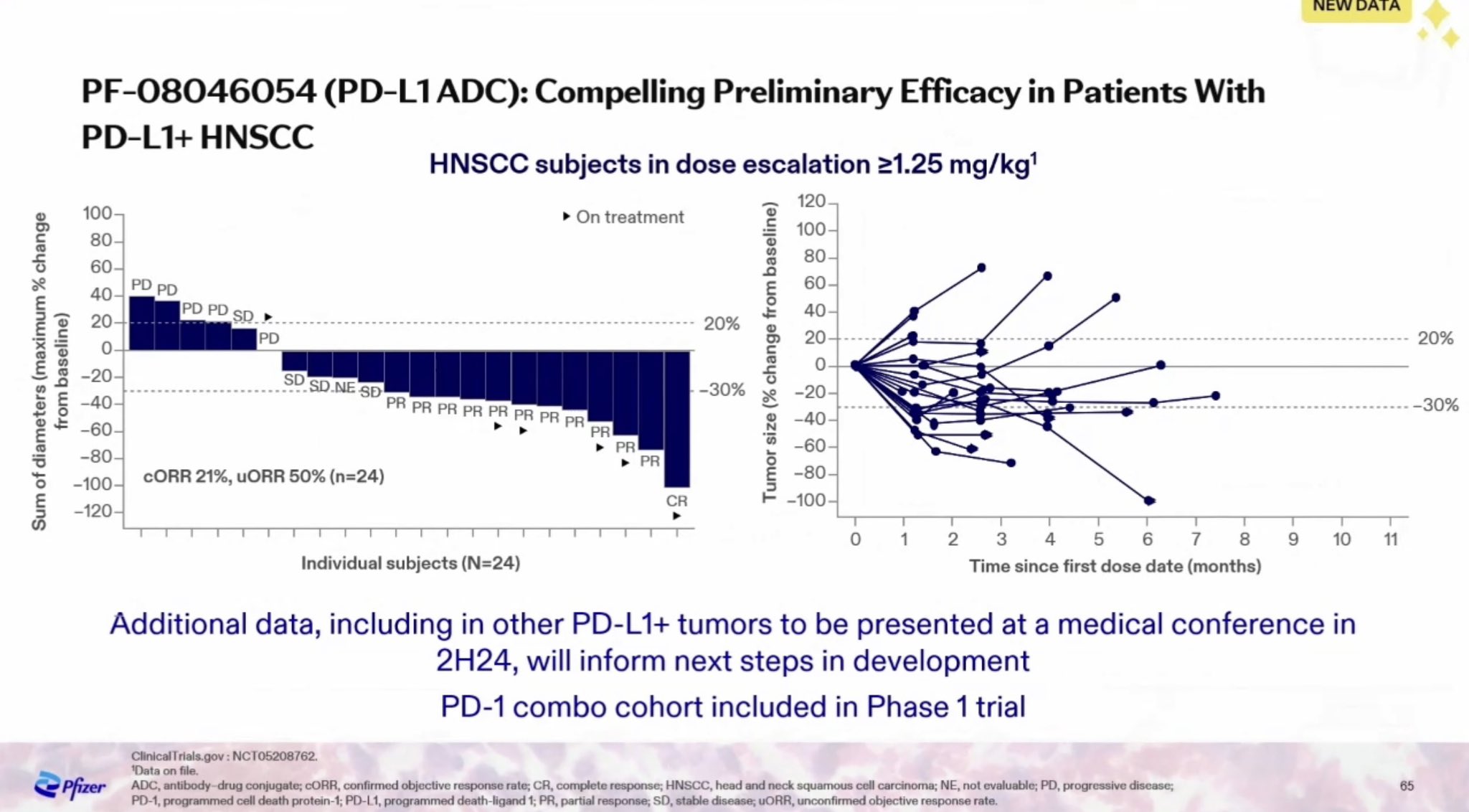
So BGB-A3055 was another possibility, although I think it just recently entered phase 1b and there’s little or no published data on it. Around the time we were learning about BGB-A3055 from Dr. Gutierrez, we also met an oncologist named Dr. Weight at Sarah Cannon in Denver. Dr. Weight told us about a trial for ABBV-400, another ADC that uses a different mechanism than PDL1V, and said that it has also shown some success in some head and neck patients. A downside of all these phase 1b studies is that there’s little published data, which makes comparisons difficult. Oncologists almost never give numbers: “We dosed 10 patients, and the disease control rate in phase 1a was 50%.” Instead, they’ll be vague, but they’ll also indicate why they think their top trials are their top trials. Strangely—or perhaps not strangely—we found more preliminary data was provided to investors by the drug companies in investor reports, than was given to oncologists or patients. We shared slides from investor pitches with oncologists, who were also surprised to see even early spider graphs of data that hadn’t crossed their desk.[6]

Bess and I spent a lot of time debating the sometimes gnomic descriptions of various trials—it’s like listening to people talk about wines: is “oaky” good while “tannic” is bad? “Mineral forward” versus “fruit notes?” I have no idea. We had to decide between oncologists who have seen “some responses” in head and neck, versus the ones who have seen “good responses.” Or the others who have seen “some activity.”

We also had to figure out what might available. BGB-3055 would open in April—around the same time as PDL1V. There was also a site called NEXT in Dallas that was offering the trial. ABBV-400 was immediately available, which was attractive. I found a single slide from a Feb. 29 Pfizer presentation to investors, via a Google search that brought me to a biotech investor’s tweet:

While this was going on, we kept trying to get MDA’s phase 1 clinical trials department to recommend some trials to us, but they wouldn’t. Bess faxed all my information to MDA (healthcare systems use the world’s fax machines and pagers, stuck as they are in the past), with pleas for a return e-mail or phone call, but none came. She also tried leaving messages with the department, and cold e-mailing PIs. No luck. We’ve learned that if someone won’t, or can’t, spend the cash and energy to show up in person, MDA isn’t the right place. This is surprising to me, given how hard flying is for many cancer patients, how expensive cancer is, and given the fact that we’re not living in 1995 and have digital records, but at some point the organization behaves how it behaves and the culture is what it is. We did get some unexpected help from someone at MDA (thank you! you know who you are), who tried to facilitate conversations between us and the right departments, but even that person couldn’t break through the bureaucracy. By the time we finally heard back from the oncologist at MDA, START was already moving me along the qualification process for PDL1V. Plus, the MDA oncologist said I wasn’t eligible for PDL1V. Bess and I were baffled, and might have asked why she thought I wasn’t eligible, but she’d turned off the “reply” feature in MDA’s EHR; it didn’t seem worth starting a new message thread. I was already tracked to start at START.

We decided to focus on PDL1V, the main reason being that, if I got another trial, I’d lose it forever due to the lines-of-therapy limitation; BGB-3055 and ABBV-400 don’t have lines-of-therapy limitations. Secondarily, that Pfizer slide shows three-quarters of patients responding to it, which is good by HNSCC standards. Somewhere in this ordeal, we also asked START if I could do a round of chemo and still qualify for PDL1V. START-San Antonio initially thought the answer was yes: getting a round of the exact same chemo I’d had in summer 2023 should be fine. We made appointments.

START-Utah thought the same based on what was written in their provider guidelines (we’ve learned to double check whenever possible). But Pfizer had scheduled a meeting later in the week to discuss updated guidelines, which mean the guidelines might be different in four days, and the answer obsolete. Bess asked if they could confirm with Seagen’s “medical liaison,” who makes the final eligibility decisions. The tumors in my neck were visibly growing, so I was worried about whether I’d make it to mid-April, and even a delay of a few days could affect my “washout period” and the timing when I could start the trial. But I delayed while waiting for their answer. Pfizer’s decision: Any more chemo will count as a new line of therapy. If we hadn’t known to ask about the meeting, to ask for the medical liaison, to clarify and clarify again, I’d have lost a potential spot. We shelved the plan to get chemo.

In slightly good news, we were told that, if a patient fails the previous line of therapy, there is only a two-week washout period. So I could at least get one more round of petosemtamab, on the off chance that I wasn’t entirely resistant, which Dr. Sacco agreed to arrange. I flew back to San Diego on Mar. 28 for an infusion on Mar. 29. Did that infusion do anything? Probably not, but maybe, and it was something. Bess and I were watching the tumors in my neck grow larger seemingly by the day. At least the petosemtamab had kept the tumors in my lungs more or less in check.


Dr. Sacco also said that many trials will let patients get some spot radiation in an attempt to shrink tumors enough for the patient (me) to survive. We contacted Dr. Patel at Mayo Phoenix about this, and he was like: “Makes sense! Let’s do it.” We told him about the back-and-forth regarding whether I’d actually be eligible, and he’s clearly seen this game played before, because attitude was: “Let’s schedule a simulation so that you can get your mask made and be ready.” Beautiful. And easy! I got the radiation simulation Apr. 4

START told us that Pfizer was holding a kickoff meeting the first week of April. That meeting happened, and we planned to target START-Utah, since Utah is closer to Arizona than San Antonio. There was some kind of unspecific institutional review board (IRB) holdup as well. Ultimately, START said that I could get consented on Apr. 8, so I got a last-minute (meaning: $$$) ticket to Utah for Apr. 7. Unfortunately, START doesn’t have its own CT machine on site, so getting the mandatory CT scans became yet another logistical challenge; I will spare the details, apart from saying that something as simple as getting CT scans locally couldn’t go smoothly, resulting in a seven-hour day to get 60 seconds’ worth of scans, an experience that might seem minor in the grand scheme of suffering, but which showcases the accumulation of seemingly minor problems that  together become crushing. It was exhausting. I was exhausted. I am exhausted. You are probably exhausted just reading this.

I was so exhausted that I considered whether I wanted to terminate treatment, or just do local phase 1a trials, which is nearly equivalent to terminating treatment, because 1a dose-finding trials start with such low concentrations of active medicine that, even if the medication ultimately works, the initial people who get it probably won’t see a response. I was sick. I was tired. I was sick and tired of fighting bureaucracy. Bess and I spent a month continuously wrangling an inefficient, balky medical system. The void felt better than continuing the fight—not the fight against cancer, but the fight against the balkanized clinical-trial system.

Ultimately, I went through with the PDL1V trial, flying to Utah on Apr. 14 and receiving the first dose on Apr. 15. The worst parts of the process were behind me. It’s saying something when the “worst part” isn’t the actual infusion of a largely untested study drug. It isn’t even the fatigue that followed. But I want to spend as much time with Bess as I can, before the curtain falls, as it will likely will soon enough. I worry that I’ll get hit with a pulmonary embolism (PE), stroke, cardiac event, sudden breach of critical blood vessels by tumors—and I’ll feel a sudden pain in my head or neck, then nothing. PDL1V could delay that moment.

In “The Council of Elrond” from The Fellowship of the Ring, Gandalf gives an account of his captivity by the traitorous Saruman, and he says: “May Elrond and the others forgive the length of it.” May you forgive the length of this account.[7] It gives a flavor of my life, but it may also prove educational to patients who are suffering as I have—firstly from cancer and other dread diseases, but secondly from the process of searching for treatment.

Part 2 is here. If you’ve gotten this far, consider the Go Fund Me that’s funding ongoing care.


[1] “Ligne Maginot” in French, according to Wikipedia.

[2] In my case, cancer also chose to take the Belgian route, bypassing our defenses and leading to my personal Dunkirk, except even more disastrous.

[3] ADCs are hot in oncology because results so far show them as being efficacious and with fewer side effects than things like chemotherapy. One description says ADCs “couple two therapies, basically work like guided missiles. A toxic warhead is strapped to a missile that homes in on and drops its payload on a specific tumor.” PDL1V contains a chemo agent called MMAE, which Wikipedia says shows “potency of up to 200 times that of vinblastine.” Seagen is a, or the, leader in ADCs, and Pfizer just bought it for $43 billion, which is a vote for ADCs’ potential.

[4] We were also interested in a small-molecule called NT219, but that drug had completed its phase 1b trial and hasn’t yet moved to phase 2 or approval—so another promising candidate from our previous research was lost to us.

[5] Dr. Sacco also recommended an ADC trial, if possible, because of the amount of research (and money) are indications that that mechanism of action is likely to work.

[6] One reader suggests: “The Hippocratic oath may be incompatible with capitalism if shareholders continue to be prioritized over the researchers who desperately need this data in order to make informed decisions for patients like me.” My view is different: the FDA rules that drive and create this insane process are imposed by government. The drug companies want to sell drugs! I want to take drugs. For fatal diseases like R / M HNSCC, there should be basic safety studies—essentially phase 1a and 1b studies—and from there oncologists should be allowed to prescribe novel therapies.

[7] Gandalf’s captivity is not just physical but also involves psychological dimensions as he deals with isolation, uncertainty, and deception. Cancer patients face emotional and mental torment, dealing not only with their physical illness but also with the psychological burden of managing their treatment process, which is often opaque—and, in my case, unending, or rather ending only in death. Most of the clinical trials see a tiny number of patients get “complete response,” or the apparent elimination of their cancers, but that is so rare that I’m discounting it for myself. 

In which the squamous cell carcinoma tumors in my neck grow by 20% in two months

The four tumors in my neck grew by an average of about 20% from Jan. 16 to Mar. 11—and that’s after they shrank by about 20% between Sept. 27, when I got my first dose of the bispecific antibody petosemtamab, and Jan. 16. Existing published data shows that “Of the patients who responded [to petosemtamab], the median DOR was 6.0 months.” I’m a bit under the six-month mark, and three neck tumors are substantially larger:

* 38 x 27 mm -> 43 x 33 mm

* 29 x 16 mm -> 35 x 18 mm

* 22 x 14 mm -> 29 x 21 mm

(I don’t understand how radiologists evaluate a three-dimensional object like a tumor with two-dimensional measurements,[1] but radiologists are, like pathologists, part of the hidden, antisocial,[2] subterranean section of the medical system, rarely interacting with humans (or light), sleeping by day and waking by night, and subsisting on a diet primarily of human blood, supplemented by small mammals when none is available.[3] So I’ve not gotten a chance to ask what’s up with the two-measurements thing when there ought to be three.)  

No tumor is yet impinging on critical structures, which is nice, although one is poking out of my neck, which is less nice. One oddity is that my lung tumors are stable and one even seems to have resolved, despite the growth of the tumors in my neck. Dr. Sacco, my oncologist at UCSD, said she’s never seen a patient’s lung and neck tumors diverge in response like mine. If that means anything, I don’t know what.

So now Bess and I back to scrambling for a new trial—and “scrambling” is the right word, despite all of our effort to avoid having to scramble. Most trials mandate a 30-day washout period,[4] and I got my last petosemtamab infusion on March 13, and thus a goal is to receive the new trial drug by Monday, April 15. I thought I had two good options for a Seagen trial of an antibody-drug conjugate (ADC): one at UCSD at one at MD Anderson (“MDA”) in Houston. I thought (incorrectly, it appears) that UCSD would host Seagen’s “A Study of SGN-PDL1V in Advanced Solid Tumors,” but there are two issues: one is that there are actually two different Seagen trials that I’m eligible for. The other is that there’ve been delays in opening a Seagen trial at UCSD. My tumors are growing too fast to wait around to see when it might open. Some trial sites report years’ worth of delays for something as finicky as “the drug company doesn’t like the hospital’s supplier of saline,” or something equally ludicrous. Maybe an astrologer told Seagen now isn’t an auspicious time?

Adding to the complexity, “PDL1V” is one Seagen trial. The other is SGNTV-001, which is the innovaTV 207 trial. SGNTV appears to be the trial available at UCSD.

You may have read the above paragraphs and thought: “Seagen trial one, Seagen trial two, who cares?” But the difference may be critical to whether I live or die. Few people understand how maddening and challenging the clinical-trial system can be, which is part of the reason I’m describing what’s happening to me. The SGNTV trial is one that, back in August or September, a research oncologist who hosted an SGNTV trial site told us wasn’t looking so good.

We listen carefully to oncologists and take what they say seriously. But data from 2022 says that “Tisotumab Vedotin Shows Promising Efficacy and Manageable Toxicity Profile in Phase 2 Study of SCCHN:” “Results from the phase 2 innovaTV 207 study (NCT03485209) showed a confirmed objective response rate (ORR) of 16% and an overall disease control rate of 58%, along with a tolerable safety profile.” By the standards of recurrent/metastatic squamous cell carcinoma (R / M HNSCC), 60% is pretty good. An abstract from 2023 reports that “15 pts with SCCHN were treated” and “Confirmed ORR was 40%.” “Stable disease” also qualifies as “pretty good” by R / M HNSCC, and “ORR” doesn’t include patients who have “stable disease.” “Stable disease” is anything that is plus or minus thirty percent in size from the original. The disease control rate of petosemtamab was around 70%, and petosemtamab is arguably the most promising drug for what I have.

Should I try for PDL1V, or SGNTV? Although finding an open trial site is a challenge, so is ranking the trials. PDL1V is being held at MDA, where I also established care back in November (I wrote about that in “Finally, some good tumor news, but, also, hacking up blood is probably bad”). But the physician with whom I established care there is out of town until Mar. 25. MDA has, let us say, not made it easy to consult with someone else about a PDL1V trial slot. Waiting two weeks and then finding out that there isn’t a slot available at MDA could be fatal. Bess and I are working to figure out if we can talk to someone else at MDA about a PDL1V trial slot. None of the other 12 places I established care are hosting either of these trials, so we’re back to searching on clinicaltrials.gov for other host sites and trying to beg our way in quickly.

Is SGN-PDL1V likely to be better than SGNTV-001? PDL1V began in 2022, and SGNTV began in 2018, so PDL1V is newer. Are clinical trials like graphics cards, in that newer is better? I don’t know. The oncologist who said SGNTV didn’t look great said so in 2023, but more data has presumably been generated between September and now.

The third drug is NT219. We’re trying to get an appointment at Cedars-Sinai hospital in LA to learn more about it. There’s hardly any published data about NT219. UCSD had an NT219 trial, but that’s not open any more. Has NT219 failed? On clinicaltrials.gov, no sites are listed as recruiting. Drug companies keep early data close to their chests. The best bet is to talk to a clinical investigator involved in the trial and hope they drop an information nugget, or make a vague hand motion indicating whether a drug is doing well or poorly. Many, but not all, are loath to say, “My observation is that x% of patients are responding to the drug,” and the ones who do play a heavily weighted role in my deciding how best not to die.

“Not dying” is hard. I’ve got an appointment at a PDL1V site in Salt Lake City, Utah, at South Texas Accelerated Research Therapeutics (START)—Rocky Mountain. The organization’s name may be “South Texas” but that the site is in Utah. I’m also working on getting into START—San Antonio. The variability among hospitals in terms of intake and acceptance is massive—both START sites, like UCSD, have made getting appointments and getting into their systems straightforward. It’s almost as if they realize they’re a research institution and want research subjects. I can’t decide if it’s mostly individual initiative within the systems that accounts for differences, or if organizational culture between different hospital organizations accounts for how patient-friendly versus patient-hostile hospital sites are. A lot of clinical trial insiders complain about the difficulty of patient recruitment, and, given how hard it is to get into a study after saying “Hey, I’d really like to be in this study,” I have a few ideas as to why.

If I were in charge of clinical trials, I’d be working hard to make patient intake easy—a subject I talk about in “Puzzles about oncology and clinical trials.” Those puzzles continue to puzzle. Among businesses that sell to consumer, there’s a rabid obsession with user interface and user experience (UI/UX), because getting those wrong can lead to outcomes that range from “make less money” to “go bankrupt.” In a lot of medical situations, there seems to be no conscious, deliberate effort at improving UI/UX or intake. And after a decade and a half of promises about health-record sharing via electronic medical records (EMRs), I still wind up sending a ton of PDFs to intake coordinators, who then, I assume, manually attach them to the local EMR. One PDL1V site, UC Davis, requires that all records be faxed to them. This is not a joke. The records they request run to 100+ pages. UC Davis, as the name implies, is part of the University of California system—as is UCSD. I’d imagine they’d be able to pull records from another UC hospital, but no. Fax or die. Faxing it is.

You may think that me describing the clinical-trial process is pointlessly, tediously boring, but I’m doing it most of all for other people in similar situations. Don’t give up! Persevere despite the struggle. You are not alone. The system should be fixable, and, though I personally can’t fix them, I can explain my experience and thus hopefully shed light on the process in a way that helps others.

Between late December and March, life had slowly slid into a new normal. Although I’m not physically well compared to where I was before the cancer recurrence, I had more energy than I did in that bleak period of surgical recovery and systemic chemotherapy. A low bar, but one I managed to shuffle over. I’ve managed to do a lot of writing, and to help Bess do a lot of writing. I’ve been emailing advice and guidance to other people with cancer who are navigating clinical trials. I’ve been trying to live a positive, meaningful life.

It feels like my Interregnum Is over, and I’m back to wondering If this Is It. I know, intellectually, that I may be able to survive the month-long washout period, and that the next trial drug may work. But I also know that the month-long washout period may be long enough to get bone or brain metastases. The next trial drug may not work. And, even if it does, after the PDL1V trial, there is no other highly promising trial that I’m aware of. There are some okay trials in phase 1a, but most 1a trials don’t really work. NT219 requires that participants have had no more than two systemic lines of therapy, and SGNTV has the same requirement. So doing PDL1V means I won’t be able to do the other two. I might have to move to New Jersey for a drug called RAPA-201.

There are a huge number of issues to track, and limited information. We’re seeking more information but often not getting it. Life is usually an incomplete-information game. It’s more statistics and less calculus. Sometimes, one makes life-or-death decisions based on incomplete information. 

I recently read an interesting though flawed memoir called The Trading Game, by Gary Stevenson, and the narrator describes the eponymous game that helps get him a job as a currency trader:

The trading game was supposed to be a simulation of trading, but actually, it was just a numbers game.

It ran using a special deck of seventeen numbered cards: some higher, some lower. In case you ever want to play it yourself, the full deck of cards was a -10, a 20, and all the numbers 1 through 15. Each player is dealt their own card, which they could look at, and then another three cards are placed, face down, in the center of the table. The game works by players essentially making bets against each other on what will be the total numerical value of the eight cards in the game (each of five players has one card, plus the three in the middle).

Conceptually, you can think of it like this: you are all buying and selling some asset and the total value of that asset is the sum of the cards in the game. You only have certain information (your own card); more information (the cards in the middle) is revealed as the game goes on. If you have a high card, say the 15, or the 20, then that gives you inside information that the total will probably be quite high, so you want to make “buy” bets that it’s a high total. If you have a low card like the -10 you probably want to make “sell” bets that the total is low. If you get a middle card like a 6 or a 7, then I guess you’ll have to make something up.

The betting system Is mainly what made the game a “trading game,” Ie It was designed to mimic the way that traders make bets in the markets: “price-making” and “price-taking” using “two-way markets.”

I feel like I’m playing the clinical-trial game. Instead of numbers on cards, I know there’s a large pot of hidden efficacy data that I can’t access. It’s siloed in databases run by hospitals or drug companies. Occasionally, some of that data is released publicly, and it becomes common knowledge. Often, however, I don’t know whether a given clinical trial is -15, or 20, or, most commonly, somewhere in between. Petosemtamab was close to a 20—maybe a 15 or something. I’m trying to trade on what public data exists, and what I can glean from conversations with oncologists, to make the optimal decision.

The analogy is inexact, but I wonder what happens to the people who don’t fully realize the kind of “game” that’s being played with their lives. If their oncologist even brings up the option of clinical trials (few actively refer patients to studies), it’s probably to whatever happens to be available at the hospital where they practice, regardless of the quality of the drug.

And the FDA doesn’t care; the FDA’s goal is to make itself look good, or as not-bad as possible, regardless of the number of people who fill the invisible graveyard while waiting for potential treatments to fatal disease. People running the trials are at the mercy of the incentives set by the FDA within the system. Some individuals within the system are amazing, and that fact is part of the reason I’ve been telling people with head and neck cancer to establish care at UCSD if doing so is feasible and reasonable. My top-level feeling, though, remains what I wrote about in “Who cares about your healthcare? What’s commonly overlooked in the ‘health’ care system:” no one is going to care as much as you and your family.

If you’ve gotten this far, consider the Go Fund Me that’s funding ongoing care. As you can infer, I probably have a lot of flights in my future.


[1] Bess read this and said that radiologists look at the two longest vectors. But that leaves a lot of room for the third axis, doesn’t it?

[2] I kid: I assume radiologists are as social as any other sort of doctor, though I can’t be sure because I hardly ever interact with them.

[3] Although I was kidding about the antisocial thing, this part is serious.

[4] During the washout period, I’ll ideally also be “screened” for study eligibility—CTs, MRIs, PET scans, labs, palm reading, awaiting drug-company sponsor approval. Not having to go through the process of waiting for appointments to establish care at new cancer centers can shave a few weeks off the process.

The dead and dying at the gates of oncology clinical trials

If you find this piece worthwhile, consider the Go Fund Me that’s funding ongoing care.

I was reading Tyler Cowen and Daniel Gross’s book Talent: How to Identify Energizers, Creatives, and Winners Around the World, and in it they write: “You can open doors for other people at relatively low cost (perhaps zero cost) to yourself just by making some options more vivid to them.… You embody something, and that something will stir some others into action” (237). That’s a lot of what Bess and I are doing when we write about clinical trials, where getting the wrong answer means death: thus, our extensive focus on it, and the healthcare system more broadly. We’re trying to open doors, especially for people who are sick or who don’t realize what their options are.

Right now, according to “The pharma industry from Paul Janssen to today: why drugs got harder to develop and what we can do about it,” apparently “Only 6% of cancer patients take part in clinical trials nationally in the US, for instance, and the number is generally lower in other countries and for other conditions.” A lot of cancer patients don’t need clinical trials and are healed by existing treatments, but, even granting that standard-of-care often works, 6% seems low—it may be low because of poor guidance combined with fatalism. If my experience is representative,[1] a lot of cancer patients aren’t getting adequate help understanding the system and finding a trial. Bess and I only succeeded in finding a clinical trial to keep me alive because of our own perseverance and obsessiveness; we were explicitly encouraged by multiple oncologists not to bother and to let me die. My primary oncologist at the Mayo Clinic Phoenix offered zero guidance, aid, or advice. I can’t tell how common this is, though feedback so far seems to indicate the answer might be “pretty common.” For a normal person without some of our traits, background, and resources, getting an optimal clinical trial would be far harder, if not impossible—and it was already hard for us. I’m still puzzled that more people with poor prognoses on standard-of-care treatments aren’t working to get the best clinical trials they can.

What’s the barrier? Mindset, and discouragement from oncologists, is probably one problem. A guy named Richard Chen, whose profile says he wrote two books on clinical trial recruitment, said: “First, FDA’s remit is not, and has never been, to get therapies to patients.” He also said: “Its primary mission first and foremost, is to prevent unsafe drugs from injuring patients.” If the FDA’s remit isn’t to get therapies to patients, that’s bad, and its remit should change. The second comment is pure, unintentional comedy. Right now, I’m a dead man walking. The FDA is preventing “unsafe” drugs from injuring me, so that I can be “injured”—which is to say, killed—by a recurrent/metastatic squamous cell carcinoma infestation. If I’m injured or killed by a drug, that’s not so different from my ultimate trajectory anyway, and the knowledge that can be created from my situation might accelerate treatments and save the next guy’s life.

Moreover, we already have an example of a medical area that works well with minimal FDA interference: surgery. Maxwell Tabarrok describes the situation in “Surgery Works Well Without The FDA: The best evidence against the FDA:”

Despite extreme information problems and a complete absence of federal oversight, surgery seems to work well. Compared to similar patients on the waiting list, 2.3 million life years were saved by organ transplants over 25 years. The WHO claims that “surgical interventions account for 13% of the world’s total disability-adjusted life years.” Coronary artery surgery extends lifespan by several years for $2300 a year. Cataract surgery and LASIK can massively improve quality of life for a few thousand dollars.

Regarding drugs, particularly drugs for people who are already effectively dead, like me, we should be moving closer to a surgical model.

I think Chen is a smart and well-meaning person. But he’s so bureaucratized, and he’s so imbibed the FDA’s line, that he doesn’t realize the Kafkaesque absurdity of telling me, a dying man who’s failed all standard therapies, that the FDA is protecting me from potentially unsafe drugs, so that I can safely die of cancer. If the FDA didn’t flex their paternalism quite so aggressively, terminal patients could at least consent to try something that might help them, which is better odds than trying nothing and waiting for a certain end. Look, if the FDA wants to have long trial periods for dubious drugs like those meant to lower cholesterol or whatever, fine. Once a person has a fatal diagnosis, however, that person is probably, like me, a lot more inclined to take a flyer on what’s available and see what happens. And we should be allowed to do that. We’re terminal, not without capacity. If the FDA’s remit is, ultimately, preventing patient injury, maybe they should ask themselves if they’re causing injury with their current approach?

Knowledge among patients and oncologists seems to be another barrier, according to “Why drugs got harder to develop:”

Many patients are willing to take part in clinical trials in principle, but awareness is poor. About 50% of the time when patients are invited to clinical trials they accept, but 90% are never invited to participate, mainly because most patients are not treated in settings that conduct trials. Patients are also not necessarily aware of or educated about the benefits of trials, and how they may enable them to access a high standard of care. Leading clinical research centres often have too many studies and not enough patients. When it comes to the trial itself, the site may be far from where the patient lives, requiring them to travel or even relocate for the duration of the trial — without adequate support for doing so.

Poor awareness is consistent with my experience—no one explicitly told me to seek clinical trials. Bess writes about the dearth of oncologists referring their patients to clinical trials in “Please be dying but not too quickly: part three” and I’ve written about this issue as well, but, as I mentioned above, if I’d followed my then-oncologist’s guidance, I’d have done some palliative chemo and then died. That doesn’t seem like an optimal outcome. If I die, Bess will be lonely. In spaces like oncology, I’d expect patients to be more like me—that is, highly motivated to attempt to not die. I don’t wholly understand what’s going on, which is why I titled my last essay on the subject “Puzzles about oncology and clinical trials.”

I guess (or infer from behavior) that most oncologists aren’t penalized or rewarded for helping their patients find and enter clinical trials. In the emergency room, a doctor who routinely misses heart attacks or strokes will find his or her license attacked and him or herself in a court room. In oncology, there’s apparently no real effort to consistently help patients who’ve exhausted standard treatments. It’s not, I guess, part of the professional elements of the profession, which I find surprising. Sure, many patients are likely elderly and too sick to pursue clinical trials, but a fair number must be like me: motivated and able to undertake somewhat arduous efforts to prevent or delay death.

One reason too few people participate may be logistical:

To get enough patients to fill up large trials companies need to conduct trials at multiple sites. The more sites involved in a trial, the greater the logistical complexities involved in coordinating that the protocol is executed appropriately across sites, the data is collected to a good standard, and the drug is distributed to all sites as needed. This all increases costs. More sites also increases variance in execution, and improper trial conduct can delay or even sink a development program. According to data from Tufts university, >80% of trials fail to recruit on time, actual enrolment times are typically around double the planned timelines, and ~50% of terminated trials result from recruitment failures. An estimated 11% of trial sites fail to recruit a single patient, and another 37% don’t reach their target enrollment criteria.

There are efforts to create “virtual” trial sites—in other words, to allow clinical trials to proceed at local sites that reach some minimum threshold of competence. To use myself as an example, if the petosemtamab trial I’m doing at UCSD included a real virtual site component, petosemtamab could be shipped to HonorHealth in Scottsdale or one of the Ironwood Cancer Centers in Chandler, and I could receive my infusions and monitoring locally, with the data reported to UCSD and/or Merus (the drug company). Although that would mean “more sites involved in a trial,” it also means less responsibility at each site. The “recruitment failures” issue is interesting in light of the fact that almost no trial sites seem to do basic, modern marketing.

I’m not hugely optimistic about fomenting real change. Real change is slow in a society like the United States, which has been characterized since the 1970s overwhelmingly by complacency, stasis, and status-quo bias. One sees that in our inability to build new housing, our inability to build new ships for the Navy, our refusal to accelerate subway development, our preference for interminable litigation over infrastructure, the Jones Act, the FDA, dishonest and tuition-seeking universities, and the innumerable other veto players who, like Richard Chen, are great at saying “no” and unable to say “yes.” I hope we can build O’Neill Habitats that will allow a re-opening of the frontier and a new space where the dreamers who are tired of hearing “no” can instead create a new polity where it’s possible to say “yes.” The United States is huge on safetyism instead of true safety—and human flourishing.[2] We can and should do better. I doubt we will, however, because the people who most need FDA reform are dead. They’re not writing. They’re not doing podcasts. They’re not agitating Congress.

Still, sometimes change happens, and the bureaucratic inertia is somehow overcome. For example, voucher and charter schools seem to continue to ascend, despite entrenched and intense monied union interests opposing them, and decades after their intellectual foundations were laid. Marijuana legalization seemed unlikely until it happened. Psychedelics look like they’re on the path to medical legalization, at the very least, and possible general legalization; based on my experiences, psychedelics are both safer and far more interesting than alcohol. SpaceX has revolutionized the space game, and I’d have incorrectly predicted failure. Tesla is the sole bulwark against state-affiliated and subsidized Chinese companies owning the entire electric car market. Who knows what’s possible? I don’t hope for this, but if someone in some senator or senior house member’s family gets cancer, and that senator or house member learns what I’ve learned, FDA reform might become a vital issue for that person. Few people I’ve seen online have defended the current system (there are some—just not a lot).

The fact that the current ossified, slow system has persisted as long as it has is an argument for it continuing. Good enough is good enough, right? Moreover, the way the press responds to events helps perpetuate stasis: if a drug has negative side effects, including potentially death, that gets plastered all over the news. Investigations are launched. Scapegoats are sought. If a drug works, and saves lives, the response is muted. The articles go unread. The beneficiaries are happy but don’t start campaigning for more and better medical treatment, faster. One person who dies from a drug outweighs one hundred who might be saved by another. It reminds me of all the press given to any kind of airline accident, even one without casualties, while 40,000 people a year die in car crashes, without most of them making headlines.

One person on LinkedIn said this about Bess’s clinical trial essay-guide:

An extraordinarily damning overview of the way things operate currently, that puts everything we complain about from within the industry into perspective. Thanks for sharing this Brad [Hightower—mentioned above] – as you say, a must read that underlines how we must all work together to improve things.

It might be a damning overview, but it also turns out that seemingly everyone working in or adjacent to clinical trials knows about the problems already. That includes everyone from the researchers themselves to the drug companies to the hospitals to the oncologists to the support staff. If a lot of people have known for a long time how bad the system is, and no one has managed to coordinate sufficiently to make substantial improvements, that implies that the problems will persist. Can Bess and I be the catalysts that finally galvanize some change? That’d be great, and yet I’m pessimistic. There’s a saying in investing: “The market can stay irrational longer than you can stay solvent.” Call this Seliger’s Law: “A broken system can stay broken for longer than people have the time, energy, and ability to try fixing it.”

Still, Bess and I would like to try to make the world a better place, to the extent we can, and within whatever limits our abilities and skills may impose, and trying to nudge the clinical trial system into a better equilibrium is part of our effort. It’s too late to save my tongue, but it may not be too late to save the tongues and lives of others. In an alternate world, petosemtamab, or a cancer vaccine, would’ve been approved and available in Oct. 2022. I’d have gotten surgery, and then petosemtamab, which is way less toxic than chemotherapy. Maybe that wouldn’t’ve saved my tongue—but maybe it would’ve. Oncologists are reluctant to use chemotherapy, but modern alternatives like petosemtamab should help people like me in the future.

Cancer vaccines exist, though trials are moving achingly slowly. A company called Transgene is testing a cancer vaccine called TG4050 on patients with initial head and neck cancer diagnoses—the same diagnosis I had in Oct. 2022.  TG4050 is moving to a Phase 1b and 2 trial; according to the company, “The compelling initial Phase I data presented with NEC at ASCO 2023 showed that all evaluable patients treated with TG4050 monotherapy developed a specific immune response and remained disease-free.” I wish I’d remained disease-free; instead, I have no tongue and am likely to die soon.  

Despite my pessimism, “Why drugs got harder to develop” says: 

Yet, even though there are major forces pushing against drug developers, there is a sense that the industry is still underperforming, and that it could do more. One reason for optimism can be seen in the recent flattening of the slope of Eroom’s law following decades of declining productivity. It remains to be seen whether the recent uptick is a sustained turnaround or not. The pessimistic view is that it is illusory, a result of how drugmakers have side-stepped fundamental productivity issues by focusing on developing drugs for niche subpopulations with few or no options where regulators are willing to accept less evidence, it’s easier to improve on the standard of care, and payers have less power to push back on higher prices: rare disease and oncology in particular. It’s no coincidence that investment has flowed into areas where regulatory restrictions have been relaxed and accelerated approvals are commonplace: 27% of FDA drug approvals in 2022 were for oncology, the largest therapeutic area category, and 57% were for rare/orphan diseases.

That seems better than nothing. Maybe Congress and/or the FDA is responding to the Richard Chin logic I note above. The FDA has created systemic problems, and it can also create systemic solutions. For example, the FDA doesn’t really account for the time-value of money,[3] which is especially important in a high-interest-rate environment:

As a more general point, it would help if regulators could be more predictable and transparent in their decision making. In a survey of drug and device industry professionals, 68% said that the FDA’s unpredictability discouraged the development of new products. It can be hard to predict how regulators will react to a certain dataset in the context of high unmet need, so companies can be inclined to ‘submit for approval and pray’, even after receiving negative feedback on the data package from regulators during prior interactions.

“Hard to predict” means that many people stop pushing a drug before they start. Companies are competing for investable cash with all other companies; the more time-consuming (read: expensive) the FDA makes the process, the fewer drugs will even be attempted. “Why drugs are harder to develop” suggests the FDA be more accountable to patients:

A straightforward start to improve transparency across the industry would be for the FDA to disclose the formal ‘complete response letters’ (CRLs) issued when they reject a drug which contain the reasons for rejection. Making this information public would give future developers insight into the regulator’s thinking on a disease, with minimal downsides. How companies represent their CRLs to the broader market today is often misrepresentative of the actual reasons for rejection, potentially misleading patients as well as future investors and drug developers in the indication.

I’m not the only one thinking about reform; pretty much everyone in the industry is. To return to a point I raised at the beginning of this essay, reforms could also make clinical trials easier for patients to access. Bess and I spent thousands of dollars and countless hours learning how the clinical trial system works and then how to participate. Initially, no one comprehensively helped us on this journey; my original oncologist at the Mayo Clinic Phoenix was and likely still is sluggish. Mayo Phoenix has a great ENT department but appears to be poor in oncology, which is surprising for an organization with a reputation for cancer care. Bess and I had to learn what we know piecemeal, which is part of the reason we’re trying to describe comprehensively what we’ve learned and how other people’s experiences can be made better.

The best trial for head and neck cancers is petosemtamab, and that trial is being hosted at UCSD. Bess and I are lucky enough to have the resources necessary to get me there twice a month from Arizona for infusions, thanks in large part to the generosity of friends and strangers who’ve contributed to the Go Fund Me. I’ve been saying that being sick for an extended period of time has at least three components to it: health itself; financial well-being; and managing healthcare. Drop any one of the three and the other two are likely to fall too. Very few people can help my health or healthcare directly, but the contributors to the Go Fund Me have made the financial challenges easier.

What’d make things better for everyone, however, is reforms like virtual trial sites. The healthcare team at UCSD has been great, but being infused locally would negate the need to be away from home six days a month, the cost of flights, hotel, and the huge energy expenditure all that entails. The process of getting a clinical trial medication can and should be less expensive and arduous than it is. I can see why most people who might want to participate in the better clinical trials for their illness run out of money and energy to pursue those trials. Bess and I were ready to move anywhere. Fortunately, we’ve not had to move somewhere expensive and far from family and friends. We were ready to, though. We may still have to one day—and maybe, but hopefully not, soon.

Both of us also wish that there were greater transparency around which trials are doing well in terms of patient outcomes and which trials aren’t doing so well. We’ve learned via experience that right now, there’s no substitute for establishing care at a bunch of sites and listening to the oncologists there. Oncologists running trials will often tell you how things are going for trials that’ve been running for a while. If they’re enthusiastic about a trial, it’s often because they see a lot of patients doing well on it. They have observational data that outside docs and institutions have to wait months, maybe years, to get wind of.

Sometimes they’ll also steer patients away from trials that aren’t producing enough positive results. I’m grateful to the docs who’ve quietly advised us against floundering drugs. Some oncologist meetings produce non-public intel about which trials are most promising, provided enough patients have received the drug in question; the oncologists won’t know much if you’re like the first or fifth or tenth human to be dosed with a novel substance, but a lot of these trials have built up years of data. If a site has run through dozens or as many as 100+ patients, the oncologists will have a sense of whether it’s working, even if nothing “official” has been released.

This is one of innumerable tiny facts and practices about effectively participating in clinical trials that we’ve discovered. I’ve never read anyone else who’s put out things like this, just like I’ve never read anything remotely like Bess’s clinical trial guide-essay, “Please be dying, but not too quickly.” Somehow, a lot of this essential information isn’t making it into the larger information ecosystem. The lack of quality information has been driving my writing over the last five months, including my last essay, “On not being a radical medicine skeptic, and the dangers of doctor-by-Internet.” We collectively can and should be doing better. I’m trying to be part of the solution. In reading this, and passing it to others, you’re part of the solution, too.

If you’ve gotten this far, consider the Go Fund Me that’s funding ongoing care.


[1] Which I hope it isn’t, and yet the emails I’ve been getting indicate that my experience is distressingly common.

[2] The book Where is My Flying Car? by J. Storrs Hall is good on this. We should have so many nuclear power plants that power is almost too cheap to meter, we should have O’Neill Habitats that re-open the political frontier in order to let the non-complacent gather and advance the human condition, and we should have progressed much further in curing cancer and making biology a variable rather than a constant. That we’re content to creep and crawl on the earth rather than soar into the heavens is an indictment of our whole society. Too many lawyers, too few makers.

[3] Bess asked what the time-value of money is. Briefly, it’s how much an investment or investor would lose or gain from alternatives. Take a simple example: you can invest a million dollars in a company running a clinical trial, or in a money-market fund paying 5% a year. If you invest in the money market fund, you wind up with $1,050,000 at the end of the year. If FDA delays cost you a year, you’ve effectively lost the $50,000—you have more like $950,000! Inflation matters in these calculations, too.

This is also why delays to housing construction are so evil.

Puzzles about oncology and clinical trials

Some things about the clinical trial process—and the behaviors of the drug companies, hospitals, and oncologists that are part of the clinical trial process—puzzle me, because I notice problems and common, suboptimal practices that seem easy to fix and yet, from what I’ve experienced and observed, they persist. That slows medicine and science, which is euphemistic way of saying: “more people die, sooner, than would by using better practices and processes.” Patient care and outcomes suffer. Hard-to-fix problems like the FDA aren’t readily solved because those fixes likely demand congressional action, and most congresspeople aren’t pressured to act by voters, and the potential voters most interested in FDA reform have probably already died, or are in the process of dying, and thus are unable to make it to their local polling place.*

“Puzzles about oncology and clinical trials” is a companion to “Please be dying, but not too quickly: A clinical trial story and three-part, very deep dive into the insanity that is the ‘modern’ clinical trial system. Buckle up.” The clinical trial system could be a lot worse, and many treatments obviously get through the system, but, in its current state, the clinical trial system far from optimal, to the point that I’d characterize it as “pretty decently broken.” Interestingly, too, almost all parties involved appear to acknowledge that it’s broken, but no one can seem to coordinate enough pieces to generate substantial improvement. While the clinical-trial field is being seduced by AI models and large-scale tech “solutions,” most of which don’t yet work, some of the problems I’ve noticed and am listing here could be, if not solved altogether, then at least substantially ameliorated at the level of the individual or department, rather than the level of states, the country as a whole, or the FDA:

1. Many oncologists don’t appear to know the clinical trial landscape, even in their sub-specialty. As you might’ve read in Bess’s “Please be dying, but not too quickly” essay / guide, almost none of the head and neck oncologists Bess and I talked to knew the head and neck clinical trial landscape well. Most barely seemed to know it at all, apart from vague reputation (“MD Anderson has a lot of trials” or “Try the University of Colorado” or “I’ve heard good things about Memorial-Sloan Kettering (MSK)”). A lot of that advice was helpful, and I don’t want to scorn it or the oncologists giving it, but that advice also wasn’t at the ideal resolution.

It’s puzzling that more oncologists don’t learn the clinical trial landscape, given how many patients must, like me, reach the end of conventional treatments and want or need to try whatever might be next. To a non-expert outsider, the trial landscape is a bizarre, confusing world that takes enormous time and effort to understand. But to an oncologist or someone else working in the field, it shouldn’t take more than a few hours once every month or two or even three to keep abreast of what’s happening.

In head and neck squamous cell carcinoma (HNSCC), the ailment that’s killing me, there are a lot of trials, though most aren’t highly relevant and perhaps 30 – 50 “good” trials are recruiting at any given moment. The “good ones” mean ones in which a drug company is investing heavily in the drug and the drug is at least in phase 1b and more likely phase 2. Moreover, trials can last years, with varying periods of enrollment, so once an oncologist understands the “good” trials, those trials are likely to be relevant for years. Keeping up with the better trials, even via clinicaltrials.gov, shouldn’t consume lots of time. It took Bess an unbelievable amount of effort and energy to get up to speed from nothing, but the trial situation is like riding a bike: starting from a stop is much tougher than maintaining speed.

Bess spent 50+ hours a week for six straight weeks trying to learn the head and neck clinical landscape, and, with the help of a great consultant named Eileen Faucher, she basically did. Though Bess is a doctor, she’s not an oncologist and doesn’t have the baseline expertise that comes from treating head and neck cancer patients as a career. Bess doesn’t attend the yearly ASCO: head and neck conference where breakthroughs and the research landscape are discussed. Yet she, despite being in the emergency room, somehow became better versed in both the most promising experimental molecules and the up-to-date clinical trial offerings than any other single physician we spoke with (a few were well-informed, to be sure, and if you are well informed and gathering up your outrage, please release it!). The big picture wasn’t obvious at first, but it was discoverable to a determined, non-expert ER doc, and therefore it should be to experts.

Although I’m now in a trial hosted by UCSD’s Moores Cancer Center for a bispecific antibody called MCLA-158 / petosemtamab, Bess just reached out to her contacts at back-up trials, because I’m getting scans on Nov. 21, and those scans may show that petosemtamab is failing and we should try something else, instead of waiting to die. The rate of return for a few “how’s it looking?” e-mails or calls from Bess to trial coordinators and oncologists seems exceptionally high. In my view, community oncologists should do the same thing every couple months. UCSD has probably the best and most extensive program in the west. It would be easy for an oncologist like mine at the Mayo Clinic Phoenix, Dr. Savvides, to send an email every three or four months that says: “Any new trials I should know about, in order to better help my patients?” Instead, he seems to know almost nothing about the clinical trial landscape. There are also some good research centers in Arizona: HonorHealth Research in Scottsdale, Ironwood Cancer Centers, or the University of Arizona Cancer Center in Tucson.

Problems like mine are common, and HNSCC patients commonly experience recurrence and/or metastases (“About 50% of these patients will experience a recurrence of disease. Recurrent/metastatic SCCHN have poor prognosis with a median survival of about 12 months despite treatments”).

If a lot of patients wind up failing conventional treatments, like me, then it would seem logical that helping those patients find a good clinical trial should be part of the standard of practice, and even standard of care, for HNSCC oncologists.

Discussing how clinical trials work with a patient before the patient needs one is also important for improving the number of trials a patient is eligible for—and the speed with which the patient gets into a trial. If a conscientious oncologist knows that their patient is open to a clinical trial and knows what clinical trials are available at the time of a patient’s recurrence, they might be able to get that patient directly into a trial. Early action is particularly helpful because a number of phase 1b/2 clinical trials combine the experimental treatment with standard of care, but only if the patient has not yet received standard of care. How can the patient into a study so quickly? Their oncologist has to know about it at the time of diagnosis.

To use myself as an example, at Ironwood Cancer Center there’s a promising phase 2 trial of an anti-CD47 antibody called magrolimab for HNSCC patients. It combines the antibody itself with chemo and pembrolizumab (Keytruda), but only patients who haven’t had pembro are eligible. I have had pembro, so I’m not. Given the circumstances under which I had it—as a crash measure to try and improve matters before the massive May 25 surgery that wound up taking my whole tongue—I wasn’t a great candidate due to timing problems. Other patients, though, who don’t need or get surgery fast as I did, might benefit greatly from the magro trial. I got a “hot” PET scan on April 26. If I’d been told on or near that day: “Get an appointment to establish care at Ironwood Cancer Center and HonorHealth Research; if that hot PET scan is confirmed, you want to be in a position to combine a clinical-trial drug with pembro,” I would’ve done so. Pembro on its own only helps about ~20% of HNSCC patients, according to the big KEYNOTE-048 study.

Not telling patients to get ready to attempt clinical-trial drugs in the event of recurrence is insane.

I will note the important caveat that a lot of cancer patients who reach the end of conventional treatments aren’t good candidates for the kind of intensive clinical trial search and entry that Bess and I did. Most clinical trials require patients who have good mobility, life expectancies longer than 12 weeks, no metastases in places like the brain or spine, etc. A lot of cancer patients are elderly and immobile; for them, discontinuing care and making their peace makes sense. The financial challenges are also substantial. I’ve been fortunate to get a lot of support via a Go Fund Me that my brother set up, but a lot of people are likely prevented from doing out-of-state clinical trials due to financial challenges. but not everyone.

So what’s going on? Do most oncologists know their area’s clinical trials, and my read of the situation is wrong? Is HNSCC unusual? Is my assumption that most oncologists will see a reasonable number of people who fail conventional treatments and want to do the best trials wrong?

It’s possible that oncologists are just lazy, but after four years of med school, three of internal medicine residency, and three of oncology fellowship, I’m going to discount “lazy.” A much larger number are likely burned out, a subject I address some in “Why you should become a nurse or physicians assistant instead of a doctor: the underrated perils of medical school” from back in 2012. Maybe few patients demand help with clinical trials, and consequently few oncologists provide real help?

2. Hospital center sites and/or drug companies don’t appear to do much outreach to community or even specialist oncologists. It wouldn’t take much for hospital research centers and/or drug companies to find oncologists, or even oncology support staff, in the larger region of a given trial site and try to say: “Hey, here are the better and more promising phase 1b / phase 2 trials we’ve got.” Bess and I were told, repeatedly and independently, that it’s not worth traveling or moving for typical phase 1a does-finding trials, which seems accurate, but for us it sure is worth moving or commuting for the most promising trials. There are likely many others in our position, too.

In terms of outreach, let’s use HNSCC as an example. How many head and neck cancer doctors can there be in the greater Phoenix area? 15, 20, maybe 30? It’s a highly specialized field. HNSCC is the sixth- or seventh-most common type of cancer, so it’s up there but far from number one. Phoenix, Tucson, Las Vegas, and Reno are all within easy commuting distance by plane to San Diego, and someone who prefers driving could commute that way. The petosemtamab trial I’m in at UCSD is probably the best available experimental treatment for HNSCC, and UCSD also has the BCA101 trial, which is another promising EGFR attack \ bispecific antibody. UCSD doesn’t seem to conduct a lot of deliberate outreach, or, if they are, it’s not reaching the oncologists Bess and I have been talking to. I don’t want to pick on UCSD—they’ve been great—and it seems that no clinical trial sites are doing substantial outreach.

If I were UCSD, I’d keep a list of the community oncologists of all the incoming patients. I’d send emails to those oncologists and their PAs every two or three months. It could be simple: “Hey Dr. Savvides—your patient Jake Seliger is doing well on the petosemtamab trial, and instead of dying rapidly, as expected due to the growth of his tumors, he’s able to live a somewhat okay life. If you have similar patients, please send them our way!” Yes, I know about HIPAA, and UCSD should get patient permission to do something like this.

I’ve seen speculation that hospital systems don’t want their oncologists sending patients outside the hospital system. So Mayo wants to keep its patients in-house, HonorHealth does the same, and so on with big hospital systems in every area. To put it bluntly, this is just keeping a patient and their insurance card close, only to watch them die.

It would not be hard for trial sites to hire search engine optimization (SEO) specialists and target pages at keywords likely to be of interest to persons searching for clinical trials. It wouldn’t be hard to bid on Google or Facebook ads targeting patients. To my knowledge, no trial sites do.

HonorHealth has been really good about keeping in touch with Bess and me via email and phone calls, which I appreciate.

3. Clinical trial sites don’t try to get their doctors licensed in other states.

If I were the boss at UCSD, I’d be paying for and facilitating my oncologists getting licensed in, say, Arizona and Nevada. If I were the boss at somewhere like HonorHealth Research, I’d want my docs licensed in California and Nevad. It’s not that hard or that expensive to get licensed in other states. Bess has done it! A lot of states are now taking part in the “licensing compact,” so that a doctor who gets licensed in state x can also practice in ten other states if they’re willing to pay the license fees.

Being licensed across state lines would allow those oncologists to see patients and screen them for potential trials at their institution from those states, likely via telemedicine. If insurance companies won’t pay for care across state lines, then it might be worth either eating the cost of the initial visits or charging a relatively nominal cash fee, like $100 or maybe a couple hundred bucks. This is, again, pretty low-hanging fruit of the kind that I’d expect a lot of businesses to be able to identify and knock down.

I’ve been told that a lot of clinical trial sites want to keep their patient rosters high and face pressure to get enough patients. I’ve heard from many principal investigators (PIs) that it’s difficult to fill a trial. It’s got to be hard to fill spots if patients are being aggressively disincentivized from joining at every step. How many are doing any of the things listed above? How many have created search-engine optimized pages for their trials? This isn’t costly relative to the expense of doctors, hospital care, intake, etc. The kinds of relatively minor changes I’m talking about won’t cost millions. An Arizona medical license can be obtained for $550 and a fingerprinting fee, and then it’s good for a couple of years.

On Facebook, one doctor said that there’s a lot of concern about “coercion,” and one doctor noted:

“Granted, hands are tied in lots of instances because it can’t come across as coercion. I would love to give your “insights” to our patients. Thank you for thinking of others while you are in the midst of everything.”

I’m not sure what specifically she means by “it can’t come across as coercion,” and when Bess asked she didn’t get a reply. Also, come across to who? How? Is the author worried about drug companies, the FDA, IRBs, or some other actor? Too much “coercion” is probably bad, but it doesn’t seem to me that trying to inform oncologists about relevant clinical trials is coercive. I personally would like some more coercion in this field, if it means I might learn about treatments that could save my life and the lives of people who come after me.

Still, I think that doctor is right about the way a lot of doctors think, or, worse, how a lot of administrators think; it’s easy to blame “HIPAA” or “coercion” or, worse, “medical ethics” for stasis. What passes for “medical ethics” is basically a joke, as shown most obviously during the pandemic, and when people cite “medical ethics,” they are almost always bizarrely non-specific about what “medical ethics” they mean, where those “medical ethics” come from, who upholds and interprets them, how they are evaluated, what “medical ethics” say about trade-offs, etc. There also seems to a be powerful, poorly supported paternalism that runs through the notion of “medical ethics.”

In my first public essay about me dying from recurrent / metastatic HNSCC, I talked about the FDA’s role in blocking medicines and consequently killing patients. The FDA’s villainy, which like so much villainy calls itself “good,” as in, “We’re denying you rapid access to potentially life-saving treatments for your own good, so please enjoy being protected while you die,” is the focus of that essay, but if we discount our ability to change the FDA, where else should we focus our attention? Changes at the margins ought to be possible, like those I’m proposing here. So far, this comment is one of the best I’ve seen about why change is hard.

It may be that most people are okay with the current state of affairs. Complacency and “good enough” define our age. There are real improvements over time—pembro is a miracle drug for a lot of people, to use one example, and although mRNA cancer treatments will probably arrive too late for me, they are likely to arrive at some point. If those real improvements move more slowly than they ought to, most people are okay with that, at least, until they or their loved one is dying of the disease.

This is kind of like how the crappy transit systems in the United States are enabled by widespread cost disease. Transit nerds know that NEPA is a huge problem for both transit applications and clean energy applications, but NEPA reform remains frustratingly out of reach. Even the few cities that really depend on good transit, like New York, can’t generate the institutional motion to reduce the cost of building out subways and thus allow the building of more. The U.S. can and should do better at transit, but the median voter can go get in his or her car and drive to wherever. Sure, the traffic might suck. Sure, there might be better ways. But the current way is good enough, and good enough has become good enough in a lot of the United States. Sometime in the 1970s, we became culturally uninterested in the future, in the possibilities of material abundance, and in making the world better for our children. I think we should switch back to having a sense of urgency and importance about the future, including the future of medicine.

I’ve already lost my tongue. My neck mobility is probably 30% of what it used to be, and it’s criss-crossed by constricting scars. I’ve lost forty pounds that I can’t seem to gain back. Even the treatments that are in clinical trials right now are only likely to slightly prolong my life, not save it. I’m a dead man walking, but maybe the next person won’t lose his tongue. In another world, petosemtamab (or Transgene’s TG-4050) was already widely available in October 2022.

In that imaginary world, I got the first surgery, which removed only a part of my tongue, and then got petosemtamab orders along with radiation. The petosemtamab killed enough of the remaining cancer cells that I kept my tongue and didn’t need the second surgery. I’m working normal hours and eating normal food. I’m not concerned about the child Bess and I are working on creating will enter this world after his or her father departs it. That alternate world exists in a space where the FDA moves faster and there’s greater urgency around moving treatments forward.

I’m open to and interested in explanations other than the ones Bess and I have posited.

If you’ve gotten this far, consider the Go Fund Me that’s funding ongoing care. In addition, for more on these subjects, see “Reactions to ‘Please be dying, but not too quickly’ and what clinical trials are like for patients.” 


* Even absentee ballots probably won’t help much.

Puzzles about oncology and clinical trials: what we've learned from examining the field