Links: The virtues of silence, the virtues of true liberalism, the real and the pose, and more!

* “Why we ignore progress: The single most important trend in human history is too often ignored.”

* Actually, SpaceX’s Starship actually had a remarkably successful flight. Which is consistent with us collectively ignoring progress.

* Lithium recycling. Whenever you see articles with the usual yada-yada-yada about commodity prices, remember that high prices drive further exploration and eventual exploitation of commodities, as well as greater efforts at things like recycling.

* “I Don’t Have to Post About My Outrage. Neither Do You.”

* “Why I am a liberal” by Cass Sunstein. A beautiful restatement of the values of freedom, tolerance, growth, and progress. The far left and right are too eager to sacrifice the first two, which inevitably leads to sacrificing the second two.

* How Richard Hanania learned to love the American empire. Consistent with Cass Sunstein’s love letter to liberalism. It’s also interesting that when the facts change, Hanania changes his mind, unlike many others. Katherine Boyle also wrote “How to Win the Fight for America,” which is congruent with many of this week’s links.

* “The world’s first pathway for individually designed drugs.” A step in the right direction, but, like many improvements in the drug regulatory regime, too slow. Especially for me.

* Arnold Kling gets it:

By fraudulent, I mean that [progressive causes and activists] do not help the people that they purport to help. BLM does not help black people. Diversity, Equity, and Inclusion does not help achieve any of those goals. The champions of the Palestinian cause do not help Palestinians. The climate alarmists probably do not help the climate. The various gender ideologues probably do not help people who are struggling with the psychological problems that accompany their gender identity issues.

I’d like to improve all the issues listed but have not been able to put into words what Kling does here.

* “How major environmental groups ended up on the wrong side of California’s housing crisis.” This article is perfectly in keeping with the “actions and political goals don’t help the problem that they purport to help.” Those actions and political goals hurt the problem they are ostensibly supposed to be helping! The degree of pretend and make-believe is tremendous.

* “The Next Power Plant Is on the Roof and in the Basement.” Good. Progress.

* Do you have the freedom to transact? Are you sure?

* The tragic fall of Russia.

* Technical work continues to resist commodification.

Links: The virtues of electric bikes, how to raise the aspiration level in others, undead laptops, and more!

* “How Theoretical computer scientist Manuel Blum became a legendary academic advisor and guided generations of graduate students into fruitful careers.” About talent, among other things, and how to maximize other people’s talents.

* Argument that “The world’s 280 million electric bikes and mopeds are cutting demand for oil far more than electric cars.” Ebikes are great, and they’re now cheap and good too. I have one. Mine is from Rad Power, but there are more good choices now than bad. Plus, “Electric vehicle battery prices are falling faster than expected.”

* How Steven Ells, Chipotle’s Founder, Is Moving Beyond Burritos (wsj, $). The new restaurant is called Kernel and it looks good to me (lgtm). It probably won’t come to Phoenix.

* “Hamas envisioned deeper attacks, aiming to provoke an Israeli war.” Surprising venue for this, too. Notice: “one dead fighter had a notebook with hand-scrawled Quranic verses and orders that read, simply, ‘Kill as many people and take as many hostages as possible.” From 2014: “Top Secret Hamas Command Bunker in Gaza Revealed: And why reporters won’t talk about it.”

* “The Laptop That Won’t Die: My $200, 12-year-old Thinkpad has outlasted two high-end Macbooks.” It seems to me that Framework laptops are rapidly usurping the role Thinkpads used to have. If I weren’t using MacOS I’d get one.

* Americans’ Confidence in Higher Education Down Sharply. I wonder why. Could it be the absurd prices, the absurd prices for low-value degrees, the political indoctrination, or maybe something else? Have institutions of higher education and their members showcased great courage and commitment to their putative principles since Oct. 7?

* “Crossing the Taiwan Strait with the U.S. Navy.”

* “How math built the modern world.”

* “We No Longer Need a Big Carrier’s Wireless Plan. Discount Ones Are the Way.” I’ve been making this mistake.

* In pursuit of decent coffee. A noble pursuit. A few months ago I bought an Aeropress and that’s the league leader in coffee gadgets in my household right now.

My Rad Mission ebike.

Links: Vertical Spain, the right to transact, building stuff, and more!

* Do you have the right to transact? Not in the fiat world. Here is Patrick McKenzie (patio11) explaining how banks work, among other things.

* “Los Angeles Is On a Transit-Building Tear. Will Riders Follow?” I’ve taken the L.A. subways and it was nice. Pity they’ve taken so long to construct. Relatedly, it could be that America was built on cost overruns, but, crucially, those overruns led to finished infrastructure.

* “When did humans start burying the dead?

* “New Industries Come From Crazy People.”

* When Every Child Is a Choice. An unusual and interesting perspective.

* “All My Life, I’ve Watched Violence Fail the Palestinian Cause.”

* “The Dogs of War.” Antonio Garcia Martinez visits Israel; the last third psychoanalyzes the American response.

* “Thiel’s Unicorn Success Is Awkward for Colleges.” Surprising venue for this. Also: Peter Thiel on political errors. Figuring out you’re wrong is useful, and a lot of people can’t or won’t do it. Can you?

* “Gas Stoves Mean Dangerous Pollution in Most Homes, Study Finds.” We have a Breville Control Freak induction stovetop and it’s great, apart from the name.

* Spain lives in flats: why the country is built vertically.

* Why Vitalik Buterin (possibly a crazy person) built Zuzalu:

We already have hacker houses, and hacker houses can last for months or even years, but they usually only fit around ten or twenty people. We already have conferences, and conferences fit thousands of people, but each conference only lasts a week. That is enough time to have serendipitous meetings, but not enough to have connections with true depth. So let’s take one step in both directions: create a pop-up mini-city that houses two hundred people, and lasts for two whole months.

This hits a sweet spot: it’s ambitious enough and different enough from what has already been repeated ad nauseam that we actually learn something, but still light enough that it’s logistically manageable. And it also intentionally does not center any specific vision about how something like this should be done, whether Balaji’s or otherwise.

* “Forever is such a short, long time.”

Links: China’s malaise, the leakage of university absurdity, CAR-T therapies, and more!

* “China’s age of malaise.” Interesting, measured, and not the usual. Note: “Someone has to tell the Americans that the idea that China is going to overtake them is over. This guy [Xi] has ended that game.” And: “When information doesn’t flow, the whole country will go backward.” The U.S. has some major and important weaknesses, especially in our inability to build things and build things fast, but we have some strengths, too.

* “The ‘Decolonization’ Narrative Is Dangerous and False: It does not accurately describe either the foundation of Israel or the tragedy of the Palestinians.” Not just false, but absurd. On the other hand, for people living at the center of a large, safe rich country, for whom everything is “rhetoric” and nothing is real, maybe it doesn’t matter, at least until the students stop coming and the budget is slashed. Perhaps relatedly, this Twitter thread is good: “This is what we’re witnessing – the dismantling of public higher ed in conservative states – and we’ve created the conditions for what’s going on at UNC. How did anyone think we could get away with being nakedly ideological for years without any chickens coming home to roost?” And: “This is about universities shamelessly embracing, as their official institutional posture, an openly ideological framework/stance.”

* “Miguel Ángel Perales, oncologist: ‘What we are doing today with CAR-T cell therapy against cancer seems like science fiction’.” Unfortunately for me, personally, CAR-T therapies haven’t yet been successful in solid tumors: “[I]n solid tumors, the biology is somewhat different. There are more variations in the tumors because they grow over a longer term. What is more, the tumor microenvironment is more difficult for the immune system because there is more suppression of immune cells. I think there will be something, but it will take time.”

* “Climate Risk Is Becoming Uninsurable. Better Forecasting Can Help.” Alas, that we’ll likely continue to ignore climate change, even as the evidence piles up that we can’t.

* Whatever happened to light verse?

* “Home schooling’s rise from fringe to fastest-growing form of education.” Could be that the legacy schools and districts will now have to compete better.

* White House effort to improve clinical trial infrastructure and system. Good. Granted, a lot of the focus appears to be on pandemics, and on a signaling topic that no one in the real world cares about, but the effort is appreciated.

* “Anorexia was the gender dysphoria of yesterday: Both socially induced psychological illness and ambivalence toward the female condition is much older than the gender dysphoria boom.”

* “The Technological Innovations that Produced the Shale Revolution.”

* “Connecticut parents arrested for letting kids, ages 7 and 9, walk to Dunkin’ Donuts.” Let kids be free.

* “It Only Takes 200 Joules To Restart A Heart.”

* Group narcissism:

Pareto called this the aristocracy of lions vs. the aristocracy of foxes. Lions are proud, forceful aristocrats who explicitly own their position as leaders. Foxes, however, are humble servants who will forever deny that they’re in charge. While lions want to run the world, foxes want to save the world.

Because our new elites are foxes and not lions, they no longer feel comfortable celebrating productive habits for the rest of society.

Our old elites used to share a sense of common responsibility and noblesse oblige — not just to give back, but to expect the masses to act in a way that would let them rise up as well.

Links: Malaria vaccines will save lives, the need to build, and more!

* “First malaria vaccine slashes early childhood mortality: Huge analysis of RTS,S in Africa shows it decreased toddler deaths by 13%.” Tremendous, hugely important news, and much more important than 99%+ of what’s in the headlines.

* How science often actually works. :(

* “Why America Doesn’t Build: Even green-energy projects get quashed by local opposition.” Relatedly: a good thread on how California “environmentalists” are overwhelmingly not. This might be easier to read, and it doesn’t require a Twitter login.

* “How to Prevent Gun Massacres? Look Around the World.” We’d rather live-action role play macho toughness than not be shot, which seems like a bad tradeoff to me.

* “The Sinking Submarine Industrial Base.” Part of the preparation for losing a war over Taiwan, or possibly the Philippines.

* “The Extremist’s Gambit Helps Explain Why Hamas Attacked Now.” Not just more of the same: depressing, but also interesting.

* “Open source news is the future of journalism.” One quote: “What the incident showed is that in a race to the truth between professional journalists and self-organizing investigators online, all of whom had access to the same public materials, the journalists lost by a long shot.” And they continue to lose.

* “When the Music Stopped: An Inside Look at the Hamas Assault on the Trance Festival.”

* “On Writing (or not): Bad habits and why the voice in my head needs to kindly shut up.”

Links: On what matters, as opposed to what’s foregrounded

* “What Was Literary Fiction?” See also me, on the death of literary culture.

* Racism at literary journals: “Literary Submission Policies Shouldn’t be Color-Coded.” This seems obvious. On Substack, no one has to know who you are or what you look like.

* “On Having Children: The Most Private Choice We Make Has Potent Public Consequences.” I think there’s a big time preference issue here: having kids is great in the long term but very hard in the short term. That, and we’ve made housing very, very expensive. See also this catalogue of fertility matters. Information-dense, which is great!

* “Learning from Houston: It’s clear that the city’s permissive housing development policies help with affordability.”

* Paul Graham’s new essay, “Superlinear Returns.” He’s the best essayist of the age.

* “The Techno-Optimist Manifesto.” Beautiful, needed, and important.

* Carbon capture pipeline nixed after widespread opposition. In case you’re wondering whether we’re serious about climate change. We’ve just experienced the hottest summer on record, and 2023 is the hottest year on record.

* Apple won’t let Jon Stewart talk about China. Anything you get from Apple comes from a company that puts the priorities of the CCP first.

* Get an ebike cause they’re fun. Mine is fun! You should try one.

* Why Big Money Can’t Easily Change Campus Politics.

* “A Digital Pornutopia, Part 1: The Seedy-ROM Revolution The Digital Antiquarian.”

* Orwell’s Inner Party: The man behind the myth.

* On ambition and encouraging ambition. Nothing in in the essay is proven or causal but it’s interesting nonetheless.

“Please be dying, but not too quickly: a clinical trial story”

Please be dying, but not too quickly: a clinical trial story” is Bess’s latest essay, and it describes 1. how I got into the petosemtamab clinical trial, which is among the better I could have gotten in; 2. how the process of finding a good clinical trial functions, which is useful for anyone in a position similar to the one Bess and I were in July, and 3. how the clinical trial process can and should be improved. People are dying (I’m one of them) while patients, doctors, and drug companies struggle against a system that appears to have evolved in a dysfunctional direction. We can and should do better.

“Forever is such a short, long time”

Forever is such a short, long time” is Bess’s latest essay. It starts this way:

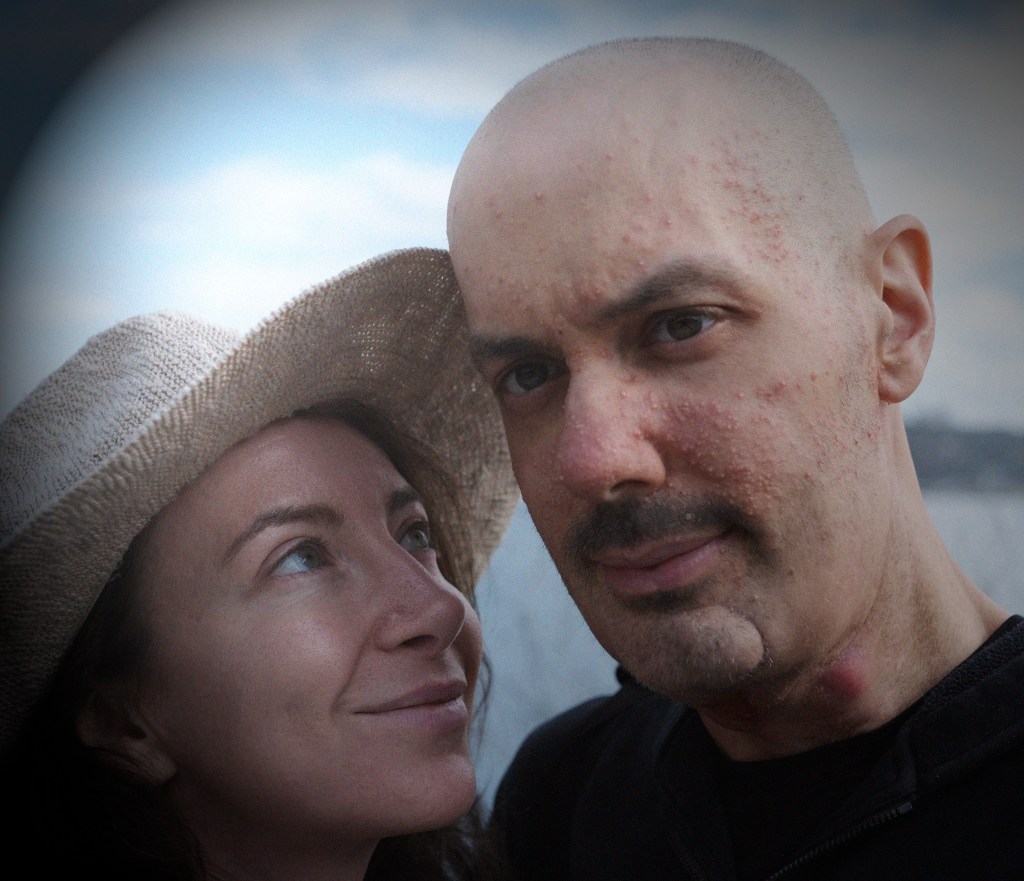
Jake and I look at each other and say, “I will love you forever.” But Jake is dying of a squamous cell carcinoma, so while “forever” is supposed to be a very long time, our actual time horizon is so very short.  

We married on May 24, 2023, the night before a huge surgery that was supposed to cure his recurrent squamous cell carcinoma of the tongue. Our impromptu wedding was in the courtyard of our apartment building, beside the empty pool, and underneath a second-floor stranger’s patio; we’d chosen the spot because those neighbors had had fairy lights strung up for ambience. In the background, in lieu of a string quartet, were jokes and distorted laughter from a drag queen hosting bingo across the street at an open-air bar called The Hot Chick. Our friend-slash-quickly-ordained-online-officiant Smetana had to raise her voice to recite the ChatGPT-composed ceremony (she did a beautiful job).

We didn’t have rings to exchange because we hadn’t yet bought any: Jake’s surgery had been scheduled for June 8 but was moved up, probably because his surgeon, Dr. Michael Hinni, thought Jake might not make it to June 8. I worried about the same issue, because Jake was getting visibly, alarmingly worse day by day. I’d been watching him, as a doctor and wife, and I didn’t know whether he’d make it through the surgery (or the night).

Read the rest.

Links: Spacecraft, the psychology of psychology, perspectives on death, and more!

* This is Astral Codex Ten on the first Elon biography. It’s germane to the new biography by Walter Isaacson—I’ve read about half of the Isaacson one, and all of the Vance one—in that specifics about Elon may have changed in the last seven or eight years, but the essentials have not. He’s still brilliant and insanely hard working, and he still takes enormous risks and likes emotional chaos. His description of his father as “evil” seems apt. The material from the end of that biography to the present is different in the sense that Elon is building the Model 3 and more advanced rockets, but the same in the sense of underlying drives, character, etc.

* Doing business in Japan. One of these essays that’s about far more than its title. Also, from a different writer: “Notes on not liking Japan as much as everyone said we would.”

* MDMA history.

* “A review of Number Go Up, on crypto shenanigans.”

* Trying to get people to go vegetarian. Look at the illustrative picture: that’s part of the challenge. Social desirability bias is real, for both vegetarianism and polyamorism. Yet most of us are hypocrites when it comes to kindness towards animals, like dogs, that are in front of us, and incredible cruelty towards animals that aren’t in front of us.

* “I’m so sorry for psychology’s loss, whatever it is.” What does one do with a discipline that bears too much resemblance to astrology? What is the psychology of psychology? The psychology of psychologists?

* “My death is close at hand. But I do not think of myself as dying.” ($, WaPo). And, also, “As my end nears, I crave the soul-to-soul connection of seeing friends in person.” H/t Ryan Holiday. What is a good life? So much of it is most truly about connecting to other people, one way or another. The Internet, used well, facilitates those connections. You and I are connecting right now.

* “The case against (most) books.” Not wholly convincing but interesting, and applicable to the many books that should in fact be articles (Astral Codex Ten is great at sheering books to an appropriate size). Hanania cites Marcus Aurelius’s Meditations:

it’s all basic stuff like “don’t worry about what others think of you,” and “control your emotions.” Maybe it was mind-blowing the first time someone said these things, and it’s definitely sort of cool that a Roman Emperor can communicate with you across two millennia. But I’m 100% certain that if you gathered some passages from Marcus Aurelius and hired a halfway intelligent blogger to produce content made to sound like Marcus Aurelius, nobody would be able to tell the difference.

Is Meditations “all basic stuff?” Then why do so many of us have trouble implementing it, if it’s basic? “But anything intelligent or insightful they said you’ve probably absorbed already through run-of-the-mill blogs and self-help books, shorn of all the stupid things that inevitably made their way into their writings.” I’d be curious to see examples from the “run-of-the-mill blogs” or self-help books. This is me on Stoic philosophy.

* Impulse Space CEO Tom Mueller talks early days at SpaceX, moon bases and a booming space industry.

spacecraft and the psychology of psychology

“Days of Awe: The clinical trial drug that might save my husband’s life”

Days of Awe: The clinical trial drug that might save my husband’s life” is Bess’s latest essay. It’s great!