* “Cancer Is Striking More Young People, and Doctors Are Alarmed and Baffled: Researchers are trying to figure out what is making more young adults sick, and how to identify those at high risk.” I’m one of them, which makes this of particular interest to me. I notice especially this: “But doctors said obesity and lifestyle can’t fully account for the plight of the people arriving at their clinics. ‘A lot of the young patients are very healthy,’ said Dr. Y. Nancy You, a colorectal cancer surgeon at the University of Texas MD Anderson Cancer Center in Houston.” I fit the “very healthy” category and yet that didn’t help me. Bess saw this and observed that some research fingers microplastics as a possible culprit, but, as the article notes, there’s at least some evidence for almost everything under the sun.
* Impulse Labs’ battery-powered induction stove. If I owned a housing unit, I’d have pre-ordered this stove, which looks incredible. We’ve not seen substantial improvements in kitchen appliances in decades, but induction stoves are so much better than legacy electric or gas stoves. I have a standalone induction stove called a Breville|PolyScience Control Freak. The name is not the best but the device is amazing. It, an Instant Pot, and a rice cooker have largely replaced the gas stove in my apartment.
* “Impact on the Internet is a direct function of what you have done recently: a YouTuber is as popular as their latest video, a tweeter as their latest joke, or an influencer as their latest video. In the case of Rufo what mattered was whether he brought evidence for his claims or not; obsessing about the messenger is to miss the point that he might as well be the New Yorker dog.” I think this is a little overstated—lots of people will read older, evergreen writing—but it’s directionally correct.
In part 1 I wrote about the struggles that come with complex healthcare problems, like the cancer that’s killing me, the efforts to treat it, and the numerous ancillary problems those treatments have caused. I lacked meaningful guidance on important topics like clinical trials or how to significantly decrease the incapacitating side effects of chemotherapy. I had to seek out other interventions that would significantly improve my quality of life, like a low-profile mic-key PEG tube. Instead of being guided by experts, I often had to crowd-source recommendations and double-check (and drive) treatment plans, or else so much would have fallen through the cracks. I’d likely be dead. My experiences should help guide others in similar situations, so they can better advocate. But I’m not a radical skeptic and, though I’d like to see improvements in healthcare and other institutions, I also don’t see fantastic alternatives at present levels of technology. If you find this piece worthwhile, consider the Go Fund Me that’s funding ongoing care.
What I’m suggesting isn’t the same as getting your medical degree from Dr. Google
Patients love to tell doctors what to do, and it drives doctors crazy. Online, and sometimes in the legacy media, you might’ve seen quotes from doctors complaining about know-it-all patients who attempt to incorrectly drive treatment. Demanding inadvisable treatment isn’t just bad for the doctor’s sanity; it’s bad for the patient’s health outcomes. Bess, to cite one example who happens to be sitting next to me as I write this, is barraged by ER patients demanding antibiotics for their viral illness or steroids for their chronically sore backs—even though these treatments won’t address the problem and may cause real harm—all because the patient “knows their body,” evidence-based medicine be damned. Many, if not most, people aren’t great at gathering and evaluating evidence, or reading, and even doctors don’t appear to be great at statistical literacy.
I’m sympathetic to doctors’ views regarding patient knowledge or lack thereof, especially when doctors are trying to protect patients from unnecessary medications with real and serious side effects, and yet, at the same time, I continue to be (stupidly, foolishly) surprised at all the things not being done by the doctors who’re supposed to be driving my care. The first time something negative happens can reasonably be a surprise; the eighth time should not. They’re the experts and I’m the amateur, so why am I outperforming them in important ways? If Bess and I don’t drive, there’s no one behind the wheel, and that’s bad. Beyond my individual case, there’s also a larger question: What happens to trust in doctors as a whole when so many individual doctors aren’t providing the guidance or care they should?
Martin Gurri wrote a now-famous and excellent book called The Revolt of the Public and the Crisis of Authority in the New Millennium. It’s about, among other things, the loss of confidence in institutions of all sorts, including doctors and medical institutions. If you’re trying to understand the present better, The Revolt of the Public is a great, essential read. Patients need to listen to their doctors, yes, but for healthcare to benefit patients, doctors also need to listen to their patients. I’m not supposed to be an expert in every aspect of healthcare, and yet, as described in Part I, Bess and I have done and caught a bunch of things that the people who’re supposed to catch and do those things haven’t. In Poor Charlie’s Almanack, Charlie Munger wrote that “If, in your thinking, you rely entirely on others—often through purchase of professional advice—whenever outside a small territory or your own, you will suffer much calamity. And it is not just difficulties in complex coordination that will do you in.”* While it’s true that relying entirely on others isn’t a great idea, we all have to rely on others to some extent, and I’ve had to rely heavily on what doctors, nurses, physicians assistants, and others tell me. It’s hard to know what I don’t know.
Doctors go to school for four years and residency for a minimum of three. So why have I, a writer, had to double check so much? Why have so many of the plans that have kept me alive revolved around suggestions that Bess and I have made to oncologists and other experts—plans and treatments that wouldn’t have otherwise been considered? Bess and I did almost all the work and all the learning about clinical trials to keep me alive. It’s sub-optimal for me to do the double-checking because I don’t know everything the doctors know, or what I don’t know. Bess is an ER doctor and so doesn’t know oncology well. Still, Bess would agree that it only takes one minute for a doctor to ask him or herself: “if I was in my patient’s position, is there anything I can do to simply and easily make their situation better?”
I’m not anti-doctor. This isn’t a screed about how doctors are dumb (they’re not, in the main). Although I’m not writing a screed, I am describing what I’ve faced and experienced in trying to not die, including many of the unflattering parts. After I die, I know Bess will be consumed by crushing existential loneliness, and I want to delay that day as long as possible. Delaying that day as long as possible means that Bess and I are constantly fighting to get the care that doctors haven’t been providing. Bess has been able to keep a close eye on most emergent medical matters, and she’s activated the doctor-network to beg for help from peers in Facebook medical groups. She’s banged down the digital doors of so many oncologists, trying to crowd-source a sense of whether the path we’re on makes sense (we appreciate the help, I want to emphasize: many of you have literally been lifesavers).
We’ve gotten some real medical oncology help, to be sure: a head and neck oncologist at Mayo Rochester named Dr. Kat Price has been hugely helpful in clinical trials, chemotherapy regimen questions, and other matters. Dr. Assuntina Sacco at UCSD understands the clinical trial landscape and is more knowledgeable than we are about what’s out there. Both have, I think, asked themselves what they would want in my situation. But they’ve been the exception, not the rule, which seems crazy to Bess and to me—I guess we live in a crazy upside-down world. By writing about what I’ve seen and experienced, I’m trying to help others, and to warn them of the many challenges Bess and I have faced and, based on experience, are likely to continue to face.
* The rise of the sectarian university, and the risks that increasingly brazen political side-taking is doing long-term damage. Josh Barro’s “Universities Are Not on the Level: Academics should think more about what their industry has done to lose the trust of Americans” covers related ground, and it doesn’t immediately go in the predictable directions. Instead, it initially focuses more on the Goodhart’s Law issue—when a measure becomes a target, it ceases being a good measure. The “measure” of academia is publications and citations. They’ve been gamified so thoroughly that they’re often pretty bad measures, and they encourage dishonesty among researchers, or, often, “researchers.”
* America doesn’t know tofu. One of vegetarianism’s challenges is that a lot of vegetarian cooking is poorly done.
* “Towards a ‘shallower’ future: Adversity isn’t worth the price of adversity.” I prefer a lot less (bad) adversity, and I’ve had plenty of adversity as of late.
Having a body is already a UX* nightmare: There’s the feeding, the cleaning, the general upkeep, the constant and varied states of discomfort (depending on your age, setting and health). When things go wrong—as they have for me, given that a squamous cell carcinoma infestation is busily working to suck up every nutrient I take in and leave what I consider to be “me” dead—they can go really, spectacularly wrong. The healthcare system is, presumably, in the business of meat-suit maintenance and optimization, much like the gym or smoothie industries, and unlike McDonald’s, and yet, if the same level of consideration was given to our bodies as is commonly given to a car being detailed, the body shop would go out of business.
Body shops for cars and body shops for humans seem to operate on different standards, although I suppose one could argue that cars are simpler than humans and better understood by humans. Mess up a little on the car, and the mechanic might have an angry customer; mess up a little on the body, and someone dies. “Good enough,” when it comes to the human body, often isn’t close to good enough. And yet, in the last year, as I’ve become a tremendous consumer of healthcare services, I’ve seen how often things don’t get done. I need a Project Manager (PM) for healthcare, and, since no one has stepped forward to project manage project Jake, Bess and I have wound up becoming janky, half-knowledgeable, struggling PMs with a vital project: make sure Jake doesn’t die.
So many aspects of treatment and recovery have seen Bess and me fighting and struggling to figure out and implement things that should’ve been explained to us, instead of us being left adrift to solve problems on our own; if not for our backgrounds, attitudes, and fortitude, I’d probably be dead right now. Bess being a doctor and me having worked extensively as a consultant in healthcare and healthcare research shouldn’t be relevant to me getting important, lifesaving care, and yet both matter. Instead of us having to jerry-rig care, learn the clinical trial process, and double check whatever we’ve been told by doctors, the whole system should work better for everyone. It shouldn’t take two reasonably bright, exceptionally determined people so much effort to navigate the healthcare system. If it’s this hard for us, what’s it like for other people—normal people who don’t have some of our experiences, expertise, endowments, or credentials? What hope do they have? Yeah, you might hear bleating from people in the healthcare system about diversity and access, but how’s that translate into action?
Bess and I feel like we’ve had to become semi-experts in oncology in order to make sure that I get the treatments most likely to ensure I don’t die sooner than I have to, given present technology. That we’ve had to assume that healthcare PM role is absurd, but if we don’t, who will? No one else is watching out for us.[1] No one else is comprehensively guiding us. So much falls through the cracks. In theory, doctors are supposed to be the experts in what’s both possible and optimal. In practice, we’ve discovered that’s frequently not the case. Opportunities for the system to automate recommendations for patients receiving chemo, PEG tubes and surgeries were also missed, putting the burden on what a doctor can remember to recommend during a short visit, as opposed to trying to streamline important processes for all patients coming through large academic centers with the capability to better automate.
As difficult as it may be to accept in the midst of a life-and-death situation, when you’re weakened, exhausted, struggling to concentrate, and relying on experts to guide your best interests, the answer to the question of “who cares?” is: no one cares as much as you and the people who love you most.
Clinical Trials
Even before the metastatic squamous cell carcinoma recurrence that’s likely to kill me, I understood intellectually that people with serious healthcare problems do better when someone—their spouse, or parent, or child—looks out and advocates for them, but I didn’t appreciated the extent to which that’s true.** The clearest example is described by Bess in “Please be dying, but not too quickly, part 1: a clinical trial story,” which tells our struggle to really understand the clinical trial system and then to find a clinical trial that might prolong my life. And we succeeded! Which is great. People love a (relatively) happy ending. But finding and entering that trial shouldn’t have been as hard as it was, and it shouldn’t have taken as much backdoor maneuvering as it did. Bess wrote “Please be dying” as a guide for other patients who find themselves in our position and don’t have as much ability to work the system as we did, and still do. I wish that writing the guide didn’t feel so necessary.
If not for our (realistically: Bess’s) efforts, I probably would’ve gotten some palliative chemo and then died. That’s the standard path for R / M HNSCC. Multiple oncologists independently encouraged us to pursue the “chemo-then-die” path. I found their encouragement of me to roll over into the grave prematurely curious. Isn’t their job to help people not die? Isn’t that what being a doctor is? To be sure, giving false hope is bad, and there’s a lot of futile end-of-life care in medicine, especially in oncology. Bess and I wanted to make sure, though, that accepting death was the only option. I’m not irrational: I know fruit diets or protein diets or coffee enemas or hydroxychloroquine or whatever else Internet people pitch won’t work. Yet we found good trials for R / M HNSCC, and one oncologist called head and neck cancer “a hot R & D area.”
Which is why it’s so wild that so many oncologists dismissed clinical trials as futile, or too much effort for the likely outcome. Do they know how much effort it takes to go through palliative chemo for the certain outcome of death? Now that I see what went into finding the trial and getting me into the trial—the trial that is successfully shrinking my tumors and keeping me alive—I can’t help but wonder: too much effort for whom? That I’m able to write this is a testament to the virtue of ignoring some medical advice and seeking advice from outside the standard system.
Nausea drugs for chemotherapy
The lack of aid around clinical trials is the most egregious example of medical oversight, but it’s not the only one. I got two rounds of chemo, one on July 24 and the other August 14; the chemo consisted of carboplatin and paclitaxel. The former is in particular a notorious fomenter of nausea. Bess and I asked the oncology care team at the Mayo Clinic Phoenix about the plan for nausea. They wanted to use Zofran and a single IV dose of emend (“Aprepitant”) during the infusion, and Zofran and compazine at home. “That’s it?” Bess and I said to each other. She’s given more robust antiemetic regimens to patients coming to the ER for a seasonal GI bug. I’ve had cisplatin, one of carboplatin’s evil cousins, and consequently suffered from intense nausea. “We’ll see how it goes,” was the reply. No one mentioned that having had a platinum chemo in the past increased the likelihood of vomiting from future platinum chemo. Fortunately, Bess and I have a friend who could help guide us, and with help we rattled for a more serious regimen: Emend, Zofran, Ativan (as needed), and olanzapine. Why take only one dose of Emend? Nothing we could find indicated that it’s dangerous to take it for a few days. Studies show a 3-7 day course are both clinically safe, and a three-day course is the most frequently provided.
Emend is generic and we found it for $50 to $300 a dose in pharmacies, so it’s not expensive. Compazine was approved in 1956 and olanzapine in 1996; the latter has been studied for chemotherapy-induced nausea and vomiting (CINV). Why use the older med? Ativan is a useful backup. Maybe the Emend and Zofran alone would’ve worked, but it’s easier to remove meds if they seem unneeded than it is to stop nausea and vomiting once they start. Oncology ordered our requested medications, and the palliative care team added on the ones that they forgot. Instead of waiting to see how badly I’d suffer, I didn’t vomit once and discontinued the olanzapine while continuing the other meds the week of chemo.
Why are we rolling our own medication list?
Port access should have made things “easier”
I have a port catheter inserted on the right side of my chest, just south of the collar bone. The day after the port was surgically installed by interventional radiology (IR), I needed to get blood drawn. I told the nurse about the new port, or the nurse saw the port in my chart, and he said he could use it. I said okay, not knowing much about the port, except that it’s supposed to be more convenient and less painful than getting my arms routinely stuck. The nurse inserted what seemed (and seems) to me a massive needle straight into it, and I felt the kind of pain that made me yelp and see space. It was insane. I got home and told Bess about what had happened. “Didn’t they give you numbing medication?” she asked.
“Numbing medication?” I replied.
Turns out that you can put topical lidocaine on the port to numb it, and/or nurses can use a tiny needle to inject a tiny amount of lidocaine before the big needle goes in. No one told me. Neither did anyone call in a prescription for a topical numbing medicine and instructions to use it forty minutes before the port was accessed to avoid the pain of being literally stabbed in the chest with a large bore needle. When Bess asked for the prescription, it was called in (notice a theme?). But no one told me ahead of time, or seemed to even consider that a fresh, bruised port, would hurt when accessed. Why not?
PEG tube
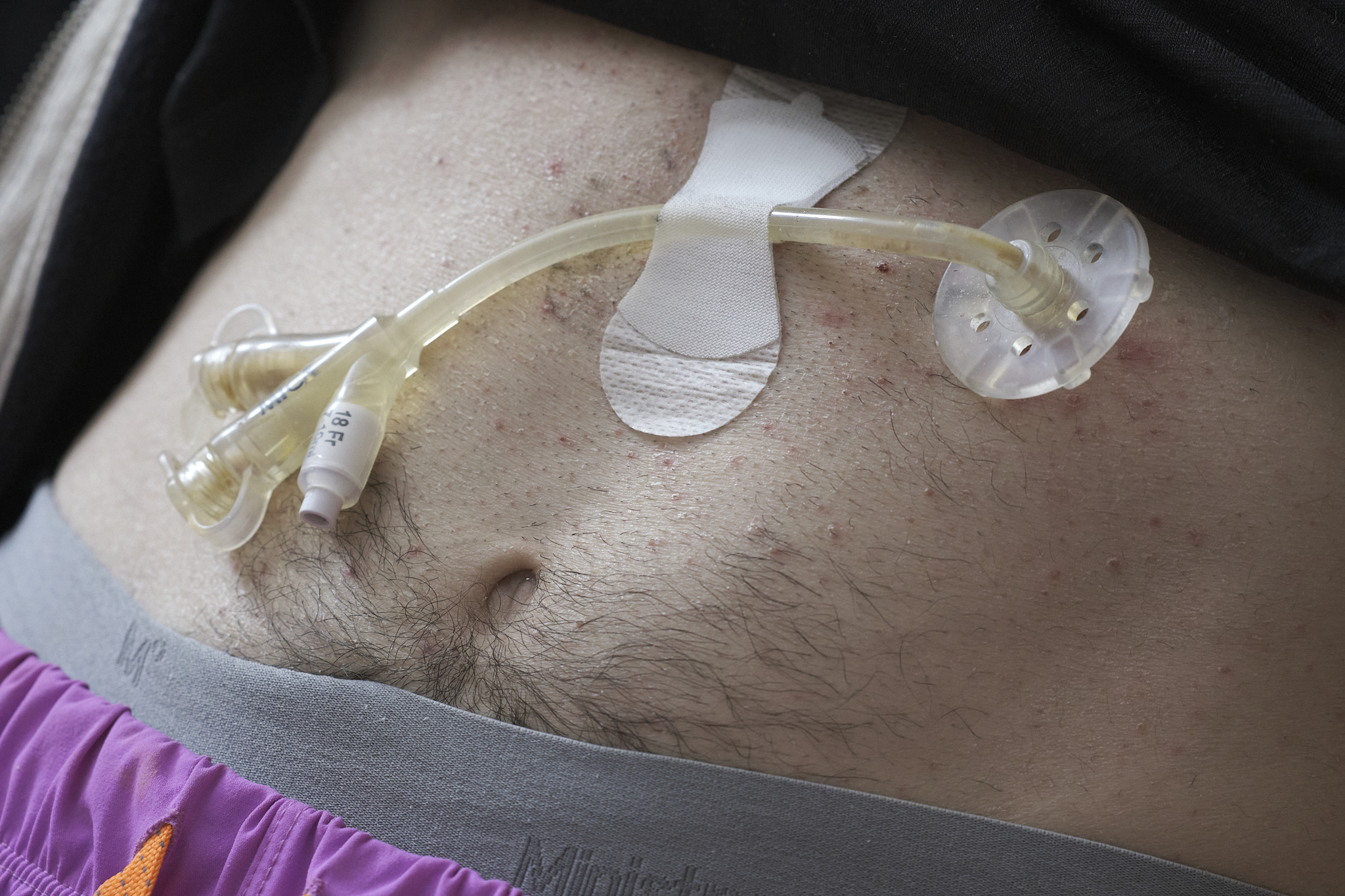
I had a PEG tubeinstalled while I was in the hospital between May 25 and June 5, and for several months the PEG tube was the exclusive means by which I got calories. This is what said tube looked like, until recently:
Make fun of this photo as you see fit: my friends already have.
As you can see, the damn thing sticks like six inches out, so it’s forever flopping around and getting caught on things. I relied on it to not die of starvation, which made this little item the most-interfaced with bit of medical equipment after my trache came out. Because of the constant in and out of the tube, the tissue gets irritated and forms painful masses of “granulation tissue” that requires steroids.
The white thing parallel to the tube itself is a “Grip-Lok” adhesive system, which I was constantly changing and which left my skin messed up. Showering was unsatisfying because of the Grip-Lok. Hugs were fraught. The damn thing kept getting caught on my shirt whenever I moved my arms. I struggled to gain weight, but the PEG tube also meant that I struggled to lift weights at the gym, because of the way it entangled with my shirt.
The PEG tube caused other problems; on Dec. 13, for example, the PEG tube inadvertently opened. Maybe it got caught in my belt or my shirt or something. Whatever the cause, stomach acid and partially digested Liquid Hope spewed all over me and the floor, which is both painful and gross: it smells like vomit (cause it is vomit). An open PEG tube literally spills calories out of me, and the resulting mess is hard to clean. So many things about my present (and permanent) condition are frustrating, like the tube opening, which makes an already physically and existentially difficult situation that much more frustrating. I can’t ignore a six-inch tube protruding from my body, and I have to interact with it multiple times a day to stay alive.
PEG tubes are supposed to last six months. Between June 5 and now, I had to go to the emergency room three times for tube problems: once because the tube slipped out of my stomach because the balloon had ruptured, and twice because the tube began leaking from the place where I (properly) kinked it. I know I properly kink it because I’ve checked with the education nurses to make sure I wasn’t inadvertently doing something wrong.
The third time happened Thanksgiving evening. Bess and I were lucky that the ER was relatively quiet, and one of her colleagues was able to locate a new tube and install it expeditiously. Still, hardly anyone wants to spend extra time in the ER.
The oncologist supervising me for the petosemtamab clinical trial at UCSD is named Dr. Sacco, and when I mentioned the Thanksgiving ER visit, she suggested I get a “button tube.”
“What’s that?” I asked.
She explained that it’s possible to install a PEG tube that’s low profile and comes with a detachable exterior tube (it’s also called a “mic-key” tube—as in much of medicine or the military, why use one term when you can use a bunch?). Bess followed up with my gastroenterologist, who said a button tube sounds like “a great idea, let’s do it.” We asked if one could be installed and, much like requesting necessary prescriptions, it was scheduled right away. Which is nice, but, also, why didn’t she tell me that the smaller, more humane tube is an option? Why were we once again having to direct my care in order to actually be cared for? The GI doc knew about my prior tube problems. Why do Bess and I have to figure this out? Neither of us are PEG tube experts. Instead of the system I used to have, my current situation looks like this:
That tiny nubbin is far easier to wrangle than the giant hose. Now the PEG tube doesn’t get caught on my shirt, or in my pants, or, potentially, on other objects. If it opens, nothing happens. Nothing, because I have to pop in an extension tube to inject. No spew. I don’t feel it rustling every time I move. Bess can hug me without coming at me from a ninety degree angle to avoid moving the tube. It turns out that installing the protruding PEG tube is standard the first time someone gets a new tube, but after two months the tract into the stomach heals and anyone can get a button tube.
So I could’ve gotten a button tube back in, say, August or September, and saved myself tremendous hassle. I asked the nurses who showed me the button tube what the downsides are, and they said that older people who don’t have good eyesight or dexterity may struggle to get the tube itself inserted and removed. Neither applies to me. For me, the button tube is all benefit. Yet I didn’t realize that a better PEG tube system is possible. So much of medicine is left to coincidence and circumstance, and I didn’t know what to ask. We didn’t know that we didn’t know.
Showering is even pleasant again! Maybe I’ll get in a pool somewhere? It’s been so long.
Phone calls to a man with no tongue and a trache in his neck
My tongue was removed and a “flap” installed on May 25. I got out of the hospital on Monday, June 5. Given that I had a tracheostomy tube in my throat and a massive, inflated flap of muscle in my mouth, I couldn’t talk. Yet that didn’t stop an incredible barrage of phone calls in the following two weeks. At the time, I wrote to friends and family:
Mayo clinic does everything via phone call. Given that they have a sizable ENT practice, which includes a large patient panel of people whose larynxes and voice boxes they have surgically removed, meaning many of their can’t speak, not incorporating texting-based contact seems bizarre. All these people call and leave messages asking me to call them back—but I can’t! Bess can, but she’s at the end of her tether too.
My sister stayed with me during that period, and she found the same:
On the topic of “remarkable,” albeit lacking positivity, is the sheer volume of calls and information directed at you daily. Your call log is just a fraction of what you’re dealing with. and possibly the most outrageous part of it all is the sound of surprise when the person on the other line (typically from insurance, mayo or other medical-related entity who should have access to your immediate medical history) when they learn, yet again, that you cannot speak.
Let’s say Bess wasn’t helping me. How would I handle all those calls? Shouldn’t there be a system for contacting people who can’t speak? I’d ask what would’ve happened if Bess couldn’t speak either, but now we know: Bess has just had vocal chord surgery, and whenever she gets a call she can whistle hello, and I can try to speak, and usually people just hang up and don’t call back. They must think they’re being pranked.
How about some gastrointestinal distress?
I wrote about this here, but I was initially prescribed an injectable food-like substance to subsist on, calorically:
I shuffled like a zombie, my left leg weakened from the taking of muscle. Inability to sleep due to snot and mucus meant that I lived in a foggy haze. Any food I ingested came from a horrible Nestlé product called “Nutren® 2.0.” Sample ingredients, taken from the Nestlé Health Science (science?) Nutren® 2.0 website:
I don’t think humans are meant to survive on sugar (not just one kind, but two are listed there), soy, palm kernel oil, and canola oil. I’ve never heard anyone recommend to a convalescing patient that they will get better faster on, exclusively, McDonald’s and ice cream (though you wouldn’t know it from reading hospital menus). But the Nutren® 2.0 edible food-like substance was on hand and probably easier on my stomach than real food. The Nutren® 2.0 first got injected by naso-gastric tube, a sensation that felt like postnasal drip I was expected to eat; maybe six or seven days after the surgery, interventional radiology (IR) punctured a hole through my abdomen and into my stomach to place a peg tube. That was better than the nose tube, except for the process of having it placed.
Later, however, I learned:
if you have to “eat” via peg tube, Functional Formularies’ Liquid Hope product is what you want, since it’s composed of recognizable ingredients that might offer some nutritional value
Someone from Mayo must’ve told Bess and me about how much better Liquid Hope is than Nutren 2.0 or Boost, right? “LOL,” as they say. Nope. A friend did. I wrote a friends and family email about how horrible Nutren 2.0 and Boost are, and said friend told Bess and me about Liquid Hope, since I’m not the first person to have perused the ingredient list of synthetic food-like substances and found those substances wanting. How could anyone with any awareness of basic human metabolism say to themselves: you know what people recovering from major cancer-surgery need to develop on top of everything else? Insulin resistance. The nutritionists I talked to during nutritional counseling seemed only to count calories. Counting calories is fine, and there are circumstances where people have major gastrointestinal disorders that prevent them from digesting normally, but there’s more to food and nutrition than the number of calories. If this is obvious to me, and anyone who’s read Michael Pollan, why isn’t it obvious to them?
It’s happening to everyone
It’s not just me: We have a friend who’s been trying to get pregnant via IVF for a while. She’s worked with two IVF docs, and one suggested an extra cycle of egg harvesting to make additional embryos in case she and her husband wanted extra options in the future, since they want two kids and she’s already 40. Six months in egg age can drastically change the ability to make embryos, and it’s recommended that women bank three embryos for every one child they want, since embryo transfers only “stick” 60% of the time (“stick” is the technical term). If they don’t bank embryos now, by the time she’s done with the first pregnancy, it may be too late to produce and harvest healthy eggs for another.
Our friend said to her other IVF doc: “Hey, do you think it’d be useful to do more egg harvesting?” And, in her account, the other doc was like: “That’s a great idea, I think more now is always better, let’s do it.” And our friend was like (mentally): “WTF? Why am I telling YOU this? You’re the fucking reproductive medicine doctor! If you think it’s such a great idea, why didn’t YOU suggest it to ME?” That same feeling has pervaded my cancer treatment. Even the words are similar to those I’ve heard from some of my docs. Why isn’t more of the IVF stuff standardized? Why is our friend only getting care that the doc thinks is great because our friend suggests it? The IVF doc is the expert, right? Shouldn’t the IVF doc know what to do and how to do it? Why is her patient guiding her, instead of her guiding the patient?
Another example, another friend. The other friend, who we’ll call Ashley, found a lump in her breast. She went to see her primary care doc, who felt the lump and said it’s nothing. A year later, the lump is still there, and Ashley is nervous. She works in healthcare, so she gets a friend of hers to write her for a mammogram and ultrasound. The lump is a highly unusual cancer, but definitely cancer. Will the year cost her her life? It’s going to cost her the breast at minimum, and her breast might’ve been saved by more timely intervention. What if Ashley hadn’t worked in healthcare and hadn’t followed up? What if she’d listened to her doctor?
I’m sensitive to the overly extreme role that lawyers play in the healthcare system, especially being married to an ER doc, but I think Ashley should really get a lawyer.
* “User experience,” the dark cousin of “user interface.” When you get frustrated by a badly designed website, the problem is often one of UX/UI.
** I thought its importance a 20 on a 100 point scale, but now I think it’s more like 55.
[1] The doctors who Bess chased down, queried, texted, called, and otherwise begged for help did offer their perspectives and, in a few cases, a very large quantity of their donated time, for which we’re incredibly grateful. If you’re one of those people, thank you! But if we hadn’t spent countless hours and resources trying to access them in the first place, we’d’ve never been privy to some recommendations and suggestions that were pivotal in decision-making.
Is This the End of Recycling? Americans are consuming more and more stuff. Now that other countries won’t take our papers and plastics, they’re ending up in the trash.” Recycling things like paper and plastics has long been a waste of energy and, worse, time. I think a lot of people like doing it because it’s easy, but it’s also irrelevant to actual environmentalism. What matters? Combatting NIMBYism, transport choices, that sort of thing.
Could the May 7 hearings mark a turning point for universities? It’s possible, sure. I’d love to see some change in the humanities and, realistically, social studies, but I don’t expect to see big changes. Not only professors but admins are now too acculturated into the social justice left (SJL) / woke / CRT / whatever-you-call-it worldview to change. I don’t exactly approve of legislative efforts to defund humanities programs, but I understand them. Universities were supposed to be devoted to disinterested free inquiry; if many of them, and many humanities departments, are explicitly devoted to being the ideological enemies of the legislators, and to producing “students” who are ideological enemies, why give them money? Aren’t the humanities supposed to help people see things from someone else’s point of view?
Math team. On intrinsic interest, real learning, college admissions, and other topics.
* Related to the above: Why math professor Alexander Barvinok objects to “diversity” statements. Note: “the routine affirmation of one’s beliefs as a precondition of making a living constitutes compelled speech and corrupts everyone who participates in the performance.” And, see further: “The Moral Decline of Elite Universities: Too much of academia cares little for universal human dignity, leaves no space for forgiveness, and exhibits no interest in shared progress.”
* “We will all become boring: Loneliness, liberalism, and the traditional family.” Poorly titled but interesting, and really about how to live your life. It underemphasizes the extent to which individuals also owe good, prosocial behavior to the groups they’re a part of. Another essay could be written along similar lines that emphasizes how important that is.
* Saying no, by Ryan Holiday. I’d highlight this: “I once heard someone say that early in our careers, we say yes to everything so at one point we can afford to say no.” The earlier you are in your career, the less known you are, the fewer the number of requests that you get, the more you should tilt towards say “yes.” I’ve also learned the hard way that, if you say yes and then can’t do the thing, or don’t want to, the sooner you correct the “yes” to a “no,” the better. Neal Stephenson’s essay “Why I Am a Bad Correspondent” is germane too. Holiday mentions that “I used to post my email address on my website, and I would respond to everyone and everything.” I still mostly do this for commenters, or commenters on Bess’s Substack, but I probably get at least an order of magnitude less inbound than he does. Different scales require different strategies. “Do things that don’t scale” is applicable.
Particularly since my cancer’s recurrence and metastases, I’ve said “no” to a lot more than I would’ve before—and some of the things I’ve said “no” to have hurt. Friends and acquaintances who are well meaning and want to see me, but whose visits mean that Bess and I won’t get the writing done we’d like to do. Journalists or “journalists” who appear not to have read whatever Bess or I have already written publicly about a subject. Focus matters. Do I want to speak to tens of thousands of people, or one or a few? How do I decide? Few inbound queries asking me for stuff start with: “I donated to your Go Fund Me, and….” And look, I’m not saying everyone can or should do that. I’ve written to and semi-coached a lot of people with head and neck cancers; few understand better than me how parlous cancer makes one’s finances. But that’s a possible strategy for standing out and appearing worth investing in—a topic I’ve hit in How to get coaching, mentoring, and attention). I’ve seen stories from VCs or startup founders who will say that one way to stand out in email or Twitter is to, instead of saying, “Can we get coffee?”, saying: “Can I buy you coffee?” It’s only a few dollars, but bringing something to the table is different than not, even if you’re bringing something minor.
* The low fertility crisis is one of opportunity costs. But I think it underestimates the role of high housing costs caused by government-imposed restrictions on new construction.
* Most professional sports have too many games and so devalue their games. The games and even playoffs don’t become societal Shelling points any more.
* “Dwarkesh Patel interviews Andy Matuschak on Self-Teaching, Spaced Repetition, and Why Books Don’t Work.” Among other things. His thoughts on the education system stand out to me.
Since finding out that the petosemtamab / MCLA-158 clinical trial drug I’m receiving has been shrinking my tumors, I’ve been considering a question that, as of July 21, I’d banished from my mind: What if things go right? Plus: What if I unexpectedly survive for an extended period of time? “Extended” as in, conceivably years (plural). Although it’s improbable that I’ll get what’s called in the clinical-trial business “complete response,” or total elimination, published phase 1 trial data shows that petosemtamab is effective for about six months for the median person suffering head and neck cancer.
After petosemtamab stops being effective, however, I’ll be able to switch to another clinical trial drug, with a different mechanism of action, and, as I wrote in “Tentative, fluttering optimism: The R & D ferment in head and neck cancer treatment,” there are at least three and probably more than half a dozen treatments that’ve shown some success. In July, I didn’t realize that there were any apart from Keytruda, which I’d already failed, and my primary oncologist then either didn’t know anything about the clinical-trial successes in his field (which is bad) or didn’t tell me about them (which might be worse).
In July, I assumed that I’d live weeks to months, and that short lifespan projection wasn’t unreasonable: the squamous cell carcinoma that started in my tongue has been relentlessly fast and aggressive. Extensive radiation therapy barely slowed it, and throughout May the tumor recurred so rapidly and grew so unexpectedly that, instead of losing half my tongue (as was anticipated), I lost all of it. The May 25 salvage surgery, combined with Keytruda, could have been curative, but, well, we know how that turned out: the cancer was back and bigger than ever in under two months. There were four tumors in my neck and multiple “nodules” presumed to be cancer in my lungs. Pessimism was warranted: Chemo is only palliative for what I have, and Keytruda only works for 20 – 30% of patients, me not among them.
Bess responded to the ill news by spending almost every waking hour for six weeks after my metastatic recurrence learning about the clinical trial system; the result is her epic tale and guide, “Please be dying, but not too quickly: A three-part, very deep dive into the insanity that is the ‘modern’ clinical trial system.” She turned out to be more helpful, and infinitely more interested, than some of the head and neck oncologists we talked to, some of whom had never heard of petosemtamab or BCA-101, two of the most promising HNSCC treatments. While Bess mastered the clinical trial system, I got two rounds of chemotherapy, which, on top of a continuing recovery from the brutal surgery, made me feel barely alive. Despite making me feel abysmal, those chemo rounds bought some time and, thanks to Bess’s efforts, I enrolled in the petosemtamab trial at UCSD.
Moreover, as mentioned above, CT scans after two months of petosemtamab treatment show that it’s effective: the tumors in my neck and lungs are now, on average, about 12.5% smaller than they were on Sept. 5. I’m still far from doing great, but I’m a little better than I was through the most intense parts of the surgery recovery, then the chemo, and then an indolent infection in a necrotic lymph node on the right side of my neck. I’m better able to take care of myself and Bess is planning to go back to work. The cancer is almost certainly still going to kill me, but we have a legitimate plan for keeping it at bay for as long as possible. How long? I don’t know. Not knowing makes it tough to figure out what to do with the life I have left. When I thought I was going to be gone in weeks to months, I focused on saying goodbye.*
Now what? Focus on saying hello, which is I guess the antonym of saying goodbye? How much should I focus on working for money? If I’m only going to live for six months, the answer is “Not much.” “Six years” yields a different priority and behavior set. The questions are unanswerable, though I have to answer them through my choices, despite them not being deterministic or computable. In the last five months, mere survival has been the desperate goal, and in pursuing that goal I’ve been thankful for and blessed in the generosity of friends, readers, and strangers in contributing to the Go Fund Me that my brother set up, which has let Bess and me focus on physical and medical challenges more than financial ones. I’ve been terribly sick, and lucky for the support, particularly in light of the mystery five-figure bills that are peculiarly not covered by United Healthcare (a topic to be further explored in the future). Because of the Go Fund Me, I’ve not been forced into the brutal, impossible decisions many cancer patients face, and for that I’m grateful. Even so, getting and staying sick for long periods of time is hard; I’m highly pro-vaccine for lots of reasons, the main one being that being sick sucks and being healthy is better. Granted, being sick is better than dying, most of the time.
In some sense everyone’s future is unknowable; lots of friends correctly point out that anyone can die at any time. While that’s obviously true, most of us expect, most of the time, to live into, say, our 70s—and actuarial tables agree. Call it 75 meaningful years. Some people get more, but by 75 a person has to wonder, at current levels of medical technology, how much is left and what the quality of what’s left might be. People in their 30s, unless they have a terminal disease, anticipate and act with decades in mind; most of us are raising families or trying to have kids, building assets, and developing careers. Memento mori, yes, yes, and the knowledge that life is fleeting, should drive us to do things that are meaningful and eschew common bullshit like bad TV or short-form video or petty feuds—all the stuff that life’s too short for. Overall, though, we plan to live more than we plan to die.
[Y]ou are the inverse of what most of us wrestle with day to day. There is a small probability that we could die soon, but we probably won’t. So we have to plan for the future practically and figure out how to live accordingly. Yours is the opposite. You are staring at the likelihood of death but you could live. You have to prepare and plan accordingly, make sense of that philosophically. It must be very strange…though I guess when I think about it like this, it’s pretty strange for all of us.
If things go right, things will also have to change. I won’t be able to pitch clients the way I did back when I had a tongue, for example—I’m hard to understand on the phone. I’m less energetic, and I have hours each day of food and medical care that can’t be ignored. Bess and I have been trying to have a kid; what’s that look like? When I saw the dreaded news in July—”likely multifocal disease recurrence along the flap margins and posterior sternocleidomastoid” and “there are multiple new enhancing masses concerning for multiple areas of disease recurrence predominantly along the inferior margin of the flap, with an additional 1.9 cm necrotic mass between the right internal jugular vein and sternocleidomastoid muscle”—Bess was talking on her phone to a realtor about buying a housing unit.
Everyone faces known unknowns and unknown unknowns, but we plan and execute our lives as best we can, knowing that we’ll likely get our future selves wrong (a topic Bess addresses in “Remembering things that haven’t happened yet: How will I know what I need to hear in a future I can’t anticipate? Who will I be, and what will she want?”). I have a larger number of unknowns, though, relative to the average person my age. I’ve adjusted my life in other ways, too; I’ve not been seeking out new friendships in everyday life to the extent I used to. Part of that is because being hard to understand makes cultivating casual friendships hard. And, if I’m going to die in a couple months, I want to focus exclusively on the people I know and on saying goodbye. If not, then I don’t want to lead a life of loneliness, as so many people do now, often, I think, inadvertently. There’s never a deliberate decision to pursue isolation, just a series of smaller choices that wind up with radical disconnection and the unhappiness that brings. Drift and complacency rule so much of human life, yet no one gets to the end and says, “I wish I’d drifted more. I wish I’d been more complacent.” Hardly anyone regrets energetically pursuing goals, ideas, knowledge, or business, but drift, inertia, complacency—they’re bad. We may not get our future selves right, but we can try to reduce the regrets of our future self.
If things go right, much will change, not only with making new friends and associates, but with maintaining old ones. It’s been hard to keep up, verbally, with friends. Most days I don’t have the energy to go out and do normal things with people. Friendships become attenuated over time as the casual touches—phone calls, coffees, adventures, whatever—slide away. So much of my old life feels like it’s sloughing off. I’ve met new friends through writing online, and some old friends have resurfaced, so the writing has produced some benefits I didn’t anticipate.
Many previous hobbies and interests probably won’t work anymore. Maybe some of my previous hobbies and interests were rooted in young adulthood, and the true adult interests of mature adulthood are coming in but aren’t quite there yet (a lot of people who live in New York can’t or think they can’t afford kids, giving them a Peter Pan quality). Probably I will never do MDMA again, despite its virtues for relationships. Other psychedelics are possible. Probably I will ride electric bikes again. Teaching? Probably not. I miss teaching, but doing it the conventional, legacy way through existing colleges and universities has so little money in it that, despite liking to teach, I’ve been waffling for years about whether it’s worthwhile. And now I’d have to struggle to be understood.
A lot of spontaneous go-places-and-do-things adventures are out: I’m too fragile and too encumbered by the gear necessary to support life. Not everyone agrees. When I said to Bess that something like, say, a week in Italy seems impossible, she surprised me by quickly rattling off a plan to rent a room above a bookshop somewhere in Tuscany and manage PEG tube feedings (I’m supposed to get a “button” PEG tube installed soon, which will sit flush against my stomach and be less of a hassle)—plus, what kind of European conversion plug the VitaMix would require and how to fit in a weekend in Rome, as if she’d been planning a potential trip for the last month, which, who knows, maybe she has. She’s a surprising, energetic woman. A week in Italy still sounds like excessive struggle, but her detailed thoughts demonstrated that having a wife who likes to travel and troubleshoot is useful for more than clinical trials. She’s really telling me, I think, that if I somehow survive this, however improbable survival is, if my life is somehow one day not utterly dominated by treatment needs, we’re not merely going to survive; we’re going to thrive.
The old ways are dead, but have the new ones been born? I’m not sure, but I’m trying to find out.
* For me, although petosemtamab is extremely unlikely to be curative, after it perhaps there will be nt219, which, in a phase 1 study, found that two of four head and neck squamous cell carcinoma (HNSCC) patients saw “partial response.” And after that something else, like Seagen’s SGN-PDL1V (Pfizer just bought Seagen for $43 billion, implying a lot of belief in Seagen’s drug pipeline). Or maybe petosemtamab will turn me into a Keytruda responder.
* Battery recycling is taking off. Humans still need, collectively, a massive amount of raw, mined material (estimates vary on exactly how much) but battery production is shifting towards lithium iron phosphate (LFP) and there may even be some shifts towards sodium batteries. Those trends auger for much less dependence on Congolese cobalt. Oh, and Lithium prices have dropped 77% in the last year. Demand goes up, new sources are found, and the price drops. The price acts as an incentive. “Shortages” of commodities rarely last.
* Why the age of American progress ended. We should try for progress again. I’m particularly interested in progress, given that medical tech progress is the only way I’m likely to live.
* Patagonia removing PFAS / “forever chemicals” from its clothes. I got a Patagonia “Nano-puffer” coat that can be stuffed into itself, yielding a tiny package good for travel, and, although I like it, I also used a seam ripper to remove the Patagonia label from the chest. I’m not a billboard for a company.
An oncologist at UCLA told Bess and me that “Head and neck cancer has become a hot R & D area in the last year,” which I find exciting: moving from “a death sentence” to a “a hot R & D area” is great, since I have recurrent and metastatic neck cancer. It started in my neck and has since reached my lungs; if it reaches much further, no clinical trial will be able to help me. I’ve read and quoted research summaries like this one: “Recurrent / metastatic SCCHN [squamous cell carcinoma of the head and neck] have poor prognosis with a median survival of about 12 months despite treatments.” Sounds bad, right? Based on those research summaries, and based on my tumor’s aggression, hitting the median survival range of twelve months seemed unlikely, and in response to those research summaries I wrote essays like “I know what happens to me after I die, but what about those left behind?” But now I’m starting to feel some tentative, fluttering optimism.
Some of that tentative, fluttering optimism is downstream of the Nov. 15 news that petosemtamab / MCLA-158 is shrinking the tumors in my neck and lungs. A UC San Diego (UCSD) Medical Center radiologist estimated that my overall tumor burden shrunk an average of 12.5% between Sept. 5 and Nov. 15. That’s great news. In a phase 1 trial, petosemtamab’s median duration of response was six months, implying that, if I’m the median responder, I have until March – April until the drug stops working and my tumors start growing again. Relative to dying, I’m pleased with the results so far, the median duration of response implies that it’d be a good idea to have a gameplan for what to do next before the crisis. The medical system can move fast at times, but it’s best not to rely on it moving fast: some appointments take weeks or longer between initial contact and the actual appointment.



 The Story's Story