Before the May 25 cancer surgery that took my tongue, I’d been lifting weights, steadily but poorly, for a decade, and that habit is in part responsible for me pulling through the horrific aftermath of the surgery. The more physically robust a person is, the greater the margin for pain and for recovery—and I feel like I barely made it through the long, brutal surgical recovery period, which constituted the whole summer, followed by chemo in July and August, and then by an indolent infection in September and October. I weighed 175 lbs before my first cancer surgery, in October 2022, and bottomed out in the 133 – 136 range last summer. Now I’m hovering between 138 – 142, despite extensive, annoying, continuous efforts to eat more, via both mouth and feeding tube injection. Eating can be a pleasure or pain, but eating for weight gain isn’t fun, particularly when the weight gain is elusive.
For months, food has stolen too much focus from me, because I need to avoid missing meals to maximize calories. Did I just wake up? Time to make a smoothie, or blend some leftovers, and then inject a bag of Liquid Hope through my feeding tube. Is the sun scooching past its zenith, which means lunch time is a little behind me? Then some calories need to go in. Are we getting past 8:00 p.m.? That’s a potential problem because of acid reflux if I lie down too soon after eating. Whatever else I’m doing, or learning, or concentrating on, there’s an annoying cognitive process weighing my food needs running in the back of my mind. Weight training can help me gain weight, yes, but to make the weight training effective, I have to consume enough calories—with “enough” tending to mean “somewhat more than I’ve been able to ingest on any given day.” Since I can’t chew or swallow normally, food must be blended with water for either injection or swallowing, and water reduces caloric density.
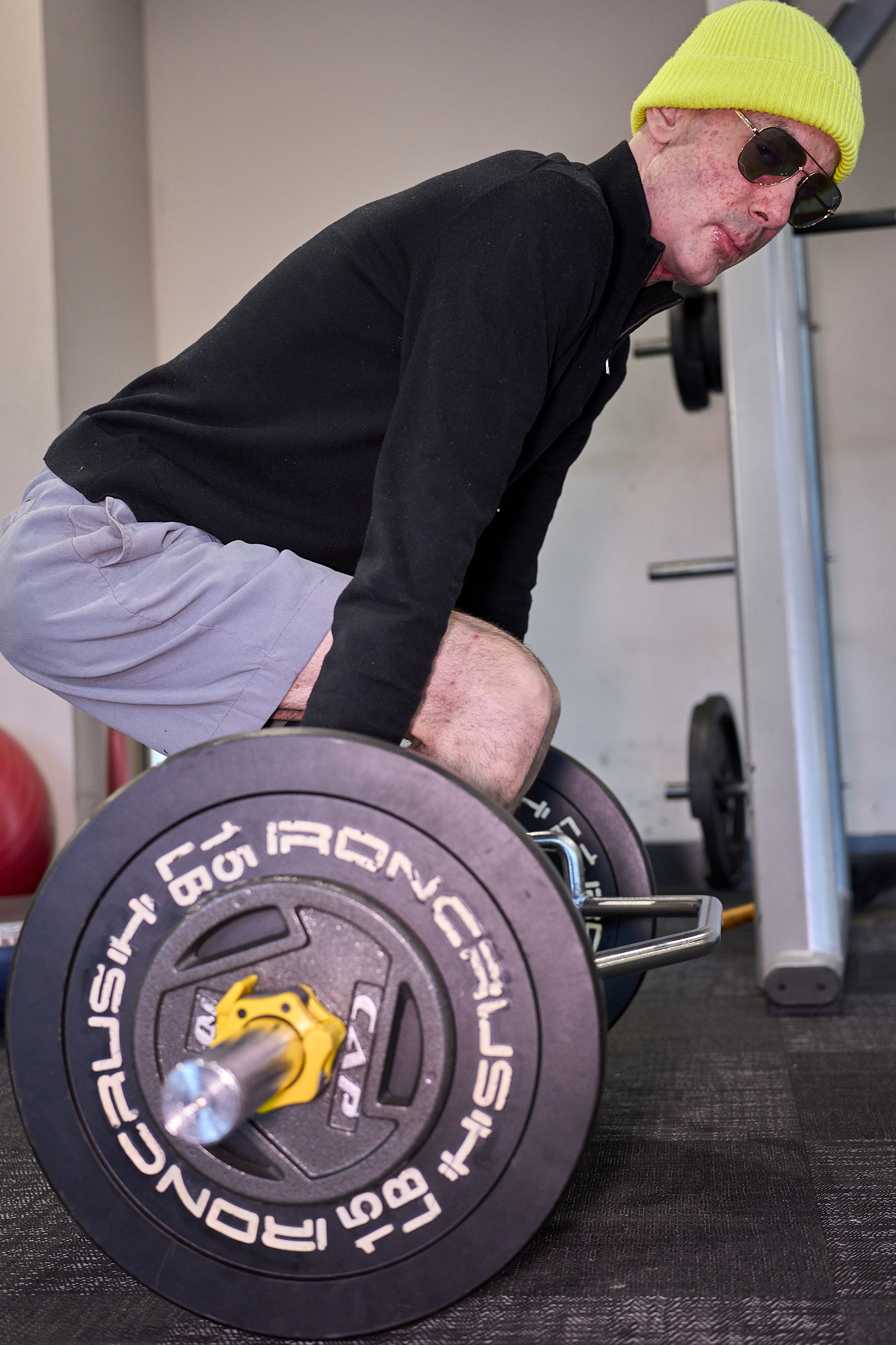
Eating is important, but, as noted, I hope to augment food with lifting. Before that first surgery, I could rep 145 lb on the squat fairly easily, and I was working my deadlift reps towards 225 lbs—”two plates,” in meathead parlance.[1] Not a lot, but better than no training. When I got back into the gym maybe a month after my first partial glossectomy in November 2022, I felt like I could barely lift my arms, and had to re-start with the bar on the squat rack, and 15 lbs training bumpers on either side of the deadlift hex bar. I started re-building as best I could, though I knew that radiation therapy would probably knock me back again.
In being knocked back, I feel some kinship with the totality of humanity. For most of human existence, humans have been building up all kinds of tribes, structures, and/or civilizations, only to be knocked back by weather, climate change, internal dissension, greed, barbarians, technological regression, disease, or some other force. It’s only since the Industrial Revolution that humans have managed to mostly transcend the condition of agricultural misery and paucity, though we might wind up in such horrifying conditions again, via nuclear war or plague or some other malady. As individuals, we’re less robust than contemporary societies or cultures, and we’re prone to setbacks like the ones I’ve experienced. I suspect that how a person responds to setbacks says something about them; my view is that the appropriate response to adversity is to persist, even futilely, even as one possibly rages against the dying light.
That philosophical outlook is evident in me going to the gym despite feeling wretched and janky. To not go is to risk not replenishing my margin for future, and (realistically) inevitable setbacks. To not go means there is worse to come. Sure, as long as the clinical trial drug petosemtamab keeps working, I can probably hover in the 140 lbs range without risk of organ failure or starvation. Apart from being skeletally thin, the other worry is the next bump in the road. What if I need another surgery? What if there’s more chemo in my future—which I expect before the end, even if “more chemo” is an effort to hold the line as I exit one clinical trial and before beginning another? What if a clinical-trial drug causes nausea? What if re-irradiation comes, and the pain that already accompanies swallowing worsens? I list the known unknowns: the unknown unknowns are infinite.
As I write this, I take a break to check my weight: 140.1 lbs. Not great but could be worse. The last week hasn’t been ideal regarding the gym : on Monday I was wrapped up in a project, Tuesday I flew to San Diego and got settled there, Wednesday I had a petosemtamab infusion, Thursday I flew home, Friday I withdrew from the prescribed dexamethasone—a steroid—that is supposed to help prevent infusion reactions to petosemtamab, and today, Saturday, I finally got in to do overhead press, hangs, and the leg press. I should’ve squatted but delayed, making excuses. The fire that used to inspire me to pump iron is gone. Meatheads speak of the “pump” when they lift; Arnold Schwarzenegger described it in Pumping Iron:
The greatest feeling you can get in a gym or the most satisfying feeling you can get in the gym is the pump. Let’s say you train your biceps, blood is rushing in to your muscles and that’s what we call the pump. Your muscles get a really tight feeling like your skin is going to explode any minute and its really tight and its like someone is blowing air into your muscle and it just blows up and it feels different, it feels fantastic. It’s as satisfying to me as cumming is, you know, as in having sex with a woman and cumming. So can you believe how much I am in heaven? I am like getting the feeling of cumming in the gym; I’m getting the feeling of cumming at home; I’m getting the feeling of cumming backstage; when I pump up, when I pose out in front of 5000 people I get the same feeling, so I am cumming day and night. It’s terrific, right? So you know, I am in heaven.
I personally haven’t experienced the level of, um, endorphin rush that Arnold describes—I suspect few people do, or gyms would be packed—but I’ve gotten a pale imitation of the physical satisfaction he cites. My occupations have been thinky and sedentary, and running or lifting contrasts with sitting in the chair or standing and typing. Unfortunately, whatever physical pleasures lifting once brought have dissipated. Now, it’s more chore than not. An important chore, but a chore. It used to be fun. I used to know how to make it fun. I’m sad that that sense of fun is gone, and I’ve not really been able to rekindle it.
Pain, not from the lifting but from everything else, is an issue. There’s good pain and bad pain, like there’s good perseverance and bad, and lifting correctly brings the good pain. For me, though, bad has been outweighing good since the second surgery. Movement has been part of my recovery, but I do it reluctantly rather than joyfully. Today, besides stiffness and fatigue and fear, my toes are a problem.
“Your toes?” you might be thinking, fairly and skeptically. Yes, my toes. Petosemtamab is an EGFR inhibitor drug, and EGFR stands for “epidermal growth factor receptor”—and, as Wikipedia notes, “Activation of the receptor is important for the innate immune response in human skin.” EGFR inhibitors can prevent some cancers from growing or metastasizing, but they also frequently cause cracking and bleeding of the skin, as has happened to me. The pads of my fingers always look like I’ve been in a hot tub for an hour. The outside of both big toes are purple-red, which sounds and is painful. Pulling on socks or shoes turns me into an old man, moving with slow deliberation to prevent further injury or pain. I’ve ordered sandals, despite how ugly and imprecise they are, because of my toes. As you’d imagine, I’m not as thrilled to hit the gym as I was when skin didn’t cause continual pain.
Friends and strangers have said they’re shocked that I’m still lifting, or, more realistically, trying to lift. I get their shock. The attitude often conveys a bit of: “Give yourself a break, man,” which I get too. I want a break; I want a break from my body’s many problems, which are better than they were six months ago but which will almost certainly never be resolved.[2] I’m not going to get a break, though, and so I’m focusing on what’s in my locus of control, and whether I squat and overhead press is within that locus of control. During radiation therapy, I’d run into friends and acquittances at my apartment’s gym, and when they asked how I was doing, I’d answer directly: “Radiation therapy sucks, but I’m going to keep coming to the iron temple as long as possible.” Was I doing a lot in the gym? No. Was I anywhere close to maxing out my capabilities, even then? Again, no. But I was doing something to try to push my universe in a positive direction, against the friction of pain, exhaustion, and misery.
In the first paragraph I wrote that I’ve lifted “weights, steadily but poorly, for a decade.” The “poorly” may seem a strange choice of word, but it’s accurate. Years ago I read “Everything You Know About Fitness Is a Lie” which extolled black-iron lifting and denigrated the single-purpose machines that constitute the bulk of most gyms. Later, I’d find out that the author goes too far against what he perceives to be the mainstream, in that he doesn’t emphasize range of motion. Still, I read Mark Rippetoe’s Starting Strength: Basic Barbell Training and began lifting. Rippetoe, however, also doesn’t emphasize something he should: mobility and flexibility. Mine were poor, though I didn’t know when I began. So I studied the black-iron compound lifts, and I kept pushing through the pain caused by “tight hammies,” which led to injury. I found a “Starting Strength” certified coach at South Brooklyn Crossfit to guide me. Turns out he didn’t know anything about mobility or flexibility either. Years of running and sitting hadn’t helped me become a supple leopard. There was much I didn’t know that I didn’t know.[3]
I learned slowly and fitfully. Some knowledge came from weekly “bare bones basics” yoga classes with Paula Tursi in NYC, who used to look at me with kind amusement as I made struggling noises while reaching futilely for my toes beside a gaggle of women who could fetchingly fold themselves in half. Now I understand the usefulness of hamstring range of motion, of hip flexibility, of calf stretches, of the need to move side-to-side, of sitting with legs folded under me. Learning motion and mobility piecemeal occurred over years, and I never got good at weight training. To be fair, weight training wasn’t a primary, driving purpose in my life; it was a secondary or more likely tertiary activity that was and is important. I wish I’d paid more attention to injuries and other problems as they happened.
Like a lot of people, injuries in my teens and twenties overwhelmingly resolved themselves with minimal intervention, but as I got older, that became less and less true. Just before I moved to New York City, for example, I hurt my shoulder while a student was teaching me the butterfly stroke in a pool, and that shoulder injury dogged me for years. I saw a physical medicine and rehab doctor (PM&R) in New York City who, I’m pretty sure, shook me down for some boat payments by giving me dubious tests, rather than sending me right away to a physical therapist. The first physical therapist I saw was okay but seemed not to have deep understanding of injury and body mechanics. And so it went, with me slowly accumulating a body of knowledge about how weightlifting should actually work, and how to deal with a body that is stiff and needs stretching and mobility work.
By the time I got somewhat okay at lifting, cancer came along, and thus stymied me again. Given my present age and condition, “lifting well” will be one of those things I never do. Which is okay. Some doors close. That any doors at all remain open to me is borderline miraculous. In my life, I’ve gotten my share of motion. Before I lifted weights, I ran; I’ve seen articles about how running (supposedly) makes us human, but then I began seeing the articles about the many (supposed) benefits of lifting. So I switched, but without adequately addressing those mobility problems; this is like deciding to emigrate to a new country without giving a thought to the country’s language or food or culture. I was never a good runner, either. I think I liked doing it but didn’t care about winning any given race. Some things are important to win, but others aren’t.
Now I’m in a “race” to gain weight before the next affliction. Last week, I slid ten pounds on the bar, five on each side, so that I was squatting 55 lbs instead of 45. That’s still barely anything, but it’s more than it was. January scans show that my tumors are approximately stable vis-à-vis November scans, so I likely have until March in approximately my present condition. Can I bulk up to a consistent 145 lbs by then? Will the ice cream I’m eating work? I’m skeptical that the answer to either question is “yes,” but trying to achieve those goals seems better than giving up. I’m likely to wind up with brain or bone metastases at some point, and they’ll likely be the signal that my time is done, and that the bonus time I’ve been granted from August to now has expired.
I mentioned to my oncologist, Dr. Sacco, regarding the perhaps excessive, obsessive work Bess and I have done in learning about clinical trials that “Only the paranoid survive.” The literary among you will recognize the allusion to Andy Grove’s famous book. Paranoia seems warranted. After the initial surgery, neither Bess nor I understood how bad perineural invasion is—that is, when the tumor invades the nerves in my tongue. The answer appears to be: “Much worse than we’d understood,” given how cancer hijacks the nervous system to grow and spread. Some oncology teams treat perineural invasion as one high-risk feature among many; others, it turns out, consider it particularly pernicious and worth of heightened treatment. I didn’t know then, however. When the tumor board told me that my case was borderline between requiring radiation or not, the oncologist said: “Why are you even here to see me? You don’t need chemo.”
Ha. Haha. Funny.
Bess turned to doctor groups online to share my case and get their input on the radiation question. She didn’t realize it wasn’t quite the right query, however, because we didn’t realize we needed to second guess (or third and fourth guess, since the tumor board is made up of multiple physicians) radiation. Instead, the more interesting questions would’ve concerned the role of chemotherapy in radiosensitizing tumors like mine, which various cancer-expert consensus statements deemed unnecessary based on a one-size-fits-most algorithm that would have added it on if my cancer had spread to a lymph node. Back then, we’d not heard about Transgene’s TG4050 vaccine; in a phase 1 study, “the participants receive their vaccine immediately after they complete their adjuvant treatment.” That’s what I needed, but I didn’t know it. .
Instead of asking about radiation versus not, the better question would’ve been: “Given what’s happened to Jake so far, what should we do?” Most docs don’t like to answer questions like that without reviewing a patient’s complete chart, but that might’ve given us responses pointing to both chemo and radiation. That might’ve given us responses pointing us to clinical trials. Admittedly, when Bess asked for help pointing us in the direction of clinical trials when that saga first began, no one in physician communities of 100,000 people were able to say “I have one!”, though many recommended research institutions. Bess and I are, to be clear, grateful for their help.
But we asked wrong, or at least not as right as we should’ve been. Our questions were a little too small, a little too constrained. Neither of us was sufficiently paranoid, and we’ve paid horribly for that inattention. I’d not properly realized then the degree to which much is overlooked in the healthcare system. I’d not realized the degree to which we’d have to find our own answers and advocate for care. Even the word “system” is a kind of misnomer: there’s less a system than a series of barely connected pieces, a set of kludges that work well enough in many cases but not in all.
So I’ve learned that, whenever and wherever I can grab an edge, I should grab that edge. I’m a little paranoid about not doing enough time in the gym. Right now, one “edge” I can get is through gripping the dumbbells and pushing, pulling, hoisting, squatting, and springing. Probably I’m not helping myself and by extension everyone around me as much as I’d like to imagine. I don’t love the gym any more, I don’t get any sick pumps, and being in it reminds me of all that I’ve lost, and yet I keep going. What is the alternative?
If you’ve gotten this far, consider the Go Fund Me that’s funding ongoing care.
[1] The nomenclature here is odd; the largest weight in most non-specialty gyms is 45 lbs, and putting one “plate” one each side side of the bar is sometimes referred to as “one plate” (despite there being a plate on each side). So a 225 lbs deadlift is “two plates”—and a standard bar is 45 lbs. Gym rats often think in multiples of 45.
[2] True resolution would probably require some kind of technology to regenerate and heal the body at the cellular level and would probably be indistinguishable from immortality or near immortality. I’m not counting on that in the short term, although, with effective accelerationism and continued technological development, who knows what might be possible in the decades to come? In order to get to something like cellular-level, total-body regeneration, I’d also have to survive the cancer in the short term—which, while not utterly impossible, is pretty unlikely. I’m planning for the likely outcome while keeping the improbable in mind.
[3] Bess and I have written about the same issues regarding clinical trial drugs.

 The Story's Story
I’m forwarding this for a couple of reasons. 1. Author has an interesting story but 2. Mainly because of how well he writes. It’s unusual that anyone these days writes so clearly yet uses all the “good” words and phrases properly. I thought you’d enjoy the quality of the article as well.
Author and doctor wife Beth live here in Phoenix somewhere. I first spotted one of his essays on the Broken Healthcare System, became enamoured by the style and story so I’m now subscribed and get a periodic update. His journey has been very educational thus far.
Bk
LikeLiked by 1 person
I’m afraid of the kind of experience you described, and grateful you did. A decade ago, I had a modest awakening when, out of my control, but not at all as drastic as what you had to go through, I lost 30+ pounds in 3 months.
As someone who started trying to be in a healthy weight range just two years before, I often wonder what I would have lost if those 30 lbs hadn’t been there.
When someone at work is surprised about me working out 3–5 times per week, I am aware that I owe it to myself because you never know when that robustness, as you called it, may have to be there again.
Your journey, and the presence and determination throughout it, are grounding, admirable, and humbling. Thank you for sharing it.
LikeLiked by 1 person
I just began Starting Strength in my mid-thirties. Buddy sold me on increased bone density, tendon thickness, and extra mass for when shit hits the fan. Timely.
Anyway. Love your writing. Absolutely refreshing. Restored some of my faith in humanity, and I’ve just dipped my toes into your archives. Thank you for sharing it.
LikeLike
Matt, I hope you had (and have!) the mobility / flexibility to do the compound lifts correctly and safely (as I did not).
Restored some of my faith in humanity, and I’ve just dipped my toes into your archives. Thank you for sharing it.
You’re welcome, and Bess and I are co-writing a memoir. Further news of it will appear at some point!
LikeLike
And you have, once again, made a huge impact on my life, with this article. The Everything You Know About Fitness is a Lie article, and your own experience, has pushed me into different routines at the gym from what I was doing, which has also spurred a bunch of extra reading and viewing on nutrition, routines, hypertrophy vs strength and a bunch of other topics.
I’ve now been a pretty consistent gym rat for about 3 months, and have noticed some real changes thanks to the advice in this and Daniel Duane’s article you’ve linked, and it’s all very much changed my thought processes around health and fitness.
Thank you, once again, for supplying invaluable information, which has by now absolutely changed my life and various thought processes.
LikeLiked by 1 person
Glad to hear it: sometimes the right thing finds us at the right moment.
LikeLiked by 1 person