What’s the purpose of life? The question is annoying and contingent and probably unanswerable, but it’s also important and vital and guides our actions. I’ve been thinking about the purpose of life lately, for obvious reasons related to me prematurely dying, and my answer is congruent with the Brooks answer: life is about other people and our relationships—defined broadly—to them. Okay, if that’s the answer then can we be dismissed and go home to watch TV? Probably not, because the answer demands more elaboration, though most of us sweep it under the rug sometime in our late teens or early 20s and prefer not to revisit it, as if it’s an elderly relative who is no longer really here.
The “What’s the purpose of life?” question is not only annoying but also frequently uncomfortable, since it foregrounds the end, which is, at current technological levels, inevitable. We don’t like the question because we don’t want to ask: are we living up to our potential? Are we achieving our purpose(s)? If the answer is “no,” it’s comforting to ask other, less important questions, like who won the game last night. We can’t always be asking the big questions. Often, we have to be asking: “What’s for dinner tonight, and who’s going to make it?” But we should sometimes ask them, and try to answer.
If our everyday actions are incompatible with what the purpose of our lives ought to be, that argues for course correcting. Course correcting is hard, too, relative to continuing to do what we’re already doing. I’m guilty of coasting because it’s easy. I’m also guilty, though, of a certain fondness for both absurdity and excessively avoiding banalities, both of which lend themselves to not only thinking about hard, unanswerable things, but sorting people in those who are like me and those who are repelled by me. Lately I’ve been dying of squamous cell carcinoma, and when casual acquaintances or distant almost-friends have asked how I am, I’ve tended to answer: “I’m dying; how about you?” (Bess has an essay on this that she’s been noodling around on for a while). Maybe casually and sunnily saying that I’m dying makes me anti-social. Maybe it makes me pro-social. There’s a more serious point lurking beneath the dark humor, though: Let’s skip the small talk and get at something real, whatever “real” means. I don’t wholly know what it means but I often see what it doesn’t mean.
David Brooks’ book How to Know a Person: The Art of Seeing Others Deeply and Being Deeply Seen has an answer about the purpose of life that I more or less agree with, albeit with some caveats and some noticing-of-omissions: he writes that, for a lot of us, the purpose of life is to know other people (and to find the love of a good woman, or perhaps good women, depending). In saying that the purpose of life is other people, Brooks is pushing against the flow of American society, which is becoming lonelier and more disconnected from others than it was a few decades ago:
“The percentage of Americans who said they have no close friends quadrupled between 1990 and 2020. In one survey, 54 percent of Americans reported that no one knows them well. The number of American adults without a romantic partner increased by a third.”
Why are we lonely and prone to suicide? Lots of reasons, presumably, and Brooks says we need not just other people but the specific skills to connect with other people:
People need social skills. We talk about the importance of “relationships,” “community,” “friendship,” “social connection,” but these words are too abstract. The real act of, say, building a friendship or creating a community involves performing a series of small, concrete social actions well: disagreeing without poisoning the relationship; revealing vulnerability at the appropriate pace; being a good listener; knowing how to end a conversation gracefully; knowing how to ask for and offer forgiveness; knowing how to let someone down without breaking their heart; knowing how to sit with someone who is suffering; knowing how to host a gathering where everyone feels embraced; knowing how to see things from another’s point of view.
Brooks also says: “These are some of the most important skills a human being can possess, and yet we don’t teach them in school. Some days it seems like we have intentionally built a society that gives people little guidance on how to perform the most important activities of life.” I find myself agreeing, and yet it seems that most people don’t agree with Brooks or me, or we’d see more change and less loneliness.
Revealed preferences show most, or many, people prefer the problems of loneliness to the problems of connection and relationship. Given the data, maybe loneliness is a symptom of large-scale learned helplessness; unhappiness and isolation begets more unhappiness and isolation as the modern status-quo. Technology also makes being alone relatively more fun than it was, say, 30 years ago, which may push people towards not cultivating the weak social ties that eventually become close friends, lovers, and confidants. Facebook, however, is not going to help you when you need it most—but Facebook also isn’t going to demand help of you. Real connection means reciprocity, which is bidirectional, and it seems a lot of us can’t be bothered.
* Lithium recycling. Whenever you see articles with the usual yada-yada-yada about commodity prices, remember that high prices drive further exploration and eventual exploitation of commodities, as well as greater efforts at things like recycling.
* “Why I am a liberal” by Cass Sunstein. A beautiful restatement of the values of freedom, tolerance, growth, and progress. The far left and right are too eager to sacrifice the first two, which inevitably leads to sacrificing the second two.
By fraudulent, I mean that [progressive causes and activists] do not help the people that they purport to help. BLM does not help black people. Diversity, Equity, and Inclusion does not help achieve any of those goals. The champions of the Palestinian cause do not help Palestinians. The climate alarmists probably do not help the climate. The various gender ideologues probably do not help people who are struggling with the psychological problems that accompany their gender identity issues.
I’d like to improve all the issues listed but have not been able to put into words what Kling does here.
* “How major environmental groups ended up on the wrong side of California’s housing crisis.” This article is perfectly in keeping with the “actions and political goals don’t help the problem that they purport to help.” Those actions and political goals hurt the problem they are ostensibly supposed to be helping! The degree of pretend and make-believe is tremendous.
On Wednesday at Mayo I got unscheduled CT scans, and they show that the squamous cell carcinoma tumors in both my neck and lungs are (mostly) smaller, relative to August 13. There are some new tumors in the lungs,* which is obviously not ideal, but the shrinkage of most tumors is really good. Two tumors in my neck appear somewhat larger, but that could be secondary to the biopsies performed on those tumors as part of the UCSD petosemtamab clinical trial, since biopsies can cause an inflammatory response that can’t be distinguished from new tumor burden via CT.
One other significant piece of evidence supports the theory: that I remain headache-free is a mark in the “this is likely inflammation” column. Regular readers may recall that I didn’t have any treatment for most of September, due to the six-week washout period 🤮 required for the petosemtamab trial, and by the end of that washout period I was getting ominous headaches that later resolved without intervention, apart from the petosemtamab.
Bess sent a CD containing the CT scan data files to UCSD, because I assume Dr. Sacco, my oncologist there, will want the UCSD radiologists to look at them too.** It’s conceivable that the UCSD radiologists will have a materially different read than the Mayo ones, but I’d guess differences will be small. Considering how many of my guesses about the cancer have been wrong, I should probably quit guessing, but I’m still doing it. If my cancer were a prediction market using real money, I’d be broke by now from getting so much wrong.
“But Jake,” you might ask after reading the preceding paragraphs, “you said previously that your CT scans are scheduled for today? What gives?”
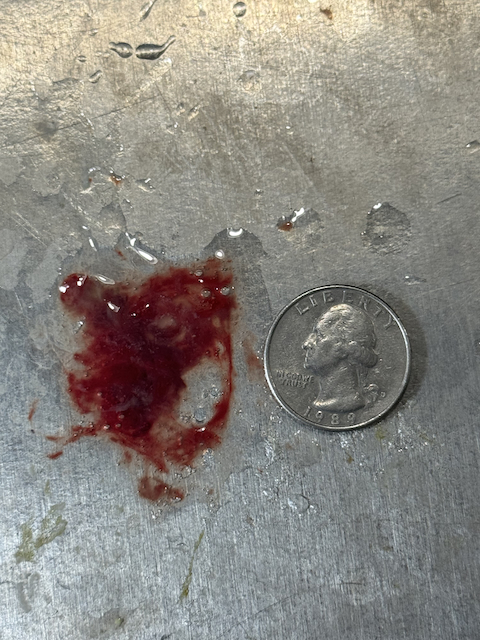
I’m glad you ask, or might ask, or accept me putting words in your mouth for purposes rhetorical: on Wednesday morning I woke up and, per the usual, trundled half-asleep to the kitchen. As I’ve done hundreds of times since the May surgery that took my tongue, I drank some water and expelled the mucus plugs in my throat. I grabbed the faucet to wash away the results, but said results woke me right up because I saw something bizarre: the mucus plugs were…red. Red? Why red? Is that blood? Sure looks like blood. Looks like blood came out of my throat. There more where that came from? What’s the cause?
I called to my personal physician: “Can you come look at something?” Much later, Bess said that “Can you come look at something?” has become her least-favorite query, especially if it’s coming from the bathroom or, now, the kitchen, because it usually means something confusing or bad (or both) is on my body, in my body, or coming out of my body. In the moment, Bess examined the bottom of the sink and said, authoritatively, indeed with all the authority that comes from medical school and a decade and a half in medicine: “That looks like blood.” I concurred, though without her authority. If you’re the sort of person who wants to see for yourself, scroll to the very bottom of this essay for the pictures. They’re deliberately way down there so that people who don’t want to see them are less likely to.
She dropped immediately into doctor mode and started quizzing me, to the point that I felt like I was a multiple-choice medical exam. I told her: no pain, no trouble breathing, no idea apart from the obvious where it’s coming from. She used a phone light to look in my mouth. Nothing. For the first time in a while, she didn’t poke anything with or without warning me first. Possibly, because she was afraid of irritating whatever was the source of this morning’s exciting new symptom. I spit some more, hacking much more gently this time, and we didn’t see much that was bloody, but we didn’t have a cause. I tasted a little blood in the back of my throat. I’ve probably not become a vampire with an insatiable desire for humans, unless the vampire part of my nature also includes amnesia (Bess’s reports of fang marks on her upper arm are patently false: fake news, nothing to see here).
What to do? We planned to go to the ER, because active bleeding in the throat is not good. I’ve not been to medical school except through proximity, but “active bleeding in the throat is not good” was my expert medical opinion. As we got ready, Bess thought to call the Mayo ear, nose, and throat (ENT) department, because the likely outcome of the ER visit would be an ENT consult, in which an ENT resident comes down to the ER and does a “scope.” A “scope” means spraying some numbing medication into the nose and then sliding a tiny camera up there and then snaking it down the throat. If you’ve cleared a drain, the action is not dissimilar. It’s not a fun, comfortable process, but I’ve now had it done a bunch of times and it’s not the worst procedure either.
Before we left for the ER, Bess got an ENT appointment with a PA at 11:00 a.m. Great: easier than the ER—cuts out the middleman. I sent a Mayo portal message to Dr. Hinni’s account, which is usually monitored by a nurse. Dr. Hinni is the surgeon who led both my surgeries; coincidentally, I’d seen him Monday for a routine follow-up. He’d looked around in my mouth with a little mirror and said I look great. It must be disappointing to be a doctor, doing all this great work, only to have the great work you’ve done up and die on you. Maybe it’s like carving pumpkins or ice sculptures, knowing that the work is doomed to transience. Anyway, the hoi polloi like yours truly use the Mayo portal, but Bess is among the exalted elect who work for Mayo, and on whom the Mayo light shines down always, so she sought her favorite backdoor: she checked Microsoft Teams, that blesséd communication tool of Mayo insiders, and saw that Dr. Hinni’s PA, Tony Mendez, was online, so she shot him a message, along with the photos showing what had come out of me.
Tony replied within a few minutes saying we could come right in, but Bess didn’t see that message, so we went in for the 11:00 a.m. appointment. Fortunately, Tony was available then, which matters for continuity of care and speed of care, since he’s already familiar with me and my many maladies. We’d have a lot less catch-up with him than with someone new.
Tony scoped me, as expected, and the scope didn’t show much; he didn’t even spot the fangs that I of course don’t have. He saw some granulation tissue in one or two spots, which indicates something healing or scabbing over. Granulation tissue is relatively good, Tony explained, because tumors don’t granulate over. Tumors just cause more problems, and it didn’t immediately appear like a tumor was pushing into my throat. It does not take advanced degrees to know that is good.
He pressed firmly on each of the tumors on either side of my neck without warning (what is it with medicals poking you without telling you first?) while the scope was in my throat, and he was relieved to see that the necrotic tumor tissue that’s been draining out of the left side of my neck since the events narrated in “What in the hole is this? A medical mystery story” wasn’t draining inward. One side of the throat showed some peculiar ridges that could be the result of a tumor pressing in, but that could also be from any number of other things, including a problematic hyoid bone. A hyoid bone horn could be poking in. That day I learned that not only rhinoceroses, Satan, and brass instrument sections have horns: the hyoid bone does too.
Not finding active bleeding was good, but Tony was concerned that an artery could be leaking blood. The lingual artery ends prematurely and was cauterized as part of the massive May 25 surgery, so it was a prime candidate. In medicine there’s a term called a “sentinel bleed,” which basically means a relatively small bleed from a vessel that precedes a massive, very dangerous bleed from that same vessel. It’s like noticing a small leak in a submarine and going, “That leak is not likely to stay small.” It’s like hearing the floor creak in a horror movie moments before the jump shot of the monster bursting forth from the closet. It’s like all sorts of terrible metaphors—the sound of shattering glass, a strange flash of light, the sudden smelling of toast— that would make you say “huh, that’s strange” before everything collapses.
Anyhow, metaphors aside, sentinel bleeds can happen with aneurysms in particular: a little blood in the brain causes a headache, and that precedes the fatal aneurysm. If you ever suddenly feel “the worst headache of your life,” get you to an ER ASAP and tell the triage nurse “I’m feeling the worst headache of my life,” cause it might herald an aneurysm.
In my case, Tony wanted to check for bleeding with a contrast-enhanced CT scan, that would make the vessels light up and reveal any leaks or signs of a tumor eroding into the vessel. He didn’t think that such a bleed was likely, but it was possible, and fatal if it occurs. Catching it would allow emergency surgery to tie off or attempt to cauterize the vessel, or, more likely, to give interventional radiology a chance to perform an “embolization,” in which they use a catheter to seal off the vessel with a coil or some kind of plugging material (I am told that “spackle” is not the correct term). Even so, the surgery or embolization could fail because tissue behaves badly secondary to radiation and tumors. If I were bleeding and elected for surgery, I might still die, but I’d have a shot. Bess and I told Tony that on Monday, Nov. 20 (that is, today), I was supposed to get some CT scans anyway, so he threw the chest and abdomen CTs on too. Why get contrast injected twice in a ~five-day span?
So Bess and I walked to scheduling, where a nice woman named Jenny mounted a spirited effort to get me a CT scan slot. Mayo is good at many things, but getting scans done expeditiously is often not one. Jenny wore bright blue contact lenses over her brown eyes, which gave her a kind of uncanny-valley-meets-mystical appearance, and it felt a little like she’d been hired direct from Arrakis to work the Mayo front desk. She sent me to have my creatinine—a measure of kidney function—drawn by the lab, since healthy creatine levels are a requirement for receiving the IV contrast I’d require for the scans.
The only available CT appointment was initially 5:10 p.m., but Bess worked the system some by intimating, vociferously but not inaccurately, that, if I needed emergency surgery, it would be best to find out during business hours. Jenny got the Mayo Scottsdale campus to slide me in. Score! We drove over. I wanted to stop on the way at J L Patisserie for snacks,*** but J L was barely yet distinctly too far out of the way. At Mayo Scottsdale I got into the CT area quickly, although the IV necessary to deliver contrast had me crying and whimpering from the pain of needle insertion. My veins are by now well scarred: they may be prominent, but they’re horribly damaged, like some political figures. Anyway, the IV did its job and I got scanned.
The first paragraphs of this essay relay what the scans found, since that’s the most important thing and in almost all writing, you should start with the most important thing. People are TERRIBLE at this. I remember this conversation between Tyler Cowen and Dave Barry on the subject:
BARRY: There are certain fundamental things that businesspeople have trouble with [in their writing].
COWEN: What’s the main thing they get wrong from the business mentality?
BARRY: OK, the most consistent mistake . . . not mistake, but inefficiency of business writing — and it was very consistent — is the absolute refusal on the part of the writer to tell you right away what message he or she is trying to deliver. I used to say to them, “The most important thing you have to say should be in the first sentence.” And “Oh, no, you can’t. I’m an engineer. We did a 10-year study, this is way too complicated.”
And inevitably, they were wrong. Inevitably, if they really thought about it, they were able to, in one sentence, summarize why it was really important. But they refused to do that because the way they found out was by spending 10 years of study and all this data and everything, and that’s the way they wanted everyone to look at what they did. They wanted their supervisors to go plowing through all they had done to come to this brilliant conclusion that they had come to.
Today’s top takeaway, for example, is that the tumors in my body are mostly smaller, so I lead with it. The tumors-being-smaller thing is good from a longevity perspective and alleviates some immediate logistical challenges because I’ll continue petosemtamab for two additional months, barring the unexpected. Being ill admittedly means expecting the unexpected; I didn’t have “hacking up some blood from my throat” on my expectations list for last week. The good news about the CT scans is more important than the fact that we got the results of the CT scans while we were in the parking lot of a juice place called Kaleidoscope, picking up a cherry smoothie whose cherry pieces Bess thought looked a little too much like the blood I’d brought up that morning. She thought the observation a little gross, but interesting from a thematic perspective (ER doctors routinely compare foods to things they’ve seen at work, which does not always make them popular dinner guests).
After Bess and I got home, Tony called us to say that he showed the CT scans to Dr. Hinni, and together they traced the arteries in the neck and concluded that there don’t appear to be any bleeds there, or any tumor eroding or compressing the vessels. Great news! The radiologist, Tony, and Hinni have all looked carefully at my insides, from the outside, and concluded that important parts of my insides are likely to stay in their proper channels.
So what happened? We’ll never know for sure. Some causes could include that 1. I’ve been hacking too hard in attempts to expel mucus, or 2. the petosemtamab is affecting the skin inside my throat as well as the skin on my body, or 3. granulation tissue (which can show up even months after surgery, particularly in people who have already been messed up by radiation). Whatever the cause or causes, if the bleeding doesn’t seriously recur, then the blood I hacked up somewhat random episode in an illness that’s been a relentless parade of boredom and pain, punctuated by terrifying and annoying episodes.
Instead of doing the writing Bess and I were supposed do on Wednesday, we spent a bunch of time in the hospital. To be sure, I don’t want to sound ungrateful for that, and not dying was and is good. Things went about as well and as fast as they could have, given the circumstances. We both got lucky, and the system worked. Tony was great! As he’s been since we met him. And yet we were still gone for like six hours, taking care of business—the business, that is, of healthcare. “The more things go wrong, the more things going wrong,” which went up last week, is highly congruent with the recent episode.
That night, to celebrate the good news from the scans Bess picked up some takeout from what used to be one of our favorite restaurants, FnB, and the food was…okay. The last bunch of times we’ve either been there (Bess) or gotten takeout from there (me), the food has felt a little phoned in. It’s never been bad, but we find ourselves looking at a dish of, say, shaved kohlrabi, cheddar cheese, lettuce, and horseradish, and we think: “Well shit, we can make that in a few minutes and for a lot less than $20.” The food used to be consistently magical, and in the last, I don’t know, six months, maybe more, it’s been less exciting. By now it’s hit that nexus of “less exciting” and “more expensive” that make us look elsewhere. Bess confirms that, although the months of disappointment with FnB correlate to my months without a tongue, the food quality has declined even when the dishes are eaten with physiologic structures intact. The Arizona challenge remains, however, in that there aren’t a lot of good or even interesting-looking restaurants, let alone really good ones, let alone great ones. I may have spent two months unable to eat via mouth, and now I can only do slurries, but I want to at least try for interesting slurries, while I can.
I have to fly to Houston on Nov. 27 to see MD Anderson on Nov. 28, and then fly home Nov. 29. Today we’re going to San Diego for a petosemtamab infusion, the week after, Houston, the week after that, San Diego again. Being sick is a full-time job—Wednesday’s adventure is thematically consistent with this—except one that you pay for instead of being paid. At least the CT scans indicate that I’ll get to spend more time with Bess, and with you, for which I’m grateful.
* In radiologist-speak: “New areas of nodularity and patchy airspace disease in the lung bases.” It appears that the radiologist caught two new nodules: “New 6 mm nodule in the right lower lobe” and “New nodularity and patchy airspace disease in the posterior left lower lobe.” But if a bunch are also “stable or decreased from prior,” that’s pretty good.
** That the most-efficient way to send medical imaging is still via plastic disc is insane, but that insanity is not today’s topic and it will have to wait for another time. The whole “share medical records via the EHR system” thing still doesn’t work seamlessly, to put it lightly.
*** Bess says that I am “like a Labrador retriever in human form.” This furthers her argument, I realize. My tail does wag at the prospect of one of their chocolate cookies.
* “The Laptop That Won’t Die: My $200, 12-year-old Thinkpad has outlasted two high-end Macbooks.” It seems to me that Framework laptops are rapidly usurping the role Thinkpads used to have. If I weren’t using MacOS I’d get one.
* Americans’ Confidence in Higher Education Down Sharply. I wonder why. Could it be the absurd prices, the absurd prices for low-value degrees, the political indoctrination, or maybe something else? Have institutions of higher education and their members showcased great courage and commitment to their putative principles since Oct. 7?
* In pursuit of decent coffee. A noble pursuit. A few months ago I bought an Aeropress and that’s the league leader in coffee gadgets in my household right now.
When you’re robust and things go wrong, recovery happens quickly: the hamstring aches for a few days, then returns to functionality. The broken arm is an annoyance, but the cast comes off and it’s not hard to hit the gym and build back strength. The cold or flu might linger, but it dissipates. I used to be robust and, like most robust people, I unconsciously assumed robustness as the natural state of my world. Now I’m not, and the painful premature slide from robustness to fragility is foregrounded every day. After my initial Oct. 20, 2022 surgery, I recovered relatively fast; sure, I woke up with a piece of my tongue gone, but I could swallow watery smoothies the night of. I rapidly got up and walked unaided. Though the surgery aftermath and recovery were uncomfortable, I could perform the bodily functions necessary for discharge from the hospital—namely, peeing. So, I peed the night of, which got marked in my medical chart, and the day after the surgery I got to go home. I achieved independence fast.
Back then I had a lot of physical margin for illness: I lifted weights, I didn’t eat much sugar, I used a Levels Health glucose monitor (rice is much worse for glucose levels than I’d realized). The surgery could have been much harder and thus the subsequent recovery harder, but it wasn’t and my baseline level of health made me better prepared than if I’d ignored nutrition and motion. I had some social margin, too: I was in a relationship with my now-wife, Bess,* who helped tremendously: it’s hard to do life alone, and it’s harder still when sick.
Bess was there when the news came down that the tumor showed bad features, like “perineural invasion” (PNI) and “extension through the base of the mouth into the geniohyoid,” and I got assigned radiation therapy to the head and neck. During the roughest stretch I was taking 10 – 15mg of Oxycodone every three hours, on top of gabapentin,** Tylenol, and ibuprofen. Yet I’d prepped for radiation, too, as best I could: I resumed going to the gym as soon as I could, and I ate as much as I could get down in order to try gaining weight.
During an education session about the radiation process, Dr. Patel, the radiation oncologist, emphasized the need to conscientiously comply with radiation mitigation strategies and avoid, if possible, hospitalization for radiation side effects. He said something interesting—well, he’s an interesting person who says many interesting things, but this one stood out—the people who wind up hospitalized and struggling are usually the ones who are alone. No one is watching and helping, and they consequently don’t have the strength or ability to mitigate the potentially devastating radiation side-effects. Having stumblingly endured radiation with help, I see how and why someone without help wouldn’t be able to do all that needs to be done. Apparently, there are a lot more of those people than I’d naively thought. The articles and books about the increasingly loneliness and disconnection of Americans are manifested in the healthcare system.
During radiation I suffered from many maladies, but not loneliness or lack of aid. Bess, for example, made me a steady diet of Kodiak Cakes and smoothies. The Kodiak Cakes were the unanticipated, relatively high-protein staple of my diet. Usually I cook, but Bess ensured that I ate even when the thought of food made me feel a range from “ennui” to “dread.” Thanks to Bess and my family, I had not only the physical robustness, but some social and financial robustness, too.
When you’re fragile, one thing going wrong cascades into other things going wrong. That first cancer surgery wasn’t pleasant, and I wouldn’t recommend it to friends, but it was successful, in that Dr. Hinni, the ENT who performed the surgery, got clean margins and removed lymph nodes (none cancerous) from the left side of my neck. The radiation series left me with a literally stiff neck and other weaknesses, but, as I wrote in “Life, swallowing, tasting, and speaking after a total glossectomy (meaning: I have no tongue)” the damage leaned cosmetic more than structural. I tried to recover from the radiation, and I did well enough to teach an English class that began the first week of February, 2023.
In Antifragile: Things That Gain From Disorder, Nassim Taleb claims that “Some things benefit from shocks; they thrive and grow when exposed to volatility, randomness, disorder, and stressors and love adventure, risk, and uncertainty. Yet, in spite of the ubiquity of the phenomenon, there is no word for the exact opposite of fragile.” He’s right in that “Some things benefit from shocks” (emphasis added) but, if the human body benefits from the shock of having part of one’s tongue removed, and then radiation therapy, I’m not aware of it and haven’t experienced any benefit. Some stressors, like the squat and deadlift, are good for the body. Others, like tongue removal or chemotherapy, are not, though they’re better than cancer. Taleb says that “Complex systems are full of interdependencies—hard to detect—and nonlinear responses.” Cancer likely qualifies as the sort of thing that creates a nonlinear, negative response. Friends and acquaintances have expressed shock and worry that I’m the one who got hit with squamous cell carcinoma (SCC) of the tongue: I have no risk factors and a bunch of relatively healthy habits.
After the recurrence and the “salvage surgery” that left me tongue-less, I’ve become fragile. Immediately after the surgery, I couldn’t walk unaided, because a huge piece of muscle and tissue had been removed from my left thigh to create the “flap” of tissue that inertly replaced my tongue. A fall would likely have been fatal. The last essay I wrote, “What in the hole is this? A medical mystery story,” is essentially about the dangerous medical cascades I’m prone to. Someone poor experiences a financial shock as a disaster someone with more money can withstand or even barely notice; someone sick experiences even a minor medical problem as a disaster, because, after a certain critical mass of illness, no setback is actually minor:
As of October 20, I’ve undergone a year of medical harassment / treatment, though I’m unlikely to undergo another. I’ve been conditioned by experience to always expect a new problem. Perhaps the most recent is Augmentin causing a fungal infection in a place where one really does not want a fungal infection.
The preceding paragraph also helps explain why travel is no fun. Friends have asked if I want to do a dream vacation. I see where they’re coming from, but until recently I was relentlessly exhausted by surgery, chemotherapy, and infection. I’m doing somewhat better, but I still feel on the verge of catastrophe. Weight is part of it: I’ve lost around 40 lbs and worry about starvation. That is not a joke. Most of my calories are injected into my peg tube, and I “eat” from pouches of Liquid Hope. The TSA won’t let Liquid Hope pouches through airport security theater, so I have to check them in a bag. If I show up somewhere and my bag—containing the food I have to eat, the syringes I have to use to inject it, and so forth—doesn’t, that’s an immediate crisis. I can’t buy peg-tube food in a grocery store. If I don’t have, or lose, medications like antibiotics when I need them, that’s a crisis. I don’t know what the next potential crisis might be, but I want to avoid it. Acquiring Covid on an airplane or in an airport could result in a crisis.
Crisis, disaster: those are always lurking in my mind, sometimes consciously and sometimes unconsciously, and everything I do or, more often, don’t do is controlled and informed by the disaster worry. The number of things I can do shrinks, and the number I can’t grows. I mourn what I could do in the past and can’t now, though I seek to emphasize the positive aspects of the here and now. Fragility means feeling like my body is betraying me, every day. It’s looking in the mirror and seeing a half-dead ghoul looking back. It’s the cruelty of disfiguration. It’s the choking on food. It’s the full body rash and my skin cracking and peeling from the petosemtamab infusions, it’s the cuts on my thumbs and heels that won’t heal properly. It’s the fear of catching a cold, because I already have so many problems with mucus. It’s the social isolation, “social isolation” being another term for “social fragility,” because speaking is now so hard that casual chat isn’t casual and subsequently doesn’t happen. The words coming out of my mouth trip over each other like drunks incoherently trying and failing to get out of a car successfully.
The sick really inhabit their own—our own—world. Beyond being isolating, it’s the world of missed connections. I read the David Brooks book How to Know a Person: The Art of Seeing Others Deeply and Being Deeply Seen, and it describes the fragility of true, intimate connection and how you can miss a momentary something and inadvertently degrade the moment:
I realized that I have to work on my ability to spot the crucial conversational moments in real time. I have to learn how to ask the questions that will keep us in them, probing for understanding.
It’s easy to miss these moments in conversations with friends, and it’s almost impossible to force them. We can try to set up conditions for the crucial conversations, but truly having those conversations is unpredictable, like good ideas: good ideas sometimes arrive at the most unexpected moments, but the people who are actively seeking them out and trying to harvest them are more likely to find them. My ability to seize the promising conversational moments has been retarded, though not yet entirely eliminated. I’m still trying to have Brooks’ crucial conversations with friends, however much I sense the relentlessly missed connections. I say something that’s too garbled to be understood; my friend stops and asks for clarification; we never quite achieve the right rhythm. Brooks speaks of talking to a dinner partner who said that: “He’d be in the middle of an important meeting with someone and his mind was always going back to reconsider something that had already happened or leaping forward to think about something he had to do later in the day.” Too late, Brooks realizes:
That was an important confession! I should have stopped him to ask him how he had become aware that he had this weakness, had this flaw marred his relationships, how did he hope to address the problem?
The moment is lost to time. For me, fragility means so many of those moments are lost to time, or they never happen due to exhaustion, nausea, and the challenges of speaking at all. I try to compensate via writing, but the writing is still a compensation. Most people don’t like writing and can’t maintain relationships primarily through text. I have a few friends who are like me and can, but I recognize that that ability is rare and weird.
My life feels like it has, and I have, been reduced and reduced and reduced. One friend wrote to me that: “NO, SUFFERING DOES NOT MAKE YOU LESS HUMAN.” He’s probably right, and yet I waver in believing him. Suffering might be the human condition, the link that binds us, but in limiting the way I connect with other humans, it somehow makes me feel both far from everyone else and also further from myself. Maybe my friend is right and being human means being isolated by the unique experience of our own personal decline and mortality. We ultimately face it alone, together.
Still, it’d be nice to feel like the “together” part isn’t being degraded by my deficits. You miss something in the conversation, and that miss degrades the connection a little. The parallel to the body’s fragility is probably obvious, but, to make it explicit, fragility means that missing something might initiate a crisis that ruins your body altogether. It might mean dying. It means losing days and days to medical treatment. A single ER visit for a dislodged PEG tube, the replacement of which takes two minutes now that the tract is fully formed, still somehow eats up at least five hours of a day. That’s five hours I don’t have to spare, but at least the PEG tube replacement is a simple repair (I know: I sound like a bike in the shop). At what point is something beyond repair? At what point am I reaching the point of no return? Do you always know the tipping point? I don’t think I do, not now, but the final tipping point is close, and at some unknown, lurking point soon I’ll fall forever.
** Gabapentin dampens nerve response and consequently has the unfortunate side effect of dampening sexual ability and response to near non-existent, so it’s testament to the discomfort of radiation that I continued to take every dose on a fixed schedule.
Check out that petosemtamab rash: apparently, most EGFR inhibitors cause rashes.
We already have hacker houses, and hacker houses can last for months or even years, but they usually only fit around ten or twenty people. We already have conferences, and conferences fit thousands of people, but each conference only lasts a week. That is enough time to have serendipitous meetings, but not enough to have connections with true depth. So let’s take one step in both directions: create a pop-up mini-city that houses two hundred people, and lasts for two whole months.
This hits a sweet spot: it’s ambitious enough and different enough from what has already been repeated ad nauseam that we actually learn something, but still light enough that it’s logistically manageable. And it also intentionally does not center any specific vision about how something like this should be done, whether Balaji’s or otherwise.
Three weeks ago, Bess and I noticed what we assumed to be three large whiteheads on the right side of my neck. “Weird,” we thought, “but the petosemtamab is provoking an acne-like rash, and whatever that is, since it looks like acne, it’s probably part of the rash caused by the drug.” I’m sensitive to growths on my neck, given that there are four or more tumors in there, and I’ve received radiation on it, and it’s been operated on multiple times. My range of neck motion is maybe 30% of what it was before cancer. Anyway, Bess and I talked to Dr. Sacco, my oncologist at UCSD, about the apparent whiteheads before the last petosemtamab infusion, and Dr. Sacco gave Bess the go-ahead to lance the whiteheads with a sterile needle.
A procedure! ER docs like Bess love procedures. She once did a thoracotomy, which requires the doctor cut through the patient’s fourth and fifth intercostal space, spread the ribs with a “rib spreader” (it is what you think), and use their hands to manually pump the heart. In movies and novels, it’s always the villain who wants to hold someone else’s still-beating heart in their hands, but in real life sometimes the heroes get to do it. Anyway, this procedure was less involved. Bess cadged a needle from an appropriate source that’ll go unnamed here and gleefully lanced me the day after we saw Dr. Sacco, cackling the whole time about how “she who wields the sword, has the power.”* I was afraid but did not die, though a bunch of gunk flowed out when Bess massaged the area after the lancing. Bess didn’t know precisely what the gunk was. It seemed thicker, more copious, and less odorous than would be expected from a small abscess. Whatever it might have been, it was out and we hypothesized that that was probably good. The experience was moderately painful, and I tried to think about other, positive things, like mild sun on the beach, or a viewquake, or nutritious-yet-tasty foods like peanut butter.
As you’d assume from a lifetime of imbibing competently created narratives, I am not in fact introducing the idea in the previous paragraphs only to let it peter out. I more or less successfully focused on matters other than my neck until a week from last Friday night, or, more technically, Saturday morning, when I woke up at 4:00 a.m. I went through the usual drink-water-and-hack-up-mucus drill, which is unpleasant but also now a consistent part of my life, and I was getting ready to inject a small amount of nature’s sleep aid into my peg tube when I reached up to scratch my shoulder and felt something wet and slimy.
Even my sleep-addled brain registered “wet and slimy” as notable. “Shit,” I thought. “What’s that?” Wet spots out of place (heretofore known as WSOP) are often medically ominous. In the bathroom, I flipped the light on, annoyed that I was probably destroying my ability to get back to sleep, but I also saw hummus-like goo along my right shoulder and neck. I understood that there was almost no way the WSOP could be hummus, which has never dripped on me from the ceiling; to enjoy hummus, I’ve always had to work for it, and I’ve never had it, or chocolate, or peanut butter, drip spontaneously on me, or from me, for my own delectable satisfaction.
“Whatever that is, it can’t be good,” I thought. I went to the bedroom and woke Bess, but I mixed up the order of things I told her: instead of saying: “I am okay, but can I show you something?”, like I ought to have, I said: “Can I show you something?” Seeing her go from “sleepy” to “alarmed” in the space of my sentence, I properly added: “I am okay.” Considering how quickly she jumped out of bed, I don’t think she believed me. She’s highly skeptical of anything that comes out of a patient’s mouth (or mine), in the manner of most ER doctors. Doctors hear too many medically implausible or impossible stories. She followed me into the bathroom and examined the WSOP running along my neck and shoulder, and she agreed that that couldn’t be good. Learning that she too thought that that couldn’t be good made me feel better about my medical judgment., but not better about the actual situation. Though it couldn’t be good, Bess also couldn’t say exactly what it was (useless ER doctors). It wasn’t fluid like pus, and it didn’t smell like necrotic tissue. It also, thankfully, wasn’t bleeding, or squirting or spurting or any other number of alarming gerunds that would have required a call to 911. She called upon her considerable medical prowess to confirm that 1. there was a small hole and deduced that 2. the small hole was where the substance was coming from. I felt reassured.
She pressed on the area around the hole without warning, also in the manner of ER doctors, to see if more would come out. More did. The mystery was at least partially solved. Apart from the hole, the right side of my neck had also been getting steadily redder over time, and we couldn’t help noticing that the redness seemed to have accelerated. Yet I was breathing, didn’t have a fever, and wasn’t showing any signs of septic shock, so a 4:00 a.m. ER trip wasn’t merited. We cleaned up the WSOP goo that had erupted from the side of my neck and went back to bed. Once we’d determined the need for immediate, emergent medical intervention wasn’t necessary, the next-best clinical step was “ignore it and go back to bed.” We’d look again in the morning.
Saturday morning, we saw that the goo had continued to leak all over me in the night. I’d gone from the general “feeling bad” that I’d been suffering to “feeling totally awful, as if I was being colonized by some alien organism.” The hole was still there and the skin around it had gotten redder and angrier, which made me think I’d have to go the ER despite not wanting to. The bottom half of my face was hideously swollen, too. Choose your animal analogy: rabbit, chipmunk, bulldog. Bess assumed a skin infection. I was wondering: “Why does this shit always happen to me on the weekend?” The peg tube has spontaneously come out of stomach twice, and both times on a Saturday, necessitating ER visits when interventional radiology (IR) wasn’t readily available to put a new tube in the hole. Going to the ER is expensive and time consuming, and it’s where the sick people are.
Bess tried to contact UCSD’s oncology department, but, it being Saturday, no one was home, so she tried ear, nose, and throat (ENT). Got a resident! He said the hummus-spewing volcano might be a necrotic, infected lymph node, and as soon as Bess heard that she realized that that read could be right. If the problem was a necrotic lymph node, that also means an abscess running deeply and dangerously into my neck was less likely. The resident asked us to send pics and said he’d call his attending, Dr. Califano,** and get back to us. Bess took a bunch of pics in which I look close to as hideous as I’ve ever looked.
Hours passed. Bess and I debated going into the ER despite having already begun the grinding of the medical gears. A CT could rule out a deep abscess, and I was feeling increasingly bad. But going to the ER sucks even if you’re being paid to work there, and it sucks worse as a patient paying to be there. Around 2:00 p.m., we got antsy and Bess called the ENT back. The resident picked up and said he was about to call us back—a likely story— to say Califano agrees that it’s likely a necrotic lymph node surrounded by a raging skin infection and that I should start an antibiotic called Augmentin.
We didn’t manage to acquire the Augmentin until 6 p.m. that night, and I injected it into my peg tube right away. By Sunday morning, I was feeling better and the swelling had declined some. Despite the experience being bad, it probably would’ve been worse if it’d happened Tuesday, when I was scheduled to fly to San Diego. I was being infused with petosemtamab on Wednesday and then, conveniently, seeing Dr. Califano for a repeat biopsy required by the study. There was (and still is) an enormous tumor growing out from the left side of my neck anyway, so I figured it ought to be easy to punch.***
“Easy,” I read in the preceding paragraph. “How much of the cancer and treatment experience so far has been easy?” I’m not a believer in fate, and yet I superstitiously felt like I was whacking Fate with a rolled-up magazine and daring it to bite me. (For once, Fate did not bite me, and the biopsy was in fact easy.)
With the infection identified—and the hummus-like WSOP determined to be whatever goo makes up an angry lymph node—I also understood why I’d been so torporous in the preceding weeks. I kept getting up absurdly late and being unable to function for hours. At most I’d have a few hours of relative energy. I’d berate myself and say: “This isn’t you. This isn’t like you. Who are you?” And then I’d sit in an exhausted haze instead of doing that which needs to be done. I read an inspiring book called Grant’s Final Victory: Ulysses S. Grant’s Heroic Last Year (you might’ve heard it alluded to in the Daily Stoic podcast), and Grant appears to have died from a squamous cell carcinoma of the tongue, caused by cigars. Grant spent much of that year writing his memoirs, hoping they’d provide financial security to his family. He and I are unalike in many ways, but this we have in common.
Grant wrote with a pen, I write with a Kinesis Advantage 360 keyboard featuring Box White switches, but the basic thrust of trying to write a memoir in hopes that it helps those who come after is similar. I get, too deeply, this problem:
Of the doctors, at this point the microbiologist and surgeon George Shrady spent the most time with Grant. He tried to keep his visits brief, because he sensed how much Grant wanted to press on with his daily writing.
Doctors back then and doctors today suck up a damned lot of time! Fortunately, my personal physician is also my best editor and reader. She is in fact reading this over my shoulder right now, as is her wont.
Anyway, Grant was worse off than me in many dimensions, and yet his writing example is one I need to better follow. The infection took a lot out of me, and Bess speculates that it was an “indolent” infection. My ears perked when she said that, because “indolent” typically means something like “wanting to avoid activity or exertion; lazy.” I’d been feeling indolent for weeks, but I’d not known that bacterial infections could also be lazy. But, ah-ha, there is a second definition! “Medicine (of a disease or condition) causing little or no pain. (especially of an ulcer) slow to develop, progress, or heal; persistent.” The infection caused little pain and didn’t progress much, thus allowing it to linger and sap me of vitality.
Being ill makes me feel like there’s always something: surgery, chemotherapy, travel, and now infection. Or maybe I should add: “and now Augmentin,” because the Augmentin is doing bad things to my stomach and digestive tract. Better than death but still frustrating. At the end of Tom Wolfe’s novel The Bonfire of the Vanities, Sherman McCoy, former bond trader and master of the universe, protests to reporters that “I have nothing to do with Wall Street and Park Avenue. I’m a professional defendant. I’ve undergone a year of legal harassment, and I’ll undergo another.” I’m now a professional patient, which is to say a professional sick person. As of October 20, I’ve undergone a year of medical harassment / treatment, though I’m unlikely to undergo another. I’ve been conditioned by experience to always expect a new problem. Perhaps the most recent is Augmentin causing a fungal infection in a place where one really does not want a fungal infection.
The preceding paragraph also helps explain why travel is no fun. Friends have asked if I want to do a dream vacation. I see where they’re coming from, but until recently I was relentlessly exhausted by surgery, chemotherapy, and infection. I’m doing somewhat better, but I still feel on the verge of catastrophe. Weight is part of it: I’ve lost around 40 lbs and worry about starvation. That is not a joke. Most of my calories are injected into my peg tube, and I “eat” from pouches of Liquid Hope. The TSA won’t let Liquid Hope pouches through airport security theater, so I have to check them in a bag. If I show up somewhere and my bag—containing the food I have to eat, the syringes I have to use to inject it, and so forth—doesn’t, that’s an immediate crisis. I can’t buy peg-tube food in a grocery store. If I don’t have, or lose, medications like antibiotics when I need them, that’s a crisis. I don’t know what the next potential crisis might be, but I want to avoid it. Acquiring Covid on an airplane or in an airport could result in a crisis. Some opportunities, if they aren’t seized in the moment, are forever foreclosed. I don’t want to sound boring, but a lot of my life entails trying to think a little ahead of health problems. For me, the best days are ones with maximum energy and minimum problems. Ideally, ones where my lymph nodes don’t explode. I hope to have more of those, before the end.
* Okay, this didn’t actually happen, but it’d be funny if it had.
** I keep mistyping his name as “Dr. California.”
*** As in, punch biopsy. I’m not suggesting that Dr. Califano was going to punch me in the neck with his fists. He seems like a lover, not a fighter, but I can’t be sure, and will try not to elicit violence from him.
* “China’s age of malaise.” Interesting, measured, and not the usual. Note: “Someone has to tell the Americans that the idea that China is going to overtake them is over. This guy [Xi] has ended that game.” And: “When information doesn’t flow, the whole country will go backward.” The U.S. has some major and important weaknesses, especially in our inability to build things and build things fast, but we have some strengths, too.
* “The ‘Decolonization’ Narrative Is Dangerous and False: It does not accurately describe either the foundation of Israel or the tragedy of the Palestinians.” Not just false, but absurd. On the other hand, for people living at the center of a large, safe rich country, for whom everything is “rhetoric” and nothing is real, maybe it doesn’t matter, at least until the students stop coming and the budget is slashed. Perhaps relatedly, this Twitter thread is good: “This is what we’re witnessing – the dismantling of public higher ed in conservative states – and we’ve created the conditions for what’s going on at UNC. How did anyone think we could get away with being nakedly ideological for years without any chickens coming home to roost?” And: “This is about universities shamelessly embracing, as their official institutional posture, an openly ideological framework/stance.”
* “Miguel Ángel Perales, oncologist: ‘What we are doing today with CAR-T cell therapy against cancer seems like science fiction’.” Unfortunately for me, personally, CAR-T therapies haven’t yet been successful in solid tumors: “[I]n solid tumors, the biology is somewhat different. There are more variations in the tumors because they grow over a longer term. What is more, the tumor microenvironment is more difficult for the immune system because there is more suppression of immune cells. I think there will be something, but it will take time.”
* “Anorexia was the gender dysphoria of yesterday: Both socially induced psychological illness and ambivalence toward the female condition is much older than the gender dysphoria boom.”
Pareto called this the aristocracy of lions vs. the aristocracy of foxes. Lions are proud, forceful aristocrats who explicitly own their position as leaders. Foxes, however, are humble servants who will forever deny that they’re in charge. While lions want to run the world, foxes want to save the world.
Because our new elites are foxes and not lions, they no longer feel comfortable celebrating productive habits for the rest of society.
Our old elites used to share a sense of common responsibility and noblesse oblige — not just to give back, but to expect the masses to act in a way that would let them rise up as well.






 The Story's Story