Apple’s Snow Leopard Day!

If you’re a Mac user, today is Snow Leopard Day—meaning that Mac OS 10.6 is out. It has few major “features” in the sense that earlier versions did but is supposed to be much refined from Leopard. My copy is due to arrive early next week.

You can also read David Pogue’s review, Joshua Topolsky’s review (which has numerous screen shots), Brian Lam’s review, and Walter Mossberg’s review if you want to know more.

Apple's Snow Leopard Day!

If you’re a Mac user, today is Snow Leopard Day—meaning that Mac OS 10.6 is out. It has few major “features” in the sense that earlier versions did but is supposed to be much refined from Leopard. My copy is due to arrive early next week.

You can also read David Pogue’s review, Joshua Topolsky’s review (which has numerous screen shots), Brian Lam’s review, and Walter Mossberg’s review if you want to know more.

Microsoft Word and the fate of the word processor

There’s a fascinating discussion at Slashdot regarding the life (and death?) of Microsoft Word, the much used and much despised word processor. Jeremy Reimer of Ars Technica posits that Word is going to lose out to wiki-style online editing tools. Maybe he’s right, but I’m skeptical because I suspect that most documents are only read by a single person, and when they’re edited by multiple people, they still tend to revolve around a single person. Writing tends to work best in serial, not parallel, mode; this might be the subject of a future Grant Writing Confidential post. (Edit: See One Person, One Proposal: Don’t Split Grant Writing Tasks.)

Some of the Slashdot comments show the worst of Slashdot’s solipsism and narrow-mindedness, however. This one in particular is galling because its author obviously doesn’t know what he’s talking about. For example, he says that “If, by “professional writer,” you mean someone actually producing text, the main needs are a good text editor, which can be found many places.”

With all due respect, I don’t think he knows what he’s talking about. A good text editor, even one that’ll give diffs, is nowhere near as fast and as easy as Word’s track changes system. As Philip Greenspun, well-known Microsoft shill, says regarding his book writing project:

At least at Macmillan, everyone collaborates using Microsoft Word. I’d wanted to write my book in HTML using Emacs, the text editor I’ve been using since 1978. That way I wouldn’t have to do any extra work to produce the on-line edition and I wouldn’t be slowed down by leaving Emacs (the world’s most productive text editor, though a bit daunting for first-time users and useless for the kind of fancy formatting that one can do with Frame, Pagemaker, or Word). Macmillan said that the contract provision to use Word was non-negotiable and now I understand why.

Microsoft Word incorporates a fairly impressive revision control system. With revision control turned on, you can see what you originally wrote with a big line through it. If you put the mouse over the crossed-out text, Word tells you that “Angela Allen at Ziff Davis Press crossed this out on March 1, 1997 at 2:30 pm.” Similarly, new text shows up in a different color and Word remembers who added it. Finally, it is possible to define special styles for, say, Tech Reviewer Comments. These show up in a different color and won’t print in the final manuscript.

The original commenter says that free software can replace Word. I’d observe that a) everyone I have to collaborate with has Word and b) only one other person I know has Open Office.org, which also looks hideously ugly on OS X and, when I’ve tried to use it, crashes frequently. Most professional writers appear to use Word. That they don’t migrate en masse to text editors, which have been around since at least the 1970s, shows that there must be some advantage, even if it’s merely network effects, to using it.

Another commenter said that Word “has too large an installed base and there is too much inertia for people to change,” inspiring a third person to chime in, “You know, I’m sure they used to say the same thing about Wordperfect, remember them?”

And in those days, the total number of computers bought every year exceeded the entire previous install base, year after year. Since the neighborhood of the late ’90s, however, that hasn’t been true. Today, if you want to get people to switch operating systems/word processors/e-mail clients/whatever, you have to get people who already have computers to consciously change their behavior. This is really, really hard to do. That’s the difference between WordPerfect’s dominance in the ’80s and Word’s dominance today.

As Joel Spolsky says:

Microsoft grew up during the 1980s and 1990s, when the growth in personal computers was so dramatic that every year there were more new computers sold than the entire installed base. That meant that if you made a product that only worked on new computers, within a year or two it could take over the world even if nobody switched to your product. That was one of the reasons Word and Excel displaced WordPerfect and Lotus so thoroughly: Microsoft just waited for the next big wave of hardware upgrades and sold Windows, Word and Excel to corporations buying their next round of desktop computers (in some cases their first round).

According to the research firm Gardner, “For the year [2008], worldwide PC shipments totaled 302.2 million units…” But Forrester estimates that there are about a billion computers in use. Many of those are probably first-time buyers in developing countries, second computers, computers for children, used by the same person at home and at work, and so forth; nonetheless, even if every one of those new computers replaced a single old computer, it would still take more than three years for the market to churn. That’s a major difference, and the installed based issue is why Word (and office) aren’t going anywhere fast.

I don’t love Word and used Lotus Word Pro for years after it had been effectively abandoned because its styles functionality was (and still is) vastly superior to Word’s. But the program isn’t available for OS X and has died in IBM’s bowels. In the current computing world, it’s hard to imagine Word being superseded on the desktop; at some point in the future, a browser-based word processor might overtake it, but that day is still further off than many Internet prognosticators believe.

Product Review: Kinesis Advantage ergonomic keyboard

(Note: The original review is below, but I’m adding this addendum because I’ve started using the Kinesis Advantage as my primary keyboard. Regular keyboards now feel cramped and uncomfortable for extended use, and although my review is mostly positive, over time the Advantage has received the greatest accolade of all: it’s the keyboard I prefer to use.)

Two kinds of people are likely to want the Kinesis Advantage Keyboard: efficiency freaks and repetitive stress injury (RSI) sufferers. The Advantage is an unusual beast that promises a better keyboarding experience than conventional, flat keyboards. Does it? I firmly answer maybe, although enough people swear by them to make me think that, if nothing else, those with wrist pain or repetitive stress injuries benefit from the placebo effect if nothing else. There are two major barriers to using the keyboard: the first is retraining, which can be overcome relatively quickly. The second is the $300 retail price.

Still, once one adapts, typing becomes fun, like learning a secret. The Advantage’s curves remind one of advanced spaceship controls from a science fiction movie, as this manufacturer-provided picture demonstrates:

The Advantage; this image was provided by Kinesis.

The Advantage.

Initial impressions and adjustments

I learned to touch type in sixth grade using Mavis Beacon teaches typing and remember the many frustrating hours spent struggling to learn while knowing that process would pay off. The Advantage makes you a beginner again, although learning was considerably easier than last time and the user’s manual wisely states that “Many new users of Kinesis contoured keyboards believe it will be difficult to adapt.”

It’s not hard, but it will take at least an hour of practice before you become proficient enough to use the keyboard regularly. For the first few days, my words per minute dropped precipitously. Yet I also discovered new things about the way I type, like that I tend to use my left index finger to hit “c.” This is a major problem on the Kinesis advantage because it’s virtually impossible to touch type and still use the index finger for that key. Even now, about half the time I come to a word with “c” in it, I get a “v,” instead; in this sentence, for example, I first wrote “vome.” A friend who tried the Kinesis didn’t have that problem, however, so it’s probably an issue unique to me.

The instincts of so many years of typing on standard keyboards are not broken in a week. This isn’t surprising given how long they’ve been ingrained. But an evening of steady practice was enough to become more or less proficient in everything except the aforementioned “c” key, which is located in a deep well where I couldn’t reach until I developed the necessary muscle memory through practice. By the start of week two, however, I was quite fast. Now I write this on my usual Unicomp Customizer and my hands feel strangely cramped, as if my fingers are constantly running into one another and I’m forced to use too small a space. This might simply show the power of adaptation and familiarity—themes I’ll return to later.

One nice feature of the Advantage is obvious from the start: Macs are first-class citizens out of the box, and no keyboard remapping is needed. As described below, a properly labeled command key is even included.

Ergonomics

The Advantage forces you to have better ergonomic posture; it’s hard at first, then it gets easier as time goes on. One’s forearms are almost forced to rest on the arm’s of a well-adjusted chair. One’s hands are spread wide, and the thumbs don’t arch as they naturally do on a standard regular keyboard. The thumbs are also used for a wider array of tasks, since the backspace, enter, and regular space characters are also driven by the thumbs. This distributes the keyboard load across one’s fingers.

The major downside of this “spread” keyboard design is that I found it difficult to reach some keys, including page up, page down, hyphen, and equals. Perhaps not coincidentally, they’re also keys I use more rarely than major keys, so I might simply have needed more time. Some key combinations, like the one for an em-dash, were a major pain at first. This is especially surprising because I’m a tall person with relatively big hands; women with small hands might find reaching some keys more difficult than me.

I also found it easier to sit with a straight back while using the Advantage. This might have been easier for me because I use a Humanscale keyboard tray that’s infinitely adjustable within about a six inch range, making finding the right level for the keyboard easy.

Tactile feel

As discussed in my post on More words of advice for the writer of a negative review, it’s hard to disentangle familiarity from genuine superiority; for example, some of Malcolm Gladwell’s work regarding the initial reaction to the Herman Miller Aeron Chair and the well-known negative response to Stravinsky’s The Rite of Spring are reactions to things that are novel rather than bad. That being said, I still prefer the buckling springs that give the Unicomp Customizer and IBM Model Ms their bounce and unique feel.

Still, the Kinesis uses very nice Cherry MX Brown keyboard switches, which offer tactile feel superior to cheap keyboards that use rubber dome switches (the linked article explains more about what this means):
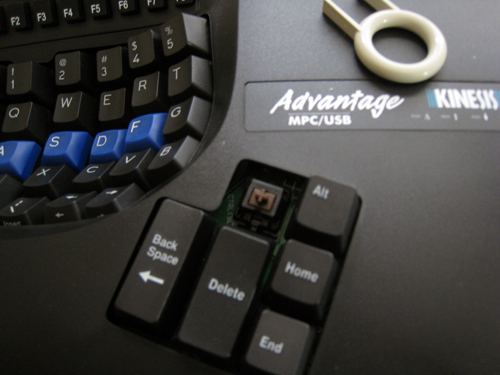
The tool used to remove keycaps is at the upper right; putting Mac-labeled keys on was easy.

The tool used to remove keycaps is at the upper right; putting Mac-labeled keys on was easy.

(Notice too the plastic device on the keyboard: that’s a key swapper included in the package, which allows one to immediately put a “command” key appropriate for Macs on the board. That’s a considerable improvement over Unicomp, which requires that one call to receive the appropriate caps.)

The Cherry switches are also considerably quieter than buckling springs, making the Advantage usable in group working environments. Attempting to use a Customizer for extended periods of time with others in the room probably won’t result in those others using the keyboard to forcefully silence its owner.

Overall, the Advantage has excellent keys.

Warning for programmers

In the default configuration, the brackets—[ and ]— and curly brackets—{ and }—are located in difficult-to-reach spots on the lower right side of the keyboard, necessitating a long stretch of the fingers. As such, almost anyone who does a fair amount of coding will want to remap the keyboard to make those keys easier to reach.

Durability

In the weeks I used mine, I saw no change in the keyboard. Although it’s made of plastic and not nearly as heavy as the Customizer, the Advantage feels sturdier than most original equipment manufacturer (OEM) keyboards. If any readers have used an Advantage for an extended period of time and would like to leave comments about their long-term durability, please do so.

Do repetitive stress injuries from keyboard usage actually exist? …

In a discussion about an article called “The World’s Greatest Keyboard,” some posters at Hacker News cited impressive evidence against RSI as being real; for example, one linked to John Sarno’s The Mind-Body Prescription, including this document summarizing his work. Another poster said that “There was a majority physical component [to his RSI problems] — actually using the mouse was much, much more painful — but there was also a psychological component. I suspect that this was anticipatory tension or somesuch, similar to a flinch response.” Another poster cited this series of posts about curing himself of RSI problems through psychology modification. There were also recommendations for this Trigger Point Therapy Workbook.

Given that testimony, as well as those who say the Advantage alleviated their pain problems, I’m not sure what to believe. I recall reading about studies that have found improved productivity among office workers when researchers increased or decreased lighting, or when researchers raise or lower temperatures. The theory is that workers aren’t necessarily more productive in higher or lower temperatures, but rather that they subconsciously respond to changes that show management is paying attention to them. By the same token, people with RSI problems might respond to keyboards like the Kinesis Advantage chiefly because they think that it will help them and because they have read accounts like the ones on Hacker News that claim improvement. This isn’t necessarily a bad thing: just because something happens in your head thanks to belief doesn’t mean it isn’t real.

… And assuming RSI injuries exist, will the Advantage fix them?

The existing research on the Kinesis Advantage is positive, but I’m not sure that any of the study designs I’ve found eliminate the placebo effect. For example, An evaluation of the ergonomics of three computer keyboards (2000) finds that “fixed” designs” like the Microsoft contoured keyboard “promoted a more natural hand position.” But the conclusion states that “the FIXED design has the potential to improve hand posture and thereby reduce the risk of developing cumulative trauma disorders of the wrist due to keyboard use.” Right. But does it actually improve such disorders? Tough call.

Another study, An ergonomic evaluation of the Kinesis ergonomic computer keyboard, found that:

Electromyographic data analysis showed that the resting posture on the Kinesis Ergonomic Computer Keyboard required significantly less activity to maintain than the resting posture on the standard keyboard for the flexor carpi ulnaris and the flexor digitorum sublimis. Furthermore, the Kinesis Ergonomic Computer Keyboard reduced the muscular activity required for typing in the flexor carpi ulnaris, the extensor digitorum communis. and the flexor digitorum sublimis.

Just because the Kinesis keyboards reduce stress on some body parts doesn’t necessarily mean you’ll automatically see a reduction in RSI issues. Both studies also come from the journal Ergonomics, which is still publishing, they appear to be reputable.

Another study, An assessment of alternate keyboards using finger motion, wrist motion and tendon travel (2000) is much more limited in scope and finds that Kinesis-style designs reduce tendon travel. But the “so what?” factor applies here too. “An assessment of alternate keyboards,” however, does not gender differences in the tendon travel, which is of interest because I still wonder if people with small hands would find it harder to type on the Advantage—perhaps the greater male tendon travel makes reaching unusual keys easier.

These studies do show, however, genuine differences in the physiology of keyboard usage. Consequently, people suffering from RSI issues should try the Advantage if they can afford it.

A word on price and productivity

No review can fail to mention the $300 price for an advantage. That’s obviously a lot of cash relative even to other high-quality keyboards. But compare the price of the keyboard to other good equipment: an Aeron chair is usually over $800, and a computer/monitor combo can still cost thousands. Relative to those kinds of price, the keyboard isn’t that expensive; as Dan Ariely demonstrates in Predictably Irrational, what we think of as a “reasonable” price very much depends on the anchors to which we compare. With anchor prices of $10 – $20 lousy rubber dome keyboards from major office supply chains as our point of comparison, we’re anchored to the wrong point.

A keyboard like an advantage or Customizer can easily make up for loss productivity if people are suffering from RSI injuries. A top programmer, consultant or lawyer might be worth hundreds of dollars an hour; not being able to work optimally because of keyboard design could cost vastly more than the keyboard itself and the retraining time necessary. Lisp hacker Bill Clementson raves about his Advantage, for example.

The treatment alternatives for RSI, like physical therapy, are also expensive, and far more expensive in both time and money terms than $300. For such people, the Advantage isn’t just cheaper in dollar terms—it could practically be a bargain.

In the introduction, I mentioned that efficiency freaks might find the Advantage faster because might be possible to type faster on an Advantage than on a traditional keyboard. Unfortunately, I can’t gauge whether this is true based on my experiences so far: by the end of the review period, I still typed slower than I had previously. Mistakes are a large part of my present slowness, especially when I’m hitting arrow keys along with backspace and/or return. Typing speed usually isn’t that important to me, however: I already type in the 50 word per minute range but think considerably slower. The track might let a train go 200 miles per hour, but if the train only goes 40, who needs the quality tracks?

That being said, if I were able to type for longer periods of time without hand fatigue, or if I were able to type with consistently fewer errors than I would on a normal keyboard, the price of an Advantage would quickly become irrelevant. But just learning whether that’s possible would take far longer than a few weeks.

Final thoughts

Despite its name, the Advantage is clearly going to be a minority taste. It’s hard to imagine many people choosing it unless they’re already experiencing fairly serious carpal tunnel or other problems. Although one can begin to touch type relatively quickly, even after a few weeks sometimes hit the arrow keys when I mean to hit letters on the bottom left of the keyboard, or vice-versa. The length of time necessary to become a fast typist again means that most will never try to make the investment because it probably won’t be worthwhile for them.

Still, enough people find the Advantage of value to keep Kinesis in business: the user manual says that Kinesis keyboards have been used commercially since 1992. In addition, the back of the Advantage says it was assembled in the United States, which is an impressive feat even among expensive products. If I did suffer from RSI problems, I would certainly try a Kinesis Advantage, although I might buy it from eBay rather than directly from a store: as of this writing, a few are available, all for less than $200. If you use a keyboard for eight hours a day almost every day, the price of retraining becomes incidental relative to the importance of being able to work comfortably.

The ultimate test of a keyboard is whether one chooses to use it on a day-to-day basis. In my case, I’m going back to the Customizer for the time being. But if I had the $300 handy, I’d probably be ordering one to see what happens after a couple months, rather than weeks, of usage. The promise of greater efficiency is a strong lure for me, but not strong enough to part me from the Customizer.

Yet.

EDIT: I wrote a long post on what I think of the the Kinesis Advantage, Unicomp Space Saver, and Das Keyboard two years later.

EDIT 2: There’s a worthwhile Hacker News discussion into the Advantage, among other things; sometimes HN will generate thousands of visitors who leave virtually no comments, because they comment on HN itself. Anyway, the top two comments say the Kinesis Advantage is quite durable, and both report that they’ve keyboards for more than ten years. One says Kinesis will repair keyboards that have been caught “drinking” soda. Taken together, they allay the longevity worry, especially if Kinesis offers service. It would be a major bummer to have to re-buy a $300 keyboard every five years because it broke, but it sounds like $300 also buys you high-quality keys that can take a lot of clacking.

EDIT 3: As of May 2014, I’m still using the Kinesis Advantage I bought in 2009. I did clean the entire board a couple months ago. I can still use normal keyboards but prefer not to. By far the most interesting recent keyboard release is the CODE Keyboard, which uses much quieter switches than the IBM Model-M-style keyboards. I have one that I use for business-related phone calls. In order of preference I like:

1. The Kinesis Advantage;

2. The Unicomp Ultra Classic (this one is too loud to use when others are around, and I’ll also note that Unicomp re-named the board I originally reviewed);

3. The CODE Keyboard (which is quiet while still being very good).


Note: The review unit was provided by Kinesis and returned to the manufacturer after this review was written.

Preview: Kinesis Advantage ergonomic keyboard and The Angel's Game

I’m typing this on a Kinesis Advantage ergonomic keyboard, which I’ve become somewhat proficient with after about six hours of use. Expect a full review of it in a few weeks. Ditto for Carlos Ruiz Zafón’s The Angel’s Game, though I’m typing it with this keyboard and so am not at my previous speeds—yet.


EDIT: You can now read the full review of the Advantage.

Computer post follow-up: The relative reliability of laptops versus desktops

In a post on the merits of laptops versus desktops, I wrote that “the inflated notebook total [regarding units sold] is probably in part due to the disposable nature and limited longevity of notebooks.” Two e-mailers took issue with this assertion because I didn’t have any direct evidence backing it up aside from the obvious engineering constraints that impair notebooks.

Evidence isn’t easy to find. The best I’ve seen comes from a recent issue of Consumer Reports, which says:

Cons: Laptops cost more than comparably equipped desktops. Our reliability surveys show laptops are more repair-prone than desktops. Components are more expensive to repair.

Isn’t that obvious? The miniaturization necessary to cram components into a laptop case combined with inferior heat dissipation and the wear of constantly opening, closing, and moving a computer would reduce the reliability of comparable laptops versus desktops. People who need the mobility should obviously make that trade-off, but to me the benefits of a laptop are overrated, especially given the price premium most already command. This holds true across brands.

One issue bigger than price is hassle: the longer I can keep a computer without the hard drive, logic board, or other components breaking, the better off I am because I don’t have to undertake the tedious process of fixing the computer. By that standard, a long-lived desktop is a beautiful thing indeed—especially when one doesn’t need the portability.

A recent NPD survey on netbooks found that “60 percent of buyers said they never even took their netbooks out of the house.” If your laptop never travels, why bother having one?

Still, my desktop preference may  eventually change. AnandTech’s review of the new MacBook Pro batteries highlights the astonishingly long charge they hold and waxes euphorically in a way most unlike the normally staid tech site:

Ever since I first looked at the power consumption specs of Nehalem I thought it didn’t make any sense to buy a new, expensive notebook before Arrandale’s launch in Q4 2009/Q1 2010. While performance will definitely increase considerably with Arrandale, Apple just threw a huge wrench in my recommendation. The new MacBook Pro is near perfect today. If you need a new laptop now, thanks to its incredible battery life, I have no qualms recommending the new MBP.

But the power/performance of desktops today still beats laptops for those who don’t need the mobility. A MacBook Pro, 24″ monitor, and Intel X-25 SSD run well north of $2,000, compared to $1,500 for an iMac, which, according to Consumer Reports, should have greater longevity.

AnandTech has one other piece that sways me towards desktops, as this 2007 article shows: “Without even running any objective tests, most people could pretty easily tell you that the latest and greatest desktop LCDs are far superior to any of the laptop LCDs currently available.”

Gizmodo has also run a polemic announcing the justified end of the desktop. I’m not buying it.

EDIT: It’s 2016 and I’m using a Retina iMac. Laptops have, however, made impressive strides in screen quality.

Computer post: desktop or laptop/notebook?

Ars Technica reports that Global notebook shipments [have] finally overtake[n] desktops, making the issue all the more salient (Slashdot’s coverage is here). Of course, many of those notebooks are probably netbooks that supplement rather than supplant desktops, and the inflated notebook total is probably in part due to the disposable nature and limited longevity of notebooks. Still, the legitimate question remains, and my short answer for most people in most circumstances in “desktop.”

My work demands sustained concentration (see, for example, “Disconnecting Distraction”) and being in spot for a time helps that; I sold my PowerBook and used the proceeds for a 24″ aluminum iMac. It’s a vastly faster machine that’ll probably last longer than an equivalent laptop will and cost less. Those who want mobility pay for it, and I suspect most people overestimate their mobility and underestimate the benefits of a desktop.

But the question is one that an individual is better suited to answer, as it depends on that person’s needs, and I can only enumerate the trade-offs inherent in the laptop/desktop decision. The question becomes almost philosophical concerning the nature of the person you are: more peripatetic or less? Working for longer at a computer or not as long? Used to a large screen or not (becoming accustomed to space and then having it removed it difficult)? Annoyed by cable creep or not? To be sure, some groups of people are well-suited to notebooks: people who move often, have to travel frequently, and students scurrying between dorm and home all probably fit that category. I suspect there are fewer of them than the laptop numbers indicate and that many people don’t consider the detriments, especially ergonomically. I’ve heard the complaint too many times: my wrists hurt, or my back hurts, or my eyes are tired, and they almost always come from laptop users. I recently gave a friend an a Griffin iCurve for her laptop, which seemed to improve the problem. ICurves are no longer made, but the new version is called an Elevator.

An Elevator, external keyboard, monitor, and mouse improves the laptop, but they’re expensive. Comparing Mac equipment makes this delta particularly obvious—even if one buys third-party monitors—as various pricing specials and what not don’t obscure the underlying prices. One person in an Ars thread said, “I’ve found that if you don’t need mobility, paying for it is a bad idea.” Indeed: and the question becomes “need,” which I can’t answer. A Slashdot commenter said that “the lack of replaceable parts is one other reason why laptop sales are ‘higher’ than desktop sales.” Combined with a) the inherent jostling laptops experience and b) the compactness of the parts, raising the temperature inside the machine and increasing the likelihood that subtle manufacturing flaws will do things like pinch video cords or dislodge logic boards, this means laptops are likely to need to be replaced more often, in addition to their higher upfront costs.

I have an iMac, which has some of a laptop’s drawbacks, including no user-serviceable parts aside from RAM. But it’s also relatively easy to move and more likely to last than a ceaselessly mobile laptop. It remains in one place, making it easier to get in the zone, as described by Rands in Repose at the link. Books, mostly fiction but still a few technical ones too, surround my desk, and, like Malcolm Gladwell, I’m more likely to turn to them for quotes, inspiration, and sounding in many circumstances than to the much-scattered Internet:

[Gladwell ….] still prefers to do most of his research at the NYU library. Google is something of a personal hobbyhorse: “Google is the answer to the problem we didn’t have. It doesn’t tell you what’s interesting or what’s important. There’s still more in the library than there is on Google.”

He’s overstating his case but I take his point. Then again, the article also says that Gladwell likes to work in coffeeshops, which is anathema to me: I look every time someone walks by or the espresso machine goes off like a whistle, and at the end of three hours I’ve written as many sentences. There’s even a picture of him sitting at a laptop, perhaps contradicting some of my overall point.

Nonetheless, like most philosophy problems, this one has no perfect answer and is more an expression of underlying value than anything else. Granted, this decision has a greater economic aspect given the continued cost disparity between laptops and desktops, which seems unlikely to disappear in the immediate future. But I think that, if most people weigh what they value, the money and advantages of a desktop more often than not make them better machines. If you’re writing, or coding, or editing movies, or doing any number of other things for a sustained period of time on a somewhat regular basis, a desktop or laptop + external peripherals seems an improvement over a laptop. If you’re chiefly using a computer to read e-mail, check Facebook, and the like, the computer choice probably doesn’t matter. Either way, I’d rather the save money, although many others obviously prefer the mobility. To me, and presumably many others who like to write and to read, and the “deep thought” stage is, to my mind, more important than shallower activities that demand less cognitive attention. That’s not to say you can’t get in the zone or produce useful work on a laptop—millions of people obviously do—but I still think a desktop a more satisfying overall choice.

I can guarantee nothing, of course, and Lord of the Rings speaks to this issue, as it does to so many:

“… The choice is yours: to go or wait.” [Gildor said.]
“And it is also said,” answered Frodo, “Go not to the Elves for counsel, for they will say both no and yes.”
“Is it indeed?” laughed Gildor. “Elves seldom give unguarded advice, for advice is a dangerous gift, even from the wise to the wise, and all courses may run ill. But what would you? You have not told me all concerning yourself; how should I choose better than you? But if you demand advice, I will for friendship’s sake give it.”


EDIT: A recent NPD survey on netbooks found that “60 percent of buyers said they never even took their netbooks out of the house” (hat tip Salon.com). If your laptop never travels, why bother having one?

EDIT 2: I posted a follow-up regarding the relative reliability of desktops versus laptops. The former win according to the best data I’ve seen.

EDIT 3: Marco Arment has a post on why he’s now using a MacBook Pro instead of a Mac Pro. The reason: Solid State Drives (SSDs). The limiting factor on laptop performance for most people used to be the hard drive. With an SSD, it’s not. If you have enough money for a large-capacity SSD and are willing to put a conventional hard drive in the CD / DVD bay, you’re not giving up any substantial performance in day-to-day tasks. More than anything else, the growing power of SSDs make me think the days of desktop computers are limited.